Source: The Conversation – Canada – By Moira A. McDonald, Associate Professor, Director, School of Tourism and Hospitality Management, Royal Roads University
For travellers, these tensions are one more deterrent for travelling to the U.S. About three-quarters of Canadians say Trump is “dangerous” and favourable views of the U.S. are at an all-time low.
Impact south of the border
This year, many Canadians reconsidered plans to visit the U.S. for business, leisure or school-related excursions, and some also boycotted American products.
These choices also reflect anxiety over border-related issues. Measures such as selected detainment and asking Canadians to register with Homeland Security if they plan to stay in the U.S. for 30 days or more has raised concerns among those accustomed to a less intrusive cross-border experience, with some even describing the U.S. as a “hostile state.”
The consequences of declining travel are being felt most acutely in U.S. border cities that rely heavily on Canadian visitors. Canadians are no longer “flooding the streets of Seattle,” but instead are supporting their own tourism economy.
Cities such as Buffalo, N.Y., hoped to entice Canadians with welcoming billboards and special incentives over the summer. But according to Patrick Kaler, CEO of Visit Buffalo Niagara, it was clear their efforts were not working, and the customary wave of Canadian visitors never arrived.
While U.S.-bound travel declines, domestic tourism in Canada is on the uptick. Tourism is the country’s second-largest service export, bringing $31 billion into the country last year, according to Destination Canada.
Unlike traditional exports, where goods are shipped out of the country, tourism brings the world’s travellers to Canada — and increasingly, keeps Canadians exploring at home.
Canadians took a total of 77.4 million trips within Canada in the first quarter of 2025. This shift has been a welcome trend to local tourism organizations and businesses that have been increasingly relying on the support of local travellers.
More Canadians are avoiding U.S. travel amid the ongoing trade war. (Global News)
But the increasing fear and uncertainty of American tariffs, policies and bilateral relationships are also causing unrest among Canadian tourism businesses.
The impact from Trump’s tariffs are felt particularly strongly by many Indigenous business owners who are now navigating inflationary pressures and workforce shortages.
With World Tourism Day approaching on Sept. 27, travel and tourism professionals are encouraged to reflect on the industry’s development.
A central goal of World Tourism Day is to inspire “awareness among the international community of the importance of tourism and its social, cultural, political, and economic value.”
As tourism experts, we continue to promote Canadian generosity through professionals and travellers who keep kindness at the centre of their travel — an action that may be even more important than many realize.
Intentional travel and tourism can foster both peace and understanding. While the focus of World Tourism Day and the United Nations World Tourism Organization is to bring the world closer, this year Canadians worked to bring Canada itself closer together.
Moira A. McDonald is affiliated with Tourism and Travel Research Association Canada (TTRA).
Ann-Kathrin McLean is affiliated with Tourism and Travel Research Association Canada (TTRA).
Israel launched an unprecedented airstrike on the Qatari capital of Doha on September 9, the first time it has directly attacked a Gulf state. The “precision strike” as Israel has called it, targeted a building in which Hamas officials were reportedly discussing a peace proposal brokered by the US.
Al Jazeera has reported that it had been told by a Hamas official that none of its leadership had been killed in the strike.
The Qatari government said it “strongly condemns the cowardly Israeli attack”, which it described as “a blatant violation of international law”. Other Middle East states, including Saudi Arabia, condemned the Israeli strike, as did the secretary general of the United Nations, Antonio Guterres, who said it was a “flagrant violation” of Qatari sovereignty.
It has also been reported that Israel’s prime minister, Benjamin Netanyahu, informed the White House of Israel’s intentions before carrying out the attack. An Israeli official told local media that the US president, Donald Trump, had given the strike the “green light” but this has not been confirmed.
A statement released by Netanyahu’s office appeared to suggest that the strike had been at least party in retaliation for the killing of six Israeli civilians at a bus stop in Jerusalem, for which Hamas has claimed responsibility.
Scott Lucas, a Middle East expert at Dublin City University spoke to Jonathan Este, The Conversation’s senior international affairs editor shortly after the attack. He addressed several key questions.
What’s the thinking behind Israel’s strike on Qatar? Why now?
The Israeli government is going for the kill with Hamas. Having staked his political and legal future on the “absolute destruction” of the organisation, Netanyahu cannot agree to a settlement in which it retains any place in Gaza, let alone power.
So he and some of his ministers have not engaged in negotiations for a ceasefire since the start of March. At that point, they pulled out of any discussion of a phase two, resumed the military assault of Gaza, and cut off humanitarian aid. They have only turned it back on in dribs and drabs. But aid distribution has been sporadic and all too often deadly for the people who queue for food. And it’s not enough to prevent widespread famine in Gaza.
But the problem for Netanyahu and his allies is that others continued to push for a resolution: both inside Israel, where citizens are beginning to get sick of endless war and among Israel’s international allies, who are sickened by the images emerging from the Strip and under pressure from their own populations.
On more than one occasion, Hamas agreed – or at least came close to agreeing – terms put to them by mediators. In August, the Palestinian organisation did so again. At that point the Israel government had a choice: accept the settlement, get the hostages back and pull back on the plan for a long-term occupation of Gaza. Or try and push aside the settlement while blaming Hamas and expand military operations to take over Gaza City.
Netanyahu’s commanders, including the head of the Israel Defense Forces, Eyal Zamir, warned against the assault on Gaza City. Other advisers noted the risk of further international condemnation and isolation of Israel.
But Netanyahu and hard-right ministers in his government have persisted and urged the prime minister to go for broke. Within minutes of the strike on Doha, finance minister Bezalel Smotrich was on social media, praising the attack, writing: “Terrorists have no immunity and will never have immunity from Israel’s long arm anywhere in the world.”
So how to accomplish “absolute” victory? For Israeli hardliners it means levelling parts of Gaza City, while taking out Hamas’s leadership – both to break up the organisation and to ensure that there is no more talk of ceasefire, only capitulation.
What does this mean for the normalisation of relations between Israel and the Gulf States?
There is no normalisation. There probably was none before this attack. The Netanyahu government has decided on a course in Gaza that involves the mass killing of at least 65,000 people, most of them civilians, to displace up to 90% of the population of 2.2 million and to threaten all of them with starvation.
Not even the most cynical Arab government could risk the domestic backlash of continuing with “normalisation” in those circumstances.
So the Netanyahu government is not losing any possibilities with the brazen bombing in a sovereign Arab state. It is trying to set the terms for the future, perhaps a distant one: we’ll come back to normalisation from the position of imposing our will on Gaza, even if you might not have liked it.
Israel has said the US president gave the attack the ‘green light’. Where does this leave Washington?
It leaves the Trump administration where it has always been: supporting Israeli actions that has led to the mass killing of people in Gaza. The US president was reportedly briefed on Israel’s intention to strike at Doha – a US ally – before the attack went ahead. Trump’s ally, the Republican speaker of the House of Representatives, Mike Johnson, is now talking about Israel having to contend with “enemies encamped around them and they’re trying to bring peace”.
Yes, Donald Trump has pursued the chimera of a deal that would win him the Nobel Peace Prize. But when Israel effectively ended the deal at the start of March, Trump provided not only an excuse – Hamas is to blame – but also a rationale. Palestinians could be moved out of Gaza to allow Trump to create his “riviera of the Middle East” – a detailed prospectus for which was obtained and published last week by the Washington Post.
Each time that the Netanyahu government has walked away from a peace proposal, Trump and his senior officials have provided them with cover. So, as the Israelis approach their long-term occupation, we are at the same point as we were in March – Trump officials talking about the removal of the civilians.
I doubt that this attack will shake this position.
What does this tell us about negotiations over Gaza?
There are no negotiations over Gaza. There is a demand by the Netanyahu government for Hamas’s capitulation. If it does not capitulate, Hamas will be destroyed – no matter how many civilians pay the cost.
This is not just about the approach to Gaza. The Netanyahu government has now decided that its regional objectives will be pursued through “decapitation”.
It has not only tried to destroy the leadership of Hamas, with attacks in Gaza, Iran, Lebanon, Syria and now Qatar. It has killed most of the leadership of Lebanon’s Hezbollah. It laid waste to Iran’s political and military commanders in its 12-day war in June. On August 24, it assassinated Ahmed Ghaleb Nasser al-Rahawi, recognised by the Houthi people as their prime minister, and other senior Houthi officials in Yemen.
The deadly message of the Netanyahu government is clear: no one whom they consider an “enemy” is immune, wherever they are. Negotiations are peripheral, perhaps even irrelevant, to that commitment.
Scott Lucas does not work for, consult, own shares in or receive funding from any company or organisation that would benefit from this article, and has disclosed no relevant affiliations beyond their academic appointment.
The top 5 ‘asthma capitals’ in the U.S. are Detroit, Rochester, Allentown, Philadelphia and Cleveland, according to the Asthma and Allergy Foundation of America’s 2025 report. Terry Vine/DigitalVision Collection via Getty Images
Philadelphia has once again been named one of the “asthma capitals” of the U.S. – ranking No. 4 in a report released on Sept. 9, 2025, by the Asthma and Allergy Foundation of America. Allentown was ranked No. 3, Harrisburg No. 15 and Pittsburgh No. 44.
The AAFA, which is the largest patient group in the country for people with asthma and allergies, ranks cities based on “how challenging they are to live in” for people with asthma. The ranking combines data on asthma prevalence rates, visits to the ER and deaths related to asthma.
Compared with 2024 data, Allentown’s ranking has improved: It went from No. 1, a position now occupied by Detroit, to No. 3. Philadelphia is doing worse, one place higher than in 2024.
Here are some steps that individuals, schools and state leaders in Pennsylvania can take to reduce asthma triggers and the cost of asthma medications in their families and communities.
The September asthma peak in Pennsylvania
The ranking was published at an especially challenging time of the year for many asthma patients.
September is known as the “asthma peak month.” The third week of September typically registers the highest number of asthma attacks, as well as asthma-related hospital and ER visits, nationwide.
Solving a problem as complex and widespread as asthma may require taking creative steps. These include initiatives led by schools and students. For example, students in Australia led a successful initiative to improve air quality around their schools by having parents cut down on engine idling time.
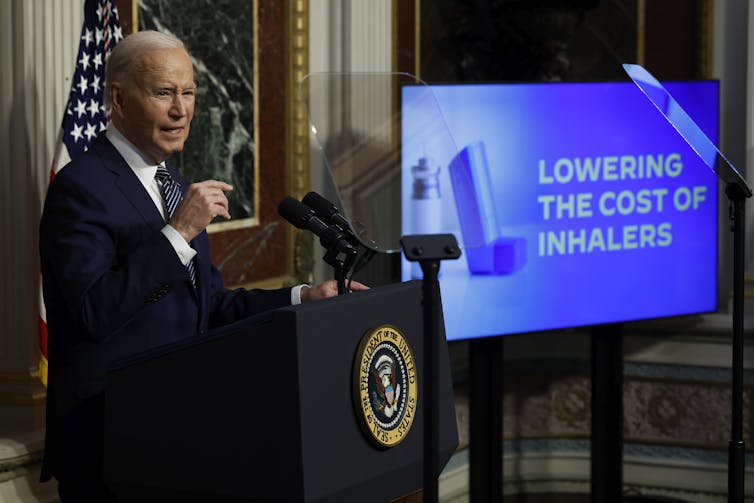
Speaking at the White House in 2024, former President Joe Biden credits Vermont senator Bernie Sanders with helping lower the cost of asthma inhalers from three of the four top companies to just $35 per month. Chip Somodevilla via Getty Images
Affordable asthma medications
Asthma patients often need medication to manage their symptoms. Yet, over the past 15 years that medication has become increasingly unaffordable.
Last year, some pharmaceutical companies capped the price of their asthma inhalers at US$35 each.
There are resources for asthma patients and parents of children with asthma that may help them save some money when filling their prescriptions. A good starting point is GoodRx, a free online platform that allows users to search and compare medication prices across pharmacies. The website currently lists 65 different types of asthma medication and their varying prices.
What Pennsylvania lawmakers can do
Since price caps don’t apply to all types of inhalers and asthma medication, states can pass legislation that imposes such caps, instead of relying solely on industry compliance. Before there was a federal Medicare price cap on insulin, several states took this route and implemented state caps.
Some states have now begun passing similar legislation for certain types of asthma medication. Minnesota, for instance, beginning Jan. 1, 2025, capped inhalers at $25, lower than the industry cap. Pennsylvania could follow suit and even consider asthma medication besides inhalers.
Pennsylvania can also address other facets of the asthma crisis. For instance, the state could offer funding or other incentives for schools to upgrade their ventilation systems or otherwise address poor indoor air quality.
Ana Santos Rutschman does not work for, consult, own shares in or receive funding from any company or organization that would benefit from this article, and has disclosed no relevant affiliations beyond their academic appointment.
Source: The Conversation – UK – By Roger Auster, Lecturer in Environmental Social Science, Centre for Resilience in Environment, Water and Waste, University of Exeter
Fifteen pine martens have been reintroduced to the south west of England as part of the Two Moors project. Terry Whittaker 2020Vision, CC BY-NC-ND
Fifteen pine martens were relocated from Scotland to Dartmoor, Devon, late last year in the first phase of a reintroduction to south-west England. This autumn, more of these domestic cat-sized mammals will be released into Exmoor as part of a long-term recovery strategy to restore pine marten populations.
Pine martens live primarily in woodland habitats, feeding on fruits, small mammals and birds. They were once found throughout Britain, until habitat loss from woodland clearance and increased predator control led to population collapse. It is thought pine martens lived in south-west England until the late 19th century.
In 2023, before plans for this release had been agreed, my colleague Kirsty Frith and I were commissioned by the Two Moors Pine Marten Project – a conglomeration of seven organisations, including the county’s environmental charity Devon Wildlife Trust and Dartmoor National Park Authority – to independently capture perspectives of local people and interest groups on the proposals. This “social feasibility” assessment used an approach similar to one used previously for a release in Wales to determine how a pine marten reintroduction would be received in this area.
Our new study, published in Human Dimensions of Wildlife, outlines how we used a technique called Q-methodology. This method identifies shared perspectives and enables a rich understanding of subjectivity.
For participants, this involves a sorting exercise with discussion, placing written statements into a configuration to illustrate their levels of agreement with each. Once completed, their sorting arrangements are statistically compared and interpreted to identify perspectives which participants associate with.
A remote camera trap captures the moment that a pine marten takes its first step into the Devon countryside. Devon Wildlife Trust, CC BY-NC-ND
Pining for martens?
Three main perspectives were identified. The anonymised participants included farmers, land managers, shooting representatives, conservationists and local residents.
Two of these perspectives supported pine martens and their reintroduction. Although similar, they exhibited some differences. The first viewpoint was more favourable to pine martens and reintroduction as a point of principle, with fewer reservations about introducing wild animals into the countryside. As one environmental farm advisor commented, “living around more nature and wildlife is a good thing”.
Although the second viewpoint still agreed strongly with reintroduction in this region, emphasis was on the motivation to restore the native population of pine martens and natural habitats. Some people expressed concerns about whether there might be negative effects on threatened native wildlife, for example, bats or dormice.
Participants wanted further evidence about the effects pine marten would have on habitats and more information about future plans for monitoring them and dealing with any issues. One participant, an environmental professional and public official, held this viewpoint and agreed with the reintroduction of pine martens “if it is done well and it is well planned”.
The third perspective was opposed to pine martens and their reintroduction. These participants were worried about introducing a predator like pine martens because they perceived them to be a threat to native wildlife, poultry and gamebirds.
They were also concerned about the availability of management support if there were negative effects from the reintroduction of pine martens. As one gamekeeper and conservationist viewed it, “they would add to the taking of wildlife when we have already lost more than 50%”.
What next?
Our new paper and previous research highlight two key challenges for any pine marten reintroduction project. By addressing those, the ability to coexist with pine martens can be improved.
Pine martens are acrobatic hunters and people’s perceptions of them vary drastically. Terry Whittaker 2020Vision, CC BY-NC-ND
People can have very different, polarised views. To minimise any conflict, reintroduction projects need to support inclusive dialogue around pine martens and how they can be monitored and managed. Unanimous support may be unlikely, but more collaborative relationships can be developed when people are involved in making plans for reintroduction.
It also really matters that people have contrasting understandings of predation. While supporters of reintroduction believed pine martens would contribute towards a functioning ecosystem, people who were less supportive were concerned that pine martens could kill threatened wildlife. Giving space for sensitive, nuanced conversations helps build trust and mutual understanding.
Our findings highlight the importance of assessing social feasibility before wildlife reintroductions take place. To ensure future success, that dynamic is just as crucial as ecological feasibility.
Don’t have time to read about climate change as much as you’d like?
This research was commissioned by the Two Moors Pine Marten Project partnership. At the time of the research project, this included: Devon Wildlife Trust, National Trust, Woodland Trust, Exmoor National Park Authority, and Dartmoor National Park Authority.
Additional content contributed by Kirsty Frith.
You’re in the supermarket. Imported beef mince, shrink-wrapped vegetables and cleaning spray are already in your basket. Then you toss in some organic apples and feel a flicker of moral relief. Surely that small green gesture lightens the load?
Not quite. Objectively, every extra product increases your carbon footprint. But psychology research reveals a curious illusion: when we add eco-friendly items, we often judge our shopping basket as having less impact on our carbon footprint than before.
This mental glitch is called the negative footprint illusion, and it matters for how we shop, how businesses market themselves and how governments design climate policies.
The illusion has been demonstrated across dozens of studies. In a typical experiment, people are asked to estimate the carbon footprint of 150 standard houses. Then they estimate the footprint of those same houses plus 50 eco-houses. Mathematically, the second total must be higher – there are simply more houses. Yet participants often judge the mixed set as lower.
In other words, adding a “good” item doesn’t just seem to cancel out a “bad” one. It creates a false impression that the total footprint has gone down, when in reality it has gone up. And the more “green” items you add, the stronger the illusion becomes.
What’s striking is how stubborn this bias is. It occurs among people with strong environmental values, people with scientific training and even among experts in energy systems. Education and numeracy don’t protect us. This isn’t a problem of knowledge, but of how the mind simplifies complex judgements.
Why does it happen?
The main culprit is averaging. Instead of adding up the total impact, we unconsciously average the mix. Toss in a few low-impact items and the “average impression” improves, even though the overall footprint goes up.
Our memory also plays tricks. If a sequence ends with an eco-friendly item, that last impression weighs heavily and colours the whole set. Likewise, when items are arranged irregularly, we find it harder to keep track of how many there are, so we default to averages rather than totals.
Psychologists have long shown that even when people are told about a bias, they often fall right back into it. Our latest experiments suggest the same applies to the so-called negative footprint illusion. That suggests it isn’t just sloppy reasoning but a deeper mental tendency: the mind simplifies.
The illusion may seem harmless in a lab, but it has real-world consequences when it comes to shopping, for example.
Businesses have also learned, consciously or not, to exploit this bias. A fast-food chain might showcase paper straws while still promoting beef-heavy menus. A hotel might advertise its towel-reuse policy while quietly expanding its energy-hungry facilities. These green cues create a halo that spills over to the whole brand.
Even well-intentioned policy nudges can misfire. Offering more green-labelled choices is often assumed to drive better behaviour. But if those choices mask the real cost of consumption, they may backfire – encouraging people to consume more under the false impression of virtue.
Can it be fixed?
The good news is the illusion can be reduced. One promising approach is “summative priming”: nudging people to think in totals rather than averages. In experiments, participants who first completed simple “totalling” tasks were later more accurate in judging carbon footprints.
Research shows that when eco-friendly items appear at the end of a list, they distort overall impressions more strongly. Placing them earlier makes the illusion weaker. Likewise, when items are arranged in a regular, predictable structure, people find it easier to keep track of totals and are less prone to averaging errors.
These tweaks won’t eliminate cognitive bias entirely, but they show that design matters. Product labels, online platforms and policy communications can all be shaped to help people think in terms of totals rather than averages.
Climate change is driven by millions of everyday decisions: what we buy, what we eat, what we throw away. Understanding the psychological biases behind those decisions is essential.
The negative footprint illusion reminds us that even well-intentioned, environmentally conscious people can misjudge the true impact of their actions. Simply offering more green options isn’t enough. If those options distort our perceptions, they may slow genuine progress.
The challenge, then, is not only to provide information – carbon scores, eco-labels, green badges – but to present it in ways that match how people actually think. That means designing interventions that highlight totals, not averages, and that help consumers see the cumulative impact of their choices.
Climate change is a global problem, but it is fuelled by small misjudgments at the individual level. By recognising how our minds work, we can design smarter tools, better policies and more honest messages – and nudge ourselves towards the sustainable future we urgently need.
Don’t have time to read about climate change as much as you’d like?
John Everett Marsh is a Reader in Cognitive Psychology at the University of Lancashire in the UK. He is also a Visiting Associate Professor at the Luleå University of Technology in Sweden and Bond University in Australia. He receives funding from Riksbankens Jubileumsfond.
Patrik Sörqvist receives funding from Stiftelsen Riksbankens Jubileumsfond and The Swedish Energy Agency.
Source: The Conversation – UK – By Mari Ellis Dunning, Associate Lecturer at the School of Languages and Literature and PhD Candidate, Aberystwyth University
On an October’s day in 1594, Gwen ferch Ellis was led to the gallows in the middle of Denbigh town square in north Wales, and hanged. She was the first recorded woman in Wales to be executed on charges of witchcraft.
Her death stands out in the context of European history. While thousands of women – and some men – were executed for witchcraft across Scotland, England and mainland Europe between the 15th and 18th centuries, only five executions took place in Wales. Surviving records list just 35 witchcraft trials in the country, making Gwen’s case exceptional.
Little is known about Gwen’s early life, but court records paint a picture of a woman who may have stood out. In her 40s, twice widowed and childless, she was described in her indictment as a “spinster”, indicating that she made her living through spinning yarn.
Like many early modern women, she also sold salves, had a reputation for healing and charming, and had achieved financial independence through these means.
The curse
Gwen’s downfall began with a discovery at Gloddaith, the home of Sir Thomas Mostyn, a powerful landowner and justice of the peace. A charm was found written backwards and was consequently believed to have destructive rather than protective uses.
Mostyn had recently quarrelled with Jane Conwy, a gentry woman who counted Gwen as a friend. Gossip quickly connected the two, suggesting Gwen had been hired to place the charm on Mostyn’s household.
As suspicion around her grew, friends urged Gwen to run, but she refused to do so, insisting she had done nothing wrong. Whether this was pride or misplaced trust in the law, it would prove fatal.
Once suspicion took hold, several people came forward with damning stories. This enabled magistrates to build a case against her, with testimony suggesting that she was responsible for the sickness and maiming of people in her community.
Three formal indictments were laid against her. Gwen was accused of “bewitching Robert Evans by breaking his arm”, of “bewitching Lowri ferch John ap Ieuan … who had lost use of her limbs”, and of “murdering Lewis ap John by witchcraft”.
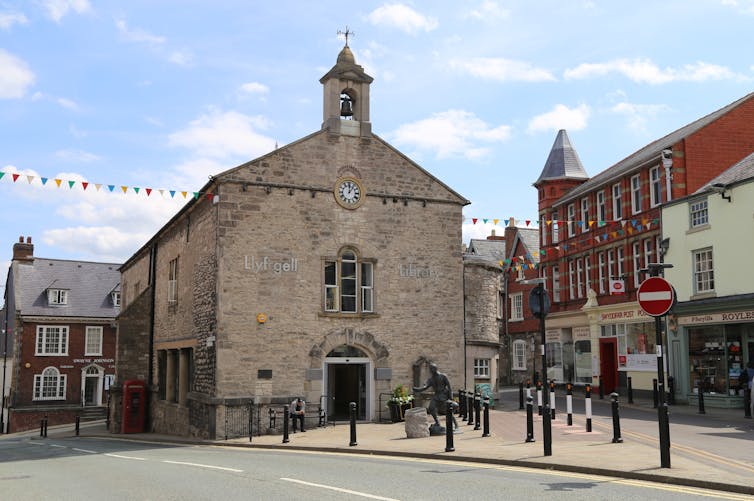
Ironically, the original charm that sparked the investigation never appeared as evidence, but it had already done its damage. It was enough to secure a guilty verdict which led to her judicial murder. Gwen was executed at a gallows erected on the spot where Denbigh library now stands.
Some years before her arrest, Gwen had been visited at home by bailiffs who insisted they had seen a huge black fly hovering on top of a drink of ale she had given them. The men were adamant this fly was Gwen’s devil or familiar spirit, a supernatural being which was believed to protect witches. This, they claimed, was proof she was a witch. Though familiar spirits where not a hugely prominent concept in Wales, they did begin to enter the public consciousness around the time of Gwen’s arrest.
Even so, witchcraft in Wales didn’t conform to the concept of a devil-worshipping anti-religion seen elsewhere. Instead, it was grounded in an intrinsic belief in charming, cursing, soothsaying and magic, and the ability of these things to harm and to heal.
But as a lay healer, with her own source of income, Gwen was, nonetheless, a prime candidate for accusations of witchcraft. Accusations were further supported when Catholic relics were found in her home, despite the Protestant church’s attempts to reform religion in Wales.
While Gwen’s case proves that Welsh juries were prepared to convict accused witches, the event was truly exceptional.
Cursing was most dangerous when crossing boundaries of age, gender or status. It was often a weapon of the physically or socially weaker party. Women laid curses against men, the poor laid curses against those who were more well off.
Gwen’s misfortune was to cross a social boundary. She had, allegedly, left a charm in the house of a prominent landowner and justice of the peace, rather than confining her activities to the farmers, craftsmen and yeomen of her neighbourhood.
Court records suggest the grand jury was uneasy. The indictment was marked as a “true bill”, allowing the trial to proceed. But the faint word “ignoramus” – meaning “we are ignorant of this bill” – was also scrawled on it, hinting at hesitation.
In spite of this, the Elizabethan Witchcraft Act of 1562 had made death by witchcraft a capital offence, and prosecutors were determined to set an example. Unfortunately for Gwen, her fate was sealed. Her story stands as a rare but chilling chapter in Welsh history.
Mari Ellis Dunning does not work for, consult, own shares in or receive funding from any company or organisation that would benefit from this article, and has disclosed no relevant affiliations beyond their academic appointment.
Source: The Conversation – UK – By Tao Zhang, Senior Lecturer, School of Arts & Humanities, Nottingham Trent University
As China ramped up its security in Bejing ahead of its largest military parade in history, over in Chongqing, a city of 30 million people, slogans mysteriously appeared projected on the walls of a university residential complex. “Only without the Communist Party can there be a new China,” read one. “Freedom is not given but seized,” said another. A third urged: “Down with red fascism, overthrow Communist tyranny.”
When the police finally tracked down the source of these projections to a hotel room nearby, they found it empty apart from a projector and remotely controlled cameras which captured their confusion at the puzzling scene. This footage was uploaded on to X along with the slogans projected on the university building walls.
The man behind this coup de théâtre – Qi Hong, a 43-year-old Chongqing native – had already left the country with his family for a “holiday” in the UK, from where he operated the projector and cameras remotely. Within six days, the posts had been viewed more than 19 million times.
This striking act of defiance points to the fact that dissenting voices – given sufficient ingenuity and determination – are still able to penetrate China’s formidable surveillance state. Furthermore, it may signal that there are significant subterranean levels of opposition to the country’s leadership under Xi Jinping.
China’s embrace of digital technologies has always presented it with a dilemma: how to exercise control over this inherently expansive and unruly – yet economically indispensable – communications sphere. As the online world became the most important platform for change in China, giving rise to pro-democracy initiatives, environmental NGOs, human rights defenders and grassroots opposition, the state’s response has essentially remained the same.
Predisposed to top-down control throughout Communist Party history in order to maintain its grip on power, the Chinese state has never been capable of imagining political solutions. Rather, it has consistently fallen back on deploying technology in the suppression of opposing voices.
Hence the Great Firewall of China (also known as the Golden Shield), launched in the late 1990s, which combined censorship with multi-layered online monitoring. This was followed by Skynet, a mass video surveillance system introduced in 2005.
These technologies – later upgraded with big data, AI, facial recognition and cloud computing – were presented as tools against crime and foreign threats. But they have also been widely criticised, both inside and outside China, for silencing dissent and restricting press freedom.
By 2024, China had installed more than 600 million cameras – roughly one for every two adults – making it the largest video surveillance system in the world.
While some devices are used for urban management, Wall Street Journal reporters Liza Lin and Josh Chin have shown how the party-state increasingly harnesses surveillance for social control – often in harsh and coercive ways. During the COVID-19 pandemic, for example, lockdown policies borrowed from Xinjiang’s system of Uyghur surveillance were implemented nationwide under the banner of “Zero Covid”.
While this massive deployment of surveillance has been superficially effective in inhibiting overt demonstrations of opposition, it has also blocked any movement towards addressing political solutions to China’s fundamental internal problems: an over-centralised economy, stalling productivity, widespread corruption and the challenges of an ageing population. Meanwhile, new forms of dissent have emerged within this surveillance state.
Audacious dissent
In October 2022, on the eve the confirmation of President Xi’s historic third term, a Chinese physicist named Peng Lifa staged a dramatic solo protest.
From a busy Beijing bridge, he hung two banners: one demanded food, reform, freedom and elections instead of lockdowns and lies; the other called for boycotts and the removal of Xi himself. Peng was swiftly detained and has not been seen since – but images of his banners went viral on Chinese social media and internationally.
Many China-watchers believe this protest inspired its “White Paper” movement in November 2022, when youth-led demonstrations erupted across the country and overseas. Initially focused on ending zero-COVID policies, many protesters also demanded democracy, equality under the law and Xi’s resignation.
Peng was dubbed “Bridge Man” – evoking the “Tank Man” of China’s 1989 Tiananmen Square crackdown – and the White Paper protests have been described as the most significant movement since Tiananmen. The almost-foolhardy audacity of Peng’s dissent has been referred to as “storming the tower” – a term from gaming culture which describes acts of bold defiance despite enormous risks.
Qi Hong’s recent protest can also be viewed in this way. Although he successfully deployed technology to avoid arrest, the price of his protest is likely to be his self-imposed exile and the constant fear of the retributive reach of the Chinese state.
In a recent interview, Qi acknowledged his protest had been directly inspired by Peng and the White Paper movement. His actions, he said, arose from deep frustration and a desire for truth, critical thinking and freedom of expression – values he felt had been denied to him and his children by China’s party-state.
Qi said he felt compelled to express his view, and to urge more Chinese people to recognise what he described as the brutality and irrationality of the Communist Party’s rule.
Institutional contradictions
Episodes like the Chongqing projections reveal deep contradictions within the Chinese state. On one hand, decades of economic reform have produced a sizeable middle class with global exposure, higher education and expectations of autonomy. On the other, the Communist Party routinely tightens its monopoly on power, leaving little room for pluralism or independent civic life.
As philosopher Ci Jiwei – a professor at the University of Hong Kong – has argued, the issue is not simply the lack of everyday “practical freedoms”. Many Chinese enjoy wide latitude in their personal and economic lives.
Rather, it is the denial of freedom itself as a legitimate value by the state. Protesting Chinese citizens are not seeking adjustments to policy, but rather the recognition of their right to question, debate and express dissent.
Qi’s slogans appear to have resonated because they articulated grievances shared by many people in China – even if voiced only fleetingly. Slowing economic growth, rising youth unemployment and increasing perceptions of inequality sharpen these frustrations. No amount of technological monitoring or punitive threats can make these problems go away.
Tao Zhang does not work for, consult, own shares in or receive funding from any company or organisation that would benefit from this article, and has disclosed no relevant affiliations beyond their academic appointment.
After heavy rains, a landslide “completely levelled” a remote village in western Sudan in early September. It was the temporary home of hundreds of internally displaced persons (IDPs) who had fled the conflict between the Sudanese army and the Rapid Support Forces paramilitary, to what they had hoped would be a safe location. In all, more than 1,000 people are feared to have died in the landslide.
At the end of 2024, more than 80 million people were living in internal displacement worldwide. While more attention is usually paid to people who cross borders and become refugees, the reality is most people who are displaced stay within their own borders as IDPs.
A changing climate and the associated extreme or erratic weather affects everyone living in the same region – but it does not affect everyone equally.
IDPs have specific vulnerabilities because they’ve been displaced. They are likely to have used up whatever money and other assets they had prior to their displacement, leaving them unable to make the same adaptations as those who have not been displaced.
Wars and climate change are inextricably linked. Climate change can increase the likelihood of violent conflict by intensifying resource scarcity and displacement, while conflict itself accelerates environmental damage. This article is part of a series, War on climate, which explores the relationship between climate issues and global conflicts.
In northern Mozambique, the centre of a jihadist insurgency since 2017, hundreds of thousands of people have been forced to flee their homes – with many seeking refuge in the port city of Pemba. After their houses were destroyed by a cyclone in 2019, IDPs living in Pemba rebuilt temporary structures. But when these were burned down by insurgents, the IDPs were left with nothing at all.
Research I carried out with ODI Global colleagues on the city of Herat in western Afghanistan found that people who had not been displaced by conflict were able to make simple lifestyle changes during periods of drought and extreme heat. These included switching to clay or earthenware jars to keep their water cool, or buying air conditioners.
But IDPs were unable to make similar adjustments. Their coping strategies focused more on reducing consumption, such as skipping meals or no longer eating meat.
When IDPs arrive in a new area, the only land available to settle on is often free to use because no one else wants to live there. In Mosul, a city in northern Iraq, stagnated reconstruction following the liberation of the city from the Islamic State militant group in 2017 has resulted in a scarcity of adequate housing. This has left many IDPs residing in unfinished or makeshift shelters on unpaved roads that are prone to flooding during heavy rains.
And in Mocoa, where a large number of people moved after fleeing Colombia’s longstanding civil conflict, IDPs settled in an area susceptible to landslides as it was the only place with cheap accommodation and land available for building. A landslide in 2017 killed more than 300 people there, destroying several neighbourhoods that were populated almost entirely by people displaced by conflict.
Furthermore, IDPs are often overlooked in whatever disaster management or disaster risk reduction plans may exist. Low literacy or speaking a different native tongue – both common traits among displaced people – can result in them not heeding early warnings when they are given.
Evidence shows that early warning systems can be effective for displaced people who have sought refuge abroad. In Bangladesh, for example, Rohingya refugees from Myanmar are included in the national early warning system, allowing them to strengthen their shelters and stockpile food before cyclones hit.
However, early warning systems are only effective if they are implemented and understandable to all of the communities at risk. The UN’s Early Warnings for All initiative, which aims to ensure everyone has access to early warning systems for hazardous weather or climate events, has only been implemented very slowly. This is particularly true in the countries most vulnerable to climate change.
Reducing the risk
Reducing the vulnerability of displaced people to climate change and related extreme weather is no easy task. It will require decision-makers – humanitarian and development aid workers, government officials and local city planners – to listen and learn from what local populations are already doing to adapt and build their own resilience.
Indigenous knowledge has a huge role to play. But people who have just moved to a new area may not know about – or be capable of making – the same adaptations as people who have lived there for generations.
There are also limits to individual adaptation, of course. Displaced people need to be included in any disaster risk reduction or risk management efforts, as well as in national adaptation plans.
Yet in 2023, the OECD found that nearly three-quarters of all national adaption plans (31 of 42) did not address the effects of climate change on people who were already displaced. And this research did not include countries with high levels of displacement which lack national adaptation plans altogether.
Unless these issues are addressed, there will continue to be tragedies on the scale of the one seen recently in Sudan.
Kerrie Holloway works for ODI Global, which receives funding from many organisations and governments. Most of our climate-related work has been funded by GIZ, BHA and the Ikea Foundation, though other donors also contribute through our central funding mechanism.
Source: The Conversation – UK – By Kit Yates, Professor of Mathematical Biology and Public Engagement, University of Bath
Heathrow’s Terminal 4 was evacuated on September 8 as fire crews were called in to investigate “possible hazardous materials” at the London airport. After a few hours of halted flights and frustrating inconvenience, emergency services declared that no “adverse substance” had been found anywhere in the airport.
People were allowed back into the terminal, and normal service was resumed. In the meantime, however, 21 people were treated at the scene by the London Ambulance Service. So what really happened at Heathrow?
According to the Metropolitan Police, it was probably “mass hysteria”. Such outbreaks – variously called mass psychogenic disorder, mass sociogenic illness, epidemic hysteria or mass hysteria – are all types of social contagion. They are typically characterised by the rapid spread, between members of a social group, of symptoms that have no apparent known cause and for which no physical infectious agent can be identified. The symptoms are real, but the trigger is psychological.
History is full of examples. In 1962, a textile factory in the US city of Spartanburg, South Carolina, shut down after dozens of workers reported rashes, numbness, nausea and fainting. Investigators suspected an insect in a shipment of cloth, but no evidence of such a cause was ever found.
Sociologists later concluded that, while an insect bite may have triggered the first case, the rest were probably psychogenic (something that originates from psychological factors rather than a physical cause). Clusters of illness followed social ties, and the main predictors were background anxiety and stress – classic conditions for hysterical contagion.
Mass psychogenic effects have been recorded even further back in time. The infamous “dancing plague” of 1518 in Strasbourg began with a single woman dancing without pause. Within weeks, hundreds of others had joined her.
In a misguided attempt to help the victims “dance away their mania”, officials in the town hired musicians and erected an enormous stage for the merrymakers to help them burn off their energy. Unsurprisingly, this only attracted more people to the fray. At its height, 15 people a day were reported to be dropping dead until the dancing abruptly stopped.
Positive feedback loop
In their early stages, infectious diseases typically spread according to a mathematical mechanism known as a positive feedback loop. These are characterised by a signal that triggers a response – or series of responses – which ultimately ends up amplifying the original signal.
In an epidemic, infected individuals can come into contact and infect susceptible people, creating more infectious individuals who have the power to infect more people, and so on.
Something similar happens in the spread of social epidemics – only in these cases, the illness is spread by the infectious power of emotion, rather than something physical. The same mathematics that we use to describe the explosive onset of an infectious disease can be used to describe the viral outbreak of an idea.
Just because an illness is spread by an idea or emotion, rather than a virus or bacterium, it doesn’t make that illness any less real for the communities or people affected. Scientists have suggested that a hugely diverse range of social phenomena – from generosity to violence and from kindness to unemployment – may be socially contagious.
Some scientists have even come full circle by suggesting that diseases like obesity, which is typically considered to be a non-communicable disorder, may have a strong social component that allows it to spread like a contagious disease. Whether teen pregnancy, for example, is genuinely socially contagious, as some scientists claim, is still hotly debated.
What is clear is that positive feedback loops can amplify an initially small quantity to unexpected magnitudes. For this reason, the impact of positive feedback is sometimes referred to as the snowball effect. A small amount of snow that begins rolling down a hillside picks up more snow as it rolls and increases in size. The bigger it gets, the more snow it picks up, until the initially small snowball has gathered both size and pace.
It seems that social contagion, mediated by a positive feedback loop, may have been the cause of the disruption at Heathrow airport. Of the 21 people assessed by ambulance staff, all but one was discharged at the scene. The Metropolitan Police even used the positive feedback loop terminology, suggesting the incident may have started with a single person falling ill and then “snowballed” from there.
The situation at Heathrow was quickly resolved, but when ideas spread like diseases, they’re much harder to stop than actual germs. Underestimating an idea’s potency, its longevity and its ability to enthral can lead us to misjudge or misunderstand how a situation will unfold.
The viral spread of such falsehoods through social media means they can reach far and wide in virtually no time – and are, consequently, extremely difficult to counter. We underestimate the snowballing of these pervasive myths at our peril.
Kit Yates does not work for, consult, own shares in or receive funding from any company or organisation that would benefit from this article, and has disclosed no relevant affiliations beyond their academic appointment.
French Prime Minister François Bayrou on Monday failed to win a confidence vote in parliament (194 votes in favour, 364 against) and has submitted his resignation to President Emmanuel Macron, who will have to appoint a new head of government or dissolve the National Assembly. How may the result of the vote be interpreted? What are the possible scenarios for a way out of the crisis? An interview with political scientist Frédéric Sawicki.
The Conversation: François Bayrou has resigned. What is your assessment of his actions and methods leading up to the vote?
Frédéric Sawicki: How can we understand such a fiasco? How can we understand this political suicide, which is a vote of confidence chosen by the prime minister when he does not have a majority?
By refusing to engage in negotiations since his nomination that could have led to some kind of governing agreement, particularly with the Socialist Party, Bayrou has deprived himself of any chance of political survival. This is a paradox for this Christian democrat who, throughout his political career, has constantly called for the right-left divide to be overcome. Remember that, to this end, in 2002 he refused to join the UMP, then France’s largest centre-right party (which was later rebranded Les Républicains or LR), and called for a vote for Socialist and former president François Hollande in 2012 and a search for compromise.
His leadership as prime minister has also been marked by a series of failures and blunders that have only served to widen the gap with the left, starting with the disastrous handling of the revelations concerning Bétharram, an episode during which Bayrou struggled to clarify his role but, above all, showed little compassion for the victims, appearing to be a man from another era. (Editor’s note: a French parliamentary inquiry found that students at Notre-Dame de Bétharram school had been victims of “physical and sexual violence”, including during a period when Bayrou, some of whose children had attended the school, served as French education minister in the 1990s.) Previously, in January, there was a total omission of climate and environmental issues in his general policy statement, followed by the use of the expression submersion migratoire“migrant flooding”, two strong signals sent to the right and the far right. If these political forces could applaud the adoption of the Duplomb law in unison with the National Federation of Farmers’ Unions (FNSEA), the Socialist Party and the large French trade union CFDT could only note that they had been duped after the failure of the “conclave” on pensions last June.
Finally, after humiliating the left in this way, the prime minister delivered the coup de grâce by announcing a €44 billion austerity plan, mainly borne by employees and pensioners, with the grotesque measure of eliminating two public holidays, which has definitively alienated the National Rally (Rassemblement National or RN), the far-right party with 120 members in the National Assembly.
Beyond Bayrou himself, what are the structural causes of this failure?
F. S.: We must look at Bayrou’s individual responsibility in context, despite his blunders.
The primary reason for this failure lies in the president’s decision to disregard the new balance of power within the National Assembly elected in July 2024. This, it should be remembered, should have led to the appointment of a prime minister from the New Popular Front, even if this government failed and the president then appointed another prime minister. Instead, Emmanuel Macron chose to rely on the Les Républicains (LR) group and its 48 MPs, who had been in opposition until then, by appointing Michel Barnier. In December, Macron did not even pretend to acknowledge his defeat by appointing Bayrou, who, with the MoDem group (36 MPs), has been part of his majority since 2017.
To have had any chance of succeeding, Bayrou and Barnier would have needed to broaden their support beyond their parties and the central bloc. If France were a “classic” parliamentary democracy, there would surely have been extensive negotiations between the parties willing to participate in the government. These negotiations would undoubtedly have taken several weeks, but they would have ensured a degree of stability around a few compromise measures. By appointing a prime minister of his choosing, interfering in the composition of the government and leaving it to them to cobble together a balancing strategy (one move to the left, two or three moves to the right and to the far right), Macron condemned it to failure.
Much criticism has been levelled at the political parties’ lack of a culture of compromise. Is this lack also a reason for this failure?
F. S.: Indeed, but it is less the culture than our institutions that do not encourage actors to act responsibly. The presidential election is always seen as the decisive moment for setting a new course for the next five years. As a result, agreeing to compromises has meant risking being “burned” at the next presidential election. This explains, for example, the attitude of LR in 2022, when it refused to join the majority even though Macron’s programme was largely in line with its own.
Hyper-“presidentialisation” prevents compromise. The freedom given to the president to appoint the prime minister without fully taking into account the results of the vote, as well as the president’s intrusion into government policy even when disavowed by the ballot box, illustrate the perversion of our institutions. They guarantee Macron’s total irresponsibility. Even if voices are beginning to be heard calling for his resignation or impeachment, nothing obliges him to act. The flip side of this irresponsibility is that it creates equally irresponsible parties: they pass the buck back to the president, it’s up to him to find the answers, and see you at the next presidential election!
Finally, the two-round majority voting system for electing MPs does not encourage parties to seek compromise either. On the one hand, the moderate left must join forces with the radical left in order to win seats, while on the other, the right is facing increasing competition from the far right in many constituencies.
What solutions could break this deadlock?
F. S.: I advocate for a proportional voting system that would make political parties and parliamentarians more accountable. Our excessively presidential system and the two-round majority vote not only fail to provide adequate representation of the diversity of political ideas and social interests, but they also no longer produce clear majorities. There are sociological, political and ideological divisions that fracture the country far beyond the old left-right divide. Bipolarisation is not about to happen again, and this is true for many countries today.
Today, these various divisions are not properly reflected in the National Assembly because French citizens are often forced to vote to eliminate one party or another. Proportional representation, on the other hand, encourages people to vote for the programme they feel closest to. It prevents any single party from governing alone and makes it easier for politicians to negotiate policy directions.
But will reforming the legislative election system be enough? Isn’t one of the challenges also to reduce the power of the president?
F. S.: Indeed, there are undoubtedly other projects to be undertaken. Some believe that we should return to a single seven-year term for the president. Others think that the president should no longer have the power to appoint the prime minister, making a vote of confidence by the National Assembly mandatory, as was the case in France’s Third and Fourth Republics. Others would like to develop shared-initiative referendums or citizen-initiated referendums. All of this will have to be discussed during the next presidential election, but in the immediate term, in order to put the Fifth Republic back on a more democratic track and break the current deadlock, proportional representation seems to me to be the first reform to consider. Political scientist Bastien François has proposed a referendum on proportional representation followed by a dissolution that would allow a new assembly to be elected. This reform could also be seen as a bargaining chip in negotiations to form a future government between the centre and the left.
What options are available to Macron today?
F. S.: Macron can now dissolve the Assembly, but this would be a risky move: it would cause his camp to lose votes. Furthermore, in a volatile social climate – with the Bloquons tout movement – dissolution could amplify the vote against the president.
Second scenario: Macron continues along the same lines, hoping that a prime minister from his camp will push the budget through using Article 49.3, even if it means dissolving parliament afterwards. But the National Rally no longer seems willing to play the neutrality game, and the Socialists are unlikely to be any more lenient. This choice would therefore amount to taking a step back in order to take a bigger leap, and would most likely lead to a new vote of no confidence in a few weeks’ time, depriving France of a budget.
Third scenario: Macron gives Olivier Faure, the leader of the Socialist Party, or a left-wing prime minister a chance. It seems to me that this would be the only rational decision to avoid dissolution. The Socialists could push through a few left-wing reforms such as the Zucman tax on ultra-rich individuals, measures that take into account the hardship of retirement, and even measures in favour of hospitals and education, which are widely supported by the French. This would undoubtedly be difficult for Macron to swallow, but he can always hope that the Constitutional Council will prohibit the Zucman tax or that the hard-left party La France insoumise (LFI or France Unbowed), will torpedo the Socialist Party. He could also try to divide the Socialists by proposing a former member of their party, such as Bernard Cazeneuve, for prime minister, but the Socialists seem more united today than they were last December – when the Barnier government collapsed and Bayrou was picked to replace him – and are likely to reject this manoeuvre.
If there is a dissolution, is the National Rally getting closer and closer to power?
F. S.: One might think that the main victims of a dissolution would be the MPs from the presidential camp. For the moment, the left seems to be holding its own in the polls. The National Rally is also holding steady, with around a third of the vote. The question is, what will the parties do? Will Les Républicains definitively shift toward an alliance with the National Rally? Will the left go into these elections united (as in 2022 and 2024), or divided? Will some voters, disappointed with Macronism, turn to the Socialists, who are ultimately considered more responsible and reasonable? It is difficult to predict the current balance of power, as measured by polls, in a context of a two-round majority election and with so many uncertainties.
Interview by David Bornstein.
A weekly e-mail in English featuring expertise from scholars and researchers. It provides an introduction to the diversity of research coming out of the continent and considers some of the key issues facing European countries. Get the newsletter!
Frédéric Sawicki ne travaille pas, ne conseille pas, ne possède pas de parts, ne reçoit pas de fonds d’une organisation qui pourrait tirer profit de cet article, et n’a déclaré aucune autre affiliation que son organisme de recherche.