Rage bait: the psychology behind social media’s angriest posts

Source: The Conversation – UK – By John McAlaney, Professor in Psychology, Bournemouth University
Jack_the_sparow/Shutterstock

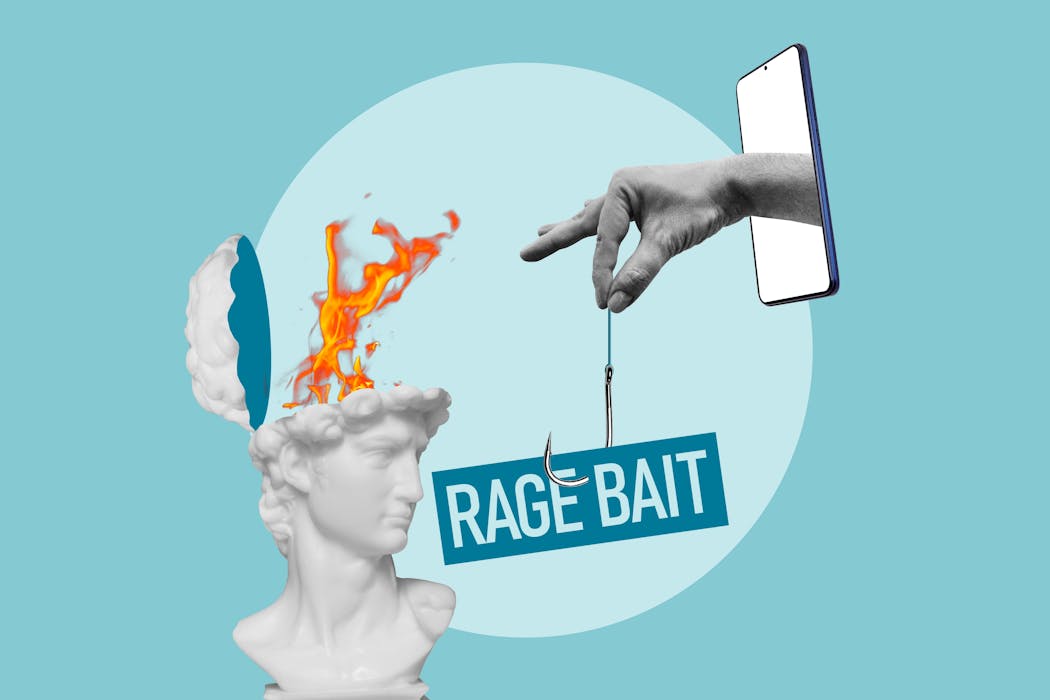
“Rage bait” has been named the word of the year by the Oxford University Press. It means social media content that is designed to create a strong and negative reaction.

Posting content intended to antagonise people may not seem like a wise strategy for a social media influencer. But people who post content on social media can make more money if their channel has a high level of engagements – regardless of how positively people are responding.

In addition, social media platforms use algorithms that tailor the content we see to what we are likely to engage with. This doesn’t necessarily mean content that will make us happy – the algorithm will learn from any engagement that we have with the content, including angry comments we might post in response.

But there are things you can do to help control your reaction to this kind of content. First though, you need to understand why rage bait is so effective.

Provocative posts can result in a higher number of clicks, shares and comments. This may be a result of a negativity bias, where negative emotions such as anger spread more quickly and more intensely through social networks.

In evolutionary terms, it is more important for us to pay attention to a situation that has caused anger to our group than a situation that has created happiness. Anger suggests that action needs to be taken to resolve an issue, whereas happiness suggests that everything is OK.

Although social media technologies are relatively new, the ways in which we understand and navigate our world are not. We are primed to look for social information, which includes anything that indicates a difference of opinion or possible threat within our social groups.

In the past, the groups we belonged to were typically local to where we lived – our friends, neighbours and colleagues. But the growth of social media means that we can now connect with people from all around the world. That means there are far more groups we can be part of and, in turn, routes through which anger can reach us.

Research has found that people can be quick to align their views with others on anything that prompts a negative emotion, which provides another evolutionary benefit by providing safety in numbers from a potential threat. In this case the person posting the rage bait content takes on the role of the pantomime villain who the audience unites against to boo at.

The other problem is we can post content or comments and immediately get a reply, non-stop 24 hours a day. Typically, we used to have some breaks from anything, or anyone, that caused us a feeling of rage. This would give us an opportunity to calm down and reflect on what had happened, but with the ubiquity of social media it can feel like we no longer have that escape.

Coping with rage bait

An awareness of the motivations behind these posts is a good place to start. There are of course people who post negative content who genuinely believe in what they are posting. But knowing that many of these posts are posted solely to drive engagement helps us reclaim our power over those interactions.

A 2020 study showed that giving people an understanding of manipulation strategies used in the media empowered them to resist these techniques.

Man in hoodie smashing through laptop screen with fist.
How not to deal with rage bait.
Ollyy/Shutterstock

Think of the person posting the content as being an actor who is playing a character, and whose actions are driven more by a desire for fame – whether that means being famous or infamous – rather than personal beliefs.

The more that we avoid engaging with any content that induces rage in us the less it will be presented to us. Unlike traditional broadcast media such as TV, we do not need to be a passive audience to social media. Instead we can influence and shape social media through both what we choose to engage with, or not engage with.

Hope instead of rage

Despite the speed and strength with which anger can spread through social media through rage bait, there is emerging research which suggests people can be nudged into reflecting on media content designed to provoke anger before they respond. This can dilute the influence of rage bait.

One benefit of social media as compared to offline interactions is that social media is, by its nature, publicly visible. This means that researchers can more easily understand what is happening on these platforms, including how rage bait is being used to drive engagements.

It can also help us better understand how to help people take control over social media content that we are exposed to, so that we can benefit from the positive aspects of these technologies without being drawn into negative content posted solely for profit.

The Conversation

John McAlaney does not work for, consult, own shares in or receive funding from any company or organisation that would benefit from this article, and has disclosed no relevant affiliations beyond their academic appointment.

ref. Rage bait: the psychology behind social media’s angriest posts – https://theconversation.com/rage-bait-the-psychology-behind-social-medias-angriest-posts-271041


Why Grand Designs-style eco-homes aren’t a good blueprint for sustainable living

Source: The Conversation – UK – By Alan Collins, Professor of Economics and Public Policy, Nottingham Trent University

A family builds an off-grid home in rural Wales. TV celebrates it as a blueprint for net-zero living. But what if this vision of sustainability simply doesn’t scale up?

Television shows such as Channel 4’s Grand Designs have long celebrated ambitious one-off homebuilding projects. These programmes often frame bespoke rural housing as a model of sustainable living.

With large audiences, they wield real influence over what viewers imagine an environmentally sustainable lifestyle looks like. But the reality behind many of these supposedly “eco” homes is far more complicated.

The BBC recently explored one such case in Wales, where a family secured planning permission under the Welsh government’s One Planet Development policy. Introduced in 2012, the policy allows zero-carbon homes to be constructed on land where conventional buildings would not be permitted. In return, residents must demonstrate they can provide their own energy and water and derive a basic income from the surrounding land.

At first glance, this all seems a laudable and well-meaning attempt to encourage net-zero living. Yet projects like these raise deeper questions about sustainability, fairness and what it means for a society as a whole to be environmentally responsible.

We can’t all live in rural eco-homes

The first issue is scalability. Rural “eco-homestead” living can appear green at the level of a single household. But how many of these homes, each taking up considerable land, could be built in the Welsh countryside – or the UK more broadly?

A few might operate as experimental demonstration sites in rural areas, but if that’s the goal then a location in or near urban areas would reach far more people.

These homes are not as self-sufficient as the image of rural idyll suggests. People living there would still own cars, commute to work, send children to school and make regular trips for food, healthcare and to socialise. Multiply these car trips over many such developments and their environmental footprint would undermine the very rationale used to approve the developments.

This is the opposite of the 15-minute city ideal. Dispersed rural living simply cannot match the efficiency of compact urban living.

Academic research in economics, geography and planning has long showed that cities generate “agglomeration economies”: the practical benefits of living around lots of other people means schools, healthcare, public transport and other services tend to be more efficient than in the countryside. This makes urban living far more sustainable for large populations and is one reason rural eco-homes are completely unsustainable as a means of meeting genuine housing needs.

Fair and inclusive

The second issue concerns fairness and access. If permission for remote single household plots is to be restricted in number, then that cap should be explicit and justified. At present, it is neither.

The result is that only the wealthy – people able to acquire attractive rural land, navigate the planning system and fund bespoke eco-builds – can pursue this lifestyle. This risks breeding resentment, especially if access to attractive countryside or forest locations becomes effectively privatised by those who can afford large, low-density housing.

This has broader political implications. As the climate crisis intensifies, public support for environmental action depends on perceptions of fairness. If “sustainable living” is seen as something the wealthy perform in idyllic rural retreats while ultimately relying on urban services and infrastructure, that narrative becomes exclusionary and demotivating. It signals that meaningful environmental responsibility isn’t possible for the majority living in towns and cities. That helps create a form of socio-environmental separation: green lifestyles for a wealthy minority, higher environmental costs for everyone else.

Programmes like Grand Designs play an important role in shaping expectations for green living and dream “forever home” residential building projects. Their enthusiasm for remote, self-built eco-homes gives viewers the impression that sustainability is achieved through architectural daring and a retreat from urban life. These stories generate a warm glow for the featured household, but they don’t represent a realistic way to collectively tackle the climate and environment crises.

The most effective solutions are more mundane, and far less televisual. For instance, better roof insulation or the replacement of old boilers could be rolled out for millions of homes and would have a far greater environmental impact. Such policies lack the drama of building a fancy off-grid smallholding, but they are scalable, accessible for all and genuinely aligned with climate goals.


Don’t have time to read about climate change as much as you’d like?

Get a weekly roundup in your inbox instead. Every Wednesday, The Conversation’s environment editor writes Imagine, a short email that goes a little deeper into just one climate issue. Join the 47,000+ readers who’ve subscribed so far.


The Conversation

Alan Collins is a very passive member of the Labour Party

ref. Why Grand Designs-style eco-homes aren’t a good blueprint for sustainable living – https://theconversation.com/why-grand-designs-style-eco-homes-arent-a-good-blueprint-for-sustainable-living-268751

Will Scotland’s planned four-day week for teachers work?

Source: The Conversation – UK – By Beng Huat See, Professor of Education Research, School of Education, University of Birmingham

Yuganov Konstantin/Shutterstock

The Scottish government recently announced plans to pilot a four-day school week. The proposal comes amid growing concerns about teacher supply and wellbeing.

Teaching remains one of the most stressful occupations in the UK, with stress, exhaustion and burnout consistently cited as major reasons for staff leaving the profession. Creating supportive cultures and cost-effective wellbeing strategies therefore remains a key challenge for school leaders.

A “true” four-day work week, as advocated for by the Four-Day Week Foundation, involves the meaningful reduction of working time as well as days. This means that working time will typically be reduced to 28-32 hours per week worked over four days. Importantly, this change is made without a reduction in pay and with expectations that overall productivity levels are maintained.

Trials across 61 UK organisations show that four-day work weeks, when implemented as genuine working-time reductions, can improve work-life balance, reduce stress and cut employee absence. Research from Australia, Canada, Ireland, New Zealand, the UK and the USA also report positive effects on wellbeing, job satisfaction and retention from adoption of the four-day work week. These studies also suggest that working-time reductions do not harm productivity.

But teaching still lags behind the wider workforce on flexible working. Many schools struggle to accommodate it. Unlike many office-based roles, schools must maintain fixed timetables, ensure pupil supervision and meet staffing ratios, which limits flexibility.

The proposal by the Scottish government differs from a “true” four-day week in that it does not reduce teachers’ overall hours but redistributes them. Teachers would work part of their planning, preparation and assessment time off-site, with only four days used for teaching.

Hand marking student work
The proposal would allow a day for assessment, planning and other tasks.
NuPenDekDee/Shutterstock

Research by one of us (Daniel Wheatley, with colleagues at the University of Birmingham) from the Four-Day Work Week Project offers useful insights from work models that do not involve reductions in hours. We have found that models of the four-day work week where hours are not reduced, and ones where working on the fifth day remains in place, are linked to high work intensity and lesser practical benefits: employees are not able to disconnect from work fully.

However, research by one of us (Beng Huat See, with colleagues at Durham University and the University of Birmingham) which has examined 18 countries, indicates that the key factor contributing to stress is not the statutory working hours, but the amount of classroom contact time. Countries where teachers have high overall hours but fewer teaching hours report fewer shortages. This suggests that the most exhausting element of teaching is the intensity of instructing and managing pupils, rather than administrative or preparatory tasks.

If reducing contact hours helps alleviate stress, then a four-day teaching week, or models that redistribute teaching time such as the proposal in Scotland, could potentially improve wellbeing and retention.

Although four-day work weeks have been adopted in some international school systems, evidence of impacts on wellbeing, retention and pupil outcomes remains limited. Most existing research has been based on people’s perceptions of the scheme rather than measurable outcomes. These could include comparing absentee rates, turnover rates of teachers and student outcomes before and after the introduction of flexible working.

The Scottish pilot therefore offers an important opportunity to generate robust evidence. In England, the Education Endowment Foundation, a research charity funded by the government, is also trialling a nine-day working fortnight and an off-site planning, preparation and assessment model, but results are not yet available.

Flexible working in practice

Whether flexible working hours are feasible in practice depends on several factors. Large academy trusts often find it easier to implement this kind of working because they can deploy staff across multiple sites, allowing less rigid timetabling than a single school can manage. Primary schools also have more capacity for flexible models because they rely less on specialist subject teaching.

Cultural change is as important as logistical change. Research from non-profit Timewise emphasises that supportive leadership is crucial. Without it, flexible arrangements remain inconsistent or inaccessible. This means that implementing a four-day week is not a simple organisational tweak.

A four-day week is not a quick fix, then, but it may be worth trying.

The Scottish government’s pilot is an ambitious step that reflects a growing recognition of the need to address teacher workload. But successful implementation will require sufficient staffing and resourcing, and a shift in leadership practice and school cultures.

Reducing the intensity of classroom contact time may be crucial to tackling stress and preventing burnout. The existing evidence base does present a cautionary tale in that adoption of work models that do not involve a meaningful reduction in working time have so far been much less successful. Nevertheless, the Scottish pilot offers a rare opportunity to test whether rethinking working patterns can improve teacher wellbeing and retention.

The Conversation

Beng Huat See receives funding from Economic and Social Research Council.

She is a Fellow of the Academy of Social Sciences, Fellow of the Royal Society of Arts and a Fellow of the Wolfson Research Institute for Health and Wellbeing

Daniel Wheatley is an Academic Fellow of the Chartered Institute of Personnel and Development, Fellow of the Regional Studies Association and member of the Association for Heterodox Economics and British Sociological Association.

ref. Will Scotland’s planned four-day week for teachers work? – https://theconversation.com/will-scotlands-planned-four-day-week-for-teachers-work-271166

How short-form videos could be harming young minds

Source: The Conversation – UK – By Katherine Easton, Lecturer, Psychology, University of Sheffield

Prostock-studio/Shutterstock.com

Online short-form video has shifted from a light distraction to a constant backdrop in many children’s lives. What used to fill a spare moment now shapes how young people relax, communicate and form opinions, with TikTok, Instagram Reels, Douyin and YouTube Shorts drawing in hundreds of millions of under-18s through endlessly personalised feeds.

These apps feel lively and intimate, offering quick routes to humour, trends and connection, yet their design encourages long sessions of rapid scrolling that can be difficult for young users to manage. They were never built with children in mind, although many children use them daily and often alone.

For some pre-teens, these platforms help develop identity, spark interests and maintain friendships. For others, the flow of content disrupts sleep, erodes boundaries or squeezes out time for reflection and meaningful interaction.

Problematic use is less about minutes spent and more about patterns where scrolling becomes compulsive or hard to stop. These patterns can begin to affect sleep, mood, attention, schoolwork and relationships.

Short-form videos (typically between 15 and 90 seconds) are engineered to capture the brain’s craving for novelty. Each swipe promises something different, whether a joke, prank or shock – and the reward system responds instantly.

Because the feed rarely pauses, the natural breaks that help attention reset vanish. Over time, this can weaken impulse control and sustained focus. A 2023 analysis of 71 studies and nearly 100,000 participants found a moderate link between heavy short-form video use and reduced inhibitory control and attention spans.

Attention hijacked

Sleep is one of the clearest areas where short-form video can take a toll.

Many children today view screens when they should be winding down. The bright light delays the release of melatonin, a hormone that helps regulate sleep, making it harder for them to drift off.

But the emotional highs and lows of rapid content make it particularly difficult for the brain to settle. A recent study found that for some teenagers, excessive short-form video use is connected to poorer sleep and higher social anxiety.

These sleep disturbances affect mood, resilience and memory, and can create a cycle that is especially hard for stressed or socially pressured children to break.

A young girl lying awake in bed.
Short-form video use may lead to insomnia.
StasyKID/Shutterstock.com

Beyond sleep, the constant stream of peer images and curated lifestyles can amplify comparison. Pre-teens may internalise unrealistic standards of popularity, appearance or success, which is linked to lower self-esteem and anxiety – although the same is true for all forms of social media.

Younger children are more susceptible

Most research focuses on teenagers, but younger children have less mature self-regulation and a more fragile sense of identity, leaving them highly susceptible to the emotional pull of quick-fire content.

Exposure to material children never intended to see adds risk and the design of short-form video apps can make this far more likely. Because clips appear instantly and autoplay one after another, children can be shown violent footage, harmful challenges or sexual content before they have time to process what they are seeing or look away.

Unlike longer videos or traditional social media posts, short-form content provides almost no context, no warning, and no opportunity to prepare emotionally. A single swipe can produce a sudden shift in tone from silly to disturbing, which is particularly jarring for developing brains.

Although this content may not always be illegal, it can still be inappropriate for a child’s stage of development. Algorithmic systems learn from a brief moment of exposure, sometimes escalating similar content into the feed. This combination of instant appearance, lack of context, emotional intensity and rapid reinforcement is what makes inappropriate content in short-form video especially problematic for younger users.

Not every child is affected in the same way, though. Those with anxiety, attention difficulties or emotional volatility seem more vulnerable to compulsive scrolling and to the mood swings that follow it.

Some research suggests a cyclical relationship, where young people with attention deficit hyperactivity disorder, or ADHD, are particularly drawn to rapid content, while heavy use may intensify the symptoms that make self-regulation difficult. Children dealing with bullying, stress, family instability or poor sleep may also use late-night scrolling to cope with difficult emotions.

This matters because childhood is a critical period for learning how to build relationships, tolerate boredom and handle uncomfortable feelings. When every quiet moment is filled with quick entertainment, children lose chances to practise daydreaming, invent games, chat with family or simply let their thoughts wander.

Unstructured time is part of how young minds learn to soothe themselves and develop internal focus. Without it, these skills can weaken.

New guidelines

There are encouraging signs of change as governments and schools begin to address digital wellbeing more explicitly. In England, new statutory guidelines encourage schools to integrate online safety and digital literacy into the curriculum.

Some schools are restricting smartphone use during the school day, and organisations such as Amnesty International are urging platforms to introduce safer defaults, better age-verification and greater transparency around algorithms.

At home, open conversation can help children understand their habits and build healthier ones. Parents can watch videos together, discuss what makes certain clips appealing and explore how particular content made the child feel.

Establishing simple family routines, such as keeping devices out of bedrooms or setting a shared cut-off time for screen use, can protect sleep and reduce late-night scrolling. Encouraging offline activities, hobbies, sports and time with friends also helps maintain a healthy balance.

Short-form videos can be creative, funny and comforting. With thoughtful support, responsive policies and safer platform design, children can enjoy them without compromising their wellbeing or development.

The Conversation

Katherine Easton has recently received funding from:
2021 – UKRI eNurture (PI) £26,762.00 Hacking the school system.
2022 – Research England, HEIF TUoS (PI) £48,983 Digiware: Knowledge Exchange in Education and Internet of Things.
to research young people’s views on the use of technology in their schools

ref. How short-form videos could be harming young minds – https://theconversation.com/how-short-form-videos-could-be-harming-young-minds-271159

Online sharing can push us apart – but when it’s authentic it can bring us together

Source: The Conversation – UK – By Claire Hart, Associate Professor of Psychology, University of Southampton

PeopleImages/Shutterstock

We spend a huge part of our social lives online. Over five billion people scroll, post and comment on social media every day, using these platforms to keep in touch, share experiences and express themselves. Yet social media is often blamed for making us lonelier, more anxious and more competitive.

Our research team at the University of Southampton wanted to test whether this overwhelmingly negative narrative tells the full story. Instead of asking only what social media does to us, we asked a different question: under what conditions does sharing online actually help our relationships?

To answer this, we conducted a systematic review of almost two decades of research on two core online behaviours: self-disclosure (sharing personal information, thoughts or feelings) and self-presentation (managing the image we project to others). Across 57 publications and 73 individual studies, a clear pattern emerged: online sharing can strengthen relationships but only when it is perceived as genuine, appropriate and socially attuned.

People have always managed how they appear to others. What social media adds is scale, speed and visibility. A single post can be seen by dozens, hundreds, or even thousands of people, from close friends to complete strangers.

Both self-disclosure and self-presentation serve important social functions. Sharing personal experiences can deepen friendships and invite support. Presenting achievements or milestones can reinforce feelings of status and belonging. Problems arise not because these processes exist, but because they become exaggerated, misjudged or mismatched to the audience.

What the evidence actually shows

Across the studies we reviewed, people who shared more about their lives online consistently felt more socially connected. Even short, everyday updates increased feelings of belonging and reduced loneliness – whether or not the posts received visible feedback.

From the audience side, people felt emotionally closer to those who disclosed more frequently and more meaningfully. These effects were not limited to close friends; even weak ties often strengthened through regular, low-stakes sharing.

Crucially, online sharing helps fulfil two fundamental social motives. One is affiliation: the need for closeness, warmth and acceptance. The second is status: the need to feel valued, admired or socially visible. Positive, sincere self-disclosure supported both. In contrast, posting that was clearly designed to impress, brag or exaggerate often undermined liking, even when it attracted superficial engagement such as likes.

One of the most robust findings from the review was the importance of perceived authenticity. Across multiple experiments, people rated targets as more trustworthy, likeable and socially attractive when their photos were candid rather than heavily posed or edited. Filtered selfies and highly polished images tended to reduce perceived genuineness, and with it, social warmth.

The same pattern appeared in written posts. Balanced, everyday content – think “Long day but finally home with a cup of tea. Nice to slow down and enjoy the small comforts” – elicited more positive responses than overt self-promotion, for example “Another huge win today — feeling unstoppable lately! Hard work really does beat talent 💪✨”. Across studies, people were consistently more liked when they appeared real rather than strategic.

This does not mean people reject positivity. Positive posts were generally associated with more likes, friendlier comments and higher interpersonal attraction. But highly curated positivity, especially when it signalled superiority, luxury or flawless success, often triggered scepticism rather than admiration.

When sharing backfires

The review also showed that more disclosure is not always better. Highly intimate or strongly negative posts were often judged as inappropriate when shared publicly, particularly among acquaintances. These posts may attract attention but not necessarily liking or trust.

Negative posts showed an important asymmetry. They tended to receive fewer likes, but more private messages and emotional support. In other words, distress expressed online does not go ignored — but the support often moves behind the scenes. What matters most is whether the disclosure appears sincere rather than performative.

Not everyone uses social media in the same way. Traits such as narcissism and attachment style shape both how people post and how others respond. Narcissistic users, for example, tended to post more frequently and more self-promotional content.

While this often increased visibility, it did not reliably increase genuine liking or closeness. By contrast, people with secure attachment styles, who were comfortable with intimacy and trust, were more likely to use social media in ways that sustain real relationships.

Context matters just as much. Close friends responded differently from acquaintances. A disclosure that strengthens closeness in an intimate relationship may feel awkward or excessive when directed at distant contacts. Platforms also differ: what feels normal on Instagram may not work on LinkedIn or X.

Most previous research, and most public debate, has focused on the harms of social media: addiction, social comparison, anxiety and loneliness. These are real concerns. But they coexist with a parallel reality: people continue to use social media because it meets genuine social needs.

Our aim was to identify what actually works in online relating. We wanted to move beyond simplistic “good” versus “bad” narratives and offer a more precise account of how digital connection succeeds or fails. The practical implications are less about posting more or less, and more about how and why we share. Posts perceived as genuine consistently outperform those seen as strategic.

In summary, positive content attracts visibility; sincere vulnerability attracts support. Extremely intimate disclosures are best reserved for closer relationships.
Heavily filtered or exaggerated self-presentation often weakens trust.

Social media is neither inherently toxic nor inherently connective. It amplifies whatever social signals we send through it. When those signals align with honesty, emotional awareness and relational context, online self-disclosure can strengthen, rather than strain, our relationships.

The Conversation

The authors do not work for, consult, own shares in or receive funding from any company or organisation that would benefit from this article, and have disclosed no relevant affiliations beyond their academic appointment.

ref. Online sharing can push us apart – but when it’s authentic it can bring us together – https://theconversation.com/online-sharing-can-push-us-apart-but-when-its-authentic-it-can-bring-us-together-271547

The price of belonging is inconvenience. Are we still willing to pay it?

Source: The Conversation – Canada – By Andrea Carter, Adjunct Faculty in Industrial and Organizational Psychology, Adler University

“Inconvenience is the cost of community” has become somewhat of a social media mantra for people looking to rediscover what belonging and community actually require.

For years, many have embraced the idea that people can have connections without co-ordination, community without commitment and relationships without the friction of difference. But belonging doesn’t work that way because human interdependence has never been without friction.

It asks us to show up when we’d rather stay home, stay in conversations we’d rather leave and to rely on people whose presence and beliefs grow our capacity to care beyond ourselves.

This inconvenience is part of the social infrastructure that holds communities together. My recent research suggests that when five core “productive frictions” are eliminated from that infrastructure, we strip away the very forces that keep communities strong, productive and together.

Three overlapping epidemics

Three converging epidemics now demand our attention, each pointing to the collapse of community infrastructure.

The first is loneliness. A World Health Organization report released in June found one in six people are affected by loneliness, with recent data from Canada and the United States showing increases since 2024.

Loneliness is linked to roughly 100 deaths every hour — about 871,000 a year — rivalling smoking in its mortality risk.


Read more:
Loneliness could kill you


Contributing to this issue is the widespread uptick in familial estrangement. Up to 130 million North Americans are estranged from a close relative, with 35 per cent involving immediate family members. Families often estrange members who are “inconvenient”: those who are different or who challenge repetitive traumatic family dysfunction.

The U.S. has approximately twice the rate of parent-child estrangement as Europe, a pattern researchers tie to a cultural emphasis on individual autonomy over family obligation.

The second epidemic is workplace toxicity. This year, 80 per cent of U.S. workers described their workplaces as toxic, up from 67 per cent in 2024, and cited it as the primary driver of poor mental health. Gallup’s global data also shows that stalled employee engagement has cost the global economy US$438 billion in lost productivity.

This is happening despite employers investing billions in wellness apps, engagement programs and other strategies. Many organizations are pouring money into individual coping tools while systematically removing the very infrastructure needed for community.

The third epidemic is an unprecedented global decline in civic and employer trust. These are not separate problems. They are all interconnected by a single root cause: the dismantling of social infrastructure that builds cohesion and belonging.

The cost of convenience

A recent study examined emotional intelligence scores from 28,000 adults across 166 countries and uncovered an alarming trend: global emotional intelligence has dropped nearly six per cent between 2019 and 2024.

Researchers call this an “emotional recession” because our shared emotional resources are shrinking in a pattern similar to an economy in a downturn. The steepest declines occurred in intrinsic motivation, optimism and a sense of purpose; three capabilities that help us to keep moving forward, hopeful and willing to invest in relationships.

Many blame “convenience culture.” Convenience culture prioritizes comfort and efficiency over collective responsibility. It often reduces human interaction to what’s easiest rather than what’s meaningful.

Digital platforms promise connection without commitment, comfort without consideration and belonging without mutual accountability. Algorithms reduce exposure to difference by curating belief-aligned feeds and allowing people to retreat from the discomfort that growth requires.

The messy, time-consuming interactions that build trust and interdependency — like the tense moments when colleagues work through conflict rather than agree or look away — are disappearing. We have optimized away the inconveniences that create interdependence, then wonder why people feel so alone, emotionally raw and incapable of handling difference.

As such, a fundamental distinction has been lost: belonging is not the same as fitting in. Fitting in is passive; it accommodates what meets the requirements, provides minimal access and enables you to stay as long as you comply. Fitting in is both conditional and transactional.

Belonging, on the other hand, is active and reciprocal. It asks something of you and the community that receives you. Both parties must adjust, accommodate and be changed by the relationship. That mutual obligation is exactly what convenience culture does not tolerate and precisely what builds trust, respect, commitment and the emotional resilience we are losing.

Five productive inconveniences

My research on workplace belonging identifies five “productive inconveniences” that make real community possible. Here’s how you can bring them into your own life:

1. Costly commitment: Real community is a two-way street. Be willing to put the group’s needs ahead of what’s easiest for you, but make sure this burden doesn’t fall on the same people every time. When only some people have to invest, being part of the community doesn’t mean much.

2. Co-ordinated time: Strong relationships need time to form. When calendars are full, try to make the effort to see people in person. Texts and emails are helpful, but they cannot replace real presence.

3. Navigating difference: Try to maintain relationships with people who see the world differently from you rather than retreating when your views are challenged. Learning to listen, respectfully disagree and stay curious in moments of conflict are what stretches you and makes your community stronger.

4. Conflict repair: Healthy relationships mean taking responsibility and accountability to work through conflict rather than just discounting or disengaging. Instead of unfollowing or walking away, have the hard conversations that allow relationships to survive and grow.

5. Mutual need: Belonging demands interdependence. Ask for help when you need it, and be willing to be needed in return. Doing everything alone is another form of isolation. Mutual reliance is what turns a group of people into a real community.

Choosing people over convenience

Leaders, whether in families, workplaces or communities, must learn to distinguish harmful barriers such as discrimination, exclusion and bureaucratic waste from essential inconveniences that build the muscle of belonging within a community.

The “emotional recession” study emphasizes this: people with higher emotional intelligence were more than 10 times more likely to have strong relationships, be effective in what they do and experience well-being in their lives.

The data suggests that investing in building emotional capacity and the productive inconveniences that develop it pays measurable dividends for individuals and organizations alike.

Community is not built solely through connection. It is built through interdependence, and interdependence is a human infrastructure that is deliberately inconvenient.

Every time we choose people over convenience, we invest in community. The real question in our homes, workplaces and democracies is whether we’re willing to pay that price.

The Conversation

Andrea Carter is an Adjunct professor at Adler University. She is also the CEO of Andrea Carter Consulting and the founder of Belonging First Methodology™.

ref. The price of belonging is inconvenience. Are we still willing to pay it? – https://theconversation.com/the-price-of-belonging-is-inconvenience-are-we-still-willing-to-pay-it-270778

Sabrina Carpenter’s and Chappell Roan’s sexy pop hits have roots in the bedroom ballads of Teddy Pendergrass and Philly soul

Source: The Conversation – USA (2) – By Jared Bahir Browsh, Assistant Teaching Professor of Critical Sports Studies, University of Colorado Boulder

Teddy Pendergrass was known for romantic R&B ballads like the 1978 hit “Close the Door.” Michael Putland via Getty Images

When Sabrina Carpenter’s provocative 2024 pop single “Bed Chem” plays on the radio, and I hear the lyrics

But I bet we’d have really good bed chem / How you pick me up, pull ‘em down, turn me ’round / Oh, it just makes sense / How you talk so sweet when you’re doing bad things

it reminds me of a song released 45 years earlier:

Let’s take a shower, said a shower together, yes / I’ll wash your body and you’ll wash mine, yeah / Rub me down in some, some hot oils, baby / And I’ll do the same thing to you
—“Turn Off the Lights” by Teddy Pendergrass

Growing up in Philadelphia in the 1990s, I listened to soul singer-turned-R&B sex symbol Teddy Pendergrass and other artists who defined the Sound of Philadelphia. Now, as a professor of ethnic studies, I teach students about the influence of Black artists on modern pop culture.

Pendergrass would have turned 75 this year. Although he died in 2010, he helped usher in an era of music that brought both disco and more mature, sensual music to the mainstream – and I see his influence in a number of pop and R&B hits today.

“Turn Off the Lights” by Teddy Pendergrass.

The Philadelphia sound

Theodore DeReese Pendergrass was born in South Carolina in 1950, but he grew up in North Philadelphia, where he sang and played drums in church and became an ordained minister at age 10.

He dropped out of Thomas Edison High School in the 11th grade to pursue a music career, and he recorded “Angel With Muddy Feet” in 1967. The song was not a commercial success, so he focused on playing drums for a number of local bands.

In 1970, Pendergrass was invited by Philly soul and R&B singer Harold Melvin to play drums with his group, the Blue Notes. During a performance, Pendergrass sang along, leading Melvin to invite him to take over as lead vocalist after John Atkins left the group. The following year, Harold Melvin and the Blue Notes signed a record deal with the newly created Philadelphia International Records, forging a partnership between Pendergrass and label founders and legendary producers Kenny Gamble and Leon Huff that would last over a decade.

Five male musicians dressed in dark suits perform on stage in front of microphones
Teddy Pendergrass (second from right) performs with Harold Melvin and the Blue Notes at the Greek Theatre in 1973 in Los Angeles.
Sherry Rayn Barnett /Michael Ochs Archives via Getty Images

Philadelphia International’s influence was felt throughout the music industry, with Gamble and Huff producing many of the hits performed by the label’s artists. Gamble and Huff blended soul and funk with complex horn and string arrangements to create the Philly soul sound.

This sound became key in the development of disco, smooth jazz and neo-soul. Slower, more intimate R&B and smooth jazz also formed the foundation for the “quiet storm” radio format that Pendergrass helped foster as a solo artist on stations like WDAS in Philadelphia.

Marvin Gaye’s 1973 album “Let’s Get It On” was Motown’s response to the emergence of Philly Soul, and helped popularize more explicitly sensual R&B and soul.

Harold Melvin and the Blue Notes had their first No. 1 hit with 1972’s “If You Don’t Know Me by Now.” While on the Philadelphia International label, the group recorded four gold records between 1972 and 1976. One of their biggest hits, “Don’t Leave Me This Way” in 1975, was not released until November 1976. It charted after R&B and disco singer Thelma Houston’s cover of the song hit No. 1 on the Billboard Hot 100 chart in 1977.

Going solo

Pendergrass left the Blue Notes in 1976 after disputes with Melvin over money, but he stayed on with Philadelphia International and began a solo career. His self-titled album was released in 1977, and the first single, “I Don’t Love You Anymore,” reached No. 5 on the R&B charts, helping to push the album into the top 20.

The following year, his “Life Is a Song Worth Singing” hit No. 1 on the Soul LP chart behind the sensual single “Close the Door.”

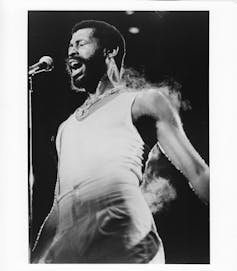
Black-and-white photo of singer wearing white undershirt singing in front of microphone, with steam coming off his body
R&B heartthrob Teddy Pendergrass performs on stage circa 1977.
Gilles Petard/Redferns via Getty Images

Pendergrass, with his stylish good looks, quickly became not just a heartthrob, but a top R&B artist with five consecutive platinum albums between 1977 and 1981. He was selling out concerts, and legendary producer Shep Gordon recognized that the vast majority of the attendees were women. This led to Pendergrass’ “Ladies Only” tour in 1978, which became a template for future soul and R&B tours by contemporaries like Luther Vandross and later artists like Ginuwine, whose tours were also marketed specifically to women.

The 1979 erotic hit “Turn Off the Lights” strengthened Pendergrass’ reputation as a sex symbol. While Marvin Gaye was dealing with both financial and personal issues, Pendergrass became the top performer of soul “bedroom ballads.”

Pendergrass and Gaye, along with other contemporaries like Barry White, Minnie Riperton and Donna Summer, included more explicitly erotic themes and lyrics than earlier artists.

For example, in Gaye’s “Let’s Get it On,” he implores to his lover:

“There’s nothin’ wrong with me / Lovin’ you, baby love, love / And givin’ yourself to me can never be wrong / If the love is true, oh baby.”

In “Close the Door,” Pendergrass similarly tells his lover:

“Close the door / Let me give you what you’ve been waiting for / Baby I got so much love to give / And I wanna give it all … to you …”

One challenge for the songwriters like Gamble and Huff was to balance the sensuality that fans loved with Federal Communication Commission rules regarding profane language. Songs like “Turn Down the Lights,” written by Gamble and Huff for Pendergrass, describe a detailed night of romance without language that would be considered obscene by the FCC.

Slow jams and sex positivity

R&B and soul slow jams by artists like Freddie Jackson and Vandross dominated bedroom music through the 1980s, although derivative genres like neo-soul and quiet storm continued to produce bedroom ballads like Gaye’s “Sexual Healing” in 1982.

Madonna and Cyndi Lauper helped bring a female perspective to more sex-positive pop music with songs including “Like a Virgin” and “She Bop.” Janet Jackson and Salt-N-Pepa did the same in R&B and hip-hop. Other groups embraced their sex symbol status through the 1990s, exemplified by TLC’s “Ain’t 2 Proud 2 Beg” and “Creep,” and Next’s “Too Close.” The artists of the 1980s and 1990s were also boosted by MTV, bringing a visual element to their sensual lyrics.

The emergence of new jack swing, a term coined in 1987 to define a new style that combined dance, hip-hop and R&B, ushered in higher-tempo erotic songs like “Do Me!” by Bel Biv Devoe along with slower bedroom ballads like “I’ll Make Love to You” by Philadelphia’s Boyz II Men.

Philly’s Boyz II Men carried the bedroom ballad tradition into the 1990s with “I’ll Make Love to You.”

Bedroom ballads with disco-synth makeover

Philadelphia International’s sound and sensual lyrics have reemerged in recent years through artists Sabrina Carpenter and Chappell Roan, whose synth-pop and disco sound can be traced back to Gamble and Huff, and the label’s stable of artists.

Proto-disco songs like “The Love I Lost” and “Don’t Leave Me This Way” by Harold Melvin and the Blue Notes, and Pendergrass’ disco hit “Get Up, Get Down, Get Funky, Get Loose” – or his later synthesizer-heavy album “Joy” – would influence current synth-pop hits like Roan’s disco-influenced “Pink Pony Club” and Carpenter’s synth-pop “Manchild.”

Chappell Roan’s campy, disco-influenced hit “Pink Pony Club.”

Carpenter in particular has seemingly struck that balance between mainstream success and sensual lyrics. Her past three albums have been certified platinum and embrace increasingly mature themes such as female arousal.

“Man’s Best Friend,” released in August 2025, sparked controversy with a sexually suggestive album cover that further cemented her Carpenter’s symbol image. This image is reinforced by her stage presence, like dancing in her underwear on “Saturday Night Live” and mature songs like “Tears,”

“Tears” by Sabrina Carpenter.

Pendergrass’ career was derailed when he lost control of his car on Lincoln Drive in the East Falls neighborhood of Philadelphia in 1982. The accident left him a tetraplegic. He later continued his music career, but the “Black Elvis” moved away from bedroom ballads.

Although Pendergrass’ meteoric rise was cut short, his influence is still seen and heard across music genres today, especially as empowered female artists utilize disco and synth-pop sounds while embracing their sexuality through their songs and performances.

Read more of our stories about Philadelphia, or sign up for our Philadelphia newsletter on Substack.

The Conversation

Jared Bahir Browsh does not work for, consult, own shares in or receive funding from any company or organization that would benefit from this article, and has disclosed no relevant affiliations beyond their academic appointment.

ref. Sabrina Carpenter’s and Chappell Roan’s sexy pop hits have roots in the bedroom ballads of Teddy Pendergrass and Philly soul – https://theconversation.com/sabrina-carpenters-and-chappell-roans-sexy-pop-hits-have-roots-in-the-bedroom-ballads-of-teddy-pendergrass-and-philly-soul-270035

Coups in Africa: how democratic failings help shape military takeovers – study

Source: The Conversation – Africa (2) – By Ernest Harsch, Researcher, Institute of African Studies, Columbia University

Mali, Burkina Faso, Niger, Guinea and Gabon have all suffered regime change in the last five years, led by men in military uniform.

Madagascar and Guinea-Bissau experienced the same fate in 2025. Benin looked to join the list in early December, but the civilian government held onto power – just.

The academic literature on coups in Africa has highlighted a wide range of influences and triggers. These include:

  • personal and institutional rifts within the armed forces

  • susceptibility to both elite manipulation and popular pressure

  • instigation by foreign powers against governments deemed hostile to their interests.

In a recent paper I added a further question: to what extent were democratic failings an element in the coups of the past six years?

I am a journalist and academic who has focused on African political and development issues since the 1970s. Among my most recently published books is Burkina Faso: A History of Power, Protest and Revolution.

In the paper I explored underlying shortcomings of Africa’s democracies as one major factor leading to military seizures. I focused on the recent coups in Mali, Guinea, Burkina Faso, Niger and Gabon.

I selected those cases because each of their takeovers was mounted against an elected civilian government. In some instances, I found, factors other than poor elections were also at play. The juntas in both Burkina Faso and Niger cited political defects of their elected, if somewhat ineffective, governments. But they mainly blamed their predecessors’ failure to put down growing jihadist insurgencies.

Insecurity was also a factor in Mali. But Mali, Guinea and Gabon all had elections commonly perceived to have been rigged or in violation of constitutional term limits. They provoked popular opposition which prompted officers to step in.

My main finding was thus that popular disappointment in elected governments was a prominent element. It established a more favourable context enabling officers to seize power with a measure of popular support.

That finding suggests that in order to better protect democracy in Africa, it is not sufficient to simply condemn military coups (as Africa’s regional institutions, such as the African Union and Economic Community of West African States, are quick to do). African activists, and some policymakers, have urged a step further: denouncing elected leaders who violate democratic rights or rig their systems to hang onto power.

If elected leaders were better held to account, then potential coup makers would lose one of their central justifications.

Problems are bigger than rigged polls

The problems, however, go beyond rigged polls, errant elected leaders, and violated constitutions. Many African governments, whether they are democratic or not, have great difficulty meeting citizens’ expectations, especially for improvements in their daily lives.

The deeper structural weaknesses of African states further contribute to hampering effective governance. As Ugandan anthropologist Mahmood Mamdani, Kenyan political scholar Ken Ochieng’ Opalo, and other African scholars have pointed out, those shortcomings include the externally oriented and fragmentary nature of the states inherited from colonial rule. These exclude many citizens from active political engagement and ensure government by unaccountable elites.

In particular, a neoliberal model of democracy has been widely adopted in Africa since the 1990s. That model insists that democracy be tethered to pro-market economic policies and greatly limit the size and activities of African states. That in turn hinders the ability of even well-elected governments to provide their citizens with security and services.


Read more:
South African protesters echo a global cry: democracy isn’t making people’s lives better


Conducting elections while continuing to subject African economies to the economic policy direction of the International Monetary Fund and World Bank has left them with a “choiceless democracy,” as Malawian economist Thandika Mkandawire termed it. That is, while voters may sometimes be able to change top leaders, they cannot alter basic economic policies. Such policies generally favour austerity and cutbacks over delivering jobs, education and healthcare.

So in addition to improving the quality of democratic systems on the continent, “coup proofing” African states will also require giving greater scope to popular input into real decision making, in both the political and economic spheres.

That will depend primarily on Africans themselves fighting for the democracies they want. Clearing the way for them means ending the all-too-common repression of street mobilisations and alternative views that displease the ruling elites.

Support for democracy

There may be general unhappiness with the flaws of Africa’s electoral systems. Surveys nevertheless demonstrate continued strong support for the ideals of democracy. Many ordinary Africans, moreover, are mobilising in various ways to advance their own conceptions of democratic practice.

For example, when the Macky Sall government in Senegal used repression and unconstitutional manoeuvres to try to prolong his tenure, tens of thousands mobilised in the streets in 2023-24 to block him and force an election that brought radical young oppositionists to power.

In Sudan, the community resistance committees that mobilised massively against the country’s military elites outlined an alternative vision of a people’s democracy encompassing national elections, decentralised local assemblies, and participatory citizen engagement.


Read more:
Africans want consensual democracy – why is that reality so hard to accept?


Findings by the Afrobarometer research network, which has repeatedly polled tens of thousands of African citizens, provide solid grounds for hope. Surveys in 39 countries between 2021 and 2023 show that 66% of respondents still strongly preferred democracy to any alternative form of government.

For anyone committed to a democratic future for Africa, that is something to build on.

The Conversation

Ernest Harsch does not work for, consult, own shares in or receive funding from any company or organisation that would benefit from this article, and has disclosed no relevant affiliations beyond their academic appointment.

ref. Coups in Africa: how democratic failings help shape military takeovers – study – https://theconversation.com/coups-in-africa-how-democratic-failings-help-shape-military-takeovers-study-271565

Roger Lumbala is accused of horrific war crimes in DRC: can his trial in France bring justice?

Source: The Conversation – Africa (2) – By Kerstin Bree Carlson, Associate Professor International Law, Roskilde University

The Democratic Republic of Congo (DRC) has been called “the worst place on earth to be a woman” and “the rape capital of the world”. A 2014 survey estimated that 22% of women and 10% of men had experienced sexual violence during the conflict in the country’s east. After years of impunity, Roger Lumbala, a 67-year-old former member of parliament who once led a rebel group in eastern DRC, is facing trial for these crimes. He is charged in a French court with complicity in crimes against humanity, including summary executions, torture, rape, pillage and enslavement. Kerstin Bree Carlson, a scholar of international criminal law and transitional justice, explains the significance of this trial and the controversies it has sparked.

What is the special war crimes chamber in Paris? And what is ‘universal jurisdiction’?

Lumbala is being tried before a special war crimes tribunal in Paris because France exercises “universal jurisdiction” over international atrocity crimes like genocide, crimes against humanity and war crimes. These are the crimes that are the remit of the International Criminal Court (ICC). Because the ICC is designed to be a court of last resort, hearing international atrocity crimes only when states cannot or will not, all ICC member states must criminalise international atrocity crimes in their domestic criminal codes.

Although courts usually only try cases against their own citizens or which occur on their own territory, France’s “universal jurisdiction” law allows it to hear cases regarding atrocity crimes committed outside France by non-French nationals. The law restricts the application of universal jurisdiction to individuals residing in France who are citizens of countries that are ICC members. Prosecutors in France’s special war crimes unit (“OCLCH”) furthermore enjoy discretion over which cases they pursue.

Prosecutions unfold as they do for any criminal case in France: a claim made by the prosecutor is sent to an investigative judge. The judge examines the claim neutrally, weighing evidence of guilt and innocence, to determine whether to issue an indictment. These findings can be appealed. When the appeals are finalised, if the indictment stands, the indicted individuals are put on trial before a panel of judges and a jury who will determine guilt (and an eventual sentence).

In addition to prosecution and defence, victims can participate in the proceedings as “civil parties”. Civil parties are full participants; they may call witnesses, address the court through argumentation, and question witnesses brought by prosecution and defence.

Lumbala’s path to the Paris court

Lumbala’s trial opened on 12 November 2025. The indictment alleges that Lumbala conspired to and was complicit in the commission of crimes against humanity in relation to Operation “Effacer le tableau” (Wipe the Slate Clean). This was a military campaign that terrorised eastern Congo in 2002-3.

The civil parties in Lumbala’s case played a central role in bringing Lumbala before the court. These include international NGOs such as TRIAL International, the Clooney Foundation for Justice, the Minority Rights Group, Amnesty International, We are not Weapons of War and others. These groups have recorded atrocity crimes in the DRC for decades, and some assisted in the 2010 Mapping report by the UN, a seminal document which detailed the extent of the violence between 1993 and 2003.

Lumbala has resided in France on and off since 2013. It was his application for asylum that put him on French authorities’ radar, and they opened an investigation into his alleged crimes in connection with his role as leader of a rebel group turned political party, Rally of Congolese Democrats and Nationalists (RCD-N). In late 2020, French authorities arrested him. Investigative judges issued an indictment against him in November 2023; that indictment was upheld by the appeals court in March 2024, leading to the opening of the trial. If convicted, Lumbala could face life imprisonment.

What is at stake in this trial?

Although a few low-level soldiers in the DRC have been tried, no high-ranking leader has been convicted for the pervasive practice of using rape as a weapon of war. A decade ago, one of Lumbala’s allies, Jean-Pierre Bemba, was prosecuted by the ICC for war crimes, including sexual violence committed in Central African Republic. Bemba’s 2016 conviction was widely celebrated as a victory for victims. His 2018 acquittal on appeal for procedural reasons was a bitter pill.

Victims wanting to address Lumbala directly have been served their own bitter pill. At the end of the first day of the trial, Lumbala announced that he did not recognise the court’s jurisdiction and would not participate in the trial. He told the court:

This is reminiscent of past centuries. The jury is French; the prosecutor is French. This court does not even know where DRC is.

Lumbala left the court and has not attended the trial since then. Every morning he is brought from jail, and sits in the basement of the court house instead of in the courtroom. He also fired his lawyers, who in turn refused to assist the court in providing a defence in absentia.

Technically, there is no problem; the trial may continue.

Symbolically, Lumbala’s absence deprives civil parties of the chance to address the defendant personally. For a victim, being able to face the alleged perpetrator as a rebalance of power is one of the purposes of trial, and contributes to justice; Lumbala’s absence may make the trial less fair for victims.

Without the participation of the defence, will the trial seem fair to others? For Lumbala and his team, who have been fighting France’s jurisdiction over this case for years, the move is in keeping with their general defence strategy of sowing doubt.

What this means for the court, and for the prosecution of universal jurisdiction cases more generally, is the larger question. If defendants can endanger judicial legitimacy by refusing to participate, it will not be the last time we see this strategy. Universal jurisdiction has been challenged in other countries: Belgium’s wide-reaching 1993 universal jurisdiction law was repealed in 2003 after a decade of practice. France’s more limited practice, akin to extraterritorial jurisdiction, is a test case for how individual countries can help support the work of the ICC. Although the ICC can investigate any case in or involving its member states, the unfulfilled arrest warrants against Russia’s Vladimir Putin and Israel’s Benjamin Netanyahu are a reminder of how difficult it can be for the ICC to take custody over defendants.

The greater significance of the Lumbala case is therefore what it may mean for France, or any country or institution, to prosecute atrocity crimes outside its borders, which will in turn have an impact on impunity for international atrocity crimes.

The Conversation

Kerstin Bree Carlson receives funding from Independent Research Fund Denmark (DFF)

ref. Roger Lumbala is accused of horrific war crimes in DRC: can his trial in France bring justice? – https://theconversation.com/roger-lumbala-is-accused-of-horrific-war-crimes-in-drc-can-his-trial-in-france-bring-justice-270482

Thiaroye massacre: report on the French killing of Senegalese troops in 1944 exposes a painful history

Source: The Conversation – Africa (2) – By Martin Mourre, Historien et anthropologue spécialisé dans les armées coloniales et postcoloniales en Afrique de l’Ouest, École des Hautes Études en Sciences Sociales (EHESS)

The Thiaroye camp near Dakar was a Senegalese army barracks housing African soldiers called “tirailleurs sénégalais” (Senegalese riflemen). It welcomed men returning from the European front of the second world war, where the riflemen had been held as German prisoners of war while serving on the side of France. They were waiting for their long-overdue back pay and bonuses.

But at dawn on 1 December 1944, they were shot by their own French officers. What should have been a time of celebration became a bloodbath. France sought to downplay or deny the massacre for many years.

In 2024, ahead of the 80th anniversary commemorations of the massacre, Senegal’s Prime Minister Ousmane Sonko appointed a commission to establish the truth of what happened, to ensure proper recognition and reparations for the victims, and to assert Senegal’s sovereignty to write its own history.

Chaired by Professor Mamadou Diouf of Columbia University, one of its tasks was to draft a new report (a white paper) on Thiaroye. This was presented to President Bassirou Diomaye Faye on 17 October 2025.

Martin Mourre, a historian and anthropologist specialising in colonial armies, has studied this issue and explains what the new report brings to light and why Thiaroye remains so sensitive.


What happened at Thiaroye?

On 21 November 1944, the first group of former prisoners of war arrived at the Thiaroye camp to be demobilised. They were owed substantial sums, mainly the back pay accumulated during their captivity.

The French army refused to give them what they were owed, even though the funds were reportedly available in Dakar.

On 27 November, tensions escalated, prompting the intervention of a senior officer. He planned a repression operation that, on 1 December, turned into a massacre.


Read more:
The time has come for France to own up to the massacre of its own troops in Senegal


Even though a number of questions remain unanswered, the event is fairly well documented. The main debate revived by the new report and echoed in the media focuses on two issues: the death toll and the burial site of the victims.

Regarding the death toll, one may rely on a literal reading of the archives, which consistently report 35 deaths (or 70 in one officer’s report, phrased in a particularly obscure way).

On this point, the white paper does not appear to go further than previous research, which supports a higher estimate of 300 to 400 deaths.

How has France responded to the Thiaroye issue over the years?

France actively sought to erase the events at Thiaroye. In the weeks following the tragedy, French officials declared, according to archival records, that adequate measures must be taken to hide these hours of madness. The language reveals a deliberate effort to downplay and conceal the atrocity.

This continued long after independence in 1960. One of the most infamous examples is the censorship of the acclaimed film The Camp at Thiaroye by Senegalese filmmakers Ousmane Sembène and Thierno Faty Sow, which failed to find distributors in France when it was released.

However, things began to change in the 2000s, particularly when President Abdoulaye Wade organised official commemorations of the massacre. For the first time, a special French ambassador attending the commemoration acknowledged the colonial army’s responsibility for the tragedy.


Read more:
Ousmane Sembène at 100: a tribute to Senegal’s ‘father of African cinema’


A more prominent gesture came in 2014 when President François Hollande visited the military cemetery. He delivered a speech and handed over a batch of archives to Senegalese President Macky Sall. He claimed – falsely, as it later turned out – that these represented all the documents France possessed on the massacre.

These archives were not available for analysis in Senegal until an executive order was issued by President Bassirou Diomaye Faye in 2024. The reason for the decade-long blockade was never adequately explained.

In 2024, President Emmanuel Macron went further than his predecessor by officially recognising events at Thiaroye as “a massacre”. A word his predecessor had avoided. Macron made this statement in a letter to Faye.

What new information does the report provide?

The main new element presented in the white paper is the initial outcome of archaeological excavations of the burial site, carried out by a team from Dakar’s Cheikh Anta Diop University. They have so far uncovered the remains of seven individuals.

All indications are that these men were victims of the massacre. Investigators highlighted the rushed and irregular nature of the graves and the burials, with bodies still dressed in military uniforms.

A black and white photo of African men in trenchcoats standing in a line with a European man in the foreground.
Senegalese Tirailleurs, 1940.
RaBoe/Wikimedia Commons, CC BY-SA

French administrative records had offered no answers about where or how the victims were laid to rest. This left the question of potential mass graves unresolved and shrouded in uncertainty.

These new findings from the report verify that victims were buried at this site. They also challenge official French narratives. The investigation continues. The archaeological team plans to expand their search, believing that more remains may lie hidden across the site.

What momentum led to the search at the grave site?

The issue of excavations of this site has a longer history. In 2017, several pan-African organisations urged Senegalese authorities to carry out such searches at Thiaroye. Among them was the party of Ousmane Sonko, today prime minister of Senegal but then a member of parliament.

Ten years earlier, during the construction of a highway crossing part of the military camp, historian Cheikh Faty Faye had already raised the issue publicly. Faye, who died in 2021, had worked on Thiaroye since the 1970s. He was part of a tradition of activist-scholars connected to pan-Africanist movements.

Through decades of commemoration and organising, these groups transformed the cemetery into a site of collective memory.


Read more:
David Diop: his haunting account of a Senegalese soldier that won the Booker prize


The cemetery holds 202 graves, roughly 30 of which stand apart from the others. To my knowledge, no scientific work has traced its origins, but it likely dates back to the first world war, when the Thiaroye camp was built.

It’s located about 1km from the camp’s main entrance. It served as the burial ground for west African riflemen from Senegal and numerous other French colonial territories who died during training. Their remains were never repatriated.

If future research confirms that the recently discovered bodies belong to the men killed on 1 December, it would be an important step towards clarifying the death toll.

What else is important in this report?

While the white paper dedicates considerable attention to the death toll, it also signals an interest in recovering the individual life stories of the Thiaroye riflemen.

Yet in my view, a crucial question remains unaddressed: the distinctly colonial character of the violence itself.

This is a form of violence inherent to the colonial context, marked by racialisation, a sense of impunity, and the distance between the colony and mainland France.

The challenge today is no longer just to document what happened at Thiaroye. It is ensure that this history is passed on to future generations. Integrating it into school curricula – anchored in rigorous scholarly work – shows how understanding the past illuminates the present and helps build a collective memory on solid foundations.

The Conversation

Martin Mourre does not work for, consult, own shares in or receive funding from any company or organisation that would benefit from this article, and has disclosed no relevant affiliations beyond their academic appointment.

ref. Thiaroye massacre: report on the French killing of Senegalese troops in 1944 exposes a painful history – https://theconversation.com/thiaroye-massacre-report-on-the-french-killing-of-senegalese-troops-in-1944-exposes-a-painful-history-271035