The discovery of a gravitational wave 10 years ago shook astrophysics – these ripples in spacetime continue to reveal dark objects in the cosmos

Source: The Conversation – USA – By Chad Hanna, Professor of Physics, Penn State

When two massive objects – like black holes or neutron stars – merge, they warp space and time. Mark Garlick/Science Photo Library

Scientists first detected ripples in space known as gravitational waves from the merger of two black holes in September 2015. This discovery marked the culmination of a 100-year quest to prove one of Einstein’s predictions.

Two years after this watershed moment in physics came a second late-summer breakthrough in August 2017: the first detection of gravitational waves accompanied by electromagnetic waves from the merger of two neutron stars.

Gravitational waves are exciting to scientists because they provide a completely new view of the universe. Conventional astronomy relies on electromagnetic waves – like light – but gravitational waves are an independent messenger that can emanate from objects that don’t emit light. Gravitational wave detection has unlocked the universe’s dark side, giving scientists access to phenomena never observed before.

As a gravitational wave physicist with over 20 years of research experience in the LIGO Scientific Collaboration, I have seen firsthand how these discoveries have transformed scientists’ knowledge of the universe.

This summer, in 2025, scientists with the LIGO, Virgo and KAGRA collaboration also marked a new milestone. After a long hiatus to upgrade its equipment, this collaboration just released an updated list of gravitational wave discoveries. The discoveries on this list provide researchers with an unprecedented view of the universe featuring, among other things, the clearest gravitational wave detection yet.

A map showing five yellow points indicating operational gravitational wave observatories: two in the US, two in Europe and one in Japan, and one orange point in India indicating a planned observatory.
The more operational gravitational-wave observatories there are around the globe, the easier it is to pin down the locations and sources of gravitational waves coming from space.
Caltech/MIT/LIGO Lab

What are gravitational waves?

Albert Einstein first predicted the existence of gravitational waves in 1916. According to Einstein’s theory of gravity, known as general relativity, massive, dense celestial objects bend space and time.

When these massive objects, like black holes and neutron stars – the end product of a supernova – orbit around each other, they form a binary system. The motion from this system dynamically stretches and squeezes the space around these objects, sending gravitational waves across the universe. These waves ever so slightly change the distance between other objects in the universe as they pass.

Detecting gravitational waves requires measuring distances very carefully. The LIGO, Virgo and KAGRA collaboration operates four gravitational wave observatories: two LIGO observatories in the U.S., the Virgo observatory in Italy and the KAGRA observatory in Japan.

Each detector has L-shaped arms that span over two miles. Each arm contains a cavity full of reflected laser light that precisely measures the distance between two mirrors.

As a gravitational wave passes, it changes the distance between the mirrors by 10-18 meters — just 0.1% of the diameter of a proton. Astronomers can measure how the mirrors oscillate to track the orbit of black holes.

These tiny changes in distance encode a tremendous amount of information about their source. They can tell us the masses of each black hole or neutron star, their location and whether they are spinning on their own axis.
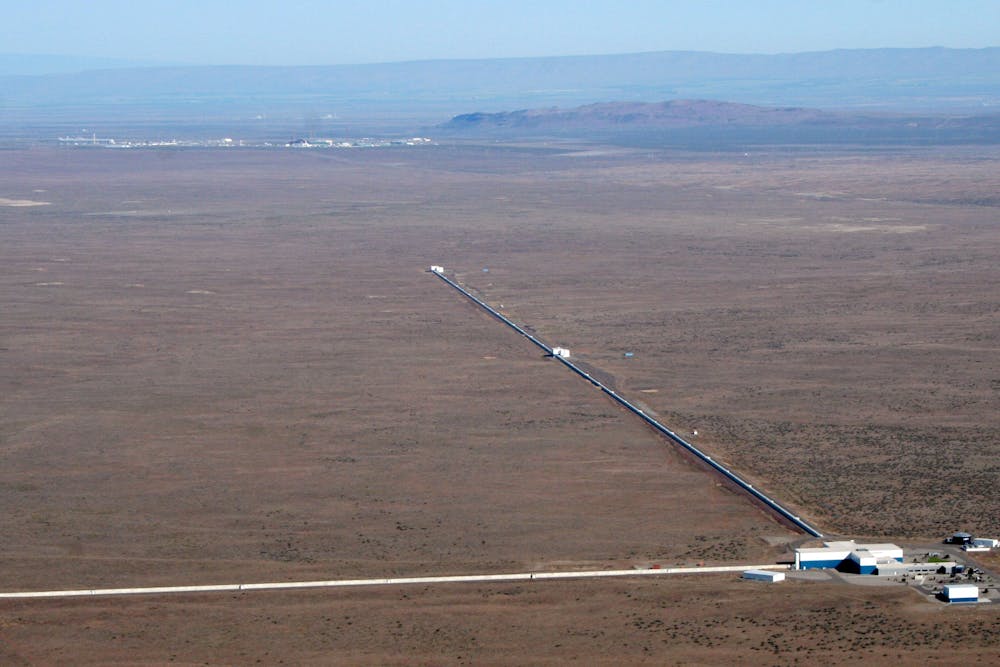
An L-shaped facility with two long arms extending out from a central building.
The LIGO detector in Hanford, Wash., uses lasers to measure the minuscule stretching of space caused by a gravitational wave.
LIGO Laboratory

A neutron star-black hole merger

As mentioned previously, the LIGO, Virgo and KAGRA collaboration recently reported 128 new binary mergers from data taken between May 24, 2023, and Jan. 16, 2024 – which more than doubles the previous count.

Among these new discoveries is a neutron star–black hole merger. This merger consists of a relatively light black hole with mass between 2.5 and 4.5 times the mass of our Sun paired with a neutron star that is 1.4 times the mass of our Sun.

In this kind of system, scientists theorize that the black hole tears the neutron star apart before swallowing it, which releases electromagnetic waves. Sadly, the collaboration didn’t manage to detect any such electromagnetic waves for this particular system.

Detecting an electromagnetic counterpart to a black hole tearing apart a neutron star is among the holy grails of astronomy and astrophysics. These electromagnetic waves will provide the rich datasets required for understanding both the extreme conditions present in matter, and extreme gravity. Scientists hope for better fortune the next time the detectors spot such a system.

A massive binary and clear gravitational waves

In July 2025, the LIGO, Virgo and KAGRA collaboration also announced they’d found the most massive binary black hole merger ever detected. The combined mass of this system is more than 200 times the mass of our Sun. And, one of the two black holes in this system likely has a mass that scientists previously assumed could not be produced from the collapse of a single star.

When two astrophysical objects – like black holes – merge, they send out gravitational waves.

The most recent discovery announced by the LIGO, Virgo and KAGRA collaboration, in September 2025, is the clearest gravitational wave observation to date. This event is a near clone of the first gravitational wave observation from 10 years ago, but because LIGO’s detectors have improved over the last decade, it stands out above the noise three times as much as the first discovery.

Because the observed gravitational wave signal is so clear, scientists could confirm that the final black hole that formed from the merger emitted gravitational waves exactly as it should according to general relativity.

They also showed that the surface area of the final black hole was greater than the surface area of the initial black holes combined, which implies that the merger increased the entropy, according to foundational work from Stephen Hawking and Jacob Bekenstein. Entropy measures how disordered a system is. All physical interactions are expected to increase the disorder of the universe, according to thermodynamics. This recent discovery showed that black holes obey their own laws similar to thermodynamics.

The beginning of a longer legacy

The LIGO, Virgo and KAGRA collaboration’s fourth observing run is ongoing and will last through November. My colleagues and I anticipate more than 100 additional discoveries within the coming year.

New observations starting in 2028 may bring the tally of binary mergers to as many as 1,000 by around 2030, if the collaboration keeps its funding.

Gravitational wave observation is still in its infancy. A proposed upgrade to LIGO called A# may increase the gravitational wave detection rate by another factor of 10. Proposed new observatories called Cosmic Explorer and the Einstein Telescope that may be built in 10 to 20 years would increase the rate of gravitational wave detection by 1,000, relative to the current rate, by further reducing noise in the detector.

The Conversation

Chad Hanna receives funding from the National Science Foundation.

ref. The discovery of a gravitational wave 10 years ago shook astrophysics – these ripples in spacetime continue to reveal dark objects in the cosmos – https://theconversation.com/the-discovery-of-a-gravitational-wave-10-years-ago-shook-astrophysics-these-ripples-in-spacetime-continue-to-reveal-dark-objects-in-the-cosmos-264554


Nepal’s social media ban sparks deadly protests, but deeper grievances fuel the fire

Source: The Conversation – UK – By Leanne McCarthy-Cotter, Programme Director for Politics and International Relations, Cardiff Metropolitan University

Nepal’s prime minister, KP Sharma Oli, resigned on September 9 as his country reeled from some of its worst unrest in decades. A government ban on 26 social media apps, including Facebook, WhatsApp, YouTube and X, triggered widespread protests. The police responded violently, 19 people were killed and hundreds more injured.

Demonstrations have escalated since then in the capital, Kathmandu, and some other cities. The homes of various politicians have been vandalised, the parliament building in Kathmandu was set on fire and the death toll has risen to 22.

Nepal’s army has announced it will take control of the situation. It has imposed a countrywide curfew and is warning of punishment for anyone involved in violence or vandalism. The gen Z groups leading the protests say the movement has been hijacked by “opportunist” infiltrators.

The forces that led to Oli’s exit run far deeper than anger at the government’s social media ban. This was merely the final straw. Anger at political instability, elite corruption and economic stagnation have built up over many years.

Nepal’s democratic era began in 2008 after a decade-long Maoist insurgency culminated in the abolition of its monarchy. Several years later, in 2015, a constitution came into effect that introduced federalism and proportional representation to address ethnic tensions and prevent authoritarian rule.

But it has instead produced a highly fragmented party system. None of the 14 governments that have ruled since 2008 have completed a full term. This revolving-door politics, underpinned by patronage-driven coalitions, has fuelled public cynicism.

Nepal also consistently ranks poorly on corruption indices. It was ranked 107 out of 180 countries in Transparency International’s 2024 Corruption Perceptions Index. Two major scandals have become symbols of elite impunity in Nepal.

The first concerns the Giri Bandhu Tea Estate. The estate’s owners – allegedly in collusion with politicians – have for decades attempted to convert land protected under law into commercial real estate for profit. Nepal’s supreme court struck down the latest attempt in February 2025.

The second is known as the Lalita Niwas land grab scam. Beginning in the 1990s, it involved the illegal transfer of government-owned land to influential businessmen, politicians and government officials. Several senior Nepalese officials have been arrested and subsequently convicted over their involvement.

Most recently, the so-called “Nepo kid” campaign has seen the luxury lifestyles of politicians’ family members showcased on social media. Among the most frequently shared images was a photo claiming to show a son of a minister posing with boxes labelled Louis Vuitton and Cartier, arranged into a Christmas tree.

The images have only crystallised public anger. Wealth inequality remains stark in Nepal, where the top 10% of earners receive three times more income than the bottom 40% of earners combined. And younger Nepalis feel excluded from opportunity.

With limited career prospects at home, many young people in Nepal see emigration as the only option. Roughly 839,000 Nepalis had to leave the country in 2024 to work abroad. For young Nepalis, these realities have bred deep disillusionment. Their demands are clear: they want systemic reforms that challenge the political elite.

What happens next?

What happens next is unclear. The Nepalese army played a decisive role in Oli’s resignation. Reports indicate that the army chief, General Ashok Raj Sigdel, privately urged Oli to step down and ensured a safe exit for him and key ministers.

Troops have also been deployed to protect government buildings and maintain order. But, while the army has committed to taking control of the situation, it has at no point attempted to seize power or suspend constitutional processes.

Unlike the overtly interventionist militaries of some states in the region, such as Pakistan, Nepal’s army has traditionally avoided direct involvement in government. It has instead acted as a stabiliser during political crises and has occasionally influenced leadership transitions behind the scenes.

In this sense, its facilitation of Oli’s exit was not entirely unprecedented. But what was striking was the public visibility and speed of the army’s intervention. Its leadership effectively communicated that the prime minister’s political survival depended on their acquiescence, while carefully framing itself as a neutral arbiter rather than a ruler.

Nepal will now enter a period of caretaker government. The country’s fractured coalition politics means forming a stable administration may prove difficult. However, figures such as Kathmandu’s mayor, Balendra Shah, are gaining popularity as symbols of generational change.

Shah, 35, has garnered significant support from young Nepalese people, who view him as a break from the country’s traditional political elites. His background as a rapper and civil engineer, coupled with his anti-corruption stance, resonates with young voters seeking authenticity and reform.

His active engagement on social media, which has included expressing solidarity with protesters, has further solidified his position as a leader aligned with the aspirations of the younger generations. And his independent status, free from the influence of traditional political parties, has allowed him to present himself as an outsider capable of enacting genuine change.

Yet on its own, a turnover of leadership – while addressing a symbolic grievance – is unlikely to satisfy all of the protesters. The slow roll-out of federalism and a lack of effective decentralisation have alienated rural populations. This has fed widespread perceptions of a Kathmandu-centric elite.

Nepalese youth are demanding change. For the country’s politicians, addressing this moment will require not only new leadership, but a genuine commitment to reform and a political system credible to a generation no longer willing to accept business as usual.

Without this, Nepal risks remaining trapped in a cycle of protest and paralysis.

The Conversation

Leanne McCarthy-Cotter does not work for, consult, own shares in or receive funding from any company or organisation that would benefit from this article, and has disclosed no relevant affiliations beyond their academic appointment.

ref. Nepal’s social media ban sparks deadly protests, but deeper grievances fuel the fire – https://theconversation.com/nepals-social-media-ban-sparks-deadly-protests-but-deeper-grievances-fuel-the-fire-264923

Trading human remains: why bones should not become a commodity

Source: The Conversation – UK – By Michelle Spear, Professor of Anatomy, University of Bristol

Bokeh Stock/Shutterstock.com

In recent years, skulls, bones, and even modified human remains have appeared with increasing frequency on online marketplaces and social media platforms. What might once have been confined to specialist collectors has become a global, online trade.

The market is fuelled by diverse groups of buyers. Some are traditional collectors of curiosities, others are ritual practitioners. And a smaller number of contemporary artists and designers buy human remains to incorporate into sculptures or installations, raising concerns about the use of the body as raw material. There are also medical and dental students, some of whom still seek real skulls for their own study, unaware of the legal and ethical pitfalls.

Perhaps the most striking development is the rise of casual consumers inspired by social media. The aesthetic known as “dark academia” has helped to drive this surge. Blending gothic literature, candlelit libraries, vintage tailoring and scholarly mystique, it presents bones as fashionable props. On Instagram (#SkullDecor) and TikTok (#OdditiesTok), users pose with skeletons in the same way they might with antique books or candlelight, transforming skulls into lifestyle decor.

This trend is troubling because it normalises ownership of human remains and blurs the line between objects of study and human individuals. By aestheticising death, it risks eroding the ethical safeguards that once protected the dead from exploitation. The surge has prompted alarm among archaeologists, anthropologists and anatomists. The British Association for Biological Anthropology and Osteoarchaeology has spearheaded a campaign to curb the trade, warning that it not only exploits the dead but also risks commodifying them. Yet the legal framework is equally complex, leaving many sellers operating in a grey area.

In the UK, the law is fragmented. The Human Tissue Act 2004 regulates the use of bodies donated for anatomical education, teaching and research, but only applies to remains less than 100 years old. Anything older falls outside its scope.

This century cut-off creates a loophole: a skull described as “Victorian” can be sold, even if its provenance is doubtful. Sellers may exploit this grey area, and buyers rarely question such claims.

Sidestepping jurisdictions

Elsewhere, laws are inconsistent. In the US, Native American remains are protected under federal legislation, yet state laws vary widely and online sales often slip through the net. The global nature of the trade makes enforcement harder still: a skull listed in the UK can be shipped abroad with little difficulty, sidestepping different national jurisdictions.

The question of origin is central. The Anatomy Act of 1832 was intended to end grave robbing in Britain by providing a legal supply of bodies – those unclaimed in hospitals, prisons and workhouses – while also making body donation legal. But demand soon outstripped supply, as evidenced by the work of the resurrectionists, and by the late 19th-century Britain looked abroad for bones.

India became the world’s largest exporter, sending an estimated 60,000 skeletons overseas in 1984 alone. Many came from impoverished communities who could not afford cremation or burial, while others were stolen from cemeteries.

Grave robbing was common, and the trade remained deeply tied to colonial structures. Even after independence in 1947, India remained Britain’s main supplier until a scandal in 1985 revealed the export of 1,500 child skeletons, raising fears of kidnapping and murder. The Indian government swiftly banned the trade. China then became the leading exporter until it too banned exports in 2008.

This history shows that many of the bones circulating today in collections, and sometimes resurfacing on the open market, were acquired in ways that were profoundly exploitative.

Provenance is everything, yet often absent. While many bones circulating today are former anatomical specimens, the scale of demand has clearly encouraged more nefarious means of procurement, and grave robbing has seen a resurgence.

An empty grave.
Grave robbing is seeing a resurgence.
David Leshem/Shutterstock.com

Museums and teaching collections usually keep detailed acquisition records, so bones offered without documentation raise immediate red flags. Anatomical specimens also tend to show signs of preparation, such as drilled holes, varnish or metal fittings.

By contrast, remains taken from graves often display soil staining, root etching, or microfractures caused by long-term burial. Fragments of coffin wood, nails or textiles may still cling to them. These differences are not always conclusive, but together they suggest whether a skeleton was prepared for study or exhumed illicitly.

Beyond legality lies a more fundamental question: should human remains ever be sold at all? Human remains are not ornaments or lifestyle accessories – they are the material traces of people’s lives.

The commodification of human remains sits at the uneasy intersection of law, science and ethics. The trade thrives because of loopholes and because platforms profit from traffic even when listings violate their own policies. At its heart, this is not a legal issue so much as one of respect.

Human remains, whether ancient or recent, represent lives once lived. They carry stories of identity, community and mortality. Treating them as commodities diminishes both the individuals they once were and the societies we live in today. As calls for reform continue, the challenge is to shift attitudes away from possession and decorative display toward recognition of the dignity owed to the dead.

The Conversation

Michelle Spear does not work for, consult, own shares in or receive funding from any company or organisation that would benefit from this article, and has disclosed no relevant affiliations beyond their academic appointment.

ref. Trading human remains: why bones should not become a commodity – https://theconversation.com/trading-human-remains-why-bones-should-not-become-a-commodity-264208

Seven health conditions that show why using your phone on the toilet is a bad idea

Source: The Conversation – UK – By Adam Taylor, Professor of Anatomy, Lancaster University

This is why you shouldn’t bring your phone with you into the toilet. Alex Goncharov/ Shutterstock

It might seem like a harmless habit to linger on the loo with your phone while “taking care of business”, but research shows that prolonged toilet time can increase the risk of several health problems. Here are the main ones.

1. Haemorrhoids

A recent study found that smartphone use while doing a number two is linked to a 46% increased risk of developing haemorrhoids. A healthy toilet trip should only last two to three minutes, yet the study found that 37% of participants who used their phones while on the can spent more than five minutes there.

Haemorrhoids are enlarged blood vessels occurring in or around the anal opening. They develop due to increased pressure in the anal cushions – a part of the spongy tissue that surrounds your anus. These cushions allow the anus to expand as faeces is expelled.

Sitting too long on the toilet places extra pressure on these cushions, leading to haemorrhoids, as does straining to force faeces out.

It’s estimated that between 50-85% of people worldwide suffer from haemorrhoids. Symptoms include painless bleeding, irritation, itching and discomfort. However, haemorrhoids aren’t always symptomatic. Some people have them without knowing.

Haemorrhoids can also lead to complications such as anaemia from prolonged bleeding, and strangulation or clotting within the haemorrhoid – both of which cause severe pain.

2. Anal fissures or tears

Sitting on the toilet too long can cause anal fissures or tears. They are small cuts in the anal lining. Anal fissures are often accompanied by significant pain – likened to passing broken glass when having a bowel movement, alongside bright red blood.

The anal lining is thin and sitting on the toilet for too long causes pooling of the blood, which stretches the lining, making it more prone to damage as faeces passes out.

3. Prolapse

Faeces may not be the only thing that passes out the body after sitting on the toilet. Extended loo time can increase your risk of having your rectum fall out of your body – a condition known as a rectal prolapse.

This uncommon condition occurred in one man who would often spend up to 30 minutes on the toilet playing smartphone games. One day, he found nearly 14cm of his rectum protruding out of his body while attempting a bowel movement.

Prolonged sitting on the toilet increases pressure in the abdomen, which subsequently increases pressure on the pelvic floor muscles. These muscles help hold our internal organs, including our rectum, inside. But prolonged pressure can weaken these muscles.

In women, this could also result in other pelvic organs – such as a uterus – prolapsing out of the body.

Rectal prolapse is often painful, and you’ll need to visit the hospital if you have one so it can be re-inserted. If it happens repeatedly or if the case is particularly extreme, it will require surgery.

4. Pressure sores and ulcers

Prolonged sitting on the loo, particularly in the elderly, may increase the risk of pressure sores occurring on the skin that comes in contact with the toilet seat.

Prolonged sitting compresses the tissues, reducing blood flow to them. This then results in toxic substances building up in the blood which damage the tissues and cause them to breakdown. Pressure sores are painful.

5. Hiatal hernia

Prolonged sitting on the toilet and straining to defecate may contribute to hiatal hernia, particularly in susceptible people (including those who are obese or over the age of 50).

This is where part of the stomach and other abdominal organs slide through the opening in your diaphragm (a dome-shaped muscle that helps us breathe), ending up in the chest cavity.

A young woman sits on the toilet looking at her phone. She is frowning.
Excess toilet time combined with straining can lead to a hernia.
Raushan_films/ Shutterstock

Hiatal hernias are common, affecting 20% of people. They typically result in indigestion, stomach pains and discomfort around the ribs and chest. They can be treated with medication to reduce the amount of acid produced by the stomach or in more severe cases require surgery.

6. Toilet seat neuropathy

Sitting too long on the toilet compresses the major nerves and blood vessels, reducing blood supply to the legs. This can cause your legs to go numb as a result – a phenomenon known as toilet seat or toilet bowl neuropathy. It usually goes away after a few minutes.

But there have been some case studies where patients who passed out on the toilet after a night of drinking – subsequently spending the night there – found themselves entirely numb and unable to move. In one extreme case, a man developed gangrene, sepsis and sadly died after falling asleep on the toilet.

7. Fainting

Prolonged toilet time combined with straining may also result in fainting.

This condition, called vasovagal syncope, occurs when prolonged straining on the toilet irritates the vagus nerves. These nerves control many of the body’s automatic functions – including heart rate and blood pressure.

In the case of defecation syncope, blood pressure can drop suddenly when we stand up from the toilet. Heart rate also drops causing dizziness, light-headedness and fainting.

The healthy way to poo

To reduce your risk of suffering any of these conditions, spend as short a time seated on the loo as possible.

You could also potentially modify your position when using the loo. Some evidence suggests squatting is better for defecation, as it reduces the stress and straining needed to poo. However, other studies have shown this position could potentially increase risk of other health problems – such as risk of stroke and damage to the achilles tendon.

Other advice includes eating more fibre and drinking water if you’re someone who regularly takes longer than five minutes to do your business as both can help you have healthier poos. They will also prevent straining while having your bowel movement.

The Conversation

Adam Taylor does not work for, consult, own shares in or receive funding from any company or organisation that would benefit from this article, and has disclosed no relevant affiliations beyond their academic appointment.

ref. Seven health conditions that show why using your phone on the toilet is a bad idea – https://theconversation.com/seven-health-conditions-that-show-why-using-your-phone-on-the-toilet-is-a-bad-idea-264808

How America helped create the Palestinian Authority – only to undermine it ever since

Source: The Conversation – UK – By Anne Irfan, Lecturer in Interdisciplinary Race, Gender and Postcolonial Studies, UCL

US president Bill Clinton with Israeli prime minister Yitzhak Rabin and Palestinian leader Yasser Arafat at the Oslo Accords signing ceremony on 13 September 1993. Vince Musi/The White House

At the end of August, the Trump administration blocked Palestinian president, Mahmoud Abbas, and 80 other Palestinian officials from attending the UN general assembly meeting in New York, which runs between September 9 and 23. The US president’s decision to revoke the Palestinian officials’ US visas comes as various European governments prepare to formally recognise the state of Palestine at the general assembly. Supporters of Palestinian statehood are proposing a central role for Abbas’ Palestinian Authority (PA) in Gaza’s future government.

Historically, the US has also supported the PA. The Oslo accords, which created the PA in the first place, were signed at the White House in 1993. US president Bill Clinton famously hosted Israeli prime minister Yitzhak Rabin and the chair of the Palestine Liberation Organisation (PLO), Yasser Arafat.

In discourse that has since become standard US policy, Clinton spoke of a so-called “two-state solution”, with security for Israel and democratic self-rule for the Palestinians. The US provided significant financial support for the PA after its establishment, with particular funding for its ample security forces.

Yet behind the scenes, the US stance on Palestinian statehood has always been murkier. A deeper look shows that the Trump administration’s recent moves blocking the PA are less of a departure from long-term US policy than they may seem. As I explain in my new book A Short History of the Gaza Strip, the US has long paired its ostensible support for the PA with policies that cripple its ability to function and undermine prospects of real Palestinian independence.

From the start, the Oslo accords were skewed in favour of Israeli interests. Under the agreement’s terms, the PA had limited autonomy over around three-quarters of the Gaza Strip and less than one-fifth of the West Bank. The Israeli military retained ultimate control and continued to seize more land for illegal settlements.

At the end of the 1990s, Clinton aligned himself closely with the new Israeli prime minister, Ehud Barak. Barak’s declared “red lines” included no Palestinian state along the 1967 borders, no Palestinian national army, no Palestinian sovereignty over any part of Jerusalem and the retention of most illegal Israeli settlements in the West Bank.

Further negotiations were structured to constrain the Palestinians, culminating in the “failure” of the 2000 Camp David summit. Familiar to anyone who has followed Israeli-Palestinian affairs, Arafat has been blamed for refusing Barak’s “unprecedented” proposal. The reality is somewhat different.

As Robert Malley and Hussein Agha wrote in their 2001 book, Camp David: a tragedy of errors, “what so many viewed as a generous Israeli offer, the Palestinians viewed as neither generous, nor Israeli, nor, indeed, as an offer”. Malley served as adviser to Clinton on Arab-Israeli affairs while Agha, a senior associate member of Oxford University’s St Antony’s College has been associated with Israeli-Palestinian affairs for more than half a century – meaning they know whereof they speak.

The US’ disingenuous approach did not end when Clinton left office. During the second intifada (Palestinian uprising) from 2000-2005, the administration of George W. Bush backed Israel’s full invasion of PA-administered areas in the West Bank and Gaza. This completely undermined any chance of a two-state solution – the very “solution” that the US ostensibly supported.

Israeli security forces shelter behind armoured vehicles when confronted by crowds of Palestinian civilians.
Second intifada, October 2000: Palestinian protesters confronting Israeli security forces near Ramallah.
Nadav Ganot (נדב גנות) / IDF Spokesperson’s Unit, CC BY-NC

In 2003, the US demanded a full restructuring of the PA’s set-up to curtail Arafat, whom Palestinians had elected president in 1996. When he died in 2004, he had spent two years under Israeli siege in Ramallah – another policy supported by the US.

Two years later, US moves to undermine the PA reached a crescendo when the 2006 Palestinian parliamentary elections returned Hamas as the largest party with 44% of the vote. While the elections were deemed free and fair by international observers, the Bush adminstration responded by plotting, arming and funding a coup to overthrow the new PA government.

In the end, the coup backfired, resulting in a lasting split from 2007 when Hamas seized control of Gaza and Abbas’ forces purged it from the PA in the West Bank. Since then, Palestinians in the two territories have been largely cut off from one another under two separate regimes. Abbas’ PA has been based in the West Bank while Hamas governs Gaza – where Israel has imposed a full blockade from 2007, supported by the US and Egypt.

No authority

In the two decades since, successive US administrations have effectively facilitated the Palestinian divide. In 2014, the Obama administration backed Israeli opposition to a short-lived Palestinian unity government. And when Abbas cancelled long-awaited Palestinian elections in 2021, the Biden administration stayed silent, with reports of tacit US support for the move behind the scenes.

While many western and Arab states are calling for the PA to take over Gaza’s future governance, critics point out that it has long been toothless and illegitimate.

Elected in 2005, Abbas is now 20 years into a four-year term. What’s more, his regime has delivered little for West Bank Palestinians in the nearly two decades since the split from Gaza.

He has been entirely ineffectual in countering the Israeli war on Gaza, launched after the Hamas-led attacks of October 7 2023 and widely recognised as genocide. As ministers call to resettle Gaza, Israel has continued to expand its illegal settlements in the West Bank and is openly planning ethnic cleansing.

It is important to remember that the PA was only ever created as an interim body, designed to serve for five years in the 1990s ahead of final negotiations. Its continued existence decades later is a serious indictment of the US-led so-called peace process. The reality of US treatment of the PA since the 1990s calls into question whether Trump’s recent moves are really a turning point in US policy – or simply the culmination of a long-term trend.

The Conversation

Anne Irfan does not work for, consult, own shares in or receive funding from any company or organisation that would benefit from this article, and has disclosed no relevant affiliations beyond their academic appointment.

ref. How America helped create the Palestinian Authority – only to undermine it ever since – https://theconversation.com/how-america-helped-create-the-palestinian-authority-only-to-undermine-it-ever-since-264759

Signs of ancient life may have been found in Martian rock – new study

Source: The Conversation – UK – By Sean McMahon, Reader in Astrobiology, University of Edinburgh

Just over a year ago, Nasa made a remarkable announcement. The Perseverance rover had found potential signs of ancient life on Mars. Now, the technical details behind that discovery have been published in a Nature paper that, despite its rather modest wording, may ultimately prove to be among the most significant in the history of science.

The bottom line is this: it might be life, but we won’t know for sure until we return the samples to Earth. Perseverance has already collected a fragment of the relevant rock — we just have to go and get it.

Indeed, Nasa has been working with the European Space Agency on a mission to go to Mars, retrieve the samples of rock collected by Perseverance and deliver them to Earth. This would include the sample from the rock that’s the subject of the Nature study. However, the mission, known as Mars Sample Return, has run into trouble because of rising costs.

In mid-2024, the Perseverance rover encountered a block of ancient mudstone, nicknamed Cheyava Falls, distinguished by its brick-red hue. This rock was laid down by water roughly four billion years ago. While most Martian rocks appear red due to a coating of oxidised (ferric) iron dust, Cheyava Falls is red through and through – the ferric iron is in the rock itself.

More intriguingly, Cheyava Falls is peppered with dozens of tiny pale spots, typically less than a millimetre across. These spots are fringed with a dark phosphorus-rich mineral, which also appears as tiny dots called poppy seeds that are scattered between the other spots. Associated with this mineral are traces of ancient organic compounds. (Organic compounds contain carbon and are fundamental to life on Earth, but they also exist in the absence of biology.)

What does this have to do with life?

All living organisms on Earth harness energy through oxidation-reduction (redox) reactions – transferring electron particles from chemicals known as reductants to compounds named oxidants. On Earth, for example, structures called mitochondria in animal cells transfer electrons from glucose (a reductant) to oxygen (an oxidant). Some rock dwelling bacteria use other kinds of organic compound instead of glucose, and ferric iron instead of oxygen.

Serpentine Rapids
A rock dubbed Serpentine Rapids also showed features reminiscent of reduction spots.
Nasa JPL-Caltech

When ferric iron is reduced to a different form, known as ferrous iron, it becomes soluble in water and either leaches away or reacts to form new, lighter-coloured minerals. The result is that many red rocks and sediments on Earth contain small bleached spots – “reduction spots” – strikingly similar to those found in Cheyava Falls. In fact, Perseverance subsequently spotted bleached features even more reminiscent of reduction spots at a site called Serpentine Rapids, but spent too little time there to analyse them and, unfortunately, didn’t collect any samples.

The new Nature paper builds on abstracts presented at the Lunar and Planetary Science Conference, held in Houston in March 2025, but with more detail and the added weight of peer review. It confirms that the pale spots are associated with organic matter, and that they contain ferrous iron and sulphur – specifically, an iron-sulphide mineral.

The most plausible interpretation is that redox reactions occurred within the rock after it formed, transferring electrons from organic matter to ferric iron and sulphate, and producing bleached zones where ferric iron was depleted.

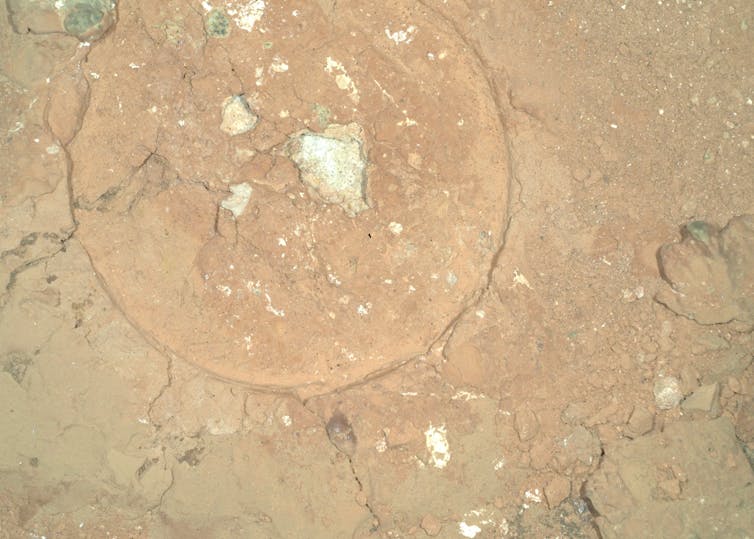
Perseverance
Perseverance with the Cheyava Falls rock.
Nasa JPL-Caltech

Notably, these reactions – especially sulphate reduction – don’t typically occur at the low temperatures this rock experienced over its history. Unless microbes are involved, that is. Microbial oxidation of organic matter can also produce phosphate minerals, like those found at Cheyava Falls.

Without getting samples back to laboratories on Earth, there’s only so much we can really know about what happened at Cheyava Falls four billion years ago. Even so, no entirely satisfying non-biological explanation accounts for the full suite of observations made by Perseverance.

The new paper does a good job of making this clear, considering the possibilities one by one. But in astrobiology, the lack of a non-biological explanation isn’t where life detection ends – it’s where it begins. History tells us that when we can’t think of a non-biological explanation for something, it’s usually not because there isn’t one. It’s just that we haven’t thought of it yet.

So what happens next? First, astrobiologists around the world must explore which oxidation-reduction reactions involving iron, sulphur, organic compounds, and phosphate can occur with and without biology under conditions relevant to Cheyava Falls.

Second, Nasa and other space agencies must provide bold leadership on the Mars Sample Return mission. Yes, it will be expensive – possibly tens of billions of dollars – but the payoff could be the most important scientific discovery ever made.

The Conversation

Sean McMahon has previously received funding from NASA.

ref. Signs of ancient life may have been found in Martian rock – new study – https://theconversation.com/signs-of-ancient-life-may-have-been-found-in-martian-rock-new-study-264960

Crashing black holes validate Stephen Hawking – new research

Source: The Conversation – UK – By Patricia Schmidt, Associate Professor of Physics, University of Birmingham

Black holes may be the fiercest objects in the universe, yet we still know very little about them. It has only been a decade since we confirmed their existence by detecting gravitational waves: ripples in the fabric of spacetime.

Since then, gravitational waves from colliding black holes have unveiled insights into their hidden physics and the theories that support them. On January 14, 2025, the loudest gravitational-wave signal ever detected, known as GW250114, was observed by the two Laser Interferometer Gravitational Wave Observatories (LIGO).

This remarkable event provided our international team of scientists with a golden opportunity to test two major predictions of Albert Einstein’s theory of general relativity with unprecedented precision: the nature of black holes and something called Hawking’s area law theorem.

The results, published in Physical Review Letters, mark a significant step forward in our understanding of gravity and black holes.

Black holes are a key prediction of general relativity, our leading theory for describing gravity. Astrophysical black holes form when a massive star reaches the end of its life and collapses under its own gravity, exceeding a certain mass called the Chandrasekhar limit (approximately 1.44 times the mass of the sun).

What remains is a region of spacetime completely disconnected from communication with the rest of the universe, bounded by a surface known as the event horizon – from which nothing can famously escape, not even light. But if black holes cannot send signals or light beyond this boundary, how can we be sure they exist and that they behave as predicted?

The power of gravitational waves

General relativity actually predicted the existence of gravitational waves in the first place. Any massive object that accelerates through spacetime will generate tiny distortions that propagate away at the speed of light. These waves encode a wealth of information about the source and the nature of gravity itself.

To produce gravitational waves strong enough to be detected, we need systems where massive objects undergo sustained and intense acceleration. One of the most powerful sources is a binary black hole, where two black holes orbit each other under the influence of gravity. As gravitational waves carry energy away from the system, the orbit will gradually shrink until the black holes eventually merge into a single, larger black hole.

Hence, by analysing gravitational waves from black hole binaries we can probe whether astrophysical black holes truly behave as predicted by general relativity.

Gravitational waves were first observed by the LIGO detectors on September 14, 2015, when they captured the collision of two black holes known as GW150914. Due to the rapid improvements in detector technology, we are now able to observe binary black hole mergers in ultra-high definition, enabling the single most stringent tests of general relativity and black hole physics to date.

Hawking’s theorem

Despite their mathematical complexity, black holes are surprisingly simple objects entirely characterised by their mass, rotation and (possibly) electromagnetic charge.

In 1972, Stephen Hawking published a seminal study showing that as two black holes merge, the surface area of the final event horizon must be larger than the sum of the surface areas of the two initial black holes. This is known as the area law.

One way to understand this is to realise that the surface area of the event horizon scales with the mass and spin of the black hole in very particular ways. If we double the mass of a black hole, its event horizon becomes four times larger. If we make the black hole spin faster, the event horizon will become more oblate (think of a rugby ball) and the surface area will decrease. For merging black holes, Hawking demonstrated that despite the loss of energy and angular momentum to gravitational waves, it will always result in a final black hole that has a larger event horizon.

GW250114 provided us with a golden opportunity to test Hawking’s predictions.
By analysing the gravitational-wave data with the best available models, our team has now validated the area law to high significance. This was possible through the detailed modelling of the “ringdown”, the final stage after the merger during which the remnant black hole emits gravitational waves in a characteristic pattern (known as quasi-normal modes).

This process is similar to striking a bell: the tones emitted depend on the material and shape of the bell, with the ringing of the bell encoding this information. By analysing the emitted sound, we can figure out the shape and material of the bell. For rotating black holes, we can do something similar using gravitational waves.

By analysing the emitted waves and all its harmonics, we can reconstruct the mass and spin of the black hole, and hence the surface area of the horizon.
With a signal this strong, we were able to carry out a comprehensive suite of tests probing different aspects of Einstein’s theory. In every case, the predictions of general relativity held firmly.

The observation of GW250114 offers the clearest validation yet of Einstein’s theory, validating some of its most profound predictions, including Hawking’s area law. This is still just the beginning, and the next decade promises to revolutionise our understanding of gravity and black holes even further.

The Conversation

Patricia Schmidt receives funding from UK Research and Innovation (UKRI) through grants ST/V005677/1 and ST/Y00423X/1, and The Royal Society through a Research Grant RGR1241327.

Geraint Pratten is supported by The Royal Society through a University Research Fellowship (URFR1221500 and RFERE221015), the UK Space Agency (grant ST/Y004922/1), and UKRI (grants ST/V005677/1 and ST/Y00423X/1).

ref. Crashing black holes validate Stephen Hawking – new research – https://theconversation.com/crashing-black-holes-validate-stephen-hawking-new-research-264995

Trump’s radical argument that he alone can interpret vague laws fails its first court test in dismissal of Fed governor

Source: The Conversation – USA – By Claire B. Wofford, Associate Professor of Political Science, College of Charleston

The firing of Federal Reserve board member Lisa Cook isn’t just about Lisa Cook − it’s about presidential power. DNY59/Getty Images

President Donald Trump’s penchant to act first, ask later was on full display recently when he became the first president in American history to fire a member of the Federal Reserve Board.

Trump’s axing of federal employees is nothing new – thousands have been terminated, including the heads of agencies that, like the Federal Reserve, are designed to be insulated from presidential control.

But in removing Lisa Cook, Trump has entered into a morass of legal questions and challenged long-standing beliefs about the power of the president to control the U.S. economy.

Trump’s action, if upheld by courts, would upend the Fed’s century-long practice of formulating the nation’s monetary policy free from political pressure. It also could affect the budget of every American household, with the cost of goods and services influenced by political ideology more than financial expertise.

As a scholar of the American courts, I believe that, depending upon how courts resolve the case, it could also mark a significant shift in the ability of the judicial branch to check executive power.

Two men in dark blue suits, one standing behind a lectern and microphone.
Before he fired Lisa Cook, President Trump had spent months publicly attacking Federal Reserve Board Chairman Jerome Powell, right.
Saul Loeb/AFP via Getty Images

This agency is different

The dispute with Cook reached the public on Aug. 20, 2025, when Trump-appointed director of the Federal Finance Housing Agency Bill Pulte announced on social media that he had made a criminal referral to the Department of Justice about potential mortgage fraud by Cook. The DOJ subsequently opened an official investigation.

After Pulte’s announcement, Trump posted, “Cook must resign, now!!!” She refused and was officially fired by Trump five days later.

Cook then filed suit in federal court on Aug. 28, asking U.S. District Judge Jia Cobb to issue an emergency order blocking her removal. Cobb did just that on Sept. 9, 2025.

Cobb’s order, however, will likely be appealed by Trump. In the meantime, Cook will stay on the job and participate in decisions made by the Fed, which is set to meet again on Sept. 16.

Among the multitude of cases about Trump’s ability to fire employees of federal agencies, this one is different – because the agency is different.

Created by Congress in 1913 after a series of banking panics, the Federal Reserve is charged with managing the nation’s economy. It acts as the national bank, monitors the health of other financial institutions, and, most critically, develops monetary policy, which includes setting interest rates, the primary tool with which it manages inflation and ensures long-term economic growth and stability.

Precisely because of the Fed’s power, presidents have often tried to influence it. Sharp criticism of its members is nothing new. Trump has an ongoing and very public fight with the chair of the Fed board, Jerome Powell, about interest rates.

But a president actually firing a board member is something else entirely.

Supreme Court warning

The Fed is just one of dozens of what are termed “independent agencies.” These are part of the executive branch but designed by Congress to operate insulated from the president’s preferences and pressure. Over time, precisely because it is so powerful, the Fed’s ability to act free from the president has become particularly sacrosanct.

The primary mechanisms through which Congress ensures agency independence are “removal provisions,” statutory directives that define when and why the president can fire agency leadership. The Federal Reserve Act, the law that creates the Fed and sets out its structure and mission, provides that members of the board, called “Governors,” serve 14-year terms, “unless sooner removed for cause by the President.”

“For cause” may sound familiar because its appearance in a different law also recently triggered litigation. That happened when Trump removed the heads of two other independent agencies, Gwynne Wilcox of the National Labor Relations Board and Cathy Harris of the Merit Systems Protection Board. The Supreme Court decided in April that the restriction on the president’s ability to fire those two independent agency heads violated Article 2 of the Constitution.


Read more:
Supreme Court ignores precedent instead of overruling it in allowing president to fire officials whom Congress tried to make independent


In that same opinion, however, the court took pains to specify that its ruling did not apply to the Federal Reserve Board. Calling the Fed a “uniquely structured, quasi-private agency” with a “distinct historical tradition,” the majority signaled to Trump that booting members off the Federal Reserve Board was a no-go.

When he fired Cook, Trump flouted this directive. A legal battle was inevitable.

Four people sitting at one end of a large wooden table, at a meeting.
Lisa Cook, second from right, at a Federal Reserve board meeting in Washington, D.C., on June 25, 2025.
Saul Loeb/AFP via Getty Images

What’s behind the case

The case is complex and involves questions about whether Cook’s termination violates a congressional statute and the due process clause of the U.S. Constitution.

Notably, the parties are not arguing about the constitutionality of the removal provision itself, as they were in the Wilcox case. Instead, the dispute centers primarily around the meaning of “for cause” – that is, what reasons can legally justify firing a board governor. Unlike other statutes, which use additional terms such as “inefficiency, neglect or malfeasance of duty while in office,” the Federal Reserve Act provides no further guidance.

Trump argues that the – alleged – mortgage fraud is sufficient “cause” to remove Cook, particularly from an agency charged with managing the nation’s finances. Cook claims that mere allegations about private conduct before she was appointed to the board cannot justify her termination, particularly when those allegations appear to be a pretext for a political disagreement.

But lurking in the background of this seemingly picayune fight over a single word in a 111-year-old statute are fundamental questions about separation of powers, checks and balances, and which branch of government determines the law.

‘Say what the law is’

Trump’s fuller argument is actually quite bold.

As he is doing in other lawsuits, the president is asserting that he – and he alone – gets to determine the meaning of “cause.” The term, his lawyers write, is “capacious” and its meaning is entirely vested by Congress in the president. No court can second-guess his judgment.

The claim is striking and seems to fly in the face of the country’s system of checks and balances. In addition, if the branch of government charged with carrying out the law – the executive branch – also gets to define it, separation of powers also appears to be left by the wayside.

Cook counters that judicial review of termination decisions is critical.

If courts abandon their responsibility here, she argues, they will obliterate the independence of the Federal Reserve and subject the national economy to the short-term whims of a president rather than the long-term vision of economic experts.

In her order blocking Trump’s removal of Cook, Judge Cobb declared that the court has a “responsibility to review” the president’s firing of Cook, rejecting Trump’s claim that the decision was immune from judicial oversight.

And given the clear and continued acquiescence of Congress to this president’s broad assertions of power, they would also remove what, at least until the next presidential election, may be the last remaining check on executive power.

The case will likely reach the Supreme Court this fall, and the outcome is hard to predict. Trump has benefited from a string of victories there issued by a conservative majority that believes strongly in executive power and judicial deference to the president.

At the same time, it will be difficult to ignore the sentiments about the independence of the Fed that those same conservative justices expressed in the Wilcox case and the potential economic consequences a ruling for Trump might generate.

The court’s ultimate decision may actually depend upon what role it wants to play in the country’s fraying democratic system. The legendary Chief Justice John Marshall famously wrote in 1803 that it is “emphatically the province and duty of the judiciary department to say what the law is,” a sentiment inscribed on the marble wall of the Supreme Court building in D.C.

This case provides the opportunity to see whether the maxim still holds true.

This story has been updated to reflect U.S. District Judge Jia M. Cobb’s Sept. 9, 2025, decision blocking President Trump from removing Cook from the Federal Reserve Board.

The Conversation

Claire B. Wofford does not work for, consult, own shares in or receive funding from any company or organization that would benefit from this article, and has disclosed no relevant affiliations beyond their academic appointment.

ref. Trump’s radical argument that he alone can interpret vague laws fails its first court test in dismissal of Fed governor – https://theconversation.com/trumps-radical-argument-that-he-alone-can-interpret-vague-laws-fails-its-first-court-test-in-dismissal-of-fed-governor-264566

2027 Nigerian poll could trigger unrest unless electoral commission is fixed

Source: The Conversation – Africa (2) – By Onyedikachi Madueke, Teaching Assistant, University of Aberdeen

Political activities heralding Nigeria’s 2027 general elections are beginning to pick up.

Politicians are limbering up, alliances are being whispered about, political war chests are being filled, and campaign narratives are being sharpened.

The country’s rapidly growing social mobilisation (online and offline) places great demands on the electoral system. Especially the referee – the Independent National Electoral Commission.

If it can’t deliver credible polls, the country risks sliding into political unrest.

In 2022, a new Electoral Act handed the commission new powers, legalised the use of election technology, and guaranteed its funding a year ahead of the polls.

But there were still reports of irregularities.

Flawed elections do more than produce disputed winners – they deepen cynicism, depress turnout, and risk violence.

Nigeria’s example matters. It’s Africa’s largest democracy. Its electoral standards influence the region. If 2027 repeats 2023’s failures, other west African leaders might feel they can treat election commissions as political tools.

My recently published research examined the factors constraining Nigeria’s electoral commission from conducting credible elections and safeguarding electoral integrity, using the 2023 polls as a case study.

The study identified four issues undermining the commission’s effectiveness: eroded autonomy, corruption, weak adherence to its own rules, and compromised personnel recruitment.

The commission needs legal reinforcement to shield it from state capture, improve its technological capacity, deepen civic engagement and accountability, and safeguard electoral integrity.

Why the commission struggles to deliver credible polls

For my study I interviewed senior electoral commission staff, representatives of political parties (the All Progressives Congress, People’s Democratic Party and Labour Party) and other political stakeholders. I also drew on materials from the commission’s website, relevant online sources, news reports, social media content, and official documents.

Some of the key issues identified include:

1.) Independence

On paper, the electoral commission is financially independent. But the real power lies in leadership appointments, which remain in the hands of the president, subject to Senate confirmation.

In practice, appointees are often politically connected, sometimes openly partisan. Civil society groups flagged these risks ahead of 2023, but partisan nominees still took up sensitive electoral posts.

This matters because leadership shapes decisions. The commission’s abandonment of real-time result uploads in the 2023 presidential poll – a core promise – fuelled suspicions of political influence.

2.) Corruption

Politicians and insiders alike admit that electoral officials, especially temporary staff, are routinely offered and often accept cash inducements. The euphemism is “sachet water” money. The impact is serious: turning a blind eye to vote buying, altering result sheets, or simply ensuring “friendly” polling officers are assigned to strategic locations.

The 2023 polls brought fresh allegations: from officials charging voters to collect their voter cards, to attempted bribes for changing the result figures.

3.) Technology

The biggest promise of 2023 was about technology. The biometric voter accreditation system and result viewing portal were designed to stop the familiar rigging playbook: stuffing ballot boxes, falsifying tallies, and “doctoring” results. The commission told voters that presidential results would be uploaded in real time. It didn’t happen.

On election day, the commission blamed “technical glitches” for the failure to upload presidential results. Oddly, the same system worked fine for National Assembly results cast the same day. Investigative journalists later uncovered glaring discrepancies between polling-unit figures and the results published on the portal.

Many believe abandoning the result viewing portal technology made it easier for the result of the 2023 presidential poll to be manipulated. This wasn’t just a technical hiccup; it was a breach of legal guidelines and public trust.

4.) Workforce

The electoral commission’s permanent staff is small; for a nationwide election, it leans on over a million ad hoc recruits. The recruitment process is vulnerable to political interference.

Training is inconsistent, with little formal induction for new permanent staff and ad hoc workers alike. As experienced staff retire without structured knowledge transfer, institutional memory weakens. Add in the temptation of bribes, and you have a workforce prone to both errors and manipulation.

Four reforms for a credible 2027 poll

If Nigeria is serious about credible polls, reform of the electoral commission must start now. Four priorities stand out:

1.) Merit-based leadership and staff recruitment: Remove the president’s sole power to appoint the commission’s top leadership. A multi-stakeholder panel should vet and nominate candidates. The commission must have a standing professional electoral service corps (career election officers) to replace the heavy reliance on temporary workers.

2.) Improve technology and enforce rule compliance: The commission needs a stronger ICT infrastructure, redundancy systems, and independent audits of its electoral technology. Publishing results promptly at the polling unit level (and protecting them from tampering) is critical. Update and integrate the voter register with biometric and national ID systems.

3.) Legal and dispute resolution: Pre-election litigation timelines should be tightened so that disputes over candidacy, party primaries and voter registration are settled well before election day. Post-election adjudication must also be concluded prior to inauguration.

Stricter penalties are necessary to end the culture of impunity surrounding electoral offences. Swift trials, stiff sanctions, and disqualification of political actors who benefit from malpractice should be enforced.

4.) Civic engagement and accountability: The commission must educate voters, particularly on issues such as vote buying, technology, and citizens’ rights.

Civil society observers, media and civic tech groups should get open access and be treated as partners.

Accountability reports before, during and after elections are essential to rebuild public trust and confidence in the electoral process.

Conclusion

The race for 2027 is already on, but the real contest isn’t between the parties or personalities. It’s between a compromised electoral institution and the reforms needed to make it worthy of public trust.

Nigeria needs to fix the electoral commission’s independence, root out its corruption, enforce its rules, and professionalise its workforce.

The Conversation

Onyedikachi Madueke does not work for, consult, own shares in or receive funding from any company or organisation that would benefit from this article, and has disclosed no relevant affiliations beyond their academic appointment.

ref. 2027 Nigerian poll could trigger unrest unless electoral commission is fixed – https://theconversation.com/2027-nigerian-poll-could-trigger-unrest-unless-electoral-commission-is-fixed-263974

Decision-making on national interest projects demands openness and rigour

Source: The Conversation – Canada – By Robert B. Gibson, Professor of Environment, Resources and Sustainability, University of Waterloo

The federal government is about to refer its initial selection of national interest project candidates to its new Major Projects Office. The news stirs both excitement and trepidation.

Projects considered in the national interest would “enhance Canada’s prosperity, national security, economic security, national defence and national autonomy,” the government says.

While the notion of national interest projects is compelling, success on the ground depends on thinking through the implementation. There’s little evidence that’s happened.

The enabling law — the Building Canada Act, hustled through Parliament in June — establishes separate decision-making steps for project approval and for approval conditions, but not much else. How the candidate projects will be evaluated is mostly unknown.


Read more:
Why the federal government must act cautiously on fast-tracking project approvals


Big project challenges

Major project development is notoriously difficult. That’s evident in the long global record of megaproject cost overruns and embarrassments. It’s not surprising, given the organizational, economic and technical complexities, inevitable trade-offs and opposition and attractive alternative uses for the money.

For the current initiative, additional practical difficulties include:

  • How to share implementation power and responsibility with many players, given the constitutional fragmentation of jurisdictional authority;

  • How to respect Indigenous rights and consent;

  • How to cover the multitude of linked factors that should inform overall public-interest evaluations and justifications for decisions;

  • How to achieve reasonable reliability in predicting the positive and adverse effects and their distribution, especially for projects expected to induce further activities;

  • How to draw well-supported conclusions about project viability, serious opportunities and risks, costs and legacies, in an uncertain global economic, geopolitical and climate context; and

  • For non-renewable resource projects, how to use limited-life gains to build more lasting well-being, while avoiding dependencies, stranded assets and toxic legacies.

Dealing with all these matters entails careful elaboration of the Building Canada Act’s basic two-step process for decisions on national interest projects.

It also requires a departure from the approach so far, which has identified potential candidates through a cloaked process involving proponents and relevant political jurisdictions without published criteria for evaluating the projects or clear plans for the deliberations to follow.

Defensible evaluations and decisions

Before candidates are referred to the Major Projects Office, all parties would benefit from the publication of a well-defined, open and rigorous approach that ensures defensible evaluations and decisions.

As set out with few specifics in the Building Canada Act, the two decision-making steps are:

  1. Evaluations leading to a determination on whether to pre-approve the candidate project;
  2. Expedited assessment and provision of permits to consolidate the conditions of approval.

The sequence seemingly ignores the normal process where assessment precedes approval (first consider, then decide). In practice, however, defensible decision-making in Step 1 must have detailed project information and a strong overall assessment of the project’s benefits, risks and uncertainties.

That’s a basic necessity if the government wants decisions on the pre-approval of projects to be well-founded and justifiable, and if the project planning is to be far enough advanced to be ready for the for Step 2’s expedited process for conditions of approval.

Process essentials

For Step 1, the Major Projects Office should provide specifics on the following requirements for decision-making on pre-approval:

  • Well-elaborated, comprehensive and visibly applied criteria for evaluations;

  • Detailed project information;

  • Analyses covering specifics on all the key considerations and their interactions;

  • Mobilized expertise for due diligence rigour in evaluating project viability, opportunities, risks and trade-offs;

  • Special imperatives for responsibility in allocating public funding;

  • Solidly defensible decisions, clearly based on well-informed analyses, while also respecting controversies and uncertainties;

  • Credible transparency and meaningful engagement;

  • Detailed project readiness for the expedited conditions and the permits process; and

  • Clarity about how other authorities are involved in Step 1 and will collaborate, especially in joint assessments, in Step 2.

One project, one assessment

The final point above may present the greatest challenges and opportunities.

The federal government has emphasized a commitment to “one project, one assessment” that will apply often. But many of the reported candidate projects involve several jurisdictions.

Perhaps in a few cases, one assessment could be achieved by deferring largely to a single provincial or territorial process. But where two or more provinces, territories and/or Indigenous jurisdictions are involved — or the project depends on significant federal funding — a joint assessment process is necessary.

Exemplary joint assessments have been conducted in Canada before. Doing so today for fast-tracked mega-projects would be a major accomplishment, especially if those joint assessments prioritize best practices and respect Indigenous rights, including the right to give or withhold free, prior and informed consent.


Read more:
‘Elbows up’ in Canada means sustainable resource development


Rigour and transparency

In sum, what’s needed now is detailed elaboration of the process for the initial group of identified candidates for national interest projects. That process should incorporate all the components listed above, including a comprehensive and credible equivalent of assessment before the first step’s pre-approval decision.

Such an approach is consistent with the the Building Canada Act and stated policy. Perhaps that’s been the federal government’s intention all along. If so, it must ensure the process is transparent to ensure the understanding and confidence of all participants.

Political enthusiasm is a useful stimulant but a poor guide and a risky base for deliberations and decisions on major projects. Judging the opportunities and risks of national interest projects is important and difficult. It’s time for an open and rigorous process.

The Conversation

Robert B. Gibson has received funding from the Social Sciences and Humanities Research Council of Canada and the Impact Assessment Agency of Canada. He is a member of the Agency’s Technical Advisory Committee.

ref. Decision-making on national interest projects demands openness and rigour – https://theconversation.com/decision-making-on-national-interest-projects-demands-openness-and-rigour-264755