Curious kids: do owls have bogies?

Source: The Conversation – UK – By Louise Gentle, Principal Lecturer in Wildlife Conservation, Nottingham Trent University

Is someone asking about my bogies? Anan Kaewkhammul

Do owls have bogies?

Ravine, aged three, Glasgow

Hi Ravine,

The quick answer is yes, but the interesting thing is why.

Bogies, or boogers as they are known in some countries, are made from nasal mucus – you probably call this snot. Snot is produced by your nose and is really important as it helps to trap dirt, germs and other nasty things. This stops these nasty things from going into your body, causing damage and making you ill. Snot also has antibodies in it – special white blood cells that help your body to fight infections. So, snot is super useful for protecting our bodies.


Curious Kids is a series by The Conversation that gives children the chance to have their questions about the world answered by experts. If you have a question you’d like an expert to answer, send it to curiouskids@theconversation.com and make sure you include the asker’s first name, age and town or city. We won’t be able to answer every question, but we’ll do our very best.


Snot is also vital to help us to smell things. The mucus traps tiny scent particles that are then transported to special smell receptors in the nose. These allow us to identify different odours like food, which is especially important to help wild animals survive.

Some animals have an amazing sense of smell, much better than ours. Elephants use theirs to sniff out food and water, detect predators, and even recognise their family. But, when animals have a cold, a lot more snot is produced, and this interrupts the ability to smell things properly.

Bogies are just dried snot that collects in nostrils.

Which animals make snot?

All organisms need to protect themselves, and all have a sense of smell. So, all have some sort of snot. Some animals have huge noses and nostrils, so produce loads of snot – these include cows, horses and rhinos. Some animals have a limited sense of smell – animals such as dolphins and snakes taste smells rather than sniff them.

Some animals even include snot in their diets. The vampire squid feeds on marine snow in the oceans. This is made of snot but also poo and dead things. The vampire squid gathers up the falling bits of snot, then once it has collected enough, it eats it.

The marine iguana is one of the sneeziest animals. They produce lots of snot to help them get rid of the large amount of salt they eat from their favourite food, seaweed.

Iguana underwater eating algae off a rock.
Marine iguanas like to eat algae and seaweed,
MDay Photography/Shutterstock

Bird bogies

Animals that rely on their sense of smell produce more mucus – dogs are expert sniffers and are known for having a wet nose. But most birds don’t have a very good sense of smell. This is because they get most information that they need to survive from other senses such as sight and hearing.

As most owls hunt their prey at night, they tend to rely on their amazing sense of hearing rather than their other senses. This means that they don’t use their sense of smell as much as many other animals. So they don’t need to produce loads of snot, but they still make some, and they still have bogies. Their poor sense of smell might explain why I, and my friends who do conservation studies on owls, have never seen an owl with a bogie. We’re going to look more closely now, though!

There are some bird species that rely on a good sense of smell. Kiwis are flightless birds that live in New Zealand. They have long, thin beaks and an excellent sense of smell, and can sniff out earthworms in the soil.

Kiwi bird with long beak.
Kiwi birds have long beaks.
kosala000000/Shutterstock

Turkey vultures are also known for their amazing sense of smell. They can smell food such as carcasses from miles away, finding rotting flesh underneath leaves just as quickly as flesh that is out in the open.

Some seabirds use their noses to produce a map of smells to recognise where they are. This is useful on long migratory journeys across the open ocean where there are no features to help them to navigate.

Like the sneezy marine iguanas, seabirds need to get rid of the salt that builds up in their bodies from the seawater they drink and the salty prey they eat. These birds often look like they have a constantly runny nose, with mucus dripping from their nostrils. But the mucus actually comes from salt glands near their eyes.

All of these birds produce lots of snot to help them to smell.

Which animals pick their bogies?

Scientists found that over 90% of people admit to picking their nose. Teenagers seem to pick their nose an average of four times a day – gross!

Nose picking also happens in primates such as gorillas, chimpanzees and lemurs. Recently, an aye-aye – a creepy-looking animal with a super long middle finger – was filmed picking its nose and eating the bogies.

Lemur with one long finger perched on a tree.
Aye-ayes have been filmed picking its nose.
Harsha_Madusanka/Shutterstock

Only animals with fingers can really pick their bogies. Nobody is quite sure why animals pick bogies, but it might be because when snot dries it can sometimes be uncomfortable and block our noses, so picking is done to help us breathe more easily.

The Conversation

Louise Gentle works for Nottingham Trent University.

ref. Curious kids: do owls have bogies? – https://theconversation.com/curious-kids-do-owls-have-bogies-264514

Working with local communities is a vital part of wildfire response

Source: The Conversation – Canada – By James Whitehead, Researcher, Mitigating Wildfire Initiative, Simon Fraser University

As a young supervisor of a wildfire crew, I (James Whitehead) had no idea what to do. My crew had arrived at a high-profile fire in southern British Columbia in 2021 and were immediately accosted by locals, who told me in colourful language that they did not feel protected by firefighters and had no use for us.

This occurred before I had seen the fire, developed a strategy or briefed my crew. I quickly realized my role was not just firefighter but also to be a mediator, relationship-builder and community advocate.

This experience is not unique. In B.C., despite provincial investments and increased capacity, some wildfire seasons can push even the best crews and agencies to the limit.

Sometimes, this means community members feel the need to help with wildfire response. For some, it’s about protecting an intergenerational connection to the land, whether it be their traditional territories or properties. For others, it’s avoiding the loss of their livelihood, culturally significant sites, or legacy to pass onto the next generation. These messages are reiterated by locals on the frontline.

Mike Robertson, a resident of Southside near François Lake, B.C. and a senior advisor to the Cheslatta Carrier Nation that experienced fires in 2018, described it this way: “If they [community members] wouldn’t have stayed…this whole community would have burnt.”

Across Canada, tensions often flare between fire agencies and community members who choose to stay and protect their livelihoods, homes and land. In B.C., Tsilhqot’in, Secwépemc, Nadleh Whut’en and the North Shuswap communities, among others, all describe this tension and the weight of responsibility to protect their communities.

However, the presence of locals scattered across a fire area can be disruptive and dangerous for responders. Not knowing where people are can interfere with the removal of hazardous trees or aerial water drops. Without co-ordination, the public can work at cross purposes with responders, and sometimes need to be rescued themselves, removing professionals from firefighting work.

The challenge is not firefighting capacity nor convincing people to help; it is co-ordinating efforts into a formalized fire response system that prioritizes safety and efficiency.

From conflict to collaboration

During that 2021 fire, what stayed with me was not the initial hostility but the desire to help that emerged over the next week. I soon realized that residents wanted to work in whatever capacity they could.

In 2022, the BC Wildfire Service launched the Cooperative Community Wildfire Response program (now called Community Response) in collaboration with the First Nations Emergency Services Society, Indigenous Services Canada, the BC Cattlemen’s Association, the University of British Columbia and the Fraser Basin Council.

This program creates and strengthens pathways for Indigenous and rural and remote communities to participate safely and effectively in wildfire response, ensuring they have the training, equipment and opportunities to do so.

These pathways emerged from calls by wildfire-impacted communities, and research and engagement through the Community Response Project. Communities highlighted the capacity they had to support firefighters — from local knowledge, to trusted community leaders, training and experience, and equipment and infrastructure.

A recent example of this occurred with the Merritt Snowmobile Club sharing knowledge, webcams and local values with the BC Wildfire Service in an excellent example of successful partnership.

Community leadership is often overlooked and undervalued because of missing communication pathways. The ability to communicate must extend from agency and community leadership to the front lines so firefighters and residents are prepared to work safely and respectfully alongside each other.

Too often, the agency-community dialogue starts only when a community is threatened by a fire. Many of the same skills that aid a community in wildfire response can be used and developed through proactive mitigation such as emergency planning, hazardous fuel reduction, or the FireSmart program. This strengthens resilience and builds relationships between locals and agencies that are vital during wildfire response.

Locally appropriate approaches

The Community Response program has shown: capacities and priorities vary widely. Some communities have prioritized developing community emergency response organizations, such as the 14 in the Thompson-Nicola Regional District funded in 2025 or the Chinook Emergency Response Society, which was created by residents in Southside near François Lake, B.C., after the 2018 fires. Others have built wildfire capacity within existing structural fire departments.

Some Indigenous communities help their members participate in BC Wildfire Services’ First Nations Bootcamps, or host their own initial response group, like Simpcw Indigenous Initial Attack.

As Ron Lampreau, fire chief of the Simpcw First Nation’s volunteer fire department, reflected on the community’s response:

“As a result of the strain placed on provincial resources during the devastating wildfires of 2017 and 2018, Simpcw recognized the need to establish its own emergency response capacity… By equipping our community members with the necessary skills and knowledge, we can build a more resilient community and enhance our ability to respond to emergencies.”

While progress is being made, this shift is long-term and complex. Programs require sustained funding, commitment from individuals and organizations and trust. The programs don’t always work for some communities that may face capacity and financial constraints or not see their needs reflected. It is imperative that these programs continue to evolve.

Building relationships is essential for a whole-of-society approach. That work should continue year-round, engaging and valuing communities in both mitigation and response. Honouring the knowledge, leadership, and contribution of communities — alongside that of agencies — highlights that people are the most important asset for addressing our escalating wildfire risk.

As Fire Keeper Joe Gilchrist said: “There’s so much work that needs to be done that partnerships have to be made.”

The Conversation

James Whitehead’s research was funded by the University of Northern British Columbia and the Regional District of Fraser-Fort George.

Kelsey Copes-Gerbitz’s research was funded by a grant from the BC Wildfire Service and in-kind support from the First Nations Emergency Services Society and Indigenous Services Canada.

ref. Working with local communities is a vital part of wildfire response – https://theconversation.com/working-with-local-communities-is-a-vital-part-of-wildfire-response-262703

When robots are integrated into household spaces and rituals, they acquire emotional value

Source: The Conversation – Canada – By Zhao Zhao, Assistant professor, Computer Science, University of Guelph

Social companion robots are no longer just science fiction. In classrooms, libraries and homes, these small machines are designed to read stories, play games or offer comfort to children. They promise to support learning and companionship, yet their role in family life often extends beyond their original purpose.

In our recent study of families in Canada and the United States, we found that even after a children’s reading robot “retired” or was no longer in active and regular use, most households chose to keep it — treating it less like a gadget and more like a member of the family.

Luka is a small, owl-shaped reading robot, designed to scan and read picture books aloud, making storytime more engaging for young children.

In 2021, my colleague Rhonda McEwen and I set out to explore how 20 families used Luka. We wanted to study not just how families used Luka initially, but how that relationship was built and maintained over time, and what Luka came to mean in the household. Our earlier work laid the foundation for this by showing how families used Luka in daily life and how the bond grew over the first months of use.

When we returned in 2025 to follow up with 19 of those families, we were surprised by what we found. Eighteen households had chosen to keep Luka, even though its reading function was no longer useful to their now-older children. The robot lingered not because it worked better than before, but because it had become meaningful.

LingTech Inc. presents the features of its reading robot, Luka.

A deep, emotional connection

Children often spoke about Luka in affectionate, human-like terms. One called it “my little brother.” Another described it as their “only pet.” These weren’t just throwaway remarks — they reflected the deep emotional place the robot had taken in their everyday lives.

Because Luka had been present during important family rituals like bedtime reading, children remembered it as a companion.

Parents shared similar feelings. Several explained that Luka felt like “part of our history.” For them, the robot had become a symbol of their children’s early years, something they could not imagine discarding. One family even held a small “retirement ceremony” before passing Luka on to a younger cousin, acknowledging its role in their household.

Other families found new, practical uses. Luka was repurposed as a music player, a night light or a display item on a bookshelf next to other keepsakes. Parents admitted they continued to charge it because it felt like “taking care of” the robot.

The device had long outlived its original purpose, yet families found ways to integrate it into daily routines.

‘Domesticating’ technologies

The way participants treated Luka challenges how we usually think about technology, which is that gadgets are disposable. A new phone replaces an old one, toys break and get thrown away and laptops end up in e-waste bins. But when technologies enter family life, especially around emotionally significant moments like storytime, they can become part of the household in lasting ways.

Our research findings also have important implications for design. Should robots come with an end-of-life plan that recognizes their emotional value? Should companies design with the expectation that some products will be cherished and repurposed, not just discarded and replaced?

There are environmental dimensions, too. If families hold on to robots because of attachment, fewer may end up in landfills; this complicates how we think about sustainability and recycling when devices are treated more like keepsakes than tools that may outlive their usefulness.

Scholars who study human-computer interaction often use the term “domestication” to describe how technologies become embedded in everyday routines and meanings.

More than machines

Our study extends that idea to what happens when technology retires. Luka was no longer useful in the conventional sense, but families still made space for it emotionally, symbolically and practically.

Many of us keep objects for sentimental reasons, long after they have served their original purpose. Luka shows us that robots can become more than machines.

Technology is often framed as fast-moving and disposable. But sometimes, as these families revealed, it lingers. A retired robot can stay in the household because it matters.

The Conversation

Zhao Zhao does not work for, consult, own shares in or receive funding from any company or organisation that would benefit from this article, and has disclosed no relevant affiliations beyond their academic appointment.

ref. When robots are integrated into household spaces and rituals, they acquire emotional value – https://theconversation.com/when-robots-are-integrated-into-household-spaces-and-rituals-they-acquire-emotional-value-263848

Charlie Kirk shooting: another grim milestone in America’s long and increasingly dangerous story of political violence

Source: The Conversation – UK – By Katie Pruszynski, PhD Candidate, Department of Politics and International Relations, University of Sheffield

Charlie Kirk, figurehead of the American far right, took a question at a 2023 event in Salt Lake City about the second amendment to the US constitution and gun-related deaths. He answered: “I think it’s worth to have a cost of, unfortunately, some gun deaths every single year, so that we can have the second amendment to protect our other God-given rights.”

Two years later, once again in Utah, Kirk was killed with a gun. His death comes against a backdrop of increased political violence in the US, driven by a new set of political, societal and technological factors, and its future trajectory will determine the health of American democracy.

Political violence is differentiated from other crimes and it is helpful to have clarity about its particular meaning. It is defined specifically as acts intended to achieve political goals or intimidate opponents through the use of physical force or threats to influence a political outcome or silence dissent. While most of these incidents come from the far right, violence is used by extremists on both sides.

Over the past decade there has been a dangerous escalation in political violence driven by rage and resentment without clearly defined goals by self-radicalised individuals rather than organised extremist groups. High profile incidents have dominated headlines. These include the insurrection of January 6 2021, the shooting at a baseball practice session of Republican members of Congress in 2018, the plot to kidnap Michigan governor, Gretchen Whitmer in 2020, the vicious attack on Paul Pelosi – the husband of the speaker of the House of Representatives – in 2022, the torching of Pennsylvania governor Josh Shapiro’s family home in April this year. And, of course, the assassination attempts on Donald Trump on the campaign trail in 2024.

But the threat has spread beyond the very visible faces of US democracy to targets such as judges, election officials, journalists and even private citizens based upon their perceived political affiliation.

It is shocking yet unsurprising, given the new factors fuelling rage in an already deeply divided society. These can be broadly summarised by three characteristics.

Hyper-partisanship at boiling point

The way politics is discussed today shows that division can’t be seen in merely partisan terms. Opponents have become enemies and those with different worldviews have become traitors. In many examples, pundits, politicians and their mouthpieces indulge in dehumanising rhetoric. Research has consistently found that dehumanisation contributes to a more ready justification of violence.

Indeed, Trump and other high-profile figures have incited violence, even when not actually issuing direct calls to action. This was most notably evident on January 6 2021, when Trump goaded supporters in Washington to march on the Capitol, telling them: “And we fight. We fight like hell. And if you don’t fight like hell, you’re not going to have a country anymore.”

Fight like hell: Donald Trump’s ‘Save America’ rally.

Digital echo chambers

These pressure cooker arguments play out on social media and online forums that help spread conspiracy theories, disinformation and violent content. Highly influential creators are able to conjure up “bespoke realities” for their followers, generating huge personal wealth from the fomenting of rage and hate. Citizens are consuming deeply flawed, incendiary political content in isolation. This fuels self-radicalisation when people become detached from reality of the world outside their bubble.

Indeed, immediately following the Kirk shooting, social media was already awash with disinformation about liberals celebrating his death and the motivations of the killer before the shooter had been found.

Erosion of trust in democracy

When faith in government, the justice system, and the electoral process erodes, citizens may come to believe that the established systems are rigged, unresponsive, or illegitimate. This makes traditional avenues for change seem futile. In this environment, violence can be rationalised as the only effective means to “correct” the broken system. The American right has long railed against a corrupt and malevolent “deep state” convincing some citizens that democratic norms no longer apply.

What next? There are three possible scenarios. The worst case is an escalation of violence in both its frequency and its organisation.

The far right has been pushing for strict limits on civil liberties, and the most extreme members may use Kirk’s assassination as an excuse for violent retaliation. Widespread civil unrest is a persistent threat, particularly approaching the 2026 midterm elections. Many fear that if Trump’s allies sense they can use escalating disorder to declare an emergency suspension of democratic processes, they will push him to do so.

More likely, but no less unsettling, is a stagnation in which political violence becomes a normalised feature of American political life without escalating to an existential crisis. This has potentially far-reaching consequences as more moderate politicians on both sides perceive the risks of being in public life to be too high and vacate their offices. This paves the way for more extreme candidates to fill the gaps. With the more moderate voices gone, it’s less likely the conversation will cool down.

But things could improve. It will require bipartisan condemnation of political violence and a reconnecting of politicians to their constituents. Both sides need to work together to drag a bigger portion of the political debate back into the real world. Meanwhile social media platforms and the legacy media alike must be held accountable for the tenor and veracity of the content they feed to the public.

And efforts must be made by political elites, the media and the public to rebuild civic trust. As the foundation stone of a healthy democracy, citizens’ trust in their government and in each other must be carefully pieced back together.

America does not need to accept violence as the norm, in fact, it must collectively and consistently reject it. The future of its democracy may depend on it.

The Conversation

Katie Pruszynski does not work for, consult, own shares in or receive funding from any company or organisation that would benefit from this article, and has disclosed no relevant affiliations beyond their academic appointment.

ref. Charlie Kirk shooting: another grim milestone in America’s long and increasingly dangerous story of political violence – https://theconversation.com/charlie-kirk-shooting-another-grim-milestone-in-americas-long-and-increasingly-dangerous-story-of-political-violence-265115

Charlie Kirk: why the battle over his legacy will divide even his most ardent admirers

Source: The Conversation – UK – By Gordon Lynch, Professor of Religion, Society and Ethics, University of Edinburgh

Wherever you stand on his political views, Charlie Kirk’s murder is a tragedy on a personal level. He was just 31 and a husband and father of young children. But as a public figure his death represents a dangerous moment, as it threatens to deepen divides between conservatives and liberals in America and beyond.

Many commentaries on Kirk’s life will focus on his significance as a political activist and the important – some would say decisive – role he played in turning out the youth vote for Trump’s presidential election victory in 2024. But it is important to recognise how significant he had become as a public leader for what a growing number of scholars have referred to as white Christian nationalism.

While there is some variation in political views and theological beliefs among white Christian nationalists, a central, shared conviction is that the US was originally established as a Christian nation. For Christian nationalists, the idea of the separation of church and state is taken to refer only to not having an official state church. The complete separation of Christianity from public institutions is anathema and secular institutions such as public schools and universities are often regarded as hostile ground.

Given their view of America’s original religious calling, many Christian nationalists therefore believe that secular, liberal society is in terminal crisis. So America will only be put right when it returns to Christian laws or principles. This view of political disagreement is inherently binary. There are those who trust in God and support God’s work to transform society. Then there are those who oppose it. These people are mired in spiritual darkness.

Kirk’s Christian nationalist views and activism were not always comfortable watching. For example, along with others on the Christian right, Kirk publicly and vehemently challenged the place and legacy of Martin Luther King Jr, a hugely honoured figure in the US. In 2024, he chose the week in which the US celebrates a national holiday in honour of the murdered civil rights leader to label King “a serial adulterer, an alleged rapist, a reparations proponent, and a race Marxist”.

His organisation, Turning Point USA, also created Professor Watchlist. This online resource encouraged conservative students to name and shame college professors who had what were judged to be problematic views or activism linked to categories including “antifa”, “socialism” and “feminism”.

But while there is an element to white Christian nationalism which risks overturning basic democratic principles (as shown by the insurrection of January 6 2021), Kirk also had a better legacy. He became widely known on social media for his roadshows on college campuses which invited students to debate with him. He would put forward his views robustly, but also listened to his opponents.

These roadshows could be challenging for more liberally inclined students unused to having to defend their views. But at their best they provided surprising opportunities to find common ground. In one filmed discussion, for example, a feminist student had an engaged and respectful discussion with Kirk about his views about essential differences between men and women. They also agreed about the harmful effects of some forms of masculinity and the normalisation of pornography in youth culture. He maintained this commitment to these open public events despite the risks involved. It ultimately cost him his life.

Charlie Kirk debates a student.

Debate over Kirk’s legacy

This ambivalence between conflict and democratic engagement in Kirk’s work and the wider Christian nationalist movement is now finding expression in responses to his murder. On Fox News, as news of his death broke, shocked and distressed reaction nonetheless highlighted an interesting divide in the commentary. There were those who wanted to see this a turning point in the battle against the side of evil, the people who opposed his Christian mission. But others saw in his legacy a commitment to engagement and debate with those whom he disagreed with.

It remains to be seen which side of this legacy wins out. It should be observed, however, that much of Kirk’s following takes its cues from the current incumbent of the White House, whose instinct is usually to lean into division. And it was not different when the US president expressed his grief and anger at Kirk’s assassination, blaming the “radical left” for rising political violence in the US.

Most of the American people are neither ardent liberals nor committed Christian nationalists. But there is an ever-deepening political divide between those on the political left and right who no longer see each other as decent, trustworthy fellow citizens. As the political scientists Steven Levitsky and Daniel Ziblatt have argued, such polarisation is often a route to the death of true democracy.

At this moment of crisis, America – and the watching world – need to hope and work hard to ensure that Kirk’s legacy of democratic engagement and debate wins out. If this does not happen, the future for America is looking bleaker today.

The Conversation

Gordon Lynch does not work for, consult, own shares in or receive funding from any company or organisation that would benefit from this article, and has disclosed no relevant affiliations beyond their academic appointment.

ref. Charlie Kirk: why the battle over his legacy will divide even his most ardent admirers – https://theconversation.com/charlie-kirk-why-the-battle-over-his-legacy-will-divide-even-his-most-ardent-admirers-265116

Charlie Kirk was emblematic of a country polarised and imploding

Source: The Conversation – UK – By Melissa Butcher, Professor Emeritus, Social and Cultural Geography, Royal Holloway University of London

In December 2021, I was in an exhibition hall in Phoenix, Arizona, with 10,000 young people who had come to hear a lineup of “America first” speakers, from Tucker Carlson to Ted Cruz. This was AmericaFest, an annual rally led by Turning Point USA, a conservative youth organisation whose founder and CEO, Charlie Kirk, was murdered on September 10.

I have spent the past four years listening most days to Kirk’s view of the world while carrying out research for my upcoming book, The Trouble With Freedom. He was charismatic, combative and at times inflammatory. But he was also strategic and clever.

He loved the US, freedom, family and football, and possessed an immense drive to “save America” from what he felt was its decline from greatness. With a national radio show and speaking tours focused on university campuses, his platform reached millions. There were times when he disseminated disinformation, but there were also times when I found myself agreeing with him.

Kirk was emblematic of a country polarised and imploding. At AmericaFest, and across a constellation of organisations and commentators working to “save freedom, save America”, the US is divided into those who are “loved” and those who are “hated”. This division is mirrored in progressive or liberal spheres.

Retribution is threatened and others are blamed. Opposing sides, each struggling for “the soul of the nation”, define the other by emotional indicators such as “angry”, “bitter”, “miserable”, “destroying”, “vicious”, “menacing”, “thugs”, “extremists”, “resentful”, “weak” or “unhinged”.

These sentiments serve a purpose. As cultural theorist Sara Ahmed argued in her 2004 book, The Cultural Politics of Emotion, it is through intensifying emotions that an “other” takes shape.

But while sharing emotions – rage as well as love – creates bonds, it also drives us away from others. This was something I experienced at AmericaFest as presenters repeatedly told the 10,000 young people present that people like me – childless, unmarried, atheist academics – hated them for being conservatives.

As people arrange themselves – where they live and who they socialise with – on the basis of how they feel, the end result can be a form of “partisan segregation”. Democrats and Republicans now appear increasingly unlikely to live with those who hold different political views.

Faced with rapid and profound changes, the idea of America and what it represents – freedom and prosperity – is slipping out of reach for some. This is creating feelings of loss and anger. In discussions I held with people from across the political spectrum, in social clubs, shooting ranges, workplaces and homes, people named points of cultural rupture.

Conversations were haunted by a feeling that community is breaking down. The promise of an affluent future is disappearing in the face of environmental collapse and successive financial crises. Deindustrialisation and the shift to a digital economy brings with it precarity. And fractious governance oversees divisions along generational, gendered, class, racial, religious, and rural and urban lines.

How people live together, and how they remember, has changed. The result is an anxiety-inducing realisation that safety can be contingent, random, luck of birth or where you happen to sit on a bus. Cultural breakdown can be watched incessantly, on repeat and archived for future reference as we doom scroll on our phones.

Responses to this rupturing and reshaping of life that was once taken for granted can range from psychological discomfort to murderous rage, as the world has just seen with Kirk’s assassination.

The US president, Donald Trump, understands this response and exacerbates it. He focuses on law and order, dystopian cities and out of control borders. He talks of a third world war not being far away, increasing anxiety and the subsequent desire for firmer ground, or a strong leader, to hang on to.

“Liberal” criticism of nationalist or populist responses neglects the pain some feel in managing change and the fears of being unsafe that go with it. This entrenches divisions further. More than just “angry Trump supporters” suffering from the loss of conservative leadership, the 2024 US election results suggest there is a broad spectrum of people who felt uncomfortable with a changing America that Democrats were held responsible for.

This is what Kirk tapped into and is encapsulated by Ines, one of the gen Z participants in my research. She said “generations that are growing up now don’t know a world where there wasn’t a school shooting every week … we were born into disaster and like our world is literally dying. So it’s like our generation doesn’t know a time when things were safe and comfortable.”

These divisions – alongside increasing inequalities, the misinformation and disinformation spread on social media and paralysed political systems – appear to be sending us collectively backwards into violent autocracy.

Even if it doesn’t feel like it right now, we can find ways to handle change and the emotions that come with it. In every conversation I’ve had across the political spectrum in the US, people talk about wanting to be part of something bigger – to care about more than just themselves, or to feel safe again through community. There’s a longing to bring back a sense of connection and care.

Even at their most angry, conversations indicated a desire to live in meaningful, caring relationships. Without a doubt, too much love and the boundaries of community become hard and less adaptable to change. But connection can also hold the potential to work against feelings of loss, ambivalence, hate and subsequent violence.

The Conversation

Melissa Butcher has received funding from UKRI and the ECR. She is affiliated with Cumberland Lodge.

ref. Charlie Kirk was emblematic of a country polarised and imploding – https://theconversation.com/charlie-kirk-was-emblematic-of-a-country-polarised-and-imploding-265094

Beyond lavender marriages: What queer unions and relationships can teach us about love and safety

Source: The Conversation – Canada – By Gio Dolcecore, Assistant Professor, Social Work, Mount Royal University

Lavender marriages, traditionally entered into by LGBT+ individuals to conceal their sexual orientation, are on the rise, according to several news sources, with some even calling them a “trend.”

Historically, lavender marriages refer to unions — often between two consenting LGBT+ individuals — formed as a way of concealing same-sex attraction in a society where being openly queer could mean social ostracism, career ruin or even criminalization.

Crucially, they were not loveless. On the contrary, they were bonds of protection and safety between two people navigating the reality of bias, prejudice and discrimination of society and politics.

Lavender marriages can be confused with mixed orientation marriages, but there is a difference: in mixed-orientation marriages, partners have different sexual orientations from one another. That doesn’t mean these relationships don’t make sense — plenty of couples do well without sharing the same orientation.

But are lavender marriages actually making a comeback? The answer is complicated. While social progress has made queer lives more visible, many still fear coming out because of social, religious, cultural and political pressures.


Dating today can feel like a mix of endless swipes, red flags and shifting expectations. From decoding mixed signals to balancing independence with intimacy, relationships in your 20s and 30s come with unique challenges. Love IRL is the latest series from Quarter Life that explores it all.

These research-backed articles break down the complexities of modern love to help you build meaningful connections, no matter your relationship status.


The roots of lavender marriages

Nowhere were lavender marriages more visible than during Hollywood’s Golden Age (1930-60s), when the Motion Picture Production Code — known as the Hays Code after the president of the Motion Picture Producers and Distributors of America from 1922 to 1945 — imposed restrictions on “immorality” and demanded that stars maintain a carefully constructed image.

For example, the 1933 film Queen Christina portrayed an androgynous queen who shared a kiss with another woman. If the film were released a year later than it was, the androgynous image and kiss would have had to be removed to comply with Hays Code.

Notable examples in Hollywood include actor Rock Hudson, whose studio reportedly orchestrated a marriage to shield his private life from public scrutiny, and stage actress Katharine Cornell, whose marriage to director Guthrie McClintic was widely regarded as a partnership of convenience that allowed both to live more authentically in private.

Earlier still, silent film idol Rudolph Valentino faced speculation about his sexuality, and was rumoured to have entered into marriages that offered him protection amid tabloid attacks.

For these celebrities, lavender marriages were not only about survival in a hostile era, but also a way of retaining access to their careers, audiences and cultural influence.

Queer censorship today

It is unsurprising that lavender marriages have returned to public discussion, given that similar concerns of queer censorship are currently happening.

Inside Out 2 (2024) was rumoured to remove a transgender character to avoid international backlash, while Elio (2025) was also rumoured to erase queer subtext from the movie’s final cut.

Censorship of queer culture is on the rise as political and social movements directly attack the LGBTQ+ community. Examples include book censorship policies, exclusion of queer art and rising violence against drag performances.


Read more:
We must all speak out to stop anti-LGBTQ legislation


These realities were poignantly illustrated in the 2022 Pakistani film Joyland, which captures the grief and danger of living inauthentically when family bonds, social safety and political punishment are at stake.

Trailer for the 2022 film ‘Joyland.’

Similar stories are surfacing in real life. In 2024, People profiled a 90-year-old grandmother who came out as bisexual after her husband’s death, revealing their 63-year union had been a lavender marriage of mutual protection.

Another People story followed a woman raised in a conservative Mormon community who married a man to conform, only to come out at 35 and reconnect with her first love.

Even today, couples negotiate these dynamics in new ways — Business Insider recently highlighted a gay man and straight woman who married not to hide but to redefine love on their own terms, while rejecting the label of “lavender marriage.”

The pressure to pass as heterosexual — whether by marrying, dating or travelling with opposite-sex friends — remains a strategy of safety for many queer people around the world.

Lavender and lesbians

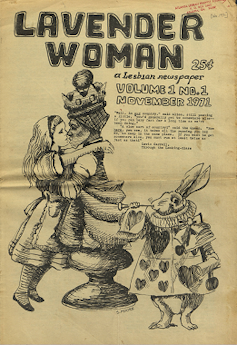
Cover image of a magazine titled 'Lavender woman' with an image of Alice from Alice in Wonderland kissing a chess piece with the head of a woman
November 1971 issue of Lavender Woman, a lesbian periodical produced in Chicago, Illinois, from 1971 to 1976. The title comes from lavender’s association with lesbianism dating back to the 1950s and 60s.
(Women’s Caucus of Chicago Gay Alliance)

The symbolism of lavender itself has particular resonance in lesbian culture. Throughout the 20th century, the colour became a coded reference to women who loved women, at once stigmatizing and unifying.

During the “Lavender Scare” of the 1950s, the U.S. government dismissed and persecuted lesbians and gay men in federal employment under the guise of “security risks.”

Yet lavender was also reclaimed as a badge of solidarity and resistance. Early lesbian feminists incorporated lavender into marches, protest sashes and art, using it as a way of asserting presence and pride in a culture that demanded invisibility.

The impact of concealment

Academic research consistently shows that concealment of sexual orientation remains widespread. A 2019 global public health study from estimated that 83 per cent of lesbian, gay and bisexual people worldwide hide their orientation from most people in their lives.

Research in Hong Kong found that concealment increases loneliness and diminishes feelings of authenticity, directly impacting well-being.

In Canada, a 2022 study of LGBTQ+ health professionals revealed how concealing one’s identity shapes daily decisions about disclosure, often producing stress and internal conflict in professional settings. Bisexual individuals frequently report concealing their orientation to avoid stigma from both heterosexual and queer communities.


Read more:
Queerphobic hate is on the rise, and LGBTQ+ communities in Canada need more support


“Passing” as straight is often a survival strategy shaped by stigma, with lasting consequences for identity, relationships and health. Lavender marriages remind us that queer lives have always been shaped by the tension between resistance and survival. Visibility itself can be an act of defiance, whether on a movie screen, in a march or in daily life.

However, visibility carries real risks: estrangement from family, discrimination or social backlash, political punishment or threats to personal safety. At the same time, concealment has often been a pragmatic choice to preserve dignity, livelihood and community.

Redefining marriage and partnership

These histories and contemporary examples reveal that marriage and partnership have never been one-size-fits-all.

For queer people, unions can be built around protection, friendship, parenting, finances or chosen kinship, just as much as romance or desire. To call them all “lavender marriages” risks oversimplifying the complex ways people craft love and survival.

Modern marriage is not bound by tradition alone; it is defined by the people who build it and by the choices they make to balance safety, authenticity and resistance in a world still learning to accept them.

This dual significance — lavender as both concealment and resistance — helps explain why the term continues to resonate today, as scholars, activists and communities revisit these marriages not simply as personal compromises, but as reflections of broader homophobia and gendered policing that continue to share queer history.

The Conversation

Gio Dolcecore does not work for, consult, own shares in or receive funding from any company or organisation that would benefit from this article, and has disclosed no relevant affiliations beyond their academic appointment.

ref. Beyond lavender marriages: What queer unions and relationships can teach us about love and safety – https://theconversation.com/beyond-lavender-marriages-what-queer-unions-and-relationships-can-teach-us-about-love-and-safety-264179

Russian drones over Poland is a serious escalation – here’s why the west’s response won’t worry Putin

Source: The Conversation – UK – By Stefan Wolff, Professor of International Security, University of Birmingham

On the morning of September 10, Nato jets were scrambled over eastern Poland to defend the airspace of an alliance member against an incursion by Russian drones. It was the first time that the west fired shots in the Kremlin’s war against Ukraine.

This incursion marks a serious escalation by Moscow. But it also highlights yet again that the west has no clear red lines and is unprepared to respond decisively if red lines that were taken for granted in the past – like the territorial integrity of Nato members – are crossed.

This latest Russian escalation isn’t the usual war of words. It was only last week that Russia’s president, Vladimir Putin, warned that foreign troops in Ukraine would be legitimate targets for his invasion force.

He slightly qualified his comments by noting that this would be the case “especially now, while the fighting is ongoing”. But the message was nevertheless clear. Russia will oppose any international security guarantees that involve western troops in Ukraine. This has been a long-standing and frequently articulated position by Russia. Yet, Putin’s rhetoric threatening to target western troops clearly ups the ante.

But these are not the only ways in which the Kremlin has markedly turned up the pressure over the past few weeks and months. Russia has also retained some momentum in its military campaign in Ukraine and has been further empowered by several successes on the diplomatic front.

On the battlefield, Russia has continued to demonstrate significant advantages in manpower and military hardware.

Where the entire Nato alliance struggled to cope with the incursion of just 19 drones, Ukraine has been subject to an intense air campaign with hundreds of drones and often dozens of missiles every night for months.

The attacks have become more brazen – recently targeting Ukraine’s government building in Kyiv. They have also become more deadly, leading to increasing loss of civilian lives. As in past years, Russia has also targeted Ukrainian energy infrastructure, which bodes ill for another grim winter for the country.

On the ground, Russian gains have been small and Ukraine has regained strategically important territory around the key city of Pokrovsk in the Donetsk region. Nonetheless, and this is what matters for Putin’s messaging, Russia is advancing, however incrementally and costly it might be.

ISW map showing the state of the conflict in Ukraine,September, 2025.
The state of the conflict in Ukraine, September 10 2025.
Institute for the Study of War

Putin’s aggressive moves

Diplomatically, Putin received an important boost from the annual summit of the Shanghai Cooperation Organisation in Tianjin and subsequent bilateral deals agreed with China. He will have been cheered by the cordial relations on display between Russian, Chinese and North Korean leaders at the September 3 military parade to mark China’s victory over Japan in the second world war.

The Russian president can now be more assured than ever that his partners will have his back – economically in the case of China and India, and militarily in the case of North Korea.

Buoyed by such “successes” that his war machine will not suddenly grind to a halt, the Russian president felt confident enough to demand that Ukraine negotiate an end to the war with him or face the consequences of him ending the war by force.

Putin’s idea of a negotiated end to the war, however, is anything but that. What he has in mind is that Ukraine and its western allies should simply accept his longstanding demands: territorial losses, no Nato membership and no western forces to secure any peace deal.

This multi-layered Russian pressure campaign is not merely an accidental confluence of unrelated forces somehow magically lining up in Putin’s favour. It is part of a carefully crafted campaign for Russia to retain relevance in what will probably shape up as a future bipolar US and Chinese-dominated international order. If Putin has accepted Chinese dominance in Asia, he still sees opportunities for Russia to be the dominant power in Europe – and restore at least part of its Soviet-era zone of influence.

For that to be achieved, the Kremlin needs to demonstrate that Ukraine’s western partners are feckless in the face of Russian determination. So far, Putin is doing well. All of the deadlines and ultimatums set by the US president, Donald Trump, have been ignored by Russia – at zero cost.

Trump’s response to Russian drones in Polish airspace was a short post on his Truth Social network that indicated surprise more than an actual response to what could quickly develop into a serious crisis. Meanwhile, Trump has yet to offer his support for a bipartisan bill in the US senate to put more sanctions pressure on Russia.

Western response

Similarly, while European leaders have been quick and forceful in their condemnations of this latest Russian provocation, their reactions have, as usual, been at the rhetorical level.

Poland merely invoked Nato’s Article 4 procedure for formal consultations among allies in the North Atlantic Council. But the outcome of this consultation was little more than a meek statement by Mark Rutte, Nato’s secretary general, that “a full assessment of the incident is ongoing” and that the alliance “will closely monitor the situation along our eastern flank, our air defences continually at the ready”.

ISW map showing where the debris from Russia's drones was found in Poland.
Where the debris from Russia’s drones was found in Poland.
Institute for the Study of War

The statement by the EU’s foreign affairs chief, Kaja Kallas, offered solidarity with Poland and promised to “raise the cost for Moscow further by ramping up sanctions significantly on Russia and its enablers”. Given that the EU is on its 18th sanctions package and the war in Ukraine continues unabated, it’s hard to see a gamechanger here. Delivered the morning after the Russian drone incursions into Poland, the annual state of the union address by Ursula von der Leyen offered little more than confirmation of EU aspirations “to be able to take care of our own defence and security”.

None of this will have Putin worried. It should, however, worry Ukrainians and the rest of Europe.

The Conversation

Stefan Wolff is a past recipient of grant funding from the Natural Environment Research Council of the UK, the United States Institute of Peace, the Economic and Social Research Council of the UK, the British Academy, the NATO Science for Peace Programme, the EU Framework Programmes 6 and 7 and Horizon 2020, as well as the EU’s Jean Monnet Programme. He is a Trustee and Honorary Treasurer of the Political Studies Association of the UK and a Senior Research Fellow at the Foreign Policy Centre in London.

ref. Russian drones over Poland is a serious escalation – here’s why the west’s response won’t worry Putin – https://theconversation.com/russian-drones-over-poland-is-a-serious-escalation-heres-why-the-wests-response-wont-worry-putin-265001

Chalk and talk vs. active learning: what’s holding South African teachers back from using proven methods? 

Source: The Conversation – Africa – By Lizélle Pretorius, Lecturer in Education, Cape Peninsula University of Technology

Learning experiences have to include opportunities to develop thinking, skills and values. PickPic

As a full-time teacher completing a PhD part-time, I made a decision early on: do research that speaks to the daily realities of teachers and teaching. And so, the idea came from a lived experience – the day I asked one of my grade 11 learners (an A student) about the interpretation of a poem. His response?

Ma’am, please just write the answer on the board so we can study it for the exam.

I am sure that many teachers can relate to that request, which is typical of education framed by a “chalk and talk” approach.

“Chalk and talk” refers to a classroom environment where the teacher does most of the talking. There’s an over-reliance on textbooks and a focus on recall and rote learning. This is your typical “one size fits all” approach to teaching. Learners are mostly motivated to learn to pass their final year exams.

In South Africa, where I work, that’s contrary to what the national curriculum states. The critical outcomes of the Curriculum Assessment Policy Statement say learning has to be active, focus on critical thinking and reasoning, and go beyond memorising.

But that’s the exception rather than the rule in South African classrooms. There is a mismatch between policy and practice.

A US study weighed the pros and cons of active learning vs direct instruction. Ultimately, active learning is essential to promote curiosity, take ownership of one’s learning journey, and develop important social skills.

The goal of my research was simple: to help teachers include active learning activities in their regular classroom routines. I called my intervention the “altered flipped classroom”. The idea originates from the “flipped classroom”, an active learning approach to make the best use of face-to-face time with learners.


Read more:
Turning traditional teaching on its head helps rural science students


Altering the flipped classroom

The flipped classroom makes use of pre-recorded lessons that learners view before coming to class. In class, teachers support them to do their “homework”.

The flipped classroom has been researched in depth and the advantages to learning are impressive. These include improved learning performance and the development of skills such as critical analysis, problem-solving and collaboration. One study discovered that the flipped classroom helped low performers to keep up with their peers.

In South Africa, only 21.48% of public schools have access to the internet for teaching and learning. Because of this limitation, I had to “alter” the flipped classroom by excluding the technology component.


Read more:
Schools must get the basics right before splashing out on technology


For example, instead of relying on online resources, learners can be given a visual representation of a poem along with a few guiding questions to prepare at home for the next day’s lesson. In class, they could then share their responses with a peer or the whole group.

This simple adjustment can enable meaningful contributions and include participation from all learners in a class.

Teachers take on the challenge

I invited Grade 8-11 teachers in public and private schools in the Western Cape province to participate. Thirty-one teachers attended the online training, and nine took part in the study. Their teaching experience ranged from first-year to over 30 years. They also received a teacher manual which included the background of the flipped classroom, its underlying theories, and practical examples of how to start. Teachers were asked to flip their classroom for three consecutive lessons and to keep a research diary to capture their experiences. These were also discussed during online interviews.

The aim was to explore what had been holding them back from active learning methods. It turned out that they experienced internal and external pressures. Teachers had to overcome possible judgement for “teaching differently” and faced uncertainty regarding the changing of roles. They also experienced fear of having less control, and noted their old habits and mindsets of teaching.

Voices from the classroom

The teachers in my study were concerned about what colleagues or management might think:

If someone walked into my class, it would have seemed like … the kids were playing around, not working, but they were. It just … looked different.

Teachers had to face their own deep-rooted habits and mindsets, which mostly centred on control. This appeared to come from their well-established teacher identities, shaped by their beliefs, assumptions and experiences with regard to their own teaching and how they were taught.

One teacher emphasised the need to move from “a conservative in a box kind of teacher”. One said “my classroom is my stage”; another “felt territorial about {her} space”.

Some teachers recognised the need for change. One said, “I feel like we can break that habit” and another, “We cannot do it the way we have always done it”. They started to become aware of old habits that influenced their practice:

It’s so like hammered into me that you have to be in the front, you have to teach.

From passive learning to purposeful growth

Ideally, teachers will challenge themselves to question the chalk and talk comfort zone and the system that reinforces it.

If nothing changes, learners are being set up to be dependent on their teachers.

The teachers reported many advantages for active learning, such as increased motivation and learners taking responsibility for their learning.

Teachers should be encouraged to go beyond the boundaries of traditional teaching. Learning experiences have to include opportunities to develop thinking, skills and values. Apart from knowledge, these are essential when entering the workforce or when studying a post-school qualification.

Change is not always easy, but it is necessary.

The Conversation

Lizélle Pretorius received funding from UNISA as part of a bursary when completing her PhD.

She is currently a member of ISATT (International Study Association of Teachers and Teaching) and the Junior coordinator of EARLI’s Special Interest Group 22 (Neuroscience and Education)

ref. Chalk and talk vs. active learning: what’s holding South African teachers back from using proven methods?  – https://theconversation.com/chalk-and-talk-vs-active-learning-whats-holding-south-african-teachers-back-from-using-proven-methods-263216

What is ableism? Words can hurt people but African culture offers an alternative

Source: The Conversation – Africa – By Sibonokuhle Ndlovu, Lecturer, University of Johannesburg

“You speak good English for a Black person.”

“Why are the plates not washed when there is a woman in this house?”

“Can I touch your hair?”

These are some common microaggressions you might have heard before, especially if you’re a Black woman.

Microaggressions can be projected to Black people because they are expected to speak perfect English when it’s not even their language. Or because what’s natural hair to them seems exotic to someone from another culture. They can be projected because of sexism that says women in African cultures belong in the kitchen.

What are microaggressions?

Microaggressions are comments or actions that reveal prejudice against marginalised people or a group of people who are oppressed. They might be micro (small or everyday) and they might manifest unconsciously or without harmful intentions. But even so, microaggressions are hurtful and devalue the people they’re projected on to.

What is ableism?

So then, what are ableist microaggressions? Ableism is a worldview in which ability and being able-bodied is favoured over disability.

Saying to a wheelchair user, “Ah, I see you are going for a stroll.” Or speaking slowly to them as if they can’t grasp what you’re saying. Or owning an office without wheelchair access. Those can be seen as ableist microaggressions. Using terms related to disability out of context is ableist: “You must be blind.” Even if said to a sighted person, it’s insensitive to people who might actually have impaired vision.


Read more:
Here are some dos and don’ts to help tackle ableism


Ableist microaggressions are made by able-bodied people who don’t understand the realities of living with a disability. Sometimes they don’t mean to be harmful or they think they are helping by, for example, doing things for disabled people that the disabled person can actually do for themselves.

Even so, ableist microaggressions create a situation of unequal power dynamics because they make people with disabilities feel inferior, incapable or unintelligent.

Black women with a disability

As a scholar of inclusive education and disability in higher education, my research often focuses on disability and gender. I recently published a paper that reviewed studies of ableist microaggressions projected on to Black women with disabilities in southern Africa.

The paper explored how microaggressions affect these women in Zimbabwe, South Africa and Eswatini. The three countries share similar cultural values, identity and beliefs when it comes to gender, race and disability. And how these three things intersect.

In these cultures, women are generally honoured and might be called “izimbokodo” (grinding stones). It might be socially accepted that “a home cannot be a home without a woman” and, in the case of South Africa, issues of human rights might have improved over the years. Yet ableist microaggressions projected on women remain common, and even more so Black and disabled women.


Read more:
Sexual health is an extra struggle for women with disabilities: findings from 10 African countries


This has a negative effect on them particularly when it comes to making individual life choices, marriage and childbearing – as it does women without disabilities.

For example, in some parts of South Africa, when women who are disabled appear pregnant in public, many people assume they were raped. They don’t assume a woman with disability had sexual agency and she is shamed and treated as unusual. It makes it even harder for her to receive equal healthcare and social standing.

For Black African women with disabilities, the impact of ableist microaggressions is worse because they have an intersectional struggle – they experience several forms of discrimination. They face racism, sexism and ableism, often at the same time.

Why ubuntu matters

The question I ask in my study is what might help Black women with disabilities to be empowered to dismantle ableist microaggressions. The answer lies in the past. I argue that ubuntu is an important weapon against this form of discrimination.

Ubuntu is an African philosophy common to the region that is understood by different people in different ways. But it can best be explained through the isiZulu saying, “umuntu ngumuntu ngabantu” (We are because of them). This means that a person is a person through other people.

In a worldview of care and cooperation like this, every human being in a community is valuable despite their gender, race or ability. Ubuntu helps people understand that they are dependent on each other. They need each other despite their differences.


Read more:
Ubuntu matters: rural South Africans believe community care should go hand-in-hand with development


In many precolonial African societies disability was positively conceived. Another isiZulu saying goes, “Akusilima sindlebende kwaso”. It means that disabled people are accepted and loved in their homes.

However, colonialism changed all that. Africans were reduced to being workers for European masters. Colonialism normalised able-bodied workers and regarded disabled bodies as inferior. This was further entrenched by colonial morality, which would shape social thinking in the region.

This mindset still plays out today in the modern African societies in these studies. Black women with disabilities are viewed as helpless, and so they are an easy target for ableist microaggression.

A system of thinking like ubuntu would give Black women with disabilities the opportunity for dignity and the agency to fight against the damaging effects of ableist microaggressions that they face in their daily lives.

The Conversation

Sibonokuhle Ndlovu receives funding from the University Research Council of the University of Johannesburg.

ref. What is ableism? Words can hurt people but African culture offers an alternative – https://theconversation.com/what-is-ableism-words-can-hurt-people-but-african-culture-offers-an-alternative-263288