The rise of sinkholes: How to spot the risks before disaster strikes

Source: The Conversation – Canada – By Peter Adesina, Postdoctoral Fellow in Geotechnical Engineering, University of Toronto

You trust the road beneath your tires. But what if that trust is misplaced? Sinkholes are increasingly turning ordinary streets into danger zones. And the cost of ignoring them is skyrocketing.

Each year, sinkholes swallow roads, homes and businesses around the world, including Canada, the United Kingdom, Kenya, South Africa and the United States.

They disrupt daily life, contaminate water supplies and cause significant damage to buildings and structures — often with devastating economic impact in economically disadvantaged regions. Repairs can cost hundreds of thousands to millions of dollars. With government budgets already stretched thin, it is critically important to prevent rather than fix sinkholes.

What causes sinkholes?

Sinkholes are sometimes mistaken for potholes, but they are far more dangerous.

Potholes are surface nuisances that form on the surface due to wear and tear and freeze-thaw cycles. Sinkholes, meanwhile, start deep underground. They form when water dissolves rocks like limestone and gypsum or when underground soils are eroded by water, creating hidden cavities.

Leaks from damaged pipes or concentrated rainwater runoff can trigger this process, as seen recently in downtown Toronto.

These cavities grow silently until the surface collapses, sometimes swallowing entire streets. Human activities like construction and mining, and natural events such as earthquakes, can accelerate their formation.

Loose, sandy soils and fast-moving water make the ground even more vulnerable. When collapse happens, the results can be catastrophic.


Read more:
What is a sinkhole? A geotechnical engineer explains


Climate change and aging infrastructure

Extreme weather events — heavy rains, droughts and freeze-thaw cycles — put stress on underground pipes, making them susceptible to damage that releases water into the ground.

Climate change worsens this by lowering water tables during droughts, causing cracks in soils and weakening binding strength, making the ground weaker and more likely to collapse.

Aging underground infrastructure compounds the problem: old pipes fail more easily releasing water into the ground. Both climate change and aging infrastructure can explain why sinkholes are appearing more frequently around the world.


Read more:
From earthquakes to wildfires, Canada is woefully ill-prepared for disasters


Can we predict sinkholes?

To build resilience against sinkholes forming in the ground, it’s imperative to be able to predict sinkholes. A comprehensive understanding of soil properties in locations of importance is required to assess the potential for sinkhole formation and develop predictive models and early warning systems.

Surveys and geological inspections have been used to map the risk of sinkhole formation in the Canadian province of Nova Scotia, where sinkholes are prevalent.

Technologies like satellite-based remote sensing and subsurface-deformation sensing techniques, like distributed fibre optic sensing, can be used to identify existing underground cavities and decipher areas of low density where sinkholes could occur in the future.

Tools used to monitor water table level can also be useful to predict future sinkholes. Damage detection sensors installed in underground water infrastructure can provide early warnings before flows from water mains result in sinkholes.

Preventing sinkholes before they happen

Cities can act now to take steps to prevent sinkholes before they happen. Rainwater runoff should be redirected into existing natural water channels to avoid pooling in high-risk areas.

Loose soils can be compacted to make them more stable and, in large projects where a sinkhole could have huge economic implications, replacing weak material with stronger fill may be necessary.

Engineers can also reinforce soils with geosynthetics and seal underground drainage channels with grout or concrete to prevent erosion and sinkhole formation. These measures cost far less than repairing catastrophic damage.

A call to action

The cost of sinkholes to economic activities and property are enormous.

Sinkholes are not just costly inconveniences, they are growing threat to commercial activities, livelihood and property. With climate change, sinkholes are becoming more frequent and will worsen with huge implications for now and in the future.


Read more:
Sinkholes: when the ground fights back after centuries of exploitation


Research is needed to understand the impact of extreme weather events on accelerated sinkhole formation so we can build sinkhole-resilient roads and infrastructure and avoid disasters that will happen if we fail to act.

Governments need to invest in the development of predictive tools and sinkhole prevention strategies by providing research funding and support for scaleable technologies emanating from research on sinkholes. Supporting preventive measures will help minimize overall costs since prevention is a lot cheaper than repairs.

The Conversation

Peter Adesina does not work for, consult, own shares in or receive funding from any company or organisation that would benefit from this article, and has disclosed no relevant affiliations beyond their academic appointment.

ref. The rise of sinkholes: How to spot the risks before disaster strikes – https://theconversation.com/the-rise-of-sinkholes-how-to-spot-the-risks-before-disaster-strikes-271799

‘An act of evil antisemitism’: at least 12 dead in terrorist attack on Bondi Beach

Source: The Conversation – Global Perspectives – By Alexandra Hansen, Deputy Editor and Chief of Staff, The Conversation

At least 12 people have been killed after two gunmen opened fire on a crowd at Bondi Beach at about 6.47pm on Sunday. Twenty-nine people were injured and taken to hospital, including two police officers. One of the gunman was among the dead. It is the deadliest mass shooting in Australia since the Port Arthur massacre in 1996.

A crowd of more than 1,000 had gathered to celebrate the first day of the Jewish festival Hanukkah. Bondi Beach is in the Sydney eastern suburbs, the heart of the Jewish community. New South Wales police have declared the shooting a terrorist attack.

Police confirmed one suspect had been taken into custody and was in serious condition. Another suspect was killed at the scene and police said they were investigating the possibility of a third offender. One of the attackers was known to authorities.

On Sunday evening, police were also investigating reports of an explosive device near the beach. New South Wales Police Commissioner Mal Lanyon confirmed an improvised explosive had been found in a car.

ASIO head Mike Burgess said Australia’s terrorism threat level remained at “probable”. This means there is a greater than 50% chance of an onshore attack or attack planning in the next twelve months. “I don’t see that changing at this stage,” Burgess told reporters in Canberra on Sunday night.

Soon after the shooting began, horrific vision emerged on social media of people shot dead or injured, as well as footage of incredible acts of bravery from passersby trying to thwart the attack.

One video shows a bystander tackling a gunman from behind, wrestling his gun from him. Others were performing CPR on the injured on the beach.

A Jewish chaplain with blood on him spoke of trying to save people amid terrible scenes of people shot in the head. People fled as the attack unfolded, but some elderly people were unable to run.

Prime Minister Anthony Albanese described the scenes as “shocking and distressing”. “My thoughts are with every person affected.” In the wake of the attack he convened an emergency meeting of the National Security Committee of cabinet.

Albanese received a preliminary briefing from Australian Federal Police acting Deputy Commissioner Nigel Ryan and New South Wales Premier Chris Minns, who convened an emergency meeting of state cabinet. Albanese defended himself against criticism he had not taken antisemitism seriously enough.

“Australia is braver than those who seek to make us afraid […] we will see justice done, and we will come through this together,” he said.

“There are nights that tear at our nation’s soul in this moment of darkness,” Albanese said. “We must be each other’s light. Hold on to the true character of the country that we love.”

At a press conference on Sunday night, Minns said “This cowardly act of terrifying violence is shocking and painful to see, and represents some of our worst fears about terrorism in Sydney.” He asked Australians to “wrap their arms around” the Jewish community, and praised both the outpouring of love and support towards the Jewish community as well as the extraordinary demonstrations of courage in the wake of the attack.

Lanyon called for calm, and said this is “not a time for retribution”. He assured the public no stone would be left unturned in bringing those responsible to justice and ensuring there are no further attacks. “This type of disgraceful activity, this wanton use of violence, the taking of innocent lives is unacceptable to New South Wales.”

Independent federal MP Allegra Spender, who represents Bondi in her seat of Wentworth, also expressed her shock and horror.

Opposition Leader Sussan Ley also expressed her shock. “Australians are in deep mourning tonight, with hateful violence striking at the heart of an iconic Australian community, a place we all know so well and love, Bondi.

“Today we stand together as Australians against hate in this moment of profound tragedy and shock.”

In a statement, Israeli President Isaac Herzog said “our heart misses a beat”. He called on the Australian government to “take action to fight against the enormous wave of antisemitism which is plaguing Australian society”.

The Australian Imams Council issued a statement condemning the attack.

“These acts of violence and crimes have no place in our society. Those responsible must be held fully accountable and face the full force of the law,” the statement said.

“Our hearts, thoughts and prayers are with the victims, their families, and all those who witnessed or were affected by this deeply traumatic attack.”

The Conversation

ref. ‘An act of evil antisemitism’: at least 12 dead in terrorist attack on Bondi Beach – https://theconversation.com/an-act-of-evil-antisemitism-at-least-12-dead-in-terrorist-attack-on-bondi-beach-272031

What’s at stake in Trump’s executive order aiming to curb state-level AI regulation

Source: The Conversation – USA – By Anjana Susarla, Professor of Information Systems, Michigan State University

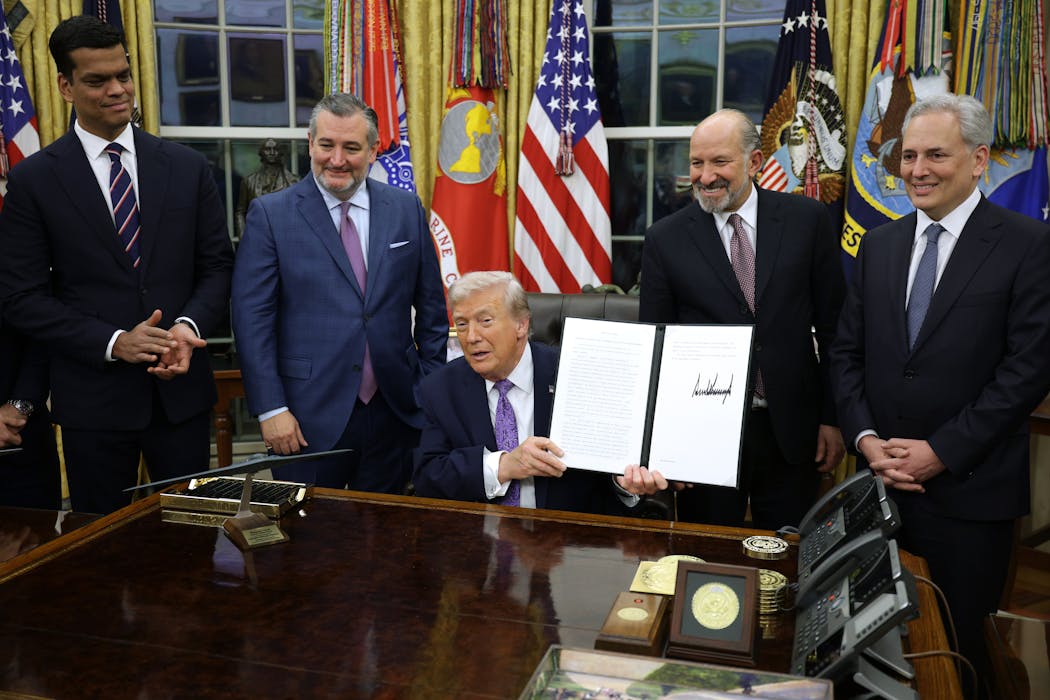
President Donald Trump displays his executive order countering state laws regulating AI. Alex Wong/Getty Images

President Donald Trump signed an executive order on Dec. 11, 2025, that aims to supersede state-level artificial intelligence laws that the administration views as a hindrance to innovation in AI.

State laws regulating AI are increasing in number, particularly in response to the rise of generative AI systems such as ChatGPT that produce text and images. Thirty-eight states enacted laws in 2025 regulating AI in one way or another. They range from prohibiting stalking via AI-powered robots to barring AI systems that can manipulate people’s behavior.

The executive order declares that it is the policy of the United States to produce a “minimally burdensome” national framework for AI. The order calls on the U.S. attorney general to create an AI litigation task force to challenge state AI laws that are inconsistent with the policy. It also orders the secretary of commerce to identify “onerous” state AI laws that conflict with the policy and to withhold funding under the Broadband Equity Access and Deployment Program to states with those laws. The executive order exempts state AI laws related to child safety.

Executive orders are directives to federal agencies on how to implement existing laws. The AI executive order directs federal departments and agencies to take actions that the administration claims fall under their legal authorities.

Big tech companies have lobbied for the federal government to override state AI regulations. The companies have argued that the burden of following multiple state regulations hinders innovation.

Proponents of the state laws tend to frame them as attempts to balance public safety with economic benefit. Prominent examples are laws in California, Colorado, Texas and Utah. Here are some of the major state laws regulating AI that could be targeted under the executive order:

Algorithmic discrimination

Colorado’s Consumer Protections for Artificial Intelligence is the first comprehensive state law in the U.S. that aims to regulate AI systems used in employment, housing, credit, education and health care decisions. However, enforcement of the law has been delayed while the state legislature considers its ramifications.

The focus of the Colorado AI act is predictive artificial intelligence systems, which make decisions, not newer generative artificial intelligence like ChatGPT, which create content.

The Colorado law aims to protect people from algorithmic discrimination. The law requires organizations using these “high-risk systems” to make impact assessments of the technology, notify consumers whether predictive AI will be used in consequential decisions about them, and make public the types of systems they use and how they plan to manage the risks of algorithmic discrimination.

A similar Illinois law scheduled to take effect on Jan. 1, 2026, amends the Illinois Human Rights Act to make it a civil rights violation for employers to use AI tools that result in discrimination.

On the ‘frontier’

California’s Transparency in Frontier Artificial Intelligence Act specifies guardrails on the development of the most powerful AI models. These models, called foundation or frontier models, are any AI model that is trained on extremely large and varied datasets and that can be adapted to a wide range of tasks without additional training. They include the models underpinning OpenAI’s ChatGPT and Google’s Gemini AI chatbots.

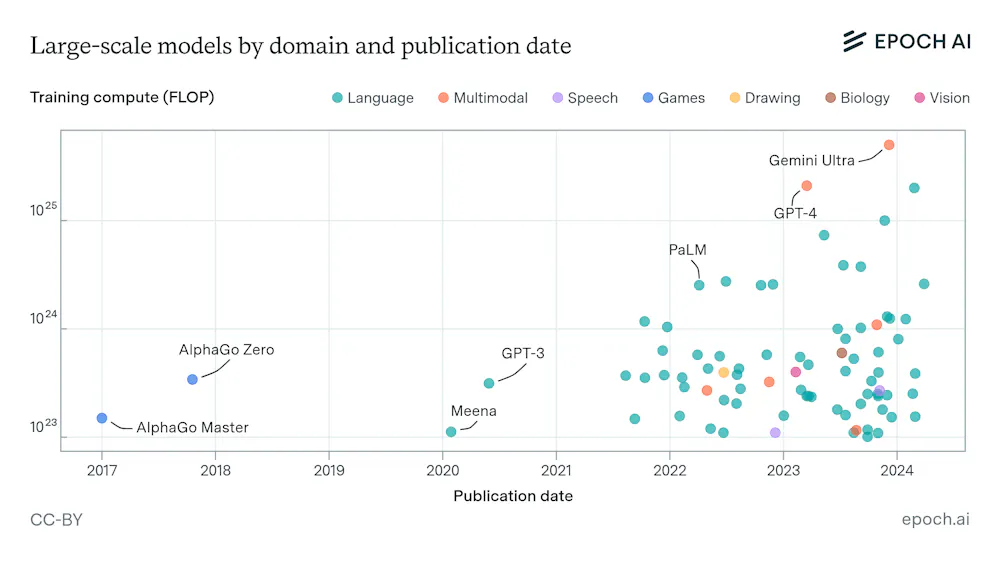
The California law applies only to the world’s largest AI models – ones that cost at least US$100 million and require at least 1026 – or 100,000,000,000,000,000,000,000,000 – floating point operations of computing power to train. Floating point operations are arithmetic that allows computers to calculate large numbers.

a scatter plot with colored dots
Today’s most powerful AI models required far more computing power to train than previous models. The vertical axis is floating point operations, a measure of computing power.
Robi Rahman, David Owen and Josh You (2024), ‘Tracking large-scale AI models.’ Published online at epoch.ai., CC BY

Machine learning models can produce unreliable, unpredictable and unexplainable outcomes. This poses challenges to regulating the technology.

Their internal workings are invisible to users and sometimes even their creators, leading them to be called black boxes. The Foundation Model Transparency Index shows that these large models can be quite opaque.

The risks from such large AI models include malicious use, malfunctions and systemic risks. These models could potentially pose catastrophic risks to society. For example, someone could use an AI model to create a weapon that results in mass casualties, or instruct one to orchestrate a cyberattack causing billions of dollars in damages.

The California law requires developers of frontier AI models to describe how they incorporate national and international standards and industry-consensus best practices. It also requires them to provide a summary of any assessment of catastrophic risk. The law also directs the state’s Office of Emergency Services to set up a mechanism for anyone to report a critical safety incident and to confidentially submit summaries of any assessments of the potential for catastrophic risk.

Disclosures and liability

Texas enacted the Texas Responsible AI Governance Act, which imposes restrictions on the development and deployment of AI systems for purposes such as behavioral manipulation. The safe harbor provisions – protections against liability – in the Texas AI act are meant to provide incentives for businesses to document compliance with responsible AI governance frameworks such as the NIST AI Risk Management Framework.

What is novel about the Texas law is that it stipulates the creation of a “sandbox” – an isolated environment where software can be safely tested – for developers to test the behavior of an AI system.

The Utah Artificial Intelligence Policy Act imposes disclosure requirements on organizations using generative AI tools with their customers. Such laws ensure that a company using generative AI tools bears the ultimate responsibility for resulting consumer liabilities and harms and cannot shift the blame to the AI. This law is the first in the nation to stipulate consumer protections and require companies to prominently disclose when a consumer is interacting with generative AI system.

Other moves

States are also taking other legal and political steps to protect their citizens from the potential harms of AI.

Florida Republican Gov. Ron DeSantis said he opposes federal efforts to override state AI regulations. He has also proposed a Florida AI bill of rights to address “obvious dangers” of the technology.

Meanwhile, the attorneys general of 38 states and the attorneys general of the District of Columbia, Puerto Rico, American Samoa and the U.S. Virgin Islands called on AI companies, including Anthropic, Apple, Google, Meta, Microsoft, OpenAI, Perplexity AI and xAI, to fix sycophantic and delusional outputs from generative AI systems. These are outputs that can lead users to become overly trusting of the AI systems or even delusional.

It’s not clear what effect the executive order will have, and observers have said it is illegal because only Congress can supersede state laws. The order’s final provision directs federal officials to propose legislation to do so.

The Conversation

Anjana Susarla does not work for, consult, own shares in or receive funding from any company or organization that would benefit from this article, and has disclosed no relevant affiliations beyond their academic appointment.

ref. What’s at stake in Trump’s executive order aiming to curb state-level AI regulation – https://theconversation.com/whats-at-stake-in-trumps-executive-order-aiming-to-curb-state-level-ai-regulation-266668

The Bible says little about Jesus’ childhood – but that didn’t stop medieval Christians from enjoying tales of him as holy ‘rascal’

Source: The Conversation – USA (3) – By Mary Dzon, Associate Professor of English, University of Tennessee

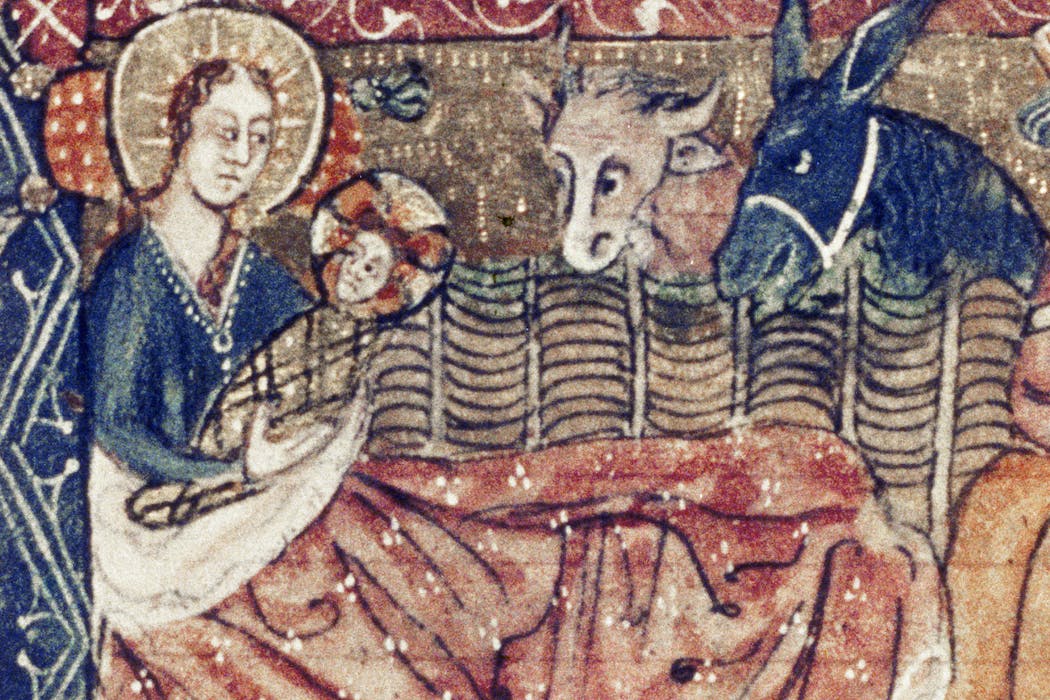
An illustration from the Vernon Manuscript, from around 1400, shows the familiar motif of an ox and ass watching over the newborn Jesus. © Bodleian Libraries, University of Oxford, CC BY-NC

Manger scenes displayed around Christmastime usually feature an ox and an ass beside the infant Jesus. According to the Gospel of Luke, Mary placed her child in a manger – an animal feeding bin – “because there was no room for them in the inn.”

No mere babysitters, the ox and ass harken back to the Book of Isaiah 1:3, a verse early Christians interpreted as a prophecy of the birth of Christ. In some early artwork, these beasts of burden kneel to show their reverence – recognizing this swaddled babe, who entered the world in humble circumstances, as lordly.

The canonical Gospels, the accounts of Jesus’ life included in the Bible’s New Testament, make no mention of those animals welcoming the newborn. Yet the motif was already seen in art from the fourth century. It was further popularized by the Gospel of Pseudo-Matthew, an apocryphal text – that is, one not included in the canon of Scripture. Pseudo-Matthew was composed by an anonymous monk, probably in the seventh century, and includes many tales about Jesus growing up.

After its account of Jesus’ birth, the Bible is almost entirely silent on his childhood. Yet legends about Jesus’ early years circulated widely in the Middle Ages – the focus of my 2017 book. While the detail of the ox and ass is quite familiar to many Christians today, few are aware of the other striking tales transmitted by the apocrypha.

Wonder-worker

A painting with a gold frame and background shows a man and woman with halos talking to a child with a halo, who has his arms crossed.
‘Christ Discovered in the Temple,’ by Simone Martini (1342).
Google Cultural Institute/Walker Art Gallery via Wikimedia Commons

The Bible does include one famous scene from Jesus’ youth: the incident when 12-year-old Jesus stayed behind at the Jewish temple in Jerusalem, unbeknownst to his parents. Searching for him with great anxiety, they find him conversing with religious teachers, both asking questions and astounding them with his answers. Fourteenth-century painter Simone Martini’s “Christ Discovered in the Temple” portrays him standing before his parents with crossed arms – a stubborn youth, apparently unapologetic about making them worry for days.

The apocryphal Gospel of Pseudo-Matthew – especially versions that incorporate material from an even earlier apocryphal gospel, the Infancy Gospel of Thomas – focuses on the years of Jesus’ childhood. Like the temple story, they show the boy Jesus as sometimes difficult and having preternatural wisdom that amazes and even offends his would-be teachers. More dramatically, the apocryphal legends depict Jesus exercising divine power from a very young age.

A small, colorful illustration with a gold background shows two adults and a child with halos, looking into a cave at small blue and green dragons
A 14th-century Italian manuscript shows Jesus fending off dragons to protect his parents.
© Bodleian Libraries, University of Oxford, CC BY-NC

Like the adult Jesus of the New Testament, this apocryphal Christ child often works wonders to help others in need. According to the biblical Gospel of Matthew, Mary and Joseph take the infant Jesus to Egypt after an angel warns in a dream that Herod, King of Judea, would kill the child. In Pseudo-Matthew’s elaboration of this episode, we see Jesus, not yet 2 years old, bravely stand on his feet before dragons emanating from a cave, where his family has stopped to rest.

The terrifying dragons worship him and then depart, while Jesus boldly assures those around him that he is the “perfect man” and can “tame every kind of wild beast.” He later commands a palm tree to bend down so that a weary Mary can partake of its fruits, and he miraculously shortens their journey in the desert.

At times, the Jesus of these legends is largely to blame for the troubles around him. The 14th-century Tring Tiles, now in the British Museum, depict one of Jesus’ friends imprisoned by his father in a tower. Christ pulls him out of a tiny hole, like a gallant medieval knight rescuing a maiden in distress. The father had tried to insulate his son from Jesus’ influence – understandable, considering that many legends show Jesus causing the death of his playmates or other boys who somehow irked him.

In a story summarized by one scholar as “death for a bump,” a boy runs into Jesus. He curses the child, who instantly drops down dead – though Jesus brings him back to life after a brief reprimand from Joseph.

A dark red or brown tile has lighter etchings on it, with scenes of a man standing next to a tower that a child stands atop, and then the child exiting the tower as another figure with a halo looks on.
One section of the Tring Tiles, created in the 14th century, shows Jesus removing his friend from a tower.
© The Trustees of the British Museum, CC BY-NC-SA

In another tale, included in an Anglo-Norman narrative that survives in an illustrated manuscript, Jesus takes off his coat, places it upon a sunbeam and sits upon it. When the other children see this, they “thought they would do the same …. But they were too eager, and they all fell down at once. One and another jumped up quickly onto the sunbeam, but it turned out badly for them, since each one broke his neck.” Jesus heals the boys at his parents’ prompting.

Joseph admits to his neighbors that Jesus “was indeed too wild” and sends him away. The 7-year-old Jesus becomes apprenticed to a dyer, who gives him very precise directions about dyeing three pieces of cloth in three different vats. Once his master has left, Jesus ignores his instructions, throwing all the cloth into one vat – yet still achieves the desired outcome. When the master returns, he at first thinks he has been “ruined by this little rascal,” but then realizes that a wonder has occurred.

An illustration with a red background shows several boys in tunics playing on a large, slide-like structure.
Jesus seated on a sunbeam, while other boys attempt to do so, in a miniature from the Selden Supra 38 manuscript, created in the early 14th century.
© Bodleian Libraries, University of Oxford, CC BY-NC-SA

Bond with animals

These apocryphal legends also show the boy Jesus having power over the animal world. When he enters a dreaded lion’s cave, cubs “ran about around his feet, fawning and playing with him,” while “the older lions … stood at a distance and worshipped him, and wagged their tails before him.” Jesus tells bystanders that the beasts are better than they are, because the animals “recognize and glorify their Lord.”

Indeed, these tales characterize Jesus as a rather haughty boy, conscious of his divinity and not happy with those who treat him as a mere child. At the same time, they depict him as a real child who likes to play. The boy Jesus is childlike in the way he often acts on impulse, not paying much attention to the admonitions of his elders.

An illumination of a pack of lions looking at a young boy with a halo who is stroking a cub outside a cave.
A 14th-century manuscript, the ‘Klosterneuburger Evangelienwerk,’ shows the young Jesus playing with lions.
Schaffhausen City Library via Wikimedia Commons

His affinity for animals, too, makes him seem childlike. Strikingly, beasts in the apocrypha, beginning with the ox and ass, often seem to realize that Jesus is no ordinary child before human characters do.

The legends’ insidious insinuation that many of the Jews around Jesus were not as perceptive as the animals is part of medieval Europe’s widespread antisemitism. In one fifth-century sermon, Quodvultdeus, the bishop of Carthage, asks why the animals’ recognition of Jesus in the manger was not a sufficient sign for the Jews.

A faded manuscript illustration shows the same boy fetching water, tending a fire, and working at a table as a man and woman look on.
The 14th-century Holkham Bible picture book depicts Jesus performing chores at home (London, British Library, Additional MS 47682, fol. 18).
Courtesy British Library

In the Bible, Jesus works his first miracle as an adult, at a wedding feast in Cana. The apocryphal tales, however, toy with the idea of the God-man revealing his power early on. The legends suggest that the childishness of Christ distracted many of those around him, preventing them from concluding that he was the Messiah. This allows the apocrypha to avoid contradicting the Bible’s reference to Jesus as simply “the carpenter’s son,” the opposite of a wonder child.

Each Christmas, modern Christians in the Western world tend to celebrate Jesus’ birthday, then quickly drop the theme of the Christ child. Medieval Christians, in contrast, were fascinated by tales about the Son of God growing up. Despite acting as a dragon tamer, physician and magician, the young Jesus of the apocrypha largely flies under the radar, cloaking his divinity with “little rascal” boyishness.

The Conversation

Mary Dzon does not work for, consult, own shares in or receive funding from any company or organization that would benefit from this article, and has disclosed no relevant affiliations beyond their academic appointment.

ref. The Bible says little about Jesus’ childhood – but that didn’t stop medieval Christians from enjoying tales of him as holy ‘rascal’ – https://theconversation.com/the-bible-says-little-about-jesus-childhood-but-that-didnt-stop-medieval-christians-from-enjoying-tales-of-him-as-holy-rascal-207475

Lily Allen’s West End Girl reflects the idea that women are becoming increasingly disaffected with men

Source: The Conversation – UK – By Kate McNicholas Smith, Senior Lecturer in Screen, University of Westminster

In October 2025, singer-songwriter Lily Allen released her fifth studio album, West End Girl, to great critical acclaim and commercial success. When she announced an album tour, the first dates sold out in just 20 minutes.

Described by the Guardian as “a gobsmacking autopsy of marital betrayal”, West End Girl is a work of “autofiction”, inspired by Allen’s separation from Stranger Things actor David Harbour, his reported affair and the emotional aftermath.

The concept album documents a relationship and its breakdown from Allen’s perspective (or that of her creative “alter ego”). The singer told Vogue that West End Girl refers to things “I experienced within my marriage, but that’s not to say that it’s all gospel.” So far, Harbour has declined to comment or address the issue.

The title track takes us back to what appears to be the couple’s move to a New York brownstone, before the singer is offered the lead role in a London play (when, she reveals, her partner’s demeanour starts to change).

The reference to the brownstone recalls the couple’s 2023 Architectural Digest video (below) featuring their home. Listeners were quick to return to that video in the wake of the album’s release, retrospectively identifying red flags in the couple’s dynamic and what is said to be Harbour’s “toxic” banter. One commentator quipped: “Harbour really made a trailer for his own cheating scandal during the first 20 seconds.”

With Allen and Harbour both well-known figures, it is unsurprising that the revealing album has captured public attention. But this interest goes beyond celebrity gossip: the album has resonated with audiences for its raw contemplation of contemporary heterosexuality.

In track three, Sleepwalking, Allen asks: “Who said romance isn’t dead?” The album’s evocative storytelling skewers the distinctly unromantic experience of a “modern wife”, navigating the conventional dichotomy of women as madonna or whore while reluctantly attempting an open marriage.

While ethical non-monogamy emphasises consent and boundaries, the reported terms of the couple’s arrangement – to be discreet, only with strangers and involving payment – are broken with the now-infamous “Madeline”, a woman referred to in a song of the same name, who is not a stranger. Though the real identity of Madeline was later revealed in the media, Allen had said she was a fictional character.

Meanwhile, the track Dallas Major documents the singer’s re-entry into the world of online dating as a 40-year-old mum to teenage children. “I hate it here,” she states unequivocally.

Over it

Just five days after the release of West End Girl, social commentator Chanté Joseph published a piece in Vogue asking: “Is having a boyfriend embarrassing now?”. The article, which quickly went viral, describes a distancing from public declarations of coupledom in what Joseph calls an era of widespread heterofatalism. Just a few months earlier, an article in The New York Times Magazine used the same concept to bemoan “the trouble with wanting men”.

The term heterofatalism was coined by writer Asa Seresin (initially as heteropessimism) in 2019 to refer to “performative disaffiliations with heterosexuality, usually expressed in the form of regret, embarrassment or hopelessness about straight experience”.

In other words, heterosexual women are expressing dissatisfaction with the ways in which, despite longstanding feminist critiques, gender inequalities persist in romantic relationships. Such expressions might be performative, Seresin suggests, in that they do not lead to change but rather to resignation.

Reasons for disappointment are backed up by data. Research shows, for example, that women do more unpaid care work than men, resulting in time poverty. In the UK, the Office for National Statistics’ analysis of time use data shows that women do more than double the amount of cooking, childcare and housework than men. The COVID pandemic only deepened these existing inequalities.

Domestic abuse remains shockingly common, and disproportionately affects women. According to Refuge, one in four women in England and Wales will experience domestic abuse in their lifetime.

Meanwhile, the rise of the manosphere has seen a proliferation of online misogyny, with concerning implications for romantic relationships. Such platforms are directly referenced in the song 4chan Stan, where Allen invokes the anonymous online forum associated with a troubling incidence of hate speech.

Into this context, social media movements like #boysober have emerged, where women pledge themselves to “no dating apps, no dates, no exes, no hookups”. In South Korea, the 4b movement sees young women similarly rejecting marriage, childbirth, dating and sex – a sentiment taken up by some US women following the re-election of Donald Trump as president in 2024.

While distinctly contemporary in their communication, these sentiments also evoke older ideas – such as the political lesbianism once proposed by second-wave radical feminists. Like political lesbianism, the 4b movement has been critiqued for trans-exclusionary ideas.

Back in 2013, Allen released the single Hard Out Here. The song critiqued the objectification of women within modern pop culture, but the music video objectified women of colour women and was described by cultural critic Cate Young as “a brilliant example of everything wrong with the current climate of white feminism”. Allen apologised for the video in 2016.

Heterofatalism can be similarly limited in its response to gender inequality, failing to recognise intersectionality – the way that different aspects of someone’s experience and identity can overlap to exacerbate inequalities and discrimination.

Nonetheless, these expressions of dissatisfaction might challenge the assumed inevitability of heterosexuality and the gender inequality it all too often reproduces. West End Girl ends on a defiant note, refusing “shame” and recognising “it’s not me, it’s you”.

While the cheating husband might remain “stuck” in his “fruityloop” of heteronormativity and toxic masculinity, for the singer – and those with whom her story resonates – there may be other possibilities.


Looking for something good? Cut through the noise with a carefully curated selection of the latest releases, live events and exhibitions, straight to your inbox every fortnight, on Fridays. Sign up here.


The Conversation

Kate McNicholas Smith does not work for, consult, own shares in or receive funding from any company or organisation that would benefit from this article, and has disclosed no relevant affiliations beyond their academic appointment.

ref. Lily Allen’s West End Girl reflects the idea that women are becoming increasingly disaffected with men – https://theconversation.com/lily-allens-west-end-girl-reflects-the-idea-that-women-are-becoming-increasingly-disaffected-with-men-271864

What is super flu? And other questions answered

Source: The Conversation – UK – By James Hay, Research Fellow, Infectious Diseases Modelling, University of Oxford

Fajar Arifiyanto/Shutterstock.com

The NHS is facing severe pressure this winter as flu cases surge earlier than usual, with some calling it “super flu”. Here’s what you need to know about this year’s flu season and how to protect yourself.

What is ‘super flu’?

Professor Meghana Pandit, NHS national medical director, said: “With record demand for A&E and ambulances and an impending resident doctors strike, this unprecedented wave of super flu is leaving the NHS facing a worst-case scenario for this time of year.”

Although this term has now been repeated frequently in the media, it was not intended as a new scientific designation. Although the flu season began early, both the spread of the virus and the severity of illness remain within what experts consider normal for a flu season.

Influenza viruses are constantly evolving to evade our immune system, which is why the flu vaccine must be updated regularly. Some years the virus mutates more than others, and it typically undergoes a major change every four to five years.

The “subtype” of flu that is dominant this year, called influenza A/H3N2, has been around since 1968 and there have been over a dozen such changes in that time. By this definition, we see “super flu” every few years.

Is the situation in the UK really as bad as some headlines suggest?

The situation isn’t unprecedented – it falls within the range of what scientists would expect in a bad flu season.

Because the season started early, it is misleading to directly compare the number of cases and hospitalisations to the same week in previous years. In fact, the situation is comparable to previous years after taking the early season start into account, as a recent analysis my colleagues and I conducted shows.

Which areas of the UK are worst affected?

The most important consideration from a public health perspective is the burden on healthcare systems in different regions, which is determined by what the virus is doing and what resources are available in those regions.

The available data only provides general infection trends at regional levels. England’s influenza season started earlier than in Scotland, Wales and Northern Ireland, so we might expect the situation to turn earlier in England than elsewhere.

Based on the data for England from the UK Health Security Agency, the north and the Midlands are possibly experiencing higher flu rates – but not significantly so.

Why are we seeing more flu cases in younger people?

Children and teens are more likely to get infected due to their high contact rates in schools, where a lot of spread happens, and also because their immune systems are less experienced at dealing with flu viruses.

Adults are less likely to become infected overall, as they typically have lower contact rates and their immune systems have more experience with influenza. However, people over 64 are more likely to have existing health conditions that put them at higher risk of severe illness if they do become infected, and their immune systems have started to weaken in a process called immunosenescence.

Babies are also at greater risk of severe illness as their immune systems are still undeveloped.

People of a similar age tend to have been infected with similar flu viruses, which might explain why certain age groups are more affected by flu than others in some seasons. It might be that the virus this year happens to have found an immunity gap in children that isn’t present in other age groups.

Vaccine effectiveness is lower for older people, so should they still get the jab?

The latest data shows that the flu vaccine reduces the risk of being hospitalised with flu by about 30 to 40% in older people. That’s lower than vaccines against some other viruses, but similar to previous years for flu.

The recommendations this year are therefore unchanged: vaccination is still the best thing you can do to protect yourself and help reduce the burden on the NHS.

Why does the vaccine have different effectiveness in different age groups?

This season’s vaccines are offering effective protection against severe flu. Children are around 70 to 75% less likely to attend or be admitted to hospital with flu if vaccinated, and, as mentioned above, adults are around 30 to 40% less likely to attend or be admitted.

Children are offered a nasal spray, whereas adults are given an injection. Studies have shown that the nasal spray vaccine works better in children and less well in adults, which is why the recommendations are different. So one reason for the difference is that we are comparing estimates from different vaccines as well as different age groups.

Another reason is differences in existing immunity. Adults have already been exposed to many flu viruses over their lives, so the incremental gain of one extra vaccine is probably smaller – but still beneficial – than for a child.

What should I do if I think I’ve caught it: call 111, stay home, or go to A&E?

Stay home if you are sick, rest, and take sensible precautions to avoid spreading the virus to others. Getting influenza is very unpleasant, but everyone will get it roughly once every five years. In the vast majority of cases, people get better on their own, without any medical treatment.

Are there test kits (lateral flow) I can buy at the pharmacy, as there were for COVID?

Yes, very similar tests exist for the flu and you can buy these at pharmacies and online. Although it’s interesting to know if it’s influenza or some other virus that is making you sick, if you have flu symptoms the advice is the same regardless of which virus caused it.

Is it too late to get the vaccine – given that it takes two weeks for the vaccine to properly kick in?

No, it’s not too late, and the sooner the better! Even after the epidemic has peaked, it will take a few months before cases reach low levels again. There is still a risk of infection in that time, so any extra protection from the vaccine is still helpful.

The Conversation

James Hay receives funding from the Wellcome Trust (grant 225001/Z/22/Z).

ref. What is super flu? And other questions answered – https://theconversation.com/what-is-super-flu-and-other-questions-answered-271959

Lily Allen’s West End Girl reflects the idea women are becoming increasingly disaffected with men

Source: The Conversation – UK – By Kate McNicholas Smith, Senior Lecturer in Screen, University of Westminster

In October 2025, singer-songwriter Lily Allen released her fifth studio album, West End Girl, to great critical acclaim and commercial success. When she announced an album tour, the first dates sold out in just 20 minutes.

Described by the Guardian as “a gobsmacking autopsy of marital betrayal”, West End Girl is a work of “autofiction”, inspired by Allen’s separation from Stranger Things actor David Harbour, his reported affair and the emotional aftermath.

The concept album documents a relationship and its breakdown from Allen’s perspective (or that of her creative “alter ego”). The singer told Vogue that West End Girl refers to things “I experienced within my marriage, but that’s not to say that it’s all gospel.” So far, Harbour has declined to comment or address the issue.

The title track takes us back to what appears to be the couple’s move to a New York brownstone, before the singer is offered the lead role in a London play (when, she reveals, her partner’s demeanour starts to change).

The reference to the brownstone recalls the couple’s 2023 Architectural Digest video (below) featuring their home. Listeners were quick to return to that video in the wake of the album’s release, retrospectively identifying red flags in the couple’s dynamic and what is said to be Harbour’s “toxic” banter. One commentator quipped: “Harbour really made a trailer for his own cheating scandal during the first 20 seconds.”

With Allen and Harbour both well-known figures, it is unsurprising that the revealing album has captured public attention. But this interest goes beyond celebrity gossip: the album has resonated with audiences for its raw contemplation of contemporary heterosexuality.

In track three, Sleepwalking, Allen asks: “Who said romance isn’t dead?” The album’s evocative storytelling skewers the distinctly unromantic experience of a “modern wife”, navigating the conventional dichotomy of women as madonna or whore while reluctantly attempting an open marriage.

While ethical non-monogamy emphasises consent and boundaries, the reported terms of the couple’s arrangement – to be discreet, only with strangers and involving payment – are broken with the now-infamous “Madeline”, a woman referred to in a song of the same name, who is not a stranger. Though the real identity of Madeline was later revealed in the media, Allen had said she was a fictional character.

Meanwhile, the track Dallas Major documents the singer’s re-entry into the world of online dating as a 40-year-old mum to teenage children. “I hate it here,” she states unequivocally.

Over it

Just five days after the release of West End Girl, social commentator Chanté Joseph published a piece in Vogue asking: “Is having a boyfriend embarrassing now?”. The article, which quickly went viral, describes a distancing from public declarations of coupledom in what Joseph calls an era of widespread heterofatalism. Just a few months earlier, an article in The New York Times Magazine used the same concept to bemoan “the trouble with wanting men”.

The term heterofatalism was coined by writer Asa Seresin (initially as heteropessimism) in 2019 to refer to “performative disaffiliations with heterosexuality, usually expressed in the form of regret, embarrassment or hopelessness about straight experience”.

In other words, heterosexual women are expressing dissatisfaction with the ways in which, despite longstanding feminist critiques, gender inequalities persist in romantic relationships. Such expressions might be performative, Seresin suggests, in that they do not lead to change but rather to resignation.

Reasons for disappointment are backed up by data. Research shows, for example, that women do more unpaid care work than men, resulting in time poverty. In the UK, the Office for National Statistics’ analysis of time use data shows that women do more than double the amount of cooking, childcare and housework than men. The COVID pandemic only deepened these existing inequalities.

Domestic abuse remains shockingly common, and disproportionately affects women. According to Refuge, one in four women in England and Wales will experience domestic abuse in their lifetime.

Meanwhile, the rise of the manosphere has seen a proliferation of online misogyny, with concerning implications for romantic relationships. Such platforms are directly referenced in the song 4chan Stan, where Allen invokes the anonymous online forum associated with a troubling incidence of hate speech.

Into this context, social media movements like #boysober have emerged, where women pledge themselves to “no dating apps, no dates, no exes, no hookups”. In South Korea, the 4b movement sees young women similarly rejecting marriage, childbirth, dating and sex – a sentiment taken up by some US women following the re-election of Donald Trump as president in 2024.

While distinctly contemporary in their communication, these sentiments also evoke older ideas – such as the political lesbianism once proposed by second-wave radical feminists. Like political lesbianism, the 4b movement has been critiqued for trans-exclusionary ideas.

Back in 2013, Allen released the single Hard Out Here. The song critiqued the objectification of women within modern pop culture, but the music video objectified women of colour women and was described by cultural critic Cate Young as “a brilliant example of everything wrong with the current climate of white feminism”. Allen apologised for the video in 2016.

Heterofatalism can be similarly limited in its response to gender inequality, failing to recognise intersectionality – the way that different aspects of someone’s experience and identity can overlap to exacerbate inequalities and discrimination.

Nonetheless, these expressions of dissatisfaction might challenge the assumed inevitability of heterosexuality and the gender inequality it all too often reproduces. West End Girl ends on a defiant note, refusing “shame” and recognising “it’s not me, it’s you”.

While the cheating husband might remain “stuck” in his “fruityloop” of heteronormativity and toxic masculinity, for the singer – and those with whom her story resonates – there may be other possibilities.


Looking for something good? Cut through the noise with a carefully curated selection of the latest releases, live events and exhibitions, straight to your inbox every fortnight, on Fridays. Sign up here.


The Conversation

Kate McNicholas Smith does not work for, consult, own shares in or receive funding from any company or organisation that would benefit from this article, and has disclosed no relevant affiliations beyond their academic appointment.

ref. Lily Allen’s West End Girl reflects the idea women are becoming increasingly disaffected with men – https://theconversation.com/lily-allens-west-end-girl-reflects-the-idea-women-are-becoming-increasingly-disaffected-with-men-271864

The quiet rise in the tax burden for UK businesses will hit workers and consumers too

Source: The Conversation – UK – By Jagannadha Pawan Tamvada, Professor of Entrepreneurship, Kingston University

William Barton/Shutterstock

Many businesses in the UK saw the 2025 budget as a tightening of the screw in a period of already difficult conditions. While the government insists it is not raising taxes on companies overall, disquiet among businesses could have an impact on jobs, wages and the wider economy.

It’s true that corporation tax (paid by businesses on their profits) will stay at 25%. But other moves are coming. From April 2026, changes to tax allowances that companies can claim on plant and machinery are expected to increase the tax take by more than £1 billion in the first year.

Things such as equipment, vehicles and office fixtures qualify for this allowance, and it means businesses can reduce their tax bill as the value of their assets depreciates. This allowance will fall from 18% to 14% in 2026.

And hospitality and retail firms have complained that changes to business rates (levied on commercial premises) could raise their annual costs by tens of thousands of pounds.

The reduction of income-tax relief for venture capital trusts (VCTs) risks making it costlier for young ambitious businesses to secure money from venture capitalists to help them grow. Tax relief for VCTs will now fall from 30% to 20%, meaning some may choose to back less risky ventures.

And from 2029, national insurance exemptions on salary-sacrificed pension contributions will be capped. This will affect nearly 290,000 employers and act as an ongoing cost increase for firms that use these schemes.

The problem for a government that wants to encourage growth but also needs to raise revenues is that increased taxes on businesses can dampen future investment.

Even if headline corporation tax is unchanged, the mix of allowance cuts, higher employment taxes and sector-specific hits (on pubs, for example) is likely to feed a “tax-raising, not pro-growth” narrative in the business community. And evidence suggests that higher effective corporate tax rates are associated with lower business investment.

For example, dropping the main rate of capital allowance on plant and machinery from 18% to 14% means these investments take longer to pay for themselves. While this is a net revenue-raising move for government, business can perceive this as policy that is tough on productive investment.

The autumn budget relied heavily on fiscal drag (frozen income-tax and national insurance contribution thresholds) and a series of smaller revenue-raisers like the pension salary-sacrifice cap. For the government, there is the risk that this creates a fear that it will keep coming back to “small print” tax measures.

And of course not all businesses will be able to absorb extra costs – many will look to pass these on to their customers. Sectors with thin profit margins (such as pubs, hospitality and small retailers) are warning that business-rate hikes plus higher wage bills force them either to push up prices or cut service and headcount.

While firms with more power will try to raise prices, more squeezed firms may hold prices but trim pay growth or hiring. This aligns with evidence that suggests consumers and workers are most affected by increases in business taxes.

Substituting workers with AI

Other evidence suggests that firms in high-wage sectors and countries adopt more AI, both to replace tasks and to make workers more productive. As the cost of labour rises, businesses are likely to have a stronger incentive to automate. This has already been a trend during periods of cost pressure or downturn – explicitly as a substitute for expensive labour.

As such, it makes financial sense for firms, especially large, capital-rich ones, to respond by increasing spend on AI tools that automate white-collar tasks such as accounting, human resources, marketing and customer support. And they may also choose to offshore or digitise back-office functions where UK labour is now relatively costly.

Without parallel policies to enhance AI skills, retraining and investment allowances for tech that complements labour, the government may be nudging firms towards automation and offshoring. This, of course, can reduce the domestic tax base over time.

queue of people waiting to be served in a shop or cafe
Higher wage bills could leave businesses trying to get by with fewer workers.
ilovephoto_KA/Shutterstock

When it comes to the super-rich, reports of an exodus from Britain may be exaggerated. But billionaire steel magnate Lakshmi Mittal did leave the UK just before the budget was announced, reportedly for tax purposes. And the founders of tech firm Improbable and fintech giant Revolut announced plans to do the same thing earlier in the year.

A small number of very wealthy individuals leaving won’t collapse the economy, but a policy mix seen as hostile to entrepreneurship can, at the margins, reduce the UK’s attractiveness as a base for high-growth founders and investors.

Think tanks, including the Adam Smith Institute, highlight that the people who leave tend to be “liquid millionaires” – founders who have sold businesses and are mobile. If too many of that very specific group leave the country, the UK could lose the mentoring networks, angel capital and soft power shoring up its “entrepreneurial ecosystem”.

This could lead to a slow erosion of the UK’s reputation as a place where ambitious and entrepreneurial people want to build things.

To restore trust that the government is not just pro-welfare but also pro-business, it should publish a multi-year tax roadmap for businesses, limiting surprise “salami-slice” changes. It could also offer incentives for firms using AI that complements workers – for example, through tax relief for AI systems that augment workers and job quality.

And to have a broad-based approach to wealth creation, it should support youth and student entrepreneurship and innovation. This could shift the narrative back to business creation, growth and prosperity.

The Conversation

Jagannadha Pawan Tamvada does not work for, consult, own shares in or receive funding from any company or organisation that would benefit from this article, and has disclosed no relevant affiliations beyond their academic appointment.

ref. The quiet rise in the tax burden for UK businesses will hit workers and consumers too – https://theconversation.com/the-quiet-rise-in-the-tax-burden-for-uk-businesses-will-hit-workers-and-consumers-too-271965

Persuasion, Paddington and Patti Smith: what to listen to, read, see, and sing along to this week

Source: The Conversation – UK – By Jane Wright, Commissioning Editor, Arts & Culture, The Conversation

Subject line: A second chance for Austen’s most melancholy heroine

This week saw the launch of the final episode of our hit podcast Jane Austen’s Paper Trail (although a bonus Q&A episode is coming in January for any Austen fans experiencing withdrawal).

Episode six is devoted to Austen’s last novel – and my favourite – Persuasion, which tells the story of lovelorn Anne Elliot who has missed her chance of happiness after being persuaded to give up the man she loves for lack of wealth and prospects. Seven years later, Anne is still pining and aching with regret, when Frederick Wentworth re-enters her life as a rich and successful naval captain.

Considered Austen’s most melancholy novel, it is little wonder one of our academic experts, John Mullan, states in the podcast: “If you’re under 40 your favourite Austen novel is Pride & Prejudice, after 40, it’s Persuasion.” It is a novel that resonates with those who have experienced the pain of loss and heartbreak.

More widely, the episode asks the question: was Jane Austen happy? As she remained a lifelong spinster, many might assume not. But this groundbreaking writer was a woman of substance, someone who filled her life with meaning through interests, friendships, socialising, travel, and most of all, a purpose.

I travelled to Lyme Regis with Nada Sadaaoui of Northumbria University to ponder this question on the very spot where the pivotal scene of Persuasion takes place: on the Cobb, a wide limestone breakwater that snakes out into the English Channel.

It is here in the novel that Anne and her captain reignite the spark of their love. And it was here we sat buffeted by the wind, listening to the waves and the cries of the gulls, imagining Austen herself walking here, exhilarated by the sense of freedom bestowed by the elements.

As Nada explains, walking alone for women in the early 19th century was a simple but radical act, a rare chance to be unshackled from men, chaperones and expectations. To feel invigorated, alive and most of all, free. It was a wonderful day spent by the seaside with this enthusiastic young academic thrilled to be walking in the footsteps of Jane Austen.

Question

As we come to our final podcast episode, having explored themes of love, romance, friendship, politics, and happiness in the life and work of Jane Austen, we’re curious to know: which is your favourite Austen novel?

a) Sense and Sensibility

b) Pride and Prejudice

c) Mansfield Park

d) Emma

e) Northanger Abbey

f) Persuasion

Eternal love and bear necessities

Who would you choose to spend the afterlife with? This is a question explored in the new romcom Eternity in which Joan (Elizabeth Olsen) has to choose between two husbands, the grumpy old one, Larry (Miles Teller) with whom she spent most of her life, and the handsome chiselled one, Luke (Callum Turner), who died young a war hero. (Luckily, in eternity your looks are restored to the period when you were happiest.) Who should Joan pick and why? We invited philosophy academic Tony Milligan to give his take exploring what really matters when it comes to love.

Twenty-nine children’s books and three movies later, our favourite little Peruvian finally becomes an all-singing, all-dancing bear in Paddington the Musical, currently delighting audiences in London’s West End. Fortuitously, we sent professor of Greek Culture Emma Stafford to review it and, by Zeus, she has decreed that Paddington is actually a hero in the classical mould, bearing comparison with the likes of Aeneas and Odysseus. Armed with his bear necessities – a trusty marmalade sarnie and a truly terrifying stare – our plucky little hero completes his journey with a real family, spreading his message of love and tolerance this Christmas.

Beauty and sorrow

Patti Smith has just published her latest memoir Bread of Angels at the age of 78, which took her a decade to write, “grappling with the beauty and sorrow of a lifetime”. This eloquently told story charts a life filled with adversity, creativity, tragedy and loss, but, says our reviewer Julia Toppin, “to read how Patti Smith has endured while staying true to herself is an uplifting experience”.

Now streaming on Netflix, Train Dreams is a new film adapted from the unsettling novella of the same name by Dennis Johnson, charting the frontier days and settler colonialism that shaped the building of America as it emerged as a superpower. Clint Bentley’s film revolves around a man haunted by regret, and is a stunning meditation on grief and loss – and an important account of the early days of environmental crisis, when huge swaths of forest were decimated to build America’s railroads.

Something good to read

Who doesn’t love a nice glass of mulled wine this time of year? This deeply warming tipple spiced with cinnamon, ginger, nutmeg and cloves has become synonymous with the Christmas period, but did you know it was brought to our shores by the Romans? Or that it is mentioned in the biblical poem, the Song of Solomon, and in Chaucer’s Canterbury Tales? Discover more fascinating facts about mulled wine as we take you through the history of this fine festive drink which is now firmly associated with yuletide thanks to Charles Dickens’ A Christmas Carol.

The Conversation

ref. Persuasion, Paddington and Patti Smith: what to listen to, read, see, and sing along to this week – https://theconversation.com/persuasion-paddington-and-patti-smith-what-to-listen-to-read-see-and-sing-along-to-this-week-271957

Who owns your chicken? We’ve mapped the corporate power behind the world’s favourite meat

Source: The Conversation – UK – By Ambarish Karamchedu, Lecturer in International Development, King’s College London

When you next bite into a chicken sandwich, consider this: 2,400 of these birds are being slaughtered somewhere in the world every second. From street stalls in Mumbai to supermarkets in Beijing, chicken has become the world’s most consumed meat. In 2023 alone, humans slaughtered an astonishing 76 billion chickens.

This didn’t arise naturally. It is the result of a system of industrial efficiency, designed by corporations to maximise profits from the birds.

The industry’s complexity often obscures who actually pulls the strings. But our new research maps, for the first time, the previously unpublicised architecture of chicken production, revealing an industry dominated by a handful of firms and their financial backers.

Feed represents up to 70% of meat production costs. That’s why firms have transformed chickens into living machines for converting feed into meat, faster than any other land animal.

The average broiler chicken is five times heavier than in the 1950s, while the time it takes to reach slaughter weight has been slashed by two-thirds. These birds grow so fast their skeletons and organs cannot keep pace, leaving them in chronic pain until their premature death.

Industrial chicken farming also devours resources. It consumes 27% of global soybean production and nearly 20% of the world’s corn – driving deforestation, pesticide use, and biodiversity loss in some of the planet’s most fragile ecosystems.

Who controls the chicken?

Our research found that 376 companies produced 75% of the world’s chicken in 2023. The top ten companies made up 28% of production, dominated by firms from Brazil, China and the US.

Our work focused in particular on four emerging countries – Brazil, Mexico, India and China.

In Brazil, JBS reigns supreme. As the world’s largest meat producer, it slaughtered 4.1 billion chickens in 2024 – about 9% of global production. Its dominance is underwritten by US asset managers, alongside pension funds and international investors. Its main rival, BRF, is also supported by Wall Street players.

Mexico tells a similar tale. Industrias Bachoco, still largely family-owned, competes with Pilgrim’s de Mexico, a subsidiary of JBS.

In India, production is dominated by private firms such as Suguna, which owes much of its growth to the International Finance Corporation (IFC), the World Bank’s investment arm. Between 2006 and 2020, the IFC invested US$96 million (£71 million) to help Suguna expand across South Asia and Africa.

China’s industry is more fragmented. Nineteen companies, many of them publicly traded, slaughtered 7.2 billion chickens in 2024. American agribusiness Cargill is a major player in China.

(Cargill is currently fighting a legal action in the UK over claims its chicken farms polluted the River Wye. The company denies the allegations).

Industrial chicken has fed millions of people globally at “cheap” prices. It has made chicken the most common meat on earth. Yet the system is not controlled by farmers or countries. It is controlled by a small group of corporations, and the financial institutions that bankroll them.

This concentration of power tends to undermine food sovereignty, leaving countries dependent on foreign corporations for staple protein. It risks perpetuating animal suffering by prioritising speed and profit over welfare. And it fuels ecological destruction, as vast amounts of crops, land and water are diverted to meat production.

Taking back control

Industrial chicken production is a clear example of how global finance and corporate power can reshape something as basic as food into a vehicle for profit, despite the cost to animals, people, or the planet. Yet the same concentration that makes the system so destructive also makes it vulnerable. A small number of firms and investors hold the keys.

If people want a food system that values justice, sustainability and compassion, they’ll need to wrest control back from the corporations that currently dictate its terms. Pressure can come from shareholders demanding better welfare and environmental standards; from investigative journalists and lawyers exposing allegations of corporate wrongdoing; from lawmakers better regulating the food industry; and from changes in our own consumption.

Ultimately, the best way to end the suffering of broiler chickens is to eliminate industrial farming altogether. This is won’t happen overnight, but – much like the transition from fossil fuels to renewables – can be achieved through a managed, gradual shift that keeps all the moving parts working together.

The most realistic path forward would be to reduce both the production and consumption of chicken meat, while accelerating the development of lab-grown alternatives. This transition would be supported by reducing subsidies for the industrial chicken sector while investing in new industries and in retraining farmers and other meat industry workers.

This would be good news for chicken, but would mean humans radically confronting our own consumption – and accepting that, ultimately, there will be less chicken available for us to eat.

All this is complicated by the fact that chicken on your plate is the endpoint of a global chain of decisions that shows who really holds power in our world. The question is: who do we want making these decisions – big corporations, or all of us?

The Conversation

Ambarish Karamchedu received funding from the Tiny Beam Fund Burning Questions Fellowship from the Tiny Beam Fund, a US non-profit, to conduct this research.

Benjamin Coles received funding from the Tiny Beam Fund Burning Questions Fellowship from the Tiny Beam Fund, a US non-profit, to conduct this research.

ref. Who owns your chicken? We’ve mapped the corporate power behind the world’s favourite meat – https://theconversation.com/who-owns-your-chicken-weve-mapped-the-corporate-power-behind-the-worlds-favourite-meat-267486