2025’s extreme weather had the jet stream’s fingerprints all over it, from flash floods to hurricanes

Source: The Conversation – USA (2) – By Shuang-Ye Wu, Professor of Geology and Environmental Geosciences, University of Dayton

The summer of 2025 brought unprecedented flash flooding across the U.S., with the central and eastern regions hit particularly hard. These storms claimed hundreds of lives across Texas, Kentucky and several other states and caused widespread destruction.

At the same time, every hurricane that formed, including the three powerful Category 5 storms, steered clear of the U.S. mainland.

Both scenarios were unusual – and they were largely directed by the polar jet stream.

What is a jet stream?

Jet streams are narrow bands of high-speed winds in the upper troposphere, around four to eight miles (seven to 13 kilometers) above the surface of the Earth, flowing west to east around the entire planet. They form where strong temperature contrasts exist.

Each hemisphere hosts two primary jet streams:

a globe showing the polar and subtropical jet streams in both the Northern and Southern Hemispheres.
The polar and subtropical jet streams in positions similar to much of summer 2025.
NOAA

The polar jet stream is typically found near 50 to 60 degrees latitude, across Canada in the Northern Hemisphere, where cold polar air meets warmer midlatitude air. It plays a major role in modulating weather systems in the midlatitudes, including the continental U.S. With winds up to 200 mph, it’s also the usual steering force that brings those bitter cold storms down from Canada.

The subtropical jet stream is typically closer to 30 degrees latitude, which in the Northern Hemisphere crosses Florida. It follows the boundary between tropical air masses and subtropical air masses. It’s generally the weaker and steadier of the two jet streams.

Illustration shows earth an air circulation cells above it.
A cross section of atmospheric circulations shows where the jet streams exist between large cells of rising and falling air, movements largely driven by solar heating in the tropics.
NOAA

These jet streams act like atmospheric conveyor belts, steering storm systems across continents.

Stronger (faster) jet streams can intensify storm systems, whereas weaker (slower) jet streams can stall storm systems, leading to prolonged rainfall and flooding.

2025’s intense summer of flooding

Most summers, the polar jet stream retreats northward into Canada and weakens considerably, leaving the continental U.S. with calmer weather. When rainstorms pop up, they’re typically caused by localized convection due to uneven heating of the land – picture afternoon pop-up thunderstorms.

During the summer of 2025, however, the polar jet stream shifted unusually far south and steered larger storm systems into the midlatitudes of the U.S. At the same time, the jet stream weakened, with two critical consequences.

First, instead of moving storms quickly eastward, the sluggish jet stream stalled storm systems in place, causing prolonged downpours and flash flooding.

Second, a weak jet stream tends to meander more dramatically. Its broad north-south swings in summer 2025 funneled humid air from the Gulf of Mexico deep into the interior, supplying storm systems with abundant moisture and intensifying rainfall.

Three people in a small boat on a river with a building behind them. The wall is torn off and debris is on the river banks.
Search-and-rescue crews look for survivors in Texas Hill Country after a devastating July 4, 2025, flash flood on the Guadalupe River swept through a girls’ camp, tearing walls off buildings.
Ronaldo Schemidt/AFP via Getty Images

This moisture surge was amplified by unusually warm conditions over the Atlantic and Gulf regions. A warmer ocean evaporates more water, and warmer air holds a greater amount of moisture. As a result, extraordinary levels of atmospheric moisture were directed into storm systems, fueling stronger convection and heavier precipitation.

Finally, the wavy jet stream became locked in place by persistent high-pressure systems, anchoring storm tracks over the same regions. This led to repeated episodes of heavy rainfall and catastrophic flooding across much of the continental U.S. The same behavior can leave other regions facing days of unrelenting heat waves.

The jet stream buffered US in hurricane season

The jet stream also played a role in the 2025 hurricane season.

Given its west-to-east wind direction, the southward dip of the jet stream – along with a weak high pressure system over the Atlantic – helped steer all five hurricanes away from the U.S. mainland.
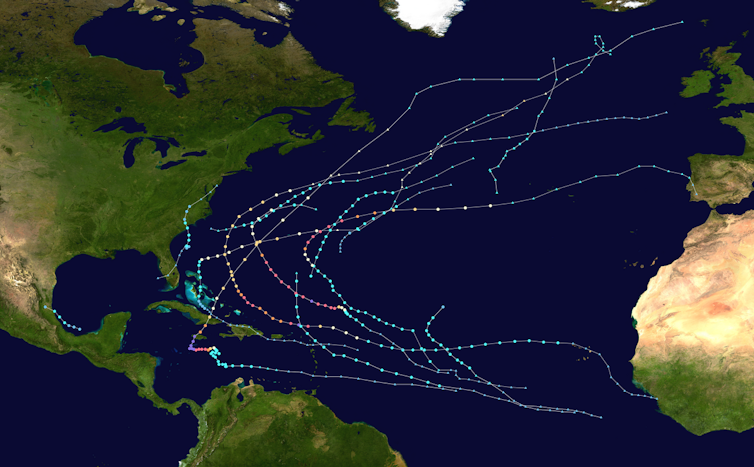
The 2025 Atlantic hurricane season’s storm tracks show how most of the storms steered clear of the U.S. mainland and veered off into the Atlantic.
Sandy14156/Wikimedia Commons

Most of the year’s 13 tropical storms and hurricanes veered off into the Atlantic before even reaching the Caribbean.

An animation shows the direction of steering winds over four days
Charts of high-level steering currents over five days, Oct. 23-27, 2025, show the influences that kept Hurricane Melissa (red dot) in place for several days. The strong curving winds in red are the jet stream, which would help steer Melissa northeastward toward the open Atlantic.
Cooperative Institute for Meteorological Satellite Studies/University of Wisconsin-Madison, CC BY-ND

Climate change plays a role in these shifts

So, how does climate change influence the jet stream?

The strength of jet streams is controlled by the temperature contrast between the equatorial and polar regions.

A higher temperature contrast leads to stronger jet streams. As the planet warms, the Arctic is heating up at more than twice the global average rate, and that is reducing the equator-to-pole temperature difference. As that temperature gradient weakens, jet streams lose their strength and become more prone to stalling.

A chart shows rising temperatures in the Arctic
The Arctic has been warming two times faster than the planetary average.
NOAA Arctic Report Card 2024

This increases the risk of persistent extreme rainfall events.

Weaker jet streams also meander more, producing larger waves and more erratic behavior. This increases the likelihood of unusual shifts, such as the southward swing of the jet stream in the summer of 2025.

A recent study found that amplified planetary waves in the jet streams, which can cause weather systems to stay in place for days or weeks, are occurring three times more frequently than in the 1950s.

What’s ahead?

As the global climate continues to warm, extreme weather events driven by erratic behavior of jet streams are expected to become more common. Combined with additional moisture that warmer oceans and air masses supply, these events will intensify, producing storms that are more frequent and more destructive to societies and ecosystems.

In the short term, the polar jet stream will be shaping the winter ahead. It is most powerful in winter, when it dips southward into the central and even southern U.S., driving frequent storm systems, blizzards and cold air outbreaks.

The Conversation

Shuang-Ye Wu does not work for, consult, own shares in or receive funding from any company or organization that would benefit from this article, and has disclosed no relevant affiliations beyond their academic appointment.

ref. 2025’s extreme weather had the jet stream’s fingerprints all over it, from flash floods to hurricanes – https://theconversation.com/2025s-extreme-weather-had-the-jet-streams-fingerprints-all-over-it-from-flash-floods-to-hurricanes-270641

Best way for employers to support employees with chronic mental illness is by offering flexibility

Source: The Conversation – USA (3) – By Sherry Thatcher, Regal Distinguished Professor of Management and Entrepreneurship, University of Tennessee

More than 20% of Americans will be diagnosed with mental illness in their lifetimes. They will, that is, experience conditions that influence the way they think, feel and act – and that may initially seem incompatible with the demands of work.

Our new research suggests that what people living with chronic mental illnesses need most to succeed at work is for their managers to be flexible and trust them.

This includes the freedom to adjust their schedules and workloads to make their jobs more compatible with their efforts to manage and treat their symptoms. For that to happen, managers need to trust that these workers are committed to their jobs and their employers.

We’re management professors who reviewed hundreds of blog and Reddit posts and conducted in-depth interviews with 59 people. And those are the most significant findings from our peer-reviewed study, published in the October 2025 issue of the Academy of Management Journal.

Scouring Reddit posts and conducting interviews

We gathered our data from three sources: anonymous blog posts from 171 people, Reddit posts from 781 people, and in-depth interviews with 59 workers employed in a variety of jobs across multiple industries.

All these people worked while dealing with chronic mental illness, such as major depressive disorder, generalized anxiety disorder and bipolar disorder. The blog posts were maintained by a nonprofit concerned with the experiences of individuals living with mental illness. We focused on posts tagged “work.”

To identify relevant data on Reddit, we searched using a combination of the word “work” with several terms associated with mental illness. Additionally, we restricted our data collection to unsolicited narratives published prior to mid-March 2020 to avoid overlap with the employment changes that occurred during the COVID-19 pandemic. Because this data was gathered from the internet, we couldn’t obtain details about participants’ gender, age, profession or education.

We also recruited people to interview through social media postings, advertising in a public university’s alumni listserv and contacting an organization that focuses on men’s mental health. We also made requests of those we’d already interviewed to see whether they had recommendations for other people to possibly interview.

The interviews took place in 2020 and 2021.

Speaking with people from all walks of working life

About 37% of the people we interviewed identified as women, and their average age was 41.5 years. Approximately 80% of them identified as Caucasian, 3.5% Black, 3.5% Hispanic, and less than 2% identified as either Indian, Korean American, mixed race or Middle Eastern and North African. About 3.5% chose not to answer.

They held a variety of jobs, including lawyer, professor, touring musician, consultant, teacher, real estate manager, chief technology officer, salesperson, restaurant server, travel agency manager, graphic designer, tester for manufacturing plant, chemical engineer and bus driver. Several worked in tech fields.

When the employees who we studied were trusted and given flexibility, they became better able to do their jobs while also attending to their well-being.

Employees who had lived with their condition for years used what we call “personalized disengagement and engagement strategies” to manage their symptoms. That refers to the fact that people with mental illness respond best to different coping strategies depending on their own preferences and symptoms, instead of using generic techniques they learned from self-help resources or peers.

Examples of personalized disengagement strategies ranged from leaving workspaces to meditate to taking a walk, to finding a quiet space to cry.

Engagement strategies included immersing more deeply into work and having conversations with co-workers. These coping strategies will sound familiar to most people, including those without any chronic mental health conditions. But workplaces don’t always give employees, regardless of their disability status, the flexibility and self-determination necessary to enact their strategies. In fact, a recent survey by Mind Share Partners found that nearly half of employees didn’t even feel like they could disconnect from their jobs after working hours or while on vacation.

Many employees also told us that they benefited from trust and flexibility in the period after they were diagnosed, when they needed to explore different therapies and treatment techniques.

When managers allow for flexibility, trust workers to do what they need to do to address their symptoms, and convey their compassion, employees with chronic mental illness are more likely to keep their jobs and get their work done.

Affecting most employers

Mental illnesses became more prevalent in the aftermath of COVID-19,especially among adolescents and young adults.

So, if you’re an employer, chances are that our research is relevant to your workforce.

Depression, a common mental illness, had an estimated cost of US$1 trillion annually in lost productivity in 2019, the World Health Organization has estimated.

People with anxiety and mood disorders, including bipolar disorder and major depressive disorder, may periodically have symptoms that interfere with their ability to do their jobs.

And while doing those jobs, they risk being stigmatized by co-workers who may know little about mental illness or be judgmental about people with those chronic conditions. That adds further stress beyond what others would experience at work.

Employee assistance programs could be falling short

In response, many employers offer benefits to help employees cope with mental and emotional problems, such as employee assistance programs, mental-wellness app subscriptions and stigma-reduction efforts.

These one-size-fits-all initiatives can help improve functioning for those with occasional or short-term emotional problems, and they can help improve leaders’ ability to respond to employees’ distress, which is crucial.

But as a whole, they are not enough to solve the problem.

Employee assistance programs, which nearly all big companies offer, have not proved systematically helpful to workers in achieving their goals. One study found that they reduced employees’ absences but did not reduce their work-related distress.

Another study even found that workers who used these programs became more inclined to leave their jobs.

Not missing out on peak performers

Contrary to stereotypes, people with chronic anxiety and depression, such as those we studied, are generally as capable of success in the workplace as anyone else in the right context.

Extremely high performers, such as the late actor Carrie Fisher and the Olympic swimmer Michael Phelps, are two such examples of people with a mental illness who were top achievers in their field.

If you were a manager, wouldn’t you want people of this caliber working for you? If so, then it’s important to create the right conditions, which many employers fail to do despite their best efforts.

Needing more mental health support

Companies will face increasing pressure to support those with mental illness and other mental health challenges.

Monster’s 2024 State of the Graduate Report found that Gen Z employees, people born between 1996 and 2010 and are currently in their teens and 20s, are increasingly prioritizing support for mental health at work, with 92% of 18- to 24-year-olds surveyed wanting a job where they are comfortable discussing their mental health at work.

This trend suggests that employers wishing to attract top entry-level talent will need to effectively support mental health, highlighting the importance of continuing to research this issue.

The Conversation

The authors do not work for, consult, own shares in or receive funding from any company or organization that would benefit from this article, and have disclosed no relevant affiliations beyond their academic appointment.

ref. Best way for employers to support employees with chronic mental illness is by offering flexibility – https://theconversation.com/best-way-for-employers-to-support-employees-with-chronic-mental-illness-is-by-offering-flexibility-270368

The price of going home: Christmas boxes and the final return from South Africa to Zimbabwe

Source: The Conversation – Africa – By Saana Hansen, Postdoctoral Researcher in Social and Cultural Anthropology, University of Helsinki

Each December, long-distance buses, minibus taxis and private cars stream northwards from South Africa as Bulawayo, Zimbabwe’s second biggest city, prepares for its annual ritual: the seasonal homecoming of “injiva” – migrants returning for Christmas.

The old industrial city, where businesses have declined and shops and restaurants struggle to survive, fills temporarily with cars with South African number plates and people dressed in trendy clothes signalling urban South African lifestyles. Trailers are loaded with remittances known as “Christmas boxes” containing cooking oil, soap and other groceries. A jumping castle is erected in the park, and popular music merges with laughter in the restaurants.

These are historically rooted signs of achievement and success earned abroad. They are a refashioned form of the festive season of colonial-era injivas: men from the Matabeleland region of Zimbabwe who worked in South African mines and farms, returning home typically once a year with gifts.

Yet, it is common knowledge that this performance is often hard-earned, and injivas – both women and men – struggle to meet these expectations. The real-life migration experiences include economic and legal uncertainties and discrimination in the labour market, low wages and difficulty in sending remittances home.

Amid the festive return lies a quieter and more solemn south-north movement – that of Zimbabwean migrants who have passed away and are taking their final journey home. Contrasting with the festivities surrounding Christmas visits, the coffin-shaped trailers along the A6 highway from the Beitbridge border post to Bulawayo are a reminder that migration’s promise of prosperity comes with risk and loss.

This homecoming, which I studied for my PhD in anthropology and have described in a recent paper, is shaped by bureaucracy, cost and intergenerational care.

The study reveals how a life-sustaining web of care is maintained. It contributes to anthropological discussions on migration, kinship, the state, documentary practices, law and development.

The moral duty and economic headache of return

The migration pattern between Zimbabwe and South Africa has its roots in colonial-era labour migration and has intensified since Zimbabwe’s independence in 1980. In the early 2000s, Zimbabwe’s economic collapse, marked by hyperinflation, political violence and mass unemployment, drove millions to seek economic opportunities and protection in South Africa.

Estimating the number of Zimbabweans in South Africa is difficult due to the largely unregulated nature of this mobility, but figures generally range between one million and three million.

Although deceased migrants, documented or not, can be buried in South African soil, bringing a body home is a vital act in Zimbabwe, as in many other African contexts. It is to restore the deceased to the lineage and to enable the spirit to be mourned and settled so it will protect younger generations. Failing to do so risks spiritual and social disorder. The respectful return in death, like the festive Christmas return of the able-bodied injivas, reinforces ties between generations.

Despite the religious and cultural importance of burial at home, repatriating a body from South Africa poses economic challenges to a family. It’s not only a moral duty but also a financial burden. So, in principle, only those whose death has been unforeseen return in coffins. Those who can will return home before they die to save the cost of repatriation.

Families make extraordinary efforts to make repatriation possible. Relatives collect and borrow money, and reach out to kin across borders. Burial societies mobilise payments from their members to collect the funds for embalming, transportation, paperwork and funerals. These obligations reveal the importance of the ancestral continuity being an economic matter, and sustenance of family welfare continuing after death.

Formal and informal burial societies

Since the 1990s, Bulawayo’s once-thriving industries have largely collapsed, leaving its old mills and factories deserted or refunctioning as spaces for religious congregations, education and garages. Amid these modest ventures, funeral services stand out in the city’s otherwise melancholic landscape.

As Zimbabwe’s economic and political instability pushes many to seek livelihoods in South Africa, the funeral industry has expanded. The Beitbridge border, crossing the Limpopo River between Zimbabwe and South Africa, has long organised the movement of labour and remittances, governing also the return of bodies.

Indeed, funeral parlours and burial societies date back to the colonial era when injured and dead migrants had to be sent home. Today, carrying prosperous names such as Doves, Kings & Queens and African Pride, funeral parlours function as key institutions in managing transnational death.

Besides these licensed funeral services, people belong to informal money pooling societies that mobilise money collectively to cover the cost of death. While some collect steady monthly deposits, others gather money ad hoc during emergencies.

These societies blur boundaries between formal and informal systems. Many “undocumented” migrants, who cannot have bank accounts, participate through friends or relatives with legal status, contributing to pooled funds tracked via mobile communication apps and bank transfer receipts. Societies sustain solidarity networks, and transparent contributions signal both moral and financial responsibility, shaping participants’ social standing.

Bureaucracies of transnational death

Between the death and the burial, numerous legal and bureaucratic steps must be completed, from obtaining death certificates and health clearances to coordinating with South African and Zimbabwean authorities.

Often, identity documents from Zimbabwe need to be collected to prove that the deceased is a Zimbabwean national. When the deceased has not revealed their identity to the South African authorities and remains “undocumented”, or has two legal identities, the disparity needs to be explained in affidavits.


Read more:
Migrants in South Africa have access to healthcare: why it’s kicking up a storm


These administrative steps are not simply procedural; they are part of the politics of death. The paperwork that allows a body to move, such as a stamp, a signature, or an affidavit, is both a form of recognition and a reminder of inequality. While some deaths can move across borders with relative ease, others become delayed or trapped in institutional procedures.

Bureaucracy is a space where care, legality and belonging intertwine. State officials may draw not only on formal guidelines but also their cultural logics of care. They are central in navigating the legal and bureaucratic challenges. Immigration officers might be sympathetic and share the cultural understanding of the importance of returning home respectably.

The homecoming of the dead mirrors, in reverse, the December journeys of the living. Both are seasonal movements that bind families across generations, space and time. The same routes that carried migrants south in search of work now carry their bodies northward, accompanied by papers, payments and prayers.

In the end, the bureaucracies that regulate transnational death are not merely state procedures, but central to how families remake connection, dignity and belonging under precarious conditions.

The Conversation

This research was supported by funding from the Academy of Finland. The author is currently supported by the Kone Foundation.

ref. The price of going home: Christmas boxes and the final return from South Africa to Zimbabwe – https://theconversation.com/the-price-of-going-home-christmas-boxes-and-the-final-return-from-south-africa-to-zimbabwe-268046

Australia is reeling from the worst terrorist attack on home soil. Could it have been prevented?

Source: The Conversation – Global Perspectives – By Greg Barton, Chair in Global Islamic Politics, Alfred Deakin Institute for Citizenship and Globalisation, Deakin University

With 15 civilians and one gunman dead so far, and another 40 people injured, Australia is reeling from its worst act of terrorism on home soil. Two gunmen opened fire on a Jewish community gathering to celebrate the first night of Hanukkah at Archer Park on Sydney’s famous Bondi Beach.

Police have confirmed the two alleged attackers were father and son, aged 50 and 24. The father, Sajid Akram, who was licensed to own six firearms, was shot dead by police. The son, Naveed Akram, remains under police guard in hospital.

Given it was clearly an antisemitic attack, authorities soon after declared it an act of terrorism – that is, an act of politically motivated violence. This designation also gives authorities extra resources in their response and in bringing those responsible to justice.

As Australians try to process their shock and grief, there has been some anger in the community that not enough has been done to protect Jewish Australians from the rising antisemitism evident since the Hamas attack on Israel in October 2023 and the ensuing Gaza war.

What we know about the alleged attackers

ASIO (The Australian Security Intelligence Organisation) Director-General Mike Burgess has said one of the alleged gunmen was “known” to ASIO, though he did not specify which one. Being “known” to authorities can simply mean someone has been associated with networks and communications that have caused concern to authorities. The ABC has reported that Naveed Akram came to the attention of authorities after the arrest of Islamic State Sydney cell leader Isaac El Matari in July 2019.

However, there are hundreds of people who come to authorities’ attention for their contact, online or off, with extremist networks and individuals. With limited resources (and authorities’ resources will always be limited, no matter how much funding they have), they have to run a triage system to assess the threat an individual or a group may pose, and manage the risk as best they can.

They will carefully assess what is being said and the language used, for example, as well as looking at whether a person has a history of violence. As angry and upset as people understandably are in the wake of such a horrific incident, it needs to be recognised that authorities can’t simply arrest everyone who expresses extremist ideas or has passing links with extremist elements.

We still need to know more about this terror attack and the alleged attackers, but to date there has been no evidence of a network in operation. Given the alleged gunmen were father and son, this technically fits the profile of a “lone actor” attack, as we saw in the Lindt Cafe siege in 2014, and Christchurch in 2019.

It is very difficult for authorities to predict and therefore prevent lone actor attacks – by their nature, there’s often no sign beforehand of the potential for violence. And public sites like the reserve at Bondi Beach require extensive resources to police, meaning not all can be adequately secured.

As Burgess pointed out in his annual threat assessment, “our greatest threat remains a lone actor using an easily obtained weapon”. Sadly, that has been shown to be true.

Changing nature of terrorist threat in Australia

There has been much attention in recent years on the rise of far-right extremism and terrorism.

One of the best guides to this is Burgess’ annual threat assessment. In it he explained that a decade ago, just one in ten cases ASIO was following up involved right-wing extremists, with radical Islamist groups occupying most of their attention. However, in recent years the ratio has shifted closer to one in two investigations involving right-wing extremism. In other words, a lot of ASIO’s attention and resources are now necessarily tied up with combating right-wing extremism, especially following the Christchurch terror attack in which 51 people were shot dead by an Australian far-right terrorist during Friday prayers in two New Zealand mosques.

More broadly, Islamic terrorism continues to remain a global threat. IS and Al-Qaeda remain active in the Middle East and increasingly in Africa, as well as central Asia and Afghanistan. Generally, authorities are doing a good job of keeping on top of any threats these networks might pose in Australia.

There is no doubt the general atmosphere between pro-Palestinian and Jewish groups has become far more febrile in the wake of the Hamas attack and the Gaza war. There is a lot of anger and frustration as scenes of violence and suffering are broadcast daily, and we have seen a rise both in antisemitism and Islamophobia since the war began, simply because of the way it plays out in people’s imaginations.

But even in the protests we have seen over many months, the number of people who might use this sentiment to spur violence is small.

Again, there is no evidence the Bondi shooting was part of a wider network, and it is very difficult to stop a lone actor attack on a public site.

In a glimmer of hope, the man whose much-lauded act of heroism in wrestling one of the alleged gunman’s weapons from him has been named as 43-year-old Muslim fruit shop owner Ahmed Al-Ahmed. It is hoped this man’s bravery, which showed us the best of humanity in the midst of the worst, will stop any simplistic analysis of blaming the Muslim community for such violence. We have seen this in the United States, and Australia must do much better.

Has the government done enough?

It is very difficult to keep outdoor public events entirely safe: buildings are relatively easy to secure, but a park at a beach far less so.

The government clearly needs to do more to stop terrorism, and public events are an obvious focus for more resources. No one should be satisfied with where we are right now. It is simply horrifying. But it’s going to take a lot of work to figure out where we can best use resources.

We can’t close every loophole or thwart every risk. We can’t stop people turning to violence, and we can’t police every hateful thought. It has been said this was an attack on all of us, and that’s very true. As the message of Hanukkah inspires us, now is the time when we need to pull together as Australians from all faiths and communities, and work together to ensure that light triumphs over darkness.

The Conversation

Greg Barton is Rector (academic head) of Deakin University Lancaster University Indonesia (DLI). Greg receives funding from the Australian Research Council. He is engaged in a range of projects funded by the Australian government that aim to understand and counter violent extremism in Australia and in Southeast Asia and Africa.

ref. Australia is reeling from the worst terrorist attack on home soil. Could it have been prevented? – https://theconversation.com/australia-is-reeling-from-the-worst-terrorist-attack-on-home-soil-could-it-have-been-prevented-272048

Bondi attack came after huge increase in online antisemitism: research

Source: The Conversation – Global Perspectives – By Matteo Vergani, Associate Professor and Director of the Tackling Hate Lab, Deakin University

At least 16 people – including a ten-year-old child – are dead after two men opened fire on a crowd of people celebrating the Jewish holiday of Hanukkah on Sunday in a public park at Sydney’s Bondi Beach. Many more are injured.

I am horrified. But as a researcher who studies hate and extremist violence, I am sadly not surprised.

The Jewish community has been a top target for terrorist ideologies and groups for a long time. Many people working in this field have been expecting a serious attack on Australian soil.

Much remains unclear about the Bondi terrorist attacks and it’s too early to speculate about these gunmen specifically. The investigation is ongoing.

But what about antisemitic sentiment more broadly?

Our research – which is in the early stages and yet to be peer reviewed – has recorded a significant and worrying increase in antisemitic sentiment after October 7.

Our research

We have been training AI models to track online sentiment in social media targeting Australian communities, including Jewish people.

That means working with humans – including extremism experts and people in the Jewish community – to label content. This is to teach our model if the content it is encountering is hateful or not.

Based on definitions adopted by the Jewish community, we distinguished between two main types of antisemitism: “old” antisemitism and “new” antisemitism.

“Old” antisemitism targets Jews as Jews. It draws on entrenched myths and stereotypes that portray them as alien, dangerous, or morally corrupt.

“New” antisemitism shifts the focus from individual Jews to the state of Israel. It blames Jews collectively for Israel’s actions.

Many in the Jewish community see this as a modern continuation of historical antisemitism. Critics (both within and outside the Jewish community) contend it risks conflating legitimate opposition to Israeli policies with antisemitism.

Central to this debate is whether anti-Israel sentiment represents a continuation of age-old prejudices or a political response to the Israeli-Palestinian conflict.

In our research, we tracked both “old” and “new” antisemitism.

A sharp increase

We found that both increased sharply after October 7.

For example, we studied posts on X (formerly Twitter) geolocated in Australia before and after October 7. We wanted to understand the size of the rise in antisemitism.

We found that “old” antisemitism rose from an average of 34 tweets a month in the year before October 7 to 2,021 in the following year.

“New” antisemitism increased even more, rising from an average of 505 a month in the year before October 7 to 21,724 in the year after.

Some examples of “old” antisemitism are explicit, such as calls to “get rid of all Jews” or “kill all Jews”.

Others are more indirect, including minimising or denying the Holocaust. Examples include posts claiming that “if the Holocaust of 6 million Jews were true, Israel could not exist today” or that the Nazis had only a minimal impact on the Jewish population.

Other forms of hate rely on conspiracy theories, such as claims that “Jews are paying to destroy Australia”.

However, the vast majority of the content our models identified as antisemitic fell into the category of “new” antisemitism. This included content that blamed the Jewish community for events in Israel, such as calling all Australian Jews “baby killers” or “Zionazi fu–wits”, regardless of their personal political views and opinions about the Israeli government and its actions.

(All examples here are drawn from real content, but the wording has been slightly modified to anonymise them and prevent identification of the original authors).

In other words, we have seen an overall escalation of hostilities against Jews online.

More extreme and explicit calls for violence rarely appear on mainstream platforms. They tend to circulate on fringe social media, such as Telegram.

On X, we have seen a collision of mainstream discourse and fringe discourse, due to the lack of moderation.

But antisemitism doesn’t always involve slurs, meaning it can also happen in mainstream platforms. Especially after the election of Trump and the relaxation in moderation practises of Meta, we have also seen it on Instagram. This includes Instagram posts published after the Bondi attack.

Could more have been done?

Certainly the Jewish community, I am sure, will feel not enough was done.

Jillian Segal, Australia’s first government-appointed special envoy for combating antisemitism, released her plan for addressing the issue back in July.

As I wrote at the time, the recommendations fell into three main categories:

  1. preventing violence and crime, including improved coordination between agencies, and new policies aimed at stopping dangerous individuals from entering Australia

  2. strengthening protections against hate speech, by regulating all forms of hate, including antisemitism, and increasing oversight of platform policies and algorithms

  3. promoting antisemitism-free media, education and cultural spaces, through journalist training, education programs, and conditions on public funding for organisations that promote or fail to address antisemitism.

The government had said it will consider the recommendations. Segal has now said government messaging combating antisemitism has “not been sufficient”.

Some might argue addressing points two and three could have helped prevent the Bondi attack. A common assumption is that a climate of widespread antisemitism can embolden violence.

The reality, however, is that this is hard to establish. People who commit terrorist acts – whether they self radicalise or are recruited by terrorist organisations – do not necessarily respond to changes in broader public sentiment.

That said, there is obvious value in prevention work aimed at reducing hostility and antisemitic attitudes, even while small networks or individuals committed to violent terrorism may still exist.

Preventing terrorist violence of this scale relies primarily on effective law enforcement. This requires adequate resourcing and a clear legislative framework.

Education and broader cultural change matter. In short term, however, they are less likely to be as effective at preventing acts of terrorism as measures such as firearm regulation, monitoring extremist networks, and disrupting plots before they turn into action.

The Conversation

Matteo Vergani receives funding from the Australian government (ARC, Department of Home Affairs) and the Canadian government (Public Safety Canada).

ref. Bondi attack came after huge increase in online antisemitism: research – https://theconversation.com/bondi-attack-came-after-huge-increase-in-online-antisemitism-research-272045

‘An act of evil antisemitism’: at least 15 dead in terrorist attack on Bondi Beach

Source: The Conversation – Global Perspectives – By Alexandra Hansen, Deputy Editor and Chief of Staff, The Conversation

The death toll has risen to 15 after two gunmen opened fire on a crowd at Bondi Beach at about 6.47pm on Sunday. Thirty-eight people were injured and taken to hospital, including two police officers and four children. One of the gunmen is also dead. It is the deadliest mass shooting in Australia since the Port Arthur massacre in 1996.

A crowd of more than 1,000 had gathered to celebrate the first day of the Jewish festival Hanukkah. Bondi Beach is in the Sydney eastern suburbs, the heart of the Jewish community. New South Wales police have declared the shooting a terrorist attack.

Police confirmed one suspect had been taken into custody and was in serious condition. Another suspect was killed at the scene and police said they were investigating the possibility of a third offender. One of the attackers was known to authorities.

On Sunday evening, police were also investigating reports of an explosive device near the beach. At a press conference on Sunday night, New South Wales Police Commissioner Mal Lanyon confirmed an improvised explosive had been found in a car.

ASIO head Mike Burgess said Australia’s terrorism threat level remained at “probable”. This means there is a greater than 50% chance of an onshore attack or attack planning in the next twelve months. “I don’t see that changing at this stage,” Burgess told reporters in Canberra on Sunday night.

Soon after the shooting began, horrific vision emerged on social media of people shot dead or injured, as well as footage of incredible acts of bravery from passersby trying to thwart the attack.

One video shows a bystander tackling a gunman from behind, wrestling his gun from him. Others were performing CPR on the injured on the beach.

A Jewish chaplain with blood on him spoke of trying to save people amid terrible scenes of people shot in the head. People fled as the attack unfolded, but some elderly people were unable to run.

Prime Minister Anthony Albanese described the scenes as “shocking and distressing”. “My thoughts are with every person affected.” In the wake of the attack he convened an emergency meeting of the National Security Committee of cabinet.

Albanese received a preliminary briefing from Australian Federal Police acting Deputy Commissioner Nigel Ryan and New South Wales Premier Chris Minns, who convened an emergency meeting of state cabinet. Albanese defended himself against criticism he had not taken antisemitism seriously enough.

“Australia is braver than those who seek to make us afraid […] we will see justice done, and we will come through this together,” he said.

“There are nights that tear at our nation’s soul in this moment of darkness,” Albanese said. “We must be each other’s light. Hold on to the true character of the country that we love.”

At Sunday night’s press conference, Minns said “This cowardly act of terrifying violence is shocking and painful to see, and represents some of our worst fears about terrorism in Sydney.” He asked Australians to “wrap their arms around” the Jewish community, and praised both the outpouring of love and support towards the Jewish community as well as the extraordinary demonstrations of courage in the wake of the attack.

Lanyon called for calm, and said this is “not a time for retribution”. He assured the public no stone would be left unturned in bringing those responsible to justice and ensuring there are no further attacks. “This type of disgraceful activity, this wanton use of violence, the taking of innocent lives is unacceptable to New South Wales.”

Independent federal MP Allegra Spender, who represents Bondi in her seat of Wentworth, also expressed her shock and horror.

Opposition Leader Sussan Ley also expressed her shock. “Australians are in deep mourning tonight, with hateful violence striking at the heart of an iconic Australian community, a place we all know so well and love, Bondi.

“Today we stand together as Australians against hate in this moment of profound tragedy and shock.”

In a statement, Israeli President Isaac Herzog said “our heart misses a beat”. He called on the Australian government to “take action to fight against the enormous wave of antisemitism which is plaguing Australian society”.

The Australian Imams Council issued a statement condemning the attack.

“These acts of violence and crimes have no place in our society. Those responsible must be held fully accountable and face the full force of the law,” the statement said.

“Our hearts, thoughts and prayers are with the victims, their families, and all those who witnessed or were affected by this deeply traumatic attack.”

A timeline of the events

  • 5pm – Chanukah by the Sea event begins. It’s run by the Chabad of Bondi which promotes it as “the perfect family event to celebrate light, warmth, and community.”
A person handing someone a hot jam donut
Instagram user @kobi_farkash was at the Chanukkah by the Sea event.
@kobi_farkash/Instagram

Beachgoers seen running from shots.
c29sty/Instagram

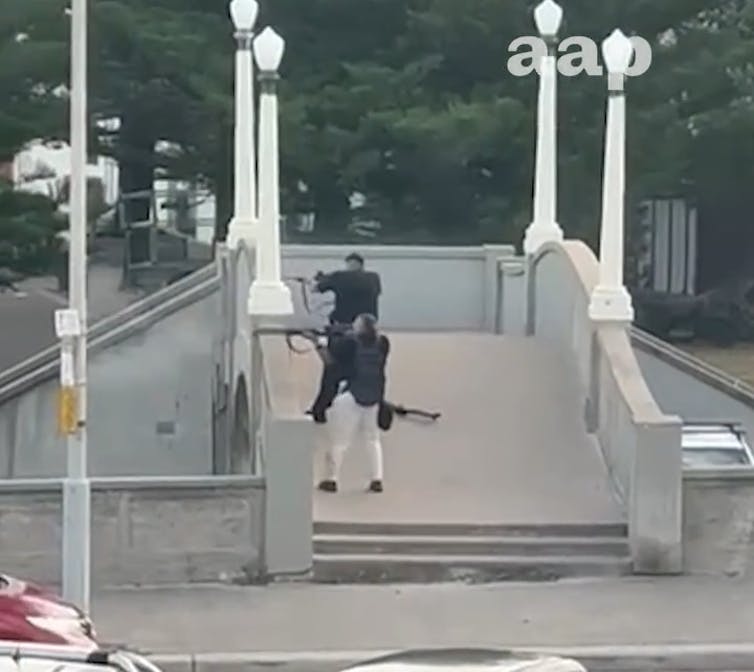
  • Sometime after 6.45pm – Two shooters can be seen firing from a bridge towards people at the Chanukah by the Sea event. They have a number of guns. Video footage shows cars driving past them as they shoot.
Footage shows the two gunmen beginning their attack from the bridge.
AAP

  • One of the shooters, since identified as Sajid Akram, moves to the park grass.

  • A bystander, since identified as Ahmed El-Ahmed, tackles gunman Sajid Akram.
Incredible footage of Ahmed al Ahmed tackling a gunman and taking his weapon.
ABC

  • Sajid Akram runs back to bridge where video shows his son Naveed Akram is still shooting. He re-arms. Both men come under fire from police nearby.
The gunman returns to the bridge and re-arms.
ABC

  • Sajid Akram is shot and falls to the ground.
Drone footage shows one gunman down while a second remained firing.
ABC
  • The second alleged gunman, Naveed Akram, is shot. A man in pale clothing walks towards the bridge then motions for police to come. Another man moves onto the bridge and raises his hands, a gunshot can be heard in the video footage.
Chaos ensues as bystanders and police rush the bridge.
AAP/ABC/X
  • Police and members of the public run onto the bridge in chaotic scenes. One man can be seen kicking one of the alleged gunmen, while another two people are fighting each other.

  • By 7.30, police are seen surrounding the shooters on the ground.

Footage shows police securing the scene and stabilising the injured gunman.
ABC
  • Sajid Akram is confirmed to have died, while Naveed Akram is in hospital with injuries.

This article has been updated.

The Conversation

ref. ‘An act of evil antisemitism’: at least 15 dead in terrorist attack on Bondi Beach – https://theconversation.com/an-act-of-evil-antisemitism-at-least-15-dead-in-terrorist-attack-on-bondi-beach-272031

Intervene or run and hide: what should you do during public violence like the attacks at Bondi?

Source: The Conversation – Global Perspectives – By Milad Haghani, Associate Professor and Principal Fellow in Urban Risk and Resilience, The University of Melbourne

A bystander tackles a gunman at the Bondi Beach mass shooting Instagram

As Sunday’s Bondi Beach attack unfolded, many will have seen footage of a man acting alone, moving toward one of the gunmen and wrestling the weapon from his hands.

It was an extraordinary act of bravery that resulted in him being shot twice.

The man was named as 43-year-old Ahmed al Ahmed, a local fruit shop owner.

Incredible bravery, but there are risks

We have no way of knowing how many additional lives were saved as a result of Ahmed’s bravery. But it almost certainly prevented further loss of life.

The moment is reminiscent of when a bystander similarly intervened at great personal risk during the Bondi Junction shopping centre attack in 2024.

When acts of courage like these occur, we rightly take notice and commend them.

But they also raise important and often overlooked questions: what motivates ordinary people to take such selfless, high-risk actions, is bystander intervention a good strategy, or does it go against official advice during mass violence events?

Two types of ‘bystander effect’

Many people would have heard of the “bystander effect”, which occurs when the presence of others discourages someone from intervening in an emergency situation, against a bully, or during an assault or other crime.

But decades of behavioural research complicate the popular idea that people inevitably freeze or look away when others are present during dangerous situations.

A large meta-analysis of bystander behaviour shows in genuinely dangerous, unambiguous emergencies (like those involving a clear perpetrator), the classic (passive) bystander effect is substantially weakened, and in some cases even reversed.

In other words, violent attacks are precisely the kinds of situations where people become likelier to act.

One reason is danger clarifies responsibility. When a situation is clearly life-threatening, people recognise it faster and are less likely to wait for social cues or reassurance from others.

We see time and again that in clear high-risk emergencies (particularly those involving violence), responsibility often sharpens rather than disappears.

An analysis of more than 100 suicide attacks in Israel shows bystander intervention can significantly reduce overall casualties.

Across these documented incidents, intervention rarely prevented an attack altogether but it frequently disrupted the attacker’s control over timing and location, triggering premature action in less crowded settings and saving lives as a result.

The same analysis, however, also shows bystander intervention often came at a direct personal cost to the interveners.

But active bystander behaviour takes many forms and can occur at different stages.

It may also involve:

  • someone who knows the perpetrator noticing and reporting concerning behaviour in the lead-up to an attack

  • guiding others to safety or sharing information as events unfold

  • providing assistance and coordination in the aftermath.

However, getting involved does seem to fly in the face of official advice from Australian authorities.

In fact, only a few weeks ago, the Australia–New Zealand Counter-Terrorism Committee launched a new national public safety campaign.

A new safety message

The new public safety campaign explicitly recognises that Australia is a safe country but there remains a risk of weapons attacks in crowded places, and that knowing how to respond can save lives.

The campaign introduced the guidance “Escape. Hide. Tell.” which means:

  • escape: move quickly and quietly away from danger but only if it is safe to do so

  • hide: stay out of sight and silence your mobile phone

  • tell: call police by dialling Triple Zero (000) when it is safe.

The aim of this advice is to help people respond in the critical first moments before police arrive, make informed decisions, and increase their chances of staying safe.

The official Australian guidance does not include any instruction to confront an attacker.

By contrast, US public safety messaging such as the FBI’s “Run. Hide. Fight” guidance does include a “fight” step, but only as a last-resort option when escape and hiding are not possible and life is in immediate danger.

Australian authorities have chosen not to include such a step, emphasising avoidance and reporting rather than confrontation.

Some practical advice

My previous experimental research has identified more specific behavioural guidance that can improve survival chances in violent attacks, particularly in crowded environments.

Using computer modelling and controlled experiments with real crowds, I have identified several strategic areas to improve their survival chance in such events.

First, moving slowly away from danger is not ideal – people need to move away from the source of threat as quickly and safely as possible.

Second, hesitation – whether to gather information, inspect what is happening, or film events – increases the risk of harm.

Third, people need to remain agile in their decision-making and navigation while they are moving and be willing to adjust their movement as situations evolve and information becomes clearer. This means continuously scanning your surroundings and adjusting direction as new information becomes apparent, rather than stopping to reassess.

Finally, when moving with family or friends, travelling in a single-file formation – staying close in a back-to-back snake formation rather than holding hands side by side – benefits everyone by reducing congestion and improving flow.

Be prepared

The events in Sydney are horrific and they underline a difficult reality: preparedness for violent risks in crowded places needs to become more mainstream.

Crowded spaces will always remain vulnerable to deliberate violence, whether driven by terrorist intent or other motivations.

Messaging needs to reach more people to be evidence-based, nuanced, and widely accessible.

With several major public events and large mass gatherings approaching (including New Year’s Eve) it is more important than ever for people to be aware of these risks and remain vigilant.

The Conversation

Milad Haghani does not work for, consult, own shares in or receive funding from any company or organisation that would benefit from this article, and has disclosed no relevant affiliations beyond their academic appointment.

ref. Intervene or run and hide: what should you do during public violence like the attacks at Bondi? – https://theconversation.com/intervene-or-run-and-hide-what-should-you-do-during-public-violence-like-the-attacks-at-bondi-272046

‘An act of evil antisemitism’: at least 16 dead in terrorist attack on Bondi Beach

Source: The Conversation – Global Perspectives – By Alexandra Hansen, Deputy Editor and Chief of Staff, The Conversation

The death toll has risen to 16 after two gunmen opened fire on a crowd at Bondi Beach at about 6.47pm on Sunday. Thirty-eight people were injured and taken to hospital, including two police officers and four children. One of the gunman was among the dead. It is the deadliest mass shooting in Australia since the Port Arthur massacre in 1996.

A crowd of more than 1,000 had gathered to celebrate the first day of the Jewish festival Hanukkah. Bondi Beach is in the Sydney eastern suburbs, the heart of the Jewish community. New South Wales police have declared the shooting a terrorist attack.

Police confirmed one suspect had been taken into custody and was in serious condition. Another suspect was killed at the scene and police said they were investigating the possibility of a third offender. One of the attackers was known to authorities.

On Sunday evening, police were also investigating reports of an explosive device near the beach. At a press conference on Sunday night, New South Wales Police Commissioner Mal Lanyon confirmed an improvised explosive had been found in a car.

ASIO head Mike Burgess said Australia’s terrorism threat level remained at “probable”. This means there is a greater than 50% chance of an onshore attack or attack planning in the next twelve months. “I don’t see that changing at this stage,” Burgess told reporters in Canberra on Sunday night.

Soon after the shooting began, horrific vision emerged on social media of people shot dead or injured, as well as footage of incredible acts of bravery from passersby trying to thwart the attack.

One video shows a bystander tackling a gunman from behind, wrestling his gun from him. Others were performing CPR on the injured on the beach.

A Jewish chaplain with blood on him spoke of trying to save people amid terrible scenes of people shot in the head. People fled as the attack unfolded, but some elderly people were unable to run.

Prime Minister Anthony Albanese described the scenes as “shocking and distressing”. “My thoughts are with every person affected.” In the wake of the attack he convened an emergency meeting of the National Security Committee of cabinet.

Albanese received a preliminary briefing from Australian Federal Police acting Deputy Commissioner Nigel Ryan and New South Wales Premier Chris Minns, who convened an emergency meeting of state cabinet. Albanese defended himself against criticism he had not taken antisemitism seriously enough.

“Australia is braver than those who seek to make us afraid […] we will see justice done, and we will come through this together,” he said.

“There are nights that tear at our nation’s soul in this moment of darkness,” Albanese said. “We must be each other’s light. Hold on to the true character of the country that we love.”

At Sunday night’s press conference, Minns said “This cowardly act of terrifying violence is shocking and painful to see, and represents some of our worst fears about terrorism in Sydney.” He asked Australians to “wrap their arms around” the Jewish community, and praised both the outpouring of love and support towards the Jewish community as well as the extraordinary demonstrations of courage in the wake of the attack.

Lanyon called for calm, and said this is “not a time for retribution”. He assured the public no stone would be left unturned in bringing those responsible to justice and ensuring there are no further attacks. “This type of disgraceful activity, this wanton use of violence, the taking of innocent lives is unacceptable to New South Wales.”

Independent federal MP Allegra Spender, who represents Bondi in her seat of Wentworth, also expressed her shock and horror.

Opposition Leader Sussan Ley also expressed her shock. “Australians are in deep mourning tonight, with hateful violence striking at the heart of an iconic Australian community, a place we all know so well and love, Bondi.

“Today we stand together as Australians against hate in this moment of profound tragedy and shock.”

In a statement, Israeli President Isaac Herzog said “our heart misses a beat”. He called on the Australian government to “take action to fight against the enormous wave of antisemitism which is plaguing Australian society”.

The Australian Imams Council issued a statement condemning the attack.

“These acts of violence and crimes have no place in our society. Those responsible must be held fully accountable and face the full force of the law,” the statement said.

“Our hearts, thoughts and prayers are with the victims, their families, and all those who witnessed or were affected by this deeply traumatic attack.”


This article has been updated.

The Conversation

ref. ‘An act of evil antisemitism’: at least 16 dead in terrorist attack on Bondi Beach – https://theconversation.com/an-act-of-evil-antisemitism-at-least-16-dead-in-terrorist-attack-on-bondi-beach-272031

What’s in a label? Rethinking how we talk about gender-based violence

Source: The Conversation – Canada – By Dianne Lalonde, PhD, Political Science, Western University

The words we use to describe gender-based violence (GBV), such as “victim,” “survivor” and “person with lived experience,” aren’t neutral. These labels are powerful. They can affirm dignity or reinforce stigma. They can mobilize movements or obscure systemic issues.

GBV can include sexual, physical, mental and economic abuse. Coercive control and manipulation in intimate partner relationships are an example, as is sexual assault, child marriages or technology-facilitated violence. And in Canada, GBV disproportionately impacts women and girls.


Read more:
Why Canada needs to recognize the crime of femicide — on Dec. 6 and beyond


As GBV evolves across digital and in-person contexts, the stakes of language are especially high.

Drawing on our research and practice, we explore what these labels mean, how they are used and the impact they have on people’s lives. Our aim is to support intentional language as part of the broader work of violence prevention, collective action and addressing harm.

Two starting points help anchor this discussion. The first is that when you are in direct contact with someone who has experienced GBV, follow their lead in how they describe their own experience. The second is to recognize that different communities use terms rooted in their own histories that demand our respect, not our translation.

What ‘victim’ reveals and what it distorts

“Victim” centres the harm experienced by individuals and the impacts it has had on their lives. It first gained prominence early in the women’s rights movement, when it was deployed to evoke sympathy and action. Today, it remains central to the legal system.

Research indicates that labelling someone as a victim frames them as someone in need of saving or protection rather than being recognized as knowledgeable and capable.

The label has also been criticized for reinforcing the “perfect victim” stereotype, suggesting that only those who appear innocent or socially respectable deserve empathy or justice. This stereotype often dismisses and blames certain groups, including Black women and women with disabilities who face compounded discrimination and disbelief.

Yet some individuals embrace the label of “victim” as an honest reflection of what they endured.

As American writer Danielle Campoamor states:

“As a victim of sexual assault, I am not a happy ending. I do not exist for others to feel better about a systemic problem.”

‘Survivor’ — the resilience story

“Survivor” foregrounds empowerment and resilience. People labelled as survivors are generally perceived more positively than people labelled as victims.

For men who have experienced sexual violence, “survivor” can offer a way to name harm in a context where acknowledging victimization is socially discouraged.

However, the label can shift attention away from aggressors and toward expectations that individuals demonstrate strength or recovery. Healing is not a linear process, and the label of “survivor” can create pressure that a person or community simply “get over it.” These expectations stigmatize people whose healing does not align with socially accepted ideas of recovery or “good” behaviour.

A focus on personal resilience can also reflect society’s discomfort with GBV by celebrating endurance rather than confronting the systems that create harm.

“Victim-survivor” has also been proposed as an umbrella term that aims to disrupt the victim/survivor binary, though it can reproduce some of the same pressures attached to both.

Does person-first language respect or obscure?

Person-first language, such as “individual who experienced GBV,” emerged from disability activism. It leads with the person rather than the label, offering an alternative to identity-first terms like “victim” or “survivor.”

Person-first language has been found to affirm dignity and emphasize that violence is only one part of a person’s story. It highlights individuality and complexity, reflecting the wide range of experiences within this group.

But person-first language can unintentionally portray the person’s identity as inherently negative or shameful. It can also individualize violence, obscuring the broader social and political structures that enable it.

Ultimately, the value of person-first language depends on how it is applied and whether it recognizes both personal experience and systemic accountability.

Navigating labels in real-life contexts

Every label captures something true while also missing something else.

The goal is not perfection or consistency; it is intention. Ask: What purpose does this label serve? How is it shaping assumptions about harm and agency? How might you capture what the label misses? Are you imposing one term universally or making space for the multiplicity of language people actually use? If you are speaking to or about an individual, what term do they prefer?

While we recognize that institutional settings often limit the language used, these questions remain useful because they help guide how those terms are applied, offering space to challenge harmful assumptions even when the terminology itself cannot change.

No single label can fully and accurately summarize experiences of violence. Labels often overlap, shift with context and evolve over time.

What matters most is using language that reflects care and respect. Our words should neither confine people to their experiences of violence nor erase the realities of that harm. Intentional language is one way we move closer to a world where GBV is actively named and dismantled.

The Conversation

Dianne Lalonde is affiliated with the Federation for the Humanities and Social Sciences.

Sue O’Neill received funding from the Social Sciences and Humanities Research Council. Sue O’Neill is on the board of directors for Bryony House, a crisis GBV shelter in Halifax, Nova Scotia.

ref. What’s in a label? Rethinking how we talk about gender-based violence – https://theconversation.com/whats-in-a-label-rethinking-how-we-talk-about-gender-based-violence-270650

Co-operatives empower people — and students need to know about them

Source: The Conversation – Canada – By Michelle Stack, Associate Professor, Department of Educational Studies, University of British Columbia

Canadian students are struggling. Many cannot afford housing, are struggling with mental health crises and increasing numbers don’t have enough money for food.

At the same time, universities are spending time and money chasing media-driven rankings that don’t offer tools for responding to these challenges or improve the quality of education or research in Canada.

But there’s a proven alternative that generates trillions in the global economy but remains largely invisible in higher education: co-operatives.

Canada’s 2025 budget mentions co-operative housing as a way to deal with the housing crisis, but co-ops go beyond housing. They could provide a place for students to practise democratic governance, to have a sense of community, to find dignified work and affordable food and housing — and to make research more accessible.

Co-operatives come in different forms, but they all sign on to key principles, many of which are similar to those espoused by educational institutions.

These include democratic member control, economic participation by members, autonomy and independence, voluntary and open membership, education and training and concern for the community.


Read more:
Housing co-ops could solve Canada’s housing affordability crisis


Thriving Canadian co-operatives

As university professors, we frequently hear from students who struggle to make ends meet. For many, the first time they learn about co-operatives is in our classes, yet Canada developed a robust system of co-operatives during other periods of hardship, including the Great Depression. Many of these co-ops continue to thrive today.

Some co-ops are huge and others are small. In 2023, it was estimated that the most profitable 300 co-operatives globally made a combined total of USD $2.79 trillion.

Vancity is an example of a financial co-op. It started in 1946 to provide loans for working-class people in the east side of Vancouver. Today, its total assets are $36 billion. Co-operatives in Canada hold $50.5 billion in assets and employ more than 100,000 people.

Co-op innovators are often people who have been excluded or marginalized from systems that measure an individual’s economic wealth with success and leave out their contributions to society and sustainability. For example,
In 2015, Solid State Communities Industries was founded. It’s well known for its success in building a solidarity economy in Surrey, B.C., and is led by racialized communities including students.

Mondragon co-operative

The co-operative Mondragon was founded in the 1950s in the town of the same name in the Basque region of Spain. It started by selling parrafin heaters and expanded to create a range of goods and services providing financial, education and health services, and has inspired many co-operative ventures, including in Winnipeg.


Read more:
The Mondragon model: how a Basque cooperative defied Spain’s economic crisis


Today, Mondragon employs more than 70,000 people and comprises 92 autonomous co-operatives, including a university with approximately 5,000 students who learn and have opportunities to practise democratic governance throughout their education. Students also have employment opportunities at a Mondragon co-operative.

Mondragon was key to the region during Spain’s recession and was able, through co-operation, to minimize harm caused by lost housing, jobs and cuts to social services. Research and innovation is central to the strength of Mondragon.

Co-operatives come in different forms

An often overlooked but important part of the co-operative movement is Rotating Savings and Credit Associations (ROSCAs).

One of the authors of this story, Caroline Shenaz Hossein, chronicles how these work in her book The Banker Ladies: Vanguards of Solidarity Economics and Community-Based Banks. In a ROSCA, a group of people contribute a set amount to a common fund at regular intervals, and each member takes turns receiving the total amount collected.


Read more:
Banking co-ops run by Black women have a longtime legacy of helping people


ROSCAs foster connection, community, trust, mutual support and financial inclusion. ROSCAS show that co-operative principles can thrive in formal organizations and everyday community life, including on university campuses.

Democratic decision-making

Co-operatives are not utopias — they are, after all, run by humans — but they do provide a structure for democratic decision-making, fairness and security. None of us is an island unto ourselves.

We need each other to ensure we all have the necessities of life — and the co-operative structures — to grapple with the existential threats we all face including climate change, the rise of disinformation and authoritarianism.

Co-operatives are a proven model for creating connection and providing affordable housing. They can also provide a means to make knowledge more freely available and to authenticate sources.

Canadian universities could choose to move away from competing over rankings to building a collaborative educational ecosystem that strengthens Canada’s ability to create and share knowledge.

As living co-operative labs, universities could connect economic capacity and democratic governance with well-being. That means providing all students opportunities to learn about co-ops and creating government and university policies that support the development of co-operatives on campuses.

The mention of co-ops in the 2025 budget is a start — but we need to do more to connect co-operatives to improving education, access to research and well-being across university campuses.

The Conversation

Caroline Shenaz Hossein receives funding from the Canada Research Chair program.

Michelle Stack does not work for, consult, own shares in or receive funding from any company or organisation that would benefit from this article, and has disclosed no relevant affiliations beyond their academic appointment.

ref. Co-operatives empower people — and students need to know about them – https://theconversation.com/co-operatives-empower-people-and-students-need-to-know-about-them-269345