Smell triggers the same brain response as taste does – even if you haven’t eaten anything

Source: The Conversation – UK – By Putu Agus Khorisantono, Postdoctoral Researcher, Department of Clinical Neuroscience, Karolinska Institutet

Our sense of smell and taste are strongly connected. Dragon Images/ Shutterstock

Taste is often thought to be controlled solely by our tastebuds. But maybe you’ve noticed how food can taste bland when you have a cold and and your nose is blocked? This common experience highlights just how important our sense of smell is when it comes to taste – and how strongly the two are connected.

When we eat something, two processes happen simultaneously. First, the taste buds on the tongue are activated by the food. At the same time, the odours from these foods travel up through the mouth and into the back of the nose – a process called “retronasal smelling”. These two processes combine in the brain to create the sensory experience we call flavour.

The connection between these two processes is extremely powerful. Just as blocking your sense of smell can alter the way your food tastes, aroma alone can also be perceived as a taste.

But though this phenomenon is well established, the mechanism behind it remained unknown. So we conducted a study that set out to understand why smell can control our taste. We discovered that aroma triggers a similar response in the brain as taste does – even if a person hasn’t actually “tasted” anything.

To conduct our study, we recruited 25 people to our laboratory. For the first part of the study, each person was given a variety of different beverages to test. These tasted and smelled of different sweet and savoury flavours. For the sweet flavours, participants were given beverages that tasted and smelled like golden syrup, raspberry or lychee. For the savoury flavours, the beverages tasted and smelled of bacon, chicken broth or onion.

Our tasters then performed a learning task where they had to correctly remember the abstract visual cues each flavour had been assigned. This helped the participants to establish a strong connection between the taste and smell components of each flavour.

Next, we scanned each person’s brain using functional magnetic resonance imaging (fMRI). This allowed us to see the brain’s responses to the various stimuli by measuring changes in blood flow. During these scanning sessions, we presented our volunteers with drinks that had only one type of sensory input – either taste or smell, but not both.

Then we used machine learning to identify unique patterns in how different areas of the brain responded when it was exposed to a sweet or savoury taste, or a sweet or savoury aroma.

As expected, we saw that the insula (the brain area that is the primary taste hub) showed different responses to sweet and savoury tastes. But it also showed a pattern of response to both sweet and savoury odours.
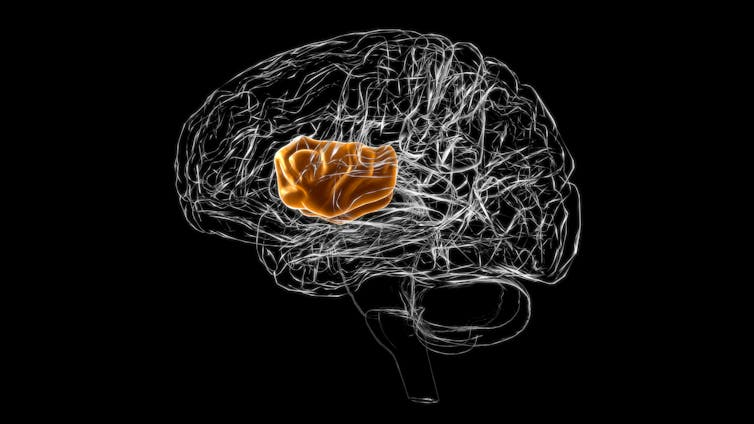
A digital rendering of the human brain, with the insula region highlighted in orange.
The insula is the brain’s primary taste hub.
mybox/ Shutterstock

Most importantly, the odour response patterns overlapped with the taste patterns. This means that the insula responds to odours in a similar way as it responds to taste. So if a person smells something sweet, the brain would respond in the same way as if you’d actually eaten something sweet.

This overlap was even more pronounced when we looked specifically at the insula’s “dysgranular” and “agranular” regions. These regions are involved in processing perceptual signals from within the body. Since hunger and thirst signals also come from the body, this could suggest that the brain uses the odour of a food to determine whether it would satisfy the body’s nutritional needs.

Flavour response

This changes what we think about the insula’s role in food perception. It was once thought to just be a taste processing site, but our research shows it’s a far more sophisticated structure that takes in taste information and integrates it with other sensory components to create flavour.

These results were also the first ever to directly show the overlapping brain response between tastes and smells in the brain’s taste centre. Essentially, this indicates that when we eat something, we perceive food odours as tastes because they induce the same response patterns in the insula as actual tastes.

Our findings have exciting implications for understanding sensory experiences and could lead to advances in the field.

The clearest application is creating innovative foods and drinks that use aromas to compensate for the removal of less healthy ingredients – such as sugar, salt or fat. But there’s still a lot we need to learn about how odours and tastes affect our dietary habits.

Understanding how this mechanism works could also help people with a reduced sense of smell (anosmia) since they may form flavour preferences differently than the rest of the population.

We’re currently conducting a follow-up study to see if this phenomenon also occurs with odours that are perceived outside of the mouth (known as orthonasal smelling). This happens when we sense an odour by sniffing it. Orthonasal smelling plays a pivotal role in food anticipation. If this does lead to a similar activation as taste, it would mean that smell is crucial to hunger regulation.

In fact, rodent research indicates that food smells encourage eating by activating a subgroup of neurons. And, this activation is inhibited when that food is eaten. Understanding how this works would unlock a host of techniques to manage eating behaviour.

Our study also showed that while responses to tastes and odours overlap, this flavour response changed throughout the course of the experiment – becoming less distinct as time went on. This suggests that when you’re repeatedly exposed to a smell without tasting it, the brain stops associating the two over time. So you might stop “tasting” these aromas if you don’t reinforce the connection occasionally.

Better understanding just how the brain processes our sense of taste and smell could have important implications for influencing eating behaviour. Some day, it could be possible to reduce cravings and guide food choices using smell alone.

The Conversation

Janina Seubert receives funding from the European Research
Council (ERC) under the European Union’s Horizon 2020 research and
innovation programme (grant agreement n° 947886) and from the
Swedish Research Council (VR 2018-0318 and VR 2022-02239).

Putu Agus Khorisantono does not work for, consult, own shares in or receive funding from any company or organisation that would benefit from this article, and has disclosed no relevant affiliations beyond their academic appointment.

ref. Smell triggers the same brain response as taste does – even if you haven’t eaten anything – https://theconversation.com/smell-triggers-the-same-brain-response-as-taste-does-even-if-you-havent-eaten-anything-264922
Child dies from complications of measles years after infection – SSPE explained

Source: The Conversation – UK – By Benedict Michael, Professor, Infectious Neuroscience, University of Liverpool

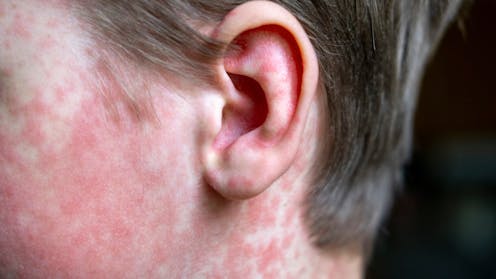
A child with measles. Natalya Maisheva/Shutterstock.com

A school-age child has died from a devastating brain complication of measles in Los Angeles, highlighting the deadly consequences of declining vaccination rates.

The child, who was too young to receive the measles vaccine, developed subacute sclerosing panencephalitis (SSPE) – a progressive and almost always fatal brain condition that strikes years after initial measles infection.

SSPE affects around one in 10,000 people who contract measles, but the risk soars to one in 600 for infants infected before their first birthday. The condition causes progressive brain scarring and inflammation, typically emerging six to eight years after the original measles infection.

Early symptoms can be mistaken for learning difficulties or concentration problems. But over months, patients develop rapidly worsening dementia, uncontrollable jerking movements and seizures. Despite treatment attempts with antiviral and anti-inflammatory drugs, nearly all patients die within five years.

The tragedy underscores growing concerns about measles outbreaks in countries with previously high vaccination coverage. The US Centers for Disease Control and Prevention has reported nearly 1,500 measles cases so far this year alone.

The anti-vaccine legacy

Declining vaccination rates stem partly from fraudulent research attempting to link the MMR vaccine to autism – claims by a now-discredited doctor that have been thoroughly debunked. Social media misinformation has amplified these fears, potentially worsened by COVID pandemic scepticism around vaccines.

Before measles vaccination began in the 1960s, the UK saw between 100,000 and 800,000 cases annually. Globally, the disease killed around 2-3 million people each year. Measles remains one of the most contagious viruses known, infecting nine out of ten unvaccinated people exposed to it.

The measles vaccine is 97% effective and prevented more than 60 million deaths worldwide between 2000 and 2023. Crucially, high vaccination rates create “herd immunity” that protects infants too young for vaccination – like the child who died in Los Angeles.

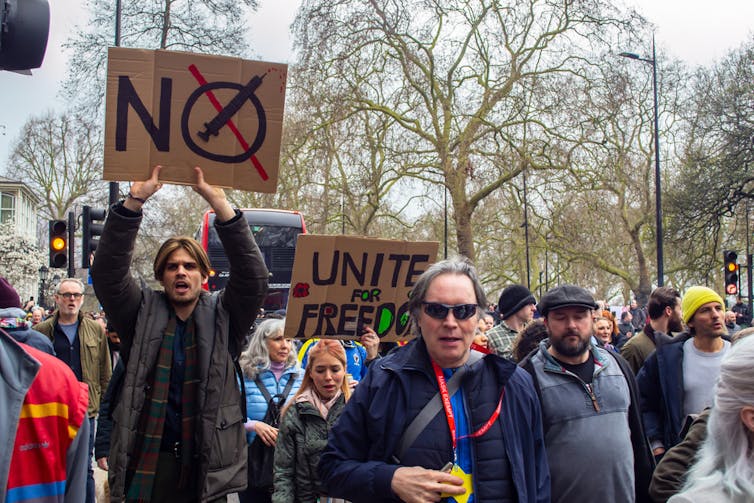
Anti-vaxx protestors in London, England.
Vaccination rates have fallen since the pandemic.
Jessica Girvan/Shutterstock.com

Medical experts can diagnose SSPE through brain scans, electrical activity tests and spinal fluid analysis to detect antibodies against the replicating measles virus. However, treatment options remain extremely limited due to the condition’s rarity, which prevents large-scale clinical trials.

It comes about because the measles virus can lie dormant in the body after infection, later mutating and attacking the brain. This causes irreversible widespread brain cell death and inflammation – the “panencephalitis” that gives SSPE its name.

While SSPE was once common in developing countries, it has become rare in nations with robust childhood vaccination programmes. However, falling vaccination rates now threaten to bring back this and other preventable diseases.

Given the years-long delay between measles infection and SSPE development, health officials warn that more tragic cases may follow current outbreaks. By the time SSPE cases become common, it will be too late to prevent a great many more through vaccination.

The death in LA serves as an important reminder that measles is not a benign childhood illness. It can cause serious complications, including pneumonia and, as this case shows, delayed but deadly brain damage years later.

The Conversation

Benedict Michael is affiliated with Encephalitis International.

ref. Child dies from complications of measles years after infection – SSPE explained – https://theconversation.com/child-dies-from-complications-of-measles-years-after-infection-sspe-explained-265220

Is Milei’s electoral blow the beginning of the end for his radical economic vision?

Source: The Conversation – UK – By Matt Barlow, Lecturer International Political Economy, University of Glasgow

In his first real electoral test since sweeping to power in October 2023, the party of Argentina’s right-wing populist president, Javier Milei, has suffered a landslide defeat. The result can be read as an emphatic reminder of the remarkable endurance in Argentina of Peronism – the movement named after former president Juan Perón.

The ideology is grounded in the state taking a leading role in the economy through progressive policies to deliver social justice – the antithesis of Milei’s mission to cut the state down to size.

Elections in the province of Buenos Aires on September 7 left Milei’s Liberty Advances party on 34% of the vote with the various factions of the Peronist party (under the banner of Homeland Force Front) on 47.4%.

While it was essentially a provincial election, the contest took on a symbolism nationally. Milei himself had framed it as a life-or-death battle between his libertarian movement and the left-wing wealth redistrubutive politics of Peronism.

Since 2003, the movement has often been called Kirchnerism because of its association with Néstor Kirchner and his wife Cristina Fernández de Kirchner. Both were once president of the country representing the Peronist party.

Despite being barred from seeking public office due to corruption charges, Fernández de Kirchner continues to dominate left-wing progressive politics in Argentina. Before the vote in Buenos Aires province, Milei argued that it was a chance for voters to put the final nail in the coffin of Kirchnerism by backing his liberal policies.

This idea of putting an end to Kirchnerism is an interesting one. Speaking with an Argentinian academic friend after Milei’s 2023 victory – the biggest vote margin since the return to democracy in 1983 – my friend said: “Kirchnerismo is dead”. In his eyes, the scale of the defeat meant that politically it could not come back from it.

I disagreed, because social justice and wealth redistribution underpin Kirchnerist progressive policies. This is certainly polarising, but it maintains significant support. Kirchnerism has been the left-wing identity of the Peronist party since 2003, and the Peronist ideology is deeply embedded in Argentinian society.

The recent vote was Milei’s first litmus test since taking his “chainsaw” to the Argentinian state through his programme of deep austerity. The 13 percentage point loss was a clear rejection of his policies in the most populous province, which accounts for 40% of the Argentinian population.

And while Buenos Aires province is traditionally a Peronist stronghold, in 2023 Milei came within 1.5% of taking it, showing that his anti-establishment appeal had gained widespread support. But after less than two years in office, the political pendulum looks to be swinging back to the Left.

Página 12, a left-wing Kircherist newspaper, summed up this idea of the battle between two social and economic visions. Its headline, “Peronism had defeated the austerity and hunger of Milei”, pointed to the extreme spending cuts for which he is now infamous.


Read more:
Kemi Badenoch says she wants to be Britain’s Javier Milei – but is the Argentinian president a model to follow?


But what does this defeat mean for the president ahead of Argentina’s October mid-term legislative elections?

First, it suggests the political capital that Milei held in 2023 has quickly eroded. When campaigning, Milei took advantage of disillusionment with the political status quo. Then, he had the advantage of being a political outsider with radical ideas that could, perhaps, work.

Now, for nearly two years his rhetoric has shaped policies that directly impact the lives and livelihoods of citizens.

Milei’s policies have managed to tame inflation. The level of rampant monthly price rises has been brought down to around 2% from the more than 7% seen in 2022. But this figure is of little comfort to many for whom his policies, such as freezing pensions, disability benefits and wages below inflation and cutting energy and transport subsidies, has made lives much harder.

In June 2025, unemployment figures reached 7.9% – the highest level since 2021. Surveys show that more than 50% of Argentine workers fear losing their jobs. Milei’s cuts to state spending on education, social care, healthcare and infrastructure have all contributed to the unemployment figures.

Real wages are being eroded as salaries fail to keep pace with inflation. And Milei’s removal of currency controls has meant that the Argentine peso has appreciated significantly against the dollar.

This is pushing up the cost of living in dollar terms, which is bad news for Argentinians. For years, many have saved in dollars to avoid the plummeting value of the peso.

Argentina is now one of the most expensive countries in Latin America – with some of the lowest salaries. All of this means that 63.7% of Argentinians are finding it more difficult to make it to the end of the month financially.

Political headwinds

Second, Milei’s hopes of expanding his minority in the country’s congress, in order to deepen his project of economic liberalism, have taken a big hit. Opposition politicians watered down his package of economic reforms, so gaining influence in the senate and chamber of deputies is essential if he is to go further.

The Peronists are the largest bloc in the country’s congress, so Milei must make significant gains in the mid-terms to counter this.

Many political commentators are suggesting that this defeat should be a point of reflection, leading Milei to change course. The president has no such plans for now though, and instead has vowed to double down on austerity.

But herein lies the problem. Milei promised that his radical policies were the answer to Argentina’s longstanding economic problems. But while making substantial progress in his agenda – with strong support from the IMF – his policies to tame inflation, balance the budget, and to deliver stability and growth are not yet being felt by Argentinians.

And reports of corruption against his sister Karina Milei (also secretary-general of his presidency) have rocked this anti-establishment president. This is the man who promised to fight the corruption.

It has been a tumultuous few weeks for the Argentine president. But does it spell the beginning of the end for Milei’s radical economic policies? The extent to which the Buenos Aires province is a barometer for national sentiment will become clear on October 26.

The Conversation

Matt Barlow does not work for, consult, own shares in or receive funding from any company or organisation that would benefit from this article, and has disclosed no relevant affiliations beyond their academic appointment.

ref. Is Milei’s electoral blow the beginning of the end for his radical economic vision? – https://theconversation.com/is-mileis-electoral-blow-the-beginning-of-the-end-for-his-radical-economic-vision-265099

Is your child in a classroom with other year groups? Here’s how it could help them

Source: The Conversation – UK – By Pinky Jain, Head of Teacher Education, Leeds Beckett University

Rawpixel.com/Shutterstock

Some children at primary school, as they head into a new school year, will find themselves learning alongside children of different ages. Year one and year two might be educated in the same classroom, for instance.

Many schools have mixed year group teaching for a range of reasons. It might be because of the size of school: in schools with a small number of pupils, it may be more practical to combine classes.

In other situations, the school may have expertise that they would like to use in the best possible way, and they feel that putting year groups together would be the best way to support all children. This might be because both year groups need to build strength in a particular subject, which a certain teacher specialises in. Or it might be the best way to make use of the school’s resources, such as teaching assistant expertise, to support children.

The routine and structure of the class will be set up to support each child and also ensure that the right level of learning is provided to children.

Much of the research carried out on mixed-age classes is based in small rural schools, as that is where there tends to be the most mixed-age classrooms. It is worth noting that the outcomes of these small schools are generally as good as schools nationally. Research has found limited impact on children, their learning and outcomes as a result of mixed-age classes.

A review of research findings on mixed-age classrooms has found that there is no empirical evidence that student learning suffered from this style of learning. In fact, some students in mixed-age classrooms have reported higher scores in their attitudes towards school and self-concept (how they feel about themselves) compared to their peers in single-age classrooms.

Reflecting the real world

In the world outside school, children regularly interact across a wide range of ages. At home, they often live alongside siblings and relatives spanning multiple generations. In after-school clubs and activities, children may differ by several years in age. Public spaces for play and learning such as parks and museums are open to children of all ages.

Beyond childhood, it is uncommon to encounter higher education or professional environments composed of people from only a single age group. Even during the primary school day, it is typical for children of all ages to share break times. In nearly every context, mixed-age interaction is the norm except for one notable exception – the school classroom.

Children high fiving
Apart from in classrooms, mixed-age friendships are the norm.
Inside Creative House/Shutterstock

There are some additional benefits to mixed-age classes. They may help enhance social skills, promote individualised learning, and help children thrive socially and emotionally.

They can create a more realistic approach to learning, where older children work more independently and can mentor younger children, and enhance children’s communication and collaboration skills. They can also support a greater sense of belonging and community in schools, when children across year groups form friendships.

A new school year is full of excitement but also apprehension. There will be a lot of new things for parents and their child to manage and cope with. Having your child go into a mixed-age class is a supportive start and one which, if managed well, may enhance children’s experiences in school.

It is important that communication between school and parents is open and honest. Schools will consider a wide range of resources that will support all children’s development over the time that they are in school.

So it is important that if you are unsure about sending your child into a school where there are mixed-age classes, that you have conversations with the school about what they are planning, and how they will be supporting children to develop their learning. Parents and school working in collaboration is the best way to support children as both school and parents have a key role play in supporting children’s development.

Children who are in mixed-age classes will not feel any different to single age classes. As a lot of mixed-age classes are in small schools, there is an additional benefit in that it prepares children to move to high school where they will encounter and mix with children of all ages. Being in a mixed-age class will support and offer a variety of friendships and support their time in school.

The Conversation

Pinky Jain does not work for, consult, own shares in or receive funding from any company or organisation that would benefit from this article, and has disclosed no relevant affiliations beyond their academic appointment.

ref. Is your child in a classroom with other year groups? Here’s how it could help them – https://theconversation.com/is-your-child-in-a-classroom-with-other-year-groups-heres-how-it-could-help-them-263071

Americans expect inflation to be far higher than it really is, polling shows

Source: The Conversation – UK – By Paul Whiteley, Professor, Department of Government, University of Essex

BearFotos/Shutterstock

American voters often rank inflation as the most important issue facing the US. But something odd has happened to inflationary expectations since Donald Trump became president in January. Americans believe inflation is much higher than it is, and are bracing themselves for further increases.

The difference between real inflation and what the public think it is has diverged by a significant amount – much more so than under former president Joe Biden.

In December 2024, while Biden was still in office, respondents in surveys conducted by the University of Michigan predicted a rate of inflation of 2.8%, when it was actually 2.7%. However, by May 2025, five months into Trump’s second term, the public was estimating inflation at 6.6% when inflation had fallen to 2.4%.

The inflation expectations surveys included the following question: “By about what percent do you expect prices to go up/down on the average, during the next 12 months?”

The chart below shows the average response to this question over four years. This tells us what the average American feels about price increases, rather than what is actually happening in the economy. These views directly affect spending by consumers and therefore growth and employment in the US economy.

Expectations and actual inflation 2021 to 2025:

A graph by Paul Whiteley

Graph by Paul Whiteley with Federal Reserve and University of Michigan data., CC BY-SA

The red line on the chart above shows the actual inflation rate in the US, measured by the annual change in the consumer price index. It starts from former US president Joe Biden’s inauguration as president in January 2021 when the pandemic had a big impact on inflation. Subsequently, the rate has been declining since early 2022 although there was a modest increase from the start of Donald Trump’s second term from January 25 this year.

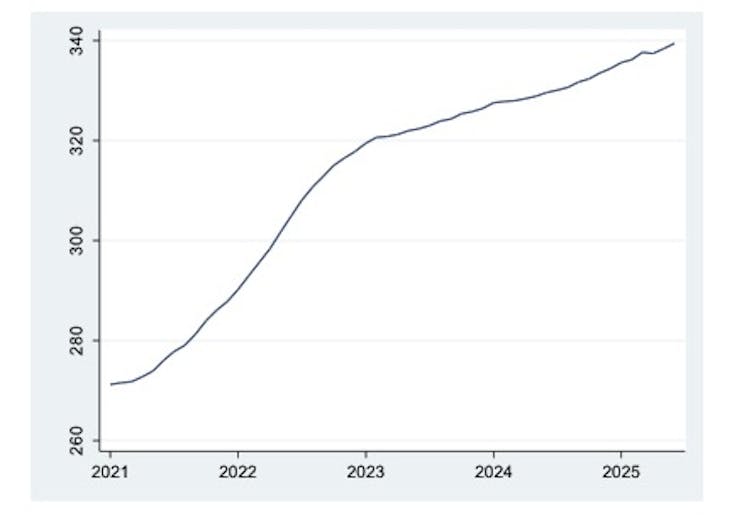
Some of these expectations can be explained by specific items. For example, food prices in the US have continued to increase as the chart below shows. The increases were rather rapid after the end of the pandemic, and they have continued but at a slower rate from the start of 2023, even though the broader inflation rate was falling at the time. Food prices are a particularly sensitive item because food is an essential.

Another item is the rapid rise in house prices that started after the pandemic and has continued under the Trump administration. This has put home ownership beyond the means of many Americans. However, neither of these can fully explain why the public believe inflation is so much higher than it actually is since the start of Trump’s second term in office.

Consumer food price index in the US 2021 to 2025:

A graph showing the Consumer Food Price Index.

Graph by Paul Whiteley, CC BY-SA

A reason for this concern among the US public could be the financial uncertainty among businesses and financial markets and consumers.

Donald Trump’s attempts to sack Lisa Cook, the governor of the Federal Reserve, currently held up by the courts, is one example of a factor creating economic instability. The Fed is an independent institution that controls inflation via changes in interest rates and so dramatic changes there are likely to create worries about what happens next.

What about tariffs?

The introduction of high tariffs on goods from other countries by the Trump administration is probably another factor. Put simply, tariffs are a tax on imports and so have a direct impact on the price of goods on sale in the US.

This, coupled with a fall in the value of the dollar in recent months, will be pushing up prices in American shops. A dollar would buy 98 euro cents in January of this year, almost a one-for-one exchange rate. By August 25, it would buy only 85 euro cents, a fall in value of around 15%.

Trump’s so-called “big beautiful bill”, which passed Congress in July, could be another source of inflationary expectations. This extends the tax cuts introduced in Trump’s first term, reducing taxes by US$4.5 trillion (£3.3 trillion) over ten years while cutting welfare spending and reducing investments in green energy projects.

The Yale University Budget Lab, a research centre studying financial policy, estimates that the bill will add US$3 trillion to the nation’s debt over the period 2025-2034 and US$12.1 trillion from 2025-55. This means that the US Treasury has to pay higher rates to encourage lenders when they become nervous about the inflationary consequences of the deficits.

If a country has to borrow large amounts to balance the books, it creates a temptation to print more money, which then boosts inflation.

When it comes to the political consequences of this, inflationary expectations are really important. This is because the public’s judgment about the president’s handling of inflation are largely the same as judgments about his overall presidency.

This can be seen in the chart below, which comes from successive surveys conducted by YouGov for the Economist newspaper since Trump came to office.

Approval ratings for the president’s handling of inflation and his overall job ratings:

Trump's approval ratings graphed.

Graph by Paul Whiteley based on data from YouGov for the Economist, CC BY-SA

The chart compares Trump’s overall job approval with his approval ratings for handling inflation. They track very closely – and both are rapidly falling, indicating that the failure to combat inflation is tarnishing the president’s approval ratings.

Presidential job approval is closely related to voting behaviour, so if inflation continues to rise and the public believe it will be even higher in the future, then this is likely to damage both Trump and the Republican party in the midterm elections next year.

The Conversation

Paul Whiteley has received funding from the British Academy and the ESRC.

ref. Americans expect inflation to be far higher than it really is, polling shows – https://theconversation.com/americans-expect-inflation-to-be-far-higher-than-it-really-is-polling-shows-264070

Meduza: Berlin exhibition highlights the publication speaking truth to Putin while in exile

Source: The Conversation – UK – By Julie Curtis, Professor of Russian Literature (Emerita), University of Oxford

While Vladimir Putin imposes ever-harsher restrictions on freedom of speech some people still seek to voice opposition to him, inside and outside Russia. The exhibition NO in Berlin was dedicated to these people – “to all those who have the courage to disagree.”

Its main focus was the respected media organisation Meduza, established in Latvia in 2014 by journalists fleeing the increasingly restrictive policies of oligarch media moguls and the Russian security services after the annexation of Crimea.

Meduza’s coverage has remained a trusted source for those in the west and in Russia (where it has yet to be blocked) wanting closely to follow events under the Putin regime. The significance of Meduza’s work, which is published in Russian and English, has only been heightened by Russia’s full-scale invasion of Ukraine in February 2022.

NO, held in Berlin’s Kunstraum Kreuzberg/Bethanien cultural centre, was a multidisciplinary exhibition that wove together contemporary art and documentary testimonies. The first section of the exhibition featured the works of 13 artists from Russia and elsewhere reflecting upon key themes inspired by Meduza’s work: dictatorship, censorship, exile, war, resistance, fear, loneliness, polarisation, and hope.

The second featured a specially commissioned documentary by Russian playwright and exile Mikhail Durnenkov. The video project reflects on the last ten years of Meduza and uses the testimonies of its journalists and collaborators.

As soon as the invasion of Ukraine began, the Russian authorities announced that publishing any account of the events which did not correspond to official versions could incur up to 15 years in prison. The journalists of Meduza, naturally, have not respected these constraints. As the film critic Anton Dolin puts it in the documentary: “I’m a product of the 1990s [after the collapse of the USSR], I’m used to feeling like an adult, a person who chooses his own trajectory.”

Telling the truth, and thereby inevitably expressing solidarity with Ukraine as the victim of Russian aggression, led to Meduza being proclaimed an “undesirable organisation” in 2023. This now means that criminal charges may be brought against anybody who so much as mentions Meduza’s existence on their social media. Those anonymous contributors who are still working within Russia are therefore taking extraordinary risks.

The Russian authorities have started to restrict access to VPNs (virtual private networks, used for confidential access to websites), banned the Meduza app and, as the testimonies in the documentary attest, have also deployed spyware to harass individuals and mounted relentless cyber-attacks to try and close the Meduza site down.

Even abroad, Meduza’s journalists take care not to reveal their office’s address, not to bring visitors there or even have food delivered. All this only serves, of course, to underline the significance of Meduza’s work, and the extent of the threat the Russian government perceives from its fearless reporting.

Life in exile

Most of the journalists interviewed for the exhibition now find themselves involuntarily in exile. While over 6 million Ukrainians have fled to Europe as refugees because of the war, around 650,000 Russians have also left Russia during the same period.

Once in Europe, they are left wondering just what their status is abroad: are they themselves refugees? Political émigrés? Have they become effectively the opposition to Putin in exile? Will they ever return to their native country, for which some have a love-hate relationship?

Life in exile is a contradictory existence. There are benefits of a material kind, and journalists are for the most part physically safe. And yet, as the exhibition shows, they feel profoundly rootless, cut off from their normal lives and environments, welcome neither at home nor entirely in their new countries. They maintain a bridge to their home country, yet it is a bridge they cannot imagine themselves crossing in the foreseeable future. Many of the journalists are still young, many of them women.

Galina Timchenko, co-founder and publisher of Meduza, reflects on the paternalism of dictatorship, which guarantees security and stability for the national “family” at the expense of individual freedom. And the war correspondent and writer Elena Kostyuchenko adds: “War is a concentration of patriarchal culture, its manifestation.”

One anonymous contributor from within Russia comments:

“At the beginning of the war, I thought that people supported the war because they didn’t know what was really happening. […] It turns out the problem isn’t so much that journalists can’t tell the truth about the war, but that people to whom that truth is addressed don’t want to hear it.”

One Meduza editor reported utter dismay upon discovering that even their own family members believed the attack on Ukraine to be justified. And yet the journalists persevere.

There is little optimism in this exhibition. Most contributors acknowledge that they have little chance of overcoming the Leviathan that is Putin’s police state. The violent deaths of several journalists within Russia, the murder of politician Boris Nemtsov in Moscow in 2015, and the suspicious death of the politician and vocal critic of Putin Aleksey Navalny in prison in 2024 were shattering blows to liberal hopes for a more democratic future.

The Meduza journalists live with fear and guilt about what might happen to them physically, or to their loved ones back home. As Meduza’s co-founder Ilya Krasilshchik puts it:

Inside the country, we have a decimated civil society, opposition leaders killed or imprisoned, and people who have fallen into a state of apathy. Externally, there is the attack on Ukraine and an alliance with the worst political regimes on the planet…But even now, we know of people who have spent years speaking out against authoritarianism, dictatorship and war…Even when it’s impossible to win, we can save ourselves, our family, friends, values and sense of self-esteem.

These émigrés fall back on a personal code of ethics, a belief in the transformative power of non-violent acts of resistance, solidarity with fellow dissidents and a genuine sense of community. Saying “no” powerfully outweighs the dangers of saying nothing at all.


Looking for something good? Cut through the noise with a carefully curated selection of the latest releases, live events and exhibitions, straight to your inbox every fortnight, on Fridays. Sign up here.


The Conversation

Julie Curtis does not work for, consult, own shares in or receive funding from any company or organisation that would benefit from this article, and has disclosed no relevant affiliations beyond their academic appointment.

ref. Meduza: Berlin exhibition highlights the publication speaking truth to Putin while in exile – https://theconversation.com/meduza-berlin-exhibition-highlights-the-publication-speaking-truth-to-putin-while-in-exile-263006

AI hype has just shaken up the world’s rich list. What if the boom is really a bubble?

Source: The Conversation – Global Perspectives – By Angel Zhong, Professor of Finance, RMIT University

Just for a moment this week, Larry Ellison, co-founder of US cloud computing company Oracle, became the world’s richest person. The octogenarian tech titan briefly overtook Elon Musk after Oracle’s share price rocketed 43% in a day, adding about US$100 billion (A$150 billion) to his wealth.

The reason? Oracle inked a deal to provide artificial intelligence (AI) giant OpenAI with US$300 billion (A$450 billion) in computing power over five years.

While Ellison’s moment in the spotlight was fleeting, it also illuminated something far more significant: AI has created extraordinary levels of concentration in global financial markets.

This raises an uncomfortable question not only for seasoned investors – but also for everyday Australians who hold shares in AI companies via their superannuation. Just how exposed are even our supposedly “safe”, “diversified” investments to the AI boom?

The man who built the internet’s memory

As billionaires go, Ellison isn’t as much of a household name as Tesla and SpaceX’s Musk or Amazon’s Jeff Bezos. But he’s been building wealth from enterprise technology for nearly five decades.

Ellison co-founded Oracle in 1977, transforming it into one of the world’s largest database software companies. For decades, Oracle provided the unglamorous but essential plumbing that kept many corporate systems running.

The AI revolution changed everything. Oracle’s cloud computing infrastructure, which helps companies store and process vast amounts of data, became critical infrastructure for the AI boom.

Every time a company wants to train large language models or run machine learning algorithms, they need huge amounts of computing power and data storage. That’s precisely where Oracle excels.

When Oracle reported stronger-than-expected quarterly earnings this week, driven largely by soaring AI demand, its share price spiked.

That response wasn’t just about Oracle’s business fundamentals. It was about the entire AI ecosystem that has been reshaping global markets since ChatGPT’s public debut in late 2022.

The great AI concentration

Oracle’s story is part of a much larger phenomenon reshaping global markets. The so-called “Magnificent Seven” tech stocks – Apple, Microsoft, Alphabet, Amazon, Meta, Tesla and Nvidia – now control an unprecedented share of major stock indices.

Year-to-date in 2025, these seven companies have come to represent approximately 39% of the US S&P500’s total value. For the tech-heavy NASDAQ100, the figure is a whopping 74%.

This means if you invest in an exchange-traded fund that tracks the S&P500 index, often considered the gold standard of diversified investing, you’re making an increasingly concentrated bet on AI, whether you realise it or not.

Are we in an AI ‘bubble’?

This level of concentration has not been seen since the late 1990s. Back then, investors were swept up in “dot-com mania”, driving technology stock prices to unsustainable levels.

When reality finally hit in March 2000, the tech-heavy Nasdaq crashed 77% over two years, wiping out trillions in wealth.

Today’s AI concentration raises some similar red flags. Nvidia, which controls an estimated 90% of the AI chip market, currently trades at more than 30 times expected earnings. This is expensive for any stock, let alone one carrying the hopes of an entire technological revolution.

Yet, unlike the dot-com era, today’s AI leaders are profitable companies with real revenue streams. Microsoft, Apple and Google aren’t cash-burning startups. They are established giants, using AI to enhance existing businesses while generating substantial profits.

This makes the current situation more complicated than a simple “bubble” comparison. The academic literature on market bubbles suggests genuine technological innovation often coincides with speculative excess.

The question isn’t whether AI is transformative; it clearly is. Rather, the question is whether current valuations reflect realistic expectations about future profitability.

Hidden exposure for many Australians

For Australians, the AI concentration problem hits remarkably close to home through our superannuation system.

Many balanced super fund options include substantial allocations to international shares, typically 20–30% of their portfolios.

When your super fund buys international shares, it’s often getting heavy exposure to those same AI giants dominating US markets.

The concentration risk extends beyond direct investments in tech companies. Australian mining companies, such as BHP and Fortescue, have become indirect AI players because their copper, lithium and rare earth minerals are essential for AI infrastructure.

Even diversifying away from technology doesn’t fully escape AI-related risks. Research on portfolio concentration shows when major indices become dominated by a few large stocks, the benefits of diversification diminish significantly.

If AI stocks experience a significant correction or crash, it could disproportionately impact Australians’ retirement nest eggs.

A reality check

This situation represents what’s called “systemic concentration risk”. This is a specific form of systemic risk where supposedly diversified investments become correlated through common underlying factors or exposures.

It’s reminiscent of the 2008 financial crisis, when seemingly separate housing markets across different regions all collapsed simultaneously. That was because they were all exposed to subprime mortgages with high risk of default.

This does not mean anyone should panic. But regulators, super fund trustees and individual investors should all be aware of these risks. Diversification only works if returns come from a broad range of companies and industries.

The Conversation

The authors do not work for, consult, own shares in or receive funding from any company or organisation that would benefit from this article, and have disclosed no relevant affiliations beyond their academic appointment.

ref. AI hype has just shaken up the world’s rich list. What if the boom is really a bubble? – https://theconversation.com/ai-hype-has-just-shaken-up-the-worlds-rich-list-what-if-the-boom-is-really-a-bubble-265080

The deep sea scientist who didn’t see the ocean until he was 27

Source: The Conversation – Global Perspectives – By Digital Storytelling Team, The Conversation

➡️ Read the interactive visual feature here

The Conversation

Digital Storytelling Team does not work for, consult, own shares in or receive funding from any company or organisation that would benefit from this article, and has disclosed no relevant affiliations beyond their academic appointment.

ref. The deep sea scientist who didn’t see the ocean until he was 27 – https://theconversation.com/the-deep-sea-scientist-who-didnt-see-the-ocean-until-he-was-27-257230

Can you ‘microdose’ exercise?

Source: The Conversation – Global Perspectives – By Hunter Bennett, Lecturer in Exercise Science, University of South Australia

Natalia Lebendinskaia/Getty

Microdosing” originally meant taking tiny amounts of psychedelics (such as mushrooms) to enhance mood or performance, with fewer side effects.

But the term has taken off to mean anything where you incorporate a much lower “dose” of something – and still reap the benefits.

So, does this work for exercise? If you can’t make time for a 30-minute run, will shorter bursts of activity do anything for your health?

Here’s what the evidence says.

The minimum you should move

According to the World Health Organization (WHO), adults should aim each week for either a minimum of 150 minutes of moderate intensity aerobic exercise – meaning it’s hard to hold a conversation – or 75 minutes of vigorous intensity – you are gasping for air at the end of it. Or you can do a combination of moderate and vigorous activity.

This can include activities such as brisk walking, cycling, running, swimming or rowing, and team sports such as football and basketball.

If you exercise every day, you’d need to do 20–30 minutes of these activities. Or you might do a couple of longer training sessions or matches two or three times a week.

WHO guidelines also recommend including muscle-strengthening activities (such as lifting weights, or high-impact exercise like sprinting) at least twice a week.

What counts as exercise?

Incidental activity – unplanned or everyday movement, such as playing with kids or walking to the bus stop – may contribute to your physical activity levels over the week.

So, yes, housework can count. For example, chores like mopping and vacuuming tend to have a similar physical demand as going for a walk.

While this activity wouldn’t be considered vigorous, it could contribute to your moderate intensity minutes.

So, do smaller chunks work?

Yes, the good news is doing small amounts of exercise throughout the day is just as effective as doing one long session.

In fact, it may have some additional benefits.

A 2019 review of 19 studies looked at this question, involving more than 1,000 participants. It found multiple, shorter “chunks” of exercise in a day improved heart and lung fitness and blood pressure as much as doing one longer session.

And there was some evidence these chunks actually led to more weight loss and lower cholesterol.

The most common way this exercise was compared in the 19 studies was with one group doing three ten-minute bouts of exercise five days a week, and another doing one 30-minute session, five days a week.

Even very short bouts might help

Another 2019 study in young adults examined the effect of short “exercise snacks” on fitness. While small, it had some interesting and positive results.

The exercise “snack” group did three very short sessions per day, three times a week, for six weeks. Each session involved a light two-minute warm-up, followed by a 20-second maximal effort sprint – where you push as hard as you can – and then a one-minute cool-down.

In total: just three minutes and 20 seconds of exercise, three times a day, three days a week.

The control group did one session a day, three days a week, but it was longer – a total of ten minutes. It involved a two-minute warm-up, followed by three  20-second sprints, with three minutes of light recovery between sprints, then a one-minute cool-down.

The “snack” group saw significant improvements in aerobic fitness, which is one of the strongest predictors of your risk of dying early and overall health.

Similar research has suggested this same approach can have positive effects on lowering cholesterol levels. However, it may not provide enough total exercise time to lose weight.

Shorter – but harder?

The research outlined above suggests the shorter your exercise session, the harder you need to push.

So you might need to adapt your exercise to increase intensity. For example, one minute of maximal intensity exercise might be worth two minutes of moderate intensity exercise.

Basically, if you’re short on time you will get more bang-for-your-buck by going harder.

So, is it worth still doing longer sessions?

For health and general fitness, the research suggests there aren’t downsides to breaking a long workout into smaller chunks.

But there are some reasons you might still want to keep exercising longer.

If you are training for a longer duration event (maybe a 10 kilometre run, a 30km ride, or even a marathon), you will need to do some longer sessions. This will ensure your muscles and joints are prepared to tolerate the demands of the event, and help your body adapt to maximise performance on the day.

For mental health, there is also some evidence to suggest doing more than the recommended minimum exercise might be better.

For example, two recent meta-analyses (studies which review the available evidence) found that around one hour of moderate intensity exercise a day can significantly improve anxiety and depression symptoms.

But these studies didn’t compare the benefits of one session versus chunks, so it’s likely you can still break up your exercise across the day and feel an effect.

The bottom line

Any exercise is better than none. If you struggle for time, as little as three minutes a day, spread across three sessions, can have a positive effect on our health.

But don’t forget – the shorter the session, the harder it needs to be.

The Conversation

Hunter Bennett does not work for, consult, own shares in or receive funding from any company or organisation that would benefit from this article, and has disclosed no relevant affiliations beyond their academic appointment.

ref. Can you ‘microdose’ exercise? – https://theconversation.com/can-you-microdose-exercise-263049

50 years without coups or dictators: how PNG built a durable democracy based on dignity and fairness

Source: The Conversation – Global Perspectives – By Brad Underhill, Research fellow, Deakin University

On April 20 1972, 100 newly elected parliamentarians gathered in Port Moresby for the opening of the Third House of Assembly, Papua New Guinea’s legislative body.

Many of these members were young and some were new to politics: Chief Minister (later Grand Chief) Michael Somare was 37, Minister of Finance Julius Chan was 33, and Josephine Abaijah, the only woman, was 32.

Within three years, these trailblazers would steer the country from a colonial territory of Australia to a newly independent nation, declared on September 16 1975, 50 years ago this week.

As they moved from colony to self-government to independence, the members of the Third House of Assembly held sophisticated debates on decolonisation.

Leaders did not simply inherit Australian institutions. They reimagined them, arguing about land, law, unity, culture and what the concept of “development” should mean in a Melanesian society.

These speeches and debates are captured in Debating the Nation: Speeches from the House of Assembly, 1972–1975, the recently published book we co-edited along with Keimelo Gima, a historian at the University of Papua New Guinea.

The formation of the ‘mother law’

Papua New Guinea prepared for independence with a radical approach to the drafting of its constitution. The task fell to the Constitutional Planning Committee (CPC) — led in practice by Bougainville priest-politician John Momis.

Over three years, the committee held meetings across the country, gathering the “raw materials” of people’s views on citizenship, governance and development. The result was a constitution known as the “mother law”. It was one of the most inclusive in the world, and, in Momis’ words, a truly “home-grown” document.

At its heart was a redefinition of development in the context of PNG. Momis believed progress should not just be measured in gross domestic product (GDP) and prestige projects, but also in the continuation of the traditional values of PNG – liberally sprinkled with the progressive ideals of the 1970s, which celebrated small-scale societies.

Momis declared that true development was “integral human development” – measured by people’s wellbeing, not wealth or power.

This was a radical stance in the 1970s. It defined development in terms of human dignity, fairness between regions, grassroots participation and the preservation of cultural and spiritual values. It foreshadowed the “Melanesian Way”, the celebration of Melanesian communalism developed by another central figure in PNG independence, the esteemed jurist and philosopher Bernard Narokobi.

This concept remains strikingly relevant today. Allan Bird, the governor of East Sepik province, recently invoked the spirit of this philosophy in an address to students at the University of Papua New Guinea’s 60th anniversary symposium last month.

Independence day ceremonies in 1975.
National Archives of Australia

Putting policy into action

If the constitution set out the vision for the nation, the Eight-Point Plan put forth by Somare, who would become the country’s first prime minister, translated it into policy.

It called for Papua New Guinean control of the economy, decentralisation, support for village industries, equal participation for women and self-reliance. Somare warned against foreign dependency and of a “very rich black elite [emerging] here at the expense of village people.”

Turning ideals into practice also required new institutions. That task fell in part to Chan, the finance minister, who in 1972 delivered the first budget by a Papua New Guinean — a symbolic moment in the transfer of power.

For Chan, controlling the purse strings was the foundation of self-government, and he insisted the country must “look to its own resources” if it was to pay its own way. Within three years, the Central Bank and the kina were also in place.

Citizenship proved explosive. Many Australians living in the territory feared they would be expelled from an independent PNG and were loud in their demands.
Parliamentarians such as Ron Neville urged an open, multi-racial citizenship model to attract investment.

Momis argued, however, that three million Papua New Guineans “had nothing” and needed protection from Australian control. United Party leader Tei Abal rejected dual citizenship for Papua New Guineans and Australians and insisted the law should be “firm but not racist”.

The eventual compromise — single citizenship, no automatic rights for expatriates, but scope for naturalisation — reflected the balancing act between inclusion and integrity. But if citizenship defined who belonged to the new nation, the harder question was whether the nation itself would hold together.

The trials of decolonisation

Unity was not guaranteed. Secessionist movements such as Abaijah’s Papua Besena, which advocated for an independent Papuan state separate from New Guinea, threatened the territorial integrity of the new nation, but it was not the only threat.

At the same time, leaders on the island of Bougainville pushed for their own secession, citing grievances over the Panguna copper mine, which began production in 1972 under a subsidiary run by Rio Tinto.

Somare declared, however, that unity was not up for negotiation. He staved off the disintegration of the nation by introducing provincial governments and a federalised system in the months before independence.

Holding the country together was only part of the challenge. Independence also demanded a deeper transformation — freeing PNG from the colonial institutions and mindsets that still shaped daily life.

As Momis argued in 1974, true freedom was a difficult task when education and the very institutions of nationhood were all created by the colonial regimes, first under the Germans and British, and then the Australians. Decolonisation meant more than simply raising a new flag – it entailed building a society grounded in justice, dignity and local values.

Those ideals still shape PNG today, but they also matter for Australia. PNG’s independence is part of Australia’s story.

When PNG became independent in 1975, many people on both sides of the Torres Strait feared fragmentation or chaos. But despite secessionist pressures and economic challenges, PNG has remained a parliamentary democracy for 50 years: no coups, no military takeovers, no descent into dictatorship.

That outcome was not inevitable. It was the product of hard debates and principled choices in the 1970s. Leaders such as Somare, Chan, Abel, Momis, Abaijah and John Guise fought over unity, land and development — but they fought in parliament, not through violence.

Half a century later, their words still resonate. At the University of Papua New Guinea symposium we attended in August, speaker after speaker referred to the ideals of the founders. They reminded us the constitution was never just a legal framework. It was a profound statement about what development actually means. This is not simply growth, but dignity, participation, fairness and cultural identity.

That is a legacy Australians should not forget.

The Conversation

Brad Underhill receives funding for the “Debating the Nation” book from the Department of Foreign Affairs and Trade.

Helen Gardner received funding for Debating the Nation from the Department of Foreign Affairs and Trade

ref. 50 years without coups or dictators: how PNG built a durable democracy based on dignity and fairness – https://theconversation.com/50-years-without-coups-or-dictators-how-png-built-a-durable-democracy-based-on-dignity-and-fairness-264484