Dealing with a difficult relationship? Here’s how psychology says you can shift the dynamic

Source: The Conversation – USA – By Jessica A. Stern, Assistant Professor of Psychology, Pomona College

A heated exchange may stem from something deeper than the issue at hand. skynesher/E+ via Getty Images

Relationships can feel like both a blessing and the bane of your existence, a source of joy and a source of frustration or resentment. At some point, each of us is faced with a clingy child, a dramatic friend, a partner who recoils at the first hint of intimacy, a volatile parent or a controlling boss — in short, a difficult relationship.

As a psychology professor and relationship scientist, I’ve spent countless hours observing human interactions, in the lab and in the real world, trying to understand what makes relationships work – and what makes them feel utterly intractable.

Recently, I teamed up with psychologist Rachel Samson, who helps individuals, couples and families untangle difficult dynamics in the therapy room. In our new book, “Beyond Difficult: An attachment-based guide for dealing with challenging people,” we explore the roots of difficult behavior and evidence-based strategies for making difficult relationships more bearable.

So what’s really going on beneath the surface of “difficult” behavior? And more to the point, what can you do about it?

Difficult interactions can have deep roots

When a conversation with a co-worker goes sideways or a phone call with a friend goes off the rails, it’s easy to assume the issue stems from the situation at hand. But sometimes, big emotions and reactions have deeper roots. Difficult interactions often result from differences in temperament: your biologically based style of emotional and behavioral responses to the world around you.

People with a sensitive temperament react more strongly to stress and sensory experiences. When overwhelmed, they may seem volatile, moody or rigid — but these reactions are often more about sensory or emotional overload than malice. Importantly, when sensitive children and adults are in a supportive environment that “fits” their temperament, they can thrive socially and emotionally.

baby in crib looks up toward camera
Attachment style traces back to how you interacted with your earliest caregivers.
KDP/Moment via Getty Images

Beyond neurobiology, one of the most common threads underlying difficult relationships is what psychologists call insecure attachment. Early experiences with caregivers shape the way people connect with others later in life. Experiences of inconsistent or insensitive care can lead you to expect the worst of other people, a core feature of insecure attachment.

People with insecure attachment may cling, withdraw, lash out or try to control others — not because they want to make others miserable, but because they feel unsafe in close relationships. By addressing the underlying need for emotional safety, you can work toward more secure relationships.

Managing difficult emotions

In challenging interactions, emotions can run high — and how you deal with those emotions can make or break a relationship.

Research has shown that people with sensitive temperament, insecure attachment or a history of trauma often struggle with emotion regulation. In fact, difficulty managing emotions is one of the strongest predictors of mental illness, relationship breakups and even aggression and violence.

It’s easy to label someone as “too emotional,” but in reality, emotion is a social event. Our nervous systems constantly respond to one another — which means our ability to stay regulated affects not only how we feel, but how others react to us. The good news is that there are evidence-based strategies to calm yourself when tensions rise:

  1. Take a breath. Slow, deep breathing helps signal safety to the nervous system.
  2. Take a break. Relationship researchers John and Julie Gottman found that taking a 20-minute break during conflict helps reduce physiological stress and prevent escalation.
  3. Move your body. Exercise – particularly walking, dancing or yoga – has been shown to reduce depression and anxiety, sometimes even more effectively than medication. Movement before or after a difficult interaction can help “work out” the tension.
  4. Reframe the situation. This strategy, called cognitive reappraisal, involves changing the way you interpret a situation or your goals within it. Instead of trying to “fix” a difficult family member, for example, you might focus on appreciating the time you have with them. Reappraisal helps the brain regulate emotion before it escalates, lowering activity in stress-related areas like the amygdala.
two women in discussion sitting on couches
People may not know the effect their behavior has on you until you tell them.
Klaus Vedfelt/DigitalVision via Getty Images

Giving better feedback

Difficult people are usually unaware of how their behavior affects you — unless you tell them. One of the most powerful things you can do in a difficult relationship is give feedback. But not all feedback is created equal.

Feedback, at its core, is a tool for learning. Without it, you would never have learned to write, drive or function socially. But when feedback is poorly delivered, it can backfire: People become defensive, shut down or dig in their heels. Feedback is most effective when it stays focused on the task rather than the individual; in other words, don’t make it personal.

Research points to four keys to effective feedback, based in learning theory:

  1. Mutuality: Approach the conversation as a two-way exchange. Be open to the needs and ideas of both parties.
  2. Specificity: Be clear about what behaviors you’re referring to. Citing particular interactions is often better than “You always ….”
  3. Goal-directedness: Connect the feedback to a shared goal. Work together to find a constructive solution to the problem.
  4. Timing: Give feedback close to the event, when it’s still fresh but emotions have settled.

Also, skip the so-called “compliment sandwich” of a critique between two pieces of positive feedback. It doesn’t actually improve outcomes or change behavior.

Interestingly, the most effective sequence is actually to start with a corrective, followed by positive affirmation of what’s going well. Leading with honesty shows respect. Plus, the corrective is more likely to be remembered. Following up with warmth builds connection and shows that you value the person.

The bottom line

Difficult relationships are part of being human; they don’t mean someone is broken or toxic. Often, they reflect deeper patterns of attachment, temperament and differences in how our brains work.

When you understand what’s underneath the behavior – and take steps to regulate yourself, communicate clearly and give compassionate feedback – you can shift even the most stuck relationship into something more bearable, perhaps even meaningful.

Strengthening relationships isn’t always easy. But the science shows that it is possible – and can be rewarding.

The Conversation

Jessica A. Stern does not work for, consult, own shares in or receive funding from any company or organization that would benefit from this article, and has disclosed no relevant affiliations beyond their academic appointment.

ref. Dealing with a difficult relationship? Here’s how psychology says you can shift the dynamic – https://theconversation.com/dealing-with-a-difficult-relationship-heres-how-psychology-says-you-can-shift-the-dynamic-264669
Dogs can need more than kibble, walks and love − consider the escalating expenses of their medical care before you adopt

Source: The Conversation – USA (2) – By David L. Weimer, Professor of Political Economy Emeritus, University of Wisconsin-Madison

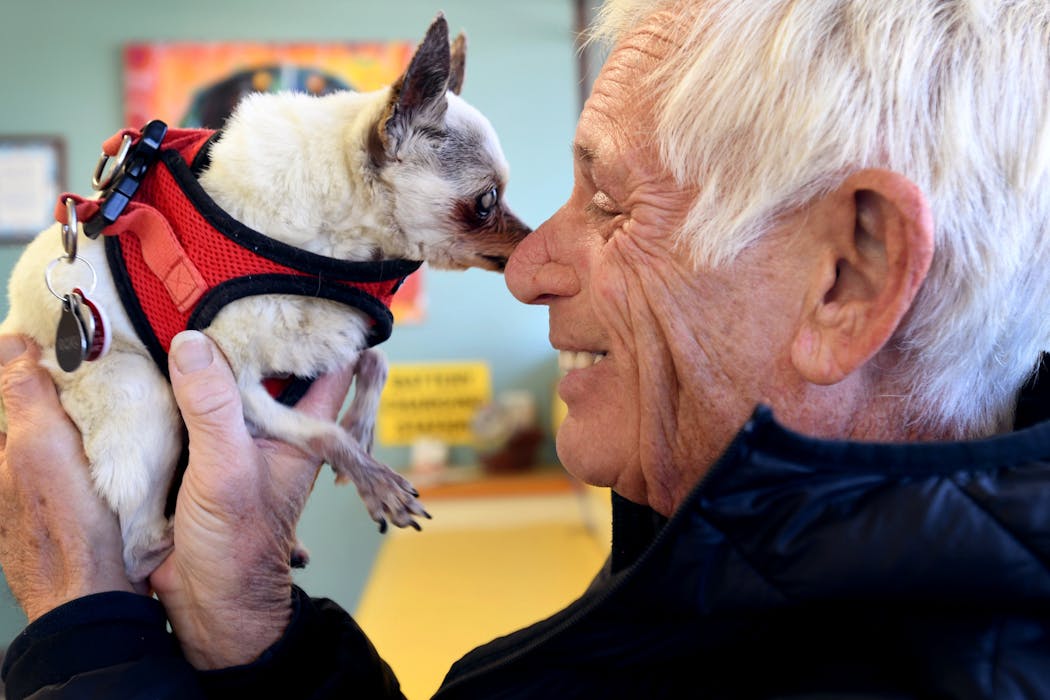
A man holds his 17½-year-old Chihuahua mix, which is receiving end-of-life hospice care.
Brittany Murray/MediaNews Group via Long Beach Press-Telegram and Getty Images

Many Americans struggle to pay for health care for themselves and other members of their families, even if they have insurance coverage.

Some very big bills arise when the furriest members of their households get sick or just need an annual checkup: their dogs. Americans spend an average of about US$1,700 annually on their dogs’ food and care, including $580 for veterinary bills.

All told, Americans spent more than $41 billion on their pets’ veterinary care in 2025, primarily on dogs and cats. Veterinary costs have soared in recent years, rising much faster than inflation in the past decade.

The average cost of any visit to a veterinarian for a dog is about $214 today. Appointment costs for a routine examination for a dog range from $70 to $174, depending in part on the vet’s location and your dog’s conditions.

Estimating future costs

Aidan Vining, a Canadian public policy scholar, and I, a public policy researcher based in the U.S., considered the extent to which economics can explain our canine relationships in our 2024 book “Dog Economics.”

Our own love of dogs helps us understand how people bring dogs into their lives without fully taking account of future costs. One of these often unanticipated costs is for veterinary bills that may break the family budget.

Indeed, a Gallup survey of dog and cat owners conducted for PetSmart Charities in 2024 and 2025 found that 42% of respondents had declined veterinary care for their pets because they could not afford it. In the same study, an additional 38% declined care because they did not believe it was worth the cost.

I think that people should consider the risk of bearing these costs before bringing a dog into the family.

Part of the family

Between 60 million and 68 million U.S. households include at least one dog. That means that as many as half of all occupied U.S. homes include a dog.

Most families with dogs revere them. A survey I conducted with colleagues in 2018 found that 73% of people with pet dogs strongly agreed with the statement “I consider my pets to be part of the family.”

A 2023 Pew Research Center survey found that 51% of pet owners viewed their animals as being as much a member of their family as their human relatives.

Because many of us will spend whatever we can to save the life of our family members, being unable to afford lifesaving care for dogs can be very upsetting.

Steep veterinarian bills

But sometimes dogs require very expensive care. And veterinarians in cities where the costs of living are high tend to charge more than elsewhere.

Treating some fairly common dog ailments can cost a bundle: as much as $3,000 for gastroenteritis, $7,000 for intestinal obstruction surgery, $5,000 for severe pancreatitis and $8,000 for stomach bloat.

The tab for canine cancer treatments involving chemotherapy or radiation can set you back more than $10,000.

The initial phase of treatment for immune-mediated hemolytic anemia for my family’s poodle, for example, cost more than $10,000 in veterinary costs. She is doing well but needs continuing medical care.

A white and tan poodle stands in a grassy spot.
Ming, the author’s family poodle, needs continuing veterinary care.
Dave Weimer

Sometimes pooches require overnight veterinary supervision. That can cost you as much as $1,500 per night they spend in an animal hospital on top of those other expenses.

Many Americans cannot afford to pay for such expensive care – only 41% could cover a $1,000 unanticipated expense of any kind from their savings.

Although only a stopgap,there are charities that provide free or lower-cost veterinary care for the pets of low-income people?

Insurance coverage is rare and often falls short

Pet insurance can help make these expenses more manageable, but it covers only about 4.9 million dogs – about 8% of all American dogs.

Most of those policies have deductibles you have to meet before they’ll reimburse you for at least part of the cost of your animal’s care. Some policies cover treatment only for accidents. Many exclude routine checkups and impose caps on total claims, typically at $5,000.

Ironically, people who can most easily afford pet insurance are also the most likely to have enough money to pay for veterinary expenses.

Insurance premiums for dogs, which depend on breed, where you live, their age and coverage terms, average about $62 per month. Premiums that cover well visits and either have high caps – annual limits on what you can be reimbursed through pet insurance policies – or no caps at all cost more than that.

And pet insurers may exclude preexisting conditions. That is, unlike human patients protected by the Affordable Care Act, insurers can decline to cover dogs with prior illnesses.

To be sure, some claims of over $60,000 have been paid by insurers through policies without any claim caps.

But in most cases, it’s clear that having a dog can mean you’ll bear substantial financial risks when your dog gets injured or ill. And that’s true whether or not you’re paying pet insurance premiums throughout its lifetime – which on average lasts about a dozen years.

Going into debt to pay the vet

Americans who do pay big veterinary bills often have to borrow to do so – 39% of pet owners say they have gone into debt to pay for veterinary care, according to a survey conducted by MetLife’s pet insurance division.

Even when they can afford those bills, many families often find providing care demanding and difficult to accommodate, given their work schedules and the caregiving that other relatives require.

People who cannot afford the cost or lack the time to provide their dogs with the veterinary care required may choose to euthanize, give their dogs to someone else – known as rehoming – or surrender them to shelters. There’s no reliable data about this but I’m certain that veterinary issues contribute to the 6% of the pet surrenders that happen for financial reasons.

And these surrenders contribute to the over 330,000 dogs that U.S. shelters euthanize each year.

3 considerations before acquiring dogs

Although dogs can enrich your life with their devotion and companionship, I urge anyone considering bringing a dog into your home to think through these financial issues first.

1. The potential cost of veterinary care for dogs is high and likely to increase.

Veterinary science will continue to develop new treatments, and some inevitably will be very expensive. As a result, dog owners will more often face heartbreaking choices between extending the life of an animal they consider to be a family member and destabilizing their own finances.

2. Like your human relatives, dogs tend to have more medical problems as they age.

Most people with dogs will outlive their pets and will eventually have to confront canine medical problems. In other words, veterinary costs will at some point challenge almost all pet parents.

3. Whether or not our relatives want to get expensive medical care, we usually err on the side of providing whatever we can afford unless they demand a switch to palliative care only.

Despite our emotional bonds with our dogs, they cannot tell us how they feel about the trade-off between quality of life and longevity. We should not ignore their suffering even when we can afford extensive veterinary care. Sometimes, euthanasia is the most loving decision.

Those facing these difficult end-of-life decisions may benefit from seeking out veterinary palliative and hospice care, which is increasingly available.

The Conversation

David L. Weimer does not work for, consult, own shares in or receive funding from any company or organization that would benefit from this article, and has disclosed no relevant affiliations beyond their academic appointment.

ref. Dogs can need more than kibble, walks and love − consider the escalating expenses of their medical care before you adopt – https://theconversation.com/dogs-can-need-more-than-kibble-walks-and-love-consider-the-escalating-expenses-of-their-medical-care-before-you-adopt-272953

Feeling unprepared for the AI boom? You’re not alone

Source: The Conversation – USA (2) – By Patrick Barry, Clinical Assistant Professor of Law and Director of Digital Academic Initiatives, University of Michigan

Many workers feel helpless – and anticipate widespread economic displacement – as companies scramble to incorporate AI into their business models. imagedepotpro/iStock via Getty Images

Journalist Ira Glass, who hosts the NPR show “This American Life,” is not a computer scientist. He doesn’t work at Google, Apple or Nvidia. But he does have a great ear for useful phrases, and in 2024 he organized an entire episode around one that might resonate with anyone who feels blindsided by the pace of AI development: “Unprepared for what has already happened.”

Coined by science journalist Alex Steffen, the phrase captures the unsettling feeling that “the experience and expertise you’ve built up” may now be obsolete – or, at least, a lot less valuable than it once was.

Whenever I lead workshops in law firms, government agencies or nonprofit organizations, I hear that same concern. Highly educated, accomplished professionals worry whether there will be a place for them in an economy where generative AI can quickly – and relativity cheaply – complete a growing list of tasks that an extremely large number of people currently get paid to do.

Seeing a future that doesn’t include you

In technology reporter Cade Metz’s 2022 book, “Genius Makers: The Mavericks Who Brought AI to Google, Facebook, and the World,” he describes the panic that washed over a veteran researcher at Microsoft named Chris Brockett when Brockett first encountered an artificial intelligence program that could essentially perform everything he’d spent decades learning how to master.

Overcome by the thought that a piece of software had now made his entire skill set and knowledge base irrelevant, Brockett was actually rushed to the hospital because he thought he was having a heart attack.

“My 52-year-old body had one of those moments when I saw a future where I wasn’t involved,” he later told Metz.

In his 2018 book, “Life 3.0: Being Human in the Age of Artificial Intelligence,” MIT physicist Max Tegmark expresses a similar anxiety.

“As technology keeps improving, will the rise of AI eventually eclipse those abilities that provide my current sense of self-worth and value on the job market?”

The answer to that question, unnervingly, can often feel outside of our individual control.

“We’re seeing more AI-related products and advancements in a single day than we saw in a single year a decade ago,” a Silicon Valley product manager told a reporter for Vanity Fair back in 2023. Things have only accelerated since then.

Even Dario Amodei – the co-founder and CEO of Anthropic, the company that created the popular chatbot Claude – has been shaken by the increasing power of AI tools. “I think of all the times when I wrote code,” he said in an interview on the tech podcast “Hard Fork.” “It’s like a part of my identity that I’m good at this. And then I’m like, oh, my god, there’s going to be these (AI) systems that [can perform a lot better than I can].”

Graphic of blue 100-dollar bill covered in ones and zeroes looming over silhouetted people holding bags and briefcases.
What will happen to workers who have spent their entire lives learning a skill that AI can replicate?
jokerpro/iStock via Getty Images

The irony that these fears live inside the brain of someone who leads one of the most important AI companies in the world is not lost on Amodei.

“Even as the one who’s building these systems,” he added, “even as one of the ones who benefits most from (them), there’s still something a bit threatening about (them).”

Autor and agency

Yet as the labor economist David Autor has argued, we all have more agency over the future than we might think.

In 2024, Autor was interviewed by Bloomberg News soon after publishing a research paper titled Applying AI to Rebuild Middle-Class Jobs. The paper explores the idea that AI, if managed well, might be able to help a larger set of people perform the kind of higher-value – and higher-paying – “decision-making tasks currently arrogated to elite experts like doctors, lawyers, coders and educators.”

This shift, Autor suggests, “would improve the quality of jobs for workers without college degrees, moderate earnings inequality, and – akin to what the Industrial Revolution did for consumer goods – lower the cost of key services such as healthcare, education and legal expertise.”

It’s an interesting, hopeful argument, and Autor, who has spent decades studying the effects of automation and computerization on the workforce, has the intellectual heft to explain it without coming across as Pollyannish.

But what I found most heartening about the interview was Autor’s response to a question about a type of “AI doomerism” that believes that widespread economic displacement is inevitable and there’s nothing we can do to stop it.

“The future should not be treated as a forecasting or prediction exercise,” he said. “It should be treated as a design problem – because the future is not (something) where we just wait and see what happens. … We have enormous control over the future in which we live, and [the quality of that future] depends on the investments and structures that we create today.”

At the starting line

I try to emphasize Autor’s point about the future being more of a “design problem” than a “prediction exercise” in all the AI courses and workshops I teach to law students and lawyers, many of whom fret over their own job prospects.

The nice thing about the current AI moment, I tell them, is that there is still time for deliberate action. Although the first scientific paper on neural networks was published all the way back in 1943, we’re still very much in the early stages of so-called “generative AI.”

No student or employee is hopelessly behind. Nor is anyone commandingly ahead.

Instead, each of us is in an enviable spot: right at the starting line.

The Conversation

Patrick Barry does not work for, consult, own shares in or receive funding from any company or organization that would benefit from this article, and has disclosed no relevant affiliations beyond their academic appointment.

ref. Feeling unprepared for the AI boom? You’re not alone – https://theconversation.com/feeling-unprepared-for-the-ai-boom-youre-not-alone-273192

Doing things alone is on the rise, and businesses should pay more attention to that – even on Valentine’s Day

Source: The Conversation – USA (2) – By Peter McGraw, Professor of Marketing and Psychology, University of Colorado Boulder

Every February, Valentine’s Day amplifies what single people already know – that public life is built for two. Restaurants roll out prix fixe menus for couples. Hotels promote “romantic getaway” packages designed for double occupancy. A table for one still invites the question, “Just you?”

Yet there’s irony that’s hard to miss. While Valentine’s Day doubles down on togetherness, more adults are living – and moving through the world – alone.

As a behavioral economist, I study what I call the “solo economy.” A growing share of economic life today is organized around people who live, spend and make decisions on their own.

1-person households aren’t outliers

Half of U.S. adults are unmarried, and one-person households are now the nation’s most common living arrangement. This isn’t a temporary phase confined to young adults waiting to settle down. It includes never-married professionals, divorced empty nesters, widows and widowers, and people who simply prefer to live independently.

Lifelong singlehood is also rising: 25% of millennials and 33% of Gen Z are projected to never marry.

It’s a slow-moving demographic shift away from long-term partnership as the dominant adult life path, but a consequential one – reshaping everything from housing and travel to social policy and commerce. One of its clearest expressions is the number of people doing things alone in public.

The rise of public solo life

It would be one thing if the economy were built for two and solos stayed home. But they are going to museums, traveling and, of course, dining alone in restaurants. To assess this behavior, I surveyed single and married Americans about their participation in 25 activities that occur in public – from shopping and dining to attending movies and concerts.

The pattern was striking. Overall, singles were much more likely to do things alone in public than their married counterparts – 56% versus 39%. The difference held across every activity I measured.

The biggest gaps weren’t for practical tasks like grocery shopping. They were for leisure experiences like going to the movies, dining out and attending concerts. In fact, seven of the 10 largest differences involved retail or entertainment settings – the very places most designed and marketed with couples in mind.

Bias that keeps people from having fun alone

Why hasn’t the business world paid more attention to the singles market?

The answer lies in psychology. Some reluctance stems from the belief that other customers will perceive solo diners or moviegoers as sad or lonely. These fears are amplified by what psychologists call the spotlight effect – our tendency to overestimate how much other people notice and judge us.

Findings by consumer researchers Rebecca Hamilton and Rebecca Ratner can help explain why this bias is so persistent. Across studies conducted in the U.S., China and India, people consistently predicted they would enjoy activities less if they did them alone – even though they’d be seeing the same movie or visiting the same museum.

But when people actually went alone, they enjoyed the experience just as much as those who went with others. The fear, it turns out, is largely imagined.

Another problem is that solo consumers don’t always feel welcome.

While behavior is changing, markets have been slower to adapt. Most businesses still design experiences around pairs, families or groups. Consider restaurants that seat solo diners at the bar or near the kitchen or bathrooms, or ticketing systems that require purchasing in pairs. The result is friction for solo consumers – and missed opportunities for companies.

Valentine’s Day promotions make that mismatch especially visible. In 2024, IKEA Canada offered a Valentine’s Day dining experience in its showroom priced and designed for two – and only two – people.

After backlash, the company revised the promotion the following year to be more inclusive: “Bring a loved one, a good friend, or the whole family.” It was a small change, but a revealing one.

Why solo shoppers have outsized influence

Solo consumers represent a large, growing and profitable market segment, yet they’re navigating a marketplace that still treats them as edge cases.

Another study that Ratner conducted with business school professor Yuechen Wu adds an important twist.

Analyses of more than 14,000 Tripadvisor reviews of restaurants and museums show that reviews written by solo diners and solo museumgoers are rated as more helpful – and receive more positive feedback – than reviews written by people who went with others.

Follow-up experiments showed that when otherwise identical recommendations differed only in whether the reviewer experienced the activity alone or with others, respondents were more likely to rely on the solo reviewer when deciding what to do.

Why? Observers infer that people who go alone are more genuinely interested in the experience and more focused on its quality, rather than simply going along with someone else’s preferences.

Being alone, it turns out, functions as a credibility cue. For businesses, that means solo customers aren’t just customers − they can be very influential customers.

Designing for 1 in Asia

Asian businesses are far ahead of the West in recognizing the buying power of people doing things alone.

In South Korea, for example, “honjok,” which translates as “alone tribe,” culture has fueled products and services designed explicitly for solo living. Think single-serve meals at convenience stores, one-person karaoke booths, and restaurants that promise judgment-free service.

Similarly, in Japan, the ramen chain Ichiran built its brand around the idea of “flavor concentration,” which encourages diners to eat alone in private booths.

Officially, the design is meant to eliminate distractions and heighten the dining experience. In practice, it does something more important: It legitimizes solo dining.

Progress in the US

In the U.S., Disney theme parks and some of the company’s competitors have long used single-rider lines that reward solo visitors with shorter waits, turning independence into operational efficiency – a logic ski resorts adopted decades ago to fill empty seats on chairlifts.

And solo tourism has become a major trend. Demand is growing, and tour operators are adapting offerings to meet it, including specialized tours for singles and adjustments to historically prohibitive pricing practices.

Industry analysis also shows the global solo travel market expanding rapidly, with tailored products and experiences emerging worldwide. Some companies now offer dedicated solo travel collections with no single supplement − the extra fee traditionally charged to travelers who occupy a room alone − and tours designed specifically for independent travelers.

Doing things alone is an opportunity

Valentine’s Day offers a chance to see how outdated many widespread assumptions still are.

It treats solitude as a problem to be solved, even as people’s behavior tells a different story. Yet businesses, policymakers and U.S. culture more broadly have not designed a world that fully acknowledges that about 42% of American adults are single.

In the meantime, singles aren’t waiting at home. They’re out there – at the movies, on planes, in museums and restaurants – moving through public life on their own terms.

Valentine’s Day may always be built for two. But the economy won’t be.

The Conversation

Peter McGraw does not work for, consult, own shares in or receive funding from any company or organization that would benefit from this article, and has disclosed no relevant affiliations beyond their academic appointment.

ref. Doing things alone is on the rise, and businesses should pay more attention to that – even on Valentine’s Day – https://theconversation.com/doing-things-alone-is-on-the-rise-and-businesses-should-pay-more-attention-to-that-even-on-valentines-day-273227

Is being virtuous good for you – or just people around you? A study suggests traits like compassion may support your own well-being

Source: The Conversation – USA (3) – By Michael Prinzing, Research and Assessment Scholar, Wake Forest University

Opportunities to show compassion often feel difficult, but exercising virtue seems to help people cope. FG Trade/E+ via Getty Images

Virtues such as compassion, patience and self-control may be beneficial not only for others but also for oneself, according to new research my team and I published in the Journal of Personality in December 2025.

Philosophers from Aristotle to al-Fārābī, a 10th-century scholar in what is now Iraq, have argued that virtue is vital for well-being. Yet others, such as Thomas Hobbes and Friedrich Nietzsche, have argued the opposite: Virtue offers no benefit to oneself and is good only for others. This second theory has inspired lots of research in contemporary psychology, which often sees morality and self-interest as fundamentally opposed.

Many studies have found that generosity is associated with happiness, and that encouraging people to practice kindness increases their well-being. But other virtues seem less enjoyable.

For example, a compassionate person wants to alleviate suffering or misfortune, but that requires there be suffering or misfortune. Patience is possible only when something irritating or difficult is happening. And self-control involves forgoing one’s desires or persisting with something difficult.

Two people in red coats crouch on a sidewalk, speaking with someone in a green jacket seated atop blankets.
Volunteers who drive homeless people to shelters talk with a person from Ukraine in Berlin on Jan. 7, 2026.
Michael Ukas/dpa/picture alliance via Getty Images

Could these kinds of virtues really be good for you?

My colleagues and I investigated this question in two studies, using two different methods to zoom in on specific moments in people’s daily lives. Our goal was to assess the degree to which, in those moments, they were compassionate, patient and self-controlled. We also assessed their level of well-being: how pleasant or unpleasant they felt, and whether they found their activities meaningful.

One study, with adolescents, used the experience sampling method, in which people answer questions at random intervals throughout the day. The other, studying adults, used the day reconstruction method, in which people answer questions about the previous day. All told, we examined 43,164 moments from 1,218 people.

During situations that offer opportunities to act with compassion, patience and self-control – encountering someone in need, for example, or dealing with a difficult person – people tend to experience more unpleasant feelings and less pleasant ones than in other situations. However, we found that exercising these three virtues seems to help people cope. People who are habitually more compassionate, patient and self-controlled tend to experience better well-being. And when people display more compassion, patience and self-control than usual, they tend to feel better than they usually do.

In short, our results contradicted the theory that virtue is good for others and bad for the self. They were consistent with the theory that virtue promotes well-being.

Why it matters

These studies tested the predictions of two venerable, highly influential theories about the relationship between morality and well-being. In doing so, they offered new insights into one of the most fundamental questions debated in philosophy, psychology and everyday life.

Moreover, in the scientific study of morality, lots of research has examined how people form moral judgments and how outside forces shape a person’s moral behavior. Yet some researchers have argued that this should be complemented by research on moral traits and how these are integrated into the whole person. By focusing on traits such as patience, compassion and self-control, and their roles in people’s daily lives, our studies contribute to the emerging science of virtue.

What still isn’t known

One open question for future research is whether virtues such as compassion, patience and self-control are associated with better well-being only under certain conditions. For example, perhaps things look different depending on one’s stage of life or in different parts of the world.

Our studies were not randomized experiments. It is possible that the associations we observed are explained by another factor – something that increases well-being while simultaneously increasing compassion, patience and self-control. Or maybe well-being affects virtue, instead of the other way around. Future research could help clarify the causal relationships.

One particularly interesting possibility is that there might be a “virtuous cycle”: Perhaps virtue tends to promote well-being – and well-being, in turn, tends to promote virtue. If so, it would be extremely valuable to learn how to help people kick-start that cycle.

The Research Brief is a short take on interesting academic work.

The Conversation

This research was made possible through the support of grants from the John Templeton Foundation (#61221, #62208). The opinions expressed here are those of the authors and do not necessarily reflect the views of the John Templeton Foundation.

ref. Is being virtuous good for you – or just people around you? A study suggests traits like compassion may support your own well-being – https://theconversation.com/is-being-virtuous-good-for-you-or-just-people-around-you-a-study-suggests-traits-like-compassion-may-support-your-own-well-being-273641

UK earmarks £1.5 billion in arts funding until 2030 – expert panel responds

Source: The Conversation – UK – By Adam Behr, Reader in Music, Politics and Socieity, Newcastle University

Visitors enjoying Manchester Art Gallery. Mark Saxby/Shutterstock

The UK government has announced a £1.5 billion funding package for the arts, which it says marks a turning point after a decade of underinvestment. Spread across five years from 2025 to 2030, the money includes £600 million for national museums and other organisations backed by the Department for Culture, Media and Sport. A further £160 million has been set aside for regional and local museums.

While many cultural leaders have applauded the move, others are more critical, pointing to UK National Audit Office reports that the culture department consistently underspends. We asked three industry experts to weigh in.

Wider support is needed

Adam Behr, Reader in Music, Politics and Society, Newcastle University

A £1.5 billion investment is welcome news for a sector buffeted by years of austerity and inflation (not to mention the long tail of pandemic shutdowns). But the devil is in the detail, as ever, and the wider context: definitions of “infrastructure” beyond the landmarks, and its relationship to cultural workers.

While the scale of this settlement is encouraging, it will need to support the wider cultural ecosystems in which headline assets sit. Culture is not a series of isolated institutions; it depends on networks of freelancers, grassroots venues and small organisations operating on tight margins. Many are reeling from rising costs, including increased employers’ national insurance contributions.

The policy ambition here, especially alongside growing recognition of the regions, is a clear step forward. But capital funding that stabilises national and regional flagships will be degraded if the surrounding ecology continues to thin out. Careful deployment of the Creative Foundations Fund for capital projects and Arts Everywhere Fund for local growth will be vital to ensure benefits flow throughout the system, supporting sustainable work and everyday cultural activity.

Consider the artists not just the buildings

Wanja Kimani, PhD Candidate in Fine Art, University of the Arts London

The £1.5 billion government commitment, particularly the £160 million for regional museums, is a vital lifeline. By addressing urgent infrastructure needs, this funding ensures the physical survival of museums and galleries after a decade of strain.

However, these spaces are more than buildings. They provide room to reconnect and reimagine our future, but this potential requires new ways of working that reflect our current reality. To truly serve communities, museums must be willing to interrogate the gap between intention and impact, becoming more experimental and open to new forms of collaboration.

Crucially, I question how this benefits artists, often the most precarious and underpaid members of the cultural ecosystem. For this significant investment to be truly effective, museums and galleries must actively create equitable opportunities, remove economic barriers for visitors and facilitate genuine community-rooted collaborations. We must invest in the people who inspire us, not just the assets that house them.

Questions remain

Charlie Gregson, Senior Lecturer in Museum Studies, Nottingham Trent University

The new funding aims to address foundational issues through its emphasis on repairing cultural venues and creating more sustainable business models. This directly responds to several pressing issues, particularly in context of the Arts Council England suggestion that they will be less prescriptive to artists and organisations and reduce grant administration.

Key details are not yet available, particularly regional distribution of funds, how recipients are prioritised and whether strategic initiatives will fill specialist skills shortages. Criticisms from the sector include lack of funding for core costs, with no news on the continuation of the funding stream for Local Authority museums facing a shortfall.

The funding represents potential opportunities to develop socially engaged decision-making. What happens when a site cannot be saved, what value do communities place in the asset and what might be the impact of radical new approaches such as “adaptive reuse or release” (giving an old building a new purpose instead of tearing it down)? Developing such co-productive approaches could embed sustainability-led practice to create a leap in resilience that the funding seeks to achieve.


This article is part of our State of the Arts series. These articles tackle the challenges of the arts and heritage industry – and celebrate the wins, too.


The Conversation

Adam Behr has received funding from the Arts and Humanities Research Council and the British Academy.

Charlie Gregson has previously received funding from Arts Council England and National Lottery Heritage Fund, and subsequently worked as for Arts Council England.

Wanja Kimani does not work for, consult, own shares in or receive funding from any company or organisation that would benefit from this article, and has disclosed no relevant affiliations beyond their academic appointment.

ref. UK earmarks £1.5 billion in arts funding until 2030
– expert panel responds – https://theconversation.com/uk-earmarks-1-5-billion-in-arts-funding-until-2030-expert-panel-responds-274230

How romanticised images of London fog shaped the way we see polluted air

Source: The Conversation – UK – By Michelle Henning, Chair in Photography and Media, University of Liverpool

Researching in the archives of the British photographic company Ilford Limited, I recently came across a curious memo pasted into an experiment book by one of the company’s chemists. Dated January 19 1923, it appears as a small interruption in the page: a practical instruction that “in future, coating of any kind of emulsion must not be commenced or proceeded with during a fog”.

This brief directive was my first clue to a connection between the photographic term “fogging” and the noxious London fogs which, though often associated with the 19th-century city, persisted well into the 1950s.

The memo was attached to a page otherwise dedicated to photographic fog. In chemical photography, “fogging” describes an effect caused by chemical contamination or light leaks during the processing of prints or negatives, producing a mist-like veil across the image.

In the experiment book, the memo registers the intrusion of London smog itself – laden with chemical pollutants, not least sulphurous compounds – which reacted with the silver in photographic emulsions. The fog therefore disrupted not only photographic manufacture, but also the taking and processing of photographs.

London’s fog literally fogged photographs with the yellowish hue of the capital’s notorious “pea-soupers”. This presented difficulties for early “orthochromatic” photographic emulsions, which were insensitive to orange and red (which appear darker in a positive print).

In the 1920s and 30s, British press photographers sent out to capture the winter fog found it hard to prevent the fog from appearing very dark because of this. But it was also difficult to get decent exposures because of the reduced light.

Press photographers also struggled to protect their glass plates and films within the camera or the darkroom. The fog seemed to penetrate even the interior of portrait studios, via chimneys or even keyholes.

Movie studios similarly found it virtually impossible to keep out the fog, which both softened the picture and muffled the sound, just as the talkies were being introduced. Yet despite these difficulties there is a proliferation of fog photographs from the interwar period and from the 1950s. Many still circulate today in online collections devoted to historical images of London.

The fogs were significant, newsworthy events. They were highly toxic: it’s estimated that more than 4,000 people died as a result of the fog of 1952, which led to the Clean Air Act of 1956. Yet far from communicate the poisonous dangers of urban atmospheric pollution, the press photographs often seem to emphasise the beauty and mystery of the fog.

The photographs in the magazine Picture Post’s photo-feature “Foggy Morning” (January 21 1939), as in many press photos, made the most of the picturesque opportunities given by artificial lighting in the fog: headlamps, flares, neon advertising lights and traffic lights.

They also made use of the ways in which fog transforms familiar figures and landmarks into silhouettes. The accompanying text claimed the images represented a “natural beauty … the beauty of atmosphere”, going so far as to say: “A foggy morning in London is as beautiful as an Arctic night, if shorter.”

One reader of Picture Post, Ernest Restell, wrote to complain about the feature. He objected not simply to the claims made in the article but to the fact that the “pictures were so beautiful, for fog is an ugly harmful thing”. Which – as he goes on to point out, is the concentrated result of the “inefficient combustion of raw coal” (combined with meteorological conditions).

Today, some writers argue that sublime beauty is a way to make photographs of environmental destruction more impactful, while others share Restell’s concern that spectacular images detract from attention to the causes of pollution and climate change.

It’s tempting to see beauty as intrinsic to the photograph or to the scene itself, but it was a technical struggle to photograph the London fog, and photographers drew on existing pictorial traditions to do so, in the process suppressing and concealing the foulness of the air.

The art of fog

There was already a nostalgia associated with the London fog in which the romantic visual effects of the filthy air were inseparable from ideas about the might of the industrial, imperial centre at its 19th-century peak.

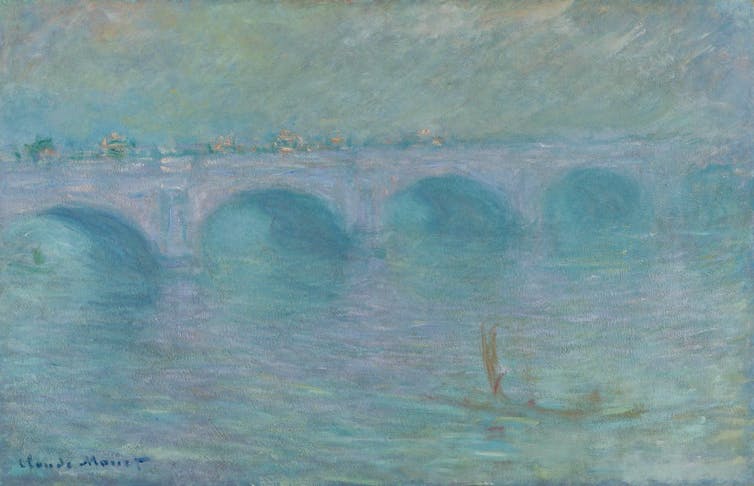
Impressionist painters, notably Claude Monet, had been drawn to the London fog. And in photography, the pictorialists (photographers keen to establish the medium as an expressive art form) followed the impressionists in their attraction to mist and fog as a means to convey emotional as well as physical atmosphere.

By the 1930s, pictorialism was a popular aesthetic in Britain. Encouraged by magazines such as The Amateur Photographer and Cinematographer, the amateur photography scene was dominated by an aesthetic of atmosphere. The British Journal of Photography, as early as 1898, lambasted “mud-and-slush photographers” who would seek out bad weather conditions and foggy atmosphere for aesthetic effect.

painting of a bridge in fog
Waterloo Bridge in the Fog by Claude Monet (1903).
Denver Art Museum

Fog allowed photography to be expressive, it introduced mystery through softening and blurring effects but also a shallowness to the pictorial space, an aesthetic of silhouettes and lighting effects anticipating film noir, especially films like The Third Man (1949), with their dramatic use of night-time urban lighting, smoke and shadow.

In the hands of the press photographers, it gave rise to a distinctive repertoire, of London buses and archways, policemen with their distinctive helmets and white gloves, lamplighters and classical buildings outlined in the mist. The fog appeared as an opaque backdrop against which an increasingly cliched and nostalgic image of the imperial city could emerge, at a time when Britain’s colonies were fighting for independence.

As the historical geographer Stephen Legg argues, when a severe “black smoke fog” plagued the first India Round Table Conference in November and December 1930, the press commented on developments in the conference in relation to differences in climate and dress, interpreting Indian “difference as inferiority or nonmodernity”.

As Legg and other writers on atmosphere and climate have shown, ideas about weather and climate, and especially fog, go hand in hand with ideas about race and empire. As well as making the polluted atmosphere appear picturesque, and despite the difficulties involved in photographing in fog, photographs of foggy London reproduce and circulate an ideological vision of the British empire.


The climate crisis has a communications problem. How do we tell stories that move people – not just to fear the future, but to imagine and build a better one? This article is part of Climate Storytelling, a series exploring how arts and science can join forces to spark understanding, hope and action.


The Conversation

Michelle Henning received funding from the Arts and Humanities Research Council for some of the work informing this article, under grant no. AH/R014639.

ref. How romanticised images of London fog shaped the way we see polluted air – https://theconversation.com/how-romanticised-images-of-london-fog-shaped-the-way-we-see-polluted-air-272851

Russian knowledge of Soviet-era energy systems has helped it to target Ukraine’s heating and homes

Source: The Conversation – UK – By Pauline Sophie Heinrichs, Lecturer in War Studies, Climate and Energy Security, King’s College London

In the middle of Ukraine’s fiercest winter of the war, many Ukrainians are unable to prepare hot meals or are unable to heat their homes while temperatures have dipped as low as -20C in the past few weeks. Harsher weather is forecast.

Russia has once again targeted Ukraine with sustained attacks on power stations, energy grids and heating nodes affecting electricity, as well as heating systems and water pumps.

Following the Russian strikes on January 20, around 5,600 apartment buildings in Kyiv were left without heating and almost half of Kyiv was believed to be without heat and power, affecting around one million people. The situation is so dire that the city has set up “heating tents” to help people stay warm in the freezing temperatures. Other cities have also been attacked.

Ukraine’s president Volodymyr Zelensky declared the situation an energy emergency.

One factor is that as a legacy of Ukraine’s membership of the Soviet Union, Russia probably holds deeper knowledge about Ukraine’s centralised energy systems than an outside nation would generally have.

For decades Ukraine’s energy system was linked to Russia and Belarus as part of a centralised grid, and was “tightly connected to Russia’s energy architecture”. While this did not mean Ukraine was dependent on Russia for its energy supply, it did mean that Russia played the central role in coordinating frequency and balancing supply and demand across the whole network.

Some Ukrainian officials have argued that the nature of these attacks suggests that Russian knowledge of Soviet-era energy systems has helped it to target Ukraine’s energy centres.

There’s another big factor for the Ukrainian authorities to struggle with.

While Ukraine’s authorities were quick to restore heating in around 1,600 buildings, an estimated 4,000 remained without heating on January 21. The challenge in Ukraine is more severe than it might be in other countries because of the centralised systems for water, sewage and heating used by its urban neighbourhoods, known as district heating.

What is district heating?

Ukraine still relies heavily on Soviet-era thermal heating systems using mostly gas. The percentage of households that rely on district heating varies by region and city, with a particularly high percentage of these buildings, mostly built in the 1960s, in densely populated urban cities including Kyiv.

Thermal power plants usually heat water which is then piped around districts and to individual pumping stations. It is then distributed to apartment buildings. But if the pipes are full of water and power for heating is off, the pipes can burst if the water freezes. Right now, with temperatures spiralling downwards this is a major threat.

Russian attacks on Ukraine leave thousands without heating in middle of winter.

Each district heating system can serve tens of thousands of citizens across multiple buildings and, when powered with renewable energy, they can be significantly more efficient, cost-effective and low-carbon than individual boilers. District heating systems depend much more on fixed physical infrastructure, including large pipes and pumping stations, to circulate hot water.

But centralised infrastructure is inherently vulnerable to physical attack. Damage to a major transmission pipe or the loss of a key pumping station can disable heating across entire neighbourhoods, particularly during winter.

Russia has damaged around 8.5GW of Ukraine’s power generation since October 2025, or around 15% of pre-war capacity. With the amount available nearly matching the amount generated there’s little room to redistribute energy within the system.

Whatever the system’s weaknesses may be, no energy system in the world is built to sustain continued bombardment.

Ukraine relies on nuclear power

Ukraine’s energy system is also largely dependent on nuclear power. Around half of Ukraine’s electricity is nuclear-powered, with coal-fired power plants making 23% and gas-fired plants 9%. In all cases these are features of a highly centralised energy system.

Patterns of attacks indicate that Russian forces monitor where repairs are under way and then hit the same sites again once they are restored. This has compounded repair costs and prolonged the loss of critical services. Kyiv’s mayor Vitali Klitschko said that the situation was difficult because most of those buildings that were being reconnected for the second time were damaged as part of a previous attack on January 9.

Russia uses “double-tap” strikes, where a second attack follows closely after the first. This often endangers emergency services and repair crews rushing to restore heat and electricity. Such tactics force officials to balance the urgent need to fix infrastructure with the risk to workers and civilians.

Even before the war, there were weaknesses in Ukraine’s energy and power networks. Old water systems and heating devices — and often entire buildings — need to be reconstructed.

However, Ukraine had already started to reduce technical reliance on Russia before the war. The dependency on the post-Soviet system changed in March 2022, when Ukraine’s grid was integrated with the European Network of Transmission System Operators for Electricity, (Entso-E), a Europe-wide association of national electricity transmission system operators.

These attacks have had significant consequences on hospitals, transport systems, and vulnerable people in their homes. This devastating cycle of repeat strikes in the middle of an incredibly cold winter has intensified Russia’s energy terror.

The Conversation

Pauline Sophie Heinrichs does not work for, consult, own shares in or receive funding from any company or organisation that would benefit from this article, and has disclosed no relevant affiliations beyond their academic appointment.

ref. Russian knowledge of Soviet-era energy systems has helped it to target Ukraine’s heating and homes – https://theconversation.com/russian-knowledge-of-soviet-era-energy-systems-has-helped-it-to-target-ukraines-heating-and-homes-274052

The rise of Reza Pahlavi: Iranian opposition leader or opportunist?

Source: The Conversation – Global Perspectives – By Eric Lob, Associate Professor of Politics and International Relations, Florida International University

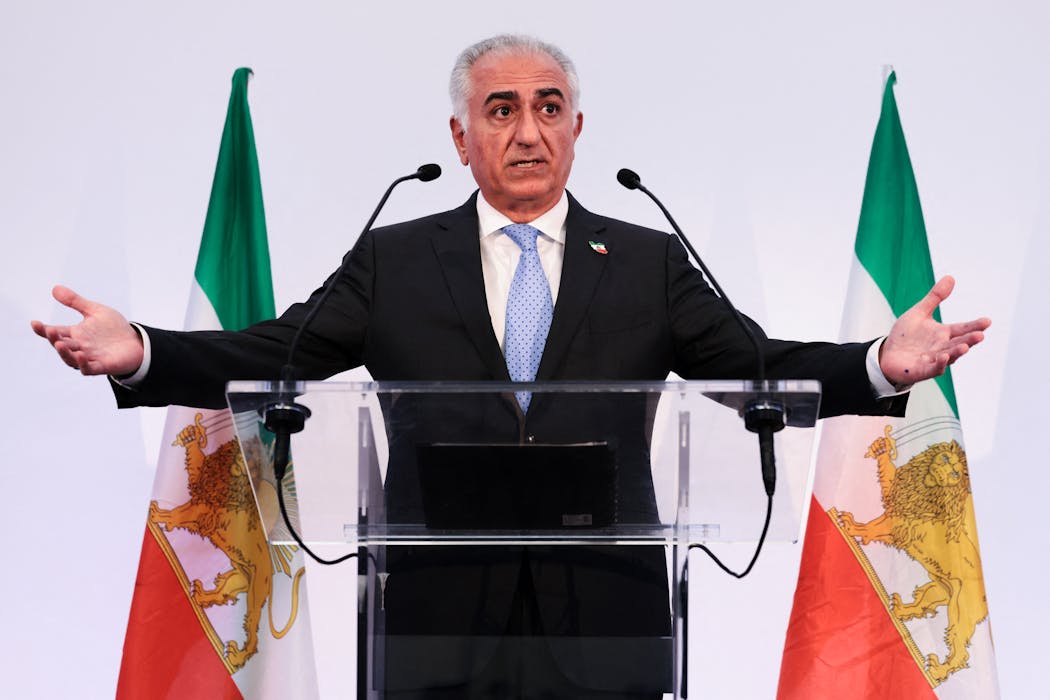
Reza Pahlavi, Iranian opposition leader and son of the last shah of Iran. Joel Saget/AFP via Getty Images

During the protests that ripped through Iran in January, one person who gained attention was Reza Pahlavi. Pahlavi, who lives in Los Angeles, is the son of the late shah of Iran, who ruthlessly ruled the country before being deposed during the Iranian Revolution in 1979.

Pahlavi emerged during the recent upheaval as a prominent political dissident in exile who encouraged and inspired Iranians to demonstrate. It remained unclear, however, what level of popular support he commanded inside Iran, not to mention whether he was, in fact, dedicated to democracy as the descendant of a monarch.

While some Iranians perceived Pahlavi as an opposition leader, others considered him an opportunistic figure with monarchical designs and a mixed track record.

Crown prince to political dissident

Born in Tehran in 1960, Reza Pahlavi was the eldest son of the shah, Mohammad Reza Pahlavi, and his wife, Queen Farah Diba, making him the crown prince.

From 1941 to 1979, the shah ruled Iran with an iron fist. With funding and training from France, the United States and Israel, he established and deployed a secret police force, the SAVAK, that subjected political opponents to surveillance, imprisonment, torture and execution.

As popular discontent against the shah grew in 1974-75, Amnesty International estimated there were between 25,000 and 100,000 political prisoners in Iran.

Although the shah stated during the 1979 revolution that he would rather flee the country than fire on protesters, his security forces killed approximately 500 to 3,000 Iranians – though those figures are lower than those killed in the latest Iran protests.

In 1980, the shah admitted to mistakes, including acknowledging that his regime had tortured Iranians.

CBS Evening News anchor Walter Cronkite reports on Jan. 16, 1979, that a “tearful” Shah and his family had left Iran “on a vacation from which he may never return.”

The shah and his family fled Iran in 1979, and the Islamic Republic subsequently was established. After the shah died in 1980, Reza Pahlavi declared himself the next shah and started his political activism against the Islamic Republic from abroad.

More recently, he attempted to organize and unify a divided opposition composed of ethnic and religious groups, leftists, rightists, centrists, republicans and, of course, monarchists. In the process, Pahlavi also aspired to raise his public profile.

From 2013 to 2017, he served as co-founder and spokesperson of the Iran National Council, an umbrella organization of opposition groups, headquartered in Paris. It reportedly suffered defections from some groups, which stifled its ability to accomplish much. In February 2019, Pahlavi helped establish the Phoenix Project of Iran, a think tank in Washington, D.C., dedicated to regime change and a transition plan in Iran.

During the 2022-23 Woman, Life, Freedom protests, sparked by the death of the young Iranian woman Mahsa Amini while in the custody of the morality police, Pahlavi called for rallies against the Iranian government in the United States, Canada and other countries. Leading opposition figures spoke at these rallies, and thousands of people participated.

That same year, some high-profile activists and celebrities, including some his father had imprisoned, endorsed Pahlavi as a leader or figure who could unite the opposition.

Presence and politics

In April 2023, Pahlavi made his first official visit to Israel, where he was hosted by Intelligence Minister Gila Gamliel and met with Prime Minister Benjamin Netanyahu. The visit was condemned by Iranians, from regime supporters to anti-government activists, who were opposed to monarchy and unsympathetic to Israel.

After Pahlavi’s participation in the February 2025 Munich security conference was nixed, he and his supporters gathered in the city that month and in the summer to unify the political opposition and plan a post-regime transition. For Pahlavi, the meetings may have been simply a face-saving measure after the security conference snub.

As a political dissident, Pahlavi continually called for a popular uprising, regime change and a secular and democratic state. At the same time, he did not rule out the return of the monarchy, albeit a constitutional one, based on a national referendum and constituent assembly.

In an attempt to appease other opposition groups and some anti-monarchy Iranian citizens, Pahlavi occasionally insisted he was “not a political leader” and was “not personally seeking political office” in Iran if the regime fell.

On the foreign policy front – and following in his father’s footsteps – Pahlavi has advocated for Iran to align itself with the United States and Israel.

Protesters holding enlarged photos of Reza Pahlavi as they stand on a street, some of them wearing flags around their shoulders.
Iranian protesters hold a photograph of Reza Pahlavi during a Free Iran rally in London on Jan. 18, 2026.
Dinendra Haria/SOPA Images/LightRocket via Getty Images

Unclear support, mixed record

As Pahlavi became more politically active abroad, questions surfaced about his viability as an opposition leader in Iran.

Discounting a 2023 poll conducted by a pro-Pahlavi institute indicating he was widely popular in Iran, it remained difficult to determine his support in Iranian society.

In a 2022 poll conducted by an independent, nonprofit research foundation with 158,000 respondents in Iran, Pahlavi received the highest percentage – 32.8% – among 34 candidates listed to serve on a transitional solidarity council, should the regime collapse.

At the same time, Pahlavi apparently lacked a serious monarchist movement and a strong connection with local opposition leaders and activists in Iran. He purportedly had little, if any, support among reformist or liberal groups in the country.

The lack of clarity concerning support for Pahlavi in Iran explained the hesitation of U.S. officials, including President Donald Trump, to engage with him. That did not deter Pahlavi from attempting to persuade them to abandon diplomatic talks and negotiations with the Islamic Republic over its nuclear program.

Despite the debates outside Iran about Pahlavi’s support within the country, pro-monarchy slogans increasingly appeared in Iranian social media postings and anti-government protests, including those in 2017-18, 2019-20, and 2022-23.

During the 2019-20 protests, the security forces arrested members of monarchist groups around the country and acknowledged their rising popularity and ability to infiltrate the government. Some reformist intellectuals suggested that monarchist slogans were merely a means for Iranian youth and other citizens to channel their anger and frustration at the authorities rather than expressions of true support for Pahlavi.

The slogans also reinforced the regime’s efforts to delegitimize the protests by portraying them as a plot by external and internal enemies, including the monarchists, to destabilize the country.

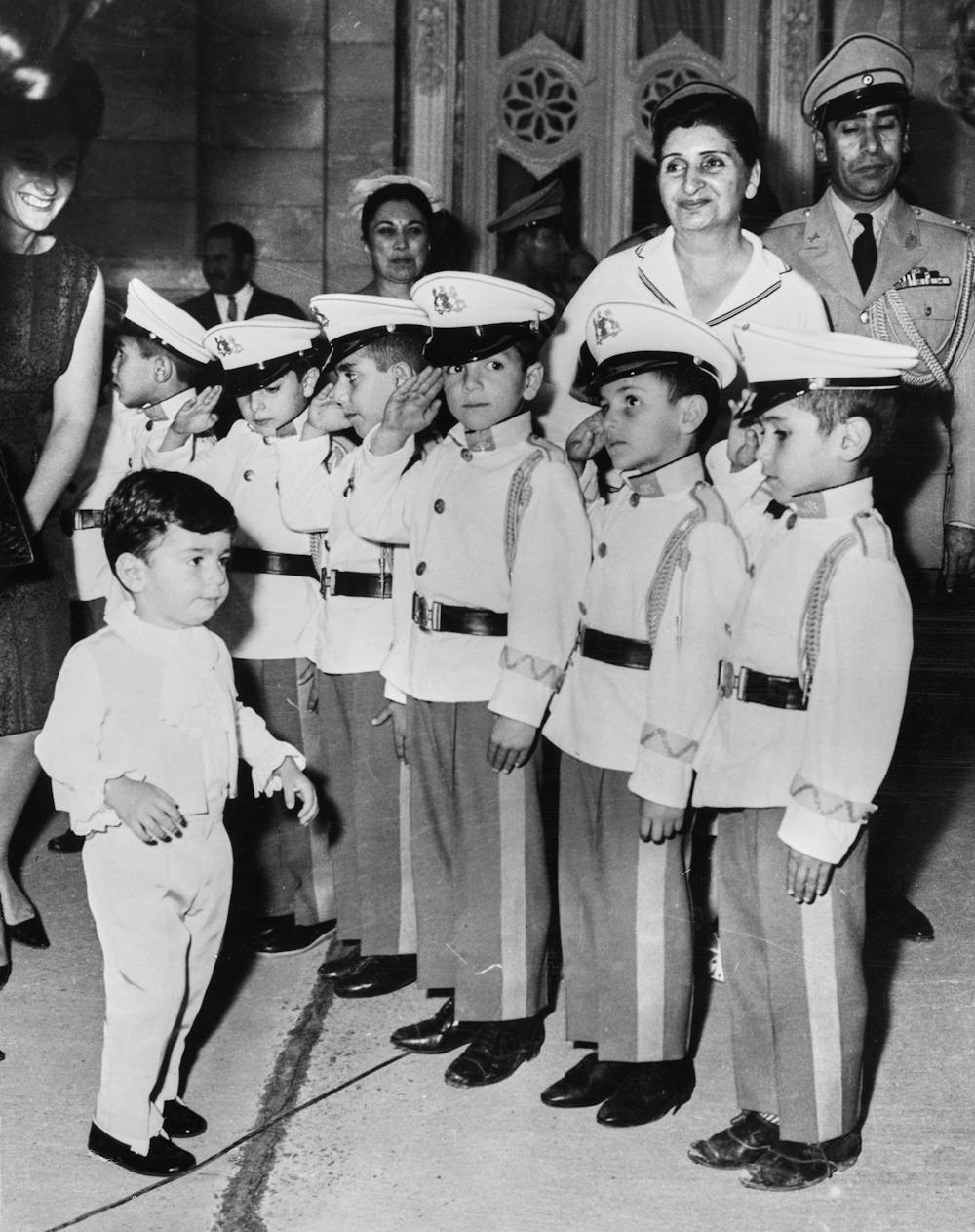
A young boy standing in front of a line of boys in military uniforms.
Crown Prince Reza Pahlavi of Iran inspects a ‘guard of honour’ composed of young boys in uniform in Tehran, Iran, on Sept. 19, 1963.
Keystone Hulton Archive/Getty Images.

Throughout the 12-day war in June 2025 between Iran and Israel, which claimed the lives of 1,190 Iranian civilians and injured and displaced thousands more, Pahlavi publicly lamented the destruction of Iran’s military infrastructure that his father had initially built and the price its people paid for a war he blamed on Supreme Leader Ayatollah Ali Khamenei and the regime.

At the same time, he was criticized by prominent political prisoners and other Iranian activists and citizens for betraying his country by supporting the Israeli strikes and failing to condemn them.

After the war, Israeli investigative journalists uncovered an influence operation conducted and funded by Israeli public and private entities to promote – among Persian-speaking audiences on social media – Pahlavi as a potential leader in a post-Islamic Republic Iran. The disinformation campaign created cynicism and controversy concerning Pahlavi’s true popularity inside the country and his tacit connection with Israel before and during the war.

Latest protests and future prospects

During the most recent protests, Pahlavi expressed support for protesters and encouraged them to demonstrate at certain times in the evening. The timing of the protests and demonstrations was intended to increase turnout by accommodating people’s work schedules and to maximize media coverage by aligning with news cycles.

Thousands of protesters turned out in the streets at those times, with some chanting anti-government slogans and others pro-monarchy ones.

His role in the protests was reduced after the regime cut off the internet and telecommunications between the people of Iran and the outside world, as well as among activists inside the country.

While some people praised Pahlavi for inspiring protesters, others asked whether he was responsible for sending them to detention and possible death, as some believed Trump was for similarly encouraging the protesters.

For the last 15 years, Pahlavi has intensified his efforts to unify the political opposition and gain greater exposure, culminating in him emerging as a central figure in the latest protests.

Yet there remain questions about whether he is viable as an opposition leader or is simply an opportunist.

His message about a democratic future for Iran has been largely consistent. However, his father’s repressive and imperial legacy, combined with his own royal pedigree and American and Israeli proximity, prevent him from finding favor with Iranians who oppose monarchy and prioritize sovereignty.

Now, the prospect of Iranians across the country rallying around Pahlavi remains as much of an open question as whether they will succeed in creating the conditions for his return by toppling the regime.

The Conversation

Eric Lob is affiliated with the Carnegie Endowment for International Peace.

ref. The rise of Reza Pahlavi: Iranian opposition leader or opportunist? – https://theconversation.com/the-rise-of-reza-pahlavi-iranian-opposition-leader-or-opportunist-273423

The big higher education question in 2026 ought to be: what are we preparing young people for?

Source: The Conversation – UK – By Lucy Gill-Simmen, Associate Dean (Education & Student Experience) Faculty of Business & Law, Royal Holloway, University of London

The UK’s proposed post-16 education and skills policy promises a nation “where nobody is left behind”. The country’s modern industrial strategy 2025 talks of a workforce ready for a decade of growth, green jobs and artificial intelligence. It is the language of momentum and modernity, but beneath the optimism of these papers and policies lies unease.

We have a plan for skills, but do we still have a philosophy of education? The refrain that “nobody gets left behind” only holds meaning if we first know where we are going.

Education is not merely about producing employable subjects, but cultivating human beings capable of judgement, imagination and democratic participation. Without that moral compass, our forward motion risks becoming little more than acceleration without direction.

In 1949, Albert Einstein lamented: “It is nothing short of a miracle that modern methods of instruction have not yet entirely strangled the holy curiosity of inquiry.”

More than seven decades later, it feels prophetic. Across higher education in the UK, a quiet malaise has taken hold. Universities have become fluent in the language of metrics, policies and dashboards, while students have become fluent in anxiety and debt.

We speak earnestly of agility and alignment, yet without clear direction. Once the moral and intellectual conscience of society, the British university risks becoming something far more ordinary: an institution of conformity, competing for the same diminishing pool of students and, in doing so, becoming indistinguishable from its peers.

This creeping homogenisation reflects the global commercialisation of higher education, where institutions mirror market logics (such as supply and demand) rather than challenge them, often at the expense of curiosity, critical thinking and imagination.

US educational reformer John Dewey described education as “life itself”. Brazilian educator Paulo Freire warned that schooling without liberation (meaning here agency and active learning rather than passively absorbing information) becomes “the banking of facts”, while the feminist author and academic known as bell hooks viewed education as “the practice of freedom”.

These were not romantic slogans; they were blueprints for survival. These people understood that education is not training – it is a process of becoming. Yet today, the language of learning has been colonised by a language of logistics.

Students are “learners”, teachers “deliverers”, and curiosity has no place in key performance indicators. The university system is increasingly one of transaction and we are building a system that can measure everything except meaning.

Opportunity in a crisis

The world is moving faster than the curriculum. Recently leaked documents suggest Amazon could replace up to 600,000 workers with robots – a glimpse of a labour market where efficiency outruns employment. If automation can transform one of the world’s largest employers, then the question for higher education is urgent: what are we preparing young people for?

The answer cannot be “the jobs of tomorrow”, because those jobs may not exist. The task now is to educate for adaptability, imagination and moral judgment, the qualities no algorithm can replace. As the historian and philosopher Hannah Arendt wrote in 1961: “Education is the point at which we decide whether we love the world enough to assume responsibility for it.” This is the work before us.

The government has correctly diagnosed a skills shortage. But its policy misses a meaning shortage. We need not only employable graduates but capable citizens – people able to reason ethically, collaborate across cultures and invent purpose where automation erases routine.

Higher education must recover its voice as the space where society asks its most difficult questions. What is progress for? What is prosperity without dignity? What does it mean to flourish or even to matter in an age of intelligent machines? These are not rhetorical questions – they are the foundation of survival strategies for a civilisation on the cusp of reinvention.

The courage to begin again

Universities across the world are banging the drum of transformation, insisting that doing things differently is the way forward. But how many actually are doung things differently? For all the rhetoric of innovation, much of the sector remains bound by inherited models of teaching and governance.

Into this inertia steps a new generation of institutions reimagining what a university can be. The “challenger university” model exemplified by Minerva University in the US and the London Interdisciplinary School in the UK, has begun to disrupt long-held assumptions about place, teaching and purpose.

These universities treat the world itself as a campus, fusing digital delivery, experiential learning and global immersion to craft education around curiosity rather than compliance.

Traditional universities are slowly following suit, rolling out accelerated degrees and hybrid formats with experiential learning embedded in their cities. At Royal Holloway Business School, the BSc Business and Management (London Accelerated) degree was built from this conviction. It is faster – two years all in instead of three – but not shallower.

London itself becomes the campus as students collaborate with businesses and design projects that connect innovation to ethics. They learn to work with artificial intelligence as a creative partner, not a threat.

This is not a course in survival; it is a course in significance. It teaches that employability follows from imagination, and that imagination begins with purpose. At its heart lies the courage of moral imagination: the willingness to envision not only alternative futures, but better ones.

Higher education stands at a fork in the road. One path leads deeper into optimisation: faster courses, tighter metrics, closer alignment to industry. The other path leads back to truth, curiosity and moral imagination. The first path is safe but soulless. The second is uncertain but alive.

And perhaps that is what this moment demands: to make education full of wonder again. When acceleration becomes an end in itself, education becomes soulless; when it is used to support inquiry, reflection and ethical engagement, it can do the opposite.

Universities must not only expand access but redefine ambition. They must teach not just for the labour market but for the human market – the realm of creativity, empathy and responsibility that automation cannot touch.

So yes, let us commit to no one being left behind. But let us also dare to ask: towards what? Towards compliance or consciousness? Towards growth or grace and fulfilment? If we want education to matter again, we must stop treating it as the servant of policy and start recognising it as the architect of possibility.

The Conversation

Lucy Gill-Simmen does not work for, consult, own shares in or receive funding from any company or organisation that would benefit from this article, and has disclosed no relevant affiliations beyond their academic appointment.

ref. The big higher education question in 2026 ought to be: what are we preparing young people for? – https://theconversation.com/the-big-higher-education-question-in-2026-ought-to-be-what-are-we-preparing-young-people-for-270208