The extent of these changes was greater for those who spent longer in space. As NASA plans longer space missions, and space travel expands beyond professional astronauts, these findings will become more relevant.
Why it matters
On Earth, gravity constantly pulls fluids in your body and your brain toward the center of the Earth. In space, that force disappears. Body fluids shift toward the head, which gives astronauts a puffy face. Under normal gravity, the brain, cerebrospinal fluid and surrounding tissues reach a stable balance. In microgravity, that balance changes.
Without gravity pulling downward, the brain floats in the skull and experiences various forces from the surrounding soft tissues and the skull itself. Earlier studies showed that the brain appears higher in the skull after spaceflight. But most of those studies focused on average or whole brain measures, which can hide important effects within different areas of the brain.
Our goal was to look more closely.
Astronauts need to exercise and take care of their bodies while in space.
How we do our work
We analyzed brain MRI scans from 26 astronauts who spent different lengths of time in space, from a few weeks to over a year. To focus on the brain’s movement, we aligned each person’s skull across scans taken before and after spaceflight.
That comparison allowed us to measure how the brain shifted relative to the skull itself. Instead of treating the brain as a single object, we divided it into more than 100 regions and tracked how each one had shifted. This approach enabled us to see patterns that were missed when looking at the whole brain, on average.
We found that the brain consistently moved upward and backward when comparing postflight to preflight. The longer someone stayed in space, the larger the shift. One of the more striking findings came from examining individual brain regions.
In astronauts who spent about a year aboard the International Space Station, some areas near the top of the brain moved upward by more than 2 millimeters, while the rest of the brain barely moved. That distance may sound small, but inside the tightly packed space of the skull, it is meaningful.
Areas involved in movement and sensation showed the largest shifts. Structures on the two sides of the brain moved toward the midline, which means they moved in the opposite direction for each brain hemisphere. These opposing patterns cancel each other out in whole brain averages, which explains why earlier studies missed them.
Most of the shifts and deformations gradually returned to normal by six months after return to Earth. The backward shift showed less recovery, likely because gravity pulls downward rather than forward, so some effects of spaceflight on brain position may last longer than others.
What’s next
NASA’s Artemis program will mark a new era of space exploration. Understanding how the brain responds will help scientists assess long-term risks and develop countermeasures.
Our findings don’t mean that people should not travel to space. While we found that larger location shifts of a sensory-processing brain region correlated with postflight balance changes, the crew members did not experience overt symptoms – such as headaches or brain fog – related to brain position shifts.
Our findings do not reveal immediate health risks. Knowing how the brain moves in spaceflight and subsequently recovers allows researchers to understand the effects of microgravity on human physiology. It can help space agencies to design safer missions.
The Research Brief is a short take on interesting academic work.
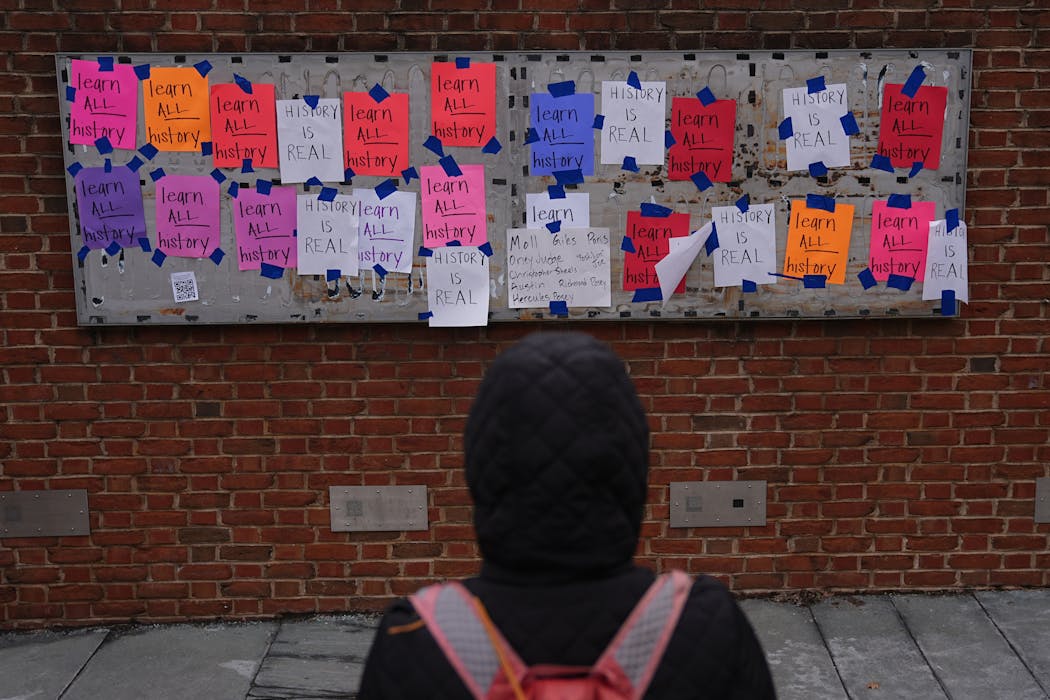
The National Park Service removed an exhibit on slavery at the President’s House site in Philadelphia on Jan. 22, 2026. The city of Philadelphia has sued the Trump administration in response. AP Photo/Matt Rourke
On the evening of May 21, 1796, Ona Judge made the daring decision to free herself.
Considering the prominence of her owner, the laws of the time and the dangerous trek to New Hampshire, a place where she could discreetly live freely, the act carried remarkable risk. Nevertheless, she slipped out of the President’s House undetected while the first family dined.
The house, then located at the intersection of 6th and Market streets in Philadelphia, served as the first executive mansion. It stood mere feet from Independence Hall, where the nation adopted its lofty language regarding freedom.
The slavery exhibition at Independence Hall opened in December 2010. It was the first slavery memorial on federal land in U.S. history. Michael Yanow/NurPhoto via Getty Images
Years later, Judge described her narrow escape to Rev. Benjamin Chase in an interview for the abolitionist newspaper The Liberator. Judge told Chase, “I had friends among the colored people of Philadelphia, had my things carried there beforehand, and left Washington’s house while they were eating dinner.”
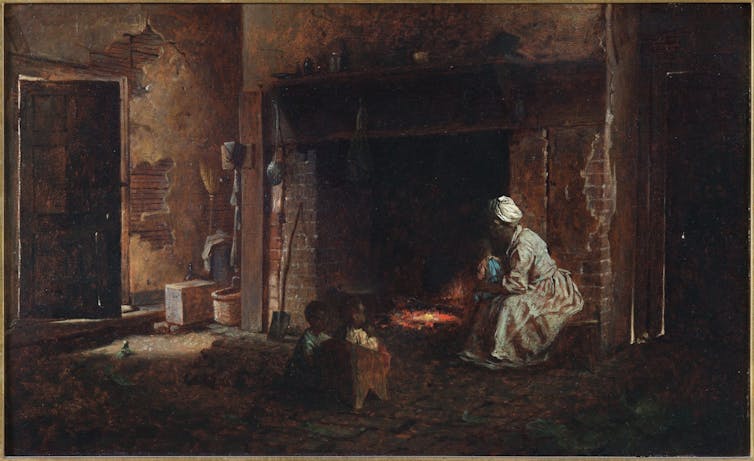
Prior to her escape, Judge served as a chambermaid in the President’s House. She spent years tending to Martha Washington’s every need: bathing and dressing her, grooming her hair, laundering her clothes, organizing her personal belongings, and even periodically caring for her children and grandchildren.
Being a chambermaid also included grueling daily tasks such as maintaining fires, emptying chamber pots and scrubbing floors.
Even though she engaged in this arduous labor as property of the Washingtons, living in Philadelphia provided Judge a glimpse of what freedom could eventually look like for her. Historians estimate that 5% to 9% of the city’s population at the time were free Black people. Prior to her escape, Judge befriended several of them.
In the spring of 1796, the Washingtons prepared to return to Virginia to resume private life. President Washington issued his farewell address in the fall of 1796, but he told family and close confidants of his plans earlier in the year.
During that time, Martha Washington made arrangements for their pending return to Mount Vernon. Her plans included bequeathing Ona Judge to her granddaughter, Elizabeth Parke Custis, as a wedding gift. Upon learning this, Judge made plans of her own.
In her interview with Chase she explained, “Whilst they were packing up to go to Virginia, I was packing to go, I didn’t know where; for I knew that if I went back to Virginia, I should never get my liberty.”
As a civil rights lawyer and professor in the Africology and African American Studies department at Temple University in Philadelphia, I study the intersection of race, racism and the law in the United States. I believe Judge’s story is vital to the telling of America’s history.
Before January 2026, those who wished to learn about Judge could literally stand on the same walkway in Philadelphia where Judge once stood when she chose to flee. Several footprints, shaped like a woman’s shoes and embedded into the pathway outside of where the President’s House once stood, memorialize the beginning of Judge’s journey. These footprints composed part of an exhibit examining the paradox between slavery, freedom and the nation’s founding.
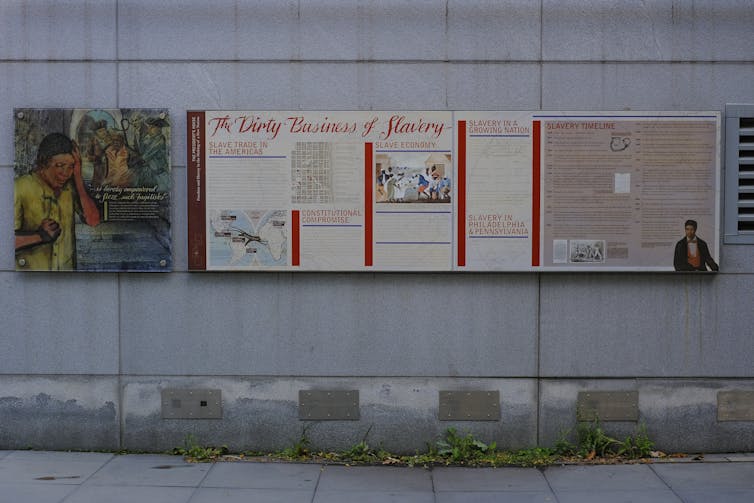
The exhibit, “Freedom and Slavery in the Making of a New Nation,” also included 34 explanatory panels bolted onto brick walls along that sidewalk. They provided biographical details about the nine people the Washingtons owned while living in the presidential mansion. The exhibit presented the sobering reality that our nation’s first president enslaved people while he held the nation’s highest office.
These and other panels discussing the founders’ owning of slaves were removed in late January 2026, after an executive order issued by President Donald Trump in March 2025 called to eliminate materials deemed disparaging to the Founding Fathers or the legacy of the United States. Matthew Hatcher/Getty Images
This changed in late January when the National Park Service dismantled the slavery exhibit at Philadelphia Independence National Historic Park. The removal sparked intense, immediate outrage from people across the country dismayed by the attempt to suppress unfavorable aspects of American history.
Philadelphia Mayor Cherelle Parker responded swiftly. “Let me affirm, for the residents of the city of Philadelphia, that there is a cooperative agreement between the city and the federal government that dates back to 2006,” she said in a public statement. “That agreement requires parties to meet and confer if there are to be any changes made to an exhibit.”
The city of Philadelphia later sued Interior Secretary Doug Burgum and National Park Service acting Director Jessica Bowron. Pennsylvania subsequently filed an amicus brief in support of the city’s lawsuit.
Civil rights activist and Philadelphia-based attorney Michael Coard recently had an opportunity to visit and examine the exhibits in storage. Coard has led the fight to create and preserve the exhibit and now is at the center of the fight to restore it.
Philadelphia-based attorney Michael Coard, who helped lead the effort to create the exhibition, visited the site after its removal. AP Photo/Matt Rourke
Limiting discussion of race
While the court deliberates the future of the exhibits, critics continue to raise key concerns regarding the exhibit’s removal. Many argue the National Park Service’s dismantling of the exhibit is an attempt to “whitewash history” and erase stories like Ona Judge’s.
This is particularly the case considering the Trump administration has restored and reinstalled two Confederate monuments of Albert Pike in Washington, D.C., and Arlington National Cemetery, while removing the slavery exhibit in Philadelphia.
Similarly, during the first Trump administration, the federal government engaged in various efforts to counterbalance the 1619 Project, a project spearheaded by Pulitzer-winning journalist Nikole Hannah-Jones that discussed the 400th anniversary of slavery’s beginnings in America. The 1619 Project spawned yearslong backlash. This included the 1776 Commission, created during the first Trump administration, which tried to discredit the conclusions of the 1619 project.
This pattern has intensified as the United States prepares to celebrate the 250th anniversary of the framers signing the Declaration of Independence. As the nation celebrates its history, it must decide how much of it to explore.
In the face of widespread pessimism about the political fate of the United States and growing political polarization, scholars and citizens across the country are reimagining how American democracy could better serve the needs of the whole population.
In an October 2025 poll, a slight majority said that radical change is needed to make life better in America, compared to 32% who answered only small change is needed.
Reimagining a political system’s future effectively begins with the system’s foundation: how the populace chooses the people who will represent them and make collective decisions.
The U.S. Constitution mandates elected representatives in Congress to decide important questions, such as how to tax the population and spend that collective revenue. And they determine whether to go to war or to defend allies if they are invaded.
What would it take to make that electoral system become more responsive to citizens’ needs? How could it be fairer and more accurate in representing the entire electorate?
One answer is found in proportional representation, an electoral system used in most of the rest of the world’s established democracies. These systems elect multiple representatives in a district in proportion to the number of people who vote for them.
It examined evidence from other countries and concluded that proportional representation could provide more fair and accurate representation and more choice. Proportional representation could also help with the deep political polarization engulfing the United States.
How proportional representation works
This proposal would change the way Americans elect representatives to the U.S. House of Representatives and potentially to state legislatures.
Currently, the winner-take-all system in the U.S. works like this: States are divided into districts based on population and elect one representative to the House of Representatives per district. The winner is the person who gets the most votes. Most states also use this single-member district system to elect members of their state legislatures.
A proportional representation system has larger, multimember districts. Candidates are elected according to the share of votes they or their parties receive.
Different versions of proportional list systems exist. In one version called open list proportional representation, voters choose a candidate from party lists of nominated candidates or from lists of independent candidates.
So if the Good People Party, for example, wins 40% of the vote in a district with 10 members, it will get four seats. And the top four vote-winners on their list will be elected. If the Serious People Party wins 20% of the vote, it will get two seats, with the top two vote-getters on their list elected.
This method simultaneously serves the purpose of a primary election, allowing voters to choose among nominees from a party.
Another version of proportional representation also has multimember districts but uses ranked-choice voting to select the members, where voters rank candidates in order of preference. New Zealand and Australia changed to this system for some of their representative bodies in 1993 and 1948, respectively.
A September 2024 poll found that over half of Americans think the U.S. should change the way representatives are elected to the House of Representatives. SDI Productions
The advantages of proportional representation include outcomes where many more voters would live in a district with at least one of the elected officials representing their choice. That differs from the winner-take-all system where those on the losing side feel unrepresented, especially when the district is split 51% to 49%, for example.
Proportional representation opens the door to more choice because it becomes possible for a smaller party to win one seat out of five, for example. It would begin to break up the two-party system that currently forces some voters to choose the “lesser of two evils,” or to vote strategically against their most disliked party rather than for someone they want.
To be sure, proportional representation can lead to difficulty in forming a majority coalition. This happened in Belgium in 2010. It can also lead to situations where small, extremist parties can demand major concessions to join a larger party in forming a majority coalition, which Israel recently experienced.
Israel is often cited as a negative example of proportional representation. But the country remains unusual in that its extreme electoral system includes the entire country as one large district with 120 seats, so that many small parties can be elected.
Research indicates that districts with three to eight members are ideal to provide more accurate representation without overly fragmenting the party system.
In the U.S. it’s more likely that proportional representation would allow for different factions of the existing parties to be represented. Imagine a five-seat district that elects one MAGA Republican, one traditional Republican, one progressive Democrat, one centrist Democrat and one third-party or independent candidate. This would begin to break down the polarization and allow for different coalitions to form across different issues.
Changing the system to elect House members does not require a constitutional amendment. The Constitution allows states to determine the manner of elections.
In a bloc system, voters get as many votes as there are seats in that district. So in a five-seat district, each voter gets five votes instead of only one vote in a proportional system. A majority group, say whites, could thus choose to vote for only white candidates and win across the board, locking out any minority candidate from winning. The repeal could include a prohibition on returning to that bloc system.
Proportional representation would require that lawmakers who hold their seats under the current system agree to change the 1967 law. And they may be reluctant to change to a system that would give voters more choice.
But interviews with retiring lawmakers show their frustration with the dysfunction and toxicity of the current Congress. And some lawmakers are pushing for a committee to study how changes to the electoral system could create a better-functioning Congress.
Additionally, there is growing support for electoral reform in the U.S. A September 2024 poll found that over half of Americans think the U.S. should change the way we elect representatives to Congress. And 63% believe the country would be better off with more than two competitive parties.
One U.S. city – Portland, Oregon – recently moved to proportional representation. The Portland City Council that took office in 2025 has greater gender, minority and neighborhood representation than in the past, even if it experienced some initial difficulty in forming a majority coalition. And Cambridge, Massachusetts, has used proportional representation since 1941, where 95% of voters see one of their top three choices elected.
States and municipalities could thus become laboratories of innovation, experimenting with different versions of proportional representation and providing models and momentum for a national-level change. And the country could begin not only to reimagine but to experience a different democracy that serves all.
Jennifer Lynn McCoy receives funding from the Carnegie Corporation for an Andrew Carnegie fellowship on depolarization as well as the Institute for Humane Studies.. She is Regent’s Professor of Political Science at Georgia State University and a nonresident scholar at the Carnegie Endowment for International Peace.
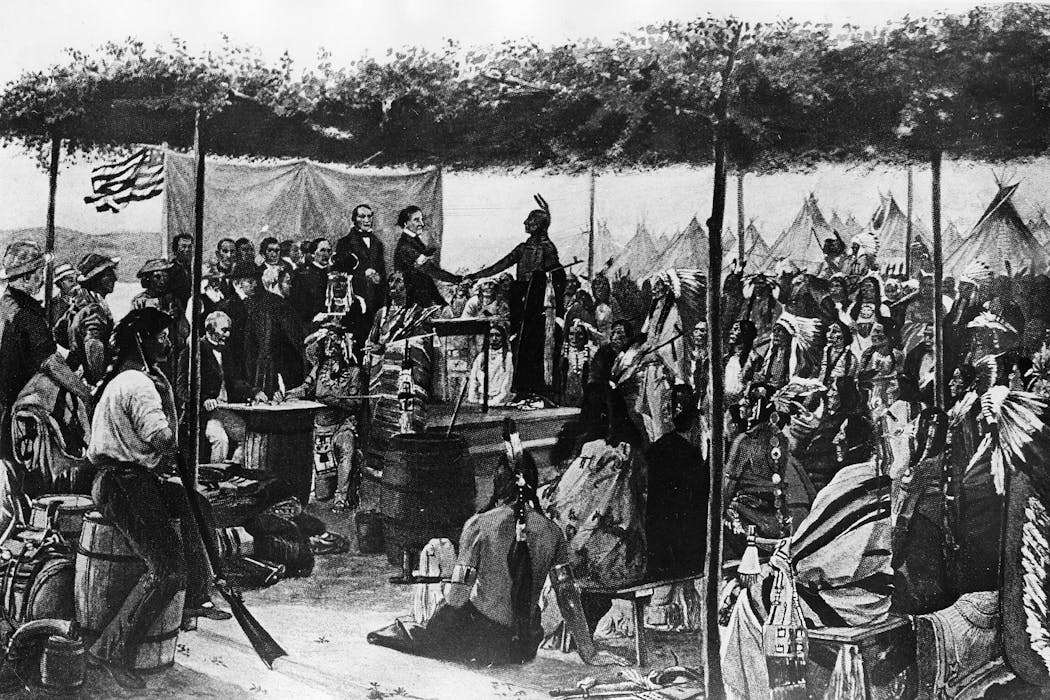
Leaders of Native nations and representatives of the United States have signed many treaties over the centuries, including the 1851 Treaty of Traverse des Sioux.ullstein bild via Getty Images
Native American tribal lands contain 30% of the nation’s coal, 50% of its uranium and 20% of its natural gas. And they contain materials critical for advanced technologies, including renewable energy: copper for electric grids, lithium and rare earth elements for batteries and electronics, and water for agriculture and power generation.
Significantly expanding domestic access to fossil fuels, critical minerals and water will require the U.S. government to work with Native nations. Their rights to resources on their lands are enshrined in long-standing treaties whose legal power is on equal footing to the U.S. Constitution itself. I study these agreements, negotiated from the late 18th to the late 19th centuries and ratified by the U.S. Senate. They are not mere historical artifacts but rather key documents at the center of modern conflicts over drilling, mining, pipelines and energy infrastructure.
For Indigenous nations, access to natural resources is more than a matter of economic opportunity or environmental sustainability. Managing these lands is inseparable from questions of sovereignty, sacred land and treaty enforcement.
Treaties as living law
Under the U.S. Constitution, treaties are ranked as “the supreme Law of the Land” right alongside the Constitution itself.
Federal Indian Law, largely codified in Title 25 of the U.S. Code, defines the relationship between the United States and tribal nations, including recognizing tribes as possessing and exercising “self-government.” Supreme Court decisions sometimes recognize tribes as sovereign political entities, but that sovereignty is constrained by congressional authority and overlapping state jurisdiction.
But in recent decades, Native nations have used the treaties as grounds for reasserting their sovereign status, restoring the documents to their original purpose as an organized set of nation-to-nation relationships deeply rooted in North American diplomatic history.
Treaty rights were central to objections in 2018 over a proposal to build an oil pipeline in Minnesota to replace an older pipeline known as Enbridge Line 3. AP Photo/Steve Karnowski
Energy projects and treaty disputes
The tribes are demanding the federal government protect sacred lands, ecosystems and community health when evaluating proposals for mining and other developments.
Native-led protests and lawsuits are a common feature of large infrastructure projects that cross their land or threaten their resources. In 2021, the White Earth Nation sought to block the expansion of the Enbridge Line 3 oil pipeline. The route was planned to run underneath a spiritually significant Minnesota lake where it and other tribes had treaty-protected rights to water, hunting and fishing.
In its effort, which was ultimately unsuccessful, the tribe cited treaties from 1837, 1854 and 1855. The tribe argued that these treaties required the federal government to protect their rights to hunt, fish and gather – a position supported by a 1999 Supreme Court ruling.
More successful was a 2024 move by the Navajo Nation to get the Federal Energy Regulatory Commission to reject a proposed hydropower project on Navajo lands.
In late January 2026, however, the commission approved a similar hydropower project on a sacred and treaty-protected area of Yakama Nation lands in the state of Washington. The Yakama Nation and other tribes and local groups are asking state courts to block the project.
These cases expose a long-standing tension in U.S. law between the federal government’s treaty-bound responsibility to protect tribal resources and the authority claimed by the federal and state governments over land and development.
The Sun sets over Oak Flat, or Chi’chil Biłdagoteel, a place sacred to Apaches and a site of a proposed copper mine. AP Photo/Ty O’Neil
Oak Flat and the Apache Stronghold case
One of the most significant current disputes involves the proposed Resolution Copper mine at Oak Flat in Arizona. Known to the Western Apache as Chi’chil Biłdagoteel, Oak Flat is a sacred site used for ceremonies central to Apache religious life.
The courts have so far sided with the federal government on the grounds that Congress, rather than the states, has ultimate authority in what federal law calls “Indian country.”
First, a U.S. District Court denied an injunction to stop the transfer. In March 2024, the justices of the 9th U.S. Circuit Court of Appeals issued a split ruling upholding that decision and finding that the project did not impose a “substantial burden” on the Apaches’ religious rights.
The Apaches tried again in late 2025, but the Supreme Court denied that request, too, leaving intact the 9th Circuit ruling, which allowed the land transfer to the mining company.
Even so, the conflict is not over. The Apaches took additional claims to the 9th Circuit in a different legal form, and the court issued temporary restraining orders in late 2025, which paused aspects of the land transfer while litigation continues.
Some treaties between colonists and Native Americans were agreed on centuries ago, including this 1661 treaty between William Penn and residents of what is now Pennsylvania. Picturenow/Universal Images Group via Getty Images
Why treaties still matter
The Oak Flat dispute highlights the limits of existing legal protections for Indigenous sacred sites, even when treaties and religious freedom are clearly at stake. It also shows how congressional control over use of federal land can override Indigenous objections in the name of energy security and critical minerals.
This and comparable disputes also show how treaties, federal law and the Constitution can be used to slow, reshape and sometimes halt extractive projects, forcing states and corporations to reckon with Native sovereignty, even where Congress or the executive branch claims the last word.
For Native nations, treaties remain central tools for asserting sovereignty and shaping energy futures. Tribal governments and Indigenous corporations are increasingly active in renewable energy and mineral markets, seeking development on their own terms. In April 2025, Buu Nygren, president of the coal-rich Navajo Nation, called for energy developments that honor tribal sovereignty and secure Indigenous nations’ place in global supply chains.
Treaties are not relics of the past. They continue to shape how energy, law and sovereignty intersect in the United States today.
Charles Prior receives funding from the Leverhulme Trust (Major Research Fellowship, 2024-27).
In 2024, 51% of families read aloud to their very young children, while 37% read aloud to their kids between the ages of 6 and 8 years old.
Some parents have said they stop reading aloud to their school-age children because their kids can read on their own.
I’m a neuroscientist with four children, and I wondered whether children might be losing more than just the pleasure of listening to books read aloud. In particular, I wondered whether it affected their empathy and creativity.
A simple idea from the literature
I have studied and written about empathy and creativity as part of my personal effort to better understand how to be a good parent. I have found that empathy and creativity aren’t talents you’re born with or without. They are skills that respond to practice, just like learning to play piano.
And creativity is essential for self-control and problem-solving. It’s much easier to regulate your behavior if you can imagine multiple solutions to a problem instead of fixating on the one thing you’re not supposed to do.
About 10 years ago, I started making some changes at home to ensure that my children got these skills.
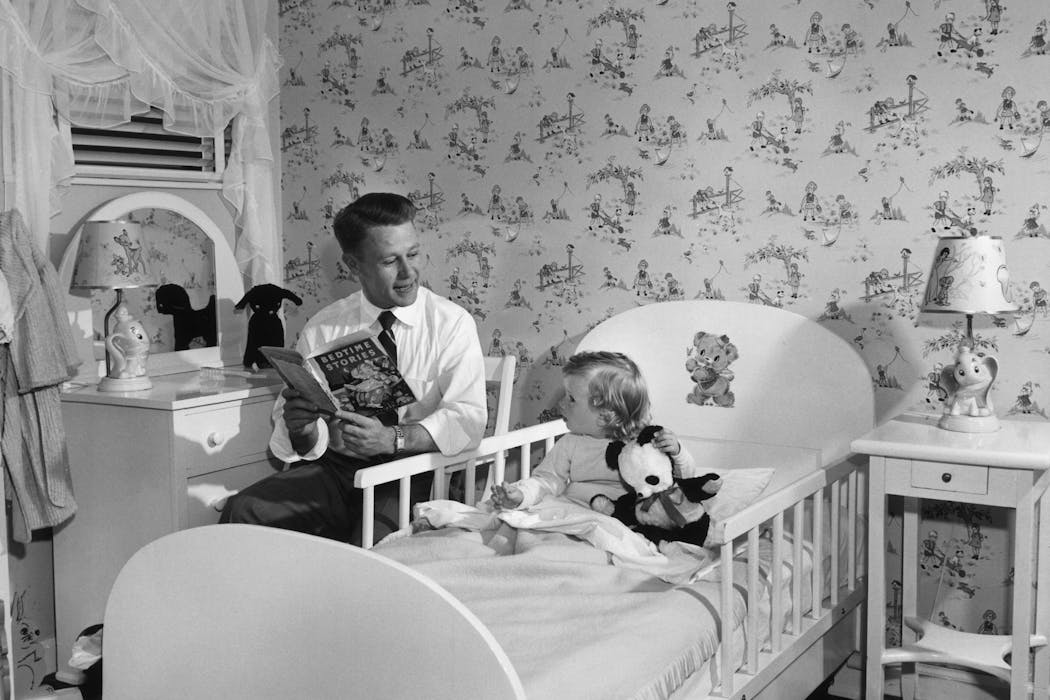
Setting aside 15 minutes at night was sometimes the only one-on-one time I had with each kid, with bedtimes of 7:30, 7:45, 8:00 and 8:15 p.m. It was precious to me. I wondered whether using conflicts in bedtime stories as teachable moments would help them develop more empathy for others and boost their creativity.
I wrote in 2016 about how I think my children became more empathetic when we paused at times during a book to ask: “How do you think this character feels?” and “What would you do?”
But no one had tested this experiment on a broader scale.
Testing the idea
Beginning in 2017, four colleagues and I recruited 38 families in central Virginia with children ages 6 to 8, which is an age when kids are navigating social relationships and experiencing intense brain development. All of the children in our study were somewhat independent beginning readers or they could read independently. In our study, caregivers read one storybook nightly for two weeks.
They were about, among other characters, a polar bear cub who becomes separated from his mother in the snow, and a boy who hid his teeth from the tooth fairy.
Half the families in our study read a book each night straight through without pausing. The other half paused at one conflict point per story to ask two reflection questions. For example, when the tooth fairy stole the tooth Nathan desperately wanted to keep, they asked, “How would you feel if you were Nathan?” If the child answered, parents just listened. If not, they waited 30 seconds before continuing.
Before and after two weeks, we tested children’s empathetic ability to understand what others might be thinking and how they are feeling. We also tested creativity using the alternative uses task, which asked kids to generate creative ideas, such as thinking of unusual uses for a paper clip or listing things with wheels.
A boost in empathy either way
After just 14 bedtimes with books, we found – as our 2026 research shows – that children whose parents paused for questions got better at understanding others’ perspectives. But so did children whose parents just read straight through.
We found that what scientists call cognitive and overall empathy improved significantly in both groups between childen’s initial visit and our follow-up visit two weeks after they read the books for a week.
This may be because it is easier to quickly develop cognitive empathy – meaning when you put yourself in someone else’s shoes – as compared to developing emotional empathy, or feeling what others feel. Emotional empathy involves different brain regions and likely requires longer to change deeply rooted emotional processing patterns.
A creative approach
After two weeks of bedtime reading, children in both groups got better at creative thinking. We used a standard creativity test that measures the number and the originality of responses when children were asked to think of uses for everyday objects. For example, if asked about a brick, a common answer would be to build a wall, while a more original response might be to grind it up to make red chalk.
But the children whose parents paused for questions generated significantly more ideas overall.
Their responses delighted me: They suggested using a paper clip as wire in a potato clock, to help put on a doll’s shoes, or to simply see what sound it makes hitting the floor.
We also noticed that the younger kids came up with more original ideas than the older ones. This matches other research showing that creativity may fade as children grow up and they prioritize fitting in with others more than thinking differently.
What we still need to learn
Our study had limitations: We did not have a comparison group that did not read at all. And most families had a higher income, with 92% of families earning more than $50,000 per year.
Future research could address this gap and also investigate whether the benefits we found persist past two weeks – and whether they translate into real-world kindness.
But importantly, we found no gender differences in our study. The practice works equally well for boys and girls. And even though the majority of our families said they already read regularly to their children, this practice still worked to boost empathy and creativity.
Children who read bedtime stories with their parents are likely to benefit from a boost in creativity – especially if they consider questions about the books. Anastasiia Krivenok/Getty Images
Bedtime stories are about more than routine
As a neuroscientist, I know the elementary school years are a particularly powerful window when children experience intense formation of new brain connections.
These 15 minutes of reading aren’t just about preparing kids to sleep or teaching them to decode words. They’re building neural pathways for understanding others and imagining possibilities. With repeated practice, these connections strengthen, just like practicing piano.
In a world designed to pull families toward screens, bedtime reading remains a refuge where parent and child share the same imaginative space.
But the pressure’s off for parents: You don’t have to read in any special way. Just read.
What might hold you back from standing up for a colleague who’s treated unfairly?AnVr/E+ via Getty Images
What really holds people back from stepping up as allies in support of their marginalized colleagues? For example, why don’t more men say something when they see a colleague or a customer make a sexist remark about a female co-worker?
Our research, published in the European Journal of Work and Organizational Psychology, suggests that people often hesitate to intervene when co-workers are mistreated because they themselves feel disempowered in their organizations and experience distrust and polarization.
Our findings run counter to the common assumption that people don’t step up to support marginalized colleagues because they don’t care or are unmotivated. Not seeing much action against inequity and injustice can drive this cynical idea. It’s built into many diversity, equity and inclusion training programs that rely on motivational tactics of persuasion, guilting and shaming to get people to act.
We arepsychology researchers interested in how people can use their strengths to effectively support others who are marginalized. We surveyed 778 employees in Michigan and 973 employees across all provinces of Canada, representative of urban and rural areas, working-class and professional jobs, and across all demographics, including gender, race and sexual orientation. We asked them, “What makes it hard for you to be an ally for underrepresented and marginalized people (e.g., people of color, women, persons with disability) in your organization?”
Low motivation represented just 8% of the barriers people cited. And lack of awareness that marginalized groups face inequities accounted for only 10% of the barriers people mentioned. Most diversity training money tends to be devoted to teaching employees about these topics – suggesting why many diversity training programs fail.
The most common barrier to allyship that our participants named was distrust and tension between people in their organization, which had them second-guessing themselves and self-censoring. People also reported feeling disempowered, like they didn’t have the power, opportunity or resources to make a real difference for their colleagues.
Why it matters
Researchers, specialists and consultants alike approach issues of workplace inequity with the assumption that to drive action they need to first unblock potential allies’ deep-seated resistance to change. For example, specialists assume that people need to become more motivated, more courageous, less biased or better informed about existing inequities in order to act as allies.
In this study, we temporarily set aside all preexisting assumptions and directly asked people what made it hard for them to be an ally, in their own words. Our goal was to identify practical roadblocks at the top of people’s minds that stop them from taking the first step, or the next logical step.
When popular messaging, like on social media, and organizational interventions misunderstand the causes of people’s inaction, they risk exacerbating frustration and tensions. Interventions need to account for their audience’s true perspectives on what makes allyship difficult. Otherwise, they’ll lack credibility, and people will likely be less receptive to program content.
Workplace DEI training would likely be more effective if it focused on what research identifies as the main issues. jacoblund/iStock via Getty Images Plus
What still isn’t known
We’d like to further investigate the impacts of the specific barriers mentioned in our study. More insight could help workplaces focus interventions on addressing barriers that are the worst pressure points and avoid overspending on interventions that can move the needle only so much.
More than a quarter of respondents said they experienced no barriers to standing up for colleagues. We’d like to investigate whether these respondents simply didn’t want to engage with our question, are uncertain about the barriers, or are already engaging in some form of allyship. Our team’s previous research has shown that even loud allies who publicly call out bias often also engage in quiet allyship actions, such as privately checking in on how a victim of bias is doing and assisting in strategizing next steps.
What’s next
Our research team is investigating whether programs designed with this study’s findings in mind – starting with building trusting relationships and helping people feel empowered – can increase allyship action. When diversity programs built on inaccurate assumptions don’t show the desired results, they risk having funding withdrawn or being halted altogether. Instead, as organizations take stock and pivot, evidence from our study and others can help them more effectively plan their next move.
The Research Brief is a short take on interesting academic work.
The authors do not work for, consult, own shares in or receive funding from any company or organization that would benefit from this article, and have disclosed no relevant affiliations beyond their academic appointment.
In announcing its “Great Healthcare Plan” in January 2026, the Trump administration became the latest in a long history of efforts by the U.S. government to rein in the soaring cost of health care.
But it also reflects a complex system fraught with competing interests – and the fact that patients, hospitals, health insurance companies and drug manufacturers change their behaviors in conflicting ways when faced with new rules.
Soaring costs
U.S. health care is the most expensive in the world, and according to a poll published in late January 2026, two-thirds of Americans are very worried about their ability to pay for it – whether it’s their medications, a doctor’s visit, health insurance or an unpredictably costly medical emergency.
Disputes over health policy even played a central role in the federal government shutdown in fall 2025.
Patent protection is another issue. Drug patents last 20 years, but completing costly trials necessary for regulatory approval takes up much of that period, reducing the time when manufacturers have exclusive rights to sell the drug. After a patent expires, generic versions can be made and sold for significantly less, lowering the profits for the original manufacturer. Though some data challenges this claim, the pharmaceutical industry contends that high prices while drugs are under patent help companies recover their investment, which then funds the discovery of new drugs. And they often find ways to extend their patents, which keeps prices elevated for longer.
Then there are the intermediaries. Once a drug is on the market, prices are typically set through negotiations with administrators called pharmacy benefit managers, who negotiate discounts and rebates on prescription drugs for health insurers and employers offering benefits to their workers. Pharmacy benefit managers are paid based on those discounts, so they do not have an incentive to lower total drug prices, though new transparency rules enacted Feb. 3 aim to change payment practices. Drugmakers often raise the list price of drugs to make up for the markdowns that pharmacy benefit managers negotiate – and possibly even more than that.
In many countries, centralized government negotiators set the price for prescription drugs, resulting in lower drug prices. This has prompted American officials to consider using those prices as a reference for setting drug prices here. In its blueprint, the Trump administration has called for a “most-favored nation” drug pricing policy, under which some U.S. drug prices would match the lowest prices paid in other countries.
Policy experts have questioned whether TrumpRx will bring down drug prices.
In late 2025, 16 pharmaceutical companies agreed to most-favored nation pricing for some drugs. Consumers can now buy them directly from manufacturers through TrumpRx, a portal that points consumers to drug manufacturers and provides coupons for purchasing more than 40 widely used brand-name drugs at a discount, which launched Feb. 5. However, many drugs available through the platform can be purchased at lower prices as generics
Increasing price transparency
Fewer than 1 in 20 Americans know how much health care services will cost before they receive them. One fix for this seems obvious: Make providers list their prices up front. That way, consumers could compare prices and choose the most cost-effective options for their care.
Spurred by bipartisan support in Congress, the government has embraced price transparency for health care services over the past decade. In February 2025, the Trump administration announced stricter enforcement for hospitals, which must now post actual prices, rather than estimates, for common medical procedures. Data is mixed on whether the approach is working as planned, however. Hospitals have reduced prices for people paying out of pocket, but not for those paying with insurance, according to a 2025 study.
For one thing, when regulations change, companies make strategic decisions to achieve their financial goals and meet the new rules – sometimes yielding unintended consequences. One study found, for example, that price transparency regulations in a series of clinics led to an increase in physician charges to insurance companies because some providers who had been charging less raised their prices to match more expensive competitors.
Many Americans struggle to afford monthly insurance premiums. But curbing that increase significantly may be impossible without reining in overall health care costs and, paradoxically, keeping more people insured.
Insurance works by pooling money paid by members of an insurance plan. That money covers all members’ health care costs, with some using more than they contribute and others less. Premium prices therefore depend on how many people are in the plan, as well as the services insurance will cover and the services people actually use. Because health care costs are rising overall, commercial insurance companies may not be able to significantly lower premiums without reducing their ability to cover costs and absorb risk.
When health insurance costs rise, healthier people may risk going without. Those who remain insured tend to need more health services, requiring those more costly services to be covered by a smaller pool of people and raising premium prices even higher.
The Trump administration has proposed routing the money spent on subsidies directly to eligible Americans to help them purchase health insurance. How much people would receive is unclear, but amounts in previous proposals wouldn’t cover what the subsidies provided.
To sum it up, health care is extremely complicated and there are numerous barriers to reforms, as successive U.S. administrations have learned over the years. Whether the Trump administration finds some success will depend on how well the policies are able to surmount these and other obstacles.
Patrick Aguilar does not work for, consult, own shares in or receive funding from any company or organization that would benefit from this article, and has disclosed no relevant affiliations beyond their academic appointment.
Cardinals Robert McElroy, Joseph Tobin and Blase Cupich issued a statement on U.S. foreign policy on Jan. 19, 2026.Gregorio Borgia/Gregory Bull/AP Photo
On Jan. 19, 2026, the three cardinals heading U.S. archdioceses – Blase Cupich of Chicago, Robert McElroy of Washington, D.C., and Joseph Tobin of Newark – issued a rare joint statement. “The United States has entered into the most profound and searing debate about the moral foundation for America’s actions in the world since the end of the Cold War,” they began, calling for “a genuinely moral foreign policy.”
The cardinals quoted Pope Leo XIV’s annual address to the Vatican’s diplomatic corps, delivered earlier that month, in which he deplored that “a zeal for war is spreading,” and the norm governing the use of force “has been completely undermined.”
In follow-up interviews, Cupich criticized the U.S. operation to capture President Nicolás Maduro for sending a message that “might makes right.” Tobin noted that some members of the Trump administration seemed to be advancing “almost a Darwinian calculus that the powerful survive and the weak don’t deserve to.”
As a former foreign policy adviser to the U.S. Conference of Catholic Bishops, and now director of Catholic peacebuilding studies at Notre Dame’s Kroc Institute, I know how rare it is that the cardinals’ short statement became headline news – especially because what they said mostly reiterated long-standing church teachings.
Military Services Archbishop Timothy Broglio speaks during a press conference at a plenary assembly in Baltimore on Nov. 11, 2025. AP Photo/Stephanie Scarbrough
More novel, however, were statements by Archbishop Timothy Broglio, who leads the Archdiocese for the Military Services. In December 2025, Broglio issued a detailed critique of the morality and legality of the Trump administration’s strikes against boats in the Caribbean. In a January interview with the BBC, when asked if an invasion of Greenland could be considered just, he said, “I cannot see any circumstances that it would.”
It is unusual for an archbishop of the military services to question the morality of specific U.S. military interventions. After doing so, it is even more unusual to call on the nation’s leaders to respect the consciences of military personnel “by not asking them to engage in immoral actions,” and to remind service members that “it would be morally acceptable to disobey (such an) order.”
All of these statements continue U.S. bishops’ legacy of opposing virtually every major U.S. military intervention since Vietnam, except the invasion of Afghanistan.
Just war
That opposition reflects the Catholic Church’s centuries-old “just war” tradition and its increasingly restrictive approach to what counts as “just.”
Just war criteria limit when, why and how force may be used. According to the Catholic catechism, going to war is legitimate in cases where there are not other means of stopping “lasting, grave, and certain harm,” there is reasonable chance of success, and war will not produce “evils and disorders graver than the evil to be eliminated.”
In other words, war should be “a last resort in extreme situations, not a normal instrument of national policy,” as the cardinals noted in their statement. The Catholic Church presumes that war is a failure of politics.
That restrictive approach, which some conservative Catholics dub “functional pacifism,” has put church leaders in opposition to U.S. military interventions that reflect a much more permissive interpretation of just war. The permissive approach presumes that war might be a last resort, but it remains a form of politics – one tool in the foreign policy toolbox.
Cold War criticism
These contrasting approaches were especially evident in the nuclear debate of the early 1980s and the debate over the 2003 Iraq invasion.
When Ronald Reagan first took office, his administration launched a massive nuclear buildup and deployed intermediate-range nuclear weapons in Europe, arguing that Americans were falling behind the Soviets in the Cold War.
President Ronald Reagan discusses the production of the MX nuclear missile during a news conference on May 14, 1984. AP Photo/Scott Stewart
In 1983, the U.S. bishops issued a highly influential letter, The Challenge of Peace, that opposed core elements of the administration’s nuclear policy. They called for a halt to the arms race, opposed the first use of nuclear weapons, and were skeptical of the morality of even a limited second, or retaliatory, use.
Their 103-page letter did not have a direct impact on U.S. nuclear policy, but it helped ensure that the just war tradition was no longer dismissed as outdated by policymakers and analysts. The pastoral was required reading in military academies.
One of the architects of Reagan’s Strategic Defense Initiative, Chief of Naval Operations Adm. James Watkins, was troubled by the church’s criticism of deterrence, according to journalist John Newhouse. Watkins saw missile defense as a morally superior alternative, which is how the so-called “Star Wars” program was sold to a skeptical Congress and public.
No preventive war
Debate about overly permissive use of force reached its zenith in the lead-up to the Bush administration’s invasion of Iraq in 2003. The administration argued that military force should not be restricted to defense against aggression. Preventive war was justified, in this view, to remove the potential danger Iraq posed in the aftermath of 9/11: a rogue regime, with weapons of mass destruction, and ties to global terrorists.
Pope John Paul II, U.S. bishops and Catholic leaders around the world vociferously objected, saying such a doctrine would emasculate the just war tradition and international law. As then-Cardinal Joseph Ratzinger – who later became Pope Benedict – said in 2002, “The concept of ‘preventive war’ does not appear in the Catechism of the Catholic Church.”
As early as May 2002, U.S. bishops embarked on a series of meetings with White House officials, urging them not to go to war. In March 2003, John Paul sent the Italian Cardinal Pio Laghi to hand-deliver a letter to President George W. Bush urging the same.
During remarks on June 4, 2004, Pope John Paul II reminded President George W. Bush of the Vatican’s opposition to the war in Iraq. Eric Vandeville/Gamma-Rapho via Getty Images
New context
It is not new for the church’s more idealist and cosmopolitan approach to international affairs to be in deep tension with a realist, “anti-globalist” U.S. foreign policy. In fact, the bishops have been more outspoken in the past than now.
But what is new, at least since the end of the Cold War, is church leaders’ growing concern about an intentionally norm-busting foreign policy. Past administrations offered legal and moral justifications for military inventions, such as the Bush administration’s claims that Iraq was a just war.
Trump, however, has abandoned any pretenses of his predecessors, telling The New York Times, “I don’t need international law.” The only limit on his international power, he said, is “my own morality.”
The bishops’ statements on his administration’s foreign policy are few and modest compared to the past. But with an American pope leading the way, they may prove the first salvo in more public and vigorous opposition by Catholic leaders.
Gerard F. Powers received a grant from the Nuclear Threat Initiative that helped support the Catholic Peacebuilding Network’s Project on Revitalizing Catholic Engagement on Nuclear Disarmament. He is an expert consultant (unpaid) to the Holy See Mission to the UN. From 1987-2004, Powers was a senior advisor on international policy for the U.S. Conference of Catholic Bishops.
Marks and Spencer is one of the latest UK high-street brands to launch a ski-wear collection. Even supermarket Lidl are in on the action, with their ski range starting from £3.99. This follows earlier moves by fast-fashion retailers such as Topshop who launched SNO in the mid 2010’s and Zara’s imaginatively titled Zara Ski collection, which launched in 2023.
Fast fashion brand PrettyLittleThing’s Apres Ski edit (a collection of clothes chosen for a specific theme) tells potential shoppers that going skiing is “not necessarily essential” which is good, because many of the products in the collection are listed as athleisure, not sportswear.
It’s not just the high-street. Kim Kardashian’s shapewear brand Skims has recently collaborated with The North Face and has dressed the USA team for the 2026 Winter Olympics – though these are strictly designed to serve the athletes during down-time, not for the piste.
Alongside dedicated ski-wear lines, the apres-ski aesthetic has become a recurring seasonal trend over recent years, expanding well beyond the slopes. You may have noticed the slew of ski-themed sweatshirts across the market. One of these, an Abercrombie & Fitch sweatshirt, went viral in January after a buyer noticed that the depicted resort was actually Val Thorens, France – not Aspen, Colorado, as the text printed on the garment claimed.
It is not only the quality of ski-themed fashion products that are a cause for concern, but also those designed for the slope. Many of these high-street collections have received criticism from consumers, with some claiming that the garments are “not fit for purpose”. Meanwhile, many influencers have taken to social media to warn their followers to avoid skiing in garments from fast fashion brands. Such were the complaints that Zara Ski reportedly renamed its products “water resistant” instead of “waterproof”.
These collections respond, in part, to a genuine need for women’s sportswear that is practical, fashionable and most critically, affordable. Ski and performance wear in general is costly and such collections, being both fashionable and relatively low-cost make for an attractive prospect. And yet, if these garments are so poorly suited to skiing, then what are they for?
The visual allure of skiing
Despite sports playing a key role in challenging gender ideology and perceptions of female physicality, the perceived importance of femininity and how women look while doing sports has lingered. Images of sportswomen frequently fixate on gender difference and femininity is foregrounded over athleticism. Here, the glamorous image of skiing has much to account for.
Glamour relies on distance and difference to conjure a feeling of longing. For many, the novelty of eating fondue at 3,000ft is out of reach, as is the ever-increasing price of a lift pass.
1983 Ski Time by Warren Miller.
Throughout the 20th century, the glamour of skiing has been defined by women’s fashion. In the 1920s, Vogue magazine featured illustrations of elongated skiing women on their covers. Designer Pucci’s aerodynamic one-piece ski suit premiered in Harper’s Bazaar magazine in 1947 whilst Moncler’s ski anoraks – photographed on Jackie Kennedy in 1966 – gave birth to a vision of American ski “cool”. Changing ski fashions were recorded in photographer Slim Aarons’ resort photography, capturing the leisure class on and off piste between the 1950s and 1980s.
Women’s fashionable ski-wear has taken many forms since the activity first became popular in the 1920s. It was during this decade that skiing became a marker of affluence. Leather, gaberdine, fur and wool were popular materials in early women’s ski-wear and were selected for their natural properties; water-repellence, insulation, breathability.
By the mid-century, women’s ski-wear became more focused on silhouette and excess fabric was considered unfeminine. Equally, ski-wear gradually became more colourful and in the fashion press, women were even encouraged to match their lipstick to their ski ensemble. By the 1980s, ski-wear aligned with the fashionable “wedge” silhouette; causing the shoulders of ski jackets to widen and salopettes (ski trousers with shoulder braces) to draw even tighter.
These historic developments parallel today’s aesthetic ski trend where fashion and image arguably comes before function. For example, PrettyLittleThing’s models are photographed on fake slopes, holding vintage skis. The glamorous image of the skiing woman lies not only in the clothing but in her stasis. The suggestion is that ski culture does not necessarily require skiing at all: it may simply involve occupying the most visible terrace, Aperol in hand.
No wonder then, that so many fast-fashion ski lines for women are deeply unpractical – they appear designed less for physical exertion than for visual consumption. They sell women on the alluring glamour of skiing, while leaving them out in the cold.
There is an additional irony here: climate change means that skiing is becoming increasingly exclusive. Lower-level resorts are closing as the snow line moves up, meaning fewer options and increased demand. In this sense, the image of skiing looks to become even more glamorous via increasing inaccessibility and therefore distance. Fast-fashion has a negative impact on the environment, and the ski aesthetic risks damaging the very thing it claims to celebrate.
Looking for something good? Cut through the noise with a carefully curated selection of the latest releases, live events and exhibitions, straight to your inbox every fortnight, on Fridays. Sign up here.
This article features references to books that have been included for editorial reasons, and may contain links to bookshop.org. If you click on one of the links and go on to buy something from bookshop.org The Conversation UK may earn a commission.
Tamsin Johnson receives funding from the AHRC via the Midlands4Cities doctoral partnership. Tamsin is the current secretary of the British Society of Sports History and part-time Lecturer at Nottingham Trent University.
Source: The Conversation – UK – By Janset Özün Çetinkaya, Teaching Associate in Philosophy, University of Nottingham
Valentine’s Day is traditionally a time of heart-shaped balloons, overpriced roses and fully-booked restaurants. Couples kiss and hold hands, smiling selfies celebrate a day of public displays of devotion.
Why do so many of us feel such pressure to offer grand gestures, buy pricey gifts, and go through elaborate displays of affection? Presumably, to prove our love. Valentine’s Day is a showy, one-day-a-year demonstration that promises to do just that.
For the ancient Greek philosopher Aristotle (384-322BC), however, this approach misunderstands the nature of love. For him, the true form of love wasn’t intense passion or grand gestures on one day of the year. Instead, it’s a steady commitment to help your beloved grow into their best version through everyday practices of care.
Aristotle wrote extensively about love, friendship and their place in a good life. His main book on ethics, the Nicomachean Ethics (350BC) – affectionately named after his son – is a classic work on virtue and happiness.
As a keen observer of human life, Aristotle’s philosophy was based on a real understanding of human beings – our emotions, needs, habits and the ways we live alongside each other. Humans are social animals, he argued, so we must live in a society and work toward a common good. More than this, we are “pairing” creatures. Coupling and sharing a life matters deeply. Interestingly, he believed this means learning to love ourselves, as well as others.
Aristotle said we should love ourselves the most. This could sound like a celebration of narcissism, a gospel for the selfie age. But Aristotle meant that truly loving someone means loving them as another self, extending our self-love to another – a process with five parts.
First, loving yourself means desiring and promoting your own good. Do the same for your loved one. Desire and promote whatever is in their interest. Second, work for their own safety and security as you would your own. Third, self-love means enjoying your own company and taking pleasure in reminiscing about past times and looking forward to good times to come. Desire and enjoy their company, too, in a shared life of interests, commitments and hopes.
Psyche by Berthe Morisot (1876). Aristotle believed you should love a partner as yourself. Thyssen-Bornemisza Museum
Fourth, make sure your desires are rational, and only desire things that are part of a “fine and noble life” – a life that is virtuous, rational and filled with meaningful relationships. Fifth, openly express and experience your pains and pleasures. Consistently pursue what brings you pleasure and avoid whatever brings pain. For your beloved, recognise and share in their pains and pleasures, as if they were your own.
Love, Aristotle says, comes from the sense that the lover is “mine”. If that sounds icky to a modern ear, the point isn’t about ownership. When I say “my beloved is mine”, I mean “we belong together in a shared life”. I do not own my finger, it belongs to my hand, which is a part of me. Likewise, I don’t own my beloved, but they belong to our loving relationship, of which I, too, am part.
Love, friendship and skill
Aristotle also described lovers as friends – not any old good friends but each other’s other halves. Like friends, lovers hang out, have each other’s back and support one another. As lovers, they treat each other as a part of themselves. Aristotle thinks it’s a big red flag if your lover doesn’t care as much about your feelings and needs as their own, no matter how grand their gestures and gifts.
Love was not a passive feeling for Aristotle, but a practice requiring skill. A lover, he argues, makes themselves better for their beloved, unlike a carpenter who makes a table for himself. Loving is a practice of constant self-improvement for the sake of another person. Being a good lover means striving to be a better person, so that you and your beloved bring out the best in each other.
For Aristotle, love is not about how your Valentine makes you feel on a single night of the year. Gifts and gestures are nice, but the real proof of love is nothing you can buy. Loving another as much and as well as you love yourself is the real proof, one that takes time and practice. To quote Aristotle, “one swallow does not make spring” – nor does one magical night really show our love.
Looking for something good? Cut through the noise with a carefully curated selection of the latest releases, live events and exhibitions, straight to your inbox every fortnight, on Fridays. Sign up here.
The authors do not work for, consult, own shares in or receive funding from any company or organisation that would benefit from this article, and have disclosed no relevant affiliations beyond their academic appointment.