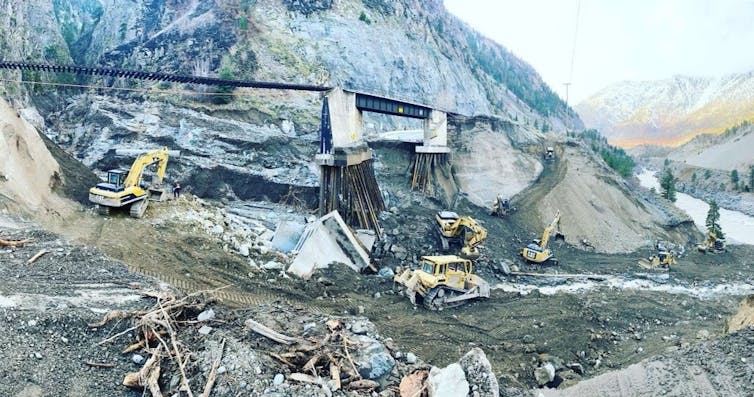
Sydney motorists experienced lengthy delays following the closure of Sydney’s M4 on Thursday morning.Photo: ABC News
Drivers have been stuck in Sydney’s M4 tunnel for several hours over fears part of its concrete roofing could tumble onto traffic.
Transport for NSW said the motorway was closed to westbound traffic between Haberfield and North Strathfield on Thursday morning because of emergency roadworks.
Transurban, which owns and operates the tunnel, said one of three westbound lanes was in the process of being reopened.
Transport for NSW coordinator general Howard Collins said engineers found “a couple of large bulges” in the sprayed concrete lining, called shotcrete, of the tunnel roof overnight.
“[The engineers] were concerned that if there was a major issue with this shotcrete, it could fall on vehicles,” he said.
Mr Collins said the entire section would be closed again at 10pm tonight so further remedial work could be carried out.
‘Exorbitant’ delays
NSW Minister for Roads Jenny Aitchison said drivers had spent an “exorbitant amount of time” in the tunnel, with some reportedly waiting up to four hours inside.
“Ultimately, this is a failure of privatisation. This tunnel is privately operated,” she said.
Frustrated motorist Jonathan Cooper said he was stuck in the tunnel for more than an hour after leaving Glenmore Park.
“You could see everybody getting really anxious themselves, like nobody was letting anybody in,” he said.
Mr Cooper had been travelling to the airport this morning to meet family who had returned from a cruise.
He said communication about the incident should have been clearer on radio and LED traffic signs throughout the city.
“I wasn’t listening to the news or anything like that, and I shouldn’t have to rely on radio stations to tell me that there’s a problem in there,” he said.
“I think they need to consider how they’re going to fund everybody’s tolls for this morning, to have to pay for the privilege of sitting in traffic for an hour.”
Communication breakdown
Mr Collins criticised Transurban’s handling of the incident, saying there was a “frustrating” lack of communication from the company as the government tried to step in.
“We’ve offered engineers, all sorts of equipment. Unfortunately, those offers have not been readily accepted,” he said.
“It is frustrating. My crews and teams who really want to get people around the network did find it very difficult to get information from this organisation.
“We will investigate and work with the timelines, and go through this with Transurban, to ensure that motorists are not put through this pain again.”
Shadow Roads Minister Natalie Ward said the NSW government should have issued earlier warnings so drivers knew to avoid the motorway.
“Jenny Aitchison, as roads minister, should have been out there this morning communicating to motorists, not waiting until after her leisurely lunch,” she said.
“It’s not acceptable to blame everybody else when you are the roads minister.”
More delays expected
Despite the partial reopening of a single westbound lane, Transurban has warned drivers to expect delays this afternoon and to avoid the area.
Transurban said in a statement one of the westbound lanes would be reopened on Thursday afternoon, with the rest of the tunnel to reopen “as soon as it is safe to do so”.
“Two of the three lanes in that small section of the tunnel between Haberfield to Homebush will remain closed,” the statement said
“Motorists are advised to expect delays this afternoon and avoid the area if possible.”
The toll-road operator said planned maintenance closures on Thursday night would go ahead with reopening expected on Friday morning.
Motorists affected by the traffic gridlock have been offered a refund by contacting Linkt on 133 331 or its app.
-ABC
– Published by EveningReport.nz and AsiaPacificReport.nz, see: MIL OSI in partnership with Radio New Zealand
Remember when Twitter used to be good? I reckon it peaked somewhere around the first COVID lockdowns.
In those days, there was a running gag on the site where everyone would refer to it as a “hellscape”. And it did invite some of the worst that humanity has to offer. Opinions, as the old joke goes, are like assholes: everybody has one.
But if you curated your Twitter feed effectively, you could have immediate scrolling access to the best journalism and cultural commentary, excellent podcasts and comedians, film criticism and book reviews, the latest trends in food, music or clothing, decent information about public health, live stream feeds of smart people on the ground at the most pressing events of the day, not to mention the wisecracks and insights of your friends.
It was like being perpetually part of an in-crowd. The promise of a world where potentially anyone could feel connected, in touch, popular.
Review: Enshittification: Why Everything Suddenly Got Worse and What to Do About It – Cory Doctorow (Verso)
Then came the rumours that the increasingly fascist-curious Elon Musk was scheming to buy the platform. Not possible, we thought at first. It would be a terrible business decision. And anyone interesting or important would flee overnight.
Then Musk did buy Twitter, horribly rebranding it as X. Then we speculated (or hoped) it would drive him bankrupt. Then it didn’t. Then, through deliberate and explicit effort, it went to shit.
Musk decided he would raise money by selling the coveted blue-checks, a form of authentication previously reserved for those who had developed their influence organically. He changed the algorithm to reflect his own views and fired moderators tasked with weeding out misinformation and hate speech. As a result, the platform formerly known as Twitter was soon full of ads, gore, porn, toxicity, AI slop and scams of all variety.
Yet, as if trapped by their established followings or perhaps some contagious fear of missing out, people stayed. Calls to migrate en masse to other liberal-coded platforms largely failed.
For some reason, this logic seems to be taking over all social media, even the internet itself. Facebook, Instagram, TikTok, Amazon, Google, Apple, Uber, Spotify: everything turns to shit. And no one is able to escape.
To paraphrase a song about another way we get trapped by misplaced desires: welcome to the Hotel Crapifornia. You can check in any time you like, but you can never leave.
An inhuman nightmare
In 2022, Canadian journalist, novelist and activist Cory Doctorow coined the term “enshittification” to describe the degeneration of the internet.
Back when the internet was good, in the late 1990s and early 2000s, Doctorow was every hipster’s hero. His blog Boing Boing was required reading for anyone interested in emerging technologies. If you wanted to be recognised as cool, you entered the coffee shop conspicuously carrying a copy of his latest book. It seemed that no one knew more about where technology had come from, and where it was likely to go. He was our prophet.
His 2003 novel Down and Out in the Magic Kingdom, for example, was a dystopian story of a post-scarcity world where monetary currency had been replaced with what Doctorow called “whuffie” – essentially a measure of how much others respect you.
This was just before social media stormed into all our lives, with its vertiginous economy of likes and followers, attention and influence.
All these years later, Doctorow’s Enshittification: Why Everything Suddenly Got Worse and What to Do About It is an attempt to explain how the great dream of the internet – its powerful democratising potential, its incredible capacity to generate human communities and circulate human knowledge – turned into an inhuman nightmare.
We were offered a world of connection and cooperation – an open-source paradise of instant and free access, liberated from the fetters of both corporate ownership and state control.
What we got was a world of ruthless monopolies and oligarchs who control a colossal surveillance apparatus capable of tracking our most private behaviours, producing a population of powerless, compliant consumers – people who have no choice but to keep using their abysmally bad products, because there is nowhere else to go.
Prisoners of our own devices
“Enshittification” is not just a clever term for the grumpy complaint of an ageing Gen-X tech-head. Doctorow wants to develop it as a formal concept that explains the process by which internet platforms, applications and innovations go from being loved by their users to being despised.
Beginning with the case studies of Facebook, Amazon and the iPhone, then expanding out to more or less every platform on the internet, Doctorow proposes that enshittification has three basic stages.
First, platforms are good to their users. People genuinely want to participate. A community develops, but not much profit is made.
Second, in an effort to monetise this new community, platforms are good to companies. They offer them access to markets through advertising or shipping or proprietary arrangements.
Finally, they find a way to screw over those business customers as well as their users to claw all excess value back for themselves.
That is how we arrived at what Doctorow calls “a giant pile of shit”.
Amazon is the easiest example to explain. It started by providing a service that people wanted: fast cheap delivery of products. It then attracted business customers by providing a means to increase profit and market share.
But then, like a medieval warlord, it crushed all competition and used its market dominance to compel tributes from its business customers, in the form of fees that absorbed and exceeded whatever extra profit they may have made in the first place.
At this point, Amazon has absolutely no reason to improve its service. In fact, in order to siphon off even more value by cutting costs, it has every reason to make its service worse.
For Doctorow, the problem is not that some or many internet platforms follow this kind of enshittifying procedure; it is that almost all of them do. And given the ubiquity of the internet in our daily lives, particularly with the advent of the smartphone, our entire world has become enshittified.
We are now in what Doctorow calls the “enshittoscene”. To return to the musical reference mentioned above: we are all just prisoners here, of our own devices.
As Doctorow notes, it is easy to predict how the tiny handful of ghouls who benefit from this situation are likely to respond. Well, they are going to say, it might not be great, but that’s capitalism. And as everyone knows, capitalism is the worst system, except for all the others.
But Doctorow refuses to accept the familiar neoliberal logic of “there is no alternative”, because members of his generation (which also happens to be mine) know this is a sham. We know there is an alternative, because we have seen it with our own eyes. The internet was not always shit. It used to be good. And it could be good again.
Doctorow’s proposals for recreating a good internet – one that combines the autonomy and choice of the old internet with the mass scale of the current shit internet – are fourfold: competition, regulation, interoperability and tech-worker power.
In the first instance, Doctorow insists that the internet today is not capitalist at all. Following the economist Yanis Varoufakis, he calls it “technofeudalist”. Like medieval landlords, the tech overlords don’t make money in the enshittoscene by creating or circulating new products. They make it by owning the platforms for the creation or circulation of products and compelling everyone else to rent space on those platforms.
Smashing these rentier monopolies and opening spaces for healthy competition is step one. But doing so will require robust antitrust regulations, which can break the near-monopolies enjoyed by tech companies like Google and prevent anti-competitive corporate mergers. Avenues for enshittification must be shut down by law and this must be coordinated at an international level.
These laws must guarantee the interoperability of all technological systems. Currently, one of the most expensive fluids on planet earth is HP printer ink. HP sets the price unilaterally, because they construct their printers so that no other ink cartridges will work.
In the enshittoscene, the principle of anti-interoperability spreads across nearly all platforms and products. But regulation could ensure that all technological operating systems are compatible with one another, just as regulation ensures that household electronic devices are compatible with uniform powerpoints.
Finally, and most importantly, the people who work in tech industries can be empowered to realise the ethos of collaboration and innovation that, by and large, they share. For the truth is, Doctorow suggests, that most of the people who actually do the work in the enshittoscene – those who build and manage the platforms – hate it as much as the users do. And empowering them would go a long way towards empowering all of us.
Charles Barbour does not work for, consult, own shares in or receive funding from any company or organisation that would benefit from this article, and has disclosed no relevant affiliations beyond their academic appointment.
The first half of Stranger Things’ (2016–) final season has received almost 60 million views in five days – making it Netflix’s largest ever English language debut. But the reception has been marred by controversies surrounding actor David Harbour, who plays Jim Hopper, an ex-police chief in the fictional town of Hawkins, Indiana.
Harbour has been the subject of pop culture news for several weeks now, following the release of ex-partner Lily Allen’s new album. The pair separated in December, 2024, after four years together.
A little over a month ago, Allen released West End Girl – her first full-length album in seven years. It’s a blistering critique of her former partner, and accuses him of cheating during their marriage.
Online, Stranger Things viewershavepointedout they can no longer view Hopper – one of the “good guys” on the show – the way they did before Allen’s accusations surfaced.
The line between public and private
The public’s reaction to the couple’s highly-publicised separation is an interesting case study into how social media platforms now shape celebrity culture.
Both Allen and Harbour are successful in their respective fields and have large online followings. They are connected to fans who appreciate their work – many of whom are invested in their personal lives.
And while such parasocial relationships between stars and fans have existed since the dawn of Hollywood, social media platforms are reconstructing what can be defined as “public” and “publicity” – as well as the counterpoints of “private” and “privacy”.
Today’s platforms use algorithms to amplify subtle behaviours, interactions and personal qualities in celebrities that may have once flown under the radar. Putting the magnifying glass on stars in this way helps us feel “closer” to them – further blurring the line between the person and their onscreen personas.
And this inability to separate both explains why numerous stars through the decades have opted to keep certain aspects of their identity (such as their sexuality) hidden.
Two top-rated comments made under an Instagram post promoting Allen’s new album. Instagram
A social media golden girl
Allen has used Instagram (where she has about two million followers) and TikTok (420,000 followers) to get word of her new album out. It’s clear from her promotional material – and her history with social media – that she knows how to leverage an online audience.
Allen was already a hit on MySpace back in 2006. She had tens of thousands of “friends” on the then-ubiquitous platform, and sold about four million copies of her album Alright, Still (2006) in the first week of its release.
Harbour also has a huge online presence, including some 8.4 million Instagram followers. Interestingly, though, he has been relatively silent about the breakdown of his marriage.
He is now also the subject of headlines focused on allegations, first published in a Daily Mail report, that Stranger Things co-star Millie Bobby Brown filed a bullying and harassment complaint against him before filming began in 2024.
In the recent press tour, Brown told outlets she “felt safe” and has a “great relationship” with Harbour. Still, the initial Daily Mail report seems to have taken root in coverage surrounding the tour.
A new age of celebrity
Stardom has been transformed in the era of social media.
One question now is figuring out the extent to which scandals that are amplified by social media actually impact celebrities’ careers, and how this compares to coverage in the pre-social media age. If fans start to see Harbour as a “bad guy” because of the press and social media chatter, will this affect the quantity or types of roles he gets in the future?
And is it acceptable for social media platforms and influential users to have such outsized power in driving pop culture narratives?
On one hand, fans arguably deserve to know the character of the artists they choose to support. On the other, it’s concerning to think tabloids such as the Daily Mail could potentially derail someone’s career using unverified reports and unnamed sources.
David Marshall is an emeritus professor at Deakin University. He is also an honorary professor at the University of Nottingham – Ningbo China and Co-chair of the Power of Prestige (PoP) research conference. In addition, he is one of the founders/editors of the journal Persona Studies and M/C Journal: Media and Culture.
Myanmar’s military regime has announced elections will be held in three phases, starting on December 28 and concluding in January.
Two outcomes are certain: first, the military-aligned party will be recorded as winning and, second, the government in exile – the National Unity Government – will fade even further into the background.
In the close to five years since the military seized power in February 2021, the country has been engulfed in a civil war, with the military pitted against People’s Defence Forces and numerous ethnic armed organisations. Thousands of resistance protestors, fighters and politicians, including President Win Myint and the ever-popular leader Aung San Suu Kyi, remain imprisoned.
The military controls the levers of government and holds all the major population centres. But its brutal air, artillery and drone attacks have failed to crush the resistance. The resistance has captured large swathes of territory, restricting the upcoming elections to only 274 of the nation’s 330 townships (constituencies).
Inside and outside the country, the elections are seen as a sham. The military-stacked Union Election Commission has deregistered political parties for failing to meet criteria it has set, such as having a certain number of party members or offices. It has also dissolved Aung San Suu Kyi’s National League for Democracy party.
Citizens criticising the election on social media have been sentenced for up to seven years in prison with hard labour. For some offences, the death penalty applies.
The elections are an attempt to gain the legitimacy, at home and abroad, that currently eludes the military regime. They are designed to demonstrate authority and give an impression of effective control. By simulating compliance with international democratic norms, the regime hopes to promote a sense of normalcy, consolidate power and open the door to greater international engagement, all the while preserving the status quo.
The National Unity Government living in exile and a myriad of its international supporters are calling on the international community to not send election observers. Instead, they want the world to denounce the sham election.
ASEAN leaders are insisting that a cessation of violence and inclusive political dialogue precede elections. They have rebuffed an invitation to send observers.
The best the regime could hope for is that some individual ASEAN member states join Russia and Belarus in sending observers. However Thailand, the most ambivalent ASEAN member, which has argued the election should serve as a foundation for a sustainable peace process, is now saying it will be difficult for ASEAN re-engage with Myanmar. China is believed to be supportive of elections, but has not committed publicly to sending observers.
Continued Western ostracism won’t matter to the junta, for whom regional legitimacy is more important than either domestic or Western legitimacy.
Neighbouring countries are concerned about peace and stability on their borders, high levels of irregular migration, the impact of unregulated mining that pollutes rivers flowing through their countries, the flourishing production and trade in heroin and methamphetamine, and the proliferation of cyber scam centres enslaving and defrauding their citizens.
Citizens of these countries demand their governments address these issues, and the elections will make contact with the regime more defensible. It won’t be a case, as it was before, of competing views on whether engagement or isolation is the better way to bring about reform in Myanmar.
This time, there will be no delusions about reform. Rather, neighbours will be concerned with their national interest agenda, and will ride out any accusations of appeasement and complicity in atrocity crimes. After all, authoritarian elections and dealing with authoritarian regimes is not unusual in Southeast Asia.
It would be a mistake to see the elections in 2025–26 as a re-run of the 2010 elections. Those elections were held under the 2008 constitution, which ushered in a reformist government led by a former general.
The elections will not be a transition to civilian or parliamentary rule. Nor will they be an exit ramp for coup leader Commander-in-Chief Min Aung Hlaing. To ensure his own safety, he will want to remain in a role where the apparatus of the state will protect, not prosecute, him.
The elections will be a sham, but they will usher in changes to the military line-up. The current commander will no doubt become president and choose a compliant military officer as his replacement as commander-in-chief. The parliament will be dominated by the military and military-aligned parties.
In the immediate aftermath of the election, it will be hard to see any change in the fear and violence that are the tools of choice for regime survival.
However, under Myanmar’s tattered constitution, the military commander is not answerable to any civilian authority, even the president. Min Aung Hlaing’s replacement might at some point become his own man and favour a negotiated end to the conflict.
That is, the elections open the possibility of some diffusion of power. Although this seems unlikely now, it may be better to have this (albeit remote) possibility rather than no election and a continuation of the status quo – a brutal military dictatorship and relentless war of attrition.
The National Unity Government in exile needs to engage with the reality that elections will be held, bringing the junta greater regional engagement, rather than wishing for some imagined day of meaningful international support. Otherwise, it could fade even further into the background.
Nicholas Coppel is affiliated with the Australia Myanmar Institute, a not-for-profit group, and is a former Australian ambassador to Myanmar.
Flood management is a priority for many governments around the world. Recent floods have led to hundreds of deaths and caused significant damage in Indonesia, Sri Lanka, Thailand, Vietnam, Albania, Kenya and elsewhere.
While many scientific and technical reports show that floods are becoming larger and more common, these reports may be underestimating how their frequency is changing. Flood sizes get the spotlight, however governments and experts need to also consider their frequency to address implications overlooked by traditional management methods.
The consequences are severe. We can build infrastructure like dikes and dams bigger so they withstand larger once-in-a-century floods. But if we don’t capture how floods of all sizes (including the 100- and 200-year events) are becoming way more common, infrastructure can weaken and fail faster than we expect.
In our recently published study, we examined a range of scientific, technical and governmental documents to assess whether practices today help us reliably predict flood risks. We found that many of the factors contributing to the severity of a flood could respond much more strongly to climate and landscape changes than traditional methods imply, calling for change in our flood prediction practices.
Nature’s flood “ingredients” include rainfall, snow, soil wetness and energy for snowmelt, which combine in many “recipes” to trigger floods. Human influences like climate change, land use and land cover changes can alter these recipes, making floods bigger and more common. Understanding how human activity causes these effects on floods means predicting flood frequency and size together.
However, short flood records make it difficult to estimate the frequency and size of large floods. Without overcoming this challenge, assessments can produce unreliable results.
These practices together produced a widespread perception in risk assessments where flood sizes rise rapidly, or steeply, per change in frequency (called a “heavier tail”).
To make reliable flood projections, we first need to identify a region’s natural flood frequencies and sizes, and which climate and landscape features drive them. With this solid baseline, we can determine how human activities shift flood frequencies and sizes, if floods are sensitive to human influence and what this means for society.
By adopting stronger practices, our study predicts that many regions could see very different frequency-size relations: flood sizes could increase more slowly per change in frequency.
It signals a more “fragile,” or super sensitive, flood regime than what current methods imply. When we disturb the climate or landscape, large floods can react strongly; they become much more common, reflecting what we see in many places today.
This knowledge can help governments effectively manage the land while mitigating major jumps in flood frequency.
Effective flood management must include strong policies, nature-based solutions, and infrastructure designed for size and strength to withstand both larger and more frequent floods.
In B.C., landscape features like mountains, forests, lakes, wetlands and floodplains spread out floods, lowering their peaks and making large events rarer. However, these same features make floods react strongly to changes in the climate and landscape.
Flood risk management must work with nature, maintaining or increasing the landscapes’ ability to store floodwaters. Our policies must address flood risk at the source through effective land management, recognizing that key causes of urban floods could lie thousands of kilometres away in the distant uplands. With strong policies and interventions both upstream and downstream, we can proactively manage floods.
Samadhee Kaluarachchi receives funding from the Natural Sciences and Engineering Research Council of Canada, the Faculty of Forestry at the University of British Columbia, the Gordon and Nora Bailey Fellowship in Sustainable Forestry, and the Mary and David Macaree Fellowship.
Younes Alila receives funding from Mitacs Canada and the Natural Sciences and Engineering Research Council of Canada.
Source: The Conversation – UK – By Emma Humphries, Research Fellow, School of Arts, English and Languages, Queen’s University Belfast
“Pink goes good with green.” This is a lesson we learned from Glinda (Ariana Grande) in Wicked part one. But do you remember the line that comes after that?
“Goes well with green.”
A small, easily missed comment from the green-skinned outsider Elphaba (Cynthia Erivo), but one that reveals something important about language and common usage. Hierarchies of “correct” and “incorrect” language are not just found in grammar books and classrooms, but in popular culture too.
From “holding space” to “sex cardigans”, Wicked continues to dominate popular culture, but one thing that has been overlooked is Elphaba’s insistence on correct language.
In the first film, we see Elphaba ostracised and eventually positioned as public enemy number one by the Oz propaganda machine. From the film’s very opening, a flashforward to citizens celebrating Elphaba’s death, her unpopularity is made clear in the song No One Mourns The Wicked.
One way in which the filmmakers signal Elphaba’s unlikeability is through her often awkward, borderline rude social encounters, including when she first meets her frenemy, Glinda. It’s safe to say that the two characters don’t hit it off and Elphaba’s correction seems to upset Glinda.
Glinda: I could care less what others think.
Elphaba: Couldn’t.
Glinda: What?
Elphaba: You couldn’t care less what other people think. Though, I … I doubt that.
In the land of Oz, where people “pronuncify” and “rejocify”, are “disgusticified” and “moodified”, Elphaba’s comments demonstrate the idea that there is only one correct way to use language and that incorrect language should be corrected.
From stage to cinema
Elphaba’s corrections are not in the original stage musical. They were added to the film. The adaptation of a stage show for film offers an opportunity to modernise and change parts of the story that have been controversial or become outdated.
One excellent example of this in Wicked is its improvement of the stage show’s depiction of disability. The addition of language policing, however, is more disappointing. Because when we correct someone’s language, it’s about much more than the words themselves.
Correcting language is not neutral. When we place value on using language correctly, those who fall short often find themselves judged and discriminated against.
The policing of correct language can be seen as a gatekeeping tool, deciding who belongs and who is excluded. This has inevitable consequences for diversity. The way we speak, write and sign can reflect many aspects of our identities: where and how we grew up, our gender, age and race.
Rules and rebellion
With the run time of the films almost doubling that of the stage show, there is much more time devoted to character development in the films. Elphaba’s language pedantry has been added to demonstrate how she can rub people up the wrong way. However, it also suggests an adherence to authority and to socially constructed rules that stands in contrast to her character more broadly.
Elphaba is an outsider who starts the film wanting to be “degreenified”, but by the end of Wicked part one and as a main storyline in Wicked: For Good, she is willing to sacrifice her safety and reputation to do what is morally right, rather than what is socially acceptable.
Adherence to the strict rules of correct language suggests the opposite: a tendency to want to be accepted and to uphold the societal status quo. Elphaba resists social norms in every other respect, yet the film makes her a standard grammar enforcer.
Given that this trait is absent from part two, rather than undermining her personality as a resister, perhaps this further signals Elphaba’s journey from wishing to fit in to fully embracing her outsider status. Indeed, Elphaba’s insistence on correctness speaks to a broader challenge facing anyone positioned as an outsider: having to work that much harder to be accepted.
Glinda’s (famous) need to be popular and her interests in social climbing align with traits of a language enforcer, yet her behaviour tells a different story. She corrects language only once and it concerns her original name, Galinda. When Dr Dillamond, a professor at Shiz University – who also happens to be a goat – struggles to pronounce the “gah” in Galinda, Glinda corrects his pronunciation and berates him.
This moment, present in both the stage musical and the film, does not reflect a desire to uphold the prescriptive rules of the language, but rather a personal motivation. Glinda’s name is central to her self-image and public persona, and protecting that matters to her.
Beyond Oz
In an era when equality, diversity and inclusion initiatives are being rolled back, and languages other than English face renewed marginalisation, Wicked offers a case study in how linguistic hierarchies operate under the radar of popular culture. But there are plenty other examples. Think about Ross in Friends, Ted in How I Met Your Mother and Sheldon in The Big Bang Theory – all notorious language correctors.
Elphaba’s corrections are more than just a shorthand to signal an abrasive character. They reflect the linguistic hierarchies and gatekeeping that exist beyond Oz. Using language “correctly” is a marker of belonging and shows adherence to societal norms.
Across the two films, Elphaba moves from wanting to conform and erase a stigmatised part of her identity, her skin colour, towards rebellion against convention. It’s clear she questions blind adherence to political power, but perhaps this extends further to questioning the rules we construct around language.
Looking for something good? Cut through the noise with a carefully curated selection of the latest releases, live events and exhibitions, straight to your inbox every fortnight, on Fridays. Sign up here.
Emma Humphries receives funding from The Leverhulme Trust and is currently employed by Queen’s University Belfast.
The most popular search topics in New Zealand in 2025 on Google included Kiwi sports stars and celebrities like David Parker, Liam Lawson and Lorde, overseas celebrities like Ozzy Osbourne and Jimmy Kimmel, and notable news stories like the death of Charlie Kirk.Photo: File / RNZ / AFP
Labubu. Viral ice cream. Tom Phillips, wind warnings, and how to make butter.
Google has announced the top trending searches for New Zealand in 2025, and it’s a snapshot of the wild, weird year that’s nearly over.
The single biggest search term in Aotearoa this year had little to do with New Zealand – it was the American conservative activist Charlie Kirk, who was not well known here before his death in September.
But right up there in the top ten were also the death of Tom Phillips after a four-year search for the missing man and his children, weather events like Cyclone Alfred and the long-dead American serial killer Ed Gein, subject of a popular Netflix series.
Oh, and the All Blacks. There’s always the All Blacks.
Google New Zealand’s communications and public affairs manager Carrie Jones told Morning Report the results provided interesting data about what Kiwis are thinking about.
“This list of top trending searches spanned pop culture, lifestyle, sports, news – and they’re the queries that had the greatest spike in interest this year as compared to last year.
“So they give us a really good insight into what Kiwis were curious about.
“This year the searches paint a picture of a population that was pragmatic, hyper-vigilant and digitally aware.
“One thing that is consistent year on year is we are sports mad and the All Blacks are actually the most-referenced search term of the past five years.”
With a new album out, Lorde remained a top search topic in New Zealand this year.Photo: Supplied / Universal Music
When it came to Kiwi searches, boxer Joseph Parker, ACT Party deputy leader Brooke van Velden, former Green MP Benjamin Doyle, singer Lorde and F1 driver Liam Lawson were among the top queries.
Celebrities who passed away in 2025 were also frequently searched, such as Ozzy Osbourne, Gene Hackman and Diane Keaton.
Another hot spot in the top 10 was health searches.
“Interestingly in our overall searches list we saw searches for COPD treatment and osteoporosis treatment, perhaps showing Kiwis taking health matters into their own hands,” she said.
Jones said Google has also seen a sharp increase in people using search as a real-time safety tool for events like cyclones, tsunami warnings and storms.
“Our desire for information about these immediate weather hazards has never been more pronounced.”
“Kiwis are searching for urgency around local matters such as wind warnings, rainfall warnings and tsunami warnings and also showing interest in engagement and political processes. So we saw searches for how to make a submission for the Treaty Principles Bill, for example.”
Jones said that last search showed a desire to participate rather than just gather information.
“We see a shift from lots of reading, maybe just looking for headlines, moving more to actionable paths to engagement. So, ‘how to make a submission to the Treaty Principles Bill’ shows Kiwis’ interest and a desire to be involved, rather than just participate and read.”
“I think there is a natural scepticism of new technology. I think there is real excitement around the opportunity that AI can present and how it can make a real difference in our society, whether it’s through health care or across different industries.”
And with food, “There were two main flavours that came through our searches this year,” Jones said.
“So we had Dubai chocolate, pistachio cream and matcha coming through, people wanted to know how to make Dubai chocolate, how to make pistachio cream. That was sort of the unexpected flavour duo of 2025.”
Courtesy of Google, here’s the full lists of trends in New Zealand for 2025:
Slain American political commentator Charlie Kirk was New Zealand’s top overall search in 2025.Photo: ANGELA WEISS / AFP
Overall searches
Charlie Kirk
COPD treatment
Osteoporosis treatment
Tom Phillips
All Blacks vs France
Ozzy Osbourne
Cyclone Alfred
Iran
Ed Gein
Club World Cup
Kiwis
Joseph Parker
Benjamin Doyle
Lorde
Liam Lawson
Daniel Hillier
Kai Kara France
David Nyika
Brooke Van Velden
Chris Wood
Stuart Nash
Deaths
Charlie Kirk
Tom Phillips
Michelle Trachtenberg
Gene Hackman
Hulk Hogan
Diane Keaton
Val Kilmer
David Lynch
Robert Redford
Jane Goodall
People
Belle Gibson
D4vd
Diogo Jota
Pope
Andy Byron
Luke Combs
Jimmy Kimmel
Tyler Robinson
Kendrick Lamar
Prince Andrew
Local moments
Wind warning
Rainfall warning
Tsunami warning
Thunderstorm warning
Cyclone Tam
Treaty Principles Bill Submission
Metallica Auckland
Tongariro Fire
Measles
Sail GP Auckland
Global moments
Cyclone Alfred
Iran
Day of the Dead
LA Fires
Labubu
Russia Earthquake
KPop Demon Hunters
Bianca Censori Grammys
67
Air India Crash
How to…
How to make butter
How to invest money in shares
How to make buttermilk
How to get rid of bed bugs
How to screenshot on Macbook
How to watch All Blacks vs France
How to soft boil an egg
How to say Happy Matariki in te reo Maori
How to clear cache on Chrome
How to calculate a tax refund
Definitions:
Plancha
Taki
Parens
Loris
Hubris
Atria
Ziti
Ouroboros
Orgo
Seitan
Internet trends/memes
Action Figure Trend
Mango Ice Cream
Barbie AI Trend
Revenge Saving Financial Trend
Peach Ice Cream
What is the 6 7 Trend
Squishy Toy Trend
Polaroid Trend
Starter Pack Trend
Sports events
Club World Cup
India vs England
Auckland FC
India vs Australia
Champions Trophy
New Zealand vs Pakistan
Super Rugby Fantasy
All Blacks vs Australia
New Zealand vs West Indies
Sign up for Ngā Pitopito Kōrero, a daily newsletter curated by our editors and delivered straight to your inbox every weekday.
– Published by EveningReport.nz and AsiaPacificReport.nz, see: MIL OSI in partnership with Radio New Zealand
The FDA has provided no evidence that children died because of receiving a COVID-19 vaccine. Anchiy/E+ via Getty Images
The Food and Drug Administration is seeking to drastically change procedures for testing vaccine safety and approving vaccines, based on unproven claims that mRNA-based COVID-19 vaccines caused the death of at least 10 children.
The agency detailed its plans in a memo released to staff on Nov. 28, 2025, which was obtained by several news outlets and published by The Washington Post.
The death of children due to an unsafe vaccine is a serious allegation. I am a pediatric cardiologist who has studied the link between COVID-19 vaccines and heart-related side effects such as myocarditis in children. To my knowledge, studies to date have shown such side effects are rare, and severe outcomes even more so. However, I am open to new evidence that could change my mind.
But without sufficient justification and solid evidence, restricting access to an approved vaccine and changing well-established procedures for testing vaccines would carry serious consequences. These moves would limit access for patients, create roadblocks for companies and worsen distrust in vaccines and public health.
In my view, it’s important for people reading about these FDA actions to understand how the evidence on a vaccine’s safety is generally assessed.
From my perspective as a clinician, it is awful that any child should die from a routine vaccination.
However, health professionals like me owe it to the public to uphold the highest possible standards in investigating why these deaths occurred. If the FDA has evidence demonstrating something that national health agencies worldwide have missed – widespread child deaths due to myocarditis caused by the COVID-19 vaccine – I don’t doubt that even the most pro-vaccine physician will listen. So far, however, no such evidence has been presented.
While a death logged in VAERS is a starting point, on its own it is insufficient to conclude whether a vaccine caused the death or other medical causes were to blame.
In his Substack and Twitter accounts, Prasad has said that he believes the rate of severe cardiac side effects after COVID-19 vaccination is severely underestimated and that the vaccines should be restricted far more than they currently are.
In a July 2025 presentation, Prasad quoted a risk of 27 cases per million of myocarditis in young men who received the COVID-19 vaccine. A 2024 review suggested that number was a bit lower – about 20 cases out of 1 million people. But that same study found that unvaccinated people had greater risk of heart problems after a COVID-19 infection than vaccinated people. In a different study, people who got myocarditis after a COVID-19 vaccination developed fewer complications than people who got myocarditis after a COVID-19 infection.
Existing vaccine safety infrastructure in the U.S. successfully identifies dangers posed by vaccines – and did so during the COVID-19 pandemic. Today, most COVID-19 vaccines in the U.S. rely on mRNA technology. But as vaccines were first emerging during the COVID-19 pandemic, two pharmaceutical companies, Janssen and AstraZeneca, rolled out a vaccine that used a different technology, called a viral vector. This type of vaccine had a very rare but genuine safety problem that was detected.
A report in VAERS is at most a first step to determining whether a vaccine caused harm.
Death due to myocarditis from COVID-19 vaccination is exceedingly rare. Demonstrating that it occurred requires proof that the person had myocarditis, evidence that no other reasonable cause of death was present, and the absence of any additional cause of myocarditis. These factors cannot be determined from VAERS data, however – and to date, the FDA has presented no other relevant data.
A problematic vision for future vaccine approvals
Currently, vaccines are tested both by seeing how well they prevent disease and by how well they generate antibodies, which are the molecules that help your body fight viruses and bacteria.
Some vaccines, such as the COVID-19 vaccine and the influenza vaccine, need to be updated based on new strains. The FDA generally approves these updates based on how well the new versions generate antibodies. Since the previous generation of vaccines was already shown to prevent infection, if the new version can generate antibodies like the previous one, researchers assume its ability to prevent infection is comparable too. Later studies can then test how well the vaccines prevent severe disease and hospitalization.
That may seem reasonable theoretically. In practice, however, it is not realistic.
Today’s influenza vaccines must be changed every season to reflect mutations to the virus. If the FDA were to require new placebo-controlled trials every year, the vaccine being tested would become obsolete by the time it is approved. This would be a massive waste of time and resources.
Also, detecting vaccine-related myocarditis at the low rate at which it occurs would have required clinical trials many times larger than the ones that were done to approve COVID-19 mRNA vaccines. This would have cost at least millions of dollars more, and the delay in rolling out vaccines would have also cost lives.
Placebo-controlled trials would require comparing people who receive the updated vaccine with people who remain unvaccinated. When an older version of the vaccine is already available, this means purposefully asking people to forgo that vaccine and risk infection for the sake of the trial, a practice that is widely considered unethical. Current scientific practice is that only a brand-new vaccine may be compared against placebo.
While suspected vaccine deaths should absolutely be investigated, stopping a vaccine for insufficient reasons can lead to a significant drop in public confidence. That’s why it’s essential to thoroughly and transparently investigate any claims that a vaccine causes harm.
Vaccine vs illness
To accurately gauge a vaccine’s risks, it is also crucial to compare its side effects with the effects of the illness it prevents.
For COVID-19, data consistently shows that the disease is clearly more dangerous. From Aug. 1, 2021, to July 31, 2022, more than 800 children in the U.S. died due to COVID-19, but very few deaths from COVID-19 vaccines in children have been been verified worldwide. What’s more, the disease causes many more heart-related side effects than the vaccine does.
The interesting thing about Benjamin Netanyahu’s call on Israel’s president, Isaac Herzog, to pardon him for charges of bribery, fraud and breach of trust, is that he has not been found guilty on any of them.
The trial is made up of three separate but related cases and began in May 2020. They’ve been paused regularly, especially since the country began its military campaign in Gaza, and are thought likely to continue for years.
Netanyahu’s 111-page pardon application does not admit guilt. Instead it’s a sustained attack on Israel’s legal system. In particular it alleges that the cases against him have involved illegal interrogations and unlawful manipulation in the collection of evidence. He argues that the charges against him undermine national unity and impair his ability to do his job as the country’s leader.
In short this is not Netanyahu asking for a pardon so much as an attempt by the prime minister to portray himself as a great man wronged by the elite.
Significantly it comes just a few months before the next election will have be called in Israel. As Herzog has said the application will could “unsettle” the Israeli public.
The latest developments in the long-running saga of the Israeli prime minister’s trial began in October. The US president, Donald Trump, in his speech to the Knesset to celebrate the apparent success of his peace plan for Gaza, called for the pardon.
Having recently humiliated Netanyahu at a meeting in the White House by making him apologise to Qatar for his airstrike on Hamas officials in Doha, Trump – ever the deal maker – thought he could sweeten things for his staunch ally by making such a public appeal. The US president has since followed this up with a formal letter to the Israeli president.
Donald Trump calls for Netanyahu to be pardoned.
Trump seems to be under the impression that Israel’s president has the same widely discretionary powers that he exercises. He has just pardoned the former president of Honduras, Juan Orlando Hernandez, who had been sentenced to 45 years during the Biden years for drug trafficking and has a well established track record of pardoning his allies.
But Israel has a complex system that may take weeks to work through. First the pardon must be submitted to the Ministry of Justice to consider before it goes to the president. The president then has to ask his own legal advisor for her view.
The reaction to Netanyahu’s pardon application has predictably divided Israelis along political lines.
Opposition party leaders are overwhelmingly opposed to the grant of a pardon, especially as Netanyahu has not accepted guilt. Opposition leader Yair Lapid has said that no pardon can be given unless Netanyahu admits guilt. Yair Golan, the leader of the Democrats, also says that only the guilty can apply for pardon.
Former prime minister, Naftali Bennett – a frontrunner to succeed Netanyahu should the opposition coalition win the election – has a more nuanced view. He argues that a pardon should be given but on condition that Netanyahu retires from office.
Netanyahu’s government colleagues have of course welcomed the application and agree with Netanyahu’s criticisms of Israel’s justice system. Environment minister, Idit Silman – a fellow member of Likud, Netanyahu’s party – has gone so far as to suggest that any refusal to grant the pardon will result in the justice officials involved being sanctioned by the Trump administration.
Undermining due process
All of this places Herzog in a delicate position. The judicial reforms which the current government initiated when it took office in December 2022, which have drawn the anger of many in Israel who perceive them as an attempt to emasculate what was once a robust legal system, have continued during the war in Gaza.
The government and its supporters already treat Israel’s Supreme Court with contempt. This was amply demonstrated on December 1 when a hearing on the government’s attempt to sack the attorney general was cancelled after the government boycotted the hearing.
It is also a moot point whether the president is legally able to pardon anyone who has not been convicted of a crime or at least been admitted guilt. There have been two cases where pardons were granted without convictions.
These related to a 1984 trial in which two operatives working for Israeli intelligence agency Shin Bet were charged with the summary execution of two Palestinians who were hijacking a bus. It was considered that a full trial could compromise security – so on the basis of the admission of guilt a pardon was given.
It has been suggested that Herzog could offer a conditional pardon dependent on Netanyahu not returning to office after the next election, whatever the result. But the Israeli prime minister seems in no mood to admit to any wrongdoing on his part – let alone retreat from political life. Instead, his application for a pardon is a demand that the Israel public rally round him and a statement that disunity has been caused by the trial not by his actions.
This has echoes of the way in which Trump dealt with the litigation against him after his first term. He used it as proof of the bias and indeed the corruption of the legal system at the service of the elite.
In this period of populist politics this stance evidently did him no harm as he was reelected. Netanyahu must be hoping the same politics work for him. But unlike Trump, it was under his watch the most catastrophic intelligence and military failures took place on October 7 2023.
The Israeli electorate may well not accept his excuses for that traumatic day. They may instead see his pardon application as another self-serving act of a politician who is putting himself first.
John Strawson does not work for, consult, own shares in or receive funding from any company or organisation that would benefit from this article, and has disclosed no relevant affiliations beyond their academic appointment.