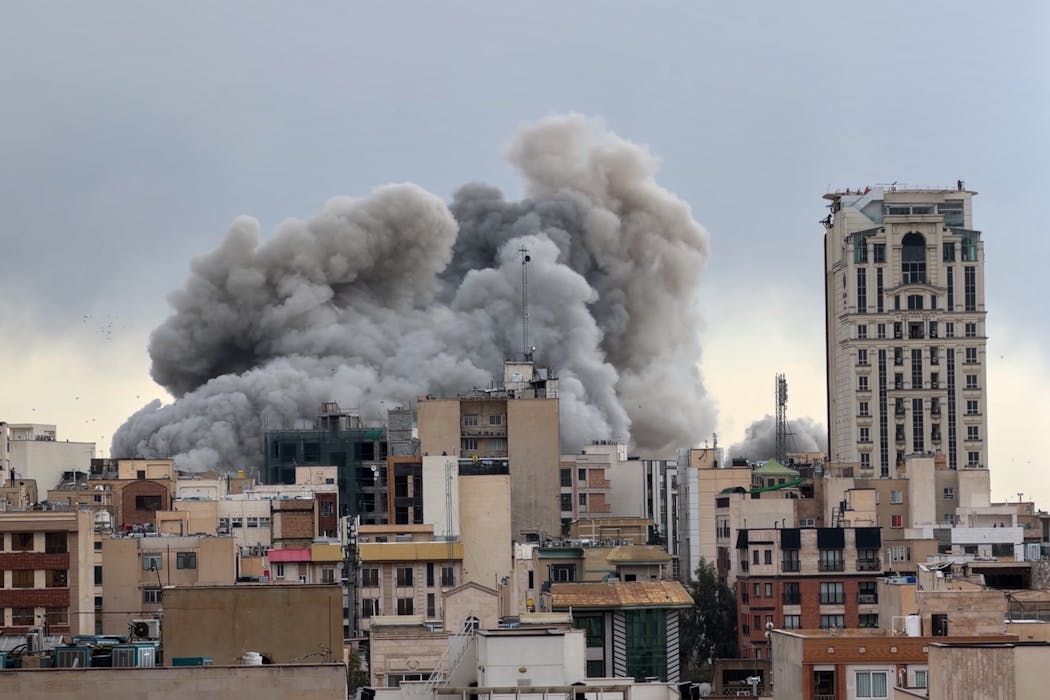
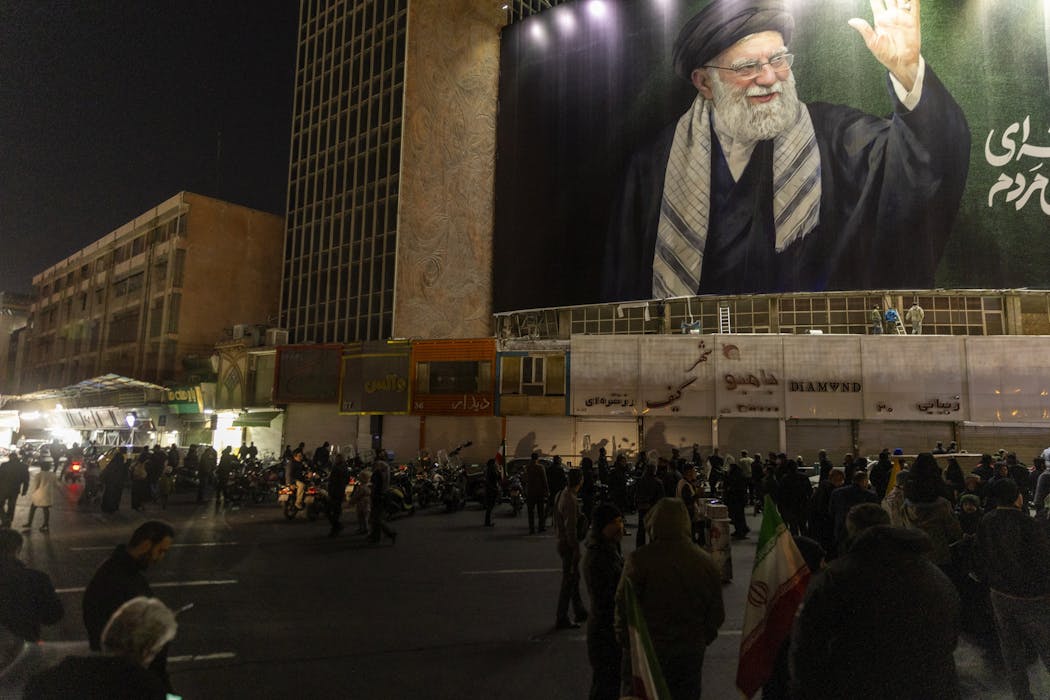
Iran’s targeting of airport, ports and hotels in reaction to US strikes has forced Gulf nations onto front lines of a war they want no part in

Source: The Conversation – Global Perspectives – By Kristian Coates Ulrichsen, Fellow for the Middle East at the Baker Institute, Rice University
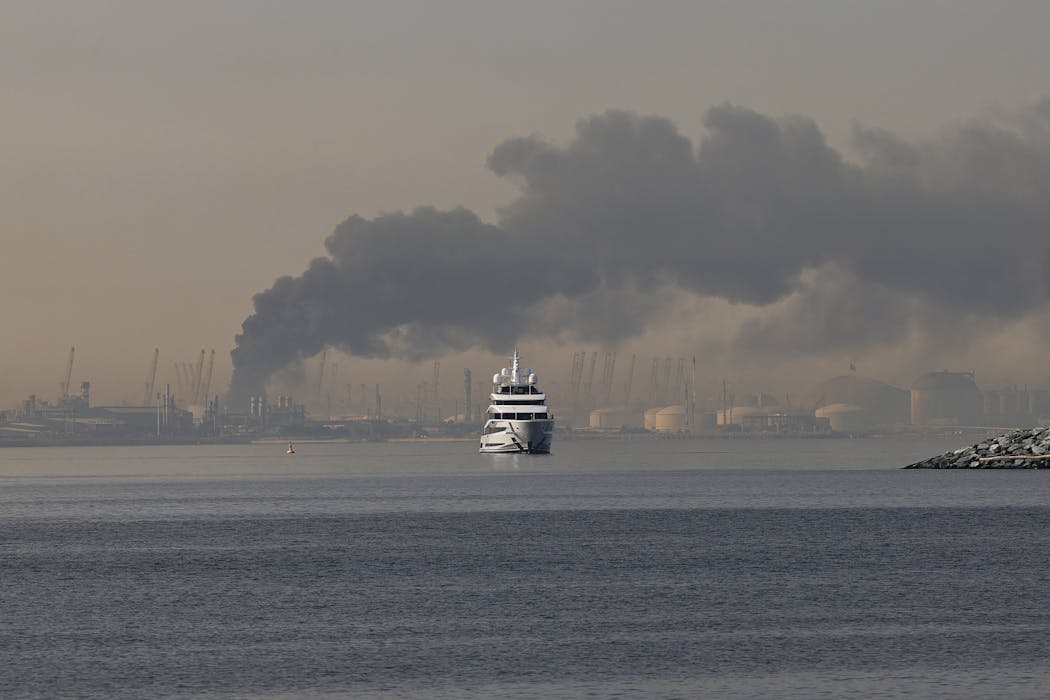
A yacht sails past a plume of smoke rising from the port of Jebel Ali following a reported Iranian strike in Dubai on March 1, 2026. Fadel Senna/AFP via Getty Images

Washington’s allies in the Persian Gulf have found themselves in a position they have long sought to avoid: on the front line and bearing the brunt of a widening Middle East conflict.

Having been dragged into a war of choice by the U.S. – one which many around the world are calling a war of aggression – all six Gulf Cooperation Council nations have been struck by Iranian retaliatory attacks in response.

Military facilities in Bahrain, Kuwait, Oman, Qatar, Saudi Arabia and the United Arab Emirates have all been hit. But the missiles and drones from Iran have been aimed at civilian infrastructure, too, including airport, ports and hotels in the opening days of U.S. and Israeli operations against Iran.

In scale and scope, the barrage marks a major departure from Iran’s previous response to being attacked by U.S. and Israeli airstrikes. In contrast, during a 12-day war in June 2025, Tehran only attacked one base in Qatar, and even then forewarned authorities in Doha.

Instead, what is occurring in the region is a scenario that planners in Persian Gulf capitals have long warned about: a deliberate attempt by Tehran to widen conflict and hit nations it sees as allied to the West.

As an expert on Gulf dynamics, I see the unfurling events as undoing years of work to de-risk the region and placing in jeopardy the unique selling point and business models that have underpinned the Gulf states’ global rise.
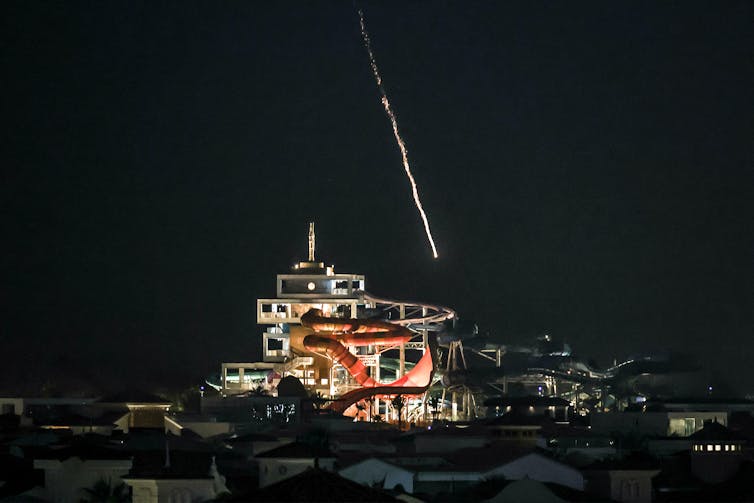
an entertainment building can be seen as a missile falls from the night sky, leaving a trail
An intercepted projectile falls into the sea near Dubai’s Palm Jumeirah archipelago on March 1, 2026.
Fadel Senna/AFP via Getty Images

A cornered regime fighting for survival

Ever since the Oct. 7, 2023, attacks by Hamas and other Palestinian militants on Israel, policymakers in the Gulf nations have sought to avoid the regionalization of conflict.

Qatar led the way in mediating between Israel and Hamas, while Oman has done the same with the U.S. and Iran. Meanwhile, Saudi Arabia has maintained regular dialogue with Iran to de-escalate regional tensions.

Each of the successive escalations between Israel and Iran – in April and October 2024 and then in June 2025, with the joint U.S.-Israeli strikes – brought the region closer to, without tipping over into, all-out war.

But Iran’s actions in the opening days following what Washington has named “Operation Epic Fury” have signaled that the comparative restraint it showed during the 12-day war is firmly off the table.

The Islamic Republic is now a cornered regime fighting for its survival. As such, it is lashing out and seeking to spread the pain to regional neighbors. The logic in this approach is that Gulf nations could put pressure on the U.S., which may fear the cascading costs of a prolonged regional conflict.

Gulf nations are also obvious targets for Iran. With Iran lacking the capability to hit the U.S. mainland through conventional weapons, the American military bases that dot the Gulf region are within the reach of Tehran’s ballistic arsenal.

Psychological impact on Gulf nations

The scale of the Iranian attacks on targets in the Gulf nations in the opening two days of the current conflict underscores the extent to which Iran’s response now differs from that of June 2025: In the first two days of the conflict, Iran had fired at least 390 ballistic missiles and 830 drones at the Gulf states. By comparison, the Iranian strike on the Al-Udeid air base in Qatar last year involved 14 ballistic missiles and was a one-off attack on a single target.

Air defense systems in Gulf nations have neutralized most of the incoming Iranian missiles, to date, and actual damage and casualties have been limited to a handful of deaths and injuries in the dozens.

But it is the intangible and psychological impact on Gulf cities under attack that threatens to inflict profound damage on the reputation and image of cities such as Dubai, Abu Dhabi and Doha. In recent years, Gulf Cooperation Council nations have presented the Gulf as an oasis of stability and havens to live and work.

This is especially the case for Dubai, which has marketed itself strongly as a hub for business and tourism. But it is also applicable to other Gulf nations as well, such as Qatar, which relies heavily on a steady stream of large-scale meetings and events.

Iran’s attacks on civilian infrastructure and soft targets – airports in Bahrain, Dubai, Abu Dhabi and Kuwait, and hotels in Bahrain and Dubai – serve to puncture this image of safe and secure Gulf capitals.

This choice of targets by Iran likely reflects a calculation that leaders in the Gulf countries would immediately feel the full impact of the war and push Washington hard to find a resolution and quick.

The subsequent targeting by Tehran on oil and gas facilities, including Ras Laffan in Qatar and Ras Tanura in Saudi Arabia, serves as a further and highly consequential step. It has already triggered a forceful response from Qatar, which shot down two Iranian jets on March 2.

There is concern among Gulf nations that the next step in the ladder of escalation could involve targeting the desalination plants that are so vital to overcoming water scarcity in the region.

Vulnerable to escalation

As critical hubs in the global economy by virtue of their reserves of oil and gas and centrality to international shipping and aviation, the Gulf nations are uniquely vulnerable to further escalation by Iran.

Dubai, Abu Dhabi and Doha have invested heavily in creating airlines that function as “super-connectors” capable of linking any two destinations worldwide with a stop in the Gulf. A Feb. 28 drone strike on Dubai International Airport, the world’s busiest for international travel, illustrated the impact that Iran’s asymmetric responses could have on the global hub model that has come to dominate world air travel.

Already, closure of airspaces over Qatar and the UAE, as well as in Bahrain and Kuwait, has stranded tens of thousands of passengers and created the biggest disruption to global travel since the COVID-19 pandemic.

In addition, cargo operations essential to local supply chains have been heavily impacted, at the same time that seaborne trade through the Strait of Hormuz has been similarly interrupted.

Whereas initial spikes in oil prices and insurance premiums at the start of the 12-day war last year fell away as it became clear that energy infrastructure was not significantly targeted, the opposite has happened this time.

Peril and uncertainty

But the short-term shock to the global economy is not what will be of primary concern to the Gulf Cooperation Council members. Not since the Gulf crisis of 1990-91, with the Iraqi invasion of Kuwait and subsequent Gulf War, has the region faced so much peril and uncertainty.

And that is what Iran’s leaders are banking on. The attacks across the Gulf by Tehran are not, after all, without strategy. The intent is to expand the conflict, thereby significantly raising costs to the U.S. and its partners in the Gulf.

Tehran’s hope is that the economic impact will encourage Gulf leaders to press Trump for an endgame. But in attacking capitals across the region, Iran risks perhaps doing the opposite: rupturing any chance of bettering ties with rivals in the region and instead pushing them further back into Washington’s orbit after a period of drift.

The Conversation

Kristian Coates Ulrichsen does not work for, consult, own shares in or receive funding from any company or organization that would benefit from this article, and has disclosed no relevant affiliations beyond their academic appointment.

ref. Iran’s targeting of airport, ports and hotels in reaction to US strikes has forced Gulf nations onto front lines of a war they want no part in – https://theconversation.com/irans-targeting-of-airport-ports-and-hotels-in-reaction-to-us-strikes-has-forced-gulf-nations-onto-front-lines-of-a-war-they-want-no-part-in-277208

Booked to travel through the Middle East? Here’s why you shouldn’t cancel your flight

Source: The Conversation – Global Perspectives – By Natasha Heap, Lecturer in Aviation, University of Southern Queensland

Travellers are being advised not to cancel their tickets for flights through the Middle East and check with their airlines, as airspace remains closed indefinitely.

If travellers cancel a ticket, they may lose some of their consumer rights and ability to claim refunds.

The US and Israeli bombing of Iran and the closure of airspace and airports is affecting all global airlines that fly through the region. The closures will have a flow-on effect, leading to significant disruption to the global airline industry that may take weeks to clear.

Tens of thousands of travellers affected

The Middle East is home to three of the world’s largest airlines: Emirates and Etihad, both in the United Arab Emirates (UAE), and Qatar Airways, based in Qatar.

Over the past 20 years, the region has become the global hub of international aviation. It is not only the three airlines that call the region home that are affected by the current conflict.

Emirates has issued a notice to all passengers advising it has suspended all operations to and from Dubai until 3pm UAE time on March 2.

Passengers booked to travel on or before March 5 have two options: rebook on an alternative flight or request a refund. Etihad has issued similar advice. Qatar is referring travellers to its app.

Other carriers that fly through the region, such as Lufthansa have also issued notices to their passengers.

Virgin Australia and Qantas’ operations are not directly affected by the airspace closure. However, some passengers may be affected if travelling on partner airlines. It is essential for people due to travel to check with their airline.

Travel insurance for cancellations is unlikely to be helpful, because acts of war that disrupt travel are explicitly excluded from coverage.

It could take weeks to clear the backlog of travellers just from the past weekend. US President Donald Trump has said the operations could last for “4 weeks or less”.

Tens of thousands of travellers are stranded in the Middle East waiting for the airspace to reopen so they can continue their journey.

The General Civil Aviation Authority in the UAE announced the UAE government will bear the cost of accommodating all stranded passengers in their country. There are around 20,000 people stranded in the UAE, and many more in other countries across the region.

Plans in place to keep passengers safe

Airlines have been watching the rising tensions in the region very closely. They’re used to dealing with unexpected operational disruptions.

With the major shutdown of Middle Eastern airspace in June 2025 still fresh in people’s minds, the airlines were quick to factor that experience into their decisions this time around.

The current situation is a little different to June 2025. Following US and Israeli bombing of targets in Iran at the weekend, Iran responded with missiles and drones that hit both civilian and military targets in several countries across the region.

Dubai International Airport and Abu Dhabi’s Zayed International Airport were both hit by drone attacks or debris. Both of these airports are for civil use. They are not military assets.

This is not the first time airports in the region have come under attack. In January 2022, Houthi forces in Yemen launched a drone attack on Abu Dhabi’s airport. Three people were killed.

The airline hubs have few alternatives

Some airlines affected by the airspace closure will be able to adjust their schedules and routes to avoid the area to try and lessen the impact both to their passengers and their business profitability.

However, the carriers that call the Middle East home have built their networks and highly profitable businesses using the hub and spoke model. They bring passengers into the hub, which is a transfer point to then fly them onward to their destinations. With the airspace closed, these airlines cannot bring passengers in or fly them out.

It would be nearly impossible for the main carriers in the Middle East to temporarily move their base of operations to another country.

They are large organisations. Emirates currently has a fleet of 261 passenger aircraft in service. Simply finding a place to park all the aeroplanes would be a significant challenge.

Complex systems within systems

Running an airline is like putting together a complex jigsaw puzzle with constantly moving pieces.

Beyond the aircraft, airlines need large teams of pilots and cabin crew, as well as extensive catering, cleaning, refuelling and maintenance operations. These systems are highly integrated and location-specific. This makes it extremely difficult to relocate or replicate them in another country at short notice.

Currently, the Middle Eastern carriers have large numbers of aircraft, crew and passengers stranded at the far reaches of their networks. For all airlines, the safety and security of their passengers and crew is their priority.

When the airspace reopens, airlines will face significant challenges to work through the backlog of stranded passengers. Extra flights and adjustments to schedules will likely be needed.

It remains unclear how long the airspace will be closed. But the airlines will already be working on plans to restore full operations quickly and safely when the time comes.

Will this latest airspace closure reduce demand for travel through the Middle East? It may in the short term. However, people will continue to travel. The Middle Eastern airline hubs are geographically located for global connectivity. The hope is the current military action and regional instability will be short-lived.

The Conversation

Natasha Heap does not work for, consult, own shares in or receive funding from any company or organisation that would benefit from this article, and has disclosed no relevant affiliations beyond their academic appointment.

ref. Booked to travel through the Middle East? Here’s why you shouldn’t cancel your flight – https://theconversation.com/booked-to-travel-through-the-middle-east-heres-why-you-shouldnt-cancel-your-flight-277191

Does international law still matter? The strike on the girls’ school in Iran shows why we need it

Source: The Conversation – Global Perspectives – By Shannon Bosch, Associate Professor (Law), Edith Cowan University

As the US and Israel began their joint assault on Iran, reports emerged from Iran that a strike hit the Shajarah Tayyebeh girls’ elementary school in the southern city of Minab.

The school was reportedly packed with young pupils at the time. Iranian authorities say more than 150 people were killed, including children, and 60 more injured (these figures are yet to be independently verified).

Videos verified by international media show rescue workers digging through collapsed concrete, school bags being pulled from the debris, and scorch marks along the remaining walls.


Warning: this gallery contains graphic images.


The New York Times says it has verified videos that show the school next to a naval base belonging to the Iranian Revolutionary Guards Corps, or IRGC, and a strike hitting that base.

Iranian representatives at the United Nations have characterised the strike as a deliberate targeting of civilian infrastructure and labelled it a war crime and a crime against humanity.

Neither the United States nor Israel have publicly confirmed hitting the school. The US military’s Central Command (Centcom) said:

We are aware of reports concerning civilian harm resulting from ongoing military operations. We take these reports seriously and are looking into them. The protection of civilians is of utmost importance, and we will continue to take all precautions available to minimize the risk of unintended harm.

At present, we do not have enough verified facts to reach a firm legal conclusion about what happened.

But given the questions about the legality of the US and Israeli strikes on Iran – and deeper questions about whether we’re witnessing the “death of international law” more broadly – incidents like this illustrate the continuing importance of the law, especially in times of conflict.

Which targets are protected under the law?

In armed conflict, international humanitarian law applies. International humanitarian law is built on foundational principles that must inform all decisions by armed forces concerning what they target:

  • distinction

  • proportionality

  • military necessity

And precautions must be taken to avoid incidental harm to civilians.

So what do these terms mean?

The principle of distinction requires parties to an armed conflict to always distinguish between civilian objects and military objects.

Attacks may only be directed against combatants and military objects. Civilians and civilian objects, such as schools, hospitals and public transport, are protected and may not be directly targeted.

If there is any doubt about whether a target is military or civilian in nature, it must be presumed to be civilian.

Schools are not merely buildings. They are protective spaces, and their destruction can cause immediate loss of life and long-term societal damage.

Children under 18 also enjoy special protection under international humanitarian law. They, too, may not be directly targeted.

This protection is not absolute, however. Any civilian object (including schools) can lose their protected status if they become military objectives. A school used as a military base, artillery position or command post could meet that definition.

So far, we have no evidence the school in Minab was being used for military purposes or that it was intentionally targeted.

Proportionality and precautions in attacks

What, then, if the school was not intentionally targeted, but was incidental collateral damage from an attack directed at the IRGC barracks nearby?

International humanitarian law recognises civilian objects may be affected by attacks on military objectives.

Incidental harm to civilians and civilian objects is only lawful if it satisfies the test of proportionality and military necessity under the law. All feasible precautions must also have been taken to minimise harm to civilians.

So, if a school near a military target is hit, the legality of that strike turns on whether the expected harm to children and the school was excessive compared to the military advantage gained by striking the target.

Also important: did the military commanders take all feasible precautions to assess the effect of the attack on nearby civilians or civilian infrastructure? This includes the specific weapons that are used and the timing of the attack.

Why international law matters

In recent years, we have witnessed a number of countries and their leaders openly flouting international law and the rules-based order. Yet, it would be a profound mistake to conclude that international law has ceased to matter. Even grave breaches do not negate the system itself.

As renowned American international law scholar Louis Henkin famously wrote in 1979:

Almost all nations observe almost all principles of international law and almost all of their obligations almost all of the time.

Henkin’s point was not naïve optimism. Daily compliance of international law remains the norm in diplomacy, trade, aviation, maritime navigation, treaty compliance and peaceful dispute settlement.

Violations do occur – sometimes brazenly – but they are exceptions to an overwhelmingly compliant pattern of behaviour.

The fact that some states breach foundational rules such as the prohibition on the use of force in Article 2(4) of the United Nations Charter does not render international law illusory.

Rather, it underscores the importance of naming breaches for what they are and defending the legal order that most states, most of the time, continue to respect.

If the strike on the Minab school is ultimately shown to have violated the principles of distinction, proportionality and military necessity, it would not prove Henkin wrong; it would prove his point.

International law matters precisely because departures from it can be identified, judged and condemned.

The rubble of a girls’ school is not evidence that the law is meaningless; it is a stark reminder of why the law exists, and why insisting on compliance remains essential.

The Conversation

Shannon Bosch does not work for, consult, own shares in or receive funding from any company or organisation that would benefit from this article, and has disclosed no relevant affiliations beyond their academic appointment.

ref. Does international law still matter? The strike on the girls’ school in Iran shows why we need it – https://theconversation.com/does-international-law-still-matter-the-strike-on-the-girls-school-in-iran-shows-why-we-need-it-277196

The strikes on Iran show why quitting oil is more important than ever

Source: The Conversation – Global Perspectives – By Hussein Dia, Professor of Transport Technology and Sustainability, Swinburne University of Technology

Anton Petrus/Getty

As Israel and the United States strike Iran, global oil markets are on edge.

Oil prices have begun rising even before any disruption to supply. Oil traders are factoring in the possibility the Strait of Hormuz might close.

Roughly 20% of the world’s traded oil passes through this narrow waterway between Iran to the north and Oman and the United Arab Emirates to the south. One oil tanker has been bombed and traffic has all but halted. In global energy markets, the mere threat of interruption can push prices higher.

Oil isn’t like most commodities. Control of the energy-dense fuel shapes geopolitics. Three-quarters of the world’s population live in countries dependent on oil imports for cars, trucks and other uses. Controlling the flow of oil and, increasingly, gas, has long been used as leverage, from the oil shocks of the 1970s to Russia cutting European gas supplies in 2022.

Any serious disruption to tanker traffic in the Gulf would send shockwaves through global oil markets and threaten economic stability. Long queues have already been reported in Australia as motorists vie to fill up before possible price spikes.

As international tensions increase, nations from Cuba to Ukraine to Ethiopia are accelerating plans to reduce their oil dependence and boost energy security.

Half a century of oil leverage

The power of oil became obvious during the 1973 oil embargo, when major Middle East oil producers slashed supply in a bid to reshape US foreign policy. Prices quadrupled, economies stalled and energy security became a central political issue almost overnight. The Organization of the Petroleum Exporting Countries have since coordinated supply to drive up prices.

Today, the mechanisms of control look different but the power created by oil dependence remains.

Even before US military action, sanctions on major producers such as Iran and Venezuela have cut supply and reshaped trade flows.

Current tensions near chokepoints such as the Strait of Hormuz introduce risk premiums into prices.

Oil markets are forward-looking, meaning prices reflect not only current supply and demand but expectations of what might happen next.

The strikes on Iran have seen prices of Brent crude – the global benchmark – trading around US$76 (A$107) per barrel, up from roughly US$68 (A$96) a few weeks earlier. Because prices are global, political instability anywhere can have economic consequences everywhere.

Who’s reducing dependence on oil?

In 2015, India blocked Nepal’s oil imports, triggering chaos. In response, authorities encouraged the very rapid growth of electric vehicles. Oil imports have begun to fall.

More recently, the Russia–Ukraine war and US strikes on Venezuela and Iran have brought new focus on reducing oil imports and bolstering domestic energy security.

In oil-dependent Cuba, US pressure has slashed the supply of oil. Blackouts are common and cars stay put. In response, authorities and businesses are importing 34 times as many Chinese solar panels as they did a year ago.

It’s not ideology driving this shift – it’s necessity. Electric vehicle imports, too, are soaring. “Cuba may experience the fastest energy transition in the world,” a Cuban economist told The Economist.

Why renewables change the equation

Unlike oil, solar panels and wind turbines can avoid being shipped through maritime chokepoints such as the Strait of Hormuz. Renewables are not traded in the same globally centralised way. Power is generated locally and increasingly across many smaller sites.

Russia has long targeted Ukraine’s energy infrastructure and power plants during the war. In response, Ukraine is ramping up renewables as fast as possible, as decentralised power generation is much harder to destroy. As a Ukrainian energy expert told Yale360, a single missile “could take out” a coal power station, while a wind farm would require 40 missiles.

Decentralised power is more resilient, meaning damage to one farm won’t collapse the grid.

Resilience through electric transport

Electrification of transport is a key plank of these new approaches to energy security.

Electric vehicles powered by locally-produced electricity reduce exposure to global oil markets. This thinking is visible in Ethiopia’s decision to ban new internal combustion cars.

China imports most of its oil – much of it from Iran. Beijing has been accelerating its rapid shift to electric vehicles. Last year, EVs made up 50% of new cars in China and 12% of the total fleet. China is increasingly using oil to make plastics, not for transport. Last year’s uptick in imports was due to stockpiling of huge volumes amid global uncertainty.

Australia’s exposure

Australia imports the vast majority of its refined fuels. We would have about a month’s worth of petrol before we ran out.

If wars drive up oil prices, pain at the petrol pump will flow through to freight costs, food prices and inflation.

While the EV shift is accelerating, Australia is slow by global standards. Even as electricity rapidly goes green, transport remains overwhelmingly dependent on foreign oil. That leaves Australia exposed.

Energy policy is security policy

Renewables do not eliminate geopolitical risk. Power grids face cyber threats. Critical mineral supply chains introduce new dependencies – and much of today’s solar panel, battery and EV manufacturing is concentrated in China.

But there is a clear structural difference. Decentralised systems are harder to manipulate through supply chokepoints. Solar panels, once installed, generate energy locally. The vulnerability shifts from ongoing fuel imports to upfront manufacturing dependence.

Oil has shaped global politics for decades because it’s transportable, globally traded and only a few countries have large reserves.

Reducing oil dependence is often framed as climate policy. But it is also vital to energy security and national security. Cutting oil use boosts resilience to shocks and reduces the leverage of other nations.

The Iran crisis may not lead to sustained price spikes. Supply may adjust. Markets may stabilise. But leaders will be rethinking the wisdom of exposure to globally traded oil in a volatile world.

The Conversation

Hussein Dia receives funding from the Australian Research Council, the iMOVE Australia Cooperative Research Centre, Transport for New South Wales, Queensland Department of Transport and Main Roads, Victorian Department of Transport and Planning, and Department of Infrastructure, Transport, Regional Development, Communications, Sport and the Arts.

ref. The strikes on Iran show why quitting oil is more important than ever – https://theconversation.com/the-strikes-on-iran-show-why-quitting-oil-is-more-important-than-ever-277192

What treating Kashechewan evacuees reveals about Canada’s drinking water crisis: Policy failure is an Indigenous health issue

Source: The Conversation – Canada – By Jamaica Cass, Director, Queen’s-Weeneebayko Health Education Partnership, Queen’s University, Ontario

When 200 people evacuated from Kashechewan First Nation arrived in Kingston, Ont. on a Sunday afternoon in January 2026 — many Elders, children and medically complex family members — the urgency was immediately clear. By the next afternoon, my colleagues from the Indigenous Interprofessional Primary Care Team and I had brought our mobile clinic to the evacuees’ hotel and were seeing patients who had been abruptly displaced by yet another failure of their community’s drinking water system.

At the same time, Kingston’s Indigenous friendship centre was organizing volunteers to lead cultural programming and create supports to help families maintain connection and dignity during displacement.

This matters because Kashechewan is not an exception. Research across Canada shows that unsafe drinking water continues to drive preventable illness, mental distress and evacuations in First Nations communities.

These events are often described as isolated emergencies or technical breakdowns. But decades of public health, engineering and Indigenous-led scholarship demonstrate that they are the predictable outcome of how water systems for First Nations have been governed, funded and maintained.

I am an Indigenous primary care physician who works with Indigenous communities, including those affected by long-standing water insecurity. What I see in Kingston closely reflects patterns documented in Canadian research.

A widespread problem in a water-rich country

Canada has one of the largest supplies of fresh water in the world, yet many First Nations communities have lived under “boil-water” or “do-not-consume” advisories for years — some for more than a decade. National analyses and community-based studies show that Indigenous households are far more likely than non-Indigenous households to lack reliable running water, particularly in remote or northern communities.

In many of these settings, water is delivered by truck and stored in household cisterns, drums or buckets. Studies led by Canadian researchers, including work in Manitoba First Nations, have shown that these systems are difficult to disinfect consistently and are far more vulnerable to bacterial contamination than piped, continuously supplied systems.

In plain terms, the way water is delivered and stored in many homes increases the risk that it becomes unsafe before it’s ever used.

What unsafe water looks like in the clinic

The health impacts of water insecurity are well documented. Reviews of Canadian studies consistently identify gastrointestinal illness — such as diarrhea and vomiting — as the most frequently reported outcome in communities with unsafe drinking water. Skin infections are also common when regular bathing and hand-washing are limited.

Research from First Nations communities in Manitoba has found that people living in homes without indoor plumbing are significantly more likely to report illness overall. That same body of work shows strong associations between indoor water access and mental health: households with reliable in-home water and sanitation report lower rates of depression and stress-related symptoms.

Mental health effects are increasingly recognized in the literature. Researchers describe “water anxiety” — the chronic stress of worrying about whether water is safe to drink, cook with or bathe in.

Qualitative and survey-based studies show this burden falls disproportionately on women, who are more likely to manage household water and caregiving responsibilities. Carrying water, hauling heavy bottles and cleaning storage containers have also been linked to back and shoulder injuries.

Among the evacuees I see in Kingston, these physical and mental health burdens are compounded by displacement itself: being far from home, separated from land and trying to manage chronic illness, educate their children and maintain professional responsibilities in crowded conditions in an unfamiliar environment.

Why these failures persist

If unsafe drinking water in First Nations communities has been so thoroughly studied, why does it continue?

One reason, consistently identified in Canadian policy and academic literature, is that water problems are framed primarily as technical failures rather than as governance failures. Responsibility for drinking water on reserves is fragmented across federal departments, leading to regulatory gaps, unclear accountability and slow responses.

Infrastructure design is another factor. Studies show that water systems in First Nations are often modelled on urban technologies that are poorly suited to remote or low-capacity settings. Even when new systems are built, chronic underfunding of operations, maintenance and operator training leaves communities vulnerable to repeated breakdowns.

Housing plays a critical role as well. Research clearly demonstrates that the absence of indoor plumbing — not just treatment plant performance — is strongly associated with illness. Yet housing and water infrastructure are frequently planned and funded separately, despite their intertwined health impacts.

Evacuation as a recurring health risk

When water systems fail, evacuation becomes the default response. For remote communities, this can involve flying hundreds of people to southern cities on short notice.

Canadian studies show that these disruptions affect schooling, employment, access to cultural practices, and family cohesion.

From a health perspective, evacuation trades one risk for another. While it may reduce immediate exposure to contaminated water, it introduces stress, disrupts continuity of care and worsens mental health outcomes, particularly for Elders, children and people with chronic disease.

What the evidence points to

Across disciplines, Canadian research converges on several findings. Long-term water safety improves when First Nations have meaningful authority over water governance and source-water protection.

Infrastructure is more reliable when systems are designed for local conditions and paired with stable funding for maintenance, training and housing upgrades, not just construction.

Importantly, Indigenous-led approaches that integrate community knowledge with engineering and public-health expertise have been shown to strengthen environmental protection and improve trust in water systems.

Back to that hotel clinic

The patients I see in Kingston are living with the downstream effects of problems that Canadian researchers and Indigenous leaders have been documenting for decades. Their illnesses were not random. They were shaped by unsafe distribution systems, chronic under-investment and governance structures that leave communities reacting to crises rather than preventing them.

Canada’s drinking water crisis reflects systemic design and governance failures, not a lack of fresh water. In a country with the capacity to ensure safe water for all, persistent water insecurity in Indigenous communities represents a preventable policy failure.

The evidence is clear: Chronic water insecurity is a manufactured driver of illness and displacement. Treating its consequences in a makeshift hotel clinic should not be routine. Ensuring safe, reliable, Indigenous-governed water should be.

The Conversation

Jamaica Cass works for Queen’s University. She receives funding from the National Circle on Indigenous Medical Education, the CPFC and the CMA. She is a board member of the Indigenous Physicians’ Association of Canada and the Medical Council of Canada.

ref. What treating Kashechewan evacuees reveals about Canada’s drinking water crisis: Policy failure is an Indigenous health issue – https://theconversation.com/what-treating-kashechewan-evacuees-reveals-about-canadas-drinking-water-crisis-policy-failure-is-an-indigenous-health-issue-274402

‘Destruction is not the same as political success’: US bombing of Iran shows little evidence of endgame strategy

Source: The Conversation – USA – By Farah N. Jan, Senior Lecturer in International Relations, University of Pennsylvania

A plume of smoke rises after a strike in Tehran on March 2, 2026. AP Photo/Mohsen Ganji

Shortly after the opening salvo of U.S.-Israeli attacks on Iran on Feb. 28, 2026 – with missiles targeting cities across the country, some of which killed Supreme Leader Ayatollah Ali Khamenei – President Donald Trump declared the objective was to destroy Iran’s military capabilities and give rise to a change in government.

Framing the operation as a war of liberation, Trump called on Iranians to “take over your government.”

In the first days alone, Israel dropped over 2,000 bombs on Iranian targets, equal to half the tonnage of the 12-day Israel-Iran conflict in June 2025. Heavy U.S. bombing, meanwhile, has targeted Iran’s Revolutionary Guard as well as ballistic missile and aerial defense sites.

The destruction is real. But, as an international relations scholar, I know that destruction is not the same as political success. And the historical record of U.S. bombing campaigns aimed at regime change shows that the gap between the two – the point at which Afghanistan, Iraq and Libya campaigns all stalled – is where wars go to die.

Destruction is not strategy

Decades of scholarship dating back to World War I on using air power to force political change has established a consistent finding: Bombing can degrade military capacity and destroy infrastructure, but it does not produce governments more cooperative with the attacker.

Political outcomes require political processes – negotiation, institution-building, legitimate transitions of power.

Bombs cannot create any of these. Instead, what they reliably create is destruction, and destruction generates its own dynamics: rallying among the population, power vacuums, radicalization and cycles of retaliation.

The American record confirms this. In 2003, the George W. Bush administration launched “Shock and Awe” in Iraq with the explicit aim of regime change. The military objective was achieved in weeks. The political objective was never achieved at all.

The U.S. decision to disband the Iraqi army created a vacuum filled not by democratic reformers but by sectarian militias and eventually ISIS. The regime that eventually emerged was not friendly to American interests. It was deeply influenced by Iran.

In 2011, the Obama administration led a NATO air campaign in Libya that quickly expanded from civilian protection into regime change. Dictator Moammar Gadhafi was overthrown and killed.

But there was no plan for political transition. Chaos and political instability have endured since. Asked what his “worst mistake” was as president, Barack Obama said, “Probably failing to plan for the day after, what I think was the right thing to do, in intervening in Libya.” Libya remains a failed state today.

The intervention also sent a powerful signal to countries pursuing nuclear weapons: Gaddhafi had dismantled his nuclear program in 2003. Eight years later, NATO destroyed his regime.

Even Kosovo, often cited as the success story of coercive air power, undermines the case. Seventy-eight days of NATO bombing did not, by themselves, compel Slobodan Milosevic, president of the Federal Republic of Yugoslavia, to withdraw.

What changed was the credible threat of a ground invasion combined with Russia’s withdrawal of diplomatic support. The political outcome – contested statehood, ongoing ethnic tensions – is hardly the stable governance that air power advocates promise.

The pattern is consistent: The United States repeatedly confuses its unmatched capacity to destroy from the air with the ability to dictate political outcomes.

Why this war?

The recent U.S. attacks on Iran raise a fundamental question: Why is the United States fighting this war at all?

The administration has declared regime change as its objective, justifying the campaign on the grounds of Iran’s nuclear program and missile capabilities.

But that nuclear program was being actively negotiated in Geneva days before the strikes. And Iran’s foreign minister told NBC the two sides were close to a deal. Then the bombs fell.

Iran did not attack America. And it currently does not have the capability to threaten the American homeland. What Iran challenges is Israel’s regional military dominance, and I believe it is Israel’s objective of neutralizing a rival that is driving this operation.

Israel targeted 30 senior Iranian leaders in the opening strikes. Israeli officials described it as a preemptive attack to “remove threats to the State of Israel.” I see the strategic logic for these killings as Israel’s, and Americans are absorbing the costs.

U.S. military bases in Bahrain, Qatar, Kuwait, the UAE, Jordan, and Saudi Arabia have taken Iranian missile fire. American service members are in harm’s way – three have already been killed – not because Iran attacked them, but I believe because their president committed them to someone else’s war without a clear endgame.

Smoke rises from buildings.
Smoke rises from a reported Iranian strike in the area where the U.S. Embassy is located in Kuwait City on March 2, 2026.
AFP via Getty Images

Each coercive step in this conflict – from the 2018 withdrawal from the nuclear deal, to the 2020 assassination of Qasem Soleimani, Iran’s most powerful military commander, to the June 2025 strikes – was framed as restoring leverage.

Each produced the opposite, eliminating diplomatic off-ramps, accelerating the very threats it aimed to contain.

The regime is not one man

Decapitation strikes assume that removing a leader removes the obstacle to political change. But Iran’s political system is institutional — the Guardian Council, the Assembly of Experts and the Revolutionary Guard have survived for four decades.

The system has succession mechanisms, but they were designed for orderly transitions, not for active bombardment. The group most likely to fill the vacuum is the Revolutionary Guard, whose institutional interest lies in escalation, not accommodation.

There is a deeper irony. The largest protests since 1979 swept Iran just weeks ago. A genuine domestic opposition was growing. The strikes have almost certainly destroyed that movement’s prospects.

Decades of research on rally-around-the-flag effects – the tendency of populations to unite behind their government when attacked by a foreign power – confirms that external attacks fuse regime and nation, even when citizens despise their leaders.

Iranians who were chanting “death to the dictator” are now watching foreign bombs fall on their cities during Ramadan, hearing reports of over 100 children killed in a strike on a girls school in Minab.

Trump’s call for Iranians to “seize control of your destiny” echoes a familiar pattern. In 1953, the CIA overthrew Iran’s democratically elected prime minister in the name of freedom.

That produced the Shah, the Shah’s brutal reign led to the Iranian Revolution in 1979, and the revolution produced the Islamic Republic now being bombed.

What comes next? And what guarantee is there that whatever emerges will be any friendlier to Israel or the United States?

What does success look like?

This is the question no one in Washington has answered. If the objective is regime change, who governs 92 million people after?

If the objective is stability, why are American bases across the Middle East absorbing missile fire?

There is no American theory of political endgame in Iran — only a theory of destruction. That theory has been tested in Afghanistan, Iraq and Libya – and Iran itself over the preceding eight months. It has failed every time, not because of poor execution, but because the premise is flawed.

Air power can raze a government’s infrastructure. It cannot build the political order that must replace it. Iran, with its sophisticated military, near-nuclear capability, proxy networks spanning the region and a regime now martyred by foreign attack, will likely not be the exception.

U.S. law prohibits the assassination of foreign leaders, and instead Israel killed Iran’s supreme leader while American warplanes filled the skies overhead. Washington has called the result freedom at hand, but it has not answered the only question that matters: What comes next?

The Conversation

Farah N. Jan does not work for, consult, own shares in or receive funding from any company or organization that would benefit from this article, and has disclosed no relevant affiliations beyond their academic appointment.

ref. ‘Destruction is not the same as political success’: US bombing of Iran shows little evidence of endgame strategy – https://theconversation.com/destruction-is-not-the-same-as-political-success-us-bombing-of-iran-shows-little-evidence-of-endgame-strategy-277201

As Canada’s Mark Carney heads to Australia, how did he become the darling of the global anti-Trump movement?

Source: The Conversation – Canada – By Stewart Prest, Lecturer, Political Science, University of British Columbia

Canadian Prime Minister Mark Carney is having a moment.

While every leader in the world has to grapple with the abrupt and arbitrary decision-making of United States President Donald Trump, few have had to do so with such high stakes as America’s neighbour and ostensible ally to the north.

With more than two-thirds of Canadian exports bound for the US, bilateral trade is a matter of economic life and death for Canada. Since his return to office in January 2025, Trump has made repeated references to Canada becoming America’s “51st state” in an effort to put economic and political pressure on its northern neighbour.

Despite this, Carney has met the challenge with rare candour.

In his recent speech at this year’s World Economic Forum in Switzerland, Carney gave the world a word for the transformations now underway, describing a “rupture” in the international rules-based order.

The speech was remarkable in its honesty on other fronts, as well. Effectively, Carney acknowledged what everyone knows, but no one in a position of power has previously admitted: even before Trump’s return to the White House for a second term, the US-led liberal international order was deeply unfair in its distribution of prosperity and security.

Carney’s pedigree

Why was Carney able to say what others would not, or could not, on such a high-profile stage?

In many ways, his background and present role give him unique credibility in the eyes of the wealthy and powerful who gather each year at Davos.

Born and raised in northern and western Canada, Carney’s academic and professional career played out on a larger stage. Following a PhD in economics at the University of Oxford in 1995, he pursued a career in finance and banking that took him to the heights of both the private and public financial world.

After more than a decade working at the American multinational investment bank Goldman Sachs, Carney entered Canadian public service, eventually becoming governor of the Bank of Canada in 2008 under Conservative Prime Minister Stephen Harper. He went on to become the first non-British head of the Bank of England, serving in that role from 2013-2020.

His governorships coincided with tumultuous times in both countries, spanning the sub-prime financial crisis, Brexit and the early days of the COVID pandemic. While not without criticism, Carney’s performance in both countries won significant acclaim, leading to other international leadership roles.

By early 2025, Carney threw his hat in the ring to replace Canada’s beleaguered Liberal Prime Minister Justin Trudeau, who was trailing badly in public opinion polls. Carney won that race convincingly, and shortly after led the revived Liberals to a narrow but definitive victory over the Conservatives in a federal election in April 2025.


Read more:
Game change Canadian election: Mark Carney leads Liberals to their fourth consecutive win


The party’s stunning come-from-behind victory was fuelled significantly by Trump’s 51st state talk and other forms of coercion.

Commanding respect

Carney has a remarkable CV by any measure. He has moved from the heights of academia to business, finance and finally, government. In politics, he’s been successful in both Liberal and Conservative political environments. That broad credibility ensured that when he spoke from the podium at Davos about a rupture in an already unequal global political system, his words would be taken seriously.

Carney’s role as prime minister of Canada has also played a role in making him the poster boy of a global anti-Trump movement. Since Trump’s return to office, Canada has been on the front lines of America’s movement away from long-held alliances towards a more mercurial, coercive and even predatory foreign policy.

Trump’s penchant for insulting Canadian leaders, threatening Canadian sovereignty and weakening the Canadian economy in the service of American interests makes Canada an important test case that other American partners can learn from.

Within Canada itself, Carney is popular, though his responses to Trump have not always been without criticism. Some have pointed to a recurring gap between rhetoric and action.

Carney’s swift move to endorse the recent US attacks on Iran fit this pattern, as well. Yet, such appeasement hasn’t been rewarded with reciprocity by the Trump administration.

Seeking partners

As Carney visits the Pacific Rim, including a stop Australia, there’s no question he’s put himself — and Canada — in the global spotlight for his handling of Trump.

His speech in Davos sketched out a vision of an alternate global order that Canada and other like-minded countries might collectively pursue as a defence against the chaotic and unstable world unleashed by Canada’s former friend and ally. However, that rhetoric is not yet reality.

Accordingly, on his visit to India, Japan and Australia, Carney is looking to find partners for that vision. He’s seeking opportunities to improve relations, expand trade and cooperate on issues of Pacific security.

The old world order is not coming back. What Carney achieves in his foray to the Pacific Rim may help determine what new order, if any, emerges in its place.

The Conversation

Stewart Prest does not work for, consult, own shares in or receive funding from any company or organisation that would benefit from this article, and has disclosed no relevant affiliations beyond their academic appointment.

ref. As Canada’s Mark Carney heads to Australia, how did he become the darling of the global anti-Trump movement? – https://theconversation.com/as-canadas-mark-carney-heads-to-australia-how-did-he-become-the-darling-of-the-global-anti-trump-movement-277039

Can the 2026 FIFA World Cup still be a force for global unity?

Source: The Conversation – Canada – By Paul R. Carr, Professeur/Professor (Université du Québec en Outaouais) & Titulaire/Chair, Chaire UNESCO en démocratie, citoyenneté mondiale et éducation transformatoire/ UNESCO Chair in Democracy, Global Citizenship and Transformative Education., Université du Québec en Outaouais (UQO)

The FIFA Men’s World Cup will unfold across North America from June 11 to July 19, co-hosted by Canada, Mexico and the United States. This year’s event will be the largest ever, with some 48 countries represented.

The FIFA 2026 World Cup was awarded in 2018 and preparations have been ongoing ever since. However, the U.S. has significantly altered course since the election of Donald Trump in January 2025.

The international community is facing an onslaught of actions, threats and rhetoric from the U.S. government, which has led to chaos, confusion, instability and massive political, economic and sociocultural vulnerability.

As a result, calls have emerged to boycott the tournament, including from former FIFA president Sepp Blatter.

It’s clearly late in the game to consider adjusting, transferring, suspending or altering this thoroughly planned international event. The implications for changing the status of the FIFA 2026 tournament are numerous and far-reaching.

Why consider a boycott now?

A series of recent American actions raises serious questions about its suitability to host the FIFA World Cup at this time.

These include destabilizing allies, imposing tariffs without clear justification, launching a military attacking on Iran with Israel, attacking Venezuela and capturing its president, threatening to annex Greenland and Canada, eliminating USAID and putting millions of people at risk of disease, illness, famine and death and overseeing the violence inflicted by U.S. Immigration and Customs Enforcement (ICE) agents that endangers citizens and residents.

In addition, the fair and equitable treatment of people seeking to visit the U.S. cannot be assured. People from many countries would effectively be barred from visiting the U.S. to attend the event because of current American policy.

There is a serious threat of people being detained, surveilled and persecuted. Racial profiling is a particular concern given how ICE has maneuvered in immigrant communities in the U.S.

Many are also concerned about violence within the U.S., which is disproportionately higher than in most western countries.

At the same time, the U.S. has withdrawn from numerous international organizations and agreements, the antithesis of co-operation on global issues, shutting down the potential for meaningful and necessary dialogue.

All these realities fly in the face of the spirit and solidarity of global sporting events like the World Cup that aim to cultivate peace and intercultural understanding.

FIFA’s record

Allegations of corruption and bribery within FIFA have persisted for years. They have been documented in a U.S. Department of Justice indictment and in FIFA’s own Garcia Report.

FIFA is sensitive to these complaints, and some reforms have been implemented to make the organization more transparent and credible, but many groups still argue the corruption is rampant.

Human rights have long been an issue at FIFA events. The 2022 FIFA World Cup in Qatar prompted concerns related to LGBTQ+ rights, with many players wearing the “One Love” armband in protest. It also raised concerns over the rights of workers and migrants, who were exploited and faced discrimination.

There are also environmental concerns related to the carbon footprint of such a large event. However, the counter-claim of the event fostering global solidarity is an equally strong justification for it.

FIFA is lathered in capitalist trappings, and there is a great deal of profit to be made for a small number of people. The 2026 World Cup is expected to bring in more than US$10 billion for the organization.

It is unclear how local taxpayers and citizens benefit economically from holding the World Cup, especially given that they underwrite many of the costs through their taxes.

Similarly, the marketing, television and dissemination rights present a lucrative landscape, yet that funding does little to fight poverty, hunger and unacceptable living conditions for many.

Do boycotts work?

There is some debate about the effectiveness of boycotting. The boycotts of the 1980 Summer Olympics in Moscow, following the invasion of Afghanistan, and of the 1984 Summer Olympics in Los Angeles, led by the Soviet bloc in retaliation, did not produce substantive political change.

Some questioned the enormity of eliminating the potential for intercultural and diplomatic interaction.

By contrast, the sporting boycott of apartheid-era South Africa from 1964 to 1992 did help contribute to significant change in the country.

The ongoing Boycott, Divestment, Sanctions movement against Israel — although not supported by the U.S. and many other countries — has had varying success, but the very fact that it exists and is supported by many is politically significant.

The costs of boycotting now

Altering or boycotting the tournament at this stage would inevitably punish national teams and athletes for political considerations beyond their reach. The FIFA event could generate goodwill, promote global understanding and bring people together, especially in relation to nations from the Global South that are often portrayed negatively.

Some argue a boycott would affect players and fans more than FIFA itself. The economic repercussions of a boycott would also be substantial. Yet the very notion of a boycott is that it does, and should, affect and influence attitudes, behaviours and actions.

Others have suggested alternative avenues for change, including through organized protests and social movement mobilization.

Other alternative proposals for enacting change include targeted boycotts against certain sponsors, institutions and sectors. Some activists may wish to target a policy, such as the assault on migrants in the U.S. or corruption within FIFA.

A force for the global public good?

Boycotts are complicated and have been more commonly related to the Olympic Games than the World Cup. However, citizens and activists alike seek opportunities to develop a more just and equitable world.

In 2021, there were also great concerns regarding human rights violations. Interestingly, while a Statista survey of 4,201 respondents across 120 countries found that most respondents believed their country should boycott the 2022 World cup in Qatar, very few soccer fans were willing to boycott it themselves.

But FIFA isn’t a political party; it’s a business and sports organization. Although considered favourable, it does not need the population to approve its decisions, and sponsors are at risk of being targeted and tarnished if public sentiment turns sharply against the event.

Will the FIFA World Cup provide the opportunity for the U.S. to address problems of racism, gender discrimination, the mantra to annex other countries, ICE overreach and denigration against migrants? Or will such issues be simply swept under the carpet?

The tournament could offer a platform to engage with the world through diplomacy grounded in sovereignty, human rights and mutual benefit. A tri-national hosting arrangement with Canada and Mexico may yet foster cross-border co-operation, even amid strained relations.

The current U.S. political climate does not provide an encouraging model to move the FIFA World Cup toward peace and solidarity currently, but the world is in desperate need for it to do so.

The Conversation

The authors do not work for, consult, own shares in or receive funding from any company or organisation that would benefit from this article, and have disclosed no relevant affiliations beyond their academic appointment.

ref. Can the 2026 FIFA World Cup still be a force for global unity? – https://theconversation.com/can-the-2026-fifa-world-cup-still-be-a-force-for-global-unity-276502

Amanda Seyfried nails bits of the 1700s Manchester accent in The Testament of Ann Lee – a linguist explains how we know

Source: The Conversation – UK – By Danielle Turton, Senior Lecturer in Sociolinguistics, Lancaster University

Imagine time-travelling to Manchester, England in the late 1700s. What do you think people would sound like?

That’s the challenge facing Amanda Seyfried in The Testament of Ann Lee: portraying a working-class Mancunian accent from three centuries ago.

When historical linguists reconstruct past speech, it is an interpretative process. It relies on written evidence, including spelling, poetic rhymes, criticisms in old pronouncing dictionaries about how people ought to speak, and dialect descriptions. From these fragments, we can piece together a historically informed reconstruction.

In the late 18th century, English certainly sounded different, but not unrecognisable. Manchester would have been variably rhotic at this time. This is the pronunciation of the strong “r” sound in words like “star” or “bird”. Rhoticity is a feature shared with present-day American English.

In terms of vowels, the northern pattern in which words like “good” and “blood” are exact rhymes was present then as it is today. Both of these features are present in Seyfried’s portrayal.

Another feature Seyfried exhibits, but which is no longer typical of 21st-century Manchester accents, is her lack of what linguists call diphthongs, or gliding vowels. You can hear this in words she says like “great” and “clothed” where she uses vowel sounds that viewers might recognise from traditionally Lancashire or Yorkshire speech. These sounds were entirely consistent with 18th-century Mancunian accents but not today’s.

Seyfried has said she based her accent on actor Maxine Peake’s – although Peake is from Bolton, and not Manchester proper, this is not a bad decision. Bolton has its own distinct accent, but smaller towns often retain older features for longer while urban centres tend to experience accent changes more quickly.

In that sense, Peake’s accent may reflect features that Manchester has since moved away from, making her a more suitable reference point than a present-day speaker from the city.

Historic accents on screen

Seyfried’s performance sits within a broadly plausible northern English frame. Viewers online are divided: some praise the accent, others find it distracting. The difficulty is that without recordings we cannot know exactly how a Manchester accent sounded in the 18th century. It is though, entirely possible that her pronunciation is closer to historical reality than modern ears expect.

To this end, dialect coaches on historical films face a dilemma: do they recreate the speech of the time as faithfully as possible and risk losing the audience, or use something more contemporary? How far back could we go and still understand English?

We would manage 18th-century English reasonably well. For instance, it’s easier to understand Robinson Crusoe in 1719 than the 1500s English in Shakespeare or even the late 1300s and early 1400s middle English in Chaucer’s Canterbury Tales. But recognisable does not mean identical, and reproducing it, accent and all, too strictly could alienate viewers.

Most historical films don’t try to recreate how people actually sounded in the past. In Hamnet, which is set in the 1580s, the characters speak in modern received pronunciation instead of the kind of English spoken in Shakespeare’s time.

Even in stories set closer to the 18th century, such as The Favourite, Olivia Coleman’s Queen Anne still sounds distinctly modern – arguably, even more so than her Queen Elizabeth II in The Crown. Actors playing Tudor courtiers, medieval knights and even Shakespeare himself are routinely given modern accents on screen. Audiences rarely question it – or even notice.

Sociolinguistic research has long shown that southern and “prestige” accents, like that of royalty or the upper classes, are often treated as neutral and timeless while regional varieties are more readily linked to place and class. It is perhaps not surprising, then, that when Manchester appears on screen – especially in a historical setting – audiences listen more closely.

Part of that scrutiny might stem from its rarity. Working-class accents are under-represented in major films, and are even less often heard in leading roles. When they do appear, they carry the weight of representation. That scrutiny is understandable. Accent carries belonging, and carelessness can feel dismissive.

Amanda Seyfried seems aware of this sensitivity, noting in interviews that she originally suggested Olivia Cooke, who is from Oldham in Greater Manchester, for the role of Ann Lee. That comment, I think, shows that she recognises something important: these accents signal place, history and belonging and they matter to people.

So how authentic is the accent in The Testament of Ann Lee? In the absence of recordings from that time, certainty is impossible. But perhaps the more interesting question is not whether Seyfried’s accent is perfect, but what it means to hear a northern voice carry a feature film. It shifts our assumptions about what the past sounded like, and about who we imagine at its centre.

The Conversation

Danielle Turton has received funding from The Leverhulme Trust.

ref. Amanda Seyfried nails bits of the 1700s Manchester accent in The Testament of Ann Lee – a linguist explains how we know – https://theconversation.com/amanda-seyfried-nails-bits-of-the-1700s-manchester-accent-in-the-testament-of-ann-lee-a-linguist-explains-how-we-know-276917

Ayatollah Ali Khamenei’s killing plays into Shiite Islam’s reverence for martyrs, but not for all Iranians

Source: The Conversation – USA (3) – By Eric Lob, Associate Professor of Politics and International Relations, Florida International University

A banner with the image of Ali Khamenei during a memorial vigil in Tehran, Iran. Majid Saeedi/Getty Images

The day Ayatollah Ali Khamenei was killed, the Iranian government called for 40 days of public mourning in line with Shiite tradition. It also praised the supreme leader for his martyrdom – a concept considered sacred and significant in the Islamic Republic and Shiite Islam.

While some Iranians came out to commemorate Khamenei, others celebrated his demise. The scenes reflected the contradictions in how Khamenei was perceived: by some as a martyr, and by others as an oppressor.

Women in headscarves hold portraits of Ayatollah Ali Khamenei.
Demonstrators mourn the death of Ayatollah Ali Khamenei outside the Israeli consulate in Istanbul, on March 1, 2026.
AP Photo/Khalil Hamra

The theology of martyrdom

The roots of Shiite reverence for martyrdom date back centuries. After the death of the Prophet Muhammad in 632, a dispute emerged over who would inherit the leadership of the Muslim community. On one side was the prophet’s senior companion and father-in-law, Abu Bakr. On the other was his cousin and son-in-law, Ali ibn Abi Talib, who became the first Shiite imam.

In 680, the Battle of Karbala took place in present-day Iraq between Hussain ibn Ali – the grandson of the Prophet Muhammad and the third Shiite imam – and Yazid ibn Mu’awiya. Yazid was the second Umayyad caliph, which means deputy of God, and the ruler of the early Islamic empire.

Before the battle, negotiations had failed between Hussain and Yazid’s governor. Hussain refused to swear allegiance to Yazid, believing him to be unjust and not the rightful successor. In a 10-day battle that followed, most of Hussain’s army, including some of his closest companions and relatives, was slain. Hussain’s followers, who believed him to be the third Imam – after his father Ali and older brother Hasan ibn Ali – came to be called Shiites. Since then, martyrdom has held a central place among Shiites. They comprise the smaller of the two main branches of Islam, with Sunni being the larger one.

Iran has become the epicenter of Shiite Islam, which is the official state religion. Ninety to 95% of the population identify accordingly.

Every year on the 10th of Muharram, the first month of the Islamic calendar and the same day as the Battle of Karbala, Shiite Muslims inside and outside of Iran observe Ashura and commemorate the slaying of Hussain by reenacting his death and performing self-flagellation, among other rituals.

Iranian political rhetoric

In Iran and other parts of the Muslim world, contemporary politics is often framed in this seventh-century language of moral resistance.

After the Islamic Republic of Iran was established under Ayatollah Ruhollah Khomeini in 1979, martyrdom appeared as a central theme. This was particularly the case during and after the Iran-Iraq War, which lasted eight years in the 1980s and was perceived and portrayed as a holy war.

During the war, the Islamic Republic suffered hundreds of thousands of casualties. After Khomeini reluctantly accepted a United Nations-brokered ceasefire, he compared the decision to drinking a “poisoned chalice.” In other words, he considered the compromise a crushing defeat that contradicted his goal of overthrowing Iraqi President Saddam Hussein, even if it enabled the Iranian regime to survive.

After the war, public space in Iran was increasingly filled with revolutionary and religious symbols related to wartime sacrifice and martyrdom. They included street signs named after prominent people who died in the war, murals and posters of the fallen, and media programs and publications dedicated to the conflict – symbols which were still prominent when I visited Iran between 2009-2011.

The Islamic Republic’s Foundation of Martyrs and Veterans Affairs – Bonyad-e Shahid va Omur-e Ithargaran – provided services for veterans and families of the fallen in the war and other conflicts. Like other foundations under the purview of Khamenei, who succeeded Khomeini after his death in 1989, it also participated in profit-seeking activities.

It is against this backdrop that Khamenei’s actions leading up to the American and Israeli strikes on Feb. 28 that cost him his life must be seen.

During the three rounds of U.S.-Iran negotiations in Oman and Geneva before the current conflict, Khamenei refused to capitulate to President Donald Trump’s demands. They comprised curbing not only Iran’s nuclear enrichment, but also its missile program and support for its regional proxies. Khamenei directed his negotiators not to yield ground, particularly on those last two points, seen as red lines in Tehran – even as Trump amassed the most military assets in the region since the U.S. invasion of Iraq in 2003.

Authoritarianism, protests, polarization

Demonstrators carry Iranian flags and chant slogans during a rally.
Iranian demonstrators living in Cyprus attend a protest outside the presidential palace in Nicosia on Feb. 14, 2026.
AP Photo/Petros Karadjias

For over three decades, Khamenei subjected Iranians to severe authoritarianism and repression, culminating in him ordering the security forces to shoot and kill thousands of Iranians during the protests in January 2026, not to mention those in previous years.

He deprived the families of deceased protesters from holding funerals for their loved ones. His regime also reportedly required them to pay for the ammunition that had been used to kill their relatives before receiving the body for burial.

And despite recurrent waves of protests – the January unrest followed similar waves in 2017-18, 2019-20 and 2022-23 – Khamenei refused to listen to the demands of demonstrators for political, economic and social change. The furthest he was willing to go was to make cosmetic concessions while ruthlessly repressing citizens.

He also refused to reform the system from within and placed the political elites who pushed him in that direction under house arrest or in prison.

During his almost 37-year rule, Khamenei accumulated massive power and wealth. As supreme leader, he commanded the armed forces, appointed the head of the judiciary, supervised the state media, and possessed a parallel body that vetted electoral candidates and vetoed parliamentary legislation.

Although Khamenei appeared austere in public, he held sizeable assets. Setad, a quasi-state organization under his direct control, was estimated to be worth US$95 billion as of 2013.

He continued support for regional proxies, such as Hamas and Hezbollah, while maintaining a confrontational rhetoric toward the U.S. and Israel. Since 2024, these actions led to Israeli and American intervention in Iran that brought death and destruction to the country, and ultimately the strikes that killed him. The strikes also killed some of his closest relatives, including his daughter, son-in-law, grandchild and daughter-in-law.

In the end, some Iranians will remember Khamenei as a martyr – someone who stood firmly by his principles and faced a more powerful enemy, even if it meant losing his life.

But others, now rejoicing in the streets, will remember him as an oppressor who put personal power and profit above the public interest.

The Conversation

Eric Lob is affiliated with the Carnegie Endowment for International Peace.

ref. Ayatollah Ali Khamenei’s killing plays into Shiite Islam’s reverence for martyrs, but not for all Iranians – https://theconversation.com/ayatollah-ali-khameneis-killing-plays-into-shiite-islams-reverence-for-martyrs-but-not-for-all-iranians-277207