Congress once fought to limit a president’s war powers − more than 50 years later, its successors are less willing to assert their authority

Source: The Conversation – USA – By Sarah Burns, Associate Professor of Political Science, Rochester Institute of Technology; Institute for Humane Studies
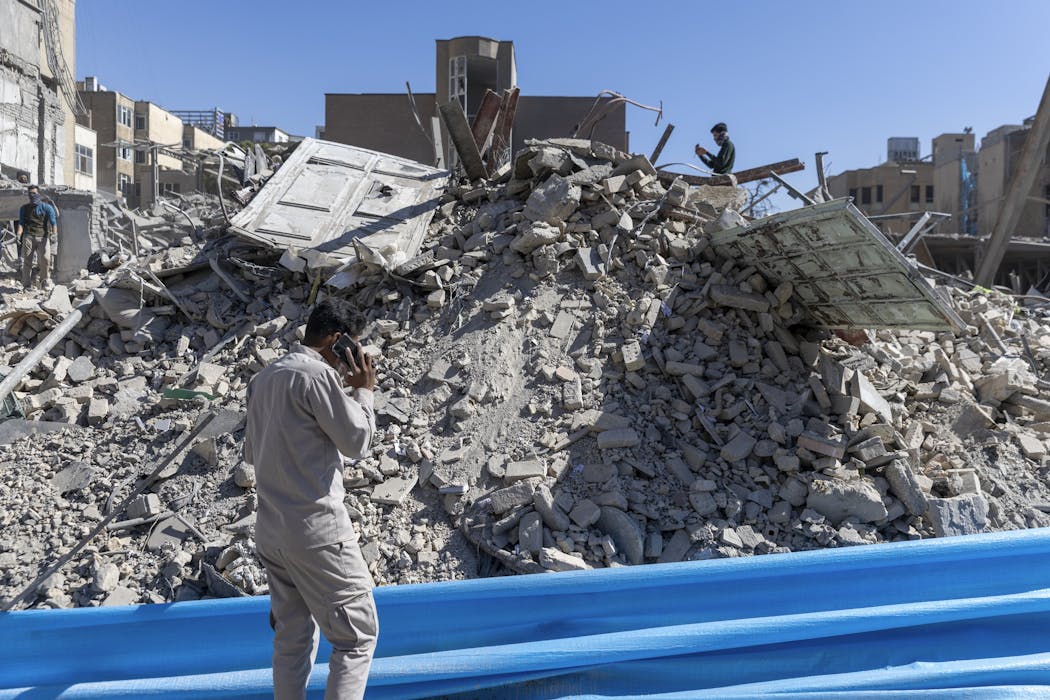
Rubble from a police station damaged in airstrikes on March 3, 2026 in Tehran, Iran. Majid Saeedi/Getty Images

Article 1 of the U.S. Constitution gives Congress the power to declare war, not the president. But most modern presidents and their legal counsel have asserted that Article 2 of the Constitution allows the president to use the military in certain situations without prior congressional approval – and have acted on that, sending troops into conflicts from Panama to Libya, with no regard for Congress’ will.

Congress has for the most part registered only feeble and ineffective opposition to such executive action. The current move in Congress to deny President Donald Trump the ability to continue the war with Iran – led by Democrats, but with some Republican support – will likely fail, as have previous efforts during other conflicts.

But there was a time when Americans saw Congress stand up to a president who unilaterally took the country to war.

It was at the tail end of the Vietnam War, when Congress passed the War Powers Resolution of 1973, asserting that it was legislators – not the president – who had the power to declare war.

Once it passed both houses, President Richard Nixon vetoed it, claiming it was unconstitutional.

In response, the legislative branch overturned the veto with the two-thirds majority vote needed to prevail.

Compared to Congress’ limp response to Trump’s actions in Iran, and its similar failure to assert itself during Trump’s military action in Venezuela, it was a breathtaking act of legislative assertion.

A section of text from a Congressional resolution about war powers.
The ‘purpose and policy’ section of the 1973 War Powers Resolution passed by Congress.
National Archives

Congress asserts itself

When they debated the War Powers Resolution, members of Congress were seeing the erosion of their control over the decision to engage in military operations large and small. With a strong bipartisan consensus, they determined they had to collectively use their powers, including the power of the purse, to thwart executive overreach.

Congress’ actions came in response to the growing protests against the Vietnam War in general and Nixon’s decision to expand the war by sending U.S. troops to invade the neutral country of Cambodia to disrupt the supply lines of the Viet Cong, the communist guerrilla force that accounted for a large number of the 58,000 Americans killed in the war.

Nixon had begun covert carpet bombing of Cambodia in 1969, and then announced in 1970 that he would send ground troops into the country the next year.

Congress – and the country– reacted extremely negatively. Members of Congress collaborated across party lines to draft legislation in an attempt to assert their power. It was a slow process, however, involving long periods of deliberation.

A setting sun behind a plume of black smoke rising in the sky.
The sun sets behind a plume of smoke rising after a U.S.-Israeli military strike in Tehran, Iran, on March 3, 2026.
AP Photo/Vahid Salemi

They used many different methods to attempt to constrain the president. Within months of the introduction of troops to Cambodia, Congress attempted to pass amendments that would restrict his ability to invade neighboring countries. Prompted by protesting and the illegal actions in Cambodia, Congress began crafting legislation that would draw down troops in Vietnam.

With these moves, lawmakers placed immense pressure on the president. This eventually led to the drafting and eventual signing of the peace agreement ending the Vietnam war in 1973.

This was not enough for Congress, however.

Rules – and flexibility

Congress wanted to create a document ensuring presidents could not unilaterally make war. They wanted legislative consultation.

They intended the War Powers Resolution to act as a permanent constraint. So, in the resolution they spelled out the specific actions in which presidents can start a conflict:

• First, if there is an invasion of the United States, the president can respond. In this instance, the president can act prior to congressional authorization.

• Second, if Congress provides an “Authorization for the Use of Military Force,” the president can assume he has authorization – but only as long as it is in effect.

• Finally, if Congress declares war, the president can act.

Lawmakers did, however, provide some flexibility. In the War Powers Resolution, they said a president can initiate and carry out hostilities for 60 days and has a further 30 days to draw down the troops. Once the executive has initiated hostilities, Congress must receive information about that action within 48 hours.

This opens the door for presidents to engage in smaller-scale or short operations without stepping outside the lines set in the law.

Presidents from both parties have availed themselves of this flexibility. As far back as 1975, when President Gerald Ford rescued the SS Mayaguez, the merchant ship captured by Cambodia’s Khmer Rouge, presidents have acknowledged the law and dutifully reported their military actions to Congress.

Like his predecessors, Trump sent a letter to Congress after his June 2025 missile attacks against Iran, as well as at the start of the currently open-ended conflict.

An older man in a blue coat and red hat with 'USA' written on it waves.
President Donald Trump after landing aboard Air Force One on March 1, 2026, at Joint Base Andrews, Maryland.
Roberto Schmidt/Getty Images

Presidents since the passage of the War Powers Resolution have not, however, acknowledged that they have to get congressional approval of their actions, with few exceptions. Predominantly, without congressional approval, they limit their actions to the 60-to-90-day window.

President Barack Obama, however, attempted to circumvent the window when his bombing campaign in Libya in 2011 dragged on, as well as when he bombed the Islamic State group in 2014. In the first instance, he claimed the War Powers Resolution did not apply. In the second, he claimed each bombing campaign was discrete, rather than part of a larger campaign.

Exploiting authorizations

The balance of power between the legislative and executive branches changed considerably with the passage of the 2001 Authorization for Use of Military Force related to the Sept. 11, 2001, terrorist attacks, and the 2002 Authorization for Use of Military Force that gave legislative permission for President George W. Bush to invade Iraq.

Because Congress did not put sunset dates into these authorizations, subsequent presidents Obama, Trump and Joe Biden used those same authorizations for a host of later military actions in the Middle East and elsewhere.

And legislators are deeply divided in the current discussions about demanding the cessation of hostilities against Iran.

Republican House Speaker Mike Johnson says that limiting the president at this time is “dangerous.” Former congresswoman Marjorie Taylor Greene – who has fallen out of favor with Trump’s MAGA base and the president himself – took the opposing view, posted on social media, “Now, America is going to be force fed and gas lighted all the ‘noble’ reasons the American ‘Peace’ President and Pro-Peace administration had to go to war once again this year, after being in power for only a year.”

Has the U.S. entered a moment when members of Congress reassert themselves the way they did at the tail end of the Vietnam war?

It is possible that they will follow James Madison’s advice about the power relationship between Congress and the president. Writing in the Federalist Papers, Madison said that “ambition” has “to counter ambition.” He continued, “The interest of the man must be connected with the constitutional rights of the place. It may be a reflection on human nature, that such devices should be necessary to control the abuses of government.”

As I explain in my book about congressional war powers, the constitutional system creates an invitation to struggle. Now, as the U.S. wages war on Iran, Congress must decide whether it wants to struggle, as it did during the Vietnam War, or remain compliant and in the president’s shadow.

The Conversation

Sarah Burns has received funding from the Institute for Humane Studies.

ref. Congress once fought to limit a president’s war powers − more than 50 years later, its successors are less willing to assert their authority – https://theconversation.com/congress-once-fought-to-limit-a-presidents-war-powers-more-than-50-years-later-its-successors-are-less-willing-to-assert-their-authority-277435

Far from random, China’s global port network is clustering near the world’s riskiest trade routes

Source: The Conversation – USA (2) – By Dylan Spencer, Assistant Professor of Criminology, Georgia Southern University

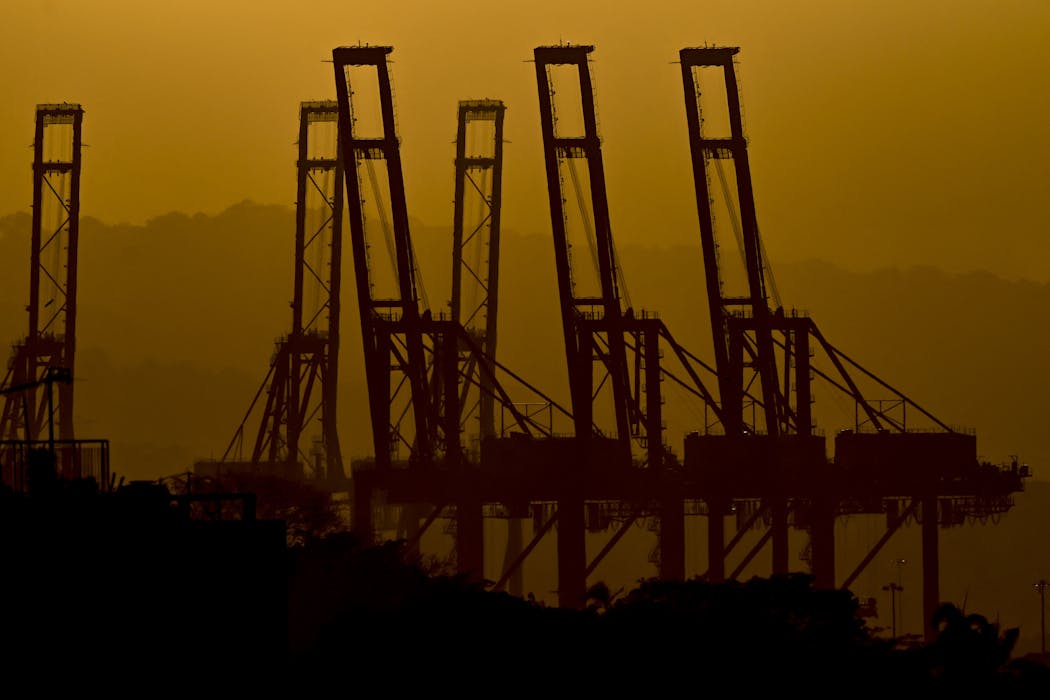
The silhouettes of the container cranes in the Port of Balboa in Panama City on Feb. 24, 2026. Martin Bernetti/ AFP via Getty Images

In late February 2026, the Panamanian government took control of two ports in the Panama Canal that had been operated by a Hong Kong conglomerate for two decades. The move is the latest in a long-simmering legal battle after Panama’s high court voided the company’s contracts.

Far from just a local dispute, however, the episode has drawn in the United States and China, whose competition over global ports and trade routes has intensified in recent years, including in the crucial Panama Canal Zone, where China’s presence has repeatedly drawn the ire of the Trump administration.

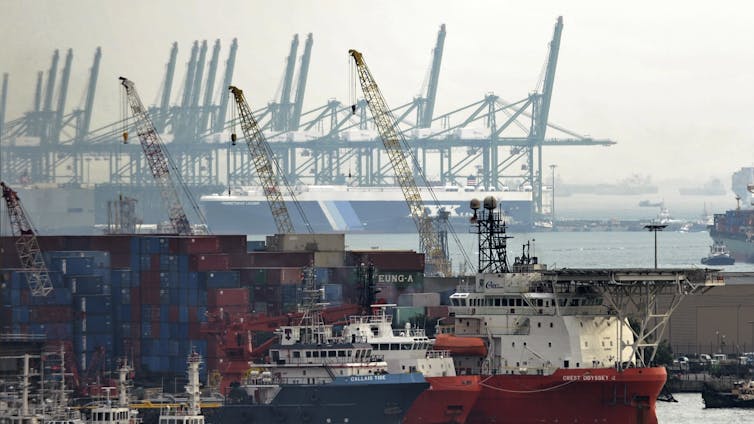
Chinese firms now own or operate terminals at more than 90 ports worldwide, including many of the busiest. The network spans Africa, Europe, the Middle East and Asia, with growing activity in South America.

The scale of China’s involvement in overseas ports has fueled debate over whether these investments are purely commercial or serve broader strategic goals.

Much of that debate has relied on case studies and politicized headlines, including in the case of the Panama Canal. But understanding where these ports are located, and whether there are consistent patterns in the countries that host them, is important given that disruptions to global shipping lanes can reverberate across the world economy.

In a recent study, we – researchers in maritime security, global infrastructure and trade – built the first global database of Chinese-affiliated ports and analyzed 133 coastal countries to understand why some host Chinese port investments while others do not.

We found that China’s overseas port expansion is not random. Far from being driven primarily by general business climate measures, the investments cluster near maritime chokepoints and piracy-prone shipping corridors, with more modest evidence that resource-rich countries are also more likely to host these ports.

The importance of chokepoints

Some sea routes are more important than others. The Suez Canal, the Strait of Hormuz and the Strait of Malacca are examples of chokepoints – narrow routes through which large volumes of global trade and energy shipments must pass.

In our findings, countries near primary or secondary chokepoints, such as Panama or countries bordering the Dover Strait, such as France, were substantially more likely to host a Chinese-affiliated port. Put simply, proximity to critical trade bottlenecks strongly predicts Chinese investments.

A map of the world has various points marked out
Chokepoints are found along sensitive shipping corridors.
Spencer/Christiansen/Pires/Tsai/Gondhali/Petrossian

This makes economic sense. China depends heavily on maritime trade to sustain economic growth. And ports near chokepoints sit along the world’s most sensitive shipping corridors and offer long-term commercial access in strategic locations.

Despite concerns in the West that Beijing is developing ports for military reasons, not every port is a naval base in disguise.

Most Chinese-affiliated facilities are commercial terminals. However, commercial infrastructure can still have strategic value. China’s first overseas military logistics base in Djibouti sits alongside the Chinese-operated Doraleh port complex. A report from the Congressional Research Service notes that the facility supports naval operations and regional access in the western Indian Ocean.

That does not make other Chinese-owned or operated ports military installations. But control over terminals, logistics platforms, and supply chain data can shape economic and security relationships over time.

The role of piracy and resources

The same corridors in which Beijing is concentrating port investment are also hot spots for maritime crime. In separate research, we found that seaports can facilitate illegal, unreported and unregulated fishing when oversight is weak. Our latest findings show that Chinese-affiliated ports are more common in countries already experiencing piracy and maritime insecurity.

That overlap does not mean ports cause illicit activity, but it shows these investments often occur in higher-risk maritime environments.

One of the most surprising findings from our study was the relationship between piracy and port investment.

Between 1991 and 2018, thousands of piracy incidents were recorded worldwide. But rather than avoiding risky waters, Chinese-affiliated ports are more common in countries experiencing higher levels of piracy.

Why invest in unstable corridors? One explanation is that piracy signals where trade routes are both vulnerable and valuable. Investing in ports in areas such as the Gulf of Guinea or parts of Southeast Asia may help Beijing protect its shipping interests. In this sense, piracy may signal not just risk but opportunity.

Cranes are seen next to a large ship.
Chinese investment has poured into countries around the world, including Singapore.
Roslan Rahman/AFP via Getty Images

We also examined natural resource wealth of port host nations using a broad measure that includes extractive mineral and agricultural resources. We found modest evidence that countries with higher resource levels were more likely to host at least one Chinese-affiliated port, though this relationship was not consistent across all models.

Some commonly cited explanations as to where and why China invests in ports did not hold up in our analysis.

Broad measures of business climate and governance, such as ease of doing business or institutional stability, were not consistent predictors of Chinese-affiliated port presence.

This suggests that geography and maritime risk factors may matter more than general economic or governance indicators.

Broader implications

Whatever the motivations behind Chinese investments, their implications extend beyond local trade and logistics.

Ports are no longer just local infrastructure projects. They are nodes in global supply chains and increasingly in geopolitical competition.

And while not every investment signals a covert military ambition, it would be naive to treat all port projects as politically neutral.


Read more:
China is losing ground in Latin America


Recent U.S. policy responses reflect these growing concerns. In early 2026, the White House outlined a plan to strengthen the U.S. shipping industry and reduce reliance on foreign-controlled maritime infrastructure. The administration has also taken a closer look at foreign involvement in key facilities in the Western Hemisphere, including ports linked to the Panama Canal.

Such moves suggest that control over maritime infrastructure is no longer viewed in Washington as just a commercial issue but increasingly as a matter of economic and national security.

And as the map of countries with Chinese-affiliated ports suggests, Beijing’s investments are following the world’s most consequential trade routes not by accident, but by design.

The Conversation

The authors do not work for, consult, own shares in or receive funding from any company or organization that would benefit from this article, and have disclosed no relevant affiliations beyond their academic appointment.

ref. Far from random, China’s global port network is clustering near the world’s riskiest trade routes – https://theconversation.com/far-from-random-chinas-global-port-network-is-clustering-near-the-worlds-riskiest-trade-routes-274934

When unpaid cooking, cleaning and child care get a dollar value, income inequality in the US shrinks – but the gap has grown since 1965

Source: The Conversation – USA (2) – By Leila Gautham, Lecturer in Economics, University of Leeds

Keeping up with chores takes a lot of time and is worth money. jubaphoto/E+ via Getty Images

When economists track inequality, they typically focus on income and spending.

But a significant share of the services that families actually consume – meals cooked at home, child care, housecleaning and lawn mowing – is produced by unpaid labor that never appears in these conventional measures.

As economists who study caregiving and inequality, we wanted to know whether accounting for unpaid work at home might change our understanding of inequality in American living standards – the gap between what richer and poorer Americans can actually afford to consume.

To find out, we conducted a study, published in the March 2026 issue of the Journal of Public Economics, in which we estimated the dollar value of unpaid housework and child care and added it to standard measures of income and spending for U.S. households from 1965 to 2018. Economists call these broader measures “extended income” and “extended consumption.”

We found that unpaid work used to significantly cushion inequality through the provision of many services. But we also determined that this cushion has been thinning for 50 years. Our findings indicate that the inequality in living standards has grown more than standard data suggest.

Counting unpaid work reduces inequality

To visualize these findings, consider the financial situation faced by two families.

While both have two adults and two children, their income from their salaries and other cash flows – including everything from stock dividends to Social Security benefits – is different. One has two earners bringing in a total of US$150,000. The other has a single breadwinner making $110,000 and a stay-at-home spouse. The lower-income family gets 45 more hours per week of unpaid chores done.

If every hour of those chores were worth $17, the typical wage for a housekeeper, that unpaid work would be worth roughly $39,780 a year. Factor it in, and the gap between the two families shrinks from $40,000 to just $220.

Extended income, the economic term that includes not just what’s in your paycheck but the value of doing the laundry, home repairs and other unpaid work yourself for your own benefit, tends to be more equally distributed than earned income.

The reason for this consistency is straightforward: Rich and poor families generally devote about the same amount of time to housework and child care.

A shrinking buffer

Because we valued everyone’s unpaid hours at the same wage in our study, adding unpaid work to income narrowed the gap between the top and the bottom somewhat.

But we also found evidence that this equalizing effect is eroding.

Between 1965 and 2018, the average amount of time that Americans devoted to unpaid chores at home fell, driven by changes in what women did. Their average number of hours fell from 37 to 24 per week. Meanwhile, men increased the time they spent on unpaid chores a little: Their number of weekly unpaid hours of work rose from 12 in 1968 to 15 in 2018.

To be clear, we did not try to figure out why these hours of unpaid work fell. Among the many reasons for the change could be the large increase in women’s employment and the growth of time-saving technology, such as dishwashers.

Lowest-income families hit hardest

We studied these shifts by combining three national datasets: time diary surveys from the American Heritage Time Use Study, income data from the Current Population Survey and expenditure data from the Consumer Expenditure Survey.

To put a dollar figure on unpaid work, we valued each hour at what U.S. housekeepers typically earn in a particular year.

The decline in unpaid work hit low-income households hardest – not because they cut more hours, but because unpaid work made up a much larger share of their total income.

We found that the income gap between households near the top and those near the bottom between 1965 and 2018 grew around 40% using conventional measures. Once we added unpaid work, this gap grew by 66%. For household spending, the contrast is similar: conventional inequality barely budged – up 4%. When we incorporated the value of unpaid work at home, inequality grew by 18%.

Overall, we determined that a typical U.S. family’s extended income grew 40% from 1965 to 2018. That was a much slower pace than the 69% growth in the income they earned from their paid work and other cash flows over the same period.

Who lost the most

Conventional data suggest that the gap between middle-income and poor households was generally stable during this period. Once we accounted for unpaid work, however, that is no longer true: This gap grew substantially.

Single-parent families – mostly headed by single mothers – were hit especially hard. Their income from paid employment rose sharply, but this came with large declines in the value of their unpaid work at home.

While they could afford to spend more on purchased goods and services, once unpaid work is factored in, single parents saw no net improvement relative to married parents.

A man rakes leaves.
Those leaves won’t rake themselves.
Herman Bresser/Moment via Getty Images

What it means

The roughly 20-percentage-point increase in the share of women working outside the home over the past six decades was driven by expanded opportunity and economic necessity.

It has brought enormous economic benefits to those women and their families. But it has also meant that families – especially those with the least income – lost a cushion of services that women used to do in their own homes.

Our findings suggest that looking only at changes in income and spending can exaggerate improvements in living standards for the lowest-income Americans over the past five decades.

When you do fewer hours of chores that need to be done, you wind up paying other people to do them for you, and that costs money.

Otherwise, you have to make do with fewer services than you had before.

The Conversation

The authors do not work for, consult, own shares in or receive funding from any company or organization that would benefit from this article, and have disclosed no relevant affiliations beyond their academic appointment.

ref. When unpaid cooking, cleaning and child care get a dollar value, income inequality in the US shrinks – but the gap has grown since 1965 – https://theconversation.com/when-unpaid-cooking-cleaning-and-child-care-get-a-dollar-value-income-inequality-in-the-us-shrinks-but-the-gap-has-grown-since-1965-275499

Brazilian jiu-jitsu is having its #MeToo moment

Source: The Conversation – USA (2) – By Matt Wilkinson, Associate Professor of Sociology, Coastal Carolina University

Andre Galvao, wearing black, competes in the Abu Dhabi World Professional Jiu-Jitsu Championship in 2014. Francois Nel/Getty Images

A #MeToo-style reckoning appears to be unfolding within Brazilian jiu-jitsu.

In February 2026, Brazilian jiu-jitsu legend Andre Galvao was accused of sexual misconduct by multiple women, including a teenager who had trained at Atos Jiu Jitsu, the school Galvao co-founded in San Diego in 2008 that now boasts academies around the world.

The backlash was swift: Multiple gyms and high-profile athletes affiliated with Atos severed ties with the school.

Galvao dismissed the accusations as “false rumors” and stated he is “taking the proper legal steps to protect the integrity” of Atos.

On Feb. 6, 2026, however, Atos Jiu Jitsu announced it had removed Galvao from his leadership posts. Many other gyms and athletes without a direct connection to Galvao or Atos nonetheless took the news as an opportunity to post messages about their commitment to safety for their gym members.

In a sport that has long struggled with addressing sexual harassment and misconduct, we see the widespread condemnation of Galvao as a watershed moment. And it comes on the heels of research we conducted to better understand the unique challenges that female martial artists face.

A sport built on trust

For those unfamiliar with the sport, Brazilian jiu-jitsu is a martial art focused on grappling and ground fighting – think wrestling, but with submission techniques like arm bars, shoulder locks and chokeholds. It’s essentially the grappling on the ground part of UFC, minus the punches and knee strikes.

Although almost all Brazilian jiu-jitsu competitions are split by gender, sparring and drilling routinely happen between men and women. It typically involves physical contact, usually between two people with different levels of strength and experience.

For these reasons, trust, restraint and respect are essential.

When your opponent successfully applies a technique that limits your movement and from which you cannot escape, you “tap out” to signal that you have accepted defeat. When you submit, your opponent is obligated to let go immediately to avoid causing injury or unconsciousness.

A young woman in a white martial arts suit performs an arm bar on a young man as the two grapple on a blue mat.
Trust and restraint are paramount in jiu-jitsu.
Leonard Ortiz/Digital First Media/Orange County Register via Getty Images

Much of the attention on sexual harassment in the sport has historically focused on incidents of assault. And a review of news coverage between 1989 and 2018 identified 177 incidents of martial arts coaches being convicted of sexual offenses.

But the kind of harassment that may not rise to the level of a crime in most countries – more pervasive and more subtle, but nonetheless insidious – has largely remained unacknowledged in Brazilian jiu-jitsu.

Blissful ignorance or something more insidious?

Whether it’s through inappropriate or sexualized comments both on and off the mat – or through unsolicited remarks about their bodies or appearance – women encounter a far different training environment than their male counterparts.

This is what we wanted to explore in our own research.

In 2021, we conducted a survey on martial arts participation that generated responses from 289 martial artists – 209 men, 77 women and 2 nonbinary people – in the U.S. and around the world. Most of them listed Brazilian jiu-jitsu as their primary art.

In the analysis, 43% of our survey respondents – 51% of women and 40% of men – indicated that they were aware of harassment in their martial arts community, which ranged from bullying to sexual harassment, to sexual assault.

But harassment was just one issue raised. The survey revealed a wider problem of “gender blindness” in martial arts, which involves simply ignoring or overlooking the impact that gender can have on participation, practice and performance.

When asked, “What does it mean to be a woman in martial arts?” 62% of men responded with statements that actively downplayed or ignored the ways gender shapes the sport. For example, one man noted that “the beauty of martial arts” is that “anyone can do it,” regardless of age, ability, “gender, shape or size.”

By contrast, nearly two-thirds of women in our survey indicated that being a woman in martial arts does, in fact, matter. They said they had fewer training opportunities, revealed that they felt they needed to work twice as hard to prove themselves, and highlighted safety concerns.

Two young women grappling on a blue mat.
For many women practicing jiu-jitsu, their gender plays a part in the experience.
Fenom Kimonos/Powered by She

It isn’t clear whether the gender blindness among male martial artists reflected optimism, ignorance or something else. But the impact is the same: Women see gender as central to their experience. Men generally perceive gender to be irrelevant to the sport, and they don’t realize what women deal with on a day-to-day basis.

Unfortunately, gender blindness isn’t just relegated to Brazilian jiu-jitsu. Long studied by sociologists and gender scholars, it’s a pattern that lays the groundwork for abuse across all types of sports. And where gender blindness exists in combination with rigid hierarchies, it enables abuses of power and a culture of silence.

When people refuse or fail to recognize how gender shapes the experiences of women in sports, it becomes much harder to address conditions that allow for harassment and assault to occur. For example, when inappropriate contact or groping during training is dismissed as merely “accidental” or minimized as someone being “handsy,” it signals that this behavior is trivial rather than harmful. And it creates an environment where women – and men – may feel uncomfortable coming forward or speaking out.

Some prominent figures in the Brazilian jiu-jistu community are making this connection.

In a recent postmatch victory speech, Brazilian jiu-jitsu champion and coach Adele Fornarino issued a call to action. Criticizing the hierarchical structure of the sport, she emphasized that people in positions of power are taking advantage of the vulnerable and called for “no more blissful ignorance.”

What comes next?

In jiu-jitsu, men have traditionally held positions of power. By and large, they’ve been the owners of gyms, the instructors leading classes, the holders of black belts.

Two young women wearing white martial arts suits watch a young man in a white martial art suits hold the arm of another young man in a white martial arts suit.
Two women observe a move being demonstrated during a Brazilian jiu-jitsu class at a gym in Boston in 2013.
Christopher Evans/MediaNews Group/Boston Herald via Getty Images

But this has been changing: The adult black belt women’s division at the 2025 International Brazilian Jiu-Jitsu Federation World Championships saw a 40% increase in participants over the previous year. By contrast, participation in the men’s division decreased by 18%.

More women are standing side by side with men at the front of the class as leaders and experts. As a result, it’s possible that many male martial artists are more likely to respect, trust and see their female peers as equals.

When they live up to what they can be, the martial arts are a place where men and women struggle together and protect each other. They can develop unique friendships, cultivate empathy and practice mutual support.

Men and women having the opportunity to train together in the same gym can lead to what German sociologist Max Weber called “verstehen”: the kind of understanding that comes from working closely enough with someone to grasp the fears, aspirations and experiences that drive them. Spaces that allow for that depth of connection are all too rare.

We see the swift denunciation of Galvao, a legend in the sport, as a sign that Brazilian jiu-jitsu may be progressing toward a culture centered on care, concern and restraint instead of dominance and power.

The Conversation

The authors do not work for, consult, own shares in or receive funding from any company or organization that would benefit from this article, and have disclosed no relevant affiliations beyond their academic appointment.

ref. Brazilian jiu-jitsu is having its #MeToo moment – https://theconversation.com/brazilian-jiu-jitsu-is-having-its-metoo-moment-275916

Front lines of humor: Dark humor voices Ukrainians’ hopes for victory

Source: The Conversation – USA (3) – By Neringa Klumbytė, Professor of Anthropology, Miami University; Lithuanian Institute of History

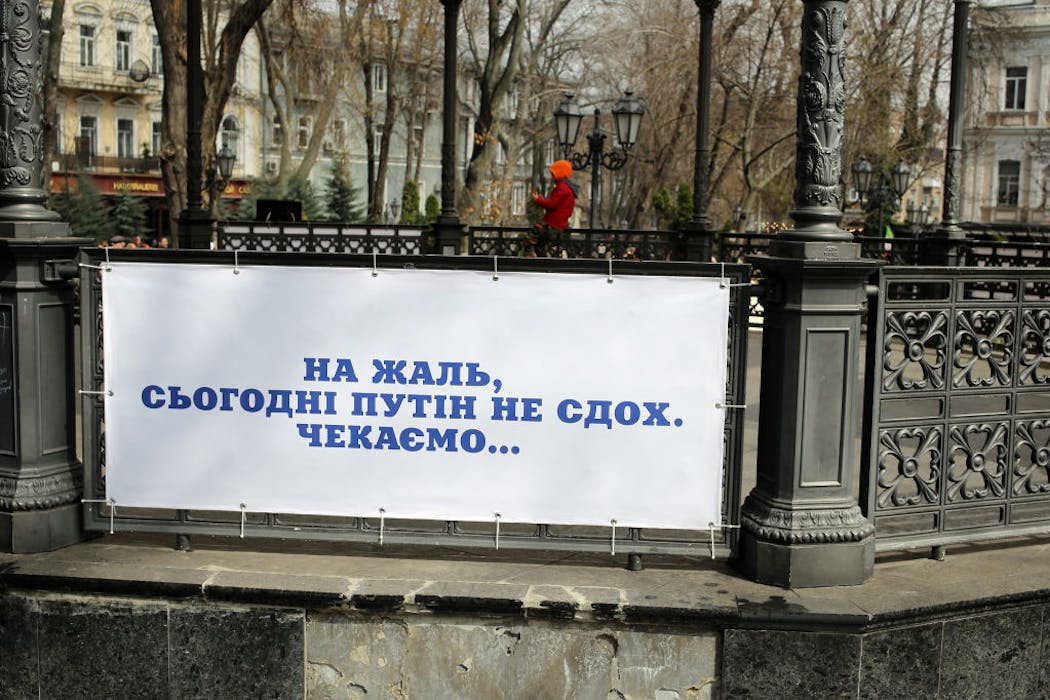
A banner reading, ‘Regrettably, Putin did not die today. We are waiting …’ hangs in the City Garden of Odesa, Ukraine, on April 1, 2023. Viacheslav Onyshchenko/Global Images Ukraine via Getty Images News

In 1991, a simple line appeared in Broom, a Lithuanian satire and humor journal. “A shortest joke: Communism,” it said. A one-liner to celebrate the collapse of the Soviet Union.

Four years since Russia’s full-scale invasion, a shortest joke could be told about Russia’s war in Ukraine: “Liberation.”

Since the Russian Federation began its “special military operation” to “liberate” Ukrainians on Feb. 24, 2022, hundreds of thousands of people have been killed, millions have fled their homes, cities have been destroyed, and water and land have been contaminated. But people in Ukraine still laugh. Laugh to overcome pain, express solidarity and resilience, and hope for the victory.

In the first two months of 2026, there have been over 200 attacks on energy infrastructure across Ukraine, damaging thermal and hydroelectric plants and causing prolonged electricity outages. Millions were left without power or with just a few hours of electricity. I asked my friend in Kyiv how she is holding up. She responded, “Organic matter survives better in cold.”

I have studied humor in authoritarian and democratic states for many years. I have been fascinated by humor’s power to overcome pain and liberate from absurdity and oppression. In Ukraine, war humor has mobilized people, expressed their resistance and helped them overcome daily hardships.

Dangerous jokes

Throughout history, satirists and cartoonists have faced punishment, prison and even executions. Lenin and Stalin, like Mao and Hitler, allowed no laughter at the expense of themselves or their regimes. The power of humor lies in its capacity to mobilize people for a common cause. It is a weapon of the powerful as well as the powerless.

In authoritarian states, official humor reinforces the state’s political ideology and is a propaganda tool. Soviet satire and humor journals, for example, ridiculed Western imperialism. They satirized various ills of Western societies – high crime rates, unemployment, homelessness, corruption and poverty – while presenting the Soviet Union as more advanced.

Since 2022, many comedians have left Russia, some under threat. Like in Soviet times, anti-regime jokes can be told in kitchens and among friends but cannot freely circulate. In state media comedy shows, jokes about Putin are told from time to time, but they are used to bolster his image as a powerful, cunning leader, and hold up Russia as a great country.

War humor

In democratic societies, people are generally free to laugh at what they want. Ukrainian humor circulates from grassroots social media to government offices, to business sites. Since 2022, Ukrainian social media has been flooded by jokes – producing the biggest virtual humor archive in the history of wars.

But war humor is different from humor in times of peace. It can be hateful, obscene, grotesque, vulgar and dark. It fulfills many functions, from defense mechanism and survival strategy to a form of escape.

When lights went off in the winter of 2026, Ukrainians joked that even without light, they can see that “Putin is a ‘khuylo’” – an obscene punch line. Some jokes noted that Ukrainians do not have electricity but have power; or that there is no electricity in Ukraine, but there is light – and there is no light in Russia.

War humor has also been a form of resistance and perseverance. After Putin’s nuclear threats in 2022, memes about an orgy on Kyiv’s Mount Shchekavitsa in the event of an “end of the world” began to spread online. People were invited to join in case they had unfulfilled sexual fantasies. Memes multiplied of a couple passionately kissing in the background of a nuclear mushroom cloud.

One young man, presumably one of 15,000 who signed up for the orgy on Telegram, told Radio Free Europe, “It’s an attempt to show that the more they try to scare us, the more we will transform it into something else.”

Similar groups popped up, including a group promoting an orgy on Odesa’s Derybasivska Street. The orgy idea led to other forms of civic activism, such as the Soloma Cats charity foundation organizing first-aid training on Mount Shchekavitsa.

Laughing toward victory

Humor also is a form of news and commentary. Some people learn about international events, policy decisions and even battle victories from jokes rather than the mainstream media.

At the beginning of the war, internet memes laughed at European leaders’ reluctance to supply arms to Ukraine. Billionaire Elon Musk was mocked in October 2022 after suggesting a plan for peace that would repeat elections in annexed regions, recognize Crimea as Russian territory and make Ukraine a neutral country. Even Pope Francis was laughed at for his March 2024 suggestion that Ukraine should wave “the white flag and negotiate” to save lives, which for Ukrainians meant surrendering their sovereignty.

During the Ukrainian army’s counteroffensive in 2022, humor spread news of victories in Kherson, Bakhmut and other cities, laughing at Russian forces. Memes commonly portrayed Russian soldiers as incompetent, indoctrinated, or as zombies. Comparisons to Orcs in “The Lord of the Rings” were prominent, with one meme suggesting, “Stop calling Orcs Russians, it’s offensive toward Orcs.”

In response to reports of Russian soldiers stealing loot to sell in Belarussian open markets, Ukrainians created a meme of reselling captured Russian tanks at a “farmer’s market.” Another joke about Russian looting: “Did you take Kharkiv?” “No.” “Kyiv?” “No.” “What did you take?” “A washing machine, a mixer, and shoes …”

Some of the jokes provide commentary on global geopolitics, including Russia’s propaganda that it had been threatened by NATO. “Did you hear? It turns out Russia is at war with NATO,” one man asks. “How is it going for them?” asks another. “They already lost tens of thousands of soldiers and a ton of military equipment.” “And NATO?” “Oh, they have not arrived yet.”

In some ways, such jokes are a counteroffensive against Russian disinformation. In fact-checking, journalists fight propaganda with logical arguments, but propaganda targets emotions, identity and fears. Humor does not argue; it changes the context itself, subverting the message. And whereas fact-checking treats an opponent seriously, humor makes them ridiculous.

Ultimately, Ukrainians’ laughter communicates resistance, solidarity and dedication to victory. In one joke, a husband asks his wife why she bought seven bottles of wine. What about water and preserves, in case the war drags on? The woman responds: “I am getting ready to celebrate the victory!”

The Conversation

Neringa Klumbytė does not work for, consult, own shares in or receive funding from any company or organization that would benefit from this article, and has disclosed no relevant affiliations beyond their academic appointment.

ref. Front lines of humor: Dark humor voices Ukrainians’ hopes for victory – https://theconversation.com/front-lines-of-humor-dark-humor-voices-ukrainians-hopes-for-victory-265948

That cosy candle? It’s also polluting the air you’re breathing

Source: The Conversation – UK – By Karin Rosenkilde Laursen, Postdoctoral fellow in Public Health, Aarhus University

During the winter months, when days are short and cold and nights are long and dark, creating a warm and cosy indoor atmosphere can feel especially important.

Where I live in Denmark, around 75% of the population burns candles two or more times a week, and 34% use them daily during the winter months.

In fact, Denmark is often said to be the country with the highest per-capita candle consumption in Europe. Danes burn around 5.8kg of candle wax per person per year – the equivalent of about six bags of sugar.

Yet, nice as they can look, studies show burning candles is one of the biggest sources of indoor air pollution. This is because when burning, candles emit a large number of ultrafine particles.

These particles are so small that they are invisible to the human eye, and more than a thousand times thinner than a human hair. They can remain airborne for long periods, and when candles are blown out, the concentration of these particles (including soot) increases even further.

Candles vs cooking

In our experiments conducted in exposure chambers (where the climate is controlled) at Aarhus University, we examined how indoor air is affected both by burning candles and cooking pork in an oven.

Cooking – and especially frying – is known to emit high concentrations of particles due to combustion (the process of burning something). Particles from combustion processes are among the most harmful to human health – but less is known about the role that particles emitted from candles plays when it comes to indoor air pollution.

Our research found that while both candles and cooking emit high levels of particles, the number of particles from candles was much higher. Even more significant was the difference in particle size: cooking produced particles about 80 nanometers wide, whereas candles generated particles around seven-to=eight nanometers in size – much smaller and much easier for our lungs to inhale.

We also measured chemical compounds in the air, and found that burning candles produced not only soot particles but gases such as nitrogen dioxide and polycyclic aromatic hydrocarbons (PAHs) – a group of chemicals associated with inflammation and even cancer.

The particles we breathe

Ultrafine particles are of particular concern from a health perspective. They are easily inhaled into our lungs, but research has found they are excreted from the body very slowly.

Due to their extremely small size, particles from candles can penetrate deep into our smallest airways, known as the alveoli, and may even enter the bloodstream. From there, they can reach organs such as the heart and brain.

Indeed, the particles formed when candles are burning are remarkably similar to those found in diesel exhausts in size and composition. These particles have been linked to increased mortality rates from lung and cardiovascular diseases.

Candles on window sill next to plant.
Ultrafine particles from burning candles are invisible to the eye, but harmful to your lungs.
pexels/skylar kang, CC BY

In our study, we also investigated how candle burning affects young adults with mild asthma. We found subtle but measurable biological changes following exposure to candle emissions.

Some markers of airway and blood inflammation were altered, and participants reported irritation and discomfort. Other studies among healthy adults have observed small decreases in lung function, changes in arterial stiffness and heart rate, and reduced cognitive function after exposure to burning candles.

Light and dark

You might be thinking: all this from just a candle? But it’s worth remembering that people with chronic conditions like asthma or chronic obstructive pulmonary disease are far more sensitive to particulate air pollution.

Because people with these conditions already have chronically inflamed airways, even relatively low levels of pollution — including particles released by burning candles — can be enough to trigger symptoms.

Children, older adults and people with chronic illnesses are also particularly vulnerable to air pollution, due to immaturity of their lungs or weakened immune systems.

Indeed, for anyone with asthma or other respiratory conditions, the quality of indoor air is not a minor detail, but a key factor in day-to-day symptom control and long-term respiratory health.

Blow out all the candles?

But that’s not to say those without lung disease or asthma aren’t affected. As research shows, burning candles affects not only the indoor environment but potentially everyone’s health. Fortunately, a few simple steps can help maintain a healthier indoor climate.

Try using LED candles, for example, or light only a few candles at once. You should also place candles away from drafts to avoid a flickering flame, which can produce more soot and smoke. Trim your candles’ wicks to reduce soot formation, too. And candles should never be burned near (or by) people with respiratory disease.

Most importantly, air out the room afterwards by opening your windows. Such measures can help reduce the number of particles significantly, and make all the difference when it comes to keeping your cosy or hygge-time healthy.

The Conversation

Karin Laursen received funding from Realdania and Innovationsfonden (Denmark) to conduct exposure trials with burning candles.

ref. That cosy candle? It’s also polluting the air you’re breathing – https://theconversation.com/that-cosy-candle-its-also-polluting-the-air-youre-breathing-269126

Most plastic waste is contaminated – our new ‘nano’ recycling tech embraces this messy reality

Source: The Conversation – UK – By Conor Boland, Assistant Professor of Materials Science, Dublin City University

Conor Boland (right) with colleague James Carton in the lab, Kyran O’Brien/Dublin City University, CC BY-NC-ND

A plastic drinks bottle is one of the most “recyclable” objects in the modern waste stream. It is lightweight and collected in huge volumes. Yet even for this item, the reality of recycling is messy: labels, inks, caps, food residues, colourants and the occasional wrong plastic all get bundled together. The chemistry may be simple, but the waste is not.

My team is developing a new way to deal with contaminated plastic waste. Instead of assuming perfect sorting, we start from the reality that waste streams are mixed, inconsistent and often dirty – and design chemistry that can tolerate that.

Using nanomaterial-based catalysts, we drive depolymerisation, a process that breaks plastics back into their molecular building blocks. By tuning the reaction, it becomes possible to selectively target specific plastics even in mixed or impure streams. The aim is a process built for real-world waste, not laboratory conditions.

This work matters because the scale of the problem is vast. Globally, only about 9% of plastic waste is recycled after losses and residues are accounted for. Much of the rest is sent to landfill, burned or leaks into the environment.

Recycling can look deceptively successful when you only track what gets collected.

Polyethylene terephthalate (PET) is the single polymer – molecular material – used in many bottles. In Europe, collection for PET drinks bottles has reached around three-quarters in recent years. But collection is only the start. What happens next determines whether plastic truly circulates or quietly exits the system.

dirty empty plastic bottle on white background
Most plastic waste is contaminated.
lusia599/Shutterstock

Most PET today is recycled mechanically: the plastic is sorted, washed, melted and remoulded. This works well for clean, colourless material, but it is sensitive to contamination and additives. A small amount of the wrong polymer can weaken a batch. Dyes and stabilisers can persist. Each heating cycle can slightly reduce performance. Over time, the material drifts away from the quality required for food-grade packaging and is often downcycled into lower-value products.

That is why chemical recycling attracts attention. Instead of melting plastics into new shapes, the aim is to break the polymer back into small molecules that can be purified and used again, effectively returning it to its chemical building blocks.

Recent reviews of chemical recycling highlight both the promise and the technical challenges, especially when waste streams are mixed. The difficulty is not proving that plastics can be broken down in a laboratory. It is making that chemistry work reliably with real-world waste.

Nanomaterials are engineered at a very small scale – thousands of times thinner than a human hair – which gives them a large reactive surface area. That surface can be tuned to encourage specific chemical reactions while discouraging others, making depolymerisation faster and more controllable. Broader catalytic depolymerisation research highlights how advanced materials may help make these processes more practical at scale.

Embracing imperfections

Contamination tolerance shapes the economics of recycling. Studies in waste management show that mixed or contaminated plastics drive up recycling costs because they require extra separation and cleaning. Water, energy and labour are spent chasing purity. A chemistry that can accept dirtier inputs could shift where value is created.

When plastics cannot be recycled into new products, they are often incinerated or landfilled. A UN roadmap on plastic pollution argues that more circular approaches could significantly reduce waste and emissions. That requires seeing plastic not just as rubbish, but as stored carbon that can be redirected.

Plastics are often treated as rubbish, but chemically they are concentrated carbon and hydrogen. If those molecules can be reorganised rather than discarded, waste plastic becomes a potential feedstock for hydrogen production. Hydrogen is widely discussed as a future fuel and industrial feedstock, yet most hydrogen today is still produced from fossil fuels.

According to the International Energy Agency, global hydrogen production in 2023 emitted about 920 million tonnes of carbon dioxide. If hydrogen demand grows for industry, transport and energy storage, its carbon footprint will matter. Some emerging research explores converting plastic waste into hydrogen-rich gas using catalysts to guide the breakdown of long plastic molecules. By carefully controlling the reaction conditions, the process can favour the production of hydrogen rather than unwanted by-products.

In this way, waste plastic shifts from being purely a recycling challenge to becoming a potential feedstock for lower-carbon energy systems.

The practical test for any of these approaches is straightforward: do they keep working when feedstock changes day to day? A bale that is mostly bottles but includes trays. A batch with too much dye. A stream with traces of paper and glue.

Industrial reality is rarely tidy. If that variability can be dealt with under less than ideal conditions rather than having to eliminate it, plastic waste becomes an imperfect, but still incredibly useful, raw material. In a world where waste is inevitable, designing processes that work with the mess may prove more important than designing ones that only work without it.

The Conversation

Conor Boland receives funding from the Research Ireland – Gas Networks Ireland Innovation Challenge 2025 (25/FIP/GNI/14147)

ref. Most plastic waste is contaminated – our new ‘nano’ recycling tech embraces this messy reality – https://theconversation.com/most-plastic-waste-is-contaminated-our-new-nano-recycling-tech-embraces-this-messy-reality-277103

The novel that changed my mind – ten experts share a perspective‑shifting read

Source: The Conversation – UK – By Anneliese Hodge, PhD Candidate, Ecotoxicology, Plymouth Marine Laboratory

Alphavector/Shutterstock

Our beliefs aren’t fixed. They’re shaped, stretched and sometimes overturned by the ideas we encounter as we move through life. For many of us, novels are the moments where that shift happens.

For World Book Day, we asked ten academic experts to share a work of fiction that has challenged their assumptions and changed their thinking in a lasting way.

1. A Kestrel for a Knave by Barry Hines (1968)

A Kestrel for a Knave by Barry Hines showed me that my potential could not be defined by anyone but myself. The novel made me realise how easily labels from teachers and colleagues can become self-fulfilling. If you’re consistently told that you’re bad at something, you often end up believing it; like the main character Billy, and like myself, when my A-Level biology teacher told me I wouldn’t amount to anything in science and that I should quit.

Hines shows that potential isn’t determined by the people who underestimate you. Learning thrives when it is fuelled by passion and determination, and Billy’s dedication to training his kestrel Kes mirrored my own dedication to become a scientist.

The novel reminded me that the most meaningful growth happens when you trust your abilities more than the limitations other people put on you.

Anneliese Hodge is a PhD researcher in biological sciences

2. Beautiful World Where Are You? by Sally Rooney (2021)

Beautiful World Where Are You? follows the lives and loves of two friends for a period in their late 20s. It is the novel that changed my mind in relation to writing about sexual consent, at least, writing explicitly and positively about it.

I thought that consent was a subject rarely tackled by writers, unless to violate it or teach teenagers. In the latter case, it was usually done in a responsible style – not something stylish or sexy. Choosing a formative diet of 19th-century novels from the western canon undoubtedly biased my perceptions. Beautiful World shattered them. Its graphic sex scenes are peppered with the language of consent. Alright? OK? Can I? Do you want? Yes.

Rooney normalises seeking and giving clear, continuous consent, regardless of gender. Consent is integral to these scenes and part of the pleasure for characters and – if her bestseller status is any indication – readers.

Sarah Olive is a senior lecturer in English literature

3. Purple Hibiscus by Chimamanda Ngozi Adichie (2004)

I grew up Roman Catholic in an all-boys school, and I first read Purple Hibiscus as a teenager, when faith was not a question but a climate of incense, rosaries and the quiet mathematics of guilt.

The novel follows Kambili, a Nigerian teenager navigating family, politics and belief under a father whose strict Catholicism masks violence and silence. One scene, in which he pours boiling water over her feet while praying for her soul, captures that terrible fusion of devotion and control.

Across the novel, Adichie unsettled me. I had assumed to question the church was to wound God. She showed me that devotion and questioning can live in the same breath, and that faith is deepened by honest attention rather than unexamined obedience.

This insight continues to shape my thinking about identity, scholarship and everyday moral life, including on African diaspora faith and international development.

Edward Ademolu is a lecturer in cultural competency

4. The Years by Annie Ernaux (2008)

The Years by Annie Ernaux changed my mind on how a life can be narrated.

Childhood by Nathalie Sarraute had already pushed the boundaries of autobiography in 1983 by splitting the narrating self and exposing the inconsistencies of memory. Ernaux masterfully continued along that path, showing how the images and memories that shape us are at once both personal and collective.

The book’s protagonist is approached through descriptions of photographs taken over the years by family members and others. These passages are interwoven with images, events and stories cutting across generations.

What emerges is a fragmented, patchwork portrait that is able to provoke the strongest emotions – immensely more than in a narration where the illusion of the singularity of a life is maintained. And this is probably because of its strange realism, allowing proximity through impersonality. Reading it, I encountered a life as an open space, a theatre of memory where I could wander, moving in and out, getting closer or just passing by.

Cecilia Benaglia is associate professor of French and comparative literature

5. Ministry for the Future by Kim Stanley Robinson (2020)

Kim Stanley Robinson’s Ministry for the Future opened my eyes. Not only to the future reality of climate change, but it also made it clear to me that my naive belief that we could engineer our way out of the problem was very far from the truth.

I’d never read a more visceral description of what living and dying in a world ravaged by climate change would feel like. When the temperature climbs and we hit 100% humidity it’s simply impossible for the human body to cool itself, leaving the power grid straining to keep up with demand as those who can afford it attempt to stay alive with air conditioning.

Nothing short of a fundamental shift in what we value and how we act as a collective can get us close to avoiding the worst consequences of the climate crisis, and whichever way we choose the world will change beyond recognition. We just have to pick which path to follow.

Richard Sulley is a senior research fellow in sustainability policy


Read more:
Top climate books to look out for in 2026 – recommended by experts


6. Never Let Me Go by Kazuo Ishiguro (2005)

In Never Let Me Go, humans are farmed so their organs can be harvested by benefactors whenever needed. The book raises numerous moral questions but the core question for me is – how far will we go to meet a human need?

History suggests that we will damage our natural environment and destroy human lives, societies and even civilisations, to meet some human needs. We face this question now regarding technology such as AI and genetic engineering. They meet human needs of quick data processing or improved health outcomes, but present untold negative risks. Our activities around fossil fuels and minerals raise similar concerns.

This core question, raised by my reading of the novel, has shaped my career. It led me to leave a career in business to retrain as a philosopher so that I could combine business theory with philosophy. I now explore ways of continuing to innovate, but do so more awake to the potential harms and perhaps to make trade-offs that favour human dignity rather than economic progress alone.

Athol Williams is a senior fellow in strategy, leadership & ethics


Read more:
Kazuo Ishiguro said he won the Nobel Prize for making people cry – 20 years later, Never Let Me Go should make us angry


7. The Bluest Eye by Toni Morrison (1970)

Toni Morrison’s The Bluest Eye had a deep impact on me. It changed how I understand racism. The novel shows that racism is not just built into institutions and systems. It also shapes how people see themselves and the world around them. In the book, whiteness is treated as the standard for everything – beauty, goodness, success, and even what it means to be fully human.

The novel details how Pecola Breedlove, an African-American girl growing up in post-Great Depression Ohio, internalises anti-Black racism and develops a crippling inferiority complex through her desperate yearning to have blue eyes. The psychopathological effects of internalising anti-Black racism lead to Breedlove’s eventual insanity, which in a way constitutes her only protection from the misogynoir world.

What is further instructive about Morrison’s work is that it shows what literature, rather than highly technical theory, can do – connects us at a deeply emotional level, helping forge cultures of empathy and care.

Paul Giladi is a reader in philosophy

8. Middlemarch by George Eliot (1871)

Middlemarch calls itself a “study in provincial life”. It traces a picture of how – even in the 19th century – shifts in religion and science created complicated webs of human relationships.

I read the novel when I was 16, an age at which few people’s ideals are taken particularly seriously. Nevertheless, its central character, Dorothea, gave me a hugely formative model of an unapologetically clever, ardent woman shut out from formal education and struggling to find a meaningful channel for the intensity of her faith. Dorothea keeps searching for meaning, no matter how often she stumbles.

Middlemarch changed my mind by teaching me a kind of consolatory optimism: that whether we place our faith in religion or science, both can set us out “with a glorious equipment of hope and enthusiasm and get broken by the way”. To persist, we need “patience with each other and the world”.

Miranda Jane Mourby is a PhD candidate in law

9. Flowers for Algernon by Daniel Keyes (1966)

Back when I was 17, youthfully arrogant and thinking intelligence to be the only virtue worthy of measure, an unassuming sci-fi novel found me.

Flowers for Algernon is told through progress reports penned by the main character, Charlie. Charlie is born with a very low IQ, and is chosen to become the first human subject for an experimental treatment that enhances his IQ over time, eventually making him a genius. The treatment is not successful long term – and so what goes up must also come down.

Transhumanism is the philosophical movement in favour of transforming the human condition through technology, including enhancing cognitive abilities. Flowers for Algernon changed my naïve acceptance of the transhumanist core premises, as the novel forces you to ask instead: What makes intelligence good? Who is this enhancement for, and who does it benefit? How do we define what makes humans “better”?

In these days of tech billionaires investing in gene-editing and hailing the coming of artificial general intelligence, words from this novel still echo in my head: “Intelligence and education that hasn’t been tempered by human affection isn’t worth a damn.”

Sarah Moth-Lund Christensen is a fellow in AI and In/equality

10. Convenience Store Woman by Sayaka Murata (2016)

Whenever I’m asked if I “live to work” or “work to live”, I think of the adage: “I do not dream of labour.” My position has been troubled once, namely by Sayaka Murata’s Convenience Store Woman.

Murata’s novel follows Keiko, a convenience store worker who is socially shamed to leave her job and find a husband. Despite establishing a fake relationship with her workshy former colleague Shiraha, she still earns scorn from their respective families. Keiko ultimately leaves, determined to work at a convenience store again.

Initially, I was tempted to read this as a sad ending. Considering the novel’s critique of how society forces people into specific “norms” against their better judgement, I suddenly paused; was I missing the point?

This is not to say that the novel presents Keiko’s return to low-wage work as a fully positive thing. There is a gothic quality to Keiko’s view that she is a mere appendage of the store’s ecosystem. However, the ending made me consider: as a reader, was I adding to socially prescribed assumptions of what a “happy” ending might look like?

Lillian Hingley is a researcher and tutor in English

Has a novel ever changed your mind? Let us know in the comments below.

The Conversation

Richard Sulley receives funding from The Grantham Foundation for the Protection of the Environment

Anneliese Hodge, Athol Williams, Cecilia Benaglia, Edward Ademolu, Lillian Hingley, Miranda Jane Mourby, Paul Giladi, Sarah Moth-Lund Christensen, and Sarah Olive do not work for, consult, own shares in or receive funding from any company or organisation that would benefit from this article, and have disclosed no relevant affiliations beyond their academic appointment.

ref. The novel that changed my mind – ten experts share a perspective‑shifting read – https://theconversation.com/the-novel-that-changed-my-mind-ten-experts-share-a-perspective-shifting-read-274073

Is legal uncertainty softly killing remote-work innovation?

Source: The Conversation – France – By Kseniya Navazhylava, Associate Professor, Audencia

As France debates the “end of the golden age of remote work”, both workers and
employers face growing confusion: are today’s working from home practices really compatible with emerging work habits in in the public and private employment sectors — and more importantly, with the law?

New research suggests that legal uncertainty does not empower HR managers to innovate. Instead, it pushes them to take on extra responsibilities that weren’t in their job description.

Could unclear regulations be the “silent killer” of innovation in remote-work strategies? Recent research carried out in Kazakhstan’s technical-gas industry during the healthcare crisis offers an unexpected insight from Central Asia that might shed light on the situation in France. Although far removed from the French context, the case study offers some universal common ground: when regulations lag behind reality, remote-work policies become fragile, inconsistent, and difficult to innovate.

A climate of doubt – on both sides of the employment relationship

Recent articles in The Conversation highlighted the questions that have dominated public debate since early 2024, when several major tech firms in the US publicly rolled back their remote work policies. In Europe, Danish firm [Novo Nordisk] ended remote jobs after massive layoffs, while in France, workers went on strike to protest over reduced remote work]. The result: a widespread sense of uncertainty.

Employers wonder whether remote work truly maintains productivity, and whether offering it to some workers (for example, administrative staff) but not others (such as plant workers) creates new inequalities.

In the meantime, employees are unsure about how they are monitored, how much data is collected, and whether remote work places them at greater risk of job loss.

France, grappling with these tensions, can learn from countries where legal uncertainty has long shaped HR decisions. During the Covid-19 crisis, Kazakhstan faced a similar fog surrounding unclear rules and shifting expectations around remote work — and the lessons are telling.

Improvised solutions and the limits of ‘empowerment’

In this climate of uncertainty, companies often resort to improvised and sometimes intrusive practices. Some managers judge employee performance through teams’ connection status. Others rely on constant connectivity, webcam checks, or software tracking mouse or keyboard movements. And many fall back on “management by objectives,” asking employees to retroactively justify their work.

Training exists to help managers navigate these new modes of work but it is often described as superficial, sometimes delivered by people who do not remote work themselves.

In these moments of ambiguity, a familiar concept resurfaces: empowerment. The assumption is that frontline workers “know best”, and should therefore make autonomous decisions. While autonomy can indeed boost productivity and satisfaction, it also brings risks: blurred work–life boundaries, difficulty disconnecting, and increased stress. More importantly, the rhetoric of empowerment may hide a deeper issue: it shifts responsibility downward, asking employees and HR teams to fill the gaps left by insufficient or outdated regulations.

When unclear laws block innovation

This is where the Kazakhstan study I conducted with my fellow researcher Meruyert Ibraimova offers crucial takeaways. Our research shows that when labour law is vague or overly rigid, as may currently be the case in France, companies struggle to modernise their HR practices, especially during crises.

Unclear employment regulation has several consequences:

1) It slows innovation, precisely when organisations need agility.

2) It pushes HR teams into defensive decision-making, focused on avoiding
legal mistakes rather than rethinking work.

3) It can even force professionals to take legal risks, stretching or bypassing norms simply to keep operations running.

For example, our research demonstrates how during Kazakhstan’s healthcare crisis, the absence of clear rules on employee presence forced HR managers to improvise.
With no legal guidance on who could work remotely and who had to remain on-site, some plant workers were required to ensure the production of oxygen and other gases, while blue-collar employees stayed at home. These decisions disrupted principles of workplace equity and put the organisation at risk legally but were made to enable employees to maintain life-saving activities. Similarly, the managers had to make executive decisions on whether oxygen would be exported to long-term strategic clients, or local hospitals. Instead of empowering HR managers, these examples show how they are obliged to take on responsibilities and absorb the burden of inadequate laws, thus bearing risks that should be shared or eliminated through clearer regulation.

France at a crossroads

While today’s debates often lament the “lack of innovation” in remote-work practices, the obstacle may not lie in managerial creativity or employee willingness. The real bottleneck may be legal uncertainty itself.

If France wants to move past improvised monitoring systems, inconsistent rules, and growing mistrust, it must address the underlying issue: its remote work regulation is out of sync with the realities of digital working practices. Despite that, examples of innovative remote-friendly working approaches exist. WeProov, one of Europe’s leading app-based providers of digital vehicle inspection solutions, attracts unique talent by enabling employees to work from anywhere in the world ,and invests in trimestrial team-building sessions to support group cohesion.

In Japan, Microsoft’s Work Life Choice Challenge rethought how work was organised and measured, from 4-day working weeks without decreasing the pay to data-driven measurement of productivity rather than presence in the workplace.

Without a clearer framework, companies will continue to experiment in isolation, workers will remain unsure of their rights, and HR teams will bear disproportionate responsibility. As a result, “innovation,” the kind that makes remote work sustainable, equitable, and productive, will remain dangerously out of reach.


A weekly e-mail in English featuring expertise from scholars and researchers. It provides an introduction to the diversity of research coming out of the continent and considers some of the key issues facing European countries. Get the newsletter!


The Conversation

Kseniya Navazhylava ne travaille pas, ne conseille pas, ne possède pas de parts, ne reçoit pas de fonds d’une organisation qui pourrait tirer profit de cet article, et n’a déclaré aucune autre affiliation que son organisme de recherche.

ref. Is legal uncertainty softly killing remote-work innovation? – https://theconversation.com/is-legal-uncertainty-softly-killing-remote-work-innovation-276083

Donald Trump campaigned against ‘endless wars’. So why is he risking another one in Iran?

Source: The Conversation – Global Perspectives – By Jared Mondschein, Director of Research, US Studies Centre, University of Sydney

US President Donald Trump has summed up his rationale for attacking Iran fairly simply, saying “this was our last best chance to strike”.

Not known for adhering to any particular lasting strategy, Trump sees each day in the White House as an episode in a reality show in which he seeks an advantage over his rivals, if not to vanquish them. And Iran certainly qualifies as one of America’s most enduring rivals.

To be sure, Trump’s claim that Iran posed an imminent threat to the US is hard to justify. After all, Iran’s military and proxy groups have never been weaker.

It’s also hard for him to claim that Venezuela or Islamic State operatives in Nigeria, Syria and Iraq posed imminent threats to the US. Nonetheless, the Trump administration struck all of them over the past year.

As much as Trump may have campaigned against nation-building and “forever wars” when running for president, he certainly never campaigned against military strikes, particularly ones that entail minimal danger to American lives.

Trump campaigned in 2016 on strengthening the US fight against Islamic State. And once in office, his administration not only helped eliminate the IS caliphate – finishing the job started under the Obama administration – but also killed IS leader Abu Bakr al-Baghdadi.

The first Trump administration was also behind the assassination of Iranian commander Qassem Soleimani in a brazen attack near Baghdad airport.

It is likely for this reason his administration decided to go for the death blow now, when the Iranian government is at its most vulnerable.

There were also specific circumstances that have made Trump more open to limited military actions in the past:

  • long-lasting, bipartisan frustration with an adversary
  • the support of regional US allies and partners for a strike (or at least their toleration)
  • US capability to mitigate potential responses.

And there was another undeniable factor: the increasing confidence that comes from the perceived success of previous actions. Many expected the Trump administration’s capture of Venezuelan President Nicolas Maduro to result in chaos, for instance, but that has yet to happen.

Trump in 2019: ‘Great nations do not fight endless wars.’

Decades of antagonism

This is undoubtedly a war of choice, not necessity. That said, the Trump administration is likely hoping the US can be less involved in the Middle East after this war, if it results in a different Iran.

The sentiment that fuels Trump’s antagonism towards NATO allies is the same that is motivating his war against Iran: the US wants to do less overseas.

Such a statement may appear ironic given the administration has undertaken America’s largest military attack since the invasion of Iraq 23 years ago. But this is presumably the administration’s end game with Iran, risky as it may be.

Half a century ago, Iran was second only to Israel among Middle Eastern countries with close working relationships with the United States. The post-1979 Islamic Republic, however, upended the region’s power dynamics. Iran’s top foreign policy priorities for decades have been projecting hostility towards the United States and Israel.

In that time, Democratic and Republican administrations alike have labelled Iran the world’s foremost state sponsor of terrorism.

For years, Iran has proudly supported Hamas in Gaza, Hezbollah in Lebanon, the Houthi rebels in Yemen, Bashar al-Assad’s regime in Syria, and Shia militant groups in Iraq. Such groups have killed hundreds of Americans and tens of thousands of others across the Middle East. Iranian agents also sought to assassinate Trump and other senior US officials.

Iran and its proxy groups have cost successive American administrations – both Democratic and Republican – enormous political capital and resources for decades.

It should also be said the vast majority of Iranians are against the regime and have never felt more optimistic about a brighter future since the Islamic Revolution in 1979.

Limiting factors moving forward

US Defence Secretary Pete Hegseth has tried to distinguish the Iran war from the “forever wars” of the past, saying, “This is not Iraq, this is not endless”.

The administration is likely aware of other key differences, too.

Compared to George W. Bush’s war against Iraq in 2003, Trump has lacklustre support for the Iran strikes.

Democratic lawmakers have called the attack both unconstitutional and against international law.

Only 55% of Republicans support the attack, despite the fact Trump himself enjoys an approval rating among members of his party of around 80%.

The Trump administration hasn’t helped itself with its incoherent messaging, either. It has used a number of justifications for the strikes, including stopping an imminent Iranian attack, destroying Iran’s ballistic missiles, preventing it from acquiring nuclear weapons, cutting off support for its proxy militant groups, and regime change.

Most recently, the administration said it had to join Israel’s offensive against Iran because it was going to be drawn in by Iran’s response anyway. And Trump refused to rule out boots on the ground in Iran.

These conflicting messages don’t help sell the operation to a wary public, particularly one that is far more concerned about the economy than the Middle East. After all, the last time a foreign policy issue played a significant factor in a US election was arguably more than 20 years ago.

So, why engage in such an expensive and risky endeavour that even his own base doesn’t fully support?

One reason is the US constitution allows the president to do a lot more to change the dynamics on the ground in Iran than it does in the United States. The judicial branch, for instance, has limited Trump’s “Liberation Day” tariffs and deployment of federal troops domestically. Foreign policy is one area where he can be a man of decisive action.

But Trump knows a long war is not feasible. The US, Israel and their regional allies and partners face the real prospect of running low on munitions to continue defending against Iran’s far cheaper drones for the weeks or months that Trump says the war may continue.

The Islamic Republic of Iran is also facing an existential battle for its survival. The regime’s will to fight and ruthlessly effective internal security forces – combined with low US domestic support for war – means time may be on its side.

Facing increasing levels of domestic opposition, we can expect the Trump administration to try to avoid a long-term conflict in Iran. As history shows, however, it still needs an exit strategy.

The Conversation

Jared Mondschein does not work for, consult, own shares in or receive funding from any company or organisation that would benefit from this article, and has disclosed no relevant affiliations beyond their academic appointment.

ref. Donald Trump campaigned against ‘endless wars’. So why is he risking another one in Iran? – https://theconversation.com/donald-trump-campaigned-against-endless-wars-so-why-is-he-risking-another-one-in-iran-277370