Will AI drones, robots and wearable sensors revolutionize workplace safety?

Source: The Conversation – Canada – By Atieh Razavi Yekta, Postdoctoral Research Fellow, University of British Columbia

Around 60 per cent of Canadian employees can expect their job to be transformed through artificial intelligence (AI). For many, AI will complement, rather than replace, their work. For some, it could prevent illness, injury or death.

This might look like a nurse wearing a T-shirt equipped with sensors to track her lower back posture during a hospital shift. It might be an algorithm monitoring noise levels in a steel factory, to prevent worker hearing loss. Or it could be a robotic glove that helps workers avoid repetitive strain injury on an assembly line.

High-risk sectors such as construction, oil and gas, mining and heavy manufacturing may have the most to gain. Workers experience large numbers of serious injuries in these sectors, despite decades of safety regulations. Falls, equipment accidents, repetitive strain and exposure to environmental and psycho-social hazards are risks of the job.

Globally, there at least 60,000 fatal accidents on construction sites each year. In British Columbia alone, the construction industry reported more than 15,200 serious injury claims between 2015 and 2024.

AI systems — such as machine learning and large language models — can go far beyond traditional occupational health and safety practices such as inspections, training and audits. They can adapt to changing conditions, continuously monitor risks and provide real-time decision support, helping anticipate and prevent accidents before they occur.

These technologies also bring risks — to psychological health, privacy and worker rights. Canada and other nations need to develop robust governance frameworks, to ensure worker safety and well-being.

Smart helmets, boots, wrist sensors

Among the most visible applications of AI in occupational health and safety are commercial wearables and smart personal protective equipment. These include smart helmets, boots, belts, biometric garments and wrist sensors. They collect data on posture, movement, heart rate, temperature, vibration, noise and location. Connected platforms analyze these patterns in real time.

On construction sites, wearables can detect fatigue and risk of falls. For example, companies manufacture fall-protection equipment such as smart harnesses with sensing carabiners. These can be integrated with digital monitoring platforms to track worker positioning, anchorage use and fall events. They generate immediate alerts to support on-site safety decisions.

Wearables can also monitor repetitive strain and alert workers to heat stress or toxic exposure. They can warn when workers enter hazardous zones. Continuous monitoring can allow for earlier ergonomic intervention, and may even help prevent musculoskeletal disorders. For aging workers, early detection and targeted adjustments can extend careers and reduce disability risk.

At the same time, research on the combined effects of aging and workplace technologies shows that AI, robotics and automation can increase job insecurity and the risk of job loss for older workers, particularly when retraining and upskilling opportunities are limited.

Drones and robots inspect demolition sites

Beyond wearables, AI-driven drones and robotic systems are enhancing inspection and maintenance in confined or unstable environments. They can enter tunnels, bridges, demolition sites, highway corridors, mines and nuclear sites, reducing human exposure to danger.

For example, research shows that sensory-enhanced tele-operation of compact demolition robots can improve both safety and accessibility in high-risk interior sites. Operators rely on multiple sources of feedback (vision, sound and vibration) to detect hazards such as falling debris, unstable floors and blind spots.

AI-enabled drones and robotic systems are also used in mining and nuclear plants. In mining, robots can work in tight or unstable spaces while keeping operators safely outside. In the nuclear industry, they protect workers from radiation while dismantling structures and handling waste, reducing human exposure to extreme risks.

Predictive AI can also model long-term occupational health risks. In industrial settings, neural networks have been created to predict hearing loss among workers — for example in a steel factory. In this way, AI can identify complex hazards before they cause irreversible harm.

These tools can reduce exposure to hazards and help address labour shortages in high-risk industries. They also appeal to younger, tech-savvy workers.

Emerging risks and ethics

AI systems are not risk-free. Drones, robots and sensors sometimes malfunction in dusty, high-vibration or complex environments, creating new hazards on worksites.

The Canadian Centre for Occupational Health and Safety notes that AI used for worker monitoring can affect psychological health by increasing pressure, performance monitoring or a sense of constant surveillance.

Wearables and other AI-enabled technologies also raise important questions about data and privacy, bias, reliability, data protection and regulatory oversight. For example, who owns the information generated? How is it stored? Could insights derived from this data be used for discipline rather than occupational health and safety purposes?

Research also shows that workers are far more likely to accept these technologies when they understand their purpose, trust the system and are confident that data is used solely to support safety and well-being.

A critical gap in protections

Under its G7 presidency in 2025, Canada helped lead the development of a global compendium of best practices for human-centred AI in the workplace. This reinforced Canada’s role as a driving force in shaping ethical, safe, workforce-ready AI policies worldwide.

And yet in many areas, when it comes to regulating AI, Canada lags behind. Canada is, for example, the only G7 country with no digital safety regulator and no online safety legislation of any kind. As AI quietly transforms workplaces, Canada risks leaving workers’ privacy, autonomy and dignity unprotected, with the proposed Artificial Intelligence and Data Act (AIDA) having never been enacted.

Without robust governance, even AI’s potential to enhance worker health and safety remains uncertain, exposing a critical gap in protections at a time of rapid technological change.

Safeguarding privacy, autonomy and dignity

In 2025, 12.2 per cent of Canadian businesses reported using AI to produce goods or deliver services, double that reported the year before. Adoption of AI in Canada is strongest in information, cultural and professional services, while agriculture, accommodation and food services lag.

As workplaces adopt AI, policymakers in Canada and globally must now focus on rules and practices that protect workers and uphold their rights. The path forward is neither to reject AI nor to adopt it uncritically. These technologies must be reliable, interoperable and designed ethically.

We need risk and impact assessments, worker consultation and governance frameworks that safeguard occupational health, privacy, autonomy and dignity.

Applied thoughtfully, with adequate regulatory frameworks in place, AI and commercial wearable technologies can prevent injuries, anticipate illness and place workers’ safety and well-being at the centre of workplace practices.

The Conversation

Christopher McLeod receives funding from the Canadian Institutes of Health Research, WorkSafeBC, the Workplace Safety and Insurance Board, and the British Columbia Construction Safety Alliance.

Atieh Razavi Yekta does not work for, consult, own shares in or receive funding from any company or organisation that would benefit from this article, and has disclosed no relevant affiliations beyond their academic appointment.

ref. Will AI drones, robots and wearable sensors revolutionize workplace safety? – https://theconversation.com/will-ai-drones-robots-and-wearable-sensors-revolutionize-workplace-safety-275412

Behind women’s success is a sisterhood that sustains it

Source: The Conversation – Canada – By Maha Khawaja, PhD Student, Health and Society, McMaster University

Success is often seen as an individual journey. The ambitious woman’s dedication and hard work get her where she wants to be. But social psychologists suggest something different: behind many women’s achievements lies a powerful and often overlooked support system — their friendships with other women.

Overwhelmingly, research shows that female friendships have the capacity to greatly enhance nearly every domain of life, from mental well-being to quality of life. They even foster better physical health.

In childhood, these social bonds are vital to reinforce emotional resilience, build healthy coping mechanisms and strengthen communication skills. As time goes on, this steady support also buffers the negative impacts of life transitions such as breakups, caregiving, burnout and illness.

Female friendships are social and psychological infrastructure that shape health, resilience and achievement, not just a sentimental side story.

Getting through life together

These bonds can help encourage goal-setting, ambition and later success. Developmental psychologists use the self-in-relation theory to posit that women’s growth in particular is built through social connection and interaction with one another.

Solid friendships can boost self-esteem, growth and even empowerment. And if you think about it, it makes intuitive sense. Empowerment is cultivated within the communities women build and sustain together.

In university settings in high-pressure environments, for example, female friendships prove critical in maintaining a positive outlook and building a strong sense of self. They also ensure a much better experience when transitioning to university in the first place, and getting used to it.

When it comes to problem-solving, studies show women don’t always do it alone. In fact, processes of co-rumination, which involve audibly working through problems with one another, lead to better problem-solving abilities and a capacity to handle strife.

Female friendships can also function as a therapeutic mechanism, providing real-time cognitive reframing by “telling it like it is” and improving coping strategies and stress tolerance.

A network in times of crisis

When it comes to hardships such as cancer, menopause or chronic pain, women also support one another through emotional comfort, access to valuable knowledge and even help offset emotional and physical labour. For example, for women recovering from substance use disorders, evidence shows that friends empower one another to recover and attain access to resources they hold in high regard.

For women who are post-partum and new mothers, having a supportive network to help with domestic and emotional labour also proves to have profound impacts on sense of self and buffers poor mental health. Even in later life, menopause sisterhoods — supportive, often informal communities where women help each other navigate the changes of menopause together — are vital in protecting quality of life.

Biology reinforces the positive impacts of friendship and social supports through the release of oxytocin, otherwise known as the “love hormone,” which then improves overall health.

For those without an in-person village by their side, online spaces such as Reddit function as a way for women to connect with other like-minded women globally and find solidarity. For people seeking help regarding sex education, for example, and who may not have an in-person support network, these online forums function as spaces to share knowledge, alleviate anxiety and build confidence.

Having a sisterhood can also aid immensely in protecting mental health during the ups-and-downs of a romantic relationship. Even more so, female friendships can help during situations of domestic abuse by providing valuable resources, emotional comfort and ultimately strength.

The politics of collective solidarity

Though supportive social bonds are a major part of an individual’s foundation, movements like #MeToo illustrate how collective female solidarity can shift institutional power too.

They function as a top-down process that can reshape what is socially possible. Even some of the first feminist movements in North America were largely constructed through the connections formed between women and the reliance they had on one another to achieve their goals.

While the end of a friendship is certainly not easy, there is still much beauty in the relationships that are meant to exist for specific season and in the opportunity to build new ones across our lifespan.

If society is serious about advancing women’s success, it must recognize that success is rarely achieved alone. Female friendships are foundational to women’s progress.

Whether it’s a friend who lends a listening ear and brings joy through late-night conversations or one that sternly tells you when to get back up and fight, the importance of female friendships is something we should celebrate this International Women’s Day.

The Conversation

Maha Khawaja does not work for, consult, own shares in or receive funding from any company or organisation that would benefit from this article, and has disclosed no relevant affiliations beyond their academic appointment.

ref. Behind women’s success is a sisterhood that sustains it – https://theconversation.com/behind-womens-success-is-a-sisterhood-that-sustains-it-276838

Warming winters are reshaping Canada’s snowpack

Source: The Conversation – Canada – By Ali Nazemi, Associate Professor, Building, Civil, and Environmental Engineering, Concordia University

Snow is Canada’s hidden reservoir. Each winter, the precipitation it brings is stored not behind dams, but across mountains, forests and prairies as snowpack. When temperatures rise, that stored water melts and is released gradually, sustaining rivers, groundwater, ecosystems, agriculture and hydropower.

This seasonal storage underpins water security across much of the country. Prairie agriculture depends heavily on mountain snowpack for irrigation. The Great Lakes basin relies on snowmelt to sustain spring inflows that support navigation, ecosystems and freshwater withdrawals. Hydropower systems in British Columbia and Québec depend on snow accumulation and melt timing in upland watersheds.

For decades, scientists and water managers have relied on snow water equivalent (SWE) to measure this winter water reservoir. SWE estimates how much liquid water snowpack would produce if melted instantly. It is physically intuitive and remains central to seasonal water forecasting.

But climate change is altering not only how much snow falls, but where snowpack persists and how long it lasts. Warmer winters are bringing more rain instead of snow, more frequent mid-winter melt events and shorter snow-cover duration. In many regions, peak snowpack now arrives earlier. Snow cover is becoming more intermittent, particularly during early winter and spring transitions.

These changes expose a limitation in traditional SWE measurements at large spatial scales. As temperatures rise, snow may disappear across large portions of a landscape while remaining deep in isolated patches. Under such conditions, the average snow water equivalent can appear stable even though the snow-covered area has shrunk substantially.

To address this limitation, colleagues and I have introduced a complementary metric called snow water availability (SWA). Rather than averaging snow water across an entire area, SWA estimates how much water exists within the portion of the landscape that is covered with snow. The metric combines SWE with satellite measurements or climate reanalysis estimates of the fraction of snow cover over the landscape. The result is a measure particularly sensitive to patchy snow, a condition that is becoming more common in a warmer climate.

Snow water availability

Using our SWA metric, we conduct a large-scale analysis across Canada and Alaska and have found pronounced differences in how snow water is changing. In northern and eastern regions, snow water availability has increased in recent decades. In some Arctic and sub-Arctic areas, reduced sea ice and warmer air temperatures enhance atmospheric moisture, increasing snowfall in northern regions.

However, in Western Canada, especially within the Rocky Mountains, significant declines in SWA are emerging in mid-elevation mountain headwaters. These regions feed major river drainage systems, including the Saskatchewan, Fraser and Columbia river basins.

The response of mountain snowpack to warming is strongly elevation-dependent. High alpine zones, where winter temperatures remain well below freezing, can retain relatively stable snowpacks. Low elevations may already experience intermittent snow.

However, mid-elevation transitional zones, where winter temperatures frequently hover near freezing, are especially climate-sensitive. Small temperature increases can shift precipitation from snow to rain, shorten snow-cover duration and accelerate melt timing and rate.

This creates an important asymmetry. Although overall, SWA has increased across Canada and Alaska between 2000 and 2019, gains in sparsely populated northern regions do not compensate for losses in southern and western headwaters where water demand is highest.

In addition, mountain regions function as natural water towers. When snow storage declines there, the effects propagate downstream through entire river basins. Where snow disappears can matter more for water supply reliability than how much accumulates elsewhere. The geography of loss matters.

Uneven snowpack

The impacts can be amplified when declines in western headwaters coincide with widespread but less statistically pronounced decreases downstream. Combined, these patterns influence drainage basins that support a large share of Canada’s population and economic activity.

Historical events underscore this vulnerability. The 2015 Western Canada snow drought reduced streamflow originating in Rocky Mountain headwaters, stressing municipal systems, agriculture and aquatic ecosystems. During the winter of 2011-2012, reduced snowpack in southern Ontario and Québec contributed to depressed Great Lakes water levels, affecting shipping and water management.

Climate variability adds further complexity. Large-scale ocean–atmosphere patterns can amplify or temporarily offset warming effects from year to year. Some winters remain snow-rich; others are dominated by rain-on-snow and/or mid-winter melt events. But long-term warming increases the likelihood of SWA loss in patchy snow regimes across climate-sensitive elevations.

Despite its advantages, our proposed SWA is not free of uncertainty. Snow observations remain sparse in remote northern and high-elevation regions. Satellite products are affected by cloud cover, vegetation and polar nights.

Climate reanalyses rely on modelling assumptions that vary among models and products. While basin-scale trends can be detected with reasonable confidence, uncertainty increases at finer spatial scales, where slope orientation, vegetation, terrain details and microclimate greatly affect SWA.

As water management decisions increasingly require sub-basin precision, improving spatial resolution and physical realism in snow monitoring becomes essential. Future research will require improved satellite observations, enhanced land-surface modelling and expanded ground-based monitoring networks.

In a warming climate, understanding how much snow exists, where it persists, how fragmented it becomes and how quickly it disappears will be central to anticipating water supply risks.

Canada’s snowpack is not simply shrinking or growing; it is becoming more uneven. And in an uneven landscape, the location of loss can matter more than the total amount of gain.

The Conversation

Ali Nazemi does not work for, consult, own shares in or receive funding from any company or organisation that would benefit from this article, and has disclosed no relevant affiliations beyond their academic appointment.

ref. Warming winters are reshaping Canada’s snowpack – https://theconversation.com/warming-winters-are-reshaping-canadas-snowpack-275677

A new face for ‘Little Foot’, the most complete Australopithecus skeleton to date

Source: The Conversation – France – By Amélie Beaudet, Paléoanthropologue (CNRS), Université de Poitiers

What did the face of our ancestors look like 3 million years ago? Meet the reconstructed face of “Little Foot” – the most complete biological Australopithecus specimen that ever existed.

What did the face of one of our ancestors look like more than 3 million years ago? Our international team has answered this question by virtually reconstructing the facial fragments of “Little Foot,” the most complete Australopithecus skeleton yet discovered. This reconstruction sheds light on the influence of the environment on how our face evolved. Our findings have just been published in the Comptes Rendus Palevol journal, and the new 3D face of “Little Foot” can be explored online on the MorphoSource platform.

The search for human origins has never been more fruitful, with fossil discoveries pushing back the appearance of the earliest humans (members of the genus Homo) to 2.8 million years ago, and the development of cutting-edge methods for analysing these remains such as recovering genetic information from fossils over 2 million years old.

Yet, while our knowledge of extinct human species grows with each discovery, the story of our ancestors before the first humans appeared remains blurry. It is during this pivotal period that the traits defining our humanity emerged, enabling our genus’ evolutionary success.

Although the identity of our direct pre-Homo ancestor is far from resolved, one fossil group plays a central role in this search: Australopithecus. This genus, to which the famous “Lucy” belongs (discovered 50 years ago in Ethiopia), inhabited much of Africa and survived for over 2 million years. Australopithecus is known from many fossil remains, but often these are highly fragmentary, isolated, and have sometimes been distorted over the millions of years they have been buried. Notably, only a handful of skulls preserve nearly the entire face, a part of our anatomy that has profoundly shaped who we are today.

Through digestive, visual, respiratory, olfactory, and non-verbal communication systems, the face is at the heart of interactions between individuals and their physical and social environments.

Significant changes occurred in the facial region throughout human evolution, with most structures generally becoming less robust. However, the factors driving these changes remain unclear. Were they caused by shifts in diet, social behaviour, or both? Only the discovery of more complete skulls can clarify this debate, and this is why the skull of “Little Foot” is crucial.

The “Cradle of Humankind”

South Africa has been and remains a crucial region for researching into human origins. A century ago, the iconic “Taung Child” was published in Nature as a representative of a new African branch of humanity, Australopithecus. While scientific attention had previously focused on Eurasia, this discovery inspired decades of exploration and major finds across Africa. In particular, South Africa saw a proliferation of palaeontological sites in a region now UNESCO-listed and known as the “Cradle of Humankind.” Among these, Sterkfontein has proven exceptionally rich in fossils, many attributed to the hominin genus Australopithecus, and including numerous remarkably preserved specimens. But it was in 1994 and 1997 that Sterkfontein yielded its most spectacular find: the skeleton of “Little Foot,” over 90% complete, and the oldest human ancestor found in Southern Africa. To date, it is the most complete Australopithecus skeleton ever discovered, far surpassing “Lucy,” of which only 40% of the anatomy is preserved.

Our team has been studying this skeleton since its complete excavation concluded in 2017. The skull, in particular, has been the focus of our attention, as it is relatively complete, preserving all parts of the head – the cranium and mandible. However, 3.7 million years of burial underground have fragmented and displaced parts of its fossilised face. This process is especially visible in the forehead and eye sockets (orbits), making it impossible to quantitatively analyse these informative areas. Given the exceptional and unique nature of this fossil, we decided to harness the most recent technological advances in imaging to restore the face of “Little Foot.”

“Little Foot” in Europe

Creating a digital copy of “Little Foot” was essential to allow the virtual isolation and repositioning of the fragments without damaging the original skull. However, conventional X-ray scanning technologies have limitations. Through burial and fossilisation process, cavities were created in “Little Foot’s” skull as soft tissues disappeared and filled with sediment. As a result, X-rays struggle to penetrate this extremely dense sedimentary matrix, limiting image contrast and quality. After several unsuccessful attempts, we turned to a more powerful alternative: synchrotron radiation scanning. A synchrotron is a high-energy particle accelerator used to produce ultra-high-resolution images (at micron or even sub-micron scale).

With this in mind, we took “Little Foot’s” skull to England for scanning at the I12 beamline of the Diamond Light Source synchrotron. In the summer of 2019, “Little Foot” made its first journey outside Africa, carefully escorted across the world and housed in a secure vault during its stay in the UK.

A new face for Australopithecus

Several days were required to scan the entire skull at a resolution of 21 microns. The exceptional images generated revealed intimate details of “Little Foot’s” anatomy, and also provided the necessary data for facial reconstruction. However, the high quality of the data came at a computational cost: over 9,000 images were generated, representing terabytes of information to process. To virtually isolate the fragments, these images were processed using the supercomputer at the University of Cambridge (England). Once rendered in 3D, the fragments were repositioned according to their anatomical location, and missing parts were recreated to finally restore the complete face of “Little Foot.”

Little Foot’s face reconstructed.
Fourni par l’auteur

The size and shape of “Little Foot’s” orbits, previously obscured by displaced fragments, are among the most striking features of our reconstruction. In primates, the orbital region is heavily influenced by functional (visual) and behavioural (ecological) adaptations. “Little Foot’s” proportionally large orbits compared to other hominins suggest a strong reliance on sensory information, likely for foraging. This hypothesis is supported by a previous study showing that its visual cortex was more developed than that of modern humans.

The second major result of this study has implications for our understanding of the relationships between Australopithecus groups living in Africa between 4 and 2 million years ago. Although the comparative sample is limited, it includes specimens from both East and South Africa. Surprisingly, “Little Foot,” from a South African site, shows strong similarities with East African specimens. These similarities may indicate that “Little Foot” shared close ancestors with East African populations, while its probable descendants in South Africa later developed distinct anatomy through local evolution.

While the face provides valuable insights into our ancestors’ adaptations to their environment, the rest of “Little Foot’s” skull will offer further key elements for understanding our evolutionary history. Notably, the braincase, affected by “plastic” deformation, will require similar work to reconstruct and explore the neurological features of this fossil group.

The Conversation

This research was supported by the Agence Nationale de la Recherche, the Centre National de la Recherche Scientifique, the Claude Leon Foundation, the DST-NRF Center of Excellence in Palaeosciences, the French Institute of South Africa, Diamond Light Source, and the ISIS facility of the Science and Technology Facilities Council (STFC).

Dominic Stratford est membre de organisation:

Department of Anatomical Sciences, Renaissance School of Medicine, Stony Brook University, Stony Brook, NY, 11794, USA

Funding: Already stated by Dr Beaudet

ref. A new face for ‘Little Foot’, the most complete Australopithecus skeleton to date – https://theconversation.com/a-new-face-for-little-foot-the-most-complete-australopithecus-skeleton-to-date-277278

Arrowhead points found in Central Asia could prove the presence of ‘Homo sapiens’ 80,000 years ago

Source: The Conversation – France – By Hugues Plisson, archéologue spécialisé en tracéologie (reconstitution de la fonction des outils préhistoriques par l’analyse de leurs usures), Université de Bordeaux

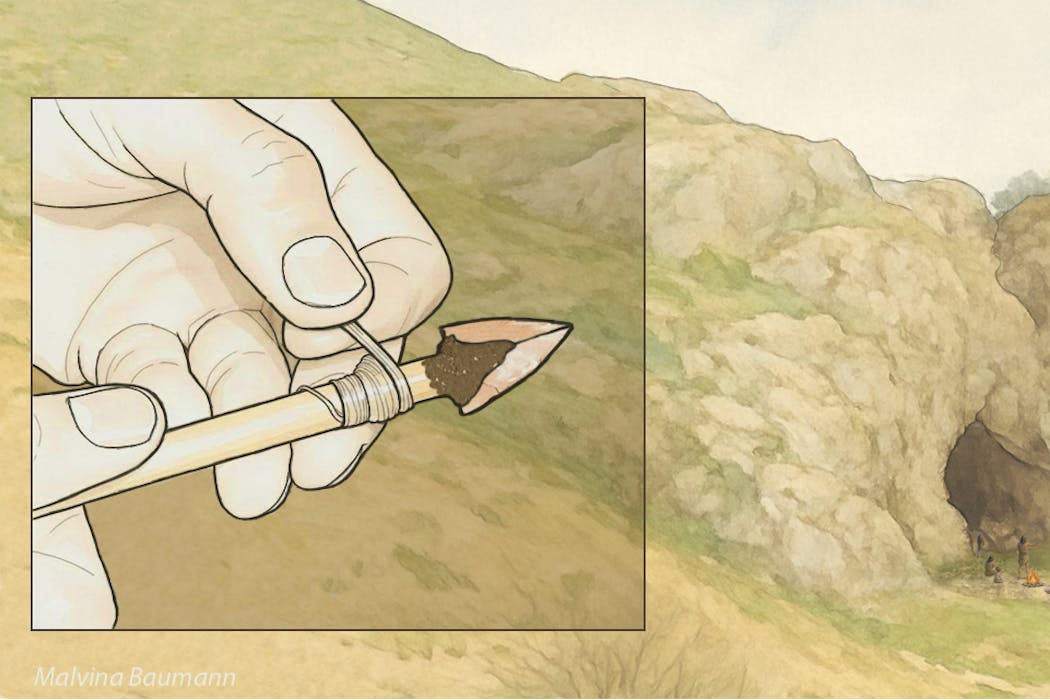
Obi-Rakhmat rock shelter in Uzbekistan, micro-point hafting and main game hunted around the site 80,000 years ago (artwork courtesy of Malvina Baumann). Malvina Baumann, Fourni par l’auteur

Unretouched triangular microlithic projectile points have been identified from their impact traces in the oldest occupation layers of the Obi-Rakhmat site in Uzbekistan, dating to 80,000 years ago. Their size corresponds to small arrowheads, which are directly comparable to those produced by Homo sapiens during an incursion into Neanderthal territory in the Rhône Valley, 25,000 years later. This new study, published in PLOS One journal, provides a strong argument that could rewrite history on Homo sapiens‘ first settlement in Europe.

The chrono-cultural and anthropological frameworks of prehistory, along with the evolutionary models they inspired, were first created in Western Europe, especially France, in the second half of the 19th century. They were initially linear and Eurocentric: Cro-Magnons (European early modern humans), descending from Neanderthals, laid the foundations for the civilisational superiority claimed by this part of the world at the time. It was not until a century later that the African origin of Homo sapiens, as well as the technological and social features that characterised the Western Upper Palaeolithic (symbolic productions, long-distance networks, and diversified lithic and bone tools and weapons), were recognised.

The earliest evidence of Homo sapiens in Australia, dating back around 65,000 years (Clarkson et al., 2017), predates that found in Europe by 10 millennia, while the ways in which our ancestors initially colonised Western Eurasia over 45,000 years ago remain contentious. The temporal alignment of the earliest European Upper Palaeolithic settlements with those in the Levant, which are considered the closest in terms of typology and technology, is still not satisfactory. This is either because the Levantine data comes from old excavations or because it does not fit into the supposed direct lineage. Despite its geographical proximity to Africa, the origins of the Initial Upper Palaeolithic in the Levant are themselves uncertain. This is why the possibility of a Central Asian origin suggested by archaeologist Ludovic Slimak in 2023 (Slimak, 2023) deserves attention.

A site in Central Asia

View from the Obi-Rakhmat rock shelter on the end of the Tien Shan. Hugues Plisson.
Fourni par l’auteur

Depending on climatic conditions, Central Asia has served as a corridor facilitating movement between the western and eastern parts of the continent or as a refuge zone. The archaeological record in this region is limited but includes several significant Palaeolithic sites.

Among them is the Obi-Rakhmat rock shelter in Uzbekistan, discovered in 1962, whose latest excavation campaigns were led by Andrei Krivoshapkin. At the south-western end of the Talassky Alatau range of the Tien Shan mountains, at an altitude of 1,250 metres, the settlement provides a remarkably consistent lithic industry, comprising points, large blades, and bladelets across a stratigraphic sequence spanning over 10 metres, dating from approximately 80,000 to 40,000 years ago. This industry was initially classified as part of the Initial Upper Palaeolithic but it appears to derive from the Levantine Early Middle Palaeolithic. The early Middle Palaeolithic, associated with archaic Homo sapiens at the Misliya cave (Hershkovitz et al., 2018), disappeared from the Near East around 100,000 years ago. At Obi-Rakhmat, the skull remains of a child found in a layer dating back ~70,000 years show features considered to be Neanderthal and others to be anatomically modern, a combination that could be the result of hybridisation.

Massive blades but microlithic points

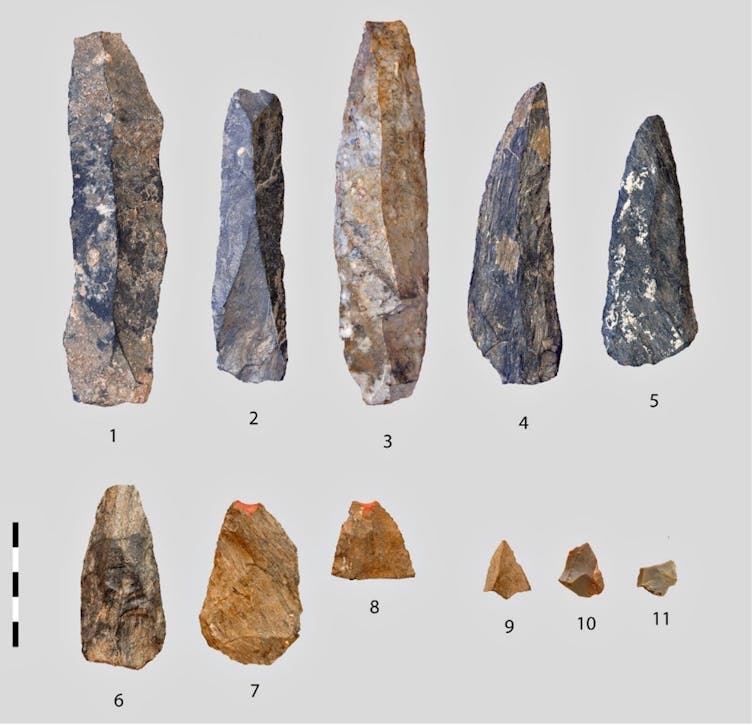
Elements of lithic industry from layer 21 at Obi-Rakhmat: unretouched blades (1-2), large retouched blade (3), pointed retouched blades (4-5), impacted retouched points (6-8), unretouched Levallois micro-point (9), unretouched impacted micro-points (10-11). Hugues Plisson.
Fourni par l’auteur

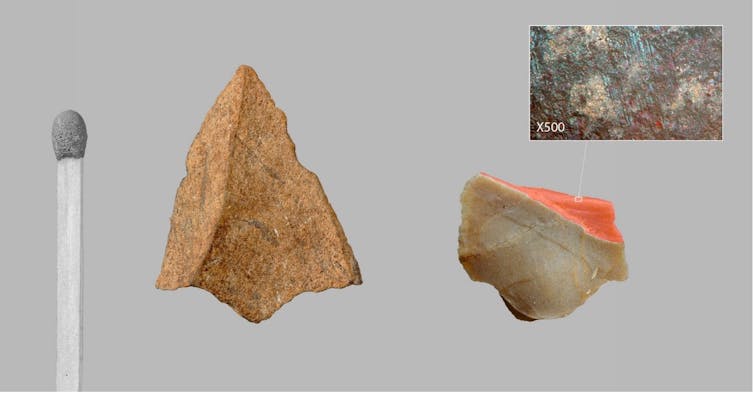
In this context, our international multidisciplinary team has identified tiny, unretouched, triangular projectile points within the lithic debris of the oldest stratigraphic layers. These points were distinguished based on their macroscopic and microscopic impact marks, which were compared to experimental reference data. Due to their small size (less than 2 cm in width and weighing only a few grams) and brittleness, they would have been unsuitable for mounting on heavy shafts. The width of their cutting edges corresponds to the diameter of arrow shafts documented ethnographically for low-poundage bows, consistent with transcultural invariants rooted in physical and ballistic constraints.

Two unretouched micro-points recovered from layer 21 of Obi-Rakhmat. One is intact, while the other is broken and shows scratches resulting from use as a projectile head. The matchstick illustrates their small size.
Fourni par l’auteur

A question of ballistics

Thrown piercing weapons are complex systems whose components are not interchangeable from one type of weapon to another, as they meet different requirements in terms of intensity and nature of stress.

The significant impact force of spears held or thrown by hand makes the robustness of the weapon an essential parameter, both in terms of effectiveness and the hunter’s survival, with mass ensuring robustness, impact force and penetration. In contrast, the penetration of light projectiles shot from a long distance depends on their sharpness, because their kinetic energy, which is much lower, comes mainly from their speed, which, unlike mass, decreases very rapidly along the trajectory and in the target. As this speed cannot be achieved by the extension of the human arm alone, it necessarily depends on the use of a throwing instrument. Arrowheads and spearheads or javelin heads are therefore not designed according to the same criteria and cannot be mounted on the same shafts, the dimensions and degree of elasticity of which are also essential in terms of ballistics. Thus, as in palaeontology, where the shape of a tooth reveals the type of diet and suggests the mode of locomotion, the characteristics of a point provide clues as to the type of weapon of which it is the wounding element.

Weaponry specific to ‘Sapiens’?

The tiny size of Obi-Rakhmat’s points cannot be regarded as a default choice, not only because there is no shortage of good-quality lithic raw material on site from which large blades were made, but microscopic examination of traces of use or wear also shows that within this same assemblage there are also much more robust retouched points (15 to 20 times heavier and 3 to 4 times thicker), similarly impacted by use as axial projectile points (the size of spearheads or javelin heads).

Returning to the bibliography and our own work on Middle Palaeolithic tools (Plisson et Beyries, 1998), we found that the presence in the same assemblage of various types of projectile points and inserts, some of which were microlithic and produced for this purpose, is only known at Homo sapiens sites. The oldest documented occurrences are in South Africa in the Pre-Still Bay (more than 77,000 years old) and later cultural layers of the Sibudu cave. In contrast, lithic points damaged by use as projectile heads are rare in the Neanderthal record. When present, they tend to be large and do not notably differ in size, manufacture or type from points used for activities other than hunting, such as gathering plants or butchery. This difference in the design of tools and weapons takes on anthropological significance.

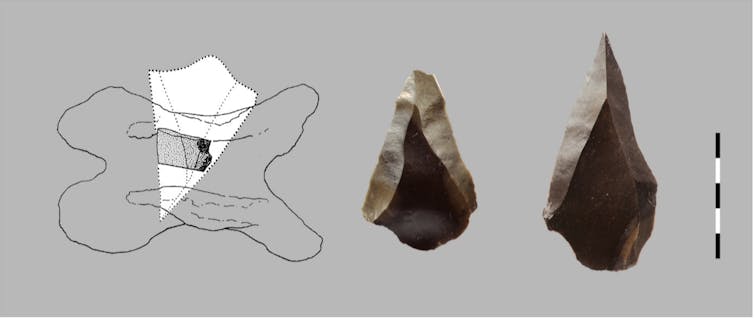
Levallois points from the Um El Tlel site in Syria, from the Late Middle Palaeolithic period in the Levant attributed to Neanderthals. From left to right: graphic reconstruction based on a fragment found embedded in a donkey vertebra, plant knife blade, butcher knife blade. These multipurpose points are 2 to 3 times wider than the micro-points from Obi-Rakhmat. Hugues Plisson.
Fourni par l’auteur

Given their respective dates, the distance between South Africa and Central Asia (14,000 km) and the difference in the manufacture of the Obi-Rakhmat and Sibudu weapon heads (unretouched knapped stone points vs. shaped stone points or retouched inserts, shaped bone points), the hypothesis of independent centres of invention is the most likely.

From the foothills of the Tien Shan to the Rhône Valley 25,000 years later

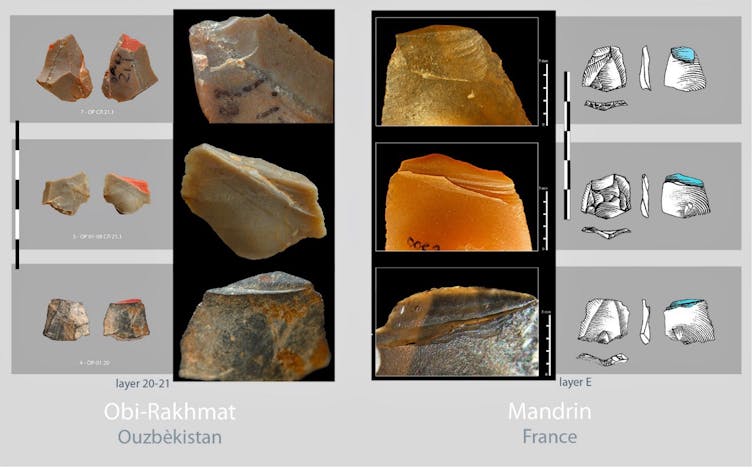
The micro-points from Obi-Rakhmat have no known equivalents in the Eurasian Middle Palaeolithic, except for identical projectile points identified by Traceology expert Laure Metz (Lewis et al., 2023) at the Mandrin site, in the Rhône Valley, France, in a layer dating to approximately 54,000 years ago – some ten thousand years before the disappearance of local Neanderthals. Notably, a Homo sapiens milk tooth was also recovered from this layer (Zanolli et al., 2022. The similarity between the micro-points from Obi-Rakhmat and Mandrin, despite being separated by more than 6,000 km and 25 millennia, is such that they could be interchanged without any detail other than the stone betraying the substitution.

Morphological and functional similarity between the micro-points of Obi-Rakhmat and Mandrin, broken by their use as projectile head. The location and extent of their fracture (highlighted in red and blue and macroscopic detail) are indicative of axial impact. Hugues Plisson.
Fourni par l’auteur

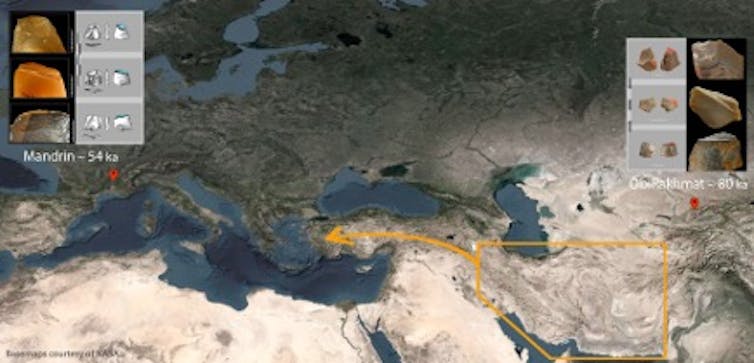
Recent work published by paleogeneticists Leonardo Vallini (Vallini et al., 2024) and Stéphane Mazières (Mazières et al., 2025) defines the Persian Plateau, on the north-eastern edge of which Obi-Rakhmat is located, as a population hub where the ancestors of all present-day non-Africans lived between the early phases of expansion out of Africa – long before the Upper Palaeolithic – and the wider colonisation of Eurasia. This resource-rich environment may have provided a refuge conducive to demographic regeneration after the genetic bottleneck of the exit from Africa, interaction between groups and, consequently, technical innovations.

On either side of the Persian plateau (orange box), genetically identified as a refuge area for the concentration and demographic development of first Homo sapiens who left Africa, Obi-Rakhmat and Mandrin share the same micro-projectile points, 25,000 years and 6,000 km apart. Hugues Plisson.
Fourni par l’auteur

Obi-Rakhmat and Mandrin may represent two geographical and temporal milestones within the same process of dispersal, as suggested by Ludovic Slimak (Slimak, 2023), characterised by the dissemination of a key technological innovation unique to Homo sapiens. So far unnoticed because they are unretouched, tiny and fragmentary, it is likely that the micro-projectile points for which recognition criteria have now been defined will begin to appear at sites between Central Asia and the western Mediterranean.

Premises for a new scenario of the western peopling by ‘Homo sapiens’

This discovery is stimulating in several ways.

It validates the consistency of the research conducted at the Mandrin site, which came to the conclusion that Sapiens armed with bows made a brief incursion into Neanderthal territory. Several elements of this study had been criticised (Klaric et al., 2024)– which is, however, normal in science when a new proposal deviates too far from established knowledge – but its predictive dimension had not been considered at the time.

The similarity between Mandrin and Obi-Rakhmat’s micro-points cannot be a mere coincidence. It is not only their shape that is similar, but also the way they are made, which requires real expertise, as evidenced by the meticulous preparation of their striking platform and their function. One could debate the appropriate instrument for shooting arrows armed with such tiny tips, the bow being in filigree, or whether it is preferable to remain cautious and speak only of shooting, but this already contrasts with what we know about Neanderthal hunting weapons and their design.

Another remarkable aspect, which is still relatively uncommon, is the convergence and complementarity of data from material culture and from our genetic memory, which did not influence each other given the dates of the respective studies and publications. Together, they sketch out a rewriting of the scenario of Homo sapiens’ arrival in Europe: it was thought that he came directly from Africa by the shortest route 45,000 years ago, but we now discover that he had been established in the heart of the Eurasian continent for a long time, well before expanding in search of more territories.


A weekly e-mail in English featuring expertise from scholars and researchers. It provides an introduction to the diversity of research coming out of the continent and considers some of the key issues facing European countries. Get the newsletter!


The Conversation

Les auteurs ne travaillent pas, ne conseillent pas, ne possèdent pas de parts, ne reçoivent pas de fonds d’une organisation qui pourrait tirer profit de cet article, et n’ont déclaré aucune autre affiliation que leur organisme de recherche.

ref. Arrowhead points found in Central Asia could prove the presence of ‘Homo sapiens’ 80,000 years ago – https://theconversation.com/arrowhead-points-found-in-central-asia-could-prove-the-presence-of-homo-sapiens-80-000-years-ago-276550

AI and 3D printing help researchers create heat- and pressure-resistant materials for aerospace and defense applications

Source: The Conversation – USA – By Houlong Zhuang, Associate Professor of Engineering, Arizona State University

Hypersonic aircraft, like NASA’s X-43A shown here, are exposed to extreme heat and pressure. Jim Ross/NASA via Getty Images

From hypersonic aircraft to nuclear-powered submarines, many of today’s most advanced defense systems rely on a special class of materials known as refractory alloys. This class refers to metals that do not melt or weaken easily, even in extreme heat.

An alloy is a material made by combining two or more metallic elements to achieve properties no single metal can offer on its own – greater strength, for example, or better resistance to corrosion. Refractory alloys are based on elements such as tungsten, niobium and molybdenum, which have some of the highest melting points of any metals.

Their atoms are held together by strong chemical bonds and arranged in a stable crystal structure that resists deforming, even at extreme temperatures. Where conventional alloys begin to soften and slowly deform under constant stress, refractory alloys retain their strength, making them essential for components exposed to extreme heat, stress and radiation.

Most refractory alloys in service today were designed decades ago. They predate modern 3D printing of metal parts, also called additive manufacturing, and artificial intelligence.

To execute metal 3D printing, a laser or electron beam melts successive thin layers of metal powder.

This builds up a 3D part directly from a computer model by adding material layer by layer, rather than using molds or removing material from a solid block. 3D printing allows shapes that are impossible with traditional manufacturing methods. However, many current refractory alloys are difficult or impossible to manufacture reliably using these techniques.

This mismatch can slow the domestic production of new parts. To help address these manufacturing and supply-chain challenges, our team of materials researchers at Arizona State University and UNSW Sydney has formed a new international collaboration to redesign high-temperature alloys.

Old alloys in a new manufacturing world

Additive manufacturing allows defense and aerospace manufacturers to produce complex components locally, on demand and with far less material waste. In principle, it is ideal for producing replacement parts for aircraft, spacecraft and naval systems.

In practice, many refractory alloys crack, warp or develop internal defects when 3D-printed. Their compositions were optimized for casting or forging, not for the rapid melting and solidification involved in laser-based printing. In 3D printing, a laser melts and resolidifies metal thousands of times in quick succession, creating steep temperature gradients that generate enormous internal stresses. Several key refractory metals are brittle at room temperature and cannot absorb those stresses without cracking.

The inside of a 3D printer where a piece deposits a thin stream of material onto a round part.
3D printers deposit thin layers of material on top of each other until they build up the part based on the design.
brightstars/Photographer’s Choice RF via Getty Images

Redesigning these alloys using traditional trial-and-error methods would take decades.

Teaching computers to design new metals

Our alternative approach uses reinforcement learning, a form of artificial intelligence best known for training computers to master games such as Go or chess.

Designing a new alloy is a bit like mixing ingredients for a recipe, but at the atomic level. Instead of planning moves on a board, the AI system explores thousands of possible alloy recipes – for example, different combinations of chemical elements. Even tiny changes in the ingredients can completely change how the final material behaves.

The AI evaluates each candidate virtually against multiple criteria, including strength at temperatures above 1,800 degrees Fahrenheit (1,000 degrees Celsius) and resistance to damage caused by reacting with oxygen at high heat, as well as weight, cost and, crucially, whether it can be reliably 3D-printed.

A diagram showing AI leaning to 3D printing, then testing and analysis, then next-generation materials
The research team uses reinforcement learning to figure out combinations of metals to create alloys, then uses 3D printing to manufacture parts with less waste than traditional methods.
Vitor Rielli

Alloys that should perform well are rewarded, while those that fail are discarded. Over repeated cycles, the system learns which chemical combinations work best.

We can then manufacture and test the most promising AI-designed alloys in the laboratory. Their real-world performance feeds back into the model, steadily improving its predictions.

Strategic benefits beyond the laboratory

The implications of our research extend beyond the lab.

For defense agencies, faster materials development means quicker deployment for next-generation engines, hypersonic vehicles and systems that protect against heat. AI-designed alloys can be optimized for strength, heat resistance and manufacturability. For example, NASA’s GRX-810 alloy, designed with computational methods and 3D-printed, is 1,000 times more durable at high temperatures compared with traditional alloys.

Traditional manufacturing of refractory metals wastes up to 95% of the raw material through machining – removing unwanted material to create the precise shape – but 3D printing can bring that figure close to zero.

Our work is an international collaboration. At Arizona State University, the focus is on AI-driven computational design. UNSW Sydney’s facilities allow for high-temperature testing by looking at the metal’s microstructure and conducting additive manufacturing under realistic conditions.

Researchers use AI to design materials that can function under extreme heat and pressure.

Challenges still ahead

This approach is not without hurdles. One of the biggest is data scarcity: AI models learn from existing experimental results, and for refractory alloys, that data is limited. Far fewer alloys in this class have been systematically tested, compared with more common materials like steel or aluminum.

There are also practical constraints. Refractory metal powders suitable for 3D printing are expensive and difficult to source, and scaling up from small laboratory samples to full-sized components is difficult. An alloy that performs well as a thumbnail-sized test sample may behave very differently when printed as a large, complex part.

Finally, AI predictions must always be validated experimentally – and those experiments are costly and time-consuming. The system does not eliminate the need for rigorous physical testing.

A new model for defense-focused research

Our collaboration is in its early stages. We are currently building the AI model and assembling the experimental databases it will learn from. Later this year, the first candidate alloy compositions will be selected for 3D printing and laboratory testing. The results will feed back into the model.

We are also working with defense research agencies to ensure our work aligns with real-world needs and to lay the groundwork for larger-scale programs.

In an era where technological advantage increasingly depends on speed and adaptability, reimagining how we design the metals behind defense systems can improve the systems themselves.

The Conversation

Houlong Zhuang receives funding from Security and Defence PluS Alliance.

Vitor Rielli receives funding from Security and Defence PluS Alliance

ref. AI and 3D printing help researchers create heat- and pressure-resistant materials for aerospace and defense applications – https://theconversation.com/ai-and-3d-printing-help-researchers-create-heat-and-pressure-resistant-materials-for-aerospace-and-defense-applications-273687

With Artemis II facing delays, NASA announces big structural changes to the lunar program

Source: The Conversation – USA – By Marcos Fernandez Tous, Assistant Professor of Space Studies, University of North Dakota

Top NASA officials give an update on major changes to the Artemis program on Feb. 27, 2026. Miguel J Rodriguez Carrillo/AFP via Getty Image

Throughout February 2026, people at the Kennedy Space Center got to witness an exciting sight: NASA’s behemoth Space Launch System rocket, SLS, standing on the launch pad, aimed toward the sky. The launch system has been key to the Artemis program – an ambitious series of missions intended to culminate in a sustained human presence on the Moon. NASA had initially planned to launch the second Artemis mission, which would take a crew of four people around the Moon, in February.

But as anticipation for launch built, an issue with the liquid propellant arose. A few days later, the SLS faced another problem, this time with the rocket’s upper stage, and had to roll back from the pad.

I’m an aerospace expert who is deeply passionate about aerospace technology and what it means for the U.S. and humanity’s future. I’ve been following the Artemis program’s timeline – February 2026 has represented a pivotal moment for U.S. spaceflight. Artemis II faced a number of delays, and NASA officials announced a shake-up of the larger program’s timeline.

A rocket attached to scaffolding on a rolling pad, against a sunset.
NASA’s Artemis II SLS Moon rocket, along with the Orion spacecraft, slowly rolls back toward the vehicle assembly building at the Kennedy Space Center on Feb. 25, 2026.
AP Photo/John Raoux

Springing leaks

It started on Feb. 2, during Artemis II’s first wet dress rehearsal. During this major test, engineers assemble all components of the Space Launch System and fill its tanks with a combined 700,000 gallons of super-cold liquid hydrogen and liquid oxygen. These liquids act as the propellant for the rocket during launch.

During the test, the team detected a hydrogen leak at the interface of a 33‑foot-high (10 meters) service mast, the removable structure that brings the hydrogen and oxygen to the tank. They attributed the cause of the issue to moisture accumulated in the Teflon seal of two interfaces between that mast and the vehicle’s tank.

On the following day, NASA decided to postpone the launch until March 6. A new wet dress rehearsal would take place on Feb. 19 to verify everything was working as expected.

On the day of the second wet dress rehearsal, hydrogen operations proceeded smoothly, seemingly confirming plans for a March launch for Artemis II. Engineers at NASA likely breathed a sigh of relief, but they did so too early. A couple of days later another problem surfaced: They found the exploration upper stage was leaking helium. This upper stage of the rocket kicks in above 62 miles (100 kilometers), once the core stage expends all its propellant.

Because helium is essential for pressurizing cryogenic tanks and for purging the pipelines that will carry highly reactive liquid oxygen, the leak raised concerns.

Notably, these issues echoed the challenges SLS encountered ahead of its first launch for the Artemis I mission in 2022. Artemis I launched nearly six years after NASA’s original target date, ultimately accumulating 25 scrubbed or delayed launch attempts. Recurring hydrogen leaks in the tail service mast umbilical – a very similar issue – caused several of these delays.

Trouble with the SLS

On Feb. 25, the same day SLS rolled back to the vehicle assembly building for more work, NASA’s independent Aerospace Safety Advisory Panel released its annual report. This panel began in the aftermath of the January 1967 Apollo command module fire that claimed the lives of three astronauts, and NASA headquarters takes its assessments very seriously.

Citing the problems encountered on Artemis I and II, the panel warned of elevated risks for Artemis III, which planned to land on the Moon. They strongly recommended NASA restructure the program to reduce the likelihood of similar issues on future missions.

On Feb. 27, NASA made a major announcement: Artemis IV, scheduled for 2028, would now include a lunar landing. Artemis IV would then overlap with another landing planned in the same year, Artemis V.

NASA head Jared Isaacman discusses changes to the Artemis program on Feb. 27, 2026.

NASA also confirmed that it plans to replace the exploration upper stage – the source of the helium leak – with a different upper stage known as the interim cryogenic propulsion stage. While the exploration upper stage was designed to use four engines, the interim cryogenic propulsion stage relies on a single engine.

The interim cryogenic propulsion stage previously flew on Artemis I, after which NASA intended to transition to the exploration upper stage for future missions. With the restructuring, however, the exploration upper stage program has been canceled, and NASA is returning to the interim cryogenic propulsion stage instead. With this change, Artemis appears to be going back to the basics and returning to simpler, proven hardware.

While Artemis II will not launch before April, the plan for the mission itself remains the same: It will still fly around the Moon.

But this new situation poses a question: If Artemis IV will now carry out the lunar landing, what will become of Artemis III, which had originally been planned as humanity’s return to the Moon? In essence, NASA is accelerating the schedule by adding more launches and tests before the first lunar landing attempt, and these changes are not necessarily to Artemis’ detriment.

A new timeline

NASA aims to increase the cadence of launches up to every 10 months starting in April 2026, incorporating fewer changes from mission to mission each time. This approach reduces technological uncertainty and stands in sharp contrast to the more than three‑year gap between the 2022 launch of Artemis I and the potential 2026 launch of Artemis II.

Artemis III will now become a tightly focused rehearsal mission lasting 30 days. NASA will test each mission component independently rather than checking them all together as a unit. Instead of visiting the Moon, Artemis III will remain closer to Earth.

NASA Administrator Jared Isaacman explained to CBS on Feb. 27 that Artemis III will launch the Orion spacecraft, which holds the astronaut crew, into low Earth orbit, where it will dock with one or both lunar landers – Blue Origin’s Blue Moon lander and SpaceX’s Human Landing System.

Jeff Bezos stands in front of a large spacecraft lander labeled 'Blue Moon'
Jeff Bezos, founder of Blue Origin, introduces its newly developed lunar lander Blue Moon.
Jonathan Newton/The Washington Post via Getty Images

The Human Landing System will be a modified version of SpaceX’s Starship, the company’s enormous, superheavy spacecraft. The docking maneuver will help NASA confirm that the lander can handle the forces involved in connecting with Orion in space – essentially checking that the structure behaves as expected and can safely support the crew and their equipment.

Isaacman also pointed out that Artemis III may allow for NASA to test out the new spacesuit Axiom Space is designing for forays outside of the spacecraft.

The mission may also test navigation, communication, propulsion and life‑support systems. Interestingly, this series of tests aligns Artemis III more closely with the historical role of Apollo 7, which focused on evaluating the command and service module in Earth orbit.

In short, the new plans reshape Artemis III into a proof‑of‑concept mission intended to validate several critical systems before the two lunar landings planned for 2028 with Artemis IV and V. If successful, this approach should greatly improve the reliability of the missions that will finally return humans to the lunar surface. The revised timeline creates more opportunities to test and troubleshoot all the systems required for a safe landing.

It will also keep the missions more straightforward. With the same configuration across all missions, the tests will build on each other.

For now, you will need to wait a bit longer to watch humans walk in the Moon’s south pole region, where icy craters may hold clues to the early history of our solar system. But if February 2026 sets the tone, this next chapter will be anything but dull. Fasten your seat belts.

The Conversation

Marcos Fernandez Tous does not work for, consult, own shares in or receive funding from any company or organization that would benefit from this article, and has disclosed no relevant affiliations beyond their academic appointment.

ref. With Artemis II facing delays, NASA announces big structural changes to the lunar program – https://theconversation.com/with-artemis-ii-facing-delays-nasa-announces-big-structural-changes-to-the-lunar-program-277169

I study why zebrafish larva prefer to circle left or right, to understand how and why human brains encode right- and left-handedness

Source: The Conversation – USA – By Eric Horstick, Associate Professor of Biology, West Virginia University

Having a hand preference speaks to more than just your preferred way to write. Domingo/iStock via Getty Images Plus

Being right- or left-handed is a familiar fact about yourself you likely don’t think about much on a day-to-day basis. However, your handedness affects how you interact with the world.

For many people, it determines how they brush their teeth, use tools, play sports, write, eat and much more. Simply try to enjoy a bowl of soup or sign your name with your nondominant hand to appreciate the impact a hand preference can have on your daily life.

Interestingly, this behavioral asymmetry is not unique to humans. Preferences for using the right or left hand, paw or eye exist in most species. For example, many primate species have individual left- or right-hand preferences for manual tasks. Similarly, different bird species have varying eye preferences for distinct visual tasks. Even the largest animal alive, the blue whale, shows a preference for the direction of its rolls during feeding. This inherent and often-overlooked feature of behavioral asymmetry is a widespread phenomenon in the animal kingdom.

The universality of behavioral asymmetry suggests that having an assigned hand, eye or other preference is beneficial. But depending on one hand for so many important tasks means that a single injury could be devastating. This paradox poses an important question: Why would having handedness be better for survival than not?

Insights from fish ‘handedness’

To address this question, scientists have tried to understand the genetics of handedness. While large-scale genetic studies in humans have identified dozens of genes associated with handedness, researchers also found that genetics alone only partially accounts for whether someone is left- or right-handed. This means behavioral asymmetry like handedness is likely the product of complex interactions between genetics, development and the environment.

For the past six years, my research lab has been interested in understanding behavioral asymmetry and how such behaviors get encoded in the brain. We primarily use larval zebrafish to explore the neural basis of behavioral asymmetry. These animals have transparent bodies and rapidly develop into adults in just a few days, making them ideal models to study. Additionally, the genetics and brain structure of zebrafish are highly similar to those of humans.

Fish have a form of handedness called motor asymmetry, which involves sustained periods of turning in the same direction. I had previously found that when light was cut off, larval zebrafish start circling in a leftward or rightward direction, sometimes for up to a minute or more. The fish would continue to preferentially turn in that same direction over the course of hours, days and even weeks, looking for a light source. This meant that vision drove their motor asymmetry.

Microscopy image of violet, symmetrical outline of the top of a fish with two white lines and nodules extending down its length
Zebrafish make it easy to see their neural activity. Eyes are to the left, and neurons are colored white.
National Institute on Deafness and Other Communication Disorders/Flickr, CC BY-NC-SA

Students in my lab recorded the zebrafish’s neural activity in response to loss of environment light – the trigger for motor asymmetry. They found a subset of approximately 60 neurons in the thalamus – a region of the brain that is evolutionarily conserved among vertebrates and involved in relaying sensory information – was functionally linked to motor asymmetry. Removing these neurons eliminated this motor asymmetry, suggesting a potential neural basis for where behavioral asymmetry is established in the fish brain.

When my lab repeated our experiments on five additional species of larval fish from around the world, we found similar motor asymmetry in response to light. Much like handedness in primates, it appears that handedness in fish is likely more of a rule than an exception.

However, we did find one exemption: the Mexican tetra, also known as cavefish. These animals are found in perpetually dark cave environments and are naturally blind. In collaboration with our colleagues at the Duboué Lab at Florida Atlantic University, we found that these animals showed no motor asymmetry.

These findings suggest that the universal nature of behavioral asymmetries are likely crucial responses to common challenges that different organisms encounter.

Behavioral asymmetry may solve challenges

Hurting your dominant hand does more than just ruin your softball or ultimate frisbee game. Handedness is associated with broad neural asymmetries in the brain that are linked to performance in language comprehension and working memory tasks. In addition, having atypical handedness – such as preferring different hands for different activities – is associated with a range of neurological conditions, including autism and attention-deficit/hyperactivity disorder.

Understanding why animals have behavioral asymmetries offers clues about how the environment influences broader cognitive function. If environmental challenges indeed drive handed behaviors, what problems does motor asymmetry solve for fish?

Close-up of a silver fish looking up at a pink-tinged fish without eyes
Astyanax mexicanus living on the surface have eyes (bottom), while those living in caves do not (top).
Daniel Castranova/NICHD/NIH via Flickr, CC BY-NC-ND

In nature, animals often circle when searching for something, such as a food source. For larval zebrafish, light is an important resource for their ability to see and capture prey. When we placed a light source at varying locations around them, the larval zebrafish start circling to quickly navigate into illuminated environments conducive to hunting. Based on our work, we hypothesize that the asymmetries in fish that allow them to search more efficiently work in parallel ways to those of other animals, like eye movement in birds or language comprehension in people.

Prior research has suggested that brain asymmetries improve cognitive performance by reducing competition between the two sides of the brain. Our work supports these hypotheses by showing how, for zebrafish, motor asymmetry provides a default response to find light and efficiently catch a needed snack.

With a helping hand from fish handedness, researchers are getting a clearer idea of the universality of behavioral asymmetry and how the environment may be shaping the brain so that one hand, or fin, provides an advantage in daily life.

The Conversation

Eric Horstick receives funding from the National Institutes of Health and National Science Foundation.

ref. I study why zebrafish larva prefer to circle left or right, to understand how and why human brains encode right- and left-handedness – https://theconversation.com/i-study-why-zebrafish-larva-prefer-to-circle-left-or-right-to-understand-how-and-why-human-brains-encode-right-and-left-handedness-274578

Why the U.S. is unlikely to curtail China’s critical minerals dominance

Source: The Conversation – Canada – By Craig Anthony Johnson, Professor of Politics, University of Guelph

The United States government recently hosted a critical minerals summit aimed at reducing China’s predominant role in the global production of smartphones, weapons systems, lithium-ion batteries and electric vehicles (EVs).

The meeting, which included representatives from Argentina, Australia, Bolivia, Canada, Chile, the Democratic Republic of Congo, India, the European Union, Japan, South Korea and the United Kingdom, is part of a larger structural trend that Canadian Prime Minister Mark Carney recently called a “rupture” to the rules-based international order.

At first glance, the U.S. government’s weaponization of tariffs and trade indicate changing dynamics in global trade and the development of critical minerals, advanced manufacturing and emerging technologies. On closer inspection, American efforts to weaken China’s dominance over the critical minerals industry face a more complicated reality and an intricate web of public- and private-sector investment agreements tied to Chinese firms.

According to the International Energy Agency, China accounts for more than 80 per cent of global battery production. The figure jumps to 90 per cent for grid scale batteries that are used to store wind and solar power.

Global battery sales have grown sixfold since 2020, a direct result of falling prices and the competitiveness of China’s low-cost manufacturing model. Over the same period, manufacturing of grid-scale battery systems has expanded 20-fold.

Within this reality, the idea that the U.S. can strategically reduce China’s role in the production and processing of critical minerals appears highly unlikely.

Competition for critical minerals

My research focuses on environmental politics, extractive industries and the expansion of renewable energy value chains in Latin America. I am currently leading a study on the politics of lithium extraction in Argentina, Australia, Bolivia, Canada and Chile.

Over the past year, the U.S. upped its efforts to reduce China’s involvement in South America, a region that accounts for more than 50 per cent of the world’s known lithium deposits.

In 2025, the U.S. government acquired a five per cent share in Lithium Americas, a Canada-based company that has a long presence in Argentina. In February, the U.S. government announced another deal to acquire a 10 per cent stake in the mining company USA Rare Earth.

In 2025, the White House used the threat of tariffs and a US$20 billion bailout package to negotiate a new trade agreement with Argentina. Meanwhile, the U.S.-dominated Inter-American Development Bank signed an agreement to provide more than US$140 million to improve critical mineral production and processing capacity in Latin America.

However, decoupling China from regional production networks raises deeper questions about whether it makes good business or strategic sense to disrupt a global production network that produces 80-90 per cent of the world’s lithium-ion batteries.

At a time when the U.S. is pursuing an “America first” policy of onshoring the production and processing of critical minerals, China has used joint ventures and public-private partnerships to secure access while offshoring the dirtier parts of critical minerals production.

The Chinese company Ganfeng Lithium has been active in Argentina for about a decade and is currently expanding its presence through joint ventures.

In August 2025, the company signed joint ventures with Canadian company Lithium Americas, expanding its operations in the salt flats of Pozuelos, Pastos Grandes and Cauchari-Olaroz. The vast majority of Ganfeng’s production goes to battery and EV assembly hubs in China and Southeast Asia.

In contrast, China’s involvement in Chile has largely been limited to a minority share in the Chilean mining company SQM since 2018. Under the left-wing government of Gabriel Boric, Chile’s National Lithium Strategy promised to restrict new licences to state-owned copper and mining companies Codelco and Enami.

However, the recent electoral victory of President-elect José Antonio Kast, a right-wing politician with close ties to Chile’s business sector, raises new questions about the future viability of the nationalist policy.

Similarly, questions have been raised about whether the Bolivian government will maintain its state-led model of resource nationalism under the newly elected right-wing government of Rodrigo Paz Pereira.

Chinese and Russian companies have a strong presence in Bolivia. In 2024, the majority state-owned lithium company, YLB, signed a US$1 billion agreement with the Chinese consortium CBC to start developing the Uyuni salt flat. But Bolivia’s lithium production has remained negligible, reflecting longstanding challenges of extracting lithium from the Uyuni salt flat and resolving domestic conflicts over the distribution of profits.

Looking ahead

In theory, the election of right-wing governments in Argentina, Bolivia and Chile should favour the U.S. This is most evident in Argentina, where libertarian president Javier Milei has already established strong ties with the White House and with U.S. President Donald Trump personally.

Compared with Argentina, Chile appears less likely to concede to American concerns about China. This reflects the Chilean state’s dominant role in the global copper market, domestic conflicts over the nationalization of Chile’s lithium sector and the enduring influence of Chinese political and diplomatic interests.

Looking ahead, major questions remain about whether American companies have the willingness and capacity to assume China’s role in the global production of lithium-ion batteries and whether they’ll align themselves with U.S. foreign policy interests. For instance, the U.S.-based Albemarle Corporation is one of the world’s largest lithium companies, but it is publicly traded and owned by multiple investors.

Outside of South America, global lithium production remains dominated by American, Chinese and Australian firms, including Rio Tinto, the Anglo-Australian mining giant that is currently consolidating lithium operations in Argentina and Chile. Almost all have joint ventures with Tianqi, Ganfeng and other Chinese companies.

The North American economy has neither the capacity nor the wage competitiveness to replace China’s role in producing and processing critical minerals for batteries, energy storage systems and EVs.

Reducing China’s dominant role in the global critical minerals industry would entail developing a robust supply chain that can out-compete China’s. Given current economic and geopolitical realities, this seems improbable in the foreseeable future.

The Conversation

Craig Anthony Johnson receives funding from the Social Sciences and Humanities Research Council of Canada.

ref. Why the U.S. is unlikely to curtail China’s critical minerals dominance – https://theconversation.com/why-the-u-s-is-unlikely-to-curtail-chinas-critical-minerals-dominance-275416

Housing First helps people find permanent homes in Detroit − but HUD plans to divert funds to short-term solutions

Source: The Conversation – USA – By Deyanira Nevárez Martínez, Assistant Professor of Urban and Regional Planning, Michigan State University

Detroit area homelessness providers worry the federal funding shift could affect thousands of individuals and families across the region. Charles Ommanney/Getty Images Joshua Lott/Getty Images

A bureaucratic shift in Washington is threatening to undo years of progress in Detroit’s fight against homelessness, potentially forcing thousands of the city’s most fragile residents back onto the streets.

In November 2025, the U.S. Department of Housing and Urban Development revised how it would allocate funding through its flagship homelessness program, the Continuum of Care.

The change reduced the share of funding available for permanent subsidized housing and increased funding for transitional short-term housing.

HUD officials described the shift as a move away from a “housing first” model toward a “treatment first” approach that emphasizes participation in services, such as drug addiction disorder treatment, before or alongside housing placement.

The administration has argued that this promotes self-sufficiency. Critics contend that stable housing is the foundation that makes treatment and recovery possible.

The policy revision has been challenged in court by 20 states, including Michigan, as well as city and county governments and advocacy organizations. They argue it could destabilize individuals and families across the country, state and here in Detroit.

I am an urban and regional planning scholar who studies housing policy, and I serve on the research council of the National Alliance to End Homelessness.

In December 2025, I joined 77 other homelessness researchers who sent a letter to Congress analyzing the likely impacts of HUD’s revised funding approach. That analysis draws on decades of peer-reviewed research evaluating which housing interventions reduce homelessness and which do not.

That same month, a federal judge issued a preliminary injunction that temporarily pauses HUD’s efforts to shift funding away from permanent supportive housing.

HUD officials stated that the agency intends to apply the changes in future funding rounds, once the order is no longer in effect.

Homelessness in Detroit

Detroit’s homelessness crisis is both long-standing and worsening.

The number of people who experience homelessness in Detroit, Hamtramck and Highland Park increased by about 16% from 2023 to 2024, with roughly 1,725 people experiencing homelessness on a single January night, including hundreds of families. Children in particular have been hit hard by this crisis. One data snapshot shows 2,579 children reported being doubled up, staying in a shelter, staying in a hotel or motel or being unsheltered. This was a record number for the Detroit Public Schools Community District.

While permanent supportive housing has strong outcomes for those who receive it, overall homelessness has continued to increase due to rising rents, economic instability and the limited housing supply, which has historically outpaced the number of available supportive units.

Detroit’s homelessness response system is coordinated through the federally funded local Continuum of Care led by the Homeless Action Network of Detroit.

In recent years, Detroit has taken steps to strengthen coordination, expand shelter capacity and increase housing placements. But the system heavily depends on federal funding to provide permanent supportive housing.

What could change in federal homelessness funding

The Continuum of Care program began in 1994 and was later codified in 2009 by the Homeless Emergency Assistance and Rapid Transition to Housing Act. It is the largest federal funding stream dedicated to addressing homelessness in the United States.

Last year alone, Detroit received US$40 million from the HUD program.

Those funds pay for emergency shelters, transitional housing and rapid rehousing programs – which provide temporary rental assistance and the assistance of a social worker, without preconditions – and permanent supportive housing.

Like other cities nationwide, Detroit has built its homelessness response system around HUD’s funding priorities.

For more than a decade, HUD has emphasized permanent housing. A strong body of evidence shows that stable housing leads to better long-term outcomes than temporary programs.

Color portrait of a Black man in a light blue suit and yellow tie
Current HUD Secretary Scott Turner.
Tom Williams/CQ-Roll Call Inc. via Getty Images

Prior Continuum of Care funding cycles allocated roughly 85% to 90% of funds to permanent housing, according to the National Alliance to End Homelessness.

The revised funding priorities announced in late 2025 would substantially reduce that share and redirect funding toward transitional housing and short-term interventions.

According to the Homeless Action Network of Detroit, this means that Detroit area providers could go from about $34 million per year allocated for permanent supportive housing under the current allocation to no more than about $11 million under the new priorities.

Local advocates warn that capping permanent housing at roughly 30% of Continuum of Care dollars would drastically reduce the number of supportive units available and place hundreds of households at risk of returning to homelessness.

Why permanent supportive housing matters

Permanent supportive housing is one of the most rigorously studied homelessness interventions in the United States.

It is an evidence-based intervention that provides long-term rental assistance paired with voluntary supportive services for people who have experienced chronic, or repeated, homelessness, particularly those with disabilities or chronic health conditions.

Under the current Continuum of Care framework, households typically pay no more than 30% of their income toward rent, with the subsidy covering the remainder. Assistance can continue as long as eligibility criteria are met.

Programs also offer staff to help with coordination of health care and behavioral health services and assistance identifying and applying for relevant benefits to promote long-term housing stability. Tenants hold standard leases and have the same legal protections as other renters.

Research shows that permanent supportive housing using a housing-first approach consistently reduces homelessness and improves health outcomes for people with disabilities.

Greater investment in permanent supportive housing is also linked to reductions in chronic homelessness, meaning individuals or families who have been homeless for long periods or repeatedly over time.

A long-term study published in Social Service Review in 2014 found that communities that increased permanent supportive housing capacity experienced measurable declines in chronic homelessness over time.

Local data from the Detroit Continuum of Care indicate that at least 160 new permanent supportive housing units have been made available in the past year, and another 235 units are projected for 2026. These units help people exit homelessness and maintain stable homes amid rising rents and affordability challenges.

How transitional housing compares

Transitional housing typically requires residents to participate in supportive services or programming as a condition of stay. This can include regular meetings with a social worker, employment readiness classes, substance use treatment or financial literacy workshops, for example.

The model is often used for survivors of domestic violence or young adults aging out of foster care. While transitional housing can provide short-term stability and support during these transitions, it differs from permanent supportive housing in that it is time-limited and may require program compliance as a condition of continued residency. Transitional housing placements typically last from about six months up to two years.

Exterior of building with a sign that reads: Detroit Recovery Project Inc.
Residents who live in transitional housing must comply with program requirements as a condition of their stay, which could include treatment for substance use.
Sylvia Jarrus for The Washington Post via Getty Images

However, research consistently finds that transitional housing is less likely than permanent housing to produce long-term housing stability. This is particularly the case for families and people with disabilities.

HUD’s Family Options Study in 2016 found that families offered permanent housing experienced significantly better long-term housing stability than those offered transitional housing, despite transitional housing costing more per household.

Follow-up research conducted by the Urban Institute, a nonprofit organization that studies economic policy, similarly found that many families who leave transitional housing once their time limit expires struggle to maintain stable housing. These findings are especially relevant for individuals with disabilities, chronic illnesses or mental health conditions, all groups that are typically prioritized for permanent supportive housing.

Why Detroit is especially vulnerable

Research shows that housing instability increases reliance on emergency services such as shelters, hospitals and public safety systems. This drives up taxpayer costs and additionally strains already overextended local services.

Detroit area homelessness service providers are pushing back against the potential federal changes, which they identify as “radical.”

In response, many organizations are turning to state and philanthropic partners for support while continuing to develop housing locally to help offset possible reductions in federal funding.

The Conversation

Deyanira Nevárez Martínez has received funding from the State of Michigan, the Latino Policy and Politics Institue at UCLA, the Institute for Research on Poverty at the University of Wisconsin-Madison, and the Freedom Together Foundation (formerly the JPB Foundation). She is an Assistant Professor of Urban and Regional Planning at Michigan State University and is an elected member of the Lansing City Council representing ward 2.

ref. Housing First helps people find permanent homes in Detroit − but HUD plans to divert funds to short-term solutions – https://theconversation.com/housing-first-helps-people-find-permanent-homes-in-detroit-but-hud-plans-to-divert-funds-to-short-term-solutions-274272