Four years ago, Vladimir Putin escalated his war against Ukraine to an all-out assault. The plan was for a quick and lively campaign and a speedy takeover of a country the Russian president thought shouldn’t exist.
Victory would reassert Russia’s status and hasten a shift from a unipolar to a multipolar world; instead of one great power (the United States), we’d have several. Russia would, of course, become one of the “greats”.
So, how’d that go?
Four years on, Russia has not found itself among fellow great powers willing to divide up the globe.
A middle power despite its great power cravings, Russia has instead been forced into a growing dependence on China while having to deal with a multitude of hostile middle powers, which often thwart its ambitions.
When Iran’s foreign minister asked his Russian counterpart for help, Sergei Lavrov sounded more like a European politician than an advocate for a new world order.
He condemned the “unprovoked act of armed aggression […] in direct violation of the fundamental principles and norms of international law”. He called for a “peaceful solution based in international law, mutual respect and a balanced consideration of interests”.
rejection of the old rules of geopolitics have not necessarily played into its favour.
Russia underestimated the extent to which the old order gave it room to manoeuvre. Then, as long as others played by the rules, breaking them could give Russia a tactical advantage.
But once others also opted for raw power, the limits of Russia’s abilities became obvious.
Reality checks
The first reality check came on the battlefield.
Russia lost the battle of Kyiv, had to retreat from much of what it had occupied in the north of Ukraine, and was forced into a grinding war of attrition in the east.
Ukraine lost big swathes of territory in the south, which allowed Russia to establish a land bridge between Donbas and Crimea (which it illegally occupied in 2014).
But Ukraine’s government retained control of 80% of its territory. It also held onto its use of the Black Sea, a vital link to world markets.
Unable to advance meaningfully on the ground, Russia tried a criminal air war targeting civilian infrastructure, hoping to freeze Ukraine into submission.
Such tactics rarely work, but do cause untold misery and suffering for civilians.
Meanwhile, Ukraine is fending off Russia’s attempt to enforce Ukraine’s capitulation at the negotiating table.
Being a great power isn’t cheap
All Russia’s efforts are complicated by the emerging multipolar world order it had so desperately hoped to conjure into being.
Ukraine has been supported by a coalition of middle powers that are slowly finding their feet in this new reality.
Russia has discovered the hard way that its geopolitical fantasy of being a great power in this new multipolar world order comes with one tiny problem: it can’t afford it.
Its population is both declining and ageing. Its GDP (adjusted to purchasing power) is in the same ballpark as that of Japan or Germany (rather than the much larger India, to say nothing of the US or China).
And its economy is dominated by hydrocarbon exports destined for a bleak future in a quickly decarbonising world.
As one of the most consequential middle powers of the Euro-Asian landmass, with a permanent seat on the UN Security Council, and a sizeable military armed with nuclear weapons, it could cause significant damage trying to assert its desired great power status.
But the results were opposite to intentions.
From bad to worse
Unable to subdue Ukraine, Russia’s power projection suffered elsewhere. Its once-close relationship with Israel is on the rocks. It lost its foothold in Syria and has proved unable to support its allies in Iran and Venezuela.
In a lawless international order, it is too inconsequential to dictate the play.
While US President Donald Trump at times treats Putin as an equal, nobody else does.
True, China has celebrated a “no-limits partnership” with Russia, its biggest neighbour.
But it neither took clear sides in Russia’s Ukraine war, nor sent weapons. Instead, Beijing used Russia’s isolation to cement a relationship in which it clearly has the upper hand.
India increased its purchase of Russian oil (now at a steep discount) and continued to buy Russian weapons, but as part of a multi-vector geopolitical strategy.
Rather than a fellow great power, India saw Russia as an opportunity to be exploited in its ongoing quest for an autonomous foreign policy.
Fantasy and reality
Ukraine, meanwhile, lost the clear support from the US it had enjoyed at the start of the war, but has been supported financially and militarily by a flexible coalition of middle powers.
According to the latest data, the nearly US$75 billion (A$105 billion) in military aid the US has provided since the start of the war has amounted to only 30% of the total tally.
The remaining 70%, and all ongoing military support in the past 12 months, came from middle and smaller powers, led by Germany (20%), the United Kingdom (9%), Norway (8%) and Sweden (7%).
Thus, Russia’s war on Ukraine did hasten the emergence of a multipolar world.
It just wasn’t the one Russia had in mind.
Mark Edele receives funding from the Australian Research Council.
The latest US-Israeli bombings in Iran differ from last year’s, because one of the stated aims this time is regime change.
Engaged in the mass murder of civilians at home and fomenting violence abroad, the current Iranian regime has few friends internationally.
Many would be glad to see Iran undergo a far-reaching program of political reform. For many in the Iranian diaspora, regime change imposed from outside is better than none.
But the historical record of imposed regime change, particularly as undertaken by the United States, is patchy at best.
Things rarely go to plan, and the long-term consequences are often disastrous.
Afghanistan and Iraq
Some immediate examples spring to mind.
Still fresh in the public mind would be the shocking scenes of desperate Afghans trying to leave Kabul in 2021 as the United States conceded it could not permanently defeat the Taliban.
This admission came after two decades, thousands of deaths of US and allied troops and tens of thousands of Afghan deaths.
Many would also remember then-US President George W. Bush’s disastrous speech in May 2003 about America’s regime change efforts in Iraq, begun in March that year. Here, Bush addressed the press while standing in front of a huge banner that said “Mission Accomplished”; the implication was regime change had been achieved in just a few months.
In fact, what followed was another decade of US fighting to try to stabilise Iraq, with actions arguably not wound up until 2018 or even beyond.
Once again this came at a huge cost to civilian lives, with The Lancet estimating as early as 2004 that around 100,000 “excess deaths” had occurred as a result of the US attempt to effect regime change there.
Thereafter, Iraq was continuously wracked by violence and civil war. Notably, ISIS took advantage of its weakened state to establish its “caliphate” on Iraqi territory, leading to yet another wave of US intervention.
But US attempts to impose regime change have a much longer and equally unsuccessful history, as well.
From the Bay of Pigs to Iran
The phrase “Bay of Pigs” has become a synonym for the inability to overthrow a government.
Aimed at overthrowing Fidel Castro in Cuba in April 1961, not only was then-US President John F. Kennedy’s foray into regime change unsuccessful (Castro died in his sleep with his regime still in control of Cuba at the age of 90 in 2016), it also led to the execution of CIA operatives there.
The US also faced the embarrassment of having to swap tractors for the freedom of the Cuban exiles who had carried out the failed invasion for them.
In 1953, the US and Britain actually did succeed in overthrowing Iranian Prime Minister Mohammad Mossadeq after he’d announced Iran’s oil industry would be nationalised in response to Western oil companies’ intransigence on royalties and control.
This regime change effort by the US did “succeed” in the short run, but it led to a series of events that culminated in the repressive regime the US aims to replace today.
Mossadeq’s toppling led to the shah of Iran, Mohammad Reza Pahlavi, becoming an absolutist monarch in the cruellest tradition.
His savage repression led in no small way to the 1979 Iranian revolution, which became the vehicle for the present theocratic government to come to power.
It is one of the ironies of history that the son of the dictatorial shah is now presenting himself as the logical candidate to bring democracy to a new Iran.
Some might reach further back and argue regime change in Germany worked after the second world war.
It is worth remembering, however, that this was far from a simple process. It involved occupying Germany for more than a generation, decades of trials against ex-Nazis and splitting the country in two for more than 40 years.
As the epicentre of the Cold War, this is hardly an experiment in regime change that could be easily replicated.
Earlier examples of regime change from the colonial period provide similar lessons.
Large armies of invading colonial forces were able to pull down governments in Africa and Asia and prop up unpopular ones.
But once the occupying forces sought to remove their militaries or lost the will to resort to massacres to reinforce their rule, the shift towards decolonisation or self-rule became increasingly irresistible.
In the Dutch East Indies, French-ruled Vietnam, British India and the Belgian Congo, governments imposed by external powers were rarely viable once the threat of force was removed.
Czechoslovakia’s Prague Spring protests in 1968 – an effort to throw off Soviet-imposed rule – were quickly crushed by the USSR, showing once again that regime change “works” for as long as you are prepared to enforce it with violence.
By 1989, however, the Soviet Union’s appetite for enforcing its hegemony across eastern Europe had waned, leading to a largely peaceful transition to democracy across the region.
A failure to learn from history
Today’s US leaders are unlikely to accept the counsel of history.
But they would do well to remember the simple message of former US Secretary of State Colin Powell’s “Pottery Barn” rule for attempts to overthrow governments: you break it, you own it.
At present, however, the view from Washington seems to be that you can just break states and hope someone else will fix it for you.
Matt Fitzpatrick receives funding from the Australian Research Council He is currently president of the History Council of South Australia.
Global oil markets have reacted swiftly to escalating tensions in the Middle East as the United States and Israel continue their assault on Iran.
After oil tanker traffic through a key chokepoint, the Strait of Hormuz, stopped,
the benchmark oil price, Brent crude, jumped about 6% to over US$77 a barrel. It initially spiked as high as US$82, its highest level since January 2025.
A roughly US$10 jump in a matter of days is a significant move and delivers an immediate inflationary jolt for oil-importing economies.
What does this mean for households, businesses and central banks?
Why oil still matters
Oil may no longer dominate the global economy as it did in the 1970s, but it remains embedded in modern production.
It feeds directly into petrol prices, diesel, aviation fuel and shipping, and shapes the cost of transporting and producing everything from food to manufactured goods. When oil prices rise quickly, the effects spread beyond energy markets.
Economists call this a “negative supply shock”: the result is production becomes more expensive. Companies can absorb higher costs or pass them on to consumers. In practice, they usually do both.
The result is an uncomfortable mix of higher inflation and slower economic growth.
The inflation impact will weigh on central banks
The most immediate effect is at the petrol pump. Higher crude prices lift fuel costs and push up headline inflation. For households already facing cost-of-living pressures, that can be felt quickly.
For example, when the price of oil goes up by $10 a barrel, the rough rule of thumb is that the price of gasoline for US drivers could rise by about 25 cents a gallon. Elsewhere, such as Australia, it’s estimated at around 10 cents a litre more for every US$10 rise.
Transport and logistics costs also increase, and some of those higher costs filter into the broader price level over time.
How much inflation rises depends how long the disruption to oil markets lasts. A brief spike might add only a few tenths of a percentage point to inflation. A sustained increase would be more problematic.
Central banks are watching closely. Inflation in the US and Europe has eased from post-pandemic peaks. In Australia, inflation has fallen from its pandemic highs, but recent data show renewed upward pressure. Reflecting those concerns, the Reserve Bank of Australia raised the official cash rate in February.
An oil shock could weaken global growth
Higher fuel costs risk adding fresh momentum to inflation now, arriving at precisely the wrong time, just as policymakers at the US Federal Reserve and the European Central Bank were hoping it was coming under control.
In one of the first comments from a central banker on the economic impact of the conflict, the Reserve Bank of Australia’s governor today noted the supply shock could add to inflation pressures.
However, Governor Michele Bullock also warned that a prolonged impact on energy markets
could have adverse effects on global economic activity and result in downward pressure on inflation. It is not obvious how this might play out.
Oil-driven inflation is particularly challenging for central banks. Raising interest rates cannot affect the supply of oil. Unlike demand-driven inflation – where strong consumer spending can be cooled by higher interest rates – supply-driven inflation reflects higher production costs.
If central banks lift rates to contain prices, they risk slowing growth further. But the interest rate rises cannot directly lower oil prices.
Pressure on household budgets
Higher oil prices also squeeze household budgets.
When families spend more on fuel, they have less to spend elsewhere. Since household consumption typically accounts for around 60% of the economy in advanced economies, even modest shifts in spending can matter.
Businesses face similar pressure. Higher energy and transport costs reduce profit margins and can delay hiring or investment.
The effects vary by country. Europe is a major net energy importer. While Australia exports coal and gas, it relies heavily on imported oil and refined fuel. That leaves both economies exposed to higher global oil prices.
The United States is more mixed: higher prices support its energy sector, but still lift costs for most households.
The current jump in the oil price is not enough to trigger a global recession. But it adds another headwind as global growth moderates.
How does this compare with 2022?
The obvious comparison is the oil price surge following Russia’s invasion of Ukraine in 2022.
Then, crude prices briefly climbed above US$120 a barrel, intensifying already high inflation. In response, the US Federal Reserve hiked rates rapidly to rein in inflation.
Today’s situation is less extreme. Prices are well below those peaks, global demand is softer, and interest rates in the United States, Europe and Australia are several percentage points higher than they were in early 2022. Inflation has been trending down in most major economies.
Still, households may be more sensitive now. After years of rising prices and higher interest rates, consumer confidence is fragile. Even moderate increases in petrol prices can influence spending.
The key question is whether this is temporary, or the start of a sustained climb.
What if prices rise further?
If oil prices continue moving higher – especially toward US$100 a barrel – the risks would increase.
Inflation would be pushed higher. Central banks could face an uncomfortable choice: tolerate higher energy-driven inflation or keep interest rates higher for longer.
Financial markets would adjust quickly, and volatility could rise.
The most serious scenario would involve supply disruptions that constrain global output, increasing the risk of slower growth combined with persistent inflation.
A shock, but not yet a crisis
For now, the 6% jump in oil prices represents a clear inflationary impulse and a moderate drag on growth. It complicates the outlook, but does not resemble past energy crises.
What matters most is persistence. If prices stabilise, the impact should be manageable. If they continue to climb, oil could again become a central driver of global inflation – and a renewed challenge for central banks.
Stella Huangfu does not work for, consult, own shares in or receive funding from any company or organisation that would benefit from this article, and has disclosed no relevant affiliations beyond their academic appointment.
US-Israeli joint strikes on Iran over the weekend have seen war break out in the region once again and the death of Iran’s supreme leader. Iran has retaliated with volleys of ballistic missiles and drones targeted at Israel, but also several of its Persian Gulf neighbours.
Iran has launched hundreds of missiles and drones across the gulf, at targets in United Arab Emirates (UAE), Saudi Arabia, Oman, Bahrain, Kuwait and Qatar, grounding planes as a result. This is in spite of none of these nations coordinating officially with the US and Israel in their initial operations.
This is a deliberate strategy by the Iranian government, designed to exact early and substantial costs on its neighbours and overall stability in the region.
An unpopular neighbour
In spite of Iran’s relative size and military power in the region, the Iranian government is not well liked by its neighbours. At best, Iran is seen as a rival, at worst an adversary.
Saudi Arabia and Iran have spent more than a decade in a proxy war over Yemen.
The rest of the gulf states, namely the UAE, Kuwait, Oman and Qatar, have fostered more pragmatic relations with Iran by keeping regular diplomatic channels open and offering to mediate disputes within the Gulf Cooperation Council.
Despite simmering tensions, Iran has never been in a direct military confrontation with any of these states.
So why send the bombs?
Almost all of the gulf states have one important thing in common: they all have security guarantees from the US and host US military bases.
Iran sees this as one of the most effective ways it can retaliate for a few reasons. Firstly, these bases are firmly in the range of its most plentiful ballistic missiles.
Bases in the gulf also have significant strategic value to the US. The base struck in Bahrain over the weekend was the headquarters of the US Fifth Navy Fleet.
However, Iran is aware of how sophisticated US early warning systems are and likely doesn’t expect to significantly damage US infrastructure.
What’s the aim then?
Instead, the strategy is to make the region less stable and ensure all its neighbours feel it. It’s effectively vowing that if operations continue, the relative peace and prosperity the gulf has enjoyed will come to an end.
Iran is hoping its neighbours will see this as a war of choice by the US and Israel, with them being dragged into the hostilities. Gulf states will be forced to either double-down on their alliance with the US or work toward deescalation.
It’s not clear if this strategy will pay off. It’s possible this could lead to even more military pressure on Iran if the gulf states become more involved in operations.
At the same time, the increasingly strained relations between the gulf states and Israel over the last two years would likely make several of them reluctant to get more involved.
It’s also impossible for Iran to keep this strategy up indefinitely. Even though it has the region’s most extensive and varied arsenal of missiles, at some point it will run out of ordnance. Other countries may choose to just wait it out.
Iran has made this kind of action a signature of its long-held “forward defence” strategy – attacking targets far away from its borders to show the depth of its reach. Using its drone and missile arsenal is simply one way to tell the region, and the world, the regime will not go quietly.
Dragging the whole region into chaos
Alongside this, Iran has a damaged, but still far-reaching network of independent proxies across the region. Groups in Yemen, Iraq and Lebanon are likely to stay loyal to the Islamic Republic and employ long-term insurgent strategies in its name.
The Lebanese paramilitary group Hezbollah has already fired projectiles into Israel. This has restarted hostilities across the Lebanese border, opening up another front for Israel.
Put another way, the extent of these attacks are a signal. These are not the same as the calculated deescalatory strikes Iran conducted in 2024 and 2025.
This war is existential for the Islamic Republic. Its strikes across the gulf are designed as a reminder that it will do all it can to drag the entire region into chaos, uncertainty and instability to save itself.
At a minimum, Iran wishes to create political consequences for all involved. The question is whether the regime will survive long enough for these consequences to have an effect.
Andrew Thomas does not work for, consult, own shares in or receive funding from any company or organisation that would benefit from this article, and has disclosed no relevant affiliations beyond their academic appointment.
The Israeli Operation Roaring Lion and the American Operation Epic Fury started early on Feb. 28 when both countries began attacking Iran. Their airstrikes killed Iran’s leader, Ayatollah Ali Khamenei, while striking military targets and cities across the country. More than 700 people have reportedly been killed in the attacks so far.
Iran responded with its own Operation True Promise 4 missile and drone strikes against Israeli and American targets. But it also started bombarding nine other Middle East countries.
Iran’s counterattacks might appear strategically reckless. But they’re sowing chaos across the region and revealing the limits of their neighbour’s defences.
Its newest weapon is a laser system. Iron Beam saw its first combat use last year against drones and small rockets.
But interceptors aren’t foolproof, and they sometimes fail.
Iran’s newest weapons aggravate this problem. Some missiles reportedly carry dozens of small explosives instead of one big one. These little bomblets disperse while falling from the sky to complicate interception.
Additionally, some older shelters were designed only to withstand smaller rockets. On March 1, a ballistic missile with a 500-kilogram warhead directly hit a shelter, killing nine people inside.
Jordan, Iraq, Kuwait, Saudi Arabia, Bahrain, Qatar, the United Arab Emirates and Oman have all been assaulted by Iranian weapons. Some 282 missiles and 833 drones attacked those countries over the weekend, and the barrage remains ongoing.
Three U.S. Patriot air defence missiles (rising from bottom of screen) fail to stop an incoming Iranian ballistic missile warhead (descending from upper right).
It’s difficult to predict how long the attacks will continue. Iran is believed to have around 2,500 ballistic missiles stockpiled, including 1,000 that could strike Israel or perhaps Europe. Its drone supply is likely larger, meaning launches could continue for months.
U.S. and Israeli warplanes are actively hunting Iranian missile launchers, but past conflicts show airstrikes alone have little impact on launch rates. Those drop only if ground invasions occur.
It’s likewise unclear how long the American-Israeli bombing campaign will last. U.S. President Donald Trump has suggested four to five weeks, maybe longer.
America’s previous regime change in Iran also didn’t end well. In 1953, the U.S. Central Intelligence Agency incited a coup that removed Iran’s elected government and replaced it with a military regime that was friendly to U.S. but unpopular in Iran. In 1979, a revolt ended the dictatorship and installed the current Islamic Republic.
Trump has often favoured transactional diplomatic deals in the past. Whether this conflict moves toward escalation or negotiation remains unclear, but it’s likely he’ll seek do something similar here.
What is clear is that the longer the conflict continues, the greater the human and economic costs are likely to be.
Michael J. Armstrong does not work for, consult, own shares in or receive funding from any company or organisation that would benefit from this article, and has disclosed no relevant affiliations beyond their academic appointment.
Source: The Conversation – USA – By Gregory F. Treverton, Professor of Practice in International Relations, USC Dornsife College of Letters, Arts and Sciences
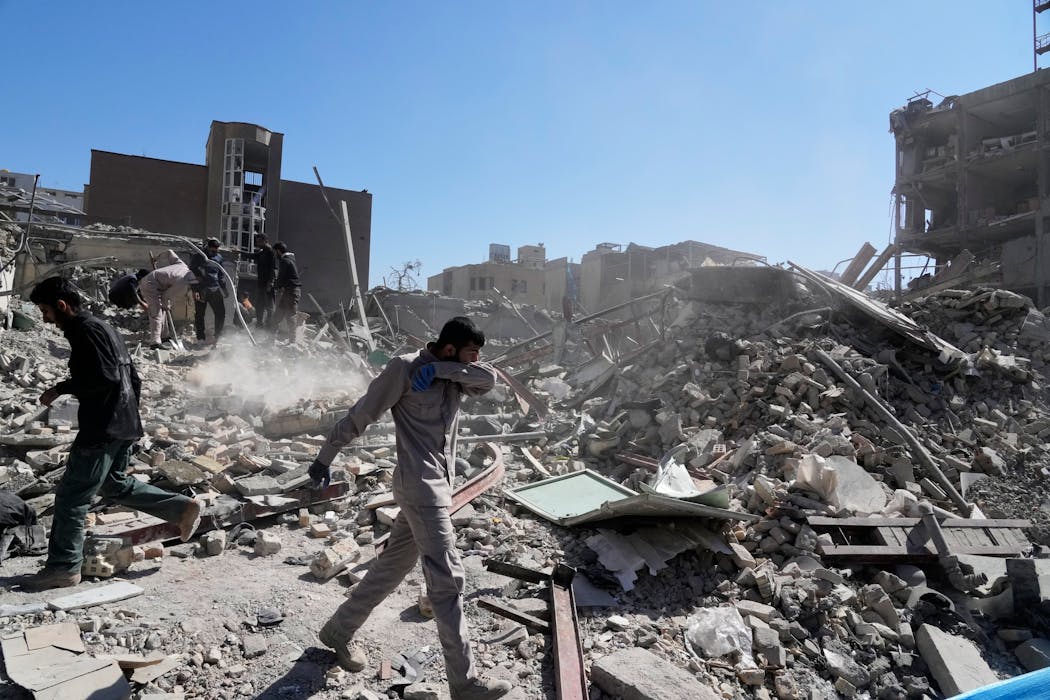
A group of men inspects the ruins of a police station in Tehran, Iran, on March 3, 2026. AP Photo/Vahid Salemi
When the bombing of Iran began on Feb. 28, 2026, the Trump administration had not informed the American people exactly what it was prepared to achieve.
Was the attack intended to degrade Iran’s nuclear program? Trump had declared that “obliterated” after last June’s bombing.
Was it to show support for Iran’s opposition, as Trump’s earlier “HELP IS ON ITS WAY” posts on Truth Social suggested? A bombing campaign that was bound to kill innocent Iranians, including 175 people at a girls elementary school near a military base, seemed an odd form of support.
I am a scholar and former practitioner of intelligence and national security policy in the White House. I believe there are lessons in effecting political change in Iran that can be taken, ironically, from the very U.S.- and British-led clandestine campaign in the mid-20th century that set Iran on the road to the intense anti-Western and anti-American sentiment that has characterized its government policy for decades.
How does this end?
President Trump has said he wants regime change in Iran but has articulated no strategy for achieving that end.
Strategy is the connection between means and ends. For waging a war, it means asking whether the military means available match the desired military outcome. In trying to effect political change, it means asking whether the instruments employed will produce the desired change.
Mossadegh had moved to nationalize the Anglo-Iranian Oil Company – effectively, British oil interests. Britain responded with an an oil embargo and a severe economic squeeze on Iran.
By early 1953 the U.S. government, under President Dwight D. Eisenhower, authorized the CIA to prepare a covert plan to remove Mossadegh and restore effective power to the shah, who at the time held a more ceremonial role. British intelligence had been pushing a similar agenda, and the two services collaborated on both the strategy and its implementation.
Men alleged to be communist spies await death before a firing squad in the Ghasr army barracks in Tehran in October 1954. Bettmann/Contributor/Getty Images
It was composed of three elements. First it funded newspapers and printed propaganda designed to discredit Mossadegh, portraying him as corrupt or sympathetic to communism. The propaganda also promoted fears of instability and communist infiltration.
Second, according to declassified histories, agents staged “false flag” incidents – attacks attributed to communists, for example – to stoke fear and backlash against Mossadegh among religious and conservative groups.
Third, the coup planners attempted to engage influential clerical leaders and organizations to amplify anti-Mossadegh sentiment.
Iranians crowd the main square in Tehran in August 1954 to celebrate the first anniversary of the arrest of former Premier Mohammad Mossadegh. Bettmann/Contributor/Getty Images
Shaping the crowds on Tehran’s streets proved critical to the operation. The CIA organized demonstrators to pose as pro-shah protesters, including paying individuals to chant slogans and confront Mossadegh supporters.
These orchestrated demonstrations climaxed on Aug. 19, 1953, when pro-shah forces and sympathetic leaders in the Iranian military – with CIA financial and logistical backing – seized key points of the country, confronted Mossadegh loyalists and helped topple his government. Estimates suggest around 200 to 300 people were killed in the chaotic fighting in Tehran.
What might have been, and what might be
The Mossadegh coup occurred in a less transparent world. However – and regardless of how you feel about it – the coup suggests the value of having a strategy to accomplish political change and, beyond Israel, bringing allies along if possible.
So far, Trump has called for the Iranian military and the Revolutionary Guard to lay down their arms. But the Trump administration has provided no guidance on how to do so, or to whom to do so.
Surely, the administration should be able to devise a plan for potential political change in Iran. It has insight from the years it has spent negotiating a nuclear deal with Iran. Recent events suggest the extent of Israeli, if not American, penetration of Iran.
Iranians participate in a funeral in Tehran for Revolutionary Guard commanders, Iranian nuclear scientists and civilians who were killed in Israeli attacks on June 28, 2025. Morteza Nikoubazl/NurPhoto via Getty Images
In June 2025, Israel conducted covert drone operations deep inside Iran, in concert with airstrikes on Iranian missile and military infrastructure. Mossad reportedly established an undercover drone network and launched explosive drones to neutralize air defenses and missile launchers before the main attack.
The successful targeting of Ayatollah Ali Khamenei and his close associates in the latest round of airstrikes suggests the extent of likely Israeli monitoring of Iranian communications by Mossad and the CIA.
Crises tend to put pressure on governments to open communications channels, and the take from any successful eavesdropping might be passed to opposition groups to help them organize and avoid capture.
If Israel can smuggle explosive drones into Iran, it should be able to make the satellite internet provider Starlink and its kin available to enable the opposition to better – and more safely – organize.
It is late in the day to emulate the Mossadegh coup with information operations, and it is probably more difficult in an era of ubiquitous social media, not newspapers. But it’s not too late to try.
I believe those brave opposition elements in Iran, who have been killed by their government and bombed by the United States and Israel, deserve no less.
Gregory F. Treverton does not work for, consult, own shares in or receive funding from any company or organization that would benefit from this article, and has disclosed no relevant affiliations beyond their academic appointment.
Source: The Conversation – France – By Hugues Plisson, archéologue spécialisé en tracéologie (reconstitution de la fonction des outils préhistoriques par l’analyse de leurs usures), Université de Bordeaux
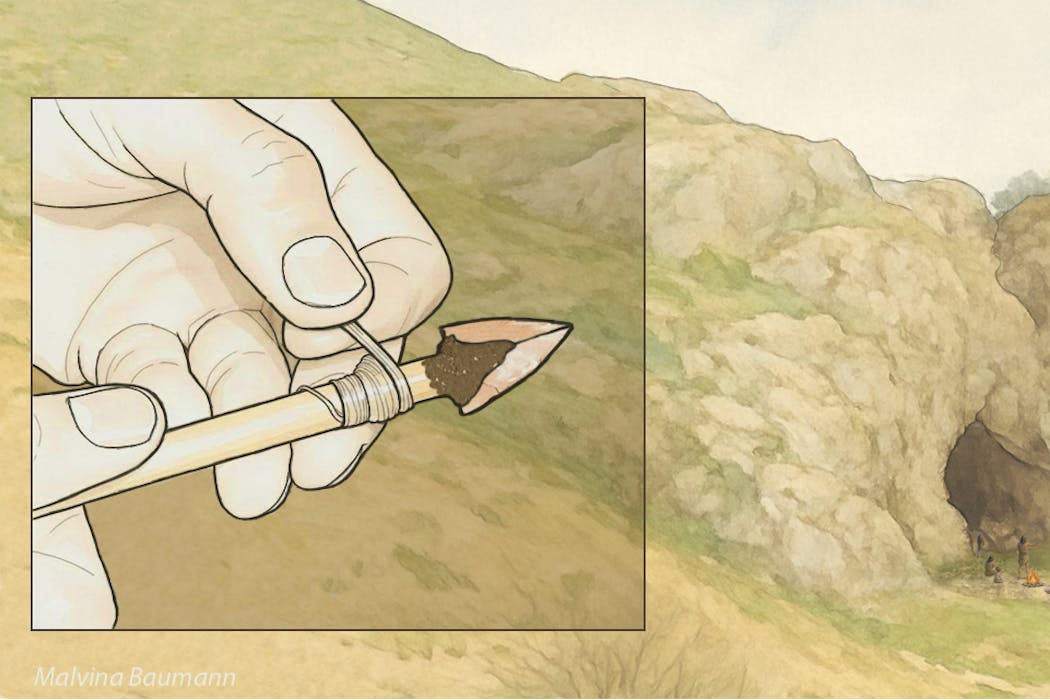
Obi-Rakhmat rock shelter in Uzbekistan, micro-point hafting and main game hunted around the site 80,000 years ago (artwork courtesy of Malvina Baumann).Malvina Baumann, Fourni par l’auteur
Unretouched triangular microlithic projectile points have been identified from their impact traces in the oldest occupation layers of the Obi-Rakhmat site in Uzbekistan, dating to 80,000 years ago. Their size corresponds to small arrowheads, which are directly comparable to those produced by Homo sapiens during an incursion into Neanderthal territory in the Rhône Valley, 25,000 years later. This new study, published in PLOS One journal, provides a strong argument that could rewrite history on Homo sapiens‘ first settlement in Europe.
The chrono-cultural and anthropological frameworks of prehistory, along with the evolutionary models they inspired, were first created in Western Europe, especially France, in the second half of the 19th century. They were initially linear and Eurocentric: Cro-Magnons (European early modern humans), descending from Neanderthals, laid the foundations for the civilisational superiority claimed by this part of the world at the time. It was not until a century later that the African origin of Homo sapiens, as well as the technological and social features that characterised the Western Upper Palaeolithic (symbolic productions, long-distance networks, and diversified lithic and bone tools and weapons), were recognised.
The earliest evidence of Homo sapiens in Australia, dating back around 65,000 years (Clarkson et al., 2017), predates that found in Europe by 10 millennia, while the ways in which our ancestors initially colonised Western Eurasia over 45,000 years ago remain contentious. The temporal alignment of the earliest European Upper Palaeolithic settlements with those in the Levant, which are considered the closest in terms of typology and technology, is still not satisfactory. This is either because the Levantine data comes from old excavations or because it does not fit into the supposed direct lineage. Despite its geographical proximity to Africa, the origins of the Initial Upper Palaeolithic in the Levant are themselves uncertain. This is why the possibility of a Central Asian origin suggested by archaeologist Ludovic Slimak in 2023 (Slimak, 2023) deserves attention.
A site in Central Asia
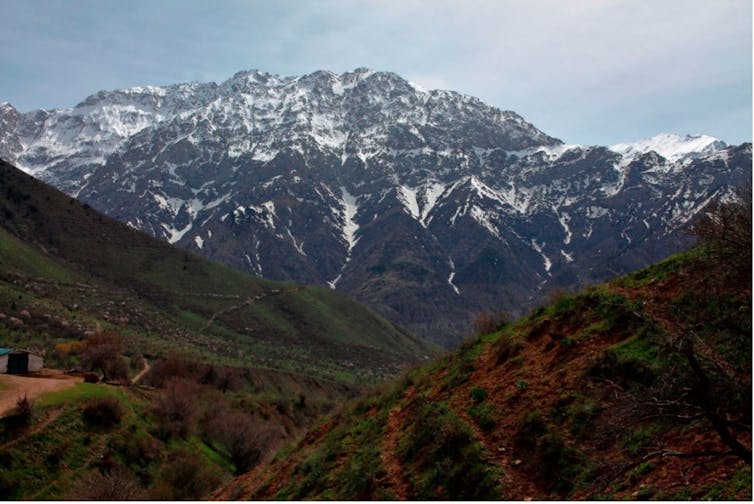
View from the Obi-Rakhmat rock shelter on the end of the Tien Shan. Hugues Plisson. Fourni par l’auteur
Depending on climatic conditions, Central Asia has served as a corridor facilitating movement between the western and eastern parts of the continent or as a refuge zone. The archaeological record in this region is limited but includes several significant Palaeolithic sites.
Among them is the Obi-Rakhmat rock shelter in Uzbekistan, discovered in 1962, whose latest excavation campaigns were led by Andrei Krivoshapkin. At the south-western end of the Talassky Alatau range of the Tien Shan mountains, at an altitude of 1,250 metres, the settlement provides a remarkably consistent lithic industry, comprising points, large blades, and bladelets across a stratigraphic sequence spanning over 10 metres, dating from approximately 80,000 to 40,000 years ago. This industry was initially classified as part of the Initial Upper Palaeolithic but it appears to derive from the Levantine Early Middle Palaeolithic. The early Middle Palaeolithic, associated with archaic Homo sapiens at the Misliya cave (Hershkovitz et al., 2018), disappeared from the Near East around 100,000 years ago. At Obi-Rakhmat, the skull remains of a child found in a layer dating back ~70,000 years show features considered to be Neanderthal and others to be anatomically modern, a combination that could be the result of hybridisation.
Massive blades but microlithic points
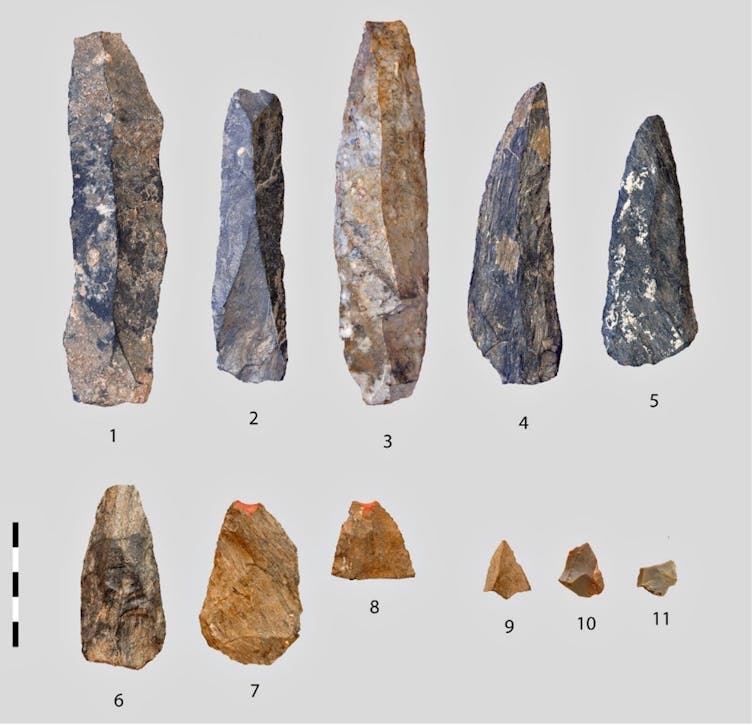
Elements of lithic industry from layer 21 at Obi-Rakhmat: unretouched blades (1-2), large retouched blade (3), pointed retouched blades (4-5), impacted retouched points (6-8), unretouched Levallois micro-point (9), unretouched impacted micro-points (10-11). Hugues Plisson. Fourni par l’auteur
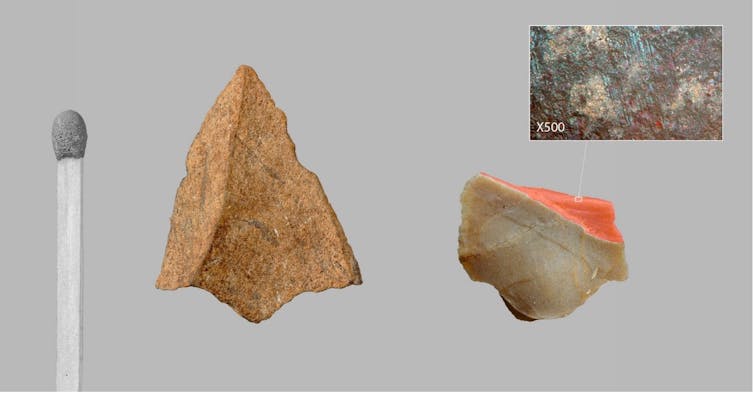
In this context, our international multidisciplinary team has identified tiny, unretouched, triangular projectile points within the lithic debris of the oldest stratigraphic layers. These points were distinguished based on their macroscopic and microscopic impact marks, which were compared to experimental reference data. Due to their small size (less than 2 cm in width and weighing only a few grams) and brittleness, they would have been unsuitable for mounting on heavy shafts. The width of their cutting edges corresponds to the diameter of arrow shafts documented ethnographically for low-poundage bows, consistent with transcultural invariants rooted in physical and ballistic constraints.
Two unretouched micro-points recovered from layer 21 of Obi-Rakhmat. One is intact, while the other is broken and shows scratches resulting from use as a projectile head. The matchstick illustrates their small size. Fourni par l’auteur
A question of ballistics
Thrown piercing weapons are complex systems whose components are not interchangeable from one type of weapon to another, as they meet different requirements in terms of intensity and nature of stress.
The significant impact force of spears held or thrown by hand makes the robustness of the weapon an essential parameter, both in terms of effectiveness and the hunter’s survival, with mass ensuring robustness, impact force and penetration. In contrast, the penetration of light projectiles shot from a long distance depends on their sharpness, because their kinetic energy, which is much lower, comes mainly from their speed, which, unlike mass, decreases very rapidly along the trajectory and in the target. As this speed cannot be achieved by the extension of the human arm alone, it necessarily depends on the use of a throwing instrument. Arrowheads and spearheads or javelin heads are therefore not designed according to the same criteria and cannot be mounted on the same shafts, the dimensions and degree of elasticity of which are also essential in terms of ballistics. Thus, as in palaeontology, where the shape of a tooth reveals the type of diet and suggests the mode of locomotion, the characteristics of a point provide clues as to the type of weapon of which it is the wounding element.
Weaponry specific to ‘Sapiens’?
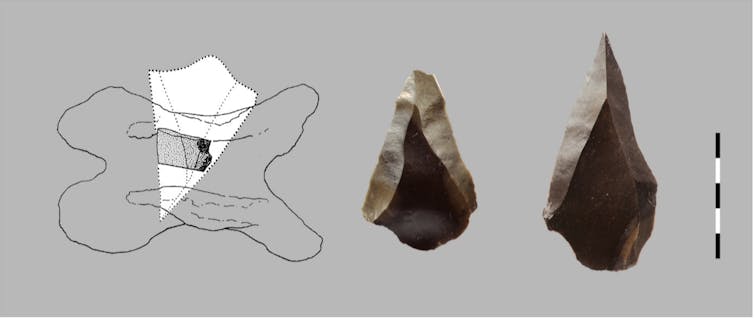
The tiny size of Obi-Rakhmat’s points cannot be regarded as a default choice, not only because there is no shortage of good-quality lithic raw material on site from which large blades were made, but microscopic examination of traces of use or wear also shows that within this same assemblage there are also much more robust retouched points (15 to 20 times heavier and 3 to 4 times thicker), similarly impacted by use as axial projectile points (the size of spearheads or javelin heads).
Returning to the bibliography and our own work on Middle Palaeolithic tools (Plisson et Beyries, 1998), we found that the presence in the same assemblage of various types of projectile points and inserts, some of which were microlithic and produced for this purpose, is only known at Homo sapiens sites. The oldest documented occurrences are in South Africa in the Pre-Still Bay (more than 77,000 years old) and later cultural layers of the Sibudu cave. In contrast, lithic points damaged by use as projectile heads are rare in the Neanderthal record. When present, they tend to be large and do not notably differ in size, manufacture or type from points used for activities other than hunting, such as gathering plants or butchery. This difference in the design of tools and weapons takes on anthropological significance.
Levallois points from the Um El Tlel site in Syria, from the Late Middle Palaeolithic period in the Levant attributed to Neanderthals. From left to right: graphic reconstruction based on a fragment found embedded in a donkey vertebra, plant knife blade, butcher knife blade. These multipurpose points are 2 to 3 times wider than the micro-points from Obi-Rakhmat. Hugues Plisson. Fourni par l’auteur
Given their respective dates, the distance between South Africa and Central Asia (14,000 km) and the difference in the manufacture of the Obi-Rakhmat and Sibudu weapon heads (unretouched knapped stone points vs. shaped stone points or retouched inserts, shaped bone points), the hypothesis of independent centres of invention is the most likely.
From the foothills of the Tien Shan to the Rhône Valley 25,000 years later
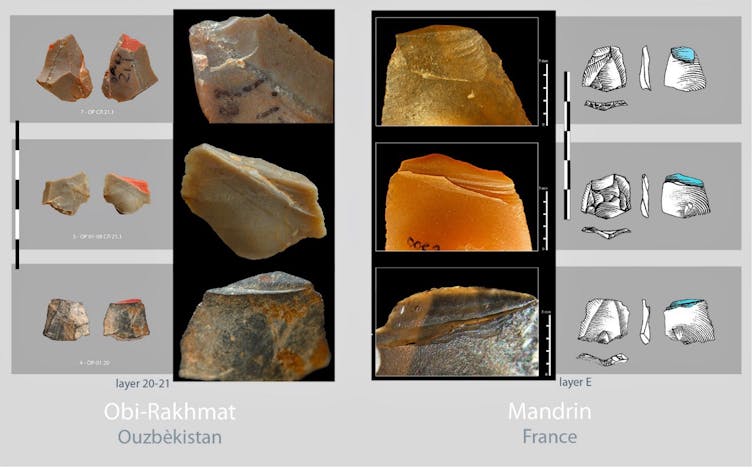
The micro-points from Obi-Rakhmat have no known equivalents in the Eurasian Middle Palaeolithic, except for identical projectile points identified by Traceology expert Laure Metz (Lewis et al., 2023) at the Mandrin site, in the Rhône Valley, France, in a layer dating to approximately 54,000 years ago – some ten thousand years before the disappearance of local Neanderthals. Notably, a Homo sapiens milk tooth was also recovered from this layer (Zanolli et al., 2022. The similarity between the micro-points from Obi-Rakhmat and Mandrin, despite being separated by more than 6,000 km and 25 millennia, is such that they could be interchanged without any detail other than the stone betraying the substitution.
Morphological and functional similarity between the micro-points of Obi-Rakhmat and Mandrin, broken by their use as projectile head. The location and extent of their fracture (highlighted in red and blue and macroscopic detail) are indicative of axial impact. Hugues Plisson. Fourni par l’auteur
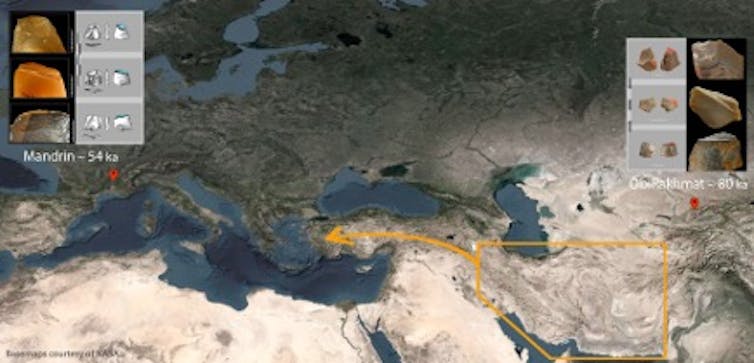
Recent work published by paleogeneticists Leonardo Vallini (Vallini et al., 2024) and Stéphane Mazières (Mazières et al., 2025) defines the Persian Plateau, on the north-eastern edge of which Obi-Rakhmat is located, as a population hub where the ancestors of all present-day non-Africans lived between the early phases of expansion out of Africa – long before the Upper Palaeolithic – and the wider colonisation of Eurasia. This resource-rich environment may have provided a refuge conducive to demographic regeneration after the genetic bottleneck of the exit from Africa, interaction between groups and, consequently, technical innovations.
On either side of the Persian plateau (orange box), genetically identified as a refuge area for the concentration and demographic development of first Homo sapiens who left Africa, Obi-Rakhmat and Mandrin share the same micro-projectile points, 25,000 years and 6,000 km apart. Hugues Plisson. Fourni par l’auteur
Obi-Rakhmat and Mandrin may represent two geographical and temporal milestones within the same process of dispersal, as suggested by Ludovic Slimak (Slimak, 2023), characterised by the dissemination of a key technological innovation unique to Homo sapiens. So far unnoticed because they are unretouched, tiny and fragmentary, it is likely that the micro-projectile points for which recognition criteria have now been defined will begin to appear at sites between Central Asia and the western Mediterranean.
Premises for a new scenario of the western peopling by ‘Homo sapiens’
This discovery is stimulating in several ways.
It validates the consistency of the research conducted at the Mandrin site, which came to the conclusion that Sapiens armed with bows made a brief incursion into Neanderthal territory. Several elements of this study had been criticised (Klaric et al., 2024)– which is, however, normal in science when a new proposal deviates too far from established knowledge – but its predictive dimension had not been considered at the time.
The similarity between Mandrin and Obi-Rakhmat’s micro-points cannot be a mere coincidence. It is not only their shape that is similar, but also the way they are made, which requires real expertise, as evidenced by the meticulous preparation of their striking platform and their function. One could debate the appropriate instrument for shooting arrows armed with such tiny tips, the bow being in filigree, or whether it is preferable to remain cautious and speak only of shooting, but this already contrasts with what we know about Neanderthal hunting weapons and their design.
Another remarkable aspect, which is still relatively uncommon, is the convergence and complementarity of data from material culture and from our genetic memory, which did not influence each other given the dates of the respective studies and publications. Together, they sketch out a rewriting of the scenario of Homo sapiens’ arrival in Europe: it was thought that he came directly from Africa by the shortest route 45,000 years ago, but we now discover that he had been established in the heart of the Eurasian continent for a long time, well before expanding in search of more territories.
A weekly e-mail in English featuring expertise from scholars and researchers. It provides an introduction to the diversity of research coming out of the continent and considers some of the key issues facing European countries. Get the newsletter!
Les auteurs ne travaillent pas, ne conseillent pas, ne possèdent pas de parts, ne reçoivent pas de fonds d’une organisation qui pourrait tirer profit de cet article, et n’ont déclaré aucune autre affiliation que leur organisme de recherche.
Source: The Conversation – Canada – By Warren Mabee, Director, Queen’s Institute for Energy and Environmental Policy, Queen’s University, Ontario
The joint attack launched by the United States and Israel on Iran began on Feb. 27 and has sparked a fast-moving conflict that could expand across the Middle East.
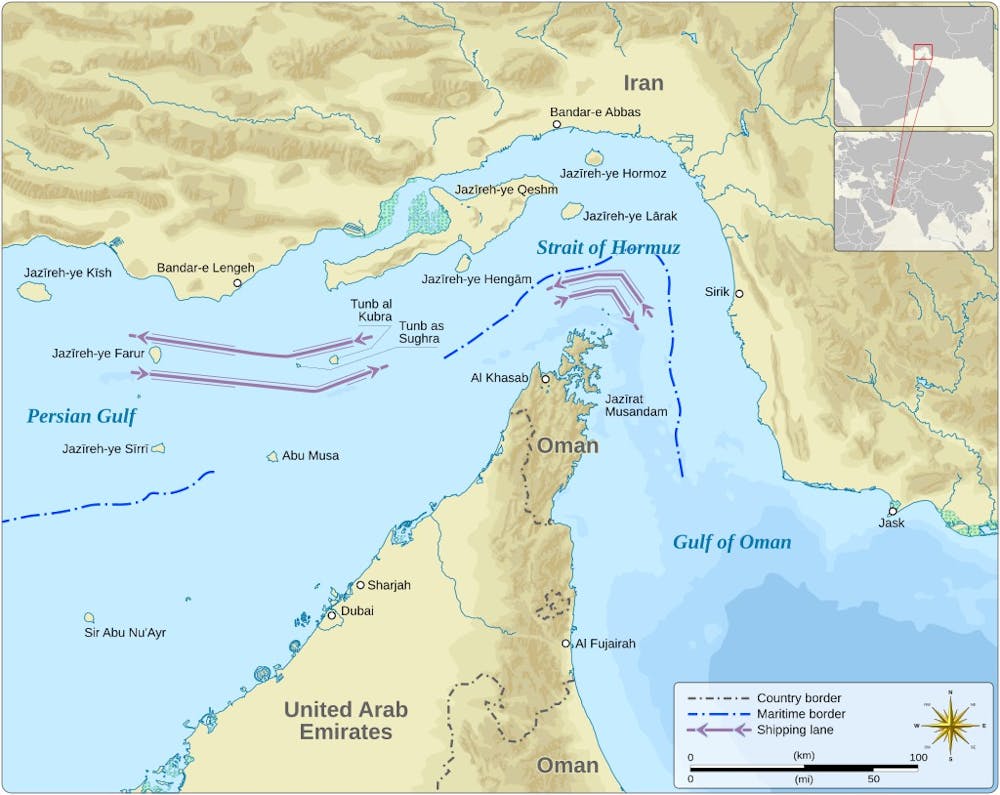
Iran’s response has already included strikes on U.S. bases in surrounding countries as far away as Qatar and Oman, and has announced the closure of the Strait of Hormuz, going so far as threatening to set ships on fire if they enter the strait.
The Strait of Hormuz is a 55-kilometre-wide narrows between Iran and Oman, separating the Persian Gulf from the Arabian Sea. It is a particularly important piece of global real estate in terms of the energy sector and one of the busiest and most strategically significant shipping routes in the world.
A map of the Strait of Hormuz. (Wikimedia Commons)
The closure has disrupted oil and gas shipments from the region and rattled markets around the world. Overall maritime traffic through the strait has dropped by 70 per cent since the closure, with 18 loaded and 37 unloaded tankers remaining in the Persian Gulf.
About 13 million barrels of oil per day normally move through these waters — about 31 per cent of global oil shipments. Blocking passage through the strait will certainly affect world oil prices.
Closure of the strait affects major ports belonging to Iraq, Kuwait, Saudi Arabia and the United Arab Emirates, as well as Iran itself. For several of these countries, the strait is the primary route through which oil reaches global markets.
On March 2, Brent Crude — the global benchmark — reached about US$79 per barrel before declining slightly, about eight per cent higher than last week’s prices. West Texas Intermediate, the North American benchmark, reached US$71 per barrel — a six per cent increase.
Those price movements are already being felt at the pump. Gasoline prices in both Canada and the U.S. have begun to rise, although not as dramatically as commodity prices.
Increases could persist as long as the conflict continues to disrupt tanker traffic through the Strait of Hormuz.
Throughout the last 50 years, oil price increases have often presaged an upcoming economic downturn. Some events, such as the first and second oil crises in the 1970s and early ‘80s, led to structural changes in global economies.
Could this happen again today?
Lessons from the first oil crisis
Gasoline ration stamps printed by the Bureau of Engraving and Printing in 1974. (Wikimedia Commons)
The first oil crisis began in October 1973 when the Organization of Arab Petroleum Exporting Countries (OAPEC, later OPEC) put an embargo on oil exports to the United States as a response to U.S. support of Israel.
While the U.S. had the economic wherewithal to be able to import oil from other sources, this action kept global prices high and many other countries suffered from elevated costs. The fallout from the first oil crisis affected the auto sector, the energy sector and energy policy across the U.S.
Today, OPEC nations are not working in close alignment with Iran. Instead, many of these nations — along with Russia and other oil-producing nations — have agreed to boost production by about 206,000 barrels per day in an effort to stabilize markets.
Parallels with the second oil crisis
Today’s conflict in Iran may have more parallels with the second oil crisis. In 1979, the Iranian Revolution led to a drop in global oil production of about seven per cent.
According to the U.S. Energy Information Agency, the largest energy producers are the U.S. (22 per cent), Saudi Arabia (11 per cent) and Russia (11 per cent), followed by Canada (six per cent) and China (five per cent).
Iran’s ability to influence the global market has been reduced while the U.S. role has dramatically increased. The market is therefore less likely to respond with major price increases in the face of the current conflict.
The wildcard in the current situation is the Strait of Hormuz. The largest port for Saudi exports of oil is Ras Tanura on the Persian Gulf, where the local refinery was recently hit in a drone attack.
A total closure of the strait would mean potential loss of at least five million barrels per day in shipments from Ras Tanura, which are unlikely to be taken up quickly by the port at Yanbu on the Red Sea, especially with refining capacity now impacted by the conflict.
Implications for Canada
For Canada, the conflict is likely to lead to higher prices for gasoline and diesel, as well as increased prices for imported goods. Although Canada is a net oil exporter, domestic fuel prices are tied to global benchmarks and reflect international volatility.
At the same time, the Canadian oilpatch often benefits from higher global prices. Elevated prices can boost revenues and investment in the sector, even as consumers face higher costs at the pump.
Expanded connectivity to the West Coast via increased capacity on the Trans Mountain pipeline could allow Canadian producers to supply Asian markets that depend heavily on shipments from the Persian Gulf. However, taking advantage of the opportunity means moving quickly, as other oil-producing nations will also move to fill this gap.
U.S. President Donald Trump has said that conflict will last at least four to five weeks, but potentially much longer. Ultimately, Canada could play a role in helping the world to respond to the crisis.
Whether the present crisis is a short-term shock, or whether it is the beginning of a larger geopolitical event, will depend largely on developments in and around the Strait of Hormuz in the days and weeks ahead.
Warren Mabee receives funding from the Natural Sciences and Engineering Research Council.
The United States government recently hosted a critical minerals summit aimed at reducing China’s predominant role in the global production of smartphones, weapons systems, lithium-ion batteries and electric vehicles (EVs).
The meeting, which included representatives from Argentina, Australia, Bolivia, Canada, Chile, the Democratic Republic of Congo, India, the European Union, Japan, South Korea and the United Kingdom, is part of a larger structural trend that Canadian Prime Minister Mark Carney recently called a “rupture” to the rules-based international order.
At first glance, the U.S. government’s weaponization of tariffs and trade indicate changing dynamics in global trade and the development of critical minerals, advanced manufacturing and emerging technologies. On closer inspection, American efforts to weaken China’s dominance over the critical minerals industry face a more complicated reality and an intricate web of public- and private-sector investment agreements tied to Chinese firms.
According to the International Energy Agency, China accounts for more than 80 per cent of global battery production. The figure jumps to 90 per cent for grid scale batteries that are used to store wind and solar power.
Global battery sales have grown sixfold since 2020, a direct result of falling prices and the competitiveness of China’s low-cost manufacturing model. Over the same period, manufacturing of grid-scale battery systems has expanded 20-fold.
Within this reality, the idea that the U.S. can strategically reduce China’s role in the production and processing of critical minerals appears highly unlikely.
Competition for critical minerals
My research focuses on environmental politics, extractive industries and the expansion of renewable energy value chains in Latin America. I am currently leading a study on the politics of lithium extraction in Argentina, Australia, Bolivia, Canada and Chile.
Over the past year, the U.S. upped its efforts to reduce China’s involvement in South America, a region that accounts for more than 50 per cent of the world’s known lithium deposits.
In 2025, the U.S. government acquired a five per cent share in Lithium Americas, a Canada-based company that has a long presence in Argentina. In February, the U.S. government announced another deal to acquire a 10 per cent stake in the mining company USA Rare Earth.
In 2025, the White House used the threat of tariffs and a US$20 billion bailout package to negotiate a new trade agreement with Argentina. Meanwhile, the U.S.-dominated Inter-American Development Bank signed an agreement to provide more than US$140 million to improve critical mineral production and processing capacity in Latin America.
However, decoupling China from regional production networks raises deeper questions about whether it makes good business or strategic sense to disrupt a global production network that produces 80-90 per cent of the world’s lithium-ion batteries.
At a time when the U.S. is pursuing an “America first” policy of onshoring the production and processing of critical minerals, China has used joint ventures and public-private partnerships to secure access while offshoring the dirtier parts of critical minerals production.
The Chinese company Ganfeng Lithium has been active in Argentina for about a decade and is currently expanding its presence through joint ventures.
In August 2025, the company signed joint ventures with Canadian company Lithium Americas, expanding its operations in the salt flats of Pozuelos, Pastos Grandes and Cauchari-Olaroz. The vast majority of Ganfeng’s production goes to battery and EV assembly hubs in China and Southeast Asia.
In contrast, China’s involvement in Chile has largely been limited to a minority share in the Chilean mining company SQM since 2018. Under the left-wing government of Gabriel Boric, Chile’s National Lithium Strategy promised to restrict new licences to state-owned copper and mining companies Codelco and Enami.
However, the recent electoral victory of President-elect José Antonio Kast, a right-wing politician with close ties to Chile’s business sector, raises new questions about the future viability of the nationalist policy.
Similarly, questions have been raised about whether the Bolivian government will maintain its state-led model of resource nationalism under the newly elected right-wing government of Rodrigo Paz Pereira.
Chinese and Russian companies have a strong presence in Bolivia. In 2024, the majority state-owned lithium company, YLB, signed a US$1 billion agreement with the Chinese consortium CBC to start developing the Uyuni salt flat. But Bolivia’s lithium production has remained negligible, reflecting longstanding challenges of extracting lithium from the Uyuni salt flat and resolving domestic conflicts over the distribution of profits.
Looking ahead
In theory, the election of right-wing governments in Argentina, Bolivia and Chile should favour the U.S. This is most evident in Argentina, where libertarian president Javier Milei has already established strong ties with the White House and with U.S. President Donald Trump personally.
Compared with Argentina, Chile appears less likely to concede to American concerns about China. This reflects the Chilean state’s dominant role in the global copper market, domestic conflicts over the nationalization of Chile’s lithium sector and the enduring influence of Chinese political and diplomatic interests.
Looking ahead, major questions remain about whether American companies have the willingness and capacity to assume China’s role in the global production of lithium-ion batteries and whether they’ll align themselves with U.S. foreign policy interests. For instance, the U.S.-based Albemarle Corporation is one of the world’s largest lithium companies, but it is publicly traded and owned by multiple investors.
Outside of South America, global lithium production remains dominated by American, Chinese and Australian firms, including Rio Tinto, the Anglo-Australian mining giant that is currently consolidating lithium operations in Argentina and Chile. Almost all have joint ventures with Tianqi, Ganfeng and other Chinese companies.
The North American economy has neither the capacity nor the wage competitiveness to replace China’s role in producing and processing critical minerals for batteries, energy storage systems and EVs.
Reducing China’s dominant role in the global critical minerals industry would entail developing a robust supply chain that can out-compete China’s. Given current economic and geopolitical realities, this seems improbable in the foreseeable future.
Craig Anthony Johnson receives funding from the Social Sciences and Humanities Research Council of Canada.
The very next day, the U.S. and Israel launched a large-scale offensive against Iran.
This leaves many wondering: how different would a war with fully autonomous weapons look? How important an ethical decision was it, when Amodei referred to fully autonomous weapons and mass surveillance as AI “red lines” that his company would not cross? What do these red lines mean for other nations?
AI chatbots are typically not weapons on their own, but they can become part of weapons systems. They do not fire missiles or control drones, but they can be plugged into the larger military systems.
They can quickly summarize intelligence, generate target shortlists, rank high-priority threats and recommend strikes. A key risk is that of a process going from sensor data to AI interpretation, target selection and weapon activation with minimal to no human control or even awareness.
Fully autonomous weapons are military platforms that, once activated, independently conduct military operations without human intervention. They rely on sensors such as cameras, radars and AI algorithms to analyze the environment, search for, select and engage targets.
Advanced helicopters, for instance, already operate with no human intervention. With fully autonomous weapons, human control and oversight disappear and AI makes final attack and battlefield decisions.
This is concerning, given recent research in which advanced AI models opted to use nuclear weapons in simulated war games in 95 per cent of cases.
The risks of mass surveillance
Frontier AI models can promptly summarize huge data sets and auto-generate patterns to look for signals of suspicious people and activity through even weak associations. In his statement on Anthropic’s discussions with the Department of War, Amodei argued that “AI-driven mass surveillance presents serious, novel risks to our fundamental liberties.”
They can analyze records, communications and metadata to scan across populations. They can produce briefings and lists of people that flag automatically who gets questioned, denied entry into a country, refused a job, etc. These systems create risks to privacy because they can analyze data from multiple sources, such as social media accounts, and combine these with cameras and facial recognition to track people in real time.
AI models can also make mistakes. Even a small erroneous association can scale up dangerously if the system is run over millions of people.
AI models are also opaque: how they analyze data and reach their conclusions cannot be fully comprehended, which adds to the difficulty of challenging the output.
‘All lawful purposes’
The label “all lawful purposes” sounds like a safety limit. Yet, this language means that the government can use AI for all purposes that it deems legal, with few limits in the contract.
This matters because legality is a moving target, laws can change and are often ill-equipped to deal in real time with fast changing innovations, and interpretations can shift.
Anthropic has famously developed an internal lab to understand how Claude works, interprets queries and makes autonomous decisions. Given the opacity of LLMs as well as the speed with which their capacities develop, such efforts matter.
Project Maven with higher stakes?
In some ways, this story is familiar. Technology companies have long been at the forefront of innovation, with great promises of progress but also risks of misuse and negative consequences. The closest historical comparison is Google’s Project Maven in 2018.
Google had a contract with the Pentagon for the company to help analyze drone surveillance footage. Four thousand Google employees protested the project, arguing that surveillance should not be part of the company’s mission. Google announced it would not renew Maven and later issued AI principles that included commitments around weapons and surveillance.
The situation became a landmark case in the power of employee activism and public pressure.
Anthropic’s current situation is in some respects similar to Google’s Project Maven one: it shows a company and its leaders trying to place limits on military uses of AI. It illustrates tensions that emerge when espoused corporate values collide with governments and national security demands.
The Anthropic case is also distinct because generative AI in 2026 is much more powerful than it was just a few years ago. Project Maven was only about analyzing drone footage. Today’s models can be used for many tasks, so the spillover risk is larger.
These events are neither about Anthropic being uniquely principled nor about the Pentagon being uniquely demanding. They are about a critical issue that will keep coming back as AI becomes more powerful: who sets the limits regarding AI use when national security is involved?
If “all lawful purposes” become the default, the guardrails will depend on politics and legal interpretation. For Canada and other nations, the safeguards matter. Ethics cannot be left to contract negotiations and corporate conscience.
These events illustrate the complexities of engaging in AI ethics in practice. AI ethics principles and declarations are important and abound. At the same time, in practice, AI ethics are set through contracts, procurement rules, various parties’ actual behaviour and oversight.
Canada’s defence and public sectors are building AI capacity and Canada operates closely with the U.S. defence and intelligence. This means that procurement language and standards can travel. If “all lawful purposes” becomes the standard language in the U.S. national security market, this could put pressure on Canada and other nations to adopt similar terms.
The reassuring news is that Canada has governance tools in place it can strengthen and extend. The Directive on Automated Decision-Making is designed to ensure that systems are transparent, accountable and fair. It requires impact assessment and public reporting.
But Canadians should be mindful of ongoing developments to check that procurement standards name prohibited uses, to call for audits and for independent oversight so that safeguards do not depend only on particular governments and companies at the top.
Emmanuelle Vaast does not work for, consult, own shares in or receive funding from any company or organisation that would benefit from this article, and has disclosed no relevant affiliations beyond their academic appointment.