We designed an AI tutor that helps college students reason rather than give them answers

Source: The Conversation – USA (2) – By Saharnaz Babaei-Balderlou, Teaching Assistant Professor of Economics, University of Wisconsin-La Crosse

If prompted, an AI tool can be tailored to help students think through their own reasoning rather than just feed them answers. Issarawat Tattong/iStock/Getty Images

Students using AI to cheat on homework or tests is a source of much discussion. But some scholars argue the greater risk of students using AI is that they will simply not learn.

Approximately 90% of 1,100 U.S. students surveyed at two-year and four-year colleges in 2025 reported using generative AI for everything from drafting assignments to clarifying complex concepts.

But when students use AI as a tutor or study partner, not as an immediate answer generator, does it make it easier or harder for them to learn?

We are economists who tried to answer this question by designing an AI tool using ChatGPT’s custom GPT feature, with the web access of the chatbot disabled.

We named the tool Macro Buddy and trained it to guide some students at one of our undergraduate macroeconomics classes at the University of Wisconsin, La Crosse, through their reasoning rather than giving them direct answers.

We found in our research, conducted in spring 2025, that students who used Macro Buddy, alongside peer discussion, earned higher exam scores than students who worked alone, without this AI tutor.

An image shows a row of college-aged people sitting at a long desk in a library.
College students are increasingly using AI to help them with their studies.
Maskot/iStock/Getty Images

Meet your new tutor

One of our macroeconomics courses enrolled 140 undergraduate students, mostly in their first or second year of college, divided across four sections.

Students’ course materials, assignments and exams were identical across all four sections. Students were generally not allowed to use AI tools or collaborate with classmates during exams. Students took all tests in person and were not allowed to reference any notes or other materials during the exam.

As a result, exam scores reflected what students understood and could explain on their own – without the help of AI or any other outside source.

After all students took their first exam, we randomly assigned the four class sections to take on a different study format.

We prompted one group of students to work individually, without Macro Buddy; another group of students worked in groups, without Macro Buddy; a third group of students worked individually, with Macro Buddy; and a fourth group of students worked in groups, with Macro Buddy.

We wanted to compare how different study approaches – working alone, working with classmates, using Macro Buddy or combining both – altered how well students did on exams.

Macro Buddy’s skills

We trained Macro Buddy with the help of lecture transcripts, slides and homework questions specifically from this macroeconomics course.

Macro Buddy had internet access turned off, so it relied only on the instructor’s course materials.

Macro Buddy was designed to act like a tutor, not an answer machine. Instead of giving students complete solutions, Macro Buddy asked follow-up questions meant to guide students toward an answer.

For example, if a student asked why lower prices might increase consumers’ spending, Macro Buddy would not offer a quick, full explanation. It might instead ask what happens to people’s purchasing power when prices fall. The student would then have to connect the concepts and explain their reasoning, in their own words, step by step.

This distinction between explaining an idea and receiving a finished answer matters.

An AI tool that simply delivers answers can allow students to skip thinking through a problem. One study found that when college students rely on a chatbot as a crutch, they perform worse when they no longer have access to it. A tool that asks questions requires students to do the work themselves, even while receiving guidance. This is the very process that makes learning stick.

What happened to students’ learning

The one group of students that continued working individually, without AI, served as our control group.

The other three groups changed how they studied: One began working in groups without AI, one worked individually with Macro Buddy, and the last group combined group work with Macro Buddy.

All of the students’ average scores declined when they took their second exam, across all four study groups.

By the third exam, however, differences across sections became clearer.

Students who used both Macro Buddy and group discussion earned the highest average scores. Students who used Macro Buddy alone also scored higher than those who worked alone without Macro Buddy. Students who worked in groups without Macro Buddy showed smaller improvements, when compared to the students in other groups.

The third exam happened several weeks after we introduced the new study formats.

By that point, students in the combined group may have grown more comfortable using Macro Buddy to test their understanding, while also explaining ideas to classmates. Working with peers meant having to articulate reasoning clearly and respond to questions, which can deepen understanding over time.

Why this matters

Some critics of AI worry that students will rely on AI to do the hardest parts of learning for them. This reflects a fear that students may stop practicing the skills that build expertise. Students become experts in their fields while struggling with confusing material, revising explanations and seeing whether they truly understand an idea.

Our experiment suggests erosion of learning when using AI is not inevitable.

We found that when AI is designed as a tutor that asks questions instead of simply giving answers – and when students are also required to explain their reasoning to classmates – the technology can support learning rather than replace it.

Most students today use general-purpose chatbots that are not designed as tutors. They type in a question and receive a response. But our findings suggest that even small design choices, such as building an AI chatbot with guiding questions, can shape how students engage with the material.

Peer discussion also adds something to the learning process that AI cannot provide: social accountability and exposure to alternative reasoning.

Together, these practices encourage students to think through problems more actively.

The evidence from our experiment highlights a practical distinction: AI can be used to replace thinking, or it can be used to support it. The impact may depend less on the technology itself and more on how it is structured and integrated into learning.

The Conversation

The authors do not work for, consult, own shares in or receive funding from any company or organization that would benefit from this article, and have disclosed no relevant affiliations beyond their academic appointment.

ref. We designed an AI tutor that helps college students reason rather than give them answers – https://theconversation.com/we-designed-an-ai-tutor-that-helps-college-students-reason-rather-than-give-them-answers-276584


Nearly a third of Pennsylvania gamblers are at risk of problem gambling − but few seek treatment

Source: The Conversation – USA (3) – By Gillian Russell, Assistant Research Professor, Penn State

Pennsylvania legalized online gambling in 2017. Tatiana Maksimova/Moment Collection via Getty Images

Nearly three times as many Pennsylvania adults gamble online today than just a few years ago.

And as online platforms make gambling easier and more convenient, some Pennsylvanians are gambling more often and may be more prone to developing problems.

We are researchers at Penn State’s Criminal Justice Research Center and the University of Kentucky’s College of Social Work who recently published these findings in a report on online gambling in Pennsylvania. The report was produced in partnership with the Pennsylvania Department of Drug and Alcohol Programs.

We surveyed over 3,500 Pennsylvania adults and found that between 2.5% and 6.4% could be classified as problem gamblers.

An additional nearly 30% fell into “at-risk” categories, meaning they show meaningful signs of harm but do not yet meet the threshold for problem gambling.

Here are five of our key findings and why they matter:

1. Most Pennsylvanians still gamble offline, not online – but the distance between the two is shrinking

When Pennsylvania legalized online gambling in 2017, it required an annual assessment on the impacts of the legislation on Pennsylvania residents’ gambling behaviors. The assessment began two years after the first licenses were issued.

In the first two years of the survey, which were used to produce the 2021 and 2022 annual reports, approximately 11% of Pennsylvania adults reported gambling online. That number rose to as high as 30% in the most recent 2025 report, which was released in January 2026.

The 2025 report, which used both online and phone survey methods, identified that between 61% and 74% of Pennsylvania adults had gambled at least once in the past year. These numbers were consistent with previous reports. Depending on the sampling method, between 56% and 69% of adults reported they had gambled offline – for example, playing slot machines at brick-and-mortar casinos or buying lottery tickets at a store. Between 17% and 30% had gambled online.

Lottery games and raffles remain the most popular offline gambling format, while sports betting remains the most popular online gambling format. This finding has been consistent through all five years of the report.

But the line between “online gamblers” and “offline gamblers” is blurry. Among those who had gambled online, more than three-quarters also gambled offline.

We grouped Pennsylvania gamblers into three subgroups and found that about 43% gambled exclusively offline, about 4% exclusively online, and somewhere between 14% to 27% were “mixed-mode” gamblers, meaning they gambled both online and offline.

Thumb shown touching mobile phone with betting apps on its display
The number of online gamblers in Pennsylvania has nearly tripled over the past three years.
AP Photo/Jeff Chiu

2. The more ways people gamble, the more they tend to gamble overall

Those who engaged in mixed-mode gambling participated in nearly twice as many gambling formats as those who gambled only offline or only online.

They also gambled most often: close to once a week on average, compared with about once a month for those who gamble offline only.

Mixed-mode gamblers also spent more time and more money on gambling. People who gambled offline-only or online-only spent a median of about US$20-$40 per month on gambling. Mixed-mode gamblers, meanwhile, spent about $105-$230 per month. Mixed-mode gamblers also had the largest single-day gambling losses.

3. Nearly a third of Pennsylvania gamblers are at risk of problem gambling

This year’s report is the first to estimate how many Pennsylvanians meet criteria for problem gambling in the general population.

Between 2.5% and 6.4% of adults could be classified as current problem gamblers, according to the “problem gambling measure.” This is an evidence-based measure of problem gambling that classifies individuals as recreational, at-risk and problem gamblers.

Nearly 30% fell into “at-risk” gambling categories. They showed meaningful signs of harm but did not yet meet the threshold for problem gambling.

People who engage in mixed-mode gambling are significantly more likely to fall into at-risk and problem gambling categories than people who gamble offline only or online only.

4. Most people with gambling problems do not seek help

Despite the size of the at-risk and problem gambling groups, very few people seek treatment or other assistance.

Only about 1.5% of Pennsylvanians said they felt they had a gambling problem in the past year. Just 0.2% said they had sought help.

Even among those who met criteria for problem gambling, only about 6% reported getting help.

Some people did reach out proactively for others. About 0.4% of residents said they had contacted the 1-800-GAMBLER helpline because of someone else’s gambling.

This gap between harm and help-seeking is not unique to Pennsylvania. But it matters more as gambling becomes easier, faster and more continuous, and as people are more exposed to gambling content through social media and streaming platforms.

5. Young men are particularly vulnerable

Pennsylvania’s experience with gambling mirrors what public health research has long shown with alcohol, tobacco and more recently cannabis: When a behavior becomes more accessible and easier to repeat, overall use rises and harm concentrates among a smaller, more vulnerable group.

Features of online gambling – such as ease of access and acceptance of online payment methods, including cryptocurrencies – are particularly appealing to younger adults, many of whom have shown declining interest in traditional forms of gambling, such as casinos or lotteries. Online platforms offer them the opportunity to gamble on their phones, at all hours, with rapid feedback and minimal barriers to entry. This matters because younger people, especially young men, are disproportionately vulnerable to different types of addictive behaviors, including misuse of alcohol and illicit substances.

For most Pennsylvanians, gambling remains a casual pastime. But as with drinking or substance use, increased availability expands both experimentation and the number of people who progress to harmful levels of engagement. As the online gambling market grows, the data suggests that entertainment and harm may be rising together, following a pattern that public health has seen before with alcohol and cannabis.

Read more of our stories about Philadelphia and Pennsylvania, or sign up for our Philadelphia newsletter on Substack.

The Conversation

Gillian Russell receives funding from the Commonwealth of Pennsylvania.

Glenn Sterner receives funding from the Commonwealth of Pennsylvania.

ref. Nearly a third of Pennsylvania gamblers are at risk of problem gambling − but few seek treatment – https://theconversation.com/nearly-a-third-of-pennsylvania-gamblers-are-at-risk-of-problem-gambling-but-few-seek-treatment-272240

Women and wealth: what stands in their way and how to overcome it

Source: The Conversation – Africa – By Bomikazi Zeka, Associate Professor in Finance, University of Canberra

You’ve probably heard the saying, “The rich become richer, while the poor become poorer”. It’s about how uneven financial progress can be.

One of the reasons behind financial inequality is the gender pay gap, but the wealth gap is even more revealing. It explains why disparities persist between the rich and the poor. Wealth – your assets, savings, property and retirement provisions – is the true measure of long-term financial security.

Research shows that wealth gaps aren’t created by gender alone. Aspects like race, class, education, disability, age and nationality also influence the distribution of wealth. When these aspects overlap, they create forms of exclusion or privilege that become more powerful over time.

For example, women who come from single parent homes or low-income neighbourhoods are at a disadvantage because this environment can negatively influence their job opportunities, career progression and financial independence. In contrast, women from wealthier families tend to have higher education levels, access to professional networks, better-paid jobs and more money left over for investments.

As a result, some women begin their wealth-building journey on higher ground before they even enter the labour market. Others have obstacles they first need to overcome.

Because of this, we know that inequality doesn’t happen in a vacuum. Our research explored why the income women earn now is not indicative of the ability to build wealth.

We explored the systems that keep people marginalised and how they overcome them. We identify three main things that set women back financially:

  • career interruptions

  • restricted access to capital

  • social norms.

The good news is that financial literacy can create opportunities for women to shift their financial direction, even if inequality has been piling up for years. Financial literacy is the ability to understand and manage money confidently. We recommend ways it can be improved.

Our analysis shows that five benefits flow from women becoming more financially literate. These are:

  • improved savings habits

  • increased confidence in investing

  • better debt management

  • the ability to build wealth across generations

  • improved retirement outcomes.

The barriers

Women face a number of barriers to achieving financial stability.

Career interruptions: Women are more responsible than men for childcare, caring for ageing parents and housekeeping. These unpaid responsibilities make it harder to save for the future.

Restricted access to capital: Because of caregiving responsibilities, many women don’t qualify for access to credit, loans or property ownership.

Social norms: Men are often seen as the financial decision-makers, leaving women out of conversations about long-term planning, investing and asset-building.

Financial systems reward those with a good financial head start and penalise those who begin with fewer resources. When all these factors come together, the result is a gender wealth gap that spans generations.

Solutions

Our research set out to understand how gender inequality affects women’s ability to build wealth and whether financial literacy makes a difference. We found that economic and social barriers like gendered occupations and caregiving pressures matter in building wealth. We also found that financial literacy can help women feel more confident about saving, investing and planning for their future.

Savings habits: Financially literate women save actively. They save before spending, instead of saving after spending. This reduces the temptation to spend impulsively. With good savings habits, you no longer rely on willpower to save: the system does the work for you. One practical way to do this is to automate transfers to a savings account the day you’re paid. Even small amounts grow over time.

Investment confidence: Research shows that women are often more risk-averse. Not because they’re inherently cautious, but because they lack confidence or have been excluded from financial conversations. Financial education changes that. Some women avoid investing because it feels complicated. When someone doesn’t understand how investing works, it’s normal to feel unsure or be afraid of making mistakes.

Financial education teaches basic concepts like how money grows over time and the tools necessary to make financial decisions. The more you understand something, the less scary it feels, and the more confident you become.

Debt becomes more manageable: Women with strong financial literacy take on less expensive debt, avoid predatory lending, and maintain better credit health. Financially literate women are more likely to borrow wisely. They compare interest rates before choosing a loan, avoid high-interest options like cash advances or instant loans, and read the details carefully before signing any contract. Financial understanding helps women recognise danger signs, ask the right questions, reject unfair offers, and choose better financial options.

Wealth-building becomes intergenerational: Financially literate women pass this knowledge on to their children. As primary caregivers, women are in a good position to do this. By teaching their children how to manage money, they help them develop essential skills early, such as saving, budgeting, and making thoughtful spending decisions. These lessons not only promote responsible financial habits but also give children the confidence to handle money matters independently. Over time, this guidance lays a strong foundation for lasting family wealth.

Retirement outcomes improve: Women live longer than men but retire with less money. Financial literacy helps women plan early and more effectively. They can take control of their financial future rather than relying on others. Strong financial skills help women achieve independence, reduce stress about the future, and enjoy a more secure and comfortable retirement.

The way forward

For financial literacy to reduce the gender wealth gap, it needs to be widely accessible and supported at multiple levels, through government policies, workplaces, schools, families and everyday conversations.

Financial literacy isn’t just about knowing budgeting tips or being able to understand compound interest. It’s about giving women the knowledge, confidence and skills to make financial decisions.

When women can ask financial questions with confidence, negotiate salaries, invest in assets and teach their children about money, their power isn’t just personal, it changes society.

The Conversation

The authors do not work for, consult, own shares in or receive funding from any company or organisation that would benefit from this article, and have disclosed no relevant affiliations beyond their academic appointment.

ref. Women and wealth: what stands in their way and how to overcome it – https://theconversation.com/women-and-wealth-what-stands-in-their-way-and-how-to-overcome-it-277379

Women farmers in South Africa pay the cost of broken irrigation systems – the story of one cooperative

Source: The Conversation – Africa – By Elizabeth Hull, Senior Lecturer in Social Anthropology, SOAS, University of London

The South African government makes a great deal of the fact that it supports women’s empowerment in agriculture.

But does it?

As an anthropologist, I’ve been engaged in long-term ethnographic research in KwaZulu-Natal since 2007, focusing mostly on rural food systems and food-based livelihoods and before that on health care.

We conducted research into the Isibonelo Cooperative, a small-scale women-led farming cooperative in KwaZulu-Natal. We found that weak governance and old infrastructure had led to women’s dispossession from the land they had farmed for decades.

This isn’t happening through formal dispossession, but because failing irrigation infrastructure is making farming impossible. Old and damaged equipment, high operating costs, and institutional barriers interact to limit the viability of smallholder farming on South Africa’s smallholder irrigation schemes.


Read more:
Rural women farmers in South Africa: how global promises aren’t translating into support on the ground


The inability of the women to farm has significantly affected their wellbeing, and that of their families.

Women make a substantial contribution to smallholder farming in South Africa. They have the skills and determination to farm. But they depend on adequate water infrastructure and functioning institutional arrangements to make it happen.

The collapse of farming in Makhathini

The Isibonelo Cooperative is a small-scale women-led farming cooperative in KwaZulu-Natal. It belongs to the Makhathini Irrigation Scheme, situated in the north of the province near the borders of Eswatini and Mozambique.

Cooperatives have long been promoted in South African policy as democratic, entrepreneurial entities that facilitate inclusion of women and youth. In practice, they are often fragile, state-dependent institutions that manage resource sharing in precarious circumstances.

We initially chose Isibonelo for our research due to its long-term success at growing food and supporting local families and markets. Until recently, it was successful compared to many cooperatives.

The Makhathini Irrigation Scheme was established in the 1970s by the then apartheid government. The government forcibly resettled local residents to make way for the scheme and in collaboration with chiefs, allocated newly formed 10ha plots to male farmers. Women were excluded from the process.

A group of women organised themselves and successfully applied for a shared plot, which they subdivided into individual plots or “gardens” of 0.2 hectares each. Some of the women were local residents while others were new arrivals who had been forcibly expelled from their homes on white-owned farmland as part of a notorious process of mass evictions carried out by the apartheid regime.

The women continued to grow food into the democratic period after 1994. And its success attracted attention.

Between 2011 and 2018, my research collaborator, Khulekani Dlamini, and I conducted ethnographic research with the Isibonelo Cooperative. It was successfully producing food for families and regional markets. It operated effectively under modest conditions, providing its members with a structure for productive activity, household improvement, and local sharing of labour and resources. But in 2018, farming activity ceased due to broken pipes. Despite repeated efforts by members to raise the issue with authorities, water supply to the gardens has not been restored.

As a result, the cooperative’s agricultural operations have halted almost entirely.

A wider problem

The problem is far wider than this scheme alone. In 2007, over a third of South Africa’s 317 smallholder irrigation schemes were inactive. Recent studies suggest that the revitalisation of schemes has been sporadic, and they remain inhibited by structural problems. These include market access, access to credit, physical infrastructure and governance of the schemes. Beyond Makhathini, farmers have abandoned plots due to difficulties accessing water.

Yet the absence of comprehensive recent data inhibits a clear understanding of the scale of the problem.


Read more:
Big irrigation projects in Africa have failed to deliver. What’s needed next


In some cases, a focus on expensive technology upgrades has necessitated high yielding commercial production to ensure financial viability. In turn this has led to the unintended demise of smallholder projects. Across Makhathini and other schemes, cost recovery is low as farmers struggle to pay for operational bills in a context of intermittent and unreliable water.


Read more:
African land policy reforms have been good for women and communities – but review of 18 countries shows major gaps


Impact on local economies and food security

The schemes are a vital part of the local economy. Before farming was interrupted, the cooperative was more than a means of survival. It enabled women to improve their homes, feed their families, engage in urban markets, and maintain some economic independence in a region with high unemployment and limited formal opportunities.


Read more:
Feeding Africa: how small-scale irrigation can help farmers to change the game


To understand what had changed, Dlamini returned to Makhathini between 2022 and 2025 to interview 11 cooperative members, their relatives and neighbouring farmers.

They reported that the collapse of farming has led to loss of income, food insecurity, household debt, mental health challenges, and a decline in local cooperation including food sharing and stokvel (informal saving club) participation.

Rising prices have compounded these problems. One member told us:

Today we are buying everything that we used to grow for ourselves… We never bought vegetables (previously), but today we are buying from other farmers and in shops at high prices.

Home extensions initiated by farming income stood incomplete. One member had moved away from the area, troubled by poultry theft and no longer able to farm. Some found work cutting grass as part of government employment schemes or selling clothes door-to-door. Others relied on borrowing from local store owners. One member stated her challenges candidly:

I am struggling to buy enough food for my grandchildren and I am always in debt.

The group has made repeated efforts to raise the issue with relevant authorities. But water supply to the gardens has not been restored. The lack of clear accountability for infrastructure maintenance, coupled with a fragmented governance environment involving traditional leaders, municipal authorities and parastatal entities, contributes to inaction.

Today the gardens are overgrown. The women are still waiting for water. The impact extends to future generations as opportunities to pass valuable farming knowledge and skills to younger family members dwindles.

What needs to happen next?

Political attention focuses on the speed and scale of land transfers as part of the government’s flagship land reform programme. But apartheid era irrigation schemes also deserve much greater attention. Targeted and appropriate support could enable recovery.


Read more:
Land reform in South Africa: what the real debate should be about


For this to be sustainable, the focus must extend beyond technology fixes to address deeper problems in the governance of the schemes. These must tackle how top-down management has impeded the potentiality of smallholders.

There is an urgent need for irrigation infrastructure to be repaired and restored on plots where smallholders have the potential to return to farming. Rainwater is unreliable and other water sources are far too limited to grow food without irrigation.

Local governance structures must be better coordinated by clarifying the role of scheme management bodies, municipal officials, traditional leaders, and provincial departments. Farmers will then better understand who is responsible for water, maintenance and dispute resolution.

The voice of farmers, especially women and cooperatives, must be strengthened through improved local liaison structures and strengthening procedures for maintenance requests.

Training and support must be developed that is tailored to both group-level and individual needs, recognising that individual production affects group-level viability and developing finance models that accommodate this uncertainty.

Khulekani T. Dlamini was a co-researcher and contributed to this article.

The Conversation

Elizabeth Hull received funding from The London Centre for Integrative Research on Agriculture and Health (LCIRAH).

ref. Women farmers in South Africa pay the cost of broken irrigation systems – the story of one cooperative – https://theconversation.com/women-farmers-in-south-africa-pay-the-cost-of-broken-irrigation-systems-the-story-of-one-cooperative-271855

Billions of dollars, decades of progress spent eliminating devastating diseases may be lost with undoing of USAID

Source: The Conversation – USA – By Sarah Greene, Instructor in Pediatrics and Infectious Diseases, Washington University in St. Louis

The parasites that cause river blindness and elephantitis have been afflicting people for centuries. Alexis Huguet/AFP via Getty Images

In Greek mythology, King Sisyphus was condemned by the god Zeus to spend eternity rolling a boulder up a hill only to have it roll back down, having to start anew every day.

His story captured our attention as researchers studying neglected tropical diseases – a collection of conditions that primarily affect poor people in low-income countries. These diseases do not kill people at the rates of more well-known infections, such as HIV, malaria and tuberculosis, but cause significant pain and disability. As chronic infections that can cause disfigurement, they are also stigmatizing and economically devastating.

For over 50 years, researchers, clinicians and policymakers in the global health community have worked to eliminate infections such as onchocerciasis (also known as river blindness) and lymphatic filariasis (elephantiasis). They’ve done this through controlling black flies and mosquitoes, the vectors that spread these diseases, as well as huge campaigns to distribute antiparasitic medications to entire communities in areas where these diseases are endemic.

Unfortunately, the Trump administration’s sudden defunding of the U.S. Agency for International Development in 2025 has created a real-life Sisyphean struggle for countries working to eliminate neglected tropical diseases. Withdrawal of USAID support is abandoning the boulder of disease elimination partway up the mountain. When countries are unable to provide treatment, the parasites that cause these diseases will spread to infect more people.

Inevitably, the boulder will roll backward, undoing decades and billions of dollars of work.

Ancient foes

Lymphatic filariasis and onchocerciasis are centuries-old afflictions. An Egyptian statue of Pharaoh Mentuhotep II from 2000 B.C. is suggestive of lymphatic filariasis.

Filarial worms can live for years within humans, causing a variety of different problems. In lymphatic filariasis, adult worms live in the lymphatic vessels, a network running throughout the body that returns fluid back to the circulatory system. This disruption of the lymphatic system can cause the extremities or the scrotum to swell tremendously.

In onchocerciasis, adult worms live in small nodules under the skin. The larval forms of these parasites migrate through the skin and can invade the eyes, causing chronic inflammation that can lead to blindness.

Close-up of a person's legs, one significantly swollen in comparison
Lymphatic filariasis, also known as elephantitis, causes significant disfigurement and disability.
Noah Seelam/AFP via Getty Images

In recognition of the significant suffering these diseases cause, the World Health Organization coordinated global efforts to eliminate them: onchocerciasis starting in 1974 and lymphatic filariasis in 2000.

Since then, these public health campaigns have distributed hundreds of millions of doses of treatment for lymphatic filariasis and onchocerciasis. Medications vary somewhat by location, but they often involve the use of the Nobel Prize-winning drug ivermectin. Merck, the manufacturer of ivermectin, provides the drug for free to each country’s disease control program. Similarly, the companies GlaxoSmithKline and Eisai respectively donate the antiparasitic medications albendazole and diethylcarbamazine citrate for these campaigns.

Together, these programs have dramatically reduced the numbers of people exposed to these infections. For lymphatic filariasis, as of 2024, 871 million people no longer need preventive medications, and 21 countries have eliminated this infection. Five countries have eliminated onchocerciasis.

A job partially completed

Despite significant progress in controlling these infections, it remains logistically challenging to map endemic areas, deliver medications, test for ongoing infection and decide which areas have active outbreaks.

While each country runs its own medication delivery programs, these efforts have been supported by the World Health Organization as well as USAID or USAID-funded nongovernmental organizations. The Trump administration’s funding cuts to USAID halted over 40 drug distribution drives in 2025, affecting over 140 million people. Importantly, the U.S was the largest financial contributor to the World Health Organization until it withdrew its membership in January 2026.

The end of USAID has caused famine and disease outbreaks.

We and others working on eliminating these neglected diseases are concerned that the rapid decrease in funding for these programs will destabilize efforts to treat infections. Stopping medication delivery now can allow these infections to spread unchecked and roll back decades of progress. Donated medications can be effective only if they are delivered to those who need them. This might mean that these campaigns will have to be combined with other public health efforts already underway, or that each country reallocates resources toward these efforts.

If the world turns its back on eliminating these diseases, millions of people will be hurt by the boulder rolling back down.

The Conversation

Sarah Greene has received funding from the NIH.

Philip Budge has received funding from the Gates Foundation and the NIH. He is a member of the Infectious Diseases Society of America and the American Society of Tropical Medicine and Hygiene.

ref. Billions of dollars, decades of progress spent eliminating devastating diseases may be lost with undoing of USAID – https://theconversation.com/billions-of-dollars-decades-of-progress-spent-eliminating-devastating-diseases-may-be-lost-with-undoing-of-usaid-266195

Researchers are combining drones and AI to make removing land mines faster and safer

Source: The Conversation – USA – By Sagar Lekhak, Ph.D. Student in Imaging Science, Rochester Institute of Technology

Ukraine is just one of many conflict zones contaminated by land mines. Maksym Kishka/Global Images Ukraine via Getty Images

At least 57 nations have live antipersonnel land mines in their territories. In 2024 alone, 1,945 people were killed by mines and 4,325 were injured, 90% of whom were civilians. Nearly half of those were children. Demining operations removed 105,640 mines in the same year.

With new conflicts, the number of mines continues to grow. For farmers, children and others returning to areas after a conflict, a single step can mean permanent injury or death.

I am a Ph.D. student in the Imaging Science Department at Rochester Institute of Technology, working with Emmett Ientilucci. My research focuses on using drone-based, multisensor imagery and artificial intelligence to improve the speed, accuracy and reliability of land mine and unexploded ordnance detection.

Our research aims to do this in three ways: developing techniques for combining data from multiple types of sensors, building benchmark datasets for developing and evaluating detection systems, and improving the reliability of AI detection methods by incorporating estimates of uncertainty.

Multiple sensors from above

Land mine detection still relies heavily on ground-based methods, each with serious limitations. Handheld metal detectors often struggle in mineral-rich soils and have difficulty reliably detecting low-metal or predominantly plastic mines. Ground-penetrating radar can detect nonmetallic objects but performs poorly in wet or uneven terrain, or ground covered by vegetation, and often generates high false-alarm rates. Manual probing and trained detection animals remain effective methods for locating land mines, but the process is slow, resource-intensive and exposes deminers to considerable risk. At the scale of land mine deployment seen in Ukraine and other conflict and post-conflict regions, ground surveys alone cannot keep pace.

Demining operations are increasingly using drone-based aerial imagery to accelerate land mine surveys, particularly for mines laid on the surface of the ground. However, camouflage, vegetation and changing lighting conditions often make these mines nearly invisible in conventional images.

Earlier research my colleagues and I conducted examined whether aerial sensing can realistically replace or support traditional ground-based surveys. We evaluated the viability of substituting an airborne metal-detection system for handheld metal detectors for detecting land mines and unexploded ordnance.

The results showed that drone-mounted magnetic sensing can detect metallic targets with accuracy comparable to ground-based methods in a controlled test site, while reducing human risk and increasing survey speed approximately tenfold. Our heat map, generated by an airborne electromagnetic-induction metal detector over a test site, highlights likely locations of buried land mine and unexploded ordnance targets, illustrating how drone-based sensing can safely and efficiently survey areas where land mines have been deployed.

Aerial detection benefits from complementary sensors. RGB cameras, which detect visible light images in color, capture visual features of land mines. Thermal sensors reveal temperature differences between mines and the ground around them. Multispectral and hyperspectral sensors identify signatures of different materials. Synthetic-aperture radar detects changes in land surfaces. LiDAR maps subtle surface disturbances. And magnetometers detect underground metallic components. Together, these sensors can address the variety of mine types and deployment conditions found in real-world environments.

photo of a drone and two views of a grassy field with a diagram in between them
Drone-based land mine detection using multiple sensors and AI can improve safety and speed.
Rochester Institute of Technology

Despite their potential, multisensor, drone-based land mine detection systems remain underexplored. Progress is limited by the lack of publicly available benchmark datasets with data captured from multiple types of sensors using realistic mine deployments and precise ground truth, meaning the actual positions and depths of the target mines. Without such datasets, researchers cannot accurately compare algorithms, validate test results or develop AI models that work well outside of test environments.

Building mine-detection datasets

To address this challenge, our team along with several other researchers collaborated with the nonprofit Demining Research Community to collect a comprehensive dataset. We used the Demining Research Community’s controlled test field in Oklahoma, which included over 140 inert land mine and unexploded ordnance targets.

We collected a large, georeferenced, multisensor dataset using both ground-based and drone-based platforms at multiple altitudes. We used hyperspectral, multispectral, thermal, RGB, LiDAR, synthetic-aperture radar, ground-penetrating radar, electromagnetic induction metal detectors and magnetometers. This dataset will be released through a journal paper that is currently under review. We have released a portion of this collection – specifically a visible and near-infrared hyperspectral dataset acquired at an altitude of 20 meters – through a conference publication.

We expanded this effort internationally through a collaboration with the Royal Military Academy of Belgium during a large data-collection campaign. Together, we deployed over 110 replicas of PFM-1 mines across varied terrains and vegetation conditions.

To simulate realistic minefields, we scattered the inert mines to approximate aerial dispersal. We precisely surveyed and geolocated each mine using GPS base stations. We then collected data at multiple altitudes using drones outfitted with hyperspectral, multispectral, thermal, RGB, LiDAR and polarization sensors that reduce glare.

Other research groups, participants and industry partners, including sensor manufacturers, collected additional datasets over the same test field. These datasets are currently being processed and will be released as open-access in the near future.

To our knowledge, these will be the first publicly available datasets of their kind, opening new opportunities not only for land mine detection research but also for the broader AI and remote sensing community. By making these datasets openly available, we aim to accelerate research on multisensor data fusion, improve the reliability of AI-based detection systems, and help bridge the gap between academic research and the needs of industry developers and humanitarian organizations.

Aerial view of a grassy field with an inset ground-level view of a portion of the field
This test field had 110 PFM-1 replica mines with their positions geolocated (inset) to calibrate experiments with detectors.
Rochester Institute of Technology

Measuring reliability

But even if you carefully calibrate your sensors using our dataset, you still need to recognize the limitations of the technology. In applications like land mine detection, a single mistake can be fatal. A major part of my research focuses on AI reliability and uncertainty estimation. In a recent study, we developed a measure of an AI model’s uncertainty about its predictions.

Rather than forcing models to produce confident predictions at all times, we are developing methods that allow systems to say, “I’m not sure.” Our goal is to provide an uncertainty metric alongside predictions: The noisier or more ambiguous the input, the higher the uncertainty score. This information can help demining operators make safer and more informed decisions, particularly in challenging or uncertain conditions.

With the release of these datasets, we believe new opportunities will emerge for researchers in AI and remote sensing to explore multisensor data fusion. The datasets include a wide variety of targets in terms of size, shape and orientation, with all data fully georeferenced and with precise ground truth. Because each target was observed by multiple sensors at multiple altitudes, researchers will be able to conduct comparative analyses of individual sensors versus combined sensing approaches. This will support the development of more reliable, safer and faster detection algorithms tailored to real-world demining needs.

At its core, this research is not about algorithms or drones, it is about people. It is about farmers reclaiming their land, children walking safely to school, and communities rebuilding without fear. By combining AI, drones and open science, we aim to transform land mine detection from a slow and dangerous practice into a safer, smarter and more scalable process, one that helps turn post-conflict landscapes back into places where life can grow again.

The Conversation

I have research collaborations with the Demining Research Community and the Royal Military Academy of Belgium, but no financial or commercial relationships related to this work.

ref. Researchers are combining drones and AI to make removing land mines faster and safer – https://theconversation.com/researchers-are-combining-drones-and-ai-to-make-removing-land-mines-faster-and-safer-272248

Why are some stars always visible while others come and go with the seasons?

Source: The Conversation – USA – By Vahe Peroomian, Professor of Physics and Astronomy, USC Dornsife College of Letters, Arts and Sciences

Stars near the north celestial pole circle the North Star, Polaris. Photographed in the Eastern Sierra Nevada, Calif. Vahé Peroomian

As a space scientist, every time I go outside with my family, I tell my children to look up at the sky. The front door of our home looks southeast, and on winter nights the constellation Orion hangs majestically just above the horizon as soon as it grows dark enough to see stars.

One summer night, my son came running in and exclaimed, “Dad, Orion’s not there!” It was time for his first real astronomy lesson.

We went outside and I asked him to find the Big Dipper, the easily identifiable pattern of stars that make up a portion of the constellation Ursa Major. I reminded him that we could always see the Big Dipper no matter what time of the year it was.

So, why is it that Orion is not always visible in the night sky, and certainly not in the same location month after month, while the Big Dipper always is? The answer is intimately tied to a few concepts: how astronomers measure the length of a day, the motion of the Earth around the Sun during a year, and the cadence with which stars rise and set night after night.

Sidereal time

If you look eastward at the same hour for two nights in a row, you’ll find that the stars seem to be in the same place. But they’re not, and this movement becomes apparent if you continue observing at the same hour for a week or more. A combination of the Earth’s daily rotation on its axis and its yearly orbit around the Sun cause them to appear to move across the sky.

Earth spins on its axis, which runs from the South Pole through the center of the Earth to the North Pole, once a day. Astronomers measure a day in two different ways: They measure a solar day, 24 hours long, with the position of the Sun from high noon to high noon. They measure a sidereal day with respect to distant stars that are fixed in the sky. A sidereal day is 23 hours and 56 minutes long.

A diagram showing the Earth and the Moon, with a sidereal day demarcated as an angle at 90 degrees from the North pole and a solar day demarcated as a 91 degree angle, adding 4 minutes to the rotation time.
Rather than measuring a day as how long it takes for the Earth to rotate with respect to the Sun, a sidereal day measures how long it takes for Earth to rotate with respect to faraway stars. A sidereal day doesn’t account for the small amount Earth moves on its orbit around the Sun, which is why it is slightly shorter than a solar day.
James O’Donoghue/Interplanetary, CC BY

The constellation Orion – and every star in the night sky – will appear in exactly the same place every 23 hours and 56 minutes. Because of this slight offset, stars will appear to rise four minutes earlier every 24 hours on successive nights. Over the course of a month, a star that was close to the eastern horizon at 10 p.m. will now be much higher in the sky, having risen two hours earlier.

So while the constellation Orion appears close to the horizon at sunset in late December, it is nearly overhead in February and March.

Bright stars visible over a rushing river.
The constellation Orion is visible in the sky. You can find it by seeing three bright, evenly spaced stars that represent Orion’s belt.
Vahé Peroomian

You can use an interactive star chart to see this phenomenon. Do you want to find Orion in August in North America? Just wake up at 4:30 a.m. and look eastward.

Unlike Orion, the Big Dipper is always visible at night in most of the Northern Hemisphere. This is because of how Earth’s daily rotation is projected onto the stars.

Circumpolar stars

Astronomers use a common set of reference points to project Earth’s north and south poles, and the equator, onto the celestial sphere, an imaginary sphere encompassing the sky.

The idea of the celestial sphere evolved in ancient times from the notion that the Earth was the unmoving center of the universe. The projection of Earth’s equator delineates the celestial equator, and the poles project onto the north and south celestial poles.

The motion of stars near the celestial poles differs from how Orion and other constellations behave. Presently, the north celestial pole is very close to the star Polaris, also known as the North Star. Stars close to Polaris never rise or set. They appear to circle counterclockwise around that star as the Earth spins on its rotation axis once a day.

The number of these circumpolar stars increases as you move toward the North Pole. There are no circumpolar stars at the equator. Every star and constellation rises in the east and sets in the west because Earth rotates west to east on its axis.

If you are standing at the North Pole, every northern constellation is circumpolar, circling the North Star and never rising or setting. The pattern is similar in the Southern Hemisphere, with the southern constellations circling clockwise around the south celestial pole.

Earth’s precession

Millennia ago, people charted the path of the Sun through the constellations of the zodiac, which birthed the practice of astrology.

What does it mean for the Sun to be in Sagittarius, for example? It means that to see the constellation Sagittarius, you have to be looking toward the Sun. That would make it daytime, when the stars are not visible. Wait for nightfall, and you can see Gemini high in the sky. Six months later, the Sun is in Gemini, and Sagittarius is visible in the night sky. This pattern repeats year after year, as the Earth orbits the Sun. Your zodiac signs depend on which constellation the Sun was in when you were born.

The constellations of the zodiac form a beltlike circle around the Earth and Sun in space.

There is one other change in the night sky that occurs on time scales much longer than a human lifetime. Because of the gravitational influence of the Sun, and to a lesser extent Jupiter, on Earth’s daily rotation, Earth’s spin axis precesses, or moves in a circle, like a toy top spun on a table.

Because of this motion, which also subtly changes Earth’s orbit in space, Polaris will no longer be the North Star a thousand years from now. Wait 12,000 years, and the bright star Vega will be closest to the north celestial pole, more than 50 degrees across the night sky from its present location near Polaris.

Another consequence of this motion, sometimes referred to as the precession of the equinoxes, is that today the constellations of the zodiac no longer align with the traditional dates associated with them.

For example, when horoscopes and astrological signs were originally devised, the Sun was in the constellation Sagittarius from Nov. 22 to Dec. 21. However, because of precession over thousands of years, the Sun now crosses this constellation from Dec. 18 to Jan. 19. It spends the early part of December in Ophiuchus, which is not part of the traditional 12 constellations of the zodiac.

These changes in the night sky take weeks, months or even hundreds of years to be visible. If you’re not that patient, you can fly to the opposite hemisphere to see Orion upside down and the night sky turning in the opposite direction above.

The Conversation

Vahe Peroomian has, in the past, received funding from the National Science Foundation (NSF) and from the National Aeronautics and Space Administration (NASA) for research in the field of space science.

ref. Why are some stars always visible while others come and go with the seasons? – https://theconversation.com/why-are-some-stars-always-visible-while-others-come-and-go-with-the-seasons-274096

Wild macaques don’t abandon babies. So why did Punch’s mother?

Source: The Conversation – Canada – By Sarah E. Turner, Associate Professor, Geography, Planning and Environment, Concordia University

Japanese macaques or snow monkeys, _Macaca fuscata_ to scientists, are a highly social and intelligent species. In wild and free-ranging groups, mothers do not abandon infants. (Brogan M. Stewart)

Little Punch, a seven-month-old Japanese macaque living in the Ichikawa City Zoo in Japan, has captured hearts on the internet. Abandoned by his mother in the first few days of his life and raised by the keepers at the zoo, he has had some trouble integrating into the group of around 60 Japanese macaques.

The keepers gave him a stuffed orangutan, which he carries with him — grooming its plushy fur the way monkeys usually care for one another. Some monkeys in the group were pushing Punch away, dragging him and reacting negatively to him. The internet is demanding to know why. And why would his mother abandon him?

As primate researchers who have spent thousands of hours scientifically observing Japanese monkeys like Punch, we wanted to provide a bit of Japanese monkey-world context.

Wild monkey mothers don’t abandon infants

Japanese macaques or snow monkeys — Macaca fuscata to scientists — are a highly social and intelligent species.

In the wild, these monkeys do not abandon their infants.

A Japanese macaque nurses a baby macaque
An adult female Japanese macaque nurses her one- to three-month-old infant.
(Brogan M. Stewart)

We won’t say it has never happened, but it would be an extreme behaviour if it occurred. We have also not seen it in more than 25 years of studying Japanese monkeys at the Awajishima Monkey Center on Awaji Island, Japan, where the monkeys live in free-ranging groups.

Quite the contrary, we have observed mothers caring for their infants and providing extra care for infants with physical disabilities that prevent them from clinging to their mother, and for injured or ill infants.

An adult female, Purico09, had an infant named Pukichi with physically impaired hands who struggled to cling to her. Purico09 supported her son by wrapping her arm around him during travel and while nursing (Megan M. Joyce).

We have witnessed macaque mothers at Awajishima hold their disabled infants up to nurse and walk on three limbs, using an arm to support the baby, sometimes carrying them for years longer than a mother usually would.

A Japanese macaque mother carries her yearling with extensive physical impairments up a hill at the Awajishima Monkey Center.
A mother carrying her yearling with extensive physical impairments.
(Sarah E. Turner)

If an infant dies in the wild, a mother will often carry the body for days, presumably a reflection of her deep attachment.

This also makes sense from an evolutionary perspective because, in rare cases, an unresponsive infant may regain consciousness.

To be a Japanese mother monkey is to be a dedicated mother.

Dedicated, sometimes bewildered, mothers

This is not to say that every wild Japanese monkey mother is immediately good at it. We have seen bewildered monkey mothers holding their infants upside down or becoming distracted while their infants wander into trouble.

A Japanese macaque nurses her infant in the shade
A Japanese macaque mother nurses her infant in the shade.
(Megan M. Joyce)

We have seen them looking at the new squirming creature they have birthed with expressions of mystified dismay that would be recognizable to any human mother at one time or another.

But in a wild group, those first-time mothers have relatives to help them and to learn from. They usually stay in the same group for their whole lives, and they have a dominance rank order that they pass down to their offspring.

Male Japanese monkeys are usually not directly involved with infants. As the infants get older, though, and gain more independence, the males help out too by socializing with them.

An adult male is surrounded by a group of juveniles. They groom, rest and play. (Megan M. Joyce)

Abandonment in captivity

Punch’s mother either lacked the skills to look after her infant, was stressed by captivity and its associated conditions, or both. We don’t know her full story; she may have been raised by humans herself or experienced other difficulties.

Infant abandonment does happen sometimes in captivity — 7.7 per cent of cases according to one study — primarily in first-time or low-ranking mothers. Human caretakers do their best to raise infants, but it causes challenges.

Adoption can happen in captivity too. But the environment is different in a zoo: groups are not necessarily composed of female relatives the way a wild group would be; the males can’t leave as they would in the wild. Also some zoo monkeys are raised by humans or come from the entertainment industry.

These monkeys may “speak” a different social language. Punch wasn’t able to learn how to “speak Japanese macaque” from his human caregivers.

A behaviourally flexible species

The good news for Punch (and his devoted human followers) is that Japanese macaques are behaviourally flexible and can learn from the monkeys around them, and he is already learning to communicate with other monkeys and to find a place in his group.

In the wild, infant Japanese monkeys will nurse for up to two years. When they are orphaned, they can survive at Punch’s age — especially if they are adopted, or even just befriended, by others.

A baby Japanese macaque gazes up at its mother
A baby Japanese macaque, around one to three months old, watches its mother groom another monkey.
(Brogan M. Stewart)

When Punch was approaching another monkey to play, he may have been inadvertently sending signals such as, “I’m afraid of you,” or “I’m dominant over you.”

The more time Punch spends in his group, the more he will learn how the other monkeys interact. He will learn what behaviours are okay, socially. For Punch, this is the best outcome. Monkeys should not be kept as pets — they are wild animals and need to be part of the rich and stimulating social world of other monkeys.

Infants whose mothers socialize together often form play groups, where they explore the environment and learn how to behave in the group. (Megan M. Joyce)

Punch is part of an intelligent, social and behaviourally flexible species that relies on learning social cues from their mothers and relatives. Punch will likely integrate into his new social circumstances.

Research on wild and free-ranging Japanese macaques helps us understand Punch’s story and demonstrates the importance of research on animal welfare in zoos, on wildlife behaviour and in conservation science.

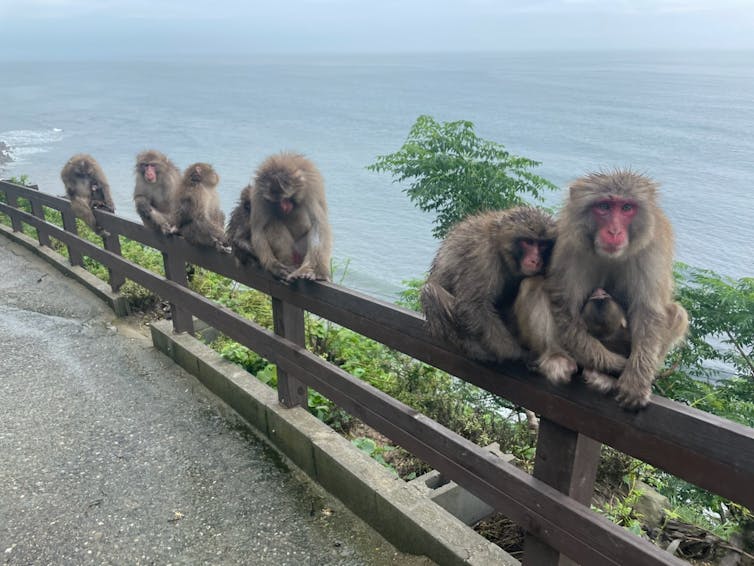
Japanese macaques resting on a fence at the Awajishima Monkey Center with the ocean in the background
Japanese macaques resting on a fence at the Awajishima Monkey Center.
(Sarah E. Turner)

The Conversation

Sarah E. Turner and students in her lab receive funding from the Natural Sciences and Engineering Research Council of Canada – Discovery Grants Program and Leadership in Environmental and Digital innovation for Sustainability (LEADS-CREATE), MITACS Globalink Research Awards, the Quebec Centre for Biodiversity Science, and Concordia University.

Brogan M. Stewart receives funding from the Natural Sciences and Engineering Research Council of Canada, Fonds de recherche du Québec – Nature et technologies, Leadership in Environmental and Digital innovation for Sustainability (LEADS-CREATE), MITACS Globalink Research Awards, the Quebec Centre for Biodiversity Science, and Concordia University.

Megan M. Joyce receives funding from the Natural Sciences and Engineering Research Council of Canada – Discovery Grants Program and Leadership in Environmental and Digital innovation for Sustainability (LEADS-CREATE), MITACS Globalink Research Awards, the Quebec Centre for Biodiversity Science, and Concordia University.

Mikaela Gerwing receives funding from the Fonds de recherche du Quebec – Nature et Technologies, Leadership for Environmental Innovation for Sustainability (LEADS-CREATE), Miriam Aaron Roland Fellowship, MITACS Globalink Research Awards, the Quebec Centre for Biodiversity Science, Concordia University. She is affiliated with Planet Madagascar.

ref. Wild macaques don’t abandon babies. So why did Punch’s mother? – https://theconversation.com/wild-macaques-dont-abandon-babies-so-why-did-punchs-mother-277065

Mark Carney in Australia: How did he become the darling of the global anti-Trump movement?

Source: The Conversation – Canada – By Stewart Prest, Lecturer, Political Science, University of British Columbia

Canadian Prime Minister Mark Carney is having a moment.

While every leader in the world has to grapple with the abrupt and arbitrary decision-making of United States President Donald Trump, few have had to do so with such high stakes as America’s neighbour and ostensible ally to the north.

With more than two-thirds of Canadian exports bound for the US, bilateral trade is a matter of economic life and death for Canada. Since his return to office in January 2025, Trump has made repeated references to Canada becoming America’s “51st state” in an effort to put economic and political pressure on its northern neighbour.

Despite this, Carney has met the challenge with rare candour.

In his recent speech at this year’s World Economic Forum in Switzerland, Carney gave the world a word for the transformations now underway, describing a “rupture” in the international rules-based order.

The speech was remarkable in its honesty on other fronts, as well. Effectively, Carney acknowledged what everyone knows, but no one in a position of power has previously admitted: even before Trump’s return to the White House for a second term, the US-led liberal international order was deeply unfair in its distribution of prosperity and security.

Carney’s pedigree

Why was Carney able to say what others would not, or could not, on such a high-profile stage?

In many ways, his background and present role give him unique credibility in the eyes of the wealthy and powerful who gather each year at Davos.

Born and raised in northern and western Canada, Carney’s academic and professional career played out on a larger stage. Following a PhD in economics at the University of Oxford in 1995, he pursued a career in finance and banking that took him to the heights of both the private and public financial world.

After more than a decade working at the American multinational investment bank Goldman Sachs, Carney entered Canadian public service, eventually becoming governor of the Bank of Canada in 2008 under Conservative Prime Minister Stephen Harper. He went on to become the first non-British head of the Bank of England, serving in that role from 2013-2020.

His governorships coincided with tumultuous times in both countries, spanning the sub-prime financial crisis, Brexit and the early days of the COVID pandemic. While not without criticism, Carney’s performance in both countries won significant acclaim, leading to other international leadership roles.

By early 2025, Carney threw his hat in the ring to replace Canada’s beleaguered Liberal Prime Minister Justin Trudeau, who was trailing badly in public opinion polls. Carney won that race convincingly, and shortly after led the revived Liberals to a narrow but definitive victory over the Conservatives in a federal election in April 2025.


Read more:
Game change Canadian election: Mark Carney leads Liberals to their fourth consecutive win


The party’s stunning come-from-behind victory was fuelled significantly by Trump’s 51st state talk and other forms of coercion.

Commanding respect

Carney has a remarkable CV by any measure. He has moved from the heights of academia to business, finance and finally, government. In politics, he’s been successful in both Liberal and Conservative political environments. That broad credibility ensured that when he spoke from the podium at Davos about a rupture in an already unequal global political system, his words would be taken seriously.

Carney’s role as prime minister of Canada has also played a role in making him the poster boy of a global anti-Trump movement. Since Trump’s return to office, Canada has been on the front lines of America’s movement away from long-held alliances towards a more mercurial, coercive and even predatory foreign policy.

Trump’s penchant for insulting Canadian leaders, threatening Canadian sovereignty and weakening the Canadian economy in the service of American interests makes Canada an important test case that other American partners can learn from.

Within Canada itself, Carney is popular, though his responses to Trump have not always been without criticism. Some have pointed to a recurring gap between rhetoric and action.

Carney’s swift move to endorse the recent US attacks on Iran fit this pattern, as well. Yet, such appeasement hasn’t been rewarded with reciprocity by the Trump administration.

Seeking partners

As Carney visits the Pacific Rim, including a stop in Australia, there’s no question he’s put himself — and Canada — in the global spotlight for his handling of Trump.

His speech in Davos sketched out a vision of an alternate global order that Canada and other like-minded countries might collectively pursue as a defence against the chaotic and unstable world unleashed by Canada’s former friend and ally. However, that rhetoric is not yet reality.

Accordingly, on his visit to India, Japan and Australia, Carney is looking to find partners for that vision. He’s seeking opportunities to improve relations, expand trade and cooperate on issues of Pacific security.

The old world order is not coming back. What Carney achieves in his foray to the Pacific Rim may help determine what new order, if any, emerges in its place.

The Conversation

Stewart Prest does not work for, consult, own shares in or receive funding from any company or organisation that would benefit from this article, and has disclosed no relevant affiliations beyond their academic appointment.

ref. Mark Carney in Australia: How did he become the darling of the global anti-Trump movement? – https://theconversation.com/mark-carney-in-australia-how-did-he-become-the-darling-of-the-global-anti-trump-movement-277039

The Iran war and global trade: will the Cape route become the new normal?

Source: The Conversation – Africa – By Francois Vreÿ, Research Coordinator, Security Institute for Governance and Leadership in Africa, Stellenbosch University

Events in the Middle East during February and March 2026 again disrupted the flows of shipping trade to the eastern and western spheres of the international system.

Given that the global economy is maritime based and rests on secure and predictable flows of goods by sea, the armed attacks on Iran and their maritime spillovers sharply underlined the vulnerability of global maritime trade and its value, which is embedded in safe and predictable deliveries of goods in the interconnected global system.

Although armed attacks caught much of the attention, a more subtle development was playing out as shipping lines and insurers again contemplated the convenience of the Cape sea route around the southern tip of Africa.

Following the Israeli and US armed attacks on Iran, Tehran closed the Strait of Hormuz. The impact was severe disruption to global trade.

Military hostilities and insurance risk suspensions added to uncertainty and bottle-necked carriers inside and outside the Persian Gulf. This high-risk scenario again escalated the importance of the Cape sea route as a convenient alternative should hostilities widen. Iran, for example, also fired missiles towards Cyprus in the eastern Mediterranean while a US submarine sank an Iranian naval frigate in the Indian Ocean south of Sri Lanka.

Based on a widening of the conflict, it is possible that the events of March 2026 could mark a turning point in how the Cape sea route is seen. Dangerous confrontations that force shipping companies to sail along the route are increasing in frequency. Instead of simply being the standing default for diverting risks to global shipping in the north-western Indian Ocean, the route is rapidly becoming the new normal for shipping flows.

I have studied maritime security events off Africa for more than 15 years, and it appears to me that the constant re-routing now calls for less ad hoc decision-making about risks and opportunities. It calls for a rethink about how the route is viewed and managed. For example, it is in the interests of shipping companies, crews and stakeholders to ensure a safe alternative route around Africa that can also guarantee a good standard of shipping and delivery of goods.

That requires paying close attention to the risks associated with the route, and how they can be mitigated.


Read more:
African states don’t prioritise maritime security – here’s why they should


African countries, and particularly South Africa with its Atlantic and Indian Ocean ports and service hubs, must become partners in ensuring a sea route of choice amid a shifting and insecure global security landscape with its maritime spillovers.

The Cape route’s value in history

Until the inauguration of the Suez Canal in November 1869, the Cape sea route was the only viable route for maritime traffic sailing between the Atlantic and Indian Oceans and onwards to the Pacific Ocean.

The Suez Canal shortened the distance for shipping, but it wasn’t a perfect solution. In 1956, 1967 and 1973, Arab-Israeli Wars caused lengthy shutdowns of the Suez Canal.

After the 1967 war, the canal remained closed for about eight years, trapping commercial vessels in its waters. Later developments also disrupted shipping through the Suez Canal and the Red Sea.

Around 2008, sea piracy resurfaced as a dangerous threat to commercial shipping off the Horn of Africa. The arrival in 2008 of an international armada of an estimated 30-40 naval vessels operating under UN Resolution 1816 contained the threat. The intervention prevented the route through the Gulf of Aden and Suez Canal from becoming a piracy haven.

But shipping remained vulnerable and despite the naval deployment, shipping companies intermittently diverted large flows past the Cape.

During March 2021 the container vessel Ever Given blocked the Suez Canal for several days due to a combination of climatic conditions and human failure. This incident demonstrated that war and armed conflict are not the only risks to shipping in this region. Again, some shipping was diverted around South Africa.


Read more:
Houthi militant attacks in the Red Sea raise fears of Somali piracy resurgence


By 2024, in solidarity with the Palestinian cause, the Houthi rebel movement in Yemen began attacking selected commercial vessels passing through the southern Red Sea. Extensive attacks with missiles, drones and unmanned seaborne vessels again rerouted ships southward around the Cape of Good Hope.

This rerouting persisted for most of 2024. Shipping companies had to choose between:

  • risking Houthi missiles and drones

  • being escorted by naval vessels from the US, the UK and the EU

  • taking the Cape sea route.

It is estimated that as much as 66% of shipping sailed south along the Cape sea route at its height.

The Cape sea route 2026: the risks

Duration, costs, services and sea conditions add up to a different risk repertoire along the Cape route.

One risk is the extra loss of containers; sea conditions can be very rough around the tip of Africa. This carries heavy financial and environmental costs.

A second risk relates to support along the route, which adds up to 15 days to a journey. For example, there are limited deep sea salvaging capabilities on the route. South Africa used to be a salvage hub, but has abandoned those capabilities.


Read more:
Mozambique insurgency: focus needs to shift to preventing criminality at sea


A third set of risks are those that ships face if they enter an African harbour for unplanned reasons. There they stand exposed to dysfunctional service delivery and port inefficiencies.

All require implementing risk mitigation plans.

What needs to be done

The first plan should be extensive cooperation between African governments, their maritime agencies, and shipping companies. This remains the gold standard for building maritime security to contain non-traditional and non-naval threats along the route.

For example, there needs to be international cooperation for modernisation and port service delivery. These range from bunkering services to salvage assistance to collaboration on search and rescue services.

Responses do not solely depend on naval interventions. However, naval cooperation and roping in coast guards remain critical. This requires that African maritime agencies become better organised to secure the route to support safe global trade, including trade with Africa.

Derisking cannot be a solely South African responsibility. Maritime safety and security are about cooperation and partnerships. For the Cape sea route this implies African partnerships as well, intra-continental and with other international partners.

The Conversation

Francois Vreÿ received funding from the Friedrich Naumann Stiftung for Freedom in 2022 and 2023.

ref. The Iran war and global trade: will the Cape route become the new normal? – https://theconversation.com/the-iran-war-and-global-trade-will-the-cape-route-become-the-new-normal-277582