How dangerous has the conflict in Iran become? Expert Q&A

Source: The Conversation – UK – By Scott Lucas, Professor of International Politics, Clinton Institute, University College Dublin

The conflict in the Middle East is now in its sixth day and is showing no sign of letting up. Israeli and US warplanes have continued to strike targets inside Iran, which has prompted retaliatory attacks throughout the region. An American submarine has also sunk an Iranian navy ship off the coast of Sri Lanka, killing at least 80 people, while Nato defences intercepted a missile heading towards Turkey.

US officials, who initially envisioned the conflict in Iran lasting four to five weeks, are now warning it may go on far longer. “We are accelerating, not decelerating,” Defence Secretary Pete Hegseth told reporters on March 4, adding that “more bombers and more fighters are arriving just today”. We asked Middle East expert Scott Lucas how dangerous the situation has become.

You’ve called this ‘uncontained war’. What do you mean by that?

Once the Iranian regime retaliated, hours after initial US-Israel airstrikes that it was later revealed killed Iranian supreme leader Ayatollah Ali Khamenei, this was no longer just an American-Israeli war on Iran. Tehran, which had refrained from retaliation beyond Israel in the 12-day war in 2025, was taking this across the region.

This was a war in the Gulf states, where Iran fired not only on American bases but also industrial areas, ports and tankers. This was a war in Lebanon, where Israel responded to Hezbollah rocket fire with airstrikes and an expansion of its occupation in the south of the country. This was the possibility of war spreading to Iraq, where the US military and CIA may be supporting Iranian Kurds for a cross-border incursion.

It is now possibly also a war beyond the Middle East. A drone attacked the UK’s RAF Akrotiri base in Cyprus and an Iranian missile has been intercepted flying towards Turkey. Drones have struck an airport and school in Azerbaijan. Iran has denied responsibility but the Azerbaijani president, Ilham Aliyev, has put his armed forces on high readiness.

How dangerous a moment is this?

War is always dangerous, of course, but this conflict is compounded by the shattering of any international “rules of the game”. The US and Israel have blatantly violated international law. They have assassinated the head of another country and his senior officials.

The UN can condemn the strikes, but this will be easily disregarded by Israel and the US. Donald Trump has historically taken little notice of UN criticism, and said in January that his power is limited only by his “own morality”. European countries can call for deescalation, but almost all have now prioritised working with the US on the defence of positions threatened by the Iranians.

China is maintaining a cautious position and Russia will be grateful that attention is being taken away from its invasion of Ukraine. If the Iranian regime does not surrender, there does not appear to be anyone or anything capable of checking the US and Israeli attacks – and thus the retaliatory shocks across the region and beyond.

Is there a risk that Nato will be drawn in?

Nato is already drawn in. Once Iran went beyond the Middle East to threaten Cyprus and Turkey, then the bloc had to take action. However, while Nato forces downed the missile heading towards Turkish airspace, the alliance is not yet discussing invoking Article 5 (the agreement that an attack on one Nato member is considered an attack on all).

The alliance has also become involved in the conflict verbally to ensure the Trump camp does not abandon Ukrainian and European security at a sensitive point in talks to end Russia’s invasion of Ukraine. Nato secretary-general Mark Rutte, already known for calling Trump “daddy”, has given fulsome praise to the war even as some Nato members like Spain condemn it.

In a recent interview with a German television channel, Rutte said: “It’s really important what the US is doing here, together with Israel, because it is taking out, degrading the capacity of Iran to get its hands on nuclear capability.”

Where are the Gulf states in this? What happened to Qatar’s attempts to mediate?

The Gulf states are likely to be happy that Iran’s supreme leader and others in his circle have been assassinated. For decades, Khamenei had pursued a strategy of expanding Iran’s influence across the Middle East – directly threatening Gulf monarchies. However, they are loathe to see regime change, fearing the disorder and instability that marked Iraq after the 2003 US invasion.

They have been trying to pull back the Trump administration – an initiative by Qatar to persaude Trump into finding an off-ramp is notable – but they have to do so quietly. Open opposition to the US president risks even more serious disruption of the political and economic situation, with no guarantee that a triggered Trump will listen.

There is a further complication because of division among the Gulf states. Saudi Arabia, Qatar and Kuwait put some of the blame for the rising hostilities in the Middle East on the United Arab Emirates and Bahrain for their policy of normalising relations with Israel. They claim this has emboldened the Israeli government of Benjamin Netanyahu.

So far, the quiet push for deescalation does not appear to have succeeded. Without naming Qatar or another Gulf partner, Trump said on March 3 that there will be no talks with Tehran.

The US and Israel are reportedly arming Kurdish groups. How could that change things?

With Plan A for regime surrender not succeeding so far, the Trump camp has had to consider what to do next. More bombing and an incursion by ground forces are two options, as is supporting an insurrection by Iranian Kurds.

It appears the US president and his senior advisers (along with their Israeli allies) may opt for the Kurdish option. According to reports, Trump has in recent days called Kurdish minority leaders to offer them “extensive US aircover” and other backing if they enter the conflict.

But the Iranian regime will undoubtedly unleash its military against the insurgents, throwing the west of the country into further turmoil. And it will have a justification to rally Iranians around the nation, despite the mass protests that were crushed in January.

Even if the US can support the insurgency in splitting off part of Iran, what happens to the rest of the country? What does Plan B offer other than instability and fragmentation that could parallel post-2003 Iraq?

This does not bring an assurance that the regime’s retaliation will be halted soon. Meanwhile, the US military is facing a shortage of interceptors which – if Iran’s firepower has not been expended – maintains the threat facing the Gulf states.

The Conversation

Scott Lucas does not work for, consult, own shares in or receive funding from any company or organisation that would benefit from this article, and has disclosed no relevant affiliations beyond their academic appointment.

ref. How dangerous has the conflict in Iran become? Expert Q&A – https://theconversation.com/how-dangerous-has-the-conflict-in-iran-become-expert-qanda-277632

The Gulf’s delicate balancing act between the US and Iran is now in flames

Source: The Conversation – UK – By Gemma Ware, Host, The Conversation Weekly Podcast, The Conversation

As Israel and the US continued to bomb Iran after killing the country’s supreme leader Ali Khamenei, Iran lashed out at its neighbours. Among the targets of Iranian drone strikes were a hotel in Dubai, a port in Oman, gas facilities in Qatar, and multiple US bases and embassies in the region, including in the Saudi Arabian capital, Riyadh.

Saudi Arabia and Iran have a long and bitter rivalry. Yet, in recent years, the Saudis had begun building new diplomatic relationship with Iran, even as they and other Gulf states continued to host American military bases, and court American investment.

Now the Gulf states find themselves in the middle of the very regional conflict many of its leaders hoped to avoid. It’s one which threatens longstanding efforts to cement the Gulf as a hub for finance, travel and tourism, and as an oasis of security.

In today’s episode of The Conversation Weekly podcast, we speak to Simon Mabon, a professor of international relations at Lancaster University in the UK and expert in Saudi-Iran relations, about how the Gulf’s delicate balancing act between the US and Iran came toppling down.

Mabon says that in recent years, Gulf states realised they had to live alongside Iran. “You can’t do that without having regional stability. And the only way you could get regional stability is to integrate Iran in some way, shape, or form,” says Mabon.

But after the US-Israeli war on Iran, and Iran’s retaliation against its neighbours, Mabon thinks it will be very difficult “to rebuild the sort of trust that had been cultivated over years between the Gulf Arab states and Iran”. That leaves big questions about how Gulf states, which may have advanced military hardware, but only small armies, ensure the security of their populations and their economies.

Listen to the interview with Simon Mabon on The Conversation Weekly podcast. This episode was written and produced by Mend Mariwany and Katie Flood. Mixing by Eleanor Brezzi and theme music by Neeta Sarl. Gemma Ware was the executive producer.

Newsclips in this episode from CNN, 60 minutes, euronews, BBC News, PBS NewsHour and WION.

Listen to The Conversation Weekly via any of the apps listed above, download it directly via our RSS feed or find out how else to listen here. A transcript of this episode is available via the Apple Podcasts or Spotify apps.

The Conversation

Simon Mabon receives funding from Carnegie Corporation of New York and the Henry Luce Foundation. He is affiliated with the Foreign Policy Centre.

ref. The Gulf’s delicate balancing act between the US and Iran is now in flames – https://theconversation.com/the-gulfs-delicate-balancing-act-between-the-us-and-iran-is-now-in-flames-277449

Sophie Oluwole, the trailblazing Nigerian woman who redefined philosophy

Source: The Conversation – Africa – By Christophe Premat, Professor, Canadian and Cultural Studies, Stockholm University

Sophie Oluwole (1935-2018) was a Nigerian scholar and the first woman to earn a PhD in philosophy in her country. She not only placed Nigeria’s rich Yoruba philosophical tradition on the intellectual map, she also helped redefine African philosophy, a field dominated by men.

As a scholar of cultural studies with a focus on francophone and west Africa, I recently co-authored, in French, a book called African Intellectual Sensitivities: From Western Discourse to African Voices (1988-2022). One of its chapters is devoted to Oluwole and African women intellectuals.

She did much more than break gender barriers. By placing Nigeria’s Yoruba thought in dialogue with the famed western philosophers like Socrates, she challenged the assumption that African philosophy was merely folklore. To her it was a rigorous intellectual tradition.

Who gets to think?

For centuries, western philosophy presented itself as the universal measure of reason. Beginning with German philosopher Georg Wilhelm Friedrich Hegel (1770-1831), influential strands of western philosophy described Africa as “outside history”.

The continent was said to lack philosophy because it lacked a written tradition comparable to ancient Greece’s. Rational thought, many argued, needed text.

It was against this assumption that Oluwole built her work. She did not simply ask for African thinkers to be added to reading lists. She questioned the criteria used to define philosophy. In the process, she challenged a long-standing intellectual hierarchy.

A philosopher between worlds

Born in 1935 in what is today Ondo State, Sophie Bosede Olayemi Oluwole came of age during the final decades of British rule and the intense debates that would culminate in independence in 1960.

Like many girls of her generation, she initially trained as a teacher. But her intellectual curiosity pushed her further. She enrolled to study philosophy at the University of Ibadan, then the country’s premier university. It was an unusual choice for a Nigerian woman in the 1960s. She earned her PhD there in 1984.

Pursuing a doctoral degree took persistence in an academic culture overwhelmingly dominated by men. Her path reflects both the new educational opportunities after independence and the structural barriers women still faced in higher education.

Her intellectual career unfolded from the 1970s through the early 2000s, while Nigerian universities were wrestling with their post-independence identity. After 1960, several institutions sought to Africanise curricula and leadership. Yet philosophy departments often remained anchored in European traditions.

Oluwole herself was Yoruba, one of the largest ethnic and language groups in west Africa. The Yoruba were concentrated mainly in south-western Nigeria but also present in Benin and Togo.

Yoruba thinking is structured around a cosmology linking the visible and invisible worlds, ancestors and descendants, individual destiny and communal responsibility. Knowledge is not separated from ethics or spirituality; wisdom is understood as practical guidance for living well within a web of relationships.

She focused on the corpus of Ifá, a vast body of oral literature linked to ethics, cosmology and reflection on human destiny. At its centre stands Òrúnmìlà, a figure associated with wisdom and knowledge.

For Oluwole, Òrúnmìlà was not just a religious figure. He functioned as a philosopher – a teacher of critical inquiry and moral reasoning whose insights were preserved through disciplined oral storytelling.

She drew comparisons between him and the Greek philosopher Socrates. Socrates left no written work of his own. His ideas were transmitted through dialogue and memory. Why, then, should the spoken word disqualify an African thinker from being recognised as philosophical?

The problem, she insisted, was not Africa’s lack of philosophy. It was the narrow definition of philosophy inherited from Europe – one that privileged written texts and dismissed oral traditions as pre-philosophical. By questioning that definition, Oluwole was not only defending Yoruba thought. She was expanding philosophy itself.

The politics of the spoken

At the centre of Oluwole’s work was a simple but disruptive question: must philosophy be written to exist? In her book Philosophy and Oral Tradition (1997), she argued that African oral texts – including myths, proverbs and Ifá verses – contain structured reasoning and critical reflection, and therefore meet the criteria of philosophical thought. Texts are preserved, cited and institutionalised.

She exposed the colonial logic behind this hierarchy. During the 1800s and early 1900s, European scholars often portrayed Africa as a continent of myth rather than reason.

The absence of classical written texts was interpreted as intellectual absence. But storytelling does not prevent intellectual reasoning. Writing does not automatically produce critical thought. By analysing Ifá verses, Oluwole showed that they contain ethical reasoning, reflection on causality (cause and effect) and debate about human responsibility.

Her work entered into dialogue with broader debates in African philosophy. Thinkers like Benin’s Paulin Hountondji criticised the idea that African philosophy was only a collective worldview. They argued for critical and argumentative traditions. Oluwole demonstrated that such critical reasoning could also be embedded in oral forms.

A trailblazing woman

Oluwole’s work cannot be separated from her position as a woman. Philosophy remains one of the most male-dominated disciplines worldwide.

But Oluwole faced a double challenge. She was a woman in philosophy. She was also an African philosopher confronting Eurocentric standards.

She would become an increasingly public figure, making many TV appearances and speaking engagements, always spurring debate.

Why she matters today

The questions Sophie Oluwole raised remain pressing.

As calls to decolonise knowledge grow, universities around the world are rethinking what they teach. Yet change often focuses on adding authors to the syllabus. The deeper issue concerns the criteria used to define knowledge.

Oluwole’s work invites a more structural reflection. If philosophy is defined too narrowly, inclusion will remain limited. The definition of philosophy itself must be examined.


Read more:
Achille Mbembe on how to restore the humanity stolen by racism


Her argument also speaks beyond Africa. Many indigenous knowledge systems continue to be marginalised because they are transmitted orally or embedded in ritual and narrative. They are treated as cultural heritage rather than intellectual production.

By defending the philosophical depth of Yoruba thought, Oluwole challenged this hierarchy. She showed that philosophy is not the property of one civilisation. It is a human practice shaped by different media and histories.

The Conversation

Christophe Premat is a professor in Francophone cultural studies at the Department of Romance and Classical Studies at Stockholm University. He co-authored in 2025, with Buata B. Malela, the book Sensibilités intellectuelles africaines (Éditions Hermann).

ref. Sophie Oluwole, the trailblazing Nigerian woman who redefined philosophy – https://theconversation.com/sophie-oluwole-the-trailblazing-nigerian-woman-who-redefined-philosophy-277382

Solar power in rural Zimbabwe hasn’t reduced women’s unpaid work: can policy do better?

Source: The Conversation – Africa – By Ellen Fungisai Chipango, Senior Research Associate, University of Johannesburg

Zimbabwe’s 2019 renewable energy policy envisions a transition to green energy in which women and men participate equally and benefit equitably.

But the real test of this promise lies in whether women and men have equal access to renewable energy and are able to use it for the tasks they most need to accomplish in their everyday lives.

As an energy justice researcher, I wanted to find out how residents, government officials and energy non-governmental organisations view gender (in)equality in the move to green energy.

I chose to interview people from Zingondi (a rural area in the Manicaland province of Zimbabwe) because this area offers a clear case of how renewable energy policy plays out in low-income, rural areas that are not connected to the national grid.


Read more:
Green energy doesn’t benefit everyone: ubuntu ideas can help include more people


I asked the people I interviewed what a truly equal and equitable energy policy would look like in practice. By equal, I mean giving women and men the same opportunities and access to energy. By equitable, I mean recognising that they often start from unequal social and economic positions, and that women may therefore need additional support (funds, training, or extra decision-making powers) to reach the same level of energy access and benefit as men.

There are about 39 households living in Zingondi. They are not connected to the national electricity grid. To cook, they use fuelwood and what’s left after crops are harvested (biomass). Many families live in thatched mud houses. When I visited, I saw that all families used solar lanterns. Some also had solar panels to charge phones and radios.

My research found that having such limited access to electricity did nothing to change traditional gender roles where women do a lot more unpaid work around the house than men. For example, women remained primarily responsible for cooking on fire. They also had very little control over new forms of solar energy (what to buy and how to fix it if it broke) as these decisions and actions were controlled by the men in the families.

Overall, women saw little change in their economic or decision-making power even though clean forms of energy had come into their lives.


Read more:
How socio-economic conditions shape renewable energy uptake in Zimbabwe


My findings show that even new renewable energy is never neutral. It is shaped by power: who controls resources, who captures the benefits, and who remains excluded. Achieving gender equality in energy transitions needs more than introducing small solar devices or promising future grid access.

Zimbabwe’s energy policies must move beyond promises of gender equality in energy access and deliver real transformation on the ground. The country’s renewable energy policy commits to gender equality and women’s participation, but pays less attention to whether this is taking place.

If this change does not happen, new energy initiatives will simply prop up existing gender hierarchies which leave women at the bottom, rather than transforming women’s lives.

Solar power in rural Zingondi

Zingondi is a resettlement area (where land was redistributed under the fast-track land reform programme to small-scale farmers) whose households have three hectares of land each.

Most families there depend on small-scale farming to grow food. But they face problems of insecure land rights (they only have temporary licences to occupy the land), political disputes, and limited access to resources to develop their farms.


Read more:
Green energy for all: Zimbabwe will need a new social contract to roll out projects like solar power


At first glance, the solar lanterns in every home, purchased by the residents, indicate that universal access to affordable, reliable and modern energy is being achieved. But when I asked women how solar energy had improved their lives, their responses were cautious.

First, many women were still cooking with firewood, because small solar devices can’t power electric stoves. One female participant observed:

When I am cooking using semi-dried wood, no one can even enter the kitchen because of the smoke. It is like a prison cell!

Second, they had little decision-making power over energy:

Solar gives men more power to control us in the home … if it’s not the money to buy the gadgets, such as solar lanterns, it’s how to use them, or it’s about when and where to buy a replacement.

Third, the quality of solar lanterns varied. Families that received remittances from relatives working in South Africa were able to afford higher-quality appliances. But poorer households could not. Cheap solar lanterns often overheated and “blew” after a short time. Paying for replacements placed financial strain on many women.

Fourth, having light at night made the working day for these rural women even longer:

Having a light bulb (solar lantern) means more work to cover, not to relax. The reason is: I am a woman!

Women also reported that their husbands did not allow them to travel to renewable energy meetings where they could learn more about solar power.

Some women hid small amounts of money from their husbands to avoid conflict or to retain some financial autonomy for buying electricity later – known in ChiShona as kusungirira mari muchiuno (“to tie money around the waist”). But because these savings were hidden, the women couldn’t spend them on larger or more reliable solar energy systems.

What needs to happen next

Zimbabwe’s energy transition must make sure that women are not just passive recipients of energy infrastructure but active participants in shaping how energy is accessed, used and managed.

Women begin from unequal positions. So energy policies must tackle the question of the power relations that shape who controls resources within households and communities.


Read more:
Zambia’s forest communities need finance for solar power – so they don’t have to cut down trees to pay for it


Zimbabwe’s energy policy emphasises women’s inclusion and solar entrepreneurship. However, its largely market-driven approach means that only women who can afford solar systems benefit, leaving off-grid and marginalised communities like Zingondi excluded.

To make the policy truly transformative, the government could take these steps:

  • introduce targeted subsidies, micro grants or low-interest loans for rural women

  • support community-shared solar schemes

  • set quotas for women in resettlement areas to participate in renewable energy schemes

  • convene training in local areas where childcare is provided, so that women can participate

  • set up mentorship programmes to strengthen women’s leadership and decision-making

  • implement regular monitoring to ensure that women not only participate but also gain meaningful control over energy resources.

This is happening in other countries. In rural Bangladesh, women have been trained as solar technicians, and in Nepal, women have taken on leading roles in managing tiny, micro hydro plants.


Read more:
Why renewable energy won’t end energy poverty in Zimbabwe


In India, government‑linked schemes such as the Ministry of New and Renewable Energy’s Women in Renewable Energy initiative provide training and business support that expand women’s participation in the energy sector.

Unless these changes are made, solar energy infrastructure will expand in rural Zimbabwe without expanding equality.

The Conversation

Ellen Fungisai Chipango does not work for, consult, own shares in or receive funding from any company or organisation that would benefit from this article, and has disclosed no relevant affiliations beyond their academic appointment.

ref. Solar power in rural Zimbabwe hasn’t reduced women’s unpaid work: can policy do better? – https://theconversation.com/solar-power-in-rural-zimbabwe-hasnt-reduced-womens-unpaid-work-can-policy-do-better-276287

What does a house mean to you? We asked some women who head households in South Africa

Source: The Conversation – Africa – By Mziwandile Sobantu, Professor, University of Johannesburg

Wikimedia Commons

South Africa’s new democratic government inherited a 1.5 million housing backlog in 1994, which it has been struggling to close. The current national deficit stands at 2 million.

The 2025 White Paper for Human Settlements records that government has delivered 5.2 million houses and housing opportunities (units or subsidies) since 1994. But rapid urbanisation, population growth and the pace of housing provision by government have meant that there’s still a shortfall.

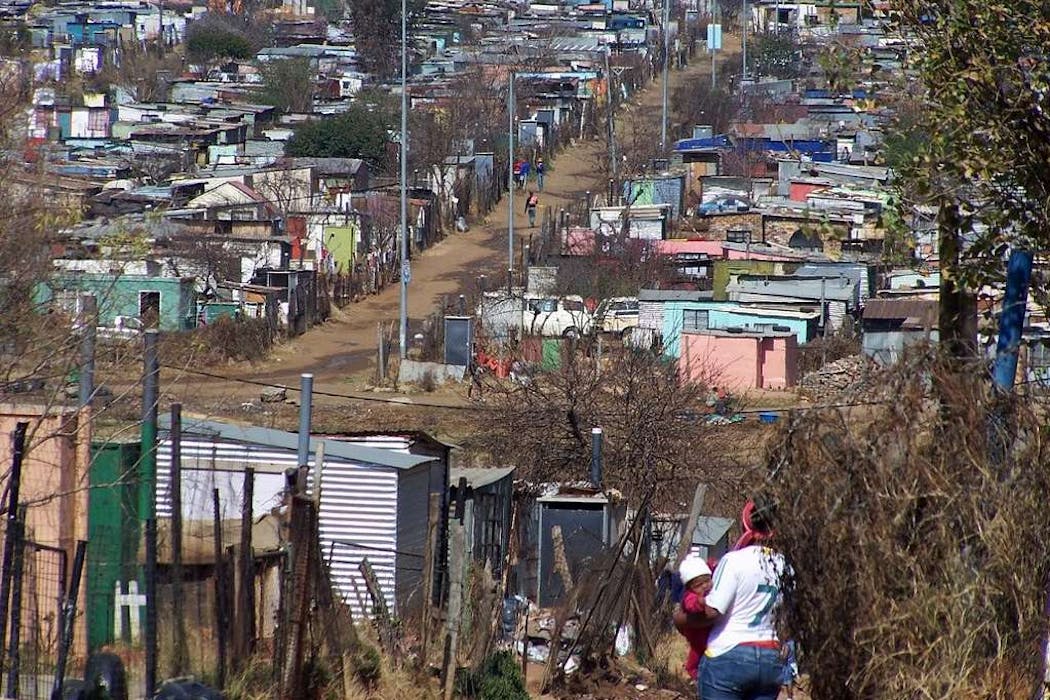
Many of the people who face housing challenges are women who bear full responsibility for childcare and families. In two of the province’s main metropolitan areas, Ekurhuleni and Johannesburg, four in ten families are headed by women. Many have to resort to inadequate housing in informal settlements and backyard dwellings.

We are social work research academics who recently explored what housing means to female-headed households living in a low-income community in Kathrada Park, Johannesburg. Rather than treating housing only as shelter or physical asset, the study examined how women experience and interpret their homes in the context of their everyday lives.

The findings show that housing is not just about having a roof overhead. It is also about dignity, control, emotional security and belonging. These meanings are shaped by women’s life histories, including migration, widowhood, divorce and caregiving roles. They also challenge narrow policy definitions of what constitutes adequate housing.

Understanding housing through people’s lived experiences is critical in a country where women increasingly shoulder the responsibility of sustaining families.

Housing is a basic right and human need which is enshrined in South Africa’s 1996 constitution. The International Bill of Rights cites adequate housing as a measure of social progress as well as a commitment to build the economy.

Women in Kathrada Park

In urban areas such as Kathrada Park in Johannesburg, women head households under conditions shaped by gender inequality, economic precarity and social responsibility. Unemployment, particularly for Black women, remains very high in the country.

Kathrada Park.

Our study was based on interviews with eight female heads of households aged between 37 and 71. Qualitative research with smaller samples allows researchers to gain in-depth descriptions of whatever they are studying. All were single women heading households, had lived in Kathrada Park for at least two years, had their own accommodation, and were engaged in either formal or informal livelihood activities. Some were supporting children, adult dependants or grandchildren.

Rather than focusing only on material conditions, we asked a simple but powerful question:

What does a house mean to you?

Their responses revealed three closely connected themes: dignity and self-worth, safety and security, and livelihood.

Theme 1: Housing as dignity and self-worth

For many participants, having a house, however modest, was a source of pride. In a society where women heading households may be stigmatised or blamed for poverty, a home symbolised responsibility, achievement and resilience. One woman explained:

…you get dignity when you live in a house.

For her, housing was not only about protection from the elements, but also about being respected by her children and by others in the community.

Small acts of homemaking such as painting walls, planting a garden or keeping the space orderly carried deep emotional meaning. These practices were ways of asserting identity and self-worth in contexts marked by exclusion and hardship. Housing was not only about ownership or tenure; it was about being able to say: I am a capable woman, providing for my family.

All participants emphasised that, despite raising children on their own, their families had shelter and a home, could use flushing toilets, and had access to water and electricity. These basic services, often taken for granted elsewhere, gave them a strong sense of pride and self-respect.


Read more:
Health risks at home: a study in six African countries shows how healthy housing saves children’s lives


Theme 2: Housing as safety for women and children

Safety emerged as a central concern in participants’ lives. South Africa experiences high levels of crime and gender-based violence. Participants spoke about fear of break-ins, violence and insecurity while also describing their homes as offering some degree of protection.

As one woman put it:

It’s a pity that our community is not safe. You just have to live and pray that nothing will happen to you till the next day. A good house is very important here.

For these women, housing represented a fragile but crucial buffer against exposure to danger. It provided a place where children could sleep behind locked doors, where families could retreat from public risk, and where a sense of control, however limited, could be maintained.

This highlights an important reality: even poor-quality housing can improve safety and wellbeing compared to homelessness or informal living arrangements. For female-headed households, the home often functions as the primary line of defence against vulnerability.

Theme 3: Housing as livelihood

Housing was also closely linked to livelihood and economic survival. Several participants used their homes to grow vegetables, support small-scale food production, or supplement household income in other ways.

One woman explained:

This garden is helping us so much. At least my kids at the creche get to eat greens every day, which is good. And it keeps us busy.

Her home enabled both food security and daily activity. Other participants highlighted the importance of location. Being close to schools, transport routes, or informal work opportunities made daily survival possible.

Housing was therefore not only a place to live, but a base from which women sustained their families economically. This reinforces the idea that housing cannot be separated from broader questions of poverty, care and economic inclusion.


Read more:
South Africa’s addressing system is still not in place: a clear vision is needed


Women and disadvantage

Across many societies, women remain disadvantaged in three interrelated dimensions: limited access to education, lower economic returns for heavier workloads, and persistent barriers to socioeconomic mobility. These inequalities have direct consequences for housing outcomes, often resulting in inadequate housing or, in some cases, the absence of stable shelter altogether.


Read more:
South Africa’s low-cost housing model is broken – study suggests how to fix it


For many female-headed households in South Africa, housing is the difference between vulnerability and survival. It is a place of safety in an often-unsafe world, a space of autonomy following loss or separation, and a foundation from which women care for children, elders and themselves. Yet access to quality housing and property has long been skewed against women in many developing societies, undermining not only their right to shelter but also their access to safety, security, piped water, electricity and sanitation.

Our findings show that for women who head households, housing is not simply about shelter. It’s about the possibility of belonging in a society marked by inequality and uncertainty.

Contributor Lydia Mmola was a postgraduate student when this study was conducted.

The Conversation

Mziwandile Sobantu works the University of Johannesburg, Auckland Park Campus

Emmison Muleya does not work for, consult, own shares in or receive funding from any company or organisation that would benefit from this article, and has disclosed no relevant affiliations beyond their academic appointment.

ref. What does a house mean to you? We asked some women who head households in South Africa – https://theconversation.com/what-does-a-house-mean-to-you-we-asked-some-women-who-head-households-in-south-africa-275012

Faith leaders joined the fight against woman abuse in the DRC. Did it help?

Source: The Conversation – Africa – By Meg A. Warren, Professor of Management, Western Washington University

Can pastors, imams and rabbis be allies to women and children and help stop gender-based violence?

Many wars have been fought in the name of religion. Much pain and dehumanisation has been inflicted on women and girls in the name of religious culture. So, it wouldn’t be surprising for there to be cynicism about the question.

But, in fact, a growing body of research shows that faith leaders can be powerful allies against social ills like gender-based violence.

As a social-organisational psychologist, I research how people use their strengths and the strengths of their culture to assist those who are suffering in their society.


Read more:
Sexual violence: a weapon of war in eastern Congo for more than 20 years


My colleagues, Karen Torjesen and Grace Ngare, and I set out to study the impacts of a year-long intervention by religious leaders in the Democratic Republic of Congo (DRC). The religious leaders had initiated a programme that they hoped would contribute to social change when it came to gender-based violence within marriage, gender roles in the family, and male allyship in the community.

Our study found that faith leaders could indeed be activated as champions of positive social change. They can activate entire communities – men and women – to come together to address gender-based violence. We found that the ripple effect can endure and extend well beyond initial efforts.

A history of violence

The Second Congo War (1998–2003) was one of Africa’s deadliest civil wars, claiming as many as 3 million lives.

Systematic rape was wielded as a weapon of war. The DRC earned the unfortunate label of “rape capital of the world”. Internally displaced women and girls were viewed by armed militia as soft targets.

From the 2000s, boys in the DRC who had been recruited as child soldiers were returning home as young adults. They had been taught that women were no more than “spoils of the war”.

Without the support of therapy, they had to reintegrate into their families and live among their mothers, aunts and sisters, and start their own families. Predictably, gender-based violence was rampant.

Ending it was a clear goal for the health and stability of civil society.


Read more:
I was a child soldier – here’s what it’ll take to protect young lives in conflict zones


At the same time, women were reluctant to report the men who raped them. In addition to cultural norms of silence and shame around sexual violence, they did not want to have their brothers, sons and husbands locked up in prison. The community had to find another means to restore women’s safety and well-being while also protecting the fabric of their society.

In a context of crumbling infrastructure, the people who truly understood the extent of the rape and violence against women were not the police or other authorities. Rather, it was the quiet presence of the church pastors and the wives of the imams that the women confided in.

The pastors and imams decided to use their influence to teach congregants about healthy interpersonal relationships – where respect, gender equity, nonviolence and empowerment were key.

The Tamar Campaign

In 2013, their three-year initiative, the Tamar Campaign, was delivered directly and through spin-off efforts to more than 30,000 people across multiple cities and villages in the DRC. Participants each attended the programme for about a year.

Created by the Fellowship of Christian Councils and Churches in the Great Lakes and the Horn of Africa, this was an interfaith, inter-organisational effort to combat gender-based violence through the use of scriptures and the engagement of communities. It was named after the story of the rape of Tamar in the Old Testament – a common thread across Christianity, Islam and Judaism – in which a daughter of King David was raped by her brother.

Because of toxic gender norms around what it meant to be a man, the men returning from war had not learned how to identify their own emotions, how to speak about their emotions, or how to see the emotions of others and work with them.


Read more:
The war after the war: How violence is passed down through generations


The goal was to use stories from scripture as the entry point to teach men how to be better allies to women and girls. In the story of Tamar, for example, rape combines elements of incest, domestic violence and the conspiracy of men. When Tamar sought help after being raped, she was told to be quiet. This displays the culture of silence around such acts.

In each monthly session run by the faith leaders, scriptural stories were introduced as an entry point to openly discuss gender-based violence within a mixed-gender setting. They lifted the shroud of silence in a sacred and safe space, often a house of worship. Next, participants discussed gender-based violence in their own families and the community. They talked about how they could become agents of change.

In the process, in monthly group sessions of 25 or so people, the programme sought to teach socio-emotional skills, detoxify notions of masculinity, deepen understanding between men and women, strengthen their relationships, and develop action plans for healing, repair and allyship.

The study

My research team evaluated the effectiveness of this intervention four years later. In a field study, a survey was given to Tamar participants, and matching control groups in North and South Kivu.

We found that those in the programme had a 50%-85% lower incidence of violence, with larger drops in violence in North Kivu compared to South Kivu. It was a dramatic success story.

This tremendous drop in violence happened after many earlier interventions to address the problem had failed. Typical advocacy-based interventions failed because women worried that even if they became better at advocating for themselves, the fabric of society would disintegrate – the women would be beaten, ousted from their community, and lose their children. Their only choice seemed to be silence – unless the intervention wasn’t about the women at all, but about turning the men into their allies.

My team studied the results, including the effects on the participants’ marital relationships. We found, amazingly, that their relationships were better than when women had remained silent. There were accounts of women and men communicating and dealing with emotional issues with respect, rather than derision.


Read more:
Women activists in the DRC show how effective alliances can be forged


Long after the funding had ended, other groups and communities who had heard about the programme borrowed the Tamar curriculum, with positive results. The allyship was still spreading and still having an impact. Community members were intervening when they saw violence occur among their neighbours or their extended family. They were being allies out in the world, not just for their own partner or immediate families.

This offers one example of how cultural phenomena like religion can be a resource to combat large, complex and entrenched societal problems. Congolese participants were drawing on their strength, building relationships, prioritising healing, and thinking in the long term to shift a toxic culture from the inside out.

The Conversation

This study was made possible by research funding from Norwegian Church Aid.

ref. Faith leaders joined the fight against woman abuse in the DRC. Did it help? – https://theconversation.com/faith-leaders-joined-the-fight-against-woman-abuse-in-the-drc-did-it-help-277270

The Black Death’s counterintuitive effect: as human numbers fell, so did plant diversity

Source: The Conversation – UK – By Christopher Lyon, Visiting Research Fellow, Centre for Death and Society, University of Bath

Paul Nash/Shutterstock

Between 1347 and 1353, Europe was gripped by the most catastrophic pandemic in its history: the Black Death. Killing many millions, the plague wiped out between one-third and a half of Europe’s population.

In some cities, mortality rates were as high as 80%. In rural areas, Black Death mortality caused intense labour shortages. Entire villages were left empty as rural economies collapsed. In many places, cultivated fields were abandoned and reclaimed by woodland, scrub and deer.

Given the widely reported negative effects that people have had on nature over recent decades and centuries, we might expect this continental-scale “rewilding” to have enabled biodiversity to flourish. However, our new study in the journal Ecology Letters uncovers a potentially counterintuitive result: when Europe’s human population crashed, plant biodiversity also plummeted.

Fossilised pollen grains in sediment cores extracted from lakes and bogs contain information about plant communities that existed thousands of years ago. We used data from over 100 fossil pollen records from across Europe to explore how plant diversity changed before, during and after the Black Death.

The pollen data show that between 0BC and 1300, plant diversity in Europe increased. It grew through the rise and fall of the Western Roman Empire and continued through the early Middle Ages. By the High Middle Ages, biodiversity levels were at their peak.

However, in 1348, Europe was hit by plague and for about 150 years, plant biodiversity plummeted. It was only after a century and a half – as human populations recovered and farming resumed – that plant diversity began to rise again.

black and white etch of people dying from black death
The plague of Florence in 1348, as described in Boccaccio’s Decameron. Etching by L. Sabatelli. Iconographic Collections.
Wellcome Collection gallery (2018-04-05), CC BY-NC-ND

We found that the biggest losses of plant diversity occurred in areas most affected by land abandonment. By plotting patterns of biodiversity changes from sites with different Black Death land use histories, we discovered that biodiversity collapsed in landscapes where crop (arable) production was abandoned, whereas landscapes with growing or stable arable farming became more biodiverse.

Our work suggests that over 2,000 years of increasing European biodiversity was generated because of – not in spite of – humans. But why? And what lessons can we learn from this for managing biodiversity now, when land being converted into farmland is driving biodiversity losses?

Population growth and technological innovations pushed agricultural activities into previously unused lands over the first 1,300 years of the common era. Unlike today – where crop monocultures are dominant – mixed agricultural systems were the norm over the majority of the last 2,000 years. Across Europe, a diverse lattice of farmlands and farming practices were typically separated by woods, rough grazing lands and uncultivated plots, often enclosed by hedgerows or trees.

wooded landscape with crops on farmland
A patchy landscape of woodland, farmland, grazing lands and unused areas creates a mixture of habitats for plants that raises biodiveristy.
Yuri Dondish/Shutterstock

The result was a patchy landscape where there were lots of opportunities for different plant species to survive, and biodiversity was high.

The Black Death disrupted this by reducing human disturbance. The result was a less patchy landscape and an overall loss in plant diversity. Diversity only recovered when extensive farming returned.

People can boost nature

These findings call into question conservation policies that advocate for removing or reducing human influence from Europe’s landscapes to protect biodiversity.

One such policy initiative is rewilding, which is seen by many as a route to achieving a biodiverse future where nature is given space to flourish. Yet, many of the most biodiverse locations in Europe are those with a long history of low-intensity, mixed agriculture. To rewild these human-formed landscapes may, paradoxically, risk eroding the biodiversity that conservationists seek to protect.

Our findings of long-term positive human–biodiversity relationships is not solely a European phenomenon. Multimillennial interactions between humans and the natural world have resulted in elevated biodiversity levels across planet. Examples of diverse, cultural ecosystems include the forest gardens of the Pacific North West (forests cultivated by Indigenous peoples), the satoyama of Japan (low intensity mixed systems of rice paddies and woodlands in mountainous foothills) and the ahupua’a of Hawaii (segments of diverse hillsides used to cultivate multiple crops).

Modern, intensive farming practices have caused substantial biodiversity losses across the globe. Yet, our Black Death findings, in combination with numerous other examples, show us that humans and nature do not always have to be kept separate to conserve and promote biodiversity. Indeed, recognising landscapes as cultural ecosystems may help us imagine futures where both nature and people can live together and thrive.

Traditional, low-intensity land management practices have generated diverse ecosystems for millennia. Today, where locally appropriate, they should be encouraged for the conservation of both biological and cultural diversity.

The Conversation

Christopher Lyon receives funding from a Leverhulme Trust Research Centre—The Leverhulme Centre for Anthropocene Biodiversity, grant no. RC-2018-021 and the Biotechnology and Biological Sciences Research Council, grant number BB/Z516697/1. He has previously received funding from the York Environmental Sustainability Institute; the White Rose University Consortium; the Biotechnology and Biological Science Research Council, Economic and Social Research Council, Natural Environment Research Council, and the Scottish Government, grant no. BB/R005842/1; and the Social Sciences and Humanities Research Council of Canada, grant no. 132726.

Jonathan D. Gordon receives funding from a Leverhulme Trust Research Centre—The Leverhulme Centre for Anthropocene Biodiversity, grant no. RC-2018-021

ref. The Black Death’s counterintuitive effect: as human numbers fell, so did plant diversity – https://theconversation.com/the-black-deaths-counterintuitive-effect-as-human-numbers-fell-so-did-plant-diversity-277386

How Denver’s Northeast Park Hill community reduced youth violence by 75%

Source: The Conversation – USA – By Beverly Kingston, Director and Senior Research Associate, Center for the Study and Prevention of Violence, University of Colorado Boulder

The neighborhood had nearly double the youth arrest rate of the other 76 Denver neighborhoods combined. Royalty-free/Getty Images

Northeast Park Hill, a Denver neighborhood, has a long history of violence. During Denver’s summer of violence in the early 1990s, it was considered ground zero for gang conflict.

From the late 1990s through 2014, violent crime in Northeast Park Hill declined from its peak in the early ’90s but remained persistently higher than city averages. In 2016, Northeast Park Hill recorded 1,086 youth arrests per 100,000 young people. The arrest rate for the combination of the other 76 Denver neighborhoods was 513.

With a population of approximately 9,600, 19% of families in the neighborhood lived below the federal poverty line, 39% of residents identified as Black, and 27% identified as Hispanic.

Yet, Northeast Park Hill is also a community defined by collective action. In 2013, residents started organizing in response to a series of violent events. They laid the foundation for an emerging movement committed to rebuilding community safety.

Building on these community strengths, researchers at the University of Colorado Boulder’s Center for the Study and Prevention of Violence partnered with local leaders to implement Communities That Care in 2016. The program is a science-based prevention process designed to help communities use data, evidence and collective action to reduce youth violence.

As a sociologist and director of the Center for the Study and Prevention of Violence, my work examines the root causes of youth violence. I study how community-led, data-driven prevention efforts can reduce risk and build supports that help young people stay safe and connected. Working alongside leaders and residents in Northeast Park Hill, I’ve seen firsthand what’s possible and what their remarkable success can teach all of us.

A welcome change

After just five years, the youth arrest rate in Northeast Park Hill fell to 276 per 100,000 – a 75% reduction.

This drop in youth arrests reflects a decades-long nationwide trend. Across the country as a whole, juvenile arrests peaked in 1996 and then began a steady decline.

But not all neighborhoods benefited equally. To measure the impact of local prevention work in Northeast Park Hill, we compared its arrest rate to a carefully constructed “look-alike” community made up of similar Denver neighborhoods that did not receive the intervention. We found Northeast Park Hill saw a sharper and earlier decline than its comparison community – pointing to an impact beyond national trends and tied to the local interventions.

Impacts of youth violence

Youth violence is a major cause of harm.

This is especially true for urban communities that have endured decades of chronic disinvestment. That includes neglected infrastructure, deteriorating housing and long-standing environmental and health inequities. Such environments often lack the opportunities, resources and support that are essential for healthy youth development.

In the 1960s, Park Hill became a burgeoning mecca for affluent Black families. Redlining, a federal practice that deemed certain minority neighborhoods “hazardous” and denied those residents mortgages and insurance, changed the community. A 9News report looks back at how redlining defined Park Hill.

Young people in these neighborhoods are more likely to face increased exposure to violence and daily challenges associated with navigating violent communities, such as witnessing shootings near their homes and schools. They also face ongoing experiences of marginalization and discrimination. Many young people move through daily life in a constant state of vigilance. Some youth withdraw, carry weapons for protection or turn to substances to cope with chronic anxiety.

Building a prevention infrastructure

As part of Communities That Care, the community formed a prevention coalition of approximately 25 members, known as Park Hill Strong, to guide the work.

Three Black leaders, Troy Grimes, Jonathan McMillan and Dane Washington Sr., who grew up in the neighborhood and experienced the violence of the 1990s firsthand, chaired the coalition.

Following the Communities That Care model, they began by creating a community profile. They used local data, including youth and parent surveys, and neighborhood indicators, such as access to safe parks, after-school programs and healthy foods. The data helped the coalition identify the biggest sources of risk and what protective supports were available in the community.

That data pointed to several factors that increase the likelihood of youth violence. Many youth felt disconnected from their community and had limited supervision or inconsistent support at home. The data also highlighted early and persistent problem behaviors among youth, including aggression and defiance, which can place young people on a pathway toward later violence.

The data also revealed protective supports to build on. It showed that opportunities for young people to participate in positive activities were limited. Community recognition of youths’ healthy and constructive contributions was also low — highlighting important areas for improvement.

Once the profile was complete, the coalition developed a community action plan describing the community prevention strategies the coalition would use to address their prioritized risk and protective factors.

Community-level prevention strategies

The coalition selected three community-level prevention strategies.

First, a youth-led media campaign called the Power of One (PO1) addressed the risk factor of low neighborhood attachment. The campaign challenged the idea that young people themselves are the cause of violence, instead highlighting how decades of redlining, concentrated poverty and limited access to quality schools and jobs have shaped the conditions they are navigating. The campaign also highlighted positive stories about young people and their communities. The Power of One has reached more than 3,000 youth and adults through social media and hosted six community block parties.

Power of One campaign teaser.

Second, the coalition selected Promoting Alternative Thinking Strategies, known as PATHS. This evidence-based program aims to reduce early and persistent problem behaviors. It was implemented in all three of the elementary schools in Northeast Park Hill. PATHS helps students learn social and emotional skills, including managing strong emotions by recognizing when they are feeling angry and using calming strategies before reacting. Strengthening these competencies is associated with lower rates of aggression.

Third, pediatric health care providers identified youth at risk for carrying out future serious violence through the violence, injury protection and risk screening tool. Youth identified as high or medium risk after completing a 14-item screening tool that assesses violence and victimization history and other risk factors are referred to appropriate services. A total of 222 youth ages 10 to 14 were screened between 2016 and 2021.

Funding is in jeopardy

For more than two decades, the Centers for Disease Control and Prevention has funded the National Academic Centers of Excellence in Youth Violence Prevention, which includes programs like ours. But recent CDC funding cuts threaten the continuation of this work.

Since 2000, these efforts have contributed to reductions in violence in communities across the nation, including Chicago; Denver; Flint, Michigan; Richmond, Virginia; and Youngstown, Ohio.

In Flint, community groups mowed and removed trash from vacant lots between 2009 and 2013. The surrounding areas saw 40% fewer assaults and violent crimes between the months of May and September compared to areas surrounding unmaintained lots.

Likewise, in Youngstown, during the summer months from 2016 to 2018, violent crime fell at twice the rate on streets surrounding vacant lots transformed into gardens and play spaces by community residents than on streets where professional mowers did the greening.

Funding for programs like these is critical for neighborhoods where resources are already scarce and the burden of violence has been concentrated for generations. Without continued investment, communities risk losing hard-won gains and the capacity to create safe and supportive environments for young people.

Read more of our stories about Colorado.

The Conversation

Beverly Kingston receives funding from the Centers for Disease Control and Prevention’s National Centers of Excellence in Youth Violence Prevention under Cooperative Agreement Number, 5 U01 CE002757. The findings and conclusions are those of the author and do not necessarily represent the official position of the Centers for Disease Control and Prevention.

ref. How Denver’s Northeast Park Hill community reduced youth violence by 75% – https://theconversation.com/how-denvers-northeast-park-hill-community-reduced-youth-violence-by-75-265943

Operational secrecy kept the US from making evacuation plans – and that means Americans in the Mideast could wait days

Source: The Conversation – USA – By Donald Heflin, Executive Director of the Edward R. Murrow Center and Senior Fellow of Diplomatic Practice, The Fletcher School, Tufts University

Canceled flights due to the Iran war have made it difficult for Americans to leave countries in the Middle East. Marcin Golba/NurPhoto via Getty Images

As the U.S. and Israel launched strikes on Iran, American citizens living in or visiting the Middle East found themselves stranded in countries facing bombing attacks by Iran. The State Department on March 2, 2026, urged Americans in 14 Middle Eastern countries to leave via “available commercial transportation, due to serious safety risks.” But commercial air travel and airports were shut down in many of those places and the U.S. wasn’t offering to evacuate its citizens.

Media reports featuring frustrated and frightened Americans stuck in places where danger was mounting, as well as growing criticism that the U.S. hadn’t handled the situation well or according to normal procedure, led the State Department to scramble and send charter flights to evacuate U.S. nationals from a handful of countries.

The Conversation’s politics editor Naomi Schalit interviewed former ambassador Donald Heflin, a veteran diplomat who now teaches at Tufts University’s Fletcher School, to understand how such situations are normally handled – and how the current situation diverged from longstanding practices.

A Facebook post with a message from the State Department on March 3, 2026, urging 'Americans to DEPART NOW' from the countries listed.
A Facebook post from the U.S. State Department on March 3, 2026, urging ‘Americans to DEPART NOW’ from the countries listed.
Facebook

What is the customary way that the United States and the State Department deal with U.S. nationals who are abroad in an area that becomes dangerous?

Over my 35-year career, I was ambassador to a small country and I worked a lot on African affairs. But most of my time was spent in consular affairs, which is the part of the State Department that does this work. And over the last 20 or 30 years, we’ve made a lot of progress. We’ve developed a model that works pretty well.

When you’re in a country with instability, what you want to do is to get the population of Americans down as small as you can. So the first thing that happens is you have some instability, and you tell Americans, “Listen, we advise against traveling here.” See if you can discourage everybody except missionaries or people whose employers really want them to go there to make money or people visiting family members, but get rid of the casual tourist.

Then, a little more time goes by and things start to get bad, and you say, “You should consider leaving.” And then, a little while later, the embassy gives its own employees and their families what they call “authorized departure,” which is, “It’s OK for you to go back to the U.S., and in fact we’ll help pay for it.” And we tell the public that, and we hope that that’ll help spur more people to leave.

And the step after that?

Next step: We order departure, where we tell parts of the embassy, “You’ve got to go home. You can’t make the decision to stay here, you and your kids go home.” And we tell the public that, and hopefully that makes the number of Americans remaining in the country smaller and smaller.

Then – and it doesn’t always happen – the last step is we evacuate. We say, “We’re getting our people out of here on planes, we’ve got space for you on the planes, you should have listened to us before.”

That’s the standard model. Unfortunately, it didn’t get followed very well this week.

What did you see this week, and how did it diverge from the normal procedure?

We went from zero to 60 very quickly. Look, the Mideast is unstable on a good day, but there had not been a new instability where people should be getting scared and going home. And then what happened was we launched the attack, and all of a sudden there was that instability.

Logically, you would think, there were two places that Americans should be getting out of. One was Iran, where we’ve told people not to be for many years. The other was Israel, because Israel is going to be attacked.

But no, the Iranians attacked over half a dozen countries. So now, all of a sudden, you’ve got Americans who feel unsafe in places that have never really been considered unsafe, like Oman, Cyprus or Turkey.

So now you have a long list of countries where you want to encourage Americans to leave and where they want to leave. There’s some demand, and you haven’t got that drawdown, where it makes things smaller, and also you haven’t done anything about arranging charter flights or military flights to get them out. So they’re going to have to stay where they are and feel unsafe for X number of days.

That’s when this started generating news stories.

This led to lot of people calling a member of Congress, a lot of people talking to the press, saying, “We got to get us out of here.” That’ll continue until the evacuation is arranged. There’s a bit of an analogy to COVID. When COVID first took off, we had a lot of Americans stuck overseas. They wanted to get home to their families. They figured U.S. health care to be the best that’s available, and it took us awhile to arrange charter flights. It was a very expensive process to get everybody home. They just kind of had to hunker down. That’s where we are right now.

On March 3, 2026, the State Department’s recorded message said the U.S. couldn’t help evacuate nationals in the Mideast; a more helpful message appeared the next day.

Do you think this problem that’s being faced by Americans in the Middle East now should have been anticipated by the State Department?

Yes and no. I think a big part of the problem here was that the Trump administration kept the knowledge of the impending attack to a very small circle of people for operational security reasons. You can’t launch a surprise attack if half of Washington knows about it.

You can see a scenario by which a very trusted State Department officer has to eventually talk to a charter plane company about chartering a whole bunch of planes. They’re going to figure out pretty quickly what’s going to happen, and then you’ve got a security leak.

At the same time, I think going back weeks and months, maybe people should have been arranging charter flights and military flights, kind of on spec so that you could flip the switch and get that going right away. They’re kind of starting from scratch this week.

You’ve got people who are stranded, afraid and can’t get on with their lives. What should happen next?

All these Iranian strikes, the casualty numbers aren’t high. So objectively speaking, I think that very few of the Americans over there are in actual, real danger.

But casual tourists do get afraid, and they don’t travel overseas that much. This may be their first time in the Mideast, and all of a sudden this is happening. They want out bad. They’re scared, whether, objectively speaking, they have a good reason to be scared or not. And it’s better for everybody – the U.S. embassy, the host country, for people in Washington – if we get them out of there and get them home.

This will sort itself out. There will be planes, we’ll get all the people out who want to get out, but it’s going to take at least a few days, maybe a week.

The Conversation

Donald Heflin does not work for, consult, own shares in or receive funding from any company or organization that would benefit from this article, and has disclosed no relevant affiliations beyond their academic appointment.

ref. Operational secrecy kept the US from making evacuation plans – and that means Americans in the Mideast could wait days – https://theconversation.com/operational-secrecy-kept-the-us-from-making-evacuation-plans-and-that-means-americans-in-the-mideast-could-wait-days-277578

2025 was hotter than it should have been – 5 influences and a dirty surprise offer clues to what’s ahead

Source: The Conversation – USA (2) – By Michael Wysession, Professor of Earth, Environmental, and Planetary Sciences, Washington University in St. Louis

The sun rises over New York City as a heat wave arrives in June 2025. Gary Hershorn/Getty Images

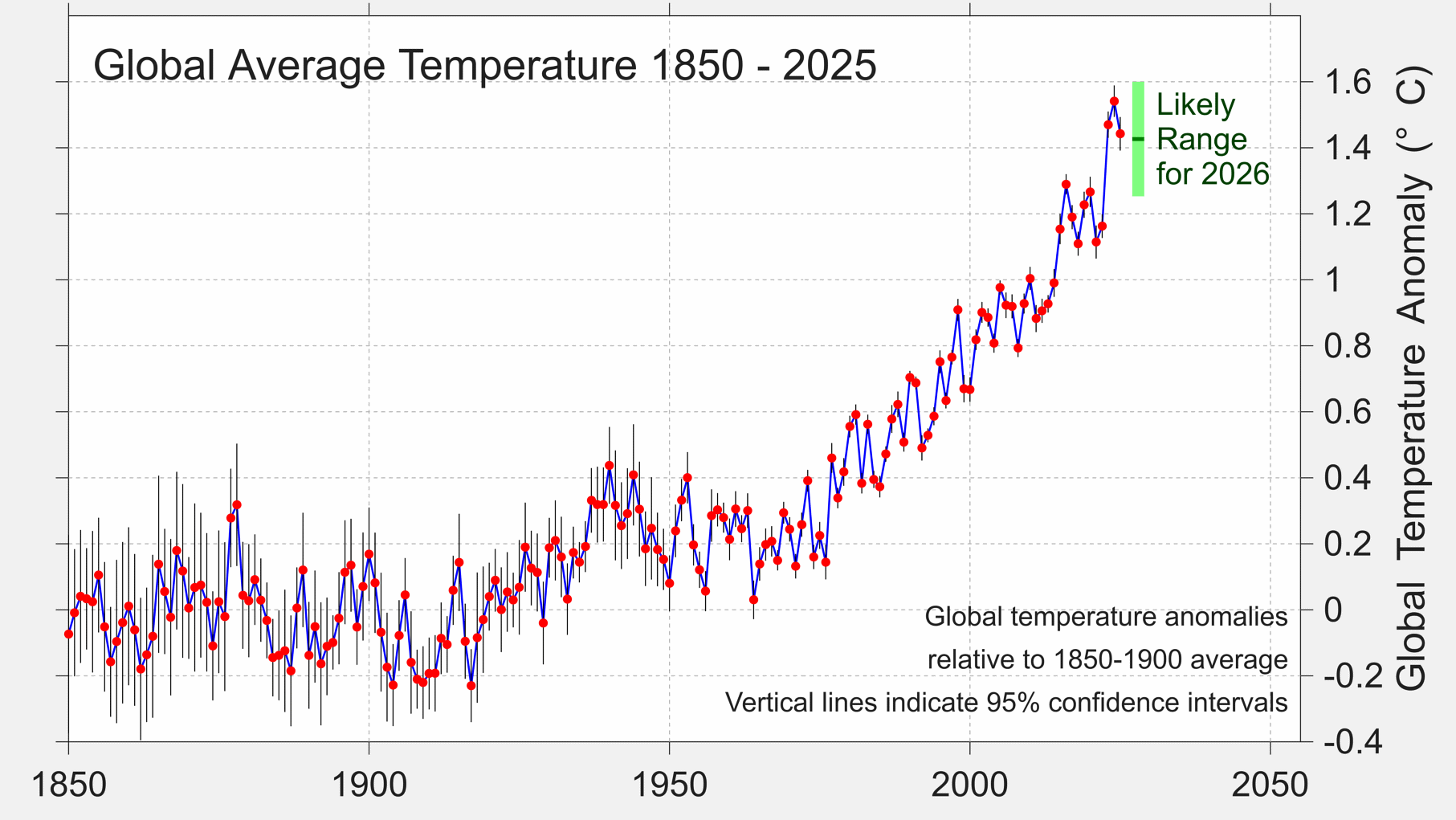
The past three years have been the world’s hottest on record by far, with 2025 almost tied with 2023 for second place. With that energy came extreme weather, from flash flooding to powerful hurricanes and severe droughts. Yet, by most indicators, the planet should have been cooler in 2025 than it was.

So, what happened, and what does that say about the year ahead?

As an earth and environmental scientist, I study influences that affect global temperatures year to year, such as El Niño, wildfires and solar cycles. Some make Earth hotter. Some make it cooler. And one particularly unhealthy influence has been quietly hiding a large amount of global warming – until now.

Chart shows temperatures rising
The past three years have been the warmest on record. The chart compiled by the European Union’s Copernicus Climate Change Service shows the comparison to preindustrial-era temperatures in the second half of the 1800s.
C3S/ECMWF

Factors that made 2025 cooler than 2024

The Earth’s climate is the result of many factors that change from year to year. Some that helped make 2025 cooler than 2024 include:

La Niña’s arrival: La Niña is part of the El Niño-Southern Oscillation, a natural climate pattern that fluctuates between warm El Niño conditions and cooler La Niña conditions. During El Niño, the Pacific Ocean heats up along the equator, influencing the atmosphere in ways that can cause intense storms, droughts and heat waves around the planet. La Niña does the opposite; it’s like putting an ice pack on the atmosphere.

Both 2023 and 2024 were El Niño years, but in 2025 conditions shifted to neutral and then to La Niña starting in September.

The solar cycle: The Sun reached its solar maximum near the end of 2024, the peak of its energy output in an approximately 11-year cycle, and began declining in 2025. So, while the sun’s output was still stronger than average in 2025, it was less than in 2024.

Fewer wildfires: Despite some destructive blazes, the world also saw fewer wildfires during 2025 than 2024, which put less carbon dioxide – a planet-warming greenhouse gas – into the atmosphere.

How different factors affected temperature over a decade.
Major warming and cooling influences from 2016 to 2025. Each graph starts at 2016. Anthropogenic warming, natural carbon sinks and sulfur dioxide (SO2) reductions start from zero in 2016 to illustrate cumulative changes to existing reservoirs; El Niño/La Niña and the solar cycle show real-time influences on the global temperature, relative to mean values.
Michael Wysession. Data: Global Carbon Project (Anthropogenic Global Warming, Natural Carbon Sinks); NOAA (El Niño/La Niña, Solar Cycle); SO2 Reductions (FaIR Analysis by Carbon Brief)

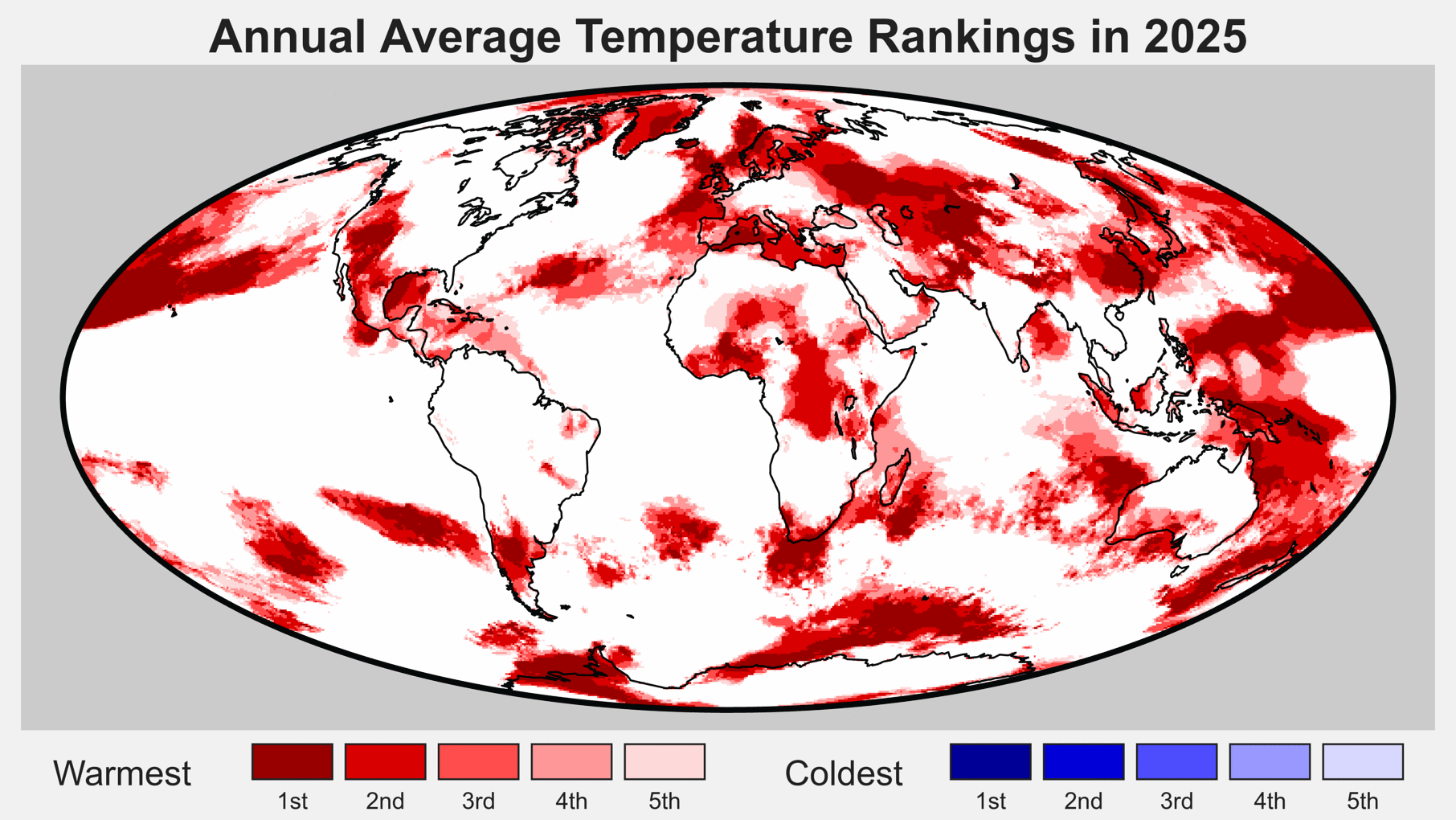
Despite those points, 2025 still ended up as the third-hottest year in over 175 years of record-keeping and likely one of the warmest in at least several thousand years. It was nearly as warm as 2023, at 2.6 degrees Fahrenheit (1.47 Celsius) above the 1850-1900 average, according to the European Union’s Copernicus Climate Change Service. It also had the second-highest average land temperature recorded, up 3.6 F (2 C) compared to preindustrial years, with more than 10% of the land experiencing record-high temperatures.

Factors that made 2025 warmer than expected

Several other factors made 2025 warmer than expected, and some are likely to continue to increase in 2026. They include:

Greenhouse gas emissions: The big driver of global warming is excess greenhouse gas emissions, largely from burning fossil fuels, and 2025 had plenty.

Greenhouse gases trap heat near Earth’s surface like a blanket, raising the temperature. They also linger in the atmosphere for years to centuries, meaning gases released today will continue to warm the planet well into the future. The levels of carbon dioxide, methane and nitrous oxide in the atmosphere all increased in 2025.

Coal is the largest source of carbon dioxide emissions, followed by oil and gas.
Sources of worldwide carbon dioxide emissions that have grown the most in recent decades.
Carbon Brief, CC BY

Rising energy demand drove an increase in fossil fuel use. About 80% of the increasing electric power demand came from emerging economies, largely for rising air conditioning demands as the world gets hotter. In the U.S., the rapid growth of data centers for AI and cryptocurrency mining helped boost U.S. carbon dioxide emissions by 2.4%.

China has become the largest carbon dioxide emitter in the past 20 years. U.S. emissions have fallen.
Countries that have been the largest sources of carbon dioxide emissions in recent decades.
Carbon Brief, CC BY

Earth’s energy imbalance: Other sources can disrupt the natural balance between the amount of sunlight that reaches Earth and the lesser amount radiated back to space. A recent study found that Earth’s energy uptake surged and temperatures rose quickly when a rare three-year La Niña in 2020-2022 shifted to El Niño in 2023-2024.

Declining polar ice, which efficiently reflects sunlight back into space, also affects the energy balance. As sea ice declines, it leaves dark ocean water that absorbs most of the sunlight that reaches it. In a spiraling feedback, warmer water melts sea ice, allowing more sunlight into the ocean, warming it faster; 2025 had the lowest winter peak of Arctic sea ice on record and the third-lowest minimum extent of Antarctic ice.

Air pollution: Sulfate aerosol pollution from coal combustion and burning heavy fuel oil in shipping has also been affecting Earth’s energy balance. It has been masking the full effects of human-caused greenhouse gases for years by reflecting sunlight back into space, creating a cooling effect. But sulfate aerosol pollution is also a serious health hazard, blamed for about 8 million human deaths per year from lung diseases.

Recent reductions in sulfate pollution – now 40% less than 20 years ago – have meant about a 0.2 F (0.13 C) increase in global temperatures. Much of the reduction was from China’s efforts to reduce its notoriously bad air pollution in recent years and international shipping rules in effect since 2020 that have reduced sulfur emissions from large ships by 85%.

Lines show 2025 was among lost sea ice years for both Arctic and Antarctic sea ice.
Sea ice levels were near record lows for both Arctic and Antarctic ice in 2025.
Carbon Brief, CC BY

Taking all factors together, humans are now warming the planet at a faster rate than at any point in human history: at about 0.5 F (0.27 C) per decade. That extra heat can fuel extreme weather, including flash floods, heat waves, extended droughts, wildfires and coastal flooding, affecting human lives and economies.

Predictions for 2026

Most climate models predict 2026 will be about as hot as 2025, depending on whether a Pacific El Niño develops, which forecasters give about a 60% chance of happening. The planet is already starting the year out warm, even if it doesn’t feel like that everywhere. While January was very cold in parts of the U.S., globally, Earth saw its fifth-warmest January on record, and much of the western U.S. saw one of its warmest winters on record.

Solar output will continue to decrease slowly in 2026. However, the International Monetary Fund projects strong global economic growth at about 3.3%, suggesting electricity demand will also continue to grow. The International Energy Agency expects global electricity demand to increase by 3.6% per year through at least 2030.

Even though global renewable energy use is growing quickly, it isn’t growing fast enough to meet rising demand, meaning more fossil fuel use in the coming years. More fossil fuels burned means more emissions and more warming, while the ability of the ocean and land to absorb carbon dioxide continues to decrease. As a result, the atmosphere and oceans heat up, increasing the risks of passing tipping points – glaciers disappear, Atlantic Ocean circulation shuts down, permafrost thaws, coral reefs die.

If greenhouse gas emissions continue at a high rate, humanity may look back at 2025 as one the coolest years globally in the rest of our lives.

The Conversation

Michael Wysession does not work for, consult, own shares in or receive funding from any company or organization that would benefit from this article, and has disclosed no relevant affiliations beyond their academic appointment.

ref. 2025 was hotter than it should have been – 5 influences and a dirty surprise offer clues to what’s ahead – https://theconversation.com/2025-was-hotter-than-it-should-have-been-5-influences-and-a-dirty-surprise-offer-clues-to-whats-ahead-276605