Female writers and readers have been challenging the patriarchy for more than 200 years

Source: The Conversation – UK – By Roberta Garrett, Senior Lecturer in Literature and Cultural Studies, University of East London

Emerald Fennell’s film adaptation of Wuthering Heights has been pulling in the crowds recently, which is quite a feat in troubled times for cinema. Published in 1847, Emily Brontë’s tale of psycho-sexual power dynamics is just one of many enduring female-authored 19th century novels exploring female sexuality and desire for autonomy. These characters existed within a system that allowed women few education or career opportunities.

The ever-popular work of canonical British female writers such as Jane Austen, the (other) Brontë sisters and George Eliot were very different in style and tone. But they also draw attention to various forms of gender inequality.

Their novels focused on issues such as inheritance and property laws, the pressure on young women to marry for financial security, the sexual double standard and the lack of career prospects for women. In doing so, they gave voice to the frustrations of an expanding female readership in the 19th century.

The work of these and lesser-known female authors was crucial in shaping and fuelling public debates on what was referred to in the mid-Victorian period as “the woman question” (women’s right to vote). It later became the first-wave feminist movement in the late 19th and early 20th century.

The emergence of two inventive new literary forms in the early 20th century were key. One was modernism and the other the new printed paperback; both were intertwined with the expansion of women’s concerns and desires in the social and cultural sphere.

Modernism saw the burgeoning of experimental female writers such as Virginia Woolf and Jean Rhys in the 1920s. Then came popular genres such as mass market romance and what is now described as “cosy” crime fiction in the 1930s. Women writers and readers were creating spaces in high art and mass culture that centred female experience and domestic and personal life from the beginning of the 20th century.

The second wave

Given the importance of novels and reading to the history of feminist struggle, it is not surprising that second-wave feminism drew heavily on women’s literary heritage. This saw the publication of landmark academic studies of women’s writing such as Elaine Showalter’s A Literature of Their Own (1977), and Sandra Gilbert and Susan Guber’s The Madwoman in the Attic (1979). And with them came the proliferation of university courses on women’s writing.

The 1960s and 1970s also witnessed the birth of polemical feminist bestsellers. This included Germaine Greer’s The Female Eunuch (1970) and “consciousness raising” popular novels, such as The Woman’s Room (1977) by Marilyn French.

In the 1970s and 1980s, a more diverse group of feminist writers came on the scene. Writers like Margaret Atwood, Angela Carter, Alice Walker, Audre Lorde, Toni Morrison, Octavia Butler and Rita Mae Brown, continued to shape and expand the political and cultural scope and influence of women’s writing into queer, black and postmodernist forms.

Bookgroups, BookTok and the feminist novel

In our own era, while men are reading fewer and fewer novels, female writers and readers are keeping the world of fiction alive. Aside from being the major purchasers of fiction, women are far more likely to enhance and socialise their literary interests. Local book groups and online review and recommendation communities such as Booktok are popular spaces for exploring new literature.

They are also the driving force in the creation and consumption of successful new literary cycles. For example, one of the publishing success stories of the last ten years in English language fiction was the female-centred psychological thriller/domestic noir crime novel. This included the likes of Gone Girl (2014), The Girl on the Train (2016), Big Little Lies (2017) and The Housemaid.

As feminist literary critics have pointed out, not only are these novels predominantly written and narrated by women. Through widespread circulation and screen adaptations, they have also continued to bring to light key gender and power issues such as coercive control, domestic violence and the murder of women. At the lighter end of the spectrum, the recent explosion of “romantasy” fiction (a romance-fantasy hybrid) focuses on female desire and pleasure.

The boundary between literary and genre fiction is becoming increasingly blurred. But contemporary female writers such as Rachel Cusk, Bernadine Evaristo, Anna Burns and Eimear McBride continue to produce innovations in style and form. And younger female writers of “rage” and “sad girl” novels like Ottessa Moshfegh, Oyinkan Braithwaite, Rachel Yoder, Raven Leilani and Aria Aber are not afraid to explore edgy and unsettling accounts of women’s experience.

In life-writing, creative non-fiction and autofiction, women’s stories have also proliferated. Post #MeToo bestsellers such as Acts of Desperation (2022) by Meghan Nolan, and Three Women (2020) by Lisa Taddeo, tearing down comfortable myths of equality and exposing the persisting inequalities in women’s personal relationships.

For more than two centuries, women’s writing has not only reflected the constraints of patriarchy but actively challenged and reshaped them. As long as women continue to write, read and reimagine the world through fiction, novel reading will remain a vital site of feminist resistance and possibility.

This article features references to books that have been included for editorial reasons, and may contain links to bookshop.org; if you click on one of the links and go on to buy something, The Conversation UK may earn a commission.

The Conversation

Roberta Garrett does not work for, consult, own shares in or receive funding from any company or organisation that would benefit from this article, and has disclosed no relevant affiliations beyond their academic appointment.

ref. Female writers and readers have been challenging the patriarchy for more than 200 years – https://theconversation.com/female-writers-and-readers-have-been-challenging-the-patriarchy-for-more-than-200-years-276231

What Americans think of the war in Iran

Source: The Conversation – UK – By Paul Whiteley, Professor, Department of Government, University of Essex

The American people are bitterly divided over the conflict in Iran. The US president, Donald Trump, won office in 2024 after campaigning on a message of “no new wars”. So the conflict that began with airstrikes conducted with the Israeli military in the early hours of February 28, and which has quickly spread into the rest of the region, has polarised opinion across the country.

An Economist/YouGov poll completed on March 2 provides early information about what Americans think of the war so far. The poll asked the following question: “Would you support or oppose the US using military force to overthrow the government of Iran?”

There is a great deal of confusion about what the objectives of the war are, since the messaging from Trump, and his senior officials, has veered from preventing Iran from developing nuclear weapons, to destroying the country’s ballistic missile capability, to regime change.

But, from the point of view of polling, this is as good a question as any for finding out what Americans think. Altogether 32% of them support the war and 45% oppose it.

A divided society

The responses to this question analysed by gender, race, age and education appear in the graph. Those who were uncertain are not included in the totals.
The graph shows that large variations exist among the different groups in relation to their attitudes to the war.

The relationship between attitudes to the war and the
social backgrounds of respondents

The largest differences are in relation to race. Some 37% of white respondents support the war and 44% oppose it. In contrast 7% of black people support it and 60% oppose. Hispanics were in between these two, but rather closer to whites than to blacks.

The was a large gender difference in the responses as well with 37% of men in support but only 26% of women. A marked age difference existed too with only 21% of 18-to-29 year olds supporting and 50% opposed. At the same time some 40% of those over the age of 65 supported the war with 49% opposed. Finally, 34% of those without a college degree were in support compared with 27% with a college degree. Overall, young black women with a college degree were most likely to oppose the war, whereas older white men without a college degree were most in support.

A question of politics

The social backgrounds and attitudes to the war of respondents are interesting, but they are overshadowed by the polarisation of opinion among supporters of the political parties and ideological factions. These appear in the second chart.

The relationship between attitudes to the war and the
political affiliations of respondents

The striking feature of this chart is the difference between respondents who identify with the Democrats and those who identify with the Republicans. Only 8% of Democrats support the war compared with 64% of Republicans. The highest level of support comes from respondents who are Maga (Make American Great Again) supporters. No less that 75% of them support the war and only 10% oppose it.

There is similar polarisation among liberals, which refers to anyone on the left of the ideological spectrum in the US, and conservatives. Only 8% of liberals support the war compared with 66% of conservatives. Moderates are in between the two with 25% of them supporting and 50% opposing the war.

What it could mean for November’s mid-term elections

One theory of elections argues that individuals have a set of well-defined preferences over policies and so they support the party which is closest to them in relation to these policies. In this analysis, policy preferences are summarised by the left-right ideological dimension, or alternatively by the liberal-conservative dimension in politics.

In fact, it appears that in reality the reverse is true with voters choosing a party or leader and then changing their views to fit in with those of their newly adopted party. The 47th US president is an extreme case of this, because he constantly changes his mind. Before he was elected, he promised that the US would not get involved in any more wars in the middle east. It appears that most Republicans and nearly all the Maga supporters are quite willing to go along with the U-turn and agree with anything he does.

This is a big advantage for a president who is so polarising, since it means that he can rely on a body of loyal supporters even when they don’t know the latest policy changes. However, it is a weakness when it comes to elections because the Democrats and Independents together easily outnumber the Republicans and Maga supporters in the electorate.

The Cooperative Election Study, a large-scale survey conducted at the time of the presidential election in 2024 showed that 32% of respondents in their national survey identified with the Democrats, 27% with the Independents and 30% with the Republicans. In short, the Republicans are up against a coalition of Democrats and Independents who make up just under 60% of the voters. Add the factor that many Americans are outraged by the president’s behaviour and you have a winning coalition for the opposition in the mid-term elections.

Whatever happens in the war, Trump is unlikely to recover his popularity for the Republicans not to lose control of the House of Representatives – and possibly the Senate – in the mid-term elections in November.

The Conversation

Paul Whiteley has received funding from the British Academy and the ESRC.

ref. What Americans think of the war in Iran – https://theconversation.com/what-americans-think-of-the-war-in-iran-277627

Ebo Taylor took highlife to the world and changed Ghanaian music forever

Source: The Conversation – Africa – By Eric Sunu Doe, Senior lecturer, University of Ghana

The news of the passing of Ghanaian highlife star Ebo Taylor on 7 February 2026 felt less like the loss of a public musical figure and more like the closing of a living chapter of Ghanaian musical knowledge. To many, he was a legendary guitarist, composer, arranger, and ambassador of Ghanaian highlife music.

Highlife music is a homegrown Ghanaian popular dance-music, believed to have emerged along the west African coast in the late 19th century. It fuses indigenous musical elements with those of the west. Several styles that characterise it include brass and regimental influenced adaha and its konkoma variants, guitar influence and the “swing” dance bands which were popular with the then emerging local elite. These styles have become the bedrock of today’s popular musical styles.

Ebo Taylor was a custodian of Ghanaian popular musical thought, of ensemble ethics (playing music in a group), and of what it meant to live inside music as a craft and community. His mentorship shaped my musical life as an ethnomusicologist and as a musician in the palmwine genre.

I first encountered him as part of the pioneering guitar class at the University of Ghana in the early 2000s. For the next few years he shaped how I played guitar, how I listened, how I arranged, and how I understood the responsibilities of being in a band. Much of what I do today in my highlife ensemble traces directly back to those encounters.


Read more:
Ghana’s politics has strong ties with performing arts. This is how it started


Who was Ebo Taylor?

Deroy Ebo Taylor’s life in music was inevitable and self-fashioned. He was born on 7 January 1936 in the city of Cape Coast in southern Ghana into a musical environment shaped by church and community music-making. His formal education revolved around music as practice, as his father was a known choirmaster and church organist.

By his late teens in Cape Coast, he was already involved in the dance band culture that would become the backbone of modern Ghanaian popular music. This was the time when “swing” dance band highlife was popular with many Ghanaians. Bands like the Stargazers Dance Band, the Broadway Dance Band and Tempos Dance Band would provide the sounds that shaped Ghana’s fight for independence. These sounds deepened his resolve to be a musician. He often told stories of how he would break school rules to watch or, later, perform with some of the local bands in Cape Coast.

His early music was shaped by the formal instruction he received from his father and his music teacher at secondary school (St Augustine’s College), as well as his peers and eventually the various bands he played in.

Taylor later deepened his theoretical and arranging knowledge through formal studies in London at the Eric Gilder School of Music in the early 1960s. That period placed him within a broader Black Atlantic musical conversation. It connected him to Ghanaian musicians who would later shape African popular music globally. These included saxophonist Teddy Osei and drummer Sol Amarfio, who were members of what would become the globally remowned Osibisa, and contemporaries like Nigerian music star and activist Fela Kuti, who were similarly navigating jazz, highlife and emerging African popular forms.

Highlife pioneer

When he returned to Ghana, he worked with bands, recording studios, and particularly the pioneering Ghanaian label Essiebons Records. It was with Essiebons that his creative genius became widely recognised by Ghanaians, as he contributed in shaping the sound that has become known as highlife from the 1970s. He worked with great Ghanaian musicians like Pat Thomas, C.K. Mann and Gyedu-Blay Ambolley.

His fingerprint could be heard on the songs he worked on, especially in his trademark guitar phrasing and tone, and in his horn arrangements. These included My Love and Music, Love and Death and Atwer Abroba. Some of these songs have been introduced to contemporary global audiences by being sampled by artists including the Black Eyed Peas, Jidenna, Kelly Rowland and Vic Mensa.

Scholars of highlife, including John Collins and Mark Millas Fish, have emphasised the centrality of arranger-bandleaders such as Taylor in shaping modern Ghanaian dance band music. His compositional practice, as I observed it, was quite casual with a deeper sense of reflection.

Taylor’s achievements were honoured domestically and globally. In 2014 he received a Lifetime Achievement Award.

Reflections of a mentee

For those of us who had the privilege of being his students, his greatest legacy was how he imparted knowledge to us. In his classes, he embraced us as the next generation of musicians who would be responsible for carrying the highlife tradition forward. He gave us an understanding of palmwine guitar, how to play the intricate rhythms with relative ease, and how to leave spaces for the voice to tell the stories that were meant to be told.

Today, I model my ensemble pedagogy around some of these ideals Ebo Taylor instilled in us and, as much as possible, I collaborate with professional musicians who come in to engage with my students when their time permits.

His passing marks the closing of yet another library. But we will continue to hear his voice in the numerous songs he shared with us and in those of us who are building on the knowledge he passed down.

The Conversation

Eric Sunu Doe does not work for, consult, own shares in or receive funding from any company or organisation that would benefit from this article, and has disclosed no relevant affiliations beyond their academic appointment.

ref. Ebo Taylor took highlife to the world and changed Ghanaian music forever – https://theconversation.com/ebo-taylor-took-highlife-to-the-world-and-changed-ghanaian-music-forever-276406

Choosing to buy organic food depends more on trust than taste – what our new study in the UK and Japan shows

Source: The Conversation – UK – By Steven David Pickering, Honorary Professor, International Relations, Brunel University of London

Akarawut/Shutterstock

Organic food is often presented as a healthier, greener or more ethical choice. But when people decide whether to pay extra for organic milk, eggs or vegetables, something else is going on.

Organic food belongs to a curious category that economists call “credence goods”. These are the products whose key qualities can’t be verified even after you’ve bought them. There’s no way that you can tell by looking at, tasting or cooking a food item whether it was genuinely produced to organic standards. Instead, you have to take it on trust.

That makes buying organic less about what’s on the plate and more about what’s going on in people’s heads.

When people pay more for organic food, they are effectively buying a promise: that production followed certain rules, that certification means something and that the system policing those rules is credible. Whether people are willing to pay that premium depends not just on how much the food costs or how much money they earn. It also depends on how much trust they place in the certification and regulatory system behind the label, and how comfortable they are paying more for something they cannot personally verify.

As part of our ongoing research into trust, we conducted two large surveys with around 1,300 respondents in Britain and 1,500 in Japan. We asked people whether they would be willing to pay more for organic versions of everyday foods such as dairy products, meat, eggs and vegetables.

We also asked a few simple questions about trust (both trust in government and trust in other people) as well as how willing respondents were, in general, to take risks.

radishes, jute bag of veg, handwritten chalkboard sign says 100% organic
People who trust the government are more willing to pay extra for organic food.
New Africa/Shutterstock

We got the same message back from both countries. In both the UK and Japan, people who trusted the government were more willing to pay extra for organic food. This was true regardless of whether the product was milk, eggs or vegetables, and regardless of age, gender, education or political views.

Willingness to take risks mattered too. People who described themselves as more comfortable taking risks were more willing to pay a premium for organic food. Paying more for something you can’t directly verify is, after all, a form of everyday risk taking.

Trust in other people (what social scientists call “generalised trust”) played a slightly different role. It mattered most when organic food was seen as reflecting personal values, such as environmental responsibility or ethical production, rather than having guaranteed quality.

Where Japan and the UK differ

Comparing results from the UK and Japan helps explain why trust plays such a pivotal role in these shopping decisions.

Japan’s organic certification system is centralised and state-led. Organic food is less common, but public trust in the government remains relatively high. In this context, institutional credibility is crucial. If consumers trust the state, they are more likely to trust the organic label it oversees.

In the UK, organic food is more widely available than in Japan, but certification is fragmented across government bodies and private organisations. Here, trust spreads outwards: confidence in other people, social norms and shared values plays a bigger role alongside institutional trust.

In both cases, however, the basic logic is the same. Organic labels work only when the system behind them is trusted. This has important implications at a time when food prices are rising and trust in public institutions is under pressure in many countries.

Promoting organic food is often framed as a matter of better information or clearer labelling. But our findings suggest that even perfect labels won’t persuade consumers if confidence in institutions is weak, or if paying more feels like too much of a gamble.

When trust erodes, ethical consumption becomes harder. This isn’t because people stop caring about sustainability or animal welfare, but because they stop believing the promises attached to higher prices.

Organic food, then, depends on trust. And without that trust, even the most well-intentioned labels will struggle to sell.

The Conversation

Steven David Pickering received funding from the UKRI’s ESRC (grant reference ES/W011913/1).

Yosuke Sunahara receives funding from the Japan Society for the Promotion of Science (JSPS, grant reference JPJSJRP 20211704).

Martin Ejnar Hansen does not work for, consult, own shares in or receive funding from any company or organisation that would benefit from this article, and has disclosed no relevant affiliations beyond their academic appointment.

ref. Choosing to buy organic food depends more on trust than taste – what our new study in the UK and Japan shows – https://theconversation.com/choosing-to-buy-organic-food-depends-more-on-trust-than-taste-what-our-new-study-in-the-uk-and-japan-shows-275163

Iran conflict: air campaigns rarely work as intended – they often make matters worse

Source: The Conversation – UK – By Matthew Powell, Teaching Fellow in Strategic and Air Power Studies, University of Portsmouth

The US and Israel have launched a coordinated air campaign in recent days to destroy Iran’s missile capabilities and navy, curb its ability to develop nuclear weapons and eliminate its leadership. The strikes have been accompanied by calls from Donald Trump for the Iranian people to rise up and overthrow their government.

In his statement announcing the start of the operation on February 28, Trump said: “When we are finished, take over your government. It will be yours to take. This will be probably your only chance for generations.” It is clear that Trump is hoping US and Israeli air power can weaken the regime in Tehran sufficiently for the Iranian people to finish the job themselves.

This approach has been criticised by some world leaders. British prime minister Keir Starmer, for instance, told MPs on March 2 that his government “does not believe in regime change from the skies”. And, in any case, history offers few examples in which an aerial bombing campaign aimed at enabling regime change has produced positive outcomes.

There are strategic benefits to using air power. It is inherently flexible in how it can be deployed, which allows for the escalation and deescalation of violence with greater ease than is possible with land or naval power. The speed and reach of air power also broadens the range of available military targets, while simultaneously reducing the need to expose troops to risk.

But air power has several limitations. Perhaps the main limitation is that, unlike ground forces, air power is unable to hold and secure territory that would allow for the consolidation of control. This was evident following the Libyan revolution in 2011, where a Nato air campaign supported a rebellion that overthrew the country’s ruler, Colonel Muammar Gaddafi.

Despite the initial success of the rebellion, Libya soon fell into chaos. Two main competing governments, supported by complex networks of militias, have spent the past decade or so vying for control. This has created a deeply divided, highly fragile state.

This is not to say putting western boots on the ground to help manage a transition would have led to a different outcome. Several years earlier, ground forces were unable to prevent Iraq from descending into civil war after the toppling of Saddam Hussein. But what is clear is that the deployment of air power alone was not sufficient to influence the political direction of Libya once Gaddafi had been removed.

Situation in Iran

The lesson from Libya is that fomenting a revolution when you have little ability to control how events play out on the ground can lead to unfavourable outcomes. This can be applied directly to the current situation in Iran.

As was the case in Libya, it is far from clear what will replace the government in Tehran should it fall. Iran’s opposition is fragmented and disorganised. Reza Pahlavi, the exiled son of Iran’s last shah, has positioned himself as a possible successor to the current leadership.

But the level of support for him within Iran is unclear. Surveys by the Gamaan group, an organisation that attempts to gauge political sentiment in Iran, suggest roughly one-third of people are strong supporters of Pahlavi and another third strongly oppose him.

With no unified opposition ready and able to enact a provisional government if the regime falls, the result is likely to be a power vacuum. This could possibly result in a civil war that further destabilises the region.

At the same time, there is no guarantee that the US-Israeli air campaign will encourage the Iranian people to topple their country’s leadership. Rounds of protests in recent years have been met with brutal repression by the authorities, with estimates suggesting tens of thousands of protestors were killed during the latest crackdown in January 2025.

It will remain a significant risk to protest against the Iranian regime, regardless of the damage that has been inflicted on the country’s leadership. Karoline Leavitt, the White House press secretary, said that “49 of the most senior Iranian regime leaders” had been “wiped off the face of the Earth” in the opening US-Israeli strikes.

The Iranian Revolutionary Guard Corps (IRGC), which operates parallel to Iran’s regular armed forces, exists solely to support the regime and answers directly to the supreme leader. It has upward of 190,000 troops under its command and is supported by the Basij paramilitary force, which claims it can mobilise around 600,000 volunteers.

Trump has threatened the IRGC and the Basij with certain death unless they lay down their arms. They are unlikely to take notice of these threats. However, if they do, there is effectively no one to accept their surrender – it is impossible to surrender to an aircraft tens of thousands of feet in the sky.

The removal of the regime in Tehran will be wished for by many across the globe. But there is no guarantee an air campaign will lead to its demise, nor is it clear that what follows will be any better. As Libya shows, what could follow the overthrow of the Islamic Republic is instability and chaos – a situation that could create more problems than it solves.

The Conversation

Matthew Powell does not work for, consult, own shares in or receive funding from any company or organisation that would benefit from this article, and has disclosed no relevant affiliations beyond their academic appointment.

ref. Iran conflict: air campaigns rarely work as intended – they often make matters worse – https://theconversation.com/iran-conflict-air-campaigns-rarely-work-as-intended-they-often-make-matters-worse-277319

How the Iran war could create a ‘fertiliser shock’ – an often ignored global risk to food prices and farming

Source: The Conversation – Global Perspectives – By Nima Shokri, Professor, Applied Engineering, United Nations University

Tehran is moving to restrict – or effectively close – the Strait of Hormuz to shipping, as part of the latest escalation in the war involving Iran.

Markets have reacted to the global impact of closing this incredibly busy shipping channel, focusing on the risk to oil and gas flows, the prospect of higher crude prices and the inflationary pressures that would follow.

That concern is justified. But it captures only part of the story. A sustained disruption of traffic through Hormuz would not simply constitute an energy crisis. It would also represent a fertiliser shock (where prices go up dramatically and supply goes down) – and, by extension, a direct risk to global food security.

Modern agriculture runs not only on sunlight and soil, but on natural gas. When German chemists Fritz Haber and Carl Bosch developed their nitrogen fixation method in the early 20th century, they did more than just manufacture ammonia at scale.

They launched a global chemical revolution that remains a cornerstone of modern civilization and agriculture. Through this process, methane is transformed into ammonia, and ammonia into nitrogen fertilisers such as urea – the most widely used nitrogen fertiliser. Those fertilisers allow crops to reach the yields on which today’s global population depends. Without it, harvests of wheat, maize and rice would fall dramatically.

Around a third of globally traded urea passes through the Strait of Hormuz. The Persian Gulf sits at the centre of this system for two structural reasons. First, it offers access to some of the world’s cheapest natural gas, essential for ammonia production.

Second, over decades, vast capital investments have built ammonia and urea capacity in countries within the region, including Qatar, Saudi Arabia, and the United Arab Emirates. This is aimed at the export market. A significant share of globally traded nitrogen fertiliser – and the liquefied natural gas (LNG) that powers fertiliser plants elsewhere – must therefore travel through the Strait of Hormuz. A closure of the strait would threaten not only oil and gas exports but also the physical flow of nitrogen-based fertilisers and what is needed to make them.

The immediate effect would be delays to shipments of ammonia, urea and LNG. They could be stopped completely or become prohibitively expensive through higher freight and insurance costs. But the deeper impact would unfold in the months ahead at farms around the world.

A tractor spreading fertiliser in a wide open field.
Farmers stocks of essential fertiliser may soon be depleted because of the Iran war.
Fotokostic/Shutterstock

In the northern hemisphere, fertiliser purchases accelerate before planting seasons. A delay of weeks can be disruptive; a disruption of months can make a huge difference. If shipments fail to arrive on time, farmers face difficult choices such as how to pay sharply higher prices, reduce application rates, or alter crop mixes. Because of how crops respond, even modest reductions in nitrogen use can produce disproportionately large declines in yield. That could translate into millions of tonnes of lost crops. The consequences would ripple through global supply chains into feed markets, livestock production, biofuels and ultimately retail food prices.

Do countries not have their own supplies?

Some countries have supplies of fertilisers, but self-sufficiency is rarer than it appears. India, for instance, relies heavily on LNG imports from the Persian Gulf to run its domestic urea plants. Brazil depends substantially on imported nitrogeon and phosphate fertilisers to sustain soybean and maize production.

Even the United States, one of the world’s largest fertiliser producers, imports meaningful volumes of ammonia and urea to help meet regional demand and reduce prices. In sub-Saharan Africa, use of fertiliser is already low. A further rise in prices is likely to reduce use even more, cutting yields and increasing food insecurity.

The system’s fragility extends beyond nitrogen. Sulphur – as an essential nutrient for plant growth – is largely a byproduct of oil and gas processing. If energy shipments through Hormuz are disrupted, sulphur output falls alongside fuel exports. So, the shock would not only reduce fertiliser shipments but also restrict ways to produce them elsewhere.

Meanwhile, the production of synthetic nitrogen tightly coupled to energy markets because it is manufactured continuously from natural gas. A disruption in gas supply or ammonia trade immediately constrains global nitrogen availability. Estimates suggest that without synthetic nitrogen, the world could feed only a fraction of its current population. The Strait of Hormuz therefore sits at the intersection of energy and food security.

Changing where fertiliser is produced cannot happen overnight. Financing and constructing new ammonia plants takes years. A double-digit contraction in exports from a key region cannot be swiftly offset. In the interim, prices would rise, trade flows would re-route and planting decisions would be made under uncertainty. Food price inflation, historically correlated with social unrest, could intensify.

Central banks, focused primarily on fuel-driven inflation, could underestimate the contribution of fertiliser scarcity to prices overall. Crucially, fertiliser shocks do not register with the same immediacy as oil shocks. Petrol prices change overnight. Crop yields reveal themselves months later. Yet the latter may prove more destabilising.

Controls and closure of this narrow maritime chokepoint would reshape the cost-of-living well beyond the Persian Gulf.

If the 20th century taught policymakers to fear oil embargoes, the 21st should teach them to fear a fertiliser shock. Energy markets can absorb shocks through reserves and substitution. But the global food system has far thinner buffers. A prolonged disruption at Hormuz would not simply reprice crude; it would test the resilience of the industrial nitrogen cycle on which modern civilisation depends.

Oil powers cars. Nitrogen powers crops. If the Strait of Hormuz closes, the most consequential price may not be Brent crude but the cost of feeding the world.

The Conversation

Nima Shokri is affiliated with Hamburg University of Technology.

Salome M. S. Shokri-Kuehni does not work for, consult, own shares in or receive funding from any company or organisation that would benefit from this article, and has disclosed no relevant affiliations beyond their academic appointment.

ref. How the Iran war could create a ‘fertiliser shock’ – an often ignored global risk to food prices and farming – https://theconversation.com/how-the-iran-war-could-create-a-fertiliser-shock-an-often-ignored-global-risk-to-food-prices-and-farming-277552

What the conflict in Iran means for Putin and Ukraine

Source: The Conversation – UK – By Stefan Wolff, Professor of International Security, University of Birmingham

As the war in the Middle East spreads and intensifies, the one in Ukraine continues. While geographically some 2,500km (1,600 miles) apart, the consequences of US president Donald Trump’s latest military adventure for the Russian war against Ukraine will be acutely felt across several areas. In the short term, the Kremlin will probably feel emboldened to double down on its aggression, but this is unlikely to shift the dial significantly towards Russian victory in the long term.

The targeted killing of Iranian supreme leader Ayatollah Ali Khamenei by a precision US strike would have reminded the Russian president, Vladimir Putin, of his reportedly “apoplectic” reaction to the killing of the Libyan leader, Muammar Gaddafi, in 2011. Comments on social media from the likes of far-right Russian nationalist Alexander Dugin, who posted, that “one by one, our allies are being systematically destroyed”, and former Russian president Dmitry Medvedev, who alleged that the “talks with Iran were just a cover”, are unlikely to have steadied Putin’s nerves.

The Russian leader’s fears about being next after a string of US successes targeting foreign leaders may have been played up somewhat by the western media, but they are not completely unfounded. Putin continues to walk a fine line between paranoia and his outrage over the killing of supreme leader Ali Khamenei, which he condemned in a condolence letter to the Iranian president, Masoud Pezeshkian, as a “cynical violation of all norms of human morality and international law” but did not mention Trump or the US as the culprits.

Concerns about his own longevity, however, will not be the only things weighing on Putin’s mind and compelling him to double down on his war against Ukraine. The escalation of violence in the Middle East offers Russia several opportunities – at least in the short term.

The sharp rise in oil prices throws Moscow a new lifeline for financing its ongoing war. Not only did prices spike, but the sudden – and probably lasting – inability of Iran to export oil will also have a major impact on China. China bought over 80% of all Iranian oil exports, equivalent to some 13% of China’s oil imports.

China has large stockpiles of oil that will allow it to ride out current inflation. But it is now likely to double down on its energy relationship with Russia.

This will serve both countries well. Russia will deepen its economic ties with China and rebalance the relationship, while China will tap into a reliable supply line that will not be as vulnerable to being choked off as maritime supply routes in a future confrontation with the US.

The closure of the strait of Hormuz and Iranian strikes against oil and gas facilities across the Gulf countries have destabilised global energy markets. This affects 30% of global seaborne oil trade and 20% of all trade in liquefied natural gas.

This offers a market opportunity for Russia and its shadow fleet of tankers, at least in the short term, given that Moscow retains sufficient refining and port capacity, despite a long Ukrainian air campaign against the country’s oil infrastructure.

US diverting arms to Middle East

Another likely benefit for the Kremlin will be disruptions to weapons supplies to Ukraine. While insisting that the US had “virtually unlimited supply” of weapons and munitions, Trump also conceded that there were areas “at the highest end, (where) we have a good supply, but are not where we want to be”.

This is a view echoed within the Pentagon. Defence officials are keen to discuss an acceleration of weapons production with key arms manufacturers.

With large parts of western military support for Ukraine consisting of US weapons paid for by Kyiv’s European allies, US shortages will immediately affect the flow of vital equipment to Ukraine. Even deliveries already agreed could be derailed. In June 2025, during the so-called 12-day war with Iran, the US diverted some 20,000 missiles from Ukraine to the Middle East.

Russia is unlikely to face any similar constraints. On the contrary, a Russian-Iranian deal in late 2022 enabled Moscow to acquire technology from Tehran that allowed the Kremlin to kick-start domestic drone production based on the Iranian Shahed design. Not only has Russia improved the drones, it now also produces them faster and cheaper than Iran ever did.

If western military supplies to Ukraine now dry up even temporarily as a result of an increased focus of the US on the Middle East, Russia’s air superiority and the devastating impact its relentless campaign of missile and drone strikes has had on Ukraine is likely to continue for some time.

At the same time this drives home the point that dependence on the US puts Ukraine and its European allies in an unacceptably precarious position. Ukraine’s own defence industry already meets half of the country’s needs, and the fallout from Iran war will probably further accelerate homegrown military production and innovation across Europe as the traditional US-European alliance frays.

Transatlantic relationships fraying

In the short term, transatlantic decoupling will serve Moscow’s interests more than Kyiv’s. European countries, including the UK, France, and Spain, have been critical of US and Israeli attacks on Iran, earning them the expected rebukes from Trump.

The White House might be too busy to follow through on threats “to cut off all trade” with Spain, but it will equally not put much effort into already fraught mediation efforts between Russia and Ukraine. Given the dismal performance of Trump’s own efforts and those of his negotiation team, as well as the pressure that the US had put on Ukraine rather than Russia to cut a deal, this may not be much of a loss.

But US diplomatic disengagement from the Russian war against Ukraine still poses a problem. The US is the only country with the leverage to bring both sides together and – if Trump were to decide so – achieve a just and sustainable peace agreement.

Ukraine and its European partners may be able to prevent a Russian victory, but it will take some time for them to develop the military and political muscle to force Russia to make meaningful concessions that could pave the way towards a settlement.

If nothing else, Trump’s war of choice in the Middle East will be another factor in prolonging the war against Ukraine. Regardless of its short-term effects, it will not make a Russian victory more likely. But it has thrown the world into additional turmoil for no good reason, and it will delay the much-needed restoration of peace in Europe.

The Conversation

Stefan Wolff is a past recipient of grant funding from the Natural Environment Research Council of the UK, the United States Institute of Peace, the Economic and Social Research Council of the UK, the British Academy, the NATO Science for Peace Programme, the EU Framework Programmes 6 and 7 and Horizon 2020, as well as the EU’s Jean Monnet Programme. He is a Trustee and Honorary Treasurer of the Political Studies Association of the UK and a Senior Research Fellow at the Foreign Policy Centre in London.

ref. What the conflict in Iran means for Putin and Ukraine – https://theconversation.com/what-the-conflict-in-iran-means-for-putin-and-ukraine-277298

Iran war fallout: risks for the Red Sea and the Horn of Africa

Source: The Conversation – Africa (2) – By Federico Donelli, Associate Professor of International Relations, University of Trieste

The death of Ayatollah Ali Khamenei, Iran’s supreme leader, in March 2026 marks the end of a political era in the Middle Eastern country. Khamenei was killed in US and Israeli airstrikes on Iran’s capital, Tehran. This has triggered a war drawing in numerous countries across the Middle East.

The Horn of Africa and Red Sea regions, which link Africa and the Middle East, share a dense web of military, political and economic interactions that enable crises on one shore to quickly affect the other. Here, Somalia, Eritrea, Yemen, Sudan, Ethiopia and Djibouti sit along one of the world’s most important trade and geopolitical corridors.

But the consequences of Khamenei’s death may be less dramatic than many expect. This is because power in Iran is dispersed across entrenched institutions and security elites who are capable of preserving regime continuity.

The Horn of Africa and the Red Sea

Iran is no stranger to the Red Sea and the Horn of Africa. During the 1990s and 2000s, Tehran established security and economic ties with several countries, notably Sudan, to gain a foothold along the Red Sea.

Iran’s influence waned, however, during the 2010s as Gulf states, particularly Saudi Arabia and the United Arab Emirates, increased their diplomatic, financial and military presence.

As a political scientist studying Middle Eastern and African security, I have followed Iran’s regional engagement for years. From my perspective, events in Iran and the Gulf matter to African countries because conflicts, arms flows and rivalries can easily spill across shores in a single strategic region.

Three intertwined dynamics shape how Khamenei’s death affects the Red Sea and the Horn of Africa.

Firstly, Tehran’s influence here has declined over the past decade. This is with the exception of Yemen, where Iran supports the Houthi movement, which has previously attacked Israeli-linked vessels.


Read more:
Global power shifts are playing out in the Red Sea region: why this is where the rules are changing


Secondly, the way this latest conflict was triggered and has escalated may be more important than a change in Iranian leadership. It could contribute to a broader erosion of moderation.

Thirdly, the Islamic Revolutionary Guard Corps (IRGC) – Iran’s powerful military force – is set to play a pivotal role in the post-Khamenei transition.

This is significant for the Horn of Africa and the Red Sea. Iran’s engagement here has largely relied on unconventional methods. Naval manoeuvres are an example, such as the long-term deployment in the Red Sea of the Iranian vessel Saviz, which has served as a logistical and intelligence platform. The country has also deployed military advisers and established arms networks to transport Iranian weapons.

Any future leadership closely aligned with the IRGC is likely to keep using these low-cost tools.

In this sense, continuity will likely prevail over rupture. Iran’s ambitions are filtered through a sober assessment of constraints that the ongoing war may entrench.

Iran’s shifting priorities

Since the 1979 revolution, Iran has considered itself a middle power with legitimate claims to regional pre-eminence. The Red Sea and the Horn of Africa gradually became part of Iran’s expanded strategic geography.

Following the consolidation of the regime promoted by Ayatollah Ruhollah Khomeini, Khamenei – who took over in 1989 after his predecessor’s death – progressively translated Iran’s ambition into strategic depth.

This aimed to extend Iran’s security perimeter beyond its borders through alliances, proxies and low-cost commitments.

In the 2000s, Iran cultivated close ties with Sudan and Eritrea.

It established naval access points in the two countries and used soft power tools, such as development aid and religious networks. It considered the Bab al-Mandeb Strait, which is between Yemen and Djibouti, vital for countering Saudi and Israeli influence and maintaining alternative trade routes.

The limitations of this expansion became apparent, however.

Iran’s ambitions soon came up against reality. The country’s economy was weakened by sanctions linked to its nuclear programme and US withdrawal from a 2015 nuclear deal.


Read more:
Iran will respond to US-Israeli strikes as existential threats to the regime – because they are


Meanwhile, political power remained fragmented across competing institutions. Domestic pressures, including economic hardship and periodic protest movements, were mounting. Instability in neighbouring states such as Iraq, Syria and Yemen made long-term regional power projection costly and uncertain.

After 2015, Saudi Arabia increased its engagement in the Horn of Africa through financial aid, diplomatic pressure and military cooperation linked to the war in Yemen.

Seeking logistical support along the Red Sea and aiming to counter Iran’s influence near the Bab el-Mandeb strait, Saudi Arabia strengthened its ties with regional governments. This prompted Sudan, Djibouti and Eritrea to sever or scale back their relations with Tehran. They effectively aligned themselves with Saudi Arabia and its allies. Iran redirected resources to higher-priority theatres of war, such as Iraq, Syria and Yemen.

For a decade, therefore, Tehran’s presence in the Horn of Africa and the Red Sea has become more selective and opportunistic. Iran has relied on indirect leverage there, such as Houthi operations, rather than direct expansion.

Khamenei’s death is likely to reinforce rather than reverse the trend. In fact, the outcome of the current war and the start of a delicate succession process could prompt an even more cautious approach abroad.

Worsening fragility

Although a change in Iranian leadership may not alter the approach to the Red Sea and the Horn of Africa, the dynamics that led to the recent conflict may have an impact on the region.

The scale and visibility of the Israeli-US attack – and Iran’s direct retaliation – signal something deeper: the erosion of thresholds in the use of force.

Iran is not buying time and avoiding direct confrontation while limiting the manoeuvre room of its rivals.

This could usher in a period of “anything goes”.

Regional actors, from Gulf states to local governments, are likely to feel increasingly justified in bypassing established security norms. The Red Sea has already become a crowded arena. External powers are projecting their strength. Local states are exploiting competition among them. The reshuffling of forces triggered by the war in Iran will have repercussions throughout the region.

In such a context, characterised by multiple hierarchies, even a reduction of Iranian capabilities could have knock-on effects.

The region’s fragility – as seen in civil war in Sudan, tensions between Ethiopia and Eritrea, instability in Somalia and the heavy presence of military bases along maritime routes – amplifies these risks.

In other words, the question is not whether Iran will suddenly expand into east Africa. It is whether the regional climate will shift towards fewer restrictions and greater acceptance of coercive tools.

If escalation becomes normalised in the heart of the Middle East – the region’s most interconnected theatre – the fallout could be felt in places like the Horn of Africa.

Uncertainty in the short term

Khamenei’s death is likely to generate uncertainty in the short term at the regional level, but will lead to continuity in the long term.

Over time, Tehran has adopted what can be termed a “realist defence” doctrine – deterrence through a strong indirect presence, but at reduced cost and risk.

Iran’s view of international politics as a zero-sum game – where one actor’s gain is another’s loss – and its desire to reduce the influence of its rivals are not merely the result of personal legacies. Rather, they are deeply rooted in the country’s identity.

For the Horn of Africa, this means that Tehran is likely to remain a secondary but persistent player: active enough to hinder its rivals’ strategies, yet restrained enough to avoid major commitments.

The Conversation

Federico Donelli is affiliated with the Italian Institute for International Political Studies (ISPI), the Nordic Africa Institute (NAI), and the Orion Policy Institute (OPI).

ref. Iran war fallout: risks for the Red Sea and the Horn of Africa – https://theconversation.com/iran-war-fallout-risks-for-the-red-sea-and-the-horn-of-africa-277512

The world’s largest climate finance deal was built to flounder: why funding fails to reach the front-line

Source: The Conversation – Indonesia – By Nikita Sud, Professor of the Politics of Development, University of Oxford

Adopted in December 2015, the Paris Agreement commits countries to keeping global temperature rise below 2°C above pre-industrial levels.

All 195 signatories set their own plans to meet this shared goal. However, UN climate negotiations acknowledge that wealthy nations bear the greatest responsibility for climate change.

Because of their wealth and historically higher emissions, developed countries made a nonbinding commitment in Paris to raise at least US$100 billion a year by 2025 to help developing nations shift to renewable energy and adapt to climate change.

But for developing countries such as Indonesia, meeting these targets is not just a matter of political will. It requires massive financial mobilisation, and current funding levels may not be enough to bridge the gap.

The trillion-dollar gap

The OECD says the US$100 billion target was met for the first time in 2022. Still, many countries in the Global South — across Asia, Africa and Latin America — argue the funds are far from enough.

At every UN climate summit since Paris, countries in the Global South have called for more funding to meet tougher climate targets.

At the second-to-last summit in Baku, Azerbaijan, developed countries agreed to “help channel” at least US$300 billion a year to developing countries by 2035. But the Global South countries pushed for more.

In 2025, COP30 held in Belem in Brazil called for mobilising at least US$1.3 trillion a year by 2035 for climate action.

Where does the money promised by the industrialised, developed Global North to the South for historical overuse of the global carbon budget actually go, and what does it fund? And does it really help countries on the front-line of climate change to cut emissions and adapt to its effects?

To find out, I examined the largest climate finance deal signed between several developed countries and a Global South country, Indonesia.

Not a partnership

Indonesia is the world’s fourth most populous country and the 17th largest economy. It is also the largest exporter of coal, and an archipelago of more than 17,500 islands that are highly vulnerable to rising seas and intensifying storms.

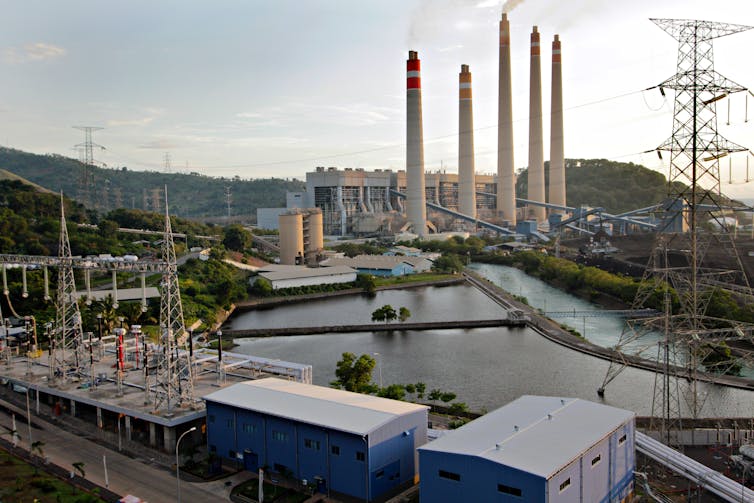
A coal power plant.
Indonesia must wean its power sector off coal to decarbonise.
Cpaulfell/Shutterstock

To meet the Paris climate goals, Indonesia pledged to source 29% of its energy from renewables by 2030 — or 41% with international support. In 2022, that support seemed to arrive through a US$20 billion Just Energy Transition Partnership (JETP).

JETPs are designed to help fast-growing, coal-reliant emerging economies speed up their shift to clean energy. The funding blends public and private money, including grants, concessional loans, and commercial debt and equity investments.

Despite the size of this supposed transfer of wealth, my research indicates that Indonesia’s JETP has delivered very little so far.

One reason is governance. The JETP secretariat — meant to serve as the agreement’s planning hub — had to get its policy and investment plans approved by developed-country partners. Although it was chaired by an Indonesian appointed by the Energy and Mineral Resources Ministry, there was no dedicated funding to hire a proper JETP team.

Once touted as Indonesia-led, the JETP was soon beholden to the interests of developed countries. Its working groups for technical planning, policy, finance and justice were funded respectively by the OECD-led International Energy Agency, the Washington-headquartered World Bank, the multilateral Asian Development Bank (whose largest shareholders are the US and Japan) and the UN Development Programme.

Companies from the donor countries also dominated discussions about JETP funding. One of the first proposed projects was the early closure of the Cirebon-1 coal power plant in Java, the largest stake of which is owned by Japan’s Marubeni Corp (32.5%). Recent reports indicate the plans to retire the plant early have now been shelved.


Baca juga:
Global tensions demand a faster energy transition — why does Indonesia still rely on fossil fuel imports?


‘An instrument of control’

“Justice” is a common tagline in climate finance initiatives, including JETPs.

My research shows that JETP documents include justice “standards”, such as preserving cultural heritage or respecting labour rights. But these remain guidelines that are not legally binding.

According to the JETP secretariat, by mid-2024, 19 programmes totalling US$144.6 million had been launched, or were in the final phase of discussions. Yet, Eco-Business reported in October 2024 that none of the pledged transition finance had “translated into new clean energy projects or the early retirement of coal-fired power plants”.

Instead, the initial funding from the US, Germany and Canada was reportedly going towards paying consultants for feasibility studies or technical assistance.

Follow-on funding to build renewable projects is not guaranteed after feasibility studies have concluded. In fact, some programmes credited to JETP assistance, like Germany’s energy transition mechanism partnership fund, were already sanctioned under other schemes, like the Asian Development Bank’s flagship Energy Transition Mechanism. This is not JETP-specific cash that will add to an Indonesia-led energy transition.

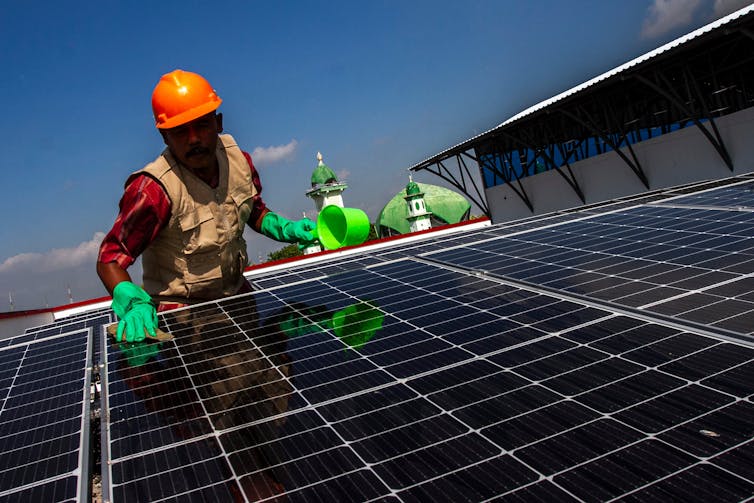
A worker attends a solar panel.
Under threat: funding for solar power production in Indonesia.
Kemarrravv13/Shutterstock

Indonesian policymakers I have spoken to are candid about the politics of climate finance. They see it as driven less by justice than by self-interest. One policymaker in the energy sector described the JETP as “an instrument of control” used by G7 countries to counter China’s influence in Southeast Asia.

At the onset of Trump’s second presidency, with a US withdrawal from the Paris Agreement — and from Indonesia’s JETP — looming, Indonesian policymakers began calling JETP a failure. Others took a more pragmatic view, suggesting the process had accelerated discussion around energy transition in Indonesia.

Today, as developed economies face fiscal pressures and rethink their aid budgets, climate finance — often drawn from aid commitments — looks increasingly uncertain.

As climate funding tightens, justice for historical emissions and support for those disadvantaged by the renewable transition risk slipping further down the agenda. The same fate might await substantive partnerships between developed and developing countries to meet climate goals.


Baca juga:
If Australia and Indonesia agreed to end new thermal coal mines, it could drive the green transition.


The Conversation

Nikita Sud menerima dana dari Oxford University’s John Fell OUP Research Fund (Number 0012658) and a Leverhulme Research Fellowship (RF-2024-551).

ref. The world’s largest climate finance deal was built to flounder: why funding fails to reach the front-line – https://theconversation.com/the-worlds-largest-climate-finance-deal-was-built-to-flounder-why-funding-fails-to-reach-the-front-line-273805

GLP-1 drugs may fight addiction across every major substance, according to a study of 600,000 people

Source: The Conversation – USA (3) – By Ziyad Al-Aly, Clinical Epidemiologist, Washington University in St. Louis

With GLP-1 drugs becoming more accessible and affordable, they could also be within reach for substance use treatment. Michael Siluk/Universal Images Group via Getty Images

A patient of mine, a veteran who had tried to quit smoking for over a decade, told me that after he started a GLP-1 drug for his diabetes, he lost interest in cigarettes. He didn’t use a patch. He didn’t set a quit date. He simply lost interest. It happened without effort.

Another patient on one of these drugs for weight loss told me that alcohol had lost its pull – after years of failed attempts to quit.

People struggling with many addictions, ranging from opioids to gambling, are reporting similar experiences in clinics, on social media and around dinner tables. None of them started these drugs to quit. This pattern of people losing their cravings across a broad range of addictive substances has no precedent in medicine.

But my patients were giving me an important clue. People taking GLP-1 drugs often talk about “food noise” vanishing: the constant mental chatter about food that dominated their days simply goes quiet. But my patients were reporting that it wasn’t just food: They were noticing that the preoccupation with smoking, drinking and using drugs that drives people back despite their best intentions to stop was going quiet too.

As a physician whose patients are often on GLP-1 drugs, and as a scientist who works on answering pressing public health questionsfrom long COVID to medication safety – I saw a problem hiding in plain sight: Many addictions have no approved treatment. The few medications that exist are massively underutilized, and none works across all substances. The idea that a drug already taken by millions might do what no addiction treatment has done before was too important to ignore.

My team and I set out to test whether GLP-1 drugs – medications like semaglutide (Ozempic and Wegovy) and tirzepatide (Mounjaro and Zepbound), originally developed for diabetes and then approved for obesity – could do what no existing addiction treatment does: curb craving itself.

Our evidence strongly suggests they can.

Researchers believe that GLP-1 drugs act on reward areas of the brain that are responsible for food cravings.

Biological basis of cravings

The hormone that these drugs mimic – GLP-1 – is not only produced in the gut. It is also active in the brain, where the receptors it binds to cluster in regions governing reward, motivation and stress – the same circuitry that gets hijacked by addiction. At therapeutic doses, GLP-1 drugs cross the blood-brain barrier and dampen dopamine signaling in the brain’s core reward center, making addictive substances less rewarding.

GLP-1 drugs seem to inhibit cravings for several different substances in multiple animal models. For instance, rodents given GLP-1 drugs drink less alcohol, self-administer less cocaine and show less interest in nicotine. When researchers gave semaglutide to green vervet monkeys – primates that voluntarily drink alcohol much like humans do – the animals drank less without showing signs of nausea or changes in water intake. This suggests the drug lowered the reward value of alcohol rather than making the animals feel sick.

From animals to people

To find out whether these drugs have a similar effect on people, we turned to the electronic health records of more than 600,000 patients with Type 2 diabetes at the U.S. Department of Veterans Affairs – one of the largest health care databases in the world.

We designed a study that applied the rigor of randomized controlled trials – the gold standard in medicine – to real-world data. We compared people who started GLP-1 drugs to people who did not, adjusting for differences in health history, demographics and other factors, and followed both groups for three years.

My team and I asked two questions: For people already struggling with addiction, did the drugs reduce overdoses, drug-related hospitalizations and deaths? And for people with no prior substance use disorder, did GLP-1 drugs reduce their risk of developing one across all major addictive substances: alcohol, opioids, cocaine, cannabis and nicotine?

What we found was striking. In the group already struggling with addiction, there were 50% fewer deaths due to substance use among those taking GLP-1 drugs compared with those who were not. We also found 39% fewer overdoses, 26% fewer drug-related hospitalizations and 25% fewer suicide attempts. Over three years, this translated to roughly 12 fewer serious events in total per 1,000 people using GLP-1 drugs – including two fewer deaths.

Reductions of this magnitude are rare in addiction medicine – and what’s remarkable is that the finding came from drugs initially designed for diabetes, later repurposed for obesity and never intended to treat addiction.

The drugs also appeared to prevent addiction from developing in the first place. Among people with no prior substance use disorder, those taking GLP-1 drugs had an 18% lower risk of developing alcohol use disorder, a 25% lower risk of opioid use disorder and an approximately 20% lower risk of cocaine and nicotine dependence. Over three years, this translated to roughly six to seven fewer new diagnoses per 1,000 GLP-1 users.

With tens of millions of people already using GLP-1 drugs, the reductions in deaths, overdoses, hospitalizations and new diagnoses could translate into thousands of prevented serious events each year.

Converging evidence

Our findings align with a growing body of evidence.

A Swedish nationwide study of 227,000 people with alcohol use disorder found that those taking GLP-1 drugs had 36% lower risk of alcohol-related hospitalizations. This is more than double the 14% reduction that the same study found with naltrexone, which was the best-performing medication approved for treatment of alcohol use disorder in that analysis. Other observational studies have linked GLP-1 drugs to lower rates of new and recurring alcohol use disorder, reduced diagnoses and relapse in cannabis use disorder, fewer health care visits for nicotine dependence and lower risk of opioid overdose.

Meanwhile, randomized controlled trials that directly test whether these drugs help people with addiction also show promise. In one trial, semaglutide reduced both craving and alcohol consumption in people with alcohol use disorder. In another, dulaglutide reduced drinking. More than a dozen additional trials are already underway or actively enrolling, and several more are planned.

The future of addiction treatment

GLP-1 drugs are the first type of medication to show potential benefit across multiple substance types simultaneously. And unlike existing addiction medications, which are prescribed by specialists and remain vastly underused, GLP-1 drugs are already prescribed at enormous scale by primary care doctors. The delivery system to reach millions of patients already exists.

The consistency of GLP-1 effectiveness across alcohol, opioids, cocaine, nicotine and cannabis suggests these drugs may act on a shared vulnerability underlying addiction – not on any single substance pathway. If confirmed, that would represent a fundamental shift in how society understands addiction and how doctors treat it.

Some unanswered questions remain, though, about how these drugs would affect addiction. Many people who take GLP-1 drugs to treat obesity or diabetes discontinue them; afterward, their appetite typically returns and they regain the weight they lost. Whether the same rebound would occur with addiction, and what it would mean for someone in recovery to face the roar of craving again, is unknown. Nor is it clear whether the benefits persist over years of continuous use, or whether the brain adapts in ways that dampen those effects.

Also, because GLP-1 drugs engage the brain’s reward circuitry – the same system that governs not just craving but everyday motivation – prolonged use could, in theory, dampen motivational drive in some people. Whether that might affect real-world outcomes, such as initiative, competitive drive or performance at work, remains an open question.

Mounting research – as well as real-life success stories – paints a bright future for the use of GLP-1 drugs in addiction treatment.

What comes next

GLP-1 drugs have not been approved for addiction, and there is not yet enough evidence to prescribe them solely for that purpose. But for millions of people already weighing whether to start a GLP-1 drug for diabetes, obesity or another approved indication, it is one more factor worth considering.

A patient living with diabetes who is also trying to quit smoking might reasonably choose a GLP-1 drug over another glucose-lowering medication, not because it is approved for smoking cessation, but because it may help them quit, a benefit that other diabetes drugs do not offer. Similarly, for people living with obesity who also struggle with alcohol, the potential for benefit beyond weight loss could be one more reason to consider a GLP-1 drug.

If additional trials confirm that they effectively curb cravings across addictive substances, these drugs could begin to close one of the most consequential treatment gaps in medicine. And the most promising lead in addiction in decades will have come not from a deliberate search but from patients reporting a benefit no one anticipated. Like my patient who quit smoking after a lifetime of trying, it happened without effort.

The Conversation

Ziyad Al-Aly receives funding from U.S. Department of Veterans Affairs.

ref. GLP-1 drugs may fight addiction across every major substance, according to a study of 600,000 people – https://theconversation.com/glp-1-drugs-may-fight-addiction-across-every-major-substance-according-to-a-study-of-600-000-people-275233