Will the Iran war go global?

Source: The Conversation – UK – By Jonathan Este, Senior International Affairs Editor, Associate Editor, The Conversation

This article was first published in The Conversation UK’s World Affairs Briefing email. Sign up to receive weekly analysis of the latest developments in international relations, direct to your inbox.


Before the first airstrike hit Iran on Saturday morning, analysts were warning that a war against Tehran would be a highly risky business. The regime has been in place for nearly 50 years, has a huge, well-trained and loyal military, proxies throughout the region and a huge stockpile of ballistic missiles and drones – plenty to wreak havoc across the region and beyond.

And so it has proved. While Israeli and American forces have been pounding targets across the country, Iran has responded by attacking Israel as well as US military targets in neighbouring Gulf states, including the United Arab Emirates, Bahrain, Saudi Arabia and Kuwait. Attacks have also been reported from Cyprus, Iraq and Jordan.

There is a fresh round of fighting in southern Lebanon after Hezbollah joined Iran in targeting Israel. Beirut is being bombarded.

The economic damage to the region has been enormous. Oil refineries have been shut down, the vital strait of Hormuz – through which 20% of the world’s oil cargo passes – is effectively closed, evacuation flights are leaving the Gulf states around the clock and people are cancelling their travel plans in droves.

And within days of the assassination of Iran’s supreme leader, Ali Khamenei, in a targeted airstrike that also killed a number of his top advisers, a new leader is set to be picked. The smart money appears to be on his son, Mojtaba, known to be cut from very much the same authoritarian clerical cloth as his father. So the notion that with Iran you kill the figurehead and the regime collapses appears to be flawed, to say the least.

Just one week ago, American and Iranian negotiators were engaged in talks in Geneva, which were reported to be making “significant progress”. Now there’s no knowing how this conflict could escalate. On Wednesday, the downing of an Iranian missile over Turkish airspace prompted speculation that Nato would be pulled into a war it clearly doesn’t want. A US submarine sank an Iranian warship in international waters off the coast of Sri Lanka.

There are so many moving parts to this conflict that the sense of jeopardy is at times overwhelming. My email inbox this morning contained a message from Robert Reich, who was Bill Clinton’s secretary of labour between 1993 and 1997 and is a trenchant and energetic critic of the US president, headed: “World War III?
Trump’s and Netanyahu’s illegal war turns global”.

Let’s not second-guess Armageddon just yet. But there’s no denying how dangerous the situation is becoming as the conflict continues to spread. Scott Lucas, an expert in US and Middle East politics at the Clinton Institute, University College Dublin, answers some of the key questions about this fast-developing situation.


Read more:
How dangerous has the conflict in Iran become? Expert Q&A


This has gone beyond what the US president, Donald Trump, referred to as “major combat operations in Iran”. What it might become is anyone’s guess.

What we don’t have to guess is whether Trump is managing to take the American people with him on his foreign adventure. A poll taken on March 2 and published by YouGov/Economist found that US respondents oppose the war by a margin of 45% against to 32% in favour. Predictably, there’s a hugely partisan divide: most Republicans back their president, while Democrats are overwhelmingly anti war.

Significantly, writes Paul Whiteley of the University of Essex, an expert pollster with an interest in UK and US politics, Independents are also against the war by a significant margin. Looking ahead to November’s mid-term elections, as the US president’s advisers undoubtedly are, things do not look good for Republicans’ chances of holding either the House or the Senate.


Read more:
What Americans think of the war in Iran


And the war looks as if it will not end anytime soon. NBC News was reporting this afternoon that the Trump administration may invoke the Defense Production Act to accelerate the production of munitions, which would effectively move the US economy further on to a war footing.

This would seem to hint at something that analysts have speculated about, namely that a lengthy conflict could exhaust America’s stockpile of munitions. The US and its allies — including Israel and the Gulf states — are most acutely exposed to this shortage of defensive interceptors. It’s only been ten months since the US and Israel waged the 12-day war against Iran and that depleted an enormous number of both countries’ defensive missiles, according to Andrew Gawthorpe, an expert in modern American history at Leiden University.

This inevitably means that Washington will have to pull munitions away from other theatres, including those earmarked for South Korea. It’s also fair to say there will be fewer available for Kyiv’s European allies to purchase for the defence of Ukraine, which will please Vladimir Putin no end.


Read more:
How prepared are the US and its allies for a protracted conflict in Iran?


And whether an air campaign will be enough to achieve regime change – if that is indeed the purpose of this conflict – is debatable, writes Matthew Powell, an expert in air power at the University of Portsmouth. Air campaigns rarely work as intended – they often make matters worse, as the world saw after the Nato air campaign that led to the toppling of the country’s ruler, Muammar Gaddafi. With no coherent ground strategy to follow, things fell apart rapidly, with the terrible results that are with us to this day.


Read more:
Iran conflict: air campaigns rarely work as intended – they often make matters worse


‘Special relationship’ under strain

Keir Starmer certainly doesn’t believe in regime change “from the skies”, or so he told the House of Commons this week when fending off criticism of the UK government’s position on whether and how the UK should be involved in this conflict. As the US-Israeli attacks began, Starmer said that the UK would have none of it (due, in large part apparently, to his assessment of a lack of lawful basis for the campaign) and he was not prepared to allow America to use the UK’s bases in any capacity either.

He has since softened his stance, allowing the US to use some British bases, but purely for defensive purposes, to target Iranian ballistic launch sites that could threaten British interests in the region.

‘No Winston Churchill’.

But Donald Trump remains unimpressed and there’s no doubt that this episode has put severe pressure on the so-called “special relationship” between Britain and America. Matt Bar, of Nottingham Trent University, walks us through some of the ups and downs of this relationship over the decades and concludes that it has survived worse setbacks in its time.


Read more:
Iran is putting pressure on the US-UK ‘special relationship’ – but it has survived worse over the years


If this all wasn’t so serious, the US president’s reaction to not immediately getting his way from Starmer would be amusing. In fact it drew an involuntary bark of laughter when I read that, in a press session after a meeting with the German chancellor, Friedrich Merz, on March 3, the US president threw a few barbs Starmer’s way, concluding that: “This is not Winston Churchill that we’re dealing with.”

Indeed. Historian Richard Toye of Exeter University explores that unlikely comparison.


Read more:
What would Winston Churchill make of war with Iran?


The view from Moscow and Beijing

As you’d expect, Beijing was quick to condemn the strikes. China has been heavily dependent on its imports of oil from Iran, and regime change there would threaten this and force it to look elsewhere.

China is linked to Iran in a number of ways, including – significantly – via Tehran’s use of China’s satellite navigation system, BeiDou , which Beijing is touting as a possible replacement for the western Global Positioning System (GPS).

China-watcher Tom Harper, of the University of East London, assesses how this conflict will affect China and concludes that while it will cause turmoil in the short-term, a protracted conflict will play to its benefit in the long term.


Read more:
China set to suffer from turmoil in the Middle East, but it stands to benefit long term


The assassination hit a raw nerve in Moscow. Putin, whose fear of assassination borders on the pathological, watched the killing of a fellow autocrat with undisguised alarm.

Iran is a close ally of Russia. Tehran provided huge numbers of its Shahed drones to Putin to help him wage his illegal war in Ukraine, and Iran has also helped Moscow circumvent the west’s sanctions regime.

Stefan Wolff, an expert in international security at the University of Birmingham, believes that the conflict will play to Moscow’s advantage in the short term at least, as the US diverts munitions earmarked for purchase by Kyiv’s European allies. But he thinks the war is “unlikely to shift the dial significantly towards Russian victory in the long term”.


Read more:
What the conflict in Iran means for Putin and Ukraine


Sign up to receive our weekly World Affairs Briefing newsletter from The Conversation UK. Every Thursday we’ll bring you expert analysis of the big stories in international relations.


The Conversation

ref. Will the Iran war go global? – https://theconversation.com/will-the-iran-war-go-global-277680
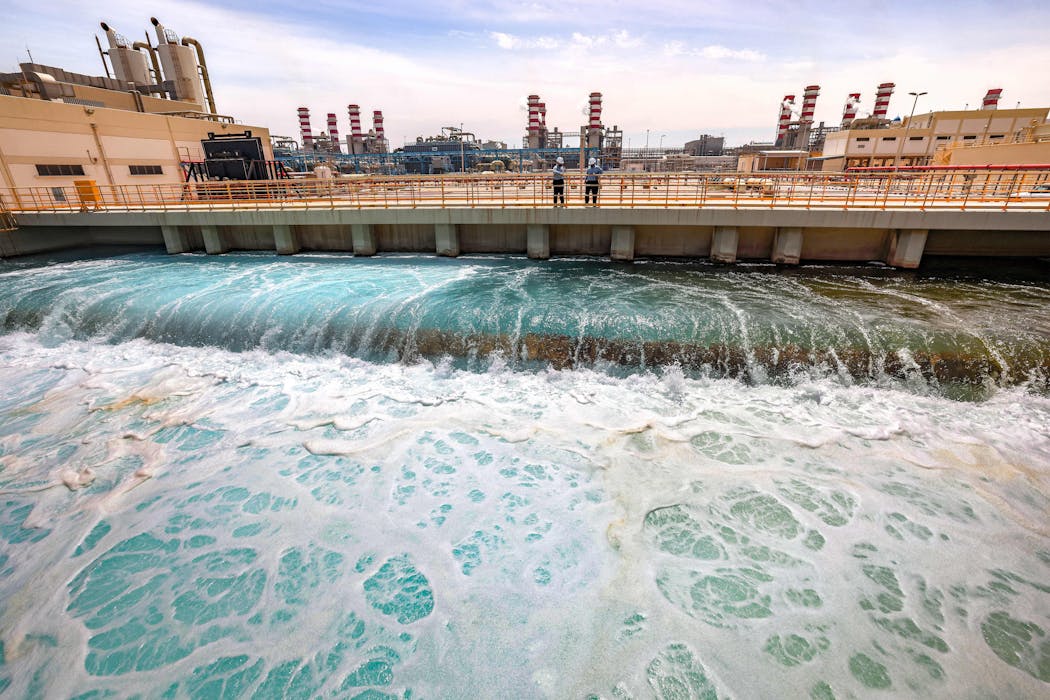
Persian Gulf desalination plants could become military targets in regional war

Source: The Conversation – USA (2) – By Michael Christopher Low, Associate Professor of History; Director, Middle East Center, University of Utah

The Ras al-Khair water desalination plant in eastern Saudi Arabia is just one of many along the Persian Gulf coast. Fayez Nureldine/AFP via Getty Images

Saudi Arabia, the United Arab Emirates and neighboring countries in the Persian Gulf region use the fossil fuels under their desert lands not only to make money, but also to make drinking water. The petroleum they produce powers more than 400 desalination plants, which turn seawater into drinkable water.

In the war that began on Feb. 28, 2026, with U.S. and Israeli attacks on Iran, retaliatory attacks from Iranian forces have hit oil refineries and natural gas plants and disrupted tourism and aviation. Those attacks all hurt Gulf nations’ economies and their hard-won reputations for safety and stability.

But Iranian strikes have also already hit close to a key desalination plant in Dubai. Iranian strikes on March 2 on Dubai’s Jebel Ali port hit about 12 miles (20 kilometers) away from a massive complex with 43 desalination units that are key to the city’s production of more than 160 billion gallons of water each year.

And there has already been damage to the UAE’s Fujairah F1 power and water plant and at Kuwait’s Doha West plant. In both cases, the damage seems to have stemmed from attacks on nearby ports or from falling debris from drone interceptions.

Three people walk through a massive space with many large pipes and valves.
The internal workings of desalination plants can be massive and very complex.
Fayez Nureldine/AFP via Getty Images

Saltwater kingdoms

The region’s monarchies are often described as petro-states, but they have also become what I call saltwater kingdoms, global superpowers in the production of human-made fresh water drawn from the sea. Desalination is part of the reason there are golf courses, fountains, water parks and even indoor ski slopes with manufactured snow.

All together, eight of the 10 largest desalination plants in the world are in the Arabian Peninsula. Israel’s two Sorek plants round out the list.

The countries of the Arabian Peninsula have about 60% of global water-desalination capacity. And plants close to Iran, around the Persian Gulf and the Arabian Sea, produce more than 30% of the world’s desalinated water.

Roughly 100 million people in the Gulf region rely on desalination plants for their water. Without them, almost nobody would be able to live in Kuwait, Qatar and the UAE – or much of Saudi Arabia, including its capital, Riyadh.

Under a massive roof, skiers slide down snow-covered slopes while others sit in a chairlift.
A massive indoor ski area in Dubai is just one of the ways Gulf nations use desalinated water.
Karim Sahib/AFP via Getty Images

Sabotage of water supplies

CIA worries about attacks on Gulf region desalination plants date back to the 1980s. During Saddam Hussein’s 1990 invasion of Kuwait, those worries became real.

After coalition forces began bombing Iraqi positions in January 1991, part of Iraqi troops’ response was to release millions of barrels of crude oil into the Persian Gulf. As the massive oil slick drifted south, U.S. and Saudi officials feared it was meant to sabotage desalination systems.

Workers installed protective booms to shield intake valves at major plants, especially the one that supplies much of Riyadh’s water. In Kuwait, Iraqi sabotage damaged or destroyed much of the country’s desalination capacity.

Kuwaiti authorities also turned to Turkey and Saudi Arabia to supply some 750 water tankers and 200 trucks to import an 18-ton emergency supply of bottled water. U.S.-supplied generators and mobile desalination units provided additional temporary relief, though the full recovery took years.

A beach with black oil on it and large buildings in the background.
Oil washes up on a Persian Gulf beach near a Saudi desalination plant in late January 1991.
Chris Lefkow/AFP via Getty Images

More recent threats

Fears of attacks on desalination plants resurfaced after Yemen’s Houthi movement launched drones and missiles at Saudi facilities at Al-Shuqaiq in 2019 and 2022 – though they did no lasting damage.

Iran’s weapons are far more numerous and sophisticated than the Houthis’, though, so if it attacked desalination plants, the damage could be significant.

There is an irony here: Iran’s capital city of Tehran has a water shortage crisis so serious that in 2025 the government reportedly considered relocating the drought-stricken capital to the coast. But Iran is less vulnerable to attacks on desalination, because its water supply relies instead on dams and wells.

Whatever else the war may be about, water could well become a major factor in the violence and leave lasting political scars. And if either side were to intentionally attack water sources or desalination plants, it would clearly be a human-rights violation.

The Conversation

Michael Christopher Low does not work for, consult, own shares in or receive funding from any company or organization that would benefit from this article, and has disclosed no relevant affiliations beyond their academic appointment.

ref. Persian Gulf desalination plants could become military targets in regional war – https://theconversation.com/persian-gulf-desalination-plants-could-become-military-targets-in-regional-war-277597

Why do sports shoes squeak? Here’s what our research reveals

Source: The Conversation – UK – By Gabriele Albertini, Assistant Professor in Structural Engineering, Department of Civil Engineering, University of Nottingham

The unofficial soundtrack of every basketball, squash or hard-court tennis match is the constant high-pitched squeak or shreak of the players’ shoes. But can this squeak be designed out of them while retaining the grip?

That’s the question an international team of engineers and applied physicists, including me, have been investigating. It sounds like a small design tweak. In fact, it cuts to a deep physics problem: how a soft body slides against a rigid one.

Perhaps surprisingly, the mechanism that produces sound when a soft solid slides against a stiffer one has long been the subject of scientific debate. Most theories are linked to the concept of “stick-slip”: when, instead of sliding smoothly, the sliding object rapidly alternates between sticking and slipping.

While it sticks, the soft body (such as a rubber sole) deforms and stores elastic energy. Then it suddenly slips, turning much of that energy into heat through friction – while also releasing rapid vibrations that radiate out as sound.

But this is not exactly what we observed in our experiments.

After Leonardo da Vinci

Our recently published study took inspiration from the simple-but-effective setup used by Leonardo da Vinci in his studies of friction from the late 15th century.

Leonardo da Vinci's sketches of his pioneering friction experiments.
Leonardo da Vinci’s sketches of his pioneering friction experiments.
Codex Arundel, British Library (41r), 1500-05.

Leonardo used a wooden block resting on a flat surface. The block was subjected to two forces: a normal force (its own weight) and a tangential force which was applied using an additional weight attached to a cable.

By stacking and combining multiple blocks, Leonardo discovered the two fundamental laws of friction: that friction is proportional with how hard the surfaces are pressed together, and largely independent of the size of the contact area.

But Leonardo never published these findings, which were finally rediscovered and made public in the 19th century in notebooks scattered throughout Europe. In the meantime, the laws of friction had only been formally enunciated by French physicist Guillaume Amontons in 1699 – two centuries after Leonardo’s studies.

Furthermore, these laws are empirical rather than fundamental, and in extreme cases they break down. This led us to the question of what makes a shoe squeak.


Read more:
Leonardo da Vinci’s early work on friction founded the modern science of tribology


A surprising result

One of the biggest difficulties in friction studies is that the interface being tested (where a shoe sole meets a hardwood floor, for example) is hard to get at, and comes under a lot of pressure while slipping at high speed. Placing sensors at the interface is almost impossible – and even if it were, this would probably alter the frictional response.

Our solution was to use an optical trick: we replaced the hardwood floor with a transparent acrylic plate and mounted an array of LED lights along its sides. When each test object – including multiple rubber blocks – made contact with the plate, light would leak into the contact region, brightening up this area alone. That allowed us to visualise exactly which parts of the soft-rigid interface were in contact.

We used a high-speed camera, capable of capturing up to 1 million frames per second, to film how the contact patches evolved while the “sole” was skidding, and recorded the sounds being emitted with a microphone.

We found that at the point of contact, tiny wrinkles in the surface of the rubber block – known as “opening slip pulses” – were created, which then raced along the interface at nearly 100 metres per second. While most of the block remained stuck in place, these rapidly moving wrinkles created the sound in each friction test.

Surprisingly, even tiny geometrical features at the frictional interface had profound effects on the sound generated. When it was perfectly flat and smooth, the pulses were messy and generated a scratch-like noise of many different frequencies – closer to the sound of peeling adhesive tape than a clean squeak.

But when ridges were present, like those on the soles of sport shoes, the pulses were confined by the width of these ridges, making them very regular (not messy any more). This turned the sound into a more musical tone akin to the squeaks heard on a basketball court.

We were also able to determine what decides the precise pitch of a shoe squeak. In each test, it was largely unaffected by either the speed of sliding or magnitude of the force applied (which relates to the weight of a player).

Rather, the clearest link was with the height of the rubber block – or the thickness of a shoe’s sole. Using this knowledge, we created a series of blocks of different heights in order to play a familiar melody, as shown in this video.

Video: Nature.

Our research lays the groundwork for controlling or suppressing squeaking in many mechanical systems involving soft-on-rigid friction. These range from brakes and tyres to hip and knee replacements, where polymer liners slide against polished metal or ceramic heads.

And yes, it could even lead to the development of squeakless sneakers. Designing intricate patterns that keep plenty of rubber in contact (so the grip stays high) but break the sliding into lots of tiny, out-of-sync microevents could kill the clean note of the squeak, and leave only a soft hush.

Table-top earthquakes

Beyond the realm of sports, this work also relates to much larger geophysical questions. Similar experimental approaches to ours have served as table-top models for studying earthquakes, during which ruptures and slip pulses spread along tectonic faults at extremely high speed.

If we can reproduce earthquake-like slip pulses in the lab, the next challenge is scaling – working out how those centimetre-scale measurements translate to what happens inside real faults in the Earth.

Achieving this could help interpret seismic signals more confidently: using waves recorded far from a fault to infer what has actually happened at the source. Better physics-based models could improve seismic hazard estimates and lead to more reliable hazard maps.

Meanwhile, we’ll keep thinking about squeakless sneakers too.

The Conversation

Gabriele Albertini received funding from the Swiss National Science Foundation (SNSF), the Engineering and Physical Sciences Research Council (EPSRC), and the University of Nottingham.

ref. Why do sports shoes squeak? Here’s what our research reveals – https://theconversation.com/why-do-sports-shoes-squeak-heres-what-our-research-reveals-277518

How to spot the use and abuse of the word ‘context’

Source: The Conversation – UK – By Paolo Heywood, Associate Professor, Social Anthropology, Durham University

‘My comments about how much I dislike my family were taken outrageously out of context’. Shutterstock/Paper Trident

Everyone’s been in a debate when someone says: “You’re taking that out of context.” But what does it actually mean to understand something “in context”?

Appeals to context feel irrefutable. Of course we need context. But “context” is one of those ideas that seems obvious until you actually try to define it. What counts as context? Where does context end and the thing itself begin? And whose context matters?

Take a typical example: a quote from a politician surfaces that seems damning. Condemnation ensues. But a defence is mounted: the quote has been taken out of context – the politician was being sarcastic, as you’ll see when you look at what else they said at the same time.

But the assault continues when it’s pointed out that the quote fits with other remarks the politician has made. Meanwhile, still further defences are mounted on the basis of the wider political debates around the subject of the quote. Everyone’s invoking context, but nobody’s agreeing.

“Context” isn’t one thing, though the way we use the word often suggests it is. It’s dozens of different things we’ve given different names to over centuries. Social context. Historical context. Cultural context. Political context. Economic context. Linguistic context. Biographical context. Institutional context. Each of these emerged as distinct ways of thinking about how to situate meaning, and each implies a different kind of explanation.

We haven’t always been as concerned about context as we are now – and we haven’t always understood it in the same way. The historian Peter Burke dates “context” in roughly its current (and quite capacious) senses to the counter-enlightenment romanticism of the 19th century.

This same counter-enlightenment romanticism is partly the context in which my own discipline of anthropology emerged – and people started insisting we understand human practices “in their total social context”. They meant something specific: that you can’t understand a ritual or belief by isolating it, and you have to see how it fits into an entire way of life.

When historians talk about “historical context”, they often mean the sequence of events and conditions that preceded something – the causal chain. When literary critics invoke “textual context”, they often mean the surrounding words that shape meaning. These are all genuinely different intellectual operations, and they often pull in opposite directions.

The philosopher Ludwig Wittgenstein spent much of his life thinking about this problem. In his early work, he thought meaning depended on logical context – how a statement fits into a formal structure.

Later, he abandoned this for something messier: meaning depends on what he called “form of life” – the shared practices and assumptions that make our words intelligible to one other. There’s no algorithm for context, there’s just the hard work of making explicit what we normally take for granted. This helps to explain why political arguments can sometimes be so frustrating. We think we’re disagreeing about facts when we’re actually disagreeing about which kind of context is relevant.

A woman looking sad holding a chart showing a line going down, another looking happy with a chart showing a line going up and a third between them looking confused.
Things are going great! And also absolutely terribly.
Shutterstock/Maya Lab

Take recent debates about crime statistics. In 2024, the then Conservative government of the UK argued that crime had fallen by 56% since 2010, yet it also claimed that knife crime had risen dramatically in London since the arrival of Labour mayor Sadiq Khan.

More recently, meanwhile, Reform’s Nigel Farage argues that crime has skyrocketed since the 1990s in ways that records fail to make clear because people aren’t reporting crimes. Still others point to the economic context of austerity and cuts to policing that have hit deprived areas the hardest.

Who’s right? They all might be, in a sense. But they’re playing different games with context. The Conservative government used temporal context (crime down since 2010) and regional context (but up in London). Farage invokes methodological context (the problem of unreported crime skewing the data). Critics of austerity point to economic and structural context (resource distribution and its effects). Each context tells you to look at different things, weigh different factors, draw different conclusions.

There’s no neutral context, no view from nowhere. Every context is itself a choice: a decision about what matters, what explains what, which background is relevant. When we invoke context, we’re not just adding information, we’re making a claim about what kind of thing the world is. These aren’t just different amounts of context, they’re different ideas about what makes things meaningful.

What do we do with this?

Choosing a context is itself an argumentative move. When you invoke historical context, you’re claiming – probably – that temporal sequence and precedent matter most. When you invoke social context, you’re claiming that group membership or structural position matter most. These are substantial commitments, not neutral framings.

It’s also helpful to recognise that contexts can conflict. The immediate linguistic context (x was being ironic) might point one way, while the historical context (but x voted for similar measures) points to another. Both can be “true” while supporting opposite conclusions.

None of this means context doesn’t matter. It means it’s helpful to be honest about what we’re doing when we invoke it. We’re not just adding background information. We’re making claims about what kind of background matters, which in turn depend on deeper assumptions about how the world works.

It’s helpful to be explicit about which context we’re operating in, and why we think it’s the relevant one. That certainly won’t resolve all arguments. But it might help us see that we’re not always arguing about the same thing.

Understanding context isn’t an invitation to add more and more information until everyone agrees. It’s an acknowledgement that meaning is situated, and that different situations generate different meanings. The hard part is figuring out which situation we’re actually in.

This article contains references to books that have been included for editorial reasons, and this may include links to bookshop.org. If you click on one of the links and go on to buy something from bookshop.org The Conversation UK may earn a commission.

The Conversation

Paolo Heywood does not work for, consult, own shares in or receive funding from any company or organisation that would benefit from this article, and has disclosed no relevant affiliations beyond their academic appointment.

ref. How to spot the use and abuse of the word ‘context’ – https://theconversation.com/how-to-spot-the-use-and-abuse-of-the-word-context-275875

This is why you only breathe out of one nostril at a time

Source: The Conversation – UK – By Adam Taylor, Professor of Anatomy, Lancaster University

The dominant nostril naturally switches multiple times a day. Daniel Hoz/ Shutterstock

One of the most bothersome things about being sick or having seasonal allergies is that it makes your nose stuffy and blocked. This makes breathing in through your nostrils frustrating – if not altogether impossible.

But even when you aren’t sick, perhaps you’ve noticed that when you take a deep breath, only one of your nostrils seems to be allowing the air in. Before you panic and wonder if you’re coming down with something, what you’re experiencing is actually a normal bodily process.

Multiple times a day, without us even noticing, the nostrils naturally switch between a dominant nostril for airflow. This process is called the nasal cycle and it plays an important role in the health of our nose.

The body actually switches the dominant nostril as frequently as every two hours while we’re awake. This switch is less frequent when we’re sleeping as our breathing rate slows and the volume of air entering and leaving the body lowers.

There are two key aspects to the nasal cycle: congestion and decongestion.

During the congestion phase, one nostril will experience reduced airflow, while the opposite nostril will be open, or decongested – allowing for more air to pass through it. The decongested phase actually fatigues the open nostril, as air dries it out and brings pathogens into contact with it. This is why it’s important for the dominant nostril to swap.

This alternating cycle is automatic, regulated subconsciously by the hypothalamus in the brain. However, some people have no nasal cycle (such as those who have a hypothalamic disorder). There’s also evidence that the left nostril may be more dominant – particularly in right handed people.

Studies looking at nasal breathing even suggest that when the right nostril is dominant, the body is in a more alert or stressed state. But when the left nostril takes over, the body is in a more relaxed state.

The nasal cycle is important for a number of reasons.

First, it protects the lining of the nose and respiratory system. At least 12,000 litres of air pass through it each day, making it a key front-line defence from pathogens. Having the dominant nostril alternate reduces the risk of damage and also makes it easier for the nasal passage to protect against pathogens.

The nose also has to rest and repair. Air exposure dries it out – so without time to recuperate, this could make it easier for pathogens and inflammation to cause damage.

A woman touches her blocked nose with her hand.
Colds can affect our nasal cycle.
Doucefleur/ Shutterstock

Part of the congestion process also sees increased blood flow to the nose’s vessels. This ensures the nostrils are moistened properly for both the repair and recovery processes, and so that air is warmed and moistened as it passes through the nostril.

Nasal cycle function

A number of things can affect the nasal cycle’s normal function. Respiratory conditions such as colds and flu result in an increase in mucous production. This restricts how easily the nasal passages are able to alternate.

Allergens such as pollen or dust mites can cause severe inflammation of the nasal tissues – again impeding proper function of the nasal cycle.

Certain medications, such as those for high blood pressure, can cause irritation of the nasal lining, too. This is because these drugs effect the blood vessels throughout the body – including those in the nose.

Overuse of nasal decongestants (for more than five days at a time) can cause rhinitis medicamentosa – a form of congestion that occurs when you overuse these drugs. The sudden swelling of the nostril tissues affects the nasal cycle.

For others, structural issues interfere with their nasal cycle. Nasal polyps, which are found in up to 4% of people, are an outgrowth of the nasal lining that usually occurs in both nostrils. These limit how easily air can pass through the nostrils, making the nasal cycle ineffective and leaving both nostrils constantly feeling blocked.

A deviated nasal septum – where the cartilage and bone plate between the nostrils is off-centre – can also make the nostrils feel constantly congested or blocked. This often requires surgery to improve breathing and sleep quality.

Even factors as simple as lying in bed or slouching over can affect the nasal cycle. When you lay down, blood pools in the tissues of the nose. Gravity also causes the contents of the sinuses to move into the nostril closest to the pillow. This can block one of the nostrils, making it harder to breathe and preventing the nasal cycle from working as normal.

If you’re struggling with blocked nostrils, infections such as colds and the flu are usually the most common culprit. It can take up to two weeks to clear the congestion. Sinusitis, where the sinuses become infected, can last for four weeks.

Pollen allergies can also be a common culprit of a abnormal nasal cycle. This symptom can last for weeks depending on the specific allergen you’re allergic to. Regularly taking antihistamines during hay fever season may help to reduce symptoms and clear any congestion.

But if you find one nostril is persistently blocked for more than two weeks, it’s usually a good idea to get it checked out – particularly if there’s mucus coming from your nose, or a discharge that doesn’t look normal for you.

The Conversation

Adam Taylor does not work for, consult, own shares in or receive funding from any company or organisation that would benefit from this article, and has disclosed no relevant affiliations beyond their academic appointment.

ref. This is why you only breathe out of one nostril at a time – https://theconversation.com/this-is-why-you-only-breathe-out-of-one-nostril-at-a-time-276407

Can police reforms improve trust in UK forces?

Source: The Conversation – UK – By Tara Lai Quinlan, Associate Professor in Law and Criminal Justice, University of Birmingham

William Barton/Shutterstock

Police in England and Wales have lost public trust over the last decade, with confidence in policing declining across several measures since 2015. Five years on from the murder of Sarah Everard by a serving London Met police officer, Met commissioner Mark Rowley says he understands why women still do not trust the UK’s largest force.

Everard’s murder and the lack of police investigation into violence against women and girls more generally is just one example of why trust has dipped. Other reasons include use of stop-and-search that disproportionately affects black people, and independent reviews finding that police organisational culture in the Met and other forces is institutionally racist, sexist and homophobic.

The government recently released its plans for the most significant overhaul of policing in decades. The proposals include changes to the sizes of forces, a new system of police licensing, and improving oversight and accountability for police.

This is an opportunity for policing to move away from the “warrior culture” that drives a wedge between police and local communities. As I have explored in my research, warrior-like policing culture – characterised by aggression, violence, sexism, racism and homophobia – is present in forces around the world, including in the UK.

The UK has made strides to increase transparency and accountability nationally, with publicly accessible barred police officers lists and using body-worn cameras.

The government’s proposal to reduce the number of forces in England and Wales from 43 to around 12 could be a chance to purge the most harmful aspects of this culture. Larger police forces are typically more diverse, and have more robust complaints and oversight systems. For example, New York and other US cities have civilian complaint review boards, which allow members of the public to review police misconduct complaints and be involved in improving policing.


Read more:
Met police: Casey review shows how ‘warrior culture’ drives policing in the UK


It could also be a chance to replace this warrior-like culture with “guardianship policing”, a policing model that prioritises police legitimacy through community respect, partnership and working with the public to combat crime and violence. This could include creative new solutions to local crime problems – like adopting public health solutions to issues like knife crime, which are health, not punishment, focused.

Improving accountability

Under the proposals, all police officers across England and Wales will be required to hold and regularly renew their Licence to Practice. While the College of Policing will set the standards, this is an opportunity to develop more robust, fair and accountable training and licensing requirements.

Too often, police standards and training are designed and delivered by current and former officers without input from the communities they serve. Members of the public could offer perspectives on their own experiences of crime, and also of poor policing, to better inform police of the consequences of their work.

The government also wants to give the police inspectorate new legal powers to better support and incentivise problematic forces to improve. This means the inspectorate could take action where they find deeply embedded misogyny, racism, homophobia or other worrying misconduct. However, the Independent Office for Police Conduct (IOPC), the police misconduct complaints watchdog, also needs increased enforcement powers so they can directly hold problematic people and forces to account, which they cannot currently do.


Read more:
Police are failing to deliver a minimum standard of service, according to the UK public


But even under the proposals, the police inspectorate and IOPC will still handle too few cases. Currently, police misconduct is mostly handled internally within forces, and often results in little action. The inspectorate and the misconduct watchdog should therefore also be empowered to sue problematic forces for systemic problems, which they still will not be able to do under the proposals.

Another possibility would be to give courts the power to create and enforce consent decrees. Common in the US, these court-ordered settlement agreements mandate changes to troubled police forces, which are overseen by a court or independent monitoring team. These are the types of reforms that would give systemic misconduct investigations real teeth.

Politicising the police

The reforms present some real opportunities to change policing, but are also fraught with potential for misuse.

For example, giving central government more control over policing, including restoring the home secretary’s ability to fire chief constables. This could be helpful in instances of large numbers of police misconduct complaints or low police legitimacy levels in certain forces. But if a home secretary can fire police chiefs on a whim – because they don’t their like politics, because they work too closely with local communities, or because their initiatives are not punitive enough – that is problematic.

View from behind of Welsh police officers
The reforms will only affect police in England and Wales.
Gareth Llewelyn Evans/Shutterstock

Policing policy should be driven by evidence, not by politics. The risks and implications of overly-politicised policing and security decisions are worrying, because they can mean peoples’ needs are not addressed.

To this end, it is promising that the government is replacing elected Police and Crime Commissioners (PCCs). PCCs were controversially introduced in 2012, with proponents arguing they provided greater police accountability and innovation. Yet critics assert they added additional police bureaucracy, tied the hands of police chiefs in addressing local crime, and are more subject to political pressures.

The proposal to replace PCCs with Policing and Crime Boards under mayoral or local council control could allow for better coordinated, more innovative solutions to local crime and security problems. Or, it may effectively just be keeping PCCs, but under another name.

The Conversation

Tara Lai Quinlan does not work for, consult, own shares in or receive funding from any company or organisation that would benefit from this article, and has disclosed no relevant affiliations beyond their academic appointment.

ref. Can police reforms improve trust in UK forces? – https://theconversation.com/can-police-reforms-improve-trust-in-uk-forces-274673

Why unemployment – and bad jobs – carry hidden social and political costs

Source: The Conversation – UK – By Peter Howley, Professor of Economics and Behavioural Science, University of Leeds

Irene Miller/Shutterstock

The outlook for job seekers in the UK appears to be taking a turn for the worse. Weak economic growth and continued uncertainty for employers have led to forecasts that unemployment will hit 5.3% this year.

In politics, the debate typically follows a familiar pattern: creating jobs, tackling unemployment and making sure welfare benefits are fair. But this economic framing captures only part of what is at stake. Work is not simply a source of income. It is about much more than a paycheck.

When people lose work or cannot find a job, the damage is often psychological as much as financial. With official estimates suggesting that UK unemployment will climb higher this year than previously forecast, that leaves problems for the government beyond just the numbers.

Economists estimate that in terms of life satisfaction the non-financial costs of unemployment are several times larger than the loss of income itself. Unemployment can also leave long-term scarring effects – fears about becoming unemployed again, for example – even after people have found a new job.

One reason is that employment fulfils important psychological needs. Just as vitamins are essential for human bodies, certain aspects of work – autonomy, variety, recognition – are essential for the mind.

When work disappears, people lose not only financial security but often routine and social connection as well. Days can become less structured, social networks might shrink and confidence can erode. In most societies, work is also closely tied to self-worth, meaning unemployment can bring feelings of guilt, shame or personal failure even when job loss is beyond a person’s control.

A good illustration of how powerful these social meanings can be comes from a study of people’s happiness as they transitioned into retirement. People who move directly from employment into life as a pensioner typically experienced little change in their overall satisfaction.

In contrast, those who had been unemployed before retiring reported a marked improvement in wellbeing once they reached retirement age. The difference was not due to changes in financial circumstances. Rather, retirement removed the stigma attached to not working. During working life, being unemployed carries a heavy social stigma. But no one looks down on a pensioner for not working.

Psychological pain

To illustrate further these non-financial costs of not working, research my colleagues and I conducted also looked at how unhappy people feel when they are out of work depending on the overall unemployment rate in their neighbourhood. If unemployment were purely an economic issue, then living in an area with high joblessness should make things worse. It means fewer jobs and tougher competition for those roles, after all.

But what actually happens is the opposite: although the psychological pain of being unemployed is always substantial, this pain reduces as more people around you lose their jobs. Now, it is clearly not the case that people are just cruel and taking pleasure in others’ misfortune. But when job loss becomes more common, the stigma eases and people no longer feel as alone or to blame for their situation.


Read more:
Why unemployment can feel worse when there is less of it around


The current challenge is not limited to outright job loss. Globalisation and technological change have expanded economic opportunities overall, with things like new industries, cheaper goods and services, and greater access to global markets. But they have also contributed to the growth of insecure and lower-quality work. For many people, stable and meaningful employment has become harder to find.

These changes are unevenly distributed: communities that have historically been reliant on manufacturing have suffered lasting declines. These include higher unemployment, lower wages and wider social problems following exposure to competition from cheaper manufacturing bases. In this sense, economic change has created a new geography of disadvantage.

young greek men holding flares in support of the far-right golden dawn party.
High rates of unemployment in Greece fueled the rise of the far-right Golden Dawn party in the mid-2010s.
Alexandros Michailidis/Shutterstock

The consequences extend beyond individual happiness. Rising job insecurity and dissatisfaction with work can reshape how people view government institutions and politics more broadly. They are associated with falling trust and growing frustration: conditions that have been linked to stronger support for populist and anti-establishment movements across advanced economies.

When large groups feel economically marginalised or socially undervalued, political discontent often follows. Labour market policy, therefore, is not only about employment rates or economic growth. The right decisions can help to sustain social cohesion and democratic stability during periods of economic change.

The rapid advance of AI in the workplace brings these questions into sharper focus. It promises extraordinary gains in productivity, but also raises an uncomfortable question for the future. What happens when large numbers of people are no longer needed for the work that once defined economic life?

The challenge posed by AI is not simply how to distribute income, but how to sustain human flourishing in a world where work plays a smaller role. Financial compensation alone may prevent poverty, but it cannot guarantee satisfaction with life. And if citizens do not feel that their lives have value or direction, the political consequences may prove as significant as the economic ones. The future of work is not just an economic question, but a social one.

The Conversation

Peter Howley does not work for, consult, own shares in or receive funding from any company or organisation that would benefit from this article, and has disclosed no relevant affiliations beyond their academic appointment.

ref. Why unemployment – and bad jobs – carry hidden social and political costs – https://theconversation.com/why-unemployment-and-bad-jobs-carry-hidden-social-and-political-costs-277559

Netflix and Paramount bidding for a potentially lucrative back catalogue mirrors 18th-century publishing deals

Source: The Conversation – UK – By Marrisa Joseph, Associate Professor of Organisation Studies & Business History, University of Reading

miss.cabul/Shutterstock

Netflix’s plan to buy the Hollywood studio Warner Bros Discovery is over. The streaming giant was eventually outbid by rival company Paramount Skydance, which is willing to pay around US$111 billion (£82.2 billion) for the company.

It’s not a done deal yet. There will be regulatory hoops that Paramount needs to get through.

But after a tense few months of negotiations, Warner Bros, which put itself up for sale last year, said Paramount’s latest bid was “superior” to the one from Netflix, which then refused to raise its offer.

And if things go according to Paramount’s plan, the company will soon become the new owners of a vast library of content. It will own the likes of Casablanca, Friends, Superman, Harry Potter and Game of Thrones. Plus it will have the Sopranos, Sex and the City and Succession.

Media companies like Paramount and Netflix appear to see high quality back catalogues as valuable strategic assets. The theory is that control over legacy content can provide financial stability and a durable competitive advantage.

And it’s a strategy with a long history. Back in the 18th century for example, Longman, the UK’s oldest commercial publishing house, built up its business by acquiring the catalogues of other firms.

Founded by Thomas Longman in 1724, the company steadily and deliberately expanded its portfolio of titles. One of the most famous and lucrative of these was Robinson Crusoe by Daniel Defoe.

In addition to acquiring catalogues from publishers (who were often retiring or leaving the trade) Longman was also a keen trader of shares in consortiums known as “congers”. This was where publishers collaborated to finance new literary works as a way of spreading the risk of potentially costly publishing ventures. In 1755, for example, Longman joined a consortium with five other publishers to produce and publish Samuel Johnson’s Dictionary of the English Language.

By the time Longman reached its centenary in 1824, the firm was regarded as one of the most distinguished publishing houses of the age. Its fortunes were built on the substantial capital generated through the acquisition of lucrative copyrights, a strategy that successive generations continued.

It was the third generation of Longman publishers for example, who, in 1863, acquired the business of John William Parker & Son, publishers of Gray’s Anatomy. First issued in 1858, the work had already become pivotal to medical education, making it a highly valuable addition to Longman’s catalogue. It has never been out of print, and still sells well to medical students and doctors around the world today.

Longman continued to grow, and was considered one of the major players in British publishing in the 19th century. A steady commitment to purchasing reference and instructional works helped cement the firm’s reputation as a leading educational publisher, a position strengthened by its overseas trade and broad catalogue of school textbooks.

Content is always king

This would become their enduring legacy well into the 20th century, as Longman’s reference works came to define standards in English language educational publishing.

Copy of Gray's Anatomy on a desk.
Still a bestseller.
Tom Quisenaerts/Shutterstock

As successive generations of Longman had pursued this strategy of acquiring established firms with profitable lists, new media companies entered the market seeking to expand their portfolios. Longman’s reputation and extensive back catalogue eventually made the firm an attractive target for a take over.

In 1968 Longman was acquired by Pearson, bringing an end to a publishing dynasty that had lasted for centuries. And although no longer family-owned, the Longman imprint has endured as a strong brand in educational publishing.

Similarly, by absorbing Warner Bros. Discovery’s extensive archive, Paramount will gain control over a vast catalogue of cultural content, influencing which stories persist and how future entertainment landscapes may be shaped.

The deal, if it happens, demonstrates how legacy assets remain powerful tools for shaping markets and culture. It will also show that for media companies in the 21st century, as with publishing companies 300 years ago, ownership of a profitable back catalogue continues to be a cornerstone of growth and innovation.

The Conversation

Marrisa Joseph works for the University of Reading.

ref. Netflix and Paramount bidding for a potentially lucrative back catalogue mirrors 18th-century publishing deals – https://theconversation.com/netflix-and-paramount-bidding-for-a-potentially-lucrative-back-catalogue-mirrors-18th-century-publishing-deals-275955

How the Greeks mapped the mythical places of their heroes and legends

Source: The Conversation – UK – By Lisa Doyle, Postdoctoral Research Fellow, Trinity College Dublin

From the third century BC, Alexandria in Egypt was the intellectual hub of the Greek world, as the literature of classical antiquity was collected, edited and canonised at the Mouseion (Shrine of the Muses) and the Library of Alexandria.

To the ancient Greeks, myths were more than just stories, and to the scholars working at the library, mythical tales presented an opportunity to understand the inhabited world. We are able to uncover how scholars attempted to bridge the gap between myths and the real world through a particular type of source material, one that is preserved in the margins of manuscripts.

We are fortunate that the commentaries and scholarly works of Alexandrian critics have been passed down to us – copied and transmitted across the centuries as comments, notes and annotations in the margins of papyri and manuscripts.

These comments are known as scholia, and they are a window into the workings of ancient scholars. Scholia reveal a range of concerns and ideas, from analysis of poetic techniques to criticisms of grammar. They are also testament to the endeavour of ancient scholars to map the mythical places traversed on heroic voyages onto locations in the known world.

Mapping myths and monsters

One of the most significant scholarly disputes in antiquity, even predating the establishment of the Alexandrian library, was the route taken by the hero Odysseus on his perilous homeward journey after the Trojan War. The final stages of the Greco-Trojan conflict and the subsequent homecoming of Odysseus were the subjects of the ancient epic poems attributed to Homer: the Iliad and the Odyssey.

Homer’s epics were the focal point of scholarly activity in Alexandria. Indeed, one of the chief librarians there, Apollonius of Rhodes, composed his own epic, the Argonautica, which recounts the quest of Jason and the Argonauts to obtain the golden fleece and was modelled on the Homeric poems of a few centuries before.

Like Odysseus, the route taken by Jason was disputed, and Apollonius, as a scholar-poet, was familiar with debates on the exact routes taken by these heroes. Across several annotations, the scholia tell us about the versions of the Argo’s journey that differ from Apollonius’, including that of his contemporary, the poet Callimachus.

The attempt to map mythical locations is most notably characterised by the wanderings of Odysseus (as recounted in Books 9-12 of the Odyssey), which were located in Sicily and Italy. Significantly, the sea monsters Scylla and Charybdis were thought to dwell in the treacherous strait of Messina, the strip of water between the north-east of Sicily and the toe of Italy’s boot.

A strict opponent of this approach, however, was Eratosthenes – the Alexandrian scholar who calculated the circumference of the earth, to a remarkable degree of accuracy. He preferred to locate the wanderings of Odysseus and the travels of the Argo at a remove from the Mediterranean, dispelling them to the remote regions of the ocean.

Professor Helen Lovatt of the University of Nottingham shares insights about Jason and the Argonauts.

How to spot a myth

While the route of Apollonius’ Argonauts contained fantastical elements (like the Sirens and the Clashing Rocks), scholars were also interested in mapping known locations along the route.

As the Argonauts navigate places like the Black Sea in Book II of the Argonautica, the evidence in the scholia demonstrates that scholars had a desire to record the geographical landmarks visited by the heroes, as well as any myths associated with those locations.

In his own epic, Apollonius ensures that the Argonauts leave markers of their journey, often in the form of an altar that is still visible in the landscape. The scholia show us scholars discussing the exact location of these markers – whether the altar to the 12 gods on the Bosporus strait was found on the European side or Asian side, for instance.

In addition to the markers mentioned by Apollonius, the scholia document a vast array of location-based stories which explain the origin of a place’s name – the aition. By using the mythical past to explain a phenomenon in the present, aetiology is a way for the contemporary reader to orient themselves in a text.

It is clear that critics had a “checklist” of sorts for talking about physical landmarks such as rivers or mountains: they note their location, the origin of their name and any connected myths or mythical markers. A standard entry in the scholia reads like this:

The Callichorus is a river sacred to Dionysus in the region of Heraclea. The river is called this because Dionysus organised a chorus there.

The consistency with which these physical landmarks are documented resembles the catalogues which we also find on papyri from the Hellenistic period – the era after the death of Alexander the Great which saw the expansion and transformation of Greek language and culture. Papyri of this type list the names of rivers and associate them with renowned peoples and places (such as those on the Argonautic voyage).

This shows us that these locations, even if they are known from poetry or a fictional voyage, could be situated in the landscape and understood through an origin myth. The cataloguing of mythical landmarks ensures they become enshrined in cultural memory and, through the process of copying them in the margins, ingrained in Greek identity.

The Conversation

Lisa Doyle receives funding from Taighde Éireann / Research Ireland.

ref. How the Greeks mapped the mythical places of their heroes and legends – https://theconversation.com/how-the-greeks-mapped-the-mythical-places-of-their-heroes-and-legends-275035

Menopause makes teachers’ work lives harder – and may push them out of the profession

Source: The Conversation – UK – By Hannah Ainsworth, Senior Lecturer in Primary and Childhood Education, Edge Hill University

Frame Stock Footage/Shutterstock

Secondary teaching in England currently faces a recruitment and retention crisis. Over 90% of teachers leave before retirement.

Although the government have made efforts to improve recruitment and retention, interventions tend to focus on initial teacher trainees and early career teachers – ignoring the experiences of midlife teachers, including menopause.

Research suggests that menopause can increase the risk of burnout at work. However, there has been limited exploration of how menopause affects secondary teachers’ intentions to remain in the profession.

My PhD research explored this. I surveyed 258 peri- and post-menopausal secondary teachers between the ages of 40 and 65 across England, carrying out interviews with 12. I found that teachers are statistically more likely to intend to leave teaching if they are menopausal than if they are pre-menopausal.

When interviewed, menopausal teachers explained they felt they had no option but to leave or reduce their hours and responsibilities as they were unable to manage their menopause symptoms at work. Teachers experiencing menopause symptoms felt that they were less able to do their jobs. “I am planning my exit as we speak now,” Rachel said. “It’s not a job you can sustain.”

Menopause can cause a range of symptoms, with teachers finding menopause-related bladder problems, heavy bleeding and fatigue to be most problematic. Teachers often had limited access to bathrooms during the school day. Jane explained how she was often unable to access a bathroom for up to four hours, and Maddie said she was having “stress dreams about not being able to go the toilet”.

Alongside bathroom access, women found the lack of flexibility and the performance element of the job difficult to manage while experiencing menopause-related fatigue. Paige, who retrained as a teacher in her forties, recounted how she had “never actually come across a profession which is so rigid”. “It is relentless and there is no let up,” Jane explained.

This rigidity also meant many menopausal teachers could not access health appointments, meaning they lacked menopause support inside or outside of school. This further affected their health and wellbeing, as well as their intentions to leave the profession.

Woman in meeting
Women felt they didn’t receive the right support.
AYA images/Shutterstock

Only 7% of menopausal secondary teachers in my survey felt supported by their school; 80% reported struggling to manage workload and to access accommodations, such as flexible working, cooling down methods and regular breaks. Most teachers felt as though their line manager would not know how to help them or how challenging menopause can be. Caroline, a head of department, thought her current headteacher “would find it almost laughable” if she was to ask for support around menopause.

No sympathy

Those who do try to ask for support are often penalised or ignored. Maria raised her heavy bleeding with her line manager and was told discussing the issue was “inappropriate”. Rachel explained that “they had no sympathy” for her symptoms. Maddie asked for more access to toilets: “Of course, it’s been completely ignored.”

Discriminatory practices are having a detrimental impact on women secondary school teachers, psychologically and financially. Rachel felt forced to give up her role as head of department and “took a huge hit financially”. Susan “felt anxious and ashamed”. The teachers highlighted a systemic failure for midlife women in secondary teaching, noting “a cull of older ladies” in the profession. Only 34% of teachers surveyed identified a menopause policy, with those I interviewed noting how the menopause policies in place were tokenistic and ineffective. Maria explained that her school’s policy was “very much box ticking”.

Despite being a female dominated sector, the “career stifling” described in the interviews is represented in the persistent gender pay gap. Women are less likely to be in leadership positions in schools than men.

These findings raise questions around the inclusivity of secondary teaching, particularly for women and for those who have health-related needs. Supporting menopausal teachers is imperative for retaining experienced and talented teachers.

Changes such as accessing bathrooms, reducing workload and the consideration of flexible working opportunities would make a real difference for women in teaching. Training for line managers and HR would help them effectively support menopausal teachers – and wider scrutiny needs to occur around the potential gendered and ableist discriminatory practices occurring in the teaching profession.

All names have been changed for anonymity

The Conversation

Hannah Ainsworth received funding from the ESRC for the research project informing this article.

ref. Menopause makes teachers’ work lives harder – and may push them out of the profession – https://theconversation.com/menopause-makes-teachers-work-lives-harder-and-may-push-them-out-of-the-profession-276307