US oil industry doesn’t see profit in Trump’s ‘pro-petroleum’ moves

Source: The Conversation – USA (2) – By Skip York, Nonresident Fellow in Energy and Global Oil, Baker Institute for Public Policy, Rice University

Expanding offshore drilling is one of President Donald Trump’s key policy goals for his second term. Mario Tama/Getty Images

As the Trump administration makes announcement after announcement about its efforts to promote the U.S. fossil fuel industry, the industry isn’t exactly jumping at new opportunities.

Some high-profile oil and gas industry leaders and organizations have objected to changes to long-standing government policy positions that give companies firm ground on which to make their plans.

And the financial picture around oil and gas drilling is moving against the Trump administration’s hopes. Though politicians may tout new opportunities to drill offshore or in Arctic Alaska, the commercial payoff is not clear and even unlikely.

Having worked in and studied the energy industry for decades, I’ve seen a number of discoveries that companies struggled to moved forward with because either the discovery was not large enough to be commercially profitable or the geology was too difficult to make development plausible. Market conditions are the prime drivers of U.S. energy investment – not moves by politicians seeking to seem supportive of the industry.

Market fundamentals trump policy announcements

The general decline in oil prices from 2022 through late 2025 has reduced the attractiveness of many drilling investments.

And opening the East and West coasts to drilling may sound significant, but these regions have unconfirmed reserves. That means a lot of subsurface work, such as seismic surveys, stratigraphic mapping and reservoir characterization – potentially taking years – would need to be done before any drilling would begin.

Offshore drilling also faces enormous opposition.

On the West Coast, California Gov. Gavin Newsom and California Attorney General Rob Bonta have made forceful statements against any new California offshore oil drilling. They have said any effort is economically unnecessary, environmentally reckless and “dead on arrival” politically in the state.

California local governments, environmental groups, business alliances and coastal communities also oppose drilling and have vowed to use legal and political tools to block them.

There is opposition on the East Coast, too. More than 250 East Coast local governments have passed resolutions against drilling.

Governors on both sides of the aisle, including Democrat Josh Stein of North Carolina and Republicans Brian Kemp of Georgia and Henry McMaster of South Carolina, have spoken out against drilling off their coasts.

Arctic drilling is even harder

Drilling for oil and gas in the Arctic National Wildlife Refuge and the Beaufort Sea off Prudhoe Bay in Alaska would be a massive undertaking. These projects require years of development and are subject to future reversals in federal policy – just as Trump has lifted long-standing drilling bans in those areas, at least for now.

In addition, Alaska is one of the most expensive and technically challenging places to drill. Specialized equipment, infrastructure for frozen landscapes, and risk mitigation for extreme weather drive costs far above other regions. These projects also face logistical challenges, such as pipelines running hundreds of miles through remote, icy terrain.

Natural gas from Alaska would likely be sold to Asian buyers, who increasingly have alternative sources of supply from Australia, Canada, Qatar and even the U.S. Gulf Coast. As production rises in those places, the entrance of Alaskan natural gas into the market raises the risk for global oversupply, which could depress prices and reduce profitability.

Despite political support from the Trump administration, the oil and gas companies would need financing to pay for the drilling. And those loans won’t come if the oil companies don’t have agreements with buyers for the petroleum products that are produced. Major oil companies have withdrawn from Alaska and signaled skepticism about attractive long-term returns.

A close-up of a person holding a pen and signing a piece of white paper.
President Donald Trump has signed several executive orders seeking to boost the oil and gas industry.
Shawn Thew-Pool/Getty Images

Trump has helped some

In the first 10 months of the second Trump administration, the president has signed at least 13 executive orders pertaining to the energy industry. Most of them focus on streamlining U.S. energy regulation and removing barriers to the development and procurement of domestic energy resources. However, the broad nature of some of these orders may fall short of establishing the stable regulatory environment necessary for the development of capital-intensive energy projects with long time horizons.

Those efforts have reversed the Biden administration’s go-slow approach to oil drilling, reducing – though not completely eliminating – the backlog of requests for onshore and offshore drilling permits that accumulated during Biden’s presidency.

Delays in permit approvals increase project costs, risk and uncertainty. Delays can increase the chances that a project ultimately is downsized – as happened with ConocoPhillips’ Willow project in Alaska – or canceled altogether. Longer timelines increase financing and carrying costs, because capital is tied up without generating revenue and developers must pay interest on the debt while waiting for approvals. Delays also lead to higher project costs, eroding project economics and sometimes preventing the project from turning a profit.

Investment follows economics, not politics

Unlike in some countries, such as with Saudi Arabia’s Aramco, Norway’s Equinor or China’s CHN Energy, the U.S. does not have a national oil or gas company. All of the major energy producers in the U.S. are privately owned and answer to shareholders, not the government.

Executive orders or political slogans may set a tone or direction, but they cannot override the fundamental requirement for profitability. Investments can’t be mandated by presidential decree: Projects must make economic sense. Without that, whether due to low prices, high costs, uncertain demand or changing regulations, companies will not proceed.

Even if federal policies open new areas for drilling or relieve some regulatory restrictions, companies will invest only if they see a clear path to profit over the long term.

With most energy investments costing large amounts of money over many years, the industry likely wants a sense of policy stability from the Trump administration. That could include lowering barriers to profitable investments by accelerating the approval process for supporting infrastructure, such as transmission power lines, pipelines, storage capacity and other logistics, rather than relying on sweeping announcements that lack market traction.

The Conversation

Skip York does not work for, consult, own shares in or receive funding from any company or organization that would benefit from this article, and has disclosed no relevant affiliations beyond their academic appointment.

ref. US oil industry doesn’t see profit in Trump’s ‘pro-petroleum’ moves – https://theconversation.com/us-oil-industry-doesnt-see-profit-in-trumps-pro-petroleum-moves-270518

You care about fairness at work – so why do you feel like a fake?

Source: The Conversation – USA (2) – By Meg Warren, Associate Professor of Management, Western Washington University

Most people care about fairness at work and want to support colleagues who face marginalization – for example, people of color, women and people with disabilities. Our research has found that 76% of employees want to be allies to co-workers who face additional challenges, and 84% value equity. That’s in line with a 2025 national survey that found 88% of employees supported employers offering training on how to be more inclusive.

So why doesn’t that support always turn into action?

Our new study in the Journal of Workplace Behavioral Health points to one reason: Some people may freeze with worry because they feel like a fake. Specifically, they feel like they don’t have the skills to effectively support their marginalized co-workers, even though they want to. Those feelings may block action, which makes people feel even more fraudulent – creating a loop that’s hard to break.

Together, we – Meg Warren, Michael T. Warren and John LaVelle – found that 1 in 5 people who want to support marginalized groups experience the impostor phenomenon even when they have the skills to be effective allies.

The impostor phenomenon, formerly called the “impostor syndrome,” is the feeling that you’re not good enough – even when there’s objective evidence that you are. Researchers have documented it across many workplace and professional settings, including in health care, technology, entrepreneurship, the C-suite and academia.

Importantly, these feelings are linked to significantly higher anxiety and feelings of depression among people who want to be allies. We found that men, leaders, younger employees and people of color were more likely to experience the impostor phenomenon in the context of allyship.

What the impostor phenomenon looks like for allies

Consider “James,” a senior project manager. For the past few years, his company has expected all managers to undergo diversity, equity and inclusion training and to support the company’s Black Employee Network. Earlier this year, however, the company publicly withdrew its commitment to DEI and removed all mentions of it from its website.

When his team asked for his thoughts, James felt lost. The facts he learned during the Black Employee Network meetings were unsettling and undeniable. Before, he regularly cited these during various meetings with his colleagues and senior leaders. Now, he felt pressured to act as if none of this mattered. He felt frustrated, at a loss for words and a complete fake – like he didn’t know how to support his colleagues anymore.

While “James” is a composite character drawn from many stories we’ve heard over the course of our research, his experience captures the bind that many would-be allies face.

When allies feel this way, they often compare themselves to an imagined “perfect ally,” thinking that if they can’t be outrageously heroic, they must be failures. They then deal with feelings of inadequacy by procrastinating or overpreparing before stepping up for others – to the point where they miss crucial opportunities where they could have made a difference.

People tend to feel like an impostor when they encounter a challenge that seems bigger than their ability to cope with it. So it’s not surprising that a lot of people feel this way about workplace equity. Inequity and bias play out in complex ways in organizations: The rules change rapidly, and people can receive mixed messages about what behaviors are appropriate, valued and rewarded. This can make allyship feel overwhelmingly challenging, even for those who are otherwise skilled.

Work culture also matters. In toxic organizational cultures or hypercompetitive environments, people feel pressure to hide their mistakes, they worry about colleagues sabotaging their efforts, and they see humility as a weakness. In such places – and especially when the would-be ally’s role is highly visible and entails heavy responsibility – people are vulnerable to impostor feelings.

Past criticism can add fuel, too. If you’ve been admonished for standing up for a colleague or have seen others be attacked – including by those who wish to maintain an unjust status quo – you might further feel pressure to only act in ways that are immune to criticism. That’s an impossible standard.

Consequences of feeling like an impostor: Feeling worse, doing worse

Leaders in particular are vulnerable to feeling like impostors on allyship. Many haven’t been properly trained on how to listen to and support co-workers who might be facing discrimination and are quietly suffering, yet are held responsible for solving complex issues around fairness that long predated them.

And when stuck in this uncomfortable space, people who feel like impostors are likely to become defensive and feel pressured to be a hero. To prove themselves, they may overcompensate in ways that backfire – for example, by loudly claiming support for disadvantaged workers without following up with useful action, or by swooping in to fix issues without respecting the preferences of the people involved.

Unfortunately, this not only affects their ability to be a supportive colleague, but it also likely harms their mental health. Indeed, the impostor phenomenon has been found to be linked to heightened anxiety and feelings of depression, both in our study and beyond.

So you might wonder: What if I opt out of all of this by not thinking about inequity at all? Our research suggests that this is a bad idea. People who are disengaged from issues of inequity, and who don’t invest in learning and growing as allies, experience lower self-confidence at work and have lower job satisfaction. Checking out of allyship could be bad for your professional well-being.

The good news is you don’t have to be stuck feeling this way. You can take low-risk, bite-sized actions that can pull you out of feeling fake and boost your confidence, all while improving your own professional success and mental health.

Research points to three simple ways forward. First, recognize and loudly celebrate the strengths of marginalized colleagues, which creates an uplifting work culture. Second, take concrete steps to build trust – for example, by giving proper credit to a disadvantaged colleague if their merit is wrongfully questioned. And finally, overcome your cynicism – which research shows invariably suppresses constructive action – and instead adamantly choose hope, even when it’s hard.

The Conversation

The authors do not work for, consult, own shares in or receive funding from any company or organization that would benefit from this article, and have disclosed no relevant affiliations beyond their academic appointment.

ref. You care about fairness at work – so why do you feel like a fake? – https://theconversation.com/you-care-about-fairness-at-work-so-why-do-you-feel-like-a-fake-271081

Sabrina Carpenter’s and Chapelle Roan’s sexy pop hits have roots in the bedroom ballads of Teddy Pendergrass and Philly soul

Source: The Conversation – USA (2) – By Jared Bahir Browsh, Assistant Teaching Professor of Critical Sports Studies, University of Colorado Boulder

Teddy Pendergrass was known for romantic R&B ballads like the 1978 hit “Close the Door.” Michael Putland via Getty Images

When Sabrina Carpenter’s provocative 2024 pop single “Bed Chem” plays on the radio, and I hear the lyrics

But I bet we’d have really good bed chem / How you pick me up, pull ‘em down, turn me ’round / Oh, it just makes sense / How you talk so sweet when you’re doing bad things

it reminds me of a song released 45 years earlier:

Let’s take a shower, said a shower together, yes / I’ll wash your body and you’ll wash mine, yeah / Rub me down in some, some hot oils, baby / And I’ll do the same thing to you
—“Turn Off the Lights” by Teddy Pendergrass

Growing up in Philadelphia in the 1990s, I listened to soul singer-turned-R&B sex symbol Teddy Pendergrass and other artists who defined the Sound of Philadelphia. Now, as a professor of ethnic studies, I teach students about the influence of Black artists on modern pop culture.

Pendergrass would have turned 75 this year. Although he died in 2010, he helped usher in an era of music that brought both disco and more mature, sensual music to the mainstream – and I see his influence in a number of pop and R&B hits today.

“Turn Off the Lights” by Teddy Pendergrass.

The Philadelphia sound

Theodore DeReese Pendergrass was born in South Carolina in 1950, but he grew up in North Philadelphia, where he sang and played drums in church and became an ordained minister at age 10.

He dropped out of Thomas Edison High School in the 11th grade to pursue a music career, and he recorded “Angel With Muddy Feet” in 1967. The song was not a commercial success, so he focused on playing drums for a number of local bands.

In 1970, Pendergrass was invited by Philly soul and R&B singer Harold Melvin to play drums with his group, the Blue Notes. During a performance, Pendergrass sang along, leading Melvin to invite him to take over as lead vocalist after John Atkins left the group. The following year, Harold Melvin and the Blue Notes signed a record deal with the newly created Philadelphia International Records, forging a partnership between Pendergrass and label founders and legendary producers Kenny Gamble and Leon Huff that would last over a decade.

Five male musicians dressed in dark suits perform on stage in front of microphones
Teddy Pendergrass (second from right) performs with Harold Melvin and the Blue Notes at the Greek Theatre in 1973 in Los Angeles.
Sherry Rayn Barnett /Michael Ochs Archives via Getty Images

Philadelphia International’s influence was felt throughout the music industry, with Gamble and Huff producing many of the hits performed by the label’s artists. Gamble and Huff blended soul and funk with complex horn and string arrangements to create the Philly soul sound.

This sound became key in the development of disco, smooth jazz and neo-soul. Slower, more intimate R&B and smooth jazz also formed the foundation for the “quiet storm” radio format that Pendergrass helped foster as a solo artist on stations like WDAS in Philadelphia.

Marvin Gaye’s 1973 album “Let’s Get It On” was Motown’s response to the emergence of Philly Soul, and helped popularize more explicitly sensual R&B and soul.

Harold Melvin and the Blue Notes had their first No. 1 hit with 1972’s “If You Don’t Know Me by Now.” While on the Philadelphia International label, the group recorded four gold records between 1972 and 1976. One of their biggest hits, “Don’t Leave Me This Way” in 1975, was not released until November 1976. It charted after R&B and disco singer Thelma Houston’s cover of the song hit No. 1 on the Billboard Hot 100 chart in 1977.

Going solo

Pendergrass left the Blue Notes in 1976 after disputes with Melvin over money, but he stayed on with Philadelphia International and began a solo career. His self-titled album was released in 1977, and the first single, “I Don’t Love You Anymore,” reached No. 5 on the R&B charts, helping to push the album into the top 20.

The following year, his “Life Is a Song Worth Singing” hit No. 1 on the Soul LP chart behind the sensual single “Close the Door.”

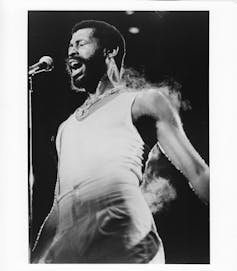
Black-and-white photo of singer wearing white undershirt singing in front of microphone, with steam coming off his body
R&B heartthrob Teddy Pendergrass performs on stage circa 1977.
Gilles Petard/Redferns via Getty Images

Pendergrass, with his stylish good looks, quickly became not just a heartthrob, but a top R&B artist with five consecutive platinum albums between 1977 and 1981. He was selling out concerts, and legendary producer Shep Gordon recognized that the vast majority of the attendees were women. This led to Pendergrass’ “Ladies Only” tour in 1978, which became a template for future soul and R&B tours by contemporaries like Luther Vandross and later artists like Ginuwine, whose tours were also marketed specifically to women.

The 1979 erotic hit “Turn Off the Lights” strengthened Pendergrass’ reputation as a sex symbol. While Marvin Gaye was dealing with both financial and personal issues, Pendergrass became the top performer of soul “bedroom ballads.”

Pendergrass and Gaye, along with other contemporaries like Barry White, Minnie Riperton and Donna Summer, included more explicitly erotic themes and lyrics than earlier artists.

For example, in Gaye’s “Let’s Get it On,” he implores to his lover:

“There’s nothin’ wrong with me / Lovin’ you, baby love, love / And givin’ yourself to me can never be wrong / If the love is true, oh baby.”

In “Close the Door,” Pendergrass similarly tells his lover:

“Close the door / Let me give you what you’ve been waiting for / Baby I got so much love to give / And I wanna give it all … to you …”

One challenge for the songwriters like Gamble and Huff was to balance the sensuality that fans loved with Federal Communication Commission rules regarding profane language. Songs like “Turn Down the Lights,” written by Gamble and Huff for Pendergrass, describe a detailed night of romance without language that would be considered obscene by the FCC.

Slow jams and sex positivity

R&B and soul slow jams by artists like Freddie Jackson and Vandross dominated bedroom music through the 1980s, although derivative genres like neo-soul and quiet storm continued to produce bedroom ballads like Gaye’s “Sexual Healing” in 1982.

Madonna and Cyndi Lauper helped bring a female perspective to more sex-positive pop music with songs including “Like a Virgin” and “She Bop.” Janet Jackson and Salt-N-Pepa did the same in R&B and hip-hop. Other groups embraced their sex symbol status through the 1990s, exemplified by TLC’s “Ain’t 2 Proud 2 Beg” and “Creep,” and Next’s “Too Close.” The artists of the 1980s and 1990s were also boosted by MTV, bringing a visual element to their sensual lyrics.

The emergence of new jack swing, a term coined in 1987 to define a new style that combined dance, hip-hop and R&B, ushered in higher-tempo erotic songs like “Do Me!” by Bel Biv Devoe along with slower bedroom ballads like “I’ll Make Love to You” by Philadelphia’s Boyz II Men.

Philly’s Boyz II Men carried the bedroom ballad tradition into the 1990s with “I’ll Make Love to You.”

Bedroom ballads with disco-synth makeover

Philadelphia International’s sound and sensual lyrics have reemerged in recent years through artists Sabrina Carpenter and Chapelle Roan, whose synth-pop and disco sound can be traced back to Gamble and Huff, and the label’s stable of artists.

Proto-disco songs like “The Love I Lost” and “Don’t Leave Me This Way” by Harold Melvin and the Blue Notes, and Pendergrass’ disco hit “Get Up, Get Down, Get Funky, Get Loose” – or his later synthesizer-heavy album “Joy” – would influence current synth-pop hits like Roan’s disco-influenced “Pink Pony Club” and Carpenter’s synth-pop “Manchild.”

Chapelle Roan’s campy, disco-influenced hit “Pink Pony Club.”

Carpenter in particular has seemingly struck that balance between mainstream success and sensual lyrics. Her past three albums have been certified platinum and embrace increasingly mature themes such as female arousal.

“Man’s Best Friend,” released in August 2025, sparked controversy with a sexually suggestive album cover that further cemented her Carpenter’s symbol image. This image is reinforced by her stage presence, like dancing in her underwear on “Saturday Night Live” and mature songs like “Tears,”

“Tears” by Sabrina Carpenter.

Pendergrass’ career was derailed when he lost control of his car on Lincoln Drive in the East Falls neighborhood of Philadelphia in 1982. The accident left him a tetraplegic. He later continued his music career, but the “Black Elvis” moved away from bedroom ballads.

Although Pendergrass’ meteoric rise was cut short, his influence is still seen and heard across music genres today, especially as empowered female artists utilize disco and synth-pop sounds while embracing their sexuality through their songs and performances.

Read more of our stories about Philadelphia, or sign up for our Philadelphia newsletter on Substack.

The Conversation

Jared Bahir Browsh does not work for, consult, own shares in or receive funding from any company or organization that would benefit from this article, and has disclosed no relevant affiliations beyond their academic appointment.

ref. Sabrina Carpenter’s and Chapelle Roan’s sexy pop hits have roots in the bedroom ballads of Teddy Pendergrass and Philly soul – https://theconversation.com/sabrina-carpenters-and-chapelle-roans-sexy-pop-hits-have-roots-in-the-bedroom-ballads-of-teddy-pendergrass-and-philly-soul-270035

Outside the West, the Kundalini tradition presents a model of the ‘divine feminine’ beyond binary gender

Source: The Conversation – USA (3) – By Anya Foxen, Associate Professor of Religious Studies, California Polytechnic State University

A piece of art shows the tantric tradition’s depiction of Kundalini and energy centers – or chakras. Tantrika painting/Wellcome Collection, CC BY

The notion of the divine feminine is a recurring motif in American pop culture, playing with the assumptions people make when referring to God – often the deity described in the Bible – as “He.”

Whether it’s Alanis Morissette’s iconic portrayal of God in the 1999 comedy “Dogma” or Ariana Grande’s titular declaration in her 2018 track “God is a Woman,” the effect is the same: a mixture of irreverence and empowerment. It dovetails, moreover, with a ubiquitous political slogan: “The future is female.”

But in a historical moment when society is bitterly contesting ideas about gender, we’d note that these notions still rely on a simplistic binary.

As two scholars who study the entangled history of spirituality and gender, we often observe an especially fraught version of this dynamic playing out among “spiritual but not religious” practitioners, often called spiritual seekers. To many such people, the divine feminine represents an escape from oppressive gender norms, and yet many stumble in trying to reconcile the idea with the embodied realities of biological sex.

An approach that escapes this dilemma is the centuries-old Kundalini tradition, which paints a model of the divine feminine beyond gender altogether.

The feminine Shakti

There are certainly examples of the feminine divine to be drawn from Christian and other Abrahamic religious traditions. Yet many seekers quickly find themselves reaching beyond these borders.

When they do, one of the first concepts they come across is Shakti, a divine feminine energy that manifests in the human body as the electrifying force of Kundalini. Both terms originate in South Asian religions – especially Hinduism – that fall under the broad umbrella of tantra.

Tantric cultural and spiritual traditions, which began to emerge in the early centuries of the Common Era, take a positive perspective on the material world in general and the human body in particular, as opposed to traditions that regard both as inherently illusory or sinful. In tantra, the material world and physical body are suffused by divine energy. This energy is called Shakti, and it is feminine.

Another key idea common to tantric traditions is that the universe is composed of two fundamental principles – or rather that it has two poles: a dynamic energy, which is female, balanced by an unchanging consciousness, which is male. As the great Goddess, Shakti goes by many names, including Durga, Kali and myriad others. The masculine principle is usually called Shiva, though this can vary as well.

Divinity beyond binaries

Tantric traditions span over a millennium in time and a subcontinent in space, so it should come as no surprise that they are incredibly diverse. However, most practices that enjoy global popularity today, especially those centered on the divine feminine energy of Kundalini, can be traced to a specific tradition called Kaula Tantra, which developed in the northeast of modern-day India near Kashmir.

An old painting of a many-armed religious figure.
A picture of tantric art from the 19th century.
Pictures From History/Universal Images Group via Getty Images

This tradition is distinctive by maintaining that while the cosmos is polar, it is also nondual, meaning that there is only one ultimate reality. So, the pairing of Shakti and Shiva, feminine and masculine, energy and consciousness, is best understood not as a binary but as the two sides of a Mobiüs strip, where one seamlessly flows into the other.

Take a strip of paper, twist it into a figure eight – also the symbol we use for infinity – and glue the back to the front. That’s the Kaula model of the universe.

In such a world, Shiva is Shakti. The masculine is the feminine. Both are divine, but even more than this, both are ultimate, because there is no difference between them. God is goddess, and both are nonbinary.

Awakening Kundalini

Kundalini yoga is a centuries-old practice quite different from the branded version popularized more recently by Yogi Bhajan. It involves using complex meditative and physical techniques to awaken and raise this energy from its usual resting place in the bottom of the torso.

In doing this, tradition says the practitioner experiences a radical transformation both of the body and of consciousness. Premodern texts describe Kundalini’s fiery energy burning through the tissues of the body, shooting up to the crown of the head, where the feminine Shakti unites with her masculine counterpart and all dissolves into oneness.

While some texts treat this ascent as equivalent to a sort of voluntary death, others describe how, once she has ascended, Kundalini returns to bathe the body in a cooling nectar of immortality, resulting in an embodied state of enlightenment and liberation.

According to this tradition, the body may appear the same but is now enlivened with a new consciousness that has transcended all dualities – including male and female.

Is the divine feminine female?

Human gender norms often prove difficult to shake, however. Though the energy of Kundalini is understood as feminine, Kundalini yoga in South Asia has been traditionally practiced by men. The reasons for this are perhaps almost entirely social, and yet they remain a powerful force.

Ironically, the very fact that Kundalini is often believed to be associated with womanhood has resulted in women being excluded – or at least deprioritized – from cultivating their own practice. Instead, they have historically become assistants or accessories to the enlightenment of men.

The fieldwork we present in our recent book on the topic bears this out. Among South Asian practitioners, the common attitude is that women embody the maternal principle, and this makes them extremely powerful. In them, the energy of Kundalini operates naturally. Men, on the other hand, need to be purified by a woman through ritual in order to effectively engage in Kundalini practice.

A woman meditates in the forest.
A woman meditates during festival for a modern, branded version of Kundalini yoga.
Godong/Universal Images Group via Getty Images

Such ideas are also common among Western practitioners, who tend to believe women have a more natural aptitude for Kundalini awakening. One of our subjects said this is because women have less ego. Another attributed it to female sexual fluids.

However, cultural difference plays a role, too. Western notions of the divine feminine are much more inclined to cling to the binary, resisting the idea that male and female bodies alike are ultimately woven from the same nondual reality.

Most striking, perhaps, one man who had spent a lifetime among seekers at spiritual retreats in the U.S. and South America told us of a long-held and common belief that only women were capable of Kundalini experience. It was, to him, an energy exclusive to the female body. He recounted having been shocked, only months prior, at encountering a copy of the 1967 classic “Kundalini: The Evolutionary Energy in Man,” authored by the decidedly male Gopi Krishna.

The broader point, however, is that the historical core of Kundalini practice has always been about transcending all dualities.

Thus, even as a goddess representing the ultimate “She,” Kundalini is best understood as nonbinary. Perhaps if we can wrap our heads around this idea, we can cultivate a more inclusive empowerment.

The Conversation

The authors do not work for, consult, own shares in or receive funding from any company or organization that would benefit from this article, and have disclosed no relevant affiliations beyond their academic appointment.

ref. Outside the West, the Kundalini tradition presents a model of the ‘divine feminine’ beyond binary gender – https://theconversation.com/outside-the-west-the-kundalini-tradition-presents-a-model-of-the-divine-feminine-beyond-binary-gender-263402

Pope Leo XIV’s visits to Turkey and Lebanon were about religious diplomacy

Source: The Conversation – USA (3) – By Ramazan Kılınç, Professor of Political Science, Kennesaw State University

Pope Leo XIV and the Armenian patriarch of Constantinople, Archbishop Sahag II Mashalian, celebrate a liturgy in the Armenian Apostolic Cathedral of Istanbul, Turkey, on Nov. 30, 2025. Dilara Acikgoz/AP Photo

On his visit to Turkey and Lebanon between Nov. 27 and Dec. 2, 2025, Pope Leo XIV met with political and religious leaders, celebrated Mass and visited historical sites.

The trip marked the 1,700th anniversary of the Council of Nicaea, which resolved core doctrinal differences, with the aim of advancing Christian unity at the time.

The Vatican framed the visit to the two Muslim-majority countries as a gesture of interreligious dialogue, as well as support for local minority Christian communities.

Through interfaith dialogue and symbolic acts, religious leaders often act as diplomats to strengthen relationships with other faith groups as part of religious diplomacy.

Traditional diplomacy often prioritizes political and economic interests, whereas religious diplomacy builds on identities and values. But as a scholar of religion and politics, I have often seen how religious diplomacy complements conventional diplomatic tools – the pope’s visit being the most recent example.

Turkey and religious freedom

Lebanon and Turkey have a long history of Christianity, dating back to the early centuries of the religion. The Bible mentions Jesus visiting Tyre and Sidon, coastal cities in Lebanon. Many early Christian communities thrived in lands of modern-day Turkey, such as Ephesus, Antioch and Cappadocia.

Despite Turkey’s significance in the history of Christianity, today Christians constitute less than 0.5% of its population. These include diverse Christian communities, from Armenian Orthodox, Greek Orthodox and Syriac Orthodox to Roman Catholic and Protestant.

Turkey’s constitution guarantees religious freedom, but Christians face legal and administrative hurdles in matters such as building places of worship.

The pope’s visit did not directly confront these structural issues, but the trip itself drew international attention to the plight of Christians.

The pope met with Muslim leaders to foster dialogue. He visited Istanbul’s Blue Mosque, an architectural icon for Turkish Muslims. In a meeting with Turkish President Recep Tayyip Erdoğan, the pope emphasized Turkey’s role as “a bridge between East and West, Asia and Europe.”

Even the pro-government media, which does not usually support rights for religious minorities, highlighted Turkey’s responsibility to provide religious freedoms for its Christian minorities in its coverage of the trip.

Several people walking in a large dome-like structure with high ceilings. Some are dressed in black suits and a few in white robes.
Pope Leo at the Blue Mosque in Turkey.
AP Photo/Emrah Gurel

Challenges of Lebanese Christians

Christians make up about a third of the Lebanese population – the largest proportion of any country in the Middle East.

Maronite Catholics, an Eastern Catholic community that traces its roots to the fourth century, constitute the largest group among Lebanese Christians. They are followed by Greek Orthodox communities, concentrated in Beirut and Mount Lebanon. Other groups include Melkite Greek Catholics, Armenian Apostolic, Armenian Catholics, Syriac Orthodox, Syriac Catholics, Assyrians, Chaldean Catholics, Copts and various Protestant communities.

Christians in Lebanon enjoy constitutional protections and better political representation than Christians in other Middle Eastern countries. Lebanon’s confessional system allocates power among religious communities. The president must be a Maronite Christian, the prime minister must be a Sunni Muslim, the speaker of the parliament must be a Shia Muslim; parliament and cabinet seats are split equally between Christians and Muslims.

However, Christians are concerned with their decreasing population in Lebanon. They constituted over 50% of the population when Lebanon gained its independence from France in 1943. Over the years, many Christians left Lebanon because of economic pressures, the dominance of the Shia group Hezbollah and insecurity stemming from Israeli strikes.

The pope advised political leaders to prioritize cooperation over sectarian interests within its confessional political system. As a gesture, he joined Muslim leaders in Martyrs’ Square in Beirut and shared readings from both the Gospels and the Quran.

Moral boost

The pope’s visit provided a morale boost for Lebanese Christians. Many saw the pope’s presence as encouragement to stay in Lebanon despite all the concerns.

Yet, some expressed disappointment that the pope did not travel to southern Lebanon, where Christian villages have suffered from Israeli strikes.

However, the pope reiterated the Vatican’s support for a two-state solution to the Israeli-Palestinian conflict as the only way to resolve “the conflict they continually live.”

Religious diplomacy

Through his visits to Turkey and Lebanon, Pope Leo XIV intertwined religious teachings with cultural gestures to promote a message of peaceful coexistence.

By meeting Christian groups in Turkey and Lebanon, he offered moral support and visibility to minorities facing insecurity and emigration pressures. By meeting with Muslim leaders, he showcased the Vatican’s commitment to coexistence and dialogue with Islam.

It remains to be seen whether the pope’s religious diplomacy will lead to tangible policy outcomes. Yet, one thing is clear: Religious diplomacy serves as a valuable tool for encouraging dialogue and understanding as it did with the pope’s visit.

The Conversation

Ramazan Kılınç does not work for, consult, own shares in or receive funding from any company or organization that would benefit from this article, and has disclosed no relevant affiliations beyond their academic appointment.

ref. Pope Leo XIV’s visits to Turkey and Lebanon were about religious diplomacy – https://theconversation.com/pope-leo-xivs-visits-to-turkey-and-lebanon-were-about-religious-diplomacy-271208

Fossil science owes a debt to indigenous knowledge: Lesotho missionary’s notes tell the story

Source: The Conversation – Africa (2) – By Julien Benoit, Associate professor in Vertebrate Palaeontology, University of the Witwatersrand

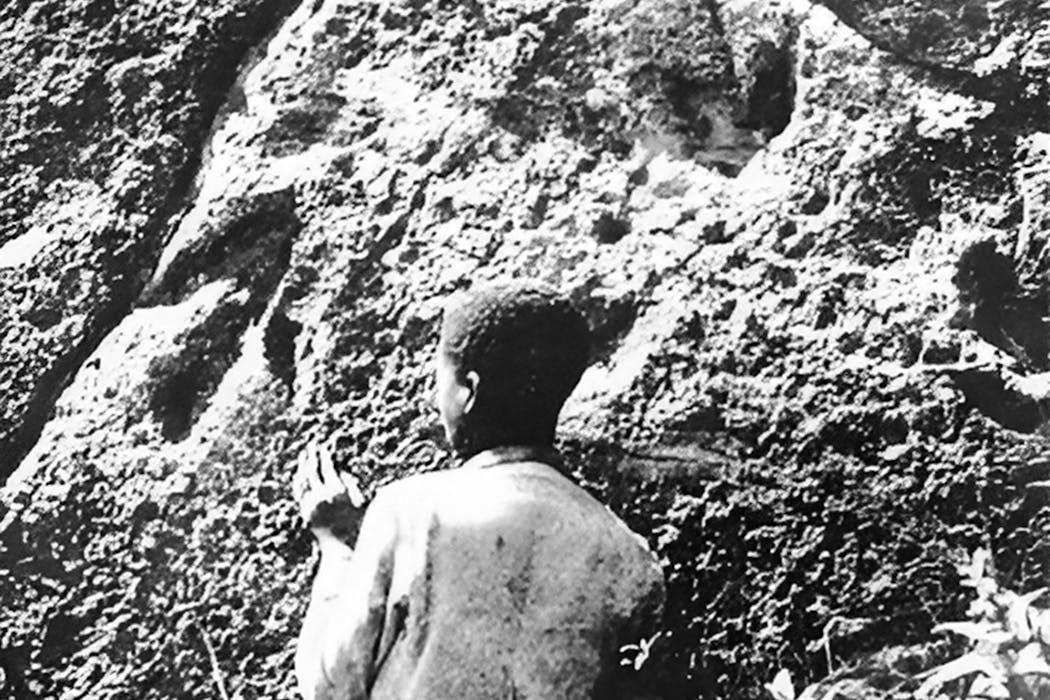
Dinosaur footprints at Morija, Lesotho, in 1906. The person standing in front of the rock slab covered with tridactyl fossil footprints is not identified. Photos courtesy of the Institut des Sciences de l’Evolution of the University of Montpellier, France , CC BY-NC-SA

For over a century, the scientific literature has credited western missionaries with “discovering” fossils in Lesotho, the small, mountainous country surrounded by South Africa.

The narrative typically begins with figures like the French missionary Hermann Dieterlen, who, in 1885, reported unusual “petrified bird tracks” near the settlement of Morija. This account implies that earth sciences like the study of rocks and fossils arrived in Lesotho from Europe.

In contrast, our research supports the notion that the local people recognised, interpreted and explained these fossils before missionaries arrived. Our research focus is on the dinosaur bones and tracks of Lesotho, its geomythology (cultural explanations of geological phenomena), and indigenous palaeontology.

Our recent study revisits the private archives of French missionary and self-taught palaeontologist Paul Ellenberger (1919–2016). He lived in Lesotho from 1953 to 1970 as part of a three-generation missionary family. During this period, he documented various fossils and published his findings in scientific literature. After returning to France, he earned a PhD in palaeontology in the mid-1970s. His contributions laid the foundation for the study of animal fossil tracks and traces in southern Africa.

His notes reveal that the Basotho and San people in Lesotho not only noticed fossils but also integrated them into their culture as geomyths.

This matters beyond Lesotho. Scientific history has often portrayed African indigenous communities as passive background figures. Fossils were deemed “discovered” only when Europeans documented them, despite what local people already knew.

Revisiting Ellenberger’s archives corrects this imbalance. His notes support that indigenous knowledge informed scientific discovery. As some sciences grapple with their colonial legacies, narratives like this offer a path forward.

Fossils in Lesotho

Lesotho is part of the southern African main Karoo Basin, one of the world’s richest continental fossil archives. It is a record of several major evolutionary and environmental transitions. This includes the rise of dinosaurs after the end-Permian mass extinction some 252 million years ago.

Both body fossils and trace fossils have been found in Lesotho and its surroundings. Erosion of fossil-rich rocks exposes numerous dinosaur, amphibian and reptile trackways, fish trails and burrows, alongside full or partial skeletons and plant remains. Thus, fossils are part of Lesotho’s rugged landscape.

For the Basotho, giant bones eroding from the hills are not mere curiosities; they are referred to the Kholumolumo. This was an enormous, all-devouring mythical creature whose thunderous footsteps echoed across the landscape, leaving footprints behind.

This folktale aligns closely with the fossil record: skeletons and trackways, mostly of dinosaurs, which are prevalent in the sky-high exposures of the Maloti (or the Drakensberg, as the mountain range is known in South Africa).


Read more:
Dinosaur tracksite in Lesotho: how a wrong turn led to an exciting find


The Kholumolumo myth serves as a cultural framework that preserves real observations of Lesotho’s fossil heritage over time. It’s an example of early citizen science – local people identifying recurring patterns in their environment and explaining them within their own cultural framework.

Ellenberger’s original archival materials reveal that this local knowledge was highly practical. When French palaeontologists arrived in 1955, they were guided to Maphutseng – now known for one of southern Africa’s richest dinosaur bone beds – by Samuel Motsoane. He was a local schoolteacher who had known the “stone bones” since childhood, in the 1930s.

The San and the fossil footprints

The Basotho and San were among the first in southern Africa to examine giant footprints preserved in stone and ponder: what walked here?

The indigenous San people, who followed a hunter-gatherer way of life before their culture disappeared from Lesotho, were masters in the interpretation of tracks. They could identify the size, behaviour and movement of living animals from a single footprint. Ellenberger believed they applied these skills to fossil tracks as well.


Read more:
Mysterious South African cave painting may have been inspired by fossils


His manuscripts describe rock art at Mokhali Cave that appears to depict a dinosaur footprint alongside bipedal creatures reminiscent of the three-toed dinosaur fossils preserved in nearby outcrops.

Ellenberger also noted that some San myths seemed to differentiate between the tracks of four-legged animals in the lowlands and those of two-legged animals higher in the mountains.

In southern Africa, fossil tracks of bipedal dinosaurs are found in higher rock layers only, where the rocks are younger. Lower rocks contain only quadrupedal trackways made by more primitive animals.

So the myths appear to demonstrate some level of understanding of the evolution of species.

Although this seems more speculative, his core observation remains valid: the San recognised patterns in the fossil record and integrated them into their worldview. They observed their land with precision long before formal palaeontology developed in the area.

Rethinking the narrative of ‘discoveries’

The diaries show that locals guided researchers to fossil sites. They recognised fossil bones and tracks as evidence of ancient animals, and preserved this understanding through stories that served as explanations.

Ellenberger himself valued this intellectual tradition: he spoke Sesotho fluently, collaborated with locals, and documented their insights respectfully. His notes credit half a dozen Basotho who discovered fossils of important scientific value.

His notes show that the roots of awareness and interpretation of fossils in southern Africa predate European expeditions and reach into the deep sense of place held by the people living among these fossils since generations. Their interpretations were not “quaint myths” but sophisticated observations shaped by centuries of engagement with the land.

Acknowledging this enriches the scientific record, broadens our understanding of early palaeontology, and honours the contributions of communities whose insights led to important discoveries. Ellenberger has left us an empowering and inspiring legacy for the new generation of southern African palaeontologists.

The Conversation

Julien Benoit receives funding from DSTI-NRF GENUS (Centre of Excellence in Palaeosciences) and African Origins Platform.

Emese M Bordy receives funding from DSTI-NRF GENUS (Centre of Excellence in Palaeosciences). www.genus.africa

Charles Helm does not work for, consult, own shares in or receive funding from any company or organisation that would benefit from this article, and has disclosed no relevant affiliations beyond their academic appointment.

ref. Fossil science owes a debt to indigenous knowledge: Lesotho missionary’s notes tell the story – https://theconversation.com/fossil-science-owes-a-debt-to-indigenous-knowledge-lesotho-missionarys-notes-tell-the-story-270431

Young, undocumented immigrants are finding it increasingly hard to attend college as South Carolina and other states restrict in-state tuition or ban them altogether

Source: The Conversation – USA (2) – By William McCorkle, Associate Professor of Education, College of Charleston

Students at Arizona State University protest against a Republican student group encouraging people to report undocumented immigrants in January 2025 . Ross D. Franklin/Associated Press

The Trump administration’s aggressive deportation policies have heightened stress among the country’s approximately 14 million immigrants who are living in the U.S. without legal authorization.

The sharp rise in dramatic arrests and deportations of immigrants over the past year has received widespread media attention.

A less publicized issue is that many young, undocumented immigrants are also finding it harder to apply to and stay in college.

As someone who researches teacher training and was a high school teacher in South Carolina, I have researched how restrictive education policies make it harder for immigrant students, particularly undocumented students, to receive a college degree.

A green expanse of grass and trees is seen with people sitting under a tree.
The University of South Carolina is the largest public university in the state.
Wikimedia, CC BY

Bumpy path to higher education for undocumented students

In 1982, the Supreme Court ruled that students could not be discriminated against based on their immigration status.

This ruling ensured that immigrant students could not be denied entrance to public K-12 schools.

The caveat is that the ruling did not extend to higher education.

In 1996, Congress approved the Illegal Immigration Reform and Responsibility Act, which made it harder for undocumented immigrants who are deported to reenter the U.S., among other changes to increase border security.

This law also said that states could not provide in-state tuition to undocumented students at public universities, unless they gave the same benefits to out-of-state American citizens.

Then, in the early 2000s, a bipartisan group of Texas representatives helped pass a bill that opened up in-state tuition to undocumented students. The bill based tuition and scholarships on specific residency requirements, such as graduating from high school in the state, allowing the bill to circumvent the 1996 federal law.

Also in the early 2000s, California, Illinois, Washington and New York also passed similar legislation that allows undocumented immigrants to receive in-state tuition – and in some cases, state scholarships – at state universities.

Even some conservative states, such as Utah, Oklahoma and Kansas, passed such legislation during the early 2000s that let undocumented immigrants pay in-state tuition at public universities and colleges.

The tide turns

But just a few years later, things began to shift.

In 2008, South Carolina became the first state to ban undocumented students from studying at public colleges and universities altogether.

Georgia and Alabama quickly followed suit with similar bans.

In 2012, after Congress created the Deferred Action for Childhood Arrivals program to allow immigrants who came to the U.S. as children to temporarily work, study and stay in the U.S., some schools in South Carolina briefly banned DACA students from attending public universities – despite the new federal law.

The schools reversed course the next year following a lawsuit by the American Civil Liberties Union of South Carolina, but still required DACA students to pay out-of-state tuition.

Until 2015, South Carolina even denied in-state tuition for some American citizens with undocumented parents. The state reversed the policy following a lawsuit.

The trend toward more restrictive policies toward undocumented students has continued during the Trump administration.

In February 2025, Florida passed a law that revoked in-state tuition for undocumented students. Florida still allows undocumented immigrants to enroll at public colleges and universities, as long as they pay full tuition.

And over the summer, the Department of Justice challenged Oklahoma’s and Texas’ in-state tuition policies, which had allowed all undocumented students to pay in-state tuition.

Both states quickly ended their policies.

Texas and Oklahoma still allow DACA recipients to attend public universities and pay in-state tuition rates.

As of 2025, 22 states and Washington D.C. allow undocumented students to pay in-state tuition. The remaining states, meanwhile, either do not have a state policy, require undocumented immigrants to pay out-of-state tuition, or bar them entirely from attending public universities.

A challenging environment

Overall, these shifts make it harder for many undocumented students to go to and stay in college.

The price of in-state tuition at public universities varies, but it typically offers in-state residents a much lower tuition rate than students coming from out of state. While the average in-state tuition at public colleges costs about US$11,610 for the 2024-25 school year, out-of-state students paid $30,780, on average, during this same time frame.

Undocumented students do not qualify for federal financial aid, so paying out-of-state tuition at a public university usually prevents immigrants from pursuing a college degree.

Some research shows that in-state tuition policies help reduce undocumented college students’ dropout rates by about 8%.

In-state tuition policies also increase college enrollment of noncitizen Latino students by 54%.

A blockade for students

I began teaching social studies at a high school in South Carolina in 2012, soon after many of these restrictions on immigrant students were enacted. I found that many educators and students were not aware of these restrictions until students applied to colleges or sought state licenses.

My students included DACA recipients who completed a two-year program in areas like cosmetology, only then to be told they would not be allowed to practice in the state.

My later research focused on DACA students who aspired to become educators but had to either stop pursuing that goal or go out of state to teach. Other immigrant students I surveyed in my research said they lost motivation in the high school classroom due to the restrictions to pursue higher education.

An aerial view shows a large group of people walking together on a track.
Students stage a walkout at a high school in Charlotte, N.C., on Nov. 18, 2025, protesting Border Patrol operations targeting undocumented immigrants.
John Moore/Getty Images

Carryover effects

Policies that make it easier for undocumented immigrants to attend college don’t just affect individual students and their families – they also have a positive effect on local economies.

Research from 2025 shows that when undocumented students can pay in-state tuition, they become more likely to have a job after graduation.

Another study from Clemson University and the nonprofit group Hispanic Alliance found that South Carolina could be losing up to $68 million a year in revenue due to the license policy for DACA recipients.

I have known undocumented people who are aspiring doctors and teachers and moved to other states since they could not study or receive professional licenses in South Carolina.

Restrictive education policies could mean that some of the most talented immigrant students will leave their respective states. However, the average undocumented immigrant student will not usually pursue or delay higher education if the tuition is not affordable.

I believe these policies will ultimately mean a less educated and productive society.

The Conversation

William McCorkle does not work for, consult, own shares in or receive funding from any company or organization that would benefit from this article, and has disclosed no relevant affiliations beyond their academic appointment.

ref. Young, undocumented immigrants are finding it increasingly hard to attend college as South Carolina and other states restrict in-state tuition or ban them altogether – https://theconversation.com/young-undocumented-immigrants-are-finding-it-increasingly-hard-to-attend-college-as-south-carolina-and-other-states-restrict-in-state-tuition-or-ban-them-altogether-267597

With a deadline looming, Lebanon is under pressure to disarm Hezbollah or risk another war

Source: The Conversation – Global Perspectives – By Amin Saikal, Emeritus Professor of Middle Eastern Studies, Australian National University; The University of Western Australia; Victoria University

Lebanon faces a grave predicament. Israel wants the Hezbollah militant group based in the country to be disarmed. Hezbollah has refused to give up its arms as long as Israel threatens Lebanon. And the Lebanese government is not strong enough to subdue Hezbollah on its own.

This is a recipe for renewed internal conflict in Lebanon, as well as another round of war between Israel and Hezbollah. The cost could be devastating for both Lebanese and regional stability.

Israel’s two-month war on Hezbollah

Israel and Hezbollah have been at loggerheads since the Lebanese group’s creation, with help from the Islamic Republic of Iran, in the early 1980s.

Successive Israeli leaders have sought to stifle Hezbollah’s growth as a formidable paramilitary force in Lebanese politics and threat to Israel’s national security. Israel invaded Lebanon in 1982 and 2006 to try to destroy the group, without much success.

However, Israel’s war against Hamas in Gaza gave it another opportunity to take on Hezbollah when the group joined the conflict in solidarity with Hamas.

After nearly a year of Hezbollah rocket attacks on northern Israel and Israeli retaliation, Prime Minister Benjamin Netanyahu opened a “new phase” of the Gaza war in September 2024.

Using unprecedented means, such as remote detonation of the group’s pagers and 2,000-pound (900kg) US-made “bunker buster” bombs, the Israel Defence Forces (IDF) quickly pierced Hezbollah’s defences. It decapitated the group by killing its firebrand and strategic-minded leader, Hassan Nasrallah, and his successor, Hashem Safieddine.

Shaky ceasefire

When a ceasefire took hold after nearly two months of fighting, 3,800 people in Lebanon were killed, many of them civilians. Israel lost more than 80 soldiers and 47 civilians. Some 1.2 million Lebanese people were displaced, along with around 46,000 Israelis.

Israel claimed to have eliminated many of the group’s hideouts and assets, including ammunition depots and infrastructure, especially in Beirut and southern Lebanon. The IDF also pushed most of Hezbollah’s forces back to the Litani River – 29 kilometres north of the Israeli border.

In February of this year, Israel withdrew its troops from most of southern Lebanon, but maintained control of five strategic points inside Lebanon after the deadline to withdraw its troops.

Then, in August, Israel said it would pull back the rest of its forces only when the Lebanese army was able to take over positions currently manned by Hezbollah operatives and the group was totally disarmed.

Under the terms of the ceasefire, brokered by the United States and France in November 2024, the Lebanese army is responsible for disarming Hezbollah. The Trump administration has set a December 31 deadline to disarm the group.

But the reformist Lebanese Prime Minister Nawaf Salam’s task has become very difficult, with Israel regularly bombing what it calls Hezbollah targets to ensure the group does not regain its pre-war strength.

Israeli strikes have killed at least 127 Lebanese civilians and wounded dozens since the start of the ceasefire.

Hezbollah has vowed not to disarm. Its new chief, Sheikh Naim Qassem, has warned the Lebanese government against giving in to Israeli and American demands.

He also said if Israel broadens its attacks into another war, Hezbollah’s missiles “would fall” on Israel.

Will war return?

Hezbollah has been weakened as Tehran’s most important pillar of influence in the Middle East. But it still remains well-manned and equipped. It also remains popular among the Shias who form the largest segment of Lebanon’s religiously and politically divided population.

Salam, a Sunni Muslim, has his work cut out for him.

On the one hand, he presides over a “consociational” system of governance, in which different religious and sectarian groups share power in proportion to the size of their communities under the presidency of General Joseph Aoun (a Christian). This does not augur well for long-term national unity.

On the other hand, Salam needs to deal with a shattered economy and finances – and, more importantly, the Israeli demand that Hezbollah be disarmed.

If Salam deploys the Lebanese armed forces, numbering around 60,000 active personnel, to force Hezbollah to disarm, this could trigger a devastating civil war, similar to the one that gripped Lebanon from 1975 to 1990. If he doesn’t, he risks Israel’s wrath and another round of war.

There is no easy way out of this explosive situation. But the key to a viable resolution lies largely with the Trump administration. It needs to restrain Israel from continuing to breach the ceasefire to give time to Salam’s government to find a non-confrontational way to defuse the situation.

Lebanon has endured many tragic episodes in its turbulent history and can survive its current predicament, as well. As the renowned Lebanese-American writer, poet and artist Khalil Gibran (1881–1931) has said:

We are a nation strong in its weakness, majestic in its concealment, speaking while silent and giving while begging, we are the burden of a thicket, while our enemy looks at us from a high place then descends and seizes us with his claws and bites our bodies with his beak, enjoying our taste, but he cannot swallow us and will not be able to swallow us.

The Conversation

Amin Saikal does not work for, consult, own shares in or receive funding from any company or organisation that would benefit from this article, and has disclosed no relevant affiliations beyond their academic appointment.

ref. With a deadline looming, Lebanon is under pressure to disarm Hezbollah or risk another war – https://theconversation.com/with-a-deadline-looming-lebanon-is-under-pressure-to-disarm-hezbollah-or-risk-another-war-271523

Jane Austen’s happiness was complicated – her last heroine in Persuasion knew why

Source: The Conversation – UK – By Anna Walker, Senior Arts + Culture Editor, The Conversation

Summer Evening on the Southern Beach by Peder Severin Krøyer (1893). Skagens Museum

Jane Austen’s Paper Trail is a podcast from The Conversation celebrating 250 years since the author’s birth. In each episode, we’ll be investigating a different aspect of Austen’s personality by interrogating one of her novels with leading researchers. Along the way, we visit locations important to Austen to uncover a particular aspect of her life and the times she lived in. In episode 6, we explore whether Jane was happy, using her last published novel, Persuasion, as our guide.

Given that happy endings in Jane Austen’s novels chiefly revolve around a love match with the desired hero, some might conclude that as Austen remained a lifelong spinster, happiness must have eluded her. But this groundbreaking writer was a woman who filled her life with meaning through interests, friendships, socialising, travel, and most of all, a purpose.

The Cobb in Lyme Regis
The Cobb in Lyme Regis remains much as Austen would have known it.
Nada Saadaoui, CC BY-SA

Of course Austen had her fair share of worries. This was especially true after her father died, and she, her mother and her sister Cassandra found themselves in much reduced circumstances in less salubrious lodgings in Bath and then Southampton. A life of genteel poverty was leavened by her close relationships with the women in her life, including her good friends Martha Lloyd and Anne Sharp, a fellow writer with whom Austen could discuss the business of writing.

Much like her lovelorn heroine Anne Elliot, Austen had little affection for Bath. She missed the verdant Hampshire countryside of her youth and found the city oppressive, despite its lively social whirl. After eight years she returned to her beloved county when her brother Edward offered his mother and sisters a house on his estate at Chawton.

Here the women settled into a more comfortable life, allowing Austen the space and peace to write. It was at Chawton in 1815 that she wrote her final novel, Persuasion – the story of happiness lost and regained. The world-weary Anne Elliot, whose bloom has withered and is considered past her prime at 27, is still pining for Frederick Wentworth, the man she was persuaded to give up years before, when he re-enters her life as a dashing naval captain.

In the sixth episode of Jane Austen’s Paper Trail, Jane Wright is joined by Nada Saadaoui of the University of Cumbria, whose research examines Austen’s depiction of walking in Romantic-era English landscapes, to answer the question: was Jane happy?

A seaside landscape
Jane Wright and Nada Saadaoui walked in Austen’s footsteps in Lyme Regis.
Jane Wright, CC BY-SA

Austen’s abiding love of walking is reflected in the character of Anne, who finds restoration and renewal in the act. Taking in the sea air at the Cobb in Lyme Regis, the two explore what this coastal Dorset town meant to Austen, and how it inspired the pivotal scene in Persuasion where Anne and Wentworth reignite the spark of their connection.

“In walking and being out of doors, these characters open themselves up to transformation,” says Saadaoui, “and we see, especially for Anne, that this walk along the Cobb becomes a walk back to herself – to her strength, her voice, her true self, and her happiness.”

Painting of Jane Austen with her back to us
A portrait of Austen painted by her sister Cassandra during one of their visits to Lyme Regis.
Wiki Commons

Later on, Anna Walker sits down with two more Austen experts – John Mullan, professor of literature at University College London, and Freya Johnston, professor of English at the University of Oxford – to comb through what clues Persuasion offers about Austen’s own happiness.

Johnston has studied Austen’s remaining letters closely. “Quite often [she] sounds angry. She also sounds quite bitter … but there is also happiness in the letters. Certainly a degree of pride in her achievements as an author and just an enjoyment of writing.”

Mullan believes Austen also derived happiness from her family: “I think if you could beam yourself down to an Austen family gathering, [you’d find that] they were a really rather terrific family. I think that they were open-minded, intelligent, humorous, optimistic people … they valued Jane’s talents and her intelligence and enjoyed hearing her read bits of her writing to them. And I think that that one can’t overestimate how important that must have been to her.”

Listen to episode 6 of Jane Austen’s Paper Trail wherever you get your podcasts. And if you’re craving more Austen, check out our Jane Austen 250 page for more expert articles celebrating the anniversary.

You can also sign up to receive a free Jane Austen 250 ebook from The Conversation, bringing together a collection of our articles celebrating her life and works.

This is the last episode of Jane Austen’s Paper Trail – however we will be running a special Q&A episode in January where you can put your questions to our panel of experts. Please send your questions to podcast@theconversation.com


Disclosure statement

Nada Saadaoui, John Mullan and Freya Johnston do not work for, consult, own shares in or receive funding from any company or organisation that would benefit from this article, and has disclosed no relevant affiliations beyond their academic appointment.


Jane Austen’s Paper Trail is hosted by Anna Walker with reporting from Jane Wright and Naomi Joseph. Senior producer and sound designer is Eloise Stevens and the executive producer is Gemma Ware. Artwork by Alice Mason and Naomi Joseph.

Listen to The Conversation Weekly via any of the apps listed above, download it directly via our RSS feed or find out how else to listen here.

The Conversation

ref. Jane Austen’s happiness was complicated – her last heroine in Persuasion knew why – https://theconversation.com/jane-austens-happiness-was-complicated-her-last-heroine-in-persuasion-knew-why-270591

Guinea-Bissau coup: election uncertainty has triggered military takeovers before

Source: The Conversation – Africa (2) – By Salah Ben Hammou, Postdoctoral Research Associate, Rice University

Guinea-Bissau has had nine attempted coups and five successful ones since its independence in September 1973. Salah Ben Hammou, a researcher with a focus on the politics of military coups, explains that the coup on 26 November 2025 appears to have followed earlier patterns of military intervention. It undermines Guinea-Bissau’s already fragile efforts to stabilise democratic governance.


How does the latest coup fit into Guinea-Bissau’s history of military takeovers?

This latest episode fits into a pattern of electoral coups that the country has experienced in the last two decades. In 2003 and 2012 the armed forces intervened at moments of electoral uncertainty.

The 26 November coup followed the same logic. It came just one day before the electoral commission was due to release the results of the 23 November presidential election, a contest already mired in controversy. Major opposition parties had been barred from running and President Umaro Sissoco Embaló faced accusations of overstaying his mandate. Both candidates claimed victory before any official results were announced.

Given this backdrop, the coup’s timing strongly suggests that the intervention was intended to preempt or nullify one potential outcome: the victory of opposition candidate Fernando Dias da Costa.

Many observers suspect that Embaló may have helped instigate or tacitly approved the military’s move to prevent an opposition victory.

There is still no definitive evidence of Embaló’s role. But incumbents have, in some cases, instigated coups against their own governments to void unfavourable election outcomes or preempt mass unrest. Sudan’s 1958 coup and Bolivia’s 1951 episode are classic examples.

What are the implications of the coup?

The coup undermines Guinea-Bissau’s already fragile efforts to stabilise democratic governance in two key ways.

First, it entrenches the military as the ultimate arbiter of political power, privileging the barracks over the ballot box. Once the armed forces are viewed – by incumbents, opposition forces, or the public – as a legitimate referee in political disputes, incentives shift. Instead of resolving conflicts through elections or courts, political competitors are more likely to seek military intervention when outcomes appear uncertain or unfavourable. This dynamic has long plagued Guinea-Bissau, and the latest coup reinforces it.

Second, and closely related, by effectively vetoing a core democratic process, the coup deepens the institutional backsliding already underway. In the months leading up to the vote, Guinea-Bissau had seen the exclusion of major opposition parties, disputes over term limits, and allegations of presidential overreach. The military’s intervention now entrenches these anti-democratic practices.

Whether or not Embaló played a direct role, the signal is clear: electoral rules and constitutional procedures can be overridden by force when they are inconvenient. The new junta’s reliance on Embaló’s allies to staff the new government further suggests continuity, not rupture, from the previous administration.

Economically, the coup is unlikely to benefit the general population. Nearly 70% live below the poverty line, making it one of the poorest countries in the world. Instability deters foreign investment, disrupts trade and stalls development projects. Even recent gains in the cashew industry, around 5.1% this year, risk being undermined.

What are the regional implications of the coup?

For anyone following developments in west Africa, and the continent more broadly, over the last five years, Guinea-Bissau’s latest coup will come as no great surprise. It joins a growing roster of countries under military rule. Each successful takeover in this so-called coup wave sends a clear signal: such interventions are possible and, in some contexts, tolerated.

Yet the broader impact will hinge on the junta’s next moves. It is not just the initial seizure of power that matters. Jonathan Powell and I have highlighted a pattern in which military rulers now remain in power for long periods compared with coups in the early 2000s. Transitional timelines, like the one-year promise announced by Guinea-Bissau’s junta, are increasingly symbolic rather than binding.

As I noted earlier this year in Foreign Policy, efforts to consolidate power, from delaying elections to manipulating them, also embolden other junta leaders across the region.

Guinea-Bissau’s military leaders are likely to study the strategies of their counterparts in west Africa and adopt them. In turn, the tactics they employ will provide a template for others. This type of learning is what will continue to solidify the return to military rule.

What should Ecowas and the African Union do?

Coups are rarely isolated events; they are usually symptoms of deeper political challenges. In Guinea-Bissau, the environment leading up to the coup, marked by Embaló’s efforts to undermine the electoral process, largely went unchecked. That created conditions that made military intervention more likely.

Regional organisations like Ecowas also face real constraints in addressing these challenges. Embaló threatened to expel Ecowas mediators attempting to negotiate a resolution to the electoral timeline. The same constraints are usually present after coups take hold.

That said, Ecowas and the African Union cannot afford to look away from post-coup developments. Every step the junta takes, whether shaping electoral timelines or managing opposition activity, must be scrutinised.

Both organisations should coordinate a unified diplomatic approach alongside other regional actors to secure clear, credible commitments to free and fair elections. Any attempts to delay the transition, manipulate political competition, or suppress dissent must be met with swift and meaningful consequences.

A key component of this strategy should be a ban on electoral participation for anyone involved in the coup. Existing mechanisms already allow for such measures, but their effectiveness depends on consistent application. Regional organisations have yet to do that.

Without such consistency, coups carry minimal consequences. And those who orchestrate them continue to profit from their actions.

The Conversation

Salah Ben Hammou does not work for, consult, own shares in or receive funding from any company or organisation that would benefit from this article, and has disclosed no relevant affiliations beyond their academic appointment.

ref. Guinea-Bissau coup: election uncertainty has triggered military takeovers before – https://theconversation.com/guinea-bissau-coup-election-uncertainty-has-triggered-military-takeovers-before-271368