Home Alone’s ‘Wet Bandits’ are medical miracles

Source: The Conversation – UK – By Adam Taylor, Professor of Anatomy, Lancaster University

The festive movie season is upon us, and one of my perennial favourites is Home Alone 2: Lost in New York. I will die on this hill: it is better than the original. But rewatching it as an adult raises an awkward question. How on earth did the Wet Bandits survive the first film at all, let alone escape without lasting injuries?

Ten-year-old Kevin McCallister, the boy left home alone, sets up traps that are played for laughs, but many involve levels of force that would be catastrophic in real life. A 100lb (45kg) bag of cement to the head, bricks dropped from height, or heavy tools swung at the face are not things a human body can simply shrug off. High-impact trauma to the head and neck rarely ends well.

To understand why, it helps to know a little about skull anatomy. The skull has a protective “vault” that encases the brain, while the bones of the face contain hollow spaces called sinuses. These spaces reduce the weight of the skull but also act as a biological crumple zone, helping to absorb force and protect the brain during impacts. But that protection has limits.

A rough calculation of the forces involved when a 100lb bag of cement strikes the head suggests instant fatal injury. The neck simply cannot absorb that level of force. To put that in perspective, research shows that the cervical spine suffers severe damage above about 1,000 newtons of force. A 100lb (around 45kg) cement bag already exerts roughly 440 newtons under its own weight, and when falling, it decelerates over a very short distance on impact.

While the exact force depends on the height of the fall and how quickly the bag comes to a stop, even conservative assumptions place the impact well above 1,000 newtons, easily exceeding thresholds for catastrophic neck injury.

Beyond that, there is a high risk of brain herniation, where swollen brain tissue is forced into spaces it does not belong. This can compress areas that control breathing and movement, often leading to coma and death.

Head injuries are only part of the problem. Many of Kevin’s traps would also place enormous stress on the chest and major blood vessels. Falling forward from a height, being crushed by heavy objects, or being struck in the torso can cause severe internal injuries. These forces are commonly seen in high-speed, head-on car crashes. In extreme cases, the impact can rupture the aorta, the body’s main artery, which is almost always fatal.

Crush injuries elsewhere in the body can have serious and life-changing consequences. Even if they are not immediately deadly, they can cause internal bleeding that worsens over hours or days. Broken ribs, for example, can puncture the liver, kidneys or spleen, allowing blood to leak slowly into the abdomen. Damage to soft internal organs can also lead to infection, organ failure, or delayed death, depending on the severity.

Then there are the less obviously lethal moments. When Marv crashes into a shelf stacked with paint tins and the shelf falls on him, the impact alone could cause serious internal injury. And paint splashed into the eyes could cause chemical burns and blindness.

Simple slips and falls are not harmless either. The bones at the back of the skull are only about 6–7mm thick. A hard blow here can cause bleeding inside the skull. These brain bleeds do not always show symptoms immediately and may worsen over hours or days after what seemed like a minor bump.

Electricity is another recurring gag that would be anything but funny in reality. When Marv grabs the taps attached to an arc welder, he is exposed to electrical current that causes his muscles to contract uncontrollably. This is why people who touch live electrical sources often cannot let go. The current overrides the body’s normal nerve signals. Prolonged exposure increases the risk of disrupting the heart’s normal rhythm, potentially triggering cardiac arrest.

Despite what cartoons suggest, electricity does not make the skeleton visible – as we see happen to Marv. There is no X-ray radiation involved. To expose bone, you would need extremely high-voltage current, causing fourth-degree burns, which destroy skin, muscle and bone.

Piercing injuries also feature heavily. A nail through the foot is not just painful. It can damage nerves and soft tissues, fracture bones, and introduce bacteria deep into the wound. This raises the risk of serious infection, including tetanus.

Finally, there is Harry’s infamous blowtorch scene. Being set alight for 22 seconds is more than enough time to cause permanent nerve damage, potentially destroying pain sensation altogether. While scalp skin is among the thickest on the body, it has relatively little cushioning underneath. This makes the underlying tissue and bone more vulnerable to deep burns, reaching third or even fourth degree severity, which can be lethal.

Add combustible kerosene to the mix and the risks escalate further. Exposure is linked to kidney damage, heart problems, central nervous system depression and serious respiratory issues.

In short, Harry and Marv are walking medical impossibilities. Surviving a second round of Kevin McCallister’s festive booby traps would require extraordinary luck, immediate trauma care, and months of rehabilitation. Even if they appeared outwardly fine, the internal damage would probably be devastating. Perhaps those lingering injuries explain why the Wet Bandits never made it back for another sequel.

The Conversation

Adam Taylor does not work for, consult, own shares in or receive funding from any company or organisation that would benefit from this article, and has disclosed no relevant affiliations beyond their academic appointment.

ref. Home Alone’s ‘Wet Bandits’ are medical miracles – https://theconversation.com/home-alones-wet-bandits-are-medical-miracles-271538

What happens when managers don’t act? New research reveals the consequences can be severe

Source: The Conversation – Canada – By Christine C. Hwang, Postdoctoral scholar in the Department of Management, Lang School of Business and Economics, University of Guelph, University of Guelph

Most people recognize that we shouldn’t actively harm others at work. Yet people tend to assume that failing to act is relatively benign or inconsequential.

Imagine witnessing an employee being belittled by a coworker. As a manager, should you step in or could staying on the sidelines give employees room to resolve conflict themselves?

Our new research demonstrates that “perceived managerial inaction” — the belief that a manager has failed to act in response to a negative experience — can have devastating consequences in the workplace. We examined how employees react when they believe their manager has failed to respond to a harmful or disrespectful incident.

Across an experiment and surveys involving hundreds of employees, we measured whether people felt their manager had a duty to intervene, whether they believed that duty was violated and how this shaped their trust, well-being and behaviour.

What is perceived managerial inaction?

Because of their formal position of authority, managers have the obligation to protect their employees from harm and maintain a safe and ethical work environment.

We use the term perceived employee-directed managerial inaction to describe situations in which employees believe their managers have not acted to prevent or address potential harm to them. Three conditions need to be present for employees to perceive managerial inaction:

  1. There was a potential for harm to the employee;

  2. The manager was aware of this potential for harm, and

  3. The manager violated perceived managerial responsibilities or obligations by failing to act in response to this potential for harm.

When these conditions are met, employees interpret the absence of a response as a meaningful choice.

Why it matters for individuals and organizations

Perceived managerial inaction has real, measurable effects on employees’ well-being and their relationship with the manager.

Our research reveals that even a single instance of perceived managerial inaction can result in profound consequences. Employees can lose trust in their manager, even if there was a pre-existing positive relationship and their manager had demonstrated positive leadership behaviours.

Perceived managerial inaction can also undermine managers’ effectiveness. Our studies indicated that it can motivate employees to protect themselves from the manager by withdrawing support, engaging in negative gossiping and resisting work-related requests.

Organizations also face risks, as there is increasing momentum to hold them accountable for managers’ inaction. As high-profile cases show — such as the California lawsuit alleging that Activision Blizzard managers failed to “take reasonable steps” to protect employees from discrimination — inaction can escalate from an interpersonal issue to a legal and reputational one.

Addressing common misconceptions

Many managers underestimate the impact of doing nothing. Our research highlights four misconceptions that often keep leaders from acting and the reality behind them.

Misconception #1: Inaction is benign, and employees won’t notice or negatively react to managerial inaction.

Reality: Employees can be highly attuned to inaction because it has significant implications for how they perceive their manager and navigate their work environment.

Misconception #2: Inaction can empower employees or help them grow.

Reality: Even if managers withheld action with positive intentions, employees experience inaction as a violation of managerial responsibilities.

Misconception #3: The negative effect of managerial inaction is short-lived.

Reality: Managerial inaction can cause short- and long-term damage to employees’ well-being, managerial effectiveness and organizations at large.

Misconception #4: The negative effect is limited to the employee who perceived that the manager failed to act.

Reality: By failing to address harmful experiences, managers may inadvertently signal that mistreatment will be tolerated, which can normalize mistreatment within the workplace and increase its frequency.

Practical recommendations for managers

Managers are not only responsible for their actions, but also for failing to act to protect employees from harm. If inaction occurs or is perceived to have occurred, managers can take steps to repair trust and prevent harm:

1. Talk to the affected employee about inaction and address the source of the harm.

Listen to and support employees, including acknowledging their experience and any harm that occurred. Provide a clear explanation for why you did not act, without being defensive. Be honest if you were not sure what was happening at the time or if you did not know how to act. Take appropriate steps to remedy the situation: apologize, acknowledge responsibility and clearly communicate the steps you will take to repair harm and prevent future occurrences.

2. Recognize that the impact of the situation may include coworkers and the team.

Those who witnessed or heard about the incident may need support or benefit from debriefing the incident. If the negative experience involved employee mistreatment, reinforce that any mistreatment is against organizational norms will not be tolerated and consistently apply negative consequences.

3. Set an appropriate tone for the team to mitigate the negative impact of inaction.

Set clear expectations for appropriate organizational conduct and encourage employees to voice unpleasant work experiences while also addressing employees’ concerns.

Managers must recognize that “with great power comes great responsibility.” Fulfilling managerial obligations is critical to support employees as well as avoid negative implications for managers and organizations. Action, even if it is not perfect, can enable managers to fulfil their responsibilities and help create workplaces where people feel safe and valued.

The Conversation

Christine C. Hwang receives funding from the Social Sciences and Humanities Research Council of Canada.

Laurie J. Barclay receives funding from the Social Sciences and Humanities Research Council of Canada.

Daniel L. Brady and Robert J. Bies do not work for, consult, own shares in or receive funding from any company or organisation that would benefit from this article, and have disclosed no relevant affiliations beyond their academic appointment.

ref. What happens when managers don’t act? New research reveals the consequences can be severe – https://theconversation.com/what-happens-when-managers-dont-act-new-research-reveals-the-consequences-can-be-severe-271477

Who benefits from ‘nation-building’ projects like Ksi Lisims?

Source: The Conversation – Canada – By Sibo Chen, Associate Professor, School of Professional Communication, Toronto Metropolitan University

When the Canadian government added the proposed Ksi Lisims LNG terminal on Nisg̱a’a territory in northwest British Columbia to its new list of fast-tracked “nation-building” projects this fall, it resurrected an idea many British Columbians thought had quietly faded away: that liquefied natural gas (LNG) exports are central to the economic future of both B.C. and Canada.

A decade ago, then-B.C. premier Christy Clark promised up to 20 LNG export plants, 100,000 jobs and a sovereign-wealth “prosperity fund,” turning B.C. LNG into one of the most polarizing issues in the province between 2011 and 2018.

My research on this period reveals how competing coalitions of industry, governments and environmental groups struggled over whether B.C. LNG represented a climate solution or a risky fossil-fuel lock-in.

In reality, most of those projects were shelved; only one major export terminal in Kitimat has now entered its first phase of operation.

In recent years, public debate over LNG has largely slipped from view. Media analysis of Canadian climate coverage during the COVID-19 pandemic, for example, shows a sharp drop in climate stories in 2020 compared to 2019 as COVID-19 dominated the news agenda. Ksi Lisims brings those debates back with a twist. It is promoted as an Indigenous-led project and as a pillar of a more “diversified,” resilient Canadian economy.

However, the rhetoric around Ksi Lisims as a “nation-building” project masks unresolved questions about who actually benefits, who bears the risks and how such projects fit within a rapidly changing global LNG market.

Ksi Lisims LNG is frequently described as an Indigenous-led project proposed “in partnership” by the Nisg̱a’a Nation, Rockies LNG and Western LNG and an example of what reconciliation can look like. Those aspirations deserve to be taken seriously. Yet, public documents tell a more complex story about who ultimately controls the project and where profits will flow.

What is resource nationalism?

As American political geographers Natalie Koch and Tom Perreault describe, resource nationalism is when “the people of a given country, rather than private corporations or foreign entities, should benefit from the resources of a territorially defined state.”

Scholars have used the related concept of petro-nationalism to describe how fossil fuel industries and their allies frame oil, gas and bitumen extraction as a national public good, casting critics as “anti-Canadian” or “foreign to the body politic.”

A key tactic in this tactic is what Canadian communications scholar Shane Gunster and his colleagues call “symbolic nationalization:” a “thoroughly capitalist enterprise organized to profit private corporations and shareholders” is presented as if it were a public enterprise serving citizens and the common good.

The language surrounding Ksi Lisims LNG fits this pattern. In a September news release announcing the project’s environmental certificate, the B.C. government called Ksi Lisims “Indigenous-led.” Premier David Eby emphasized that there has “never been a more critical time to diversify our economy and reduce reliance on the U.S.,” framing the project as part of “the next chapter of a stronger, more resilient Canada.”

Federal messaging has similarly bundled Ksi Lisims into a package of “nation-building” megaprojects intended to reshape Canada’s economy and trade patterns. Such narratives are classic markers of resource nationalism: the project is cast as serving the people and the national interest, even as its ownership and risk profile are far more complicated.

Who owns and controls Ksi Lisims?

The Nisg̱a’a leadership has framed the project as a vehicle for “sustainable economic self-determination” and as an example of what reconciliation can look like: “a modern Treaty Nation moving from the sidelines of our economy” to leading a major project.

Filings from B.C.’s Environmental Assessment Office show that Ksi Lisims LNG is a “wholly owned” subsidiary of Texas-based company Western LNG.

Under the partnership agreement, the Nisg̱a’a Nation and Calgary-based company Rockies LNG sit on a steering committee until construction begins; only then do they become limited partners with specified governance rights. In other words, the project’s governance structure grants Nisg̱a’a important influence and potential revenues, but it does not resemble a nationalized public utility.

Moreover, Indigenous support is not unanimous. Along the route of the planned Prince Rupert Gas Transmission pipeline that would supply Ksi Lisims, several First Nations — including the Gitanyow — have opposed the project and launched legal challenges. This raises a crucial question for any “nation-building” story: which nation, and whose consent, are we talking about?

A crowded global LNG market

The economic case for Ksi Lisims is being made at a moment when the global LNG market is undergoing rapid change — and not in ways that favour new, high-cost projects in British Columbia.

The International Energy Agency (IEA) forecasts that over 300 billion cubic metres of additional annual export capacity will become operational between 2025 and 2030 from projects currently under construction, primarily led by the United States and Qatar.

A 2024 study by the think tank Carbon Tracker, commissioned by the Pembina Institute and the David Suzuki Foundation, stated that B.C. is a late entrant to an LNG market “dominated by lower-cost competitors.”

The study found that all four B.C. terminals still awaiting final investment decisions — including Ksi Lisims — sit high on the global cost curve. B.C. projects are, on average, about 26 per cent more expensive than competing projects in countries like Qatar, the United States and Mozambique.

Carbon Tracker also notes that the world’s existing LNG capacity is sufficient to meet projected demand under all three of the IEA’s main scenarios, with no new LNG export projects needed to satisfy demand through 2040.

This fragile economic base for Ksi Lisims complicates the notion that LNG expansion is a reliable source of public revenue. It highlights that long-term LNG export contracts — often touted as a way to lock in stable prices — cannot fully shield against global market fluctuations.

Rethinking “nation-building”

Ksi Lisims LNG has been presented as a reconciliation project for the Nisg̱a’a Nation, a diversification tool for Canada’s economy and a clean fuel solution for Asian buyers. But the project’s ownership structure concentrates control and profits in foreign-backed corporate hands, even as its public branding emphasizes Indigenous leadership.

Regional First Nations remain divided, highlighting an unresolved debate over consent and the meaning of “the people” in resource nationalist narratives. B.C. is entering a crowded, increasingly risky LNG market late and at a cost disadvantage.

If we take climate commitments and economic justice seriously, nation-building in the 2020s should mean something different: investing in infrastructure and industries that reduce emissions rather than lock them in, and supporting Indigenous and local communities in ways that do not depend on highly volatile fossil fuel markets.

Public discussions about the Ksi Lisims LNG project offer an opportunity to question whether the government’s approach to “nation-building” still makes sense in a warming and changing world.

The Conversation

Sibo Chen receives funding from Toronto Metropolitan University and the Social Sciences and Humanities Research Council of Canada. He is affiliated with International Environmental Communication Association and the Environment, Science, and Risk Communication Section of International Association for Media and Communication Research.

ref. Who benefits from ‘nation-building’ projects like Ksi Lisims? – https://theconversation.com/who-benefits-from-nation-building-projects-like-ksi-lisims-271272

The MAGA International: Trump’s 2025 National Security Strategy as an ideological manifesto

Source: The Conversation – France – By Jérôme Viala-Gaudefroy, Spécialiste de la politique américaine, Sciences Po

On December 4, 2025, the Trump administration released its new National Security Strategy. Far from being a dry technocratic document, it reads like a blistering broadside against Europe, a reaffirmation of American exceptionalism, and a self-portrait of the president as a heroic defender of Western civilization against mortal threats. It is less a set of policy guidelines than a full-blown ideological proclamation.

In theory, the National Security Strategy (NSS) is a technocratic, non-binding document that every US president must submit to Congress during their time in office to provide an overall framework for the country’s foreign policy.

The version published by the Trump administration in 2025, however, looks far less like a “state paper” than a MAGA (Make America Great Again) manifesto. It panders to Trump’s political base as much as the rest of the world – beginning with Washington’s European allies, accused of betraying “true” democracy. For the first time, compared with the 2017 NSS, national security is framed almost entirely through Trumpian obsessions: immigration, culture wars, and nationalism.

Three main narrative arcs

The 2025 NSS marks a clear break with the liberal tradition of constitutional democracy – fundamental rights, the rule of law, and political pluralism. It also rejects its international counterpart: the promotion of democracy through a multilateral, rules-based order. It rewrites the history of the post-Cold War era, stitches together a composite enemy (immigration, “globalist” elites, Europe), and hijacks the language of freedom and democracy for an ethno-populist vision of American exceptionalism.

The document unfolds as a grand narrative in three acts.

Act I: The betrayal of the elites

First comes the story of the failure of US policies since 1991, blamed on the hubris of elites who allegedly sought global hegemony. They are said to have waged “endless wars” and embraced “so-called free trade”. They also subjected the country to supranational institutions, at the expense of US industry, the middle class, national sovereignty, and cultural cohesion. This first act also highlights the lack of any credible new national narrative after the end of the Cold War. Trump builds his own story on that narrative vacuum.

Act II: Decline

In the Trump administration’s telling, America’s decline is economic, moral, geopolitical, and demographic all at once. It is manifested in deindustrialization, failed wars, and the crisis on the Mexican border. It echoes the “American carnage” denounced by Trump in his first inaugural address in 2017. The enemy is presented as both internal and external. Immigration is cast as an “invasion” tied to the cartels, while international institutions and foreign-policy elites – American and European alike – are portrayed as accomplices. All are folded into a single confrontational framework – that of a global war the Trump administration says it is prepared to wage against anyone who threatens US sovereignty, culture, and prosperity.

Act III: The Saviour

The NSS then casts the occupant of the White House as a providential leader, “The President of Peace,” correcting the betrayal of the elites. Trump appears as a heroic fixer – or anti-hero – who has supposedly “settled eight violent conflicts” in less than a year. He embodies a nation restored and ready to enter a “new golden age”.

This is a textbook American narrative pattern, rooted in the religious tradition of the jeremiad: a sermon that begins by denouncing sin and decadence, then calls for a return to founding principles to “save” the community. Historian Sacvan Bercovitch has shown how this jeremiad structure lies at the heart of the American national myth. A text that should have been technocratic and bureaucratic is thus refashioned into a story of fall and redemption.

American exceptionalism, Trump-style

Read closely, the 2025 NSS teems with tropes drawn from the grand myths of the United States. The aim is to “mythologize” the break with decades of foreign policy by presenting Trump’s course as a return to the nation’s origins.

The text invokes “God-given natural rights” as the foundation of sovereignty, freedom, the traditional family, and even the closing of borders. It calls on the Declaration of Independence and the “Founding Fathers” to justify selective non-interventionism. It claims the “America’s pioneering spirit” as “a key pillar” of “continued economic dominance and military superiority”.

The word exceptionalism never appears (nor does the phrase “indispensable nation”). Yet the strategy is saturated with formulations that present the United States as a unique nation with a special mission in the world – what scholars call American exceptionalism. It piles superlatives onto America’s economic and military power and casts the country as the central hub of the global monetary, technological, and strategic order.

This is foremost an exceptionalism of power. The text details at length the economic, energy, military, and financial dominance of the United States, then infers from it a moral superiority. If America is “the greatest and most successful nation in human history” and “the home of freedom on earth”, it is primarily because it is the most powerful. Virtue is no longer an ethical standard that might restrain power. Power itself is treated as evidence of virtue.

Within this framework, elites – including European elites – are portrayed as weakening America’s capacity in areas such as energy, industry, and border control. They are not just making strategic mistakes; they are accused of committing moral wrongs. In this view, exceptionalism is no longer the classic liberal idea of spreading democracy abroad. It becomes a “sovereignty-first” moral exceptionalism, with America cast as the chief guardian of “true” freedom – not only against its adversaries, but, when necessary, against some of its allies as well.

Where previous strategies stressed the defence of a “liberal international order,” the 2025 NSS casts the US primarily as a victim – exploited by its allies and shackled by hostile institutions. Exceptionalism becomes the story of a besieged superpower rather than a model of democracy.

Behind the rhetoric of “greatness”, the document often reads like a business plan designed to advance the interests of major industries – and, not incidentally, Trump’s own businesses. In this logic, profit is no longer constrained by morality; morality is re-engineered to serve profit.

A trumpist rewriting of the Monroe Doctrine

The NSS also offers a mythologized version of the Monroe Doctrine (1823), describing its approach as “a common sense and potent restoration of the historic vocation” of the United States – namely, to protect the Western Hemisphere from external interference. In reality, this appeal to the past serves to build a new doctrine – a “Trump Corollary,” echoing Theodore Roosevelt’s corollary. America is no longer merely defending the political independence of its neighbours; it is turning the region into a geo-economic and migratory preserve, a direct extension of its southern border and a showcase for US industrial power.

Under the guise of “restoring” Monroe, the text legitimizes a Trumpist version of regional leadership. It makes control over flows of capital, infrastructure, and people the very core of America’s mission. A quasi-imperial project is thus presented not as a break with the past, but as the natural continuation of American tradition.

The 2025 NSS, by contrast, openly embraces political interference in Europe. It promises to fight what it calls “undemocratic restrictions” imposed by European elites. In Washington’s view, these include regulations on US social-media platforms, limits on freedom of expression, and rules targeting nationalist or sovereigntist parties. The NSS also vows to weigh in on Europe’s energy, migration, and security choices.

In other words, Washington invokes Monroe to turn its own hemisphere into a protected sanctuary while claiming the right to intervene in European political and regulatory life – effectively granting itself what the doctrine denies to others.

Europe as the central battlefield

Europe is omnipresent in the 2025 NSS – mentioned around fifty times, roughly twice as often as China and five times more than Russia. It is described as the central theatre of a crisis that is at once political, demographic, and civilizational. The text systematically pits European “elites” against their own peoples. It accuses those elites of using regulations to impose deeper European integration and more open migration policies. Such policies are portrayed as a form of “civilizational erasure” that poses an existential threat to Europe. Without saying so, the document echoes the logic of French writer Renaud Camus’s “Great Replacement” theory, a well-documented far-right conspiracy narrative.

The Trump administration claims for itself an unprecedented right to ideological interference. It pledges to defend Europeans’ “real” freedoms against Brussels, the courts, and national governments, while implicitly backing ethno-nationalist far-right parties that present themselves as the voice of “betrayed peoples”. The European Union is portrayed as a suffocating norm-producing machine whose climate, economic, and social rules allegedly sap national sovereignty and demographic vitality.

In the process, the very meaning of “democracy” and “freedom” is turned on its head. These values are no longer guaranteed by liberal institutions and treaties but by their contestation in the name of a supposedly homogeneous and threatened people that Washington now claims to protect – even on European soil.

Russia, for its part, appears less as an existential foe than as a disruptive power, whose war in Ukraine mainly serves to hasten Europe’s decline. The 2025 NSS insists on the need for a swift end to hostilities and for a new strategic balance. China is the only true systemic rival, above all economically and technologically. Military rivalry (over Taiwan or the South China Sea) is acknowledged but is always framed through the key concern: preventing Beijing from turning its industrial might into regional and global hegemony.

The Middle East is no longer central. Thanks to energy independence, Washington seeks to offload the security burden onto regional allies, reserving for itself the role of dealmaker vis-à-vis a weakened Iran. Africa is considered as a geo-economic battleground with China, where the United States favours commercial and energy partnerships with a handful of “select countries” rather than aid programs or heavy-footprint interventions.

A doctrine that fails to command consensus

Despite the apparent coherence and the highly assertive tone of the strategy, the MAGA camp remains deeply divided over foreign policy. On one side stand “America First” isolationists, hostile to any costly projection of power; on the other, hawks who still want to use US military superiority to impose favourable power balances.

Above all, opinion polls (here, here, and here) suggest that while part of the Republican electorate embraces the language of toughness (on borders, China, and “the elites”), the American public as a whole remains broadly attached to liberal democracy, checks and balances, and traditional alliances. Americans may want fewer endless wars, but they are not clamouring for an illiberal retreat, nor for a frontal assault on the institutions that have underpinned the international order since 1945.

The Conversation

Jérôme Viala-Gaudefroy ne travaille pas, ne conseille pas, ne possède pas de parts, ne reçoit pas de fonds d’une organisation qui pourrait tirer profit de cet article, et n’a déclaré aucune autre affiliation que son organisme de recherche.

ref. The MAGA International: Trump’s 2025 National Security Strategy as an ideological manifesto – https://theconversation.com/the-maga-international-trumps-2025-national-security-strategy-as-an-ideological-manifesto-272094

What has — and hasn’t — changed in the way news addresses sexual violence

Source: The Conversation – Canada – By Tuğçe Ellialtı-Köse, Assistant Professor of Sociology, University of Guelph

Despite decades of commitments to gender equality, women remain marginalized in news media. According to the latest report of the Global Media Monitoring Project (GMMP) — the largest research study on gender equality in the media — women constitute only 26 per cent of news subjects and sources.

This imbalance is especially concerning in Canada where local news outlets are increasingly shuttered and national newsrooms continue to shrink. As such, whose voices make it into the headlines matters now more than ever.

The problem, however, is not only underrepresentation but also misrepresentation. The GMMP report notes news stories that challenge simplistic, widely held beliefs about women and men are rare, indicating that gender stereotyping in news coverage is more pronounced than at any point in the past 30 years.

Equally alarming is the finding that stories of gender-based violence seldom make the news. In fact, fewer than two out of every 100 news articles, and only a third of these, focus on sexual assault and harassment against women.

These findings challenge the myth of post-feminism in 21st-century media and raise important questions such as:

Our research explored these questions.

Examining sexual assault reporting after 2017

We analyzed news articles published after the viral spread of the #MeToo hashtag in 2017. We examined how Canadian news media report, portray and comment on sexual violence, primarily its causes, contexts and consequences.

The results are mixed.

On the one hand, there has been increased recognition of sexual violence as a widespread social problem.

On the other hand, news coverage remains fraught with sympathetic portrayals of perpetrators, skepticism toward victims/survivors and a reluctance to contextualize sexual violence within broader gender norms and inequities.

This creates a paradoxical picture, where the integration of feminist ideas and the much-discussed “narrative shift” — a transformation in how the public perceives and discusses sexual violence that moves from silence and stigma to validation and demands for accountability — that remains inconsistent.

Subtle language choices reinforce old myths

Our key finding is that news coverage still reinforces false, stereotypical beliefs about rape, rape victims and rapists that minimize, deny or justify sexual violence, often shifting blame from the perpetrator to the survivor.

Although victim-blaming and “overt sexism” seem to finally be diminishing in prevalence, news articles continue to cast doubt on the credibility of victims’/survivors’ accounts. This helps sustain the myth of false allegations and of the lying (female) victim.

In our study, the term “allege” and its derivatives appeared 525 times across 106 out of 162 articles, and words like “accuse” and its variations were used 240 times across 72 articles. While such language reflects legitimate legal precautions, its repeated and unexamined use in sexual violence reporting can shift attention away from victims’ experiences.

We also found that news coverage often casts perpetrators in a positive light, underscoring, for example, their social status even when it adds little to the case.

Across our pool of samples, accused perpetrators were described in flattering ways including “a top pain specialist during his four decades at Toronto Mount Sinai Hospital,” “the biggest stars of the Canadian entertainment industry” and “one of the wealthiest and most famous soccer players in the world.” These portrayals feature successful careers and draw attention to credentials and accomplishments.

Given the incorrect societal perception that high-status individuals are less likely to commit sexual assault, this complimentary language is problematic.

The consequences of selective storytellling

Our research shows that news articles tend to give the most attention to high-profile cases involving popular figures or celebrities.

While this selective focus often reflects the media outlets’ strategies to boost readership, it has real consequences. It shapes which stories get told and which do not, leaving many ordinary yet equally important cases without coverage.

This unequal attention can make sexual violence seem like an issue confined to a few “high-profile” settings such as film sets, business corporations or professional sports.

In doing so, it risks overlooking the fact that sexual victimization affects people across all backgrounds, with low-income, Indigenous and racialized women being at higher risk. It also echoes long-standing critiques of #MeToo for centring the experiences of white, affluent, young and able-bodied women, and lacking an intersectional perspective.

This can be mitigated through small but intentional efforts such as explicitly addressing known inequities in reporting.

Toward more responsible journalism

Prior research noted that news coverage relied heavily on political and criminal justice officials when relaying crime stories, including gender-based violence. Our research shows this is starting to change.

Notably, we are starting to hear from the victims/survivors, who have largely been left out from media accounts for being “unreliable narrators and testifiers.” This is significant as it sheds light on the firsthand experiences of the victims/survivors.

Our work, however, suggests that reporting on sexual violence remains inconsistent.

One significant observation is that even the articles that recognize the lasting impact that sexual violence has on victims/survivors tend to fail to provide support-service information. Only 10 out of the 162 articles in our study included such information. This is concerning given the significant positive impact that victim services have for victims/survivors and the media’s role in raising awareness on this topic.

It is timely to call for more news coverage that is not only accurate and reliable but also socially conscious and gender-equitable.

Editorial guidelines, for example, recommend using specific language that reflects the violating nature of sexual assault and avoids euphemisms like “inappropriate behaviour,” “sex scandal” or “sexual incident” to describe it.

This work is particularly important as the news remains the place Canadians turn to for information that they trust the most.

The Conversation

The authors do not work for, consult, own shares in or receive funding from any company or organisation that would benefit from this article, and have disclosed no relevant affiliations beyond their academic appointment.

ref. What has — and hasn’t — changed in the way news addresses sexual violence – https://theconversation.com/what-has-and-hasnt-changed-in-the-way-news-addresses-sexual-violence-270008

Shaping the conversation means offering context to extreme ideas, not just a platform

Source: The Conversation – USA – By Graham Bodie, Professor of Media and Communication, University of Mississippi

Tucker Carlson triggered outrage in some quarters of the conservative movement by interviewing white supremacist Nick Fuentes. J. Scott Applewhite/AP

The Oct. 27, 2025, interview between former Fox News host Tucker Carlson and political streamer Nick Fuentes created a rare public divide inside the MAGA movement.

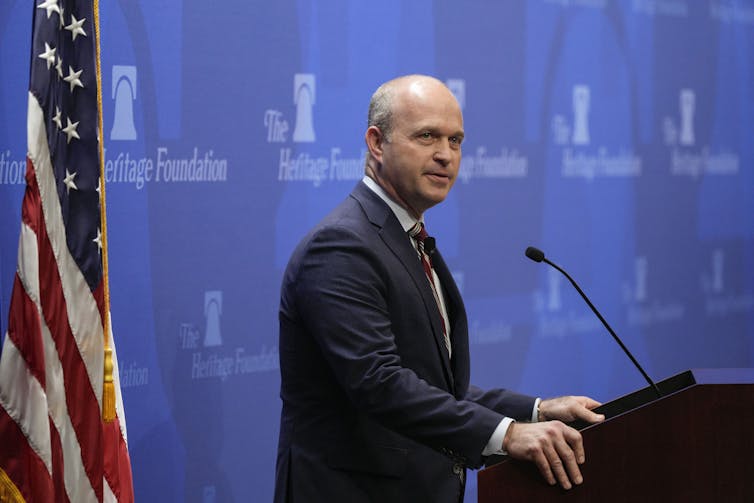
Critics say Carlson gave Fuentes a national platform to advance his antisemitic and white nationalist views. Some conservatives, including President Donald Trump and Heritage Foundation president Kevin Roberts, defended the conversation as necessary to understand a growing segment of the movement.

These reactions may seem incompatible, but both contain slices of the truth. Public debates about extreme views often pull us toward simple binaries – platform or censor, engage or avoid – when the real issue is how the engagement is structured and the purpose it serves.

The current tension raises a broader question that extends beyond any single interview: When does a conversation with someone who holds extreme views illuminate their beliefs, which could serve the public interest, and when might it risk being interpreted as validation?

As a communication scholar who studies how people engage across deep divides, I see this as a question not about whether to interact with individuals who espouse extremist views, but how to structure that engagement and to what end.

Engaging ideas does not mean endorsing

When public figures say they are “just asking questions” or having a “respectful debate,” it’s easy to assume they believe that all conversation is valuable. Indeed, Carlson opened his interview by claiming he is simply “trying to understand” what Fuentes “affirmatively believes.”

In practice, however, the format and tone of an interview do much of the ethical work. Some conversations interrogate ideas. Others normalize them, meaning they make extreme claims sound ordinary or socially acceptable – in other words, treating them as just another position in public debate rather than as views outside widely shared norms. A conversation that presents all viewpoints as morally equivalent risks signaling that even extreme positions belong within normal political discourse.

Kevin Roberts, the president of the Heritage Foundation, defended the interview with Nick Fuentes.
Kevin Roberts, the president of the Heritage Foundation, has defended Carlson’s decision to interview Fuentes, leading to some resignations from Heritage staff and board members.
Jess Rapfogel/AP

This is the concern raised by Carlson’s interview. Fuentes has made a series of claims about Jewish people that mainstream conservatives have rejected for decades. Although Carlson pushed back at one point, saying Fuentes’s views are “against my Christian faith,” the overall tone of polite exchange allowed some listeners to interpret the discussion as a meeting of two legitimate positions rather than as a critical examination of ideas widely understood as bigoted.

Listening is not neutrality

One explanation for these differing interpretations comes from a recent series of experiments showing speakers often confuse “active listening” with agreement. Even when they had maintained eye contact and signaled attention using short phrases like “I see,” listeners who disagreed were consistently judged as worse listeners. Because people tend to assume their own views are correct, they often infer that anyone who disagrees must not have listened well.

This psychological tendency complicates how the public interprets interviews like Carlson’s. Conversations can sound civil while failing to challenge harmful claims, leaving listeners with the mistaken belief that those claims are widely held.

Listeners operating from a humanizing mode attempt to understand the person behind the belief, asking questions such as “When did you first encounter this idea?” or “What was happening in your life at the time?” or “What concerns does this belief address for you?” A decade ago, a Dutch study found that extremist views often grow from fear, misinformation, isolation and a desire for belonging, along with other demographic, personality and social factors. Understanding those roots helps explain how individuals arrive at certain worldviews.

But understanding is not the same as acceptance. Good listening does not have to signal agreement.

Examples of this kind of engagement exist outside politics. Former extremists such as Christian Picciolini, who founded the Free Radicals Project, and musician Daryl Davis, known for building relationships with members of the Ku Klux Klan, have shown that humanizing conversations can help people leave hate groups without normalizing the ideas those groups promote. Their work illustrates that it is possible to confront harmful beliefs while still recognizing the humanity of the people who hold them.

Moving beyond just calling out

The ongoing debate about Carlson and Fuentes also reflects a broader tension in terms of how society responds to harmful speech.

Calling someone out, usually in public, focuses on blame. “Calling someone in,” a term developed by scholar and activist Loretta Ross, emphasizes private accountability and the possibility of correction. In a media setting, this might look like an interviewer saying, “I want to understand what you mean by that claim, because some viewers may hear it as targeting an entire group. Can you clarify how you see the people affected by this?” This approach challenges the idea while signaling curiosity about the speaker’s reasoning.

Nick Fuentes, a white nationalist commentator, appeared at a Donald Trump campaign event in 2020.
Right-wing podcaster Nick Fuentes has had occasional differences with Donald Trump, but the president defended the decision by commentator Tucker Carlson to interview him.
Jacquelyn Martin/AP

A similar approach, described by authors Justin Michael Williams and Shelly Tygielski, is known as “calling forward.” This framework focuses less on correcting a single remark, less on past mistakes and more on future growth by inviting reflection about how a belief fits within a person’s broader values. In practical terms, calling forward means setting clear boundaries around unacceptable beliefs while still recognizing an individual’s potential to change.

Using a “calling forward” approach, Carlson might have followed his mild pushback that Fuentes’s ideas are against his “Christian faith” by exploring how Fuentes understands the tension between his political claims and widely held moral or religious principles.

By stating directly when a claim is false or discriminatory but still allowing the conversation to explore how someone came to that belief, the interview places the idea in a fuller social and psychological context. The emphasis shifts to curiosity paired with accountability, and it can encourage someone to examine the roots and consequences of their beliefs without framing the exchange as a clash between equal positions.

Most people will never interview a national figure or decide whether to put an extremist on camera. Ideally, most of us won’t be faced with the burden of listening to views that question our or others’ humanity.

Even so, each of us likely has a relationship with someone who holds a belief we find troubling. More broadly, families, classrooms and community groups all face moments when someone introduces an idea that others find threatening.

The Carlson–Fuentes interview has become a flash point partly because it forces a public reckoning with a private question: What is the cost of engagement, and what is the cost of refusing it? Understanding that distinction requires paying attention not only to who is invited to speak, but also to how the ways in which we listen fundamentally shape the conversation.

The Conversation

Graham Bodie does not work for, consult, own shares in or receive funding from any company or organization that would benefit from this article, and has disclosed no relevant affiliations beyond their academic appointment.

ref. Shaping the conversation means offering context to extreme ideas, not just a platform – https://theconversation.com/shaping-the-conversation-means-offering-context-to-extreme-ideas-not-just-a-platform-269883

Supreme Court case about ‘crisis pregnancy centers’ highlights debate over truthful advertising standards

Source: The Conversation – USA – By Carly Thomsen, Associate Professor of English and Creative Writing, Rice University

The latest Supreme Court case related to abortion is not technically about the legal right to have one. When the court heard oral arguments on Dec. 2, 2025, the word “abortion” came up only three times. The first instance was more than an hour into the 82-minute hearing.

Instead, First Choice Women’s Resource Centers Inc. v. Platkin hinges on whether First Amendment rights to freedom of speech and association give a chain of five crisis pregnancy centers in New Jersey the right to protect its donor records from disclosure to state authorities. The centers are Christian nonprofits that try to stop pregnant women from obtaining abortions.

There are more than 2,500 of them across the United States.

I’ve done extensive research regarding crisis pregnancy centers, and I’ve written about that work in more than a dozen articles in academic journals, books and the media.

Resembling doctors’ offices in appearance only

Many critics of the centers call them “fake clinics” because the centers appear to be medical facilities when they are not.

Often, their waiting rooms look like those at doctors’ offices, and their volunteers wear white lab coats or medical scrubs. And they offer free services that people think of as medical, such as pregnancy tests and ultrasounds. But these pregnancy tests are typically the same kind that drugstores sell over the counter.

They’re able to function without medical professionals because it’s generally legal in the U.S. to operate ultrasound machines without any specialized training. They ask clients to read their own pregnancy tests so they can avoid laws regarding medical licensing.

Under current law, crisis pregnancy centers don’t need to tell their clients that they are not medical clinics. Nor must they disclose that they don’t provide abortions or birth control.

After California enacted a law that would force the centers to provide their clients with accurate information, the Supreme Court ruled in 2018 that it was unconstitutional.

A person holds an umbrella that reads '#EndTheLies' during a rally outside the Supreme Court.
Supporters of abortion rights rally outside the Supreme Court in 2018, as the court hears a case regarding California’s regulation of crisis pregnancy centers.
AP Photo/Andrew Harnik

The centers also don’t have to tell their clients that they are not bound by the Health Insurance Portability and Accountability Act, or HIPAA, or other patient privacy laws. They don’t have to say that few, if any, members of their staff are licensed medical professionals or that their ultrasounds are not typically intended to diagnose anything.

Crisis pregnancy centers far outnumber the 765 abortion clinics operating across the United States as of 2024 – two years after the Supreme Court allowed states to ban abortion in its Dobbs v. Jackson ruling.

Deceptive by design

The centers’ deceptive tactics appear before clients walk through their doors.

A team of researchers found that 91.3% of crisis pregnancy center websites misleadingly imply that they provide medical services.

In many cases, as I’ve previously explained, these centers are branded confusingly, with names suggesting they are clinics that provide abortions.

Their websites and mobile vans are often emblazoned with medical imagery.

Many operate near abortion clinics, adding to the confusion.

Researchers found that 80% of crisis pregnancy center websites include false information about abortion, including that it is linked to mental health issues, infertility and breast cancer.

All of these claims have been disproved. Many major medical organizations have issued statements to this effect, including the American College of Obstetricians and Gynecologists, the American Psychological Association and the Mayo Clinic.

In response to these concerns, crisis pregnancy centers often reference the goods and services they offer to women in need. But the resources they offer are often slim – far less than what is necessary to care for a baby – and may be contingent on participation in the Christian centers’ classes on parenting and other topics.

First Choice, when asked for comment, said that it “provides women and families free, compassionate care, including ultrasounds, educational resources, baby clothes and food.”

Photo of a storefront location for a place called Problem Pregnancy with a sign outside offering 'free testing and counseling.'
Problem Pregnancy, a crisis pregnancy center located near a Planned Parenthood facility in Worcester, Mass., offers ‘free testing and counseling.’
Pat Greenhouse/The Boston Globe via Getty Images

First Choice’s practices

First Choice, the organization that brought this case, uses many of these tactics.

Four of its five centers in New Jersey are located within one mile of an abortion clinic.

Its homepage includes a photo of a woman dressed like a medical professional, wearing teal scrubs with a stethoscope around her neck.

The chain’s name, First Choice Women’s Resource Center, uses the language of “choice,” which has long been associated with the abortion rights movement.

First Choice’s website suggests that abortion can lead to depression, eating disorders and addiction. It makes claims about the prevalence of what it calls “post-abortion stress disorder,” a nonmedical term used by anti-abortion activists who have sought to falsely frame abortion as if it is something most women regret.

In reality, long-term studies show that 95% of women who have had abortions believe they made the right decision.

State consumer fraud investigation

In November 2023, New Jersey Attorney General Matthew Platkin began investigating First Choice Women’s Resource Center to see whether the nonprofit had violated state consumer fraud laws by misrepresenting its services to clients, donors and the public.

Part of that probe, which was interrupted by the litigation that culminated in this Supreme Court case, included requesting documents about the center’s donors.

The next month, First Choice sued Platkin in federal court.
The lawsuit asserted that the First Amendment protects the privacy of First Choice’s donors.

A district court and appeals and court determined that this case should be heard in state court.

But instead of pursuing the case at the state level, First Choice appealed directly to the Supreme Court, which decided in June 2025 to take the case.

New Jersey’s fraud investigation and the “sweeping subpoena” it issued “may chill First Amendment freedoms,” said attorney Erin Hawley, when she argued the case before the Supreme Court on behalf of First Choice.

Following oral arguments, Platkin released a statement that said “First Choice – a crisis pregnancy center operating in New Jersey – has for years refused to answer questions about its operations in our state and the potential misrepresentations it has been making.”

Analyzing training manuals

Many crisis pregnancy centers like First Choice are affiliated with large networks that provide training materials.

For example, First Choice is affiliated with Heartbeat International, a Christian anti-abortion global network, which says that it has 45,000 active volunteers. Because those volunteers undergo training, I’ve been learning more about the centers by examining the network’s volunteer and staff manuals.

I’ve analyzed nearly 1,600 pages of these materials put together by large anti-abortion networks, including Heartbeat International. Along the way, I’ve tracked medical misinformation and references to confidentiality, privacy and data retention.

These training guides instruct volunteers to highlight the “medical services” their center provides and to omit “Christian language” from their branding and materials.

But the manuals I examined indicate that advancing their religious beliefs, rather than providing health care, is the centers’ primary goal. One manual says, “Heartbeat International is convinced that the loving outreach of a pregnancy center in the name of Jesus Christ is the most valuable ‘service’ provided, no matter what else is on the list of services.”

Heartbeat International’s Talking About Abortion manual includes medical misinformation about the supposed risks of having an abortion, such as cancer and mortality risks. It encourages volunteers to share these claims with clients.

None of that information, which includes official-sounding statistics, is backed by peer-reviewed scientific research.

A sign advertises free pregnancy tests and abortion information outside a building identified as the Woman's Choice Pregnancy Resource Center.
Crisis pregnancy centers, like this one in Charleston, West Va., sometimes have names that suggest they offer abortions, evoking the pro-choice branding of the abortion rights movement.
AP Photo/Leah M. Willingham

Client privacy not protected

Although First Choice sued in part due to concerns about its donors’ privacy, crisis pregnancy centers do not necessarily protect the privacy of the health data they collect from their clients.

The training manuals use the language of HIPAA, referencing the policy itself or its protections of private medical data. At the same time, the manuals inform volunteers that crisis pregnancy centers are “not governed by HIPAA” precisely because they are not medical clinics.

Instead, the manuals make clear that the centers can offer clients the opportunity to request confidentiality. But as stated in Heartbeat International’s Medical Essentials training manual, they “are under no obligation to accept or abide” by that request.

To New Jersey Attorney General Platkin, these kinds of approaches seemed worthy of investigation.

Fewer obstacles ahead?

Should the Supreme Court majority rule in favor of First Choice, I believe states may have more trouble trying to investigate crisis pregnancy centers’ practices, while anti-abortion networks may face even fewer obstacles to their efforts to publicize medical misinformation.

Indeed, Aimee Huber, First Choice’s executive director, has said she hopes other states would “back off” any other efforts to probe crisis pregnancy centers.

But based on my 20 years of experience researching crisis pregnancy centers, I also believe that this case can be helpful for abortion rights supporters because it shows that the crisis pregnancy center industry understands that greater public awareness of its practices may restrict its power.

Heartbeat International did not respond to a request for comment by The Conversation.

The Conversation

Carly Thomsen consults for Reproductive Health and Freedom Watch. She has contributed to the Public Leadership Institute’s policy playbook regarding crisis pregnancy centers and she has testified in support of Vermont’s legislation regulating crisis pregnancy centers.

ref. Supreme Court case about ‘crisis pregnancy centers’ highlights debate over truthful advertising standards – https://theconversation.com/supreme-court-case-about-crisis-pregnancy-centers-highlights-debate-over-truthful-advertising-standards-271254

America faced domestic fascists before and buried that history

Source: The Conversation – USA – By Arlene Stein, Distinguished Professor of Sociology, Rutgers University

Fritz Kuhn, center, is congratulated by fellow officers of the German American Bund in New York on Sept. 3, 1938. AP Photo

Masked officers conduct immigration raids. National Guard troops patrol American cities, and protesters decry their presence as a “fascist takeover.” White supremacists openly proclaim racist and antisemitic views.

Is the United States sliding into fascism? It’s a question that divides a good portion of the country today.

Embracing a belief in American exceptionalism – the idea that America is a unique and morally superior country – some historians suggest that “it can’t happen here,” echoing the satirical title of Sinclair Lewis’ 1935 book about creeping fascism in America. The social conditions required for fascism to take root do not exist in the U.S., these historians say.

Still, while fascist ideas never found a foothold among the majority of Americans, they exerted considerable influence during the period between the first and second world wars. Extremist groups like the Silver Shirts, the Christian Front, the Black Legion and the Ku Klux Klan claimed hundreds of thousands of members. Together they glorified a white Christian nation purified of Jews, Black Americans, immigrants and communists.

During the 1930s and early ’40s, fascist ideas were promoted and cheered on American soil by groups such as the pro-Nazi German American Bund, which staged a mass rally at New York’s Madison Square Garden in February 1939, displaying George Washington’s portrait alongside swastikas.

The Bund also operated lodges, storefronts, summer camps, beer halls and newspapers across the country and denounced the “melting pot.” It encouraged boycotts and street brawls against Jews and leftists and forged links to Germany’s Nazi party.

Yet the Bund and other far-right groups have largely vanished from public memory, even in communities where they once enjoyed popularity. As a sociologist of collective memory and identity, I wanted to know why that is the case.

The Bund in New Jersey

My analysis of hundreds of oral histories of people who grew up in New Jersey in the 1930s and ’40s, where the German American Bund enjoyed a particularly strong presence, suggests that witnesses saw them as insignificant, “un-American” and unworthy of remembrance.

But the people who rallied with the Bund for a white, Christian nation were ordinary citizens. They were mechanics and shopkeepers, churchgoers and small businessmen, and sometimes elected officials. They frequented diners, led PTA meetings and went to church. They were American.

Hundreds of American Nazis walk on a country road.
Nearly 1,000 uniformed men wearing swastika armbands and carrying Nazi banners parade past a reviewing stand in New Jersey on July 18, 1937.
AP Photo

When they were interviewed decades later, many of those who had seen Bundists up close in their communities remembered the uniforms, the swastika armbands, the marching columns. They recalled the local butcher who quietly displayed sympathy for Nazism, the Bund’s boycotts of Jewish businesses, and the street brawls at Bund rallies.

German American interviewees, who remember firsthand the support the Bund enjoyed before the U.S. entered World War II, 50 years later laughed at family members and neighbors who once supported the organization. Even Jewish interviewees who recalled fearful encounters with Bundists during that period tended to minimize the threat in retrospect. Like their German American counterparts, they framed the Bund as deviant and ephemeral. Few believed the group, and the ideas for which it stood, were significant.

I believe the German Americans’ laughter decades after the war was over, and after the revelations of the mass murder of European Jews, may have been a way for them to distance themselves from feelings of shame or discomfort. As cognitive psychologists show, people tend to erase or minimize inconvenient or painful facts that may threaten their sense of self.

Collective memories are also highly selective. They are influenced by the groups – nation, community, family – in which they are members. In other words, the past is always shaped by the needs of the present.

After World War II, for example, some Americans reframed the major threat facing the U.S. as communism. They cast fascism as a defeated foreign evil, while elevating “reds” as the existential threat. Collectively, Americans preferred a simpler national tale: Fascism was “over there.” America was the bulwark of democracy “over here.” This is one way forgetting works.

Communities will remember what they have forgotten or minimized when history is taught, markers are erected, archives are preserved and commemorations are staged. The U.S. has done that for the Holocaust and for the Civil Rights Movement. But when it comes to the history of homegrown fascism, and local resistance to it, few communities have made efforts to preserve this history.

Remembering difficult pasts

At least one community has tried. In Southbury, Connecticut, community members erected a small plaque in 2022 to honor townspeople who in 1937 organized to keep the Bund from building a training camp there. The inscription is simple: “Southbury Stops Nazi Training Camp.”

Mounted police form a line in front of hundreds of people.
New York City mounted police form a line outside Madison Square Garden, where the German American Bund was holding a rally on Feb. 20, 1939.
AP Photo/Murray Becker

The story it tells provides more than an example of local pride – it’s a template for how communities can commemorate the moments when ordinary citizens said “no.”

When Americans insist that “it can’t happen here,” they exempt themselves from vigilance. When they ignore or discount extremism, seeing it as “weird” or “foreign,” they miss how effectively such movements borrowed American idioms, such as patriotism, Christianity and law and order, to further hatred, violence and exclusion.

Research shows that some Americans have been drawn to movements that promise purity, unity and order at the expense of their neighbors’ rights. The point of remembering such histories is not to wallow in shame, nor to collapse every political dispute into “fascism.” It is to offer an accurate account of America’s democratic vulnerabilities.

The Conversation

Arlene Stein does not work for, consult, own shares in or receive funding from any company or organization that would benefit from this article, and has disclosed no relevant affiliations beyond their academic appointment.

ref. America faced domestic fascists before and buried that history – https://theconversation.com/america-faced-domestic-fascists-before-and-buried-that-history-268978

Rising electricity prices and an aging grid challenge the nation as data centers demand more power

Source: The Conversation – USA (2) – By Barbara Kates-Garnick, Professor of Practice in Energy Policy, The Fletcher School, Tufts University

Energy prices are going up – still. zpagistock/Moment via Getty Images

Everyone – politicians and the public – is talking about energy costs. In particular, they’re talking about data centers that drive artificial intelligence systems and their increasing energy demand, electricity costs and strain on the nation’s already overloaded energy grid.

As a former state energy official and utility executive, I know that many of the underlying questions involving energy affordability are very complex and have been festering for decades, in part because of how many groups are involved. Energy projects are expensive and take a long time to build. Where to build them is often also a difficult, even controversial, question. Consumers, regulators, utilities and developers all value energy reliability but have different interests, cost sensitivities and time frames in mind.

The problem of high energy prices is not new, but it is urgent. And it comes at a time when the U.S. is deeply divided on its approaches to energy policy and the politics of solving collective problems.

A person in an elevated bucket works with tools and wires.
To stay reliable, the electricity grid needs long-term investment, not just repairs after storms.
Miguel J. Rodriguez Carrillo/Getty Images

Rising costs

From September 2024 to September 2025, average U.S. residential electricity prices have risen 7.4%, from 16.8 to 18 cents per kilowatt-hour. Government analysts expect prices will continue to rise and outpace inflation in 2026.

With household earnings basically flat when adjusted for inflation, these increases hit consumers hard. They take up higher percentages of household expensesespecially for lower-income households. Electricity prices have effects throughout the economy, both directly on consumers’ budgets and indirectly by raising operating costs for business and industry, which pass them along to customers by raising prices for goods and services.

The problem

By 2030, energy analysts expect U.S. electricity demand to rise about 25%, and McKinsey estimates that data centers’ energy use could nearly triple from current levels by that year, using as much as 11.7% of all electricity in the U.S. – more than double their current share.

The nation’s current electricity grid is not ready to supply all that energy. And even if the electricity could be generated, transmission lines are aging and not up to carrying all that power. Their capacity would need to be expanded by about 60% by 2050.

Orders of key generating equipment often face multiyear delays. And construction of new and expanded transmission lines has been very slow.

A Brattle Group analysis estimates all that new and upgraded equipment could cost between US$760 billion and $1.4 trillion in the next 25 years.

The reasons

The enormous scale of the work needed is a result of a lack of investment over time and delays in the investments that have been made.

For instance, since at least 2011 there has been an effort to bring Canadian hydropower to the New England electricity grid. Political opposition to cutting a path for a transmission line through forestland meant the project was subjected to a statewide referendum in Maine – and then a court case that overturned the referendum results. During those delays, inflation raised the estimated price of the project by half, from $1 billion to $1.5 billion – an added cost that will be paid by Massachusetts electricity customers.

That multiyear effort is just one example of how the vast web of companies that generate power, transmit it from power plants to communities, and distribute it to homes and businesses complicates attempts to make changes to the power grid.

State and federal government agencies have roles in these processes. States’ public utilities commissions oversee the utility companies that distribute power to customers. The Federal Energy Regulatory Commission oversees connections of power generators to the grid and the transmission lines that move electricity across state lines.

Often, those efforts aren’t aligned with each other, leading to delays over jurisdiction and decision-making.

For instance, as new generators prepare to operate, whether they are solar farms or gas-fired power plants, they need permission from FERC to connect to the transmission grid. The commission typically requests technical engineering studies to determine how the project would affect the existing system. Delays in this process increase the timeline and cost of development and postpone adding new capacity to the grid.

The costs

A key question for regulators and consumers alike is who should pay for adding more electricity to the grid and making the system more reliable.

Utilities traditionally charge customers for the costs of generating and delivering power. And it’s not clear how much power the data centers will ultimately require.

Some large data centers have taken to paying to build their own on-site power plants, though often they can supply energy to the grid as well.

In some states, efforts have begun to address public concern about electricity bills. In November 2025, two utility commissioners in Georgia, who had consistently approved electricity rate hikes over the previous two years, were voted out of office in a landslide.

New Jersey’s Gov.-elect Mikie Sherrill has pledged to declare a utility-price emergency and freeze costs for a year.

In New York, Gov. Kathy Hochul has paused implementation of state law, driven by environmental concerns, requiring that all new buildings over seven stories tall only use electricity and not natural gas or other energy sources. Hochul has said that requirement would increase electricity demand too much, raising prices and making the grid less stable.

In Massachusetts, Gov. Maura Healey has filed legislation seeking to provide energy affordability, including eliminating some charges from utility bills, capping bill increases and barring utility companies from charging customers for advertisement costs.

A wind turbine stands near a large group of block-shaped buildings.
Generating more power – from wind, nuclear or other sources – is only part of the potential solution.
Scott Olson/Getty Images

The solutions

Clearly, there are no quick fixes or easy solutions to this complex situation.

However, innovation in regulation, combined with new technologies and even AI itself, may enable creative regulatory and technical solutions. For instance, devices that can be programmed to use energy efficiently, time-sensitive pricing and demand monitoring to smooth out peaks and valleys in electricity use can potentially ease both grid load and customers’ bills. But those solutions will work only if all the players are willing to cooperate.

There are a lot of ideas about how to lower the public’s burden of paying for data centers’ power. New ideas like this need careful scrutiny and possible revisions to ensure they are effective at lowering costs and increasing reliability.

As the country grapples with the effort to upgrade the grid, perform long-deferred maintenance and build new power plants, consumers’ costs are likely to continue to rise, further increasing pressure on Americans. Existing regulations and government oversight may no longer lower electricity costs immediately or help people plan for the rising costs over the long term.

The Conversation

Barbara Kates-Garnick receives funding from

I received funding from the Mass Clean Energy Center through Tufts University for a grant on Offshore wind..
I serve on the board of Resources for the Future

ref. Rising electricity prices and an aging grid challenge the nation as data centers demand more power – https://theconversation.com/rising-electricity-prices-and-an-aging-grid-challenge-the-nation-as-data-centers-demand-more-power-271465

Where the wild things thrive: Finding and protecting nature’s climate change safe havens

Source: The Conversation – USA (2) – By Toni Lyn Morelli, Adjunct Full Professor of Environmental Conservation, UMass Amherst; U.S. Geological Survey

Much wildlife relies on cool streams and lush meadows in the Sierra Nevada. Ron and Patty Thomas/E+ via Getty Images

The idea began in California’s Sierra Nevada, a towering spine of rock and ice where rising temperatures and the decline of snowpack are transforming ecosystems, sometimes with catastrophic consequences for wildlife.

The prairie-doglike Belding’s ground squirrel (Urocitellus beldingi) had been struggling there as the mountain meadows it relies on dry out in years with less snowmelt and more unpredictable weather. At lower elevations, the foothill yellow-legged frog (Rana boylii) was also being hit hard by rising temperatures, because it needs cool, shaded streams to breed and survive.

A ground squirrel with a skinny tail sits up on its back legs.
A Belding’s ground squirrel in the Sierra Nevada.
Toni Lyn Morelli

As we studied these and other species in the Sierra Nevada, we discovered a ray of hope: The effects of warming weren’t uniform.

We were able to locate meadows that are less vulnerable to climate change, where the squirrels would have a better chance of thriving. We also identified streams that would stay cool for the frogs even as the climate heats up. Some are shaded by tree canopy. Others are in valleys with cool air or near deep lakes or springs.

These special areas are what we call climate change refugia.

Identifying these pockets of resilient habitat – a field of research that was inspired by our work with natural resource managers in the Sierra Nevada – is now helping national parks and other public and private land managers to take action to protect these refugia from other threats, including fighting invasive species and pollution and connecting landscapes, giving threatened species their best chance for survival in a changing climate.

An illustration shows protected lakes and glaciers and shaded streams
Examples of climate change refugia.
Toni Lyn Morelli, et al., 2016, PLoS ONE, CC BY

Across the world, from the increasingly fire-prone landscapes of Australia to the glacial ecosystems at the southern tip of Chile, researchers, managers and local communities are working together to find and protect similar climate change refugia that can provide pockets of stability for local species as the planet warms.

A new collection of scientific papers examines some of the most promising examples of climate change refugia conservation. In that collection, over 100 scientists from four continents explain how frogs, trees, ducks and lions stand to benefit when refugia in their habitats are identified and safeguarded.

People walk along a mountain ridge with a glacier in the background.
Chile has been rapidly losing its glaciers as global temperatures rise. Humans and wildlife depend on them for water.
Joaquin Fernandez

Saving songbirds in New England

The study of climate change refugia – places that are buffered from the worst effects of global warming – has grown rapidly in recent years.

In New England, managers at national parks and other protected areas were worried about how species are being affected by changes in climate and habitat. For example, the grasshopper sparrow (Ammodramus savannarum), a little grassland songbird that nests in the open fields in the eastern U.S. and southern Canada, appears to be in trouble.

We studied its habitats and projected that less than 6% of its summer northeastern U.S. range will have the right temperature and precipitation conditions by 2080.

The grasshopper sparrow. American Bird Conservancy

The loss of songbirds is not only a loss of beauty and music. These birds eat insects and are important to the balance of the ecosystem.

The sand plain grasslands that the grasshopper sparrow relies on in the northeastern U.S. are under threat not only from changes in climate but also changes in how people use the land. Public land managers in Montague, Massachusetts, have used burning and mowing to maintain habitat for nesting grasshopper sparrows. That effort also brought back the rare frosted elfin butterfly for the first time in decades.

Protecting Canada’s vast forest ecosystems

In Canada, the climate is warming at about twice the global average, posing a threat to its vast forested landscapes, which face intensifying drought, insect outbreaks and destructive wildfires.

We have been actively mapping refugia in British Columbia, looking for shadier, wetter or more sheltered places that naturally resist the worst effects of climate change.

A young moose and an adult moose run through a meadow.
Forests and wetlands used by moose and other wildlife are becoming more vulnerable to climate change as temperatures rise.
Alexej Sirén, Northeast Wildlife Monitoring Network

The mapping project will help to identify important habitat for wildlife such as moose and caribou. Knowing where these climate change refugia are allows land-use planners and Indigenous communities to protect the most promising habitats from development, resource extraction and other stressors.

British Columbia is undertaking major changes to forest landscape planning in partnership with First Nations and communities.

Lions, giraffes and elephants (oh, my!)

On the sweeping vistas of East Africa, dozens of species interact in hot spots of global biodiversity. Unfortunately, rising temperatures, prolonged drought and shifting seasons are threatening their very existence.

In Tanzania, working with government agencies and conservation groups through past USAID funding, we mapped potential refugia for iconic savanna species including lions, giraffes and elephants. These areas include places that will hold water in drought and remain cooler during heat waves. The iconic Serengeti National Park, home to some of the world’s most famous wildlife, emerged as a key location for climate change refugia.

Giraffe wander among trees with a mountain in the distance.
In East Africa, climate change refugia remain cooler and hold water during droughts. Protecting them can help protect the region’s iconic wildlife.
Toni Lyn Morelli

Combining local knowledge with spatial analysis is helping prioritize areas where big cats, antelope, elephants and the other great beasts of the Serengeti ecosystem can continue to thrive – provided other, nonclimate threats such as habitat loss and overharvesting are kept at bay.

The Tanzanian government has already been working with U.S.-funded partners to identify corridors that can help connect biodiversity hot spots.

Hope for the future

By identifying and protecting the places where species can survive the longest, we can buy crucial decades for ecosystems while conservation efforts are underway and the world takes steps to slow climate change.

Across continents and climates, the message is the same: Amid our rapidly warming world, pockets of resilience remain for now. With careful science and strong partnerships, we can find climate change refugia, protect them and help the wild things continue to thrive.

The Conversation

Toni Lyn Morelli receives funding from U.S. Geological Survey.

Diana Stralberg receives funding from Natural Resources Canada, the Governments of the Northwest Territories and British Columbia, Canada, and the Wilburforce Foundation.

ref. Where the wild things thrive: Finding and protecting nature’s climate change safe havens – https://theconversation.com/where-the-wild-things-thrive-finding-and-protecting-natures-climate-change-safe-havens-270350