The ‘pawprint economy’ is booming – and it offers huge opportunities for tourism

Source: The Conversation – UK – By Lori Hoy, Researcher in Leisure, Tourism, and Hospitality, Leeds Beckett University

New Africa/Shutterstock

Luxury pet pampering packages at hotels, menus with dog-friendly roast dinners and £6,000 animal-friendly charter flights. Pet travel isn’t just a trend, it’s something of a transformation. This is the “pawprint economy” – and it’s booming.

Globally, the pet industry is projected to reach US$500 billion (£375 billion) by 2030, with pet travel services alone expected to be valued at US$5.9 billion by 2034. In the UK, where 60% of households have pets – including roughly 13.5 million dogs – that’s a substantial market.

People travel with their pets for leisure, business, relocation and specialist care. And while some people even travel with horses, cats, birds or other small animals, it’s dogs that dominate the leisure travel surge. For people who enjoy travelling with their pets, the benefits are real for both parties: strengthened bonds, shared experiences and opportunities to build skills and confidence.

But there’s a growing gap between what the industry is offering and what people and pets need. As this market explodes, it’s a good time to ask whether the travel industry is genuinely adapting or just coming up with superficial offerings.

While humans and dogs have travelled together for millennia, today’s growth reflects something distinctly modern: pets are now family members. With 40% of people viewing their dog as their child and nearly half calling them their best friend, dogs occupy a central place in millions of UK homes.

During COVID restrictions, pet acquisition surged globally. Today nearly half of “pet parents” are first timers. The years since COVID emerged have seen an acceleration in the inclusion of pets in leisure life, from dog-friendly cafes to outdoor festivals, paddleboarding and holidays.

Even cost-of-living pressures haven’t dampened this enthusiasm. While 34% of people who have pets have altered their pet-related behaviour due to financial pressures (changing to a cheaper brand of pet food, for example), pet travel continues to grow. UK pet families take an average of two domestic holidays every year with their animals.

Here’s where the disconnect emerges. While providers advertise “pawsecco” and pet spas, research has shown that people prioritise practical care over “extras”.

Studies identify six key attributes that people are looking for: service design (pet-friendly room placement, shared dining), activity support (walking guides, bins), safety, pet-savvy staff, transparent policies with fair fees, and lastly, amenities. This is a low priority for travellers with pets, but often what providers focus on. Crucially, green spaces drive pet travel planning, boosting wellbeing for both human and animal. After all, this is the fundamental reason why people choose to travel with pets.

Love me, love my pet

Yet many people with pets say they don’t believe any accommodation is truly pet friendly, signalling a trust gap. Many properties advertise as “pet friendly” but impose restrictions, surprise fees or go no further than simply allowing pets to stay.

Part of the problem seems to be one-size-fits-all thinking. Research identifies three distinct segments of people travelling with dogs. There are those seeking basic, convenience-focused accommodation. Premium experience seekers are willing to pay for luxury. And activity-loving travellers prioritise outdoor adventures. A chihuahua on a city break has different needs to a labrador on a hiking trip, yet many providers offer generic packages that delight no one.

The evidence from both researchers and industry is clear: people will pay more to travel with their pets. For tourism providers, the opportunities are significant. For example, hotel pet fees in the UK can range from £15-40 daily or £20-75 per stay. Being viewed as pet friendly can drive repeat visits and brand loyalty for travel-related providers and dining outlets.

But there’s one area where UK travellers seem to be less enthusiastic. When it comes to overseas travel, 54% are “very unlikely” to go abroad with their pet (compared to 37% globally). Only 7% actually have plans to do so. This hesitancy is probably driven by complicated, costly regulations and rules.

Eurostar bans pets on its trains and UK aviation regulations effectively prohibit pets in the cabin on inbound flights, with few airlines offering cabin options outbound. Most pets must fly as cargo in the hold, which often causes worry for their humans.

Brexit also ended the UK’s access to the EU pet passport system, requiring expensive animal health certificates for each trip. A 2025 UK-EU agreement will eventually see the reinstatement of pet passports, however.

small light-coloured terrier wearing a lifejacket and standing on a paddleboard out at sea.
The coast is a big draw for sea dogs and their humans.
VideoAir/Shutterstock

The UK dog travel market is heavily skewed towards domestic holidays, with travellers largely preferring coastal retreats and rural escapes, prioritising walks and eating out. This presents clear opportunities for domestic providers to capture demand, and for travellers to choose more environmentally friendly, sustainable destinations closer to home.

The travel industry in the UK and beyond faces a choice: continue offering superficial “pet-friendly” experiences or genuinely adapt and ease the stress for travellers and their pets.

The evidence shows that pet-centric facilities, support with activities, and attentive service outweigh add-ons. Delivering this means providing transparent online information so travellers can assess facilities and policies confidently, designing spaces that genuinely welcome pets, and training staff to deliver a knowledgeable service.

The appetite for pet travel is overwhelming and the pawprint economy represents a huge business opportunity, if accommodation, travel and leisure providers are willing to prioritise genuine pet friendliness. After all, if the hospitality industry makes pets and their people happy, they will come back for more – with smiles and tails wagging.

The Conversation

Lori Hoy does not work for, consult, own shares in or receive funding from any company or organisation that would benefit from this article, and has disclosed no relevant affiliations beyond their academic appointment.

ref. The ‘pawprint economy’ is booming – and it offers huge opportunities for tourism – https://theconversation.com/the-pawprint-economy-is-booming-and-it-offers-huge-opportunities-for-tourism-272287


The climate insurance gap is widening, and it’s leaving marginalized Canadians behind

Source: The Conversation – Canada – By Anne E. Kleffner, Professor, Risk Management and Insurance, University of Calgary

Every year, extreme weather events wreak havoc across Canada, disrupting the lives of tens of thousands. Financial losses from these events have surged, surpassing $7 billion in 2024, due in part to climate change, asset accumulation and more people living in high-risk areas.

Evidence from Canada, the United States and Europe shows that weather-related disasters aren’t experienced equally. The people hardest hit are often those with the fewest resources to cope.

Lower-income and marginalized populations face greater exposure, have fewer resources to prepare or recover and incur a higher proportion of losses not covered by insurance.

Even if they are insured, many people have difficulty covering the deductible because they lack emergency savings. This means damage is not repaired, people live in unsafe or unhealthy conditions and the financial and personal risk of future events is increased.

Insurance helps households recover and can prevent them from falling — or falling deeper — into poverty after a disaster. But across Canada, insurance is becoming costlier and, in some places, harder to get. Between 2019 and 2023, average home insurance premiums rose by 21 per cent overall. For lower-income Canadians, that increase was 40 per cent.

A widening protection gap

Canada’s growing insurance protection gap is a serious concern, and it’s widening at a time when weather-related disasters are becoming more frequent and more severe.

When households are uninsured, losses can strain household budgets and leave people unable to meet their basic needs. As extreme weather escalates, so does the likelihood that more families will find themselves unable to recover.

Affordability is the primary driver of the protection gap, but it is not the only one. Many Canadians do not understand the benefits of insurance, or underestimate the probability and cost of suffering a loss.

Accessibility to insurance is also a challenge, especially in remote areas where it is usually purchased in person. While the growth of digital purchasing channels helps, it is not a solution for those without reliable internet or sufficient digital skills.

Finally, the market itself does not always meet the needs of low-income or otherwise marginalized groups. There is a lack of insurance products designed for these groups, leaving many without the protection they need.

Strengthening community resilience

Better insurance options, stronger investments in mitigation and better support for consumers can help reduce inequities and strengthen resilience.

Community-level mitigation is a good starting point. Land-use planning that steers development away from high-risk areas can prevent future losses. Programs like FireSmart, which reduces wildfire losses, and infrastructure designed for a changing climate also help limit damage as severe weather becomes more frequent.


Read more:
Too little, too late? The devastating consequences of natural disasters must inform building codes


National assessments show that making housing more resilient reduces exposure for lower-income and marginalized households that are more likely to live in older or poorly maintained homes, putting them at greater risk.

While major retrofits can be costly, even small upgrades such as improving drainage, installing backwater valves or fire-resistant materials can help prevent damage. Many municipalities provide targeted subsidies and incentive programs that support these upgrades, particularly for households facing greater financial constraints.

Making hazard information easier to find and understand can also help ensure no one is left behind when disasters strike. Many Canadians lack clear information about the hazards they face and how to prepare for them. Some residents, including newcomers and seniors, may face barriers in accessing or acting upon available information.

Finally, community supports can further strengthen resilience. People with strong social ties and access to community organizations recover more quickly after disasters. Programs that build local networks and support neighbourhood groups can help accomplish this at a relatively low cost.

Closing the protection gap

A critical step in reducing the unequal impacts of weather-related hazards is closing Canada’s insurance protection gap. Microinsurance is one promising solution, and these simplified, low-cost policies can provide basic protection at a fraction of the cost for households that cannot afford traditional coverage.

Embedded tenant insurance — automatically included when renters sign a lease — is another approach that ensures basic coverage.

Digital tools, such as mobile-friendly sign-up platforms and plain-language policy explanations, can reduce barriers for those who struggle with technology.

Public support for income-tested premium subsidies or credits can bring essential coverage within reach for low-income households, while community-based catastrophe insurance — where local governments or community groups arrange coverage on behalf of residents — offers another option.

While Canadians can’t stop extreme weather, we can work together to prevent it from worsening inequality. Increasing awareness, reducing losses, closing insurance gaps and building resilience are key to protecting those at greatest risk.

The Conversation

Derek Cook is the Director of the Canadian Poverty Institute that receives funding from The Co-operators Insurance Company. The Canadian Poverty Institute is also a partner with The Resilience Institute on a collaborative project that is funded by the Canada Mortgage and Housing Company (CMHC).

Mary Kelly has received funding from Finance Canada and the Social Sciences and Humanities Research Council of Canada. She is also on the board of directors of Heartland Mutual Insurance Company.

Anne E. Kleffner does not work for, consult, own shares in or receive funding from any company or organisation that would benefit from this article, and has disclosed no relevant affiliations beyond their academic appointment.

ref. The climate insurance gap is widening, and it’s leaving marginalized Canadians behind – https://theconversation.com/the-climate-insurance-gap-is-widening-and-its-leaving-marginalized-canadians-behind-270417

It’s a Wonderful Life: A Christmas classic that reflects bigoted ideas about ‘proper’ music in the 1940s

Source: The Conversation – Canada – By James Deaville, Professor of Music, Carleton University

The most memorable musical moments in the film are not by film composer Dimitri Tomkin. (Wikimedia)

Hailed by many critics and movie lovers as a “timeless classic” — and ranking first on the American Film Institute’s list of the 100 most inspiring films of all timeIt’s a Wonderful Life (1946) has found a secure place in the hearts of audiences.

Film poster with illustration of man in a suit lifting a woman in a dress in the air.
1946 poster for ‘It’s a Wonderful Life.’
(Wikimedia Commons)

The story revolves around George Bailey, who sacrifices his personal dreams to support the small community of Bedford Falls. When a financial crisis pushes him to the brink of despair, an angel intervenes and reveals what the town’s life would look like had George never been born.

George is confronted with an alternative reality in what the film frames as a foil city, Pottersville. There, he rediscovers the value of his contributions and returns to Bedford Falls renewed, to what some viewers regard as an outpouring of communal generosity and small-town virtue.

Yet part of the film’s appeal can be attributed to its existential themes about the meaning of life.

The movie’s soundtrack — including contributions by Hollywood composer Dimitri Tiomkin — plays a central role in It’s a Wonderful Life, underscoring problems and tensions beneath the surface. Some depictions of music and sound beg analysis around how these reflect racist ideas about “proper” musical, social and community norms.

Film origins

The film began its life as a short story called The Greatest Gift (1939). Film studio RKO bought the story in 1944 and sold it to director Frank Capra’s new company, Liberty Films, in 1945.

Portrait black and white photo of man in shirt and tie.
Director and producer Frank Capra.
(Wikimedia Commons)

A team of writers — including Capra himself — rewrote the script and set to work on getting Jimmy Stewart, earlier cast in two of Capra’s pre-war films, to star.

Just back from serving in the Second World War, Stewart was reluctant, not least because of what was then known as shellshock and is now called post-traumatic stress disorder from his wartime experiences. Capra successfully coaxed Stewart into taking the role.

It’s a Wonderful Life was intended for release in January 1947, but the studio moved up the premiere to Dec. 20 in order to qualify for the 1946 Academy Awards.

The film’s success came after early scrutiny. An FBI agent attended an early screening and found the film undermined the institution of banking and advanced notions of a demoralized public, but the bureau decided not to pursue prosecution.

The fact that the film was neither a financial nor a critical success upon release is well known.

Less often acknowledged is that, owing to a clerical failure to file the necessary copyright renewal, the film slipped into the public domain, ensuring decades of holiday broadcasts that ultimately recast it as a Christmas icon.

Musical score

Black and white photo of man in shirt and tie.
Film composer Dimitri Tiomkin.
(Wikimedia Commons)

Tiomkin had already worked with Capra on several film projects, including Lost Horizon (1937) and Mr. Smith Goes to Washington (1939), as well as providing music for the director’s Why We Fight series (1942-1945).

Capra’s selection of Tiomkin for It’s a Wonderful Life is not surprising, yet little of his score remains in the final film.

Tiomkin had composed a full set of cues, which the movie condenses to about 25-30 minutes in a 130-minute run time. Tiomkin’s original cues bear such titles as “Death Telegram” and “George Is Unborn,” and are available on a 2014 recording consisting of 28 tracks.

Memorable musical moments

However, the most memorable musical moments in the film aren’t Tiomkin’s. Instead, they involve citations of well-known traditional and holiday favourites including Twinkle, Twinkle, Little Star, Auld Lang Syne, Silent Night, Adeste Fidelis as well as the folk song Buffalo Gals,“ arranged by Tiomkin, and the popular jazz composition, The Charleston by James P. Johnson.

The film score emerges as choppy and highly varied, not only because of Capra’s cuts, but also by his tracking in cues from other movies. Alfred Newman’s Hallelujah from the Hunchback of Notre Dame (1939) is heard as George jubilantly runs down the main street of Bedford Falls.

‘It’s a Wonderful Life’ trailer.

The Gregorian chant “Dies Irae” from the 13th century Mass for the Dead is heard when George — on the bridge — changes his mind about dying.

Tiomkin never worked with Capra again.

Race, music and community

A key concerning aspect to the music heard in It’s a Wonderful Life revolves around the portrayal of Black musical forms and practitioners.

Capra’s known racism against Blacks, consistent with racist discourses and practices of the era, is reflected in how jazz and other Black musical forms appear and are framed.

In the iconic Bedford falls dance, the band plays three songs, including
African American pianist and composer Johnson’s “Charleston,” which is performed by a white band.

As American journalism professor Sam Freedman notes in a podcast on whiteness and racism in America, the town features predominantly white citizens apart from a stereotypical depiction of a Black housekeeper in the Bailey family.


Read more:
I am not your nice ‘Mammy’: How racist stereotypes still impact women


The sounds of Pottersville

Music is essential to how the dystopian town, Pottersville, is imagined during George’s manic episode.

There, Black jazz reigns supreme, symbolized by the onscreen performance of unrecognizable music by Meade Lux Lewis, a pioneering and acclaimed composer and boogie woogie pianist.

In the uncredited performance, Lewis is at the keyboard wearing a derby and smoking a stogie. He appears in Nick’s Bar, which the screenwriters describe as “a hard-drinking joint, a honky-tonk … People are lower down and tougher.”

Outside the bar, we hear the fragmented strains of jazz from the dive bar pouring into the town’s main street.

Outside the bar, George bumps into Bedford Falls characters who are, in this alternate setting, destitute and desperate. The quaint main street is overrun by nightclubs and full of bright lights. Through Pottersville, the film projects a sense of moral degradation.

While negatively portraying jazz practised by Black artists, the film simultaneously draws upon and appropriates Black musical forms as necessary and key to popular American life but in a white-controlled version.

Not-so-idyllic Bedford Falls

Despite Capra’s attempt at a happy ending, in the not-so-idyllic Bedford Falls, George is not fully aware of the malicious meddling of a rich, white citizen of Bedford — Henry F. Potter — which catalyzed his financial problems.


Read more:
The dystopian Pottersville in ‘It’s a Wonderful Life’ is starting to feel less like fiction


George awakens from his Pottersville reverie to re-commit to small-town life. While some viewers see the ending as affirming community, the film also keeps George partly ignorant of how the forces of inequity are actually operating in his largely white community.

Maybe we can appreciate the film on a deeper level, when we consider its varied and competing narratives around music, race, class and belonging.

The Conversation

James Deaville receives funding from SSHRC.

ref. It’s a Wonderful Life: A Christmas classic that reflects bigoted ideas about ‘proper’ music in the 1940s – https://theconversation.com/its-a-wonderful-life-a-christmas-classic-that-reflects-bigoted-ideas-about-proper-music-in-the-1940s-270740

Climate misinformation is becoming a national security threat. Canada isn’t ready for it.

Source: The Conversation – Canada – By Sadaf Mehrabi, Postdoctoral Research Associate, Environmental Engineering, Iowa State University

When a crisis strikes, rumours and conspiracy theories often spread faster than emergency officials can respond and issue corrections.

In Canada, social media posts have falsely claimed wildfires were intentionally set, that evacuation orders were government overreach or that smoke maps were being manipulated. In several communities, people delayed leaving because they were unsure which information to trust.

This wasn’t just online noise. It directly shaped how Canadians responded to real danger. When misinformation delays evacuations, fragments compliance or undermines confidence in official warnings, it reduces the state’s ability to protect lives and critical infrastructure.

At that point, misinformation is no longer merely a communications problem, but a national security risk. Emergency response systems depend on public trust to function. When that trust erodes, response capacity weakens and preventable harm increases.

Canada is entering an era where climate misinformation is becoming a public-safety threat. As wildfires, floods and droughts grow more frequent, emergency systems rely on one fragile assumption: that people believe the information they receive. When that assumption fails, the entire chain of crisis communication begins to break down. We are already seeing early signs of that failure.

This dynamic extends far beyond acute disasters. It also affects long-running climate policy and adaptation efforts. When trust in institutions erodes and misinformation becomes easier to absorb than scientific evidence, public support for proactive climate action collapses.

Recent research by colleagues and me on how people perceive droughts shows that members of the public often rely on lived experiences, memories, identity and social and institutional cues — such as environmental concerns, perceived familiarity and trust — to decide whether they are experiencing a drought, even when official information suggests otherwise.

These complex cognitive dynamics create predictable vulnerabilities. Evidence from Canada and abroad documents how false narratives during climate emergencies reduce protective behaviour, amplify confusion and weaken institutional authority.

Tackling misinformation

Canada has invested billions of dollars in physical resiliency, firefighting capacity, flood resiliency and energy reliability. In addition, the Canadian government also recently joined the Global Initiative for Information Integrity on Climate Change to investigate false narratives and strengthen response capacity.

These are much needed steps in the right direction. But Canada still approaches misinformation as secondary rather than a key component of climate-risk management.

That leaves responsibility for effective messaging fragmented across public safety, environment, emergency management and digital policy, with no single entity accountable for monitoring, anticipating or responding to information threats during crises. The cost of this fragmentation is slower response, weaker co-ordination and greater risk to public safety.

Canada also continues to rely heavily on outdated communication mediums like radio, TV and static government websites, while climate misinformation is optimized for the social-media environment. False content often circulates quickly online digitally, with emotional resonance and repetition giving it an advantage over verified information.

Research on misinformation dynamics shows how platforms systematically amplify sensational claims and how false claims travel farther and faster than verified updates.

Governments typically attempt to correct misinformation during emergencies when emotions are high, timelines are compressed and false narratives are already circulating. By then, correction is reactive and often ineffective.

Trust cannot be built in the middle of a crisis. It is long-term public infrastructure that must be maintained through transparency, consistency and modern communication systems before disasters occur.

Proactive preparedness

Canada needs to shift from reactive correction to proactive preparedness. With wildfire season only months ahead, this is the window when preparation matters most. Waiting for the next crisis to expose the same weaknesses is not resilience, but repetition.

We cannot afford another round of reacting under pressure and then reflecting afterwards on steps that should have been taken earlier. That shift requires systemic planning:

  • Proactive public preparedness: Federal and provincial emergency agencies should treat public understanding of alerts, evacuation systems and climate risks as a standing responsibility, not an emergency add-on. This information must be communicated well before disaster strikes, through the platforms people actually use, with clear expectations about where authoritative information will come from.

  • Institutional co-ordination: Responsiblity for tackling climate misinformation currently falls between departments. A federal-provincial co-ordination mechanism, linked to emergency management rather than political communications, would allow early detection of misinformation patterns and faster response, just as meteorological or hydrological risks are monitored today.

  • Partnerships with trusted messengers: Community leaders, educators, health professionals and local organizations often have more credibility than institutions during crises. These relationships should be formalized in emergency planning, not improvised under pressure. During recent wildfires, community-run pages and volunteers were among the most effective at countering false claims.

We cannot eliminate every rumour or every bit of misinformation. But without strengthening public trust and information integrity as core components of climate infrastructure, emergencies will become harder to manage and more dangerous.

Climate resilience is not only about physical systems. It is also about whether people believe the warnings meant to protect them. Canada’s long-term security depends on taking that reality seriously.

The Conversation

Sadaf Mehrabi does not work for, consult, own shares in or receive funding from any company or organisation that would benefit from this article, and has disclosed no relevant affiliations beyond their academic appointment.

ref. Climate misinformation is becoming a national security threat. Canada isn’t ready for it. – https://theconversation.com/climate-misinformation-is-becoming-a-national-security-threat-canada-isnt-ready-for-it-271588

How to protect your well-being, survive the stress of the holiday season and still keep your cheer

Source: The Conversation – Canada – By Joanna Pozzulo, Chancellor’s Professor, Psychology, Carleton University

The holidays can be filled with joy and positive emotion, but they can also be a time when stress is in overdrive. To-do lists can be long, with little time for personal well-being.

Approximately 50 per cent of Canadians report December as being the most stressful month of the year, with women 40 per cent more likely to experience holiday stress due to pressure to manage holiday preparations. Over the holiday season, women report changes in sleep quality, dietary choices and mental health.

Although financial concerns are common over the holiday season, this year a significant number of Canadians are feeling an even greater strain with rising costs and job insecurity. Two-thirds of Canadian parents are concerned about managing costs over the holidays.

People may also experience family strain and conflict over the holidays, giving rise to feelings of loneliness and sadness. Past family dynamics may be triggering and open up old wounds. Changes in family composition may be felt more during the holidays. Grief over loss can also be intensified.

Identifying evidence-based strategies and using them to support your well-being is critical to experiencing the holiday season at its best. For example, writing a to-do list before bed can reduce worry and increase the speed of falling asleep.

Learning to regulate emotional stress

Holidays can increase the intensity of emotions, both positive and negative. Learning about emotional regulation, which involves being able to respond to experiences in adaptive ways, is important.

Cognitive reframing, where you consider the alternative perspectives of a situation, can be a helpful method for reducing the impact of negative emotions.

It requires considering whether there are alternative explanations for a seemingly negative or ambiguous situation. Less offensive interpretations can help regulate negative emotions. In this way, cognitive reframing can reduce stress, improve emotional resilience and help manage anxiety by shifting negative thought patterns into more positive ones.

Sleep matters more during holidays

Approximately 25 per cent of Canadian workers engage in some form of shift work, making healthy sleep habits particularly difficult. With ever-growing to-do lists during the holidays, cutting back on sleep to fit everything in can seem like a good idea.

However, getting sufficient, quality sleep can promote heart health and help with memory and cognitive functioning. It can also lower cortisol levels (a key stress hormone).

Practise good sleep hygiene, defined as a set of habits that promote sound sleep, such as maintaining a consistent sleep schedule and an environment free of distractions.

It can be challenging, but it’s essential to reducing irritability and helping you remember the items on your to-do list.

Eating mindfully amid indulgence

Decadent desserts and specialty treats are usually found in abundance during family gatherings and holiday work parties. Although it may be difficult to always make healthier choices during the holidays, try engaging in mindful eating.

Mindful eating can decrease stress hormones as well as promote self-compassion by reducing the negative judgment around food choices.

Be aware of what you are consuming (and how much) to help you make decisions that are consistent with your longer-term goals.

Disrupted routines and staying active

Physical activity can improve mood, decrease stress and increase energy levels. Engaging in some activity most days can support mental health.

Exercise can have a significant impact on your well-being by increasing serotonin and dopamine, two neurotransmitters that are important for a positive mood. Physical exercise can also improve self-esteem, helping you tackle stressful situations as well as lowering your anxiety levels.

The holidays can disrupt exercise routines, with fewer opportunities for longer workouts. Opt for brief (10-minute) and more frequent workouts (twice a day) to maintain the benefits that physical activity can have on your well-being.

The restorative effect of solitude

Burnout from childcare and eldercare is reported by almost 50 per cent of working mothers.

Finding some time for yourself can seem impossible, even though research demonstrates that spending some time on your own can help recharge your emotional and cognitive batteries. When preparing for busy holiday gatherings, spend some time away from everyone to feel calmer, refreshed and revitalized.

This can help calm your nervous system and recharge your mental capacity for challenges ahead.

Although the optimal amount of alone time each person needs will vary, 15 minutes a day can be restorative. During this “me time,” choose activities that you look forward to, find meaning in and find satisfying (such as reading, knitting or going on a walk.)

Strengthening family and social ties

Approximately two million Canadian seniors aged 65 and older live alone, with almost 20 per cent experiencing loneliness. Good relationships can increase our happiness, health and longevity, which makes the holidays a great opportunity to reconnect with loved ones.

Spending time with others can foster belonging and purpose, which in turn can reduce the body’s inflammation and illness risk.

Family dynamics, however, can be complex. Approximately 34 per cent of Canadians report some sort of family dispute. If relationships are strained, consider keeping the interactions brief.

If connecting with others isn’t possible, short conversations with strangers also can improve well-being. Striking up a conversation while waiting for your coffee order can be help decrease loneliness and improve mood.

Be flexible and manage expectations

Holiday traditions and rituals can be important for our happiness and well-being. They provide a sense of belonging, comfort and joy.

Rituals can also provide a sense of control through predictable actions and behaviour which in turn can help strengthen social bonds.

Consider creating new traditions that are consistent with your current situation to increase wellness. Be sure to manage your expectations for the holidays, however, as others may have different priorities.

By having a flexible mindset — the ability to adapt thinking and behaviour to new information or circumstances — you can reduce stress and decrease disappointment, allowing you to maintain a positive outlook for the holidays.

For more evidence-based books and strategies for the new year, join my Reading for Well-Being Community Book Club. Have a happy and healthy holiday!

The Conversation

Joanna Pozzulo receives funding from the Social Sciences and Humanities Research Council.

ref. How to protect your well-being, survive the stress of the holiday season and still keep your cheer – https://theconversation.com/how-to-protect-your-well-being-survive-the-stress-of-the-holiday-season-and-still-keep-your-cheer-270765

2025’s extreme weather brought intense flash flooding, but no hurricane landfalls in the US – the jet stream is a big reason why

Source: The Conversation – USA (2) – By Shuang-Ye Wu, Professor of Geology and Environmental Geosciences, University of Dayton

The summer of 2025 brought unprecedented flash flooding across the U.S., with the central and eastern regions hit particularly hard. These storms claimed hundreds of lives across Texas, Kentucky and several other states and caused widespread destruction.

At the same time, every hurricane that formed, including the three powerful Category 5 storms, steered clear of the U.S. mainland.

Both scenarios were unusual – and they were largely directed by the polar jet stream.

What is a jet stream?

Jet streams are narrow bands of high-speed winds in the upper troposphere, around four to eight miles (seven to 13 kilometers) above the surface of the Earth, flowing west to east around the entire planet. They form where strong temperature contrasts exist.

Each hemisphere hosts two primary jet streams:

a globe showing the polar and subtropical jet streams in both the Northern and Southern Hemispheres.
The polar and subtropical jet streams in positions similar to much of summer 2025.
NOAA

The polar jet stream is typically found near 50 to 60 degrees latitude, across Canada in the Northern Hemisphere, where cold polar air meets warmer midlatitude air. It plays a major role in modulating weather systems in the midlatitudes, including the continental U.S. With winds up to 200 mph, it’s also the usual steering force that brings those bitter cold storms down from Canada.

The subtropical jet stream is typically closer to 30 degrees latitude, which in the Northern Hemisphere crosses Florida. It follows the boundary between tropical air masses and subtropical air masses. It’s generally the weaker and steadier of the two jet streams.

Illustration shows earth an air circulation cells above it.
A cross section of atmospheric circulations shows where the jet streams exist between large cells of rising and falling air, movements largely driven by solar heating in the tropics.
NOAA

These jet streams act like atmospheric conveyor belts, steering storm systems across continents.

Stronger (faster) jet streams can intensify storm systems, whereas weaker (slower) jet streams can stall storm systems, leading to prolonged rainfall and flooding.

2025’s intense summer of flooding

Most summers, the polar jet stream retreats northward into Canada and weakens considerably, leaving the continental U.S. with calmer weather. When rainstorms pop up, they’re typically caused by localized convection due to uneven heating of the land – picture afternoon pop-up thunderstorms.

During the summer of 2025, however, the polar jet stream shifted unusually far south and steered larger storm systems into the midlatitudes of the U.S. At the same time, the jet stream weakened, with two critical consequences.

First, instead of moving storms quickly eastward, the sluggish jet stream stalled storm systems in place, causing prolonged downpours and flash flooding.

Second, a weak jet stream tends to meander more dramatically. Its broad north-south swings in summer 2025 funneled humid air from the Gulf of Mexico deep into the interior, supplying storm systems with abundant moisture and intensifying rainfall.

Three people in a small boat on a river with a building behind them. The wall is torn off and debris is on the river banks.
Search-and-rescue crews look for survivors in Texas Hill Country after a devastating July 4, 2025, flash flood on the Guadalupe River swept through a girls’ camp, tearing walls off buildings.
Ronaldo Schemidt/AFP via Getty Images

This moisture surge was amplified by unusually warm conditions over the Atlantic and Gulf regions. A warmer ocean evaporates more water, and warmer air holds a greater amount of moisture. As a result, extraordinary levels of atmospheric moisture were directed into storm systems, fueling stronger convection and heavier precipitation.

Finally, the wavy jet stream became locked in place by persistent high-pressure systems, anchoring storm tracks over the same regions. This led to repeated episodes of heavy rainfall and catastrophic flooding across much of the continental U.S. The same behavior can leave other regions facing days of unrelenting heat waves.

The jet stream buffered US in hurricane season

The jet stream also played a role in the 2025 hurricane season.

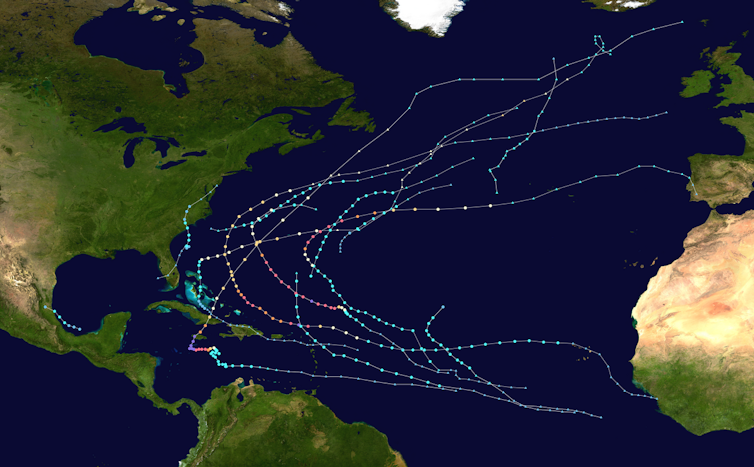
Given its west-to-east wind direction, the southward dip of the jet stream – along with a weak high pressure system over the Atlantic – helped steer all five hurricanes away from the U.S. mainland.

The 2025 Atlantic hurricane season’s storm tracks show how most of the storms steered clear of the U.S. mainland and veered off into the Atlantic.
Sandy14156/Wikimedia Commons

Most of the year’s 13 tropical storms and hurricanes veered off into the Atlantic before even reaching the Caribbean.

An animation shows the direction of steering winds over four days
Charts of high-level steering currents over five days, Oct. 23-27, 2025, show the influences that kept Hurricane Melissa (red dot) in place for several days. The strong curving winds in red are the jet stream, which would help steer Melissa northeastward toward the open Atlantic.
Cooperative Institute for Meteorological Satellite Studies/University of Wisconsin-Madison, CC BY-ND

Climate change plays a role in these shifts

So, how does climate change influence the jet stream?

The strength of jet streams is controlled by the temperature contrast between the equatorial and polar regions.

A higher temperature contrast leads to stronger jet streams. As the planet warms, the Arctic is heating up at more than twice the global average rate, and that is reducing the equator-to-pole temperature difference. As that temperature gradient weakens, jet streams lose their strength and become more prone to stalling.

A chart shows rising temperatures in the Arctic
The Arctic has been warming two times faster than the planetary average.
NOAA Arctic Report Card 2024

This increases the risk of persistent extreme rainfall events.

Weaker jet streams also meander more, producing larger waves and more erratic behavior. This increases the likelihood of unusual shifts, such as the southward swing of the jet stream in the summer of 2025.

A recent study found that amplified planetary waves in the jet streams, which can cause weather systems to stay in place for days or weeks, are occurring three times more frequently than in the 1950s.

What’s ahead?

As the global climate continues to warm, extreme weather events driven by erratic behavior of jet streams are expected to become more common. Combined with additional moisture that warmer oceans and air masses supply, these events will intensify, producing storms that are more frequent and more destructive to societies and ecosystems.

In the short term, the polar jet stream will be shaping the winter ahead. It is most powerful in winter, when it dips southward into the central and even southern U.S., driving frequent storm systems, blizzards and cold air outbreaks.

The Conversation

Shuang-Ye Wu does not work for, consult, own shares in or receive funding from any company or organization that would benefit from this article, and has disclosed no relevant affiliations beyond their academic appointment.

ref. 2025’s extreme weather brought intense flash flooding, but no hurricane landfalls in the US – the jet stream is a big reason why – https://theconversation.com/2025s-extreme-weather-brought-intense-flash-flooding-but-no-hurricane-landfalls-in-the-us-the-jet-stream-is-a-big-reason-why-270641

From truce in the trenches to cocktails at the consulate: How Christmas diplomacy seeks to exploit seasonal goodwill

Source: The Conversation – Global Perspectives – By Andrew Latham, Professor of Political Science, Macalester College

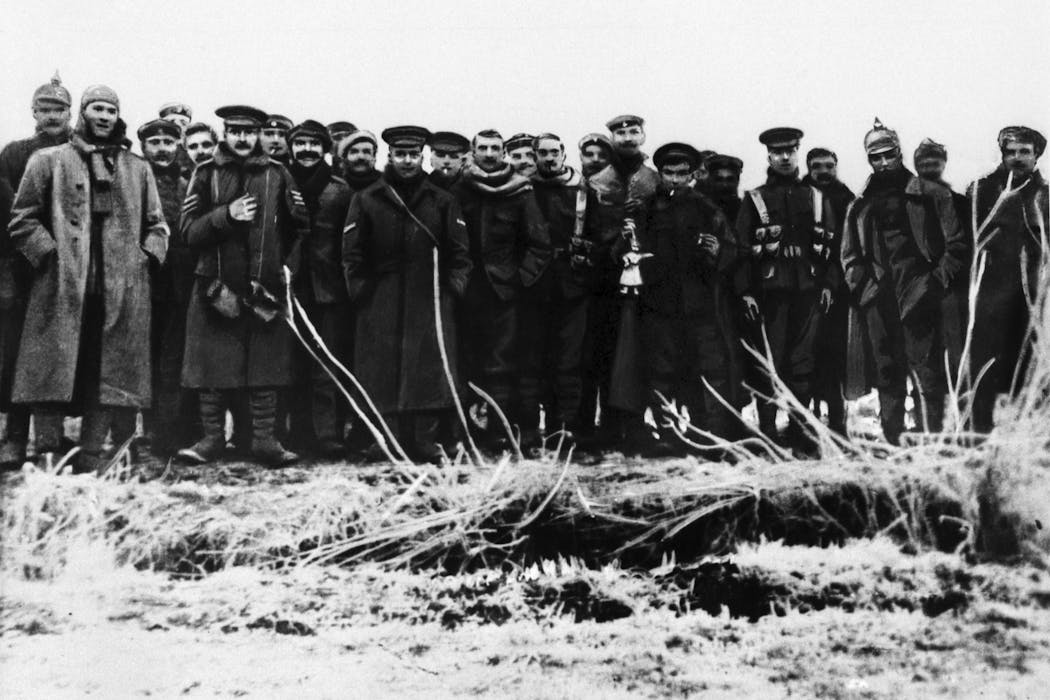
British and German troops observe a temporary truce on Christmas Day 1914. Daily Mirror/Mirrorpix via Getty Images

President Donald Trump is reportedly setting his sights on a Christmas peace deal in the Ukraine-Russia war.

The timing is apt. Every December, political leaders reach instinctively for the language of goodwill. Meanwhile, diplomats the world over use the season to host parties at which gift-giving and booze are used to help foster friendships.

The notion that the holiday season might bring a respite from conflict has deep roots in history. Medieval “Christmas peace” laws in northern Europe at one point punished crimes committed during the season with harsher penalties, enshrining in law a cultural sense of expectation for quiet and restraint.

Finland still reads the Declaration of Christmas Peace each Christmas Eve – a ceremonial reminder of an older hope that violence might briefly ebb.

Today’s “Christmas diplomacy” – that is, a range of statements and efforts to encourage peace and warm relations between nations — updates the tradition for statecraft.

Sometimes, such diplomacy really does open a window for talks. Sometimes it is a cultural reflex. Sometimes it is pure theater. And sometimes, the season’s distractions are exploited for war and violence rather than peace.

The most famous of them all

The Treaty of Ghent that ended the War of 1812 between the United States and Great Britain was signed on Christmas Eve. It was a signal that both sides were ready to convert seasonal sentiment into durable peace.

But the most famous example of the season interrupting conflict is the Christmas Truce of 1914. After months of fighting along parts of the Western Front in World War I, soldiers on opposing sides left the trenches to sing, retrieve the dead and share a moment of humanity before returning to the industrial warfare from which many of them would never return.

This act was repeated during the Battle of the Bulge in World War II, when a small number of American and German soldiers struck a temporary truce in the Hürtgen Forest during Christmas 1944.

People standing around drinking out of cocktail glasses.
Guests enjoy martinis and shots of vodka during a party at the Russian Embassy in Washington in 2007.
Getty Images for Russian Standard

A seasonal opening to dialogue?

More recently, governments and nongovernmental actors have leveraged the holidays to open the door for future peace negotiations.

In Northern Ireland, for example, the Provisional IRA repeatedly declared Christmas ceasefires, most notably in December 1974 when it announced a halt to operations from Dec. 22 through early January. While the truce ultimately collapsed, it reflected a recurring pattern during The Troubles in which Christmas provided a culturally resonant moment to signal openness to dialogue.

A similar logic was observed more recently in Colombia, where in 2022, the National Liberation Army (ELN) declared a unilateral Christmas ceasefire, explicitly tying the pause in hostilities to ongoing peace negotiations with the government.

In both cases, Christmas functioned not as a sentimental interruption to war, but as a strategic moment to legitimize restraint and probe whether diplomacy could bring an end to the underlying conflict.

But as with any temporary ceasefire, Christmas truces can be prone to violations. During the Vietnam War, warring parties in 1971 agreed to a 24-hour Christmas truce. A report from The New York Times the following day included allegations of 19 violations by the Vietcong and 170 by American and South Vietnamese forces.

The holidays can also serve as an opportunity to catch an enemy off guard.

Seven years before the short-lived 1971 Christmas truce, Vietcong fighters chose Christmas Eve to launch an attack on a hotel where U.S. officers were celebrating. Two Americans were killed and 28 were injured.

The Soviet Union launched its 1979 invasion of Afghanistan on Christmas Eve, and Israel’s 2008 Gaza operation began on Dec. 27. The logic here is that in late December, political bandwidth in national capitals is thin, diplomatic machinery moves more slowly and the opportunity for surprise is greater.

‘Tis the season for …

Christmas diplomacy can therefore be used to encourage peace – or war.

It can also be used to deepen existing bilateral friendships.

A well-known example is Norway’s annual donation of Christmas trees to the United Kingdom. The practice began in 1947, when Oslo sent a giant spruce to London’s Trafalgar Square as a thank-you for British support during World War II. It has since become a ritualized expression of common history, shared sacrifice and enduring alliance.

A man and women cut a red ribbon in front of a large tree.
Then foreign secretaries Ine Eriksen Soreide of Norway and Boris Johnson of the U.K. unveil the 2017 Christmas tree gifted by Norway.
Adrian Dennis/AFP via Getty Images

And embassies around the world host Christmas receptions that function as informal diplomatic spaces – occasions where tensions ease, conversations flow more freely and difficult issues can be broached in a more relaxed setting.

These practices do not resolve crises but lay important groundwork for goodwill and access.

Christmas diplomacy endures because it stands at the crossroads of culture, power and politics. The season brings with it a set of expectations about restraint and goodwill that leaders can invoke, diplomats can exploit and adversaries can either honor or abuse.

This article is part of a series explaining foreign policy terms commonly used but rarely explained.

The Conversation

Andrew Latham does not work for, consult, own shares in or receive funding from any company or organization that would benefit from this article, and has disclosed no relevant affiliations beyond their academic appointment.

ref. From truce in the trenches to cocktails at the consulate: How Christmas diplomacy seeks to exploit seasonal goodwill – https://theconversation.com/from-truce-in-the-trenches-to-cocktails-at-the-consulate-how-christmas-diplomacy-seeks-to-exploit-seasonal-goodwill-271478

As DOJ begins to release Epstein files, his many victims deserve more attention than the powerful men in his ‘client list’

Source: The Conversation – USA – By Stephanie A. (Sam) Martin, Frank and Bethine Church Endowed Chair of Public Affairs, Boise State University

Passage of the Epstein Files Transparency Act, backed by many of Epstein’s alleged victims and family members, led the DOJ to begin releasing some of the Epstein files. AP Photo/J. Scott Applewhite

The U.S. Department of Justice has made a partial release of documents from what’s become known collectively as the “Jeffrey Epstein files,” with more to follow at an unspecified time. On a special part of its website that the department titled “Epstein Library,” it lists documents such as court records and records released in response to Freedom of Information Act requests to the government.

Their release was ordered by Congress in bipartisan legislation passed in November 2025. The deadline imposed by Congress was Dec. 19, 2025, and the Department of Justice met it with the partial release of documents in its possession with eight hours to spare.

Those files will be read, dissected and discussed by politicians and the public and reported on by the news media. It will be the latest eruption in a story that has slipped in and out of the headlines for years, but in a very particular way. Most news articles ask a specific question – which powerful men might be on “the list”? Journalists and the public are watching to see what those documents will reveal beyond names we already know, and whether a long-rumored client list will finally materialize.

Headlines in the past have focused on unidentified elites and who may be exposed or embarrassed, rather than on the people whose suffering made the case newsworthy in the first place: the girls and young women Epstein abused and trafficked.

a screenshot of a website that says epstein library
The Justice Department began posting Epstein files late Friday afternoon.
Screenshot of DOJ website

Alongside that, there has been a stream of survivor-centered reporting. Some outlets, including CNN, have regularly featured Epstein survivors and their attorneys reacting to new developments. Those segments are a reminder that another story is available, one that treats the women at the center of the case as sources of understanding, not just as evidence of someone else’s fall from grace.

These coexisting storylines reveal a deeper problem. After the #MeToo movement peaked, the public conversation about sexual violence and the news has clearly shifted. More survivors now speak publicly under their own names, and some outlets have adapted.

Yet long-standing conventions about what counts as news – conflict, scandal, elite people and dramatic turns in a case – still shape which aspects of sexual violence make it into headlines and which stay on the margins.

That tension raises a question: In a case where the law largely permits naming victims of sexual violence, and where some survivors are explicitly asking to be seen, why do journalistic practices so often withhold names or treat victims as secondary to the story?

A “CBS Evening News” story from Dec. 12, 2025, teases the photos revealed by House Democrats of famous men with Jeffrey Epstein.

What the law allows – and why newsrooms rarely do it

The U.S. Supreme Court has repeatedly held that government generally may not punish news organizations for publishing truthful information drawn from public records, even when that information is a rape victim’s name.

When states tried in the 1970s and 1980s to penalize outlets that identified victims using names that had already appeared in court documents or police reports, the court said those punishments violated the First Amendment.

Newsrooms responded by tightening restraint, not loosening it. Under pressure from feminist activists, victim advocates and their own staff, many organizations adopted policies against identifying victims of sexual assault, especially without consent.

Journalism ethics codes now urge reporters to “minimize harm,” be cautious about naming victims of sex crimes, and consider the risk of retraumatization and stigma.

In other words, U.S. law permits what newsroom ethics codes discourage.

How anonymity became the norm and #MeToo complicated it

Anti-rape culture protesters gathered in a crowd.
The anti-rape movement in the U.S. forced newsrooms to revisit assumptions about whose voices should lead a story.
Cory Clark/NurPhoto via Getty Images

For much of the 20th century, rape victims were routinely named in U.S. news coverage – a reflection of unequal gender norms. Victims’ reputations were treated as public property, while men accused of sexual violence were portrayed sympathetically and in detail.

By the 1970s and 1980s, feminist movements drew attention to underreporting and intense stigma. Activists built rape crisis centers and hotlines, documented how rarely sexual assault cases led to prosecution, and argued that if a woman feared seeing her name in the paper, she might never report at all.

Lawmakers passed “rape shield laws” that limited the use of a victim’s sexual history in court. Some states went further by barring publication of victims’ names.

In response to these laws, as well as feminist pressure, most newsrooms by the 1980s moved toward a default rule of not naming victims.

More recently, the #MeToo movement added a turn. Survivors in workplaces, politics and entertainment chose to speak publicly, often under their own names, about serial abuse and institutional cover-ups. Their accounts forced newsrooms to revisit assumptions about whose voices should lead a story.

Yet #MeToo also unfolded within existing journalistic conventions. Investigations tended to focus on high-profile men, spectacular falls from power and moments of reckoning, leaving less space for the quieter, ongoing realities of recovery, legal limbo and community response.

The unintended effects of keeping survivors faceless

There are good reasons for policies against naming victims.

Survivors may face harassment, employment discrimination or danger from abusers if they are identified. For minors, there are additional concerns about long-term digital evidence. In communities where sexual violence carries intense social stigma, anonymity can be a lifeline.

But research on media framing suggests that naming patterns matter. When coverage focuses on the alleged perpetrator as a complex individual – someone with a name, a career and a backstory – while referring to “a victim” or “accusers” in the singular, audiences are more likely to empathize with the suspect and scrutinize the victim’s behavior.

In high-profile cases like Epstein’s, that dynamic intensifies. The powerful men connected to him are named, dissected and speculated about. The survivors, unless they work hard to step forward, remain a blurred mass in the background. Anonymity meant to protect actually flattens their experience. Different stories of grooming, coercion and survival get reduced to a single faceless category.

A window into what we think is ‘news’

That flattening is part of what makes the current moment in the Epstein story so revealing. The suspense is less about whether more victims will be heard and more about what being named will do to influential men. It becomes a story about whose names count as news.

Carefully anonymizing survivors while breathlessly chasing a client list of powerful men unintentionally sends a message about who matters most.

The Epstein scandal, in that framing, is not primarily about what was done to girls and young women over many years, but about who among the elite might be embarrassed, implicated or exposed.

A more survivor-centered journalistic approach would start from a different set of questions, including wondering which survivors have chosen to speak on the record and why, and how news outlets can protect anonymity, when it is asked for, but still convey a victim’s individuality.

Those questions are not only about ethics. They are about news judgment. They ask editors and reporters to consider whether the most important part of a story like Epstein’s is the next famous name to drop or the ongoing lives of the people whose abuse made that name newsworthy at all.

This is an update to a story originally published on Dec. 15, 2025, to reflect the release of documents by the U.S. Department of Justice on Dec. 19.

The Conversation

Stephanie A. (Sam) Martin does not work for, consult, own shares in or receive funding from any company or organization that would benefit from this article, and has disclosed no relevant affiliations beyond their academic appointment.

ref. As DOJ begins to release Epstein files, his many victims deserve more attention than the powerful men in his ‘client list’ – https://theconversation.com/as-doj-begins-to-release-epstein-files-his-many-victims-deserve-more-attention-than-the-powerful-men-in-his-client-list-272414

How to reduce gift-giving stress with your kids – a child psychologist’s tips for making magic and avoiding tears

Source: The Conversation – USA (2) – By Angela J. Narayan, Associate Professor, Clinical Child Psychology Ph.D. program, University of Denver

’Tis the season … for gift-buying stress. Photo by Ryan Miller/Invision/AP

As a child, I loved being the center of attention. So it was a problem when my baby brother was born a day before my birthday. For years, I would beg my parents for a birthday gift “one day early.” My laid-back brother remembers thinking, “I don’t care about presents. Just give her mine!”

As an associate professor and child psychologist at the University of Denver who studies child development and parenting, I’ve come to learn about these types of challenges associated with gift giving. The holidays, while a magical time, can also be stressful. Society places an expectation on parents to buy gifts, regardless of their financial circumstances, and children themselves often feel a variety of complex emotions.

How children react to getting presents is partially linked to temperament, which is the variety of ways that children experience, perceive and interact with the world. Temperament is the precursor to personality – some people are introverts, while others are extroverts. Temperament is partially heritable. That means an introverted parent who feels social pressure to buy many gifts for their shy and easily overwhelmed child may be inadvertently causing stress.

Faced with this holiday conundrum, I’m often asked questions like “Is there a magic number of gifts to give my kids?” or “What gifts will hold my child’s attention the longest?”

While there isn’t an easy answer to either question, these tips and tricks can help parents be more thoughtful and intentional about gift giving, especially for children who are young.

The age rule

Young children cannot focus on a lot of things at once. A good rule of thumb is that a 1-year-old can focus only on one thing at a time. A 2-year-old can maybe focus on two things at most, and a 3-year-old maybe three things, and so on. Stop at five. Very few children actually need more than five gifts, so feel free to go lower.

The attention rule

I have often searched for the magical gift that will keep my children occupied for hours, and so far I haven’t found it. What I have found is that my children – ages 5 and 7 – get excited about the things that I get excited about. So I try to buy things that I think are fun. Ask yourself what you would like to play with if you got to be a child again. I bet your children would be eager to join you in those things.

The games rule

Card and board games are great gifts, often inexpensive, fun for many ages – excepting babies, of course – and capable of holding attention for a long time. Plus, they usually don’t take up much storage space. I love giving my kids games that are not only fun but also teach them helpful skills.

Collaborative games for preschoolers and early school-age children like the Fairy Game and Outfoxed teach problem-solving, teamwork and early reasoning skills. Games for elementary-age children, such as Sorry and Battleship, teach kids how to manage difficult situations, like not always being in the lead, being a good sport even if you’re behind, and losing gracefully.

Timeless card games like Uno and Memory, and newer ones like Sleeping Queens and Exploding Kittens, are great for using working memory, thinking flexibly, persisting and strategizing. Most importantly, playing games together supports positive family time, which is an excellent antidote to stress, bad moods or boredom.

The pressure rule

Imagine the holiday experience through the eyes of each of your children. Some children relish receiving gifts, like I did. Others, however, may feel self-conscious, overwhelmed by the sensory overload – all the textures, commotion and bright colors, not to mention people staring at them. The elements of surprise combined with the unspoken social pressure to be gracious and well regulated are challenging for any young child.

We expect small children to contain their excitement, delay gratification and react positively to the surprise. And then come up with a polite response. These are all complex requests, rarely directly or explicitly taught. It’s no wonder that many children show negative emotions, have tantrums, or even just say, “I’m tired!” during holiday celebrations.

That’s why beyond the precise nature of “the perfect gift,” we shouldn’t lose sight of what we should be doing. And that is investing in togetherness and helping kids learn skills like being patient and taking turns, strengthening memory capacities, planning ahead, not giving up, and that being a team player will pay off later. These skills pave the way for longer sustained attention, focus and concentration, as well as confidence.

My 7-year-old is becoming a skillful chess player because we have taught him the rules and strategy and helped him practice. Maybe this is the real magical gift – not the purchase itself, but the decision to invest in time with your child early.

The Conversation

Angela J. Narayan receives funding from the National Academy of Medicine and the American Psychological Association.

ref. How to reduce gift-giving stress with your kids – a child psychologist’s tips for making magic and avoiding tears – https://theconversation.com/how-to-reduce-gift-giving-stress-with-your-kids-a-child-psychologists-tips-for-making-magic-and-avoiding-tears-272201

Why you should spend more time with a dog this Christmas

Source: The Conversation – UK – By Panagiota Tragantzopoulou, Visiting Lecturer, University of Westminster

Bogdan Sonjachnyj/Shutterstock

As daylight shortens and routines slow down, many people experience a
dip in mood and motivation. The run-up to Christmas is marketed as joyful, but for a large number of households it brings family strain and a surprising amount of loneliness. Against this backdrop, it’s no wonder the idea of welcoming a dog into the home feels appealing.

One of the most consistent findings in human–animal studies is that dogs often act as emotional stabilisers. In my 2025 study, pet owners described a sense of companionship that feels different from human relationships. They talked about dogs as warm presences that offer routine, purpose and a steady emotional tone at home.

Many participants said that when a dog is present, expressing emotions becomes easier – whether that is joy, frustration or sadness. Simply having another living being nearby, responding without judgment, can make difficult moments feel more manageable.

These needs often intensify during winter. For many people, this period makes them think about who isn’t present as much as who is. Although a dog cannot replace human relationships, a companion animal can make emotional fluctuations less dramatic. For someone dealing with a difficult December, a dog can provide steadiness during what can otherwise be an emotionally uneven month.

This helps explain the growing popularity of initiatives such as animal-assisted therapy programmes and puppy yoga sessions, where participants interact with dogs that are not their own. Research suggests that even brief contact with unfamiliar or therapy dogs can reduce stress and improve mood, indicating that the psychological benefits of canine interaction do not depend on ownership.

Some studies also suggest that dogs may be particularly effective in buffering stress compared with other companion animals, possibly because of their responsiveness to human social cues. Although these experiences are not a substitute for long-term companionship, they may offer moments of calm, connection and routine.

For people unable or unwilling to commit to dog ownership, lighter forms of contact, such as fostering for a local shelter, walking a friend’s dog or volunteering with rescue organisations, may still provide psychological benefits.

Dogs and social support

During the COVID lockdowns, people who felt strongly bonded to their dogs often reported higher levels of perceived social support. While the dog wasn’t solving practical problems, this relationship appeared to soften feelings of isolation at a time when normal social life was disrupted.

Although the circumstances were very specific, this finding has wider relevance. Many people spend long stretches at home over the Christmas period, sometimes largely alone or without regular social contact. In such situations, having a dog nearby can offer a sense of companionship during what might otherwise be extended periods indoors.

Research shows that dog owners often experience short social encounters while out walking: brief greetings from neighbours, light conversation with other dog owners, or acknowledgement from passersby. These interactions are usually quick, but they can help maintain a sense of belonging during winter, when daylight is short and social activity naturally slows.

Not every owner will have the same experience, and caring for a dog requires time, energy and resources. Even so, for some households, the presence of a dog can make the winter months feel less isolating than they might otherwise be.

Small terrier dog in living room decorated for Christmas
Better company than bickering relatives?
Eva Blanco/Shutterstock

Everyday connection

The emotional benefits of companion animals may be particularly relevant for older
adults, many of whom live alone. Loneliness in later life is associated with higher risks of depression, cognitive decline and cardiovascular disease. Here, companion animals can play a modest but important role. Everyday routines such as feeding, grooming and going outdoors with a dog provide structure to the day and encourage gentle physical activity.

Even short outings can increase light exposure and offer low-pressure
opportunities for social contact – two elements known to support wellbeing in later life. Exposure to natural daylight plays a key role in regulating circadian rhythms, which influence sleep, mood and energy levels.

Outdoor light is more intense than typical indoor lighting, even on overcast days, and is more effective at signalling to the brain when to be alert and when to rest. In adults, reduced daylight exposure is associated with sleep disruption and lower mood, particularly during winter months when days are shorter.

Being greeted at the door or having a dog settle beside the armchair does not replace human company, but it can provide a daily sense of being noticed and needed. Some studies suggest that interacting with a familiar dog can help regulate stress and promote feelings of calm. While these effects should not be overstated, they help explain why many older adults describe their animals as central to their emotional wellbeing.

But research also indicates there is an important caveat: emotional benefits are most likely to grow out of stable, long-term relationships. When dogs are adopted impulsively, that foundation may never develop.

Puppies require training, patience – and early-morning wake-ups. Adult dogs may come with behavioural histories that take time to understand. And all dogs bring financial responsibilities, from vet bills to insurance and food, that continue long after decorations are packed away. These realities are often overlooked in the excitement of December.

But for those prepared to take on the responsibility, a dog can offer far more than a fleeting festive moment. It can provide years of connection and companionship long after the Christmas lights fade.

The Conversation

Panagiota Tragantzopoulou does not work for, consult, own shares in or receive funding from any company or organisation that would benefit from this article, and has disclosed no relevant affiliations beyond their academic appointment.

ref. Why you should spend more time with a dog this Christmas – https://theconversation.com/why-you-should-spend-more-time-with-a-dog-this-christmas-272090