Friday essay: ‘epic fury’ – the men of MAGA might be the most emotional US leaders ever

Source: The Conversation – Global Perspectives – By Natalie Kon-yu, Associate Professor, Creative Writing and Literary Studies, Victoria University

In 2016 and again in 2024, Donald Trump ran against two supremely qualified presidential candidates, who both lost. Both had decades of service to government and high-ranking jobs within Democratic administrations. Both were women.

Hillary Clinton and Kamala Harris’ losses have prompted a thousand think pieces on whether or not the United States is ready to elect a female president. The old adage, dating back to the Cold War, is that women are too emotional to be trusted with the nuclear button.

But the men in the current White House might be the most emotional leadership group the US has ever had. And while their outbursts often seem spontaneous and even silly, we should take them seriously.

War and fury

Trump chronicler Michael Wolff shared his belief this week that “nothing” Trump says is ever “related to meaning” but it’s “all related to what he is feeling” – which, he says, informs Trump’s behaviour around the Iran war. The Daily Beast, which reported Wolff’s comments, approached the White House for comment.

Communications director Steven Cheung responded by calling Wolff “a lying sack of s–t” who has “been proven to be a fraud”. (Wolff has been criticised for his casual approach to fact-checking, including in his Trump biography.) Cheung continued:

He routinely fabricates stories originating from his sick and warped imagination, only possible because he has a severe and debilitating case of Trump Derangement Syndrome that has rotted his peanut-sized brain.

This in itself is unusually emotional (and colloquial) language for an official White House communication, but is not surprising in the era of Trump 2.0.

From “I HATE TAYLOR SWIFT!” to the president’s many legal suits against those who have wronged him and his apparent need for his name to be on buildings – including the former Kennedy Center for the Performing Arts – big feelings are on full display in the era of Donald Trump.

Those big feelings are also reflected in the Trump administration’s policies. What is ICE but an agency dedicated to the irrational fear of foreigners? Greed, envy, anger, lust, fear: they are all on constant display in Trump’s White House. They come from his chief of staff Stephen Miller, former DOGE head Elon Musk, Hegseth and Vice President JD Vance.

Even the name for the current war on Iran, Operation Epic Fury, is emotional. Compare it to the names of the initial wars on Afghanistan (Operation Enduring Freedom) and Iraq (Operation Iraqi Freedom).

This comes after Trump renamed the Department of Defense to the Department of War last year, to make it sound more aggressive. “Maximum lethality, not tepid legality,” Hegseth said of the change, which is reflected in his language about Iran this week:

Death and destruction from the sky all day long […] This was never meant to be a fair fight, and it is not a fair fight. We are punching them while they’re down, which is exactly how it should be.

Fear, anger and MAGA

Sociology professor Thomas Henricks explains how fear, a negative emotion “that feels bad to possess”, is often converted to anger, “an emotion that restores agency, direction, and self-esteem”.

Sociologist Arlie Russell Hochschild has long focused her research on feelings. She was studying MAGA supporters before they had a name. For her latest book, she looked at how shame and pride motivated this cohort in Kentucky. Many of those she spoke to “saw Trump as a bully — but a bully who stood up for them, against what they perceived as urban liberal elites”.

Giving loyalty to a dynamic leader, writes Henricks, can seem “the surest route to regaining” personal power that feels like it is “slipping away”.

English professor Lauren Berlant believes Trump supporters are attracted to the president’s performance of freedom, through saying whatever he feels. When expression is policed in the name of civil rights and feminism, she observes, it rejects “what feels like people’s spontaneous, ingrained responses”.

But the “Trump Emotion Machine” delivers “feeling ok” and “acting free”. It means “being ok with one’s internal noise, and saying it, and demanding that it matter”.

Gender and emotion

For centuries, political philosophy has noted that much social power is “affective”, relating to moods, feelings and attitudes. Whatever you think of Trump, his policy and style make him exactly the kind of case study political affect theorists have been waiting for.

He is the most conspicuous proponent yet of what we call aesthetarchy – or rule by feelings.

Many feminists and other writers have critiqued the gendered inequity of displays of emotion. Explaining the politics of sex roles, feminist philosopher Marilyn Frye says we all internalise and monitor ourselves to adapt to outside expectations – or “the needs and tastes and tyrannies of others”.

For example, “women’s cramped postures and attenuated strides and men’s restraint of emotional self-expression (except for anger)”.

The crying man was once mocked as womanly and the athletic or politically powerful woman was seen as manly. Both transgressions maintain positive valuations of the masculine and negative valuations of the feminine. Sex roles were once a stronger form of control than they are now.

Yet in MAGA, we have something different happening.

Tantrums and explosions: MAGA men

Hegseth has been criticised, even ridiculed by some media outlets, for his emotional outbursts in media briefings. A Pentagon briefing on US strikes on Iran last June, during which he lashed out at reporters, was labelled a “tantrum” by The Daily Beast.

Miller, too, has been criticised for on-air “temper tantrums”. Insiders revealed his daily conference calls “routinely descend into him loudly berating staff and launching into full-on meltdowns”.

Vance, who made headlines for leading a verbal attack on Ukranian president Volodymyr Zelensky at the White House last year, wrote in his memoir about his struggles to control his anger: “Even at my best, I’m a delayed explosion.”

It is hard to imagine Democrat women getting away with such behaviour. Just this week, Fox News titled an article: “Hillary Clinton storms out of Epstein deposition after House lawmaker leaks photo from inside.” It described a “stunning moment” when Clinton was made aware of the fact that Colorado congresswoman Lauren Boebert violated House rules by taking and sending a photo of her during her deposition.

Caricatures of femininity: MAGA women

What about the women of MAGA? How does emotion drive their involvement?

In 1983, Andrea Dworkin published Right-Wing Women, a confronting study of Republican women’s active participation in conservative politics in the US. She proposed that right-wing activist women submit to men and the patriarchy in exchange for structure to their lives: shelter, safety, rules and love from men.

As these rewards are conditional on their ongoing obedience to men, right-wing activist women become not just complicit, but enthusiastic perpetrators of violence and discrimination against other women.

What motivates the trade? Fear of vulnerability to men and male violence, which they believe naturally finds a target in “an independent woman”.

The “hates” Dworkin documents are just as relevant now, more than 40 years later: anti-abortion, antisemitism, homophobia, anti-feminism, disregard for female poverty, and more. The tirades of White House press secretary Karoline Leavitt against diversity, equity and inclusion are prime examples of a woman attacking feminine solidarity to strengthen her quest for power.

MAGA women can be emotional – but we only see them unleashing emotions that serve the needs of the most powerful men.

Instead of embodying soft emotions such as empathy, care and kindness (like New Zealand’s former prime minister Jacinda Adern), the women of MAGA strive to be as tough as the men in their administration.

Look at Kristi Noem, who was secretary of homeland security – until she was ousted last week. A new book reports Trump saw Noem’s pre-election admission of shooting her own dog as a reason to appoint her to implement his mass-deportation agenda.

And she did play this hard-nosed role. She responded to the murders of mother Renee Nicole Good and intensive care nurse Alex Pretti by ICE agents by saying the victims were involved in “domestic terrorism”.

MAGA women often nod to conventional femininity with their hyper-feminine looks. Both Noem and Leavitt have been described as having what commentators dub “Mar-a-Lago Face”. This “caricature of femininity”, often achieved through surgery, Botox or fillers, not only signals wealth, but is a form of submission.

“The unspoken message Mar-a-Lago face gives to men in power,” HuffPost reporter Brittany Wong suggests, “is that the woman is willing to tear into their flesh and change their entire individual appearance to gain approval.” (Admittedly, a few men, such as Matt Gaetz, have also been accused of having Mar-a-Lago face: a masculine, rather than feminine, caricature.)

Yet, as we have seen, power for MAGA women is always conditional. Noem’s “toughness” was not enough to save her. Many possible reasons have been cited for Noem’s firing, including the US$220 million advertising campaign for ICE featuring her on horseback, and alleged misuse of public funds.

But she is not the first administration official to be accused of such things – or incompetence. Remember when Hegseth accidentally sent a top-secret group chat detailing an upcoming US strike to a journalist? He still has his job.

Macho sensitivity

Men’s anger, lust or avarice has often been rationalised as acceptable or inevitable on a gendered basis. Women’s emotional outbursts were long labelled hysterical.

But on Truth Social, X and other MAGA forums, emotional outbursts no longer need rational underpinning to be positively valued. They can be seen as perfectly masculine. As Berlant says, unleashed emotion by MAGA types on social media is seen as anti-political-correctness: “being ok with one’s internal noise, and saying it, and demanding that it matter”.

Trump’s actions, such as his threat to sue comedian Trevor Noah for a joke at the Grammys, are seen as another example of strongly anti-woke, pro-white leadership, rather than thin-skinned emotional hysteria. So is Trump calling Robert De Niro “another sick and demented person with, I believe, an extremely Low IQ” last month, in response to the actor calling him an “idiot”.

Behind the machismo there is a strange vulnerabilty, a heightened sensitivity to the slightest criticism or perceived threat to the white, male order.

Last month, Daily Show host Jon Stewart pointed out the hypocrisy, after MAGA complaints about Bad Bunny performing in Spanish at the Super Bowl. “When did the right become such fucking pussies?” he said. “Remember 2017? Remember what you hated about liberals? Perpetually offended, safe spaces, censoring free speech, culture of victimhood. Remind you of anyone?”

In some ways, perhaps this public outpouring of emotion from the predominantly white men in Trump’s government should not be surprising. A former high-school acquaintance of Miller told Vanity Fair that, even as a student, he was “all about this victimhood idea, that he was this lonely soldier crusading”.

The rise of the alt-right, which contributed to Trump’s arrival in office, coalesced through movements such as GamerGate: the online social harassment campaign against female video-game journalists by predominantly white men on 4chan, who felt both victimised and infuriated by calls for more inclusive casts in video games.

Stewing in the same digital sewers were the incels: single men who consider themselves hard-done by women who have not deigned to have sex with them. The number of lives this cohort has claimed through violent attacks is comparable to those killed by Islamic State terrorists in the same period. They are particularly known for their appetite for violence.

These acts are, in part, fuelled by the irreconcilable shame and humiliation they feel at the wounding of their masculinity, along with a desire for retribution against women and any men who provoke their jealousy.

Trump’s administration, and indeed his own emotionally volatile behaviour, validates these hurt feelings through his slashing of funding support for diversity and inclusion initiatives, and violent roundups of people deemed “un-American” — even some US citizens. In this way, the current administration is a GamerGate fantasy brought to life.

Power through feeling

Political philosophy tells us social power often manifests primarily through aesthetics, or how things feel, rather than logic. The rise of totalitarianism in Europe during the 1920s and ‘30s motivated many journalists and commentators to pay close attention to this problem. Much of the work was published after 1945, some of it posthumously, by well-known writers such as Hannah Arendt, George Orwell, Primo Levi and Simone Weil.

Emotions – particularly anger and fear – are classic tools used by authoritarian leaders. But anger can work the other way, too. Political science professor Bryn Rosenfeld argues it can power action against repressive regimes, fuelling resistance and encouraging risk.

Either way, Trump’s electoral success and political power – helped by his supporters’ deep emotional identification with him – show that the philosophers are onto something important.

The Conversation

Emily Booth receives funding from the Advanced Strategic Capabilities Accelerator.

Michael Burke, Natalie Kon-yu, and Tom Clark do not work for, consult, own shares in or receive funding from any company or organisation that would benefit from this article, and have disclosed no relevant affiliations beyond their academic appointment.

ref. Friday essay: ‘epic fury’ – the men of MAGA might be the most emotional US leaders ever – https://theconversation.com/friday-essay-epic-fury-the-men-of-maga-might-be-the-most-emotional-us-leaders-ever-277227

When GPS lies at sea: How electronic warfare is threatening ships and their crews

Source: The Conversation – USA – By Anna Raymaker, Ph.D. Candidate in Electrical and Computer Engineering, Georgia Institute of Technology

Cyberattacks like GPS spoofing threaten oil supertankers and cargo ships at sea. Ping Shu/Moment via Getty Images

The war in Iran has dominated headlines with reports of airstrikes and escalating military activity. But beyond the immediate devastation, the conflict has also illuminated a quieter and rapidly growing danger: the vulnerability of ships, and the people who operate them, to disruption of their navigation systems.

Modern shipping depends heavily on GPS satellite navigation. When those signals are disrupted or manipulated, ships can suddenly appear to their navigators and to other ships to be somewhere they are not. In some cases, vessels have been shown jumping across maps, drifting miles inland or appearing to circle in impossible patterns. The risk is even higher in war zones, where ships could be misdirected into harm’s way.

As a cybersecurity researcher studying critical infrastructure and maritime systems, I investigate how digital threats affect ships and the people who operate them.

To understand the threat from GPS disruptions, it helps to first understand how GPS works. GPS systems determine location using signals from satellites orbiting Earth. A receiver calculates its position by measuring how long those signals take to arrive. Because those signals are extremely weak by the time they reach Earth, they are relatively easy to disrupt.

GPS jamming and spoofing

In GPS jamming, an attacker blocks the real satellite signals by overwhelming them with electromagnetic noise so receivers cannot detect them. When this happens, navigation systems lose their position. On a phone, it might look like the map freezing or jumping erratically.

GPS spoofing is more sophisticated. Instead of blocking signals, an attacker transmits fake satellite signals designed to mimic the real ones. The receiver accepts these signals and gives a false location. Imagine driving north while your navigation system suddenly insists you are traveling south. The receiver is not malfunctioning; it has simply been tricked.

a map showing numerous red dots and three red circles
Circular loops in the Black Sea show spoofed ship positions recorded in January 2025. The red points represent false GPS locations broadcast during spoofing events, making vessels appear to move in perfect circles on tracking maps even though they were actually hundreds of miles away. These disruptions are widely believed to be linked to electronic interference in the region during the war in Ukraine. Image created with data from Spire Global.
Anne Raymaker

For mariners at sea, spoofing can have serious consequences. In the open ocean, there are few landmarks to verify a ship’s position if GPS behaves strangely. Nearshore, the margin for error disappears: Water depths change quickly and hazards are everywhere, especially in narrow routes like the Strait of Hormuz near Iran, where reports indicate that GPS spoofing has been happening since the outbreak of the war. Because ships are large and slow to maneuver, even small navigation errors can lead to groundings or collisions.

Red Sea grounding

One example came in May 2025. While transiting the Red Sea, the container ship MSC Antonia began showing positions far from its true location. To navigators onboard, this looked like they had jumped hundreds of miles south on the map and started moving in a new direction. This caused the crew to become disoriented, and the ship eventually ran aground. The grounding caused millions of dollars in damage and required a salvage operation that lasted over five weeks.

two copies of a map side-by-side showing a body of water
MSC Antonia route comparison showing the vessel’s true route and grounding point, left, versus the spoofed route, right. The red and black lines on the right show the spoofed locations where the ship appeared to suddenly jump to on GPS. These lines confused the navigators and caused them to run aground. Images created with data from VT Explorer.
Anne Raymaker

Incidents like the MSC Antonia are not isolated. Vessel-tracking data has revealed clusters of ships suddenly appearing in impossible locations, sometimes far inland or moving in perfect circles. These anomalies are increasingly linked to GPS spoofing in regions experiencing geopolitical conflict.

But GPS interference is only one type of cyber threat facing ships. Industry reports have documented ransomware attacks on shipping companies, supply chain compromises and increasing concern about the security of onboard control systems, including engines, propulsion and navigation equipment. As ships become more connected through satellite internet systems and remote monitoring tools, the number of potential entry points for cyberattacks is growing.

Military vessels often address these risks through stricter network segregation and regular training exercises such as “mission control” drills, which simulate operating with compromised communications or navigation systems. Some cybersecurity experts argue that similar practices could help commercial shipping improve its resilience, although smaller crews and limited resources make adopting military-style procedures more difficult.

Mariners’ experiences

Much of the public discussion around maritime cybersecurity focuses on technical vulnerabilities in ship systems. But an equally important piece of the puzzle is the people who must interpret and respond to these technologies when something goes wrong.

In recent research, my colleagues and I interviewed professional mariners about their experiences with cyber incidents and their preparedness to respond to them. The interviews included navigation officers, engineers and other crew members responsible for ship systems. What emerged was a consistent picture: Cyber threats are increasingly occurring at sea, but crews are not well prepared to deal with them.

Many mariners told us that their cybersecurity training focused almost entirely on email phishing and USB drives. That kind of training may make sense in an office, but it does little to prepare crews for cyber incidents on a ship, where navigation and control systems can be the primary targets. As a result, many mariners lack clear guidance on how cyberattacks might affect the equipment they rely on every day.

a man inside the bridge of a large ship at sea looks through binoculars with another ship in the background
Commercial shipping crews are generally poorly trained to deal with cyber threats.
MenzhiliyAnantoly/iStock via Getty Images

This becomes a problem when ship systems begin behaving strangely. Mariners described GPS showing incorrect positions or temporarily losing signal. It can be difficult to tell whether these incidents are equipment failures or signs of cyber interference.

Even when mariners suspect something may be wrong, many ships lack clear procedures for responding to cyber incidents. Participants frequently described situations where they would have to improvise if navigation or other digital systems behaved unexpectedly. Unlike equipment failures, which have established checklists and procedures, cyber incidents often fall into a gray area where responsibility and response plans are unclear.

Another challenge is the gradual disappearance of traditional navigation practices. For centuries, mariners relied on paper charts and celestial navigation to determine their position. Today, most commercial vessels rely almost entirely on electronic systems.

Many mariners noted that paper charts are not available onboard, and celestial navigation is rarely practiced. If GPS or electronic navigation systems fail, crews have limited ways to independently verify their position. One mariner bluntly described the risk to us: “If you don’t have charts and you’re being spoofed, you’re a little screwed.”

A crew member explains the instruments on the bridge of an oil tanker.

Increasing connectivity, increasing risk

At the same time, ships are becoming more connected. Modern vessels increasingly rely on satellite internet systems like Starlink and remote monitoring tools to manage operations and communicate with shore.

While these technologies improve efficiency, they also expand the vulnerability of ship systems. Connectivity that allows crews to send emails or access the internet can also provide pathways for cyber threats to reach onboard systems.

As GPS spoofing becomes more common in regions experiencing geopolitical conflict, the challenges mariners described in our research are becoming harder to ignore. The oceans may seem vast and empty, but the digital signals that guide modern ships travel through crowded and contested space.

When those signals are manipulated, the consequences do not stay confined to military systems. They reach the commercial vessels that carry most of the world’s goods and the crews responsible for navigating them safely.

The Conversation

Anna Raymaker receives funding from the National Science Foundation and the Department of Energy for her research.

ref. When GPS lies at sea: How electronic warfare is threatening ships and their crews – https://theconversation.com/when-gps-lies-at-sea-how-electronic-warfare-is-threatening-ships-and-their-crews-278181

Larry Towell exhibition: Experiencing the world beyond everyday life through photography

Source: The Conversation – Canada – By Sarah Bassnett, Professor of Art History, Western University

In 1984, the now-acclaimed Canadian photojournalist Larry Towell was an aspiring writer who turned to photography during a human rights fact-finding mission to Central America.

At the time, the Ronald Reagan administration in the United States was justifying its support for military dictatorships in El Salvador, Nicaragua and Guatemala as anti-communist containment.

Mainstream news coverage of the conflicts in these countries was sporadic and often superficial. This made it difficult for North Americans to understand the scope of American involvement in the region and obscured the extent of human rights violations.

“I was struggling with language,” Towell told The Tyee about this time in this life.

“When I went to Central America I realized there was a horrible war going on and a media disinformation campaign going on and I wanted to be a part of the process of presenting some language that demonstrated that a lot of what we were hearing were lies.”

Photographs by Towell, as well as photos by others, were important in raising awareness of the brutal impact of U.S. military and intelligence operations in Latin America.

Towell’s photograph of a daughter comforting her grieving mother at the grave of her son conveys in one powerful image a family’s anguish and the emotional toll of the civil conflict.

Magnum Photo agency member

Towell began working as a freelance photojournalist in 1984, and in 1988 he became the first Canadian member of the famed Magnum Photo agency. Magnum Photos is an international co-operative of photographer-members founded in 1947 with the aim of giving photographers greater control over their work.

During his career, Towell has published 16 books, and his photo essays have appeared in publications including The New York Times Magazine, LIFE, The Atlantic and The New Yorker. He has won numerous awards, including the Henri Cartier-Bresson award, the World Press photo of the year award in 1994, along with prestigious book prizes, the Roloff Beny and the Prix Nadar.

He was awarded a Guggenheim Fellowship in 2020 and his feature-length documentary film, The Man I Left Behind, was released in 2025.

Like many other Magnum photographers, Towell favours sustained investigative projects rooted in specific places and issues. Over decades of professional practice, he has worked in numerous conflict zones, including Afghanistan, Palestine, Guatemala and Ukraine.

But as curator Grant Arnold explained regarding an exhibition of Towell’s work in 1988, Towell does not go into these contexts as a detached observer. For Towell, photography is about connecting with people and communities.

As a researcher working on photography and its role in systems of power, I situate Towell’s work within the tradition of humanist photography.

This approach consistently foregrounds human resilience in the face of suffering and hardship. Seen from this humanist lens, Towell is interested in getting close to subjects to better understand and represent their experiences. His work humanizes complex social and political issues.

Exhibitions important for viewer engagement

Although magazines have played a central role in disseminating Towell’s photography, exhibitions and books are key formats that offer more sustained engagement. Exhibitions are, in many ways, an ideal form for in-depth investigative projects because their spatial dimension allows curators to work with elements, including layout, sequencing and framing. A series of photographs can be shown together to develop connections and tell a story.

Exhibitions enhance viewer engagement by promoting focused attention and by intensifying emotional responses through arrangement and scale. Towell’s work lends itself to exhibition because his projects are best understood within a series, where photographs relate to one another and to an overarching theme.

The exhibition Larry Towell: Boundaries curated by Sonya Blazek at the Judith and Norman Alix Art Gallery in Sarnia, Ont., focuses on human relationships to the land.

Towell’s photographs show Indigenous people displaced from their land in El Salvador and Mennonites living off the land in Canada and Mexico. He portrays migrants fleeing poverty and violence in Haiti and Central America, sheltering in tents near the U.S.-Mexico border. He represents the Dakota Access Pipeline protests at Standing Rock in North Dakota, where members of the Sioux Nation asserted their sovereignty in defence of their land and water.

Within the exhibition, views encounter themes of displacement and landlessness through the material qualities and arrangement of the photographs, which invite a physical, embodied mode of looking.

As visitors wander through the gallery, they hear music by Towell, who is a gifted musician with five original albums.

Magnum photography exhibitions

Exhibitions have been an important format, not only for Towell, but also for other Magnum photographers. Magnum was at the forefront of establishing photography exhibitions as an alternative to publishing images in illustrated magazines.

The agency’s first group exhibition in 1955, called Face of Time, was a post-Second World War investigation of the human condition featuring the work of eight of the agency’s early members. After its initial run, the exhibition material was lost, but it has since been rediscovered and restored.

That original exhibition, which has been re-staged by curator Gaëlle Morel at The Image Centre at Toronto Metropolitan University, shows how Magnum created new audiences for photography by disseminating stories about world events beyond the pages of news magazines. As a Magnum photographer, Towell’s exhibitions today are a legacy of this history.

‘Slow journalism’

Towell has described his projects as slow journalism because he spends years and sometimes even a decade on a project. He has said: “The longer you spend, the deeper you go.”

Larry Towell discusses his work in The Museum Collection at Stephen Bulger Gallery in 2025.

Weeks or months in the field are followed by an extended editing process to create a coherent narrative out of each investigation. Towell’s work is based on the idea of bearing witness and documenting history, and exhibitions of his work invite viewers to experience the world beyond their everyday lives.

Larry Towell: Boundaries is on view at the Judith & Norman Alix Art Gallery in Sarnia, Ont. until March 21, 2026.

Magnum’s First is on view at The Image Centre in Toronto until April 4, 2026.

The Conversation

Sarah Bassnett receives funding from the Social Science and Humanities Research Council of Canada.

ref. Larry Towell exhibition: Experiencing the world beyond everyday life through photography – https://theconversation.com/larry-towell-exhibition-experiencing-the-world-beyond-everyday-life-through-photography-277690

Iran war: the search for an ‘off ramp’

Source: The Conversation – UK – By Jonathan Este, Senior International Affairs Editor, Associate Editor, The Conversation

This is the text from The Conversation UK’s World Affairs Briefing email. Sign up here to receive weekly analysis of the latest developments in international relations, direct to your inbox.


From the defiant tone struck by Iran’s newly appointed supreme leader, Mojtaba Khamenei, in his first statement as leader on Thursday, it appears that the ayatollah has no intention of calling an end to Iranian resistance. Instead, Khamenei – who did not appear in public but whose words were read out on state media – said Iran was preparing to open new fronts in the war and would continue to block the strait of Hormuz.

He also vowed to avenge Iran’s “martyrs”, among whom he counts his own father and wife, stressing that “every member of the nation who is martyred by the enemy is an independent subject for revenge”.

The messages coming from the Trump administration continue to be mixed. The president himself seems to change his mind on this fairly regularly. He told a rally in Kentucky on March 11 that while: “You never like to say too early you won. We won.” On Monday March 9 he was saying that: “I think the war is very complete, pretty much … we’re very far ahead of schedule.”

But at the same time he has also declared that nothing short of “unconditional surrender” will do and that he wants to pick Iran’s new leader personally.

Andy Gawthorpe believes Donald Trump is talking himself out of seeking an early exit ramp from the war. He explains that whether a conflict is a success or failure is “typically judged against the goals the combatants set for themselves”. But, he notes, not only has Trump set some lofty and unlikely goals, but his senior advisers are also introducing other factors into the equation.

Gawthorpe says it may be that the war aims as expressed by secretary of state and national security adviser, Marco Rubio, are more realistic. Rubio wants to destroy Iran’s ballistic missile programme and its navy. This is a more achievable wishlist, although it might cost the US a fortune and seriously deplete its stock of air defence interceptors, with as yet unknown consequences for global geopolitics.

For Trump to stick with his stated aims but be forced to settle for less risks looking as if the war is a failure. And that would be a disaster for the Republican Party just months away from the midterm elections.


Read more:
Trump says the Iran war will end ‘very soon’ – but it is not clear how


It’s all so different from what the president promised on the campaign trail. Back then the message was “America first” and “no new wars”. Trump’s message to his base has always been that America has been drawn into unnecessary and costly foreign conflicts on the back of what previous “liberal” administrations have seen as pointless nation-building missions to boost democracy in support of a rules-based order. Rather than being “number one”, the US had become a “do-gooder” abroad while neglecting American families suffering the fallout of globalisation at home.

So what are we to make of the reality of Trump 2.0? Bamo Nouri and Inderjeet Parmar, both experts in US foreign policy at City St George’s, University of London, believe that very little has materially changed. They write that US foreign policy, even when cooperating with regional partners and proxies as it has over the years, has been based on the overarching principle of supporting American hegemony. America first without the baseball cap, if you like.

The language is different. As Nouri and Parmar conclude: “Liberal internationalists justified primacy through universalist ideals. America first recasts it in nationalist terms: sovereignty, strength, deterrence.”


Read more:
Middle East conflict shows the real meaning of Trump’s ‘America first’ foreign policy


Over the past 14 months, the EU has had to scramble to adjust to the new realities of US foreign policy under Trump 2.0 – a new world in which European security is a long way down the agenda. This has been most evident over Russia’s war in Ukraine, which has put huge economic pressure on the EU (and other European allies such as the UK) as they’ve scrambled to find funds to support Kyiv. This has put a great deal of pressure on EU solidarity, and at least two member states, Hungary and Slovakia, are at loggerheads with the rest of the EU and threaten to derail its plans to continue to supply Ukraine with weapons.

Now the US-Israeli war in Iran is threatening to expose yet more fissures, write Richard Whitman and Stefan Wolff.


Read more:
Iran and Ukraine are changing the EU and testing its unity


Meanwhile, following the assassination of Iran’s former supreme leader, Ali Khamenei, on the opening day of the war, Luca Trenta and Arturo Jimenez-Bacardi, point out that the groundwork for that was all laid by the US, which “helped plan the operation, provided key intelligence to identify Khamenei’s location and destroyed Iranian defences to pave a path for his executioners, [but] did not pull the trigger”. The actual killing strike was delivered by Israeli warplanes.

It is, they write, something of a tradition going back many decades and spanning several continents, for the US to hatch assassination plots but allow a proxy to do the killing.


Read more:
Ali Khamenei’s killing continues long US tradition of letting others pull the trigger


View from the Gulf

Trump always claimed the Abraham accords, which aimed at normalising relations between Israel and the Gulf states, as one of the great foreign policy successes of his first term. But it’s hard to see how the stability and prosperity for all that were the aim of the accords will survive this conflict.

While so much of the Middle East was wracked with conflict over three decades (the Iran-Iraq war, the Gulf wars of Bush father and son, and the Arab Spring) the six countries of the Gulf Cooperation Council (GCC) – Bahrain, Kuwait, Oman, Qatar, Saudi Arabia and the United Arab Emirates have been largely tranquil. (A nascent uprising in Bahrain in 2011 was quickly and savagely put down with the help of its neighbours.)

Boats in marina surrounded by skyscrapers.
Dubai marina.
frank_peters/Shutterstock

Instead, stability, safety and modernity were the hallmarks of their success. But now, writes economist Emilie Rutledge of the Open University, this is at risk. For those states whose wealth has been underwritten by their oil exports, this will of course be a challenging time. But perhaps more important is the reputational damage as the hordes of businesspeople, holidaymakers and lifestyle influencers raced to get flights (some of the latter group without the pets they had delighted in posing with on Instagram). Whether and how quickly these countries’ reputations will recover will be down to how long and damaging the conflict turns out to be, Rutledge concludes.


Read more:
The Middle East conflict has swiftly exposed economic vulnerability in the region


The same goes for the price of oil, writes Adi Imsirovic. Usually oil markets are robust enough to absorb short-term supply shocks, but a lot will depend on how long Iran is able to keep the strait of Hormuz closed for. Imsirovic, an expert in energy systems at the University of Oxford, weighs up the economic and geopolitical risks of a prolonged conflict.


Read more:
These are shaky times for oil markets. An expert explains what a prolonged war will mean for prices


We’ll miss them when they’re gone

One of Iran’s great gifts to the world is its cultural heritage. The country has 29 Unesco world heritage sites spanning thousands of years of artistic, literary and architectural greatness. From the Achaemenid ceremonial capital at Persepolis to the tomb of Cyrus the Great at Pasargadae, Shiraz, the “city of poets, gardens, and wine” and the Safavid-era Persian glories of Isfahan, Iran is pretty much unparalleled as a store of cultural wonderment.

Deliberately targeting cultural monuments is prohibited under numerous international conventions. But precious things are often also delicate and easily damaged. British-Iranian academic Katayoun Shahandeh of SOAS, University of London, identifies several important sites that have already been damaged in the air campaign. They will be hard to properly repair, she concludes: “Once destroyed, these monuments cannot truly be replaced.”

The Conversation

ref. Iran war: the search for an ‘off ramp’ – https://theconversation.com/iran-war-the-search-for-an-off-ramp-278253

Inside the Manosphere: Louis Theroux opts for superficial spectacle over serious scrutiny

Source: The Conversation – UK – By Annabel Hoare, PhD Candidate in Gender-Based Political Violence, Anglia Ruskin University

The recent Netflix hit series Adolescence crystallised growing public concern about the proliferation of male supremacist beliefs targeted at young men. So Inside the Manosphere, Louis Theroux’s new documentary for the same platform, arrives at a critical moment in the masculinity debate.

Inside the Manosphere sets out to explore a group of prominent “manfluencers” who promise young men status, wealth and sexual success through a worldview shaped by misogynistic and male-supremacist beliefs about gender and power.

By crafting a stylised storyline that focuses on the few people benefiting from this phenomenon, the documentary risks presenting an idealised portrait of the manosphere that downplays the insecurity, hostility and exploitation that sustains it.

Despite moments of scrutiny, this documentary’s glamorisation of its subjects (epitomised by a slow motion shot of one subject stepping out of a sports car) renders the interrogation superficial. In other words, the show presents performative, profit-driven masculinity through the same aspirational lens that fuels these figures online appeal.

In doing so, Inside the Manosphere simplifies the vast range of misogynistic and male-supremacist attitudes, beliefs and identities circulating online and downplays the sheer scale of the harm caused by it.

What the documentary reveals

While this documentary is limited in its portrayal, it does offer viewers a glimpse behind the curtain of a growing “manfluencer” economy.

In following around several notable figures, Theroux places a spotlight on how these influencers carefully curate online identities that project moral authority, financial success and masculine credibility. And all while functioning as lucrative personal brands built on selling solutions to the anxieties of their audience. In this way, Theroux exposes the commercial logic that is driving the rise in extreme misogyny, where provocation, controversy and algorithmic engagement translate directly into profit and visibility.

The film also introduces viewers to the notion of “the red pill”, a metaphor borrowed from The Matrix (1999). This is widely used in manosphere spaces to describe an awakening to what some believe are the hidden truths governing gender relations and social power.

Through his exploration of the red pill idea, Theroux repeatedly stumbles upon an idea at the crux of what makes this worldview so exploitable: that men need to earn their worth in society. The red pill worldview frames modern society as hostile and stacked against men, portraying mainstream institutions and feminism as forces that have obscured the “true” rules governing gender and status.

In response, the red pill philosophy reframes masculinity as a competitive hierarchy that must be continuously navigated and optimised. By casting masculine value as something that must continually be earned, followers are left striving to keep up with ever-shifting standards of status and success. Meanwhile, influencers profit from offering the supposed path to achieving them.

Although the documentary repeatedly brushes against this critical dynamic, it rarely pauses to interrogate its significance, nor the harms these masculine norms produce, including the mental health struggles of those who internalise them. As a result, it falls short of the kind of sustained scrutiny that Theroux himself has argued is what gives spotlighting such figures its social value.

Instead, this documentary portrays the manosphere through a stylised and aspirational aesthetic. Slow-motion shots of his subjects in the gym, driving high-performance sportscars, wearing expensive watches and living in luxury apartments frame these influencers’ lifestyles with a cinematic sheen.

This means the show echoes the same aspirational aesthetics that underpin much of these influencers’ own branding. Elsewhere, clips of manfluencer content appear against stylised backdrops of red and black binary code over-dubbed with synth-wave music. This has the effect of rendering the content closer to internet theatre than a harmful ideological phenomenon.

The result risks trivialising the gravity of the misogynistic and male-supremacist ideas being promoted. Rather than showing how this booming economy has contributed to the normalisation of misogynistic ideas that have inspired mass violent attacks, and violence against women and girls, this documentary risks misleading viewers that the manosphere is no more than an entertainment culture.

The narrative framing of this documentary becomes clear in the way Theroux himself describes the manosphere’s composition, origins and ideological epicentre. Far from being largely made up of “relatively uncontroversial comedians and podcasters”, the manosphere encompasses a far broader network of forums, content and communities united by an anti-feminist and male-supremacist worldview.

While the misogynistic beliefs and male oppression narratives commonly seen online seem new due to their crossover with modern lifestyle, fitness, financial and entertainment cultures, these ideas did not originate with contemporary influencers, as Theroux suggests. Rather, they draw on much older traditions of anti-feminist thought.

These include “men’s self-help” movements centred on reclaiming declining masculine identities and political men’s rights movements that predate the internet. Recognising these historical roots is important because their familiarity makes these ideas more resonant and persistent.

While Theroux’s characterisation appears intended to justify the documentary’s focus on manfluencers, it inadvertently falls into the very trap that allows manosphere content to proliferate online: its ability to hide in plain sight.

The attention economy

How this documentary portrays the manosphere matters, not just for how it informs viewers, but for how it interacts with the forces that feed the phenomenon itself. On the internet, attention functions as the most valuable currency. Content that is provocative and engaging spreads quickly, rewarded by social media algorithms and amplified by cycles of debate and outrage.

In attempting to place a spotlight on the manosphere, this documentary becomes entangled in the spectacle that sustains it. The danger is that viewers may come away with a clear understanding of the style and aspirations of the manosphere. But they are left in the dark as to its harmful effects both to young men and women – and how this harm occurs.

As a result, Inside the Manosphere further fuels the attention economy that allows these figures to thrive. In these spaces, visibility equals power: controversy attracts clicks, clicks drive engagement, and engagement extends the reach and legitimacy of the ideas themselves.

This article features references to books that have been included for editorial reasons, and may contain links to bookshop.org; if you click on one of the links and go on to buy something, The Conversation UK may earn a commission.

The Conversation

Annabel Hoare does not work for, consult, own shares in or receive funding from any company or organisation that would benefit from this article, and has disclosed no relevant affiliations beyond their academic appointment.

ref. Inside the Manosphere: Louis Theroux opts for superficial spectacle over serious scrutiny – https://theconversation.com/inside-the-manosphere-louis-theroux-opts-for-superficial-spectacle-over-serious-scrutiny-277902

Iran’s ruling structure explained

Source: The Conversation – USA (3) – By Eric Lob, Associate Professor of Politics and International Relations, Florida International University

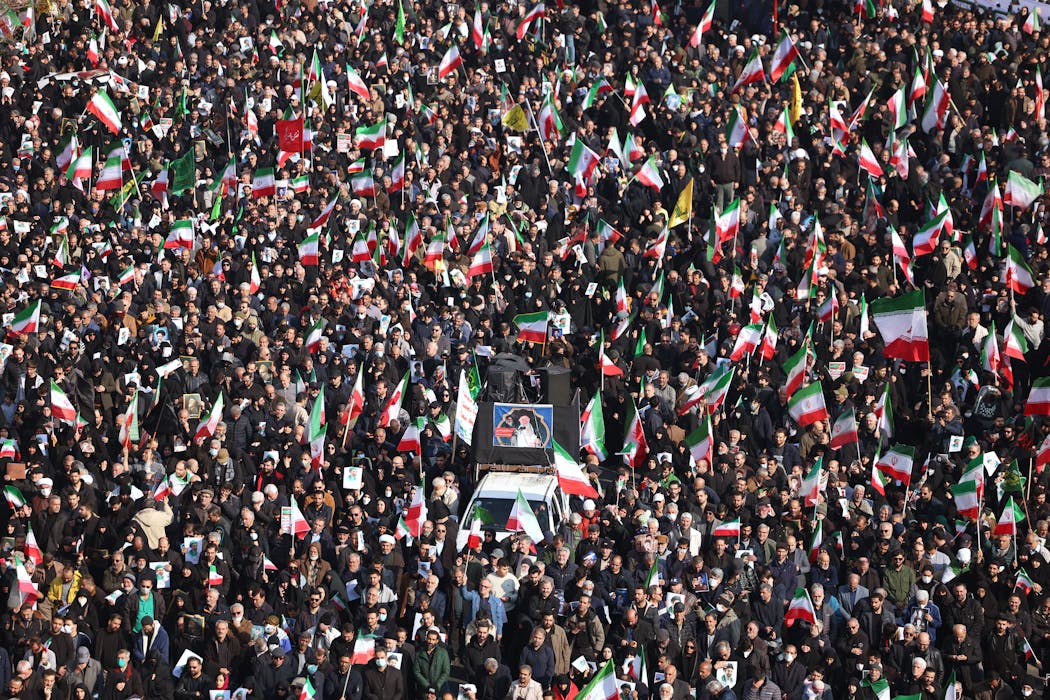
People gather in a rally to support Ayatollah Mojtaba Khamenei, the successor to his late father, Ayatollah Ali Khamenei, as supreme leader, in Tehran, Iran, on March 9, 2026. AP Photo/Vahid Salemi, File

Iran’s new ruler is already a marked man.

U.S. President Donald Trump has said Mojtaba Khamenei, who replaced his slain father, Ayatollah Ali Khamenei, as the country’s supreme leader, is an unacceptable choice and threatened to assassinate him if he does not agree to U.S. demands.

Although the supreme leader possesses disproportionate power, he is not the single authority. Instead, he is one of several positions and institutions through which the Islamic Republic’s 47-year-old regime organizes its ruling structure. Below is a rundown of how each of these entities functions and interacts with one another.

The supreme leader

After the Iranian Revolution of 1979, the position and office of supreme leader was created by the Iranian Constitution. It is based on the concept of the Guardianship of the Jurist, or “Velayat-e Faqih.”

Under Twelver Shiism – the sect of Shiite Islam that Iranians follow – the concept asserts that state affairs should be administered by righteous jurists, or faqih, until the return of the 12th imam, who is believed to have gone into hiding in 874 C.E. This concept was conceived by the first supreme leader, Ayatollah Ruhollah Khomeini, who ruled Iran for 10 years until his death in 1989.

Initially, the constitution called for the supreme leader to be a grand ayatollah and “source of emulation,” or marja’ al-taqlid – the highest-ranking cleric in the Shiite religious hierarchy. In 1989, the constitution was amended to allow Khamenei, who was a midranking cleric at the time, to assume the position from the ailing Khomeini.

Although the supreme leader is a lifetime appointment, Article 111 of the constitution authorizes the Assembly of Experts to dismiss him if he is deemed politically and religiously incapable or unqualified.

Inside the Islamic Republic or ruling system, the supreme leader is the ultimate religious and political authority. He commands the armed forces, supervises the state media and appoints the chief justice, who is the head of the judiciary.

According to articles 57 and 110 of the constitution, the supreme leader sets domestic and foreign policy and supervises all branches of the government, including the executive, legislature and judiciary. Through the Guardian Council, he has the power to vet electoral candidates and veto parliamentary laws.

The presidency

Following the revolution in 1979, the new constitution established the position, or office, of the president. The first presidential election was held in 1980.

While the supreme leader is the head of state, the president is the head of the government. After the supreme leader, the president is the second-in-command of the executive branch. As such, he answers to the supreme leader and executes his decrees.

Every four years, presidential elections take place with the participation of Iranians at least 18 years old.

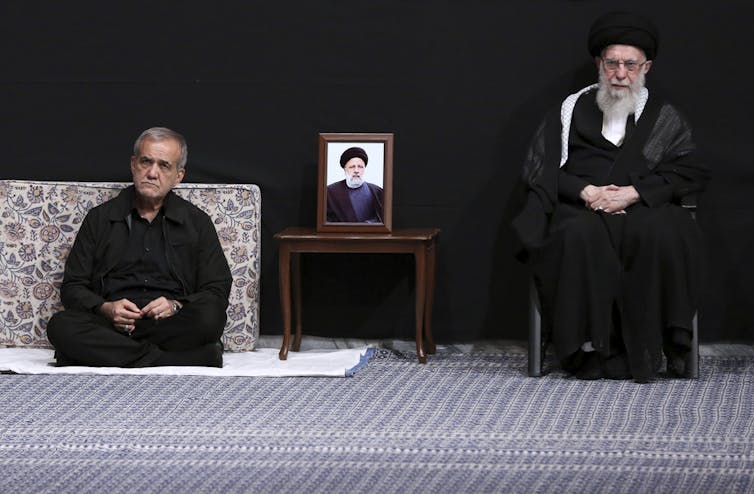
A man sits on the floor next to a man seated on a chair.
Iranian President Masoud Pezeshkian, left, sits next to Supreme Leader Ayatollah Ali Khamenei in a mourning ceremony on July 12, 2024.
Office of the Iranian Supreme Leader via AP

If reelected, the president cannot consecutively serve for more than two terms. It should be noted that every president has done so, except for Ebrahim Raisi, who governed from 2021 to 2024 and died in a helicopter crash before the end of his first term.

Before the election, all candidates are vetted by the Guardian Council, which is controlled by the supreme leader.

As the chairman of the Cabinet, the president appoints its ministers, pending a parliamentary vote of confidence. That said, the supreme leader has the authority to dismiss and reinstate them, along with the vice president.

Assembly of experts

In 1979, the Assembly of Experts of Leadership, or Majles-e Khobregan-e Rahbari, was created in the new constitution and held its first election the same year. Article 111 of the constitution authorizes the assembly to appoint, supervise and, if necessary, remove the supreme leader.

In this sense, the assembly acts as a deliberative body and is legally required to convene at least twice every six months. Its proceedings have remained strictly confidential and closed to the public.

The Assembly of Experts contains around 80 members. As ayatollahs or mujtahids, they are experts in Islamic law and exercise independent reasoning, or ijtihad. During the Islamic Republic’s history, the number of members has ranged from 82 in 1982 to 88 in 2016 and 2024. They serve eight-year terms and are directly or popularly elected by Iranians citizens.

At the same time, and as with other elections, the Guardian Council – which is controlled by the supreme leader– vets all the candidates who apply to run for office or enter the election, making the process far from free and fair.

In essence, the supreme leader approves the candidates who are potentially elected to a body that oversees him. For this reason, as observers point out, the assembly has not been known to seriously supervise or overtly challenge him.

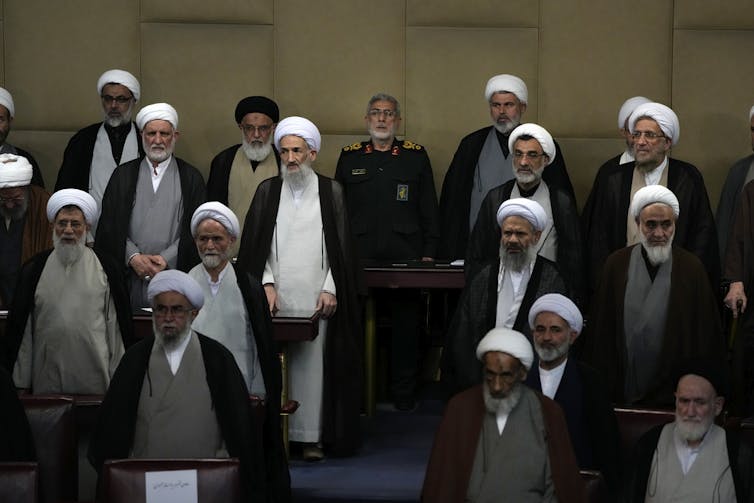
A group of men in Shia Muslim religious attire gather at a political forum.
Members of Iran’s Assembly of Experts meet after an election that decided the composition of the new assembly in May 2024.
AP Photo/Vahid Salemi

In the past two elections for the Assembly of Experts in 2016 and 2024, the Guardian Council disqualified hundreds of candidates. Many of them were moderates and reformists who opposed the supreme leader on various issues.

Consequently, the choice among voters was largely limited to conservatives and hard-liners who currently dominate the assembly.

Guardian Council

According to the Iranian Constitution, the Guardian Council, or Shoura-ye Negahban, has the power to veto laws passed by the popularly elected parliament. It is also authorized to vet candidates in elections, including those for the presidency, parliament and Assembly of Experts.

The council is composed of 12 jurists and lawyers who specialize in Islamic law and jurisprudence. They serve six-year phased terms in which half the members change every three years. The supreme leader appoints half of the council’s members and can dismiss them at will anytime. The chief justice appoints the other half, with a parliamentary vote of confidence.

Since the supreme leader also appoints the chief justice, he consequently controls the council. At the same time, the council has been known to assert a degree of agency and autonomy, as evidenced by the supreme leader occasionally ordering it to reverse bans on particular people running for public office.

Since the late 1990s, the council has disqualified a growing number of reformist candidates, many of whom have been at odds with the supreme leader over certain issues.

Consequently, conservatives and hard-liners, including those affiliated with the Revolutionary Guard, have increasingly dominated the parliament and Assembly of Experts.

Nevertheless, the Guardian Council has been unable to prevent reformists and moderates from participating in elections and even winning them, as in the case of current President Masoud Pezeshkian.

Expediency Discernment Council

In 1988, the constitution was amended to establish the Expediency Discernment Council of the System, or Majma’-e Tashkhis-e Maslahat-e Nezam.

The council’s chairman and other members are appointed by the supreme leader every five years. The council originally consisted of 13 members.

The Expediency Discernment Council initially acted as an administrative assembly that mediated and resolved disputes and differences between the Guardian Council and parliament over legislation.

Throughout the years, and based on articles 110 and 111 of the constitution, the council evolved into a body that advises the supreme leader on domestic and foreign policy and strategy.

Between the late 1990s and early 2000s, Khamenei relied on the Expediency Discernment Council to reduce the powers of the reformist-majority parliament and pressure it to approve the chief justice’s six appointees to the Guardian Council.

He also expanded the Expediency Discernment Council to 34 members – 25 of whom he appointed – and stacked it with conservatives.

Since 2007 it has consisted of 27 members, all of whom are appointed by the supreme leader. In the mid-2000s, Khamenei delegated some of his authority to the council to supervise the three branches of government.

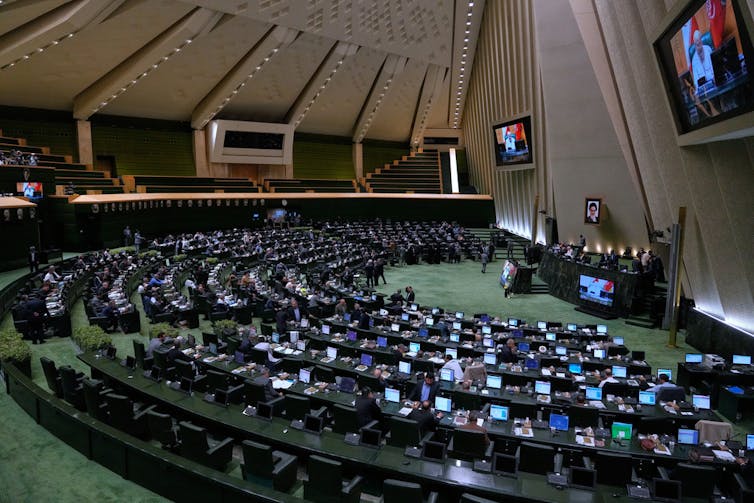
A wide angle photo of a political body and its permanent seats.
The Iranian parliament in Tehran, Iran, on Sept. 28, 2025.
AP Photo/Vahid Salemi

Iran’s parliament

The Islamic Consultative Assembly of Iran serves as Iran’s parliament and consists of a unicameral national legislative body. Representatives serve four-year terms and are elected by a popular vote.

Alongside the executive branch, the parliament can introduce legislation or propose new laws. That said, its capacity to pass laws is constrained when the Guardian Council construes them as contradicting or conflicting with the constitution and religion.

The parliament votes to approve the president’s Cabinet appointees. Alongside the supreme leader, it can also dismiss them and impeach the president for official misconduct.

Since 1979, the parliament has been chaired or led by six speakers, including, since 2020, Mohammad Bagher Ghalibaf, a conservative former commander of the Revolutionary Guard, which serves as the main armed force of Iran.

During the 2024 parliamentary election, which had a historically low voter turnout of 41%, the Guardian Council disqualified most moderate and reformist candidates. This paved the way for conservatives and hard-liners to secure a sweeping majority of 233 out of 290 seats.

It is inside this complex landscape of individuals and institutions that Mojtaba Khamenei has been appointed supreme leader. Although he stands at the pinnacle of the Islamic Republic’s ruling structure, it does not rely on him alone.

The Conversation

Eric Lob is affiliated with the Carnegie Endowment for International Peace.

ref. Iran’s ruling structure explained – https://theconversation.com/irans-ruling-structure-explained-277913

How governments can help Indigenous communities disproportionately impacted by wildfires

Source: The Conversation – Canada – By Tara McGee, Professor, Earth & Atmospheric Sciences, University of Alberta

Nearly every summer over the past decade, the story has been the same across many parts of Canada: wildfires rage out of control and skies are filled with smoke. Communities are often forced to evacuate.

Wildfires disproportionately impact Indigenous communities. Over the last four decades, 42 per cent of wildfire evacuations across Canada have been of Indigenous communities.

Thirteen years ago, there was little understanding of evacuation experiences of First Nations’ communities, despite them being so frequently impacted. That’s when we partnered with seven First Nations in Alberta, Saskatchewan and Ontario, as well as 16 departments and agencies involved in wildfire evacuations, to establish the First Nations Wildfire Evacuation Partnership (FNWEP).

Since 2013, the FNWEP has explored the evacuation experiences of First Nation residents, identified factors that affect experiences in positive and negative ways and recommended ways to reduce negative impacts of wildfire evacuations.

In 2021, we published our book, First Nations Wildfire Evacuation Experiences: A guide for communities and external agencies. The book is laid out so that each chapter is a stage of a wildfire evacuation, all the way from seeing smoke in the distance to returning to the community after the event is over.

We summarized findings from our research in each chapter, along with practical recommendations and steps that communities and external agencies can take to better prepare for wildfire evacuations.

Evacuation challenges

A video explaining the FNWEP and the challenges faced by evacuated Indigenous communities (SSHRC)

Through our research, we learned that many First Nations often lack adequate resources to prepare for and respond to wildfires, and many do not have anyone devoted full-time to emergency management.

Specific factors that complicate the evacuation of Indigenous Peoples from their community include:

  1. Being out on the land when the decision to evacuate is made, making it difficult to notify people and arrange transportation

  2. The fear of home loss compounded by existing housing shortages

  3. A lack of media interest in the evacuation of Indigenous communities, so it’s harder to get information

  4. Language issues and lack of translation

  5. Poverty caused by colonization

  6. Large multi-generational families living in one home, making transportation coordination difficult

  7. Health concerns

  8. Worries about the costs of evacuation and reimbursement

Additional challenges include short warning times, transportation challenges including multi-stage evacuations, inadequate information available for evacuees, crowded accommodation, culture shocks, family separation and racism.


Read more:
Evacuations of Indigenous communities during wildfires must prioritize keeping families together


Separated families

One of the most severe cases of family separation occurred in 2011 when people from Sandy Lake First Nation were sent to 12 different host communities, which led to reduced support for evacuees. In some cases, community leaders and a select group of residents stayed behind in the community to communicate with government agencies and evacuees, provide advice, deal with problems and look after the community.

We documented other things that just didn’t make sense. For example, when âmaciwîspimowinihk (Stanley Mission) in northern Saskatchewan was evacuated in 2014, car seats were not allowed on evacuation buses. Evacuees had to hold babies for the entire journey to the host communities. One host community was Regina, with evacuees on the road for almost 12 hours.

The most inappropriate case of accommodation for evacuees was when Deer Lake First Nation was accommodated in the Rideau Regional Centre in Smiths Falls, Ontario in 2011.

The centre was built to house people with developmental disabilities in 1951 and closed in 2009, two years before the evacuation occurred. The site and its condition were inappropriate. Some evacuees slept on the floor because they were not given a cot, some rooms were not cleaned and the shower stalls in common washrooms had no curtains or doors.

Community resilience

We found many other cases where evacuation experiences were improved because of the resiliency of people from the communities. Community leaders played the critical role of liaisons between their own and the host community, attended agency meetings, communicated what they learned to evacuees, advocated for evacuees and dealt with problems that arose.

In Sandy Lake First Nation, the chief who remained in the community recorded videos in Oji-Cree and English so evacuees could see community leaders and their community and receive daily updates during their evacuation.

Youth in Mishkeegogamang Ojibway Nation and other First Nations set up private Facebook groups so evacuees could share information. In addition to community liaison roles, First Nation community members volunteered to help in many ways, including sitting with Elders, organizing and picking up prescriptions, providing child-care services and security, and dropping off meals.

Recommendations for better evacuations

An overarching factor that affected all evacuations was jurisdiction. Wildfire management and emergency management are under provincial jurisdiction, but First Nations are under federal jurisdiction. This adds significant complexity to every wildfire evacuation. We documented examples where community leaders did not know which external agency to call to initiate an evacuation.

However, despite consistent research findings and advocacy, many of the communities we worked with who were evacuated between 2011-15 have been re-evacuated since, and again experienced many of the same issues we documented.

In 2025, the Auditor General of Canada again pointed to consistent failures in emergency management by Indigenous Services Canada, despite a dramatic increase in funding over the last decade from $13 billion in 2019-20 to almost $24 billion in 2023-24. The auditor general also found that evacuation services standards have only been met in one province: Ontario.

Federal and provincial governments should increase and provide long-term funding directly to First Nations for emergency management. They can also support the construction of buildings with air scrubbers and purifiers so that people do not have to evacuate their communities only because of air quality. In addition, they could simplify reimbursement processes to make post-wildfire recovery a less daunting process.

Governments must also increase investment in wildfire prevention and mitigation to reduce the need for evacuations including FireSmart programs. They should also fund and support Indigenous fire guardian programs across Canada, where Indigenous Peoples are employed year-round to do fire prevention, mitigation, response and recovery.

As wildfire season becomes more severe year after year, governments can take concrete steps now to ensure the most affected communities are well-equipped to deal with evacuations — and recover from them.

The Conversation

Tara McGee receives funding from Natural Resources Canada for the First Nations Wildfire Evacuation Partnership. The partnership previously received funding from the Social Sciences and Humanities Research Council of Canada.

Amy Cardinal Christianson is affiliated with the Indigenous Leadership Initiative. She previously worked for the Canadian Forest Service (Natural Resources Canada) and Parks Canada. Her association with the First Nations Wildfire Evacuation partnership over the last decade has been through in-kind contributions.

ref. How governments can help Indigenous communities disproportionately impacted by wildfires – https://theconversation.com/how-governments-can-help-indigenous-communities-disproportionately-impacted-by-wildfires-275198

As Paralympians compete for medals, the world debates Russia’s right to be there

Source: The Conversation – Canada – By Laura Misener, Professor & Director, School of Kinesiology, Western University

At the 2026 Milano-Cortina Winter Paralympic Games, the biggest debate surrounding the event has little to do with sport.

This year’s Paralympics represent the first major international sporting event since the 2014 Paralympic Winter Games in Sochi in which Russia has competed under its national flag. The ban included the recent Olympic Games, where Russia and Belarus were not allowed to send teams.

Six Russian and four Belarusian para-athletes are competing at the Paralympics, marking the end of a 12-year period of exclusion rooted first in state-sponsored doping and then Russia’s war against Ukraine.

The decision to let Russia and Belarus back in has sparked heated public debate. People are asking hard questions about fairness, disability rights and who gets to decide the rules of international sport.

While some international sport federations cling to the idealistic notion that sport and politics are separate, this situation demonstrates the deeply entrenched role of geopolitics in major sporting events.

Rule 50 of the Olympic Charter explicitly prohibits political demonstrations and displays. Yet the reality for those at the Games is very different.


Read more:
The IOC’s ban of a Ukrainian athlete over his helmet reveals troubling double standards


Russia returns to the Paralympics

In 2022, Russian athletes competed under the International Paralympic Committee (IPC) flag rather than their national flag. This sanction was already in place as punishment for the preceding Russian doping scandal.

However, as Russia’s invasion of Ukraine unfolded in the lead-up to the Games, the IPC went further, ruling that results for Russian and Belarusian athletes would not be counted in the official medal table.

At the IPC General Assembly in 2025, members voted to allow Russia and Belarus to return to the Games. This meant that athletes from those countries could compete under their own flags and national anthems.

Following this decision, 16 countries formally boycotted the Paralympic opening ceremony. Fewer than 40 per cent of athletes were present, with many deliberately absent from opening ceremonies in an act of solidarity with Ukraine.

Inclusion for athletes, silence for victims

On the one hand, the IPC’s founding mission is to “make for an inclusive world through Para sport.” The exclusion of athletes on the basis of their government’s actions appears to conflict with this principle of universality.

IPC president Andrew Parsons framed the reinstatement of Russia and Belarus as consistent with what the movement stands for: a democratic organization treating all national Paralympic committees equally under due process.

People with disabilities, including para athletes, are often excluded or overlooked in society. Supporters argued that punishing disabled athletes for their government’s conduct conflicts with disability-rights principles.

Disability rights work aims to dismantle discriminatory practices that exclude people because of social, political or embodied difference.

But the decision exposed a deeper tension. The IPC already includes athletes from states involved in active conflicts. That makes it harder to argue exclusions are applied consistently.

On the other hand, the IPC’s mission of building “an inclusive world” is undermined when a state actively destroys the lives and bodies of civilians, many of whom may themselves become disabled.

Rob Koehler, director general of Global Athlete, stated: “There is simply no justification for allowing Russia and Belarus back while the invasion continues.”

The Canadian Paralympic Committee opposed the reinstatement, indicating that the ongoing war contradicts the Olympic Truce. Further, Karen O’Neill, the committee’s president, stated that no evidence has emerged to suggest the doping issue has been resolved.

The inclusion of Russian war veterans injured fighting in the war with Ukraine has been upsetting for some athletes. Yet this debate continues to overshadow the far more pressing issue of Paralympic athletes receiving the attention and respect they have long been denied.

When neutrality becomes complicity

While the IPC president maintains that the focus must remain on sport and athletic competition, this stance carries a serious risk.

Allowing Russia back could send the wrong message that sport has no red lines; it suggests participation matters more than accountability. The IPC had a defining opportunity to demonstrate moral leadership.

History shows that international sport is capable of precisely this kind of leadership. As Richard Pound, a former Canadian International Olympic Committee member, has argued, sport has a proud tradition of standing in opposition to oppressive regimes.

In 1970, South Africa was banned from the Olympics because of apartheid — the government’s policy of racial segregation. It was a powerful moment when sport took a clear moral stand.

Giovanni Malagò, president of the Milano-Cortina organizing committee, said in his opening-ceremony speech:

“We cannot ignore that these Games are taking place in an increasingly and profoundly divided world, torn apart by wars, grief and suffering, at one of the most dramatic turning points of our time.”

This sentiment has cast a shadow on the messaging and importance of inclusion and celebration of sport at the Paralympic Games. Paralympic athletes have fought hard for recognition, and the politics of these Games have dominated public attention.

What the debate reveals about sport and politics

Sport has always been more than entertainment. It reflects the social and political climate in which it takes place, often exposing tensions and contradictions within society.

This is especially clear in the Paralympic context, where questions of inclusion, disability rights and geopolitical conflict sit side-by-side. The debates surrounding Russia’s return to the 2026 Winter Paralympic Games show how sport can both mirror and magnify broader ethical dilemmas.

Athletes and sporting bodies have long been part of wider social change, but the current events reveal how sport is also entangled with deeper issues — discrimination, war, unresolved doping concerns and the struggle over who gets to participate and under what conditions.

The Paralympic movement was built on the idea that sport should be open to everyone. But that ideal is being tested by a world dealing with war, political division and unresolved cheating scandals.

It is unfortunate that this controversy is drowning out what the Paralympics are meant to be about — celebrating remarkable athletes and promoting inclusion.

The Conversation

Laura Misener receives funding from the Social Sciences and Humanities Research Council of Canada.

ref. As Paralympians compete for medals, the world debates Russia’s right to be there – https://theconversation.com/as-paralympians-compete-for-medals-the-world-debates-russias-right-to-be-there-278019

Why Friday the 13th was bad luck for the Knights Templar and their legacy

Source: The Conversation – UK – By Patrick Masters, Lecturer, University of Portsmouth

In Ridley Scott’s 2005 epic Kingdom of Heaven, The Knights Templar are portrayed as violent extremists. The film is about a crusader, Balian of Ibelin, who is fighting to defend the Crusader Kingdom of Jerusalem from the first Sultan of Egypt and Syria, Saladin.

The Knights Templar were formed on Christmas Day 1119, as a revolutionary type of knighthood in which knights lived as monks, taking vows of poverty and piety. Their mission was to protect travellers on the dangerous roads of the Kingdom of Jerusalem. So it struck me as interesting that in Scott’s crusades film they would be portrayed as antagonists of the Crusader Kingdom.

Their singling out in Kingdom of Heaven was the spark that led to my book The Knights Templar: Crusade, Myth and Hollywood. What I found was that villainising the order was fairly common in films that include them. However, rather than being a modern trope, their vilification can be traced back to 700 years ago.

On Friday October 13 1307, the grandmaster Jacques de Molay was arrested by a debt-ridden pope along with every other Templar found in France. The sudden arrest caused widespread shock throughout Europe. Some of the confessions that would be extracted from them would have a mysterious occult edge and it would be these that would shape the order’s legacy from then on.

The Templars amassed vast riches, land, and political power for nearly 200 years. Their downfall began in 1291 with the loss of the Crusader states, or Outremer (modern Israel, Lebanon, Syria, and Turkey). After the Crusader capital of Acre fell to the Mamluk forces of Egypt and Syria, the Templars were left without a cause, making the order appear redundant and vulnerable to criticism.

The two figures central to their downfall were French Pope Clement V and French King Phillip IV, who was burdened with significant debt and had previously moved against groups within his power, such as Italian bankers in 1291 and the Jews in 1306, seizing their property and assets to ease his financial problems.

Friday 13th

On Friday October 13 1307, Jacques de Molay was in France negotiating another crusade. That military campaign would never happen and instead, he and every Templar in France (around 2000 of them) were suddenly arrested and imprisoned in the Paris Temple.

Although the news shocked Christendom, Clement V had written to Phillip IV in 1305 detailing the rumours about the Templars and plans for an investigation. Phillip IV issued the Templars’ arrest order a month prior, charging them with blasphemy, sodomy and heresy.

The first charges related to the initiation into the order, where, according to the Order for Arrests, initiates must deny Christ and spit on an image of him three times. The document then details how the initiate is stripped naked and kisses the receiving Templar on “the lower part of the dorsal spine”, “the navel” and “on the mouth”.

Once in the King’s clutches, the Templars were deprived of sleep and shackled with irons. Templar Ponsard de Gizy described in detail how he was unable to move in a pit for three months, with his hands tied behind his back so tightly that blood ran down his fingernails.

Those who did not confess faced the rack and suffered the strappado – this is where the victim was strung up by the hands, which were bound behind their back. Under these horrific conditions, 134 of the of the 138 Templars questioned in Paris confessed to some or all of the charges. Under torture, even the grandmaster admitted to denying Christ, but instead of spitting on his image, he claimed to have spat on the floor instead.

It wasn’t the charge of blasphemy, however, that haunted the Templars’ legacy, it was the accusations of worshipping false idols.

Extracted under torture, Hugues de Pairaud describes worshipping a head with two feet under its face and two feet behind it. Very few Templars had any knowledge of the mysterious head idol, and only nine admitted to knowing about it. Those who did gave contradictory accounts: the head with feet was described as having a beard, of being painted on a beam and made of wood, silver, and gold leaf. Others claimed to worship an idol called Baphomet and a bearded head called Yalla.

The origin and identity of the idol Baphomet are mysterious. However, historian Sharan Newman suggests it’s most likely a corruption of the name Mohammed.

The Templar order was abolished in 1312 and Jacques de Molay was burned at the stake in 1314 as a relapsed heretic. The majority of the Templars caught in France were either executed or confined to prison indefinitely. However, it wasn’t until the 16th century that the Templars’ heresy entered popular imagination.

The German physician Heinrich Agrippa’s 1531 book De Occulta Philosophia, recontextualised the failed order alongside witchcraft. While French writer Guillaume Paradin detailed the Templars’ sordid heresy in his 1552 Chronicle of Savoy. In his history of Savoy, the Templars engage in orgies with women after initiates worshipped an image covered in human skin with glowing carbuncles for eyes.

The salacious occult imagery of the 16th century remained a widely held perception of the Templars into the 20th and 21st centuries. This lasting association is clear in cinema.

The 1972 Spanish/Portuguese horror film Tombs of the Blind Dead portrays undead Templars rise from their graves to prey on a group of teenagers. The undead Templar recently resurfaced again in the 2017 film The Mummy, where the titular villain raised Templars from their tombs to act as her minions.

There are Templars across cinema enacting evil and its interesting to think about how this all came to be because of a handful of confessions about worshipping false idols, which were obtained through torture.

This article features references to books that have been included for editorial reasons, and may contain links to bookshop.org. If you click on one of the links and go on to buy something from bookshop.org The Conversation UK may earn a commission.

The Conversation

Patrick Masters wrote the book The Knights Templar: Crusade, Myth and Hollywood. In 2018, he received funding from the Templar Heritage Trust to present a paper at the International Medieval Conference.

ref. Why Friday the 13th was bad luck for the Knights Templar and their legacy – https://theconversation.com/why-friday-the-13th-was-bad-luck-for-the-knights-templar-and-their-legacy-278033

Have we passed ‘peak sheep’?

Source: The Conversation – UK – By Caroline Flanagan, Head of School, Agriculture, Anglia Ruskin University

Farmers are drastically reducing their sheep flocks. EddieCloud/Shutterstock

The classic view of British countryside is of hilly green fields, stone walls and sheep dotted about in the distance.

But that scene could be disappearing as farmers move away from keeping sheep, or reduce their flocks, in many areas of the country.

The total number of sheep and lambs decreased by 3.8%, to 13.3 million in June 2025. Breeding flock numbers have also dropped from 6.8 million in 2021 to 6.4 million in 2025.

Meanwhile, the nation’s eating habits also appear to be shifting as mutton and lamb production has dropped from 400,000 tonnes per year in the early 1990s to 276,000 tonnes today.

The geographical distribution of sheep across the UK is changing too, with Scotland – long celebrated for its hill flocks – reporting marked declines of sheep numbers particularly in the northwest and the Highlands.

So has the UK reached “peak sheep”?

The largest fall in sheep numbers occurred after the 2001 foot and mouth outbreak, and in England this decline deepened when government subsidies related to numbers of sheep were replaced with subsidies for looking after the land in 2024/25. This reduced the incentive to keep large flocks and led farmers to retain fewer animals. Simultaneously, UK and global dietary habits have been changing. UK red meat consumption fell by 13.7g per day per head between 2008 and 2019.

Cost, health concerns and the difficulty of positioning lamb as a fast food option have reduced demand. In 2021 60% of lamb was purchased by shoppers aged 55 plus, with younger consumers increasingly preferring alternative protein sources such as chicken and processed meat.

Planning for the future on low-income hill farms is also problematic. In the UK, 84% of farmers are over 45 (and 38% over 65), with many young people reluctant to enter an uncertain industry. On upland and hill farms, the average farm profit was just £32,000 in 2023/24, 69% of which came from government payments due to be phased out by 2027.

However, sheep are adaptable to changing circumstances and their ability to select plants to sustain themselves might offer a route to securing their future as the national flock continues to shrink.

A Scottish sheep farmer talks about some of his challenges.

That fastidious eating, once essential for survival, is proving invaluable for conservation. Many native breeds excel at balancing shrub browsing with grazing in areas inaccessible to machinery. Conservation success stories include the restoration of violets vital for fritillary butterflies and the maintenance of biodiverse mosaic grasslands.

Sheep eat different plants to cattle, so they can be deployed as appropriate to eat selectively, tackling problem plants that cattle might not. They also have less impact on the soil, which in some instances is beneficial.

Some rewilding supporters worry that sheep can harm nature in certain situations, but when they’re carefully managed, sheep can actually help store carbon and are important for looking after landscapes such as fens, saltmarshes, moorland and meadows.

Poorly managed, they can hinder conservation efforts, grazing too close to the soil. But the rise of “flying flocks” – mobile groups shepherded across different sites – demonstrates how sheep can support flexible land use on both lowland and upland farms. Meanwhile, the UK’s commitment to net zero, and the expansion of solar energy have created another niche.

Sheep, conveniently sized and behaviourally suited, are ideal for grazing underneath solar panels, keeping vegetation under control.

So, where does this leave the UK’s sheep industry?

We may be witnessing a move to lower levels with new breeds, and other changes emerging. In lowland areas, you may already be seeing more sheep, as arable farmers turn to them to graze cover crops which are used to avoid soils laying bare over long periods of time. Cover crops enhance soil structure and biodiversity, providing nutrients to the soil.

Lowland sheep are heavier, better suited to meat production and can be stocked more densely than on upland terrain, boosting efficiency. A growing proportion of the UK’s lamb supply is likely to come from lowland flocks, with reducing reliance on the traditional flow of breeding ewes from the hills. So sheep are more likely to be seen on the lower levels, and there could be fewer of them.

Beyond their ecological contributions, sheep produce a remarkable annual bonus. From carpets and jumpers to natural insulation and high-end suits, wool is natural, renewable, sustainable and biodegradable. As the clothing industry increases the use of natural fibres, demand and prices are rising, this could offer a more lucrative alternative product for sheep farmers to sell.

Sheep still have a vital place in the UK. The country may have reached “peak sheep”, but given their versatility, their capacity to thrive in tough environments, our growing commitment to sustainable land management and our deepening understanding of their grazing behaviour, sheep are well placed to help us be better custodians of our landscapes.

The Conversation

The authors do not work for, consult, own shares in or receive funding from any company or organisation that would benefit from this article, and have disclosed no relevant affiliations beyond their academic appointment.

ref. Have we passed ‘peak sheep’? – https://theconversation.com/have-we-passed-peak-sheep-277815