US snatches Maduro in raid on Caracas: what we know so far

Source: The Conversation – Global Perspectives – By Andrew Gawthorpe, Lecturer in History and International Studies, Leiden University

Venezuela’s president, Nicolás Maduro, has been apprehended and flown to the US where the US attorney-general has announced he will face charges of drug trafficking and narco-terrorism. The US military’s operation to snatch Maduro was carried out in the early hours of January 3 and follows months of steadily mounting pressure on the Venezuelan government.

Now it appears that the US operation to remove a leader it has designated as a “narco-terrorist” has come to fruition. But whether the capture and removal of Maduro will lead to regime change in the oil-rich Latin American country remains unclear at present.

The US campaign against Venezuela is the product of two distinct policy impulses within the Trump administration. The first is the long held desire of many Republican hawks, including the US secretary of state, Marco Rubio, to force regime change in Caracas. They detest Venezuela’s socialist government and see overturning it as an opportunity to appeal to conservative Hispanic voters in the US.


Read more:
How Venezuela has been preparing for a US invasion for more than two decades


The second impulse is more complex. Trump campaigned for election in 2024 on the idea that his administration would not become involved in foreign conflicts. But his administration claims that Venezuela’s government and military are involved in drug trafficking, which in Washington’s thinking makes them terrorist organisations that are harming the American people. As head of the country’s government, Maduro, according to the Trump administration’s logic is responsible for that.


TruthSocial

During Trump’s first administration, his Department of Justice indicted Maduro on charges of “narco-terrorism”. Now Bondi says there might be a new indictment which also covers Maduro’s wife, who was taken into detention with him. The fact that US law enforcement was involved in their capture reinforces the idea that they will now face those charges in a New York court, despite an early claim by opposition sources in Venezuela that Maduro’s departure may have been negotiated with the US government.

What comes next?

The big question is what comes next in Venezuela, and whether either the Republican hawks or the “America first” crowd will get the outcome that they want: ongoing US military presence to “finish the job” or simply a show of US strength to punish its adversary which doesn’t involve a lengthy American involvement.

The US has discovered time and again in recent decades that it is extremely difficult to dictate the political futures of foreign countries with military force. The White House might want to see the emergence of a non-socialist government in Caracas, as well as one which cracks down on the drug trade. But simply removing Maduro and dropping some bombs is unlikely to achieve that goal after nearly three decades of bulding up the regime under Maduro and his predecessor Hugo Chavez.

The Trump administration could have learned this lesson from Libya, whose dictatorial government the US and its allies overthrew in 2011. The country collapsed into chaos soon after, inflicting widespread suffering on its own citizens and creating problems for its neighbours.

In the case of Venezuela, it is unlikely that American military’s strikes alone will be enough to fatally undermine its government. Maduro may be gone, but the vast majority of the country’s governmental and military apparatus remains intact. Power will likely pass to a new figure in the regime.

The White House may dream that popular protests will break out against the government following Maduro’s ousting. But history shows that people usually react to being bombed by a foreign power by rallying around the flag, not turning against their leaders.

Nor would Venezuela’s descent into chaos be likely to help the Trump administration achieve its goals. Conflict in Venezuela could generate new refugee flows which would eventually reach America’s southern border. The collapse of central government authority would be likely to create a more conducive environment for drug trafficking. Widespread internal violence and human rights violations could hardly be portrayed as a victory to the crucial conservative Hispanic voting bloc.

If the Trump administration dreams of establishing a stable, pro-American government in Caracas, it is going to have to do more than just arrest Maduro. Bringing about durable regime change typically involves occupying a country with ground troops and engaging in “nation building”. The US tried this with decidedly mixed results in Iraq and Afghanistan.

Trump has pledged to avoid such entanglements and Rubio has said that, for now at least, the US has no plans for further military action against Venezuela. Trump has a penchant for flashy, quick wins, particularly in foreign policy. He may hope to tout Maduro’s capture as a victory and move on to other matters.

Nation-building failures

In almost no recent US military intervention did the American government set out to engage in nation-building right from the beginning. The perceived need to shepherd a new government into existence has typically only come to be felt when the limits of what can be accomplished by military force alone become apparent.

The war in Afghanistan, for instance, started as a war of revenge for the terrorist attacks on the US on September 11 2001 before transforming into a 20-year nation-building commitment. In Iraq, the Bush administration thought that it could depose Saddam Hussein and leave within a few months. The US ended up staying for nearly a decade.

It’s hard to imagine Trump walking down the same path, if only because he has always portrayed nation-building as a waste of American lives and treasure. But that still leaves him with no plausible way to achieve the divergent political outcomes he, his supporters and America’s foreign policy establishment want with the tools that he has at his disposal.

Meanwhile the US president will face pressure from a range of constituencies from Republican hawks to conservative Hispanic voters to force wholesale regime change in Venezuela. How Trump responds to that pressure will determine the future course of US policy towards the country.

The Conversation

Andrew Gawthorpe is affiliated with the Foreign Policy Centre in London.

ref. US snatches Maduro in raid on Caracas: what we know so far – https://theconversation.com/us-snatches-maduro-in-raid-on-caracas-what-we-know-so-far-272660


The rise and fall of Babycham – the sparkling pear drink that sold the champagne lifestyle at a small price

Source: The Conversation – UK – By Steve Parissien, Lecturer in Architectural History, University of Oxford

As a cultural historian who has worked with and lectured on the drinks industry for many years I was asked to write a book about post-war Britain and the drinks that made it. I immediately knew I had to include Babycham – a post-austerity tipple that had made Britain smile.

Britain in the early 1950s was gradually emerging from the shadow of war and was dealing with bankruptcy and post-war shortages. By the time of Queen Elizabeth II’s coronation in 1953, British manufacturing was getting back on its feet.

In that year, a little-known Somerset brewery, Showerings, hit upon a novel idea: offer cash-strapped Britons sick of the grey years of austerity a festive, sparkling alcoholic tipple that was cheap but fun. Thus was born Babycham, the celebratory drink that looked like champagne, but wasn’t.

I have distinct memories of my mum drinking the sparkling beverage in the 1960s, sometimes with brandy as a cheap, working-class alternative to the classic champagne cocktail. And who can forget those wonderful, deer-themed champagne coupes which Babycham distributed, and which are now collectors’ items.

As I write in my book Another Round, it was originally named “Champagne de la Poire” by its creators, Francis and Herbert Showering of Shepton Mallet in Somerset. Babycham was a new alcoholic perry – a cider made from pears. It had the modest strength of 6% alcohol-by-volume and came in both full-sized bottles and fashionable, handbag-sized four- and two-ounce versions.

At sixpence a bottle, Babycham’s bubbles come at a fraction of the price of genuine French bubbly – a luxury that very few could afford. Babycham came to epitomise the brave new world of mid-1950s Britain – British ingenuity still seemed to lead the world, and anything seemed possible.

Marketing with fizz

Babycham’s innovative brand design, marketing methods and advertising techniques brought flashy and flamboyant American techniques to the staid world of British beverages as its makers exploited not just the expanding potential of magazines and radio but, crucially, the revolutionary medium of television advertising. Perhaps most importantly, it was also the first British alcoholic drink to be aimed squarely at women.

Showerings and their advertising guru Jack Wynne-Williams made Babycham into the first British consumable to be introduced through advertising and marketing, rather than marketing an existing product. Their eye-catching new baby deer logo featured in the ad campaign of autumn 1953 and has been with us ever since. And it was equally prominent when their groundbreaking debut TV ad in 1956 made Babycham the first alcoholic brand to be advertised on British television.

In order to convey the idea that Babycham provided a champagne lifestyle at a beer price, Showerings advised their (largely female) customers that it was best served in an attractive and undeniably feminine French champagne coupe. Coupes were soon being customised by Showerings, who plastered them with the brand’s distinctive new deer logo and thereby created an instant kitsch collectable. In this way, Babycham offered the aspirational female Briton of the 50s and 60s a fleeting illusion of glamour and sophistication at the price of an average pub tipple.

All of this Americanised marketing paid handsome dividends. Babycham’s sales tripled between 1962 and 1971. These bumper sales enabled the Showerings to be acquired by drinks leviathan Allied Breweries in 1968, and after the merger Francis Showering was appointed as a director of the new company.

It was only in the early 1980s that Babycham’s sales began first to fall, and then to plummet. During this decade the drinks market was becoming more sophisticated and diverse. Women were turning more to wine and cocktails than to retro tipples made from sparkling pear juice.

However, after a period in the doldrums, the Babycham brand is back. In 2016, a younger generation of Showerings bought back the family’s original cider mill in Shepton Mallet and sought to revive their famous sparkling perry, relaunching Babycham in 2021.

If it is remembered at all, it’s now associated with celebrations such as birthdays or Christmas. No longer seen as a regular indulgence. The Babycham brand and its winsome fawn logo do seem rather old-fashioned today but in an age of nostalgia for the Britain of the past it could be ripe for a renaissance.


Looking for something good? Cut through the noise with a carefully curated selection of the latest releases, live events and exhibitions, straight to your inbox every fortnight, on Fridays. Sign up here.


The Conversation

Steve Parissien does not work for, consult, own shares in or receive funding from any company or organisation that would benefit from this article, and has disclosed no relevant affiliations beyond their academic appointment.

ref. The rise and fall of Babycham – the sparkling pear drink that sold the champagne lifestyle at a small price – https://theconversation.com/the-rise-and-fall-of-babycham-the-sparkling-pear-drink-that-sold-the-champagne-lifestyle-at-a-small-price-271347

The ancient braces myth: why our ancestors didn’t need straight teeth

Source: The Conversation – UK – By Saroash Shahid, Reader in Dental Materials, Queen Mary University of London

Hryshchyshen Serhii/Shutterstock.com

Ancient Egyptians and Etruscans pioneered orthodontics, using delicate gold wires and catgut to straighten teeth. It’s a tale that has appeared in dentistry textbooks for decades, portraying our ancestors as surprisingly modern in their pursuit of the perfect smile. But when archaeologists and dental historians finally scrutinised the evidence, they discovered that most of it is myth.

Take the El-Quatta dental bridge from Egypt, dating to around 2500BC. The gold wire found with ancient remains wasn’t doing what we thought at all. Rather than pulling teeth into alignment, these wires were stabilising loose teeth or holding replacement ones in place. In other words, they were functioning as prostheses, not braces.

The gold bands discovered in Etruscan tombs tell a similar story. They were probably dental splints designed to support teeth loosened by gum disease or injury, not devices for moving teeth into new positions.

There are some rather compelling practical reasons why these ancient devices couldn’t have worked as braces anyway. Tests on Etruscan appliances revealed the gold used was 97% pure, and pure gold is remarkably soft.

It bends and stretches easily without breaking, which makes it useless for orthodontics. Braces work by applying continuous pressure over long periods, requiring metal that’s strong and springy. Pure gold simply can’t manage that. Try to tighten it enough to straighten a tooth and it will deform or snap.

Then there’s the curious matter of who was wearing these gold bands. Many were found with the skeletons of women, suggesting they might have been status symbols or decorative jewellery rather than medical devices. Tellingly, none were discovered in the mouths of children or teenagers – exactly where you’d expect to find them if they were genuine orthodontic appliances.

But perhaps the most fascinating revelation is this: ancient people didn’t have the same dental problems we face today.

Malocclusion – the crowding and misalignment of teeth that’s so common now – was extremely rare in the past. Studies of Stone Age skulls show almost no crowding. The difference is down to diet.

Our ancestors ate tough, fibrous foods that required serious chewing. All that jaw work developed strong, large jaws perfectly capable of accommodating all their teeth.

Modern diets, by contrast, are soft and processed, giving our jaws little exercise. The result? Our jaws are often smaller than those of our ancestors, while our teeth remain the same size, leading to the crowding we see today.

Since crooked teeth were virtually non-existent in antiquity, there was hardly any reason to develop methods for straightening them.

A caveman chewing on a bone.
Jaws were larger, due to food being tougher to chew on.
Gorodenkoff/Shutterstock.com

That said, ancient people did occasionally attempt simple interventions for dental irregularities. The Romans provide one of the earliest reliable references to actual orthodontic treatment.

Aulus Cornelius Celsus, a Roman medical writer in the first century AD, noted that if a child’s tooth came in crooked, they should gently push it into place with a finger every day until it shifted to the correct position. Although basic, this method is built on the same principle we use today – gentle, continuous pressure can move a tooth.

After the Roman era, little progress occurred for centuries. By the 18th century, however, interest in straightening teeth had revived, albeit through some rather agonising methods.

Those without access to modern dental tools resorted to wooden “swelling wedges” to create space between overcrowded teeth. A small wedge of wood was inserted between teeth. As saliva was absorbed, the wood expanded, forcing the teeth apart. Crude and excruciating, perhaps, but it represented a step towards understanding that teeth could be repositioned through pressure.

Scientific orthodontics

Real scientific orthodontics began with French dentist Pierre Fauchard’s work in 1728. Often called the father of modern dentistry, Fauchard published a landmark two-volume book, The Surgeon Dentist, containing the first detailed description of treating malocclusions.

He developed the “bandeau” – a curved metal strip wrapped around teeth to widen the dental arch. This was the first tool specifically designed to move teeth using controlled force.

Fauchard also described using threads to support teeth after repositioning. His work marked the crucial shift from ancient myths and painful experiments to a scientific approach that eventually led to modern braces and clear aligners.

With advances in dentistry during the 19th and 20th centuries, orthodontics became a specialist field. Metal brackets, archwires, elastics and eventually stainless steel made treatment more predictable.

Later innovations – ceramic brackets, lingual braces and clear aligners – made the process more discreet. Today, orthodontics employs digital scans, computer models, and 3D printing for remarkably precise treatment planning.

The image of ancient people sporting gold and catgut braces is certainly appealing and dramatic, but it doesn’t match the evidence.

Ancient civilisations were aware of dental problems and occasionally attempted simple solutions. Yet they had neither the necessity nor the technology to move teeth as we do now.

The real story of orthodontics doesn’t begin in the ancient world but with the scientific breakthroughs of the 18th century and beyond – a history that’s fascinating enough without the myths.

The Conversation

Saroash Shahid does not work for, consult, own shares in or receive funding from any company or organisation that would benefit from this article, and has disclosed no relevant affiliations beyond their academic appointment.

ref. The ancient braces myth: why our ancestors didn’t need straight teeth – https://theconversation.com/the-ancient-braces-myth-why-our-ancestors-didnt-need-straight-teeth-270962

Online ‘brainrot’ isn’t ruining children’s minds – it’s a new way of navigating the modern internet

Source: The Conversation – UK – By Oli Buckley, Professor in Cyber Security, Loughborough University

Alena A/Shutterstock

“Brainrot” is what many people call the chaotic, fast-moving memes, sounds and catchphrases that spread across TikTok, Roblox and online gaming and into playgrounds. An example is the endlessly repeated chant of “six-seven”, which still echoes through houses and schools across the country – to the bewilderment (or annoyance) of many teachers and parents.

But if you’ve ever said “I’ll be back” in a mock-Arnie voice or asked “you talkin’ to me?”, you’ve already engaged in a form of brainrot. The instinct to repeat and remix lines from the culture around us is nothing new.

What has changed is the source material. For young people growing up in a digital world, quotable moments don’t come from films or TV but from TikTok edits, Roblox streams, speedrun memes, Minecraft mods (modifications) and the fast-paced humour of online gaming.

Hearing a child burst into the looping “Skibidi dop dop dop yes yes” audio from the Skibidi Toilet trend, or repeat a surreal line from a Roblox NPC (non-player character), might sound like nonsense to adults. For the younger generation these fragments slot neatly into a fast-paced, highly referential style of humour. Today’s equivalents are faster, more layered and often more chaotic, with that chaos very much part of the appeal.

Although brainrot is often used knowingly and with a touch of irony to describe these phrases, remixing and repeating fragments of media has always been part of how people connect. It creates a shared cultural code, a second language made of references, rhythms and sounds that bind groups together and turn everyday moments into opportunities for humour and social connection. In many ways, this style of communication offers lightness and playfulness in a world that can often feel slow and muted by comparison.

Changing play

Brainrot is changing how children play online. Many adults grew up with video games that were built around structure. In Pokémon, Zelda or Half-Life, you cleared goals, quests and puzzles to reach endings. Even when games were open-world, giving you nearly total freedom to choose what challenges you take on and when, there was an underlying design logic you were meant to follow.

Those experiences shaped how we thought about play, and later how we approached designing games and interactive tools in research. Structure, narrative and pacing felt fundamental.

Watching children engage with today’s digital culture, and particularly with what gets called brainrot, challenges these assumptions. Their experiences aren’t always built around long-form story arcs or carefully crafted mechanics and challenges. Instead, it’s fluid, fragmentary and relentlessly social.

They jump between Roblox games, short TikTok edits, chaotic Minecraft mods and meme-based jokes without losing the thread. What sometimes looks like disjointed overstimulation to adults is entirely coherent to them. They’re fluent in a form of digital literacy that involves stitching together references, humour, audio, images and interactions at high speed.

Brainrot and research

From a research perspective, this has been a timely reminder that how children engage online changes. Young people aren’t abandoning meaningful play, they’re interacting with an online environment that is dramatically different from the one their parents grew up with.

There is research that raises questions about whether switching between short, chaotic bursts of content might affect attention or wellbeing for some users. For example, a recent study found associations between heavy use of short-form video apps and poorer sleep in adolescents, but also noted that higher social anxiety partly explained this pattern.

A broader analysis of a number of research studies reported similar correlations between heavier use and lower scores on attention tasks, as well as higher stress and anxiety. But these findings do not show causation. It remains unclear whether short-form content affects attention, or whether young people with particular cognitive styles simply gravitate towards media that already fits how they process information.

This shift has changed how we design games for learning. Instead of assuming attention must be sustained in a single direction, we think more about how curiosity works in shorter bursts, how play can be modular, and how meaning can emerge from participation rather than instruction.

Brainrot may not be something we’d replicate directly in an educational game, but some of its qualities, its pace, its playfulness, its remixing of ideas, can offer valuable prompts for thinking differently about how young people engage.
The way we learn is constantly evolving and it doesn’t always fit our older frameworks. Rather than resisting that, there’s value in trying to understand it, and in meeting them where they already are.

If we want to understand why brainrot resonates so strongly with children, it helps to see it not as meaningless noise, but as a form of social communication. These references work as inside jokes, but ones that can be remixed endlessly.

This is part of the appeal: brainrot is malleable, collaborative and playful. If you understand it, then you can riff on it, combine it, subvert it, and use it to signal belonging. There’s a enticing level of creativity stitched into the chaos.

There is also an element of self-awareness in much of brainrot culture. Its absurdity isn’t accidental, it’s part of the joke. In that sense it has echoes of earlier artistic or cultural movements that embraced nonsense or playful subversion. One of the key things is that this isn’t something imposed on children by companies or algorithms. Brainrot is something young people choose to build together, adapting and evolving references within their own circles.

Brainrot isn’t evidence that young people are disengaged or unimaginative. It’s a reflection of how they make sense of a digital world that is fast, fragmented and overflowing with ideas.

The Conversation

The authors do not work for, consult, own shares in or receive funding from any company or organisation that would benefit from this article, and have disclosed no relevant affiliations beyond their academic appointment.

ref. Online ‘brainrot’ isn’t ruining children’s minds – it’s a new way of navigating the modern internet – https://theconversation.com/online-brainrot-isnt-ruining-childrens-minds-its-a-new-way-of-navigating-the-modern-internet-268623

Why brides are still reluctant to choose secondhand wedding dresses

Source: The Conversation – UK – By Lauren Thomas, Senior Lecturer in Marketing & Events, University of South Wales

shutterstock Dochynets Maryna/Shutterstock

Secondhand fashion is booming, yet most brides – even those who care about sustainability – still choose to walk down the aisle in a new wedding dress.

It’s a striking contradiction. Wedding gowns are expensive and resource-intensive to produce. They require large amounts of fabric and water for a garment worn only once. And while many couples are thinking more carefully about the environmental cost of their celebrations, secondhand bridalwear remains the exception rather than the norm.

Our research with UK brides uncovers why so many continue to resist the broader shift toward pre-loved fashion, when it comes to their big day. What we found is that wedding dresses carry cultural and emotional power far beyond their physical form.

For many brides, choosing the dress is a symbolic milestone in the transition from partner to wife. TV shows like Say Yes to the Dress have cemented the idea of a magical, transformative moment. It’s a moment that often involves loved ones, tears and the collective recognition of “the one”. Within this cultural script, the wedding dress is meant to signal the start of a new identity.

A bride trying on a wedding dress in a boutique, with a consultant adjusting the gown.
shutterstock.
VisualProduction/Shutterstock

We interviewed 18 brides for our study. Many felt that secondhand options disrupt this narrative. Brides revealed to us that wearing a pre-loved dress would feel like stepping into someone else’s story, making it harder for them to imagine their own.

Most brides in our study cared about the environment and liked the idea of greener choices, but sustainability rarely shaped the final decision. Brides often found themselves weighing their personal values against a deeply ingrained emotional script from their childhood about how the wedding should feel and who they aspire to be on the day.

The dress played a central role in this identity transition. Brides used it to express the version of themselves they wanted to present as they became a wife, relying on fit, tailoring and style to craft that image. This made control especially important.

Many felt that secondhand options limited their ability to shape the dress around their identity. They worried about alterations, condition and whether a pre-owned dress could truly carry the personal meaning they envisioned.

Shopping for the dress was also part of this transition. Many brides pictured a boutique appointment with family or friends, where they could try on different versions of themselves and choose “the one”. This moment helped them confirm the role they were stepping into.

Secondhand shopping rarely supports this experience. Charity shops may feel informal or lack privacy, and online platforms remove the chance to feel the fabric or judge the fit. Without a space that carries the emotional weight of the choice, the brides we spoke to felt the transition was disrupted.

Practical issues added further pressure. Secondhand dresses are one-offs, which limits control over size and style, and their condition can be difficult to assess. These barriers weakened brides’ sense of control over how they would look and feel on the day.

Misconceptions reinforced this reluctance. Many brides simply did not know what secondhand options existed or how to navigate them. Some assumed the dresses would be dated, damaged or unhygienic. Without clear guidance or visibility, most brides never explored secondhand seriously, even if they liked the idea in principle.

What secondhand needs to offer

For brides to consider secondhand, the shopping experience must help them feel in control and emotionally connected to the dress. Brides in our study wanted curated boutiques offering fittings, expert guidance and reassurance about cleaning and alterations, all within a calm space where they could imagine themselves on their wedding day.

They also wanted secondhand options to be easier to find and navigate. Presenting pre-loved dresses as unique and meaningful, rather than as compromises, may help them feel like a credible part of the journey into married life.

Brides are not only choosing a dress. They are managing an identity shift. The wedding dress is one of the main items they use to shape who they will be on their wedding day. Sustainability matters, but it rarely outweighs the powerful symbolic and emotional role the wedding dress plays.

Secondhand bridalwear will only thrive if it supports this emotional transition. Greater visibility, stronger emotional resonance and an experience that helps brides feel the dress is truly theirs, may encourage others to choose secondhand without sacrificing the meaning they attach to becoming a wife.

The Conversation

The authors do not work for, consult, own shares in or receive funding from any company or organisation that would benefit from this article, and have disclosed no relevant affiliations beyond their academic appointment.

ref. Why brides are still reluctant to choose secondhand wedding dresses – https://theconversation.com/why-brides-are-still-reluctant-to-choose-secondhand-wedding-dresses-271238

China’s five green economy challenges in 2026

Source: The Conversation – UK – By Chee Meng Tan, Assistant Professor of Business Economics, University of Nottingham

As China heads into the new year it will start rolling out its 15th five‑year plan, this one is for 2026-2030.

Beijing is doubling down on greening its economy, and aims to hit two major climate goals: “carbon peaking”, where carbon dioxide emissions have reached a ceiling by 2030, and “carbon neutrality”, where net carbon dioxide emissions have been driven down to zero by 2060.

Yet, China’s green push sits uneasily with its energy realities: coal still provides about 51% of its electricity as of mid‑2025, underpinning China’s difficulty in greening its energy system swiftly. Here are five major challenges that will shape China’s green transition as it moves into 2026.

1. Energy transmission and wastage

Imagine standing in western China (for instance in Tibet, Xinjiang and Qinghai), which produces a lot of solar and wind energy. On bright and windy days, these installations generate vast amounts of clean electricity. Yet much of that power goes to waste.

China’s grid can only handle a limited load, and when renewable generation peaks, it risk overloading the power network. So grid operators respond by telling energy producers to dial down output, which is a process called “curtailement”. The result is that electricity from the west often fails to reach eastern economic hubs, such as Beijing, Tianjin, Shandong, Jiangsu, Shanghai, Zhejiang, Fujian and Guangdong, where demand is greatest.

China needs to invest heavily in the ways to transport and store excess energy. The State Grid Corporation of China claims that it will be spending 650 billion yuan (£69 billion) in 2025 to upgrade the power network, and perhaps much more in subsequent years.

The challenge here is sustaining these capital-intensive projects while the broader economy still grapples with the lasting effects of the 2021 property crisis.

China is building massive solar farms, but also coal-fired power stations.

2. Cutting coal without blackouts

Even as China vows to go green and be a world leader in environmental energy, it continues to expand its coal capacity, and has added enough new coal-fired power stations in 2024 to power the UK twice over per annum. This apparent contradiction stems from concerns over energy security.

Beijing is determined to avoid a repeat of the blackouts and power shortages of 2020–2022. Coal provides dependable, round‑the‑clock power that renewables cannot yet fully replace. Yet the steady expansion of coal capacity undercuts China’s climate pledges and highlights ongoing tensions between China’s president, Xi Jinping’s, dual carbon goals and the country’s pressing energy demands, which raises questions about how far political ambition can stretch against economic reality.

3. Taming overcapacity without hurting growth

China’s vast manufacturing strength, which was once an asset, is now posing a problem. The rapid expansion of solar, wind, and electric vehicle industries has created overcapacity across the clean‑tech sector. Factories are producing more panels, turbines, and batteries than the domestic market can absorb. This has created a cut-throat price war, where companies sell at below cost price, which erodes company profits.

Beijing must find a balance between restraining overproduction without choking growth in green industries. This balancing act is politically sensitive, as local governments depend on these industries to create jobs (7.4 million in 2023), and generate substantial revenue. It was estimated that in 2024 green industries contributed 13.6 trillion yuan to China’s economy or 10% of the country’s GDP.

4. Trade tensions from overcapacity

China’s surplus of clean tech such as cheap solar panels, electric vehicles (EVs), and batteries, have triggered trade tensions abroad. In 2023 and 2024, the European Union investigated allegations of Chinese subsidies being poured into EVs, wind turbines and solar panels. Tariffs of up to 35.3% were placed on Chinese EVs. However, tariffs on Chinese solar panels and wind turbines have not been imposed so far.

But, on January 1 2026 the EU’s Carbon Border Adjustment Mechanism (CBAM) comes into effect. The CBAM is a carbon tax that Europeans will pay if imported goods are made using high carbon emissions. While the tax does not explicitly target EVs and solar panels, it will cover carbon-intensive materials used in their production, such as steel and aluminium, which are made using coal-fired plants.

What this means is Chinese clean tech might lose its competitive edge in the European market as customers are driven away from its products. Industrial players might rely on exports to stay afloat given the highly competitive nature of China’s domestic green market, but the CBAM is likely to undermine China’s green industry.

5. Fulfilling green targets locally

Chinese local governments are formally responsible for putting Beijing’s climate policies into practice, but many are expected to implement these policies largely on their own. While provincial authorities typically have more fiscal resources and technical expertise, city-level governments within each province often don’t have the funds to do so, which makes it difficult to deliver on green initiatives in practice.

At the same time, even when local authority leaders are told to achieve climate‑related targets, their career advancement remains closely linked to conventional economic performance indicators such as GDP growth and investment.

All of this helps explain the continued enthusiasm for new coal‑fired power projects. They are framed not only as a fail‑safe in case renewables and grids cannot meet rising demand, but also as avenues for local employment, fixed‑asset investment and fiscal revenue.

China’s continued greening in 2026 will be challenged by all of these issues.

The Conversation

Chee Meng Tan does not work for, consult, own shares in or receive funding from any company or organisation that would benefit from this article, and has disclosed no relevant affiliations beyond their academic appointment.

ref. China’s five green economy challenges in 2026 – https://theconversation.com/chinas-five-green-economy-challenges-in-2026-270866

Street food in Mombasa: how city life shaped the modern meal

Source: The Conversation – Africa – By Devin Smart, Assistant Professor, Department of History, West Virginia University

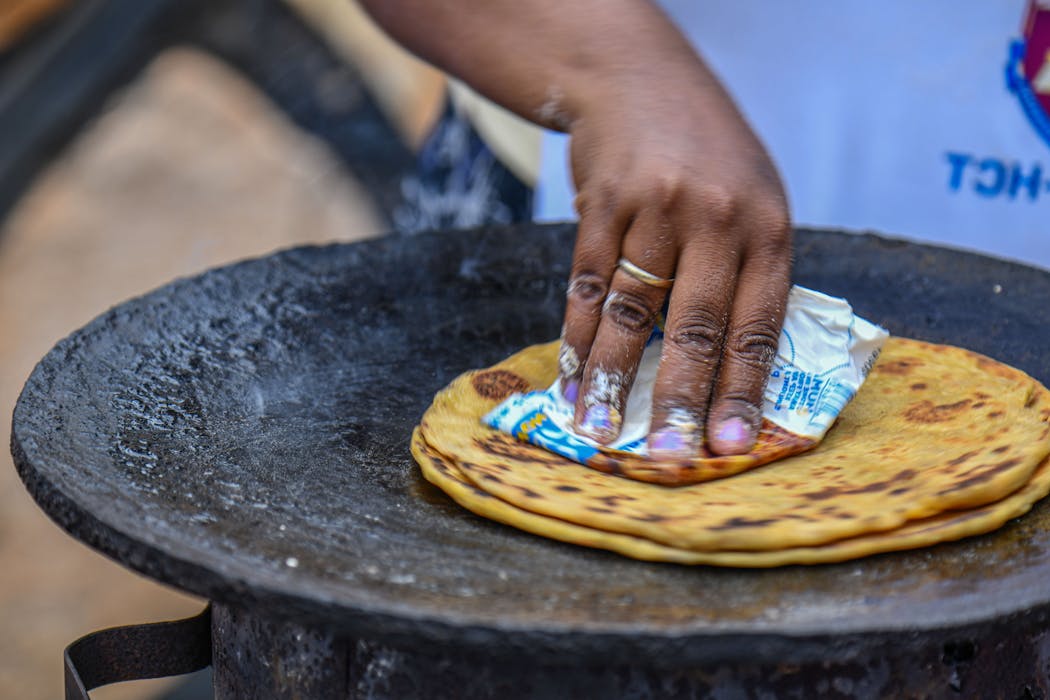
Chapati can be made on the street and paired with meat and vegetables. Ssemmanda Will/Wikimedia Commons, CC BY-SA

As Kenya’s cities grew, more and more people left their rural homes and subsistence farming systems to go to urban settlements like Mombasa to find work. In the city, meals were paid for with cash, a major transformation in Kenya’s food systems.

A new book called Preparing the Modern Meal is an urban history that explores these processes. We asked historian Devin Smart about his study.


What’s the colonial history of Mombasa?

At the turn of the 20th century, the British were expanding their empire throughout sub-Saharan Africa, including the parts of east Africa that would become Kenya.

They built a railway that connected the port town of Mombasa on the Indian Ocean coast with the newly established Protectorate of Uganda in the interior. This created the foundations of the colonial economy and drove urbanisation.

While Nairobi grew in the Kenyan highlands, Mombasa became the most important port in east Africa. The city grew fast as people came to work at the railway, docks and in other parts of the urban economy.

After independence in 1963, cities like Mombasa carried on growing rapidly and more and more people started working in the informal sector, which included making and selling street food.

How did rural people get their food?

During the early 1900s, the cuisines of east Africa’s agrarian (farming) societies were mostly vegetarian. Much of the food people ate was grown in their own fields, though there were also regional markets.

These communities grew lots of staple crops like sorghum, millet, maize, bananas, cassava, and sweet potatoes. They also had legumes, greens, and dairy products as regular parts of their meals.

These ingredients were prepared into a variety of dishes, like the Kikuyu staple irio, a mash of bananas with maize kernels and legumes added to it. The Kamba often ate isio, a combination of beans and maize kernels, while the Luo who lived along the shores of Lake Victoria regularly included a dish called kuon as part of their cuisine. It’s a thick porridge of boiled milled grain (often millet), eaten with fish or vegetables to add contrasting flavours and textures.

In these communities, the daily meal was also defined by seasonal variety. Food changed depending on what was being harvested or what stores of ingredients were dwindling. These were also gendered food systems, with women doing much of the farming work and nearly all the cooking.

In my book, I consider the dramatic changes in how east Africans came by their food when they left these rural food systems for the city.

How was food organised in the city?

In Mombasa, they entered a food system organised around commercial exchange. My study is about Kenya, but the story it reflects is one that’s unfolded on a global scale. The shift from subsistence to commodified food systems, from growing your own to buying it from others, has been one of the central features of the modern world.

By the 1930s, most people in Mombasa bought nearly all their food with cash, visiting small dried-goods grocers, fresh-produce vendors, and working-class eateries. In this urban food system, the seasonal variety of rural cuisines was increasingly replaced by the regularity of commercial supply chains.

A hand holds a folded flatbread above a plate of rice and beans.
Pilau, beans and chapati.
Teddykip/Wikimedia Commons, CC BY

This was especially the case with staple grains. In the countryside, people ate a variety of grains, but in Mombasa maize meal and wheat became daily staples eaten year-round, transforming east African foodways.

Migration also changed domestic labour in the kitchen. Many migrant men now lived in homes without women, which meant they had to prepare their own food, often for significant periods of their lives.

However, the idea that cooking was the work of women proved enduring. When women joined these households in the city, they again prepared the family’s meals.

How did street food emerge?

By the 1930s, Mombasa had a fast-growing working class. The majority of the town’s workers spent their days in the industrial district, around the railway and port. Many also had to commute a considerable distance to work.

With the long working day of urban capitalism, returning home for a filling lunch wasn’t practical, which created strong demand for affordable prepared food at midday. As this was happening, many in the city also struggled to find consistent jobs and turned to informal trades like street food to earn a living.

This convergence of supply and demand led to the rapid growth of the street food industry around the 1950s, with people opening eateries in makeshift structures outside the gates to the port and in nearby alleyways, parks, and other open spaces.

What kind of food was served?

At these working-class food spots, a popular dish was chapati, an east African version of the South Asian flatbread. People could complement it with beans, meat, or fried fish, along with githeri, a mixture of maize kernels and beans (similar to isio).

In later decades, ugali, the ubiquitous Kenyan staple made from maize meal, became more common at street food eateries, as did Swahili versions of Indian Ocean dishes like pilau (aromatic rice with meat) and biryani (rice with meat braised in a spice-infused tomato sauce).

How were street food vendors policed?

The business model that made street food work in Mombasa’s economy also brought these vendors into regular conflict with the city’s administration. Street food vendors kept overheads and thus prices low because they avoided rents and licensing fees by squatting on open land in makeshift structures.

But, in an era of urban development and modernisation, many officials desired a different kind of city, one without this kind of informal land use and architecture. Authorities began campaigns to remove these businesses from Mombasa’s landscape, arresting vendors and demolishing their structures.

This also created a tension, though, because the city’s workers, including those at the port and railway who ran the most important transportation choke point in east Africa’s regional economy, needed affordable meals at lunch.

Given that informal trade had become essential to Mombasa’s economy, there were limits on how far these campaigns could be pushed. However, arrests and demolitions did still occur, and sometimes on a dramatic, city-wide scale, which made street food a precarious way to earn a living in Kenya’s port town.

For example, in 2001, the Kenyan government launched a massive demolition campaign to clear informal business structures from city sidewalks, parks and open spaces.

After the demolitions, many rebuilt and reopened their street food businesses, but in less visible parts of town and on side streets rather than main roads. Today, these eateries remain an essential part of Mombasa’s economy and food system.

What do you hope readers will take away from the book?

I hope that readers will see how food history helps us understand the ways that capitalism transformed the modern world.

The regional focus of the book is east Africa, but it explores themes relevant to the history of capitalism more generally, including the gendered division of household labour, the commercialisation of everyday needs and wants, and the political and economic struggles of working-class communities to find space for themselves in modern cities.

The Conversation

The research for this book was supported with funding from the University of Illinois at Urbana-Champaign and West Virginia University.

ref. Street food in Mombasa: how city life shaped the modern meal – https://theconversation.com/street-food-in-mombasa-how-city-life-shaped-the-modern-meal-266590

Oldest known cremation in Africa poses 9,500-year-old mystery about Stone Age hunter-gatherers

Source: The Conversation – USA – By Jessica C. Thompson, Assistant Professor of Anthropology, Yale University

Why did this community burn one woman’s remains in such a visible, spectacular way? Patrick Fahey

Near the equator, the Sun hurries below the horizon in a matter of minutes. Darkness seeps from the surrounding forest. Nearly 10,000 years ago, at the base of a mountain in Africa, people’s shadows stretch up the wall of a natural overhang of stone.

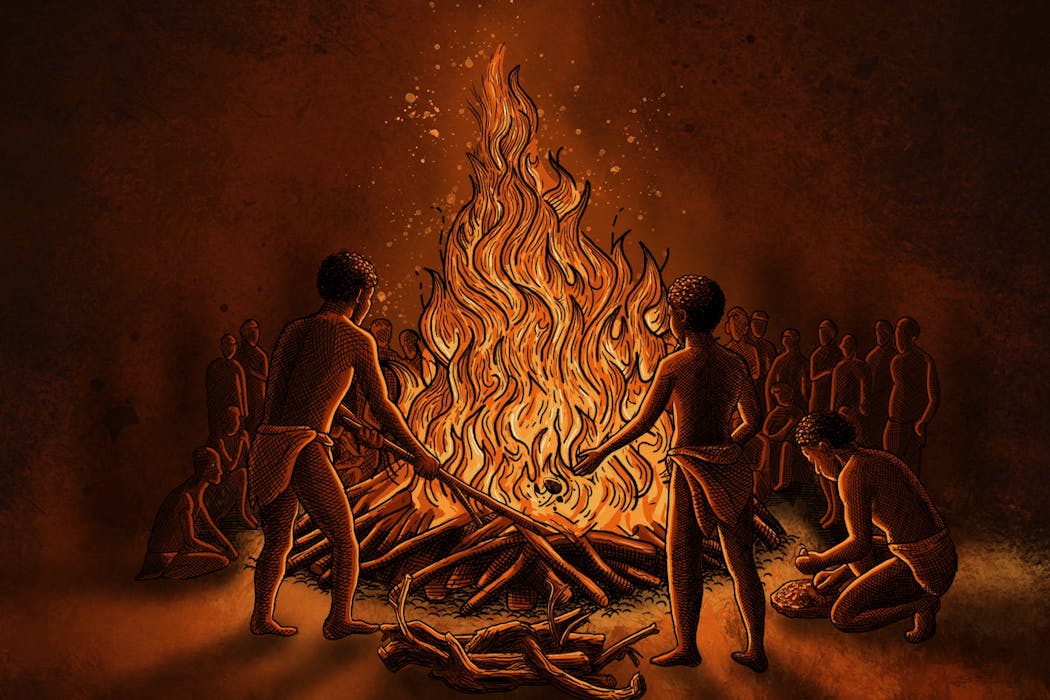
They’re lit by a ferocious fire that’s been burning for hours, visible even to people miles away. The wind carries the smell of burning. This fire will linger in community memory for generations − and in the archaeological record for far longer.

We are a team of bioarchaeologists, archaeologists and forensic anthropologists who, with our colleagues, recently discovered the earliest evidence of cremation – the transformation of a body from flesh to burned bone fragments and ashes – in Africa and the earliest example of an adult pyre cremation in the world.

Small map of Africa next to a big image of a bare rock mountaintop at sunset. The slopes are covered in forest.
The pyre was found under a giant boulder near the base of Mount Hora. The site is in Malawi, which is outlined in black within the Zambezian forest (colored green) on the map of Africa.
Jessica Thompson and Natural Earth

It’s no easy task to produce, create and maintain an open fire strong enough to completely burn a human body. While the earliest cremation in the world dates to about 40,000 years ago in Australia, that body was not fully burned.

It is far more effective to use a pyre: an intentionally built structure of combustible fuel. Pyres appear in the archaeological record only about 11,500 years ago, with the earliest known example containing a cremated child under a house floor in Alaska.

Many cultures have practiced cremation, and the bones, ash and other residues from these events help archaeologists piece together past funeral rituals. Our scientific paper, published in the journal Science Advances, describes a spectacular event that happened about 9,500 years ago in Malawi in south-central Africa, challenging long-held notions about how hunter-gatherers treat their dead.

people with digging tools against a landscape that looks like hardpacked earth
Excavators standing at the depth of the pyre at the Hora 1 site in northern Malawi.
Jessica Thompson

The discovery

At first it was just a hint of ash, then more. It expanded downward and outward, becoming thicker and harder. Pockets of dark earth briefly appeared and disappeared under trowels and brushes until one of the excavators stopped. They pointed to a small bone at the base of a 1½-foot (0.5-meter) wall of archaeological ash revealed under a natural stone overhang at the Hora 1 archaeological site in northern Malawi.

The bone was the broken end of a humerus, from the upper arm of a person. And clinging to the very end of it was the matching end of the lower arm, the radius. Here was a human elbow joint, burned and fractured, preserved in sediments full of debris from the daily lives of Stone Age hunter-gatherers.

We wondered whether this could be a funeral pyre, but such structures are extremely rare in the archaeological record.

man kneeling on a board measures down into the excavated area
Excavators began finding a thick ash deposit about 2 feet (0.6 meters) under the modern-day surface of the rock shelter.
Jessica Thompson

Finding a cremated person from the Stone Age also seemed impossible because cremation is not generally practiced by African foragers, either living or ancient. The earliest evidence of burned human remains from Africa date to around 7,500 years ago, but that body was incompletely burned, and there was no evidence of a pyre.

The first clear cases of cremation date to around 3,300 years ago, carried out by early pastoralists in eastern Africa. But overall the practice remained rare and is associated with food-producing societies and not hunter-gatherers.

We found more charred human remains in a small cluster, while the ash layer itself was as large as a queen bed. The blaze must have been enormous.

When we returned from fieldwork and received our first radiocarbon dates, we were shocked again: The event had happened about 9,500 years ago.

Piecing together the events

We built a team of specialists to piece together what had happened. By applying forensic and bioarchaeological techniques, we confirmed that all the bones belonged to a single person who was cremated shortly after her death.

This was a small adult, probably a woman, just under 5 feet (1.5 meters) in height. In life, she was physically active, with a strong upper body, but had evidence of a partially healed bone infection on her arm. Bone development and the beginnings of arthritis suggested she was probably middle-aged when she died.

Three images showing thin marks on a gray bone fragment. The images get more zoomed in moving to the right.
Marks incised on the shaft of the lower arm bone (radius) were inflicted by a stone tool. The bone then turned gray as it burned. The area in the box on the left is enlarged on the right of the image.
Jessica Thompson

Patterns of warping, cracks and discoloration caused by fire damage showed her body was burned with some flesh still on it, in a fire reaching at least 1,000 degrees Fahrenheit (540 degrees Celsius). Under the microscope we could see tiny incisions along her arms and at muscle connections on her legs, revealing that people tending the pyre used stone tools to help the process along by removing flesh.

Six fragments of shiny white and brown stone on a black background.
Tiny pointed tools made from local stone were found within the pyre. They were probably made at the same time that it burned.
Justin Pargeter

Within the pyre ash, we found many small pointed chips of stone that suggested people had added tools to the fire as it burned.

And the way the bones were clustered inside such a large fire showed that this was not a case of cannibalism: It was some other kind of ritual.

Perhaps most surprisingly, we found no evidence of her head. Skull bones and teeth usually preserve well in cremations because they are very dense. While we can’t know for sure, the absence of these body parts suggest her head may have been removed before or during the cremation as part of the funeral ritual.

A communal spectacle

We determined that the pyre must have been built and maintained by multiple people who were actively engaged in the event. During new excavations the following year, we found even more bone fragments from the same ancient woman, displaced and colored differently from in the main pyre. These additional remains suggest that the body was manipulated, attended and moved during the cremation.

Microscopic analysis of ash samples from across the pyre included blackened fungus, reddened soil from termite structures, and microscopic plant remains. These helped us estimate that people collected at least 70 pounds (30 kg) of deadwood to do the task and stoked the fire for hours to days.

We also learned that this was not the first fire at the Hora 1 site – nor its last. To our astonishment, what had seemed during fieldwork to be a single massive pile of ash was in fact a layered series of burning events. Radiocarbon dating of the ash samples showed that people began lighting fires on that spot by about 10,240 years ago. The same location was used to construct the cremation pyre several hundred years later. As the pyre smoldered, new fires were kindled on top of it, resulting in fused ashes in microscopic layers.

A mix of grey, brown, white and black colors showing what soil and ash looks like under a microscope.
Loose, sandy, burned soil was mixed on top of very thin layers of ash, showing that the pyre was lit over and over again.
Flora Schilt

Within a few hundred years of the main event, another large fire was built again at the exact same place. While there is no evidence that anyone else was cremated in the subsequent fires, the fact that people repeatedly returned to the spot for this purpose suggests its significance lived on in community memory.

A new view of ancient cremation

What does all of this tell us about ancient hunter-gatherers in the region?

For one, it shows that entire communities were engaged in a mortuary spectacle of extraordinary scale. An open pyre can take more than a day of constant tending and an enormous amount of fuel to fully reduce a body, and during this time the sights and smells of burning wood and other remains are impossible to hide.

This scale of mortuary effort is unexpected for this time and place. In the African record, complex multigenerational mortuary rituals tied to specific places are generally not associated with a hunting-and-gathering way of life.

flames of a pyre against dark black background
The pyre event was a spectacle that required many hours of communal effort and would have been impossible to hide.
Anders Blomqvist/Stone via Getty Images

It also shows that different people were treated in different ways in death, raising the possibility of more complex social roles in life. Other men, women and children were buried at the Hora 1 site beginning as early as 16,000 years ago. In fact, those other burials have provided ancient DNA evidence showing they were part of a long-term local group. But those burials, and others that came a few hundred years after the pyre, were interred without this labor-intensive spectacle.

What about this person was different? Was she a beloved family member or an outsider? Was this treatment because of something she did in life or a specific hope for the afterlife? Additional excavation and data from across the region may help us better understand why this person was cremated and what cremation meant to this group.

Whoever she was, her death had important meaning not just to the people who made and tended the pyre, but also to the generations that came after.

The Conversation

Jessica C. Thompson has received funding for this research from the Wenner-Gren Foundation, National Geographic Society, and Hyde Family Foundations. She is affiliated with the Yale Peabody Museum and the Institute of Human Origins.

Elizabeth Sawchuk and Jessica Cerezo-Román do not work for, consult, own shares in or receive funding from any company or organization that would benefit from this article, and have disclosed no relevant affiliations beyond their academic appointment.

ref. Oldest known cremation in Africa poses 9,500-year-old mystery about Stone Age hunter-gatherers – https://theconversation.com/oldest-known-cremation-in-africa-poses-9-500-year-old-mystery-about-stone-age-hunter-gatherers-268074

Three climate New Year’s resolutions that will fail – and four that can actually stick

Source: The Conversation – UK – By Anastasia Denisova, Senior Lecturer in Journalism, University of Westminster

Going cold turkey on flights is tough. Instead, resolve to take the train where possible. Jaromir Chalabala / shutterstock

Four in five adults in the UK say they have changed their lifestyle to help tackle environmental change. The New Year is a good time to implement changes to behaviour, but our willpower is finite.

The secret isn’t to be more virtuous, but to be strategic.

If you want 2026 to be the year you make a difference without burning out, here is what the evidence suggests you should prioritise – and what you should ignore.

Here are some resolutions that are likely to work.

1. Buy clothes from a reselling platform once a month

Immediate gratification is one of the most reliable predictors of long-term success. A vow to “buy nothing” is miserable and hard to keep. A vow to “buy second hand” gives you a treasure hunt.

A garment spends 2.2 years on average in a UK wardrobe, while fashion remains one of the biggest polluters – that’s why buying lots of outfits from the high street is problematic. Reselling platforms such as Vinted, Depop and eBay, or charity shops, can provide a guilt-free solution to the endless consumption encouraged by the fashion media and influencers.

2. Make plans with friends

Making changes is hard – and it’s even harder doing it alone. We are social animals, susceptible to “social proof” – naturally adopting the behaviour of people we admire or respect.

Leverage this by finding your herd. Identify a couple of friends, family members or colleagues who are interested in gardening, walks in nature, mending clothes, volunteering at a local farm or attending or teaching a zero-waste cooking workshop. Having a plan acts as scaffolding for a new habit, but making that plan with friends turns an eco-practice into a social event you actually look forward to.

two people gardening in an allotment
Rope your friends in – they’ll help you stick to your resolutions.
Monkey Business Images / shutterstock

3. Indulge in grains, vegetables and dips twice a week

Numerous studies warn about the harmful effects of a meat-heavy diet. But for “meat-attached” eaters, going cold turkey (or cold tofu) rarely works.

Instead, use positive framing. Not “eat less of this”, but “eat more of this”. Change “meat-free Monday” to “hummus-heavy Mondays”. Research shows that the most unshakeable burger enthusiasts can still be convinced to reduce their meat intake through the argument of food purity (avoiding hormones and factory farming) and the health benefits (weight control, cholesterol). Frame the resolution as indulging in grains, vegetables and dips, rather than restricting meat.

4. The ‘boring’ one: write to your MP

Less entertaining than other resolutions, this suggestion is nonetheless likely to have longer and wider repercussions. Leading climate thinkers such as academics Hannah Ritchie and Kimberly Nicholas argue that influencing policy is a stronger action than adjusting your individual behaviour.

A letter written to your local MP can echo in the higher echelons of power. Imagine your representative telling the Prime Minister: “my constituents are demanding greener energy and transport”. It takes 15 minutes. Charities such as Friends of the Earth even provide templates. It’s a low-effort, high-impact resolution.

On the other hand, there are some resolutions that are more likely to fail.

1. The ‘I will never fly again’ trap

Giving up flying is an effective way to shrink your carbon footprint, but it’s a tough New Year resolution to stick to. For many with family abroad or tight budgets, the price disparity between cheap (often heavily subsidised) flights and expensive trains makes this difficult to sustain, adding financial complications to an already tricky ethical dilemma.

A more realistic approach would be to commit to “no domestic flights” or “trains where possible”. Save the hardline stance for when the mince pies have settled.

2. Trying to go ‘all green’ at once

Beware the “sustainable consumption paradox”. This is the paralysis that comes from being overwhelmed with information when trying to make greener choices: worrying that your recycled plastic takes too much energy to produce, or if your fair trade coffee caused deforestation.

Trying to fix every aspect of your life leads to information overload and failure. Pick two or three battles, no more.

3. Converting the non-believers

Resolving to convert your friends and family is a recipe for conflict, not change. Shame triggers defensiveness, not action.

Instead, lead by example. Talk about your new habits casually – mention the bargain you found on Vinted or your new recipe for beef-free bolognese – without preaching. You are more likely to plant a seed with enthusiasm than with a smug lecture.

Eco-awareness is very high in the UK, so if you’re reading this, know that you’re in the majority. The best strategy to turn concern into action is to quiet the overthinking and begin 2026 with optimism and a realistic, achievable commitment.

The Conversation

Anastasia Denisova received funding from JJ Trust for her research policy brief Fashion Media and Sustainability.

ref. Three climate New Year’s resolutions that will fail – and four that can actually stick – https://theconversation.com/three-climate-new-years-resolutions-that-will-fail-and-four-that-can-actually-stick-271988

Why New Year’s resolutions might feel harder this year – and what could help

Source: The Conversation – UK – By Vlad Glăveanu, Professor of Psychology, Business School, Dublin City University

Boontoom Sae-Kor/Shutterstock

The start of a new year has long been considered an important moment for personal change. Psychological research shows that calendar landmarks such as birthdays, Mondays or the new year can act as mental reset points, making people more likely to reflect on their lives and attempt new goals. This phenomenon was described by researchers more than a decade ago as the “fresh start effect”.

Yet many people reach the new year less enthusiastically than they once did. We live in a world in which mental wellness is deteriorating, particularly among young people, and in which being asked to imagine change can be daunting. Climate anxiety, political instability and economic precarity can all make the idea of “starting over” seem unrealistic.

Research also shows that repeated or imposed change can lead to change fatigue. This is a state of emotional exhaustion that reduces people’s willingness to engage with new initiatives, even when they are presented as positive. Rather than renewing hope, calls for change can provoke scepticism, withdrawal or disengagement in these people.

Our ability to imagine the future is not unlimited. Studies on anxiety and uncertainty consistently show that when people feel under threat or lack control, their future-oriented thinking narrows. Instead of imagining a range of possibilities, people tend to focus on risks, losses and worst-case scenarios.

So if you’re struggling to make changes, the problem is not necessarily a lack of imagination or hope. It could be that circumstances are making it difficult for hope and imagination to operate.

My own research at the DCU Centre for Possibility Studies focuses on what psychologists call possibility thinking. This is about how people perceive what could be different, explore alternatives and feel able to act. A 2024 study showed that these elements need to support each other. When people can see opportunities but feel unable to act on them, or feel motivated but unable to imagine alternatives, meaningful change is difficult.

Woman in suit sitting at desk with hands over her face under her glasses
Feeling too frazzled to set a resolution? It could be change fatigue.
CrizzyStudio/Shutterstock

This pattern emerged in a December 2025 study I co-authored, which involved teachers taking part in a professional development programme meant to stimulate possibility thinking. During the study, participants found out they would soon move into a new school building, as their existing school was to be demolished. Many teachers reported emotional fatigue in response to the prospect of having to “start over” yet again. Instead of excitement, the dominant response was depletion and reduced motivation.

Although this example concerns a life transition rather than the new year, it helps to explain why fresh starts can feel harder in the current climate. When people feel that a change is unfair, badly supported and might harm them, they are less likely to get behind it and more likely to push back. This can undermine their capacity to engage with new possibilities.

This also helps explain why many New Year’s resolutions don’t stick: people often treat them as tests of pure willpower, but research shows that lasting change depends much more on how goals are set up, supported and built into everyday life.

Decades of research on behaviour change show that motivation is shaped by context. Time pressure, financial stress, caring responsibilities and institutional constraints all limit what people can realistically change, regardless of their intentions.

Rather than focusing on dramatic reinvention, it may be more realistic to ask what small shifts are possible within the constraints you’re under. Possibility thinking does not mean ignoring limits or pretending everything will improve. It involves learning how to work creatively with constraints, rather than against them.

For example, someone who knows they have limited time and energy might set a resolution like: “I will add a 10‑minute walk into my daily routine, such as after lunch or school drop‑off, and adjust it each week based on what is actually workable for me.”

It’s also important to recognise that imagining the future doesn’t have to be an individual activity. Research on shared or collective agency shows that people are better at envisioning and sustaining change when responsibility is distributed across groups, whether in families, workplaces or communities. Discussing limits and possibilities together can expand what feels achievable.

For example, a family might make a shared resolution to eat more home‑cooked meals, dividing tasks so that one person plans the menu, another cooks on certain nights, and children help with prep. That way, the change is carried and sustained by the group rather than one person.

In the end, the new year is a powerful cultural moment. But in a world shaped by uncertainty and fatigue, renewal is unlikely to come from pressure to “start fresh” or try harder. It may come, instead, from learning to imagine differently: with others, within limits, and in ways that make positive, even if small, changes still feel possible.

The Conversation

Vlad Glăveanu does not work for, consult, own shares in or receive funding from any company or organisation that would benefit from this article, and has disclosed no relevant affiliations beyond their academic appointment.

ref. Why New Year’s resolutions might feel harder this year – and what could help – https://theconversation.com/why-new-years-resolutions-might-feel-harder-this-year-and-what-could-help-272456