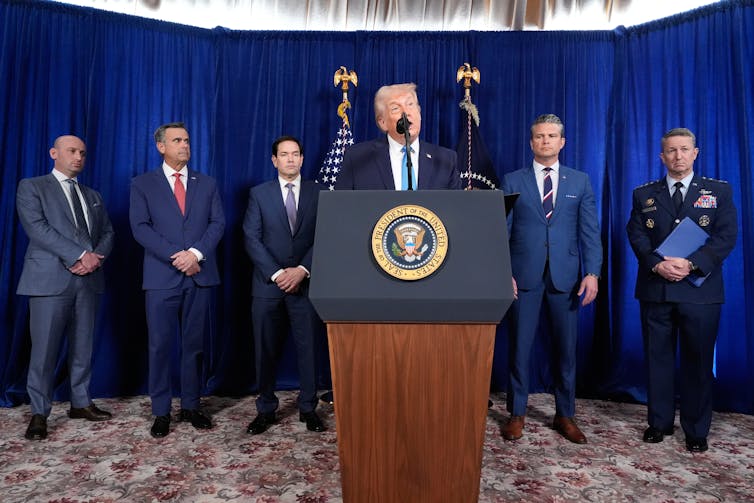
How Maduro’s capture went down – a military strategist explains what goes into a successful special op

Source: The Conversation – Global Perspectives – By R. Evan Ellis, Senior Associate, Americas Program, The Center for Strategic and International Studies
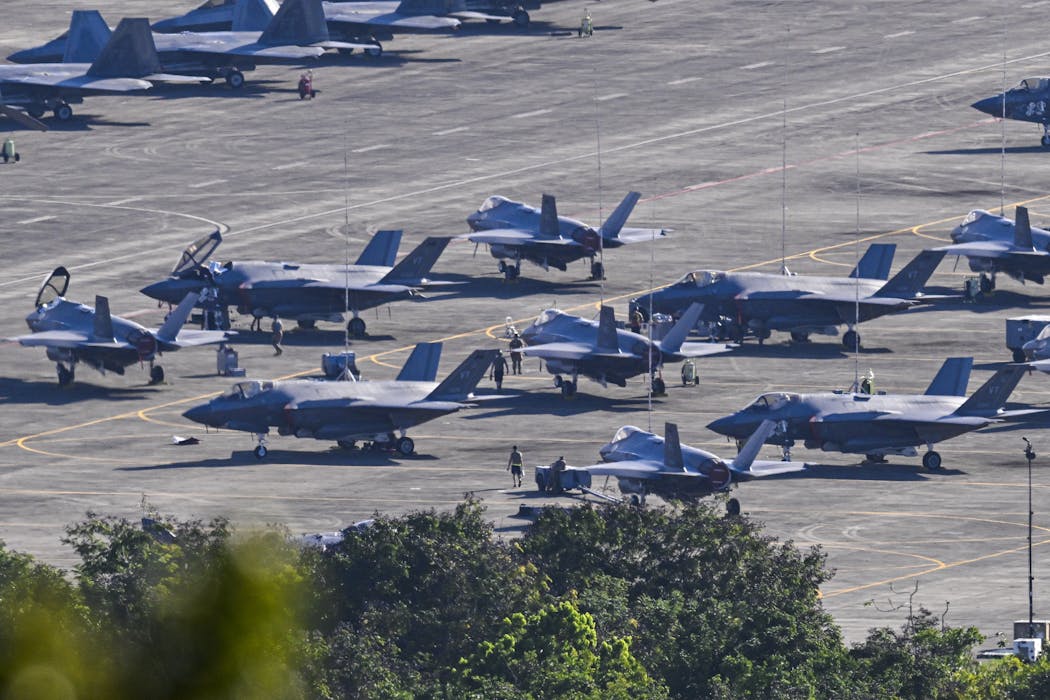
U.S. military fighter jets sit on the tarmac at José Aponte de la Torre Airport in Puerto Rico, on Jan. 3, 2026. Miguel J. Rodriguez Carrillo / AFP via Getty Images

The predawn seizure of Venezuelan President Nicolás Maduro on Jan. 3, 2026 was a complicated affair. It was also, operationally, a resounding success for the U.S. military.

Operation Absolute Resolve achieved its objective of seizing Maduro through a mix of extensive planning, intelligence and timing. R. Evan Ellis, a military strategist and former Latin America policy adviser to the U.S. State Department, walked The Conversation through what is publicly known about the planning and execution of the raid.

How long would this op have been in the works?

Operation Absolute Resolve was some months in the planning, as the Pentagon acknowledged in its briefing on Jan. 3. My presumption is that from the beginning of the U.S. military buildup in the Caribbean and the establishment of Joint Task Force Southern Spear in the fall, military planners were developing options for the president to capture or eliminate Maduro and other key Chavista leadership, should coercive efforts at persuading a change in the Venezuelan situation fail.
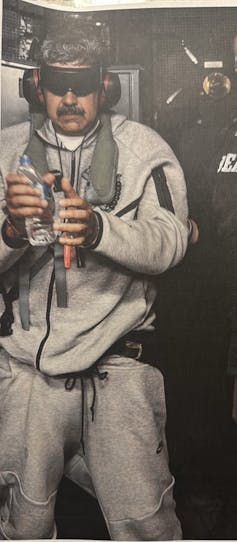
A man in a blindfold holds a bottle of water.
An image of a captured Nicolás Maduro released by President Donald Trump on social media.
Truth Social

Prior to Southern Spear, U.S. military activities in the region were directly overseen by Southern Command – the part of the Department of Defense responsible for Central America, South America and most of the Caribbean. But establishing a dedicated joint task force in October 2025 helped facilitate the coordination of a large operation, like the one conducted to seize Maduro.

Planning for the Jan. 3 operation likely became more detailed and realistic as the administration settled on a concrete set of options. U.S. forces practiced the raid on a replica of the presidential compound. “They actually built a house which was identical to the one they went into with all the same, all that steel all over the place,” President Donald Trump told “Fox & Friends Weekend.”

Why did the US choose to act now?

The buildup had been going on for months, and the arrival of the USS Gerald R. Ford in November was a key milestone. That gave the U.S. the capability to launch a high volume of attacks against land targets and added to the already huge array of American military hardware stationed in the Caribbean.

It joined an Iwo Jima Amphibious Ready Group, which included a helicopter dock ship and two landing platform vessels. An additional six destroyers and two cruisers were stationed in the region with the capability of launching hundreds of missiles for both land attack and air defense, as well as a special operations mother ship.

Trump’s authorization of CIA operations in Venezuela was probably also a key factor. It is likely that individuals inside Venezuela played invaluable roles not only in obtaining intelligence, but also in cooperating with key people in Maduro’s military and government to make sure they did – or did not do – certain things at key moments during the Jan. 3 operation.

With the complex array of plans and preparations in place by December, the U.S. military was likely ready to execute, but it had to wait for opportune conditions to maximize the probability of success.

What constitutes the opportune moment?

There are arguably three things needed for the opportune moment: good intelligence, the establishment of reliable cooperation arrangements on the ground, and favorable tactical conditions.

Intel would have been crucial. Trump acknowledged his authorization of covert CIA operations in Venezuela in October, and evidently, by the end of the year, analysts had gathered the information needed to make this operation go smoothly. The intelligence would have had to include knowing exactly where Maduro would be at the time of the operation, and the situation around him.

Over the past few months, according to media reporting, the intelligence community had agents on the ground in Venezuela, likely having conversations with people in the military, the Chavista leadership and beyond, who had crucial information or whose behavior was relevant to different parts of the operation – such as perhaps shutting down a system, standing down a military unit or being absent from a post at a key moment. A report from The New York Times indicates that the U.S. had a human source close to Maduro who was able to provide details of his day-to-day life, down to what he ate.

The more tactical conditions that were needed for the opportune moment involved things like the weather – you didn’t want storms or high winds or cloud cover that would put U.S. aircraft in danger as they flew in some very treacherous low-level routes through the mountains that separate Fort Tiun – the military compound in Caracas where Maduro was captured – from the coast.

How did the operation unfold?

Gen. Dan Caine, chairman of the Joint Chiefs of Staff, has given some details about how the plan was executed.

We know the U.S. launched aircraft from multiple sites – the operation involved at least 20 different launch sites for 150 planes and helicopters. These would have involved aircraft for jamming operations, some surveillance, fighter jets to strike targets, and some to provide an escort for the helicopters bringing in a special forces unit and members of the FBI.
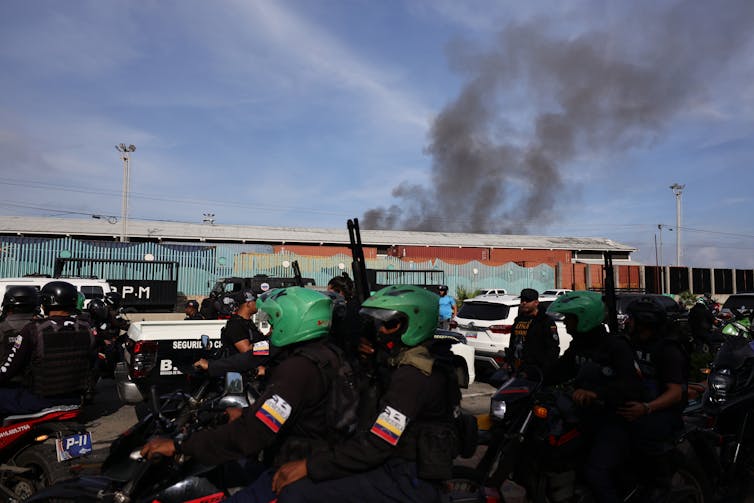
A cloud of black smoke is seen above a building.
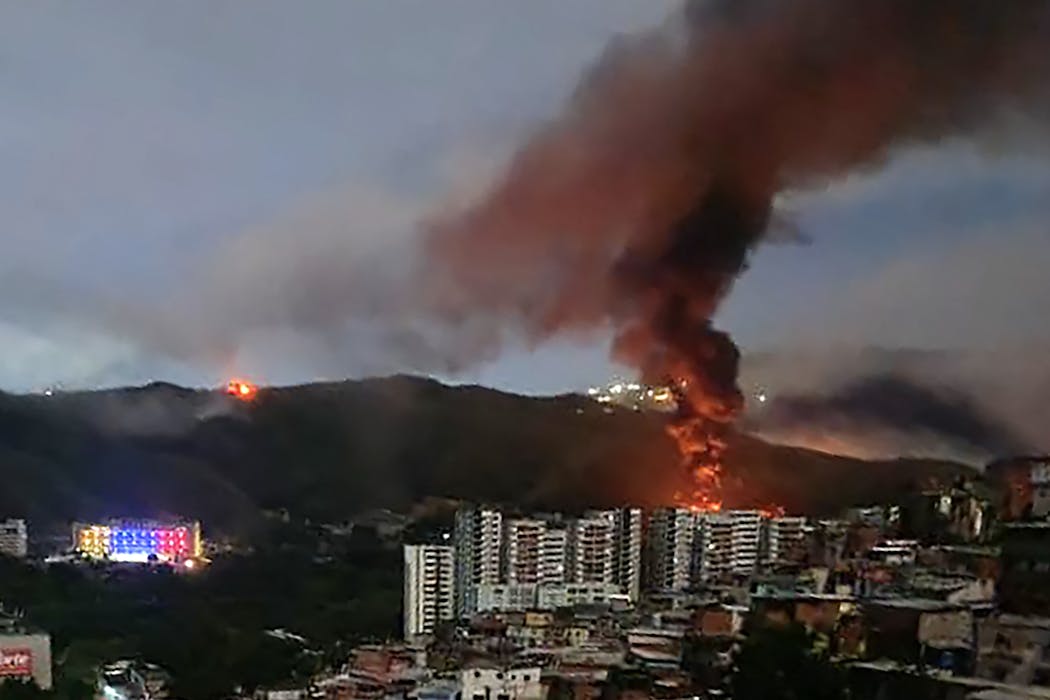
Smoke is seen billowing above the Port of La Guaira on Jan. 3, 2026, in Venezuela.
Jesus Vargas/Getty Images

As an integral part of the operation, the U.S. carried out a series of cyber activities that may have played a role in undermining not only Venezuela’s defense systems, but also its understanding of what was going on. Although the nature of U.S. cyber activities is only speculation here, a coherent, alerted Venezuelan command and control system could have cost the lives of U.S. force members and given Maduro time to seal himself in his safe room, creating a problem – albeit not an insurmountable one – for U.S. forces.

There was also, according to Trump, a U.S.-generated interruption to some part of the power grid. In addition, it appears that there may have been diversionary strikes in other parts of the country to give a false impression to the Venezuelan military that U.S. military activity was directed toward some other, lesser land target, as had recently been the case.

U.S. aircraft then basically disabled Venezuelan air defenses.

As U.S. rotary wing and other assets converged on the target in Caracas – with cover from some of the most capable fighters in the U.S. inventory, including F-35s and F-22s, as well as F-18s – other U.S. assets decimated the air defense and other threats in the area.

It would be logical if elite members of the U.S. 160th Special Operations Aviation Regiment were used in the approach to the compound in Caracas. Their skills would have been required if, as I presume, they came in via the canyon route that separates Caracas from the coast. I have driven the road through those mountains, and it is treacherous – especially for an aircraft at low altitude.

Once the team landed, it would have have taken a matter of minutes to infiltrate the compound where Maduro was.

Any luck involved?

According to Trump, the U.S. team grabbed Maduro just as he was trying to get into his steel vault safe room.

“He didn’t get that space closed. He was trying to get into it, but he got bum-rushed right so fast that he didn’t get into that,” the U.S. president told Fox & Friends Weekend.

Although the U.S. was reportedly fully prepared for that eventuality, with high-power torches to cut him out, that delay could have cost time and possibly lives.

It was thus critical to the U.S. mission that forces were able to enter the facility, reach and secure Maduro and his wife in a minimal amount of time.

The Conversation

The views expressed in this article are those of the author and do not represent the Department of Defense or the US government.

ref. How Maduro’s capture went down – a military strategist explains what goes into a successful special op – https://theconversation.com/how-maduros-capture-went-down-a-military-strategist-explains-what-goes-into-a-successful-special-op-272671
How US intervention in Venezuela mirrors its actions in Panama in 1989

Source: The Conversation – UK – By Adriana Marin, Lecturer in International Relations, Coventry University

The US dramatically escalated its confrontation with Venezuela on January 3, moving from sanctions and targeted strikes on alleged drug-trafficking vessels to direct military action. In a pre-dawn operation, US forces captured the Venezuelan president, Nicolás Maduro, and his wife, Cilia Flores, and removed them from the country.

The operation has prompted historical comparisons with the US invasion of Panama in late 1989. Although separated by more than three decades and unfolding in different international contexts, the two episodes reveal a continuity in how the US approaches intervention, sovereignty and legality in the western hemisphere.

The US invasion of Panama was justified at the time through a now-familiar set of claims. US officials argued they were protecting American citizens, restoring democracy following contested elections, combating drug trafficking and upholding treaty obligations linked to the Panama canal.

However, none of these arguments provided a solid legal basis for the use of force under the UN charter. Panama had not attacked the US, there was no imminent armed threat and the operation was not authorised by the UN security council. The invasion prompted international condemnation and was denounced by the UN general assembly as a violation of international law.

Yet concern over the legality of the operation mattered far less to the US than its political outcome. The Panamanian leader, Manuel Noriega, was removed from power and transferred to the US where he was tried on criminal charges. The US achieved its strategic objectives quickly and international condemnation produced no lasting consequences.

Panama thus established a powerful precedent: a smaller state could be reshaped forcibly without multilateral approval, provided the intervention was framed persuasively and executed decisively.

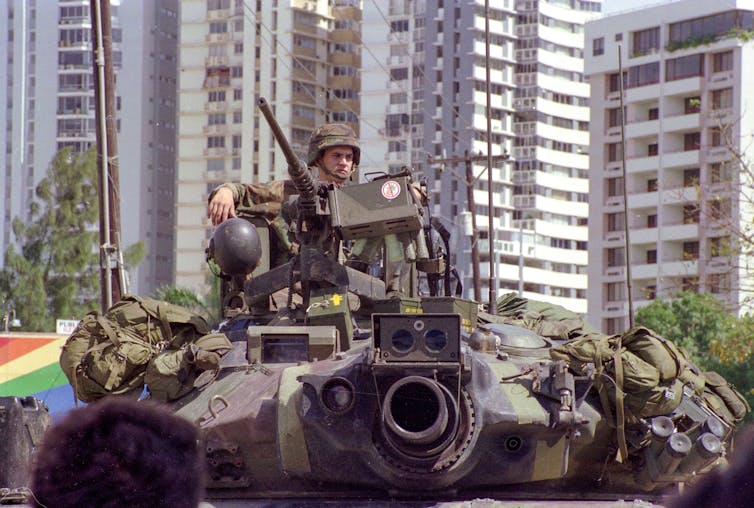
A US military vehicle in the Punta Paitilla neighbourhood of Panama City.
A US military vehicle in the Punta Paitilla neighbourhood of Panama City in December 1989.
Amador Diversified / Shutterstock

Central to that framing was what I call the criminalisation of sovereignty. Noriega was portrayed by US politicians not simply as an authoritarian ruler, but as a criminal figure. This mattered because it blurred the line between war and law enforcement, enabling regime change to be recast simply as an arrest.

Panama’s sovereignty, in turn, appeared less like a legal right and more like a shield open to abuse by criminals. While legal issues remained, the framing reduced political resistance, particularly within the US. This logic has reemerged in US discourse surrounding Venezuela.

Venezuela’s authorities have long been portrayed by Washington as criminal, corrupt and illegitimate. The US has designated drug networks linked to Venezuela, such as the so-called Cartel de los Soles, as terrorist organisations. It has also issued indictments against Maduro and other government officials on narco-terrorism and drug-trafficking charges.

As was the case in Panama, this framing shifts the debate away from inter-state relations and towards enforcement against individuals. This weakens the perceived legitimacy of Venezuelan sovereignty and helps normalise coercive external action.

It may also hint at Maduro’s eventual fate. The US state department did not recognise Noriega as Panama’s head of state, which made his later prosecution easier because it was argued he was not entitled to immunity.

Maduro, in a similar way, has been described by the state department as the “de facto but illegitimate ruler of Venezuela”. This purported lack of democratic legitimacy could mean the two men ultimately face a similar outcome in court.

Democracy plays a rhetorical role in both cases. The invasion of Panama was presented as a response to cancelled elections and democratic breakdown. In Venezuela, claims of democratic illegitimacy, contested elections and authoritarian governance have been also used to justify sustained external pressure and, now, direct intervention.

In neither case does democracy function as a legal basis for the use of force. International law does not permit military action to restore or impose democracy, nor does it allow states to determine the legitimacy of other governments unilaterally. Democracy in these contexts operates as a moral narrative rather than a lawful justification.

Pattern of intervention

There are, of course, differences between the two cases. The operation in Panama saw tens of thousands of US troops deployed on the ground. The US intervention in Venezuela was more targeted, relying on a mix of economic sanctions, diplomatic isolation and the selective use of force.

But rather than signalling a transformation in strategic intent, this reflects changes in military technology, media scrutiny and political risk.

Unlike in 1989, modern interventions unfold under real-time global media coverage and social media scrutiny, sharply increasing reputational costs. Greater domestic sensitivity to foreign entanglements also raises the political risk of overt military action.

However, notwithstanding these changes, the objective in both cases remains the same: rapid political disruption designed to weaken or remove an unfriendly regime while avoiding the costs of prolonged occupation.

The international environment has also changed. Panama took place at the end of the cold war, when US dominance in the western hemisphere was largely uncontested. Venezuela unfolds in a more fragmented global order, where regional and global players are more willing to challenge US actions.

Yet this difference cuts both ways. While global opposition may be louder, the enforcement capacity of international law remains limited. As Panama demonstrated, condemnation without consequence does little to deter future interventions.

What ultimately unites the two cases is the principle of selective sovereignty. In both Panama and Venezuela, sovereignty has been treated not as a universal legal protection but as a conditional status. States governed by leaders that have been labelled as criminal, illegitimate or destabilising are seen as having forfeited their rights.

This is not how sovereignty functions in international law, but it is how power often operates in practice. Each time this logic is applied, it weakens the credibility of the rules-based international order and reinforces the idea that legality bends to strength.

Panama’s significance lies precisely in this normalisation, showing that intervention could succeed politically even when it failed legally. Venezuela suggests that this lesson has not only been learned, but refined. Where Panama involved overt illegality, Venezuela reflects a more diffused form of coercion, spread across legal, economic and military domains.

Recent events in Venezuela thus do not represent a dramatic break from past practice. They represent continuity. Panama was not an aberration of the late cold war but a formative moment in post-war US interventionism. Venezuela is its modern-day echo.

The language has evolved and the methods have adapted, but the underlying assumption remains stable: that when powerful states deem it necessary, sovereignty can be suspended, legality reinterpreted and intervention justified after the fact.

That is the real significance of the comparison. Panama then and Venezuela now show a durable pattern in how intervention is imagined, defended and repeated.

The Conversation

Adriana Marin does not work for, consult, own shares in or receive funding from any company or organisation that would benefit from this article, and has disclosed no relevant affiliations beyond their academic appointment.

ref. How US intervention in Venezuela mirrors its actions in Panama in 1989 – https://theconversation.com/how-us-intervention-in-venezuela-mirrors-its-actions-in-panama-in-1989-272659

Your new health habit may be just a mental shift away

Source: The Conversation – Canada – By Mandi Baker, Assistant Professor, Faculty of Kinesiology and Recreation Management, University of Manitoba

The new year starts for many by making resolutions to live healthier lives. This can mean getting fitter by joining a gym, signing up to Pilates classes or starting a new diet.

For many, these resolutions are hard to maintain and the new habits slip away. Unfortunately, there are many reasons why our best intentions fail; the kids get sick so you can’t get out for a class, the costs of equipment or membership become too steep, and kale just isn’t cutting it for dinner anymore. In the end, motivation for our new habits runs out.


Read more:
The science behind building healthy habits can help you keep your New Year’s resolution


When we choose activities for our leisure that do not bring intrinsic enjoyment and/or satisfaction, we find it hard to preserve. External motivations, like gaining a reward (a particular body shape) or avoiding a consequence (minimizing the risks related to heart health), can only take us so far.

When we do things that we truly love, that are aligned with our values and/or sense of self, or we would do even if no one was watching, then the chances of maintaining those physical activities are much higher. That means the goal of resolution-setting is to find the things that tap into our intrinsic motivations.

How we frame health

Another challenge to sticking with new health-related habits, is the very individual way that health is framed. Health is positioned as being not only an individual’s responsibility, but that the individual is to blame if they are unwell. While the medical model serves a purpose in identifying problems and addressing them, applying a deficiency-model rationality obscures critical awareness about the complex and many ways that social factors impact health.

Social models of health, such as The Social Determinants of Health by Dahlgreen & Whitehead (1991), demonstrate that not only do our physiology, lifestyle choices, social and community networks matter, but socio-economic, cultural and environmental conditions do too. This shifts the responsibilities for health away from loading individuals up on guilt to shared collective responsibilities among all strata of community, government and institutions for a population’s health.

The notion that health is an individual problem, or deficiency, can be isolating, making the work of an individual’s wellness goals an effort that they feel they must do alone, and against broad systemic constraints.

Sociologists have long warned us of how these ideas, among others, lead us to think and treat ourselves poorly when it comes to moving our (fabulous and functional) bodies. Blaming ourselves or seeing physical activity, fitness and health as beyond our reach is both demoralizing and demotivating. Let alone added layers of social, economic, geographical and political inequities. This can be as heavy, if not heavier, than anything you might “lift” at the gym.

Getting physically active

Getting physically active for the first time, or after years, or only after the holidays means exercising your mental prowess. This list offers some insights into how to do the mental exercise to get your body moving and enjoying it:

  • Be in your body: be embodied. Often made popular by mindfulness movements, the idea is to slow down your sophisticated mental processing to focus on your five senses and simply be in the moment. This teaches our nervous systems to take a break from processing stressful stimulus.

  • Get active for no other reason than to enjoy yourself! Leisure theory tells us that seeking external rewards can make free time feel like work. Look for physical activity that brings you joy — make it the thing you look forward to rather than dread.

  • Focus on what your body can DO rather than how it looks. Views of beautiful, attractive or healthy bodies constantly change. Focusing on what your body can and does do (a strengths-based approach to vitality) can be a subtle yet powerful mental shift to improve your quality of life.

  • Find your activity people. Get active with people who share your philosophies about health. Find supportive people who don’t judge, who understand motivation’s ups and downs, who acknowledge that bodies come in different shapes and sizes AND that bodies are capable and beautiful things of joy.

  • Get outside. Science tells us that heart rates and worrying (anxiety, depression and rumination) come down when spending just a little time in nature. No need for remote corners of the Earth — just a walk down the street can make a big difference.

Engaging in physical activities that are joy-filled is not only a pleasure but can be a political act of hopefulness and self-respect. It acts to resist social norms about individuating discourses about health and associated assumptions of body shape, size and fitness.

Celebrating bodies in their diversity, getting out and enjoying movement, representing that healthy bodies are diverse and getting active with friends can all be political acts that celebrate countercultural ideas about health.

Movin’ and groovin’ with friends celebrates community and the value-altering, motivational shift of joy-filled embodiment and physical activity.
This subtle shift in thinking, and moving, could be the puzzle piece you’ve been missing for maintaining healthy habits.

The Conversation

Mandi Baker receives funding from the Social Sciences and Humanities Research Council of Canada and has received funding from summer camps organisations and government bodies such as the Departments of Jobs, Precincts and Regions in Victoria, Australia, the Australian Camps Association and the YMCA Camps Victoria, Australia. She is affiliated with the Canadian Camps Association, the American Camp Association and Outward Bound Vietnam.

ref. Your new health habit may be just a mental shift away – https://theconversation.com/your-new-health-habit-may-be-just-a-mental-shift-away-271923

Alberta’s proposed $11-million reading tests won’t actually help struggling learners

Source: The Conversation – Canada – By Hetty Roessingh, Professor, Werklund School of Education, University of Calgary

The Alberta government recently introduced Bill 6, a proposed amendment to the Education Act, that it says will “prioritize literacy and numeracy and ensure the province’s youngest learners receive the help they need as early as possible.”

Large classes with students who have a range of learning needs, including tailored learning plans, are among the factors that can make it difficult for teachers to ensure each child’s needs are being met. Implementing early literacy and numeracy tests with the intent of early intervention for at risk learners has intuitive appeal.

If passed, Alberta’s Bill 6 legislation would mandate reading and math tests from kindergarten to Grade 3, effective by fall 2026. According to ministry officials, its goal is to identify learning gaps early using short, simple and non-graded activities.

The announcement has received swift and forceful reaction from academics, the Alberta Teachers’ Association and senior-level school administrators.

Their concerns relate to the validity and reliability of the tests, how they were developed and their instructional value. Critics also raise concerns over the lack of teacher consultation and involvement, additional time teachers will need to administer and score the tests and whether the test results will change teaching and learning practices.

Questions also remain about whether schools will need additional resources to address learning gaps identified by way of the tests, since the bill doesn’t include any mention of this. The $11 million dollar pricetag of Bill 6 may not reap the insights needed to identify and meaningfully intervene for young children at risk.

Why early literacy matters

The testing proposed in Bill 6 misses important dimensions of literacy development. Early reading proficiency depends largely on two skills: phonemic awareness (the awareness to notice and work with different sounds) and phonics (mapping sounds to letters).

These foundational concepts and skills are learned by the majority of young children by the end of Grade 2, including English language learners (ELL) and children disadvantaged by socio-economic status. Exposure to two languages may heighten ELLs’ keen perception of sounds, helping them to apply their knowledge of how letters and their sounds relate and different letter patterns to correctly pronounce written words.

A learning-to-read school book I had as a child, Friends and Neighbours, is still on my bookshelf. As a newly arrived immigrant to Canada at age four from Indonesia, I was relatively proficient in conversational English by Grade 2. I learned the process of reading, including how to sound out letters and their English language patterns, by drawing on the vocabulary I developed and by interacting with native English-speaking children in the neighbourhood, on the playground and in the classroom.

However, a child’s strengths in recognizing and working with the sounds that make up individual words — phonemic awareness and phonics — may provide a false sense of security. These strengths can mask the needs of children at risk of reading failure as they transition to Grade 4, when the focus shifts from learning to read to reading to learn. At this stage, vocabulary knowledge becomes critical.

Beginning in Grade 4, the litmus of reading success is a child’s ability to comprehend increasingly complex and academically demanding texts. The testing proposed in Bill 6 misses the important role of vocabulary knowledge in this process.

The fourth-grade slump

The well-documented “fourth-grade slump” refers to the drop in reading performance many students experience around Grade 4. Children must shift from learning to read to reading to learn — a shift that is dependent on vocabulary depth and breadth.

A seminal 2003 study from researchers Jeanne S. Chall and Vicki A. Jacobs underscored the crucial role of vocabulary knowledge in reading success in Grade 4. They found that disadvantaged learners in Grades 2 and 3 scored as well as peer learners from higher socio-economic backgrounds.

At this early stage of reading development, phonemic awareness and phonics provides an important foundation for learners. The researchers found that it is not until Grade 4 that scores decelerate for children from lower socio-economic backgrounds.

Without attention to vocabulary knowledge, young children may find themselves woefully under-prepared for the accelerating demands of Grade 4.

What Bill 6 overlooks

Given decades of research on reading development, Bill 6’s current focus is too narrow and offers only limited utility in early identification of young learners who will be at risk by Grade 4. Most children readily learn these skills already. The relative minority who struggle with these skills respond well to direct, explicit and intensive interventions.

To support students effectively, Alberta must measure vocabulary knowledge among young children. In addition, handwriting should also be assessed. Handwriting plays an enormous role in unlocking vocabulary in Grade 3, and as a skill, unfolds from kindergarten to Grade 3 years along a developmental continuum.

Devising tools to assess vocabulary and handwriting is more than a matter of short, simple and non-graded activities. More comprehensive assessments, such as studying samples of children’s writing on a familiar and engaging topic, would provide much more useful data for transforming classroom pedagogy and practice.

Such assessments would take more time to administer and score, but they would be a far better use of $11 million than narrow assessments that capture only the tip of the iceberg of what matters for long-term literacy success.

The Conversation

Hetty Roessingh does not work for, consult, own shares in or receive funding from any company or organisation that would benefit from this article, and has disclosed no relevant affiliations beyond their academic appointment.

ref. Alberta’s proposed $11-million reading tests won’t actually help struggling learners – https://theconversation.com/albertas-proposed-11-million-reading-tests-wont-actually-help-struggling-learners-269791

Why you’re wise on Tuesday and foolish on Sunday: Practising wisdom in uncertain times

Source: The Conversation – Canada – By Igor Grossmann, Professor of Psychology, University of Waterloo

It’s that time of year when the internet turns into a giant group chat about self-improvement. New year, new you. Better habits. Better boundaries. A year older, and maybe wiser.

Right on cue, the wisdom hucksters appear. They are the “one weird trick” crowd — the gurus with a microphone, a smirk and a promise of instant ascendance if you just buy the book, sign up for the training program, use their AI tool or subscribe to their Substack.

But there is no “enlightenment pill” that works overnight and never wears off. The evidence points the other direction: wisdom isn’t a permanent halo you wear. It’s a set of mental processes you can practise — and lose — depending on whether it’s a calm Tuesday or a stressful Sunday.

To understand why we often fail to be wise when we need it most, we must stop treating wisdom like a fixed personality trait.

What is wisdom?

In modern psychology, wisdom isn’t an ethereal, mystical quality. It’s made of specific metacognitive skills — mental processes that help us navigate the crazy uncertain world we live in.
These include:

  • Intellectual humility: Admitting you could be wrong or that your knowledge is limited.

  • Recognition of uncertainty: Understanding that situations can unfold in many different ways.

  • Consideration of diverse viewpoints: The ability to see how a situation looks from another side.

  • Integration and compromise: Searching for solutions that balance competing interests rather than just scoring points.

These mental processes are ways of thinking that matter when life gets messy — whether dealing with interpersonal conflict, political disagreement or financial challenges. But here is where the “magic pill” story starts to collapse.

Wisdom isn’t a fixed personality trait

If you have ever successfully navigated a complex political disagreement at work on a Thursday, only to lose your temper over a broken dishwasher on a Sunday, you know that wisdom doesn’t work like a software update.

For a long time, psychologists treated wisdom as a stable personality trait, as something you have, like blue eyes or extraversion. The assumption is that if you measure a person once, you’ve basically captured who they are.

But major scientific advances, including a new yearlong study our team just conducted, suggest that this is exactly where the culture goes wrong.

We often use static snapshots to make big claims about how people change over time. This practice risks committing an “ecological fallacy,” which is the trap of assuming that what makes one person different from another (between-person differences) explains how a single person changes over time (within-person change).

Translation: Just because “wiser people” on average are doing better doesn’t mean each individual becomes wiser in the same way, on the same timeline or for the same reasons.

New research: Wisdom acts like a system

To test this idea, our team conducted a year-long, multi-wave study of nearly 500 North American adults. The results recently appeared in the Journal of Experimental Psychology: General.

We asked participants to reflect on real adversities — social conflicts, health scares, job losses — as they occurred over the course of a year.

Participants rated their use of four core wisdom features: intellectual humility, recognizing uncertainty and change, consideration of diverse viewpoints and searching for compromise.

The headline results are disruptive for anyone selling instant transformation.

First, wisdom fluctuates. While personality traits like extraversion or neuroticism remained stable, wisdom features fluctuated significantly from moment to moment. You can be wise on Thursday and a fool on Sunday.

Second, it’s a network, not a monolith. We found that wisdom is best modelled as a network of loosely interconnected skills rather than a single underlying “wisdom trait.”

Third, context matters. People were generally wiser when reflecting on social conflicts than when dealing with personal health issues or trauma.

Most importantly, we found that patterns between people didn’t match patterns within individuals over time. What predicts who is generally wiser doesn’t necessarily predict how individuals become wiser.

Therefore, if you’ve ever thought to yourself “I know what the wise thing is… why can’t I do it when I’m emotional?” — congratulations! Your lived experience is more scientifically accurate than half the pop-science advice market.

The good news about wisdom

If wisdom isn’t an update you install, is there anything you can actually do?

Yes. In our yearlong study, we found a specific predictor of growth. When people reported higher-than-usual self-distancing at one point in time, they reported higher levels of wisdom-related features three months later.

In other words, when people step back and view a difficult situation from a third-person perspective, they are more likely to reason wisely in the future, including by practising intellectual humility, searching for compromise and recognizing uncertainty and change.

That finding is correlational. But in a separate experiment published in Psychological Science, we tested whether training in distanced reflection changes wise reasoning.

For one month, participants kept a daily diary about the most important issues of the day. One group wrote typically (first-person), while the other group was trained to write about their daily challenges using the third-person (for example, asking “What did Chris feel?” rather than “What did I feel?”).

The result? The group trained in distanced reflection showed significant increases in wise reasoning about interpersonal challenges compared with the control group. This shift in language helped broaden their self-focus, breaking the egocentric cycle that often blocks wisdom.

How to practise wisdom (no app required)

So, what do you do practically when life gets heated? Based on this research, here’s a toolkit of repeatable practices for spiralling arguments, regrets or looming decisions in the year ahead:

1. Practise self-distancing. Instead of asking “Why am I like this?” try asking “What is [Your Name] missing right now?” It might feel awkward, but it helps with your mental geometry: you are widening the frame.

2. Ask the humility question. Ask yourself: “What would change my mind here?” If the answer is “nothing,” you aren’t reasoning but defending a position.

3. Allow two truths to coexist. Wisdom is rarely a knockout punch; it is usually an integration. Ask: “What is true on my side, and what might be true on theirs?”

Will this make you instantly wise forever? No. That’s the point. Wisdom is closer to physical fitness than a magic pill: it is trainable, context-dependent and annoyingly easy to lose when you’re tired, stressed or flooded with emotion.

The more evidence we gather, the clearer the message: if someone is promising enlightenment now, they aren’t teaching wisdom. They are selling false certainty. And certainty is often the opposite of what wisdom requires.

The Conversation

Igor Grossmann receives funding from Social Sciences and Humanities Research Council of Canada (Insight Grant 435-2014-0685), John Templeton Foundation (grant 62260), and Templeton World Charity Foundation (grant TWCF-2023-32568).

Jackson A. Smith receives funding from the Canadian Institutes of Health Research (CIHR) through the Vanier Canada Graduate Scholarship.

ref. Why you’re wise on Tuesday and foolish on Sunday: Practising wisdom in uncertain times – https://theconversation.com/why-youre-wise-on-tuesday-and-foolish-on-sunday-practising-wisdom-in-uncertain-times-272230

Feeling stuck at work as the New Year begins? It may be a sign of professional growth

Source: The Conversation – Canada – By Leda Stawnychko, Associate Professor of Strategy and Organizational Theory, Mount Royal University

As the new year starts, it’s natural to feel torn between gratitude and restlessness. December often disrupts routines: fewer meetings, quieter inboxes and a rare chance to take stock and reflect.

During this time, people may feel pride in how far they have come, alongside a growing sense that the path they are on no longer fits.

This discomfort is especially common at stages of life when professionals expect to feel more settled, yet instead feel stagnant. It’s easy to dismiss such feelings as impatience or a lack of commitment.

But research on adult learning and development suggests that feeling stuck is often a signal of growth. It’s evidence that our internal development has outpaced our external circumstances.

In educational research, this tension is often described as a disorienting dilemma: an experience that unsettles our assumptions and highlights a mismatch between how we see ourselves and the contexts we are in.

While these moments are often uncomfortable, they act as necessary catalysts for meaningful learning and change, motivating people to reassess their goals, values and direction. Seen this way, yearning for new beginnings is a rational response to growth.

Diagnosing the source of restlessness

If you’re ready for change but unsure of where to begin, a useful first step is clarifying what is driving the sense of restlessness. Is it the work itself, the people you work with or the broader organizational culture?

When organizations are generally supportive, growth doesn’t necessarily require leaving. Change may be possible within the same environment. In these cases, conversations with supervisors can reveal opportunities that are not immediately obvious, such as stretch assignments, special projects or support for further learning.

Research shows that people who stay with organizations over the long term often do so because of strong relationships, a good fit with their broader lives and what scholars call “job embeddedness” — the financial, social and psychological benefits of the position that make leaving costly.

But when the cost of staying is stifling your growth, it’s worth exploring how you might either renegotiate growth where you are or thoughtfully prepare to move on.

Re-evaluating what matters now

Whether you’re considering a shift within your organization or beyond it, taking time to reassess your needs, goals and values is essential. What mattered to you earlier in your career may not matter in the same way now. Income, learning, flexibility, stability and meaning all rise and fall in importance across life stages.

Clarifying your values does not mean choosing one priority forever. It simply provides a clearer map for evaluating opportunities.

Some people prioritize mentorship or employer-supported education. Others need predictable schedules, strong health benefits or flexibility to care for family members.

Understanding what matters most now helps narrow your options and reduces the paralysis that often accompanies big decisions.

Focusing on activities rather than titles

Another way to gain clarity is to imagine your ideal role without fixating on job titles.

Titles can be misleading and often mask the day-to-day reality of the work. Instead, focus on activities. How will you spend most of your time? What skills will you be using day to day?

One useful question is what activities you would gladly do without being paid. These often point to core strengths and motivations worth taking seriously. Organizational psychologists describe this as intrinsic motivation — the internal drive to engage in an activity because it is inherently satisfying.

For example, early in my career, I began to notice a pattern in my volunteer work. I was consistently drawn to supporting professionals through moments of career transition, conflict and change. Over time, that realization helped me recognize that mentoring and coaching were activities I already valued enough to do for free.

With that insight, I began targeting roles in my own career that rewarded those same activities, ensuring that my work consistently included elements that felt both meaningful and energizing.

Preparing for the next step

Once priorities and interests are clearer, look closely at the qualifications and experiences the roles you are drawn to actually require and begin developing them intentionally.

This can occur through low-risk avenues, including projects in your current job, entrepreneurial or side work, volunteer roles or targeted learning opportunities.

Consistently taking small, purposeful steps can help you systematically bridge the gap between your current capabilities and the demands of your next chapter. By actively cultivating these skills, you transform a period of restlessness into a constructive phase of professional readiness.

As you consider what comes next, use your network strategically to learn and ask questions. New beginnings unfold through conversations, experiments and choices made over time.

Also pay attention to the beliefs shaping your actions. Assumptions about what you can or cannot do can limit options more than skills ever do. Feeling stuck is an invitation to evolve and may mark the start of an exciting new chapter you can begin writing today.

The Conversation

Leda Stawnychko receives funding from SSHRC.

ref. Feeling stuck at work as the New Year begins? It may be a sign of professional growth – https://theconversation.com/feeling-stuck-at-work-as-the-new-year-begins-it-may-be-a-sign-of-professional-growth-270878

Political policing in Museveni’s Uganda: what it means for the 2026 elections

Source: The Conversation – Africa (2) – By Jude Kagoro, Postdoctoral Fellow, Institute for Intercultural and International Studies, Universität Bremen

Uganda’s police have long faced criticism for politically charged interventions. These include episodes in which lethal force has been used in ways that observers describe as excessive or indiscriminate. The main targets of restrictive or coercive tactics are supporters of the political opposition.

For example, in November 2020, weeks before the 2021 elections, protests at the arrest of the main opposition candidate escalated into nationwide unrest. More than 100 people died.

Under President Yoweri Museveni – in power since 1986 – the police have become a central pillar of the ruling party, the National Resistance Movement. In the campaigns for the January 2026 general election, police are critical in containing demonstrations, mobilising political support and enforcing loyalty. They can be seen ferrying ruling-party supporters and guarding their processions.

They are also active against the opposition. Party activities of Museveni’s main rival Robert Kyagulanyi, alias Bobi Wine, face routine obstruction, teargas and street confrontations. In November and early December 2025, police violently dispersed or blocked Bobi Wine’s caravans. The UN Human Rights chief condemned this.

I have published widely on themes of militarisation, security and policing, including the relationship between the Uganda police and the ruling party. It’s my conclusion that the role of the police in Uganda cannot be meaningfully analysed through a western-centric expectation of institutional neutrality.

Rather, policing has developed together with Uganda’s broader political direction of personalised authority and an ideology of cadreship that continues to shape expectations within the ruling NRM party. This has fostered, in my view, an ethos in which officers see themselves as active custodians of the existing political order. I’ve concluded that they don’t see themselves as being a neutral institution. They believe their job is to maintain the status quo.

My previous research challenges the common assumption that the police act only on direct orders to protect the regime or target the opposition. In reality, many officers believe that being visibly pro-ruling party defines them as “good officers”.

Based on my research, it’s clear that elections due in 2026 are likely to repeat these old patterns.

History of partisan policing

My extensive engagement with officers over more than 15 years, as both a researcher and a consultant, has given me a nuanced understanding of the attitudes and shared mentalities that shape policing culture. These beliefs are reflected not only in what officers say but also in their everyday behaviour.

For example, several commanders prominently display ruling party symbols or images of the president as their WhatsApp profile photos – clear signs of how pro-NRM attitudes influence officers’ conduct and become woven into police identity.

As a result, officers often take actions that favour the incumbent even without being told to. They want to signal allegiance and do what they think is expected of them as police.

This behaviour is rooted in a long relationship between political power and control of the security forces. Society expects the police to serve ruling elites rather than operate as an impartial institution. Consequently, the force today functions less as a neutral body and more as an extension of the ruling party.

Police in formation

Uganda’s police force played active roles in political policing and in supporting Britain’s colonial administration when it was established in 1906.

It continued to play the same role under the post-independence governments of Milton Obote, Idi Amin, the Tito Okello junta, Obote II, and now under the National Resistance Movement since 1986.

There have been changes in nuance and emphasis. For example, the force was initially sidelined in favour of military and intelligence agencies in the early years of Museveni’s reign. The turning point came in the early 2000s, with the appointment of senior military officers as police chiefs. This signalled a strategic fusion of military command culture with domestic policing.


Read more:
Why Uganda needs new laws to hold police in check, and accountable


Under General Kale Kayihura, appointed in 2005, the police expanded rapidly in size, budget and operational authority. He aligned the force with the ruling party by reshaping recruitment, sidelining older officers and elevating young and highly educated cadres loyal to the party.

By the mid-2010s, the police were firmly embedded within the political machinery and sustaining Museveni’s rule.

Going beyond the use of force and coercion is also credited to Kayihura’s legacy. Under the guise of community policing, he drafted millions of largely unemployed youth into a nationwide network of so-called crime preventers. Their presence at 2016 election rallies, in villages and on urban streets was decisive in boosting National Resistance Movement turnout.

Their presence also undercut opposition mobilisations.

By 2021, however, Kayihura’s apparatus had largely collapsed. Without his centralised coordination – and confronted by the rapid rise of Bobi Wine’s youth-driven movement – the state increasingly relied on coercion alone. The result was violent campaign scenes in the 2021 elections.

Heading into the 2026 elections, the National Resistance Movement appears to have rebuilt soft-power apparatus to go with strong-arm tactics. The police’s head of the Crime Intelligence department, Christopher Ddamulira, is now central to youth mobilisation. He is using outreach programmes and targeted incentives reminiscent of Kayihura’s tactics.


Read more:
How the Ugandan state outsources the use of violence to stay in power


They include the temporary integration of ghetto youth into the police intelligence networks, and funding small-scale business ventures. While these have been effective in diluting opposition support, it is the open use of force that dominates public debate.

Equipped with armoured carriers, high-capacity tear-gas launchers, water cannons and fast-response vehicles, security forces use their mobility and intelligence networks to disrupt opposition mobilisation.

It’s part of police strategy to restrict the mobility of opposition candidates. The candidates are especially restricted from densely populated urban areas where they could draw large crowds. Opposition candidates are often pushed onto back roads or sparsely populated routes. There they are less visible and less able to engage voters.

Police are also frequently deployed to bar candidates from being hosted by radio stations.

These police operations are reinforced by the Resident District Commissioners representing the presidency and backed by the military, which intervenes whenever political stakes rise. Together, they form a tightly coordinated apparatus of political control nationwide.

The constitution of Uganda establishes the police force under Article 211, requiring it to be national, patriotic, professional, disciplined, and composed of citizens of good character – standards that are incompatible with partisanship or the oppression of political opponents. Under Article 212, the police are mandated to protect life and property, preserve law and order, prevent and detect crime, and work cooperatively with civilian authorities, other security organs, and the public.

A familiar contradiction

Uganda’s 2026 elections will not simply test the popularity of competing political actors. They will again expose the fusion of policing and politics that has shaped the country for more than a century.

Police have consistently served as instruments of political order rather than neutral guardians of public security. Today’s officers operate within this inherited logic, in a political culture that has never experienced a peaceful transfer of power.


Read more:
Why Uganda needs new laws to hold police in check, and accountable


The campaign trail reveals a familiar contradiction: a security force constitutionally mandated to protect all citizens, yet increasingly functioning as a political arbiter – shaping who is heard in the public sphere.

The Conversation

Jude Kagoro does not work for, consult, own shares in or receive funding from any company or organisation that would benefit from this article, and has disclosed no relevant affiliations beyond their academic appointment.

ref. Political policing in Museveni’s Uganda: what it means for the 2026 elections – https://theconversation.com/political-policing-in-musevenis-uganda-what-it-means-for-the-2026-elections-271316

Trump’s new world order is taking shape in Venezuela. Five keys to understanding the US military attacks

Source: The Conversation – Global Perspectives – By Juan Luis Manfredi, Prince of Asturias Distinguished Professor @Georgetown, Universidad de Castilla-La Mancha

On the back of every dollar bill, the phrase Novus Ordo Seclorum (“New order of the ages”) hints at the principle guiding the US’ new security strategy.

The attack on Venezuela and the capture of President Nicolás Maduro herald the decoupling of Trump’s United States from the rules-based international order, and the end of liberal order as a whole. A new international order is now emerging, based on the use of force, revisionism and security on the American continent.

Here are five keys to understanding the outcomes of the military intervention, and the new order it ushers in.

1. Expanded presidential power

The attack cements the new doctrine of an imperious president, one who executes orders without waiting for congressional approval, legal validation or media opinion.

With checks and balances weakened, the second Trump administration is free to present the new order as a question of urgent security: with the US at war against drug trafficking (or migration) and threatened by “new powers” (a euphemism for China), it has no need to respect proper procedures or timelines.

Trump identifies himself with historic, founding American presidents like Washington, Lincoln and Roosevelt. All three were charismatic leaders, and with the 250th anniversary of the US republic approaching such comparisons feed into Trump’s authoritarian rhetoric.

Erosion of the US political and legal system is undeniable. The president has approved an extensive package of regulations that promote emergency powers, a permanent state of crisis, and suppression of political opposition and the judicial system. The attack on Venezuela is yet another milestone in the reconfiguration of the presidency’s relations to the legislative and judicial branches of power, in line with the Hamiltonian tradition of a strong and unifying executive branch.


Leer más:
Trump sees himself as more like a king than president. Here’s why


2. (Latin) America for the (US) Americans

On the international stage, the attack on Venezuela advances a diplomatic agenda that is rooted in the defence of national interests. The concept of “America for the Americans” has made a strong comeback: Panama, Mexico and Canada have all been made to bow to Trump’s will, while the administration continues to push for control of Greenland.

In Latin America, Brazil and Colombia’s left-wing governments lead regional opposition to the US, while Chile’s newly elected José Antonio Kast and Argentina’s Javier Milei are Trump’s ideological allies. The continent as a whole is witnessing a broad shift towards nationalist, right-wing parties that oppose migration.

If Venezuela’s post-Maduro transition aligns with these values, any hope for national unity and a peaceful transition to full democracy will disappear.


Leer más:
American dominance is not dead, but it is changing — and not for the better


3. Control of resources

Once again, it’s all about oil, but for different reasons than in Iraq. In a world where globalisation has shifted to geoeconomics, the United States wants to project its power in international energy markets and regulation. Venezuela’s infrastructure, ports and minerals are key to making this happen.

The US therefore doesn’t just want Venezuelan oil to supply its domestic market – it also wants to impose international prices and dominate supply. Its new vision aims to align energy sovereignty and technological development with trade and security.

Pax Silica – the international US-led alliance signed at the end of 2025 to secure supply chains for critical technologies such as semiconductors and AI – ushers in an era of transactional diplomacy: computer chips in exchange for minerals. For the “new” Venezuela, its oil reserves will allow it to participate in this new power dynamic.


Leer más:
Why is Trump so obsessed with Venezuela? His new security strategy provides some clues


4. Geopolitical realignment

The American view of territory fuels a revisionist foreign policy based on sovereignty – similar to those of China, Israel, or Russia – which is rooted in the concept of “nomos”, as defined by mid-20th century German philosopher Carl Schmitt. This is a worldview where the division of nations into “friend or foe” prevails over a liberal worldview governed by cooperation, international law, democracy and the free market.

Under this logic, spheres of influence emerge, resources are distributed, and power blocs are balanced, as the above examples demonstrate: without opposition, China would dominate Southeast Asia, Russia would scale back its war in exchange for 20% of Ukraine and control over its material resources and energy, and Israel would redraw the map of the Middle East and strike trade agreements with neighbouring countries.

5. Europe, democracy and Hobbes

Ideals like democracy, the rule of law and free trade are fading fast, and without effective capacity, things don’t end well for the European Union. As we have seen with Gaza, the EU often has strong ideological disagreement with other major powers but doesn’t command enough respect to do anything. The US’ military intervention revives Hobbesian political realism, where freedom is ceded to an absolute sovereign in exchange for peace and security.

In Trump’s new order, it is presidential authority – not truth, laws or democratic values – that has the final say.


Leer más:
Europe must reject Trump’s nonsense accusations of ‘civilizational erasure’ – but it urgently needs a strategy of its own


US domestic politics

2026 is an election year in the US, with 39 gubernatorial elections and a raft of state and local elections to be contested between March and November.

Through its actions in Venezuela, the Trump administration is effectively debating its model for succession. One faction, led by JD Vance, wants to avoid problems abroad and to renew the industrial economic model. The other, led by Secretary of State Marco Rubio, is committed to rebuilding the international order with a strong and dominant US. The outcome of the Venezuelan operation may tip the balance, and could determine Trump’s successor in the 2028 presidential elections.

The attack on Venezuela is not just an intervention in the region: it also reflects the changing times in which we live. While international Trumpism was previously confined to disjointed slogans, it has now taken its first step into military strategy. Gone are the days of soft power, transatlantic relations and peace in Ibero-America. A new order is being born.

The Conversation

Juan Luis Manfredi no recibe salario, ni ejerce labores de consultoría, ni posee acciones, ni recibe financiación de ninguna compañía u organización que pueda obtener beneficio de este artículo, y ha declarado carecer de vínculos relevantes más allá del cargo académico citado.

ref. Trump’s new world order is taking shape in Venezuela. Five keys to understanding the US military attacks – https://theconversation.com/trumps-new-world-order-is-taking-shape-in-venezuela-five-keys-to-understanding-the-us-military-attacks-272673

A predawn op in Latin America? The US has been here before, but the seizure of Venezuela’s Maduro is still unprecedented

Source: The Conversation – Global Perspectives – By Alan McPherson, Professor of History, Temple University

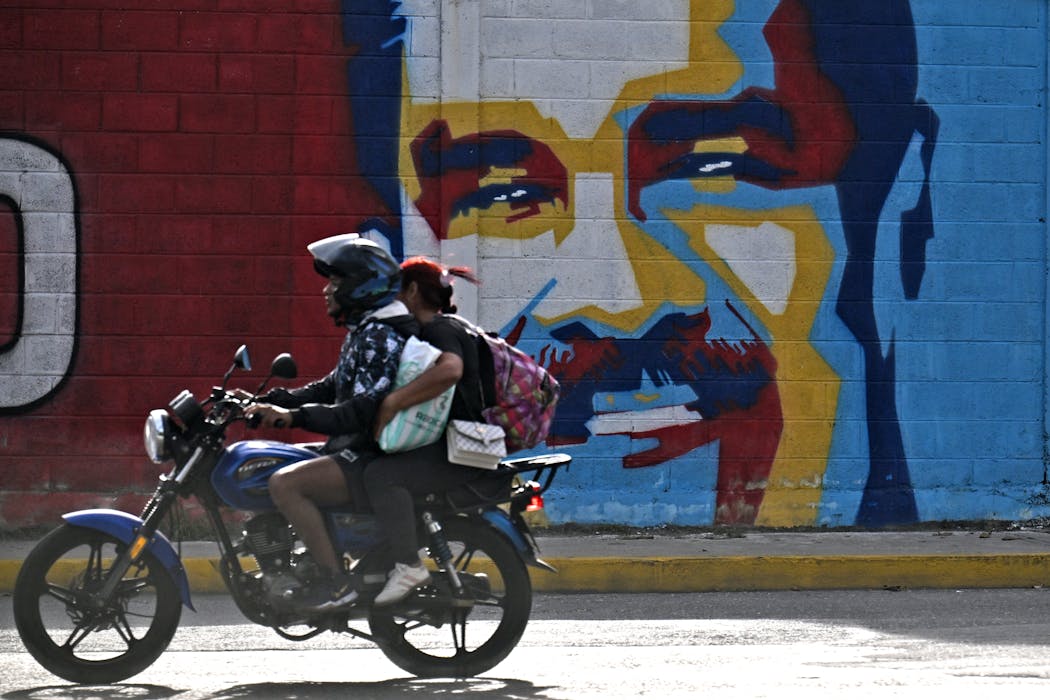
A motorcycle rides past graffiti depicting Venezuelan President Nicolas Maduro in Caracas on Jan. 3, 2026. Juan Barreto/AFP via Getty Images

In the dead of night during the holidays, the United States launched an operation inside a Latin American country, intent on seizing its leader on the pretext that he is wanted in U.S. courts on drug charges.

The date was Dec. 20, 1989, the country was Panama, and the wanted man was General Manuel Noriega.

Many people in the Americas waking up on Jan. 3, 2026, may have been feeling a sense of déjà vu.

Images of dark U.S. helicopters flying over a Latin American capital seemed, until recently, like a bygone relic of American imperialism – incongruous since the end of the Cold War.

But the seizure of Venezuelan President Nicolás Maduro, along with his wife, Cilia Flores, recalls an earlier era of U.S. foreign policy.

U.S. President Donald Trump announced that, in an overnight operation, U.S. troops captured and spirited the couple out of Caracas, the Venezuelan capital. It followed what Trump described as an “extraordinary military operation” involving air, land and sea forces.

Maduro and his wife were flown to New York to face drug charges. While Maduro was indicted in 2020 on charges that he led a narco-terrorism operation, his wife was only added in a fresh indictment that also included four other named Venezuelans.

A man in a blindfold holds a bottle of water.
An image of a captured Nicolás Maduro released by President Donald Trump on social media.
Truth Social

Secretary of State Marco Rubio said he “anticipates no further action” in Venezuela; Trump later said the he wasn’t afraid of American “boots on the ground.”

Whatever happens, as an expert on U.S.-Latin American relations, I see the U.S. operation in Venezuela as a clear break from the recent past. The seizure of a foreign leader – albeit one who clung to power through dubious electoral means – amounts to a form of ad hoc imperialism, a blatant sign of the Trump administration’s aggressive but unfocused might-makes-right approach to Latin America.

It eschews the diplomatic approach that has been the hallmark of inter-American relations for decades, really since the fall of the Soviet Union in the early 1990s took away the ideological grab over potential spheres of influence in the region.

Instead, it reverts to an earlier period when gunboats — yesteryear’s choppers — sought to achieve U.S. political aims in a neighboring region that American officials treated as the “American lake” – as one World War II Navy officer referred to the Caribbean.

Breaking with precedent

The renaming of the Gulf of Mexico as the “Gulf of America” – one of the earliest acts of the second Trump administration – fits this new policy pivot.

But in key ways, there is no precedent to the Trump administration’s operation to remove Maduro.

Never before has the U.S. military directly intervened in South America to effect regime change. All of Washington’s previous direct actions were in smaller, closer countries in Central America or the Caribbean.

The U.S. intervened often in Mexico but never decapitated its leadership directly or took over the entire country. In South America, interventions tended to be indirect: Lyndon Johnson had a backup plan in case the 1964 coup in Brazil did not succeed (it did); Richard Nixon undermined the socialist government in Chile from 1970 on but did not orchestrate the coup against President Salvador Allende in 1973.

And while Secretary of State Henry Kissinger – the architect of U.S. foreign policy under Nixon and his successor, Gerald Ford – and others encouraged repression against leftists throughout the 1970s, they held back from taking a direct part in it.

A post-Maduro plan?

U.S. officials long viewed South American countries as too far away, too big and too independent to call for direct intervention.

Apparently, Trump’s officials paid that historical demarcation little heed.

What is to happen to Venezuela after Maduro? Taking him into U.S. custody lays bare that the primary goal of a monthslong campaign of American military attacking alleged drug ships and oil tankers was always likely regime change, rather than making any real dent in the amount of illegal drugs reaching U.S. shores. As it is, next to no fentanyl leaves Venezuela, and most Venezuelan cocaine heads to Europe, anyway.

What will preoccupy many regional governments in Latin America, and policy experts in Washington, is whether the White House has considered the consequences to this latest escalation.

A man in army fatigues is in front of a landing helicopter
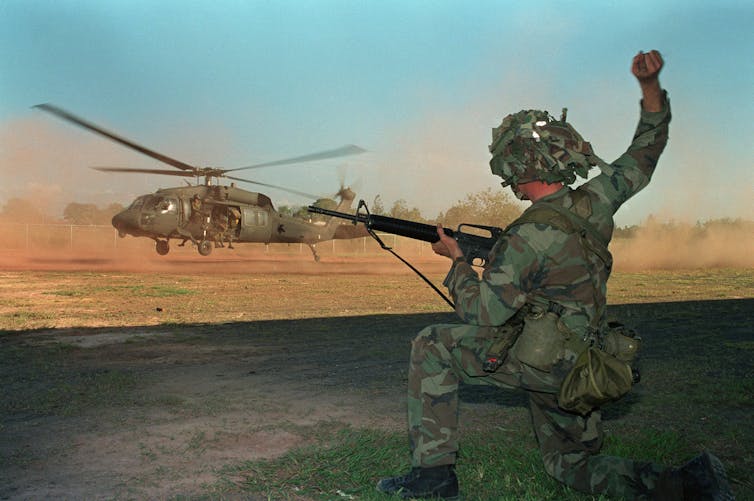
A U.S. soldier guides a military helicopter during an operation in Panama on Dec. 23, 1989.
Manoocher Deghati/AFP via Getty Images

Trump no doubt wants to avoid another Iraq War disaster, and as such he will want to limit any ongoing U.S. military and law enforcement presence. But typically, a U.S. force changing a Latin American regime has had to stay on the ground to install a friendly leader and maybe oversee a stable transition or elections.

Simply plucking Maduro out of Caracas does not do that. The Venezuela constitution says that his vice president is to take over. And Vice President Delcy Rodriguez, who is demanding proof of life of her president, is no anti-Maduro figure.

Regime change would require installing those who legitimately won the 2024 election, and they are assuredly who Rubio wants installed next in Miraflores Palace.

Conflicting demands

With Trump weighing the demands of two groups – anti-leftist hawks in Washington and an anti-interventionist base of MAGA supporters – a power struggle in Washington could emerge. It will be decided by men who may have overlapping but different reasons for action in Venezuela: Rubio, who wants to burnish his image as an anti-communist bringer of democracy abroad; Trump, a transactional leader who seemingly has eyes on Venezuela’s oil; and Secretary of Defense Pete Hegseth, who has shown a desire to flex America’s military muscle.

What exactly is the hierarchy of these goals? We might soon find out. But either way, a Rubicon has been crossed by the Trump administration. Decades of U.S. policy toward neighbors in the south have been ripped up.

The capture of Maduro could displace millions more Venezuelans and destabilize neighboring countries – certainly it will affect their relationship with Washington. And while the operation to remove Maduro was clearly thought out with military precision, the concern is that less attention has been paid to an equally important aspect: what happens next.

“We’re going to run the country” until a “safe, proper and judicious transition” occurs, the Trump promised. But that is easier said than done.

The Conversation

Alan McPherson does not work for, consult, own shares in or receive funding from any company or organization that would benefit from this article, and has disclosed no relevant affiliations beyond their academic appointment.

ref. A predawn op in Latin America? The US has been here before, but the seizure of Venezuela’s Maduro is still unprecedented – https://theconversation.com/a-predawn-op-in-latin-america-the-us-has-been-here-before-but-the-seizure-of-venezuelas-maduro-is-still-unprecedented-272664

I wrote a book on the politics of war powers, and Trump’s attack on Venezuela reflects Congress surrendering its decision-making powers

Source: The Conversation – USA – By Sarah Burns, Associate Professor of Political Science, Rochester Institute of Technology

Explosions were seen across Caracas after the U.S. launched large-scale attacks on Venezuela and captured its leader and his wife.
AFP via Getty Images

Americans woke up on Jan. 3, 2025, to blaring headlines: “US CAPTURES MADURO, TRUMP SAYS,” declared The New York Times, using all capital letters. The U.S. had mounted an overnight military raid in Venezuela that immediately raised questions of procedure and legality. Prime among them was what role Congress had – or should have had – in the operation.

Politics editor Naomi Schalit interviewed political scientist Sarah Burns, author of the book “The Politics of War Powers” and an expert at Rochester Institute of Technology on the historical struggle between Congress and U.S. presidents over who has the power to authorize military action.

Is this a war?

I wouldn’t call it a war. This is regime change, and whether or not it has a positive impact on the United States, whether or not it has a positive impact on Venezuela, I think the likelihood is very low for both of those things being true.

How does Congress see its role in terms of military action initiated by the United States?

Congress has been, in my view, incredibly supine. But that’s not just my word. Having said that, it is true that Congress – in the House, predominantly – tried to pass a war powers act recently, saying that President Donald Trump was not allowed to do any action against Venezuela, and that failed on very close votes.

So you see some effort on the part of Congress to assert itself in the realm of war. But it failed predominantly on party lines, with Democrats saying we really don’t want to go into Venezuela. We really don’t want to have this action. Republicans predominantly were supporting the president and whatever it happens to be that he would like to do. Moderate Republicans and Republicans who are in less safe districts were and are more likely to at least stand up a little bit to the president, but there’s a very small number of them.

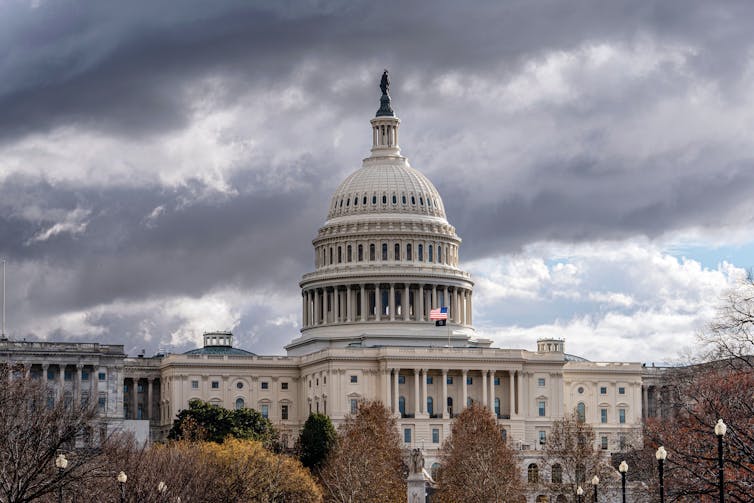
The Congress building in mid-December
Congress has been largely absent as President Donald Trump has escalated his verbal and military attacks on Venezuela.
AP Photo/J. Scott Applewhite

So there may be an institutional role for Congress, a constitutional role, a role that has been confirmed by legal opinion, but politics takes over in Congress when it comes to asserting its power in this realm?

That’s a perfect way of putting it. They have a legal, constitutional, one might even say moral, responsibility to assert themselves as a branch, right? This is from Federalist 51 where James Madison says “Ambition must be made to counteract ambition.” So it should be that as a branch, they assert themselves against the president and say, “We have a role here.”

In the 1940s, presidential scholar Edward Corwin said that in the realm of foreign policy, it is an invitation for Congress and the president to struggle. So it should be that Congress and the president are struggling against each other to assert, “I’m in charge.” “No, I’m in charge.” “No, I’m in charge,” in an effort to create a balance between the two branches and between the two things that each of the branches does well. What you want from Congress is slow deliberation and a variety of opinions. What you want from the president is energy and dispatch.

So certainly, if we have an attack like 9/11, you would want the president to be able to act quickly. And you know, conversely, in situations like the questions around what the U.S. is doing in Venezuela, you want slow deliberation because there is no emergency that requires energy and dispatch and speed. So the president shouldn’t be entirely in the driver’s seat here, and Congress should very much be trying very hard to restrain him.

What power does Congress have to restrain him?

They have to pass legislation. They aren’t particularly well suited right now to passing legislation, so effectively there is not a very clear way for them to restrain the president.

One of the things that members of Congress have attempted to do several times, with very little positive impact, is go to the courts and say, “Can you restrain the president?” And political scientist Jasmine Farrier has written that the courts have regularly said to members of Congress: “You have the power to stop the president, and you are ineffective at that. And so if you want to stop the president, you shouldn’t turn to us. You should work together to create legislation that would restrain the president.”

What would such legislation do? Cut off money for troops? Is it finger-wagging, or is it something really concrete?

There are a few different tiers. Joint resolutions are finger-wagging. They just say, “Bad, Mr. President, don’t do that.” But they have no effect in law.

The War Powers Resolution, first passed in 1973, is a legitimate way of trying to restrain the president. Congress intended to say to presidents, “You cannot start a war and continue a war without our authorization.” But what they said instead was “You could have a small war or a short war – of 60 to 90 days – without our authorization, and then you have to tell us about it.” That just sort of said to presidents the opposite of what they intended. So President Barack Obama took advantage of that with the military engagement in Libya, as well as Trump in his first administration.

This is not a partisan issue. It’s not Republican presidents who do it. It’s not Democratic presidents who do it. It’s every president since the War Powers Resolution was passed, and the only time that Congress has drawn down troops or drawn down money was the Vietnam War.

Other than that disastrous war, we have not seen Congress willing to put themselves on the politically negative side, which is taking money away from the troops. Because if you take away money right now, they’re going to be harmed.

a white man in a suit stands at a podium with the presidential seal, while several other men stand behind him
President Donald Trump and his national security team discuss the U.S. strikes on Venezuela at his Mar-a-Lago club in Palm Beach, Fla., on Jan. 3, 2026.
AP Photo/Alex Brandon)

What is the War Powers Resolution?

The War Powers Resolution from 1973, also known as the War Powers Act, was Congress – during the Vietnam War – saying definitively to President Richard Nixon, “You have overstepped your bounds.” They had explicitly said in law, you cannot go into Cambodia. And Nixon went into Cambodia.

So that was their way of trying to reassert themselves very aggressively; as I mentioned before, it didn’t work effectively. It worked insofar as presidents don’t unilaterally start wars that are large scale, the way that World War II was large scale. But they do have these smaller actions at varying levels.

Then we get to 9/11 and we see the 2001 authorization for the use of military force, and the 2002 authorization for the use of military force. The 2001 law authorized going after anyone in al-Qaida and associated with 9/11. The 2002 authorization was directly related to Iraq, saying “There is a problem with Iraq, we have to do something.” Both of them were extremely vague and broad, and that’s why we’ve seen four presidents, including Trump, using the 2001 and 2002 authorizations to carry out all sorts of operations that had very little to do with Saddam Hussein or al-Qaida.

In 2021, senators Mike Lee, Bernie Sanders and Chris Murphy collectively got together and tried to create a national security document that would restrain presidential unilateralism. It was a good effort on the part of members of Congress from a variety of different ideological views to attempt to restrain the president. It did not even sort-of pass – it barely got out on the floor.

Since that time, we haven’t seen a lot of efforts from members of Congress. They haven’t really reasserted themselves since the war in Korea, which began in 1950. It’s very clear that ambition is no longer checking ambition the way that it was meant to by the founders.

When you woke up this morning and saw the news, what was your first thought?

Here we go again. This is not a Republican or a Democratic issue. Lots of presidents have made this error, which is that they think if you do this smaller-scale action, you are going to get a positive result for the nation, for the region, for international stability. And very rarely is that the case.

The Conversation

Sarah Burns does not work for, consult, own shares in or receive funding from any company or organization that would benefit from this article, and has disclosed no relevant affiliations beyond their academic appointment.

ref. I wrote a book on the politics of war powers, and Trump’s attack on Venezuela reflects Congress surrendering its decision-making powers – https://theconversation.com/i-wrote-a-book-on-the-politics-of-war-powers-and-trumps-attack-on-venezuela-reflects-congress-surrendering-its-decision-making-powers-272668