We associate New Year with deep mid-winter and the tidy date of January 1, but for 600 years between 1155 until 1752 in England and Wales the new year began on 25 March. This day was one of the quarter days that divided the year historically and on which rents and debts were settled. March 25 became the quarter day where annual accounts were finalised. So, around about now, we’d have been preparing to welcome in a new year alongside the warmer weather and spring blooms.
Celebrations were double as the legal and ecclesiastical calendar worked in harmony as March 25 is also Lady Day or the Feast of the Annunciation. Falling exactly nine months before Christmas Day, for Christians it marks when the archangel Gabriel informed Mary that she was shortly to bear a son.
Feast days are normally days of indulgence and merrymaking, but Lady Day normally falls in Lent, a time of abstinence. This meant, for some, Lady Day was a temporary lightening of Lenten restrictions.
Also known as Annunciation Day, Lady Day has sometimes fallen on Good Friday, as it did in 1608. This day is the opposite of a feast day, marking the crucifixion and death of Christ, which is observed through fasting and abstinence. The poet John Donne reflected on this crossover in 1608 in Upon the Annunciation where he saw it as an opportunity to be extra pious:
“Tamely, frail body, abstain today;
today My soul eats twice,
Christ hither and away”
So for Donne, this was a day of fasting and reflection to commemorate both the coming of Christ and his death.
Superstitions
Lady Day has many associated superstitions. An anonymous pamphlet printed in 1721 called When my Lord Falls in my Lady’s Lap, England Beware of a Great Mishap takes its title from an old saying that means that it is unlucky when Lady Day falls on or near Easter Sunday. The author proceeds to run through the many calamities that have happened on such inauspicious occasions.
For instance, it tells of how in 1117 the heir to Henry I, William Adelin was drowned in the sinking of the White Ship along with 300 other souls. The author hasn’t got their facts quite straight here as this disaster happened in November 1120. By Victorian times, this superstition about Lady’s day falling near Easter Sunday was considered old fashioned with The Hampshire Advertiser describing it as a “former ill omen” in its 21 March 1846 edition.
Customs
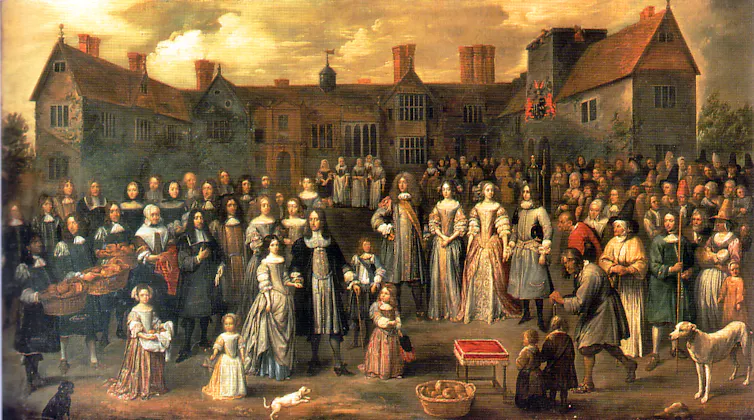
Lady’s Day is still celebrated in some parts of the UK. In Hampshire, The Tichborne Dole on Lady’s Day dates back to around 1150. Mabella (or Isabella), Lady de Tichborne of Alresford, made a deathbed request that an annual donation of bread, baked with grains from her lands, be made in her memory to the parish poor.
Her rather less charitably minded husband, Sir Roger, agreed on condition that his benevolence was limited to crops from just the land that she could walk around while carrying a single burning log from the fire. According to the legend, the dying Mabella crawled her way around some 23 acres before the flame went out. This area is still known as “The Crawls”.
The Tichborne Dole (1671) by Gillis van Tilborgh. Wikimedia
It’s said Mabella left a curse on the house that if ever the dole was stopped the family line would die out. Specifically, she vowed that a generation of seven sons would be followed by a generation of seven daughters. The dole continued uninterrupted until 1794 and it would seem that Mabella’s curse came to pass when the last male Tichborne had a family of seven daughters. And so, the custom was reinstated.
A film, The Tichborne Curse, was released in 1947. The reinstated Dole is still taking place today. Adults from the parishes of Tichborne and Cheriton are entitled to claim one gallon (2kg) of flour, and children half a gallon each.
Always in April
The dating system in the US, Britain and Ireland changed in 1752 when these countries adopted the Gregorian calendar. Then the legal New Year in these countries became the same as it had been in Scotland for the last century and a half: January 1.
However, it wasn’t just the year start that needed adjusting, as the new calendar was now out by several days. This meant that in England, 11 days were “lost” as Wednesday September 2 1752 was followed by Thursday September 14 1752 in order to right things. The jump must have been very disconcerting if we consider how much the clocks going forward an hour throws us out for a while.
In Britain, the legacy of the old-style dating system lives on in our tax system. Where the new tax year was March 25 (the old New Year) it was moved to April 5, and later to April 6, due to the leapfrog in dates 1752.
This day became Old Lady Day. April 6 day now stood in for the financial aspects of the quarter day, which meant this was the date in which new leases on farms and land began and often farm labouring families moved into new tied housing on that day as they signed new year long contracts. Author Thomas Hardy includes this in his 1891 novel Tess of the d’Urbervilles. Tess is hired on a farm upon “her agreeing to remain till Old Lady-Day”.
So March 25 may be a day that for most goes by with little notice now but it was once a major holiday that marked the beginning of the new year.
Sara Read does not work for, consult, own shares in or receive funding from any company or organisation that would benefit from this article, and has disclosed no relevant affiliations beyond their academic appointment.
Imagine a man wants to buy a new shirt for work that he plans to wear once a week for at least the next five years. When browsing for options, he finds one shirt from a lower-quality brand priced at £20 and one shirt from a high-quality brand for £50. Which one should he buy?
From his previous experience with the two brands, he knows that if he plans to wear the shirt once a week (so roughly 50 times per year) the lower-quality shirt will last him about a year. After that, he will need to replace it. The high-quality shirt will be good for at least four years. But clearly, the high-quality shirt is also more expensive.
Our theoretical shopper would probably conclude that the high-quality shirt makes more economic sense. Taking into account the purchase price relative to how many times he can wear the shirt, it would cost him only 25 pence for each time he would wear it, compared to the lower-quality shirt at 40 pence.
This is the logic of “cost per wear”. Some fashion blogs and small businesses have started using this concept to make the case for high-quality clothing. The rationale is simple – higher-quality clothing should last longer, making a higher purchase price worthwhile in the long run. Cost per wear is calculated by dividing the garment price by the number of times the consumer expects to wear it.
Essentially, cost per wear works much like unit pricing in supermarkets. These measures already help consumers compare things like the price of a product per 100g, per chocolate bar in a multipack, or per laundry load. But this same logic isn’t yet applied to clothes in a retail setting.
The fashion industry is one of the largest contributors to environmental harm, accounting for up to 8% of the world’s carbon emissions, causing immense water pollution due to textile treatments such as dyeing, and producing millions of tonnes of textile waste annually.
Using cost per wear in shops or online retail spaces could reduce the environmental impact of fashion – the more frequently a garment can be worn, the more efficiently the consumed resources are used. And of course the longer that garment remains in use, the less often it needs to be replaced.
The problem is that most shoppers don’t know how long a garment will last. Without a prompt in stores or online, many consumers do not even consider clothing longevity when buying.
But standardised fabric-testing methods exist already. These methods assess the durability of fabric according to the number of abrasion cycles (that is, the number of rubs against an abrasive surface) it can tolerate before showing signs of wear. This could easily be applied to clothing, allowing retailers to include cost per wear labels alongside the purchase price.
In research I carried out with Lucia Reisch from Cambridge Judge Business School, we tested this idea. In a number of experiments, we showed participants from online panels a lower-quality, cheaper garment (a sweater, for example) and a higher-quality, more expensive version. We then asked which they would prefer.
Fast fashion suddenly wasn’t so affordable
When we included information on the cost per wear for both options – or even just the high-quality option (showing a lower cost per wear compared to a poorer-quality option, or a reference value), participants were more likely to choose the more expensive, high-quality option.
The effect was stronger when participants were shopping for everyday wear over occasion wear, when they could compare the cost per wear between options, and when the cost per wear information was said to be certified by an independent third party. Participants then trusted the information more, and we found that this could outperform a general durability claim made by a brand.
Our studies showed that cost per wear can make cheap fashion suddenly appear more expensive to shoppers – the high-quality options were viewed as better financial investments. And by choosing the more economical, high-quality option, participants were also choosing the greener option.
Cost per wear can increase the perception of affordability for more expensive, high‐quality clothing. But of course many shoppers will still not be able to afford the higher purchase price even though they know it would make more long-term economic sense.
And cost per wear only reflects the durability of an item as one dimension of sustainability. It does not reflect ethical considerations, such as the conditions workers face in the production process, or ecological aspects such as the use of natural or synthetic fibres.
Brands and retailers must also be willing to display cost per wear labels without regulation. High-quality brands may arguably have a greater incentive to do so than fast fashion brands.
However, the concept of cost per wear is still worth pursuing. It can prompt shoppers at the point of purchase to consider a garment’s durability and how often they might wear it. And ideally, it would motivate them to ditch fast fashion and choose greener options – even if just to save money in the long run.
Lisa Eckmann does not work for, consult, own shares in or receive funding from any company or organisation that would benefit from this article, and has disclosed no relevant affiliations beyond their academic appointment.
Even before the US-Israel war on Iran, people in the UK were unusually vulnerable to sudden swings in the cost of energy. Depending how you count it, either 11% or 30% of households are officially energy poor, and already struggled to afford basic needs in times of relative peace.
The government’s fuel poverty strategy for England, published in January 2026, focuses on long-term measures such as home insulation upgrades. But it says little about how to protect vulnerable households quickly in this crisis or in future price shocks.
To reduce the immediate harm, ministers need tools that can be deployed now, not just reforms that may take years to deliver.
Here are three measures that could be deployed right now.
A social tariff
The most effective step would be to discount energy bills for lower-income or vulnerable households – a so-called “social tariff”.
This is often seen as difficult or politically risky. But energy remains one of the few essential services without targeted affordability support. Water and telecoms already enjoy it, and energy should be no different.
In a policy brief we published late last year, we showed that the UK electricity system hits lower-income households hardest and produces “uneven bills”. This means that two households using the same amount of electricity can face differences in bills of up to 15% depending on where they live, and another 22% depending on payment method or contract type.
Laundry costs more – or less – depending on where you live. Carlos G. Lopez / shutterstock
A social tariff would be fairer. Through a lower unit rate or a bill discount it would protect households with the least room to cut energy use – such as older people, low-income households, those with medical-related electricity needs and renters in inefficient homes.
These policies can also encourage energy efficiency. For instance, in California, the state’s Care programme discounts electricity and gas bills for low-income households up to a set level of use. Beyond that point, rates revert to normal.
This is not unrealistic administratively. Portugal introduced automatic eligibility for its social energy tariff in 2016. This used existing tax and social security data to expand the number of households receiving support by 400%.
The UK already has the data infrastructure to do something similar through its benefits and tax system – energy companies wouldn’t have to find out household incomes themselves; they could just ask the government. The near-term step here is straightforward – ministers could ask the industry regulator Ofgem and energy companies to design an automatic, income-linked tariff for winter 2026, instead of waiting for another crisis response.
Emergency support
The second priority is to reduce immediate exposure to the most volatile and expensive fuels.
Government has traditionally responded to shocks like the Ukraine war with emergency bill support. However, these ill-targeted policies are impractical and do not reduce reliance on volatile fossil fuels. Unlike a social tariff, which is a continuous means-tested support payment, emergency support is often a one-off payment. Traditionally, emergency support is a flat payment to all households, meaning those on lower incomes benefit less in relative terms, though it can also be targeted at vulnerable households.
Transport is one immediate opportunity. Rather than (yet again) freezing fuel duty, the government could redirect this money into cheaper public transport for low-income and car-dependent households.
Germany’s €9 (£8) public transport ticket, introduced in 2022 during the energy and cost-of-living crisis, shows that governments really can act quickly when necessary.
Subsidised public transport could help out people struggling with expensive energy. PintoArt / shutterstock
Households that are off the gas grid and reliant on heating oil are especially exposed when global prices rise. Alongside short-term support, like the welcome £50 million announced last week, the government should consider targeted support to switch from oil to heat pumps. The economic case for heat pumps is especially strong for households relying on heating oil. This switch would immediately reduce their exposure to oil prices.
Help households access existing savings
The third priority is to ensure vulnerable households can benefit from money-saving features that are already available in the electricity system.
The near-term priority is not new schemes, but making existing ones usable. The government could require suppliers, local authorities and landlords to prioritise smart meters and other low-carbon technologies in social housing and private rentals, where people face the greatest barriers to accessing these savings. It could also fund trusted community organisations to help households choose suitable tariffs, avoid poor deals and access support if they fall into arrears.
This may sound less dramatic than a new subsidy scheme, but clarity matters in a price shock. Households cannot benefit from cheaper tariffs or smart systems they do not know about or cannot use, so financial support often flows most to those already best placed to respond.
The UK cannot prevent global energy price shocks, but it can choose who bears its greatest burden. What is missing is political will. If the government is serious about protecting vulnerable households, it needs a strategic short-term response that matches the scale of urgency.
The authors do not work for, consult, own shares in or receive funding from any company or organisation that would benefit from this article, and have disclosed no relevant affiliations beyond their academic appointment.
Source: The Conversation – UK – By Tony Kushner, James Parkes Professor of Jewish/non-Jewish Relations, University of Southampton
The arson attack on four ambulances in Golders Green early on March 23 has been called “a horrific antisemitic attack” by the prime minister, Keir Starmer.
These ambulances were run for the benefit of both the local Jewish and non-Jewish communities in this district of north London by a charity called Hatzola – meaning “rescue” in Hebrew. As these ambulances played a key supportive role in enabling access to health provisions for the good of all, it is especially shocking – and has further heightened the anxieties of British Jews.
This is a community still reeling after the attack on the Heaton Park Synagogue in Manchester in October 2025 on Yom Kippur, the holiest day of the Jewish religious calendar, which killed two people. And the arson attack is part of a wider international wave of antisemitism, which has included Norway, the US and the Netherlands in the past few weeks. This is not an easy time to be a diaspora Jew.
Those who have carried out the attacks have come from different backgrounds. Many have been influenced by online hate emanating from Isis, and potentially individuals or groups supportive of the hardline Iranian regime. Counter-terror police are investigating whether an Iran-linked group is responsible for the arson. The terror group Harakat Ashab al-Yamin al-Islamiya (The Islamic Movement of the People of the Right Hand) has claimed responsibility for the attack, as well as others in Europe.
These attacks reflect the complex pattern of hostility towards Jews in the UK, which has been through a mixture of domestic and foreign-inspired hatred. In terms of the latter, there are several examples going back a century which can be highlighted.
The most well-known is the Jew hatred spread by Oswald Mosley and his British Union of Fascists (BUF), formed in 1932, which was at least partly stimulated by German Nazism.
Overall, however, there are deep domestic roots of antisemitism since the readmission of the Jews in the 17th century after a 300-year expulsion. But it has rarely resulted in violent attacks – even if it has made life uncomfortable for the Jewish minority in moments of crisis.
Golders Green’s rich history
These roots can be seen in relation to Golders Green which started to develop as a place of Jewish settlement from the first world war onward. While there were some Jews in this then small suburb in the 19th century, there was not much in the way of a formal community.
Pam Fox, the social historian of Golders Green’s Jewish community, states that “Before 1910 there was just a handful of Jews living in the community, but by 1915 … there were 300 households”. Growth continued after the first world war, and in 1922 the first synagogue, Dunstan Road, was opened. Today, the Jewish population is around 8,000 and represents some 40% of the suburb’s population.
Such crude statistics do not reflect the diversity of the Jewish population both past and present. As early as the 1930s, more orthodox Jews, some of them refugees from Nazism, were establishing different forms of worship from Dunstan Road, which was more in the form of mainstream orthodox religiosity. By the second world war, there were at least 14,000 Jewish refugees in north-west London (including Golders Green), who varied from the totally secular, to reform, to the very orthodox.
After the war, there were more influxes of Jewish refugees, including from Egypt, Hungary and later South Africa, as well as second- and third-generation Jews whose origins were from eastern Europe and then the East End of London. While the very orthodox are currently the growing group in Golders Green, it still has an incredibly heterogeneous Jewish population.
For most Jews, the vibrant cultural, social and religious life of Golders Green has made it a very comfortable place to call home. Even so, there has been antisemitism – organised in the form of the BUF and more commonly in the form of more casual prejudice.
In late 1945, the Hampstead Petition Movement aimed to remove all foreign Jews from the wider area, and it had some local support. In the Nazi era, local newspapers, including the Golders Green Times, objected to the alleged bad behaviour of the Jewish refugees who were falsely accused of being unpatriotic and selfish.
Today, the idea of Golders Green being a Jewish suburb ignores the reality that most of its population is not of that background. It also forgets the many types of Jewishness that are articulated there. Such nuances are lost on those carrying out the attack on the ambulances, with their universal usage.
It says much about the times that such distinctions are not made – many people hold all Jews responsible for the actions of a particular Israeli government. Yet in Golders Green as elsewhere, Jews for both political, cultural and religious reasons hold a range of attitudes towards the problems of the Middle East. Ultimately, such attacks are, as local Jewish resident Sam Adler put it, “cynical and cowardly”. If nothing else, as with Manchester, they have also brought communities together in solidarity and resistance to the ugliness of antisemitism.
Tony Kushner does not work for, consult, own shares in or receive funding from any company or organisation that would benefit from this article, and has disclosed no relevant affiliations beyond their academic appointment.
Denim is present in practically every country in the world and is widely adopted as one of the most common forms of everyday attire. Its appeal spans generations and social groups: jeans are worn worldwide by those who follow fashion and those who do not, by people seeking to stand out and by those who prefer to blend in. However, many of us have never found the perfect pair.
Although denim has been produced since the 16th century, its association with American culture and durable workwear emerged during the Californian gold rush of the 1850s. It was during this time that Levi’s – now arguably the most recognisable denim brand – was established.
Levi Strauss, an immigrant entrepreneur who arrived in California from Bavaria in the 1850s, opened a dry goods business catering to miners. One of his customers, the tailor Jacob Davis, developed the innovative use of metal rivets to reinforce stress points in work trousers, making them more durable. Strauss and Davis jointly patented this technique, and the Levi’s brand was born.
Blue jeans were originally a seen as symbol of labourers (like the miners) and they also gained a strong association with cowboys. In the decades that followed, denim jeans evolved from practical workwear into one of the most iconic and enduring symbols of global fashion and culture. Film stars such as Marlon Brando and James Dean popularised the jeans and t-shirt look to a young generation in the 1950s. These films personified motorcycle-loving nonconformists, and 1950s Hollywood embraced denim as the garment of rebellion.
Today, the cultural significance of denim jeans has moved beyond early associations with workwear, the cowboy and the teenage rebel, to become a staple worn by people of all ages and backgrounds.
Finding the perfect pair
Denim jeans are often seen as a problematic fashion product in terms of sustainability, because their production leaves a considerable environmental footprint.
Cheap prices on the high street can encourage consumers to treat denim products as short-term items, reducing their lifespan. Cotton, which is commonly the main fabric for denim, is incredibly water intensive; the production of one pair of jeans uses approximately 7,500 litres of water.
Different components involved in the making of a single pair of jeans, such as denim, thread, cotton and buttons, can originate from different countries all over the world. This raises questions regarding the environmental costs involved in the production process. Further issues include that jeans are often not made from single fibre materials and therefore cannot be recycled.
Adding to sustainability concerns, at the consumer level, the perfect pair of jeans remains an elusive concept. But in a recently published book chapter, I explain that the perfect pair of jeans is elusive for a reason. Jeans have to be correct for the individual wearer in terms of comfort, social and personal identity, and also the complexity of fit.
Previous reports have focused on women’s struggle to find jeans that fit and are flattering. The inability to find the perfect pair of jeans may encourage overconsumption, due to repeated purchasing based on poor fit.
My research shows that this is an issue which applies to all genders. The men I spoke to noted how they resented paying a higher price for brands like Levi’s, so spent less by purchasing cheap, high street alternatives. This attitude can lead to overconsumption, as low price points achieved through low-quality production often compromise product longevity.
This demonstrates the perpetuating cycle of fast fashion, driven by cheap, low-quality production, and contradicts the original purpose of jeans of being highly durable and having longevity. The combination of highly environmentally damaging production processes with overconsumption results in even greater environmental harm.
Retailers can make efforts to reduce the trend of overconsumption with better fitting garments. However, fit is a complex issue for retailers as well as consumers. For the retailer, producing jeans in a wide range of sizes and styles is often not cost effective, and complex sizing systems can also confuse the consumer.
Technology could provide future solutions to improving the accuracy of fit. Personalised virtual fitting, made possible through improvements in 3D human shape recognition, could ensure improved fit for the consumer. This would benefit online shoppers, although the technology does remain in its infancy, and is yet to be adopted by major online fashion retailers. Virtual fitting rooms also cannot replicate the feeling of denim next to the skin, so although the fit may be perfect, comfort could be compromised.
Ultimately, the enduring challenge of finding the “perfect pair” of jeans highlights not only the garment’s cultural significance but also the opportunity for the fashion industry – and consumers – to move toward more sustainable, better-fitting and more thoughtfully designed denim for the future.
Rose Marroncelli does not work for, consult, own shares in or receive funding from any company or organisation that would benefit from this article, and has disclosed no relevant affiliations beyond their academic appointment.
Approximately one month into the Iran war, public opinion on both sides of the Atlantic is decidedly opposed to this conflict. A recent CBS/YouGov poll shows that 60% of the public oppose military action against Iran, as do a similar percentage in the UK: 59%.
As a political scientist who studies public attitudes about foreign policy and the use of force, my research addresses an important question: under what conditions do people support military action? Based on this research, the widespread opposition to American military action against Iran is completely understandable, as the action lacks the usual foundations for support from domestic as well as international audiences.
Decades of research in political science show that broad support for use of the military rests on three key pillars: purpose, likelihood of success and legitimacy. When these elements are present, support can be high. It can even be maintained in the face of significant costs, both financial and in terms of lives lost. When they are absent, support tends to be weak, polarised and prone to erosion.
At present, these key ingredients are missing.
What’s the objective?
First and foremost, the Trump administration’s strategic rationale remains poorly articulated. Public support for military action is strongly tied to policy goals. When citizens believe force is being used to prevent a clear and immediate danger, they are far more likely to support it. But the US has not made the case that Iran was close to achieving a nuclear weapon – or posed other imminent threats for that matter. The CBS/YouGov poll confirmed that the public does not believe the rationale for war has been convincingly articulated – by a count of 68% to 32%.
In the first few days of the bombing, US president Donald Trump strongly advocated regime change as a reason for the war. But among voters there is little appetite to change another country’s domestic politics. A majority thinks this is not important, although now it has started, a small majority of respondents (53%) felt it would be a mistake to leave the regime in power. It’s a big political risk though – American voters don’t have to cast their memories back far to think of unsuccessful regime change missions.
What does winning look like?
The ambiguity surrounding mission goals complicates the second key element: what constitutes success? Airstrikes can damage nuclear facilities or disrupt Iran’s ballistic weapons programme. But they can’t eliminate the scientific knowledge or technical know-how which will enable to regime to rebuild. And, clearly, if previous strikes were as decisive as the US president, Donald Trump, has claimed, the current action would be unnecessary. The rest of the world knows that too.
The same question about what qualifies as success also applies to regime change. Killing the leadership is one thing, but creating a stable government that breaks from the Islamic revolution and protects American interests is quite another. The essential nature of politics is that there are competing factions, which will want to build or maintain governmental structures that advantage those interests. The the type of government Iran might adopt under a regime change scenario – and which faction(s) will control the levers of domestic power – are two dramatic unknowns.
Any plan to completely disempower the Islamic Revolutionary Guard Corps (IRGC) would risk a re-run of the disastrous de-Baathification strategy after the 2003 invasion of Iraq. Leaving the IRGC even partially in power leaves the civilian population at continued risk and would hardly make it easier to achieve American aims – whatever they may be. As we’re still seeing in Libya, a power struggle between factions is unlikely to produce the sort of result the region – and the wider world – want to see.
Is this a legitimate war?
Finally, there are severe concerns regarding the legitimacy of the war. Citizens rely on cues from their political leaders and institutions to inform their view about the use of force. The Trump administration had not made a sustained case for the need for military action before the war, nor has it secured Congressional authorisation or bipartisan support. There is no clear domestic consensus supporting the use of force.
Not only is there no clear signal of legitimacy domestically, the same is true internationally. Multilateral backing — especially through institutions such as the United Nations security council — has historically played an important legitimising role (especially to reassure domestic audiences who want a second opinion). This is is absent here – in fact, key US allies have expressed their opposition. The UK’s prime minister, Keir Starmer, has declared military action against Iran is “not our war”, language remarkably similar to that of Germany’s defence minister, Boris Pistorius. Having foregone building international support prior to the use of force, the US is now struggling for support from allies — particularly when it comes to protecting shipping through the Strait of Hormuz.
None of this means the operation will be uniformly unpopular. Partisan attachment is also important: those who back the administration are likely to view the operation more favourably. Accordingly, a majority of Republicans (84%) support the action, though there is a strong divide between Maga (92%) and non-Maga (70%) Republicans.
Meanwhile, Democrats (92%) and independents (69%) overwhelmingly disapprove of the conflict, so domestic support for the conflict is extremely narrow. The factors that sustain backing beyond a president’s core supporters — perceived necessity with clear strategic goals, confidence in eventual success of the mission, and legitimacy conferred by domestic or international institutions — are conspicuously absent.
Over time, events on the ground may change how the public views the conflict. Iranian efforts to expand the scope of conflict – particularly when directed at US allies – could swing support towards the American action. Or, a unified Iranian opposition could quickly coalesce on who and what replaces the Islamic Republic government. These are just two possibilities seen through rose-tinted spectacles – frankly, developments that complicate America’s position seem just as likely.
Without significant changes in clarity of goal, verifiable indicators of success, or signals of legitimacy from persuasive actors outside the administration, support will diminish. But the consequences are graver than the domestic popularity of an American military operation. Sidelining institutional constraints – such as Congressional authorisation and international institutions – erodes limits on the use of force.
When the US ignores these constraints, it invites other countries to do the same, resulting in a more unstable and insecure world.
Jason Reifler has received funding for research examining public opinion about foreign policy and the use of military force from the Economic and Social Research Council (UK), Volkswagen Stiftung, and National Science Foundation (US).
You’re scheduled for surgery next week. You’ve likely looked up your surgeon’s credentials, years of experience and perhaps even patient reviews. You want reassurance that your surgeon has steady hands, deep expertise and a thorough command of the procedure. Technical skills feels like the thing that matters most.
But there’s another question most patients never think to ask: How well does your surgeon lead a team?
It might sound like an odd thing to consider, but in the operating room, surgery is rarely a solo act. Surgeons work alongside anesthesiologists, nurses and medical residents who must co-ordinate closely, often under intense pressure, to deliver care.
When something unexpected happens and the team needs to pivot quickly, how a surgeon leads matters in ways most patients rarely see or even think about.
Despite decades of evidence showing the benefits of inspiring, people-focused leadership, those qualities alone were not enough in complex, high-stakes operations where conditions can change rapidly.
Two different leadership styles
Leadership researchers have long distinguished between two main approaches to leading teams: transformational and directive leadership.
Transformational leadership is people-focused, meaning it emphasizes inspiration, building trust, encouraging open communication and helping people feel valued and motivated.
Directive leadership is task-focused. It involves giving clear instructions, co-ordinating actions, enforcing procedures and ensuring everyone knows their role in real time.
Transformational leadership has been widely studied and positively linked with better team performance, stronger morale and improved outcomes across many workplace settings. As a result, it is often examined on its own as a driver of effective leadership.
But our research suggests the picture is more complicated in environments where the stakes are high.
Complexity changes everything
Not all surgeries are alike.
Some procedures are relatively routine and predictable. An appendectomy, for example, typically follows established protocols with predictable demands and roles. In these situations, everyone on the team knows what to do and when to do it.
But surgeries don’t always go according to plan.
A routine surgery can suddenly become complicated if a patient becomes unstable, while more complex procedures may involve unexpected challenges from the start.
In these moments, the usual script may no longer be enough to guide the team. This is when leadership becomes far more important.
Situational leadership
To make sense of this, we drew on a concept from psychology called situational strength — how much a situation provides information about appropriate or desirable behaviour.
Routine surgeries are considered “strong situations.” Protocols, prior training, roles and expectations are so clear that the situation itself largely guides behaviour with little-to-no leadership required.
More complex or unpredictable surgeries can create “weak situations.” Protocols may not fully cover what’s unfolding. Roles become ambiguous and prior training no longer suffices. The team needs real-time guidance on what to prioritize, who should act and how to co-ordinate under pressure.
In these moments, leadership becomes critical precisely because the situation no longer provides all the answers.
Our research found that during these high-complexity moments, the benefits of transformational leadership only emerged when it was combined with directive leadership.
When surgeons paired people-focused leadership with task-focused leadership, their teams reported feeling significantly safer about speaking up, raising concerns and flagging problems as they arose, otherwise known as psychological safety.
More reported errors can signal better care
One of the more counter-intuitive findings involved surgical errors. Teams that reported higher psychological safety actually had more observed errors during surgery, not fewer.
At first glance, that sounds like worse performance. In reality, it may signal the opposite.
And our data support this interpretation: teams with higher psychological safety had fewer severe complications after patients were discharged. More errors caught earlier and corrected in the operating room meant better outcomes beyond it.
But a closer look reveals that many programs focus on developing a single leadership style or approach rather than helping surgeons learn how to flexibly combine different leadership behaviours as situations change.
Our findings suggest this flexibility matters.
This has implications well beyond the operating room. Financial trading floors, emergency response teams, military units and any environment where conditions shift rapidly and errors carry serious consequences all share the same basic challenge for leaders.
The leaders who perform best in these environments don’t master one leadership style. Rather, they learn to combine and adapt approaches when it matters most.
Steve Granger receives funding from the Social Sciences and Humanities Research Council of Canada.
Julian Barling receives funding from the Social Sciences and Humanities Research Council of Canada, and the Borden Chair of Leader at the Smith School of Business.
Michaela Scanlon receives funding from the Social Sciences and Humanities Research Council of Canada.
Nick Turner receives research funding from Cenovus Energy Inc., Haskayne School of Business’s Future Fund, and the Social Sciences and Humanities Research Council of Canada (SSHRC).
Conservative Leader Pierre Poilievre, head of Canada’s official opposition, recently became the first Canadian political leader to appear on the controversial Joe Rogan Experience podcast.
Poilievre had been asked to sit for an interview with Rogan amid the federal election campaign in April 2025, but was reportedly advised by his team to pass since Rogan was, and remains, a polarizing and contentious figure. Nonetheless, Rogan’s podcast is one of the world’s longest running, averaging 11 million listeners per episode and ranked No. 1 globally on Spotify in 2025.
Whether his efforts worked remains to be seen, but could there be unintended consequences to Poilievre’s appearance on the podcast? Did he spread any harmful disinformation about Canada and North America to a massive audience that, while possibly popular among his base, could be detrimental to Canadians in general?
Our findings show that manosphere influencers spread toxic content about marginalized populations, including dangerous misinformation about health, politics, immigration and the environment. The Joe Rogan Experience is part of this ecosystem.
While recent coverage of the podcast episode in news media has focused on tariffs, Canada-U.S. relations and a shared love of fitness, we found misinformation on immigration, the health and environmental consequences of Alberta’s oilsands, seed oils, safer drug supply measures and the causes of inflation.
1. Immigration
Poilievre, citing no evidence, told Rogan that Canada admits one million immigrants per year.
But information from the Canadian government website shows that targets for temporary residents — students and work visa holders — make up 385,000 people for 2026, while permanent resident targets are at 380,000 people. Combined, that’s significantly fewer than the number cited by Poilievre.
Inflating immigration numbers is a known rhetorical tactic in far-right online spaces, where it functions to fuel anxieties about demographic change. Repeating it on a platform with millions of listeners legitimizes a distortion that creates division and harms racialized communities.
Canada’s immigration system is not without criticism and immigrants often face challenges. (Unsplash)
2. Oilsands
Poilievre told Rogan that Alberta’s oilsands have very few health or environmental consequences, stating that it has “no impact to groundwater … no impact to the environment” and that people who live near the oilsands are “very healthy.”
But a 2024 report on the Athabasca oilsands released by scientists at the University of British Columbia suggest significant environmental and health impacts from the oilsands, meaning that, at best, Poilievre oversold the safety of oil development. His characterizations don’t reflect scientific research and they sideline those most affected.
One of Rogan’s favourite topics is health and diet, so it wasn’t surprising to hear him discuss seed oils with Poilievre. They talked about how beef tallow or butter is better for people’s health than foods made from seed oils.
Canada is also the largest exporter of canola oil in the world, so when Poilievre failed to push back against Rogan’s health misinformation, he tacitly supported an idea that harms the very trade he was purportedly aiming to bolster with his appearance on the podcast.
Poilievre told Rogan that inflation during and following the COVID-19 pandemic was a direct result of the previous Liberal government’s actions. He said:
“Like back during COVID when all these governments were printing money and all the politicians and bankers said ‘Oh, this is great. Well, look at all this money we get to spend.’ I’d walk around communities and I’d have like mechanics say, you know, we’re going to have inflation. And I would say, yeah, it makes sense to me… And sure enough, all that money filtered into the economy, bid up all the goods we buy, and everybody got smoked with higher prices.”
Does it matter if Poilievre is spreading misinformation about Canada on Rogan’s podcast? We believe it does.
Poilievre aspires to become prime minister and should aim to lead the country in ways that benefit all Canadians, including canola farmers, immigrants, people who use drugs and the communities that are currently polluted by oil development.
Making false accusations about drug-related crime or unmitigated drug trafficking reinforces the case for greater governmental oversight of citizens. It also justifies, to some extent, the false narratives cited by the U.S. in its retaliatory actions against Canada, including tariffs.
By promoting politically expedient misinformation on a show like Joe Rogan’s, Poilievre risks eroding Canadians’ shared understanding of public health, environmental challenges and social cohesion — all issues he should be working to address.
At a time when democratic communication is strained by misinformation and deepening polarization, Canadians should expect better from their political leaders, regardless of party.
Jaigris Hodson receives funding from the Social Sciences and Humanities Research Council of Canada
Brianna I. Wiens receives funding from the Social Sciences and Humanities Research Council of Canada.
Nick Ruest receives funding from the Social Sciences and Humanities Research Council of Canada.
Shana MacDonald receives funding from the Social Sciences and Humanities Research Council of Canada.
Source: The Conversation – USA (3) – By Eranda Jayawickreme, Professor of Psychology & Senior Research Fellow, Program for Leadership and Character, Wake Forest University
Traditional dancers perform in front of the Buddhist Temple of the Tooth, celebrating the Buddhist festival of Esala Perahera, in Kandy, Sri Lanka, on Aug. 8, 2025.Ishara S. Kodikara/AFP via Getty Images
I grew up in Sri Lanka. Much of my adolescence was spent in Kandy, a city built around a lake, set amid the lush tea plantations of the hill country. Its northern shore houses the Temple of the Tooth, one of Buddhism’s most sacred sites. Each year, it came alive with drummers, dancers and elephants parading through the streets in a “perahera,” or procession, honoring the Buddha’s relic.
But Buddhism was only one part of Kandy’s mosaic of religious life. I went to a high school where students from different religious and ethnic backgrounds got along easily. Within walking distance stood Buddhist temples, Christian churches, brightly colored Hindu temples, or “kovils,” and Muslim mosques whose call to prayer echoed across the city multiple times a day. Religious observances filled the calendar; Sri Lanka has more holidays than almost any other country.
Our own home was a glimpse into the island’s diversity. I attended both churches and temples with ease. My mother regularly visited a Hindu kovil with a close friend – though she was Catholic and my father was Buddhist. Her family had emigrated from Kerala, the southwestern tip of India, at the turn of the 20th century. His was Sinhalese, Sri Lanka’s largest ethnic group.
I grew up during Sri Lanka’s civil war, which consumed the country from 1983 to 2009. The brutal conflict was fought between the Sinhalese-majority government and the Liberation Tigers of Tamil Eelam, a separatist group fighting to create an independent state for the Tamil minority. An estimated 80,000-100,000 people lost their lives, and the war divided the country along religious and ethnic lines. Meanwhile, a separate insurrection led by the Janatha Vimukthi Peramuna, a Marxist political party, tore through the southern part of the country in the late 1980s, killing tens of thousands of people.
As a child, I did not possess the vocabulary to describe my own personal experience during this tumultuous time. All I knew was that some people withdrew into their own groups and vilified Sri Lankans who were different from them. Others worked hard to maintain relationships. Ordinary people in extraordinary circumstances could still choose connection over anger.
Those experiences sparked enduring interest in a question that animates my work as a personality psychologist. What allows people to live together across deep religious differences, without sliding into hostility or dehumanization? What helps them commit to pluralism?
Over time, I have come to believe that pluralism requires more than laws and institutions, although such structures are important. It is a moral commitment: a virtue that we each have a responsibility to cultivate.
What pluralism is
The phrase “pluralism” is often used loosely. Sometimes it simply refers to diversity: people of many religions or ethnicities living in one society.
This can look quite ordinary: a Buddhist teacher attending a Christian colleague’s church wedding out of respect, or a Muslim shopkeeper and a Buddhist neighbor debating over tea, disagreeing sharply, but chatting again the following day. Many of the shopkeepers my family relied on every week were either Tamil or Muslim. One of my tutors – a Muslim man who had worked for the Sri Lankan foreign service in his youth – would sit with me over lessons and then linger to talk with me about politics, culture and the country.
Pluralism lives in these repeated, small acts: decisions to sustain relationships with people whose deepest convictions differ from your own. And it begins with tolerance.
True tolerance cannot exist without disapproval. If I fully agree with your beliefs, I do not need to tolerate them. Tolerance begins when you encounter a view or practice that you find mistaken, troubling or even morally wrong and choose not to interfere with it – because you recognize coercion is not the appropriate response.
Pluralism moves beyond tolerance. It’s not just permitting someone’s beliefs; it’s trying to understand them and getting to know them. This is not the absence of conviction. It is the determination to live out one’s deepest convictions within a shared civic space, and to treat other people not as a threat but as key contributors to the community.
It can help to think about pluralism as a continuum. At the opposite end is hate: “I do not accept your existence.” Next is indifference: “I do not care what you believe.” Indifference is followed by tolerance as patience or forbearance: “I disapprove, but I will not interfere.”
The deeper form of tolerance is based in respect: “I affirm your humanity, even while disagreeing.” Finally, the last space on the spectrum is what scholars label relational or covenantal pluralism: “I’m committed to our connection, even though we disagree.”
Historically, religious conflict often centered on theological disputes: questions about doctrine, salvation or authority. Enlightenment thinkers such as John Locke, Immanuel Kant and Jean-Jacques Rousseau grappled with a shared question: How can diverse societies hold together in the face of such differences?
One answer was that societies needed some form of shared civic framework to bind citizens. Two centuries later, the sociologist Robert Bellah argued that Americans had developed just such a framework: a “civil religion” of shared symbols, narratives and moral commitments – such as the American flag, the Constitution and Memorial Day – that transcended particular faiths while sustaining a sense of common purpose.
Often, though, religious pluralism is less about theological differences themselves. Instead, conflict frequently erupts over social and political differences emerging from foundational values and identities.
Sri Lanka provides vivid examples of this disagreement. Article 9 of the country’s constitution grants Buddhism the “foremost place” among religions. Many religious minorities feel that provision writes a hierarchy into law, granting special privileges to the majority religion.
Or think about the consequences of the devastating 2019 Easter bombings – coordinated attacks on churches and hotels in three Sri Lankan cities by members of the Islamist militant group National Thowheeth Jama’ath.
A relative of a victim of the Easter bombings prays at their burial site in Negombo, Sri Lanka, on April 28, 2019. AP Photo/Manish Swarup
The resulting wave of anti-Muslim sentiment was not really driven by theological differences but questions about identity, trust and political power. Social media misinformation and opportunistic political rhetoric cast Muslims as outsiders threatening a Sinhala-Buddhist national identity. The question at stake was not which religion was true but who “truly” belonged to the nation.
If societies cannot sustain engagement across differences, shared civic life becomes impossible. This challenge, in my view, is not only institutional but also personal: What habits of mind allow religious pluralism to flourish?
Psychology of disagreement
On a personal level, pluralism begins in a moment of objection. You hear a belief that conflicts with your own. You see a religious symbol you find troubling. You run into a policy grounded in values that you reject. Our first reaction is often intuitive and emotional: irritation, aversion, anger, discomfort. Moral psychology suggests that such reactions feel automatic, confirming our sense that our view is the obvious truth.
What matters is what happens next. Some people quickly dismiss ideas they don’t like, shutting down curiosity. Others pause to reflect: asking why they reacted as they did, what the other person might value, and whether broader principles like freedom of conscience or fairness should guide their response.
This is a hard standard to live up to and one which I’ve struggled with myself. In the wake of the Easter bombings, I found myself growing impatient with Sri Lankans who continued to defend the actions of the government, even as it was detaining about 2,000 Muslims, often on thin evidence; banning women’s religious head coverings; and pardoning the ultranationalist monk most associated with anti-Muslim mob violence. I sometimes caught myself doing exactly what I study, reducing complex people to the worst version of their position. I stopped asking what they were trying to protect or what fears were driving their stance.
It took deliberate effort to step back and try to understand their perspective charitably, even while continuing to disagree. I had to reflect on the fact that for Sinhalese Buddhists carrying the memory of decades of Tamil separatist violence, the government’s response in the wake of the bombings could seem like a way to take the country’s security seriously. The tragedy was that this fear of violence was directed at an entire community, rather than the fringe actors who had committed the crime.
A Muslim woman takes part in a remembrance ceremony in front of St. Anthony’s Church in Colombo, Sri Lanka, on May 21, 2019, a month after a series of deadly Easter Sunday blasts. Ishara S. Kodikara/AFP via Getty Images
Reflection does not guarantee tolerance; we may still conclude that a belief is too harmful to accept. But it could also lead to a “principled allowance,” which is what makes tolerance possible: deciding that others have a right to hold or express views we dislike.
From there, the path can diverge again. Some people settle for a minimal “live-and-let-live” coexistence, while others move toward deeper dialogue and cooperation.
In other words, pluralism is not a single decision. It’s a series of steps to uphold a relationship, shaped by virtues such as humility, empathy, patience, fairness and courage. We can strongly disagree with someone but still ask: What does this belief mean to them?
That said, I still wrestle with where the boundaries of pluralism lie. What about when someone’s convictions lead to clear harm to vulnerable people? I do not have a clean answer. Over the years, though, I’ve come to believe that the difficulty of the question is not a reason to abandon the commitment. Committing to pluralism is a sign of character – one that can be strengthened by practicing particular virtues.
Which virtues support pluralism?
One is intellectual humility: recognizing the limits of our knowledge. It does not mean abandoning conviction. It means acknowledging the possibility that we’re wrong.
Studies suggest that intellectual humility is associated with openness to opposing viewpoints, attempting to understand how another person sees the world. When combined with curiosity, it moves beyond strategic tolerance toward fostering genuine relationships.
Another key virtue is empathy – but a specific kind of empathy. As an emotion, empathy can be biased; it may pull us toward people who look like us, feel close to us, or whose suffering resonates with our own experience. Another form of empathy, though, is perspective-taking: trying to understand another person’s thoughts, feelings or point of view. Studies have found that perspective-taking can reduce prejudice against people with different views.
Similarly, the virtue of curiosity can help reframe disagreement. Instead of seeing difference as a threat to our own identity, it becomes an opportunity to learn. Higher levels of curiosity have been found to both increase people’s motivation to learn and reduce their desire to distant themselves from people with different views.
Pluralism is challenging when emotions run high. That means another virtue it requires is self-regulation, the ability to reflect before reacting. Without it, moral disagreement can quickly descend into condemnation.
Tamil war survivors pray for family members during a commemoration ceremony in Mullaitivu, Sri Lanka, on May 18, 2024. Buddhika Weerasinghe/Getty Images
Finally, pluralism takes courage. People sometimes confuse pluralism with moral relativism: the view that right and wrong are just matters of opinion, with no universal moral foundation. Pluralism doesn’t mean giving up your values, but it requires bravery to discuss them openly with people who strongly disagree.
It is still early, but the emerging picture is consistent with what I observed as a child: that the people around me who maintained friendships across ethnic and religious lines were not people without convictions. They were people who had cultivated specific habits of mind that made that pluralism possible, despite blowback from others within their own community.
Putting it into practice
One practical way to build these habits is to practice what some researchers call an “ideological Turing test.” The rule is straightforward: Before you criticize someone’s position, you first have to explain it so accurately and charitably that they would recognize themselves in your summary. They would say, “Yes, that’s what I believe.”
Doing this well is hard. You have to get curious about what the other person is actually trying to protect, what they fear, what trade-offs they’re willing to live with, and what experiences might have shaped their perspective in the first place. This exercise quietly changes the aim of the conversation: Instead of trying to defeat the other person, you try to understand them.
The process also tends to trigger intellectual humility, because when we make a serious attempt to represent opposing views fairly, we may notice faults in our own thinking. None of this requires agreement, but it does reduce our tendency to caricature the other side.
Pluralism can also be strengthened by reframing our sense of “we.” In polarized environments, “we” tends to shrink until it names only the people who pray, vote and live exactly like us. Pluralism pushes in the opposite direction: It asks us to include fellow citizens whose deepest convictions diverge from our own. Community is a shared civic fate – the responsibilities, institutions and hopes we share, despite enduring disagreement.
Many times over the years, I have thought of a story my father told me, a vivid example of “we.” In 1983, Tamil militants killed 13 government soldiers, and anti-Tamil riots swept across the country. Sinhalese mobs attacked Tamil homes, businesses and neighborhoods in what became known as Black July – days of violence orchestrated by the government that killed thousands of Tamils and displaced many more. The riots are widely regarded as the spark that turned simmering tensions into a full-scale civil war.
A woman holds a portrait of her missing relatives during a protest by Tamils demanding justice for their loved ones near mass graves in Jaffna, Sri Lanka, on July 26, 2025. AFP via Getty Images
My grandparents and uncle were living in Kandy. When violence reached their area, they hid Tamil neighbors in their home, sheltering them from the mobs outside. My father said it was a split-second decision, motivated by the recognition that the people next door were their neighbors rather than members of a different ethnic and religious group.
Their actions required courage and a moral clarity that cut against the chaos of the moment. This clarity doesn’t appear out of nowhere; it emerges from habits practiced long before the moment of crisis arrives.
To build that courage in ourselves, we can also build habits of praise, noticing and naming when others are respectful to people across a divide. Virtues grow where they are socially reinforced. Each person can build accountability by committing with a friend or colleague to one concrete practice of pluralism: asking clarifying questions before responding, summarizing an opposing view before critiquing it, or pausing before posting an incendiary comment online.
Thinking back to my childhood, I remember the evening in 1993 when neighbors gathered outside after news that Sri Lanka’s president at the time, Ranasinghe Premadasa, had been assassinated. We could hear faraway fireworks lit by others who were rejoicing in his passing. And yet we stood together quietly.
The silence of the people around us did not erase our differences; the sound of the fireworks in the distance was a callous reminder of the disagreements that did exist. But to me, our neighbors’ silence affirmed something deeper: that our disagreements did not cancel our shared humanity.
In an era when religious and moral differences often feel like threats to identity, cultivating an individual ethic of pluralism may be one of the most critical civic tasks before us. Pluralism is not who we are by default. But it can be who we become – slowly, deliberately and together.
Eranda Jayawickreme receives funding from the Templeton Religion Trust (grant ID TRT-2024-33487). He is a member of the Labour Party (UK).
Many people use drugs including paracetamol on a regular basis to treat headaches. But only part of each drug is taken into the bloodstream, while the rest is released into the wastewater through our urine when we go to the toilet.
Paracetamol is an ingredient in the tablet. Most of the paracetamol is absorbed into the blood. Around 5% of the paracetamol is immediately excreted in urine in its original form.
Over around 24 hours, up to 95% of one dose of paracetamol – including the amount that was previously absorbed into the blood stream – is excreted in urine, after being degraded in the liver.
Mainly as a result of this physical process, paracetamol is increasingly being detected in rivers around the world. In the UK, maximum concentrations around 1 microgram per litre have been measured in the River Thames and in different estuaries. Similar levels were found in rivers and lakes of other European countries, including Serbia and Spain.
In the Nairobi river in Kenya, paracetamol concentrations have reached up to 16 micrograms per litre, which is high enough to cause cellular damage in water organisms such as clams. In Asian surface waters, high paracetamol levels have been reported as well.
And even though 81% of wastewater in the EU is collected and treated in municipal wastewater treatment plants, these facilities are not yet equipped to deal with micropollutants such as paracetamol. The prefix “micro” refers to the concentrations these substances can reach in the environment, and these are typically comparable to the size of a sugar cube in an Olympic swimming pool.
In humans, an overdose of paracetamol can lead to serious liver damage. Once in the environment, the drug does not suddenly lose its effect. Water organisms tend to be more sensitive to pharmaceuticals than humans. Liver toxicity has also been observed in certain fish species after three weeks of exposure to paracetamol at concentrations below 1 microgram per litre. In another study, even a few micrograms per litre led to malformations of fish embryos and reduced their survival rate by 90%.
Wastewater is one of the major ways through which micropollutants can enter the environment. However, private households are not the only source of micropollutants in the wastewater stream – they can also come from hospitals, where medications are used in much higher quantities.
These can end up in the hospital wastewater, which often goes into the same sewer pipes that households are connected to (and some industries as well), and is transported to municipal wastewater treatment plants. In Oslo, wastewater coming from two hospitals was responsible for 12% of the paracetamol input into the local wastewater treatment works – the highest share among the 20 tested pharmaceuticals. A more extensive study from the US also found that paracetamol was the most prevalent pharmaceutical in hospital wastewater and, even after a high degree of removal in wastewater treatment plants, still posed a high ecological risk.
For that reason, many hospitals are now being encouraged to install some kind of on-site pre-treatment for their wastewater before it goes into the sewers. The other option is to treat it in separate plants, which might be hard if they are already connected to the municipal sewage network.
Given the increasing pharmaceutical consumption, the concentrations of micropollutants in wastewater, including paracetamol, are on the rise. Insufficient wastewater treatment could therefore lead to increasing levels in the environment. However, the concentrations of paracetamol in surface water have decreased since the late 90s due to advances in wastewater treatment.
Where does your sewage go?
In some European countries, such as Sweden and Ireland, a large portion (up to around 80%) of drinking water is sourced from lakes and rivers. Protecting our freshwater resources is essential in order to keep using them.
How can we clean up?
The EU is now working on introducing treatment at wastewater treatment plants to tackle levels of paracetamol and other medicines in the water supply. Large treatment works will need to upgrade their facilities by 2045.
Several techniques could be used for this. One is ozonation. You might know ozone from the atmospheric ozone layer, where it fulfils the role of shielding humans from UV light and thereby protecting cells from damage. But using its ability to readily react with other molecules, ozone can be used to treat wastewater.
This process doesn’t tackle all micropollutants equally. Paracetamol belongs to those substances that are easily removed with ozone, while others, such as the blood pressure medication irbesartan, require more ozone to be degraded fully. Unfortunately, there are also micropollutants that can’t be tackled with ozonation at all, such as the “forever chemicals” Pfas.
During ozonation, ozone doesn’t only react with micropollutants, but also with natural organic molecules in the wastewater, which means that higher ozone doses are required to clean the water. More ozone is required to remove micropollutants from wastewater than from pure water (for instance tap water), because there are other elements in wastewater that also react with ozone, while tap water is already “clean”. This process is called “ozone-scavenging” and can result in increased costs for wastewater treatment plants.
Another issue is that ozonation can sometimes even increase toxicity in the wastewater. Because by reacting with ozone, the micropollutants are technically not removed, but degraded. The molecule of a degraded micropollutant looks slightly different and can have a higher toxicity than the original molecule (at least in some cases). But ozonation can be used in combination with other treatments.
Toxicity here does not primarily refer to humans, but it can harm organisms in the environment such as algae, microbes, crustaceans, or fish, leaving them unable to swim or making them infertile in some cases. Although, if micropollutants were to pass through drinking water treatment in high enough levels, it could also have serious health implications for humans.
Pharmaceutical consumption trends show that people take more medications than ever before, and the pharmaceutical industry is rapidly growing. So it is becoming increasingly important to tackle micropollutant levels in our wastewater and upgrade wastewater treatment plants to keep our water clean.
Isabell Fritz receives funding from The Swedish Research Council (Vetenskapsrådet) and Formas – a Swedish Research Council for Sustainable Development.