Scotland’s smoking ban turns 20 – it cut secondhand smoke exposure by 96%, but the job isn’t finished yet

Source: The Conversation – UK – By Sean Semple, Professor Institute for Social Marketing, University of Stirling

At 6am on a quiet Sunday morning 20 years ago today, Scotland became the first UK nation to ban smoking in enclosed public spaces. It was a landmark moment in public health policy, and new research shows just how much has changed since.

Exposure to secondhand tobacco smoke has fallen by 96% in Scotland since the legislation came into force on March 26 2006. But our new study, published in the journal Tobacco Induced Diseases, reveals that nearly one in four people are still being exposed to tobacco smoke in settings the law does not fully cover. This raises the question of what it will take to finish what the ban started.

The Smoking, Health and Social Care (Scotland) Act 2005 made it illegal to smoke inside bars, restaurants, public transport and almost all workplaces. While there had been much lobbying for exemptions for bars on the basis of size, existing ventilation, or whether or not they also sold food, the law, when it was finally introduced, was comprehensive and simple.

Despite the scale of the change, adoption was rapid and without much dispute. It is now inconceivable that we could ever return to a time when people had to breathe high concentrations of a known carcinogen as they chatted in bars, ate dinner or sat at their workplace desk.

We should take time today to celebrate the impact of the smoking ban. Scotland led the way in the UK and showed it could be done. It also generated extensive evidence through a seven-study evaluation programme that covered everything from hospital admissions for heart attack (reduced by 17% after legislation), to air quality in bars (improved by 86%), to qualitative work examining changes in behaviour, attitudes and social norms.

That detailed and extensive evidence would go on to influence tobacco control policy decisions around the globe for years to come.

Our new analysis examines how Scotland’s exposure to secondhand tobacco smoke has changed in the 20 years since the smoking ban. We used the annual Scottish Health Survey, which gathers data from about 6,000 people across the country, and includes a group of participants who provide a sample of saliva. From this saliva, it is possible to determine the amount of nicotine that someone has inhaled in the past couple of days.

Our analysis shows that adult non-smokers now inhale 96% less nicotine than they did before the ban. Scotland has switched from a nation where seven out of eight non-smokers inhaled other people’s smoke, to a country where three out of four breathe no measurable secondhand tobacco smoke today.

And the progress hasn’t been limited to the settings where the law applies. Our study also provides an analysis of a survey question included since 2012, when people were asked about whether they permit smoking inside their own home. The percentage of homes where smoking is allowed has more than halved in a little over a decade – from 25% to under 10% in 2024.

We’ve made fantastic progress in tackling secondhand smoke exposure in such a short space of time, and it is tempting to see this as a problem solved. But dig deeper and there is a sting in the tail.

The data we present shows that nearly one in four adult non-smokers still breathe secondhand tobacco smoke, and that this figure has been relatively static in the past decade. Workers in many sectors still report they are exposed to other people’s smoke – from those serving in outdoor hospitality settings, to the healthcare workers who provide assistance to people in their own homes.

And as our study reports, we still have about one in ten homes where smoking takes place indoors. While we’ve seen major progress and reductions in that figure, the change also masks a growing inequality. When we look at smoking in the home by deprivation, we see that more than a fifth of households in the most deprived postcodes allow smoking indoors compared with just 2% in the most affluent areas – that inequality gap has doubled since 2012.

One of the most important public health achievements.

Unfinished business

So where next? The tobacco and vapes bill is progressing through the parliament and will provide new powers to extend smoke-free spaces to other settings in the UK.

Consultation on how to use these powers has already started, with options to provide protection in a whole range of outdoor and indoor spaces including playgrounds, at school entrances and in outdoor hospitality settings.

Tackling secondhand smoke in the remaining workplaces and homes where exposure continues to take place is a priority.

As we celebrate 20 years of smoke-free enclosed public spaces in Scotland, it is worth reflecting that the benefits have been extensive. For you it may be that you avoided a hospital admission for a heart attack or stroke, or your child didn’t need that GP appointment for their asthma or glue ear (a common ear infection in children).

Or perhaps it was just the simple joy of not having to wash your hair to get rid of the stink of smoke when you come home from a night out. Whatever your reason, it is little wonder that smoke-free spaces are viewed as one of the most important public health achievements of the first part of the 21st century.

The Conversation

Sean Semple has received research funding from various UK government and EU funding sources (e.g. UKRI, The Chief Scientist Office Scotland, Horizon Europe) and from the Colt Foundation to carry out work on understanding exposure to second-hand smoke. None of this work has been funded by the tobacco industry.

Rachel O’Donnell has received funding from various UK government and EU funding sources (e.g. UKRI, The Chief Scientist Office Scotland) and from Cancer Research UK and the National Institute for Health and Care Research to carry out work on tobacco control and other public health topics. None of this work has been funded by the tobacco industry.

ref. Scotland’s smoking ban turns 20 – it cut secondhand smoke exposure by 96%, but the job isn’t finished yet – https://theconversation.com/scotlands-smoking-ban-turns-20-it-cut-secondhand-smoke-exposure-by-96-but-the-job-isnt-finished-yet-278939

Ejaculating more frequently may improve sperm quality – new study

Source: The Conversation – UK – By Rebecca Dean, Research Fellow, Department of Biology, University of Oxford

When it comes to reproduction, female biology is often described in terms of a ticking clock. Women are born with most of their lifetime supply of eggs, meaning that a woman’s age is usually the same as the age of her eggs. Older women therefore produce older eggs.

But male reproduction works differently. Sperm are produced continuously from puberty onwards and can be stored in the reproductive tract before ejaculation. That means a man’s age is not necessarily the same as the age of his sperm. So what happens to sperm while they wait?

Men trying to conceive are often advised to remain sexually abstinent for several days to allow their sperm count to build up. It is true that abstinence increases sperm count. But the size of the ejaculate is not the only factor that determines fertility. Our new study shows that in men (and other male animals), sperm stored during sexual abstinence actually “ages” and deteriorates in quality.

We already know that male fertility declines with age. What has remained unclear is whether the time sperm spend in storage contributes to this decline.

Answering this question is particularly timely. Sexual activity appears to be declining, especially among young people. Combined with the global trend towards delayed parenthood, this may further exacerbate global fertility declines.

For our investigation, we collected semen data from 115 published studies involving nearly 55,000 men. We found that when men abstained from ejaculation, the health of their sperm dropped significantly. Sperm motility (their ability to swim) and viability decreased – and sperm DNA became more damaged.

We identified two likely causes. The first is oxidative stress – a form of biological “rust” that accumulates in sperm and can physically damage them. The second is energy depletion. Unlike most cells, sperm are highly active and have only a limited capacity to replenish their energy reserves. When stored for extended periods, they simply run out of fuel.

The World Health Organization advises against ejaculating two to seven days before providing a sperm sample for analysis, fertility treatments or procedures such as IVF. However, our findings suggest that even shorter periods may be better if sperm quality in the sample is to be improved.

This supports a recent discovery that ejaculating within 48 hours of providing a sample improves IVF treatment outcomes compared to longer durations of abstinence. It also aligns with a hypothesis in evolutionary biology.

We know that in primates, frequent ejaculation from masturbation improves the quality of ejaculates. Combined with our results, this suggests that male masturbation may have an adaptive benefit: it flushes out damaged, stored sperm.

Sperm does not just deteriorate inside males. It can also deteriorate after mating, when stored inside females. Human sperm only remains alive inside a woman for several days. However, in other animals such as queen ants, bees and female bats, sperm can be stored for several months or even years before eggs are fertilised.

A Colorado field ant queen.
Sperm can remain viable inside queen ants for months or even years.
Amelia Martin/Shutterstock.com

The birds and the bees

To test whether sperm deterioration during storage is a widespread biological pattern, we examined data from 56 studies across 30 different animal species, including birds and bees, reptiles and other mammals. Here too, we found that sperm quality declined during storage.

Fathers who stored sperm before ejaculation, or mothers who stored it before fertilisation, produced embryos with lower chances of survival. We suspect this is not just due to damaged DNA. It may also be that stored sperm have a different gene expression profile – that is, a different pattern of which genes are actively switched on and being used – compared to freshly produced sperm.

Interestingly, sperm deteriorated at a slower rate inside females than inside males. This may be because females in several species have evolved specialised organs that secrete antioxidants, substances that nourish and protect the sperm they are storing, effectively extending their functional lifespan.

Whether in mice or men, sperm, much like eggs, have a “use-by date” after being produced. When sperm are stored for too long before fertilisation, they deteriorate in quality.

Crucially, however, our findings also point to a simple and potentially powerful intervention. Many fertility problems are driven by factors outside our control, such as environmental toxins, stress and genetics. But the duration of sperm storage is something that can be modified. Using freshly ejaculated sperm for fertilisation could therefore provide a meaningful boost to fertility outcomes by improving sperm quality.

The Conversation

Rebecca Dean receives funding from a Daphne Jackson Fellowship funded by NERC.

Irem Sepil receives funding from BBSRC and the Royal Society.

Irem Sepil receives funding from the Royal Society.
Rebecca Dean receives funding from NERC (UKRI).

ref. Ejaculating more frequently may improve sperm quality – new study – https://theconversation.com/ejaculating-more-frequently-may-improve-sperm-quality-new-study-275373

Eco-anxiety: how do young people relate to the climate crisis?

Source: The Conversation – France – By Daniella Watson, Research fellow, Imperial College London

“Eco-anxiety” and “climate-anxiety” are the most widely known terms describing what people feel in response to being aware of the climate crisis.

We conducted a review of published academic papers including original research articles and review papers, and found surprising results on how young people aged 10-29 years actually experience being aware of global warming and climate change and its effects.

While you might have experienced climate anxiety or know about it, you might not know what it is.

Researchers do not have agreed definitions. In the papers we examined as part of our study, eco-anxiety was defined 41 times and climate-anxiety defined 24 times.

The main inconsistency between definitions of eco-anxiety stems from the extent to which it is related to anxiety. Some definitions position eco-anxiety as an extension of generalised anxiety or as having characteristics of anxiety disorders. Whereas some do not actually mention anxiety at all in the definition and may instead use concepts like “concern or worry,” which muddies the conceptual waters.

Natural disasters versus human-made disasters

Another discrepancy is whether the definitions relate to just climate-related changes, or wider environmental changes, and whether or not the feelings relate to human-caused changes only.

Some definitions consider these terms to describe experiences coming from awareness of climate and ecological change, whereas others consider “eco” and climate-anxiety to be experienced in response to more direct climate events.

In reality, all of this is likely to be going on, and our previous research has shown that eco-anxiety levels are significantly higher in US youth aged 16-24 years who self-report exposure to climate change hazards.

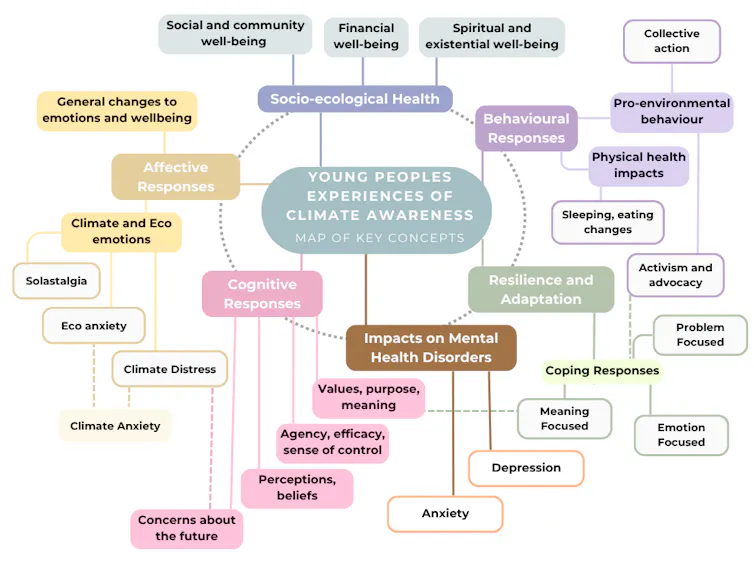
Although eco-anxiety and climate-anxiety are the most commonly used terms, our review found a total of 173 experiences describing how young people think, feel and behave in response to being aware of the climate crisis. They include: Solastalgia, symptoms of depression, sleep disruptions, financial strain and hope, along with other experiences not documented in the academic literature.

A breakdown of key climate change awareness concepts

As there were so many experiences described, we organised them into six interrelated categories and sub-categories (see the chart below).

Map of the key concepts and developed 6 categories and subcategories of young people’s experiences of climate change awareness.
Courtesy of Daniella Watson, CC BY

It is important to address and be inclusive of the full spectrum of young people’s experiences beyond climate-anxiety, including the impacts on physical health such as sleep, physical activity and eating behaviours, social and cultural practices, and spiritual and community wellbeing.

Climate awareness: exploring the cultural and colonial factors

Researchers like us are working with lived experience experts around the world to co‑design research and support tools that genuinely reflect the diverse ways people understand and are affected by climate change. Because awareness of the climate crisis is shaped by history, identity, place, and power, it is essential that research is developed with people whose lives are directly touched by these dynamics.

One example of how lived experience expertise has expanded the field comes from a contributor who challenged and deepened existing definitions of eco‑anxiety. They explained:

“I think we perceived [climate-anxiety] as more of an embodied and intergenerational, deep wound that comes out of colonisation, colonial legacies and something that was a lot more personal.”

Our research uncovered no existing definitions of climate change or eco-anxiety that acknowledge the impact of colonial history on individuals’ experiences of environmental distress. By collaborating with experts in lived experience, we have deepened and sharpened our understanding in this area.

Another example of our work with lived experience experts to codesign a research evaluation of The Resilience Project’s youth‑led intervention prompted us to adopt a broader definition of resilience: not simply “bouncing back”, but balancing strength, softness and self‑care so young people can sustain climate‑care activities in ways that are genuinely protective and long‑term.

The way forward

Taken together, our findings show that young people’s experiences of being aware of the climate crisis are far more complex, varied, and culturally situated than the terms eco‑anxiety or climate‑anxiety can capture.

While these labels have become dominant in public and academic conversations, the evidence reveals a much broader landscape of emotional, social, cultural, and structural impacts: from intergenerational grief and disrupted sleep to financial strain, solastalgia, and profound reflections on justice and inequality.

The lack of consistent definitions not only limits scientific clarity but also risks narrowing how we understand and support young people living through a rapidly changing world.

If researchers, practitioners, and policymakers want to design meaningful interventions and supportive environments, they must move beyond narrow psychological framings and engage with the full spectrum of people’s lived realities.

This means codesigning research, measures, and policies with those most affected; recognising the structural and historical forces that shape climate anxiety; and ensuring that the language we use reflects the world as people actually experience it. We recognise that news outlets and social media play an important role in shaping public understanding, which is why we chose to write this article and others like it, and to share our messages with the BBC Climate Question and other media platforms.


Created in 2007 to help accelerate and share scientific knowledge on key societal issues, the Axa Research Fund – now part of the Axa Foundation for Human Progress – has supported over 700 projects around the world with researchers from 38 countries on key environmental, health & socioeconomic risks. To learn more, visit the website of the AXA Research Fund or follow @ AXAResearchFund on LinkedIn.

The Conversation

Emma Lawrance received funding from AXA Research Fund. Emma was Director of the Climate Cares Centre at Imperial College London when this research was undertaken, and is now the Senior Research Fellow in climate change and mental health at the University of Oxford.

Daniella Watson ne travaille pas, ne conseille pas, ne possède pas de parts, ne reçoit pas de fonds d’une organisation qui pourrait tirer profit de cet article, et n’a déclaré aucune autre affiliation que son organisme de recherche.

ref. Eco-anxiety: how do young people relate to the climate crisis? – https://theconversation.com/eco-anxiety-how-do-young-people-relate-to-the-climate-crisis-277520

A host nation at war with a participant: uncertainty and tension swirl around soccer’s World Cup

Source: The Conversation – Global Perspectives – By Daryl Adair, Associate Professor of Sport Management, University of Technology Sydney

On March 11, Iranian Sports Minister Ahmad Donyamali announced he saw “no possibility” of the country’s men’s national soccer team taking part in the World Cup scheduled for North America in June and July this year.

That prognosis came in the wake of US and Israeli military attacks on Iran, which have triggered a crisis across the Middle East.

Never before has a World Cup host nation been at war with one of the countries participating in the tournament.

The failure to find a diplomatic solution to longstanding multilateral tensions has not only impacted the supply of oil and trade routes, it has complicated one of the world’s largest sporting events.


Read more:
Trump’s war language is aggressive and extreme. It also offers some insight into his thinking


Prizing peace, enacting war

In 2025, Gianni Infantino, president of soccer’s governing body – Fédération Internationale de Football Association (FIFA) – announced the inaugural “FIFA Peace Prize”.

FIFA, he said, intended to recognise:

the enormous efforts of those individuals who unite people, bringing hope for future generations.

In January 2026, US President Donald Trump was deemed the most worthy recipient of this accolade.

That is despite a litany of conduct at odds with the award, such as the US partnering Israel in the Gaza conflict, as well as the Trump administration’s “rapid authoritarian shift”, which has brought a substantial decline of civic freedoms at home.

Two months after Trump received his “peace prize”, the US partnered with Israel to provoke war against Iran.

Little wonder some critics have argued Trump’s award ought to be revoked.

Will Iran be welcome at the World Cup?

After meeting Infantino on March 10, Trump provided assurance the Iranian team would be “welcome to compete”.

Soon after, though, Trump wrote on his Truth Social media platform there would not be a welcome mat:

I really don’t believe it’s appropriate that they be there, for their own life and safety.

This veiled warning prompted a rebuke from the Iranian team, which insisted: “no individual could exclude a country from the World Cup”, and that it was the responsibility of a host nation to provide security guarantees for participants.

The players want to take part, even if their national sports minister feels it is a forlorn hope.

At this stage, scheduled friendly games against Nigeria and Costa Rica in Turkey, intended as preparation for the World Cup, are going ahead.

Pitch perambulations

Iran is scheduled to play three group-stage games in California and Seattle at the World Cup.

Competing in the United States is a sticking point for the Iranian Football Federation (FFIRI), which is responsible for the team.

FFIRI head Mehdi Taj stated:

We will prepare for the World Cup. We will boycott the United States but not the World Cup.

The Iranian hope, therefore, is the team be permitted to play in either Canada or Mexico, which are co-hosting with the US.

Mexico appears willing to play ball: on March 17, President Claudia Sheinbaum stated: “the nation stands prepared to host Iran’s group-stage matches should circumstances require”.

FIFA though said it was unwilling to move Iran’s matches from the US.

For the Iranians, the ability to take part seems more important than chasing a trophy: teams that make the final will play at New Jersey’s MetLife Stadium and Iran does not wish to play in the US.

Meanwhile, FIFA is privately pondering contingency arrangements should Iran not take part.

This includes making Iran’s place in the tournament vacant – which would mean a walkover for opponents – or replacing it with a team from either Iraq or the United Arab Emirates, both of which narrowly missed qualifying via the Asian Football Confederation pathway.

That said, Iraq is already scheduled to play the winner of a match between Bolivia and Suriname for a spot in the World Cup.

The UAE lost to Iraq in the relevant Asian Confederation match, yet should Iraq win its intercontinental playoff match, the team from the Emirates might be given a FIFA free kick into the World Cup.

Political football

FIFA states it is a “politically neutral” body.

But this has not stopped it excluding Russia from qualifying matches for the 2026 World Cup.

FIFA insists it did so for operational reasons: many countries refused to play against Russia, and if games were scheduled there would be concerns about security.

Privately, Infantino might be relieved Israel did not qualify for the World Cup, as both of these considerations may have come to light in the wake of the Gaza war and more recent attacks against Lebanon and Iran.

The withdrawal (or banning) of a team from the World Cup or qualifying matches has happened on a few occasions:

In each of these cases there were no follow-up penalties by FIFA.

If Iran withdraws from the World Cup, will FIFA sanction the FFIRI and, by extension, the national men’s team? A yellow card is feasible – a financial penalty. A red card is also possible – such as exclusion from the 2030 World Cup.

However, FIFA has the discretion not to impose any penalty, especially as the circumstances go beyond sport and have no parallel in World Cup history.

The Conversation

Daryl Adair does not work for, consult, own shares in or receive funding from any company or organisation that would benefit from this article, and has disclosed no relevant affiliations beyond their academic appointment.

ref. A host nation at war with a participant: uncertainty and tension swirl around soccer’s World Cup – https://theconversation.com/a-host-nation-at-war-with-a-participant-uncertainty-and-tension-swirl-around-soccers-world-cup-278191

Israel wants to destroy Iran’s nuclear program. But should it have nuclear weapons itself?

Source: The Conversation – Global Perspectives – By Marianne Hanson, Associate Professor of International Relations, The University of Queensland

Israel’s avowed goal in the Middle East war is to prevent Iran from acquiring nuclear weapons. Yet, the double standard associated with this is hardly sustainable in the long run.

The worst-kept secret in the world of nuclear politics is that Israel possesses a formidable arsenal of nuclear weapons. It began developing these in the 1950s and reached a fully operational capability by the late 1960s.

Although Israel refuses to confirm or deny this fact, arms control organisations have assessed that the country has some 80–90 nuclear weapons.

In recent days, Iran targeted Israel’s nuclear facility in the southern town of Dimona, injuring more than 100 people. The head of the International Atomic Energy Agency (IAEA) called for restraint to avoid a “nuclear accident”.

A program shrouded in secrecy

There is much evidence to support the existence of Israel’s arsenal.

In 1963, then-Deputy Defence Minister Shimon Peres famously stated Israel would not be the first to “introduce” nuclear weapons to the Middle East. What this actually meant was spelled out a few years later by the Israeli ambassador to the US. For a weapon to be “introduced”, he said, it needed to be tested and publicly declared. Merely possessing them did not constitute introducing them.

Several whistleblower accounts, intelligence reports and satellite imagery confirm the extent of the Israeli program and its capabilities.

More recently, Amichai Eliyahu, a far-right minister in Prime Minister Benjamin Netanyahu’s government, alluded to using nuclear weapons in Gaza – a tacit acknowledgement of Israel’s capabilities. He was later reprimanded by Netanyahu.

And in 2024, Avigdor Lieberman, a former defence and foreign minister, threatened to “use all the means at our disposal” to prevent an Iranian nuclear weapon. He added: “It should be clear at this stage it is not possible to prevent nuclear weapons from Iran by conventional means.”

It is important to remember that Israel not only developed its nuclear weapons in secret – employing subterfuge, misleading claims, and even the suspected theft of bomb-grade nuclear material from the United States – it has also rejected international inspections of its facilities and refused to join the nuclear Non-Proliferation Treaty (NPT). This treaty has been signed by almost every state in the world.

Concerns over Iran’s program

Iran, meanwhile, has never had a nuclear weapon, though its program has been the source of international concern for more than a decade.

In 2015, Iran signed the Joint Comprehensive Plan of Action (also known as the Iran nuclear deal) with the US, Russia, China, France, the United Kingdom and Germany, which imposed restrictions on its nuclear program in return for sanctions relief. This included inspections by IAEA monitors.

However, Trump scuppered the plan in 2018. Since then, Iran has enriched uranium to levels well above those needed for its energy program. And last year, the IAEA said Iran was non-compliant with its nuclear nonproliferation obligations for failing to provide full answers about its program.

But since the current war began, US and international officials have confirmed that Iran was not close to developing a nuclear weapon and did not pose an imminent nuclear threat to the US or Israel.

In short, there is no truth to the claim, made for almost 40 years by Israel, that Iran is “weeks away” from acquiring the bomb. The IAEA made clear two years ago that a nuclear weapon requires “many other things independently from the production of the fissile material”.

Getting close to nuclear threshold status, but stopping short of developing an actual bomb, likely provides a fall-back position for Iran. If Iran were to feel pushed or threatened, it could, in time, accelerate its energy program towards a weapons program. Or it could use this enriched uranium as leverage in negotiations with the US.

Nuclear powers need to show restraint

This brings us back to a major question: can double standards about who can and cannot develop a nuclear weapon be sustained indefinitely?

Israel’s nuclear arsenal has been tacitly accepted by the West, implying there are “right hands” and “wrong hands” for nuclear weapons. But this is a risky and ultimately unsustainable position.

As Australia’s Canberra Commission noted in 1996, as long as any one state has nuclear weapons, other states will want them, too.

This is precisely why many states voted in 2017 to adopt the UN Treaty on the Prohibition of Nuclear Weapons. The treaty’s purpose is to make the possession, threat and use of nuclear weapons illegitimate for all states, not just for some, on the basis of international humanitarian law.

Signed by 99 states so far, the treaty recognises that nuclear weapons promise massive destruction to civilians and combatants alike, and that even a “small” nuclear war will cause catastrophic damage.

At the end of the day, a consistent approach to nuclear weapons is more likely to prevent nuclear proliferation (by Iran or other states) than the current mess, where some states are tacitly permitted to have these weapons (and wage war on others), while other countries are not.

It is possible we are at a tipping point when it comes to nuclear proliferation, with some countries suspected of wanting to develop nuclear weapon capabilities. This includes US allies South Korea and Japan.

Are the nuclear weapons states ultimately willing to accept the UN Treaty on the Prohibition of Nuclear Weapons and disarm in the interest of global peace and security? If they don’t, then the current trajectory of keeping one’s own nuclear weapons and waging war against states that don’t have them will only weaken an already crumbling rules-based international order.

The Conversation

Marianne Hanson has previously received funding from the Norwegian Ministry of Foreign Affairs, the UK Foreign Office and Australia’s Department of Foreign Affairs. She is currently co-chair of the International Campaign to Abolish Nuclear Weapons (ICAN) Australia.

ref. Israel wants to destroy Iran’s nuclear program. But should it have nuclear weapons itself? – https://theconversation.com/israel-wants-to-destroy-irans-nuclear-program-but-should-it-have-nuclear-weapons-itself-278801

How far can Iran’s ballistic missiles reach? A defense expert explains how the missiles work, and what Iran can and can’t hit

Source: The Conversation – USA – By Iain Boyd, Director of the Center for National Security Initiatives and Professor of Aerospace Engineering Sciences, University of Colorado Boulder

Iran launched two missiles, possibly modified versions of this Khorramshahr ballistic missile, at the island of Diego Garcia. Iranian Defense Ministry via AP

Iran fired two ballistic missiles on March 20, 2026, at the Indian Ocean island of Diego Garcia, which hosts a strategically important joint U.S.-U.K. military base, according to U.S., U.K. and Israeli officials. One missile broke apart during flight, and the other appears to have been destroyed by U.S. missile defenses.

Iran has denied responsibility for the launches.

Diego Garcia is about 2,500 miles (4,000 kilometers) from Iran, which is about twice as far as the top range Iran has declared that its ballistic missiles have. Parts of Western Europe, Asia and Africa lie within a 2,500-mile (4,000-km) radius of Iran, raising concerns about the vulnerability of these areas.

However, there’s no evidence that Iran has developed a new type of missile or that it can otherwise hit targets at the longer range. Iran most likely modified an existing type of missile, but increasing a missile’s range poses significant challenges.

Ballistic missile basics

A ballistic missile is launched on a rocket and, after separating from it, subsequently flies mostly under the influence of gravity to its destination. The name refers to the characteristic arc of projectiles whose trajectories are largely shaped by gravity. The range of these missiles is determined by the size of the rocket.

Short-range ballistic missiles can fly about 300 to 600 miles (500 to 1,000 km) and can be launched from mobile trucks. They are used for destroying key defensive infrastructure such as radars.

Medium-range ballistic missiles have ranges of about 600 to 1,800 miles (1,000 to 3,000 km). They are used to attack more strategic targets such as command and control centers where military leaders coordinate operations. Intermediate-range ballistic missiles operate over about 1,800 to 3,400 miles (3,000 to 5,500 km), putting much larger geographical regions at risk.

Intercontinental ballistic missiles, or ICBMs, have a range of about 3,100 to 6,200 miles (5,000 to 10,000 km), making it possible to strike targets over an enormous area. These very long-range weapons require multiple rocket stages. They fly very high, exiting the atmosphere and entering into space, before arcing back toward Earth.

At the height of the Cold War, both the Soviet Union and the United States had thousands of ICBMs armed with nuclear warheads aimed at each other. Each weapon could obliterate an entire city, and nuclear-armed ICBMs have been the basis of mutually assured destruction in which both sides were deterred from ever using the missiles.

Iran’s inventory

Iran has an extensive ballistic missile program. The country has been developing a number of short-range ballistic missiles for many years. The suite of weapons includes the Fateh, Shahab-2 and Zolfaghar systems.

The ranges of these missiles – up to 500 miles (800 km) – are insufficient for Iran to use them against Israel directly because the closest distance between the two countries is about 550 miles (900 km). However, Iranian-backed militias have deployed these weapons in neighboring countries, such as Lebanon and Syria, and have launched them from there in attacks against Israel.

Iran has also developed intermediate-range ballistic missiles such as the Shahab-3, Sejjil and Khorramshahr weapons. These missiles have ranges of up to 1,250 miles (2,000 km), which means they can reach Israel directly from Iran.

Harder to go farther

Scaling up from short range to medium range to intermediate requires larger and larger rockets, which presents a number of increasingly difficult technical challenges. Larger rockets create more dynamic vibrations that the missile structure and all its components must survive. This requires an advanced manufacturing and testing infrastructure.

The size of the rocket also determines how much payload the missile can deliver. This challenge is very well-illustrated by the enormous Saturn V rocket that took astronauts to the Moon. Of the total launch mass, less than 2% was delivered to the lunar surface, with propellant taking up almost all the remaining mass.

ICBMs also have a small payload mass, and this in part explains why militaries more often load them with nuclear warheads than conventional chemical explosives. Pound for pound, nuclear warheads produce much larger effects. It is usually not worth the very high cost of sending an ICBM many thousands of miles just to blow up a single building.

Finally, maintaining control of the missile and hitting a target with sufficient accuracy becomes increasingly more difficult as range is extended. Missile navigation systems based on gyroscopes have slight errors that increase with time, and GPS-guided missiles can be jammed.

Limits on Iran’s reach

Having successfully launched satellites into space using two-stage rockets, however, perhaps it is not too surprising that Iran has been able to build on those successes to achieve longer ranges for its missiles. The simplest modification to extend a missile’s range is to reduce its payload.

Iran has reportedly demonstrated this with the Khorramshahr, using a smaller warhead that gives it a range of 1,800 miles (3,000 km). Some observers suggest that the missiles Iran fired at Diego Garcia most likely were further-modified Khorramshahrs.

a missile rises from a navy warship at sea
One of the Iranian missiles fired at Diego Garcia was possibly shot down by a missile fired from a U.S. Navy ship like this Arleigh Burke-class guided missile destroyer.
U.S. Navy Photo by Fire Controlman 2nd Class Kristopher G. Horton

In the Iranian attack on Diego Garcia, however, one of the missiles failed in flight and the other appeared to have been destroyed by U.S. defenses. The missile failure may indicate that Iran is attempting to operate these systems at distances they are not reliably capable of.

The apparent ability of the U.S. to defend against the second missile suggests that the Iranian intermediate range ballistic missiles do not pose a significant military threat. This conclusion is further supported by the earlier high-volume attack by Iran in December 2025 when it launched hundreds of missiles and drones in a concerted raid against Israel. Almost all were shot down by a combination of Israeli and U.S. defenses.

Surprising but not so threatening

Ultimately, while Iran’s long-range attack on Diego Garcia caught the world off guard, it was likely intended more for its psychological and political effects than for posing a real military threat.

It is worth noting that an additional challenge with fielding intermediate-range ballistic missiles is the cost, which scales with the size of the rocket required. A two-stage rocket that can fly 2,500 miles (4,000 km) is probably one of the most expensive weapons that Iran possesses: It is therefore unlikely to have many of them. When launched in small salvos, these missiles are highly susceptible to the sophisticated air defense systems of the U.S. and its allies.

Still, the attack has certainly gotten the attention of the world and may increase pressure for diplomatic approaches to end the conflict with Iran quickly.

The Conversation

Iain Boyd receives funding from the U.S. Department of Defense and Lockheed Martin Corporation.

ref. How far can Iran’s ballistic missiles reach? A defense expert explains how the missiles work, and what Iran can and can’t hit – https://theconversation.com/how-far-can-irans-ballistic-missiles-reach-a-defense-expert-explains-how-the-missiles-work-and-what-iran-can-and-cant-hit-279072

When everyday tasks become harder: Early clues to Alzheimer’s disease

Source: The Conversation – Canada – By Maryam Ghahremani, Research Data Scientist at Hotchkiss Brain Institute, University of Calgary

While almost everyone misplaces keys or forgets a name from time to time, chronic struggles that linger or worsen over months and years may reveal early disruptions in the brain’s ability to co-ordinate complex tasks. (Freepik)

For many older adults, life is full of routines. Making breakfast, paying bills, shopping, driving, managing appointments and keeping track of medications are tasks done almost automatically. For most, these routines run smoothly, but for some, small disruptions begin to creep in.

These small struggles matter. Perhaps it starts with uncharacteristically forgetting to add an item to the grocery list or misplacing a pair of glasses. Maybe a chequebook gets mismanaged, or a favourite recipe becomes harder to follow.

These moments can be brushed off as part of aging or blamed on a busy mind. Yet, when these new difficulties persist over time, they may be more than just minor frustrations; they might be early signs of something far deeper.

Understanding functional changes

Daily functioning is a key measure of independence, reflecting not only memory, but the co-ordination, planning and attention required to navigate everyday life. Changes here are often subtle, and they can go unnoticed by family members or health-care providers.

A man and a woman with grey hair preparing food
Functional changes can emerge years before dementia is diagnosed, providing an early signal that the brain may be at risk.
(Freepik)

Clinicians have long recognized that loss of functional independence, like difficulty performing everyday activities, is a hallmark of dementia. It is, in fact, part of the formal diagnostic criteria for dementia.

What is less widely appreciated is that these functional changes can emerge years before dementia is diagnosed, providing an early signal that the brain may be at risk. Even when memory seems intact, persistent new struggles in daily tasks may indicate that cognitive decline is starting quietly.

Persistent versus temporary struggles

Recent studies tracking older adults without dementia have found that those who experience persistent difficulties in activities of daily living (like preparing meals, shopping or driving) face a higher risk of developing Alzheimer’s disease in the years ahead. In addition, these persistent impairments are linked to biological markers of the disease, detectable in spinal fluid long before memory loss becomes obvious. By contrast, temporary or occasional difficulties do not carry the same risk.

One of the key insights in this new research is the difference between temporary lapses and persistent functional changes. While almost everyone misplaces keys or forgets a name from time to time, chronic struggles that linger or worsen over months and years may reveal early disruptions in the brain’s ability to co-ordinate complex tasks.


This article is part of our series The Grey Revolution. The Conversation Canada/La Conversation invites readers to examine the far-reaching impacts of the aging baby boomer generation on Canadian society — from housing and employment to culture, food, travel and health care. The series explores the transformations already underway, as well as those still to come.


These disruptions can be one of the earliest indicators that cognitive decline is on the horizon, even before conventional cognitive tests can detect it.

Families, especially those who live with or spend time daily with an older adult, are often the first to notice subtle but steady changes in function, like moments when their loved one struggles to follow a familiar schedule, double-checks every step in a process that used to be second nature or avoids tasks that were once routine. Recognizing these patterns early can help families seek timely evaluation, support and planning.

Looking beyond cognitive screening tests

These findings also underscore the value of integrating functional assessments into routine health care. Traditionally, cognitive screening has focused on memory, attention or language tests. More recently, including assessments of changes in behaviour or neuropsychiatric symptoms have been included in dementia guidelines, even at screening of cognitively unimpaired older persons.

Measuring the ability to manage daily life may provide a window into brain health that is both a practical and potentially more culturally adaptable approach to early detection than cognitive screening. Standard cognitive screening tests can be affected by language, education or cultural background. For example, someone may score lower simply because the test uses unfamiliar words, assumes certain schooling or reflects cultural norms that differ from their own.

In contrast, observing changes in everyday function over time focuses on real-life abilities and can reveal early signs of brain changes, offering a practical and widely applicable way to detect risk.

A woman with grey hair doing a puzzle while a younger woman observes.
By shifting the focus from episodic forgetfulness to ongoing functional changes, families and health-care providers can act sooner.
(Freepik)

Shifting the focus in aging and brain health

The story of everyday struggles as early warning signs challenges common perceptions of aging. What looks like normal forgetfulness may, in some cases, be a signal to pay closer attention. These subtle changes are not personal failures — they are clues, pointing to the need for care, support and awareness.

It’s also important to keep this in balance: not every struggle points to dementia, and many older adults maintain their independence without experiencing any decline in daily functioning. But for those whose difficulties persist and accumulate, the pattern is meaningful.

Based on the latest research, it is this persistence, rather than occasional slips, that is most strongly linked to future cognitive decline and brain changes associated with Alzheimer’s disease.

By shifting the focus from episodic forgetfulness to ongoing functional changes, families and health-care providers can act sooner. Support strategies, such as simplifying routines, using reminders or providing assistance with complex tasks, can help maintain independence while also serving as a form of early intervention. Early recognition also allows for better planning, access to resources and timely medical evaluation.

A woman with her grey hair pulled back smiling
By joining studies on everyday function, you can help advance research that could make a real difference.
(Pexels)

A window into brain health

Ultimately, the story of functional change in aging is one of vigilance and insight. Paying attention to what may seem like small, everyday difficulties can offer a glimpse into the brain’s health years before memory loss becomes obvious. It’s a reminder that the subtle ways life becomes harder can carry vital information, and that early attention to persistent changes may make a meaningful difference in the course of aging and cognitive health.

If you’re interested in contributing to research on everyday function and brain health, Canadian studies like CAN-PROTECT and BAMBI are exploring how subtle changes in daily life may signal early risk for Alzheimer’s.

Both studies are led by Dr. Zahinoor Ismail, a clinician scientist at the University of Calgary and one of the authors of this story. BAMBI is based in Calgary, while CAN-PROTECT is an online study open to participants across Canada. By joining such studies, you can help advance research that could make a real difference.

The Conversation

Zahinoor Ismail receives funding from Canadian Institutes of Health Research, Gordie Howe CARES, and the NIHR UK Exeter Biomedical Research Centre. He has also served as a consultant to Eisai, Eli Lilly, Novo Nordisk, Otsuka/Lundbeck, and Roche.

Maryam Ghahremani does not work for, consult, own shares in or receive funding from any company or organisation that would benefit from this article, and has disclosed no relevant affiliations beyond their academic appointment.

ref. When everyday tasks become harder: Early clues to Alzheimer’s disease – https://theconversation.com/when-everyday-tasks-become-harder-early-clues-to-alzheimers-disease-277443

Canada’s new TikTok compromise fails to resolve questions of ownership and national security

Source: The Conversation – Canada – By Philip Mai, Co-director and Senior Researcher, Social Media Lab, Toronto Metropolitan University

The Canadian government has reached an agreement with the social media platform TikTok after years of debate over the app’s data practices, particularly those affecting young users. The deal allows TikTok to continue operating in Canada under tighter oversight rather than facing a shutdown.

As social media researchers at the Social Media Lab at Toronto Metropolitan University, we’ve always paid close attention to the state of social media in Canada. We have followed the TikTok ban saga closely since early 2020, when United States President Donald Trump first tried to ban the platform, long before he later came out in favour of keeping it.

While the new agreement does move towards greater oversight of TikTok, major concerns remain. TikTok’s parent company, ByteDance, is based in China and Chinese national security laws can compel companies to co-operate with state authorities. This underlying risk sits beyond the reach of Canada’s safeguards.

The agreement follows a new national security review that reversed an earlier conclusion pointing toward closure of TikTok’s Canadian operations. Instead of a ban, the federal government has chosen a regulatory approach, one that keeps the app available while imposing legally binding conditions. The deal reduces some risks, but it does not resolve deeper questions about ownership, data flows and national security.

So what has TikTok agreed to? And what will the millions of Canadian users, creators, advertisers and cultural groups that rely on the platform notice?

Stronger protections for youth and minors

Under the new rules, TikTok must strengthen its protection of Canadian user data. This includes creating a security “gateway” to control access to that data, adopting privacy-enhancing technologies and allowing independent third-party monitoring to verify how data is handled.

TikTok also committed to stronger protections for minors and youth, a key concern driving the government’s review.


Read more:
Why Ontario school boards are suing social media platforms for causing an attention crisis


For everyday users, the focus on youth protection is likely to be the most visible change. Stricter age limits could affect livestreaming. Gift features may be more restricted for younger users. Content involving minors is likely to face stricter moderation.

Canadian creators will also feel the impact. Those with audiences largely made up of teenagers may face tighter moderation or additional eligibility checks for certain features and monetization tools. Sponsors may also ask more detailed questions about audience demographics as brands become more cautious about youth-focused content.

Many changes will happen behind the scenes. As TikTok Canada adjusts to the new requirements, its verification processes, advertising tools and moderation systems are expected to become more demanding.

As the government now requires stronger protection of Canadian user data, people who earn money on the platform may encounter extra steps. These may include stricter identity checks, added requirements for business accounts or ad payments and clearer information about where Canadian user data is stored.


Read more:
Does TikTok pose a security threat to Canadians?


Does this make TikTok safer? Compared to what existed before, the agreement does move toward greater oversight. Independent monitoring, if carried out properly, gives the government some visibility into TikTok’s data practices and the commitments are legally binding rather than voluntary.

Canadian data can still leave Canada

Enforcement details are still unclear. The government has said it will appoint an independent monitor, but has not named the monitor, explained how audits will work or detailed what penalties TikTok would face for failing to comply. Without clear consequences, oversight could prove weaker in practice than it appears on paper.

The agreement also stops short of requiring full data localization. Canadian user data does not have to stay entirely within the country. Although technical controls may limit access, data can still move through systems outside Canada. This leaves some exposure to unauthorized access or foreign influence.

Another gap is research access. The deal does not require TikTok to share data with vetted Canadian public-interest researchers, like academics or journalists. Currently, researchers from Canada are not qualified for access to the TikTok application programming interface (API), while their counterparts in the European Union and U.S. are. This makes it harder for Canadian researchers to independently study the platform’s impact on Canadian users.

A cautious compromise

Overall, the agreement reflects a compromise. Canada avoided a disruptive ban; TikTok accepted tighter rules to keep operating in a key market. The deal reduces some risks, but it does not resolve deeper questions about ownership, data flows and national security.

Those tensions are likely to resurface as Canada continues to grapple with how to regulate global platforms that play an outsized role in everyday life.

The Conversation

Anatoliy Gruzd receives funding from the Canada Research Chair program (SSHRC).

Philip Mai does not work for, consult, own shares in or receive funding from any company or organisation that would benefit from this article, and has disclosed no relevant affiliations beyond their academic appointment.

ref. Canada’s new TikTok compromise fails to resolve questions of ownership and national security – https://theconversation.com/canadas-new-tiktok-compromise-fails-to-resolve-questions-of-ownership-and-national-security-278182

My unsung hero of science: Buckminster Fuller, the architect who wanted to redesign the world (and inspired a nanosized one)

Source: The Conversation – UK – By Antonios Kelarakis, Reader in Polymers ad Nanomaterials, School of Pharmacy and Biomedical Sciences, University of Lancashire

On November 14 1985, a letter announcing the discovery of a superstable species of carbon appeared in the science journal Nature. Even the letter’s title, C₆₀: Buckminsterfullerene, caused a stir among the journal’s scholarly readers.

Molecules are usually named with sterile precision. This one was named after the American architect and futurist Richard Buckminster Fuller (Bucky to his friends), whose geodesic domes had become icons of modern design in the 1950s and 60s.

Fuller’s spherical domes were designed to be lightweight yet strong, with each triangular element distributing stress evenly across a curved framework. C₆₀ was the atomic analogue of these domes, built not from steel struts but carbon atoms – each joined by strong bonds with three of its neighbours to create a tiny spherical cage.

This new allotrope of carbon was so stable and symmetric that it redrew the map of molecular architecture. It kicked off a scientific sprint that led, barely a decade later, to the 1996 Nobel prize in chemistry for English scientist Harold Kroto and his American colleagues Robert Curl and Richard Smalley for their discovery.

Fullerenes (now nicknamed Buckyballs) had always existed on Earth – in candle soot, volcanic emissions and ancient minerals. But their scientific discovery emerged from an attempt to simulate the chemistry of carbon-rich red giant stars.

The discovery opened the era of nanotechnology – the manufacture and manipulation of materials at previously impossibly small scales. But this is not the only way Fuller’s name is remembered in science.

Buckminster Fuller holding a geodesic sphere
Buckminster Fuller holding a geodesic sphere, the structure he pioneered.
Wikimedia, CC BY-NC-ND

Who was Buckminster Fuller?

Few 20th-century figures are as hard to classify as Fuller. He was, at the least, an inventor, designer, engineer, writer, philosopher and futurist. Born in Massachusetts in 1895, his formal education was brief and rather turbulent – he was expelled twice from Harvard University. Yet this did not lessen his ambition to redesign the world.

Fuller could be eccentric and sometimes controversial. His early enterprises frequently failed, yet his charisma and boundless optimism made him a compelling public figure. The result was a remarkable portfolio of inventions and concepts, showcasing bold prototypes and radical ideas.

His earliest geodesic domes were built from lightweight materials, typically steel tubular struts connected in a triangular lattice and clad with acrylic panels. They capitalised on the structural advantage of symmetry: enclosing a vast space with relatively little material and remaining exceptionally strong.

Fuller patented the design in 1951. Despite initial scepticism from some in the architectural establishment, geodesic domes soon found practical applications. The US Marine Corps used them for rapidly deployable radar stations in Arctic conditions.

One of the most famous examples is the giant dome built for the Expo 67 international exposition in the Canadian city of Montreal. Known today as the Montreal Biosphere, the structure became one of the most recognisable symbols of futuristic architecture in the 1960s.

Video: Atlas Pictures.

Alongside his designs, Fuller spent much of his life developing Synergetics, a philosophical-geometric framework exploring how structures and energies interact in nature. At the heart of this work was “ephemeralisation” — a term Fuller coined to describe the process of achieving ever greater results with fewer materials and less energy.

In later life, he became a global intellectual celebrity, delivering thousands of lectures around the world. Fuller captivated audiences with a unique vision of design, technology and planetary stewardship — once delivering a marathon series of lectures entitled “Everything I know”. It ran for 42 hours.

The power of symmetry

Symmetry is among science’s most powerful unifying codes and one of its most versatile interpretive tools. It reveals surprising equivalences between forms that differ in size but not in structure.

In the 1960s, footballs adopted a similar geometry to Fuller’s geodesic dome: a combination of 12 pentagons and 20 hexagons stitched into a resilient mesh to absorb force and rolls with minimal deformation. Indeed, a diagram of a football was used to illustrate the announcement of C₆₀: Buckminsterfullerene.


Frank Malina beside a rocket

This series is dedicated to lesser-known, highly influential scientists who have had a powerful influence on the careers and research paths of many others, including the authors of these articles.


A growing family of atom-thin, superstrong materials has emerged since that 1985 Nature letter. These include the tiny-in-diameter but much longer carbon nanotubes in 1991, and the one-atom thick graphene in 2004 – both of which are now widely used in electronics, sensors, composites and energy devices.

When added to polymer composites or metal alloys, these tiny carbon cages strengthen and lighten materials, enhancing performance in everything from aircraft components and solar panels to medical tools including MRI scanners.

Doing more with less

The structure of fullerenes naturally realises Fuller’s principle of ephemeralisation – the ability to do more and more with less and less.

Fuller imagined technological progress as a path toward efficiency, elegance, sustainability and abundance. He applied ephemeralisation across his designs, harnessing science and geometry to achieve maximum performance with minimal resources.

Video: The Wall Street Journal.

Beyond geodesic domes, his innovations included the Dymaxion House – a prefabricated, environmentally efficient home designed for easy mass production and transport – and the Dymaxion Car. Patented in 1933, its streamlined aerodynamic bodywork was designed to carry more passengers while improving both fuel efficiency and top speed.

Fuller also imagined radical solutions for extreme environments. These included the Undersea Island – a submerged base anchored by crisscrossing cables to stay rock steady in storms – and the suspension building system, which inverted the idea of a suspension bridge into an arched dome that created vast interior space with minimal material.

Fuller died in 1983 after a lifetime spent redesigning the world – and reimagining how humanity might live. Two years later, chemistry paid him an unexpected tribute: a perfectly symmetrical carbon molecule was named after him, recognising his lifelong dedication to geometrical efficiency.

In the nanosized Buckyball, Fuller’s aspirational social ideas are encapsulated in a molecule that embodies minimalism, efficiency and intelligent design.

The Conversation

Antonios Kelarakis does not work for, consult, own shares in or receive funding from any company or organisation that would benefit from this article, and has disclosed no relevant affiliations beyond their academic appointment.

ref. My unsung hero of science: Buckminster Fuller, the architect who wanted to redesign the world (and inspired a nanosized one) – https://theconversation.com/my-unsung-hero-of-science-buckminster-fuller-the-architect-who-wanted-to-redesign-the-world-and-inspired-a-nanosized-one-278272

The world’s waste mountain is rising at an alarming rate

Source: The Conversation – UK – By Costas Velis, Lecturer in Resource Efficiency Systems, School of Civil Engineering, University of Leeds; Imperial College London

neenawat khenyothaa/Shutterstock

The world is struggling to deal with ever-growing quantities of waste.

A new World Bank Group report, What a Waste 3.0, shows that more than 2.6 billion tonnes of municipal solid waste (which includes rubbish from households, businesses and street cleaning) were generated in 2022. That figure is projected to rise to 3.9 billion tonnes by 2050. The good news is that the share of waste that is mismanaged is expected to fall over that period, from around 30% to around 20%.

That sounds like progress. But percentages can be misleading. The quantity of mismanaged waste, including plastics, is projected to remain almost unchanged, at around 760 million tonnes. This means that by 2050, enormous quantities of waste will still be openly dumped, burned or otherwise unmanaged, with many households and communities left to deal with it themselves.

This new report, which we contributed to, brings together the most recent publicly accessible municipal waste data from 217 countries and economies (such as the Channel Islands) and 262 cities. It highlights that although waste systems are improving in many places, those gains are being undermined by the growth in the amount of waste generated.

Stacked bar chart showing projected global municipal solid waste treatment under a business-as-usual scenario from 2022 to 2050. Total waste rises from 2,562 to 3,855 million tonnes per year, while the mismanaged share falls from 30% to 20%.
Business-as-usual scenario for global municipal solid waste treatment, disposal and uncollected waste.
Data from Ed Cook, Kremena Ionkova, Perinaz Bhada-Tata, Sonakshi Yadav, Frank Van Woerden. 2026. What a Waste 3.0: Global Snapshot of Solid Waste Management Toward Circularity until 2050. Urban Development Series. Washington, DC: World Bank., CC BY

This matters because when waste is not managed properly, the consequences affect human health, the environment and the economy. Poor waste management contributes to air and water pollution, damages ecosystems, increases greenhouse gas emissions and makes cities harder and less pleasant to live in.

One of the clearest examples is open burning. In many developing countries, where formal waste collection remains incomplete or absent, open burning is one of the main ways households and communities “self-manage” their waste. These fires burn at low and uneven temperatures. Combined with a mixed waste stream that can include plastics, organics and other materials, they release a complex cocktail of pollutants that can threaten the health of people living and working nearby.

With new data on self-management, this report shows how waste is actually managed across large parts of the world, especially where formal systems remain weak. Forms of self-management of waste include open dumping, open burning, burying waste in informal pits, dumping into waterways and coastal waters, and some forms of informal recovery such as recycling or composting.


Read more:
Health crisis: up to a billion tonnes of waste potentially burned in the open every year


So if the harms of poor waste management are well known, why does the problem persist?

One reason is cost. Municipal waste management is resource intensive. Many countries are still spending far less than is needed to provide universal and reliable services. Our analysis suggests that even basic systems involving collection, transport and disposal tend to cost at least US$40 (£30) to US$45 per tonne in low-income countries. In middle-income countries, basic systems cost roughly US$70 to US$80 per tonne, while in high-income countries costs can exceed US$200 per tonne.

At those cost levels, low-income countries would have needed around 0.78% of their combined GDP in 2022 to achieve universal waste management coverage. Middle-income countries would have needed roughly 0.31% to 0.46% of GDP. Yet reported public spending on solid waste management is less than 0.15% of GDP in about three-quarters of low- and middle-income countries and 0.31% in high income countries.

That financing gap helps explain why waste collection is not comprehensively provided, why open dumping is still common and why so many people are left to manage waste themselves.

Open burning of mixed roadside waste beside an iron fence, with smoke drifting across a grassy area and trees.
Around 2 billion people do not have access to solid waste collection, meaning they have to manage it themselves, often through dumping and open burning, as in Nizamat Fort Campus, West Bengal in India.
Biswarup Ganguly, CC BY

The total financial costs are also rising fast. Globally, municipal waste management cost more than US$250 billion in 2022. Under a business-as-usual scenario, that annual cost is projected to reach US$426 billion by 2050.

Shifting the costs

The cost of inaction is higher than these service costs alone suggest. Poor waste management brings wider economic losses, for example through ill health, reduced land values, damaged ecosystems, lost materials and harm to sectors such as tourism, agriculture and fisheries.

The world may not be saving money by underinvesting in waste management. It is shifting the costs elsewhere – onto public health, the environment and future generations.


Read more:
Plastic pollution hotspots pinpointed in new research – India ranks top due to high levels of uncollected waste


This is especially important in low- and lower-middle-income countries, where waste generation is rising rapidly, but service coverage and infrastructure are often far below sufficient levels. This report estimates that these countries will require hundreds of billions of dollars in investment over the next 25 years just to expand and improve municipal waste systems. Without faster investment, existing service gaps will widen and the costs of inaction will grow.

The world’s waste crisis cannot be understood only as an environmental problem. It is also a financing, public health, governance and development problem. Better data helps us see that more clearly.

Waste management is improving, but not fast enough. Unless investment and performance accelerate, the amount of mismanaged waste worldwide is unlikely to change, causing harm to public health.

The Conversation

Costas Velis has consulted for UNEP – International Environmental Technology Centre, the Organisation for Economic Co-operation and Development (OECD), EMG, the Resources and Waste Advisory Group (with funds from GIZ), the ICF (with funds from The Pew Charitable Trusts), and MARS Inc. via Imperial Consultants). He receives funding from UK Research Innovation and Global Challenges Research Fund, Grid-Arendal, The World Bank Group via UN Operations and the International Union for Conservation of Nature, and the EU via UK Research Innovation grant agreement. He serves on the steering committee for project STOP by SYSTEMIQ Indonesia; was Chair of the International Solid Waste Association Marine Litter Task Force; is on the policy and innovation forum for the Chartered Institution of Wastes Management; He is member of and served at Steering Committee of the Scientist’s Coalition for an Effective Plastics Treaty, and is the owner and Director of Fuelogy, a small research consultancy registered in the UK that offers scientifically impartial services in solid waste management, resource recovery and the circular economy to sustainability-focused consultancies, non-governmental organisations, and international organisations.

Ed Cook has consulted for: Women in Informal Employment, Globalizing and Organizing (WIEGO), World Bank Group, Julie’s Bicycle, Vision 2025, ICF (funded by Pew Charitable Trust), OHE, WasteAware (funded by GIZ), IUCN (funded by World Bank via UNOPs). He has worked on research projects funded by: Grid Arendal (funded by NORAD), Mars, Eunomia Research and Consulting (funded by The World Bank Group), and ICF (funded by the Pew Charitable Trust). He is a Chartered Waste Manager with the Chartered Institute of Wastes Management in the UK, a member of The Scientists’ Coalition for an Effective Plastics Treaty, and a member of the International Solid Waste Association.

ref. The world’s waste mountain is rising at an alarming rate – https://theconversation.com/the-worlds-waste-mountain-is-rising-at-an-alarming-rate-278627