Why do some people get ‘hangry’ more quickly than others?

Source: The Conversation – UK – By Nils Kroemer, Professor of Medical Psychology, University of Tübingen; University of Bonn

Kues/Shutterstock

“Come on, little fella – we should get going now.” But my son was not listening. The sand in the playground was just right, so he just kept digging with his new toy excavator.

As I drifted back to my list of to-dos, however, the laughter was suddenly replaced by sobs. My son was not hurt, just very upset. When I looked at my phone, I saw it was well past his regular mealtime – and he was feeling very hungry.

However old we are, we all have a tendency to grow irritated if our body lacks enough fuel. But while humans have experienced this for as long as we have been on the planet, a specific word to describe the phenomenon only entered the Oxford English dictionary in 2018. “Hangry: to be bad-tempered or irritable as a result of hunger.”

Perhaps more surprising is the scarcity of research into how hunger affects people’s everyday moods. Most studies on food and mood have focused on patients with metabolic or eating disorders – perhaps because many psychologists have traditionally understood hunger to be such a basic physiological process.

So, with colleagues from the fields of psychology and mental health, I decided to investigate how different people respond to feeling hungry. We wanted to see if (and why) some people are better at reacting calmly when hunger strikes. Perhaps there would be some lessons for those of us with young children, too.

Surprising results

In the animal world, hunger is frequently studied for its role as a key motivator. Hungry rodents, for example, will vigorously press a lever or climb over large walls to get to food rewards. In the wild, hungry animals often roam further to explore their environment, seeming restless as they seek to overcome the threat of low or no energy.

A Pallas’s cat (also known as a manul) gets increasingly hangry as it hunts for food. Video: BBC.

To investigate the relationship between energy levels, hunger and mood in people, we equipped 90 healthy adults with a continuous glucose monitor for a month. Glucose is the primary source of energy for the body and brain, and these monitors – used in clinical practice to help patients with diabetes regulate their blood sugar levels – report values every few minutes. (Participants could actively check their glucose levels using the sensor app, and we could see when they accessed them.)

We also asked our participants to complete mood check-ins on their smartphones up to twice a day. These included questions about how hungry or sated they felt on a scale from 0 to 100, as well as a rating of their current mood.

The results surprised us. First, people were only in a worse mood when they acknowledged feeling hungry – not simply when they had lower blood sugar levels. And second, people who more accurately detected their energy levels in general were less prone to negative mood swings.

This suggests there is a key psychological middle step between a person’s energy and mood levels, which scientists call interoception.

In the brain, hunger is signalled by neurons in the hypothalamus that detect a prolonged energy deficit. Conscious feelings of hunger are then linked to the insula, a part of the cerebral cortex that is folded deep within the brain, and which also processes taste and plays a role in feeling emotions.

In our recent study, people with high interoceptive accuracy experienced fewer mood swings. This does not mean they never felt hungry – they just seemed better at keeping their mood levels stable.

This is important, because a sudden change in mood can have knock-on effects on relationships with family, friends and colleagues. It can lead to bad decision-making and more impulsive behaviour – including buying fast-energy food that can be less good for you.

More generally, paying close attention to our bodies’ needs helps keep our minds at ease too, avoiding unnecessary wear and tear on both. Deviating too much from the body’s ideal state can pose a long-term risk to our health – mental as well as physical.

Caught off-guard

Young children find it hard to interpret all the signals from their rapidly developing body. They are also easily distracted by what is happening around them, and often fail to attend to their hunger or thirst without prompting – leading to a sudden meltdown like my son had in the playground.

Likewise for many adults in today’s fast-paced world full of digital distractions, it can be easy to be caught off-guard by dipping energy levels. One simple life hack is to keep a regular meal schedule, because hunger often kicks in when we skip a meal.

Everyone’s energy levels ebb and flow, of course. But it is possible to improve your interoceptive accuracy by allowing your inner systems to pay closer attention to your energy levels. In addition, exercise and physical activity can sharpen your hunger sensing and improve energy metabolism.

Most of the time, of course, our moods are only modestly affected by hunger, among the many other factors that can come into play. But one of the lessons of my time at the playground has been to take care of my son’s food needs long before they become obvious. Perhaps we all need to be more aware of the risk of getting hangry.

The Conversation

Nils Kroemer receives funding from the German Research Foundation (DFG). He is affiliated with the German Center for Mental Health (partner site Tübingen) and the German Center for Diabetes Research.

ref. Why do some people get ‘hangry’ more quickly than others? – https://theconversation.com/why-do-some-people-get-hangry-more-quickly-than-others-273617

Fast fashion: why changes in return policies don’t do enough to address environmental damage

Source: The Conversation – UK – By Anastasia Vayona, Postdoctoral Research Fellow in Social Science and Policy, Faculty of Science and Technology, Bournemouth University

Around 40% of online shopping globally is driven by impulse buying. JadeThaiCatwalk/Shutterstock

Online fashion retailer Asos recently introduced additional fees for customers who return lots of items, marking a significant shift in the fast fashion model that has relied on free, frictionless return policies as a key competitive advantage.

And now the fashion retailer has introduced a new tool to show shoppers exactly what their return rate is, and if they are about to incur a fee. The new policy is aimed at encouraging shoppers with the highest return rates to cut back.

It’s not clear yet if other fast fashion brands such as H&M, Shein, Zara and Primark might follow Asos’s lead on returns, and whether it will change shopping habits.

There are two common fast fashion shopping scenarios. The first is where customers buy three or four versions of the same item in different sizes, then return the ones that they don’t want. The second is where a shopper will buy three or four completely different dresses, for example.

The first approach, called “bracketing” in the retail industry, may be affected more by the new cost of returns. So it may encourage some shoppers to cut down on the sizes they order, perhaps from four to two, if they continue to use Asos. This may have somewhat of a positive environmental effect, if it reduces the size of orders.

The second scenario, impulse buying, generates almost the 40% of all online spending globally, with clothing being the most frequently purchased category. But when faced with return fees, impulse buyers are significantly more likely to avoid the return process entirely, if it is seen as complicated or pricey.

A study in the US found 75% of online consumers have kept unwanted items due to complicated or expensive return processes, rather than initiating a return. This means instead of items going back to the online shop (where they can potentially be refurbished and resold), they remain in consumers’ homes or end up in local landfills.

Rather than reducing overall consumption, the return fee merely shifts the waste burden from the retail supply chain to individual households and council waste systems.

However, Asos says it is committed to sustainability. Its corporate strategy states that: “We recognise our responsibility for reducing our impact on the environment and protecting the people in our supply chain.” Meanwhile, Shein says: “We are working hard to drive continued progress toward our sustainability and social commitments.”

The environmental implications of Asos’s new policy, and fast fashion generally, reveal a complex picture. To understand what they are, we need to examine what happens to unwanted clothing in our fashion system, and what incentives genuinely drive more sustainable outcomes.

The returns problem

The textile sector is a significant contributor to global carbon emissions, accounting for 8-10% of worldwide emissions – surpassing the combined carbon footprint of aviation and maritime shipping. Within this broader impact, product returns create additional environmental damage through a cascade of effects: extra transportation, packaging waste, energy-intensive inspection and sorting processes, and ultimately disposal.

The costs of fast fashion to the environment are high.

When an item is returned, it enters a reverse logistics system (sending goods back from the customer to the retailer) that is far less efficient than the original chain from manufacturer to supplier. Returns often require individual courier pickups, adding transportation costs and emissions.

So on the surface, return fees appear to offer a straightforward solution: discourage returns, reduce transportation emissions, ease the burden on waste systems. But this logic fails to account for consumer behaviour when faced with financial penalties.

Garments languishing unworn in closets represent entirely wasted resources: all the water, chemicals, energy and labour invested in their production yield no value. Discarding an item of clothing locally just shifts the burden to council waste systems that are often unprepared to handle textiles.

Return fees, in other words, don’t necessarily solve the waste problem. They simply reduce consumers’ options, sometimes forcing them towards worse alternatives.

This reveals a deeper truth: the environmental problem isn’t returns but rather fast fashion itself. The system generates excess production by design. Retailers prefer inventory buffers to avoid being out of stock. This excess is fundamental to how fast fashion operates.

What would make a big difference

Charging for returns is unlikely to improve environmental outcomes that much. The following measures could be more effective:

Extended producer responsibility: In France, retailers are required to finance their collection and sorting systems, creating incentives to design more durable products and manage end-of-life properly. This shifts responsibility from consumers to producers, where it belongs.

Taxation on hazardous materials: Sweden’s proposed tax on clothing containing harmful chemicals targets the production phase, where most environmental damage occurs.

Investment in recycling infrastructure: Research clearly shows that viable textile-to-textile recycling at scale is the bottleneck. Without it, reuse becomes the only circular option.

Design standards: Polyester blends complicate recycling. Requiring higher recycled content percentages or limiting fibre blends would address some root causes of waste.

Transparency in returns data: Multiple studies show that retailers lack basic data on where returned items end up. Mandatory disclosure of what they do with returned items would expose the destruction problem and increase their accountability.

The path to greater sustainability in fashion probably isn’t through discouraging returns. It’s more closely tied to changing how clothing is designed, manufactured and valued. The real question isn’t whether returns should cost money – it’s why we’re producing products no one wants to keep in the first place.

The Conversation

Anastasia Vayona is affiliated with Bournemouth University and ReUse Foundation in volunteer bases

ref. Fast fashion: why changes in return policies don’t do enough to address environmental damage – https://theconversation.com/fast-fashion-why-changes-in-return-policies-dont-do-enough-to-address-environmental-damage-273633

Why the home secretary can’t fire a police chief who has done wrong – it’s key to the integrity of British policing

Source: The Conversation – UK – By John Fox, Senior Lecturer in Police Studies, University of Portsmouth

Shabana Mahmood delivers a statement to MPs about West Midlands police. UK Parliament/Flickr, CC BY-NC-ND

Craig Guildford, the chief constable of one of Britain’s largest police forces, West Midlands Police, will retire, after coming under pressure over a controversial decision by the police to ban visiting supporters of the Israeli football team Maccabi Tel Aviv from attending a match against Aston Villa.

Things escalated after it was revealed that the police used incorrect evidence that was hallucinated by AI in a report that led to their decision. Guildford had previously twice denied that AI was used. In an apology, the force said it had not deliberately distorted evidence.

The home secretary, Shabana Mahmood, then told MPs that she had “lost confidence” in Guildford, and announced that she would bring in new powers to allow any future home secretary to sack a chief constable. But such a promise, I argue, may be a threat to a key principle of policing in the UK.

When Robert Peel created the current British policing model, he insisted that officers must be non-partisan and free from political control and influence. Holding the office of constable means a police officer (including a chief constable) swears their allegiance to the king rather than any elected politician.

They should execute their duty independently, without fear or favour. Neither politicians nor anyone else may tell the police what decisions to take or what methods to employ, or not employ, to enforce the law. This is why the home secretary can’t just fire a chief constable.

How police are governed

For policing purposes, the UK has three separate criminal justice jurisdictions: Scotland, Northern Ireland and England and Wales. Whatever Mahmood implements will only apply to her jurisdiction, England and Wales. Since the 1970s, this includes 43 separate police forces, each covering a county or larger urban area such as the West Midlands.

The English and Welsh forces are governed by a shared system. Responsibility is divided between the Home Office, which provides half the police budget and sets national pay awards and regulations; the police and crime commissioner, an elected official with a mandate to set certain policing priorities; and the chief constable for an area, who is supposed to be operationally independent to decide how those priorities are met.

The notion of “independence from politics” has been under threat since the introduction of police and crime commissioners (PCCs) in 2011, most of whom are aligned to one of the main political parties. In addition, there have been questions raised about interference in the operational day-to-day running of police forces by at least one recent home secretary. The judge involved in this case said she found police had “maintained their operational independence”, and that the home secretary’s conversations with senior police had not influenced on-the-ground operations.


Read more:
Suella Braverman: why the home secretary can’t force the police to cancel a pro-Palestine march


Before 2011, the second limb of the three-pronged arrangement was a police authority. This consisted of 17 members drawn from local council, the magistracy and some members of the public. They were responsible for selecting (and if necessary, removing) their chief constable. The national police inspectorate would advise the police authority on suitability and qualifications, but there was no role for central government in the decision. Arguably, this removed personal enmity and political influence from the system.

Things changed in 1996, when the Police Act gave a home secretary the power to direct a police authority to force their chief constable to resign on the grounds of gross inefficiency or ineffectiveness. This was an extremely rare event, and generally chief constables were pretty safe in their role until a time of their choosing.

When the Conservative-led coalition government came to power in 2010, the prime minister was enamoured with the policing model in the US, whereby the local mayor had direct control of policing. This inspired Cameron’s government to create the current system of locally elected PCCs. They removed from the home secretary the power to sack a chief constable, and passed it to the PCC.

Last November, the government announced they were scrapping the model of PCCs. While we don’t yet know exactly what will replace them, the mood seems to be to give responsibility for policing to elected mayors or council leaders. Whether they will have sole power to fire the chief constable remains to be seen, but given Mahmood’s current stance it seems unlikely.

Policing by consent

To work effectively, “policing by consent” requires a sufficiently high level of public trust in the police. For several reasons, public confidence in the police is currently at a low ebb.

People want to be sure that their police service is free from political interference. It is, in my view, obviously undesirable for a chief constable to be scared of upsetting the home secretary of the day, and undesirable that any politician might bully a chief constable to suit their political ends. Losing a £100,000 pension is no doubt a sobering prospect.

As is often the case in politics, this fairly new home secretary probably wants to create the impression that she is strong, and will personally tackle inefficiency in policing. On the face of it, what Mahmood is planning to do is not particularly radical or remarkable – she is simply giving herself back the power that her predecessors had before the Tories took it away in 2011.

Although that power was rarely used, we must ask whether it was ever a desirable power for the home secretary to have in the first place.

The Conversation

John Fox is a former senior police detective.

ref. Why the home secretary can’t fire a police chief who has done wrong – it’s key to the integrity of British policing – https://theconversation.com/why-the-home-secretary-cant-fire-a-police-chief-who-has-done-wrong-its-key-to-the-integrity-of-british-policing-273615

YouTube may have surpassed the BBC in viewer share, but that’s not the whole picture – a media expert explains

Source: The Conversation – UK – By Dekan Apajee, Head of Media Department, School of Arts and Creative Industries, University of East London

News this week from the Broadcasters’ Audience Research Board (BARB) that YouTube has surpassed the BBC in viewing share has been widely framed as a tipping point. Some read it as a final nail in the future of public service broadcasting in a platform-led age.

But having spent ten years as a BBC journalist, another decade as a freelance content producer and academic, as well as the past five years as an Ofcom Content Board member, my instinct at times like this is to pause.

Audience measurement in a fragmented media landscape is complex. Anyone working in the industry knows that figures like those contained in this latest report from Barb – the independent UK body that measures and provides audience data for TV and video – have long been treated with caution. They capture something meaningful, but not the whole picture.

It’s important to be transparent about how Barb arrives at its numbers. Viewing is captured through two main methods: people-based data from the Barb panel; and device-based census data for online TV viewing. Both are well-established approaches, but both are proxies. They rely on standard assumptions about attention and behaviour in a world where people are increasingly watching across multiple platforms at the same time.

One television or “a view” doesn’t necessarily mean one viewer. A clip playing on a second screen doesn’t mean it’s being actively engaged with. And in an environment of constant choice, people don’t always remember what they’ve seen, let alone where they’ve seen it. The sheer volume of content means attention is often fleeting and fragmented. All of this matters when we interpret the recent headlines like this.

Rather than framing this story as YouTube versus the BBC, a more productive approach would be to look at what’s happening in practice. Audiences are still watching the BBC content via YouTube. The real job now is to understand which BBC content is travelling, how it’s being encountered and what that means for public service value when context and branding are no longer guaranteed.

Large volumes of BBC output circulate widely on YouTube: drama clips, comedy moments, documentary sequences, music performances, children’s favourites, archive footage and cultural highlights. Often re-edited or consumed in fragments, this content reaches audiences far beyond the BBC’s own services.

When that happens, YouTube gets the credit for reach and scale. The BBC’s role as commissioner, curator and public service institution can quietly recede into the background. In that sense, this moment may be less about YouTube overtaking the BBC, and more about where BBC content now lives, and how it is experienced, remembered and understood.

This shift hasn’t happened overnight. Ofcom’s 2025 Media Nations report has been pointing in this direction for years. Audiences consistently say they value high-quality UK content and trusted brands, yet they increasingly encounter that content via platforms rather than broadcasters. Discovery is driven by algorithms, not schedules; viewing is on demand, not appointment-based. Context becomes optional.

That fundamentally changes the relationship between content and audience.
The BBC still operates with public service values embedded across its output, standards around accuracy, care, accessibility, representation and responsibility. Those values shape everything from Planet Earth, to Newsround or big TV events like The Traitors.

BBC chatshow host Graham Norton’s best bits are widely viewed on YouTube.

YouTube, by contrast, is an open ecosystem. It hosts exceptional creativity and storytelling alongside commentary, parody, reaction content and material that lacks context or accountability. The platform doesn’t distinguish between public service content and everything else: that’s down to viewers.

Purpose, reach and intent

From my time at Ofcom, one thing has been consistently clear: audiences don’t lack intelligence or curiosity. What they often lack is context (and sometimes memory). When content is encountered in fragments, across platforms, mixed with countless other videos, it becomes harder to recognise what you’ve watched, where it came from, or what values shaped it.

Public service broadcasting has never just been about reach. It has been about intent. BBC content is designed to entertain, educate, reflect the UK back to itself and provide shared cultural reference points. When that content is consumed in isolation, one clip among many, some of that public service value risks being diluted, even when the content itself remains strong.

In that context, it’s hardly surprising that this debate coincides with reports, including from Reuters, that the BBC is moving towards a formal content partnership with YouTube. In many ways, that simply acknowledges a reality audiences have already created.

So when I look at these latest Barb figures, I don’t see a simple story of decline or defeat. I see a signal – imperfect, partial, but still useful – pointing to a deeper transformation in how public service content circulates in a platform-led world.

The more important question isn’t whether YouTube has beaten the BBC, it’s whether we are paying close enough attention to which BBC content is thriving on YouTube, how audiences are encountering it, and whether its public service value remains visible once the familiar containers fall away.

Because in a media environment defined by abundance, distraction and imperfect measurement, public service values don’t disappear. They just need more help to be seen and understood.


Looking for something good? Cut through the noise with a carefully curated selection of the latest releases, live events and exhibitions, straight to your inbox every fortnight, on Fridays. Sign up here.


The Conversation

Dekan Apajee does not work for, consult, own shares in or receive funding from any company or organisation that would benefit from this article, and has disclosed no relevant affiliations beyond their academic appointment.

ref. YouTube may have surpassed the BBC in viewer share, but that’s not the whole picture – a media expert explains – https://theconversation.com/youtube-may-have-surpassed-the-bbc-in-viewer-share-but-thats-not-the-whole-picture-a-media-expert-explains-273721

Mandatory digital ID cards abandoned: where did the government go wrong?

Source: The Conversation – UK – By Tim Holmes, Senior Lecturer in Criminology and Policing, Bangor University

What was initially sold as a bold move to help stem the flow of illegal immigrants and change the UK’s approach to digital ID has now been abandoned.

The proposed scheme, unveiled in September 2025, called for the creation of a digital ID card stored on mobile phones, for use as proof of a person’s right to work in the UK. It has now emerged that this aspect of the scheme will not be compulsory.

Mandatory digital ID cards were billed primarily as a tactic to stop illegal migration. They would make employing illegal immigrants difficult, as employers would need to log ID checks of new employees. Beyond this role, they would enable quicker and easier access to government services, replacing a range of documents with one universal card.

The proposal’s downfall was, arguably, not the idea of a digital identity document. We already have these, in the form of the NHS app, eVisas, age and ID verification apps and digital banking apps. In effect, passports already have many of the characteristics of a digital ID card, including biometric data.

Rather, it was the government’s approach to one word: mandatory. Unlike drivers’ licences and passports, the scheme as proposed required universal uptake – a compulsory form of ID for all.

In an August 2025 Ipsos survey, 57% of respondents said they supported a national ID card scheme. But many had significant concerns over data security and implementation. Fear over invasion of privacy, digital exclusion and government overreach appear to have overpowered the arguments for the value of the scheme. The prime minister has been blamed for failing to make the case for the scheme, allowing these concerns to dominate discussion .

In a climate of declining trust in MPs, it would be difficult to generate confidence in the government to run a scheme which would allow the state to monitor and regulate people’s access to services and prove their identity. The Home Affairs committee noted it had received 3,500 statements from the public with the vast majority opposing the scheme. A petition opposing the scheme received 2,984,192 signatures.

How to sell an ID card scheme

Beyond addressing privacy concerns, there are a number of points that the government could have promoted to earn public support for digital IDs. They needed to do a better job at spreading the message that ID cards are part of a broader movement towards digitisation that can be trusted, and will make people’s lives easier.

The promise of a digital society has always been a quicker and easier access to services and a more responsive system to the demands of its users. In many ways, the UK has embraced this idea. But the experiences of the people of Jersey, for example, with the JerseyMe digital ID, could have been publicised more as an example of how it works in practice.

In my view, the importance of combating fraud and identity theft in particular needed more attention. The focus on illegal immigration in debates on the ID card meant the value in stopping, annually, £1.8 billion worth of identity theft was not highlighted enough.

It is evident that more attention to the concerns of those who do not have smartphones or who would prefer not to have digital ID. The civil liberties group Liberty noted that the most marginalised in society are likely to be unable to access a digital ID card. If such cards were mandatory for accessing work, this would effectively exclude people from the labour force.

A woman appearing to hold a hologram of a digital ID card floating in the air
Digital IDs will no longer be mandatory to prove a right to work in the UK.
nednapa/Shutterstock

The economic value of the digital identity sector to the UK could also have been showcased more. Latest estimates note the sector has over 260 companies, employing over 10,000 employees and generating over £2.1 billion pounds in revenue. Estimates suggest that this could increase to £4 billion by 2030.

A digital society

With the introduction of the Gov Wallet app the move to accessing government documents through your phone or digital device continues. The plan requires all government agencies to provide digital copies of documentation through the app by 2027.

Digital drivers licences, DBS checks, veteran cards, benefit proofs and child entitlement records could all be accessed digitally through the app on your phone using smartphone facial recognition. So whether or not we have digital ID cards, there is a future where smartphones are used by all to access government provided forms of identification.

State systems of surveillance, like ID cards, are often depicted as secretive and controlling. But they do not have to be. The Estonian ID card scheme is often held up as an example of transparent system for managing identification. It has a built-in system that allows citizens to monitor when their data is accessed.


Read more:
As the UK plans to introduce digital IDs, what can it learn from pioneer Estonia?


Even if, in reality, society is comfortable with digital technology, the level of confidence needs to be much higher before a mandatory scheme will be accepted. Introducing a voluntary version first that showed users the value of the system may have saved the proposal.

The other question that remains after this decision is how the government will address the other serious public concern – illegal immigration. Without this policy, its efforts to deal with illegal working in the UK will face further challenges.

The Conversation

Tim Holmes does not work for, consult, own shares in or receive funding from any company or organisation that would benefit from this article, and has disclosed no relevant affiliations beyond their academic appointment.

ref. Mandatory digital ID cards abandoned: where did the government go wrong? – https://theconversation.com/mandatory-digital-id-cards-abandoned-where-did-the-government-go-wrong-273603

As Marmite Morrissey returns, let’s talk about the actual music

Source: The Conversation – UK – By Glenn Fosbraey, Associate Dean of Humanities and Social Sciences, University of Winchester

When news broke of a new Morrissey single and album last week (both titled Make-Up is a Lie), one thing was assured: it was going to get people talking.

Perhaps the most “Marmite” artist of all time, it’s hard to find an artist who divides opinion as much as Morrissey. To some, he is so beloved that going to one of his concerts is a religious experience. To others, he is so detestable there are social media groups with names like “the Morrissey Hate Club”, with detractors dismayed by how his recent political positions on immigration and nationalism are so at odds with the socialist values his early work appeared to advocate.

Morrissey has consistently argued that his views are focused on British identity and freedom of speech, not racism, and has denied that his contemporary nationalist stance conflicts with the anti-establishment and socialist values of his early work with The Smiths. In a 2018 blog post, he wrote: “I despise racism. I despise fascism.”

Morrissey’s relationship with the media has been similarly complex. In 2007, for example, he wrote a piece on the Guardian’s music blog about how the NME had “deliberately tried to characterise” him as a racist. Then, in 2019, he was quoted in the NME for saying the Guardian was running a “hate campaign” against him for running an article that accused him of supporting far-right ideologies.

Love or hate him, people remain fascinated with Morrissey. And this means that most of the music media covered the news of his new album, even if, like Spin magazine, they did so through gritted teeth.

A 2019 Guardian article observed that it “can be difficult – painful, even – to untangle the things you love about Morrissey from those you despise”. But when it comes to the actual new music, does the good outweigh the bad?

Title shots

At present, with the exception of the single Make-Up is a Lie, fans have only the song titles for the rest of the album to go on. The track list was shared via social media on Christmas Day.

What we can take from this limited information is that Morrissey continues to come up with intriguing, unique and often bizarre song titles. Joining the likes of Don’t Make Fun of Daddy’s Voice (2004), Kick the Bride Down the Aisle (2014) and Jim Jim Falls (2020) from his back catalogue are new titles The Monsters of Pig Alley, Zoom Zoom the Little Boy and Many Icebergs Ago. Interesting, yes. But, as songs like Julie in the Weeds (2014) and Never Again Will I Be a Twin (2017) testify, compelling titles don’t necessarily lead to compelling songs.

Addressing what he saw as a media attempt to delete him “from being the central essence of The Smiths”, in 2024 Morrissey asserted that he “invented the group name, the song titles, the album titles, the artwork, the vocal melodies and all of the lyrical sentiments”.

From this list, it’s Morrissey’s authorship of vocal melodies that is most often overlooked, and it’s rare to find any reference to his songwriting contributions that goes beyond the lyrics.

Yet, for all the skill of his talented co-writers over the years, be that Jonny Marr, Alain Whyte, Boz Boorer, Jesse Tobias, or, in the case of Make-Up is a Lie, Camila Grey, those lead lines are Morrissey’s. And, when thousands of fans are singing them, like the performance (below) of There is a Light That Never Goes Out at Move Festival in Manchester, even his staunchest critics cannot deny his talent for writing catchy melodies.

Make-Up is a Lie may never be an anthemic sing-along in the same way as There is a Light, but the chorus, with its melodic leaps and repetition, does at least contain two of the components that scientists believe make up the “earworm effect”, which will make it hard to forget (whether we like it or not).

Morrissey performing There is a Light That Never Goes Out.

Rhyme time

At his best, Morrissey employed a range of different rhyme types to allow himself a wider range of words to draw from, resulting in lyrics which simultaneously felt startlingly fresh and comfortingly familiar.

In both The Smiths and in his solo career, Morrissey has used assonance, family, additive, and consonance rhymes in songs like That Joke Isn’t Funny Anymore (1985), Rubber Ring (1987), Our Frank (1991), and Lifeguard Sleeping, Girl Drowning (1994).

When he used “perfect” rhymes (rhymes where both the vowel sounds and any consonant sounds after them are the same), he was often innovative, for example rhyming “northern” with “worse and” (1992’s We Hate it When Our Friends Become Successful).

In recent years, though, Morrissey seems keen to write lyrics containing more obvious perfect end rhymes. There’s been “place/face” (Earth is the Loneliest Planet, 2014) ; “babies/rabies/scabies” (Neal Cassady Drops Dead, 2014); “bus/fuss” and “train/strain” (Spent the Day in Bed, 2017); “Room/ gloom” (The Secret Of Music, 2020); and “sleuth/ truth” (The Truth About Ruth, 2020). And, of course, the “kegs/legs” rhyme in 2006’s Dear God, Please Help Me, where the line “there are explosive kegs between my legs” is a prime candidate for his worst ever.

Pleasingly, Morrissey is more expansive and imaginative with his rhyme types in Make-Up is a Lie (“reclusion/explosion” and “Paris/granite”) with only “outburst and cloudburst” seeming like a slight regression.

Whether or not 2026 will prove another difficult year for Morrissey fans won’t just rest on the music he releases, of course. There will be interviews to nervously watch and press to nervously read, and it’s inevitable that the words “cancellation” and “controversy” will never be far away. But a strong album would certainly be a boost for those who fall on the love side of the Marmite divide.

The Conversation

Glenn Fosbraey does not work for, consult, own shares in or receive funding from any company or organisation that would benefit from this article, and has disclosed no relevant affiliations beyond their academic appointment.

ref. As Marmite Morrissey returns, let’s talk about the actual music – https://theconversation.com/as-marmite-morrissey-returns-lets-talk-about-the-actual-music-273310

America’s new food pyramid – what’s changed and why?

Source: The Conversation – UK – By Cathal O’Hara, Postdoctoral Research Fellow, School of Population Health, RCSI University of Medicine and Health Sciences

The US has unveiled a controversial new food pyramid that’s causing a stir among nutrition experts. It represents the latest Dietary Guidelines for Americans – advice on what types and quantities of food and drink make up a healthy diet.

But the Trump administration’s new guidelines differ in many ways from previous versions. Most striking is the moralising language about “real” food and a stark shift of responsibility onto individuals, with all consideration of health equity stripped away.

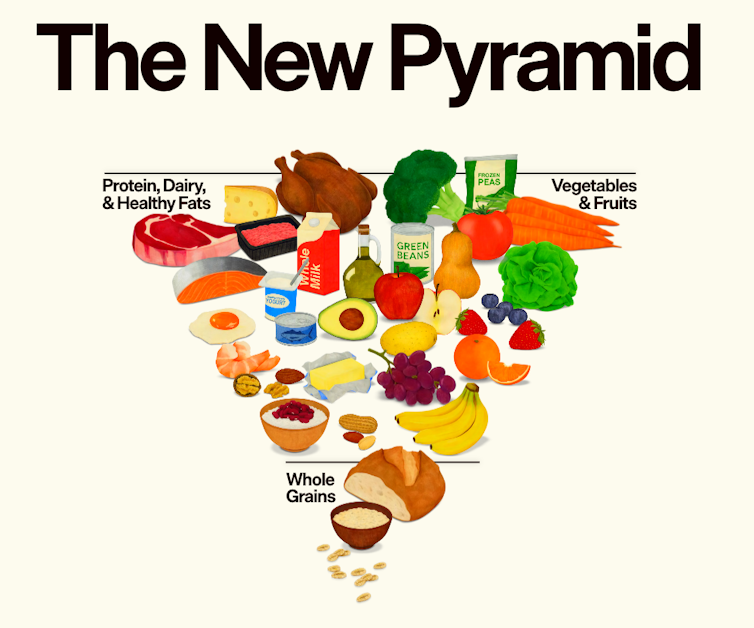
The change from the previous plate graphic to an inverted pyramid looks revolutionary at first glance. But dig deeper and the actual dietary advice hasn’t changed as much as the presentation suggests.

The new website is eye-catching, with dramatic language about “restoring common sense”. Yet many recommendations mirror the 2020–25 guidelines that came before.

Eating a variety of fruit and vegetables, aiming for five a day, limiting saturated fat to less than 10% of energy – these are all still there. So are being mindful of portion sizes, reducing processed foods, limiting refined sugars and prioritising whole foods.

Where things get contentious is the emphasis on animal fats and protein. Meats, full-fat dairy, butter and beef tallow – all sources of saturated fat – are now recommended as healthy fats.

This contradicts established science. Saturated fats are known to increase heart disease and stroke risk, which is a leading cause of death in the US.

Doesn’t add up

Crucially, the guidelines don’t explain how people can eat these foods while keeping saturated fat below 10% of energy intake. The maths simply doesn’t add up.

Protein recommendations have doubled from 0.8g of protein per kilogram of body weight per day to 1.2–1.6g per kilogram of body weight per day. This follows social trends in protein popularity rather than nutritional need.

Adequate protein is important for muscle mass, blood sugar management and keeping hunger at bay. But this shift seems odd given that Americans are not under-consuming protein in the first place.

Many other contradictions are present too. The guidelines suggest flavouring meat and vegetables with salt while simultaneously restricting sodium – a component of salt.

Fibre and fibre-containing foods like pulses and legumes get barely a mention. There’s heavy emphasis on reducing highly processed foods, but no clear definition of what these include.

The alcohol advice is equally confusing. People are told to reduce intake without any guidance on how much is too much.

Perhaps most problematic is that the inverted pyramid image doesn’t match what’s written in the guidelines. Wholegrains sit at the narrow bottom, suggesting low consumption is recommended, but the text says two to four servings per day.

Meats and saturated fat sit at the top, implying high consumption is advised. As the pyramid is the primary visual tool for communicating these guidelines to the public, this confusion is deeply concerning.

The new US food pyramid.
HHS and USDA

It’s not just the content that’s changed – the entire process has been overhauled. The US government rejected the scientific report from independent experts that usually informs the guidelines. Instead, it hired a new group of scientists who chose not to consider any fields other than nutrition science.

International and US trends in dietary guidelines increasingly take a broader view, considering environmental impact, and whether people from all backgrounds can access, afford and prepare recommended foods.

This broader perspective acknowledges a harsh reality. In their current form, dietary guidelines have limited effect on what people actually eat.

A recent review of studies from 18 countries found that only 14% to 45% of people follow some or all of their country’s dietary recommendations.

The World Health Organization and many scientists have called for “food systems-based” dietary guidelines to address this. A food systems approach doesn’t just tell people what to eat. It recommends changes across all aspects of the food system – from production through to processing, distribution, preparation and consumption.

The new US guidelines, with their narrow focus and lack of clarity, will be difficult to implement. In any region where there’s an oversupply of high-calorie, low-nutrient foods and an undersupply of high-nutrient foods – such as fruit and vegetables – these guidelines are unlikely to influence what people actually eat.

What’s truly concerning is that these guidelines inform US government-funded food and nutrition programmes. That includes school meals, military and veteran meals, and other child and adult nutrition programmes. Through confusing and contradictory advice, the new guidelines have the potential to impede rather than promote the health of millions.

Other countries often take into account international practices when preparing their own dietary guidelines. However, it seems unlikely that they will follow this new direction from the US due to the confusing messaging, the inclusion of some questionable recommendations, and a lack of consideration of the broad range of factors that influence what people eat and drink.

The Conversation

Cathal O’Hara receives funding from Research Ireland and T-Pro Ltd.

Gráinne Kent does not work for, consult, own shares in or receive funding from any company or organisation that would benefit from this article, and has disclosed no relevant affiliations beyond their academic appointment.

ref. America’s new food pyramid – what’s changed and why? – https://theconversation.com/americas-new-food-pyramid-whats-changed-and-why-273315

Trying Veganuary might be challenging. Here’s some tips on keeping going

Source: The Conversation – UK – By Bethany Clark, PhD researcher in human geography, Aberystwyth University

Josep Suria/Shutterstock

In January some people start the year by trying to eat fewer animal products. Veganuary, as the campaign is called, began in 2014 and now attracts 25.8 million people worldwide.

One reason for trying Veganuary is a growing interest in acting in ways that reduce one’s environmental impact. And one of the key ways to do this at an individual level is to reduce the amount of meat consumed in one’s diet.

Various bodies, such as the Intergovermental Panel on Climate Change and the UK’s National Food Strategy, have cited large-scale meat reduction as a way to help address the climate emergency.

As its name suggests Veganuary is framed as a short-term challenge, by the campaign itself and other supporting organisations, such as The Vegetarian Society, with messaging focused not on what is being lost, but on new and exciting foods to cook at a time of year when people often try something new.

But for many participants changing long-established behaviour is hard. Changing eating habits is particularly difficult. Barriers to dietary change include ingrained habits and routines, social norms and conventions that allow people to justify existing behaviour. Research also suggests that the perception that reducing meat will be difficult can itself discourage people from attempting to do so.

There are, however, ways to make behaviour change easier. Drawing on research from the former government-based Behavioural Insights Team’s model of behaviour change, it’s possible to find ways to make it easier when changing dietary habits. They suggest four clear principles: easy, attractive, social and timely.

Chef Gordon Ramsay talks through some Veganuary specials.

Tips to make it easier

This year, Veganuary’s focus is encouraging a gradual approach that can reduce psychological barriers. Our personal attitudes and values tend to have a stronger influence on behaviour than external motivations such as financial incentives. To support lasting change, meat reduction can be aligned with values people already hold, making it easier to act in line with them. For example, exploring the climate footprint of a bag of mince and comparing with an alternative, enabling the chance to choose a less carbon-heavy alternative. Here are some tips on what can help to make Veganuary work for you.

1. Make it attractive

January often marks a return to routines after the festive period, and this can make the long, dark winter days feel monotonous. Novelty plays an important role here: it can boost creativity and increase happiness. Trying a new dietary pattern introduces new recipes and ingredients, offering an opportunity to experiment in the kitchen. Exploring new ways of eating may also encourage greater variety in meals, such as eating a wider range of vegetables and exploring new protein sources.

2. Make it social

Social eating is an important part of many people’s lives. Sharing a meat-free meal with family or friends can strengthen social bonds through a shared experience and increase feelings of camaraderie. Veganuary does not have to create divisions between meat eaters and vegans. Talking about the challenge as a group can encourage deeper discussion about the role of meat in our diets, while support from others can also help.

3. Make it timely

Breaking large goals into smaller ones can make them more achievable and more sustainable. Taking part in this dietary change over a clearly defined period allows participants to know there is an end in sight. Research on temporary challenges such as Veganuary and Dry January (giving up alcohol) suggests that habits formed during these periods can continue even after the challenge has ended.

Behaviour does not exist in a vacuum. It is shaped by what is considered normal in society, the physical environment as well as what is available in supermarkets, and broader political and economic systems.

When attempting to change behaviour – whether through a New Year’s resolution or a short-term dietary challenge – it is important to recognise this. Systems are often in place to maintain the status quo. Doing what works for you, without aiming for perfection, can make change feel more achievable. Slipping up does not mean failure: even one meat-free meal contributes to making a difference.


Don’t have time to read about climate change as much as you’d like?

Get a weekly roundup in your inbox instead. Every Wednesday, The Conversation’s environment editor writes Imagine, a short email that goes a little deeper into just one climate issue. Join the 47,000+ readers who’ve subscribed so far.


The Conversation

Bethany Clark does not work for, consult, own shares in or receive funding from any company or organisation that would benefit from this article, and has disclosed no relevant affiliations beyond their academic appointment.

ref. Trying Veganuary might be challenging. Here’s some tips on keeping going – https://theconversation.com/trying-veganuary-might-be-challenging-heres-some-tips-on-keeping-going-273166

Will Google be third time lucky with new, AI-powered smart glasses?

Source: The Conversation – UK – By Max L Wilson, Associate Professor of Human-Computer Interaction, University of Nottingham

Tete Escape

It has been over a decade since Google Glass smart glasses were announced in 2013, followed by their swift withdrawal – in part because of low adoption. Their subsequent (and lesser known) second iteration was released in 2017 and aimed at the workplace. They were withdrawn in 2023.

In December 2025, Google made a new promise for smart glasses – with two new products to be released in 2026. But why have Google smart glasses struggled where others are succeeding? And will Google see success the third time around?

What is clear from developments in wearable tech over the last decade, is that
successful products are being built into things that people already like to wear:
watches, rings, bracelets and glasses.

These are the types of accessories that have emerged over centuries and currently adopted as normal in society.

Some of the most recent academic research is taking this approach, building
sensors into jewellery that people would actually want to wear. Research has developed a scale to measure the social acceptability of wearable technology (the WEAR scale, or Wearable Acceptability Range), which includes questions like: “I think my peers would find this device acceptable to wear.”

Noreen Kelly, from Iowa State University, and colleagues showed that at its core, this scale measured two things: that the device helped people reach a goal (that made it worth wearing), and that it did not create social anxiety about privacy and being seen as rude.

This latter issue was highlighted most prominently by the term that emerged for
Google Glass users: Glassholes. Although many studies have considered the potential benefits of smart glasses, from mental health to use in surgery, privacy concerns and other issues are ongoing for newer smart glasses.

All that said, “look-and-feel” keeps coming up the most common concern for potential buyers. The most successful products have been designed to be desirable as accessories first, and with smart technologies second. Typically, in fact, by designer brands.

A fine spectacle

After Google Glass, Snapchat released smart glasses called “spectacles”, which had cameras built in, focused on fashion and were more easily accepted into society. The now most prominent smart glasses were released by Meta (Facebook’s parent company), in collaboration with designer brands like Ray-Ban and Oakley. Most of these products include front facing cameras and conversational voice agent
support from Meta AI.

So what do we expect to see from Google Smart Glasses in 2026? Google has promised two products: one that is audio only, and one that has “screens” shown on the lenses (like Google Glass).

The biggest assumption (based on the promo videos) is that these will see a significant change in form factor, from the futuristic if not scary and unfamiliar design of Google Glass, to something that is more normally seen as glasses.

Google’s announcement also focused on the addition of AI (in fact, they announced
them as “AI Glasses” rather than smart glasses). The two types of product (audio
only AI Glasses, and AI Glasses with projections in the field of view), however, are not especially novel, even when combined with AI.

Meta’s Ray-Ban products are available in both modes, and include voice interaction with their own AI. These have been more successful than the recent Humane AI Pin, for example, which included front-facing cameras, other sensors, and voice support from an AI agent. This was the closest thing we’ve had so far to the Star Trek lapel communicators.

Direction of travel

Chances are, the main directions of innovation in this are, first, reducing the
chonkyness of smart glasses, which have necessarily been bulky to include
electronics and still look like that are normally proportioned.

“Building glasses you’ll want to wear” is how Google phrases it, and so we may see innovation from the company that just improves the aesthetic of smart glasses. They are also working with popular brand partners. Google also advertised the release of wired XR (Mixed Reality) glasses, which are significantly reduced in form factor compared to Virtual Reality headsets on the market.

Second, we could expect more integration with other Google products and services, where Google has many more commonly used products than Meta including Google Search, Google Maps, and GMail. Their promotional material shows examples of seeing Google Maps information in view in the AI Glasses, while walking through the streets.

Finally, and perhaps the biggest area of opportunity, is to innovate on the inclusion of additional sensors, perhaps integrating with other Google wearable health products, where we are seeing many of their current ventures, including introducing their own smart rings.

Much research has focused on things that can be sensed from common touchpoints on the head, which has included heart rate, body temperature and galvanic skin response (skin moistness, which changes with, for example, stress), and even brain activation through EEG for example. With the current advances in consumer neurotechnology, we could easily see Smart Glasses that use EEG to track brain data in the nextfew years.

The Conversation

The authors do not work for, consult, own shares in or receive funding from any company or organisation that would benefit from this article, and have disclosed no relevant affiliations beyond their academic appointment.

ref. Will Google be third time lucky with new, AI-powered smart glasses? – https://theconversation.com/will-google-be-third-time-lucky-with-new-ai-powered-smart-glasses-273036

What the first medical evacuation from the International Space Station tells us about healthcare in space

Source: The Conversation – UK – By Kirsty Lindsay, Scientific Officer, Northumbria University, Newcastle

Nasa

For the first time in 25 years of continuous crewed operations, an astronaut has been medically evacuated from the International Space Station (ISS). The Crew-11 mission ended when a SpaceX Dragon capsule brought the four astronauts of Crew 11 home following a medical incident in early January 2026.

To protect the crewmember’s privacy, Nasa hasn’t yet disclosed details about what happened – and this article won’t speculate. But the evacuation raises a question worth exploring: how do astronauts stay healthy in space, and why is this early evacuation so unusual?

Astronauts undergo rigorous medical screening before selection. They are assessed for conditions that might worsen in microgravity, evaluated for psychological resilience, and monitored throughout their careers.

Although modelling suggests a medical emergency could be expected roughly every three years on the ISS, serious issues are remarkably rare in practice.

Every ISS mission includes medical support both in space and on the ground. Each crew has a designated Crew Medical Officer – sometimes a qualified doctor, sometimes someone with extensive training in space medicine procedures. They can perform basic examinations, administer medications, and conduct telemedicine consultations with specialists on Earth.

What health issues do occur in space?

A 2015 study found that medication use on the ISS was relatively low, with roughly ten doses of over-the-counter medication taken per astronaut per week, most of which are for common, manageable conditions, such as:

  • Skin irritation is the most frequently reported medical issue in spaceflight. A recent systematic review found that space-related dermatoses including dry skin, rashes, hypersensitivity reactions, and impaired wound healing – occur at rates approximately 25 times higher than on Earth. The cold, dry, low-humidity spacecraft environment exacerbates these problems, and hygiene is limited to wet wipes and rinse-less products for months at a time.

  • Congestion and headaches affect most astronauts, particularly early in a mission. Without gravity pulling fluids downward, blood shifts toward the head, causing a puffy face and stuffy nose – what astronauts call “space sniffles.” This can trigger headaches, reduced appetite, and poor sleep.

  • Sleep disruption is widespread. The ISS orbits Earth every 90 minutes, creating 16 sunrises and sunsets over 24 hours, which disrupts circadian rhythms. Combined with equipment noise, reduced personal space, and the stress of spaceflight, astronauts typically get one to two hours less sleep per night compared to on Earth.

  • Musculoskeletal injuries are surprisingly common. A Nasa study catalogued 219 in-flight injuries across the US space programme, with an incidence of roughly 0.02 per flight day.

  • Hand injuries were most frequent, mostly small cuts from moving between modules or handling equipment. But exercise, ironically the leading countermeasure designed to protect astronauts’ bones and muscles, is now the leading source of injuries on the ISS.

Astronauts exercise for around two hours each day to combat bone and muscle loss and cardiovascular deconditioning in microgravity. Without gravity’s constant load, bones can lose about 1% of their density per month, particularly in the legs, hips, and spine.

Yet this essential countermeasure carries its own risks. Spacewalks present additional hazards – the study found 0.26 injuries per extravehicular activity, often caused by spacesuit components.

Research continues to make these countermeasures safer and more effective. At Northumbria University, the Aerospace Medicine and Rehabilitation Laboratory works with European Space Agency, Nasa, Canadian Space Agency and private spaceflight companies including SpaceX to develop exercise-based interventions to protect astronaut health. The research team are pioneering approaches to maintain physical function during longer missions and accelerate recovery on return to Earth.

Space-specific conditions

Some health issues are unique to spaceflight. Spaceflight Associated Neuro-ocular Syndrome (SANS) affects up to 70% of astronauts on long-duration missions. The headward fluid shift changes pressure in the eye, leading to optic nerve flattening and vision changes that can persist for years after returning to Earth.

Perhaps most striking was an incident reported in 2020, when a blood clot was discovered in an astronaut’s jugular vein during a routine research ultrasound. The astronaut had no symptoms; the clot was found by chance. In what became the ultimate telemedicine case, doctors on Earth guided treatment over more than 90 days.

Blood thinners were administered, additional medication was sent on a resupply vessel, and the astronaut performed their own ultrasound scans with radiologists directing from hundreds of kilometres below. They completed their mission and returned safely at the end of their mission without any health consequences.

The Crew-11 evacuation demonstrates that space agencies prioritise crew safety above all else. As missions move beyond low Earth orbit into deep space, new approaches to medical care will be needed – referred to as Earth Independent Medical Operations, potentially using AI to assist crew medical officers alongside lessons from current missions.

That this is the first expedited medical evacuation in 25 years highlights how effectively space medicine has developed. But it’s also a reminder that space remains inherently challenging for human biology, and sometimes there really is no place like home.

The Conversation

Kirsty Lindsay receives funding from The European Space Agency and the UK Space Agency

Luke Hughes receives funding from the UK Space Agency, European Space Agency, and the Biotechnology and Biological Sciences Research Council.

Nick Caplan does not work for, consult, own shares in or receive funding from any company or organisation that would benefit from this article, and has disclosed no relevant affiliations beyond their academic appointment.

ref. What the first medical evacuation from the International Space Station tells us about healthcare in space – https://theconversation.com/what-the-first-medical-evacuation-from-the-international-space-station-tells-us-about-healthcare-in-space-273728