Greenland: Staying with the Polar Inuit. How a secret military base helped trigger the silent collapse of an Arctic world

Source: The Conversation – France – By Ludovic Slimak, Archéologue, penseur et chercheur au CNRS, Université de Toulouse

Today, as Greenland once again becomes a strategic prize, history seems poised to repeat itself. Staying with the Polar Inuit means refusing to speak of territory while erasing those who inhabit it.

On 16 June 1951 Jean Malaurie was travelling by dog sled along the north-west coast of Greenland. He had set out alone, almost on a whim, with a modest grant from the French National Centre for Scientific research (CNRS), officially to study periglacial landscapes. In reality, this encounter with peoples whose relationship with the world followed an entirely different logic would shape a singular destiny.

That day, after many months among the Inuit, at the critical moment of the spring thaw, Malaurie was travelling with a few hunters. He was exhausted, filthy and emaciated. One of the Inuit touched his shoulder: “Takou, look.” A thick yellow cloud was rising in the sky. Through his binoculars, Malaurie first thought it was a mirage:

“A city of hangars and tents, of metal sheets and aluminium, dazzling in the sunlight, amid smoke and dust… Three months earlier, the valley had been calm and empty of people. I had pitched my tent there, on a clear summer day, in a flowering, untouched tundra.”

The breath of this new city, he would later write, “would never let us go.” Giant excavators hacked at the ground, trucks poured debris into the sea, aircraft circled overhead. Malaurie was hurled from the Stone Age into the Atomic Age. He had just discovered the secret American base of Thule, codenamed Operation Blue Jay.

The American base at Thule in the early 1950s.
U.S. Army, The Big Picture — Operation Blue Jay (1953), CC BY

Behind this innocuous name lay a colossal logistical operation. The United States feared a Soviet nuclear attack via the polar route. In a single summer, some 120 ships and 12,000 men were deployed to a bay that had previously known only the silent glide of kayaks. Greenland’s population at the time numbered barely 23,000 people. In just 104 days, on permanently frozen ground, a technological city capable of hosting giant B-36 bombers carrying nuclear warheads emerged. More than 1,200 kilometres north of the Arctic Circle, and in almost total secrecy, the United States built one of the largest military bases ever constructed outside its continental territory. A defence agreement was signed with Denmark in the spring of 1951, but Operation Blue Jay was already underway: the American decision had been taken in 1950.


A weekly e-mail in English featuring expertise from scholars and researchers. It provides an introduction to the diversity of research coming out of the continent and considers some of the key issues facing European countries. Get the newsletter!


The annexation of the Inuit world

Malaurie immediately grasped that the sheer scale of the operation amounted, in effect, to an annexation of the Inuit world. A system founded on speed, machinery and accumulation had violently and blindly entered a space governed by tradition, cyclical time, hunting and waiting.

The blue jay is a loud, aggressive, fiercely territorial bird. Thule lies halfway between Washington and Moscow along the polar route. In the era of intercontinental hypersonic missiles, once Soviet and now Russian, it is this same geography that still underpins the argument of “vital necessity” invoked by Donald Trump in his calls to annex Greenland.

The Thule base has a strategic position between the USA and Russia.
U.S. Army, The Big Picture — Operation Blue Jay (1953), CC BY

The most tragic immediate outcome of Operation Blue Jay was not military, but human. In 1953, to secure the perimeter of the base and its radar installations, authorities decided to relocate the entire local Inughuit population to Qaanaaq, roughly 100 kilometres further north. The displacement was swift, forced and carried out without consultation, severing the organic bond between this people and their ancestral hunting territories. A “root people” was uprooted to make way for an airstrip.

It is this brutal tipping point that Malaurie identifies as the moment when traditional Inuit societies began to collapse. In these societies, hunting is not merely a survival technique but an organising principle of the social world. The Inuit universe is an economy of meaning, made of relationships, gestures and transmission through the generations that confer recognition, role and place in relation to each individual. This intimate coherence, which constitutes the strength of these societies, also renders them acutely vulnerable when an external system suddenly destroys their territorial and symbolic foundations.

After the collapse of traditional structures

Today, Greenlandic society is largely sedentary and urbanised. More than a third of its 56,500 inhabitants live in Nuuk, the capital, and nearly the entire population now resides in permanent coastal towns and settlements. Housing reflects this abrupt transition. In the larger towns, many people live in concrete apartment blocks built in the 1960s and 1970s, often deteriorating and overcrowded. The economy is heavily dependent on industrial fishing geared toward export. Subsistence hunting and fishing are still commonplace. Modern rifles, GPS devices, snowmobiles and satellite connections now work hand in hand with old habits. Hunting remains a marker of identity, but it no longer shapes either the economy or intergenerational transmission.

The fallout on a human level from this shift is massive. Greenland today has one of the highest suicide rates in the world, particularly among young Inuit men. Contemporary social indicators, suicide rates, alcoholism, domestic violence, are widely documented. Many studies link them to the speed of social transformation, forced sedentarization and the breakdown of traditional systems of transmission.

American military maneuvers at Thule.
U.S. Army, The Big Picture — Operation Blue Jay (1953), CC BY

Spaces and radioactive contamination

The logic underpinning Thule reached a point of no return on 21 January 1968. During a continuous nuclear alert mission, a US Air Force B-52G bomber under the Chrome Dome programme, crashed into the sea ice some ten kilometres from Thule. It was carrying four thermonuclear bombs. The conventional explosives designed to initiate the nuclear reaction detonated on impact. There was no nuclear explosion, but the blast scattered plutonium, uranium, americium and tritium over a vast area.

In the days that followed, Washington and Copenhagen launched Project Crested Ice, a large-scale recovery and decontamination operation ahead of the spring thaw. Around 1,500 Danish workers were mobilised to scrape the ice and collect contaminated snow. Decades later, many of them initiated legal proceedings, claiming they had worked without adequate information or protection. These cases continued until 2018–2019 and resulted only in limited political compensation, without any legal recognition of responsibility. No comprehensive epidemiological study has ever been conducted among the local Inuit populations.

Now renamed “Pituffik Space Base”, the former Thule base is one of the major strategic nodes of the US military apparatus. Integrated into the US Space Force, it plays a central role in missile warning and space surveillance in the Arctic, under maximum security conditions. It is not a relic of the Cold War, but an active pivot of contemporary geopolitics.

In The Last Kings of Thule (1953), Malaurie shows that indigenous peoples have never had a place at the heart of Western strategic thinking. Amid the great manoeuvres of the world, Inuit existence becomes as peripheral as that of seals or butterflies.

Donald Trump’s statements do not herald a new world. They seek to generalise a system that has been in place in Greenland for seventy-five years. Yet the position of one man cannot absolve us of our collective responsibilities. To hear today that Greenland “belongs” to Denmark and therefore falls under NATO, without even mentioning the Inuit, is to repeat an old colonial gesture: conceiving territories by erasing those who inhabit them.

Portrait of a Greenlandic Inuit.
Popular Science Monthly Volume 37

The Inuit remain invisible and unheard. Our societies continue to imagine themselves as adults facing infantilised, indigenous populations. Their knowledge, values and ways of being are relegated to secondary variables. Difference does not fit within the categories that our societies know how to handle.

Following Jean Malaurie, my own research approaches humanity through its margins. Whether studying hunter-gatherer societies or what remains of Neanderthals once stripped of our projections, the “Other” remains the blind spot for our perceptions. We fail to see how entire worlds collapse when difference ceases to be thinkable.

Malaurie ended his first chapter on Thule with these words:

“Nothing was planned to imagine the future with any sense of elevation.”

What must be feared above all is not the sudden disappearance of a people, but their silent and radical relegation within a world that speaks about them without ever seeing or hearing them.

The Conversation

Ludovic Slimak ne travaille pas, ne conseille pas, ne possède pas de parts, ne reçoit pas de fonds d’une organisation qui pourrait tirer profit de cet article, et n’a déclaré aucune autre affiliation que son organisme de recherche.

ref. Greenland: Staying with the Polar Inuit. How a secret military base helped trigger the silent collapse of an Arctic world – https://theconversation.com/greenland-staying-with-the-polar-inuit-how-a-secret-military-base-helped-trigger-the-silent-collapse-of-an-arctic-world-273853

AI cannot automate science – a philosopher explains the uniquely human aspects of doing research

Source: The Conversation – USA – By Alessandra Buccella, Assistant Professor of Philosophy, University at Albany, State University of New York

Human scientists lay the foundations for every scientific breakthrough. Qi Yang/Moment via Getty Images

Consistent with the general trend of incorporating artificial intelligence into nearly every field, researchers and politicians are increasingly using AI models trained on scientific data to infer answers to scientific questions. But can AI ultimately replace scientists?

The Trump administration signed an executive order on Nov. 24, 2025, that announced the Genesis Mission, an initiative to build and train a series of AI agents on federal scientific datasets “to test new hypotheses, automate research workflows, and accelerate scientific breakthroughs.”

So far, the accomplishments of these so-called AI scientists have been mixed. On the one hand, AI systems can process vast datasets and detect subtle correlations that humans are unable to detect. On the other hand, their lack of commonsense reasoning can result in unrealistic or irrelevant experimental recommendations.

While AI can assist in tasks that are part of the scientific process, it is still far away from automating science – and may never be able to. As a philosopher who studies both the history and the conceptual foundations of science, I see several problems with the idea that AI systems can “do science” without or even better than humans.

AI models can only learn from human scientists

AI models do not learn directly from the real world: They have to be “told” what the world is like by their human designers. Without human scientists overseeing the construction of the digital “world” in which the model operates – that is, the datasets used for training and testing its algorithms – the breakthroughs that AI facilitates wouldn’t be possible.

Consider the AI model AlphaFold. Its developers were awarded the 2024 Nobel Prize in chemistry for the model’s ability to infer the structure of proteins in human cells. Because so many biological functions depend on proteins, the ability to quickly generate protein structures to test via simulations has the potential to accelerate drug design, trace how diseases develop and advance other areas of biomedical research.

As practical as it may be, however, an AI system like AlphaFold does not provide new knowledge about proteins, diseases or more effective drugs on its own. It simply makes it possible to analyze existing information more efficiently.

AlphaFold draws upon vast databases of existing protein structures.

As philosopher Emily Sullivan put it, to be successful as scientific tools, AI models must retain a strong empirical link to already established knowledge. That is, the predictions a model makes must be grounded in what researchers already know about the natural world. The strength of this link depends on how much knowledge is already available about a certain subject and on how well the model’s programmers translate highly technical scientific concepts and logical principles into code.

AlphaFold would not have been successful if it weren’t for the existing body of human-generated knowledge about protein structures that developers used to train the model. And without human scientists to provide a foundation of theoretical and methodological knowledge, nothing AlphaFold creates would amount to scientific progress.

Science is a uniquely human enterprise

But the role of human scientists in the process of scientific discovery and experimentation goes beyond ensuring that AI models are properly designed and anchored to existing scientific knowledge. In a sense, science as a creative achievement derives its legitimacy from human abilities, values and ways of living. These, in turn, are grounded in the unique ways in which humans think, feel and act.

Scientific discoveries are more than just theories supported by evidence: They are the product of generations of scientists with a variety of interests and perspectives, working together through a common commitment to their craft and intellectual honesty. Scientific discoveries are never the products of a single visionary genius.

Group of people wearing white lab coats and protective eye equipment working in a lab
Breakthroughs are possible through collaboration across generations of scientists.
Jacob Wackerhausen/iStock via Getty Images Plus

For example, when researchers first proposed the double-helix structure of DNA, there were no empirical tests able to verify this hypothesis – it was based on the reasoning skills of highly trained experts. It took nearly a century of technological advancements and several generations of scientists to go from what looked like pure speculation in the late 1800s to a discovery honored by a 1953 Nobel Prize.

Science, in other words, is a distinctly social enterprise, in which ideas get discussed, interpretations are offered, and disagreements are not always overcome. As other philosophers of science have remarked, scientists are more similar to a tribe than “passive recipients” of scientific information. Researchers do not accumulate scientific knowledge by recording “facts” – they create scientific knowledge through skilled practice, debate and agreed-upon standards informed by social and political values.

AI is not a ‘scientist’

I believe the computing power of AI systems can be used to accelerate scientific progress, but only if done with care.

With the active participation of the scientific community, ambitious projects like the Genesis Mission could prove beneficial for scientists. Well-designed and rigorously trained AI tools would make the more mechanical parts of scientific inquiry smoother and maybe even faster. These tools would compile information about what has been done in the past so that it can more easily inform how to design future experiments, collect measurements and formulate theories.

But if the guiding vision for deploying AI models in science is to replace human scientists or to fully automate the scientific process, I believe the project would only turn science into a caricature of itself. The very existence of science as a source of authoritative knowledge about the natural world fundamentally depends on human life: shared goals, experiences and aspirations.

The Conversation

Alessandra Buccella does not work for, consult, own shares in or receive funding from any company or organization that would benefit from this article, and has disclosed no relevant affiliations beyond their academic appointment.

ref. AI cannot automate science – a philosopher explains the uniquely human aspects of doing research – https://theconversation.com/ai-cannot-automate-science-a-philosopher-explains-the-uniquely-human-aspects-of-doing-research-272477

Iran’s universities have long been a battleground, where protests happen and students fight for the future

Source: The Conversation – USA – By Pardis Mahdavi, Professor of Anthropology, University of La Verne; University of California, Berkeley

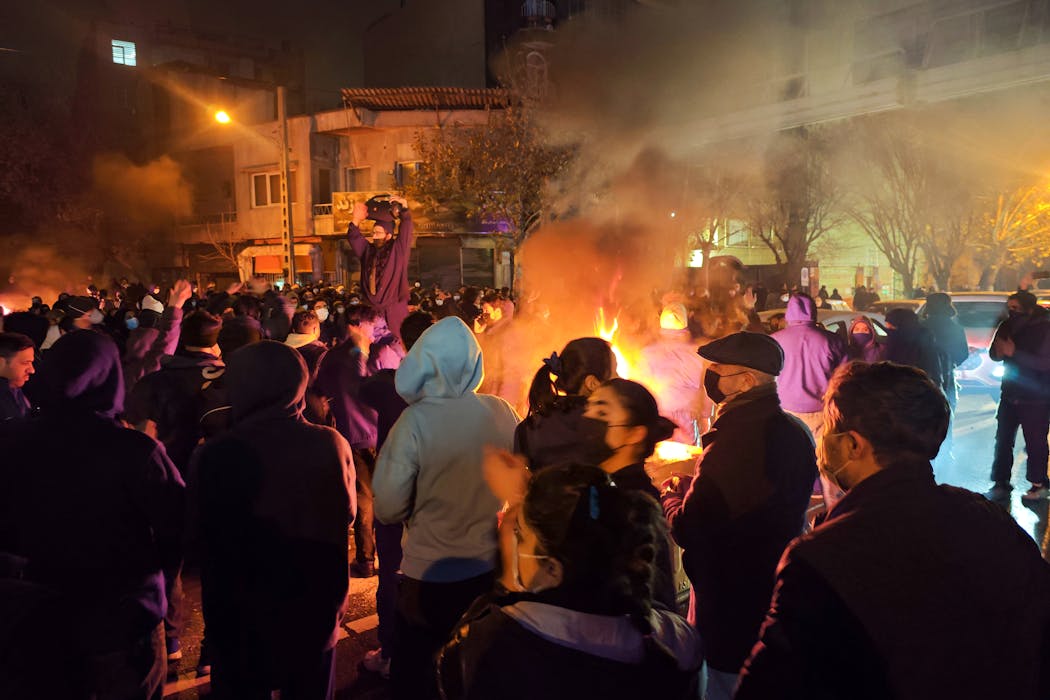
Anti-government Iranian protesters rally on Jan. 8, 2026, in Tehran. Anonymous/Getty Images

Iran’s current wave of protests continues to spread across the country, as the United States weighs military intervention. Meanwhile, many Iranian people continue to struggle to pay for basic necessities amid a collapsing currency.

The anti-government demonstrations began in Tehran’s Grand Bazaar, one of the largest and oldest covered markets in the world, in December 2025. From there, they quickly reached Iran’s university campuses.

The government’s response was swift and familiar: Authorities ordered universities to move classes online, citing weather concerns. When students continued organizing, the regime closed universities entirely.

I am an Iranian-American who has studied Iranian social movements for more than 25 years. As an educator, I have also led American universities, while maintaining ties to Iranian academic institutions.

I also witnessed firsthand the systematic assault on academic freedom during the presidency of Mahmoud Ahmadinejad from 2005 through 2013.

Iran’s universities tell the story of the nation itself: a story of persistent hope confronting relentless repression, and of intellectual life refusing to be extinguished even under extraordinary pressure.

Iranian universities have long been places of political reform and imagination – and where the Islamic Republic’s authoritarian impulses collide with people’s demands for freedom.

The heartbeat of reform

Iran has 316 accredited universities across the country, including the University of Tehran and Islamic Azad University.

Iranian universities have been hubs of political activity and protest since at least the mid-1900s.

Student-led protest movements emerged forcefully in the 1940s following the abdication of Reza Shah, an Iranian military officer who led Iran as its shah, or monarch, from 1925 to 1941.

These groups gained momentum during the oil nationalization movement led by the democratically elected Prime Minister Mohammad Mossadegh. Students supported Mossadegh’s promises of a democratic and free Iran, where the benefits of resources – like oil – would be reaped by Iranians first, before extending to the rest of the world.

The United States led a CIA-backed military coup that overthrew Mossadegh and reinstated Mohammad Reza Pahlavi as shah of Iran in 1953.

College campuses again became critical spaces for political consciousness and opposition.

A long-established pattern

This pattern continued for decades. Universities were central to the 1979 revolution, with students joining clerics, leftists and nationalists in overthrowing the monarchy.

Yet once consolidated, the Islamic Republic quickly turned against the institutions that had helped make the revolution possible.

The 1980s and 1990s saw widespread purges of faculty, with the imprisonment of professors in such numbers that the notorious Evin Prison came to be grimly nicknamed “Evin University.”

Academic life was tightly policed, books were routinely banned, and government surveillance became routine. As Azar Nafisi later documented in the 2003 book “Reading Lolita in Tehran,” intellectual engagement often survived only through clandestine reading groups and private gatherings.

Yet repression never succeeded in erasing student activism. When formal organizing became impossible, it moved underground. When campuses were locked down, ideas continued to circulate.

Thaw, reversal and academic repression

The election of Mohammad Khatami in 1997 briefly altered this trajectory of academic repression.

Khatami ran for office as a reformist candidate with strong support from young people. As president, he presided over a limited thaw in academic life. Universities reopened slightly as spaces for debate and research.

I conducted fieldwork on the youth movement and sexual revolution in Iran beginning in 1999 – research that would have been unthinkable just a few years earlier.

But the opening proved fragile. Ahmadinejad’s rise to power in 2005 marked a return to aggressive repression. Universities were again treated as ideological threats. Some faculty members were arrested or dismissed, student organizations were dismantled, and coursework and readings were heavily censored.

A group of young people, some of them with headscarves, sit on the grass near trees and look toward a man wearing a suit, with his finger in the air.
Iranian students listen to the lecture of a professor on the campus of Tehran University in October 2006.
ATTA KENARE/AFP via Getty Images

The irony was stark. By the mid-2000s, Iran had one of the highest literacy rates and highest proportions of college graduates per capita in the region.

Yet the government began restricting which majors women could study and which subjects could be taught. Entire fields, including engineering, education and counseling, were deemed suspect. Professors who resisted faced harassment and dismissal. Student protests were met with force and detention.

Despite this, youth-led mobilization persisted. Every major protest cycle over the past two decades – including the 1999 student uprising – has been driven by young people, many of them university students.

Universities in the current uprising

Recent Iranian university closures underscore the regime’s likely fears of resistance – not simply because of what is taught in classrooms, since curricula can be controlled – but also because of the power that young people can gain when they physically gather in shared spaces.

Dormitories, libraries and cafeterias are where political awareness coalesces, where individual grievances become collective demands, and where dissent acquires momentum.

Today, by systematically alienating young people through economic mismanagement, social repression and the erosion of academic freedom, the government has created its most formidable opposition: young protesters. Analysts have increasingly identified this pattern as one of the regime’s central strategic failures.

A group of young people push together against police in black, as seen through the spaces of a large fence.
Iranian students scuffle with police at the University of Tehran during a demonstration in December 2017.
STR/AFP via Getty Images

Universities are a lens into Iran

What happens inside Iran’s universities today is not a side story – it is one of the clearest indicators of where the country may be headed.

The freedom to teach, read, question and debate mirrors the freedom Iranian citizens seek in public life more broadly. Just as women have pushed back against state control of their bodies one millimeter at a time, universities have pushed back against intellectual confinement one page at a time – expanding the boundaries of permissible thought even under threat of punishment.

For decades, Iranian students and professors have demonstrated extraordinary courage in sustaining these small but vital acts of defiance. They have kept alive what Iranians call “koorsoo”: a small, stubborn flame of hope that endures even in darkness.

History suggests that societies which wage war on their intellectual institutions ultimately lose more than control – they lose legitimacy. Iran’s universities have long been the heartbeat of reform. Today, that heartbeat is growing louder – and it may once again shape the course of the nation’s history.

The Conversation

Pardis Mahdavi does not work for, consult, own shares in or receive funding from any company or organization that would benefit from this article, and has disclosed no relevant affiliations beyond their academic appointment.

ref. Iran’s universities have long been a battleground, where protests happen and students fight for the future – https://theconversation.com/irans-universities-have-long-been-a-battleground-where-protests-happen-and-students-fight-for-the-future-273742

Opera is not dying – but it needs a second act for the streaming era

Source: The Conversation – USA (2) – By Christos Makridis, Associate Research Professor of Information Systems, Arizona State University; Institute for Humane Studies

American soprano Renee Fleming performs at a dress rehearsal for a Metropolitan Opera production of ‘The Merry Widow’ in New York in 2014. Jack Vartoogian/Getty Images

Every few years, you’ll hear a familiar refrain: “Opera is dying.”

National surveys point to slumping attendance at live performances. Audiences are aging, leaving fewer fans to fill seats at productions of “La Bohème,” “Carmen,” “The Magic Flute” and the like, while production costs grow.

I’m a labor economist who studies the economics of art and culture. To
assess the state of opera in the U.S., I analyzed financial data collected by Opera America, an association whose roughly 600 members are overwhelmingly nonprofit opera companies.

After crunching the numbers, as I explained in a 2026 paper published in the Journal of Arts Management, Law, and Society, I reached a surprising conclusion about the state of those nonprofits.

Funding model is faltering

Although opera companies are experiencing financial stress, opera isn’t a dying art form. Instead, I found that the public’s demand for meaningful, live cultural experiences – including opera – remains strong.

That said, opera’s traditional business model is faltering.

Opera is, for the most part, stuck in the past. Many companies still depend on a business model that relies on season ticket sales and a small circle of big donors. This approach worked better in the 20th century than it does now.

Few opera companies have embraced strategies the rest of the entertainment industry regularly uses: audience data analysis, experimentation with digital content and streaming, and engagement through online platforms rather than brochures.

In other words, opera management practices, metrics and audience development tactics didn’t change much even as the world transitioned into the digital age.

Change is needed because subscriptions and individual ticket sales have declined for many companies, especially those with budgets above US$1 million.

The number of opera tickets those companies sold fell 21% between 2019 and 2023. Ticket revenue fell 22% over the same period.

Meanwhile, opera companies received 19% of their budgets from donations and grants in 2023, down from roughly 25% in 2019, as earned revenue weakened and fundraising failed to fully recover.

Opera companies receive more than twice as much funding from philanthropy as from government sources. Government support was low and relatively stable prior to 2020 and rose sharply during the first two years of the COVID-19 pandemic before declining again to roughly 8% of operating revenue by 2023.

A couple reads program notes in a theater.
Many audience members at operas skew older.
Robert Nickelsberg/Getty Images

Managing institutions in trouble

I don’t dispute that opera’s economic woes are troubling. But I don’t see them as a sign that this art form is in cultural decline. Instead, I believe that opera institutions need to modernize how they operate.

Audiences continue to respond to the repertoire when companies find new ways to tell familiar stories.

Productions of canonical works such as La Traviata and Don Giovanni that place well-known narratives in contemporary settings or reframe them through modern staging have drawn strong attendance and critical attention. Crossover projects that bring operatic voices into dialogue with jazz, musical theater or popular musical performance have also sold out limited runs aimed at new audiences.

And smaller-scale formats, including chamber operas and performances staged in studios or alternative venues, have consistently filled seats – even as large main-stage productions struggle to sell tickets.

Those examples point to underlying demand for experiencing operas – even if fewer people are buying season tickets.

To be sure, there are some signs of progress. Some opera companies are taking their digital productions seriously.

Boston Baroque is primarily an orchestra and chorus, but it also produces staged operas. It offered livestreams of its performances during the pandemic to earn extra money.

New York City’s Metropolitan Opera has maintained a standalone direct-to-consumer subscription product, Met Opera on Demand, that anyone in the world can access. But it illustrates the strategic tension many companies face: Digital expansion can broaden reach, but it may also complicate efforts to fill empty seats.

This 1968 recording of Luciano Pavarotti conveys the power of the opera at its best.

Grappling with an economic problem

Opera’s biggest challenge is structural, not artistic.

Live performance is inherently labor intensive – and expensive. You cannot automate a string quartet or speed up an aria without destroying what makes it valuable.

Notably, opera companies have nearly doubled administrative costs as a share of their budgets since the mid-2000s, while spending on artistic programming has remained flat.

Some of the increase in administrative spending reflects the growing complexity of fundraising, compliance and labor management. But the magnitude of the shift strongly suggests declining organizational efficiency, with managerial and overhead functions expanding faster than opera’s capacity to stage productions or build its audience in the United States.

Meanwhile, ticket sales have declined and the number of major opera donors has declined.

Facing a similar turning point

Financial distress is not unique to opera.

Many U.S. orchestras have confronted serious financial stress, including bankruptcies and closures in places like Honolulu, Syracuse, N.Y. and Albuquerque, N.M..

The orchestras that survived tended to diversify revenue, analyze data and treat innovation as part of their mission – three strategies opera companies have failed to pursue consistently.

Reaching the public where it already is

The assumption that younger generations do not care about classical music is unfounded.

When opera companies put performances on streaming platforms during the pandemic, many younger listeners tuned in.

A 2022 survey of music consumption in the United Kingdom conducted by the Royal Philharmonic Orchestra; Deezer, one of several global services tracking the digital consumption of classical music; and the British Phonographic Industry found that 59% of people under 35 streamed orchestral music during the COVID-19 lockdown, compared with a 51% national average across all age groups.

Meanwhile, classical music streaming rose sharply across digital platforms during the first months of the pandemic. Deezer reported a 17% increase in classical streams in the 12 months beginning in April 2019.

These patterns suggest that younger audiences can become interested in opera and classical music when access to those genres is easy, and that digital formats can meaningfully expand the base of younger listeners.

But younger audiences usually encounter the music they listen to through algorithms or short-form video.

Treating performances as content

The lesson is not that opera should abandon live performance – if anything, everyone needs more, not less, in-person interaction in this hybrid-work era. Instead, I believe that opera companies should treat performances as content that can be accessed both in person and in digital spaces.

That way, they can spread those fixed artistic costs across multiple formats and markets, whether they’re recordings, livestreams, educational licenses or smaller-scale spinoff events.

Opera has survived wars, depressions, technological revolutions and cultural upheavals because it evolved. Today, the risk is not that people have stopped caring about music; it’s that opera companies have presumed that upholding tradition requires a rigidity at odds with their own success.

The Conversation

Christos Makridis is also a co-founder of Living Opera and the Living Opera Foundation and founder of CM Culture Management. He is also an affiliate and contributor to several think tank communities across the aisles.

ref. Opera is not dying – but it needs a second act for the streaming era – https://theconversation.com/opera-is-not-dying-but-it-needs-a-second-act-for-the-streaming-era-271376

Juice cleanses, charcoal supplements and foot patches – is detoxing worth the hype?

Source: The Conversation – UK – By Katie Edwards, Commissioning Editor, Health + Medicine and Host of Strange Health podcast, The Conversation

If you’re healthy, do you need to do a charcoal detox? AtlasStudio/Shutterstock

January arrives with a familiar hangover. Too much food. Too much drink. Too much screen time. And suddenly social media is full of green juices, charcoal supplements, foot patches and seven-day “liver resets”, all promising to purge the body of mysterious toxins and return it to a purer state.

In the first episode of Strange Health, a new visualised podcast from The Conversation, hosts Katie Edwards and Dan Baumgardt put detox culture under the microscope and ask a simple question: do we actually need to detox at all?

Strange Health explores the weird, surprising and sometimes alarming things our bodies do. Each episode takes a popular health or wellness trend, viral claim or bodily mystery and examines what the evidence really says, with help from researchers who study this stuff for a living.

Katie Edwards, a health and medicine editor at The Conversation and Dan Baumgardt, a GP and lecturer in health and life sciences at the University of Bristol share a longstanding fascination with the body’s improbabilities and limits, plus a healthy scepticism for claims that sound too good to be true.

This opening episode dives straight into detoxing. From juice cleanses and detox teas to charcoal pills, foot pads and coffee enemas, Katie and Dan watch, wince and occasionally laugh their way through some of the internet’s most popular detox trends. Along the way, they ask what these products claim to remove, how they supposedly work, and why feeling worse is often reframed online as a sign that a detox is “working”.

The episode also features an interview with Trish Lalor, a liver expert from the University of Birmingham, whose message is refreshingly blunt. “Your body is really set up to do it by itself,” she explains. The liver, working alongside the kidneys and gut, already detoxifies the body around the clock. For most healthy people, Lalor says, there is no need for extreme interventions or pricey supplements.

That does not mean everything labelled “detox” is harmless. Lalor explains where certain ingredients can help, where they make little difference and where they can cause real damage if misused.

Real detoxing looks less like a sachet or a foot patch and more like hydration, fibre, rest, moderation and giving your liver time to do the job it already does remarkably well. If you’re buying detox patches and supplements then it’s probably your wallet that is about to be cleansed, not your liver.


Strange Health is hosted by Katie Edwards and Dan Baumgardt. The executive producer is Gemma Ware, with video and sound editing by Sikander Khan. Artwork by Alice Mason.

Dan and Katie talk about two social media clips in this episode, one from 30.forever on TikTok and one from velvelle_store on Instagram.

Listen to Strange Health via any of the apps listed above, download it directly via our RSS feed or find out how else to listen here. A transcript is available via the Apple Podcasts or Spotify apps.

The Conversation

Katie Edwards works for The Conversation and co-hosts the Strange Health podcast.

Dan Baumgardt and Trish Lalor do not work for, consult, own shares in or receive funding from any company or organisation that would benefit from this article, and have disclosed no relevant affiliations beyond their academic appointment.

ref. Juice cleanses, charcoal supplements and foot patches – is detoxing worth the hype? – https://theconversation.com/juice-cleanses-charcoal-supplements-and-foot-patches-is-detoxing-worth-the-hype-273394

Trump has threatened European countries with higher tariffs if he doesn’t get Greenland. Will it work?

Source: The Conversation – Global Perspectives – By Shannon Brincat, Senior Lecturer in Politics and International Relations, University of the Sunshine Coast

In an extraordinary escalation of his bid to claim Greenland, US President Donald Trump has threatened eight European countries – Denmark, Sweden, Norway, Finland, Great Britain, France and Germany and the Netherlands – with a 10% tariff on all goods coming into the United States from February 1 until he is able to buy the semi-autonomous Danish territory. That tariff will then increase to 25% on June 1.

On the one hand, Greenland is potentially rich in raw materials and rare earth minerals, highly desirable for US tech giants who control key levers of power in Washington. On the other, Trump claims it is necessary for national security.

Greenland is part of a sovereign country, Denmark, and any offensive action against it would constitute an act of aggression.

In the past few days, a small number of European troops have arrived in Greenland to bolster its defences. Trump’s recalcitrant stance has sent shockwaves across Europe, which is now questioning the future of NATO.

So what might happen now?

The US needs a pretext of self-defence

Aggressive wars are illegal under international law. Under the UN Charter, the use of force is lawful only when

1. authorised by the UN Security Council under Chapter VII

2. as self-defence under Article 51 in response to an armed attack.

In this case, as the US’ claims have no backing from the UNSC, its use of force would require a pretext or provocation that would allow self-defence – in other words, an attack or imminent attack.

As I always tell my students in international law, these must be scrutinised carefully as there is long, chequered history behind such claims. The key problem are “false flags” by which states fabricate or manufacture a threat or attack to justify their own offensive operations.

A recent example of this is the illegal use of force in the US-led 2003 Iraq War. This was publicly sold on two claims that had no factual basis: that Saddam Hussein possessed weapons of mass destruction and/or had close ties to al-Qaeda (and, by implication, the September 11 attacks). Even though these have been disproven, many continue to believe it.

The US wants to take over Greenland as a forward base, so we should be wary of false flags that may arise in this context. The US has justified its claim as preventing aggression from China and Russia, even though there is no evidence of their presence.

However, the potential of rivals in a region does not authorise the use of force against a third-party state. Any attack on Greenland would remain naked aggression.

What could Europe do?

There are several things Europe could do in response.

It could deploy forces, as already requested by Greenland. The Danish government has already expanded its military in Greenland and launched “Operation Arctic Endurance” in cooperation with allies including France, Germany, Norway and Sweden.

But sending 50-100 troops to Greenland is hardly a show of strength, with a handful of soldiers to cover areas the size of Switzerland.

Countries in NATO have an agreement for collective defence.
In the unlikely event of a US attack, the alliance would be sorely tested, especially given the US is a long-standing member. NATO has weathered inter-alliance disputes before, such as the 1956 Suez Crisis.

Many question whether NATO would dissolve, or if many members would leave. Certainly, it would weaken its reputation and paralyse it for some time.

Europe could threaten to close access to all military bases in Europe as this would dramatically hamper US capabilities not only in Europe but Russia, the Middle-East, and North Africa.

However, the biggest retaliatory threat Europe could muster is the Anti-Coercion Instrument (ACI) and selling off of US bonds, of which Europe holds substantial leverage (around 28% of foreign holdings). If other states, such as China, followed suit, the US economy would likely collapse because of the rapid devaluing of the dollar. However, this is the “nuclear option”, and risks self-harm to European financial power at the same time.

Overall, Europe is in a much weaker position – hampered not only by lack of military parity but energy dependency on the US. After the mysterious destruction of the Nord Stream Pipeline, Europe is energy dependent on the US – and everyone knows it.

Moreover, if Europe took action against the US in Greenland, it would then also have to shoulder the commitment to Ukraine in the war with Russia. It would be hard-pressed on two fronts.

What would Australia and other allies do?

It is doubtful many states would actively defend Greenland against the US. But not many states would actively support it either, and with that turning away from the US as “saviour”, world order would have profoundly shifted. It would likely signal the end of the liberal international order, taking any semblance of international law with it.

All other allies would be put on notice of a rogue ally. Emboldening Trump would be highly dangerous: Cuba and Iran have already been listed. More operations in Venezuela would be possible. But he has also made statements about sending troops to Mexico and threatening Colombia. Canada is already extremely worried, given Trump’s claims of making it “the 51st state” in early 2025. Where would it end?

Australia would be in the extremely difficult position of having to side with either the US, Europe, or take an independent stance.

It would also be worried about risking the AUKUS agreement – a treaty essential for Australian defence. Taiwan would be questioning the credibility of US protection. World public opinion, already dangerously low regarding Trump, would plummet further.

For these reasons, it highly like this is all just bluster from the US to coerce Greenland from Denmark. Some have explored how US security concerns could be met without annexing Greenland but this is not the point for Trump, who is seeking to appear as the “strong man” to his MAGA supporters.

What appears likely is that European powers will offer concessions so that Trump appears to “win” for his domestic base. It has been reported that EU officials will propose to use NATO to bolster Arctic security and give the US concessions on mineral extraction. This is classic appeasement. Emboldened, we could expect further aggressive US action elsewhere.

The long-term damage would be to US credibility, with all allies on notice of aberrant and erratic behaviour. Trump’s attempts to grasp at resources and forward defences highlights US decline more than anything else.

Europe seems likely to fare little better, revealed to be utterly dependent on the US and a distinct lack of principles for its members. The real loser is the West: fractured and eating itself.

The Conversation

Shannon Brincat does not work for, consult, own shares in or receive funding from any company or organisation that would benefit from this article, and has disclosed no relevant affiliations beyond their academic appointment.

ref. Trump has threatened European countries with higher tariffs if he doesn’t get Greenland. Will it work? – https://theconversation.com/trump-has-threatened-european-countries-with-higher-tariffs-if-he-doesnt-get-greenland-will-it-work-273698

Would you use AI to break writer’s block? We asked 5 experts

Source: The Conversation – Global Perspectives – By Nicola Redhouse, Lecturer, Publishing and Editing, The University of Melbourne

Pexels, The Conversation, CC BY-NC

The founder and chief executive of Bloomsbury Publishing, responsible for blockbuster romantasy author Sarah J. Maas and literary heavyweights like George Saunders, has suggested AI “will probably help creativity” – including by helping authors defeat writer’s block.

“AI gets them going and writes the first paragraph, or first chapter, and gets them back in the zone,” he said.

We asked five creative writing experts, including authors who’ve published memoirs, novels and short stories, what they think. Would they use AI to break writer’s block?

Their answers – which ranged from “a hard no” to innovative reasons for “yes” – were illuminating, complicated and often surprising.

The Conversation

The authors do not work for, consult, own shares in or receive funding from any company or organisation that would benefit from this article, and have disclosed no relevant affiliations beyond their academic appointment.

ref. Would you use AI to break writer’s block? We asked 5 experts – https://theconversation.com/would-you-use-ai-to-break-writers-block-we-asked-5-experts-271627

A year on from his second inauguration, Trump 2.0 has one defining word: power

Source: The Conversation – Global Perspectives – By Bruce Wolpe, Non-resident Senior Fellow, United States Study Centre, University of Sydney

As Donald Trump celebrates the anniversary of his second inauguration as president of the United States and begins his sixth year in office, his greatest asset is power. He covets absolute power.

The greatest threat to how Trump completes his term is how he wields his power.

Indeed, in the most foolish act in foreign policy in Trump’s presidency, he has threatened punitive tariffs on Denmark and seven other NATO allies in Europe to force the sale of Greenland to the United States. They are outraged. This is a ridiculous ploy that will not deliver Greenland to Trump.


Read more:
Trump has threatened European countries with higher tariffs if he doesn’t get Greenland. Will it work?


Trump’s escalation in Denmark has already strengthened Putin’s iron resolve to get as much of Ukraine as he can. Prospects for ending the war in Ukraine are now near zero.

On top of Trump’s pending tariffs on Europe, if Trump seizes Greenland, the consequences will shake the world – including Australia. NATO will be terminated. Australia will face an existential question of whether, under those circumstances, it must terminate its alliance with the US.

We can see in a raft of polls at this one-year mark of Trump’s second term that voters across the country are expressing growing disquiet about his management of the economy and the affordability of housing and groceries, the raids by ICE agents as they seize and deport migrants as we saw last week in Minneapolis, and uncertainty about Trump’s foreign adventurism in the Americas and with Iran.

Trump is exercising this power because he can. This will jolt Republicans in Congress to break with Trump on this issue – the first such rift between Trump and his party since his re-election.

Welcome to Trump’s year six.

Trumpism in his second term

Following his election victory in 2024, Trump has been faithful to three of four pillars of Trumpism that made his base a movement that has changed America:

  • nativism (favouring US-born citizens over immigrants)

  • protectionism and tariffs

  • America First nationalism (“Make America Great Again”).

To those ends, Trump is acting aggressively, with immigration agents arresting and deporting tens of thousands, and threats to deploy US troops in American cities to enforce these policies. Trump has imposed punitive tariffs against every trading partner – including Australia, which has a significant trade deficit with the United States. Trump demands foreign companies invest in the United States and build new factories.

But on the fourth Trumpism pillar – America-First isolationism as a driver of America’s foreign policy – Trump has redefined his foreign policy settings with grander ambitions.

Trump has rejected the history of the US waging wars to project American values: protecting Asia from communism in Korea and Vietnam; turning back brutal aggression in Kuwait; punishing the export of radical Islamic terrorism in Afghanistan and Iraq.

Trump has applied these lessons to Iran – so far. It is one thing to take out Iran’s nuclear capability. It is another to do regime change – a bridge too far back to the “forever wars” Trump despises.

Trump has buried America’s posture of globalism. He has withdrawn the US from virtually all the architecture, save the United Nations itself, erected after the second world war to ensure global security, stability and prosperity. He has ordered the US out of global organisations, and has cut billions in foreign aid.

The US attack on Venezuela was about much larger goals than arresting its leader. It was about power – controlling power over critical resources in the Americas, from Venezuela to Greenland and everything in between, from Mexico to Cuba to Canada.

Politics at home

Trump is paying a high price at home for his activism in wielding power abroad. Every day Trump spends projecting power outside the United States means he is not paying attention to the American people.

A recent poll shows 56% of US adults believe Trump has gone too far on Venezuela. 57% do not want the US to strike Iran. Even before Trump’s tariff announcement on Greenland, only 17% approved of Trump’s desire to acquire Greenland, and 71% rejected using military force to do it.

Trump’s overall polls are bad. His approval rating is 40% – nearly 10 points down since his inauguration – and disapproval is at 60%. AP-NORC also finds that “Trump hasn’t convinced the Americans that the economy is in good shape.”

CNN polling reports that 55% of those surveyed believe Trump’s policies “have hurt the economy” and that Trump is not doing enough to lower prices. Grocery prices are up sharply. The latest Wall Street Journal poll shows Trump is underwater by double digits on handling inflation, and that he is not focusing enough on the economy.

On immigration, the unrest in Minneapolis and other cities from the harsh methods employed by ICE agents is also taking a toll, with Trump’s approval on that issue lagging below 40%.

But even with all these red flags and warnings from the field, Trump is undeterred. He believes that as president, he can do anything he wants to do. Guardrails that have for decades protected America’s democracy have been cast aside.

Trump has not been blocked – yet – by an ultra-conservative Supreme Court or the pliant Republican Congress for the tariffs he is imposing, the government agencies he has shut down, the monies appropriated by Congress he has terminated, the hundreds of thousands of government employees he has fired, the military strikes he has ordered without advising, much less getting approval from, Congress.

Trump is seeking more control over the economy by seeking to prosecute the chair of the Federal Reserve Bank, an independent agency that sets monetary policy, and to pack its board with loyalists to Trump’s demands that interest rates be lowered.

Since his inauguration, Trump has instructed the Justice Department to prosecute those who attempted to bring him to justice in courtrooms and impeachment proceedings in Congress.

Trump’s musings on power

As Trump consolidates his power, Trump’s musings become imperatives. After months of expressing a desire to own it, Trump is now acting aggressively to conquer Greenland.

At home, Trump is now also musing – twice so far this month – over whether the US midterm elections will be cancelled. Trump knows the likelihood of the Democrats taking back control of the House of Representatives is high. That is precisely what he suffered in the 2018 congressional elections in his first term.

Trump told Reuters last week, “We shouldn’t even have an election,” because of all his great successes.

In January, Trump told Republicans in the House, “I won’t say cancel the election, they should cancel the election, because the fake news would say, ‘He wants the elections cancelled. He’s a dictator.’ They always call me a dictator.” He told them that if the Democrats take the House back they will “find a reason to impeach” him.

Any steps taken – such as declaring martial law to suspend the midterm elections – will be catastrophic. And that is an understatement.

Based on Trump’s restless mind and command of what he believes is absolute power, at stake this year are the future of democracy at home and alliances abroad.

The Conversation

Bruce Wolpe receives funding from the United States Studies Centre. He has worked with the Democrats in the US Congress and for Prime Minister Julia Gillard.

ref. A year on from his second inauguration, Trump 2.0 has one defining word: power – https://theconversation.com/a-year-on-from-his-second-inauguration-trump-2-0-has-one-defining-word-power-273697

The way Earth’s surface moves has a bigger impact on shifting the climate than we knew

Source: The Conversation – Global Perspectives – By Ben Mather, ARC Early Career Industry Fellow, School of Geography, Earth and Atmospheric Sciences, The University of Melbourne

Our planet has experienced dramatic climate shifts throughout its history, oscillating between freezing “icehouse” periods and warm “greenhouse” states.

Scientists have long linked these climate changes to fluctuations in atmospheric carbon dioxide. However, new research reveals the source of this carbon – and the driving forces behind it – are far more complex than previously thought.

In fact, the way tectonic plates move about Earth’s surface plays a major, previously underappreciated role in climate. Carbon doesn’t just emerge where tectonic plates meet. The places where tectonic plates pull away from each other are significant too.

Our new study, published today in the journal Communications, Earth and Environment sheds light on how exactly Earth’s plate tectonics have helped to shape global climate over the past 540 million years.

Peering deep within the carbon cycle

At the boundaries where Earth’s tectonic plates converge, we get chains of volcanoes known as volcanic arcs. Melting associated with these volcanoes unlocks carbon that’s been trapped inside rocks for thousands of years, bringing it to Earth’s surface.

Historically, it’s been thought these volcanic arcs were the primary culprits of injecting carbon dioxide into the atmosphere.

Our findings challenge that view. Instead, we suggest that mid-ocean ridges and continental rifts – locations where the tectonic plates spread apart – have played a much more significant role in driving Earth’s carbon cycles throughout geological time.

This is because the world’s oceans sequester vast quantities of carbon dioxide from the atmosphere. They store most of it within carbon-rich rocks on the seafloor. Over thousands of years, this process can produce hundreds of metres of carbon-rich sediment at the bottom of the ocean.

As these rocks then move about the Earth driven by tectonic plates, they may eventually intersect subduction zones – places where tectonic plates converge. This releases their carbon dioxide cargo back into the atmosphere.

This is known as the “deep carbon cycle”. To track the flow of carbon between Earth’s molten interior, oceanic plates and the atmosphere, we can use computer models of how the tectonic plates have migrated through geological time.

What we discovered

Using computer models to reconstruct how Earth moves carbon stored on tectonic plates, we were able to predict major greenhouse and icehouse climates over the last 540 million years.

During greenhouse periods – when Earth was warmer – more carbon was released than trapped within carbon-carrying rocks. In contrast, during icehouse climates, the carbon sequestration into Earth’s oceans dominated, lowering atmospheric carbon dioxide levels and triggering cooling.

One of the key takeaways from our study is the critical role of the deep-sea sediments in regulating atmospheric carbon dioxide. As Earth’s tectonic plates slowly move, they carry carbon-rich sediments, which are eventually returned into Earth’s interior through a process known as subduction.

We show that this process is a major factor in determining whether Earth is in a greenhouse or icehouse state.

How much carbon is recycled into Earth’s mantle at subduction zones (blues) compared to how much is released through volcanic arcs and mid-ocean ridges (oranges) over the past 540 million years. Carbonate platforms – large accumulations of carbonate rocks – are indicated by green polygons, where light green indicates active platforms, and dark green indicates older, inactive platforms.

A shift in understanding the role of volcanic arcs

Historically, the carbon emitted from volcanic arcs has been considered one of the largest sources of atmospheric carbon dioxide.

However, this process only became dominant in the last 120 million years thanks to planktic calcifiers. These little ocean critters belong to a family of phytoplankton whose main talent lies in converting dissolved carbon into calcite. They are responsible for sequestering vast amounts of atmospheric carbon into carbon-rich sediment deposited on the seafloor.

Planktic calcifiers only evolved about 200 million years ago, and spread through the world’s oceans about 150 million years ago. So, the high proportion of carbon spewed into the atmosphere along volcanic arcs in the past 120 million years is mostly due to the carbon-rich sediments these creatures created.

Before this, we found that carbon emissions from mid-ocean ridges and continental rifts – regions where tectonic plates diverge – actually contributed more significantly to atmospheric carbon dioxide.

A new perspective for the future

Our findings offer a new perspective on how Earth’s tectonic processes have shaped, and will continue to shape, our climate.

These results suggest Earth’s climate is not just driven by atmospheric carbon. Instead, the climate is influenced by the intricate balance between carbon emissions from Earth’s surface and how they get trapped in sediments on the seafloor.

This study also provides crucial insights for future climate models, especially in the context of current concerns over rising carbon dioxide levels.

We now know that Earth’s natural carbon cycle, influenced by the shifting tectonic plates beneath our feet, plays a vital role in regulating the planet’s climate.

Understanding this deep time perspective can help us better predict future climate scenarios and the ongoing effects of human activity.

The Conversation

Ben Mather receives funding from the Australian Research Council.

Adriana Dutkiewicz receives funding from the Australian Research Council.

Dietmar Müller receives funding from the Australian Research Council.

Sabin Zahirovic has received funding from the Alfred Sloan Foundation’s Deep Carbon Observatory, the Australian Research Council, and BHP via the STELLAR industry collaborative project.

ref. The way Earth’s surface moves has a bigger impact on shifting the climate than we knew – https://theconversation.com/the-way-earths-surface-moves-has-a-bigger-impact-on-shifting-the-climate-than-we-knew-272352

Congress’ power has been diminishing for years, leaving Trump to act with impunity

Source: The Conversation – Global Perspectives – By Samuel Garrett, Research Associate, United States Studies Centre, University of Sydney

A year into US President Donald Trump’s second term, his record use of executive orders, impoundment of government spending, and military interventions in Venezuela and Iran have sparked criticisms from Democrats and even some Republicans. They say he is unconstitutionally sidelining Congress.

As Trump increasingly wields his power unilaterally, some have wondered what the point of Congress is now. Isn’t it supposed to act as a check on the president?

But the power of the modern presidency had already been growing for decades. Successive presidents from both parties have taken advantage of constitutional vagaries to increase the power of the executive branch. It’s a long-running institutional battle that has underwritten US political history.

The years-long erosion of Congress’ influence leaves the president with largely unchecked power. We’re now seeing the consequences.

A fraught relationship

Congress is made up of the House of Representatives and the Senate. Under the US Constitution, it’s the branch of the government tasked with making laws. It’s supposed to act as a check on the president and the courts.

It can pass legislation, raise taxes, control government spending, review and approve presidential nominees, advise and consent on treaties, conduct investigations, declare war, impeach officials, and even choose the president in a disputed election.

But the Constitution leaves open many questions about where the powers of Congress end and the powers of the president begin.

In a 2019 ruling on Trump’s tax returns, the judge commented:

disputes between Congress and the President are a recurring plot in our national story. And that is precisely what the Framers intended.

Relative power between the different branches of the US government has changed since independence as constitutional interpretations shifted. This includes whether the president or Congress takes the lead on making laws.

Although Congress holds legislative power, intense negotiations between Congress and the executive branch (led by the president) are now a common feature of US lawmaking. Modern political parties work closely with the president to design and pass new laws.

Redefining the presidency

By contrast, presidents in the 19th and early 20th centuries generally left Congress to lead policymaking. Party “czars” in Congress dominated the national legislative agenda.

Future president Woodrow Wilson noted in 1885 that Congress:

has entered more and more into the details of administration, until it has virtually taken into its own hands all the substantial powers of government.

Wilson and Franklin Roosevelt after him would later help to redefine the president not only as the head of the executive branch, but as head of their party and of the government.

In the 1970s, in the wake of the Watergate scandal and secret bombing of Cambodia, Congress sought to expand its oversight over what commentators suggested was becoming an “imperial presidency”.

This included the passage of the 1973 War Powers Resolution, designed to wrest back Congressional control of unauthorised military deployments.

Nevertheless, the Clinton, George W. Bush and Obama administrations all argued that Congressional authorisation was not required for operations in Kosovo, Iraq and Libya (though Bush still sought authorisation to secure public support).

In turn, the Trump administration argued its actions in Venezuela were a law-enforcement operation, to which the resolution does not apply.

Why presidents bypass Congress

Historically, presidents have sought to bypass Congress for reasons of personality or politics. Controversial decisions that would struggle to pass through Congress are often made using executive orders.

Obama’s 2011 “We Can’t Wait” initiative used executive orders to enact policy priorities without needing to go through a gridlocked Congress. One such policy was the 2012 creation of the DACA program for undocumented immigrants.

Franklin Roosevelt’s use of executive orders dwarfed that of his predecessors. He issued eight times as many orders in his 12-year tenure than were signed in the first 100 years of the United States’ existence.

The question of what constitutes a genuine threat to the preservation of the nation is especially pertinent now. More than 50 “national emergencies” are currently in effect in the United States.

This was the controversial basis of Trump’s tariff policy under the International Emergency Economic Powers Act. It bypassed Congressional approval and is now being considered by the Supreme Court.

Recent presidents have also increasingly claimed executive privilege to block Congress’ subpoena power.

Institutional wrestling

Institutional wrestling is a feature of Congressional relations with the president, even when the same party controls the White House and both chambers of the legislature, as the Republican party does now.

While Roosevelt dominated Congress, his “court-packing plan” to take control of the US Supreme Court in 1937 proved a bridge too far, even for his own sweeping Democratic majorities. The Democrats controlled three quarters of both the House and Senate and yet refused to back his plan.

More recently, former Democrat Speaker Nancy Pelosi delivered many of Barack Obama’s early legislative achievements, but still clashed with the president in 2010 over congressional oversight.

As House minority leader, she rallied many Democrats against Obama’s US$1.1 trillion (A$1.6 trillion) budget proposal in 2014. Obama was forced to rely on Republican votes in 2015 to secure approval for the Trans-Pacific Partnership, despite his heavy lobbying of congressional Democrats.

Even today’s Congress, which has taken Trump’s direction at almost every turn, demonstrated its influence perhaps most notably by forcing the president into a backflip on the release of the Epstein files after a revolt within Trump’s supporters in the Republican party.

Given the extremely slim Republican majority in Congress, the general unity of the Republican party behind Trump has been a key source of his political strength. That may be lost if public opinion continues to turn against him.

Is Trump breaking the rules?

Trump and his administration have taken an expansive view of presidential power by regularly bypassing Congress.

But he’s not the first president to have pushed the already blurry limits of executive power to redefine what is or is not within the president’s remit. The extent to which presidents are even bound by law at all is a matter of long running academic debate.

Deliberate vagaries in US law and the Constitution mean the Supreme Court is ultimately the arbiter of what is legal.

The court is currently the most conservative in modern history and has taken a sweeping view of presidential power. The 2024 Supreme Court ruling that presidents enjoy extensive immunity suggests the president is, in fact, legally able to do almost anything.

Regardless, public opinion and perceptions of illegality continue to be one of the most important constraints on presidential action. Constituents can take a dim view of presidential behaviour, even if it’s not technically illegal.

Even if Trump can legally act with complete authority, it’s public opinion — not the letter of the law — that may continue to shape when, and if, he does so.

The Conversation

Samuel Garrett does not work for, consult, own shares in or receive funding from any company or organisation that would benefit from this article, and has disclosed no relevant affiliations beyond their academic appointment.

ref. Congress’ power has been diminishing for years, leaving Trump to act with impunity – https://theconversation.com/congress-power-has-been-diminishing-for-years-leaving-trump-to-act-with-impunity-273099