New Israeli law could mean death penalty by default for Palestinians convicted of deadly attacks

Source: The Conversation – Global Perspectives – By Shannon Bosch, Associate Professor (Law), Edith Cowan University

Israel’s parliament, the Knesset, this week passed legislation that would vastly expand capital punishment in Israel and in the occupied Palestinian territories.

The changes, made via an amendment to Israel’s penal law, allow for executions without proper appeal, pardons or meaningful judicial discretion.

According to media reports, 62 of 120 Knesset members voted in favour of the bill on Monday, including Prime Minister Benjamin Netanyahu, and 48 voted against. The remainder absented themselves from the vote or abstained.

UN experts and Amnesty International have warned these new death sentencing rules would apply almost exclusively to Palestinians.

It would, they argue, entrench discrimination already identified by the International Court of Justice as amounting to apartheid. UN experts said of the bill:

Since Israeli military trials of civilians typically do not meet fair trial standards under international human rights law and humanitarian law, any resulting death sentence would further violate the right to life […] Denial of a fair trial is also a war crime.

This development is a significant change for Israel, which has not executed anyone for more than 60 years. It reverses decades of global movement towards abolition, while normalising executions in an occupied territory.

Death penalty as the default

These changes were made via legislation brought by National Security Minister Itamar Ben-Gvir and his far-right Otzma Yehudit party.

The Penal Bill (Amendment ― Death Penalty for Terrorists) amends both Israeli civil law (applicable to Israeli settlers) and Israeli military law (applicable to Palestinians) in the occupied West Bank.

The law states, according to a Deutsche Welle media report:

Palestinians in the occupied West Bank convicted of terrorism in military courts will face a mandatory death sentence or, in the wording of the bill “his sentence shall be death, and this penalty only.” Only if the court determines that there are “special reasons” can it then commute the death sentence to life in prison.

Under this change:

  • prosecutors do not need to request the death penalty
  • the defence minister may submit an opinion to the judicial panel of three military officials who only need a simple majority to impose the death penalty
  • judges need to record exceptional reasons for imposing a life sentence over the death penalty
  • avenues for appeal would be tightly restricted
  • there would be no possibility of a pardon
  • people sentenced to death would be detained in isolated facilities that would have restricted visitor access, with legal counsel only by video link
  • executions (by hanging) would take place within 90 days of the final judgement.

Another yet-to-be-passed bill that may still be brought before the Knesset – the Prosecution of Participants in the October 7 Massacre Events Bill – would also see more death sentences handed down.

It establishes ad hoc military tribunals with retrospective jurisdiction to prosecute those accused of participating in the October 7 2023 Hamas-led attacks on southern Israel.

These tribunals would:

  • consist of a retired district court judge and two officers qualified to serve as judges
  • be authorised to depart from ordinary rules around evidence and procedure
  • be able to impose the death penalty via a simple majority, without prosecutors requesting it.

Appeals and clemency mechanisms would again be extremely limited.

Taken together, the two amendments significantly expand the scope of capital punishment in Israel. They also remove many procedural safeguards.

Supporters argue capital punishment could deter future attacks and preclude hostage-taking for prisoner exchanges.

Yet, historically, Israel’s intelligence services have opposed death sentences. They have argued it may encourage armed groups to kidnap Israelis as bargaining chips to prevent executions.

International humanitarian law

Critics have argued the new changes place Israel in breach of international humanitarian law and international human rights law.

As critics point out, Israel’s new death penalty rules limit access to legal counsel. They also:

  • restrict appeals
  • allows trials before ad hoc military tribunals for new capital offences
  • mandate executions be carried out within 90 days.

This all runs counter to international humanitarian law.

Significant legal concerns are raised by Israel enforcing new capital offences in the occupied territory after the International Court of Justice concluded Israel’s occupation violates international law and must cease.

These concerns are compounded by longstanding criticisms of Israeli military courts in the occupied West Bank, where conviction rates for Palestinian defendants reportedly exceed 99%.

International human rights law

Under international human rights law people should be guaranteed equality before the law and protected from discrimination.

But the changes passed by the Knesset this week subject Palestinians to death sentences as the default, while Israeli citizens accused of killing Palestinians would appear before civil courts. Here, capital punishment would be discretionary and far more limited. This entrenches a discriminatory system.

Critics argue this amounts to collective punishment against Palestinians, which is prohibited under the Geneva Convention.

The European Union has warned that executions through hanging would also violate the absolute prohibition on cruel, inhuman or degrading treatment.

Taken together, the two new amendments normalise state-sanctioned executions and violate Israel’s obligations under international law.

The Conversation

Shannon Bosch does not work for, consult, own shares in or receive funding from any company or organisation that would benefit from this article, and has disclosed no relevant affiliations beyond their academic appointment.

ref. New Israeli law could mean death penalty by default for Palestinians convicted of deadly attacks – https://theconversation.com/new-israeli-law-could-mean-death-penalty-by-default-for-palestinians-convicted-of-deadly-attacks-279458

Underwater turbines are gaining government support – our research maps their global potential

Source: The Conversation – UK – By Danny Coles, Senior Research Associate, Department of Engineering Science, University of Oxford; University of Plymouth

Turbines like these can be deployed on the seabed to harness tidal energy. Nova Innovation

Recent disruptions to oil supply in the Middle East have sent energy prices soaring, reminding countries how vulnerable they remain to imported fossil fuels. At the same time, global electricity demand is expected to almost triple by 2050.

Wind turbines and solar panels will undoubtedly play the central role. But both depend on the weather: wind turbines stand still on calm days, while solar panels generate less in overcast conditions, and nothing at night. That variability is driving interest in more predictable sources of clean power.

One promising option lies beneath the ocean’s surface.

Tidal stream turbines work much like wind turbines, only under the sea. As tides flow in and out, predictably, twice a day in places like the UK, the moving water spins turbine blades to generate electricity. This power is then transmitted to shore via cables laid along the seabed. Unlike wind and solar, tides are governed by the gravitational pull of the moon and sun, making them highly predictable years in advance.

Governments are beginning to take notice. The UK and France are investing in tidal stream energy and plan to install at least 400 megawatts of capacity over the next decade; enough to power a city like Leeds or Amsterdam.

Other countries, including Canada, the US, China and Japan, are also exploring the technology, albeit with much smaller scale projects.

Infographic of HATTs
Horizontal axis tidal turbines are the dominant form of underwater tidal stream technology.
Gemini / The Conversation

Despite this growing interest, a basic question remains: how much electricity can tidal currents actually produce, and where is it located?

I’ve teamed up with experts from around the world to help answer those questions. In our new research, we identified more than 400 potential tidal energy sites across 19 countries in Europe, the Americas, Asia and Australasia. These are locations where water flows fast enough, and at suitable depths, for turbines to operate.

Scientists typically describe tidal energy in three stages. The theoretical resource is the total energy in tidal currents. The technical resource is the portion that current turbine technology could realistically capture for electricity production. Finally, the practical resource accounts for constraints such as shipping routes, fishing activity and marine conservation areas. In practice, only a small fraction – around 1% to 20% – of the theoretical energy can actually be used to generate electricity.

Even so, the potential is significant. Across 90 of the most-studied sites, we estimate that tidal turbines could generate around 110 terawatt-hours of electricity each year – roughly equivalent to the annual electricity demand of Portugal.

annotated world map
Sites around the world with the potential to generate tidal stream power.
Coles et al (2026) / Royal Society

Half the global resource in just six sites

Some countries stand out. The US, UK, New Zealand, Canada, China and Indonesia have the largest overall tidal energy resources. In places such as the UK, Indonesia and New Zealand, tidal energy could supply at least 10% of current national electricity demand. In larger countries like the US and China, the resource is still substantial but represents a smaller share of total electricity demand.

A striking finding is how concentrated this energy is, as more than half of the global tidal resource we identified is located in just six sites. These include the Pentland Firth between mainland Scotland and the Orkney Islands, the Alderney Race between the Channel Islands and France and the Minas Passage in a part of Canada known for the world’s highest tides. Two major sites in Alaska (Chatham Strait and Cook Inlet) are also among the most energetic in the world.

However, many of these locations are far from major population centres. Remoteness presents a significant challenge, as building the infrastructure needed to transmit electricity over long distances can be costly and complex. This is one of several factors that may reduce the amount of energy that can be practically harnessed.

Tidal power tends to be strongest in narrow areas between large islands or landmasses, where lots of water is “pushed through” the gap. But finding the most promising hotspots also depends on factors like seabed geography or localised ocean currents, which need specialised and detailed research.

This means there are gaps in the data. For many promising sites, particularly in countries such as Norway, South Korea and the Philippines, detailed measurements of tidal currents are still lacking. For this reason, global estimates of tidal energy potential could increase significantly as more data becomes available.

Our findings broadly support projections from the European Commission, which anticipates up to 8 gigawatts of tidal stream capacity in Europe. However, global projections of more than 100 gigawatts – roughly the electricity demand of the entire UK – remain uncertain without better data and more comprehensive site assessments.

With enough investment and data, plus careful site selection, tidal stream energy offers something rare in renewables: power you can predict years in advance. In an electricity system increasingly affected by the weather, that reliability could make it a disproportionately valuable part of the world’s transition to clean energy.

The Conversation

Danny Coles is a member of the Marine Energy Council. Danny consults to tidal energy developers. Danny Coles receives funding from UK Research and Innovation.

ref. Underwater turbines are gaining government support – our research maps their global potential – https://theconversation.com/underwater-turbines-are-gaining-government-support-our-research-maps-their-global-potential-279509

UK parents urged to curb fast-paced screen content for small children – neuroscientist who advised government explains why

Source: The Conversation – UK – By Sam Wass, Professor of Early Years Neuroscience, University of East London

Fotoluminate LLC/Shutterstock

The UK Department for Education has just released guidance for parents on early years screen use, which I advised on as an expert. It includes recommended limits on the time children spend on screens. It also advises avoiding fast-paced content for younger children.

Recent research from the UK Department for Education suggests that over half of two-year-olds now spend over two hours a day watching screens. For the top 20%, that figure approaches five hours daily – more than a third of their waking life.

These changes have occurred rapidly, particularly since the introduction of smartphones. In 2009, children aged five to 15 spent around nine hours a week – about 1.3 hours a day – watching screens.

But the nature of what children watch has shifted just as dramatically as the amount of time they spend doing so.

Fifteen years ago, close to half of UK preschoolers tuned into CBeebies – BBC content aimed at children aged six and under – each week. Today, children’s engagement with content produced by TV companies is almost 75% lower.

Over the same period, short-form, on-demand video has expanded rapidly. Now, more than 90% of three- to five-year-olds use video-sharing platforms such as YouTube.

To illustrate what this means in practice, we can compare a 25-minute episode of the CBeebies show In the Night Garden from 2006 with a 25-minute slice of typical viewing from a four-year-old watching YouTube Kids (the latter taken from a recent US study).

The CBeebies episode followed a single narrative thread, with a stable cast of eight characters. The YouTube sample is made up of ten separate clips within the same timeframe, featuring 37 speaking characters. The editing tempo shifted from one cut every 16.7 seconds in the CBeebies episode to one cut every 1.5 seconds. There were sharp increases in visual stimulation (changes in light and colour) and auditory stimulation (shifts in pitch and volume).

Comprehension and attention

From a neuroscience perspective, we think this transformation has taken place because there are two ways in which content can hold a young child’s attention.

One route works through comprehension. Slow pacing, clear speech, exaggerated expressions and simple narrative structure allow children to follow what is happening. Comprehension drives attention.

The second route operates through attention capture. Rapid movement, abrupt edits and dynamic sound capture attention automatically. Even if we are trying not to pay attention to something, movement makes it hard to ignore. We think that we developed like this because, historically, motion signalled threat or opportunity. That reflex remains. Attention capture is immediate, involuntary and does not depend on comprehension.

Much contemporary digital content leans heavily on this second mechanism. It is instantaneous, and it works on everybody.

This shift to fast-paced content may, though, also have a role to play in the links between early screen use and later emotional and behavioural dysregulation: difficulties managing emotions and behaviour.

The reason is that young brains run at a slower tempo than adult brains. When environments are fast and unpredictable, the nervous system shifts into a heightened alert state to enable rapid detection of change. Brainstem systems involved in arousal become more active. The sympathetic nervous system – the same system engaged during fight-or-flight responses – becomes involved. In the short term, this may help explain why many children appear irritable or dysregulated when screens are switched off.

Finding patterns

Over longer periods, repeated exposure to highly stimulating, unpredictable content may contribute to broader patterns of behavioural and emotional dysregulation linked to screen use. A growing body of correlational research links high levels of early screen exposure with later difficulties in regulation and increased rates of anxiety. Correlational research shows that two things often occur together or in the same person – such as screen time and anxiety – but don’t prove that one caused the other.

Both behavioural dysregulation in childhood and anxiety in adulthood are associated with heightened brainstem and sympathetic activity – systems that are engaged by fast-paced screen content.

Much of the evidence remains correlational, making it hard to infer causation. However, some animal studies have experimentally exposed animals to doses of simulated screen time, showing that screen exposure causally affects arousal in ways that are consistent with the correlational findings.

Together, the pieces of evidence fit together in a way that is increasingly difficult to ignore – particularly against the backdrop of rising mental health difficulties in young children.

The government guidance recognises this faster-paced content – which is why the advice is to avoid it for young children. But history suggests that advisory-only approaches rarely shift behaviour at scale. If aspects of the current digital environment are indeed contributing to regulatory and mental health challenges, policy attention may need to move further upstream.

That would mean reconsidering the responsibilities of content producers and platform designers, not only parents. How exactly to do this, though, is fraught with difficulty – particularly at a time when the science itself is struggling to keep up with the pace of change.

The Conversation

Sam Wass receives funding from Leverhulme Trust RPG-2025-114

ref. UK parents urged to curb fast-paced screen content for small children – neuroscientist who advised government explains why – https://theconversation.com/uk-parents-urged-to-curb-fast-paced-screen-content-for-small-children-neuroscientist-who-advised-government-explains-why-278732

A seat on the bench isn’t enough: what Fifa’s new women’s football rule gets right (and wrong)

Source: The Conversation – UK – By Kerry Harris, Senior Lecturer in Sport Coaching, Cardiff Metropolitan University

Fifa’s latest decision to require every team in its women’s competitions to include at least one female head coach or assistant is, on the surface, a landmark moment.

The rule will apply across all women’s tournaments, from youth level to senior competition, beginning this year with the U17 and U20 World Cups and the Women’s Champions Cup.

In a sport where the technical area remains overwhelmingly male, the symbolism is powerful. But symbolism in sport is rarely neutral. It can signal progress while exposing how far the structures around it still have to travel.

Women’s football has grown rapidly in visibility and commercial value. Coaching, however, has not kept pace. At the 2023 Women’s World Cup, only 12 of 32 head coaches were women. Across some national associations, women make up as little as 5% of the coaching workforce. Against that backdrop, Fifa’s intervention is both unsurprising and, in many ways, overdue.

It is also an admission that organic change has failed. But there is a deeper issue. Research on coaching cultures consistently shows that underrepresentation is not the root problem but a symptom of more deeply embedded behaviour. Increasing numbers without addressing those issues risks leaving the foundations intact.

The timing, too, invites scrutiny. If the imbalance has been clear for years, why act now? And why only within the women’s game?

A problem contained within a single domain

The policy applies exclusively to women’s competitions. On one level, that makes practical sense. Structurally, however, it reinforces a familiar pattern. Gender inequality is treated as an issue to be solved within women’s sport, rather than across football as a whole.

The men’s game – where coaching pathways are more entrenched, better funded and more resistant to disruption – remains untouched. In effect, the responsibility for reform is placed on the side of the sport with the least power to drive it.

There is also a flawed assumption at play: that appointing more women will, in itself, transform coaching cultures. It may not. Women, like men, can reproduce the same patriarchal structures they have been socialised into. Representation alone does not guarantee change.

Policies like this walk a narrow line. Without intervention, inequality persists. But mandates risk introducing a parallel narrative: that women are present because they are required, not because they are qualified.

Fifa’s chief football officer, Jill Ellis, has framed the rule as an accelerant, designed to “create clearer pathways, expand opportunities, and increase visibility for women on our sidelines”. The logic is compelling.

Yet elite coaching is as much about perceived authority as it is about expertise. If female coaches are seen, however unfairly, as fulfilling a quota, the policy risks undermining its own aims.

There is another trap here too. The expectation that women will bring inherently different, more collaborative or empathetic approaches leans on gender stereotypes. It risks reinforcing the very assumptions that have historically limited women’s progression.

Visibility at the top does not necessarily mean readiness. Fifa has invested in coach development and nearly 800 women have received scholarship support since 2021. But the gap between training and elite international competition remains significant.

If exposure outpaces infrastructure, early difficulties may be interpreted as evidence that the policy itself is flawed. Sport is quick to remember failure and slow to acknowledge context. And if those stepping into these roles have been shaped by the same systems they are expected to change, criticism risks missing the point entirely.

Beyond visibility

None of this is an argument against increasing the number of women in coaching. Representation matters. It shapes expectations, broadens ambition and challenges long-standing assumptions about who leads.

But meaningful change is rarely immediate. It happens in coach education, in hiring practices, in mentoring networks and in grassroots environments where coaching identities first take shape. A mandate can open the door. It cannot, on its own, build the path.


Read more:
What makes a good football coach? The reality behind the myths


Without deeper structural change, such as in how coaching is taught, valued and practised, new appointments risk being placed into old systems.

Fifa’s decision is part of a broader effort to increase the presence of women in technical roles and align leadership with the rapid growth of the women’s game. It is not insignificant. It disrupts a long-standing status quo and will have visible effects, not least at the 2027 World Cup. But visibility alone will not transform a system.

If women on the touchline are to become unremarkable – as an expectation not an exception – the structures beneath elite coaching must change as well. Otherwise, mandates risk becoming what sport has seen before: gestures that are symbolically powerful, but structurally fragile. Real change will come not when women are required to be present, but when their presence no longer needs to be required.

The Conversation

Kerry Harris does not work for, consult, own shares in or receive funding from any company or organisation that would benefit from this article, and has disclosed no relevant affiliations beyond their academic appointment.

ref. A seat on the bench isn’t enough: what Fifa’s new women’s football rule gets right (and wrong) – https://theconversation.com/a-seat-on-the-bench-isnt-enough-what-fifas-new-womens-football-rule-gets-right-and-wrong-279194

Why AI health chatbots won’t make you better at diagnosing yourself – new research

Source: The Conversation – UK – By Rebecca Payne, Clinical Senior Lecturer, Bangor University; University of Oxford

Millions of people are turning to artificial intelligence (AI) chatbots for advice on everything from cooking to tax returns. Increasingly, they are also asking chatbots about their health.

But as the UK’s chief medical officer recently warned, that may not be wise when it comes to medical decisions. In a recent study, colleagues and I tested how well large language model (LLM) chatbots help the public deal with common health problems. The results were striking.

The chatbots we tested were not ready to act as doctors. A common response to studies like this is that AI moves faster than academic publishing. By the time a paper appears, the models tested may already have been updated. But studies using newer versions of these systems for patient triage suggest the same problems remain.

We gave participants brief descriptions of common medical situations. They were randomly assigned either to use one of three widely available chatbots or to rely on whatever sources they would normally use at home. After interacting with the chatbot, we asked two questions: what condition might explain the symptoms? And where should they seek help?

People who used chatbots were less likely to identify the correct condition than those who didn’t. They were also no better at determining the right place to seek care than the control group. In other words, interacting with a chatbot did not help people make better health decisions.

Strong knowledge, weak outcomes

This does not mean the models lack medical knowledge because LLMs can pass medical licensing exams with ease. When we removed the human element and gave the same scenarios directly to the chatbots, their performance improved dramatically. Without human involvement, the models identified relevant conditions in the vast majority of cases and often suggested appropriate levels of care.

So why did the results deteriorate when people actually used the systems? When we looked at the conversations, the problems emerged. Chatbots frequently mentioned the relevant diagnosis somewhere in the conversation, yet participants did not always notice or remember it when summarising their final answer.

In other cases, users provided incomplete information or the chatbot misinterpreted key details. The issue was not simply a failure of medical knowledge – it was a failure of communication between human and machine.

The study shows that policymakers need information about real-world performance of technology before introducing it into high-stakes settings such as frontline healthcare. Our findings highlight an important limitation of many current evaluations of AI in medicine. Language models often perform extremely well on structured exam questions or simulated “model-to-model” interactions.

But real-world use is much messier. Patients describe symptoms in vague or incomplete way and can misunderstand explanations. They ask questions in unpredictable sequences. A system that performs impressively on benchmarks may behave very differently once real people begin interacting with it.

A doctor using artificial intelligence technology for medical support
AI may be better used as a medical secretary.
ST_Travel/Shutterstock

It also underscores a broader point about clinical care. As a GP, my job involves far more than recalling facts. Medicine is often described as an art rather than a science. A consultation isn’t simply about identifying the correct diagnosis. It involves interpreting a patient’s story, exploring uncertainty and negotiating decisions.

Medical educators have long recognised this complexity. For decades, future doctors were taught using the Calgary–Cambridge model. This meant building a rapport with the patient, gathering information through careful questioning, understanding the patient’s concerns and expectations, explaining findings clearly and agreeing a shared plan for management.

All these processes rely on human connection, tailored communication, clarification, gentle probing, judgement shaped by context and trust. These qualities cannot easily be reduced to pattern recognition.

A different role for AI

Yet the lesson from our study is not that AI has no place in healthcare. Far from it. The key is understanding what these systems are currently good at and where their limitations lie.

One useful way to think about today’s chatbots is that they function more like secretaries than physicians. They are remarkably effective at organising information, summarising text and structuring complex documents. These are the kinds of tasks where language models are already proving useful within healthcare systems, for example in drafting clinical notes, summarising patient records or generating referral letters.

The promise of AI in medicine remains real, but its role is likely to be more supportive than revolutionary in the near term. Chatbots should not be expected to act as the front door to healthcare. They are not ready to diagnose conditions or direct patients to the right level of care.

Artificial intelligence may be able to pass medical exams. But just as passing a theory test doesn’t make you a competent driver, practising medicine involves far more than answering questions correctly. It requires judgement, empathy and the ability to navigate the complexity that sits behind every clinical encounter. For now, at least, that requires people rather than bots.


AI has long been discussed as a threat to jobs and livelihoods. But what’s the reality? In this series, we explore the impact it is already having on different occupations – and how people really feel about their AI assistants.


The Conversation

Rebecca Payne works on the Health and Care Research Wales funded REMEDY project and also recieves funding from a University of Oxford Clarendon-Reuben Scholarship. She is a Fellow of the Royal College of General Practitioners and a Senior Fellow of the Faculty of Medical Leadership and Management.

ref. Why AI health chatbots won’t make you better at diagnosing yourself – new research – https://theconversation.com/why-ai-health-chatbots-wont-make-you-better-at-diagnosing-yourself-new-research-278049

How medieval chess created a space in which players – regardless of race – could engage as equals

Source: The Conversation – UK – By Krisztina Ilko, Junior Research Fellow, Queens’ College and Affiliated Lecturer at the Faculty of History, University of Cambridge

An illustration from the Libro de Axedrez showing two players immersed in a game. Libro de Axedrez

In the medieval European imagination, racial difference was often highly polarised. Black people were perceived either as exotic status symbols – including saints and wealthy rulers such as the Queen of Sheba – or as subjugated figures, considered inferior to white Christians.

Yet, as my research demonstrates, the game of chess offered an alternative lens, creating a space in which players – regardless of their skin colour – could engage as equals.

Evidence from the Libro de Axedrez, Dados e Tablas (Book of Chess, Dice and Tables), a gaming manual completed for King Alfonso the Wise in Seville in 1283, reinforced my idea. The manuscript contains 103 chess problems, each of which is accompanied by text revealing the winner and an image. These illustrations show a wide array of figures, ranging from Jewish men to Muslim women. They include Asian, white and Black players.

One of its most striking illustrations shows a Black and a pale-skinned player facing each other across a chessboard. The latter has a shaved head, showing that he is a learned cleric. Yet, despite this signifier of intelligence, the text reveals that the Black player will win. In the “game of logic”, the triumph will be achieved by demonstrating superior strategic skills. The player’s mental prowess matters above all. As the Libro de Axedrez reasons, chess is an embodiment of wisdom, and those who study it become able to conquer others.

Another image in the manuscript shows five Black people framing the chessboard. In western medieval visual culture, scenes with only Black figures are rare and typically have negative connotations. However, this particular image envisions them in a highly intellectualised setting and in a seemingly amicable atmosphere.

Several men of colour sit around a chess board in a medieval illustration

Libro de Axedrez

While chess did not eradicate the dominant social norms when it came to race, it did empower players to challenge them within its own ludic realm.

The representation of chess as an encounter between people of different skin colour was not limited to Europe. The Shahnama, an epic poem narrating the history of the Iranians from creation to the Islamic conquest, recounts the game’s introduction to Iran.

According to the Shahnama, an unnamed Indian king sent an embassy to the Sassanian king with a chessboard accompanied by a challenge: figure out the rules or pay tribute. Fortunately, the king’s advisor, Būzurjmihr, succeeded. A 14th-century copy of the epic places this scene in a late medieval Mongol setting. Here, the paler Būzurjmihr is contrasted by the Indian envoy’s darker skin colour.

It has been argued by scholars that the latter’s dark skin and “baggy clothes” were meant to underscore his defeat. However, I believe some clues suggest otherwise. His “baggy” tunic is sumptuously adorned with gilding, in contrast to the simple blue robe of Būzurjmihr, despite him being the highest-ranking diplomat of the court. His darker skin certainly reflects his foreign origins but hardly makes him a negative character. He is, in fact, a champion of the Indian rajah, who transmits the game of logic and is presented as a guardian of much-coveted Indian knowledge.

The chess pieces themselves

In addition to representations of chess contests, medieval perceptions of race can also be studied via chess through investigating the playing pieces.

A 9th century elephant chess figure from modern day Pakistan.
National Library of France, CC BY

Chess spread across Afro-Eurasia from sixth-century India to the rest of the known world. Chess is a game of war, and the figures are meant to represent soldiers. Yet, as the game travelled, the form of the figures kept changing, reflecting the societies that produced them.

For example, a long-haired chess king made in Mansura or Multan (modern-day Pakistan) in the ninth or tenth century reflects ideals of Indian kingship. The famous Lewis Chessmen meanwhile, discovered in Scotland’s Outer Hebrides but probably carved in Norway, are often perceived as the most emblematic representatives of a medieval chess set. Yet, in this light, they are only a relatively late and geographically peripheral testimony of a longstanding tradition.

Medieval chess was not as black and white as the modern game. Some chessboards were white and red, or blue and gold. Nonetheless, the chequered squares, and the figures themselves, were differentiated through contrasting colouring. This allowed people to project ideas of skin colour and racial perceptions onto the game.

A 13th-century poem describes how chess pieces “are the people of this world, who are drawn out of one bag, like a mother’s womb, and are positioned in various places of this world”. Therefore the pieces could become representations of the different peoples of the globe. But the outcome of their encounters on the board was still decided by the rules of logic, not their skin colour. In this way chess embodied a “just world”, in which intellect, instead of religion or race, mattered the most.

The Conversation

Krisztina Ilko has previously received funding from The British Academy.

ref. How medieval chess created a space in which players – regardless of race – could engage as equals – https://theconversation.com/how-medieval-chess-created-a-space-in-which-players-regardless-of-race-could-engage-as-equals-279132

It’s not just gen Z – older adults need help spotting online misinformation too

Source: The Conversation – UK – By Holly Barnett, PhD Candidate in Psychology, Lancaster University

PeopleImages/Shutterstock

Given the ongoing and often heated debate about banning social media for under-16s, it’s easy to assume that young people are the only group at risk of online harm. Misinformation research often focuses on younger people, and multiple studies do identify younger groups, such as generation Z, as vulnerable to online deception.

But evidence shows that older adults are just as, if not more, likely than younger generations to believe misinformation. Despite the spread of misinformation online, around 15% of adults rarely or never consider if news items are true. Indeed, adults aged 65 and older shared nearly seven times more fake news links during the 2016 US election, in comparison to younger users. Older adults may be more at risk of believing falsehoods due to changes such as memory loss and lower digital skills.

In 2024, nine in ten people in the UK reported seeing misinformation on social media. Yet only 3% of the population had taken a media literacy course. While there is working being done to ensure technology is accessible, users must have the skills and confidence to recognise if they are being deceived.

My new paper reviewed studies which delivered misinformation training to older adults aged 50 and over. My colleagues and I identified which approaches improved misinformation detection, but also noted that some had the opposite effect.

1. Game-based approaches

BadNews is a free online video game developed by researchers at the Cambridge Social Decision-Making Lab. Players take on the role of the scammer to learn the techniques used to deceive people. Playing BadNews improved misinformation detection across different age groups and cultures. The improvement lasted longer when feedback was provided immediately after playing.

Another game called Spot the Troll trained older adults 60-plus to identify “troll” accounts, which are online accounts often used to spread false information anonymously. This game provided what researchers call a cross-protection effect – learning to spot trolls also improved participants’ ability to identify false news.

2. Correcting misinformation

In a study from the Netherlands, users watched a video from trusted doctors and scientists, showing others getting vaccinated and debunking common misconceptions about vaccines. Afterwards, older adults were less likely to believe vaccine myths.

This study made use of corrective information – accurate information that helps people replace false beliefs formed after encountering misinformation. Through a process known as debunking, corrective information explains what was incorrect and provides the accurate facts instead.


Read more:
Why people believe misinformation even when they’re told the facts


Graphics from the World Health Organization have been found to support the perceived credibility and sharing of corrective information across age groups in the UK and Brazil.

Addressing health misinformation among older adults is particularly crucial due to increased risk of serious illness. By stating why misinformation is inaccurate, detailed corrections can provide more long-term benefits than brief retractions, which usually do nothing more than label a claim as false. However, this sustained belief change was less common among those aged 65-plus compared to those aged 50-64. Similarly, the benefits of corrections are reduced if misinformation is encountered again afterwards.

3. Developing literacy skills

Information and media literacy courses teach people the skills needed to judge information effectively. One study found that MediaWise for Seniors, a media literacy course in the US, improved older users’ ability to judge the truthfulness of headlines. Users also showed an increased likelihood of performing research about the headline.

In Spain, engagement with a similar course improved older users’ detection of true information. Although people felt more confident in their decisions, the researchers labelled this as overconfidence – their actual detection of false information did not improve as much. Still, the course did help people to recognise when a headline was politically biased.

What more needs to be done?

Concern about misinformation is high, with older adults particularly worried about threats to the legitimacy of health and medical information, plus UK politics and social issues.

Political misinformation contributes to unfair election outcomes when fake news sways voter opinion. Amid the 2016 US election, fake stories favouring Donald Trump were shared 30 million times on Facebook, with people aged 65-plus shared sharing more fake news during this period. Older adults have also been found to show higher partisan bias. This means that they are more likely to trust content which agrees with their political views.

Because voting is more common among older people, there is a risk of democracy being swayed by fake stories – especially those which feel believable because they align with what users already think, even when they’re inaccurate.

An older woman happily scrolls on a tablet
Misinformation about health and politics may be particularly harmful.
PeopleImages/Shutterstock

Finally, researchers of media and information literacy must develop a greater understanding of how the ageing process can affect misinformation detection. While some older adults may be more susceptible, we should not assume this applies to all people over a certain age.

Multiple studies we looked at reported high dropout rates, where participants had not completed the full training course or experiment. We should therefore identify why older users do not complete misinformation training which they initially chose to take part in.

People of all ages need to feel confident in identifying when they are being deceived. But, while detecting fake news is valuable, we must not forget the importance of being able to identify true news. True content often spreads at a slower rate and taking part in misinformation interventions can increase scepticism.

In other words, misinformation detection training can lead people to become more cautious of accurate information. Clearly, achieving the right balance is essential – people should feel confident identifying misinformation without being discouraged from engaging with true content.

The Conversation

Holly Barnett receives funding from the Engineering and Physical Sciences Research Council (EPSRC).

ref. It’s not just gen Z – older adults need help spotting online misinformation too – https://theconversation.com/its-not-just-gen-z-older-adults-need-help-spotting-online-misinformation-too-274148

Kenya’s new infrastructure fund is long overdue – but design flaws could limit its impact

Source: The Conversation – Africa – By Odongo Kodongo, Associate professor, Finance, University of the Witwatersrand

Kenya is laying the ground for an infrastructure fund which will raise money for new projects – such as roads, energy and ports – through public-private partnerships, privatisation proceeds, and institutional capital. We asked Odongo Kodongo, a project finance expert, to unpack the potential risks and rewards of this strategy – and where it falls short.

Why now?

Kenya is weighed down by public debt that has built up rapidly over the last few years. The country’s public debt stood at about 12.30 trillion Kenya shillings (US$94.6 billion) as of December 2025, having risen from about 9.15 trillion shillings (US$70.3 billion) in December 2022. That is, public debt grew by over 34% in only three years.

Public debt as a percentage of GDP in 2022 was 67.9%. Thanks to an appreciating local currency, the debt to GDP ratio remained almost unchanged at 67.5% in 2025. For emerging and developing economies, a debt limit of no more than 64% of the country’s production (gross domestic product or GDP) is recommended.

In the financial year 2024/25, 71.2% of all government revenue went towards the servicing of debt. This left very little resources for other government activities including social programmes and capital projects such as infrastructure investments.

Kenya faces a massive infrastructure gap. Estimates show that the country needs to invest over US$12 billion annually in infrastructure until 2040 to meet its development goals. It doesn’t have this, resulting in an infrastructure financing gap of roughly US$2.1 billion annually.

However, due to the country’s excessive public debt, Kenyans must consider avenues other than tax revenues and public debt to pay for infrastructure. In this regard, the new fund is long overdue.

How will the fund work?

The National Infrastructure Fund Act establishes the fund as a corporate entity run by a board of directors. The board includes state officers and independent directors, recruited in accordance with the legislation governing state owned enterprises.

The treasury secretary is expected to formulate the act’s supporting regulations and guidelines. These include the fund’s investment policy, government support mechanisms, and standards and procedures.

However, the fund’s proposed legislation appears to indicate that its major responsibilities will include:

  • identifying and setting priorities for public infrastructure investments

  • conducting feasibility studies and developing bankable proposals

  • identifying an optimal mix of financing options for infrastructure projects

  • negotiating and closing financing deals with infrastructure financiers

  • overseeing implemented projects to manage risks and minimise time and cost overruns

  • audit to ensure past experiences inform project planning.

What are the potential risks and rewards?

The potential benefits of an infrastructure fund include greater infrastructure endowment, its potential cascading effects on development, and reduced reliance on the public purse.

But the success of such a fund hinges on many things. First, the fund’s design as a state owned enterprise creates the expectation that it will have autonomy to make its decisions without political interference and executive meddling.

However, some provisions of the act cast doubt that this will be possible. For example, the power to appoint independent directors is vested in the treasury cabinet secretary. This is a red flag. Given that the same cabinet secretary is a member of that board, independent board members may feel under pressure to agree with their appointing authority, making them effectively nonindependent.

Second, the fund must incentivise superior performance. Part III of the act recognises this need. The treasury cabinet secretary can set the board’s performance targets and evaluate its performance. But the cabinet secretary is a member of the same board and cannot be a fair referee.

Third, the act identifies the fund’s audited financial statements as a basis for performance evaluation. While this conventional approach appears sound, the structure of a more appropriate incentive system should focus on the objectives for which the fund is being set up. That is, performance should be based on:

  • the quantity of financial resources mobilised, especially from private sources

  • the amount of mobilised resources actually invested in infrastructure projects

  • efficiency in the management of projects

  • existence of feedback loops at various points between project origination and termination to support monitoring and corrective actions when necessary

  • capacity development and skills transfer.

The last point is important, given that human capital constraints have limited the region’s capacity to generate a pipeline of bankable projects, rendering its infrastructure sectors unattractive to private sector capital.

The fourth major weakness is the significance attached to financing derived from the disposal of government assets. Given that these assets are in short supply, monies from such sales must not be regarded as a primary source of financing.

Indeed, while the motivation for setting up the fund is to diversify funding sources and increase fiscal headroom, the act does not say much about private sector involvement.

In contrast, a similar fund created in South Africa in 2020 is specifically mandated to employ blended finance instruments. This involves using concessional finance (such as borrowing from development banks) to make an investment less risky to encourage private sector participation.

Finally, there is an ominous clause in the act that empowers the treasury secretary to issue government support in the form of letters of credit, guarantees and firm commitments to support projects. Because some of these mechanisms constitute public debt, this clause contradicts another clause that motivates the fund’s establishment on the grounds of “reduction in the reliance on public debt”.

What’s missing from the strategy, what needs fixing?

First, the implementation guidelines to be developed by the cabinet secretary should clearly spell out the fund’s goals. These include:

  • specific capital mobilisation targets: what is the volume of financial resources expected to be mobilised?

  • infrastructure investment targets: what are the immediate, medium and longer term infrastructure investment goals? These would be consistent with the country’s development plans, which often have specific timelines, such as year 2030.

Second, the underpinning law links performance measurement to the fund’s ability to “make a return commensurate with its level of investment”. This “economic/financial” view of performance ignores the social return potential of infrastructure investments.

For example, investing in hospitals and schools creates a healthier and higher quality manpower with greater longevity (social returns) and receptiveness to new knowledge. This increases labour productivity (economic returns).

Third, one of the more important beneficial spillovers of the fund’s operations is likely to be the development of the country’s capital markets. The fund could access capital from financial institutions such as pension and wealth funds, and diaspora resources, through innovative design of financial instruments.

The increased diversity of financial instruments and larger pool of capital could deepen the country’s capital markets. Thus, the act ought to have included capital markets development as one of the fund’s objectives.

At the operational level, several things need fixing. For example, the government must provide “seed” capital to support the fund’s initial activities. The amount of the seed capital, the justification for it, and its source(s) must be anchored in law.

Further, given the highlighted flaws of the cabinet secretary’s dual roles as a member of the board and its oversight agent, the cabinet secretary should be made an ex-officio member by law.

Finally, all proceeds, if any, from the sale of public assets in future should be ring-fenced to the fund. This, too, should be anchored in law.

The Conversation

Odongo Kodongo does not work for, consult, own shares in or receive funding from any company or organisation that would benefit from this article, and has disclosed no relevant affiliations beyond their academic appointment.

ref. Kenya’s new infrastructure fund is long overdue – but design flaws could limit its impact – https://theconversation.com/kenyas-new-infrastructure-fund-is-long-overdue-but-design-flaws-could-limit-its-impact-279254

After the Iran war: 5 possible outcomes and 4 ways Canada can flex its middle-power muscle

Source: The Conversation – Canada – By Kawser Ahmed, Adjunct Professor, Natural Resource Institute (NRI), University of Manitoba

The bombing in Iran and the broader Middle East will eventually cease. United States President Donald Trump keeps hinting about a possible end to hostilities and the U.S. has sent a 15-point peace proposal to Pakistan.

But that doesn’t mean the end of consequences. International relations experts are already discussing several scenarios for what comes next. Each could reshape geopolitics for decades.

Every war ends because no society can wage war indefinitely. But the nature of any forthcoming peace will determine whether the seeds of the next conflict are sown. In this charged moment, Canada’s often-touted identity as a “middle power” deserves honest scrutiny.

Five plausible outcomes could now unfold, each carrying ramifications not only for the geopolitics of the Middle East but for the trajectory of future conflicts in the region:

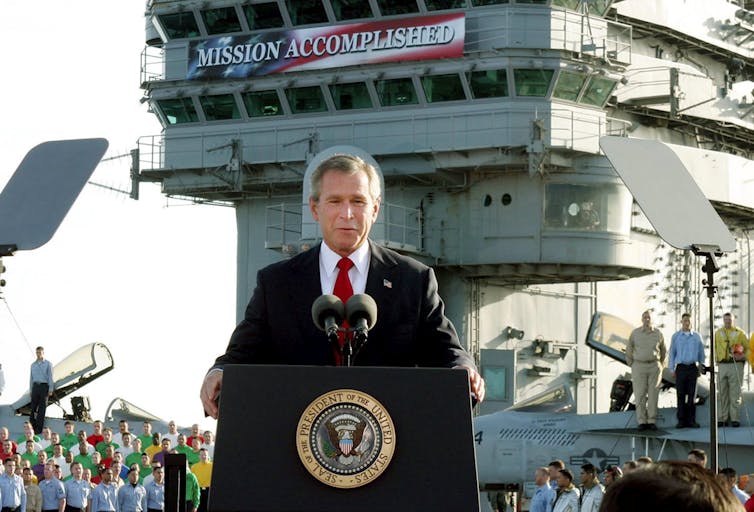
1. America’s ‘mission accomplished’ moment

The U.S. will likely end the war by declaring victory, much as it did in Iraq and Afghanistan. This outcome would add to a growing legacy of incomplete military interventions stretching back to the Vietnam War in 1963.

Domestically, there will be two major political costs: diminished support for Trump among his MAGA movement and eroding public enthusiasm for unconditional backing of Israel.

For American voters, the gap between declared victory and lived reality will be difficult to ignore when at least 13 U.S. service members have already lost their lives and 200 have been injured so far.

A grey-haired man stands a podium with the U.S. presidential insignia. Behind him a sign reads Mission Accomplished.
In this May 2003 photo, U.S. President George W. Bush declares the end of major combat in Iraq as he speaks aboard the aircraft carrier USS Abraham Lincoln off the California coast. The war dragged on for many years after that.
(AP Photo/J. Scott Applewhite)

2. An emboldened Israel

Israel will emerge from this conflict in a stronger regional position.

With Iranian proxies decimated at both leadership and operational levels,
credible military threats to Israel will be diminished for at least a decade.

Yet the mass atrocities witnessed in Gaza and now in Iran will fuel new waves of resistance under new leadership. Israel will face the challenge of managing three fronts simultaneously: the Palestinians in Gaza, Hezbollah in Lebanon and a reformed — or further radicalized — Iran.

That’s because dominance secured through force rarely translates into lasting security.

3. The Strait of Hormuz becomes Iran’s leverage

One unexpected lesson Iran may draw from this conflict is the strategic value of the Strait of Hormuz.

Approximately one-fifth of the world’s oil passes through this waterway daily. Iran could seek to turn the strait into a revenue-generating asset, modelling it loosely on the economic frameworks of the Panama or Suez canals.


Read more:
What is the Strait of Hormuz, and why does its closure matter so much to the global economy?


Although the strait remains an international waterway under the United Nations Convention on the Law of the Sea (UNCLOS-Part III), Iran may press to bypass or reinterpret existing conventions in order to recoup war expenses and rebuild its shattered economy.

This would set a dangerous precedent for international maritime law and have
adverse effect on global economy.

4. The Gulf states’ security reckoning

The Iran war has exposed just how vulnerable the Gulf states are. Iranian drones and missiles struck not only military installations, but also American diplomatic facilities hosted by Gulf Cooperation Council (GCC) countries — the United Arab Emirates, Bahrain, Saudi Arabia, Oman, Qatar and Kuwait — all of which were treated by Iran as legitimate wartime targets.

The experience will force a fundamental reassessment. The relationships cultivated through the Abraham Accords, which aimed to strengthen peace in the Middle East and around the world based on mutual understanding and co-existence, have been severely strained and new patterns of inter-state alignment may emerge across the region.

The lesson for GCC countries is clear, if uncomfortable: in the Middle East, the U.S. consistently prioritizes Israel’s security over theirs. Saudi Arabia, in particular, may need to adjust its strategic posture accordingly.

5. The failure of the ‘Venezuela model’

To the frustration of American strategists, the anticipated
popular uprising in Iran did not materialize alongside the military invasion.

An estimated 20 per cent of Iranians supported the regime in the past and continue to do so in great numbers now. Despite the killing of key leaders, Iranians have steadily filled their ranks.

In Venezuela, the U.S. forcefully removed the regime’s leader with minimal resistance as the new government acquiesced to the terms and conditions laid out by the Americans. This model has not been replicated in Iran so far.

History offers a clear parallel: aerial bombing tends to strengthen civilian resolve rather than break it — consider the Nazi bombing of Britain during the Second World War. The post-conflict Iranian government will most likely be led by an even more conservative faction, one that will draw legitimacy from having withstood a joint U.S.–Israeli invasion.


Read more:
War in Iran: Why destroying cultural heritage is such a foolish strategic move in any conflict


Canada’s middle power moment

In his widely noted speech at Davos last year, Prime Minister Mark Carney championed the role of “middle powers” in stabilizing the international order.


Read more:
Mark Carney’s Davos speech marks a major departure from Canada’s usual approach to the U.S.


Yet Canada’s stance during the Iran war has undermined that aspiration. Ottawa flip-flopped at least three times: first offering unconditional moral support, then retracting it, condemning the war and asking belligerents “to respect the rules of international engagement,” and most recently backing the reopening of the Strait of Hormuz.

These inconsistencies have damaged Canada’s credibility at a moment when middle-power leadership is most needed.

Can Canada truly exert influence as a middle power when it’s publicly at odds with the U.S.? Yes, but only if Canada act rather than simply speaks.
Canada should take four concrete steps.

4 pathways for Canada

First, it could launch a formal middle power coalition for post-conflict accountability. Bringing together countries like Australia, South Korea, Norway and Japan would create a standing diplomatic forum to co-ordinate on reconstruction, civilian protection and legal accountability. Operating alongside — not against — the UN Security Council, such a coalition would give middle powers a collective voice when vetoes stall action.

Second, Canada should leverage its large Iranian diaspora by supporting what’s known as Track II diplomacy — informal dialogue among civil society leaders, academics and former officials. These channels can build trust and lay groundwork for negotiations when official diplomacy struggles.

Third, Canada could champion a Hormuz International Maritime Authority, modelled on the Suez and Panama canals. A multilateral framework governing transit through the strait would provide a rules-based counterweight if Iran seeks to restrict or monetize access — and Canada’s distance from the region strengthens its credibility as an honest broker.

Finally, Canada must clearly denounce illegal wars, including those involving allies. Defending the rules-based order requires consistency and political courage. Middle-power status is not inherited; it’s earned through decisions and actions.

The wars that define eras are remembered not just for how they are fought, but for what follows. For Canada, this is a moment to lead with clarity, consistency and purpose — not retreat into ambiguity.

The Conversation

Kawser Ahmed does not work for, consult, own shares in or receive funding from any company or organisation that would benefit from this article, and has disclosed no relevant affiliations beyond their academic appointment.

ref. After the Iran war: 5 possible outcomes and 4 ways Canada can flex its middle-power muscle – https://theconversation.com/after-the-iran-war-5-possible-outcomes-and-4-ways-canada-can-flex-its-middle-power-muscle-279060

Peaky Blinders The Immortal Man: why mythic figures like Tommy Shelby continue to captivate us

Source: The Conversation – UK – By Adriana Marin, Lecturer in International Relations, Coventry University

Tommy Shelby returns in Netflix’s new Peaky Blinders film, The Immortal Man, a figure defined by control, composure and calculated violence. He navigates risk, trauma and conflict with an almost unnatural endurance. No matter the pressure, he adapts, survives and remains in charge.

The Immortal Man follows Shelby as he navigates a tightening web of political intrigue and criminal threats beyond Birmingham, forced to operate at a higher, more dangerous level while struggling to maintain control. As power shifts and new alliances form, he is pushed into more dangerous territory, balancing strategy, loyalty and survival, while his past continues to shape his decisions.

Irish actor Cillian Murphy delivers a masterful performance, capturing Shelby’s authority while hinting at the strain beneath the surface.

As the film’s title suggests, Shelby reflects a broader cultural archetype: the “immortal man”. He is not literally invincible, but rather resilient – a character who absorbs damage without collapsing, who endures where others fall apart.

This figure appears consistently in crime drama – Vito and Michael Corleone in The Godfather, Jimmy Conway in Goodfellas, Tony Soprano in The Sopranos – and its popularity reveals something important about how we understand crime, masculinity and power.

Criminology has long challenged the idea that criminal figures are inherently irrational or chaotic. The “enterprise model” of organised crime reframes criminal activity as structured, profit-driven and responsive to market conditions.

From this perspective, participants resemble entrepreneurs operating within illicit economies rather than criminals. Tommy Shelby fits this model closely. His actions are calculated, with violence deployed as a means to an end rather than an impulse.

The emphasis falls on strategy, recognising opportunity, managing risk and consolidating power in ways that echo legitimate business practices. This framing shifts crime away from images of chaos and unpredictability, presenting it instead as controlled and methodical. Yet rationality alone is not enough to account for his appeal.

Masculinity, control and contradiction

Cultural criminology, particularly the work of Jeff Ferrell, draws attention to the symbolic and emotional dimensions of crime. It is not only about material gain, it is also about identity, meaning and representation. Shelby is not just an economic figure but a cultural performer. His authority is constructed through style, symbolism and reputation.

Control, in this sense, is not only exercised but communicated: his presence, speech and appearance are tightly managed, projecting authority through restraint as much as action. This stylisation makes organised crime seem structured and, for some audiences, appealing. The “immortal man” is therefore not just a survivor, but a figure who appears to master both his environment and himself.

This performance of control is inseparable from masculinity. Sociologist R.W. Connell’s concept of “hegemonic masculinity” (the dominant form of masculinity in society that shapes expectations of how men should behave) helps explain Shelby’s appeal.

He embodies authority, emotional restraint and the capacity to command. He leads decisively, conceals vulnerability and maintains dominance across different spheres of life. Yet what makes the character compelling is the tension within this model. Shelby’s authority is shaped by trauma – war, loss and psychological strain.

He aligns with the ideals of dominance while simultaneously revealing their cost. The “immortal man” is defined not by being invincible, but by his ability to endure and keep going under pressure.

In this sense, masculinity is not just power, but the ability to maintain control while carrying internal damage. Shelby intensifies this model, presenting a form of dominant masculinity rooted in survival, where dominance is sustained through emotional containment rather than the absence of vulnerability.

This tension reinforces a familiar expectation: that masculinity is proven through resilience without visible collapse. At the same time, it adds complexity, presenting strength and fragility as intertwined rather than oppositional.

Sociologist Robert Merton’s strain theory suggests that when access to legitimate success is limited, individuals adapt by pursuing alternative routes.

Shelby’s trajectory reflects this logic. He does not reject the pursuit of wealth, status or influence, but he reworks the means of achieving them. Organised crime becomes a rational response to constraint, blurring the boundary between legitimate and illegitimate enterprise.

This is what gives the figure such resonance. Shelby appears to overcome structural limits while maintaining control, offering a version of success that feels both transgressive and recognisable. His appeal lies not only in what he achieves, but in how he achieves it: with certainty, authority and self-possession in contexts where those qualities feel increasingly scarce.

The endurance of this figure reflects wider cultural anxieties. In periods of instability, characters who impose order and act decisively become especially attractive. At the same time, as traditional models of masculinity are questioned, the “immortal man” offers a reassertion of clarity: an identity grounded in independence and dominance.

Shelby represents more than a criminal figure. He becomes a cultural response to uncertainty, embodying a form of masculinity and authority that promises control, even as it quietly reveals the strain required to sustain it.

Rethinking the ‘immortal man’

The issue is not that audiences engage with these narratives, but that their underlying assumptions often go unexamined. The “immortal man” ties together masculinity, power and violence in ways that appear natural but are, in fact, constructed. Authority is best demonstrated through domination, that emotional restraint is a marker of strength, and that success justifies the means by which it is achieved.

These associations are reinforced through repetition. Criminological research offers a more complex picture. Organised crime is rarely as stable or controlled as it appears on screen. It is often characterised by volatility, exploitation and harm, frequently directed at the most vulnerable.

What figures like Shelby offer, then, is not a reflection of reality, but a compelling simplification of it, one that continues to resonate because it speaks to enduring questions about power, identity and control in uncertain times.

There is, ultimately, nothing immortal about men like Tommy Shelby. What endures instead is the narrative itself: a story that continues to resonate because it speaks to persistent anxieties about inequality, control and the limits of legitimate success.

The Conversation

Adriana Marin does not work for, consult, own shares in or receive funding from any company or organisation that would benefit from this article, and has disclosed no relevant affiliations beyond their academic appointment.

ref. Peaky Blinders The Immortal Man: why mythic figures like Tommy Shelby continue to captivate us – https://theconversation.com/peaky-blinders-the-immortal-man-why-mythic-figures-like-tommy-shelby-continue-to-captivate-us-279417