Farcical peace talks continue in Abu Dhabi as Ukraine shivers under Russia’s winter onslaught

Source: The Conversation – UK – By Stefan Wolff, Professor of International Security, University of Birmingham

Russia, Ukraine and the US have met for a second time for trilateral talks to discuss a possible cessation of hostilities. The meeting got off to the same depressing start as the first one had the week before. On February 3, the night before the three sides gathered in Abu Dhabi, a massive barrage of 521 drones and cruise missiles once again targeted critical civilian infrastructure in Ukrainian cities, including the capital, Kyiv.

And while the talks were in full swing, Russia followed up on its nighttime strikes by deploying cluster munitions against a market in Druzhkivka, one of the embattled cities in what remains of Ukraine’s fortress belt in the Donetsk region.

Not the most auspicious start to talks that aim to stop fighting between the two sides. Add to that the fact that the basic negotiating positions of Moscow and Kyiv remain as far apart as ever, and any prospect of an imminent breakthrough to peace in Ukraine quickly evaporates.

The more technical discussions on military issues, including specifics of a ceasefire and how it would be monitored, appear to be generally more constructive. Apart from a prisoner exchange, no further agreement was reached. But even such small confidence-building steps are useful. And even where no agreement is feasible for now, identifying likely issues and mapping solutions that are potentially acceptable to Moscow and Kyiv is important preparatory work for a future settlement.

However, without a breakthrough on political issues it does not get the conflict parties closer to a peace deal. These political issues remain centred on the question of territory. Russia insists on the so-called “Anchorage formula”. Ukraine withdraws from those areas of Donetsk it still controls and Russia agrees to freezing the frontlines elsewhere.

Kyiv has repeatedly made clear that this is unacceptable. US mediation efforts, to date, have been unable to break this deadlock.

The political impasse, however, clearly extends beyond territory. Without naming any specific blockages to a deal, Yury Ushakov, a key advisor to the Russian president, Vladimir Putin, recently noted that there were other contested issues holding up agreement. Very likely among them are the security guarantees that Ukraine has been demanding to make sure that Russia will not renege on a settlement.

These future security guarantees appear to have been agreed between Kyiv and its European and American partners. They involve a gradual escalating response to Russian ceasefire violations, ultimately involving direct European and US military involvement.

Potholes in the road to peace

The Kremlin’s opposition to such an arrangement is hardly surprising. But it casts further doubt on how sincere Putin is about a durable peace agreement with Ukraine. In turn, it explains Kyiv’s reluctance to make any concessions, let alone those on the current scale of Russian demands.

What complicates these discussions further is the fact that the US is linking the provision of security guarantees for Kyiv to Ukrainian concessions on territory along the lines of the Moscow-endorsed Anchorage formula.

This might seem a sensible and fair compromise, but there are some obvious problems with it. First, it relies on the dependability of the US as an ultimate security backstop. But (particularly European) confidence in how dependable US pledges actually are has been severely eroded during the first 12 months of Donald Trump’s second term in the White House.

Second, Europe is moving painfully slowly to fill the void left by the US decision to halt funding to Ukraine. The details of a €90 billion (£78 billion) loan agreed in principle by EU leaders in December, have only just been finalised.

Doubts – as voiced by Nato secretary-general, Mark Rutte – also persist about whether, even in the long term, Europe has a credible prospect of developing sufficiently independent military capabilities outside the transatlantic alliance.

Few incentives to reach a deal

As a result, there are few incentives for Kyiv to bow to US pressure and give up more territory to Russia in exchange for security guarantees that may not be as ironclad in reality as they appear on paper. Likewise, it makes little sense for Moscow to accept even a hypothetical western security guarantee in exchange for territory that the Kremlin remains confident it can take by force if necessary.

Map of east Ukraine showing the battlelines.
Contested territory: Russia wants Ukraine to give up the remainder of the Donetsk region it currently occupies.
Institute for the Study of War, FAL

Following Xi Jinping’s public affirmation of Chinese support for Russia in a video call between the two countries’ presidents on the anniversary of the declaration of their “no-limits partnership” in February 2022, Putin is unlikely to feel any real pressure to change his position.

Putin will feel further reassured in his position by the fact that there is still no progress on a new sanctions bill in the US senate – four weeks after Trump allegedly “greenlit” the legislation. In addition, Trump’s top Ukraine negotiators – Steve Witkoff and Jared Kushner – are now also engaged in negotiations with Iran. This further diminishes US diplomatic capacity and is only going to reinforce Moscow’s intransigence.

Any claims of progress in the negotiations in Abu Dhabi are therefore at best over-optimistic and at worst self-deluding. And if such claims come from Putin’s envoy Kirill Dmitriev, they once more underscore that US mediation between Russia and Ukraine serves the primary purpose of restoring economic relations between Moscow and Washington. Like Kushner and Witkoff, Dmitriev is first and foremost a businessman.

Not only does this parallel track of Russia-US economic talks explain Trump’s reluctance to put any meaningful pressure on Putin, it also betrays the deep irony of the US approach to ending the war. As Europe painfully learned over more than two decades of engagement with Putin’s Russia, economic integration does not curb the Kremlin’s expansionism but enables it.

The Conversation

Stefan Wolff is a past recipient of grant funding from the Natural Environment Research Council of the UK, the United States Institute of Peace, the Economic and Social Research Council of the UK, the British Academy, the NATO Science for Peace Programme, the EU Framework Programmes 6 and 7 and Horizon 2020, as well as the EU’s Jean Monnet Programme. He is a Trustee and Honorary Treasurer of the Political Studies Association of the UK and a Senior Research Fellow at the Foreign Policy Centre in London.

ref. Farcical peace talks continue in Abu Dhabi as Ukraine shivers under Russia’s winter onslaught – https://theconversation.com/farcical-peace-talks-continue-in-abu-dhabi-as-ukraine-shivers-under-russias-winter-onslaught-275138

Countries need higher education to rebuild after conflict – study finds foreign aid isn’t going where it’s needed

Source: The Conversation – Africa – By Savo Heleta, Researcher, Nelson Mandela University

Higher education institutions are frequent casualties in violent conflicts. In Palestine, Ukraine and Sudan, to mention only a few recent examples, university campuses have been bombed. Academics, staff and students have been killed, injured or displaced. Teaching, learning and research have been undermined or come to a halt.

Higher education plays a critical role in knowledge production, research, education and skills development in any society. In conflict-affected countries, the sector is also expected to support broader societal recovery, development and peacebuilding in the post-conflict period.

In the aftermath of violent conflicts, higher education systems require support to recover and rebuild. But that has not been a priority for foreign donors and development organisations. Over the past decade, scholars and policy documents have highlighted that conflict settings have been neglected in providing foreign aid to higher education.

As researchers we’re involved in a project supported by the Education Above All Foundation from Qatar. The project studies educational systems, processes and initiatives in fragile and conflict settings around the globe. It aims to provide scientific evidence for improved decision-making by governments, educational institutions and organisations.

In a recent paper, published in the journal Globalisation, Societies and Education as part of a special issue on universities in times of conflict, we analyse aid flows to higher education in conflict-affected countries during the 2013-2022 period.

Our analysis shows that most aid to higher education never reaches countries and institutions in need, but is spent on international scholarships to study in donor countries. It’s also skewed towards certain recipient countries. These aid patterns don’t help countries and higher education institutions to rebuild after conflict.

The evidence of neglect

In our research, we relied on the Organisation for Economic Co-operation and Development’s (OECD) aid flows data. We explored where the aid to higher education went, and what types of aid were provided by donors. Our focus was on 23 countries that were either in the midst of violent conflict or in a fragile post-conflict phase during 2013-2022.

Our findings indicate that most donors prefer to give international scholarship aid. They neglect local higher education in conflict settings. Overall, scholarship aid made up more than 80% of aid to higher education provided to the countries in our sample. From 2013 to 2022, scholarship aid saw strong growth, while the aid to local systems and institutions stagnated.

The main problem with scholarship aid is that it does not reach recipient countries. It is spent in donor countries on individual recipients’ tuition, living expenses and other costs. This type of aid supports only a small number of recipients, and is often used by donors as a soft power tool.

Our research further highlights that a few countries have received most of the aid, while other countries with similar needs have been neglected. Despite what donors say about the importance of supporting the countries with greatest needs, our analysis shows that this does not happen with higher education in conflict settings. Many countries in need of assistance have been neglected by donors over the past decade.

Decisions about the recipients of either type of aid to higher education are often political. The provision of funding does not necessarily align with the recipients’ needs but largely follows donors’ strategic interests and priorities.

Rethinking higher education aid

Conflict analysis scholars Sansom Milton and Sultan Barakat wrote in 2016 that the neglect of higher education represents a “major missed opportunity to invest in critical national capacities that are capable of catalysing an effective reconstruction and recovery process” in the aftermath of violent conflict.

This neglect should not come as a surprise. In most developed countries, which are some of the top aid donors, higher education has been organised around neoliberal principles. This had led to underfunding and neglect of the sector by governments. Their provision of aid to higher education in conflict settings is based on the same principles, with the same results.

Our findings present a bleak picture of neglect of higher education in countries affected by violent conflict. The indications for the future are even bleaker due to ongoing aid cuts by many donor countries.

Importantly, our research also provides a starting point for critical engagement with donors and organisations working on education in conflict settings. More critical research, advocacy, activism, engagement and practical work is needed to challenge and reverse the neglect.

Rethinking and reforming foreign aid practices requires moving beyond donors’ strategic interests and dismantling the neoliberal agenda which has shaped much of the thinking about aid, higher education and development in general for decades. This, however, will be a challenge as the politicisation of foreign aid is unlikely to go away in the foreseeable future.

Still, changes are possible. For example:

  • Donors can redirect some scholarship funds to education systems, institutions and locally driven initiatives in conflict settings.

  • Donors can shift some international scholarship aid to domestic scholarships. This would make funding available for more students and would support local institutions.

Supporting and rebuilding higher education after violent conflict is crucial to enable systems and institutions to conduct research, develop relevant knowledge, provide quality education and contribute to societal recovery and peacebuilding.

The Conversation

Savo Heleta receives funding from Education Above All Foundation.

Logan Cochrane receives funding from Education Above All Foundation.

ref. Countries need higher education to rebuild after conflict – study finds foreign aid isn’t going where it’s needed – https://theconversation.com/countries-need-higher-education-to-rebuild-after-conflict-study-finds-foreign-aid-isnt-going-where-its-needed-274995

South African novelist Lauretta Ngcobo is the subject of a tender and urgent new film

Source: The Conversation – Africa – By Tinashe Mushakavanhu, Assistant Professor, Harvard University

Lauretta Ngcobo, who passed away in 2015, left a singular and impactful literary legacy in South Africa. Even in a life of exile and resistance to apartheid and white minority rule in the country. As a novelist, feminist thinker and freedom fighter, her intellectual contributions were foundational.

Ngcobo’s work often deals with the realities of black women facing both political and social oppression. While And They Didn’t Die (1990) is considered to be her masterpiece, her first novel Cross of Gold was published in 1981. Awards and recognition came relatively late in her career.

In a new documentary film And She Didn’t Die, producer and director Kethiwe Ngcobo creates a cinematic tribute that is at once an intimate and politically urgent portrait of her mother Lauretta. But what does it mean for a daughter to film her mother, not as a private act of remembrance but as a contribution to public history?

Structured as a conversation between them, the film moves between personal memory and historical reckoning, asking how lives shaped by political struggle are remembered and who gets to do the remembering.

As a scholar of African literature, I am aware of how few historical films exist about African women writers, and how often their voices are absent from audio and visual archives. And She Didn’t Die matters as a rare and powerful act of preservation.

It is a kind of preservation that is necessary. It points to a broader history in which African women writers, often working under conditions of exile, censorship, or displacement, have been made vulnerable to cultural disappearance.

Returning home

The opening scene allows the viewer to witness the historical return of Lauretta Ngcobo to her birthright. Against looming terrain, she reflects from a moving car, asking in her language, isiZulu: iphi inkaba yakho? – where is your umbilical cord?

The question gestures not only to physical return but to longing, for a place that exists both before her and within her. “I always find myself coming here,” she says. Land is a metaphor for what exile takes away and what memory insists on preserving. Ngcobo’s reflections feel insistently present.

Throughout the film, she speaks directly about exile as the most painful condition of her life:

There was no home. I had no home. That was the highest point of my painful exile, my painful experience as a politician.

Exile, as the film makes clear, is not only geographic displacement but a loss of self. Forced underground by the apartheid regime, Ngcobo lived an itinerant life, but always oriented towards return. Survival became a form of suspension, living for a future that was constantly deferred.


Read more:
Travel as activism: 6 stories of Black women who refused to ‘stay put’ in apartheid South Africa


Besides Ngcobo as the main character, the film’s cast also includes her husband, sister, children, grandchildren, a scholar, and close friends, each offering fragments of her and how she moved through the world. In doing so, it participates in a broader reassessment of South Africa’s literary canon that has long privileged male voices.

The film also pays attention to the costs of political commitment, particularly within family life. Ngcobo’s elder daughter Khosi Mabena reflects:

I missed the mum of small things.

The remark captures the emotional complexity of growing up alongside a mother whose responsibilities as a writer and activist often took precedence. The film does not sentimentalise this absence, nor does it frame it as moral failure. Instead, it allows the ambivalence to stand, acknowledging the real losses produced by lives lived in struggle.

At the same time, And She Didn’t Die insists that Ngcobo’s politics were never separable from care. She wrote from an understanding that resistance does not take place only in prisons, parliaments or at public rallies, but also in homes, spaces historically dismissed as domestic or minor, yet central to women’s survival.

Ngcobo practised a form of political motherhood in which care was expanded beyond the private sphere, even as that expansion came at an intimate cost.

Writing as freedom

And She Didn’t Die also responds to cultural loss. Many writers of Ngcobo’s generation, particularly women, remain absent from public memory, despite the promise of accessibility in the digital age. Their voices and images are missing. This film functions as a corrective. We hear Ngcobo speak. We see her age, laugh, remember. The documentary insists on her presence.

South African scholar and writer Barbara Boswell, author of Lauretta Ngcobo: Writing as the Practice of Freedom, situates Ngcobo in the film within a longer genealogy:

Her story didn’t start with herself. It started with her mother, her grandmother and her great-grandmother.

That lineage continues through her daughter Kethiwe, who uses the camera as a storytelling tool, extending a long line of work.

Ngcobo reflects on discovering feminism in exile:

Feminism is what I found in England. I collided with these forces with great joy.

Yet she is also clear-eyed about the limits placed on women within liberation movements:

In the main struggle mine was a cheering role, in support of the men. I had no voice. I could only assent, never contradict, nor offer alternatives. All decision-making positions were and are still in the hands of men.

Writing, then, becomes a form of freedom. As Ngcobo puts it:

My writing arises from the depths I cannot reach.

In literature, she sets the terms: she creates worlds where women speak, decide, and act. As South African scholar Zinhle ka’Nobuhlaluse notes, Ngcobo was not merely a “struggle wife”. Her marriage to A.B. Ngcobo, a stalwart of the anti-apartheid struggle, did not define her life or limit her agency.

Through her writing, she claims autonomy, forging intellectual and emotional spaces that neither exile, political struggle, nor domestic expectation could fully contain.


Read more:
How a film is fighting the erasure of South African activist Dulcie September


And She Didn’t Die is ultimately a film about survival of memory, of voice, of lineage. It is a tender and necessary portrait of a woman whose work was never marginal and whose return to public view feels inseparable from the present moment in which South Africa is once again asking what freedom means, and who gets to define it.

The film is not yet available for streaming. It is screening on film festivals around the world

The Conversation

Tinashe Mushakavanhu does not work for, consult, own shares in or receive funding from any company or organisation that would benefit from this article, and has disclosed no relevant affiliations beyond their academic appointment.

ref. South African novelist Lauretta Ngcobo is the subject of a tender and urgent new film – https://theconversation.com/south-african-novelist-lauretta-ngcobo-is-the-subject-of-a-tender-and-urgent-new-film-274432

New rugby rules for South African kids aim to keep them safe: what does the research say?

Source: The Conversation – Africa – By Sharief Hendricks, Senior Lecturer Department of Human Biology, Faculty of Health Sciences , University of Cape Town

Children in South Africa are back at school after their summer holidays. My son, aged five, has just started school at Wynberg Boys Junior, a school based in Cape Town’s southern suburbs with a strong record of playing rugby.

Like most rugby-loving families in South Africa, we hope our child discovers the pleasures of the game. We would like him to enjoy the sport, but we want him to do it in the safest way possible.

As a contact sport, rugby has the potential to result in some serious injuries if players aren’t properly prepared and supervised. Full contact tackle rugby involves repeated dynamic physical-technical contests for the ball and territory, which expose players to injury.

In South Africa, the governing body, SA Rugby, has a new policy that children under the age of nine can only play non-contact rugby. Non-contact rugby incorporates all the core elements of rugby like running, catching, passing and decision-making, but it is done without the repeated physical-technical contests of the tackle. Age categories Under 8 and younger are not allowed to engage in the full contact tackle rugby and should play tag rugby and SA T1 Rugby, a version of World Rugby’s globally endorsed non-contact game.

The non-contact game is designed for all ages, sizes and abilities, including children and first-time players. The new standards apply to all schools, clubs and associated members working in youth rugby. Before playing full-contact tackle rugby though, players will have to build the necessary skills and confidence to contest the tackle.

I am an injury prevention and player welfare researcher at the Health through Physical Activity, Lifestyle and Sport Research Centre at the University of Cape Town and a visiting professor at Leeds Beckett University. I am also a research consultant for sport governing bodies, including SA Rugby and World Rugby. Recently, with my co-author Stephen West from the University of Calgary, I published a paper outlining the current policies in different countries for introducing contact in youth sports.

The article weighed up the potential risks and benefits of an earlier versus later introduction to contact and described what needs to be considered when designing policies for this. We concluded that the introduction to contact should be a gradual, clearly defined process. It should build physiological, psychological and technical competencies to perform contact safely and optimally.

We think the new SA Rugby policies are an evidence-based investment in our children’s long-term rugby participation. The rules are catching up with those of other rugby-playing nations. By giving young players the cognitive, physical and technical foundations they need, we are making the game more sustainable, more enjoyable and safer for the next generation.

What the research says

In the research, we highlight that exposure to a range of movement experiences early on may develop skill capacities that will facilitate the learning of more advanced skills. Research has shown that significant developmental improvements in cognitive processes, such as processing speed (reaction time) and executive function, occur between the ages of five and seven years, and children become more interested in structured, rule-bound play.

We argue that contact skills can be introduced between the ages of 7 and 11 years. We also highlight that before any sport-specific techniques are introduced, players need to condition themselves for contact through skills such as falling, grappling and wrestling. These fundamental movements serve to prepare players for contact, for example, how to break a fall or physically engage (push, pull, drive, let go of) another player.

Players also need to learn how to carry the ball into contact and tackle.

Training environments should be designed to provide adequate skill development which prepares players for the demands of tackle contact rugby sport.

Coaches should understand the game demands for their age group to manipulate training to achieve specific learning objectives. For instance, in junior rugby, children tend to cluster around the ball – what we call the “beehive effect”. Our research shows this creates tackle patterns that are different from those in the adult game, with junior rugby involving more jersey pulls and arm tackles than direct front tackles.

Coaches can use this insight to adjust field size to control contact speed, and introduce rules that encourage evasion over direct confrontation.

Guidance and preparation

With input from leading researchers, practitioners and coaches in rugby, our research group developed a tackle training framework to help coaches and trainers.

For example, it provides a guide for how coaches can progress players from environments that are low-speed, controlled and structured to environments that are more representative of the game situations.

Families can also help prepare children for the joys of tackle rugby:

  • give them the opportunity to participate in a range of sports

  • expose them to forms of physical contact such as wrestling and grappling in the form of play, and activities that develop their landing, falling and rolling skills

  • encourage collision play with padded or cushioned equipment

  • explore sports that specifically promote body control and awareness in controlled contact situations, such as karate.

Of course, children develop at different rates, and many factors influence when a child is ready for contact. This is why a standardised, progressive approach benefits everyone.

The Conversation

Sharief Hendricks consults for the South African Rugby Union and World Rugby. He is also a consultant for the South African Cricketers’ Association. He is currently a board member for the South African Institute for Drug-Free Sport and serves on the South African Sports Confederation and Olympic Committee’s (SASCOC) High Performance Commission.

ref. New rugby rules for South African kids aim to keep them safe: what does the research say? – https://theconversation.com/new-rugby-rules-for-south-african-kids-aim-to-keep-them-safe-what-does-the-research-say-274458

A giant star is changing before our eyes and astronomers are watching in real time

Source: The Conversation – Africa (2) – By Keiichi Ohnaka, Associate professor, Universidad Andrés Bello (Chile)

For decades, astronomers have been watching WOH G64, an enormous heavyweight star in the Large Magellanic Cloud, a galaxy visible with the naked eye from the Southern Hemisphere. This star is more than 1,500 times larger than the Sun and emitting over 100,000 times more energy. For a long time, red supergiant WOH G64 looked like a star steadily reaching the end of its life, shedding material and swelling in size as it began to run out of fuel.

Astronomers didn’t think its final demise would happen anytime soon, because no-one has ever seen a known red supergiant die. But in recent years astronomers – including our team working with the Southern African Large Telescope (SALT) – discovered that this star has started to change, growing dimmer than before and seemingly warmer. This has surprised scientists and suggests the star’s final stages of life may be more complicated, and perhaps unfold faster, than once thought.

Massive stars, more than about eight times the mass of the Sun, produce so much energy, which we see as light, that they run out of fuel within millions of years, instead of the billions of years of the Sun’s lifespan.

Most massive stars become gigantic, cool stars in the final million years or so of their life – so-called red supergiants. All red supergiants blow gaseous winds, losing weight as they do so. Some do this so strongly that the star becomes enveloped in a shroud of the ejected material containing gas and solid particles like tiny sand grains – called dust in astronomy. This makes them look dim in visual light, but very bright in the infrared where the dust shines.

In the 1960s Swedish astronomers Westerlund, Olander and Hedin discovered number 64 in their catalogue of red stars. They thought nothing of it, as it looked like an unremarkable red giant star, something the Sun and most other stars will become later in life. But when in the 1980s Nasa, the UK and The Netherlands launched the InfraRed Astronomical Satellite into space, astronomers Elias, Frogel and Schwering discovered that WOH G64 is the most luminous, coolest and dustiest red supergiant in the entire Large Magellanic Cloud, which harbours over a thousand red supergiants. More observations over the following decades showed the strong, steady modulations of the brightness expected of a pulsating star of that kind.

Then, in 2024, our team (both authors of this article and our collaborators in Germany and the US) succeeded in taking a close-up image of WOH G64 using the European Southern Observatory’s telescopes and revealed a fresh cloud of dust close to the star. It was the sharpest picture of a star in another galaxy ever taken (comparable to being able to spot an astronaut walk on the Moon from Earth). We discovered that in the last decade, unexpectedly, the star had started to eject much more dust than before. At that time, we did not have an idea about why and how.

It turns out, WOH G64 had also become dimmer, possibly because of the dust cloud it had ejected, and started to pulsate less and a little more quickly, suggesting it had shrunk. At the same time, the star seemed to look a lot warmer, leading some to believe it might have entered a new stage of its life – a so-called yellow hypergiant on its final path to doom.

All these phenomena are happening on a human time scale, which is usually not the case when we observe stars. This makes WOH G64 even more special. Is this star offering us an opportunity not to be missed to witness the final death throes of massive stars?

Now, as we start 2026, we have announced that observations we have obtained using the Southern African Large Telescope give us some clues about what is going on with WOH G64. The SALT observations show the overwhelming presence of ions in the vicinity of the star, which means that the gas is heated up to high temperatures by what must be a much hotter star. This should not have surprised anyone as the hot gas had been spotted in the 1980s and ever since. But we also found the imprint of molecules, implying cool gas (because molecules break up at high temperatures) likely in the atmosphere of the red supergiant. It did not appear to have changed into a yellow hypergiant, at least not yet.

For a long time, astronomers have suspected that the red supergiant has a smaller, hotter twin living alongside it, but they have somehow been reluctant to claim this in publications. And now it looks to be the elephant in the room. One way of making sense of our observations is that this hotter star, looking blue in contrast to its bigger, cooler, red sibling, heats gas it might have captured from the red supergiant’s wind. Now that the red supergiant has faded, the presence of the heated gas has just become more conspicuous.

If the orbit of the blue star is not a circle but quite elongated (Earth’s orbit around the Sun only slightly deviates from a circle), the distance between the blue star and the red supergiant varies. It may have got closer in recent years, and its gravity might have caused the atmosphere of the red supergiant to stretch out. This would make it more transparent overall, allowing us to see the warmer interior, but with cool, dark molecular patches left in places. That would also have made it easier for dust to form further out in its wind.

If that is true, then once the blue star starts to recede again on its orbit, WOH G64 might regain its former red supergiant glory. On the other hand, if it did throw off its coat entirely, then the molecules would disappear, and with it, the dust, and we would gain a clean view of the star. Then again, WOH G64 might do something else unexpected. It certainly teaches astronomers to be humble.

The Conversation

Keiichi Ohnaka receives funding from Chile’s Agencia Nacional de Investigación y Desarrollo.

Jacco van Loon does not work for, consult, own shares in or receive funding from any company or organisation that would benefit from this article, and has disclosed no relevant affiliations beyond their academic appointment.

ref. A giant star is changing before our eyes and astronomers are watching in real time – https://theconversation.com/a-giant-star-is-changing-before-our-eyes-and-astronomers-are-watching-in-real-time-274562

Overactive immune cells can worsen heart failure – targeting them could offer new treatments

Source: The Conversation – USA – By Shyam Bansal, Associate Professor of Medicine, Penn State

Heart failure affects millions of people around the world. Yuichiro Chino/Moment via Getty Images

Around 64 million people worldwide suffer from heart failure, and nearly half die within the first five years of diagnosis due to a lack of effective treatments to stop the disease from getting worse.

Heart failure occurs when the heart’s ability to pump blood drops to less than 40%. Most available treatments tend to focus on reducing the effort necessary for the heart to pump blood, rather than tackling the underlying causes of the disease. This is mostly because researchers still don’t know what causes heart failure and what makes it worsen with time.

Turns out the immune system, the body’s protection against infection and disease, may be responsible for worsening heart failure.

T cells heal and harm

For the past 13 years, I have been studying how the T cells of the immune system behave during heart failure.

T cells help the body heal from injuries and fight infections. They do this by making proteins called anti-inflammatory cytokines that help wounds close, and recruiting or modifying other immune cells that kill invading pathogens.

However, when T cells are mistakenly activated against the body’s own cells, it can cause autoimmune diseases. For example, Type 1 diabetes is caused by T cells attacking pancreatic cells, and psoriasis occurs when T cells are activated against skin cells.

Illustration of five T cell types: naive, memory, regulatory, helper and natural killer
There are multiple types of T cells, each serving a different function.
ttsz/iStock via Getty Images Plus

T cells and heart failure

If T cells can help heal things like wounds on the skin, why are they unable to heal the heart? My team and I have been working to answer this question.

In initial studies in mice, we found that a type of immune cell called helper T cells makes proteins called pro-inflammatory cytokines that induce more damage to the heart during heart failure, making the disease worse.

In our latest research, we have been studying failing hearts obtained from patients receiving a transplant or an artificial pump. We found that T cells remain active in failing hearts and also turn on pro-inflammatory proteins that worsen heart damage instead of healing the heart.

We also found that the proteins within T cells of failing hearts are similar to proteins seen in T cells involved in autoimmune diseases. These parallels suggest that heart failure induces T cells to behave similarly to those in autoimmune disease rather than those that heal injuries.

Heart failure and autoimmunity

How T cells are activated in the heart might contribute to the worsening heart damage that results in slow and sustained disease progression.

While the underlying mechanisms behind heart failure remain elusive, our findings suggest that viewing heart failure as an autoimmune condition could help lead to new treatments.

Further research on how to stop T cells from damaging the heart could provide a way to stop heart failure from worsening and save the lives of millions of patients.

The Conversation

Shyam Bansal receives funding from the National Heart, Lung and Blood Institute of the National Institutes of Health, the American Heart Association and the W.W. Smith Charitable Trust. He is a member of the American Heart Association and the Society for South Asian Heart Research.

ref. Overactive immune cells can worsen heart failure – targeting them could offer new treatments – https://theconversation.com/overactive-immune-cells-can-worsen-heart-failure-targeting-them-could-offer-new-treatments-273551

AI-generated text is overwhelming institutions – setting off a no-win ‘arms race’ with AI detectors

Source: The Conversation – USA – By Bruce Schneier, Adjunct Lecturer in Public Policy, Harvard Kennedy School

Generative AI is enabling people to swamp all manner of institutions with documents, forms and messages. sekulicn/E+ via Getty Images

In 2023, the science fiction literary magazine Clarkesworld stopped accepting new submissions because so many were generated by artificial intelligence. Near as the editors could tell, many submitters pasted the magazine’s detailed story guidelines into an AI and sent in the results. And they weren’t alone. Other fiction magazines have also reported a high number of AI-generated submissions.

This is only one example of a ubiquitous trend. A legacy system relied on the difficulty of writing and cognition to limit volume. Generative AI overwhelms the system because the humans on the receiving end can’t keep up.

This is happening everywhere. Newspapers are being inundated by AI-generated letters to the editor, as are academic journals. Lawmakers are inundated with AI-generated constituent comments. Courts around the world are flooded with AI-generated filings, particularly by people representing themselves. AI conferences are flooded with AI-generated research papers. Social media is flooded with AI posts. In music, open source software, education, investigative journalism and hiring, it’s the same story.

Like Clarkesworld’s initial response, some of these institutions shut down their submissions processes. Others have met the offensive of AI inputs with some defensive response, often involving a counteracting use of AI. Academic peer reviewers increasingly use AI to evaluate papers that may have been generated by AI. Social media platforms turn to AI moderators. Court systems use AI to triage and process litigation volumes supercharged by AI. Employers turn to AI tools to review candidate applications. Educators use AI not just to grade papers and administer exams, but as a feedback tool for students.

These are all arms races: rapid, adversarial iteration to apply a common technology to opposing purposes. Many of these arms races have clearly deleterious effects. Society suffers if the courts are clogged with frivolous, AI-manufactured cases. There is also harm if the established measures of academic performance – publications and citations – accrue to those researchers most willing to fraudulently submit AI-written letters and papers rather than to those whose ideas have the most impact. The fear is that, in the end, fraudulent behavior enabled by AI will undermine systems and institutions that society relies on.

Upsides of AI

Yet some of these AI arms races have surprising hidden upsides, and the hope is that at least some institutions will be able to change in ways that make them stronger.

Science seems likely to become stronger thanks to AI, yet it faces a problem when the AI makes mistakes. Consider the example of nonsensical, AI-generated phrasing filtering into scientific papers.

A scientist using an AI to assist in writing an academic paper can be a good thing, if used carefully and with disclosure. AI is increasingly a primary tool in scientific research: for reviewing literature, programming and for coding and analyzing data. And for many, it has become a crucial support for expression and scientific communication. Pre-AI, better-funded researchers could hire humans to help them write their academic papers. For many authors whose primary language is not English, hiring this kind of assistance has been an expensive necessity. AI provides it to everyone.

In fiction, fraudulently submitted AI-generated works cause harm, both to the human authors now subject to increased competition and to those readers who may feel defrauded after unknowingly reading the work of a machine. But some outlets may welcome AI-assisted submissions with appropriate disclosure and under particular guidelines, and leverage AI to evaluate them against criteria like originality, fit and quality.

Others may refuse AI-generated work, but this will come at a cost. It’s unlikely that any human editor or technology can sustain an ability to differentiate human from machine writing. Instead, outlets that wish to exclusively publish humans will need to limit submissions to a set of authors they trust to not use AI. If these policies are transparent, readers can pick the format they prefer and read happily from either or both types of outlets.

We also don’t see any problem if a job seeker uses AI to polish their resumes or write better cover letters: The wealthy and privileged have long had access to human assistance for those things. But it crosses the line when AIs are used to lie about identity and experience, or to cheat on job interviews.

Similarly, a democracy requires that its citizens be able to express their opinions to their representatives, or to each other through a medium like the newspaper. The rich and powerful have long been able to hire writers to turn their ideas into persuasive prose, and AIs providing that assistance to more people is a good thing, in our view. Here, AI mistakes and bias can be harmful. Citizens may be using AI for more than just a time-saving shortcut; it may be augmenting their knowledge and capabilities, generating statements about historical, legal or policy factors they can’t reasonably be expected to independently check.

Today’s commercial AI text detectors are far from foolproof.

Fraud booster

What we don’t want is for lobbyists to use AIs in astroturf campaigns, writing multiple letters and passing them off as individual opinions. This, too, is an older problem that AIs are making worse.

What differentiates the positive from the negative here is not any inherent aspect of the technology, it’s the power dynamic. The same technology that reduces the effort required for a citizen to share their lived experience with their legislator also enables corporate interests to misrepresent the public at scale. The former is a power-equalizing application of AI that enhances participatory democracy; the latter is a power-concentrating application that threatens it.

In general, we believe writing and cognitive assistance, long available to the rich and powerful, should be available to everyone. The problem comes when AIs make fraud easier. Any response needs to balance embracing that newfound democratization of access with preventing fraud.

There’s no way to turn this technology off. Highly capable AIs are widely available and can run on a laptop. Ethical guidelines and clear professional boundaries can help – for those acting in good faith. But there won’t ever be a way to totally stop academic writers, job seekers or citizens from using these tools, either as legitimate assistance or to commit fraud. This means more comments, more letters, more applications, more submissions.

The problem is that whoever is on the receiving end of this AI-fueled deluge can’t deal with the increased volume. What can help is developing assistive AI tools that benefit institutions and society, while also limiting fraud. And that may mean embracing the use of AI assistance in these adversarial systems, even though the defensive AI will never achieve supremacy.

Balancing harms with benefits

The science fiction community has been wrestling with AI since 2023. Clarkesworld eventually reopened submissions, claiming that it has an adequate way of separating human- and AI-written stories. No one knows how long, or how well, that will continue to work.

The arms race continues. There is no simple way to tell whether the potential benefits of AI will outweigh the harms, now or in the future. But as a society, we can influence the balance of harms it wreaks and opportunities it presents as we muddle our way through the changing technological landscape.

The Conversation

The authors do not work for, consult, own shares in or receive funding from any company or organization that would benefit from this article, and have disclosed no relevant affiliations beyond their academic appointment.

ref. AI-generated text is overwhelming institutions – setting off a no-win ‘arms race’ with AI detectors – https://theconversation.com/ai-generated-text-is-overwhelming-institutions-setting-off-a-no-win-arms-race-with-ai-detectors-274720

A terrorism label that comes before the facts can turn ‘domestic terrorism’ into a useless designation

Source: The Conversation – USA – By Brian O’Neill, Professor of Practice, International Affairs, Georgia Institute of Technology

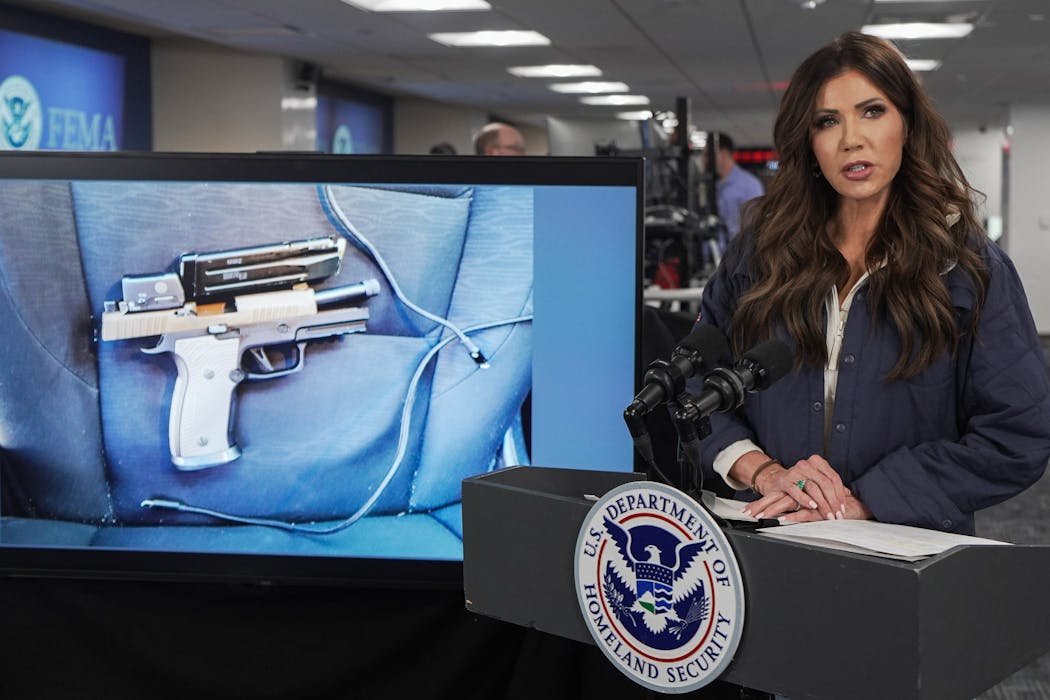
Homeland Security Secretary Kristi Noem initially said Alex Pretti committed an ‘act of domestic terrorism’ before saying later that ‘we were using the best information we had at the time.’ Al Drago/Getty Image

In separate encounters, federal immigration agents in Minneapolis killed Renée Good and Alex Pretti in January 2026.

Shortly after Pretti’s killing, Homeland Security Secretary Kristi Noem said he committed an “act of domestic terrorism.” Noem made the same accusation against Good.

But the label “domestic terrorism” is not a generic synonym for the kind of politically charged violence Noem alleged both had committed. U.S. law describes the term as a specific idea: acts dangerous to human life that appear intended to intimidate civilians, pressure government policy or affect government conduct through extreme means. Intent is the hinge.

From my experience managing counterterrorism analysts at the CIA and the National Counterterrorism Center, I know the terrorism label – domestic or international – is a judgment applied only after intent and context are assessed. It’s not to be used before an investigation has even begun. Terrorism determinations require analytic discipline, not speed.

Evidence before conclusions

In the first news cycle, investigators may know the crude details of what happened: who fired, who died and roughly what happened. They usually do not know motive with enough confidence to declare that coercive intent – the element that separates terrorism from other serious crimes – is present.

The Congressional Research Service, which provides policy analysis to Congress, makes a related point: While the term “domestic terrorism” is defined in statute, it is not itself a standalone federal offense. That’s part of the reason why public use of the term can outpace legal and investigative reality.

This dynamic – the temptation to close on a narrative before the evidence warrants it – seen most recently in the Homeland Security secretary’s assertions, echoes long-standing insights in intelligence scholarship and formal analytic standards.

Two firemen stand amid debris.
The 9/11 terrorist attacks changed the U.S. intelligence community’s analytical standards.
AP Photo/Mark Lennihan

Intelligence studies make a simple observation: Analysts and institutions face inherent uncertainty because information is often incomplete, ambiguous and subject to deception.

In response, the U.S. intelligence community codified analytic standards in the aftermath of the Sept. 11, 2001, terrorist attacks. The standards emphasize objectivity, independence from political influence, and rigorous articulation of uncertainty. The goal was not to eliminate uncertainty but to bound it with disciplined methods and transparent assumptions.

When narrative outruns evidence

The terrorism label becomes risky when leaders publicly call an incident “domestic terrorism” before they can explain what evidence supports that conclusion. By doing that, they invite two predictable problems.

The first problem is institutional. Once a senior official declares something with categorical certainty, the system can feel pressure – sometimes subtle, sometimes overt – to validate the headline.

In high-profile incidents, the opposite response, institutional caution, is easily seen as evasion – pressure that can drive premature public declarations. Instead of starting with questions – “What do we know?” “What evidence would change our minds?” – investigators, analysts and communicators can find themselves defending a superior’s storyline.

People surround a memorial site.
People visit a makeshift memorial for Alex Pretti in Minneapolis on Jan. 30, 2026.
Charly Triballeau/AFP via Getty Images

The second problem is public trust. Research has found that the “terrorist” label itself shapes how audiences perceive threat and evaluate responses, apart from the underlying facts. Once the public begins to see the term as a political messaging tool, it may discount future uses of the term – including in cases where the coercive intent truly exists.

Once officials and commentators commit publicly to a version ahead of any assessment of intent and context, confirmation bias – interpreting evidence as confirmation of one’s existing beliefs – and anchoring – heavy reliance on preexisting information – can shape both internal decision-making and public reaction.

The long-term cost of misuse

This is not just a semantic fight among experts. Most people carry a mental file for “terrorism” shaped by mass violence and explicit ideological targeting.

When Americans hear the word “terrorism,” they likely think of 9/11, the 1995 Oklahoma City bombing or high-profile attacks abroad, such as the 2005 London bombings and December 2025 antisemitic attack in Sydney, where intent was clear.

By contrast, the more common U.S. experience of violence – shootings, assaults and chaotic confrontations with law enforcement – is typically treated by investigators, and understood by the public, as homicide or targeted violence until motive is established. That public habit reflects a commonsense sequence: First determine what happened, then decide why, then decide how to categorize it.

U.S. federal agencies have published standard definitions and tracking terminology for domestic terrorism, but senior officials’ public statements can outrun investigative reality.

The Minneapolis cases illustrate how fast the damage can occur: Early reporting and documentary material quickly diverged from official accounts. This fed accusations that the narrative was shaped and conclusions made before investigators had gathered the basic facts.

Even though Trump administration officials later distanced themselves from initial claims of domestic terrorism, corrections rarely travel as far as the original assertion. The label sticks, and the public is left to argue over politics rather than evidence.

None of this minimizes the seriousness of violence against officials or the possibility that an incident may ultimately meet a terrorism definition.

The point is discipline. If authorities have evidence of coercive intent – the element that makes “terrorism” distinct – then they would do well to say so and show what can responsibly be shown. If they do not, they could describe the event in ordinary investigative language and let the facts mature.

A “domestic terrorism” label that comes before the facts does not just risk being wrong in one case. It teaches the public, case by case, to treat the term as propaganda rather than diagnosis. When that happens, the category becomes less useful precisely when the country needs clarity most.

The Conversation

Brian O’Neill does not work for, consult, own shares in or receive funding from any company or organization that would benefit from this article, and has disclosed no relevant affiliations beyond their academic appointment.

ref. A terrorism label that comes before the facts can turn ‘domestic terrorism’ into a useless designation – https://theconversation.com/a-terrorism-label-that-comes-before-the-facts-can-turn-domestic-terrorism-into-a-useless-designation-274790

Clarence ‘Taffy’ Abel: A pioneering US Olympic hockey star who hid his Indigenous identity to play in the NHL

Source: The Conversation – USA – By Michael J. Socolow, Professor of Communication and Journalism, University of Maine

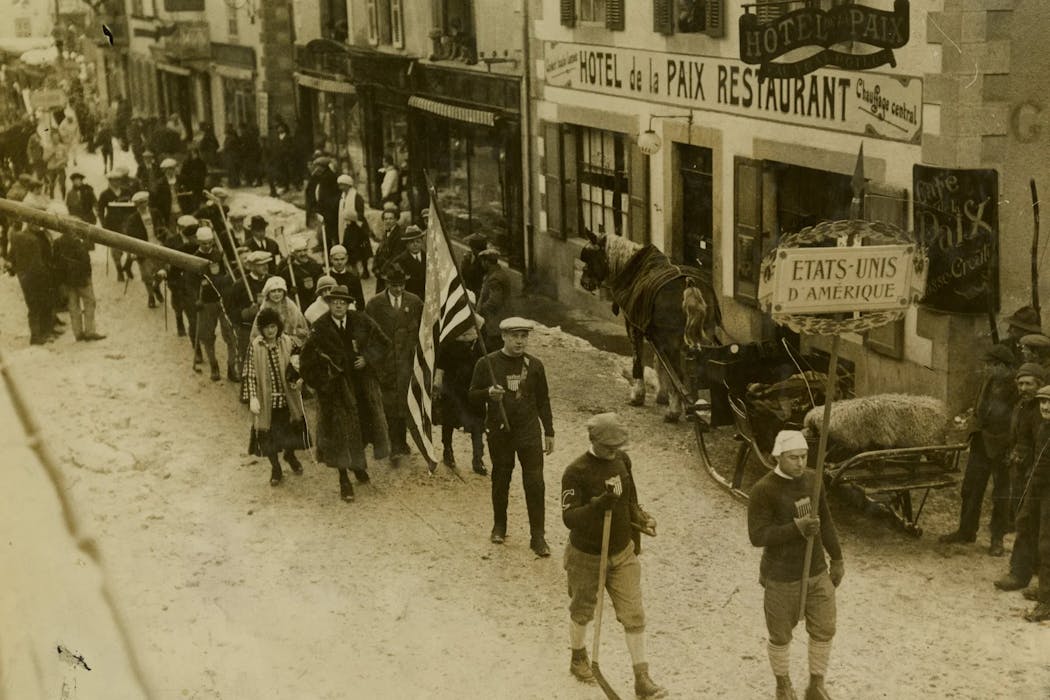
Taffy Abel, of the U.S. ice hockey team that competed in Chamonix, France, in 1924, was the first U.S. flag bearer at a winter Olympics. The Jones Family Collection

On Dec. 26, 1926, 16,000 hockey fans packed Madison Square Garden to witness the birth of a rivalry between the New York Americans and the brand-new New York Rangers. The game would later be remembered for establishing a foundation of popularity for the sport in New York City.

The only American playing for the Rangers that night also happened to be the largest player in the history of the NHL up to that point, defenseman Clarence “Taffy” Abel.

Standing over 6 feet tall and weighing 225 pounds, Abel was a brutal behemoth on the ice. Yet off the ice, he was a quiet, personable man who charmed sportswriters.

Despite being a foundational figure in American hockey – an Olympic silver medalist and a two-time Stanley Cup champion – Abel has been largely erased from the national memory. His story is not just one of athletic prowess, but of a secret identity maintained for survival and a career ended by a league that turned against him. As a scholar of Olympic media history, I recognize Abel’s story as an important but overlooked example of how race and labor issues can influence public memory.

Passing as white: Abel’s secret identity

Taffy Abel, who earned his lifelong nickname from his childhood love of candy, was half-Ojibwe, born in 1900 in Sault Ste. Marie, Michigan. One of Abel’s few surviving relatives, George Jones, a nephew by marriage, recalled that his mother, Charlotte, an Ojibwe woman, encouraged Taffy and his sister to “pass” as white to protect them from the era’s rampant racism and the threat of being sent to an Indian boarding school. Though his heritage remained an open secret in his hometown, Abel maintained his whiteness throughout his hockey career.

His mother died in 1939, and it was only after her death – and years after his retirement – that Abel began to speak openly and proudly of his Indigenous roots. This forced silence is a primary reason his legacy remained obscured; for decades, he was categorized simply as a white American athlete, masking his status as a racial trailblazer.

Pioneer on the ice

Abel’s hockey journey was historic. At the 1924 Chamonix Games – the first official Winter Olympics – he was chosen to carry the U.S. flag during the opening ceremony. He led the American team to a silver medal before being recruited by Conn Smythe for the inaugural New York Rangers roster.

Because of his size, and perhaps also because of his biracial identity, which was likely known to many players in the NHL, Abel was forced to fight often in his rookie year. He led the Rangers with 78 penalty minutes, and soon became famous around the league for his jarring and ferocious checking.

In Abel’s second season playing for the Rangers, the team won the Stanley Cup. He became the first American player to win a medal at the Olympic Games and the Stanley Cup, cementing his legacy as one of the finest hockey players in the world. In 1929, he was traded to the Chicago Black Hawks, where he anchored the defense on a team that won the Stanley Cup in 1934.

A group of men standing on snow in front of mountains, some holding hockey sticks.
Taffy Abel, third from right, was captain of the U.S. hockey team at the 1924 Olympics, which won a silver medal.
The Jones Family Collection

Hits the wall

The end of Abel’s career was not dictated by age or injury, but by a stand for labor dignity. After the 1934 championship, he held out for a salary that reflected his value as a star attraction. Black Hawks management responded by insulting him in the press, portraying Abel as an ungrateful prima donna.

Around the league, executives mocked Abel’s weight, telling newspapers that Abel walked out because he wouldn’t respect a team-mandated diet. Abel believed a team would sign him for 1935, but it soon became clear he had become effectively banned from the league due to his advocacy for equitable pay.

He had been a star attraction for the Black Hawks, and despite leading the team to the Stanley Cup in his final game, Abel never played another game in the NHL. At age 34, he returned to Sault Ste. Marie, operated a café and coached youth hockey, quietly fading from the national spotlight.

Complicated reckoning

14 men in hockey uniforms, posed in two rows for a photo, some with their hockey sticks.
The New York Rangers pose for a photo in 1928 in New York. Taffy Abel is second from right in the back row.
AP files

Only recently has the NHL acknowledged Abel’s Native American heritage. However, his story presents a challenge to the league’s historical narrative. To celebrate Abel as a pioneering person of color requires the NHL to confront its own role in the systemic racism that forced him to hide his identity. Only recently has the league’s longtime, historical ban on nonwhite players – dating from its founding in 1917 – been an open and popular subject of public discussion.

Furthermore, the history is messy. Because Abel passed as white during his playing days, some modern observers find it difficult to reconcile his achievements with those of later pioneers who broke the color barrier more overtly.

Ultimately, Clarence “Taffy” Abel was a resilient path breaker who navigated artificial borders – between the U.S. and Canada, and between white and Indigenous identities. He was a charter member of the U.S. Hockey Hall of Fame in 1973, and his memory inspired future Indigenous stars like T.J. Oshie.

Yet his name remains largely unknown because, I believe, his life forces a reckoning with a society that dehumanized him. Even Abel’s U.S. Hockey Hall of Fame biography minimizes his heritage, noting “Thought by some to be the first Native American to play in the NHL.”

Abel fought for fair pay, against racism and through physical pain. He died in 1964, but the issues he grappled with – labor exploitation and racial identity – remain at the forefront of the American story today.

The Conversation

Michael J. Socolow does not work for, consult, own shares in or receive funding from any company or organization that would benefit from this article, and has disclosed no relevant affiliations beyond their academic appointment.

ref. Clarence ‘Taffy’ Abel: A pioneering US Olympic hockey star who hid his Indigenous identity to play in the NHL – https://theconversation.com/clarence-taffy-abel-a-pioneering-us-olympic-hockey-star-who-hid-his-indigenous-identity-to-play-in-the-nhl-275144

What Olympic athletes see that viewers don’t: Machine-made snow makes ski racing faster and riskier – and it’s everywhere

Source: The Conversation – USA (2) – By Keith Musselman, Assistant Professor in Geography, Mountain Hydrology, and Climate Change, University of Colorado Boulder

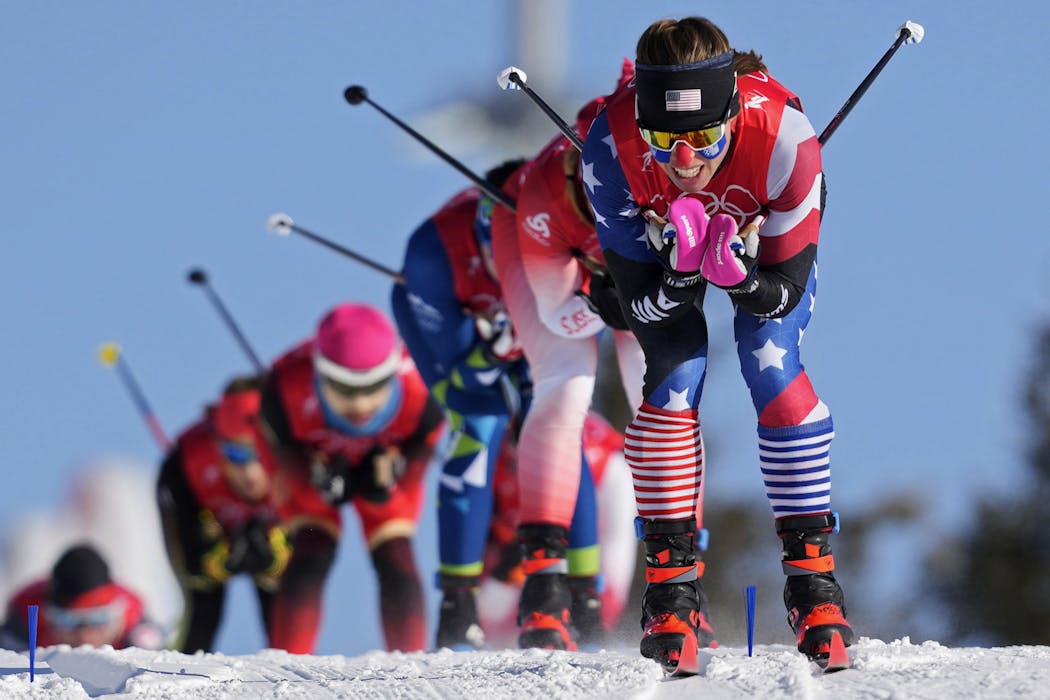
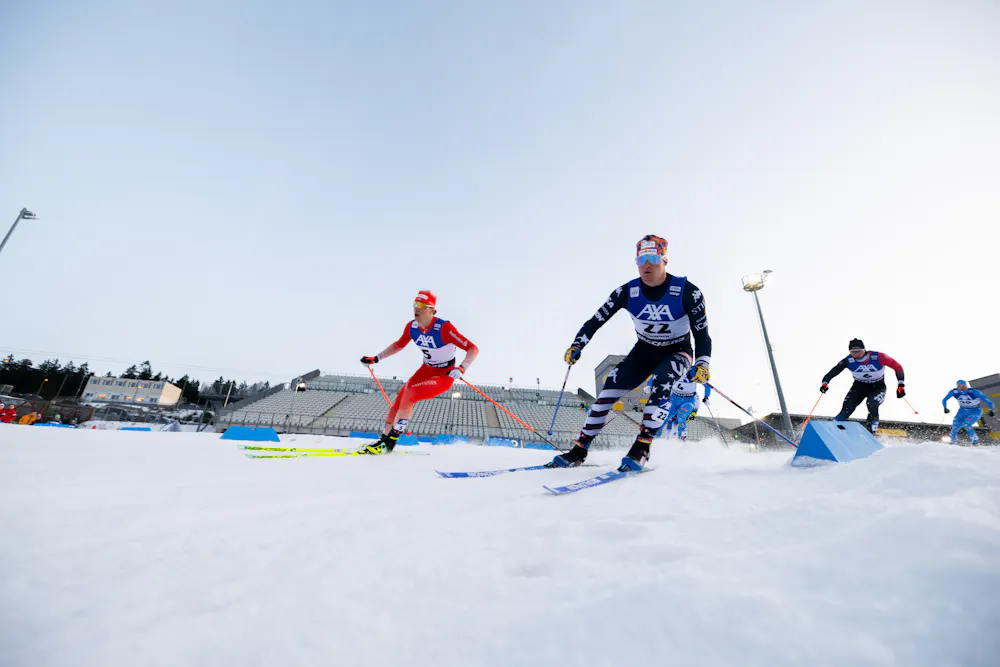
U.S. skier Rosie Brennan leads a group during the women’s team sprint classic cross-country skiing competition at the 2022 Winter Olympics. AP Photo/Aaron Favila

When viewers tune in to the 2026 Winter Olympics, they will see pristine, white slopes, groomed tracks and athletes racing over snow-covered landscapes, thanks in part to a storm that blanketed the mountain venues of the Italian Alps with fresh powder just in time.

But at lower elevations, where cross-country and other events are held, athletes and organizers have been contending with rain; thin, sometimes slushy snow; and icy, machine-made surfaces.

“Most of our races are on machine-made snow,” 2026 U.S. Olympic team cross-country skier Rosie Brennan told us ahead of the Games. “TV production is great at making it look like we are in wintry, snowy places, but this year has been particularly bad.”

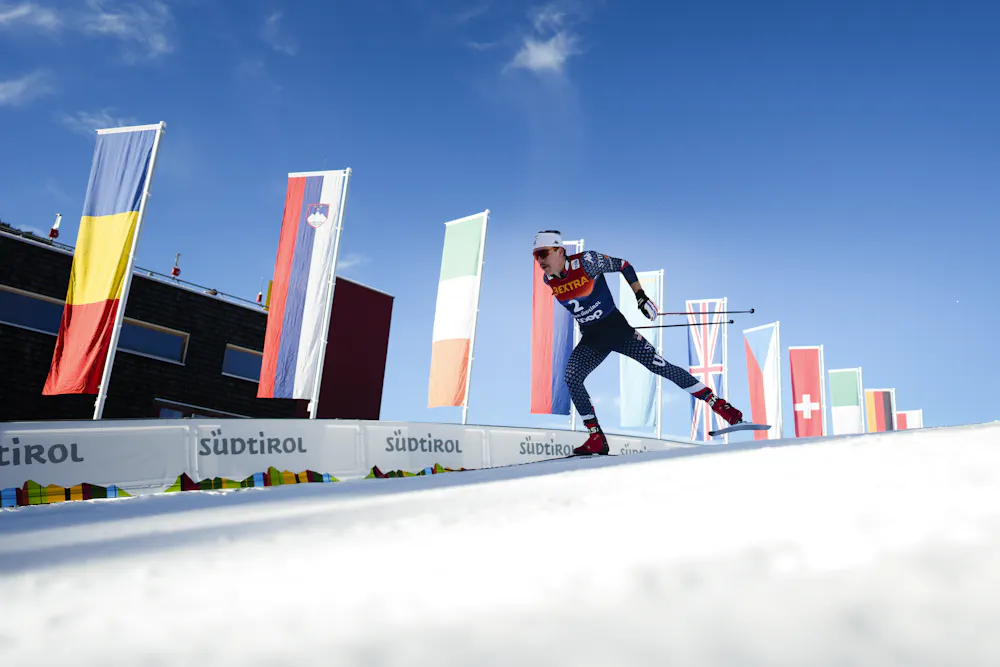
A male skier races down a slick track with flags flying along the wall beside him
Machine-made snow increasingly makes the Winter Games possible. It’s also slicker to race and harder to fall on. Here, Olympic skier Ben Ogden of the U.S. competes during the sprint of the FIS Cross-Country World Cup Tour de Ski in Toblach, Italy, on Dec. 28, 2024.
Federica Vanzetta/NordicFocus/Getty Images

As scientists who study mountain snow, water resources and the human impact of warming winters, we see winter’s changes through data: rising temperatures, shrinking snowpack, shorter snow seasons.

Olympic athletes experience changing winter conditions personally, in ways the public and scientists rarely do. Lack of snowfall and more frequent rain affect when and where they can train, how they train and how dangerous the terrain can become.

We talked with Brennan and cross-country skiers Ben Ogden and Jack Young as they were preparing for the 2026 Winter Games. Their experiences reflect what many athletes describe: a sport increasingly defined not by the variability of natural winter but by the reliability of industrialized snowmaking.

What the cameras don’t show

Snowmaking technology makes it possible to create halfpipes for freestyle snowboarding and skiing competitions. It also allows for races when natural snow is scarce – the 2022 Winter Olympics in Beijing relied entirely on machine-made snow for many races.

However, machine-made snow creates a very different surface than natural snow, changing the race.

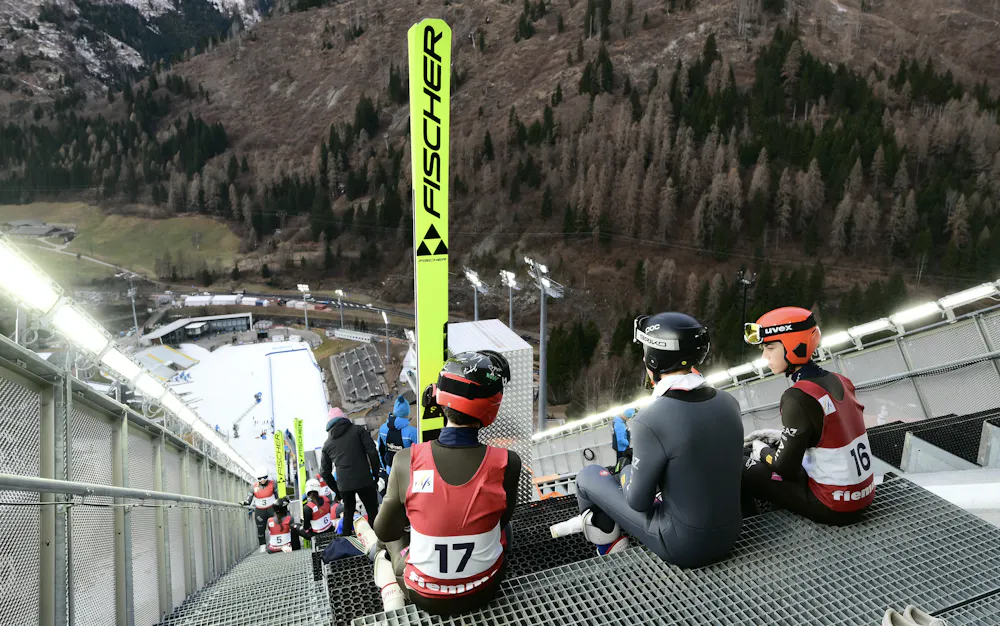
Three skiers sit at the top of a ski jump. Their view shows how much dry, snow-free ground is around the jump area
Athletes train at the ski jumping arena prior to the Open Italian Championship in Predazzo, a 2026 Winter Olympics venue, on Dec. 23, 2025.
Stefano Rellandini/AFP via Getty Images

In clouds, each unique snowflake shape is determined by the temperature and humidity. Once formed, the iconic star shape begins to slowly erode as its crystals become rounded spheres. In this way, natural snow provides a variety of textures and depths: soft powder after a storm, firm or brittle snow in cold weather, and slushy, wet snow during rain or melt events.

Machine-made snow varies less in texture or quality. It begins and ends its life as an ice pellet surrounded by a thin film of liquid water. That makes it slower to change, easier to shape, and, once frozen, it hardens in place.

‘They’re faster, icier and carry more risk’

When artificial snow is being made, the sound is piercing – a high-pitched hiss roars from the pressurized nozzles of snow guns. These guns spew water mixed with compressed air, and it freezes upon contact with the cold air outside, creating small, dense ice particles. The drops sting exposed skin, as one of us, Agnes Macy, knows well as a former competitive skier.

Snow machines then push out artificial snow onto the racecourse. Often, the trails are the only ribbons of snow in sight – a white strip surrounded by brown mud and dead grass.

Female skiers race through a town with a church beside them, fans along the track and lots of snow-free ground outside the snowy race course.
The surrounding landscape was mostly snow-free when Rosie Brennan competed in the individual sprint at an FIS Cross-Country World Cup event in Drammen, Norway, on March 3, 2022.
Federico Modica/NordicFocus/Getty Images

“Courses built for natural snow feel completely different when covered in man-made snow,” Brennan, 37, said. “They’re faster, icier, and carry more risk than anyone might imagine for cross-country skiing.”

There’s nothing quite like skiing on fresh snow. After a storm brings a blanket of light, fluffy powder, it can almost feel as though you’re floating. The snow is forgiving.

On artificial snow, skiers carry more speed into downhill runs. Downhill racers may relish the speed, but cross-country skis don’t have metal edges like downhill skis do, so step-turning or skidding around fast, icy corners can make an athlete feel out of control. It “requires a different style of skiing, skill sets and strengths than I grew up learning,” Brennan said.

How athletes adapt, with help from science

Athletes must adjust their technique and prepare their skis differently, depending on the snow conditions.

At elite levels, this is science. Snow crystal morphology, temperature, ski base material and structure, ski stiffness, skier technique and environmental conditions all interact to determine an athlete’s speed.

How snow forms. NBC News Learn.

Before cross-country, or Nordic, races, ski technicians compare multiple ski pairs prepared with different base surfaces and waxes. They evaluate how quickly each ski glides and how long it maintains that glide – traits that depend on the friction between the ski and the snow.

Compared to natural snow, machine-made snow generally provides a more durable and longer-lasting surface. In cross-country racing, that allows for more efficient and stronger pushes without skis or poles sinking deep into snow. Additionally, improvements in the machines used to groom snow now provide harder and more homogeneous surfaces that permit faster skiing.

Two male skiers on tangled on the ground after a crash.
Russia’s Alexander Terentev, right, and Czech Republic’s Michal Novak crash during a men’s cross-country sprint quarterfinal race at the FIS Nordic World Ski Championships in Oberstdorf, Germany, on Feb. 25, 2021.
AP Photo/Matthias Schrader

While fast skiing is the goal, ski crashes are also the most common cause of injury in the Winter Olympics. With machine-made snow, ski jump competitors and anyone who falls is also landing on a harder surface, which can increase the risk of injury.

Why winters are changing

Weather can always deal surprises, but long-term climate trends are shifting what can be expected of a typical winter.

In the Alps, air temperature has increased by about 3.6 degrees Fahrenheit (2 degrees Celsius) since the late 1800s, before rising fossil fuel use began increasing the levels of greenhouse gases trapping heat in the atmosphere. Globally, 2025 was the third-warmest year on record, following 2024 and 2023.

For mountain regions, these warmer conditions have consequences. Snow melts earlier and more frequently in midwinter, especially during warm spells that used to be rare.

Midwinter snowmelt events are occurring more often at higher elevations and earlier in the season across many mountain ranges of western North America. At the same time, the snow line – the elevation where precipitation shifts from snow to rain – is moving upslope.

Warming in high mountain environments is also causing the threshold where rain turns to snow to rise by tens of meters per decade in some regions. This means storms that once blanketed entire valleys in snow now may deliver snow only to upper slopes, with rain falling below.

Male ski racers turn a corner on a race course.
Taking sharp corners on icy surfaces isn’t easy on cross-country skis. Here, U.S. Olympic skier Jack Young competes in the individual sprint finals of the FIS Cross-Country World Cup Oberhof on Jan. 17, 2026, in Oberhof, Germany.
Leo Authamayou/NordicFocus/Getty Images

Together, these changes mean that many winter storms produce less snow, over less area, and for shorter durations than they did a generation ago.

Training venues

The changing winter landscape has also transformed how athletes train. Traditional training venues, such as glaciers once used for summer skiing, have become unreliable. In August 2025, the Hintertux Glacier – the only year-round training center operating in Austria – announced its first temporary closure.

“It’s been increasingly hard to make plans for locations to train between races,” Brennan said. “Snow reliability isn’t great in many places. We often rely on going to higher elevations for a better chance of snow.”

Athletes race on short skis on wheels.
Biathlon athletes practice their sport on wheels at the Loop One Festival in Munich’s Olympic Park on Oct. 19, 2025.
Sven Hoppe/picture alliance via Getty Images

Higher-elevation training can help, but it concentrates athletes in fewer places, reduces access for younger skiers due to the remoteness and raises costs for national teams. Some of these glaciers – like Canada’s Haig Glacier or Alaska’s Eagle Glacier – are accessible only by helicopter. When skiers can’t get to snow, dryland training on rollerskis is one of the only options.

Winter athletes see the climate changing

Because winter is their workplace, athletes often notice subtle changes before those changes show up in long-term statistics.

Even athletes in their earlier 20s, like Young, said they have noticed the rapid expansion of snowmaking infrastructure at many racing venues in recent years. Snowmaking requires large amounts of energy and water. It is also a clear sign that organizers see winters becoming less dependable.

Winter athletes like Canadian Dahria Beatty are seeing their environment change as temperatures rise.

Athletes also witness how communities are affected when poor snow conditions mean fewer visitors. “In the Alps, when conditions are bad, it is obvious how much it affects the communities,” Ogden, 25, said. “Their tourism-based livelihoods are so often negatively affected, and their quality of life changes.”

Many winter athletes are speaking publicly about their concerns. Groups such as Protect Our Winters, founded by professional snowboarder Jeremy Jones, work to advance policies that protect outdoor places for future generations.

A wintry look, but an uncertain future

For athletes at the 2026 Olympics, the variability within the Olympic region – snow at higher elevations, rain at lower ones – reflects a broader truth: The stability of winter is diminishing.

Athletes know this better than anyone. They race in it. They train in it. They depend on it.

The Winter Games will go on this year. The snow will look good on television. But at the same time, winter is changing.

The Conversation

Keith Musselman receives funding from the National Science Foundation. He is a member of the Science Alliance for the non-profit Protect Our Winters.

Agnes Macy receives funding from the National Science Foundation.

ref. What Olympic athletes see that viewers don’t: Machine-made snow makes ski racing faster and riskier – and it’s everywhere – https://theconversation.com/what-olympic-athletes-see-that-viewers-dont-machine-made-snow-makes-ski-racing-faster-and-riskier-and-its-everywhere-274806