Wake Up Dead Man: an enjoyable slice of murderous Christmassy fun

Source: The Conversation – UK – By Louis Bayman, Associate Professor in Department of Film Studies, University of Southampton

Murder has never been as comforting as in the Knives Out series, whose third instalment, Wake Up Dead Man, is out now in cinemas and will be available to stream from December 12 as one of Netflix’s Christmas offerings. It clocks in at nearly two and a half hours of suspense, comedy and enough asides about religion and politics to get any traditional festive arguments going.

Daniel Craig’s quick-witted but laconic southern private investigator Benoit Blanc doesn’t show up until about an hour into proceedings. Narration is handed over instead to Father Jud (Josh O’Connor), a former boxer who became a Catholic priest after killing a man in the ring.

O’Connor carries the film, not to say this winter season more generally in cinemas, occupying the starring role in Kelly Reichardt’s arthouse heist film The Mastermind last month, and The History of Sound which will be out next month.

Father Jud recounts the events leading up to murder in a far-flung parish in upstate New York, where a small group of parishioners have fallen under the unorthodox preachings of the cultish Monsignor Jefferson Wicks (Josh Brolin).

To say much more would risk giving away some of the mystery that Wake Up Dead Man advertises in its title, so let’s just say that the set-up of a priest battling perdition and the weird parishioners he is stuck with make up a cast of characters who each have their reasons for murder.

This potential is amplified by the fiery sermons of the Monsignor, who is less a guiding shepherd to the credulous flock and more a vengeful wolf. He details his vivid fantasies in confession to the cringeing Jud, as the very definition of a loose canon.

Wake Up Dead Man is an engaging comic mystery with an all-star cast, with Craig, O’Connor and Brolin joined by Mila Kunis, Jeremy Renner, Kerry Washington, Andrew Scott and Glenn Close, who hams up the gothic elements of the script with relish. This is a “locked-room mystery”, a genre begun by Edgar Allan Poe’s 1841 short story The Murders in the Rue Morgue, where murder is committed in the apparently impossible conditions of a completely closed room. The film is then not only a whodunnit but a howdunnit.

Wake Up Dead Man is aware of its own literary inspirations, which if they weren’t already clear are listed as the subjects of the parish reading group. The film is set over Easter weekend, but the idea of a good murder has become staple Christmas fare, making it no surprise that Netflix has scheduled this film for the holiday market. But what is it in the genre that makes murder so Christmassy?

Death as a puzzle

Detective fiction is unique in the way it treats death. Unlike horror, it does not dwell on the terrifying vulnerability that is our mortal condition. And unlike the war film, death is not the price for adherence to a civilisational ideal. Nor is there much sense of the sacredness of life, for death in detective fiction is treated less as a tragedy to mourn than a puzzle to solve.

Detective fiction depicts a world where mystery is no longer proof of the ultimately unknowable workings of the divine. Mystery is instead a problem to be met by the calculations of logical deduction. But as the various lustful, greedy characters of detective fiction demonstrate, if rationality provides the only source of meaning, what is there to stop us from pursuing total amoral self-interest? What is there to stop us, indeed, from murder?

The shared narration between detective Blanc and Father Jud means that Wake Up Dead Man becomes an enquiry not only into a murder but the antagonism between reason and God. Blanc states his atheism as soon as he arrives at the church that is now a crime scene. But a heavenly light shines through its windows to brighten its gloom as Father Jud provides his justification for faith.

Wake Up Dead Man nicely satirises how charismatic leaders can elicit the irrational passions of their followers for self-interested ends, but the film is not itself a rejection of belief. Of course, the intensity of a closed setting, where a lifetime of stored resentments, jealousies and greed spill over into brutal hatred, may also be why murder mysteries seem so appropriate at Christmas.

My main disappointment with Wake Up Dead Man is how underused its supporting players are; the ensemble nature of the whodunnit works best when attention is divided among a cast of characters, each of whom could be a potential murderer. But its closing revelations layer twist upon twist with enough force to make for a satisfying ending to an entertaining story.


Looking for something good? Cut through the noise with a carefully curated selection of the latest releases, live events and exhibitions, straight to your inbox every fortnight, on Fridays. Sign up here.


The Conversation

Louis Bayman does not work for, consult, own shares in or receive funding from any company or organisation that would benefit from this article, and has disclosed no relevant affiliations beyond their academic appointment.

ref. Wake Up Dead Man: an enjoyable slice of murderous Christmassy fun – https://theconversation.com/wake-up-dead-man-an-enjoyable-slice-of-murderous-christmassy-fun-271001


High-stakes tests are common in England’s schools – and they’re linked to a fear of failure

Source: The Conversation – UK – By Carolyn Jackson, Professor of Gender and Education, Lancaster University

wavebreakmedia/Shutterstock

The UK government has committed to reducing the amount of time pupils spend in GCSE exams in England by up to three hours on average. This comes after recommendations to cut exam time were made in an independent review of the national curriculum and school assessment.

Professor Becky Francis, who led the review, has said: “Exams are currently this very stressful, elongated period that young people have to endure, and it’s an unusually long period in England.”

But the government has announced the introduction of a new test. Children in year eight will take a reading assessment, intended to improve standards before they take their GCSEs. This seems to be different from the diagnostic tests in English and maths (also in year eight) recommended in the independent review’s final report.

Children in England are among the most tested in the world and are set to remain so. However, frequent testing isn’t a requirement of school education – and it could be having a serious effect on children’s wellbeing.

In our recent research, we wanted to explore how frequent, high-stakes exams – those with significant consequences, such as for your future career or education – affect children’s fear of failure. We also investigated whether children see school as competitive, how competitive they are, if they see other students as cooperative and whether they feel like they belong in school.

We analysed data from England and the Belgian region of Flanders, as these regions have very different systems when it comes to testing.

England is renowned for setting lots of tests that are high-stakes for pupils, teachers and schools. GCSE and A-level results affect pupils’ learning and career paths; schools are ranked by performance in tests that children sit in primary and secondary school.

Flanders, on the other hand, has no national high-stakes tests. Indeed, it had no nation-wide centrally-administered tests at all until 2024.

Our analysis used data from Pisa, a programme that measures 15-year-olds’ skills and knowledge in reading, mathematics and science in countries across the globe. Questions are also asked about wellbeing and school life. We analysed the data of the 5,242 English students (in 175 schools) in the assessment, as well as the 4,882 Flemish students (in 171 schools).

Competition and failure

It showed that in England, where high-stakes testing is common, students’ fear of failure is higher and they perceive more competition in school than in Flanders. By contrast, in Flanders, students perceive less competition and more cooperation from other students, and they have a higher sense of belonging and less fear of failure than their English counterparts.

The difference in fear of failure is explained partly by students experiencing more competition in England. For example, English students are more likely to report that their peers value competition and that they feel they are being compared with other students. Research by one of us (Carolyn Jackson) has shown that competition and comparisons are fuelled by testing.

Girl looking stressed in lesson
Fear of failure is linked to lower academic performance.
PeopleImages/Shutterstock

A positive sense of belonging has been linked to better academic performance, positive mental health and wellbeing, greater happiness, less stress, higher attendance and greater engagement in school.

Its value is accepted in England: Bridget Phillipson, secretary for education, recently announced her vision to foster student belonging in schools. But she discussed this at the same time as announcing more testing and related targets. According to our analyses, increased competition, which is associated with high-stakes testing, is likely to reduce rather than increase students’ sense of belonging.

Fear of failure – which is also higher in England – can lead to reduced academic performance. It’s also linked with missed opportunities for learning, lower emotional wellbeing and higher levels of stress, burnout and depression. Fear of failure is typically higher in competitive, rather than cooperative, learning contexts.

Overall, our analyses show the importance of creating education systems (and schools and classrooms) that downplay competition and instead foster cooperation and a sense of belonging. Systems like this are associated with lower fear of failure. Reducing fear of failure is crucial given that it is associated with the broad range of negative factors listed above.

This is especially important at the moment, as school-related stress is a major concern in many European countries. It has been linked to growing mental health problems among young people, especially girls.

Returning to the curriculum review, the panel’s push to reduce time spent in exams at GCSE may help slightly to reduce stress. Also, the recommendation to keep any new tests in year eight low stakes and diagnostic, and not to return to high-stakes Sats tests at this level, is encouraging in light of our findings.

Policymakers in Flanders are increasingly looking to learn lessons from the English system. But they would do well to avoid implementing changes that might increase competition and students’ fear of failure, and also reduce cooperation and feelings of belonging.

Currently, many more students in England than in Flanders report school-related pressure. That could soon change if Flanders introduces high-stakes testing and drives up competition.

The Conversation

Carolyn Jackson has received funding from the Economic and Social Research Council (ESRC) and The Nuffield Foundation.

Mieke Van Houtte does not work for, consult, own shares in or receive funding from any company or organisation that would benefit from this article, and has disclosed no relevant affiliations beyond their academic appointment.

ref. High-stakes tests are common in England’s schools – and they’re linked to a fear of failure – https://theconversation.com/high-stakes-tests-are-common-in-englands-schools-and-theyre-linked-to-a-fear-of-failure-269459

It’s not you – some typefaces feel different

Source: The Conversation – UK – By Andrea Piovesan, Lecturer in Psychology, Edge Hill University

Roman Samborskyi/Shutterstock

Have you ever thought a font looked “friendly” or “elegant”? Or felt that Comic
Sans was somehow unserious? You’re not imagining it.

Typefaces carry personalities, and we react to them more than we realise. My work explores how the shapes of letters can subtly influence our feelings.

When we read, we are not just processing the words. We are also taking in the typeface, which can shape how we interpret a message and even what we think of the person who wrote it.

Researchers demonstrated this in a 2018 study using simulated text conversations. They presented participants with an ambiguous message (for example, “That’s what I do”) and altered the typeface. A cheerful-looking font seemed to encourage readers to interpret the message positively, while a harsher one pushed them toward a more negative reading.

A similar pattern appears in email communication. In a 2014 study, the same email sent in Times New Roman made the sender seem formal and professional, whereas the more playful Kristen ITC made them appear more polite and even more attractive. Just as a voice sets the mood of a conversation, a typeface sets the mood of the page.

Research also shows that we process words more quickly when the typeface matches the meaning we expect. In one experiment, published in 1989, people recognised the word “slow” more quickly when it appeared in Cooper Black, a typeface associated with heaviness and slowness, but took longer when the same word was shown in Palatino Italic, which conveys lightness and speed.

A 2021 study found a similar priming effect in brand logos. After seeing a logo set in a particular typeface, participants were quicker to identify words that matched the qualities suggested by that design. When the style of the lettering aligns with the message, our brains seem to work more efficiently.

But how is that possible?

The answer is a mix of factors. Some qualities are built into the physical features of the typeface. Thick, straight lines signal sturdiness, while curves tend to feel softer or more approachable. Some associations may even have evolutionary roots.

Across a range of studies, people reliably link curved shapes with positivity and angular ones with threat or negativity. A 2016 review of this research traces the pattern back to survival mechanisms.

Sharp, angular forms in the environment can indicate danger, so our visual system has evolved to detect and prioritise them quickly. This bias appears to spill over into our perception of typefaces too, making angular fonts feel harsher or more alarming, while curved ones seem warmer and more pleasant.

Arms coming out of old computer monitor and hands typing on keyboard.
Some fonts just feel ‘strong’.
Roman Samborskyi/Shutterstock

Other typeface personalities have been shaped by history and use. Take Times New Roman, originally designed in the 1930s for the British newspaper the Times. Over time, its connection with journalism has become ingrained, making Times New Roman synonymous with professionalism and formality today.

The influence of typefaces becomes even clearer when the wrong choice is made. An example comes from the European organisation for nuclear research, Cern, in 2012 when researchers used Comic Sans to announce the discovery of the Higgs boson (also called the “God particle”).

The decision sparked widespread criticism because Comic Sans is widely seen as playful and informal, hardly befitting one of the most important scientific discoveries of our time.

People who work in design, communication and marketing know this phenomenon well and use it deliberately. Think about the last time you bought a product you couldn’t see inside the box. What persuaded you if the product itself wasn’t visible? Most likely the packaging.

Designers choose typefaces as well as images that communicate the qualities they think you’re looking for.

If you’re searching for screws for a DIY project, you’re more likely to trust packaging set in bold, heavy lettering that signals strength and sturdiness. If you’re choosing a perfume as a gift, a delicate, flourished typeface might suggest elegance and femininity before you’ve even smelled it.

In one 2006 study, people were shown a range of fonts and asked where they would feel appropriate.

Serif typefaces such as Times New Roman and Cambria, which are recognisable by the small finishing strokes at the ends of their letters, were judged most suitable for business documents. Monospaced fonts like Courier New, in which every character takes up the same amount of space, were seen as better suited to technical materials and computer code.

This very article is set in Baskerville, and that’s no accident. Baskerville, like Goudy Old Style and other classic typefaces, tends to be seen as professional, trustworthy and high-quality. Those are the qualities The Conversation aims to convey to its readers. The same principle applies to any professionally designed website. Every typeface has been chosen to create the right impression.

Typefaces can also shape our experience of music. An album cover with rounded letters, for example, can make the music feel more pleasant. Designers also match typefaces to the genre: curvy, playful fonts appear on hippy music covers, conveying joy and peace, while sharp, angular lettering is common on punk albums, signalling anger and aggression.

Sometimes we don’t know exactly why a font feels a certain way. In a 2023 article, I reviewed studies from the past century that asked people to rate how they perceived different typefaces.

This large collection of data revealed some surprising patterns. For example, condensed typefaces, which have letters packed closely together, tend to convey a sense of sadness more than other fonts.

Thick lines reliably signalled strength, but the opposite was not true: thin lines were not consistently judged as weak. Instead, perceptions of weakness were more strongly associated with irregular strokes and high contrast, features common in typefaces that resemble handwriting. Why do they do that? I am afraid I don’t have an answer.

Next time you pick up a book, scroll through a website or glance at a label, take a moment to notice the font. Those subtle lines and curves are doing more than you might think, shaping your experience in subtle ways.

The Conversation

Andrea Piovesan does not work for, consult, own shares in or receive funding from any company or organisation that would benefit from this article, and has disclosed no relevant affiliations beyond their academic appointment.

ref. It’s not you – some typefaces feel different – https://theconversation.com/its-not-you-some-typefaces-feel-different-270192

Why British Museum has ended 15-year Japan Tobacco deal – and what it means for future partnerships

Source: The Conversation – UK – By Allen Gallagher, Postdoctoral Research Fellow, Department of Health, University of Bath

The British Museum has long faced controversy over its sponsors. Nicolas Lysandrou/Unsplash

The British Museum has ended its controversial 15-year sponsorship with Japan Tobacco International (JTI).

The sponsorship has attracted a lot of criticism in that time. In 2016, 1,000 public health experts wrote an open letter calling for London’s cultural institutions, including the British Museum, to end “morally unacceptable” sponsorship from tobacco sponsors.

Despite this, as reported in both 2023 and 2025 by our Tobacco Control Research Group at the University of Bath, the British Museum had continued to have a close relationship with JTI.

It is therefore welcome news that the UK government has finally intervened to end the partnership. It comes following a freedom of information request from the research and campaign organisation Culture Unstained. This revealed that the Department for Health had raised concerns about the partnership earlier this year to the Department for Digital, Culture, Media & Sport, the government department that funds the British Museum. As a result, the museum’s trustees decided not to continue the partnership upon its expiration in September.

This is long overdue. Many other cultural institutions in the UK have already ceased entering into agreements with such companies, given the immense damage tobacco products do to public health.

Tate, for example, stopped accepting all sponsorship from tobacco companies in 1991. The National Gallery, National Portrait Gallery and Victoria and Albert Museum each gradually did the same, leaving The British Museum as the only major UK national art museum still accepting money from a tobacco company.

The British Museum’s director, Nicholas Cullinan, previously argued there needed to be “very good, clear reasons for turning down money that would help keep the British Museum free to the public”.

Ties to a harmful industry

Corporate social responsibility (CSR) became a popular concept in the 1950s. It was originally interpreted as a positive development whereby companies committed resources to further societal gain instead of company profit. By the 1960s, however, more critical interpretations had emerged.

CSR began to be seen as “fundamentally subversive” by business researchers, and now it is commonly interpreted as a mechanism for large corporations to legitimise and consolidate power. For health-harming industries such as tobacco, CSR campaigns can help them “clean” their image by claiming to be investing in society, while simultaneously causing extensive public health harms.

Indeed, sponsoring cultural institutions is a well-documented tobacco industry tactic. Among public health practitioners and researchers, it’s widely seen as part of the industry’s efforts to improve its public image and achieve policy influence.

Viewed in this light, the British Museum’s sponsorship from JTI could be viewed as a deliberate effort by a harmful company to improve its own reputation by exploiting the reputation of a UK cultural institution.

Government funding of the British Museum during its tobacco sponsorship contradicts the world’s first public health treaty. The World Health Organization framework convention on tobacco control was adopted in 2003 and has been signed by over 182 countries and the EU as of 2025.

It aims to protect populations from the harms of tobacco through various measures to reduce tobacco consumption, such as preventing people from starting the habit and protecting them from the harm of secondhand smoke.

Article 5.3 of the treaty aims to protect policymaking from the vested interests of the tobacco industry, given the “fundamental and irreconcilable” conflict between the industry’s commercial interests and public health.

This article and its implementation guidelines stipulate that parties should aim to limit interactions with the tobacco industry. This includes rejecting all partnerships with tobacco companies and curbing their CSR activities.

The government’s financial support of the British Museum, while the museum received JTI sponsorship, was therefore problematic.

The future of sponsorship

Unfortunately, despite the welcome British Museum developments, the tobacco industry continues its connections to other UK cultural institutions. Both the London Philharmonic Orchestra and the Royal Academy of Arts continue to accept JTI sponsorship. Hopefully, the British Museum case will draw the attention of other institutions, encouraging them to follow suit.

Tobacco industry sponsorship of the British Museum has hopefully now become a thing of the past. However, it should be noted that the museum continues to accept sponsorship from other health-harming industries. Its ten-year partnership with oil producer BP, for example, has also come under scrutiny. As with the JTI sponsorship, the British Museum appears behind the curve. Other institutions like the Royal Opera House, National Portrait Gallery and Tate galleries have already cut ties with BP.

Time will tell whether the end of the JTI sponsorship will encourage other cultural institutions to reject tobacco industry sponsorship. We need to remain alert and vigilant regarding current and future partnerships entered into by the British Museum and other UK cultural institutions.


This article is part of our State of the Arts series. These articles tackle the challenges of the arts and heritage industry – and celebrate the wins, too.


The Conversation

Allen Gallagher receives funding from Bloomberg Philanthropies as part of the Bloomberg Initiative to Reduce Tobacco Use (www.bloomberg.org).

Duncan Thomas receives funding from Bloomberg Philanthropies as part of the Bloomberg Initiative to Reduce Tobacco Use (www.bloomberg.org).

Sophie Braznell receives funding from Bloomberg Philanthropies as part of the Bloomberg Initiative to Reduce Tobacco Use (www.bloomberg.org).

ref. Why British Museum has ended 15-year Japan Tobacco deal – and what it means for future partnerships – https://theconversation.com/why-british-museum-has-ended-15-year-japan-tobacco-deal-and-what-it-means-for-future-partnerships-270598

Empathy and reasoning aren’t rivals – new research shows they work together to drive people to help more

Source: The Conversation – USA (3) – By Kyle Fiore Law, Postdoctoral Research Scholar in Sustainability, Arizona State University

What motivates people to donate their time or money to make the world better? Alistair Berg/DigitalVision via Getty Images

For years, philosophers and psychologists have debated whether empathy helps or hinders the ways people decide how to help others. Critics of empathy argue that it makes people care too narrowly – focusing on individual stories rather than the broader needs of society – while careful reasoning enables more impartial, evidence-based choices.

Our new research, forthcoming in the academic journal PNAS Nexus, a flagship peer-reviewed journal of the National Academy of Sciences, suggests this “heart versus head” argument is too simple. Empathy and reasoning aren’t rivals – they work together. Each one on its own predicts more generous, far-reaching acts of assistance. And when they operate side by side, people tend to help in the fairest ways – not favoring some over others – and in ways that touch the most lives.

We studied two groups that regularly help others at personal cost. One consisted of living organ donors who gave kidneys to strangers. The other included “effective altruists,” who use evidence and logic to direct substantial portions of their income or careers toward causes that save the most lives per dollar, such as fighting extreme poverty or preventable illness.

All participants completed survey measures of empathy – essentially, how much they care about and are moved by others’ suffering. They also completed survey measures of reasoning. These assess how often people slow down, reflect and think through things before deciding what to do.

We also examined how these abilities related to a range of altruistic judgments and behaviors, from hypothetical choices – such as deciding whether to help a close friend or a distant stranger – to real-world donations.

On average, organ donors scored higher on empathy, and effective altruists scored higher on reflective reasoning – slowing down and thinking things through. But across all participants, both traits were linked to broader, more outward-looking helping. People with either an elevated heart or head, and especially those with both compared with average adults, tended to support distant others and focus on helping as many people as possible.

Even among organ donors, whose empathic ability is far above average adults’, empathy did not make them biased toward those who were close or familiar. When we measured their altruistic judgments and real-world donations, they were just as likely as average adults, and sometimes even more likely, to favor causes that saved the greatest number of lives.

These patterns challenge the assumption that empathy can narrow moral concern. In practice, we found, empathy can broaden it.

Why it matters

A Black woman in a red apron over a blue top walks with an older white woman holding food packets.
Relying on reason alone isn’t enough to inspire people to help strangers.
Jose Luis Pelaez Inc./Digital Vision via Getty Image

Many of today’s most urgent problems – poverty, climate change, global health – depend on motivating people to care about strangers and to use limited resources effectively.

Appeals to empathy alone may inspire giving but not necessarily the most effective giving. Appeals to reason alone can leave people unmoved, as often facts and numbers don’t stir anyone to care. Our findings suggest that the most powerful approach may be to pair empathy’s motivation with reasoning’s direction.

Empathy provides the emotional spark – a reminder that others’ suffering matters. Reasoning helps steer that motivation toward where help will have the greatest impact. Together, they encourage helping that is both compassionate and consequential.

What’s next

Future research needs to determine how empathy and reasoning can be strengthened in everyday decision-making. Could emotional stories paired with clear evidence about what works best help people choose actions that do the most good?

We also don’t yet know whether people who focus their giving beyond the boundaries of their immediate social circles, like effective altruists, pay any social cost for doing so – perhaps by inadvertently signaling less investment in close others. Promisingly, early evidence from organ donors shows that those who help strangers often maintain strong, stable relationships with their closest friends and family members.

Perhaps most importantly, researchers need to rethink how altruism is understood. Psychology lacks a clear framework for explaining how empathy and reasoning work together, for whom they work best, and the situations where they come apart.

Developing that kind of model would reshape how we think about helping – when helping expands, when it stalls, and why. While such core questions remain, the present findings offer reason for optimism.

The Research Brief is a short take on interesting academic work.

The Conversation

The research relevant to this article was funded by the John Templeton Foundation.

Stylianos Syropoulos does not work for, consult, own shares in or receive funding from any company or organization that would benefit from this article, and has disclosed no relevant affiliations beyond their academic appointment.

ref. Empathy and reasoning aren’t rivals – new research shows they work together to drive people to help more – https://theconversation.com/empathy-and-reasoning-arent-rivals-new-research-shows-they-work-together-to-drive-people-to-help-more-266913

The future of work — according to Generation Z — is purposeful, digital and flexible

Source: The Conversation – Canada – By Eddy Ng, Smith Professor of Equity and Inclusion in Business, Queen’s University, Ontario

As Generation Z — those born between 1997 and 2012 — enters the workforce in growing numbers, Canadian employers are encountering a cohort whose expectations and behaviours signal a fundamental shift from current norms.

Unlike previous generations, Gen Z brings pragmatic sensibilities shaped by the unique social, economic and technological landscapes of their upbringing.

Gen Z grew up amid economic uncertainty, technological upheaval and heightened social awareness. Unlike millennials, who entered the job market with “great expectations” for rapid promotions and pay raises, Gen Z is more pragmatic.

And so if Canadian organizations want to attract, engage with and retain this generation of talent, it’s essential to understand what makes them tick.

Purpose, values and why Gen Z stays

Recent research shows that this generation values job security, work-life balance and mental health above all else. These preferences are shaped by formative experiences, including observing their Gen X parents navigate dual-career households and witnessing economic disruptions and automation-driven restructuring.

For Gen Z, stability is seen as essential for their well-being at work.

This generation is ambitious, albeit in ways that diverge from traditional hierarchical advancement. Rather than prioritizing vertical mobility, they seek roles that provide flexibility, meaningful contribution and alignment with personal values.

Central to Gen Z’s workplace vision is a desire to work for organizations that prioritize diversity, inclusion and corporate social responsibility. This generation is the most racially diverse in Canadian history and has grown up in a more socially conscious environment. They tend to hold strong views around equal treatment and environmental sustainability, often expecting their employers to “walk the talk.”

One report suggests that Gen Z employees are significantly more likely to remain with organizations that offer purpose-driven work, with retention likelihood increasing by a factor of 3.6 when such alignment exists.

The rise of “conscious unbossing”

One notable trend within Gen Z is the preference for collaboration over authority.

A recent survey reveals that nearly half of Gen Z professionals favour promotions that do not entail supervisory responsibilities. This reluctance stems from the perceived drawbacks of traditional leadership roles, including heightened stress, rigid scheduling and diminished autonomy.

Some Gen Z workers even indicate a willingness to accept reduced compensation to avoid managerial obligations. This phenomenon, described as “conscious unbossing,” presents a structural challenge for organizations anticipating leadership gaps as baby boomers retire and millennials ascend to senior positions. This means a reconceptualization of leadership, emphasizing project-based authority, mentorship opportunities and expertise-driven influence rather than hierarchical control.

This generation is also the first to grow up entirely within a digital ecosystem, resulting in expectations for seamless technological integration across work processes. Gen Z actively leverages AI tools for skill development, yet formal organizational training often lags behind these self-directed practices. If organizations don’t offer structured, technnology-based learning, digital gaps among employees will grow.

Employers will need to invest in continuous learning opportunities such as micro-credentialing, AI-driven platforms and intergenerational mentorship that can enhance skill acquisition while respecting Gen Z’s preference for autonomy.

Flexible work arrangements also constitute an important characteristic of Gen Z workers’ employment preferences. Having studied and entered the workforce during the COVID-19 pandemic, they view remote and hybrid work arrangements as normal rather than an exception.

Flexible scheduling and outcome-based performance metrics are perceived as baseline expectations rather than discretionary benefits. Employers that adhere rigidly to traditional work structures risk attrition among Gen Z employees. Instead, employers should prioritize policies that emphasize results over physical presence.

How employers must adapt or risk losing talent

To attract and retain Gen Z talent, Canadian employers should adopt evidence-based strategies that include redefining career pathways by moving away from traditional linear models toward frameworks that emphasize lateral mobility, project leadership and skills-based advancement.

As AI and algorithmic HR systems become more prevalent, employers must consider how these tools align with Gen Z’s ways of working. They expect technology to enhance — but not replace — the human side of work.

While AI and automation can improve efficiency, Gen Z places a premium on trust and authentic relationships. Employers should ensure transparency in algorithmic decision-making and maintain opportunities for personal interaction, as these elements are critical to engagement and retention for this cohort that values connection as much as convenience.

Sustainability is another priority for Gen Z. For this generation, climate action is not a marketing slogan, but a moral imperative. Employers must move beyond superficial “greenwashing” and embed sustainability into employment practices, from eco-friendly benefits to green office policies.

These initiatives should be inclusive, ensuring that environmental efforts also advance equity and deliver tangible benefits for all employees. Gen Z expects organizations to demonstrate measurable progress on both ecological and social fronts. Likewise, diversity and inclusion will remain critical for Gen Z, even in politically polarized environments.

And because this generation values guidance but prefers collaborative, non-hierarchical relationships, mentorship must also evolve. Employers should expand mentoring programs to include underrepresented groups, creating pathways for career stability and growth.

Understanding Gen Z and taking the steps to meet these new professionals where they are will help employers create the necessary trust for meaningful growth.

The Conversation

Eddy Ng receives funding from the Social Sciences and Humanities Research Council of Canada.

ref. The future of work — according to Generation Z — is purposeful, digital and flexible – https://theconversation.com/the-future-of-work-according-to-generation-z-is-purposeful-digital-and-flexible-268951

From earthquakes to wildfires, Canada is woefully ill-prepared for disasters

Source: The Conversation – Canada – By Brodie Ramin, Assistant Professor, Faculty of Medicine, L’Université d’Ottawa/University of Ottawa

A fault line in Canada’s Yukon territory has stirred after more than 12,000 years of geological sleep. Researchers studying the Tintina Fault, which stretches 1,000 kilometres from northeast British Columbia into the Yukon and towards Alaska, have found evidence that the fault has built up at least six metres of unrelieved strain.

Like a loaded weapon, it may now be primed for a massive earthquake. To most Canadians, the news passed as a remote curiosity from the North, but the fault lies within a tectonic system that extends under Western Canada and hints at deeper vulnerabilities in eastern Ontario and beyond. Below the surface lies an uneasy truth: Canada is not immune to catastrophe.

A wildfire burned through the hills of Los Angeles in early 2025. Schools closed, emergency alerts buzzed across phones and emergency crews scrambled to get ahead of the flames as Southern California experienced one of its worst wildfire seasons on record, again.


Read more:
False alerts — like the one sent during the Greater Los Angeles wildfires — can undermine trust and provoke anxiety


Meanwhile, in Canada, smoke from record-breaking wildfires blanketed major cities, sending air quality plummeting in Ottawa, Toronto and Montréal.

These events may feel far apart, but they share one common feature: a failure to act before the crisis hits.

Ignoring early warning signs

A recent survey found that most Canadians don’t believe their communities are ready for a major disaster. And yet, outside of the occasional fire drill or emergency alert test, Canadians continue living as though preparedness is someone else’s job.

But readiness isn’t just about cramming bottled water into your basement or changing the batteries in your smoke alarms. It’s about how we think, and more importantly, what we choose to ignore.

As a writer and prevention-minded physician, I’ve spent years studying how disasters unfold and how they might have been prevented. My new book, Written in Blood: Lessons on Prevention from a Risky World, investigates tragedies like nuclear meltdowns, natural disasters and pandemics. In case after case, I found a pattern: early warning signs were ignored, systems failed to communicate and people trusted that “someone else” had it covered.

The real danger isn’t nature or technology, it’s complacency.

Responding to the last disaster, not the next one

In Canada, the year 2023 saw the most hectares burned in wildfire history. Yet only one in four Canadian households reported making any preparation for a weather-related emergency in the past year.

When we ignore the cracks in our systems, we normalize risk. It’s easy to imagine preparedness as the government’s job or the job of emergency responders. But the reality is more complex, and the responsibilities should be more widespread.

Cities continue using outdated flood-risk maps that underestimate current climate realities. Schools overlook basic upgrades to improve air quality or ventilation. Transit networks run on aging infrastructure.

Canada’s cyber-security agency recently warned that hostile entities are targeting internet-connected control systems across the country, including those that manage water supplies, energy infrastructure and agricultural operations.


Read more:
Silent cyber threats: How shadow AI could undermine Canada’s digital health defences


The lesson here isn’t that Canadians need to panic, it’s that they need to think differently. In sectors like aviation or nuclear energy, safety is baked into every process. These fields rely on layered safeguards, robust near-miss reporting and a culture of constant vigilance. They know safety isn’t a checkbox, it’s a mindset.

So why doesn’t that same mindset exist in other parts of our society, and how can Canadian officials ensure it does?

A prevention mindset

Instead of reacting to disasters once they happen, Canadians should be asking:

  • What could go wrong here?
  • What would I wish I had done if it does go wrong?

This approach — a prevention mindset — doesn’t mean living in fear. It means being proactive when the headlines are quiet. It means investing in safety when no crisis is visible and building defences before something breaks.

Take the Los Angeles wildfire as a case study. Fire crews had been warning about dry conditions for months. Urban expansion and outdated building codes exacerbated the damage.

At the same time, cities in Canada had barely updated evacuation plans or wildfire risk assessments, despite years of worsening climate conditions. Last summer, toxic wildfire smoke shut down outdoor events , harmed the lung health of a large proportion of Canadians and exposed major planning failures.

These are not just “acts of God.” They’re also policy choices, deferred upgrades and missing item lines in a budget. And they are repeated across sectors — from health care to cybersecurity, from education to urban planning.

Safety must be built

Disasters feel sudden, but their roots often stretch back years. In Written in Blood, I explore the slow buildup to catastrophes like the Fukushima nuclear meltdown in Japan, the Notre- Dame fire in Paris and the Beirut port explosion. These were not lightning strikes — they were failures of imagination, leadership and system design.

The next crisis, whether wildfire, data breach, infrastructure collapse or disease outbreak, is already somewhere on the horizon.

The question isn’t if it will happen. It’s whether we will meet it with surprise — or with a plan.

The Conversation

Brodie Ramin does not work for, consult, own shares in or receive funding from any company or organisation that would benefit from this article, and has disclosed no relevant affiliations beyond their academic appointment.

ref. From earthquakes to wildfires, Canada is woefully ill-prepared for disasters – https://theconversation.com/from-earthquakes-to-wildfires-canada-is-woefully-ill-prepared-for-disasters-270848

Ctrl-alt-defy: How Ukrainians have used memes to counter Russia’s propaganda machine

Source: The Conversation – Canada – By Michel Bouchard, Professor of Anthropology, University of Northern British Columbia

As Russian tanks rolled towards Kyiv in February 2022, a quick Russian victory seemed assured. But as Ukrainian soldiers fought off Russian invaders, Ukrainian netizens launched waves of memes to provide hope to a nation under existential threat.

These memes often mocked Russian hubris and incompetence, drawing upon news and online clips as fodder to attack Russian propaganda.

One early meme taunted Russia after Ukrainians changed road signs to confuse the military convoys. The memes show a road sign indicating that the invaders should go straight and “go fuck yourself,” turn left to “go fuck yourself again” and head “to Russia to go fuck yourself.”

Another meme involved the young Ukrainian Border Guard at Snake Island, assailed by the Russian battleship the Moskva. The final words radioed to the enemy were: “Russian warship, go fuck yourself.” This phrase quickly became a meme, a shirt, and — just a few weeks later — a commemorative stamp issued by the Ukrainian post office.

Memes and genes

The term “meme” was coined by evolutionary biologist Richard Dawkins in 1976 to describe “a unit of cultural transmission or a unit of imitation.”

He based it on the Greek word mimeme (something imitated). It was meant to parallel the biological concept of a gene — both the meme and the gene seek to replicate themselves and, if successful, are widely disseminated. They can also mutate, taking on new meanings as they evolve.

Memes came of age on social media platforms like Twitter, now X. They usually combine iconic images or short videos with pithy text to create humorous digital cultural creations circulated on social media. Much like the traditional editorial cartoons, they often offer social and political commentary on current events. Still, they are much more anarchic, as anyone can create and share memes, hoping they will go viral.

Memes are invariably highly symbolic and often draw in disparate elements from history and current events.

In one Ukrainian meme highlighting karmic retribution, a soldier and a dog watch the sinking Moskva as the dog cries out: “This is for my doghouse.” This meme refers to a photo circulated online that showed a doghouse perched on a Russian tank loaded with goods pillaged from Ukrainian households. The meme satirically highlighted Russian looting and tied it to the sinking of the Russian warship.

A meme shows a man and a dog watching a Russian warship sink as they stand next to a Ukrainian flag.
Mocking the sinking Russian warship Moskva, the dog calls out: ‘This is for my doghouse — in other words, karmic payback for Russian pillaging, looting and terror.
(Facebook)

Ukrainian meme crusaders aim to counter Russian propaganda that justified Russia’s invasion. These propaganda efforts include paid detractors in Russian troll factories, as well as Russian and foreign vatniks — jingoistic proponents of Russian propaganda parroting unquestioningly what is put forward by Russian political and military leaders.

The term dates back to the 1960s, when grey cotton-wool jackets were issued to Soviet soldiers. The modern-day vatnik has been depicted disparagingly by Russian artist Anton Chadski as a patched-up hand with a black eye, a red nose and missing teeth. The image circulated widely on Russian social media and became prominent during the preliminary Russian invasion of Crimea in 2014.

The role of NAFO

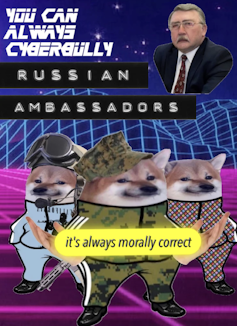
An image shows two dogs and says it's always morally correct to cyberbully Russian ambassadors.
A NAFO meme.
(NAFO)

One of the most prominent and high-profile online communities of pro-Ukrainian keyboard warriors is the North Atlantic Fella Organization (NAFO/OFAN). It’s an internet meme and social media movement dedicated to battling propaganda and disinformation about the 2022 Russian invasion of Ukraine. It floods the social media posts of Russian officials, propagandists and vatniks with memes.

NAFO “fellas” use avatars depicting Shiba Inu dogs in various dress and poses. It has grown to tens of thousands of fellas with no set leadership, but all guided by the catchphrase “see a fella, follow a fella.”

A black-and-white sketch of Putin in an outhouse.
A meme of Putin in an outhouse.
(Telegram)

Memes like those created and circulate by NAFO also serve to insult Russia, presenting the nation as an outhouse, the army as inept and the Russian soldier as “orcs,” a fictional race of brutal and aggressive humanoids famously depicted in J.R.R. Tolkien’s Middle Earth.

In one meme, a cloven-hooved, crowned Vladimir Putin rides an outhouse tank spewing filth. Above him, the Russian word paRasha is written, which means a prison outhouse seat and is also used to signify nonsense, or simply bullshit. The “Rasha” is capitalized, playing on the Russian pronunciation of the English word Russia.


Read more:
Why leaders who bullshit are more dangerous than those who lie


Latest memes

Ukraine-focused meme-making continues. Memes have emerged mocking U.S. President Donald Trump’s 28-point peace plan.

In one, there is a massive American flag and Trump in the background; the plan is presented as a 28-component Trojan horse for Ukraine.


Read more:
Peace in Ukraine? Believe it when you see it, especially if Russian demands are prioritized


Ukrainian aren’t just focused on Russia — they also challenge Ukrainian leaders and officials. In a recent meme, a pair of Ukrainian state operatives note: “And (Steve) Witkoff’s tapes are much more interesting than Mindich’s tapes…”

This is a double-barrelled jab. It refers to the 1,000-plus hours of secret recordings that were made during the explosive investigation of Ukrainian-Israeli entrepreneur Tymur Mindich’s alleged $100-million Ukrainian energy sector kick-backs, and revelations that Wirkoff, Trump’s envoy in peace talks, was advising Russian officials.

Ongoing Ukrainian memes are a testament to Ukraine’s continuing resistance to Russia, even when outsiders like Trump tell them they “have no cards” to play and that they should capitulate to Russia. They are a powerful force in contemporary Ukrainian nationalism.

Ukrainian scholar Daria Antsybor, a folklorist and anthropologist, co-authored this piece.

The Conversation

Michel Bouchard does not work for, consult, own shares in or receive funding from any company or organisation that would benefit from this article, and has disclosed no relevant affiliations beyond their academic appointment.

ref. Ctrl-alt-defy: How Ukrainians have used memes to counter Russia’s propaganda machine – https://theconversation.com/ctrl-alt-defy-how-ukrainians-have-used-memes-to-counter-russias-propaganda-machine-270767

Flat Earth, spirits and conspiracy theories – experience can shape even extraordinary beliefs

Source: The Conversation – USA – By Eli Elster, Doctoral Candidate in Evolutionary Anthropology, University of California, Davis

A belief in ghosts could be a way to explain a strange experience while asleep. ‘The Nightmare’ by Johann Heinrich Füssli/Wikimedia Commons

On Feb. 22, 2020, “Mad” Mike Hughes towed a homemade rocket to the Mojave Desert and launched himself into the sky. His goal? To view the flatness of the Earth from space. This was his third attempt, and tragically it was fatal. Hughes crashed shortly after takeoff and died.

Hughes’ nickname – Mad Mike – might strike you as apt. Is it not crazy to risk your life fighting for a theory that was disproven in ancient Greece?

But Hughes’ conviction, though striking, is not unique. Across all recorded cultures, people have held strong beliefs that seemed to lack evidence in their favor – one might refer to them as “extraordinary beliefs.”

For evolutionary anthropologists like me, the ubiquity of these kinds of beliefs is a puzzle. Human brains evolved to form accurate models of the world. Most of the time, we do a pretty good job. So why do people also often adopt and develop beliefs that lack strong supporting evidence?

In a new review in the journal Trends in Cognitive Sciences, I propose a simple answer. People come to believe in flat Earth, spirits and microchipped vaccines for the same reasons they come to believe in anything else. Their experiences lead them to think those beliefs are true.

Theories of extraordinary belief

Most social scientists have taken a different view on this subject. Supernatural beliefs, conspiracy theories and pseudoscience have struck researchers as totally impervious to contrary evidence. Consequently, they have assumed that experience is not relevant to the formation of those beliefs. Instead, they’ve focused on two other explanatory factors.

The first common explanation is cognitive biases. Many psychologists argue that humans possess mental shortcuts for reasoning about how the world works. For instance, people are quite prone to seeing intentions and intelligence behind random events. A bias of this kind might explain why people often believe that deities control phenomena such as weather or illness.

The second factor is social dynamics: People adopt certain beliefs not because they’re sure that they’re true but because other people hold those beliefs, or they want to signal something about themselves to others. For example, some conspiracy theorists may adopt strange beliefs because those beliefs come with a community of loyal and supportive co-believers.

Both of these approaches can partly explain how people come to hold extraordinary beliefs. But they discount three ways that experience, in tandem with the other two factors, can shape extraordinary beliefs.

vast grassy landscape with blue sky and white clouds
Science says one thing, but your eyes tell you the Earth looks pretty darn flat.
sharply_done/E+ via Getty Images

1. Experience as a filter

First, I propose that experience can act as a filter. It determines which extraordinary beliefs can successfully spread throughout a population.

Take the flat Earth theory as an example. We know with absolute certainty that it’s false, but it’s no more or less wrong than a theory that the Earth is shaped like a cone. So what makes flat Earth so much more successful than this equally incorrect alternative?

The answer is as obvious as it seems – the Earth looks flat when you’re standing on it, not cone-shaped. Visual evidence favors one extraordinary belief over the others. Of course, scientific evidence clearly shows that the Earth is round; but it’s not surprising that some people prefer to trust what their eyes are telling them.

2. Experience as a spark

My second argument is that experience acts as a spark for extraordinary beliefs. Strange experiences, such as auditory hallucinations, are difficult to explain and understand. So people do their best to explain them – and in doing so, they come up with beliefs that seem fittingly strange.

For this pathway, sleep paralysis is a good case study. Sleep paralysis happens in the space between sleeping and waking – you feel like you’re awake, but you can’t move or speak. It’s terrifying and quite common. And interestingly, sufferers usually feel like there’s a threatening agent sitting on their chest.

As a scientist, I interpret sleep paralysis as the result of neural confusion. But it’s not difficult to picture how someone without a scientific background – that is, nearly every human being in history – might interpret the experience as evidence of supernatural beings.

3. Experience as a tool

To me, the third potential route to extraordinary beliefs is especially intriguing. In many cases, people don’t just develop extraordinary beliefs; they develop immersive practices that make those beliefs feel true.

For instance, imagine that you’re a farmer living in the highlands of Lesotho in southern Africa, where I conduct ethnographic fieldwork. You suffer a series of miscarriages, and you want to know why. So you go to a traditional healer – she tells you that you can learn the answer from your ancestors by drinking a hallucinogenic brew. You drink the brew. Soon after, you begin to see spirits; they speak to you and explain your misfortune.

Shaman in colorful outfit and necklaces ladles from a clay pot
A shaman might administer a psychoactive substance that affects how you experience the world around you.
Luis Acosta/AFP via Getty Images

Clearly, an experience like this one might reinforce your belief in the existence of spirits. Such immersive practices – such as prayer, ritualistic dance and the religious use of psychoactive substances – create evidence that makes the associated beliefs feel true.

What’s next?

Extraordinary beliefs are not inherently good or bad. In particular, religious beliefs provide meaning, security and a sense of community for billions of people.

But some extraordinary beliefs are sources of serious concern: Misinformation about science and politics is rampant and immensely dangerous. By recognizing how those beliefs are shaped by experience, researchers can find better ways to combat their spread.

Just as importantly, though, my suggested perspective might encourage more compassion and kinship toward people who hold beliefs that seem very different from yours. They are not “mad” or insincere. Like any other human being, they think the evidence is on their side.

The Conversation

Eli Elster does not work for, consult, own shares in or receive funding from any company or organization that would benefit from this article, and has disclosed no relevant affiliations beyond their academic appointment.

ref. Flat Earth, spirits and conspiracy theories – experience can shape even extraordinary beliefs – https://theconversation.com/flat-earth-spirits-and-conspiracy-theories-experience-can-shape-even-extraordinary-beliefs-271145

Winter storms blanket the East, while the US West is wondering: Where’s the snow?

Source: The Conversation – USA (2) – By Adrienne Marshall, Assistant Professor of Geology and Geological Engineering, Colorado School of Mines

Much of the West has seen a slow start to the 2026 snow season. Hyoung Chang/The Denver Post

Ski season is here, but while the eastern half of the U.S. digs out from wintery storms, the western U.S. snow season has been off to a very slow start.

The snowpack was far below normal across most of the West on Dec. 1, 2025. Denver didn’t see its first measurable snowfall until Nov. 29 – more than a month past normal, and one of its latest first-snow dates on record.

But a late start isn’t necessarily reason to worry about the snow season ahead.

Adrienne Marshall, a hydrologist in Colorado who studies how snowfall is changing in the West, explains what forecasters are watching and how rising temperatures are affecting the future of the West’s beloved snow.

Weather map show precipitation outlook, with a strip across Colorado, Utah and up to Oregon in a band with equal chances of wetter or drier conditions.
The National Weather Service Climate Prediction Center’s seasonal outlook for January through March 2026 largely follows a typical La Niña pattern, with warmer and drier conditions to the south, and wetter and cooler conditions to the north.
NOAA

What are snow forecasters paying attention to right now?

It’s still early in the snow season, so there’s a lot of uncertainty in the forecasts. A late first snow doesn’t necessarily mean a low-snow year.

But there are some patterns that we know influence snowfall that forecasters are watching.

For example, the National Oceanic and Atmospheric Administration is forecasting La Niña conditions for this winter, possibly switching to neutral midway through. La Niña involves cooler-than-usual sea-surface temperatures in the Pacific Ocean along the equator west of South America. Cooler ocean temperatures in that region can influence weather patterns across the U.S., but so can several other factors.

La Niña – and its opposite, El Niño – don’t tell us what will happen for certain. Instead, they load the dice toward wetter or drier conditions, depending on where you are. La Niñas are generally associated with cooler, wetter conditions in the Pacific Northwest and a little bit warmer, drier conditions in the U.S. Southwest, but not always.

When we look at the consequences for snow, La Niña does tend to mean more snow in the Pacific Northwest and less in the Southwest, but, again, there’s a lot of variability.

A map show the snowpack in most of the West is more than 50% below normal.
Scientists often gauge snow conditions by snow-water equivalent, a measure of the amount of water stored in a snowpack. Most of the Western U.S. was far below normal on Nov. 30, 2025. Parts of the Southwest were above normal, but this early in the season, normal is very low to begin with in many of those areas.
USDA Natural Resources Conservation Service

Snow conditions also depend heavily on individual storms, and those are more random than the seasonal pattern indicated by La Niña.

If you look at NOAA’s seasonal outlook maps, most of Colorado and Utah are in the gap between the cooler and wetter pattern to the north and the warmer and drier pattern to the south expected during winter 2026. So, the outlook suggests roughly equal chances of more or less snow than normal and warmer or cooler weather across many major ski areas.

How is climate change affecting snowfall in the West?

In the West, snow measurements date back a century, so we can see some trends.

Starting in the 1920s, surveyors would go out into the mountains and measure the snowpack in March and April every year. Those records suggest snowfall has declined in most of the West. We also see evidence of more midwinter melting.

How much snow falls is driven by both temperature and precipitation, and temperature is warming

In the past few years, research has been able to directly attribute observed changes in the spring snowpack to human-caused climate change. Rising temperatures have led to decreases in snow, particularly in the Southwest. The effects of warming temperatures on overall precipitation are less clear, but the net effect in the western U.S. is a decrease in the spring snowpack.

When we look at climate change projections for the western U.S. in future years, we see with a high degree of confidence that we can expect less snow in warmer climates. In scenarios where the world produces more greenhouse gas emissions, that’s worse for snow seasons.

Should states be worried about water supplies?

This winter’s forecast isn’t extreme at this point, so the impact on the year’s water supplies is a pretty big question mark.

Snowpack – how much snow is on the ground in March or April – sums up the snowfall, minus the melt, for the year. The snowpack also affects water supplies for the rest of the year.

The West’s water infrastructure system was built assuming there would be a natural reservoir of snow in the mountains. California relies on the snowpack for about a third of its annual water supply.

However, rising temperatures are leading to earlier snowmelt in some areas. Evidence suggests that climate change is also expected to cause more rain-on-snow events at high elevations, which can cause very rapid snowmelt.

a man stands on a road that is flooded on both sides as far as the camera can see.  Trees are surrounded by flood water on one side.
When snow melts quickly, it can cause flooding. That happened in 2023 in California, when fast melting from a heavy snow season flooded wide areas of farmland and almond orchards covering what was once Tulare Lake.
Luis Sinco/Los Angeles Times via Getty Images

Both create challenges for water managers, who want to store as much snowmelt runoff as possible in reservoirs so it’s available through the summer, when states need it most for agriculture and for generating hydropower to meet high electricity demand. If the snow melts early, water resource managers face some tough decisions, because they also need to leave room in their reservoirs to manage flooding. Earlier snowmelt sometimes means they have to release stored water.

When we look at reservoir levels in the Colorado River basin, particularly the big reservoirs – Lake Powell and Lake Mead – we see a pattern of decline over time. They have had some very good snow and water years, and also particularly challenging ones, including a long-running drought. The long-term trends suggest an imbalance between supply and growing demand.

What else does snowfall affect, such as fire risk?

During low-snow years, the snowpack disappears sooner, and the soils dry out earlier in the year. That essentially leaves a longer summer dry period and more stress on trees.

There is evidence that we tend to have bigger fire seasons after low-snow winters. That can be because the forests are left with drier fuels, which sets the ecosystem up to burn. That’s obviously a major concern in the West.

Snow is also important to a lot of wildlife species that are adapted to it. One example is the wolverine, an endangered species that requires deep snow for denning over the winter.

What snow lessons should people take away from climate projections?

Overall, climate projections suggest our biggest snow years will be less snowy in anticipated warmer climates, and that very low snow years are expected to be more common.

But it’s important to remember that climate projections are based on scenarios of how much greenhouse gas might be emitted in the future – they are not predictions of the future. The world can still reduce its emissions to create a less risky scenario. In fact, while the most ambitious emissions reductions are looking less likely, the worst emissions scenarios are also less likely under current policies.

Understanding how choices can change climate projections can be empowering. Projections are saying: Here’s what we expect to happen if the world emits a lot of greenhouse gases, and here’s what we expect to happen if we emit fewer greenhouse gases based on recent trends.

The choices we make will affect our future snow seasons and the wider climate.

This article has been updated to correct the references to Denver, which saw one of its latest snowfalls on record.

The Conversation

Adrienne Marshall receives funding from the National Science Foundation, the National Oceanic and Atmospheric Administration, the United States Geological Survey, the Colorado Department of Transportation, and the Alfred P. Sloan Foundation, and has received previous funding from the Carnegie Institution of Washington.

ref. Winter storms blanket the East, while the US West is wondering: Where’s the snow? – https://theconversation.com/winter-storms-blanket-the-east-while-the-us-west-is-wondering-wheres-the-snow-270928