Becoming human in southern Africa: what ancient hunter-gatherer genomes reveal

Source: The Conversation – Africa (2) – By Marlize Lombard, Professor with Research Focus in Stone Age Archaeology, Palaeo-Research Institute, University of Johannesburg

New genetic research is shedding light on some of the earliest chapters of our human history. In one of the largest studies of its kind, scientists analysed DNA from 28 individuals who lived in southern Africa between 10,200 and a few hundred years ago. The study provides more evidence that hunter-gatherers from southern Africa were some of the earliest modern human groups, with a genetic ancestry tracing back to about 300,000 years ago. Marlize Lombard, an archaeologist whose research focuses on the development of the human mind, breaks down the key findings.

Why did you study the DNA of ancient hunter-gatherers in southern Africa?

According to the genetic, palaeo-anthropological and archaeological evidence, modern humans – Homo sapiens – originated in Africa hundreds of thousands of years ago and then spread around the world. But the evolutionary process of exactly how, where and when this happened is debated.

Africa has the greatest human genetic diversity and the hunter-gatherers of southern Africa represent some of the oldest known genetic lineages. They can therefore reveal more about where and when we originated as a species.

After thousands of years of migration, modern African populations have a mixed genetic heritage. So their genomes are not very helpful for understanding our deep evolutionary history. For that, we need to look at genetic variation among individuals living before large-scale population movements on the continent.

In southern Africa, it means going back to before about 1,400-2,000 years ago. It also means that such rare ancient hunter-gatherer DNA can provide valuable information, not available in the DNA of living people.

What we specifically wanted to learn from the ancient southern African DNA was to which extent the biological and behavioural patterns we observe in the fossil and archaeological records were continuous and particular to the region.

For example, at a South African fossil-bearing site called Florisbad, we have a human skull dating to about 260,000 years ago that shows a possible transition from Homo heidelbergensis into Homo sapiens. And from about 100,000 years ago there was a rapid increase in technological innovations such as paint-making, glue-making and long-range weapon use.

We sequenced the DNA of 28 ancient individuals from what is now South Africa, all dating to the Holocene epoch that started about 11,700 years ago. DNA sequencing “reads” the order of the chemical base-pairs that make up an individual’s DNA. This helps us to reconstruct a person’s genome, or their complete set of genetic information. Among other things, it can tell us something about the individual’s biological and behavioural characteristics.

Eight of the individuals used to live near the coast at Matjes River, in today’s Western Cape province. Several others lived at inland sites across South Africa. We dated their remains with radiocarbon dating, finding that the oldest died about 10,200 years ago at Matjes River and the most recent died just 280 years ago in the Free State. (All DNA from archaeological contexts is scientifically known as ancient DNA.)

What did the DNA reveal?

Our study shows that the genetic makeup of the southern African hunter-gatherer population didn’t change much for 9,000 years across the whole of South Africa, not only in the southern Cape, even though their technologies and lifeways may have changed or differed during this time.

All ancient southern Africans dated to more than 1,400 years ago had some unique Homo sapiens genetic variations. The ancient DNA had genes associated with UV-light protection, skin diseases, and skin pigmentation. These could have been essential to life on southern Africa’s grasslands and fynbos. Among the genetic variants that were common to ancient and modern humans were genes related to kidney function (potentially connected to improved water-retention) and immune-system related genes.

About 40% of the ancient southern African genes are associated with neurons, brain growth and the way that human brains process information today. Some of these gene variants may have been involved in the evolution of how humans pay attention today. Attention is a cognitive or mental trait that seems to have evolved differently in African Homo sapiens compared to the now extinct Neanderthals and Denisovans from Eurasia. It may have played a role in the successful spread of Homo sapiens out of Africa after about 60,000 years ago.

What does this tell us about human evolution and population migration?

Our work shows that some biological adaptations for becoming modern humans were unique to southern African hunter-gatherers who lived in a relatively large, stable population for many thousands of years south of the Limpopo River.

Co-author and geneticist from Uppsala University in Sweden, Carina Schlebusch, commented that

Because we now have more unadmixed ancient genomes from southern Africa, we are gaining better population-level insights, and a much clearer foundation for understanding how modern humans evolved across Africa.

Our findings contrast with linguistic, archaeological and some early genetic studies pointing to a shared ancestry or long-term interaction between different regions of Africa. Instead, it seems that southern Africa may have offered humans a climate and landscape refuge where hunter-gatherers thrived, adapting to a place rich in plant and animal resources for 200,000 years or more. During this time, we see no genetic evidence for incoming populations. Instead, sometime after about 100,000-70,000 years ago, small groups of southern African hunter-gatherers may have wandered northwards, carrying with them some of their genetic and technological characteristics.

According to population geneticist Mattias Jakobsson at Uppsala University,

these ancient genomes tell us that southern Africa played a key role in the human journey, perhaps ‘the’ key role.

Up to now, humans seemed to have developed their modern anatomical (physical) form before they developed modern behaviour and thinking. Learning more about ancient genes could help to close this gap, especially once more becomes known from genetic studies of other ancient African forager groups, and indigenous peoples elsewhere on the globe.

The Conversation

Marlize Lombard works for the University of Johannesburg. She received funding from the National Research Foundation of South Africa.

ref. Becoming human in southern Africa: what ancient hunter-gatherer genomes reveal – https://theconversation.com/becoming-human-in-southern-africa-what-ancient-hunter-gatherer-genomes-reveal-270378

How the internet became enshittified – and how we might be able to deshittify it

Source: The Conversation – Global Perspectives – By Charles Barbour, Associate Professor, Philosophy, Western Sydney University

Annie PM/Unsplash

Remember when Twitter used to be good? I reckon it peaked somewhere around the first COVID lockdowns.

In those days, there was a running gag on the site where everyone would refer to it as a “hellscape”. And it did invite some of the worst that humanity has to offer. Opinions, as the old joke goes, are like assholes: everybody has one.

But if you curated your Twitter feed effectively, you could have immediate scrolling access to the best journalism and cultural commentary, excellent podcasts and comedians, film criticism and book reviews, the latest trends in food, music or clothing, decent information about public health, live stream feeds of smart people on the ground at the most pressing events of the day, not to mention the wisecracks and insights of your friends.

It was like being perpetually part of an in-crowd. The promise of a world where potentially anyone could feel connected, in touch, popular.


Review: Enshittification: Why Everything Suddenly Got Worse and What to Do About It – Cory Doctorow (Verso)


Then came the rumours that the increasingly fascist-curious Elon Musk was scheming to buy the platform. Not possible, we thought at first. It would be a terrible business decision. And anyone interesting or important would flee overnight.

Then Musk did buy Twitter, horribly rebranding it as X. Then we speculated (or hoped) it would drive him bankrupt. Then it didn’t. Then, through deliberate and explicit effort, it went to shit.

Musk decided he would raise money by selling the coveted blue-checks, a form of authentication previously reserved for those who had developed their influence organically. He changed the algorithm to reflect his own views and fired moderators tasked with weeding out misinformation and hate speech. As a result, the platform formerly known as Twitter was soon full of ads, gore, porn, toxicity, AI slop and scams of all variety.

Yet, as if trapped by their established followings or perhaps some contagious fear of missing out, people stayed. Calls to migrate en masse to other liberal-coded platforms largely failed.

For some reason, this logic seems to be taking over all social media, even the internet itself. Facebook, Instagram, TikTok, Amazon, Google, Apple, Uber, Spotify: everything turns to shit. And no one is able to escape.

To paraphrase a song about another way we get trapped by misplaced desires: welcome to the Hotel Crapifornia. You can check in any time you like, but you can never leave.

An inhuman nightmare

In 2022, Canadian journalist, novelist and activist Cory Doctorow coined the term “enshittification” to describe the degeneration of the internet.

Back when the internet was good, in the late 1990s and early 2000s, Doctorow was every hipster’s hero. His blog Boing Boing was required reading for anyone interested in emerging technologies. If you wanted to be recognised as cool, you entered the coffee shop conspicuously carrying a copy of his latest book. It seemed that no one knew more about where technology had come from, and where it was likely to go. He was our prophet.

His 2003 novel Down and Out in the Magic Kingdom, for example, was a dystopian story of a post-scarcity world where monetary currency had been replaced with what Doctorow called “whuffie” – essentially a measure of how much others respect you.

This was just before social media stormed into all our lives, with its vertiginous economy of likes and followers, attention and influence.

All these years later, Doctorow’s Enshittification: Why Everything Suddenly Got Worse and What to Do About It is an attempt to explain how the great dream of the internet – its powerful democratising potential, its incredible capacity to generate human communities and circulate human knowledge – turned into an inhuman nightmare.

We were offered a world of connection and cooperation – an open-source paradise of instant and free access, liberated from the fetters of both corporate ownership and state control.

What we got was a world of ruthless monopolies and oligarchs who control a colossal surveillance apparatus capable of tracking our most private behaviours, producing a population of powerless, compliant consumers – people who have no choice but to keep using their abysmally bad products, because there is nowhere else to go.

Prisoners of our own devices

“Enshittification” is not just a clever term for the grumpy complaint of an ageing Gen-X tech-head. Doctorow wants to develop it as a formal concept that explains the process by which internet platforms, applications and innovations go from being loved by their users to being despised.

Beginning with the case studies of Facebook, Amazon and the iPhone, then expanding out to more or less every platform on the internet, Doctorow proposes that enshittification has three basic stages.

First, platforms are good to their users. People genuinely want to participate. A community develops, but not much profit is made.

Second, in an effort to monetise this new community, platforms are good to companies. They offer them access to markets through advertising or shipping or proprietary arrangements.

Finally, they find a way to screw over those business customers as well as their users to claw all excess value back for themselves.

That is how we arrived at what Doctorow calls “a giant pile of shit”.

Amazon is the easiest example to explain. It started by providing a service that people wanted: fast cheap delivery of products. It then attracted business customers by providing a means to increase profit and market share.

But then, like a medieval warlord, it crushed all competition and used its market dominance to compel tributes from its business customers, in the form of fees that absorbed and exceeded whatever extra profit they may have made in the first place.

At this point, Amazon has absolutely no reason to improve its service. In fact, in order to siphon off even more value by cutting costs, it has every reason to make its service worse.

For Doctorow, the problem is not that some or many internet platforms follow this kind of enshittifying procedure; it is that almost all of them do. And given the ubiquity of the internet in our daily lives, particularly with the advent of the smartphone, our entire world has become enshittified.

We are now in what Doctorow calls the “enshittoscene”. To return to the musical reference mentioned above: we are all just prisoners here, of our own devices.

Cory Doctorow coined the term ‘enshittification’ in 2022.
Internet Archive, Public domain, via Wikimedia Commons

Make the internet good again

As Doctorow notes, it is easy to predict how the tiny handful of ghouls who benefit from this situation are likely to respond. Well, they are going to say, it might not be great, but that’s capitalism. And as everyone knows, capitalism is the worst system, except for all the others.

But Doctorow refuses to accept the familiar neoliberal logic of “there is no alternative”, because members of his generation (which also happens to be mine) know this is a sham. We know there is an alternative, because we have seen it with our own eyes. The internet was not always shit. It used to be good. And it could be good again.

Doctorow’s proposals for recreating a good internet – one that combines the autonomy and choice of the old internet with the mass scale of the current shit internet – are fourfold: competition, regulation, interoperability and tech-worker power.

In the first instance, Doctorow insists that the internet today is not capitalist at all. Following the economist Yanis Varoufakis, he calls it “technofeudalist”. Like medieval landlords, the tech overlords don’t make money in the enshittoscene by creating or circulating new products. They make it by owning the platforms for the creation or circulation of products and compelling everyone else to rent space on those platforms.

Smashing these rentier monopolies and opening spaces for healthy competition is step one. But doing so will require robust antitrust regulations, which can break the near-monopolies enjoyed by tech companies like Google and prevent anti-competitive corporate mergers. Avenues for enshittification must be shut down by law and this must be coordinated at an international level.

These laws must guarantee the interoperability of all technological systems. Currently, one of the most expensive fluids on planet earth is HP printer ink. HP sets the price unilaterally, because they construct their printers so that no other ink cartridges will work.

In the enshittoscene, the principle of anti-interoperability spreads across nearly all platforms and products. But regulation could ensure that all technological operating systems are compatible with one another, just as regulation ensures that household electronic devices are compatible with uniform powerpoints.

Finally, and most importantly, the people who work in tech industries can be empowered to realise the ethos of collaboration and innovation that, by and large, they share. For the truth is, Doctorow suggests, that most of the people who actually do the work in the enshittoscene – those who build and manage the platforms – hate it as much as the users do. And empowering them would go a long way towards empowering all of us.

The Conversation

Charles Barbour does not work for, consult, own shares in or receive funding from any company or organisation that would benefit from this article, and has disclosed no relevant affiliations beyond their academic appointment.

ref. How the internet became enshittified – and how we might be able to deshittify it – https://theconversation.com/how-the-internet-became-enshittified-and-how-we-might-be-able-to-deshittify-it-269376

Struggling to believe Stranger Things’ Jim Hopper as the ‘good guy’? You’re not alone

Source: The Conversation – Global Perspectives – By David Marshall, Emeritus Professor, New Media, Communication and Cultural Studies, Deakin University

Netflix

The first half of Stranger Things’ (2016–) final season has received almost 60 million views in five days – making it Netflix’s largest ever English language debut. But the reception has been marred by controversies surrounding actor David Harbour, who plays Jim Hopper, an ex-police chief in the fictional town of Hawkins, Indiana.

Harbour has been the subject of pop culture news for several weeks now, following the release of ex-partner Lily Allen’s new album. The pair separated in December, 2024, after four years together.

A little over a month ago, Allen released West End Girl – her first full-length album in seven years. It’s a blistering critique of her former partner, and accuses him of cheating during their marriage.

It has been lapped up by critics and – although Harbour has yet to directly address the claims – has clearly left an impression on the public.

Online, Stranger Things viewers have pointed out they can no longer view Hopper – one of the “good guys” on the show – the way they did before Allen’s accusations surfaced.

The line between public and private

The public’s reaction to the couple’s highly-publicised separation is an interesting case study into how social media platforms now shape celebrity culture.

Both Allen and Harbour are successful in their respective fields and have large online followings. They are connected to fans who appreciate their work – many of whom are invested in their personal lives.

And while such parasocial relationships between stars and fans have existed since the dawn of Hollywood, social media platforms are reconstructing what can be defined as “public” and “publicity” – as well as the counterpoints of “private” and “privacy”.

Today’s platforms use algorithms to amplify subtle behaviours, interactions and personal qualities in celebrities that may have once flown under the radar. Putting the magnifying glass on stars in this way helps us feel “closer” to them – further blurring the line between the person and their onscreen personas.

And this inability to separate both explains why numerous stars through the decades have opted to keep certain aspects of their identity (such as their sexuality) hidden.

A screenshot of two comments made under an Instagram post promoting Lilly Allen's new album.
Two top-rated comments made under an Instagram post promoting Allen’s new album.
Instagram

A social media golden girl

Allen has used Instagram (where she has about two million followers) and TikTok (420,000 followers) to get word of her new album out. It’s clear from her promotional material – and her history with social media – that she knows how to leverage an online audience.

Allen was already a hit on MySpace back in 2006. She had tens of thousands of “friends” on the then-ubiquitous platform, and sold about four million copies of her album Alright, Still (2006) in the first week of its release.

Harbour also has a huge online presence, including some 8.4 million Instagram followers. Interestingly, though, he has been relatively silent about the breakdown of his marriage.

He is now also the subject of headlines focused on allegations, first published in a Daily Mail report, that Stranger Things co-star Millie Bobby Brown filed a bullying and harassment complaint against him before filming began in 2024.

In the recent press tour, Brown told outlets she “felt safe” and has a “great relationship” with Harbour. Still, the initial Daily Mail report seems to have taken root in coverage surrounding the tour.

A new age of celebrity

Stardom has been transformed in the era of social media.

One question now is figuring out the extent to which scandals that are amplified by social media actually impact celebrities’ careers, and how this compares to coverage in the pre-social media age. If fans start to see Harbour as a “bad guy” because of the press and social media chatter, will this affect the quantity or types of roles he gets in the future?

And is it acceptable for social media platforms and influential users to have such outsized power in driving pop culture narratives?

On one hand, fans arguably deserve to know the character of the artists they choose to support. On the other, it’s concerning to think tabloids such as the Daily Mail could potentially derail someone’s career using unverified reports and unnamed sources.

The Conversation

David Marshall is an emeritus professor at Deakin University. He is also an honorary professor at the University of Nottingham – Ningbo China and Co-chair of the Power of Prestige (PoP) research conference. In addition, he is one of the founders/editors of the journal Persona Studies and M/C Journal: Media and Culture.

ref. Struggling to believe Stranger Things’ Jim Hopper as the ‘good guy’? You’re not alone – https://theconversation.com/struggling-to-believe-stranger-things-jim-hopper-as-the-good-guy-youre-not-alone-270951

Myanmar’s military will no doubt win this month’s sham elections. But could a shake-up follow?

Source: The Conversation – Global Perspectives – By Nicholas Coppel, Honorary Fellow, The University of Melbourne

Myanmar’s military regime has announced elections will be held in three phases, starting on December 28 and concluding in January.

Two outcomes are certain: first, the military-aligned party will be recorded as winning and, second, the government in exile – the National Unity Government – will fade even further into the background.

In the close to five years since the military seized power in February 2021, the country has been engulfed in a civil war, with the military pitted against People’s Defence Forces and numerous ethnic armed organisations. Thousands of resistance protestors, fighters and politicians, including President Win Myint and the ever-popular leader Aung San Suu Kyi, remain imprisoned.

The military controls the levers of government and holds all the major population centres. But its brutal air, artillery and drone attacks have failed to crush the resistance. The resistance has captured large swathes of territory, restricting the upcoming elections to only 274 of the nation’s 330 townships (constituencies).

Inside and outside the country, the elections are seen as a sham. The military-stacked Union Election Commission has deregistered political parties for failing to meet criteria it has set, such as having a certain number of party members or offices. It has also dissolved Aung San Suu Kyi’s National League for Democracy party.

The elections will be held in the context of a state-controlled media landscape in which criticism of them is prohibited under the newly-minted Law on the Prevention of Disruption and Sabotage of Multi-Party Democratic General Elections.

Citizens criticising the election on social media have been sentenced for up to seven years in prison with hard labour. For some offences, the death penalty applies.

The elections are an attempt to gain the legitimacy, at home and abroad, that currently eludes the military regime. They are designed to demonstrate authority and give an impression of effective control. By simulating compliance with international democratic norms, the regime hopes to promote a sense of normalcy, consolidate power and open the door to greater international engagement, all the while preserving the status quo.

The National Unity Government living in exile and a myriad of its international supporters are calling on the international community to not send election observers. Instead, they want the world to denounce the sham election.

ASEAN leaders are insisting that a cessation of violence and inclusive political dialogue precede elections. They have rebuffed an invitation to send observers.

The best the regime could hope for is that some individual ASEAN member states join Russia and Belarus in sending observers. However Thailand, the most ambivalent ASEAN member, which has argued the election should serve as a foundation for a sustainable peace process, is now saying it will be difficult for ASEAN re-engage with Myanmar. China is believed to be supportive of elections, but has not committed publicly to sending observers.

Continued Western ostracism won’t matter to the junta, for whom regional legitimacy is more important than either domestic or Western legitimacy.

Neighbouring countries are concerned about peace and stability on their borders, high levels of irregular migration, the impact of unregulated mining that pollutes rivers flowing through their countries, the flourishing production and trade in heroin and methamphetamine, and the proliferation of cyber scam centres enslaving and defrauding their citizens.

Citizens of these countries demand their governments address these issues, and the elections will make contact with the regime more defensible. It won’t be a case, as it was before, of competing views on whether engagement or isolation is the better way to bring about reform in Myanmar.

This time, there will be no delusions about reform. Rather, neighbours will be concerned with their national interest agenda, and will ride out any accusations of appeasement and complicity in atrocity crimes. After all, authoritarian elections and dealing with authoritarian regimes is not unusual in Southeast Asia.

It would be a mistake to see the elections in 2025–26 as a re-run of the 2010 elections. Those elections were held under the 2008 constitution, which ushered in a reformist government led by a former general.

The elections will not be a transition to civilian or parliamentary rule. Nor will they be an exit ramp for coup leader Commander-in-Chief Min Aung Hlaing. To ensure his own safety, he will want to remain in a role where the apparatus of the state will protect, not prosecute, him.

The elections will be a sham, but they will usher in changes to the military line-up. The current commander will no doubt become president and choose a compliant military officer as his replacement as commander-in-chief. The parliament will be dominated by the military and military-aligned parties.

In the immediate aftermath of the election, it will be hard to see any change in the fear and violence that are the tools of choice for regime survival.

However, under Myanmar’s tattered constitution, the military commander is not answerable to any civilian authority, even the president. Min Aung Hlaing’s replacement might at some point become his own man and favour a negotiated end to the conflict.

That is, the elections open the possibility of some diffusion of power. Although this seems unlikely now, it may be better to have this (albeit remote) possibility rather than no election and a continuation of the status quo – a brutal military dictatorship and relentless war of attrition.

The National Unity Government in exile needs to engage with the reality that elections will be held, bringing the junta greater regional engagement, rather than wishing for some imagined day of meaningful international support. Otherwise, it could fade even further into the background.

The Conversation

Nicholas Coppel is affiliated with the Australia Myanmar Institute, a not-for-profit group, and is a former Australian ambassador to Myanmar.

ref. Myanmar’s military will no doubt win this month’s sham elections. But could a shake-up follow? – https://theconversation.com/myanmars-military-will-no-doubt-win-this-months-sham-elections-but-could-a-shake-up-follow-269793

Governments need to prepare for more frequent large floods

Source: The Conversation – Canada – By Samadhee Kaluarachchi, PhD Student in Forest Hydrology, University of British Columbia

Flood management is a priority for many governments around the world. Recent floods have led to hundreds of deaths and caused significant damage in Indonesia, Sri Lanka, Thailand, Vietnam, Albania, Kenya and elsewhere.

Canada too is no stranger to floods. Notably, in 2021, flooding in British Columbia cut off access to Metro Vancouver from the rest of the country and caused up to $14 billion in damages.

While many scientific and technical reports show that floods are becoming larger and more common, these reports may be underestimating how their frequency is changing. Flood sizes get the spotlight, however governments and experts need to also consider their frequency to address implications overlooked by traditional management methods.

Frequency and size together must tell the story, because even modest increases in size can lead to surprisingly big jumps in frequency. For example, timber harvesting in the B.C. Interior has led to a 19 to 26 per cent increase in flood size, and turned the former 100-year flood into a once-a-decade flood. Despite floods becoming more frequent, today’s practices still dominantly focus on flood size.

The consequences are severe. We can build infrastructure like dikes and dams bigger so they withstand larger once-in-a-century floods. But if we don’t capture how floods of all sizes (including the 100- and 200-year events) are becoming way more common, infrastructure can weaken and fail faster than we expect.

In our recently published study, we examined a range of scientific, technical and governmental documents to assess whether practices today help us reliably predict flood risks. We found that many of the factors contributing to the severity of a flood could respond much more strongly to climate and landscape changes than traditional methods imply, calling for change in our flood prediction practices.

We’re underestimating flood risk

tractors and diggers clear debris following a flood
Restoration work underway following November 2021 flooding damage at Tank Hill on Highway 1 in B.C.
(B.C. Ministry of Transportation and Transit/flickr), CC BY-NC-ND

Nature’s flood “ingredients” include rainfall, snow, soil wetness and energy for snowmelt, which combine in many “recipes” to trigger floods. Human influences like climate change, land use and land cover changes can alter these recipes, making floods bigger and more common. Understanding how human activity causes these effects on floods means predicting flood frequency and size together.

However, short flood records make it difficult to estimate the frequency and size of large floods. Without overcoming this challenge, assessments can produce unreliable results.

Additionally, many studies lump distant flood records with more recent records, suggesting that floods today have similar odds as those decades ago. Yet, experts agree that changes in the climate and landscape alter floods more strongly today.

These practices together produced a widespread perception in risk assessments where flood sizes rise rapidly, or steeply, per change in frequency (called a “heavier tail”).

Our recently published study challenges that perception, which implies that human influence shouldn’t greatly alter floods. In many places, human activities are making large floods more common. By giving little attention to how our activities affect flood frequencies, our practices don’t seem to capture just how sensitive floods are and how much they’re changing.

Without adapting our practices, we risk the loss of lives and livelihoods, misallocating funds, economic losses and lawsuits against governments, municipalities and professionals. Reliable flood projection and management is vital.

Considering flood frequency

To make reliable flood projections, we first need to identify a region’s natural flood frequencies and sizes, and which climate and landscape features drive them. With this solid baseline, we can determine how human activities shift flood frequencies and sizes, if floods are sensitive to human influence and what this means for society.

We can do this by predicting how different human activities affect floods through modelling or landscape experiments. We can work with flood records, using methods that recognize how current and future floods are far more affected by human activities than past floods.

We can use existing techniques to overcome challenges with short records and ensure that our estimates reflect a strong understanding of the natural and human drivers of flood frequencies and sizes.

By adopting stronger practices, our study predicts that many regions could see very different frequency-size relations: flood sizes could increase more slowly per change in frequency.

It signals a more “fragile,” or super sensitive, flood regime than what current methods imply. When we disturb the climate or landscape, large floods can react strongly; they become much more common, reflecting what we see in many places today.

This knowledge can help governments effectively manage the land while mitigating major jumps in flood frequency.

The way forward

Muddy floodwaters submerge a highway
Floodwaters wash away part of Highway 8 in B.C. in November 2021.
(B.C. Ministry of Transportation and Transit/flickr), CC BY-NC-ND

Effective flood management must include strong policies, nature-based solutions, and infrastructure designed for size and strength to withstand both larger and more frequent floods.

Nature-based solutions such as green areas, permeable surfaces and water-retaining features are being adopted by governments worldwide. Studies suggest that measures like increased forest cover have little impact on large floods; however, this may reflect the focus on flood size. Natural landscapes like forests can greatly reduce flood frequencies, even for very large floods.

In B.C., landscape features like mountains, forests, lakes, wetlands and floodplains spread out floods, lowering their peaks and making large events rarer. However, these same features make floods react strongly to changes in the climate and landscape.

Flood risk management must work with nature, maintaining or increasing the landscapes’ ability to store floodwaters. Our policies must address flood risk at the source through effective land management, recognizing that key causes of urban floods could lie thousands of kilometres away in the distant uplands. With strong policies and interventions both upstream and downstream, we can proactively manage floods.

The Conversation

Samadhee Kaluarachchi receives funding from the Natural Sciences and Engineering Research Council of Canada, the Faculty of Forestry at the University of British Columbia, the Gordon and Nora Bailey Fellowship in Sustainable Forestry, and the Mary and David Macaree Fellowship.

Younes Alila receives funding from Mitacs Canada and the Natural Sciences and Engineering Research Council of Canada.

ref. Governments need to prepare for more frequent large floods – https://theconversation.com/governments-need-to-prepare-for-more-frequent-large-floods-269251

Wicked: For Good – what lies beneath correcting the way people speak?

Source: The Conversation – UK – By Emma Humphries, Research Fellow, School of Arts, English and Languages, Queen’s University Belfast

“Pink goes good with green.” This is a lesson we learned from Glinda (Ariana Grande) in Wicked part one. But do you remember the line that comes after that?
“Goes well with green.”

A small, easily missed comment from the green-skinned outsider Elphaba (Cynthia Erivo), but one that reveals something important about language and common usage. Hierarchies of “correct” and “incorrect” language are not just found in grammar books and classrooms, but in popular culture too.

From “holding space” to “sex cardigans”, Wicked continues to dominate popular culture, but one thing that has been overlooked is Elphaba’s insistence on correct language.

In the first film, we see Elphaba ostracised and eventually positioned as public enemy number one by the Oz propaganda machine. From the film’s very opening, a flashforward to citizens celebrating Elphaba’s death, her unpopularity is made clear in the song No One Mourns The Wicked.

One way in which the filmmakers signal Elphaba’s unlikeability is through her often awkward, borderline rude social encounters, including when she first meets her frenemy, Glinda. It’s safe to say that the two characters don’t hit it off and Elphaba’s correction seems to upset Glinda.

Glinda: I could care less what others think.

Elphaba: Couldn’t.

Glinda: What?

Elphaba: You couldn’t care less what other people think. Though, I … I doubt that.

In the land of Oz, where people “pronuncify” and “rejocify”, are “disgusticified” and “moodified”, Elphaba’s comments demonstrate the idea that there is only one correct way to use language and that incorrect language should be corrected.

From stage to cinema

Elphaba’s corrections are not in the original stage musical. They were added to the film. The adaptation of a stage show for film offers an opportunity to modernise and change parts of the story that have been controversial or become outdated.

One excellent example of this in Wicked is its improvement of the stage show’s depiction of disability. The addition of language policing, however, is more disappointing. Because when we correct someone’s language, it’s about much more than the words themselves.

Correcting language is not neutral. When we place value on using language correctly, those who fall short often find themselves judged and discriminated against.

The policing of correct language can be seen as a gatekeeping tool, deciding who belongs and who is excluded. This has inevitable consequences for diversity. The way we speak, write and sign can reflect many aspects of our identities: where and how we grew up, our gender, age and race.

Rules and rebellion

With the run time of the films almost doubling that of the stage show, there is much more time devoted to character development in the films. Elphaba’s language pedantry has been added to demonstrate how she can rub people up the wrong way. However, it also suggests an adherence to authority and to socially constructed rules that stands in contrast to her character more broadly.

Elphaba is an outsider who starts the film wanting to be “degreenified”, but by the end of Wicked part one and as a main storyline in Wicked: For Good, she is willing to sacrifice her safety and reputation to do what is morally right, rather than what is socially acceptable.

Adherence to the strict rules of correct language suggests the opposite: a tendency to want to be accepted and to uphold the societal status quo. Elphaba resists social norms in every other respect, yet the film makes her a standard grammar enforcer.

Given that this trait is absent from part two, rather than undermining her personality as a resister, perhaps this further signals Elphaba’s journey from wishing to fit in to fully embracing her outsider status. Indeed, Elphaba’s insistence on correctness speaks to a broader challenge facing anyone positioned as an outsider: having to work that much harder to be accepted.

Glinda’s (famous) need to be popular and her interests in social climbing align with traits of a language enforcer, yet her behaviour tells a different story. She corrects language only once and it concerns her original name, Galinda. When Dr Dillamond, a professor at Shiz University – who also happens to be a goat – struggles to pronounce the “gah” in Galinda, Glinda corrects his pronunciation and berates him.

This moment, present in both the stage musical and the film, does not reflect a desire to uphold the prescriptive rules of the language, but rather a personal motivation. Glinda’s name is central to her self-image and public persona, and protecting that matters to her.

Beyond Oz

In an era when equality, diversity and inclusion initiatives are being rolled back, and languages other than English face renewed marginalisation, Wicked offers a case study in how linguistic hierarchies operate under the radar of popular culture. But there are plenty other examples. Think about Ross in Friends, Ted in How I Met Your Mother and Sheldon in The Big Bang Theory – all notorious language correctors.

Elphaba’s corrections are more than just a shorthand to signal an abrasive character. They reflect the linguistic hierarchies and gatekeeping that exist beyond Oz. Using language “correctly” is a marker of belonging and shows adherence to societal norms.

Across the two films, Elphaba moves from wanting to conform and erase a stigmatised part of her identity, her skin colour, towards rebellion against convention. It’s clear she questions blind adherence to political power, but perhaps this extends further to questioning the rules we construct around language.


Looking for something good? Cut through the noise with a carefully curated selection of the latest releases, live events and exhibitions, straight to your inbox every fortnight, on Fridays. Sign up here.


The Conversation

Emma Humphries receives funding from The Leverhulme Trust and is currently employed by Queen’s University Belfast.

ref. Wicked: For Good – what lies beneath correcting the way people speak? – https://theconversation.com/wicked-for-good-what-lies-beneath-correcting-the-way-people-speak-270639

FDA claims on COVID-19 vaccine safety are unsupported by reliable data – and could severely hinder vaccine access

Source: The Conversation – USA (3) – By Frank Han, Assistant Professor of Pediatric Cardiology, University of Illinois Chicago

The FDA has provided no evidence that children died because of receiving a COVID-19 vaccine. Anchiy/E+ via Getty Images

The Food and Drug Administration is seeking to drastically change procedures for testing vaccine safety and approving vaccines, based on unproven claims that mRNA-based COVID-19 vaccines caused the death of at least 10 children.

The agency detailed its plans in a memo released to staff on Nov. 28, 2025, which was obtained by several news outlets and published by The Washington Post.

Citing an internal, unpublished review, the memo, written by the agency’s top vaccine regulator, Vinay Prasad, attributes the children’s deaths to myocarditis, an inflammation of the heart muscle. And it says the deaths were reported to the Vaccine Adverse Event Reporting System, or VAERS, but provides no evidence that the vaccines caused the deaths.

The death of children due to an unsafe vaccine is a serious allegation. I am a pediatric cardiologist who has studied the link between COVID-19 vaccines and heart-related side effects such as myocarditis in children. To my knowledge, studies to date have shown such side effects are rare, and severe outcomes even more so. However, I am open to new evidence that could change my mind.

But without sufficient justification and solid evidence, restricting access to an approved vaccine and changing well-established procedures for testing vaccines would carry serious consequences. These moves would limit access for patients, create roadblocks for companies and worsen distrust in vaccines and public health.

In my view, it’s important for people reading about these FDA actions to understand how the evidence on a vaccine’s safety is generally assessed.

Determining cause of death

The FDA memo claims that the deaths of these children were directly related to receiving a COVID-19 immunization.

From my perspective as a clinician, it is awful that any child should die from a routine vaccination.

However, health professionals like me owe it to the public to uphold the highest possible standards in investigating why these deaths occurred. If the FDA has evidence demonstrating something that national health agencies worldwide have missed – widespread child deaths due to myocarditis caused by the COVID-19 vaccine – I don’t doubt that even the most pro-vaccine physician will listen. So far, however, no such evidence has been presented.

While a death logged in VAERS is a starting point, on its own it is insufficient to conclude whether a vaccine caused the death or other medical causes were to blame.

To demonstrate a causal link, FDA staff and physicians must align the VAERS report with physicians’ assessments of the patient, as well as data from other sources for monitoring vaccine safety. These include PRISM, which logs insurance claims data, and the Vaccine Safety Datalink, which tracks safety signals in electronic medical records.

It’s known that most deaths logged only in VAERS of children who recently received vaccines have been incorrectly attributed to the vaccines – either by accident or in some cases on purpose by anti-vaccine activists.

Heart-related side effects of COVID-19 vaccines

In his Substack and Twitter accounts, Prasad has said that he believes the rate of severe cardiac side effects after COVID-19 vaccination is severely underestimated and that the vaccines should be restricted far more than they currently are.

In a July 2025 presentation, Prasad quoted a risk of 27 cases per million of myocarditis in young men who received the COVID-19 vaccine. A 2024 review suggested that number was a bit lower – about 20 cases out of 1 million people. But that same study found that unvaccinated people had greater risk of heart problems after a COVID-19 infection than vaccinated people. In a different study, people who got myocarditis after a COVID-19 vaccination developed fewer complications than people who got myocarditis after a COVID-19 infection.

Existing vaccine safety infrastructure in the U.S. successfully identifies dangers posed by vaccines – and did so during the COVID-19 pandemic. Today, most COVID-19 vaccines in the U.S. rely on mRNA technology. But as vaccines were first emerging during the COVID-19 pandemic, two pharmaceutical companies, Janssen and AstraZeneca, rolled out a vaccine that used a different technology, called a viral vector. This type of vaccine had a very rare but genuine safety problem that was detected.

A report in VAERS is at most a first step to determining whether a vaccine caused harm.

VAERS, the Vaccine Safety Datalink, clinical investigators in the U.S. and their European counterparts detected that these vaccines did turn out to cause blood clotting. In April 2021, the FDA formally recommended pausing their use, and they were later pulled from the market.

Death due to myocarditis from COVID-19 vaccination is exceedingly rare. Demonstrating that it occurred requires proof that the person had myocarditis, evidence that no other reasonable cause of death was present, and the absence of any additional cause of myocarditis. These factors cannot be determined from VAERS data, however – and to date, the FDA has presented no other relevant data.

A problematic vision for future vaccine approvals

Currently, vaccines are tested both by seeing how well they prevent disease and by how well they generate antibodies, which are the molecules that help your body fight viruses and bacteria.

Some vaccines, such as the COVID-19 vaccine and the influenza vaccine, need to be updated based on new strains. The FDA generally approves these updates based on how well the new versions generate antibodies. Since the previous generation of vaccines was already shown to prevent infection, if the new version can generate antibodies like the previous one, researchers assume its ability to prevent infection is comparable too. Later studies can then test how well the vaccines prevent severe disease and hospitalization.

The FDA memo says this approach is insufficient and instead argues for replacing such studies with many more placebo-controlled trials – not just for COVID-19 vaccines but also for widely used influenza and pneumonia vaccines.

That may seem reasonable theoretically. In practice, however, it is not realistic.

Today’s influenza vaccines must be changed every season to reflect mutations to the virus. If the FDA were to require new placebo-controlled trials every year, the vaccine being tested would become obsolete by the time it is approved. This would be a massive waste of time and resources.

A pharmacy with a sign advertising flu shots
Influenza vaccines must be updated for every flu season.
Jacob Wackerhausen/iStock via Getty Images Plus

Also, detecting vaccine-related myocarditis at the low rate at which it occurs would have required clinical trials many times larger than the ones that were done to approve COVID-19 mRNA vaccines. This would have cost at least millions of dollars more, and the delay in rolling out vaccines would have also cost lives.

Placebo-controlled trials would require comparing people who receive the updated vaccine with people who remain unvaccinated. When an older version of the vaccine is already available, this means purposefully asking people to forgo that vaccine and risk infection for the sake of the trial, a practice that is widely considered unethical. Current scientific practice is that only a brand-new vaccine may be compared against placebo.

While suspected vaccine deaths should absolutely be investigated, stopping a vaccine for insufficient reasons can lead to a significant drop in public confidence. That’s why it’s essential to thoroughly and transparently investigate any claims that a vaccine causes harm.

Vaccine vs illness

To accurately gauge a vaccine’s risks, it is also crucial to compare its side effects with the effects of the illness it prevents.

For COVID-19, data consistently shows that the disease is clearly more dangerous. From Aug. 1, 2021, to July 31, 2022, more than 800 children in the U.S. died due to COVID-19, but very few deaths from COVID-19 vaccines in children have been been verified worldwide. What’s more, the disease causes many more heart-related side effects than the vaccine does.

Meanwhile, extensive evidence shows that COVID-19 vaccination reduces the risk of hospitalization by more than 70% and the risk of severe illness in adolescent children by 79%. Studies also show it dramatically reduces their risk of developing long COVID, a condition in which symptoms such as extreme fatigue or weakness persist more than three months after a COVID-19 infection.

Reporting only the vaccines’ risks, and not their benefits, shows just a small part of the picture.

The Conversation

I am a fellow of the American Academy of Pediatrics and regularly go on social media to share pro vaccine information.

ref. FDA claims on COVID-19 vaccine safety are unsupported by reliable data – and could severely hinder vaccine access – https://theconversation.com/fda-claims-on-covid-19-vaccine-safety-are-unsupported-by-reliable-data-and-could-severely-hinder-vaccine-access-271028

At Donald Trump’s prompting, Benjamin Netanyahu seeks a pardon – but insists he has done nothing wrong

Source: The Conversation – UK – By John Strawson, Emeritus Professor of Law, University of East London

The interesting thing about Benjamin Netanyahu’s call on Israel’s president, Isaac Herzog, to pardon him for charges of bribery, fraud and breach of trust, is that he has not been found guilty on any of them.

The trial is made up of three separate but related cases and began in May 2020. They’ve been paused regularly, especially since the country began its military campaign in Gaza, and are thought likely to continue for years.

Netanyahu’s 111-page pardon application does not admit guilt. Instead it’s a sustained attack on Israel’s legal system. In particular it alleges that the cases against him have involved illegal interrogations and unlawful manipulation in the collection of evidence. He argues that the charges against him undermine national unity and impair his ability to do his job as the country’s leader.

In short this is not Netanyahu asking for a pardon so much as an attempt by the prime minister to portray himself as a great man wronged by the elite.

Significantly it comes just a few months before the next election will have be called in Israel. As Herzog has said the application will could “unsettle” the Israeli public.

The latest developments in the long-running saga of the Israeli prime minister’s trial began in October. The US president, Donald Trump, in his speech to the Knesset to celebrate the apparent success of his peace plan for Gaza, called for the pardon.

Having recently humiliated Netanyahu at a meeting in the White House by making him apologise to Qatar for his airstrike on Hamas officials in Doha, Trump – ever the deal maker – thought he could sweeten things for his staunch ally by making such a public appeal. The US president has since followed this up with a formal letter to the Israeli president.

Donald Trump calls for Netanyahu to be pardoned.

Trump seems to be under the impression that Israel’s president has the same widely discretionary powers that he exercises. He has just pardoned the former president of Honduras, Juan Orlando Hernandez, who had been sentenced to 45 years during the Biden years for drug trafficking and has a well established track record of pardoning his allies.

But Israel has a complex system that may take weeks to work through. First the pardon must be submitted to the Ministry of Justice to consider before it goes to the president. The president then has to ask his own legal advisor for her view.

The reaction to Netanyahu’s pardon application has predictably divided Israelis along political lines.

Opposition party leaders are overwhelmingly opposed to the grant of a pardon, especially as Netanyahu has not accepted guilt. Opposition leader Yair Lapid has said that no pardon can be given unless Netanyahu admits guilt. Yair Golan, the leader of the Democrats, also says that only the guilty can apply for pardon.

Former prime minister, Naftali Bennett – a frontrunner to succeed Netanyahu should the opposition coalition win the election – has a more nuanced view. He argues that a pardon should be given but on condition that Netanyahu retires from office.

Netanyahu’s government colleagues have of course welcomed the application and agree with Netanyahu’s criticisms of Israel’s justice system. Environment minister, Idit Silman – a fellow member of Likud, Netanyahu’s party – has gone so far as to suggest that any refusal to grant the pardon will result in the justice officials involved being sanctioned by the Trump administration.

Undermining due process

All of this places Herzog in a delicate position. The judicial reforms which the current government initiated when it took office in December 2022, which have drawn the anger of many in Israel who perceive them as an attempt to emasculate what was once a robust legal system, have continued during the war in Gaza.

The government and its supporters already treat Israel’s Supreme Court with contempt. This was amply demonstrated on December 1 when a hearing on the government’s attempt to sack the attorney general was cancelled after the government boycotted the hearing.

It is also a moot point whether the president is legally able to pardon anyone who has not been convicted of a crime or at least been admitted guilt. There have been two cases where pardons were granted without convictions.

These related to a 1984 trial in which two operatives working for Israeli intelligence agency Shin Bet were charged with the summary execution of two Palestinians who were hijacking a bus. It was considered that a full trial could compromise security – so on the basis of the admission of guilt a pardon was given.

It has been suggested that Herzog could offer a conditional pardon dependent on Netanyahu not returning to office after the next election, whatever the result. But the Israeli prime minister seems in no mood to admit to any wrongdoing on his part – let alone retreat from political life. Instead, his application for a pardon is a demand that the Israel public rally round him and a statement that disunity has been caused by the trial not by his actions.

This has echoes of the way in which Trump dealt with the litigation against him after his first term. He used it as proof of the bias and indeed the corruption of the legal system at the service of the elite.

In this period of populist politics this stance evidently did him no harm as he was reelected. Netanyahu must be hoping the same politics work for him. But unlike Trump, it was under his watch the most catastrophic intelligence and military failures took place on October 7 2023.

The Israeli electorate may well not accept his excuses for that traumatic day. They may instead see his pardon application as another self-serving act of a politician who is putting himself first.

The Conversation

John Strawson does not work for, consult, own shares in or receive funding from any company or organisation that would benefit from this article, and has disclosed no relevant affiliations beyond their academic appointment.

ref. At Donald Trump’s prompting, Benjamin Netanyahu seeks a pardon – but insists he has done nothing wrong – https://theconversation.com/at-donald-trumps-prompting-benjamin-netanyahu-seeks-a-pardon-but-insists-he-has-done-nothing-wrong-271136

Así es la peste porcina africana que amenaza a España

Source: The Conversation – (in Spanish) – By Raúl Rivas González, Catedrático de Microbiología. Miembro de la Sociedad Española de Microbiología., Universidad de Salamanca

KACHALKIN OLEG/Shutterstock

La peste porcina africana ha entrado en España. El 27 de noviembre de 2025, España notificó su primer brote de peste porcina africana (PPA) desde 1994. Como consecuencia, este país ha perdido su estatus de país libre de PPA.

El número de casos positivos ha ido aumentando con el paso de los días. De momento, hay nueve jabalíes muertos por la enfermedad, todos en el municipio de Cerdanyola del Vallés (Barcelona). Los servicios veterinarios oficiales de Catalunya, en colaboración con el Ministerio de Agricultura, Pesca y Alimentación, han delimitado una zona de control y vigilancia en un radio de 20 kilómetros en torno a los casos detectados.

La campaña europea

En otoño de 2020, la Autoridad Europea de Seguridad Alimentaria (European Food Safety Authority, EFSA) lanzó una campaña, bautizada como “Alto a la peste porcina africana”, destinada a concienciar y sensibilizar a la población y a detener los graves brotes que surgían en el sudeste de Europa y que pueden amenazar gravemente la economía del continente. De momento, el éxito de la campaña es limitado, porque es evidente que la enfermedad continúa en expansión.

La peste porcina africana (PPA) es una devastadora enfermedad vírica, producida por un virus de ADN de la familia Asfarviridae y caracterizada por fiebres hemorrágicas, ataxia y depresión severa, que afecta a cerdos, jabalíes y a los parientes cercanos de la familia Suidae, con una tasa de letalidad de hasta el 100 %. Esta enfermedad afecta a todas las razas y tipos de cerdos domésticos y jabalíes europeos, y los animales de todas las edades son igualmente susceptibles al virus. Según la Organización Mundial de Sanidad Animal (OMSA), el virus de la peste porcina africana (PPA) es el patógeno más importante que afecta a la población porcina doméstica a nivel mundial.

Una de las carnes más consumidas

La enfermedad no tiene potencial zoonótico, porque no afecta al ser humano, pero el impacto socioeconómico que manifiesta es tremendo, porque el cerdo es una de las carnes más consumidas a nivel mundial.

Los cerdos son una fuente primaria de ingresos domésticos en muchos países y suponen una de las principales fuentes de proteínas animales, representando más del 35 % de la ingesta mundial de carne. En 2024, la UE produjo una cantidad provisional de 21,1 millones de toneladas de carne de cerdo. Los dos principales países productores de carne de porcino de la UE son, precisamente, España (5,0 millones de toneladas en 2024) y Alemania (4,3 millones de toneladas)

Durante la última década, la peste porcina africana ha pasado de ser una enfermedad regional del África subsahariana a erigirse como una amenaza considerable y tangible para la cría de cerdos, especialmente en Europa y en Asia. Su propagación ha devastado las granjas porcinas gestionadas por familias, a menudo el pilar del sustento de las personas. Como efecto colateral, ha reducido las oportunidades de acceder a la atención médica y a la educación en países pobres.

Europa, China y Vietnam

Desde enero de 2022, en Europa más de 1,5 millones de cerdos domésticos han muerto o han tenido que ser sacrificados o eliminados por causa de la peste porcina africana, para lq que no existe una vacuna eficaz.

En agosto del año 2018 apareció un gran brote de PPA en China, el mayor productor y consumidor de carne porcina del mundo, que obligó a los productores chinos a sacrificar a más de 200 millones de cerdos y supuso una pérdida económica del 0,78 % en el producto interior bruto chino del año 2019. Esto tuvo un importante impacto desacelerador en la economía china y afectó a los mercados cárnicos a nivel mundial, representando una fuerte amenaza para el suministro global de carne de cerdo.

En cuanto al brote de peste porcina africana que sufrió Vietnam en el año 2019, provocó una disminución del PIB del país de al menos un 0, %.

El PPA tiene 24 genotípos diferentes

El virus tiene 24 genotipos descritos, basados en la secuenciación del gen de la proteína de la cápside p72 del ASFV (siglas de African swine fever virus).

El genotipo I del virus de la peste porcina africana es endémico en Cerdeña. El genotipo II del virus fue introducido en el año 2007 en Georgia y desde allí se propagó a través de la región del Cáucaso, afectando a Armenia, Azerbaiyán, Rusia, Ucrania, Bielorrusia, Lituania, Letonia, Polonia, Estonia, Moldavia, la República Checa y Rumania, donde el virus continúa circulando.

El virus de la peste porcina africana hallado en jabalíes en España es el genotipo II, el mismo que circula en Europa.

Ojo con los productos cárnicos infectados

El virus de la PPA es muy resistente en el medio ambiente y en los productos porcinos, lo que significa que puede sobrevivir en la ropa, botas, ruedas y otros materiales y cruzar fronteras si no se toman las medidas adecuadas. Así, la transmisión de un país a otro puede verse facilitada por los viajeros que llevan cerdos infectados o productos porcinos contaminados y no los declaran a las autoridades.

Como se trata de un virus resistente a un amplio rango de pH y a ciclos de congelación y descongelación, puede permanecer infeccioso durante muchos meses a temperatura ambiente o almacenado a 4 °C. El virus presente en fluidos corporales y suero se inactiva a 60 °C en 30 minutos. Sin embargo, el virus presente en carne de cerdo sin procesar, donde puede permanecer viable durante varias semanas o meses, solo se inactiva calentándolo a 70 °C durante 30 minutos.

Se considera que la principal vía de infección por el virus de la peste porcina africana (PPA) es la ingesta de productos de animales infectados o material contaminado con el virus, como restos de comida o desperdicios que contengan carne de cerdo o productos cárnicos infectados.

Esta ruta es especialmente relevante para la propagación en jabalíes, debido a sus hábitos carroñeros o muy oportunistas a la hora de buscar comida, razón por la cual frecuentan la basura. Otras vías de transmisión importantes incluyen el contacto directo entre animales infectados (cerdos o jabalíes) y sanos (a través de fluidos corporales como saliva, orina, heces, secreciones nasales), el contacto indirecto a través de fómites (ropa, vehículos, equipos, calzado, pienso contaminado) y, en ciertas regiones, la picadura de garrapatas blandas del género Ornithodoros que actúan como vectores biológicos.

La persistencia del virus en el medio ambiente y en productos cárnicos (incluso curados, congelados o refrigerados) hace que estas vías de infección indirectas sean particularmente peligrosas y difíciles de controlar.

El aumento en el número de países infectados representa una amenaza significativa debido a la posible introducción del virus de la peste porcina africana en países libres de la enfermedad, ya sea a través de poblaciones de jabalíes salvajes o de la importación y el comercio legales e ilegales de productos y desechos de cerdo contaminados. Dado que los efectos de un brote de peste porcina africana pueden ser devastadores, la prevención, la detección y la información son esenciales para evitar la propagación y poder contener la enfermedad.

The Conversation

Raúl Rivas González no recibe salario, ni ejerce labores de consultoría, ni posee acciones, ni recibe financiación de ninguna compañía u organización que pueda obtener beneficio de este artículo, y ha declarado carecer de vínculos relevantes más allá del cargo académico citado.

ref. Así es la peste porcina africana que amenaza a España – https://theconversation.com/asi-es-la-peste-porcina-africana-que-amenaza-a-espana-271230

Doctrina Monroe: más de dos siglos de “América para los americanos”

Source: The Conversation – (in Spanish) – By Deborah Besseghini, Doctora Investigadora Marie Curie – Departamento de Geografía, Historia y Filosofía – Historia Moderna, Universidad Pablo de Olavide

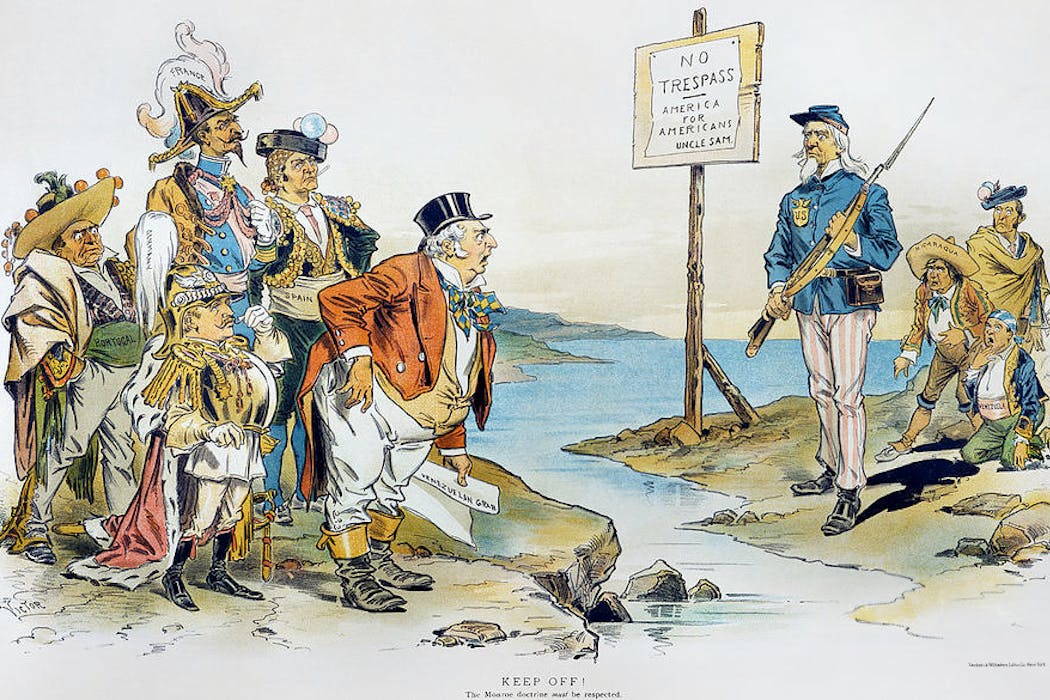
Ilustración satírica de 1896 donde se ve al Tío Sam interponiéndose entre las potencias europeas y unos personajes que representan a Nicaragua y Venezuela. Wikimedia Commons

El 24 de noviembre venció el ultimátum a Nicolás Maduro por el que Estados Unidos clasificó al llamado Cártel de los Soles como organización terrorista, allanando el camino para una posible intervención militar contra Venezuela.

Esa decisión parece menos una exigencia jurídica que una advertencia política.
Como ya se vio en la “guerra de los doce días” contra Irán, que llevó a casi toda la UE a aceptar las exigencias estadounidenses en el marco de la OTAN, Washington se preocupa cada vez menos por sustentar sus ataques mediante justificaciones normativas.

Acoso diplomático

Los detractores del presidente Trump sostienen que ha convertido a EE.UU. en un “Estado mafioso” (mafia state), debido a que recurre a prácticas gansteriles, tanto a nivel internacional como nacional. Para estas voces críticas, Trump busca la cooperación o el sometimiento mediante la amenaza del uso de la fuerza.

No hace falta simpatizar con Maduro para ver los riesgos de este acoso diplomático “bully diplomacy”. Por exitosa que haya sido hasta ahora, socava los ya frágiles cimientos del orden mundial normativo (rule-based global orden) que Occidente dice defender. Sus efectos resultan difíciles de prevenir.

Esto sucede en el aniversario de la llamada doctrina Monroe, que tuvo lugar el 2 de diciembre.

A todos nos suena el lema “América para los americanos” y ahora lo asociamos con el control de fronteras y el proteccionismo industrial. Sin embargo, no es la primera vez que se alzan banderas con este lema.

1823 fue el marco de una auténtica partida de ajedrez geopolítico. Más de dos siglos después del mensaje del presidente James Monroe, resulta útil conocer cómo Londres y Washington compitieron por la proyección política en Latinoamérica. Entender qué ocurrió y cómo Europa perdió gradualmente capacidad de influencia puede ayudarnos a leer mejor lo que se avecina.

El giro intervencionista de la doctrina Monroe

Monroe no podía prever que su declaración contra la injerencia europea en los países independientes de América y a favor del no-intervencionismo estadounidense en Europa (en Grecia, por ejemplo) se transformaría en una “doctrina” útil para justificar no solo el aislacionismo, sino también el intervencionismo en América y más allá.

Sin embargo, el germen de ese giro ya estaba inscrito en el propio mensaje de 1823.

Aquel año, la contrarrevolución alcanzaba su cenit con la invasión francesa de España, que restauró el absolutismo en Europa y parecía anunciar una intervención franco-española en América.

Cuando Monroe leyó su mensaje, Gran Bretaña ya había asegurado el gradual reconocimiento de la independencia hispanoamericana, publicando el compromiso francés a la no-intervención en América que recoge el Memorándum de Polignac. Este hecho constituyó una parte del proceso para la difícil aceptación británica de la intervención francesa en España.

Pero Washington lo desconocía. Como subrayan los expertos, la declaración de Monroe no representó una ambigua cooperación con Londres, sino una potente reacción negativa a un anterior pedido británico de colaboración sobre la independencia latinoamericana.

Fue, en esencia, un manifiesto de emancipación geopolítica.

El secretario John Quincy Adams, autor del documento, se oponía a la propuesta británica de declarar que ni Gran Bretaña ni EE. UU. anexarían territorios previamente españoles, porque pensaba que Londres quería limitar la proyección estratégica de la república. Su negativa contenía en esencia la ideología del “destino manifiesto” y un panamericanismo contradictorio.

Considerando cómo los conflictos imperiales del siglo XVIII habían perturbado la geografía continental, Adams quiso establecer que los territorios americanos ya no eran peones en el ajedrez europeo.

El mensaje de Monroe no fue una herramienta de política interna, como se ha dicho, sino que dejó claro al mundo que EE.UU. interpretaría cualquier amenaza europea a las independencias hispanoamericanas como un ataque a su propia seguridad y paz.

Percibía como interferencia los planes para crear monarquías independientes, porque nuevos lazos dinásticos habrían arrastrado a América a conflictos europeos. Por eso, la “libertad hemisférica” tenía que ser republicana.

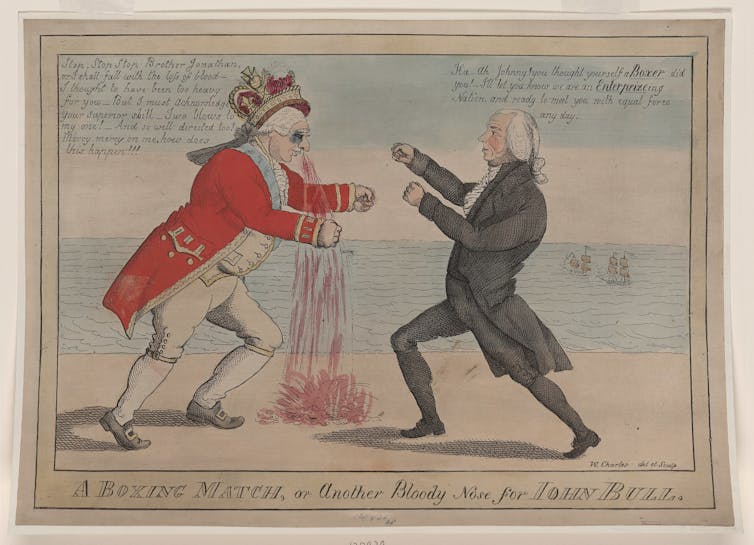
Aguafuerte coloreado a mano de Charles Williams, en el que se ironiza sobre una derrota naval británica durante la Guerra de 1812.
Library of Congress

EE. UU. terminó legitimando como defensiva su teórica intervención contra la interferencia de otras potencias en otros países. Poco importó que careciera de la fuerza y la voluntad de materializar la amenaza. Fue una herramienta propagandística en Latinoamérica, que tuvo profundos efectos en México y Texas. Creó graves divisiones internas entre conservadores probritánicos y liberales proestadounidenses y empujó la reacción británica, una dinámica observada previamente en Sudamérica durante la Guerra de 1812.

Pero al intentar debilitar a la influencia europea, EE. UU. no quería actuar como guía del mundo americano.

El origen del “patio trasero”

Los límites de la declaración de Monroe residían, contrariamente a lo que se cree, en la reticencia de EE. UU. a gobernar un continente que solo deseaba controlar en la medida necesaria para su seguridad. Hispanoamérica representaba un escudo frente a la amenaza europea, la barrera entre el hogar y el mundo. Era su “patio trasero”. Con el tiempo el “hogar” se expandiría al jardín, y el jardín se proyectaría sobre el resto del mundo entre muchas contradicciones. Pero EE. UU. no perdería su hábito, fijado ya en 1823, de interpretar la injerencia ajena en territorios externos como una amenaza directa a su propia seguridad.

Y así como en el siglo XIX no quería gobernar el caos americano, hoy no quiere gobernar el mundo ni Occidente. Como conclusión, la “bully diplomacy” de Trump encarna el lado oscuro de una potencia militar hegemónica que no quiere ser un imperio, sino seguir preservándose a sí misma.

The Conversation

Deborah Besseghini es doctora investigadoras Marie Curie en la Universidad Pablo de Olavide de Sevilla, donde desarrolla el proyecto “UNWANTED – The Revolutionary Impact of Financing a Global War, 1797-1825”, financiado por la Comisión Europea.
Algunos artículos citados son parte de un numero monográfico sobre la Doctrina Monroe en el cual la investigadora participó.

ref. Doctrina Monroe: más de dos siglos de “América para los americanos” – https://theconversation.com/doctrina-monroe-mas-de-dos-siglos-de-america-para-los-americanos-270607