Source: The Conversation – Canada – By Shannon Welbourn, Assistant Professor and Technological Education Program Coordinator, Brock University
The recent killing of a 20-year-old tradeswoman in Minnesota has struck a nerve across Canada’s skilled trades community. Amber Czech, a welder, was slain by a male colleague while on a work site.
As a researcher and educator in technological education, I see an opportunity. I help experienced tradespeople become high school teachers. They become certified to teach in one of the 10 broad-based technology subject areas — communications, computers, construction, green industries, hairstyling and esthetics, health care, hospitality and tourism, manufacturing, technological design or transportation.
The culture of industry has an impact on the adults who enter teacher education, and those teachers in turn shape the culture of tomorrow’s shops and labs. For safer workplaces, the work of prevention must start long before anyone steps onto a job site.
“Preventing and addressing GBV (gender-based-violence) in Canada requires a co-ordinated national approach, with federal, provincial and territorial governments working in close partnership with survivors, Indigenous partners, direct service providers, experts, advocates, municipalities, the private sector and researchers … Joint efforts in support of this National Action Plan will align with and complement the Truth and Reconciliation Commission’s Calls to Action and the National Inquiry into Missing and Murdered Indigenous Women and Girls’ Calls for Justice.”
While home is unsafe, so too are workplaces. Violence reflects broader societal norms that shape all institutions, including education. Yet many trades and apprenticeship systems lack the structures to protect women.
At first glance, the slaying of a U.S. welder may seem distant from Canadian high school classrooms. But in technological education, the connection is direct.
Some have spent years navigating exclusion or witnessing harassment. Others come from supportive workplaces and are surprised to learn how widespread these issues are. This means teacher education programs cannot assume shared understanding of safety, inclusion or harassment.
This dynamic creates both a responsibility and an opportunity. Technological Education teachers shape learning spaces where young people first encounter trades culture. They influence whether girls, gender-diverse students and other underrepresented learners feel welcome or pushed out, long before they reach apprenticeships.
Experiential learning emphasizes structured reflection. Case studies, workplace scenarios and opportunities to practice inclusive responses in realistic contexts deepen learning more effectively than policy readings alone. For second-career learners, connecting personal experience with broader patterns is especially meaningful.
3. Teach candidates to identify early warning signs
4. Position tech ed teachers to lead and advocate workplace culture
Technological education teachers often maintain close ties to industry, apprenticeship and co-ops. They can advocate for safe placement sites, challenge stereotypes about who belongs in the trades and create spaces where all students feel welcome. Preparing candidates for these responsibilities means inspiring them to be culture shapers.
But responsibility cannot rest solely with employers and unions. It must extend into teacher education programs and the high school classrooms where young people first experience skilled trades instruction.
By equipping future technological education teachers to recognize, prevent and challenge gender-based violence, we take meaningful steps toward safe workplaces and a skilled trades sector where everyone truly belongs.
Shannon Welbourn does not work for, consult, own shares in or receive funding from any company or organisation that would benefit from this article, and has disclosed no relevant affiliations beyond their academic appointment.
While framed by the province’s United Conservative Party government as a measure to protect competition and ensure athletes “are able to participate in the sports they love fairly, safely, and meaningfully,” the act bans transgender girls aged 12 years and older from participating in competitive sports for women.
Far from just a local or niche issue, the implementation of this act exposes inconsistencies in sport policy and raises urgent questions about how anti-trans politics are shaping access to sport.
The impact on youth
The Fairness and Safety in Sport Act empowers just about anyone to file a complaint related to an organizations’ eligibility determinations. Incidents like one in British Columbia in 2023 —
a man attending a girls’ track and field meet demanded that a nine-year-old cisgender girl with a pixie cut prove she was not a boy through documentation — demonstrate the impact of this type of gender policing.
The consequences fall on transgender and gender non-conforming youth. For them, being banned from participation brings not only the loss of athletic opportunities, but also heightened experiences of exclusion and stigma.
Teammates and coaches must also navigate fractured team dynamics and a school-based athletic culture that risks becoming less about belonging and more about surveillance. The policy undermines the very developmental and educational values that sport is meant to cultivate.
It also places heavy and often invisible demands on the people who support these children. Parents and caregivers are left to shoulder the emotional work of helping their children process the psychological repercussions of exclusion in ways that surpass the normal responsibilities of parenting.
Research consistently shows that parents of transgender and gender-diverse children face significantly elevated levels of stress compared to parents of non-transgender children. This is largely due to the chronic strain of stigma, discrimination and navigating hostile environments along with the emotional labour of advocating within schools, health care and peer groups.
The impact on society
The act also has implications for varsity athletics and broader sporting cultures at post-secondary institutions.
Universities across the province have been forced to create new internal policies and procedures to align with the act, which place incoming and existing athletes participating in women’s varsity sport under increased scrutiny.
An inconsistency emerges when Alberta athletes step onto fields, rinks and courts outside the province.
Since the national institution for post-secondary sport in Canada (U Sport) still allows transgender athletes to compete according to their gender identity, Alberta now risks excluding its own youth while requiring them to compete under different eligibility standards when facing athletes from other provinces.
In addition, implementing this act will eventually create financial strain for organizations. Administering exclusionary rules requires new systems of eligibility verification, monitoring and appeals — an administrative burden that smaller leagues in particular are ill-equipped to manage.
Public response so far to the Fairness and Safety in Sport Act has been mixed.
Since it’s provincial law, school districts and universities have complied, creating internal policies and processes to fulfil the requirements of the act even while its trans-exclusionary nature runs counter to many of their values and commitments to equity, diversity and inclusion.
Egale Canada, a national 2SLGBTQI organization — which, along with Calgary-based non-profit support organization Skipping Stone — has launched legal action against the Alberta government, challenging the constitutionality of the province’s anti-translaws, and released a statement condemning the Fairness and Safety in Sport Act.
On Nov. 17, the Alberta government tabled legislation that seeks to invoke the notwithstanding clause of the Charter of Rights and Freedoms to insulate its laws from legal challenges. Using the clause would prevent courts from striking down laws for being unconstitutional, and in this context specifically, overrides the Charter rights of gender-diverse people.
The human toll of the Fairness and Safety in Sport Act must be recognized and challenged. When people refuse to accept exclusion and the overriding of basic human rights in sport, it can become a space for play, belonging and personal growth.
The authors do not work for, consult, own shares in or receive funding from any company or organisation that would benefit from this article, and have disclosed no relevant affiliations beyond their academic appointment.
Described as “violent misogyny” by the federal government, the killings have nonetheless never officially been called femicide in Canada despite its global recognition as one of the most vivid examples of femicide in the western world.
The podcast tells the stories of 580 Canadian women and girls killed by men since 2020. (Canadian Femicide Observatory for Justice and Accountability), CC BY
Part of the podcast’s calls to action include a petition asking Canada to officially recognize the crime of femicide and include it in the Criminal Code.
It does not address the culture facilitating femicide;
It may produce unintended consequences;
It’s difficult to achieve consensus on a definition of femicide;
It has not reduced femicide.
But criminalization versus prevention is not an either/or question.
Laws are a key element of a public health approach to violence prevention. National femicide laws have generally been accompanied by prevention programs, training for law enforcement and public awareness campaigns. Italy’s law, for example, includes stronger measures against gender-based crimes like stalking and revenge porn.
Laws are not stand-alone responses. They are only one part of multi-sector responses to a social problem that must include monitoring of implementation processes and outcomes.
Changing laws can change cultures
In Italy, some women’s advocates have complained the law doesn’t go far enough, especially in changing the country’s culture. In Canada, one feminist lawyer suggests that a “radical rethink” about the entire issue may be required instead of creating a new offence in the Criminal Code.
But to call the crime femicide — a sex- or gender-specific term — is in fact a radical rethink in a climate of neutrality that too often masks the disproportionate burden women and girls bear for some forms of male violence.
State responses through laws reflect cultural values. At the moment, these values regard femicide as an individual problem rather than the product of social structures and processes built on entrenched inequalities.
Laws meant to provide protections for women can have unintended consequences, as documented by mandatory charging for intimate partner violence where police are required to lay charges if they have reasonable grounds to believe an assault occurred. And gender-neutral laws may work against rather than for women, especially some women and girls, when applied within a sexist and racist environment.
That’s why Canada needs to include femicide in its Criminal Code. Femicide is not gender-neutral, and recognizing it formally will help define how and why women are killed by men, which is crucial for effective prevention.
Such a law could also benefit particular groups of women and girls whose deaths are often discounted because of who they are and where, how and by whom they were killed.
Some research suggests femicide laws are failing; they haven’t reduced cases of femicide. But others point out femicide laws have increased accountability and improved reporting, survivor protections and awareness about all forms of gender-based violence.
The varying impacts of a law depends on context, including who knows about it, whether it’s clear and concise and whether those tasked with applying it are responsive.
Femicide laws on their own won’t immediately reduce the number of women being killed by men or other forms of gender-based violence. Few laws have that kind of power. The key challenge is whether and how a femicide law is implemented.
Like many countries have, Canada can reach a consensus on what femicide is and produce a femicide law that leads to meaningful change. But it requires proactive consultations, political will and leaders who listen.
The 580 stories in Too True Crime demonstrate clearly and starkly that the lives of women and girls depend on it.
Myrna Dawson has received prior funding from the Social Sciences and Humanities Research Council and the Canada Research Chair program.
Source: The Conversation – UK – By Ben Buckley, Senior lecturer, Liverpool John Moores University; University of Liverpool
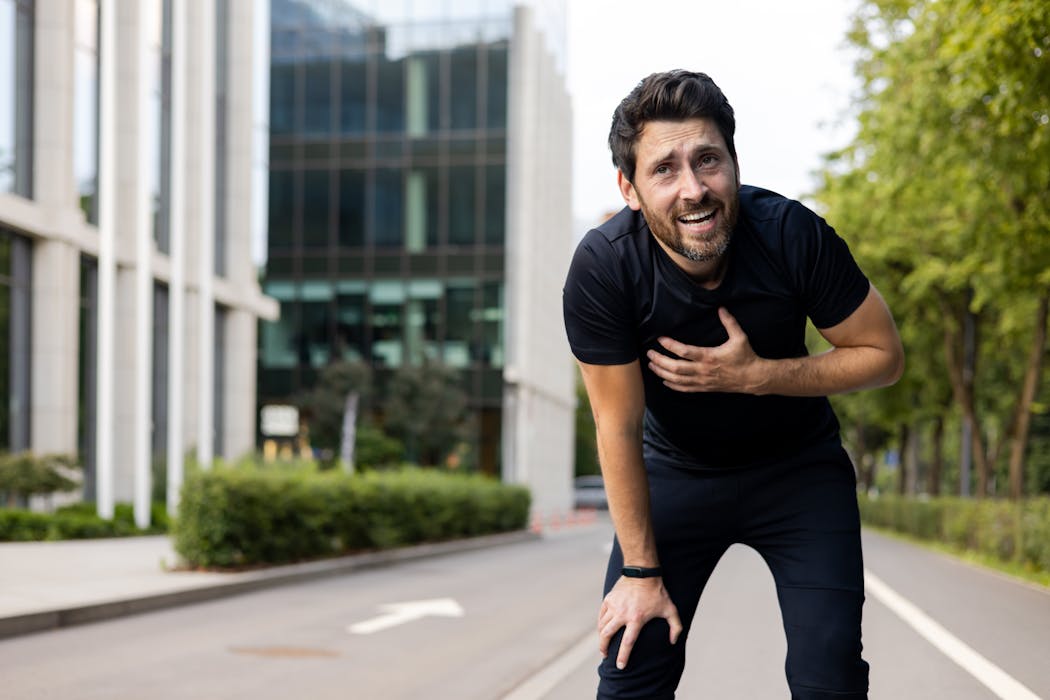
Heart problems can occur in athletes following long-term periods of intense endurance training.TetianaKtv/ Shutterstock
Exercise is one of the best things we can do for a healthy heart. Yet research shows that endurance athletes have up to a four times higher risk of atrial fibrillation (an irregular or fast heartbeat) than non-athletes. This heart condition increases risk of both heart failure and stroke.
When we take a broad look at the evidence, it’s clear that exercise plays a key role in keeping the heart healthy and lowering risk of atrial fibrillation for most of the population.
For instance, an analysis of over 400,000 people found that those who said they did between 150-300 minutes of moderate-to-vigorous intensity physical activity per week had a 10-15% lower risk of developing atrial fibrillation compared to those who were inactive.
Higher levels of exercise may only be protective in females. The study also found that exceeding these recommendations by up to three times was further protective for females but not males, with around 20% lower risk of atrial fibrillation.
Exercise is also emerging as a cornerstone treatment for patients who already have atrial fibrillation. A meta-analysis my colleagues and I conducted showed that in patients with atrial fibrillation, exercise reduced risk of arrhythmia recurrence by 30%. Exercise also improved symptoms and quality of life and fitness.
However, it was difficult to determine how much exercise was best when it came to rehabilitation, as the programme length, frequency of exercise and workout length varied substantially between participants.
So while our findings confirm that exercise plays an important role in heart health, they also highlight how little we know when it comes to the “dose” of exercise needed to optimise this protective effect. This is something we call personalised medicine.
With the growing popularity of endurance events – from marathons to mountain ultras – there’s a clear need to understand what volumes of exercise may be detrimental to the heart.
Is the dose the poison?
Our previous research proposed that there’s a J-shaped relationship between exercise levels and atrial fibrillation risk. This means that increasing your activity levels to the recommended guideline levels is associated with a significantly lower risk of atrial fibrillation. But when going way beyond these guidelines – such as doing ten times the recommended amount – we begin to see higher rates of atrial fibrillation.
Numerous studies have shown that heart problems can occur in athletes following long-term, intense periods of endurance training. Studies of endurance athletes’ hearts have also shown some have signs of scarring, which is a potential precursor to atrial fibrillation and other heart conditions.
For instance, one meta-analysis showed that athletes had a nearly four times greater risk of atrial fibrillation compared to non-athletes. This analysis included those who had no signs or symptoms of any other heart problems. Interestingly, younger athletes had a greater risk of atrial fibrillation than older athletes – something that needs further research.
Men and women appear to have different risk profiles.
One study of 402,406 people found that men who said they did more than ten times the recommended weekly amount of physical activity had a 12% higher risk of atrial fibrillation. This is roughly the equivalent of doing seven hours of vigorous intensity exercise per week (such as running or cycling at a high intensity). However, women who did this much physical activity did not appear to have a greater risk of atrial fibrillation.
It has been suggested that this lower risk in female athletes compared to male athletes may be due to a tendency for females to have fewer structural and electrical changes in the heart in response to exercise. Oestrogen, which is known to be “cardioprotective”, may stabilise heart adaptations in response to exercise training and at rest.
It appears that an endurance athlete’s atrial fibrillation risk isn’t just due to the amount of exercise they’re doing, but a combination of the overall load and intensity of long-term training.
For example, a Swedish study of around 52,000 cross-country skiers found those who participated in a greater number of races had a 30% higher risk of atrial fibrillation. Faster finishing times were also associated with a 20% higher risk.
The number of races an athlete competes in and the finishing time of these races likely represents an athlete’s training load and intensity – with more races requiring a higher training load and faster finishing times requiring more intense training. This emphasises that both the amount and the intensity of exercise are key.
Researchers don’t entirely understand the mechanisms underlying this relationship between exercise and atrial fibrillation. It’s likely explained by multiple factors working together simultaneously.
For example, over many years of very high training demands, the stress placed on the heart can lead to enlargement of the atria (heart chamber) and increased stress on its walls. This can lead to scarring.
Even after a single mountain marathon, researchers have seen short, frequent spikes in inflammation and a transient slowing of the electrical conduction in the atria. Over time with repeated events and training, these cardiac stresses could be what cause an increased heart chamber size and scarring (pathological cardiac remodelling) – increasing the risk of atrial fibrillation.
While it’s unlikely that the average runner is going to increase their atrial fibrillation risk while training for their marathon, it’s still important to train in a smart way. Considering your overall training volume and intensity – especially if you’re training for many hours per week – could help mitigate your risk of cardiac stress and atrial fibrillation.
Atrial fibrillation can be well treated and managed. Therefore, being aware of key symptoms such as an irregular pulse, palpitations or breathlessness is crucial for getting the right treatment.
Ben Buckley has received investigator initiated research funding from BMS/Pfizer, Huawei EU, NIHR, MS Society, and Research England.
China routinely sends astronauts to and from its space station Tiangong. A crew capsule is about to undock from the station and return to Earth, but there’s nothing routine about its journey home.
The Shenzhou-20 capsule will carry no crew, because one of its windows has been struck by space debris. Astronauts noticed an apparent crack on November 5, during pre-return checks.
Space journalist Andrew Jones explained how experts on the ground had studied images of the damage and concluded that a piece of debris smaller than 1mm (roughly 1/25th of an inch) had penetrated from the outer to inner layers of the glass.
Simulations and tests confirmed a low probability that the window could fail during the high-temperature re-entry through Earth’s atmosphere. Although a worst-case scenario, it was one that officials deemed unacceptable. A rescue mission – Shenzhou-22 – was launched to bring the astronauts back from the station.
Experts have been warning about the threat posed by space debris for years. The ever-growing number of space programmes by states and private entities is now contributing to an increasingly congested environment in orbit.
The European Space Agency estimates
that there are more than 15,100 tonnes of material in space that has been launched from Earth. There are 1.2 million debris objects between 1cm and 10cm, and 140 million debris objects between 1mm and 1cm.
In low orbit they will be travelling around 7.6 km/s (roughly 17,000 miles per hour), damaging anything they hit. This is how a piece less than 1mm in size was able to penetrate the thick glass of Shenzhou-20’s capsule.
Given the mounting number of objects in orbit, this is likely to be a more regular occurrence. It’s costly in terms of damage to equipment, and increasingly a threat to life. When a piece of debris hits another object in space, it can also create more space debris, adding to the problem.
A number of countries are able to track what’s in space, but given that these may include classified satellites, there is a reluctance by states to share details. China’s space programme is overseen by its military, in line with a view that space is inherently linked to national security. This only adds to the geopolitical tensions between states around the use of space.
Treaties and responsibilities
The outer space treaty from 1967 sought to outline how space should be governed. But it is outdated and does not account for the increased presence of debris or the proliferation of private space launches. Nor does it address responsibilities when it comes to the sustainable use of space.
A total of 117 states are parties to the treaty, yet while efforts are ongoing to develop new norms around space governance, including the creation of the Inter-Agency Space Debris Coordination Committee, the organisation may offer a platform for cooperation and research but does not result in binding decisions for state action. The lack of any global agreement on space debris, and more importantly repercussions, makes tackling the problem of space debris even harder.
Technology is being developed to address space debris – but this generally appears as concept mission plans with only a few trial tests being launched anywhere globally. Examples include the idea of a harpoon to collect large pieces – although the recoil of such an instrument means the spacecraft that deploys it could become a new piece of debris.
An alternative is the highly technological approach of a big net. This will work in the sense that if you can slow the debris down, it will fall into the atmosphere and burn up.
The problem with these methods is the lack of sustainability, sending one satellite up to bring only a few pieces down uses up fuel, which is adding to climate variation. An appropriate and efficient solution would be a constellation of satellites that stay in orbit and bring debris down. The process, of course, is still something to be researched.
A ground-based solution is the laser broom, which uses laser pulses to slow down objects orbiting Earth, potentially allowing them to re-enter the atmosphere and burn up. However, it is yet to be tested and comes with its own potential problems such as atmospheric warming and missing its target.
Yet without addressing the geopolitics of space governance, the removal of space debris is moot as a focus on national interests, security concerns, and the increasing presence of the private sector means that pollution in Earth orbit is happening faster than we can clean it up.
Any collisions cause many more pieces to be produced than can be collected, some notable examples include the destruction in 2007, by China, of its own Fengyun-1C satellite as part of an anti-satellite weapon test. This added an estimated 3,500 pieces in orbit.
In 2009, a Russian satellite called Kosmos 2251 collided with an Iridium communications satellite, generating roughly 2,400 pieces of debris. In 2021, Russia carried out its own anti-satellite missile test, destroying the Kosmos 1408 satellite and generating a further 1,787 pieces. These mostly came back through the atmosphere, but 400 pieces were left in orbit.
Whether such an anti-satellite weapon could be repurposed for space debris removal is unlikely but has potential.
It will require concerted global cooperation and effort to not only indicate what spacecraft states and private companies have in space, but to commit to de-orbiting every future spacecraft at the end of its life, reducing future debris.
The current space debris mitigation standards by the European Space Agency highlight that any satellites must be de-orbited within 25 years of the end of operations. While this also is intended to apply to miniature “cubesats” – the process of bringing them back down has yet to demonstrated.
Ultimately this debris will cause problems for all space launch agencies and private companies, as there is a limit to our ground-based tracking and warning abilities. This makes addressing the global governance of space critical. However, it may take several high-cost satellites being taken out of commission, or potentially loss of life, for this issue to be taken seriously.
Lesley Masters is affiliated with
Visiting Fellow Institute for Diplomacy and International Affairs, Loughborough London.
Visiting International Fellow, Human Sciences Research Council, South Africa
Ian Whittaker does not work for, consult, own shares in or receive funding from any company or organisation that would benefit from this article, and has disclosed no relevant affiliations beyond their academic appointment.
Geoffrey Chaucer’s Miller’s Tale is renowned for its salacious storyline of sexual misadventure. Set in 14th-century Oxford, it tells the tale of John the Carpenter, a husband so terrified that another “Noah’s flood” is coming to drown the world that he sleeps in a basket in the attic – freeing his wife to bed her lover downstairs.
Chaucer’s pilgrims all have a good laugh at John’s expense as they walk together from London towards Canterbury, echoing John’s neighbours who “gan laughen at his fantasye” of Noah’s flood and call John “wood” (mad). The pilgrims listen to this particular tale (one of 24 Canterbury Tales) as they walk along the south bank of the River Thames between Deptford and Greenwich.
That stretch of river was well-known to Chaucer. At the time of writing what remains one of English literature’s greatest works, he had been tasked, in March 1390, with repairing flood damage to the riverbank around Greenwich.
As a poet who swapped his pen for a spade to dig banks and defend the land around Greenwich from inundation, Chaucer knew from experience that flooding was no laughing matter. He – and later Shakespeare – lived through periods of weird weather not unlike what we are seeing today.
Their changing climate was triggered by falling rather than rising temperatures during what’s known as the little ice age. But the net effect was weather extremes like strong winds, storms and flooding – some of which were evoked in plays, prose and poems, offering valuable information on how communities were hit by, and responded to, these extreme events.
For the past two years, I have been scouring historical literature and performances for – now-often forgotten – experiences of living with water and flooding along the shorelines and estuaries of England’s coastlines. Whether in 15th-century “flood plays” in Hull or the “disaster pamphlets” (an early form of newsbook) that rose to popularity in Shakespeare’s lifetime, my research shows we do not only need to look to the future to understand the challenges posed by rising seas and more intense storms.
The River Thames and London borough of Southwark, starting point for Chaucer’s Canterbury Tales. From The Particuler Description of England by William Smith (1588). British Library via Wikimedia
Hull’s medieval flood play
Early in the new year of 1473, a crowd gathered outside Kingston-upon-Hull’s main church to watch the annual flood play performed. The play itself is now lost, but surviving records cast tantalising light on how the play was staged between 1461 and 1531. We know, for example, it was snowing in 1473 because of a payment that year for “makyng playne the way where snawe was”.
We also know from financial records that the play was performed on an actual ship, hauled through Hull’s streets on wheels and hung on ropes for the rest of the year in Holy Trinity church (now Hull Minster). We know from payments to “Noye and his wyff”, “Noyes children” and “the god in the ship” that the play must have told a very similar story to that of two medieval pageants still performed today in the neighbouring east coast city of York.
What is not immediately clear from Hull’s records is why the town’s guild of master mariners chose the snow and ice of early January as the annual date for their flood play’s performance, when biblical plays in York and other northern towns and cities were staged during the warmer months of Easter and midsummer. A payment for Noah’s “new myttens” in 1486 speaks to the challenges of performing outdoor theatre in January, typically the coldest time of year.
In fact, Hull’s flood play was always staged on Plough Monday, the first Monday after the Christian celebration of Epiphany on January 6. This date marked the traditional start of the new agricultural year, and a close reading of Hull’s records shows themes of farming woven into the flood play. The benefits of flooding for haymaking, for example, were signalled on stage through the purchase of agrarian items like a “mawnd” (grain basket) in 1487, “hay to the shype” (ship) in 1530, and plough hales (handles) “to the chylder” (children) in 1531.
Noah, A Mystery Play by Edward Henry Corbould (1858) depicts Hull’s medieval flood play performed outside Holy Trinity Church (now Hull Minster). Ferens Art Gallery via Wikimedia
The advantages of flooding meadows had long been recognised in the Humber villages surrounding Hull – and reflected in the layout of its medieval land. Grass grew well on the well-drained meadows along the River Humber’s banks, and the hay harvested from these floodplains provided winter feed for farm animals including the oxen that pulled ploughs through arable fields in January, at the start of the new agricultural year.
Writing and water management were once familiar bedfellows – and the wisdom of building raised flood banks and making hay on floodplains is reflected throughout medieval and early modern literature.
Writing of Runnymede, an ancient meadow on the banks of the River Thames, in his 1642 poem Coopers Hill, John Denham casts an approving glance on the “wealth” that the seasonal flooding of the Thames brings to the meadows on its river banks: “O’re which he kindly spreads his spacious wing / And hatches plenty for th’ensuing Spring.”
But Denham distinguishes between two types of flood: the benevolent, seasonal kind that brings wealth to the meadows, and the “unexpected Inundations” that “spoile the Mowers hopes” and “mock the Plough-mans toyle”. Floods can bring disaster if they are unexpected (for example, if they occur during the growing season in spring and summer) or out of place (flooding arable fields rather than meadow ground). But literature reminds us they can also bring benefits – if communities learn to live with water and adapt their lives to the rising tide.
Unfortunately, despite renewed interest in nature-based solutions to flood alleviation, floodplain meadows declined sharply in the 20th century and few exist today. Downstream of Runnymede, at Egham Hythe, is Thorpe Hay Meadow. Once part of a thriving medieval economy of haymaking on floodplains, its website announces it is now the “last surviving example of unimproved grassland on Thames Gravel in Surrey”.
Gone too are Hull’s meadows and its flood play, which once celebrated the benefits of flooding for farming in this stretch of north-east English coastline. Some of the meadows in the village of Drypool, directly to the east of Hull, were built on as early as the 1540s for Henry VIII’s new defensive fortifications. Much of the remainder was absorbed into this industrial city’s urban sprawl from the 17th century onwards. Today, the Humber’s banks in urban Hull are heavily defended by a £42 million concrete frontage, protecting all the homes and businesses on the floodplain beyond.
Shakespeare was born in 1564 into one of the coldest decades of the last millennium. Temperatures plunged across northern Europe in the 1560s, and the winter of 1564-5 was especially severe.
The little ice age brought shorter springs and longer winters to northern Europe. Reconstructed temperatures show the climate was on average between 1 and 1.5°C colder during Shakespeare’s lifetime than our own. But it was also an age of weather extremes, bringing heat and drought alongside snow and ice.
The weather diary of Shakespeare’s almost exact contemporary, Richard Shann (1561-1627), now housed in the British Library’s manuscripts department, is an invaluable witness to these fluctuating extremes. Writing from the village of Methley in West Yorkshire, Shann describes “a could and frostie winter” in 1607-8 “the like not seene of manie yeares before”. Indeed, the frost “was so extreame that the Rivers was in a manner dried up”.
At York, Shann writes, people “did playe at the bowles” on the river Ouse, and in London “did builde tentes upon the yse” (ice). Temperatures soared that summer, with July 1608 “so extreame hote that divers p[er]sonnes fainted in the feilde”. But the cold quickly returned. “A verie great froste” was reported as early as September 1608, with Shann reporting that the River Ouse “would have borne a swanne”.
The climate crisis has a communications problem. How do we tell stories that move people – not just to fear the future, but to imagine and build a better one? This article is part of Climate Storytelling, a series exploring how arts and science can join forces to spark understanding, hope and action.
As the weather became more variable, with hot and cold spells more extreme, so the late 16th and 17th centuries saw an increase in the frequency and intensity of storms – such that this era has been dubbed “an age of storms”.
On Christmas Eve 1601, Shann describes “such a monstrous great wynde” in Methley “that manie persons weare at theyr wittes ende for feare of blowinge downe theyre howses”. After the storm causes the River Aire at Methley to flood, he writes of his neighbours that the water “came into theyre howses so high, that it allmost did touch theyre chambers”.
In London, meanwhile, historian John Stow (1525-1605) records extremes of heat and cold leading to storms and floods throughout the 1590s. In his Annals of England to 1603, Stow reports “great lightning, thunder and haile” in March 1598, “raine and high waters the like of long time had not been seene” on Whitsunday 1599 – and in December 1599, “winde … boisterous and great” which blew down the tops of chimneys and roofs of churches. The following June, there were “frosts every morning”.
The storminess of this period also appears to seep into Shakespeare’s work. Several of his later plays use storms at sea as plot devices to shipwreck characters on islands (The Tempest) or distant shores (Twelfth Night). In Pericles, Prince of Tyre, Shakespeare (the co-author, with George Wilkins (died 1618)) tosses his hero relentlessly across the eastern Mediterranean in a play that features no fewer than three storms at sea.
While many of Shakespeare’s storms take place in distant locations and at sea, King Lear sets the storm which rages throughout its central scenes in Kent, on the English east coast. Lear describes “the roaring sea” and “curlèd waters” that threaten to inundate the land. It is a play shaped by the east coast’s long experience of living with the threat of flooding from the North Sea.
Disaster pamphlets
Surviving reports of coastal flooding caused by a series of North Sea surges in 1570-71 describe dramatic inundations in the coastal counties of Norfolk, where “people were constrained to get up to the highest partes of the house”, and Cambridgeshire, where several “townes and villages were ouerflowed”. Meanwhile, the Lincolnshire village of Bourne, on the edge of the Fens, “was ouerflowed to [the] midway of the height of the church”.
These colourful accounts of towns and churches under water were collected and printed in one of the first “disaster pamphlets” in London in 1571. It bore the lengthy title: A Declaration of Such Tempestious and Outragious Fluddes, as hath been in Diuers Places of England.
This pioneering form of news booklet rose to popularity in Shakespeare’s lifetime to cater for popular interest in the increasingly weird weather of those decades. Disaster pamphlets gathered nationwide news of floods, storms and lightning strikes into slim, pocket-sized booklets, printed in London under dramatic titles such as Feareful Newes of Thunder and Lightening (1606) and The Wonders of this Windie Winter (1613).
Of the London booksellers who sold these pamphlets and other “strange news” booklets, Shakespeare’s close contemporary, William Barley (1565-1614), was among the most prolific. Many pamphlets were accompanied by eye-catching illustrations of disaster scenes on their title pages and inside covers.
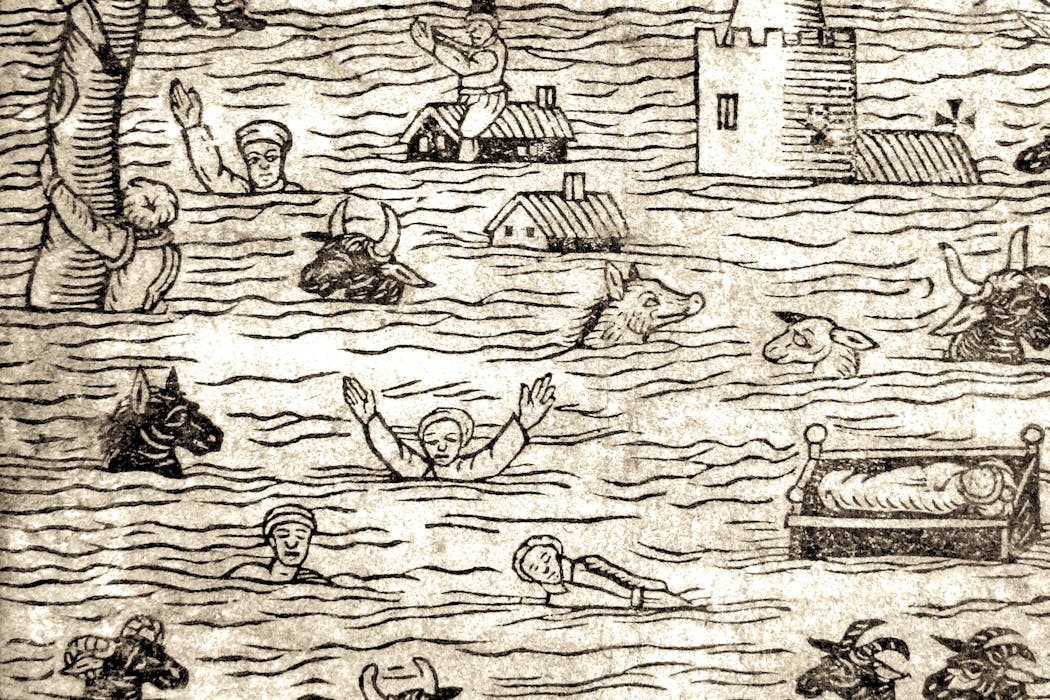
Natural disasters were by no means confined to the east coast. Two pamphlets – William Jones’s Gods Warning to his People of England, and the anonymous A True Report of Certaine Wonderfull Ouerflowings of Waters – reported on one of Britain’s worst natural disasters, the Bristol Channel flood of January 30 1607.
Their cover illustrations depicted scenes of suffering and survival, with submerged churches and steeples featuring prominently. Inside, writers knitted together statistics recording the number of miles of land flooded and cattle drowned with eyewitness accounts of local gentlemen and landowners, who described churches “hidden in the Waters”, the “tops of Churches and Steeples like to the tops of Rockes in the Sea”. Indeed, so high were the floodwaters, Jones wrote, that “some fled into the tops of Churches and Steeples to saue themselves”.
While newsbooks continued to grow in popularity, coming of age in the civil wars of the mid-1600s as a platform for reporting political news and views, disaster pamphlets focused specifically on storms and floods appear to have waned in popularity by the end of the 17th century. Their decline coincided with the rise in the later 1600s of the first local newspapers in England and Wales, which continued to feature news of floods and other weird weather events for centuries to come.
Nonetheless, references to disaster pamphlets lived on in poems such as Jean Ingelow’s High Tide on the Coast of Lincolnshire, 1571 – published in 1863 – which drew on the details of A Declaration to recreate the east coast floods of three centuries earlier from the point of view of a husband who loses his wife to the rising tide.
By focusing on the loss felt by one family, Ingelow draws attention to the human cost of these disasters which, then and now, can be buried beneath faceless figures of fatalities in news reports. The poem’s narrator notes that “manye more than mine and me” lost loved ones in that surge tide.
The concept of climate change was unknown to Shakespeare’s generation, yet the changing climate of the little ice age introduced anxieties into the reporting of weird weather in disaster pamphlets. Their authors would typically couch the causes of local floods as a national issue – as stirrings of divine anger at the sins of the English nation or of its Church.
Jones’s response to the Bristol Channel flood typified this approach. In Gods Warning, he describes the flood as a “watry punishment” – one of several “threatning Tokens of [God’s] heavy wrath extended towards us that had been experienced in recent years. How floods were represented in poems, pamphlets, newspapers and books have long reflected society’s wider anxieties over the question of what these weird, wild weather events might portend.
Lost communities
The English east coast possesses some of the fastest-eroding cliffs in Europe. In East Yorkshire, the Holderness cliffs from Bridlington to Spurn Point are eroding at an astonishing 1.8 metres per year. While erosion has been happening along this coastline since the end of the last (full) ice age approximately 11,700 years ago, it is today being accelerated by the rising seas and more frequent storms of climate change.
We can measure flooding or erosion in some very alarming numbers. According to the Flamborough Head to Gibraltar Point Shoreline Management Plan of 2010, the Holderness coast retreated by around two kilometres over the past thousand years. In the process, 26 villages named in the Domesday Book of 1086 disappeared under water.
An illustration of Old Kilnsea church in 1829, now swallowed up by the North Sea. Henry Gastineau
But literature goes further – revealing the experiences of those who lived on the edge of those crumbling clifftops, preserving fast-vanishing communities and coastlines for future generations.
In the early 20th century, histories of the Holderness coast’s lost villages were painstakingly pieced together from old photos, maps and archival records by Thomas Sheppard, whose Lost Towns of the Yorkshire Coast (1912) includes a map preserving the names and former locations of these shipwrecked villages: Cleton, Monkwell, Monkwike, Out Newton and Old Kilnsea, to name five. What must it have been like to live in these villages? How does their loss haunt today’s coastal communities, who are themselves facing a slow but sure retreat from the advancing sea?
Literature can provide what nature writer Helen MacDonald, in her collection of essays Vesper Flights (2020), calls the “qualitative texture” to enrich the statistics. It can reveal the ways of life and habits of thought of people who lived in these communities, and who adapted to the risks and benefits of living “on the edge”.
Juliet Blaxland’s The Easternmost House (2019) describes a year living in a “windblown house” in coastal Suffolk, “on the edge of an eroding clifftop at the easternmost end of a track that leads only into the sea”. The house – now demolished – was once Blaxland’s home. She wrote the book as “a memorial to this house and the lost village it represents, and to our ephemeral life here, so that something of it will remain once it has all gone”.
But Blaxland conjures more than bricks and mortar. She speaks to the mindset of coast-dwellers who pace out the distance between their houses and the advancing cliff edge, and who find solace, as well as sadness, in the inevitability of coastal loss. “Everyone has a cliff coming towards them, in the sense of our time being finite,” Blaxland writes. “The difference is that we can see ours, pegged out in front of us.”
From Noah to Now. Video by the University of Hull.
From Noah to now
Coastal communities have learnt over centuries to live with uncertainty, and to continue their ways of life despite the risks. This “living with water” mentality shapes east coast communities just as surely as banks, barriers and rock armour shape the east coast’s cliffs, river mouths and beaches. It is in literature that we see this inner life revealed, and hear the voices of the past singing out to the present.
Singing was how we engaged young people with the past on the Noah to Now project. Across six months in 2024-25, colleagues from the University of Hull’s Energy and Environment Institute worked with singers, musicians and more than 200 young people in Hull and north-east Lincolnshire to rehearse and perform Benjamin Britten’s mid-20th century children’s opera, Noye’s Fludde, at Hull and Grimsby minsters.
The opera tells the biblical story of Noah in song, using the text of one surviving medieval flood play from 15th-century Chester as its libretto. Our chorus of school children performed as the animals in the ark, and were joined by other young people who took on solo roles or played in the orchestra.
Rooted in the medieval past, the opera introduced participating schools to the lost flood play from medieval Hull, and to that play’s connections with the longstanding culture of living with water in the Humber region. One of our venues, Hull Minster, was the church in which Hull’s medieval mariners used to hang the ship (or ark) that they hauled through Hull’s streets every January, some 500 years ago.
Britten’s opera also resonates with more recent histories of east coast flooding. Noye’s Fludde was first performed in 1958 near the composer’s coastal home of Aldeburgh in Suffolk – a town devastated five years earlier by the disastrous North Sea flood of 1953.
Water swept into more than 300 houses in Aldeburgh shortly before midnight on January 31 1953 – forcing Britten to abandon 4 Crabbe Street, his seafront home. It was days before he could return to the house to write letters declaring that “we expect to feel less damp to-morrow”, and that “I think we’re going to try sleeping here to-night”. It was another week before Britten could report that “most of the mud’s gone now, thank God!”
The events of 1953 affected the whole Aldeburgh community, and the opportunity for the town to come together five years later to sing and perform an opera about flooding must have seemed especially poignant to all involved.
It was in the spirit of that first Aldeburgh performance that we involved other east coast communities in Hull and north-east Lincolnshire – each with their own long histories of flooding – in the staging of an opera that folds medieval and mid-20th century stories of flooding to address themes rooted in the past that are still relevant today.
Teachers from the participating schools spoke of their children’s enthusiasm for learning through the medium of stories and songs about a serious topic like flooding.
“[They were] so enthralled and so wanting to pass the message on of what they’d learnt,” a teacher from north-east Lincolnshire recalled about the children’s enthusiasm on returning from one of the workshops. “They came back just full of it – and full of the stories they’d been told as well.”
This article features references to books that have been included for editorial reasons, and may contain links to bookshop.org. If you click on one of the links and go on to buy something from bookshop.org The Conversation UK may earn a commission.
Source: The Conversation – UK – By Natasha R. Hodgson, Senior Lecturer in Medieval History, Nottingham Trent University
Women are largely absent from the questions, sources, and mark schemes that shape how history is taught and assessed in schools in England.
You only have to take a look recent exam papers to see the problem. For example, when my colleague Catherine Gower and I surveyed 219 GCSE, AS and A-level history papers issued in the summer of 2023, we found only 6% of 991 exam questions directed students to discuss women (37% directed students to discuss men).
A report by the charity End Sexism in Schools, which carried out a survey into the teaching of women in history in earlier years at secondary school, found a similar lack.
Surprisingly, the recently released Curriculum and Assessment Review of England’s national curriculum pays scant attention to women and girls. Coverage of gender-related issues in the curriculum as a whole was disappointingly thin.
While the need to recognise a “wider range of perspectives” is cited in the curriculum review, these references are unclear and do not specifically address gender imbalance. There is still no statutory requirement to include women in the teaching of history – even though unrelated government research suggests that misogyny is a serious problem in schools.
No educational system can fully represent the whole of human history. Designing curriculum content is always a matter of choice. Who and what we choose to teach about our shared pasts is critical to the development of young people’s identities and empathy, as well as their awareness of local, national and global connections and life experiences dissimilar to their own.
Without government specification, despite the wealth of academic scholarship produced over the past 50 years on women and gender in history, there has been no corresponding imperative to embed this within secondary schools.
While there are teachers who are keen to incorporate women, they face systemic challenges. The assessments set by exam boards, which are influenced by the national curriculum, play a crucial role here. In an era of league tables there is intense pressure on teachers to prioritise assessment-focused content. If topics relating to women are not going to be assessed, it can be a struggle for teachers to include them.
Missing women
Our research focused on exam papers across England, including primary source extracts and mark schemes. One of the most shocking findings was that over one third of the papers – 34.7% – contained no mention of any women at all. They were not mentioned in questions, in the historical sources provided for students to examine, or in mark schemes. By comparison, only one paper out of 219 made no mention of men.
Of the 991 history exam questions set in 2023, 357 featured a named individual, but only 31 were women – and nine of those were references to Elizabeth I or her reign. In fact, Elizabeth I was the most frequently named woman across all exam content, including sources and mark schemes, appearing in 55 instances. The top 11 most referenced women included nine royal figures, six of whom were queens of England. Non-elite women and those from outside the UK and Europe were almost entirely absent.
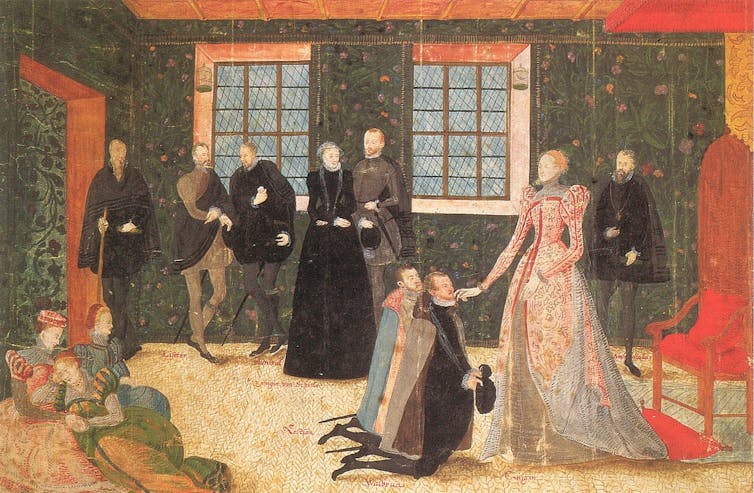
A painting of Elizabeth I receiving Dutch ambassadors, attributed to Levina Teerlinc, a female artist at the Tudor court. Wikimedia Commons
This imbalance is not just about who gets named. It is about who gets seen, studied, remembered and valued. This skewed perspective also shapes the historical understanding of thousands of students across England, year on year.
In mark schemes, where the content needed to achieve marks is specified, women only appeared in possible answers for 22.8% of questions, compared to 83.1% for men. This matters because students are both taught and assessed based on these mark schemes. It’s largely men who are presented as the “right” answer.
History exams also mention historians. Students are asked to respond to a historian’s viewpoint, or expected to refer to historians in their answers. But out of 163 historians mentioned in exams, sources or mark schemes, only 22 were women. This is a problem: 47% of UK academic historians in 2023-24 were women, and female students often outnumber male students in history at every level. Despite the evident popularity of the subject for female students, they cannot see themselves in exam assessments.
The current assessment system in England not only fails to reflect the diversity of historical experience – it actively reinforces distorted, male-centric narratives. If we want students to learn inclusive, representative history, we must start with the exams that often shape what gets taught.
Equipped with a greater understanding of their own and each other’s pasts and the skills to unpack diverse forms of evidence, students would be better informed to deal with conflicts and challenges as well as to reflect on other points of view.
History is not just about kings and wars. It’s about people. And half of those people have been missing from the story for far too long.
Natasha R. Hodgson had in the past received funding for research from the AHRC. The Teaching Medieval Women project which produced the research for the article receives internal funding for research assistance from Nottingham Trent University. Natasha is also part of the History sub group for the charity End Sexism in Schools. She has reviewed a module for Pearson and participates in the OCR History advisory board.
Once again there is an impasse in the attempts to bring an end to the war in Ukraine. A five-hour meeting in the Kremlin between the Russian president, Vladimir Putin, and the US team led by Donald Trump’s envoys, businessmen Steve Witkoff and Jared Kushner, has failed to make any significant progress.
Putin’s aide Yuri Ushakov described the talks, held on December 2, as “constructive”. But, tellingly, he added that “some American proposals appear more or less acceptable”. This was clearly a reference to the 28-point plan drawn up in late November by Witkoff and Kirill Dmitriev, the head of Russia’s direct investment fund.
This plan drew strong criticism from both Ukrainian and European leaders as it appeared to favour Russia, calling for Ukraine to give up territory, banning it from ever joining Nato and restricting the size of its armed forces.
The UK, France and Germany met in Geneva on November 22 and developed a counterproposal providing for a larger Ukrainian military and deferring the questions of Ukrainian territory and Nato membership for further negotiation. The plan was revised the following day by US and Ukrainian officials in Geneva and then again at Witkoff’s private members’ club in south Florida on November 30.
Washington and Kyiv announced a new “refined peace framework”, which they said represented “meaningful progress toward aligning positions and identifying clear next steps”. Any future agreement, a White House statement said, “must fully uphold Ukraine’s sovereignty and deliver a sustainable and just peace”.
But, predictably, progress towards any kind of peace, just or not, has run into a brick wall at the Kremlin. At the core of the stalemate is the question of territory. Putin insists on securing the whole of the Donetsk and Luhansk oblasts, including territory Russia has been unable, to date, to secure by force of arms. Kyiv and its European allies have made it clear that this outcome is unacceptable.
This highlights an important point of difference from some US statements, particularly Donald Trump, who has warned that: “The way it’s going, if you look, it’s just moving in one direction. So eventually that’s land that over the next couple of months might be gotten by Russia anyway.”
Putin has worked hard to reinforce this perception. In the days leading up to the most recent talks, he claimed that his troops had finally captured the strategically important town of Pokrovsk. He also warned that Russia would be ready to fight a war against Europe, “if Europe wants … They are on the side of war.”
In fact the reality is far more complex and lies somewhere in between. Russia’s advance in eastern Ukraine is real, but it is painfully slow and extraordinarily costly in terms of casualties.
Some estimates suggest it could take Russia months and possibly years to occupy all of Donetsk and Luhansk. Meanwhile, Russia has already lost more men in this campaign than in Chechnya and Afghanistan combined.
Does Russia want peace right now?
But the lack of progress in the talks – and the refusal of Putin to accept compromise – raises a deeper question: does Russia actually want to end the war at the moment?
The Kremlin’s current “red lines” for a peace deal: major territorial concessions by Ukraine, limits on its army and a ban on it ever joining Nato (surely the most certain security guarantee) looks more like a demand for capitulation from Kyiv than a compromise. Putin knows Kyiv cannot accept these terms.
But he appears to believe that time and resources are on his side. Russia’s economy is coping despite western sanctions. The high wages it is offering to people who sign up for the military are providing sufficient new troops to avoid taking the unpopular decision of a nationwide draft.
And, unlike his opponent, Ukrainian president Volodymyr Zelensky, he faces little domestic pressure. Zelensky, by contrast, has recently been hit by a corruption scandal that has cost him his closest advisor, Andrii Yermak. And, as winter hardens across Ukraine, Russian attacks on the country’s energy infrastructure regularly leave the country without power.
The US president is certainly keen for a deal. He has dubbed himself the “peace president”, so being seen to be a prime mover in bringing the Ukraine conflict to an end would burnish his image both internationally and for domestic audiences.
The Trump administration is clearly also interested in any commercial opportunities that might emerge in a settlement, some of which were included in the 28-point peace deal.
Putin’s wishlist
For Putin, an eventual military victory in Ukraine – while an end in itself – is not the only motivation for continuing the war. The conflict is also helping the Russian president realise other, longer-term foreign policy objectives, including, first and foremost, driving a wedge between the US and Europe and weakening Nato.
The absence of US secretary of state Marco Rubio from a meeting of Nato foreign ministers on December 3 and an apparent gap in US and European initial visions for peace suggest that the strength of western coordination is being tested.
Meanwhile dissent within the EU over continuing mechanisms to fund Ukraine’s defence, particularly from Hungary and Slovakia, betrays a growing divide in European unity. Hence the threatening rhetoric to take the fight to Europe itself, if necessary.
The impasse in Moscow shows how far away the sides remain and puts the pressure firmly back on Ukraine and its allies. It’s clear that Russia is not interested in moving away from its maximalist war aims.
Witkoff and Kushner are now set to meet with Ukrainian officials next week. Much may hang on how the US president reacts to the impasse between Putin and his envoys.
Commenting on the talks, Trump said: “What comes out of that meeting I can’t tell you because it does take two to tango. We have something pretty well worked out (with Ukraine)”. This could mean his sympathies are, at present, with Kyiv.
But as we know, this can change in the space of a phone call with Moscow.
Intigam Mamedov does not work for, consult, own shares in or receive funding from any company or organisation that would benefit from this article, and has disclosed no relevant affiliations beyond their academic appointment.
Source: The Conversation – UK – By Roman Birke, Assistant Professor in Modern European History, Dublin City University
Ukraine is facing two scenarios, and both look bleak. For any peace agreement to be accepted by Russia, Ukraine will almost certainly have to give up some of its territory. This would confirm that, in the 21st century, European borders can be redrawn by military force once more. If no deal is reached, the war will drag on.
Whichever outcome emerges, it appears that no position rooted in the defence of core international legal principles can prevail. This position would be the denial of territorial gains achieved through warfare and the prosecution of crimes committed during the conflict. International relations appear to have reverted to raw state power.
The peace negotiations have revealed that parts of the US government are willing to hand Moscow major concessions, including impunity for war crimes. Europe, including neutral countries like Ireland and Austria, now faces a growing obligation to stop what could be the biggest setback for international law since the cold war.
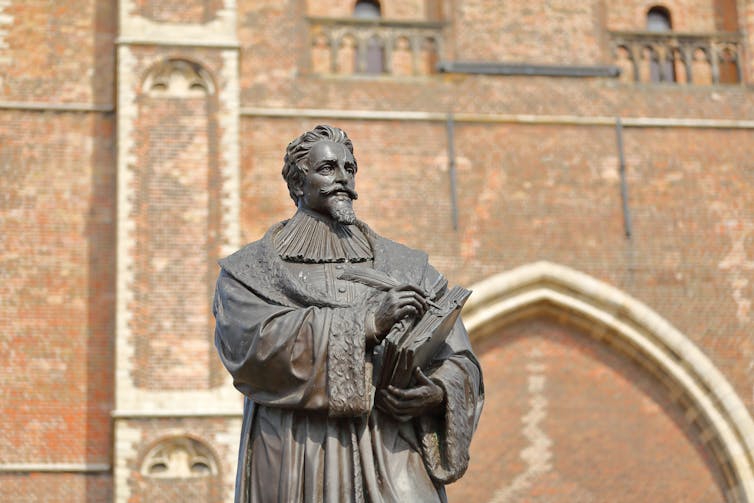
To understand the current state of international law, it is useful to look at the longer historical arc of how warfare has been regulated. Hugo Grotius, a Dutch lawyer born in 1583, became one of the most influential European thinkers on the laws of war.
He argued that only “just” wars – where one side resorts to violence to defend itself or enforce property rights – should be legal.
But after years of work on a list of just and unjust causes for war, Grotius came away disillusioned. He concluded that any state would always claim its wars were just and that such determinations might increase violence overall.
From the outside, other states couldn’t easily judge the real reasons behind a war. And if they chose a side, they would feel obliged to back the state they believed was in the right. Grotius warned that this would only drag more countries into conflict.
Grotius ultimately came to believe that societies had little choice but to accept conflict and treat its results as justified. As Yale University law professors Oona Hathaway and Scott Shapiro show in their 2018 book, The Internationalists, Grotius’s position remained dominant for centuries.
The late-19th and early-20th centuries did bring attempts to regulate warfare. This included the creation of organisations such as the International Committee of the Red Cross that provided medical aid to soldiers. But the fundamental idea that war was legitimate persisted.
Later initiatives seemed to overturn Grotius’s logic. These included the Kellogg-Briand pact of 1928 in which 15 ratifying states promised not to use war to resolve disputes, the UN Charter of 1945 and the establishment of the International Criminal Court (ICC) in 2002.
Despite its obvious later failure, the Kellogg-Briand pact declared that war should be renounced as an “instrument of national policy”. And in 2018, the ICC criminalised the “planning, preparation, initiation or execution” of aggressive wars. The hope was that this definition would deter future invasions, including actions like Russia’s assault on Ukraine.
The return of Grotius
Does the current state of peace negotiations between Russia and Ukraine signal a return of Grotius’s view that military gains, once consolidated, will ultimately be recognised? And might this view even be the wiser position as it acknowledges Russia’s military strength instead of prolonging – and possibly widening – the war in Ukraine?
For a time, such conclusions seemed unnecessary. As Hathaway argued one year into the war, there was no doubt that Russia had blatantly violated international law. But she emphasised that law was not powerless.
The imposition of sanctions, widespread military support for Ukraine and ICC arrest warrants for Vladimir Putin and other senior Russian officials showed that international law can fight back. While conflict could not be prevented, coordinated international action could inflict heavy costs on states like Russia for waging aggressive wars.
However, this argument is now hard to uphold. The Trump administration’s original 28-point peace plan, which was unveiled in November, included not only the acceptance of Russian territorial gains but also the lifting of sanctions and the granting of amnesty for perpetrators of war crimes.
In such a form, it would constitute a Grotian outcome: less powerful states can be attacked with impunity and, without risking wider war, there is little Europe and its partners can do about it. Such a deal would reward perpetrators without inflicting any costs and would be a dangerous signal in a volatile world.
Whatever the outcome of the peace negotiations, Ukraine will need continued European support to defend the remaining parts of its territory. And if a peace deal is signed, Europe must build enough deterrence to ensure that Russia will not attempt another major push to extend its borders.
In the face of the growing detachment of the US, it will also be up to Europe to inflict costs on Russia over its war of aggression when a peace deal is reached. This may include using frozen Russian assets to support the rebuilding of Ukraine and insisting on legal accountability.
Whether a deal is reached or not, these scenarios will require a major overhaul of European security and defence policy – something Europe repeatedly aspired to do after 1945 but failed to implement. As part of this, EU countries like Ireland and Austria that maintain military neutrality need to articulate a clear position regarding what they are willing to contribute.
While there can be space for neutral states within a wider European security framework, the starting point should be unity across European countries about a rejection of the idea that Russia’s actions should go unpunished and that international legal principles can simply be set aside.
With waning US support, Ukraine is pinning its hopes on Europe. In his recent speech to the Irish parliament, Ukrainian president Volodymyr Zelensky emphasised legal accountability and called on Ireland to support “all efforts to make the tribunal for Russia’s aggression a reality”.
Europe should use its weight to keep this point on the agenda. It is in the interest of all European countries to stop the return to the world of Grotius.
Roman Birke does not work for, consult, own shares in or receive funding from any company or organisation that would benefit from this article, and has disclosed no relevant affiliations beyond their academic appointment.
Clothing is one of the top categories in online sales worldwide, with expected revenues of more than US$920 billion (£702 billion) this year. And for clothing businesses, like many others, online retail opens the door to a wider customer base.
While there are clear benefits to selling clothing online, many businesses find their return rates are high. This can be as much as one in every five items, which is costly for businesses.
There is also the environmental cost of returns, both from increased transport emissions and wasted packaging. Some returned items even end up in landfill.
Sizing issues are a commonly cited reason for returns – but there are also other key elements. These include the lack of touch and the fact that a consumer can only know what the item feels like after they’ve bought it.
Touch can influence how consumers evaluate products – unsurprisingly, a shopper’s preferred textures tend to generate more positive reactions. Touching the garments can also instil confidence in the quality of the product.
And of course, clothing comes into contact with our largest organ, the skin. So it seems logical that tactile input should help to forge the relationship people have with their clothes. The skin is packed with nerve endings, which give people detailed information about what they are wearing.
Some items might be a joy to wear, while others may feel itchy or restrictive – so much so that they might never be worn again. Through touch, consumers gain formative impressions of garments, which shape perceptions of luxury or cheapness, for example.
But online, consumers can’t touch products before buying. They have to wait for them to arrive before determining whether they satisfy this tactile impression. If it’s a no, the item is likely to be returned.
Overcoming the lack of touch
Even though there is no true substitute for real-life touch, there are things retailers can do to appeal to consumers’ tactile sense.
Verbal (using voiceover or video on the website) and written descriptions of tactile properties can help to compensate for not actually touching the garment. But words can be subjective – when relying on them, retailers need to be specific. Generic wording such as “soft” or “hard” is not ideal. Instead, it is better for retailers to be more specific, perhaps using phrases like “soft as a feather”.
When attributes like fabric and fit are clearly described, it can help consumers to recall past experiences with similar clothing. This in turn can affect how the consumer perceives the quality of the item, overcoming uncertainty and making them more likely to buy.
Even observing another person touching a product, in a video on the website, for example, can help a potential buyer to connect with the item so that it generates a perception of ownership. This “psychological ownership” is known to make consumers evaluate the product more favourably – and makes them more likely to buy.
If a consumer has a high need for touch (and lots of people do) it can help if they can imagine touching the product even though they are only seeing it online. Strong visual touch cues can subconsciously nudge a shopper to do this.
Similar to real-life touch, so-called “imagine touching” is known to alter consumer perception. “Imagine touching” clothing can help a would-be buyer to judge its quality and aesthetic value.
To help with this, retailers can provide clear visuals with close-ups and zoomable images so that the consumer can clearly see the surface of the fabric. It may also help if consumers can see how the fabric moves. The more information the retail site can provide about the material, the more likely it is to reproduce a sensorial situation akin to how a customer would experience in-store shopping.
When online retailers try to make up for the lack of tactile cues, this can help consumers to make better decisions – and ultimately make them less likely to send their purchases back. This should be a win-win for both the consumer and the retailer.
Cathrine Jansson-Boyd does not work for, consult, own shares in or receive funding from any company or organisation that would benefit from this article, and has disclosed no relevant affiliations beyond their academic appointment.













_-_Noah,_a_Mystery_Play_-_KINCM-2005.4842_-_Ferens_Art_Gallery.jpg)
