Boîtes de conserve : des risques invisibles pour la santé ?

Source: The Conversation – in French – By Antía Lestido Cardama, Doctora en el área de Innovación en Seguridad y Tecnologías Alimentarias, Universidade de Santiago de Compostela

Mieux vaut éviter d’assaisonner des pâtes ou des salades avec le liquide contenu dans les boîtes de conserve, car cela pourrait augmenter l’exposition à certaines substances à risque. Ilia Nesolenyi/Shutterstock

Les boîtes de conserve métalliques qui contiennent des aliments ou des boissons sont des emballages sûrs pour la santé. Cependant, il est nécessaire d’approfondir les interactions possibles entre l’emballage et les aliments. C’est ce qui ressort d’analyses faites sur du thon et des boissons en conserves par des chercheurs de l’Université de Santiago de Compostela, en Espagne, en collaboration avec l’Agence nationale de sécurité alimentaire et nutrition (AESAN).


Elles font partie de tout kit de survie et beaucoup d’entre elles sont indispensables à la vie universitaire des étudiants. Si nous n’avons pas envie de cuisiner ou quand nous manquons de temps, elles sont la meilleure option, et elles sont indispensables si nous partons camper. Nous parlons bien sûr des conserves qui permettent de garder différents types d’aliments et de boissons dans des conditions nutritionnelles et organoleptiques parfaites.

Ce mode de conservation est utilisé depuis des décennies dans notre système alimentaire. Parmi ses nombreux avantages, il permet notamment de garder les aliments dans nos placards pendant des années grâce à leur date limite de consommation très longue.

De ce fait, traditionnellement, dans la société, les boîtes de conserve sont associées à un moyen sûr de conserver les aliments. Cependant, d’un point de vue chimique, il est nécessaire d’étudier plus en profondeur les interactions possibles entre l’emballage et les aliments qu’il contient afin de garantir leur innocuité.

En général, sauf si nous constations des bosses ou des traces de rouille sur les conserves, nous considérions que nous pouvions être tranquilles. Un choc nous mettait en alerte et ce, à juste titre, car cela peut endommager l’intégrité de la boîte au point de provoquer de petites perforations qui ne sont pas toujours visibles, ce qui facilite l’entrée de bactéries et, par conséquent, la contamination des aliments à l’intérieur de la conserve.

Ce qui a généralement été ignoré ou, a minima, insuffisamment abordé, ce sont les questions de sécurité alimentaire liées aux composants de la boîte de conserve, par exemple l’augmentation potentielle de l’exposition à des substances dangereuses que représenterait l’assaisonnement d’une salade avec l’huile qui accompagne le thon en conserve.

Les risques liés aux composants des boîtes de conserve

De quelles substances parlons-nous ? Et surtout, à quels risques sommes-nous exposés ? Les emballages métalliques contiennent généralement des revêtements polymères qui agissent comme une barrière entre les aliments et le métal. Ce revêtement empêche la corrosion de la boîte et préserve les propriétés organoleptiques et la qualité des aliments.

Cependant, certains de ses composants peuvent se retrouver dans les aliments par un processus appelé migration. Cela peut affecter la qualité du produit et, dans certains cas, représenter un risque potentiel pour la santé du consommateur, soit en raison de son ingestion en quantités importantes, soit en raison d’une exposition cumulée tout au long de la vie via l’alimentation.

Des perturbateurs endocriniens dans les boîtes de conserve

Le groupe FoodChemPack (Recherche, développement et évaluation de la sécurité chimique des aliments et des matériaux en contact avec les aliments) de la faculté de pharmacie de l’université de Santiago de Compostela (USC), en Espagne, étudie les revêtements des boîtes métalliques, pour les boissons comme pour les conserves alimentaires, dans le cadre de plusieurs projets (MIGRAEXPO, MIGRACOATING, BACFood4Expo et ACHED), en collaboration avec l’Agence espagnole dédiée à la sécurité alimentaire et à la nutrition (AESAN).

Au cours de ces dernières années, nous avons constaté que de nombreux revêtements contenaient des résines époxy à base de bisphénol A diglycidyl éther (BADGE), synthétisé à partir d’épichlorhydrine et de bisphénol A (BPA), un perturbateur endocrinien qui interfère avec le système hormonal. Il contribue ainsi au développement de maladies métaboliques, telles que le diabète ou l’obésité, et peut affecter le système reproducteur, entre autres effets néfastes. En 2011, la dangerosité de ce composé a ainsi conduit à son interdiction dans les biberons pour bébé.

Les autorités européennes réduisent de plus en plus la quantité maximale de bisphénol à laquelle la population générale devrait être exposée. À tel point que la Commission européenne a récemment interdit l’utilisation du BPA et de ses dérivés dans les matériaux destinés à entrer en contact avec des denrées alimentaires.

Le thon, plutôt au naturel que dans l’huile ou à l’escabèche

Dans les boissons que nous avons étudiées (boissons alcoolisées, énergisantes, rafraîchissantes ou eau minérale), la migration de ces composés dérivés du bisphénol A s’est avérée faible. En revanche, dans les aliments en conserve, en particulier dans ceux à forte teneur en matières grasses, des niveaux de migration plus élevés ont été mesurés.

Par exemple, dans les conserves, comme le thon à la tomate, à l’escabèche ou à l’huile, des concentrations plus élevées que dans le thon au naturel ont été relevées pour un autre composé appelé cyclo-di-BADGE. Contrairement au BPA, ce composé n’est pas encore réglementé en raison du manque d’informations toxicologiques.

Pour toutes ces raisons, nous considérons que ce n’est pas une bonne habitude d’assaisonner des pâtes ou des salades avec le liquide contenu dans les boîtes de conserve, car cela pourrait augmenter notre exposition à ces substances.

De plus, il a été observé que le fait de réchauffer les aliments directement dans la boîte de conserve, une pratique associée à des contextes spécifiques, tels que le camping, peut augmenter la migration de ces composés. En effet, la chaleur accélère les processus de transfert des substances depuis la couche interne de l’emballage vers les aliments, ce qui pourrait augmenter les risques pour la santé.

Qu’absorbons-nous, comment et en quelle quantité ?

Dans des études récentes, nous avons constaté que la bioaccessibilité de ces substances, c’est-à-dire la quantité qui pourrait être absorbée par l’organisme, augmente considérablement lorsqu’elles sont ingérées avec des aliments gras.

Pour parvenir à cette conclusion, nous avons tenté de simuler la manière dont notre système digestif traite ces composés. Pour ce faire, nous avons utilisé le protocole de digestion gastro-intestinale in vitro INFOGEST qui, entre autres, simule la composition de la salive et des fluides gastro-intestinaux, la durée de chaque phase, la température ou les valeurs de pH corporelles. Nous avons ainsi pu observer comment différents groupes de populations sont exposés de manière différente à ces substances, principalement en fonction du pH basal de l’estomac, qui est de 1,5 chez les adultes, tandis que les enfants et les personnes âgées ont un pH gastrique moins acide.

Dans la majorité des cas, les quantités détectées étaient inférieures aux limites fixées par la Commission européenne. Il est toutefois important de tenir compte de l’exposition potentielle par différentes voies et de l’exposition cumulative tout au long de la vie. En effet, une personne peut être en contact avec la même substance de différentes manières, non seulement par voie orale, par l’eau ou les aliments, mais aussi par d’autres voies, telles que les voies respiratoires ou cutanées. Cela peut augmenter l’exposition totale de l’organisme à cette substance.

Même à de faibles niveaux, une exposition prolongée peut avoir des effets négatifs sur la santé, en particulier chez les groupes de populations les plus vulnérables.

Une société informée, une alimentation plus sûre

La connaissance de ces résultats, et de ceux à venir, permettra aux consommateurs de prendre des décisions éclairées concernant l’utilisation de ce type d’emballages (par exemple, ne pas chauffer directement les boîtes de conserve sur le feu lorsque l’on fait du camping) et la consommation des aliments (par exemple, éviter de réutiliser les liquides de couverture pour assaisonner les salades), ce qui contribuera ainsi à une alimentation plus sûre.

The Conversation

Lara Pazos Soto a reçu des financements de Xunta de Galicia.

Antía Lestido Cardama ne travaille pas, ne conseille pas, ne possède pas de parts, ne reçoit pas de fonds d’une organisation qui pourrait tirer profit de cet article, et n’a déclaré aucune autre affiliation que son organisme de recherche.

ref. Boîtes de conserve : des risques invisibles pour la santé ? – https://theconversation.com/boites-de-conserve-des-risques-invisibles-pour-la-sante-258330

Pets don’t necessarily improve their owners’ well-being

Source: The Conversation – Canada – By Christophe Gagné, PhD candidate, Psychology, Université du Québec à Montréal (UQAM)

People often turn to pets to boost their mood and find companionship. Improving well-being and reducing loneliness are among the most cited reasons for adopting an animal companion.

But even though the belief that pets bring many benefits to their owners is widespread, research shows that having a pet is not a panacea for bolstering human psychological well-being.

Despite this, pets are often portrayed in the news and on social media as effective solutions to reduce stress and loneliness, reflecting a popular belief in their health benefits. This can lead people to adopt pets without fully considering the responsibilities and demands involved, which can have negative consequences for both themselves and their pets.

As social psychologists studying human-pet relationships, we take a more nuanced approach, examining when, how and for whom pets can — or cannot — enhance well-being.

What the research says

Many studies have found that pet owners are less anxious, lonely and stressed out compared to people who don’t have pets. Pet owners also report being more satisfied with their life.

These studies often catch our attention because they tap into something many of us believe: that our pets are good for us. This type of research offers reassurance and validates the deep bond we may feel with our animal companions. But they only tell one side of the story.

Other studies have found no significant link between pet ownership and human well-being. In other words, people with pets don’t necessarily report higher well-being, nor do they have better mental health than those without pets.


Read more:
Dogs may reflect their owners’ stress levels, finds research


Our research into pet ownership in Canada during the COVID-19 pandemic was surprising: it found that owning a pet was generally associated with lower well-being and mental health.

The study included both pet owners and those without pets, aiming to compare the two groups on various well-being indicators during the pandemic. Pet owners reported lower well-being than non-pet owners during that time, including higher levels of loneliness.

These inconsistencies across different studies show that the connection between having a pet and feeling good isn’t so straightforward. Our study indicated some of these complexities. For example, compared to owners of other pets, dog owners reported higher well-being.

To make sense of these mixed findings, researchers have started to look more closely at the nature of the relationship between owners and their pets. This approach may help us better understand the factors that influence whether pet ownership is beneficial for our well-being.

The quality of the connection

Just like our relationships with people, our bond with pets is complex. Many aspects of this connection can influence how much we benefit from it. It’s not just having a pet that counts, but how we bond and interact with them.

For example, owners who experience anxiety about being away from their pets or question their pet’s affection — reflecting an insecure attachment to a pet — also report feeling more depressed. Perceiving our pets as less understanding or more insensitive to our needs is also associated with higher levels of depression, anxiety and loneliness.

In contrast, the more people feel that they share characteristics with their pets (for example, loyalty, a mutual love of sleeping), the more likely they are to report higher well-being. Pets are also perceived as living in the present, not dwelling on the past or worrying about the future. Interacting with our animal companions mindfully can help us focus on the present moment as well, which also promotes greater well-being.


Read more:
Do people really resemble their dogs?


By nurturing the positive aspects of our relationships with pets and working through the more difficult ones, we may ease the stress associated with some of the challenges of caring for them, including the financial resources required or the anxiety we feel when they get sick.

Some challenges of pet ownership

In fact, pet ownership comes with responsibilities and challenges that don’t seem to be discussed as often as the benefits. These more difficult aspects of caring for a pet can sometimes be emotionally distressing and negatively impact a pet owner’s psychological well-being.

Having pets, no matter how much we love them, requires time, energy and financial resources. For some, especially during the COVID-19 pandemic, this responsibility may represent an additional source of stress. In our study, pet ownership was linked to lower well-being among women and among those with two or more children at home — groups already facing increased child-care and household demands.

Similarly, pet ownership was associated with lower well-being for people who were unemployed or in less stable forms of employment (for example, students, homemakers). Limited financial resources may have made pet care more challenging.

Likewise, having to care for a sick animal can be emotionally distressing for the owners. Caregivers of chronically sick dogs report feeling hopeless and powerless, especially when they cannot help to alleviate their dogs’ suffering.

Other factors, such as the pet’s behavioural problems and the grief experienced after losing a pet, can also be difficult for owners. For those contemplating adoption, it’s important to take these realities into account to make an informed decision.

Meeting our pet’s needs

There are many important factors to consider when welcoming a new animal companion into our homes. Above all, we need to ensure we have the time, energy and resources to meet their needs.

Choosing a pet carefully, based on what we realistically can offer and on reliable information about their characteristics and needs, gives us the best chance of having a positive and successful relationship.


Read more:
For better or worse, your dog’s behaviours can impact your quality of life


Supporting our pets’ needs can also improve our own well-being as owners, showing the potential for mutually beneficial interspecies relationships. But when those needs are not met, both pets and their owners can end up feeling stressed and unwell.

When considering adopting a pet, it’s important to ask: why do we want a pet? If the idea is to improve psychological well-being, our research suggests we might need to think again.

The Conversation

Catherine Amiot is a member of the emerging Board of Directors of the PHAIR Society, an academic society that seeks to promote research on human-animal intergroup relations. She has received funding from the Social Sciences and Humanities Research Council of Canada (SSHRC) and from the Fond de recherche du Québec – Santé (FRQS) for the research conducted in her laboratory which is presented in this article.

Christophe Gagné does not work for, consult, own shares in or receive funding from any company or organisation that would benefit from this article, and has disclosed no relevant affiliations beyond their academic appointment.

ref. Pets don’t necessarily improve their owners’ well-being – https://theconversation.com/pets-dont-necessarily-improve-their-owners-well-being-259973

Should back-to-school require parent fundraising? Ontario schools are woefully underfunded, and families pay the price

Source: The Conversation – Canada – By Lana Parker, Associate Professor, Faculty of Education, University of Windsor

Back-to-school is around the corner, which means that many parents will soon receive requests from schools to pay fees, contribute supplies or support fundraising activities.

But many families are already shouldering significant financial concerns. This raises the question why Ontario schools have become so reliant on direct fundraising contributions from parents.

Though the Ontario government insists it has never spent more money on education, a closer look at the facts and figures reveals that the budget allocated to education is woefully short of covering necessities.

My research, “Infinite Demands, Finite Resources: A Window into the Effects of Ongoing Underfunding and Trends of Privatization in Ontario Schools,” draws on discussions with educators to share insiders’ perspectives on how underfunding looks and feels in schools.

Increased demands, shortfalls

The Canadian Centre for Policy Alternatives (CCPA) released a 2022 report showing that, even amid the increased complexity of teaching during the pandemic, the Ontario government increased class sizes, cut funding and teaching staff and continued to permit the backlog for school infrastructure repair to balloon to nearly $17 billion.

Using the current government’s budget projections, Ontario’s Financial Accountability Office has forecast the education system will see a $12.3 billion shortfall over the next decade.

While some people might ask whether these cuts are a marker of prudent financial stewardship, the numbers once again reveal a different story.

The CCPA report showed that while Ontario had robust GDP growth of nine per cent in 2021 and 6.6 per cent in 2022, Ontario’s Financial Accountability Office found that, in 2017, “overall program spending in Ontario averaged roughly $2,000 per person, per year less than the average of the other provinces.”

In other words, the province has adequate funding, but is choosing to under-serve certain portfolios. For example, Ontario announced in its latest budget it will invest $28 billion on highways over 10 years.

Public investment with future returns

The choice to underfund education is shortsighted because research shows education is a public investment that can generate a high level of future returns.

This under-investment in education has real consequences for the day-to-day quality of schools. Parents who have children with special education needs have long been raising the alarm that their children lack access to adequate testing and supports, which is a direct function of insufficient funding.

Ontario’s principals, teachers and other educators issued an urgent statement in February 2025 advising the public of chronic underfunding and subsequent system challenges that “threaten the very foundation of the education our children and young people deserve.”

How boards are managing shortfalls

My recent research shines a light on the need for more sustainable funding.

The 11 highly experienced educators and one education organizer in my study described how school boards are trying to manage budget shortfalls by asking schools to increase fundraising and by asking school principals to look for private sector contributions.

They discuss how fees are becoming commonplace for extracurricular activities, which places a burden on families.

They decry the loss of materials for school libraries, arts programs and performance spaces. And they warn that the system cannot take many more years of disinvestment.

Full scope may not be clear to parents

Because educators are employed by public school boards and are responsible to the Ministry of Education, they might not be empowered to express their concerns to parents directly. Even parents who participate in school council meetings or fundraising efforts may not understand how much of an issue education underfunding is in their child’s school.

However, with their decades of experience, the educators in my study are unambiguous about the current situation.

One educator shared, “The students who suffer the most are the ones who are in our ESL programs and who are in our special education programs.”

Another noted, “With the formulas that would have been used pre-pandemic, I would have had four and a half, maybe five special education resource teachers and last year I had fewer than two.”

Yet another revealed, “There’s hundreds of kids in our neighbourhood who have never had a music teacher.” Another spoke about playgrounds, noting their board was being encouraged to seek private donations:

“That was part of the message we got the other day: ‘Look over to this school. The
[foundation name] came and built their playground. Maybe y’all should try that.’ We’re being told that we should be seeking out these donations. That’s highly problematic.”


Read more:
Music also matters in the real world


These are losses of public education goods and services that not that long ago would have been available to all children.

As one of the participants noted:

“There are a number of opportunities that used to exist that no longer exist, and then parents get upset because they think, ‘Well, when I was in school, all of this was around. What happened?’ … Really, it’s about the underfunding.”

Province appointing supervisors

Recently, the Ontario government appointed supervisors to some boards, announcing that “investigations showed they each had accumulated deficits.”

In so doing, the government is asserting more control over public education and runs the risk of political partisanship (one of the appointed supervisors is a former Progressive Conservative MPP).

Journalist Wendy Leung with The Local, who has covered the significance of these appointments, reports the move also “hampers public scrutiny over what’s happening at the boards.”

Taking over boards can be seen as a distraction tactic as the government is asking them to meet growing needs with fewer resources.

Instead of increasing funding, which is necessary and long overdue, the government is likely to cut costs in the short term by privatizing services, a trajectory researchers have documented for some time. These shifts to the private sector are shortsighted attempts to balance a budget that only serve to raise the taxpayer burden over time.

People in Ontario — and across Canada — should be proud of our public education systems. They are held in high regard globally. But education requires ongoing financial investment in our children’s futures.

It took robust political will to compel governments to offer free public education to all children.

This history suggests it will take ongoing pressure from parents applied directly to the Ministry of Education, or via engagement with school councils and school boards, to demonstrate their desire for fair and sustainable public schooling and ensure governments do not shortchange education.

In this way, support for children today will be improved, and the proud inheritance of public education will be strengthened and viable for generations to come.

The Conversation

Lana Parker receives funding from the Canadian Social Sciences and Humanities Research Council. She is affiliated with the Public Education Exchange.

ref. Should back-to-school require parent fundraising? Ontario schools are woefully underfunded, and families pay the price – https://theconversation.com/should-back-to-school-require-parent-fundraising-ontario-schools-are-woefully-underfunded-and-families-pay-the-price-261036

Vaccine hesitancy: How social and technological issues converged to spawn mistrust

Source: The Conversation – Canada – By Emanuele Blasioli, PhD Candidate in Management Science, DeGroote School of Business, McMaster University

The rise in vaccine-preventable diseases around the world is threatening decades of progress in public health and putting millions of people at risk.

The decline in vaccination coverage in the United States illustrates the global problem. Rates of most routine vaccinations recommended for children by age 24 months by the Advisory Committee on Immunization Practices, which focus on 15 potentially serious illnesses, have declined.

Canada has not been spared from this phenomenon. As of July 19, there have been 4,206 measles cases (3,878 confirmed, 328 probable) in 2025 reported by 10 jurisdictions (Alberta, British Columbia, Manitoba, New Brunswick, Northwest Territories, Nova Scotia, Ontario, Prince Edward Island, Québec and Saskatchewan).

This decline in vaccine coverage is often attributed to misinformation and disinformation. As data analytics researchers, we used operations research techniques to understand why people are vaccine-hesitant. In our study, we explore how anti-vaccination sentiments and attitudes can be better understood through an integrated approach that combines social network analysis with insights into psychological reactance and the influence of eHealth literacy on health-related behaviours.

So what fuels skepticism about vaccines? It’s a complex blend of personal, social and environmental factors.

How our brains decide (and often get it wrong)

People typically use mental shortcuts, known as heuristics, to simplify complex issues.

The purpose is to minimize analytical efforts and speed up decision-making, which can sacrifice accuracy for the sake of efficiency. This results in distortions known as cognitive biases, which influence judgment and decision-making.

Vaccination decisions are influenced by these processes in the same way as any other decision.


Read more:
How cognitive biases and adverse events influence vaccine decisions (maybe even your own)


Skepticism toward vaccines has often been associated with fears related to possible side-effects. These fears are fuelled by our broad tendency to overestimate negative consequences, a mechanism known as risk-perception bias.

A recent study published in Nature Scientific Reports confirmed that vaccine-hesitant individuals are more sensitive to risk, and give undue weight to potential side-effects.

Another study, from the journal Vaccine: X, looked at cognitive biases related to vaccine hesitancy and revealed four factors significantly associated with hesitancy. These are:

  • fear of vaccine side-effects (skepticism factor),
  • carelessness about the risks of not being vaccinated (denial factor),
  • optimistic attitude, believing they are less at risk of illness (optimistic bias factor) and
  • preference for natural products (naturalness bias factor).

Existing beliefs can also significantly interfere with evaluations and decisions, since people are inclined to seek information that reinforces and confirms their convictions. Confirmation bias interferes with the rational evaluation of evidence related to vaccine safety and efficacy.

The effect of this bias becomes particularly relevant when analyzing how susceptible individuals are to misinformation — a major barrier to vaccine uptake.

The myth of rationality

Assuming human beings can make fully rational decisions is helpful for developing simulations and models, like those in game theory. Game theory is a powerful analytical tool often used in operations research to understand phenomena arising from the interaction of multiple decision-makers, allowing us to predict the possible scenarios that may unfold.

Insights from behavioural economics and cognitive psychology suggest that any assumption of rationality is often wildly optimistic.

Bounded rationality” describes the constraints within which reason operates. Human judgments suffer from a scarcity of information, time limitations and our limited ability to analyze.

Still, even the most effective information would not be enough to convince all vaccine-hesitant individuals. In some cases, it can have the opposite effect.

Understanding psychological and attitudinal predictors of vaccine hesitancy allows us to compare their influence in different contexts. Contexts define the environmental background (or setting) in which individuals decide about the vaccine.

These comparisons show that thought patterns and attitudes that feed into vaccine hesitancy can be modified, unlike stable risk factors, including demographic factors, such as unemployment, lower education, younger age, rural residency, sex and migrant status.

Change in vaccination decision over time

Immunization behaviours evolve over time, influenced by social dynamics. Researchers have studied why voluntary vaccination programs for childhood disease sometimes fail, showing how self-interested decision-making leads to lower vaccination rates and prevents the complete eradication of the illnesses that vaccination could otherwise control.

Assuming parents can make perfectly rational decisions, the study outlined two scenarios:

  1. The benefit of vaccination for their child, accepting there might be some risk of side-effects;

  2. The benefit of not vaccinating, knowing they can avoid side-effects, and hoping their child won’t catch the disease.

Whenever these choices seem equally good to parents, the researchers found there is a critical drop in vaccination uptake, especially for highly contagious diseases.

Another study investigated why vaccination rates swing wildly up and down over time instead of remaining steady.

The authors focused on how people copy each other’s behaviour and looked at two actual vaccine scares that happened in England and Wales, one in the 1970s with whooping cough vaccine and another in the 1990s with the measles, mumps and rubella (MMR) vaccine.

They found that parents oscillated between vaccinating and not as they followed the herd in whatever choice seemed safest, causing boom-and-bust cycles and unstable community protection from the targeted illnesses.

Such dynamics can also result in localized pockets of under-vaccination that benefit the unprotected through herd immunity, but also risk unvaccinated groups becoming high-risk clusters if that protection deteriorates.

Echo chambers in social media

The COVID-19 pandemic has proven how damaging misinformation, disinformation, information voids and information gaps can be to public health, including immunization coverage and vaccine hesitancy.

The relationship between social media misinformation and vaccine hesitancy can be understood by looking at two elements: how much individuals are exposed to it and how persuasive social media is.

At the height of the COVID-19 pandemic, vaccine-skeptical content on social media had a significant negative effect and fuelled doubts about vaccine safety and effectiveness, particularly when not subjected to flagging by fact-checkers.

The impact of unflagged vaccine-skeptical content in driving vaccine hesitancy was estimated to be 46 times greater than flagged misinformation content.

Factually accurate but potentially misleading content — such as a rare instance where a young, healthy individual passed away shortly after being vaccinated — also plays a critical role in driving up vaccine hesitancy.

In our own research, we and our collaborators argue that investigating the role of social media networks can help us develop new strategies to promote and increase evidence-based vaccine literacy.

The Conversation

Elkafi Hassini received Discovery and Alliance grants funding from the Natural Sciences and Engineering Research Council of Canada that supported this research.

Emanuele Blasioli does not work for, consult, own shares in or receive funding from any company or organisation that would benefit from this article, and has disclosed no relevant affiliations beyond their academic appointment.

ref. Vaccine hesitancy: How social and technological issues converged to spawn mistrust – https://theconversation.com/vaccine-hesitancy-how-social-and-technological-issues-converged-to-spawn-mistrust-261938

Mars : la planète rouge se pare de vert durant la nuit

Source: The Conversation – in French – By Lauriane Soret, Planétologue, Université de Liège

Le rover Perseverance devant une aurore sur la planète Mars – observée, pour la première fois en 2024, dans le domaine visible. ©️Alex McDougall-Page, Fourni par l’auteur

Sur la planète Mars, il y a des lumières qui dansent dans la nuit, un peu comme les aurores boréales sur Terre. On peut aujourd’hui les observer dans différentes couleurs, depuis l’orbite ou à la surface de la planète rouge… et vert, donc.


Mars, la planète rouge, n’est finalement pas uniquement rouge.

Durant la nuit, la planète se pare de lumières vertes, certaines semblables aux aurores boréales ou australes se produisant sur Terre. Ces lueurs sont si intenses qu’elles pourraient être observées à l’œil nu par de futurs astronautes en orbite ou à la surface de Mars. Mais outre les aurores, les astronautes pourront également voir un autre phénomène lumineux nocturne appelé « nightglow », ce que l’on pourrait traduire par « lueur nocturne ».

Aurores et lueurs nocturnes martiennes étaient bien connues dans l’ultraviolet et l’infrarouge, principalement grâce aux missions Mars Express (depuis 2003) et MAVEN (depuis 2013). Mais c’est depuis 2023 seulement que nous avons pu les détecter dans le domaine du visible, grâce à la mission ExoMars de l’Agence spatiale européenne (ESA) et aux observations du rover Perseverance de la NASA.

Ces observations ouvrent la voie à de futures études avec des instruments conçus dans le domaine de visible, plus simples, plus légers et moins onéreux que ceux conçus pour observer les ultraviolets. En particulier, le nightglow doit nous apprendre davantage sur la dynamique et de la composition de l’atmosphère martienne ; tandis que les aurores nous renseignent sur les interactions entre le vent solaire et la planète rouge… et vert.

Aurore ou « nightglow » ?

Même si ces deux types d’émission lumineuse, aurore et nightglow, produisent des lueurs dans l’atmosphère, les processus en jeu sont complètement différents.

Les aurores sont le résultat de l’interaction de particules énergétiques venant de l’espace avec les atomes ou molécules de l’atmosphère neutre de la planète, par exemple l’azote ou l’oxygène sur Terre, et le CO2 sur Mars. Sur Terre, les aurores se forment près des pôles, car c’est là que convergent les lignes du champ magnétique terrestre que suivent les électrons du vent solaire.

Mais sur Mars, la réalité est bien plus complexe, car le noyau de la planète Mars ne génère pas de champ magnétique comme celui de la planète Terre. C’est d’ailleurs pour cette raison que la communauté scientifique ne s’attendait pas à trouver d’aurores dans l’atmosphère martienne, jusqu’à la découverte d’émissions aurorales ultraviolettes, en 2005, avec l’instrument SPICAM de Mars Express (ESA).


À lire aussi :
D’où viennent les aurores boréales, et pourquoi sont-elles si différentes sur Jupiter?


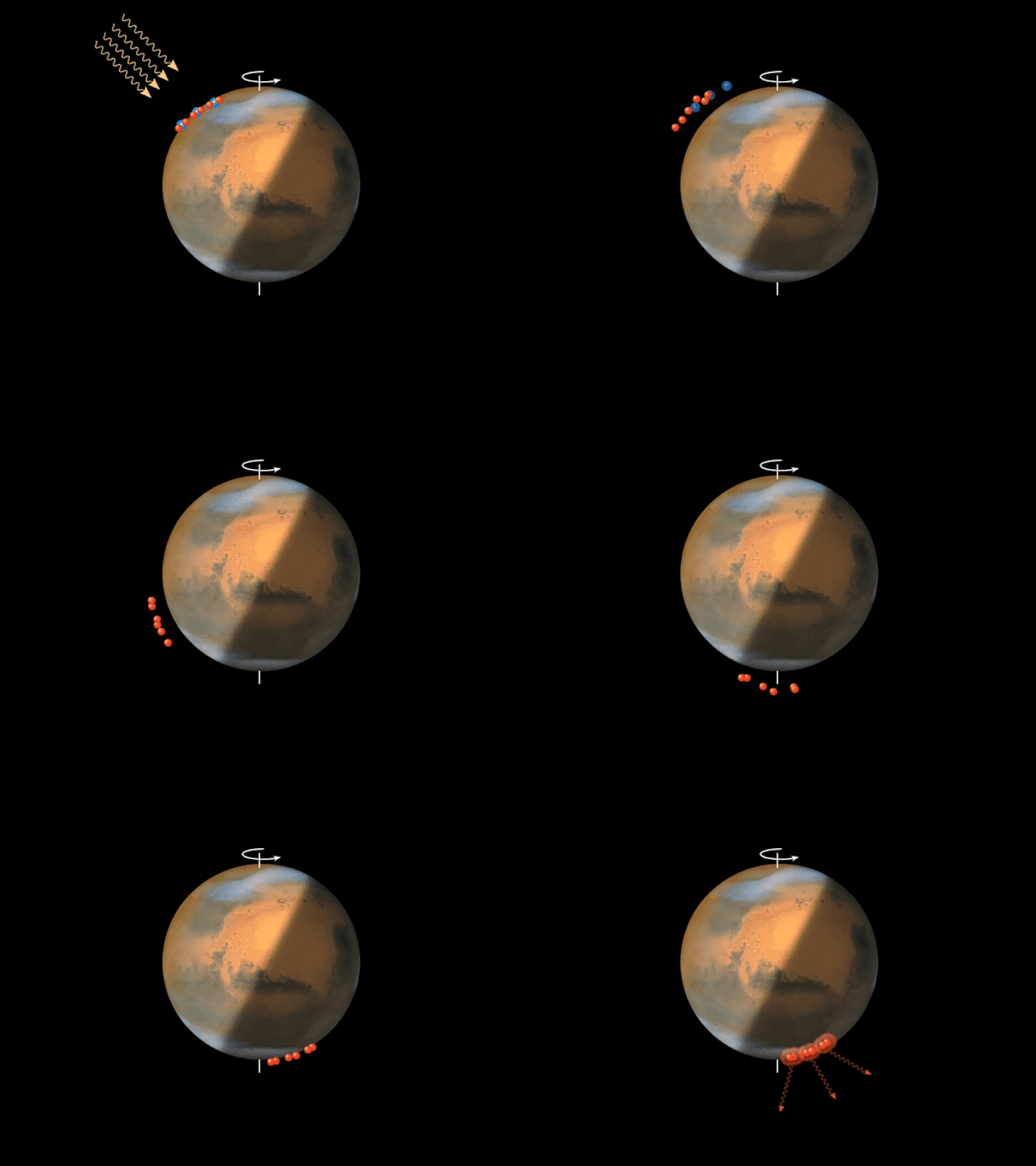
Le nightglow se forme différemment, par une suite de réactions « photochimiques ». Du côté de la planète où il fait jour, les molécules naturellement présentes dans l’atmosphère sont dissociées par les photons émis par le Soleil. Par exemple, les photons peuvent casser une molécule de CO2 en atomes de carbone et d’oxygène. Les atomes nouvellement créés sont transportés par la circulation atmosphérique provoquée par une différence de température, vers le côté nuit, où il fait beaucoup plus froid. Les atomes se recombinent alors pour reformer une molécule. La molécule se trouve cette fois dans un état excité : elle va émettre de la lumière à une longueur d’onde caractéristique en revenant à son état fondamental. C’est cette émission que l’on appelle nightglow.

Les sources de ces émissions lumineuses (aurores et nightglow) étant différentes, elles nous permettent d’étudier différents paramètres de l’atmosphère, à différents endroits et différentes altitudes de l’atmosphère.

Les aurores de Mars vues depuis l’orbite

Grâce à l’instrument SPICAM de Mars Express, notre équipe a pu observer une vingtaine d’aurores sur Mars. Toutes se situaient aux endroits où le champ magnétique résiduel piégé dans la roche à la surface de Mars est le plus fort – une région s’étend principalement dans l’hémisphère Sud, entre 120° et 250° de longitude.

détections d’aurores sur Mars
Deux types d’aurores détectées sur Mars dans l’ultraviolet par la mission emirati Emirates Mars Mission et son spectrographe Emirates Mars Ultraviolet Spectrograph. À gauche, l’aurore suit le champ magnétique résiduel conservé dans les roches de la croûte martienne (lignes rose et bleue). À droite, une aurore sinueuse qui ne suit pas le champ magnétique résiduel.
Chirakkil et collaborateurs, JGR Planets, 2024, CC BY-SA

À cet endroit, les lignes de champ magnétique forment des arcs qui agissent comme des boucliers contre les particules énergétiques, un peu comme un mini champ magnétique terrestre.

Entre deux arcades, les lignes de champ sont ouvertes et forment des sortes de canyons, dans lesquels les électrons venant du vent solaire se précipitent et interagissent avec les atomes et molécules neutres de l’atmosphère, principalement dioxyde de carbone et oxygène. Ces atomes et molécules se retrouvent alors dans un état excité instable et, lorsqu’ils se désexcitent pour retrouver dans leur état fondamental, émettent des photons à des longueurs d’onde bien caractéristiques. C’est ainsi que l’on trouvera principalement des émissions de monoxyde de carbone (CO), dioxyde de carbone ionisé (CO2+) et oxygène (O) dans l’ultraviolet et des émissions d’oxygène dans l’ultraviolet lointain. Ces émissions se produisent à environ 135 kilomètres d’altitude.

Depuis 2013, grâce aux instruments IUVS de la mission MAVEN de la NASA et EMUS à bord d’Emirates Mars Mission bien plus sensibles que SPICAM, nous sommes constamment surpris !

En effet, nous savons désormais que des émissions aurorales se produisent également en dehors de la zone de fort champ magnétique résiduel. Elles sont moins intenses, mais beaucoup plus fréquentes dans l’hémisphère Nord, par exemple.

D’autres types d’aurores ont également été observés : des aurores sinueuses, avec une forme de serpent dont la longueur peut couvrir tout un hémisphère en se déplaçant très rapidement, ou encore des aurores diffuses qui peuvent recouvrir toute la face nocturne de la planète ! Ces aurores diffuses se produisent plus bas en altitude, à environ 60 kilomètres à 80 kilomètres. Elles se produisent assez rarement car elles nécessitent la présence d’évènements SEP (pour Solar Energetic Particle) durant lesquels les particules émises par le Soleil, principalement des protons, se retrouvent fortement accélérées.

Aurores et activité solaire sont donc intimement liées. Les aurores martiennes peuvent avoir, comme sur Terre, des endroits de formation privilégiés, mais sont globalement très variables et assez difficilement prévisibles.

Observer des aurores depuis la surface de Mars

Nous savons que l’une des émissions aurorales précédemment observées dans l’UV (les atomes d’oxygène excités émettant à 297 nanomètres) possède une contrepartie dans le domaine du visible – il s’agit de la raie de l’oxygène à 557 nanomètres, qui donne sa couleur verte aux aurores terrestres. Cette composante devrait également être observable dans l’atmosphère martienne.

Et c’est l’exploit qu’a réalisé l’équipe du rover Perseverance en détectant la première aurore visible dans le ciel martien en mars 2024. L’équipe a guetté l’apparition d’évènements SEP au niveau du Soleil pour commander à distance au rover d’observer le ciel durant les nuits correspondantes. Une stratégie fructueuse, puisque l’émission à 557 nanomètres a été détectée par le spectromètre de Perseverance ! C’est donc la première fois qu’une image d’une aurore a été prise depuis le sol d’une planète autre que celui de la Terre.

L’intensité de cet évènement aurait probablement été trop faible pour pouvoir être perceptible par un œil humain, mais d’autres aurores, plus intenses, pourraient tout à fait être détectées à l’œil nu par de futurs astronautes à la surface ou en orbite autour de Mars.

Le « nightglow » de Mars serait visible par de futurs astronautes

Dans le cas de Mars, les photons émis par le Soleil interagissent avec les molécules de CO2 majoritairement présentes dans l’atmosphère martienne (~96 %), principalement au niveau du pôle d’été, éclairé et échauffé par le Soleil.

Les molécules de CO2 sont alors dissociées et les atomes d’oxygène sont transportés vers le pôle d’hiver plongé dans la nuit et le froid, par ce que l’on appelle la circulation été-hiver. Là, les atomes d’oxygène se recombinent pour former une molécule de O2 dans un état excité, qui émet alors une émission lumineuse à une longueur d’onde caractéristique en retournant à son état fondamental. C’est cette émission, que l’on observe dans la nuit polaire martienne d’hiver, que l’on appelle nightglow.

animation montrant la migration d’atomes dissociés d’une région à une autre
Production du nightglow sur Mars : des molécules de dioxyde de carbone présentes dans l’atmosphère sont dissociées côté été, et des atomes d’oxygène résultant de la dissociation se voient transportés vers les régions polaires hivernales. Les atomes d’oxygène (sphères rouges) s’y recombinent pour y former des molécules de dioxygène excitées qui émettent la lueur nocturne.
ESA, CC BY

Ce nightglow a d’abord été observé dans l’infrarouge, à 1,27 micromètre, à partir de l’orbite martienne, par la mission MRO (pour Mars Reconnaissance Orbiter), lancée en 2005, par la NASA.

Mais c’est en 2023 que cette émission de l’oxygène a été observée pour la toute première fois dans le domaine du visible, à environ 50 kilomètres d’altitude. Contrairement aux aurores, variables et difficilement prévisibles, le nightglow est très homogène dans le temps et dans l’espace.

De plus, son intensité est telle que de futurs astronautes n’auraient aucune difficulté à observer un ciel vert au-dessus du pôle d’hiver lors d’une belle nuit étoilée.

Les futures missions

Grâce à ces avancées majeures dans le domaine du visible, nous savons désormais qu’il nous est possible de continuer d’étudier l’atmosphère de Mars en utilisant des instruments plus simples, plus légers et moins onéreux en utilisant le domaine visible plutôt que celui de l’ultraviolet.

C’est ce que nous voulons faire avec la caméra aurorale M-AC à bord de M-MATISSE, une mission que nous avons proposée à l’Agence spatiale européenne (ESA) et qui est actuellement en phase de sélection. Deux orbiteurs emporteraient à leur bord différents instruments pour analyser l’environnement de Mars, ainsi qu’une caméra avec un filtre pour observer les émissions vertes autour de 557 nanomètres.

Grâce à M-AC, nous pourrions photographier et prendre des vidéos des aurores martiennes avec une résolution et une sensibilité jamais atteintes auparavant. Si elle est acceptée par l’ESA, cette mission devrait être lancée en 2037 en direction de la planète rouge… et vert !

The Conversation

Lauriane Soret a reçu des financements du F.R.S.-FNRS.

ref. Mars : la planète rouge se pare de vert durant la nuit – https://theconversation.com/mars-la-planete-rouge-se-pare-de-vert-durant-la-nuit-261723

Survivors’ voices 80 years after Hiroshima and Nagasaki sound a warning and a call to action

Source: The Conversation – USA (2) – By Masako Toki, Senior Education Project Manager and Research Associate, Nonproliferation Education Program, Middlebury

Supporters of nuclear disarmament, including Hibakusha, demonstrate in Oslo, Norway, in 2024. Hideo Asano, CC BY-ND

Eighty years ago, in August 1945, the cities of Hiroshima and Nagasaki were incinerated by the first and only use of nuclear weapons in war. By the end of that year, approximately 140,000 people had died in Hiroshima and 74,000 in Nagasaki.

Those who survived – known as Hibakusha – have carried their suffering as living testimony to the catastrophic humanitarian consequences of nuclear war, with one key wish: that no one else will suffer as they have.

Now, in 2025, as the world marks 80 years of remembrance since those bombings, the voices of the Hibakusha offer not only memory, but also moral clarity in an age of growing peril.

As someone who focuses on nuclear disarmament and has heard Hibakusha testimonies in my native Japanese language, I have been enthusiastically promoting disarmament education grounded in their voices and experience. I believe their message is more vital than ever at a time of rising nuclear risk. Nuclear threats have reemerged in global discourse, breaking long-standing taboos against even talking about their use. From Russia and Europe to the Middle East and East Asia, the possibility of nuclear escalation is no longer unthinkable.

Amid a landscape of rubble, a partially destroyed building stands, with the skeleton of a metal dome atop a tower.
The Hiroshima Prefectural Industrial Promotion Hall was one of the few buildings not totally demolished in the Aug. 6, 1945, U.S. atomic bombing of Japan.
Universal History Archive/Universal Images Group via Getty Images

Japan’s deepening reliance on deterrence

Ironically, increasing nuclear threats are contributing to further reliance on nuclear deterrence, the strategy of preventing attack by threatening nuclear retaliation, rather than renewed efforts toward nuclear disarmament, which seeks to eliminate nuclear weapons entirely.

Nowhere is this contradiction more visible than in Japan. While the Hibakusha have long stood as global advocates for nuclear abolition, Japan’s approach to national security has placed growing emphasis on the role of nuclear deterrence.

In the face of regional threats, the Japanese government has strengthened its dependence on U.S. nuclear protection – even as the survivors of Hiroshima and Nagasaki warn not only of the dangers of relying on nuclear weapons for security, but also of the profound moral failure such reliance represents.

Masako Wada, a survivor of the 1945 atomic bomb attack on Nagasaki, speaks about the risk of nuclear weapons in the 21st century.

Listen to Hibakusha voices

For eight decades, the Hibakusha have shared their stories to prevent future tragedy – not to assign blame, but to awaken conscience and spark action.

Masako Wada, assistant secretary general of Nihon Hidankyo, a nationwide organization of atomic bomb survivors working for the abolition of nuclear weapons, was just under 2 years old when the atomic bomb was dropped on Nagasaki. Her home, 1.8 miles from the blast center, was shielded by surrounding mountains, sparing her from burns or injury. Though too young to remember the bombing herself, she grew up hearing about it from her mother and grandfather, who witnessed the devastation firsthand.

In July 2025 at a nuclear risk reduction conference in Chicago, Wada told the attendees:

“The risk of using nuclear weapons has never been higher than it is now. … Nuclear deterrence, which intimidates other countries by possessing nuclear weapons, cannot save humanity.”

In a piece she wrote for Arms Control Today that same month, she further implored:

The Hibakusha are the ones who know the humanitarian consequences of the use of nuclear weapons. We will continue to convey that reality. Please listen to us, please empathize with us. Find out what you can do and take action together with us. Nuclear weapons cannot coexist with human beings. They were created by humans; let us assume the responsibility to abolish them with the wisdom of public conscience.”

This plea – rooted in lived experience and moral responsibility – was recognized globally when the 2024 Nobel Peace Prize was awarded to Nihon Hidankyo. The award honored not only the survivors’ suffering, but their decades-long commitment to preventing future use of nuclear weapons through education, activism and testimony.

A concrete building with no windows and a metal skeleton of a dome atop a tower stand against a blue sky.
The Hiroshima Peace Memorial stands as it has since 1945, partially destroyed by the atomic bomb blast and serving as a reminder of the 140,000 people who died in the attack and its aftermath.
Masako Toki, CC BY-ND

A dwindling number

But time is running out. Most Hibakusha were children or young adults in 1945. Today, their average age is over 86. In March 2025, the number of officially recognized Hibakusha fell below 100,000, according to Japan’s Ministry of Health.

As Terumi Tanaka, a Hiroshima survivor and longtime leader of Nihon Hidankyo, said at the Nobel Peace Prize ceremony:

“Ten years from now, there may only be a handful of us able to give testimony as firsthand survivors. From now on, I hope that the next generation will find ways to build on our efforts and develop the movement even further.”

Terumi Tanaka, a survivor of the 1945 atomic bomb attack on Hiroshima, delivers the 2024 Nobel Peace Prize lecture.

The role of empathy in disarmament education

Empathy is not a luxury in disarmament education – it is a necessity. Without it, nuclear weapons remain abstract. With it, they become personal, real and morally unacceptable.

That’s why disarmament education begins with human stories. The Hibakusha testimonies illuminate not only the physical destruction caused by nuclear weapons, but also the long-term trauma, discrimination and intergenerational pain that follow. They remind us that nuclear policy is not just a matter of strategy – it is a question of human survival. Nuclear weapons are the only weapons ever created with the power to annihilate all of humanity – and that makes disarmament not just a political issue, but a moral imperative.

Yet opportunities for young people to learn about nuclear risks, or hear from the Hibakusha directly, are extremely limited. In most countries, these issues are absent from school and university classrooms. This lack of education feeds ignorance and, in turn, complacency – allowing the flawed logic of deterrence to remain unchallenged.

Disarmament education that puts empathy and ethics at its center, along with survivors’ voices, can empower the next generation not only with knowledge, but with moral strength to choose their path.

A person stands at a lectern in front of a screen with photos and text reading 'As long as I could see, all the roof tiles had been blown to one side. The green of the mountain that surround the city was gone. They were brown mountains now.'
Masako Wada, a Hibakusha who survived the U.S. bombing of Nagasaki in August 1945, speaks at a church in California in 2019, spreading the message of the horror of the attack and its aftermath, and urging people to promote nuclear disarmament.
Masako Toki, CC BY-ND

From remembrance to responsibility

Commemorating 80 years since the atomic bombings of Hiroshima and Nagasaki is not about history alone. It is about the future. It is about what people choose to remember – and what people choose to do with that memory.

The Hibakusha have never sought revenge. Their message is clear: This can happen again. But it doesn’t have to.

The Hibakusha’s journey shows that human beings are not destined to remain divided, nor are they doomed to repeat cycles of destruction. In the face of unimaginable loss, many Hibakusha chose not to dwell on anger or seek retribution, but instead to speak out for the good of all humanity. Their activism has been marked not by bitterness, but by an unwavering commitment to peace, empathy and the prevention of future suffering. Rather than directing their pain toward blame, they have transformed it into a powerful appeal to conscience and global solidarity. Their concern has never been only for Japan – but for the future of the entire human race.

That moral clarity, grounded in lived experience, remains profoundly instructive. In a world increasingly filled with conflict and fear, I believe there is much to learn from the Hibakusha. Their testimony is not just a warning – it is a guide.

I try to listen, and urge others, as well, to truly listen to what they have to say. I seek the company of people who also refuse complacency, question the legitimacy of nuclear deterrence, and work for a future where human dignity, not mutual destruction, defines human security.

The Conversation

Masako Toki does not work for, consult, own shares in or receive funding from any company or organization that would benefit from this article, and has disclosed no relevant affiliations beyond their academic appointment.

ref. Survivors’ voices 80 years after Hiroshima and Nagasaki sound a warning and a call to action – https://theconversation.com/survivors-voices-80-years-after-hiroshima-and-nagasaki-sound-a-warning-and-a-call-to-action-262174

South African learners struggle with reading comprehension: study reveals a gap between policy and classroom practice

Source: The Conversation – Africa – By Tracy Kitchen, Lecturer: Student Academic Development, Rhodes University

Photo by Aaron Burden on Unsplash

South African learners consistently struggle with reading comprehension, performing poorly in both international and local assessments. A significant issue is that 81% of grade 4 learners (aged 9 or 10) are unable to read for meaning: they can decode words, but do not necessarily understand them.

While this problem has received considerable attention, no clear explanation has emerged.

In my recent PhD thesis, I considered a crucial, but often overlooked, piece of the puzzle – the curriculum policy. My research sought to uncover and understand the gaps and contradictions in reading comprehension, especially between policy and practice, in a grade 4 classroom.

This research revealed a difference between curriculum policy and practice, and between what learners seemed to have understood and what they actually understood in a routine reading comprehension task.

My main findings were that:

  • grade 4 learners were being asked overly simple, literal questions about what they were reading, despite the text being more complex than expected

  • the kinds of questions that learners should be asked (as indicated in the curriculum policy) were different from what they were being asked

  • this gap led to learners seeming to be more successful at reading comprehension than they actually were.

Pinpointing the gaps between what the policy says and how reading comprehension is actually taught at this crucial stage of development (grade 4) could pave the way for more effective interventions.

Curriculum policy

South African teachers are expected to base their reading comprehension instruction and assessment on the guidelines provided by the 2012 Curriculum and Assessment Policy Statement.

The policy outlines specific cognitive skill levels – essentially, ways of thinking and understanding – that learners should master for each reading task. These levels are drawn from Barrett’s 1956 Taxonomy of Reading Comprehension, an international guideline. It’s based on the popular Bloom’s Taxonomy of Reading Comprehension, which categorises reading comprehension according to varying skill levels.

According to Barrett’s Taxonomy, reading comprehension involves five progressively complex levels:

  1. Literal comprehension: Identifying meaning that is directly stated in the text. (For example, “Name the animals in the story”.)

  2. Reorganisation: Organising, paraphrasing, or classifying information that is explicitly stated. (“Find four verbs in the story to describe what the animals did.”)

  3. Inference: Understanding meaning that is not directly stated, but implied. (“When in the story is the leopard being selfish?”)

  4. Evaluation: Making judgements about the text’s content or quality. (“Who do you think this story is usually told to?”)

  5. Appreciation: Making emotional or personal evaluations about the text. (“How well was the author able to get the message across?”)

Typically, reading comprehension tasks will assess a range of these cognitive skills.

South Africa’s Curriculum and Assessment Policy Statement document specifies (on pages 91-92) that all reading comprehension tasks should comprise questions that are:

  • 40% literal/reorganisation (lower-order thinking skills)

  • 40% inferential (middle-order)

  • 20% evaluation and appreciation (higher-order).

This approach aims to allow most students to demonstrate a basic understanding of the text, while challenging more advanced learners.

However, as my classroom case study shows, the system appears to be failing. There was a mismatch between the policy and what was taking place in the classroom.

Classroom practice

For this research, I observed the reading comprehension practices in a single classroom in a public school in the Eastern Cape province. This took place over six months, at a time when schools were not fully reopened during the COVID-19 pandemic.

The task in question included a text and activity selected by the teacher from a textbook aligned with the policy. My analysis (which used Appraisal, a linguistic framework that tracks evaluative meaning) showed that most of the text’s meaning was implicit. To fully understand it, learners would need higher-order thinking and sophisticated English first-language skills. This was a surprising finding for a grade 4 resource, especially because most learners in this study were not English first-language speakers.

Even more surprising, learners achieved seemingly high marks on comprehension, with an average of 82.9%. This suggested they understood this complex text.

However, I found that the questions in the textbook did not align with policy. Instead of the balance of skills required by the policy, 73% of the questions called only for lower-order skills. Only 20% were inferential and a mere 7% required evaluation or appreciation (middle- to higher-order skills).

At least six of the 15 available marks could be gained simply by listing explicitly stated items, not requiring genuine comprehension.

This reveals that, in this classroom, activities labelled as policy-compliant actually tested only lower-order comprehension. Learners could pass simply by identifying and listing information from the text. This creates a false sense of comprehension success, as revealed by the high marks.

When learners were tested on the same text but using different questions that I designed to align with the policy requirements, they scored lower marks, especially for the higher-order questions.

This mismatch might partly explain why South Africans score poorly in international tests (which require more higher-order thinking).

Why this matters and moving forward

These findings are concerning, as learners may be lulled into believing that they are successful readers. A false sense of accomplishment could have significant impacts on the rest of their education.

Comprehension difficulties can’t be blamed solely on the disconnect between policy and practice, however. Many other contextual factors shape how learners perform in reading comprehension tasks.

In my study, factors like COVID-19, insufficient home language teaching policies, educational inequalities, and the pressures on teachers during a crisis (brought on by COVID-19) all contributed to the literacy crisis.


Read more:
South Africa’s reading crisis: focus on the root cause, not the peripherals


However, two key points became clear during this study.

Firstly, teaching materials favour lower-order comprehension skills, skewing perceptions of learners’ abilities.

Secondly, teachers may lack the knowledge, resources or motivation to adjust these materials to truly align with the national policy in how reading comprehension is assessed.

This calls for urgent intervention in how reading comprehension is taught and assessed and in how teachers are prepared to do this effectively.

The Conversation

This research was partially funded by the National Research Foundation (NRF).

ref. South African learners struggle with reading comprehension: study reveals a gap between policy and classroom practice – https://theconversation.com/south-african-learners-struggle-with-reading-comprehension-study-reveals-a-gap-between-policy-and-classroom-practice-260033

Votre logement est-il adapté à la chaleur ?

Source: The Conversation – in French – By Ainhoa Arriazu-Ramos, Dra Arquitecta-Investigadora postdoctoral en sostenibilidad medioambiental y adaptación al cambio climático de las ciudades, Universidad de Deusto

En 2050, plus de 70 % de la population mondiale vivra en ville. Kzww/Shutterstock

En ville, planter des arbres peut faire baisser les températures, mais au niveau des habitations en elles-mêmes, l’isolation, les fenêtres et l’exposition jouent un rôle tout aussi important.


L’année 2024 a été la plus chaude jamais recensée au niveau mondial depuis le début des mesures, avec une température moyenne supérieure de 1,55 °C à celle de la période préindustrielle. Les vagues de chaleur ne sont plus des événements isolés : elles sont de plus en plus fréquentes, intenses et longues.

L’impact du réchauffement climatique global est particulièrement grave dans les villes. Le phénomène des îlots de chaleur urbain (ICU) entraîne des températures urbaines jusqu’à 4 °C plus élevées que dans les zones rurales voisines, en particulier pendant les nuits d’été.

Si l’on ajoute à cela le fait que de plus en plus de personnes vivent en milieu urbain (en 2050, plus de 70 % de la population mondiale sera concernée), une question se pose inévitablement : comment concevoir les villes pour qu’elles restent habitables malgré les températures élevées ?

Mieux concevoir l’espace public

Intégrer davantage de nature dans nos villes est l’une des meilleures stratégies pour les adapter à la chaleur.

Mais il ne s’agit pas seulement d’assurer un minimum d’espace vert par habitant : à quoi sert d’avoir un grand parc à une heure de route, si on ne trouve pas d’ombre sur le chemin du travail ou qu’on ne dispose pas d’un espace vert dans son quartier où se réfugier pour échapper à la chaleur ?

Il faut intégrer la nature dans l’aménagement urbain en tenant compte des principes de proximité, de qualité et de quantité des espaces verts. Dans cette optique, la règle des « 3-30-300 » est intéressante : chaque personne devrait pouvoir voir au moins trois arbres depuis son domicile, vivre dans un quartier où au moins 30 % de la superficie est couverte d’arbres et avoir un parc à moins de 300 mètres.

Revoir les aménagements et bâtiments de l’espace public est aussi urgent que de planter des arbres. Les toitures des bâtiments, par exemple, peuvent être des alliés pour réduire la chaleur. Pour cela, il peut être essentiel d’y intégrer de la végétation ou des matériaux réfléchissants. Les façades sont également importantes. Bien choisir leur couleur (de préférence des tons clairs) et les matériaux qui les composent peut contribuer à réduire le problème de surchauffe au lieu de l’aggraver.

Au niveau du sol, il est tout aussi important de repenser le choix des revêtements. Il faut éviter l’utilisation systématique d’asphalte et de béton qui absorbent la chaleur. Explorer des matériaux plus perméables, plus frais et intégrer davantage de végétation peut faire une différence significative.


À lire aussi :
Nos villes doivent être plus perméables : comment le biochar peut être une solution durable face aux inondations


Des logements adaptés à la chaleur

Mais il ne suffit pas seulement d’améliorer l’espace public : les logements aussi doivent pouvoir faire face à la chaleur. Nous y passons la majeure partie de notre temps et beaucoup d’entre eux sont inadaptés. Par exemple, une étude a révélé que 85 % des logements de Pampelune (Espagne) ont enregistré des températures trop élevées pendant l’été 2022.

La conception des bâtiments est, à cet égard, déterminante. Certains aspects liés à la conception et à la construction de ces bâtiments, s’ils ne sont pas pris en compte, peuvent aggraver le problème de surchauffe des logements.

L’isolation thermique est le premier point. Bien isoler un bâtiment est une mesure importante, surtout en hiver, mais aussi en été. Cependant, lorsque des logements bien isolés mais trop hermétiques se réchauffent, il devient difficile d’évacuer la chaleur. La clé réside donc dans la conception : la distribution des pièces (et les éventuels systèmes de ventilation mécanique, comme la VMC, ndlt) doit permettre une ventilation adéquate.

Les grandes baies vitrées constituent un autre point qui peut poser problème. Elles sont aujourd’hui appréciées pour la lumière naturelle et la vue qu’elles offrent, mais si elles ne sont pas correctement protégées du soleil, elles contribuent au réchauffement du logement. Il est important que les protections solaires fassent partie intégrante de la conception du bâtiment et ne soient plus seulement des éléments accessoires. Il est possible d’atténuer le rayonnement solaire sans totalement assombrir la maison : avant-toits, volets orientables, auvents ou lamelles, etc.

Il faut également noter que les logements qui n’ont qu’une seule exposition sont plus à risque, alors que ceux à double exposition rendent le rafraîchissement plus aisé.

Compte tenu des besoins actuels en matière de logement, les nouvelles maisons ont tendance à être plus petites. De nombreux appartements en centre-ville sont eux aussi divisés en appartements plus petits. Cette tendance est problématique, car elle entraîne une augmentation du nombre de logements mono-orientés. Outre le respect de la surface minimale, il serait donc intéressant d’exiger qu’ils garantissent des conditions minimales de confort thermique.

En outre, il a été démontré que les logements situés aux derniers étages subissent entre 3,4 % et 5,4 % plus d’heures de surchauffe que ceux situés aux étages intermédiaires. Améliorer l’isolation des toitures n’est pas suffisant, car l’isolation a une limite d’efficacité. Il faut donc aussi innover pour améliorer la construction des bâtiments à ce niveau.

Tout ne dépend pas seulement de l’urbanisme ou de l’architecture. Les citoyens doivent également apprendre à s’adapter à la chaleur urbaine et savoir comment gérer leur logement lors des journées les plus chaudes : comprendre l’influence de l’orientation du logement, aérer au bon moment en fonction de la différence entre la température intérieure et extérieure ou encore utiliser correctement les protections solaires.


À lire aussi :
Impact environnemental du bâtiment : qu’est-ce que la construction passive ?


Quelles perspectives ?

Si l’on veut adapter les villes à la chaleur, il ne faut pas éluder la dimension sociale du problème.

La chaleur extrême n’affecte pas toute la population de la même manière : les personnes âgées, les enfants et ceux qui vivent dans des logements de mauvaise qualité ou dans des quartiers peu végétalisés sont plus exposés.

Enfin, nous devons être conscients que le confort thermique ne peut dépendre uniquement de la climatisation ou d’autres systèmes mécaniques. Il est nécessaire de repenser nos villes et nos logements afin qu’ils puissent s’adapter à la chaleur de par leur conception même.

Dans un monde de plus en plus chaud, les villes le plus adaptées seront celles qui seront capables de maintenir le confort thermique tout en minimisant la dépendance à la consommation d’énergie.

The Conversation

Ainhoa Arriazu-Ramos ne travaille pas, ne conseille pas, ne possède pas de parts, ne reçoit pas de fonds d’une organisation qui pourrait tirer profit de cet article, et n’a déclaré aucune autre affiliation que son organisme de recherche.

ref. Votre logement est-il adapté à la chaleur ? – https://theconversation.com/votre-logement-est-il-adapte-a-la-chaleur-262240

Le « bon sens » en politique : analyse d’un mot d’ordre contemporain

Source: The Conversation – in French – By Julien Rault, Maître de Conférences en linguistique et stylistique, Université de Poitiers

La formule est bien connue : « C’est du bon sens ! » Au quotidien, une telle injonction peut paraître juste. L’enjeu est toutefois différent lorsqu’il s’agit de discours politique. Dans le champ démocratique, le « bon sens » irrigue aujourd’hui la moindre prise de parole et vient supplanter le cadre idéologique, refusant toute confrontation d’idées.


Que rétorquer face à l’évidence sans appel du « bon sens » ? Qu’opposer à la rhétorique du consensus, au discours du « Ça va de soi » ? Avec le « bon sens », nul échange, nulle controverse, nulle spéculation. Ici règnent en maîtres la norme et le normal ; Descartes, on le sait, en fait la chose au monde le mieux partagée. L’abbé Girard, quant à lui, nous indique que, contrairement au jugement, à l’esprit ou à l’entendement, le bon sens est une faculté qui transcende les distinctions sociales pour « convenir avec tout le monde ».

S’il sent bon la logique et la volonté générale, le bon sens sent aussi la morale. Roland Barthes, dans l’Usager de la grève, parle en effet du « bon sens » comme d’un mixte de morale et de logique, qui substitue à l’ordre politique et social un ordre présenté comme naturel.

L’interprétation s’efface devant l’évidence. La formule est donc bien un mot d’ordre implicite, une sommation instaurant sans le nommer un ordre du monde autant qu’une parole sans réplique. Mais d’où ce mot d’ordre tient-il sa puissance d’imposition ? Et quel rapport entretenons-nous – en France notamment – avec cette disposition d’esprit qu’on appelle « le bon sens » et, plus étroitement, avec l’expression elle-même, qui resurgit ces dernières années dans les discours et slogans politiques, tous bords confondus ?

Un bon sens français

En France, le « bon sens » témoigne d’un imaginaire bien nourri politiquement. Et si l’on suit le leitmotiv de l’Union des Français de bon sens (UFBS), parti politique de droite fondé en 1977, il serait même devenu le « vrai symbole de la France » – le clip vaut le détour. Et, à en croire les images de terroir qui accompagnent chacune de ses interventions sloganisées, le « bon sens » des campagnes est aussi un bon argument marketing. La publicité pour le Crédit agricole a abondamment puisé dans cet imaginaire de la ruralité et de la proximité.

Évidemment, il est permis de douter d’une aptitude spécifiquement française au bon sens. Mais force est de constater que la notion est particulièrement bien implantée dans notre pays. Les trois conférences d’Henri Bergson, réunies sous le titre le Bon Sens ou l’esprit français (1895), en attestent : une longue tradition française habite l’expression, qui vient fédérer autour d’une aptitude supposément commune et d’une spécificité culturelle.

Politiquement, le « bon sens » appartient-il exclusivement à un camp ? À gauche, on le trouve très tôt dans des journaux progressistes. Le Bon Sens, journal républicain qui paraît de 1832 à 1839, se propose ainsi, selon Louis Blanc, de faire appel à « l’intelligence du peuple ». On le rencontre également dans les discours syndicaux : André Bergeron, syndicaliste FO, publie en 1996 Je revendique le bon sens, quand la Fédération des Travailleurs du Québec fait campagne en 2019 autour de l’expression « le gros bon sens ». En 2016, La France insoumise (LFI) reprend l’expression à son compte en lançant la chaîne YouTube « Le Bon Sens », sous l’impulsion d’Antoine Léaument, à l’époque responsable de la communication numérique de Jean-Luc Mélenchon.

Le bon sens est-il de droite ?

La formule reste toutefois l’apanage de la pensée de droite, dans la filiation de Pierre Poujade qui en avait fait l’élément central de sa « philosophie ». On la retrouve aujourd’hui en abondance dans le discours des républicains (LR) et du Rassemblement national. Marine Le Pen, en décembre 2010, en revendiquait sans détour l’incarnation : « C’est le vrai choix d’une autre politique. J’incarne le bon sens. » En mai 2019, elle réitérait en en faisant l’élément constitutif de sa politique : « Cela fait vingt ou vingt-cinq ans que l’on parle du bon sens, ça a toujours irrigué notre conception de la politique. »

En 2017, François Fillon l’érigeait en mot d’ordre, suivi par Éric Ciotti qui affirmait, en 2022, vouloir être le « candidat du bon sens ».

En 2019, le « bon sens » formait encore l’élément de langage fédérateur de l’extrême droite française et italienne pour les élections européennes : il se retrouve aujourd’hui dans les discours de Giorgia Meloni qui souhaite « révolutionner la normalité » en proposant « des petites choses de bon sens ». En 2025, la « révolution du bon sens » est le motif litanique de Donald Trump à l’orée de son nouveau mandat.

Lors de son discours au Congrès des États-Unis du 4 mars 2025, Donald Trump parle de la « révolution du bon sens » (« common sense revolution ») le slogan incarnant ses premières semaines au pouvoir.

Un bon sens extrême

Un tel succès est à mettre d’abord au crédit de la formule elle-même, qui active un imaginaire antisystème et anti-élite, assez proche de la pensée populiste.

Si cette dernière reste assez difficile à définir, l’invocation du « bon sens » peut apparaître finalement comme l’un de ses axiomes les plus probants. Sa fréquence actuelle s’explique aussi par le discrédit massif jeté sur l’idéologie, laquelle se doit de céder la place au réel : le « bon sens » rejoint alors la constellation des mots-consensus qui étouffent toute ambition progressiste et utopique. Enfin, l’incantation du bon sens permet surtout d’atténuer la radicalité de certaines idées. C’est l’une des fonctions actuelles du common sense, martelé par l’outrancier Donald Trump.

La substitution contemporaine du « bon sens » aux traditionnels réalisme et pragmatisme dans le discours de gouvernement peut alors se comprendre comme la manifestation langagière d’une métamorphose populiste du paysage politique.

Depuis 2020, la formule est largement utilisée par des personnalités proches du macronisme, à l’image de Jean-Michel Blanquer. Celui-ci prônait, en réponse à un mouvement lycéen d’opposition aux codes vestimentaires imposés dans les établissements scolaires, une « position d’équilibre et de bon sens ». Et prenait soin d’ajouter : « Il suffit de s’habiller normalement et tout ira bien. »

Emmanuel  Macron est également friand de la formule, étayant son plaidoyer pour la réforme des retraites avec cette sentence : « Je pense que tout le monde a du bon sens dans notre pays. » En janvier 2017, alors en campagne présidentielle, il affirmait vouloir « réconcilier l’ambition avec le réel » et défendait un « projet de bon sens ».

En visite au marché de Rungis, le 18 février 2023, Emmanuel Macron mobilise l’argument du « bon sens » pour évacuer les critiques d’une personne l’interpellant au sujet de la réforme de l’âge de départ à la retraite, adoptée un mois plus tard.

L’usage présidentiel de l’expression offre une parfaite illustration de l’émergence de ce que Pierre Serna a nommé très justement « l’extrême centre ». Cette expression en apparence oxymorique permet de qualifier la radicalisation d’une pensée et d’une action politiques dites modérées et de raison, abritant sa violence symbolique et réelle sous les étendards discursifs de l’évidence.

Mot-masque et mot d’ordre

Relevant d’une parole euphémisante, le « bon sens » fait figure de mot-masque. Derrière son pseudo-rejet de l’idéologie se cachent des orientations tout à fait idéologiques, aux relents poujadistes parfois flagrants. Interrogé sur le travail de chercheurs et les études réalisées par l’Insee qui montraient une stagnation de la délinquance, Gérald Darmanin avançait ainsi en mai 2021 : « J’aime beaucoup les enquêtes de victimation et les experts médiatiques, mais je préfère le bon sens du boucher-charcutier de Tourcoing. » Avant d’inviter journalistes et concitoyens, de façon éloquente, à ne pas « nier le réel ».

Contrairement au réalisme, pour lequel on peut constater la présence récurrente de tournures qui tendent à le redéfinir pour mieux l’asséner (« le réalisme, c’est… », « par réalisme je veux dire… »), on rencontre beaucoup moins d’énoncés cherchant à préciser ce que l’invocation du « bon sens » implique ou signifie.

Le bon sens échappe ainsi encore plus facilement à la spécification : il s’impose avec autorité, puisqu’il est bon, évident, à la portée de tout un chacun. Pointe extrême du réalisme, il instaure une vision unique du monde social et politique, étouffant toute possibilité d’un débat démocratique, dont l’essence se fonde sur l’exact opposé : l’explicitation des points de vue, la confrontation des idées.

Argument de ceux qui n’en ont pas ou plus, le mot d’ordre du « bon sens » est la traduction langagière d’une forme de perversion du politique. Il est le reflet d’une tendance contemporaine qui vise à déresponsabiliser l’acteur. En dépolitisant l’action, il permet ainsi de neutraliser le conflit et de disqualifier toute forme d’opposition.

Dès lors, il n’est pas question d’envisager cette formule (et ses voisines) pour ce qu’elle serait supposée dire réellement : l’efficacité rhétorique et plus exactement manipulatoire d’une expression augmente à proportion de son flou sémantique. Il s’agit plutôt d’interroger l’usage politique qui en est fait, la façon dont elle se manifeste dans les discours qui la convoquent et la commentent. À ce titre, le « bon sens » est bien un moyen de polariser et de politiser et, ce faisant, témoigne d’un positionnement qui, quoi qu’on en dise, reste éminemment idéologique.

The Conversation

Julien Rault ne travaille pas, ne conseille pas, ne possède pas de parts, ne reçoit pas de fonds d’une organisation qui pourrait tirer profit de cet article, et n’a déclaré aucune autre affiliation que son organisme de recherche.

ref. Le « bon sens » en politique : analyse d’un mot d’ordre contemporain – https://theconversation.com/le-bon-sens-en-politique-analyse-dun-mot-dordre-contemporain-257311

The global health system can build back better after US aid cuts – here’s how

Source: The Conversation – Africa (2) – By Jonathan E. Cohen, Professor of Clinical Population and Public Health Sciences, Keck School of Medicine and Director of Policy Engagement, Institute on Inequalities in Global Health, University of Southern California, University of Southern California

Steep cuts in US government funding have thrown much of the field of global health into a state of fear and uncertainty. Once a crown jewel of US foreign policy, valued at some US$12 billion a year, global health has been relegated to a corner of a restructured State Department governed by an “America First” agenda.

Whatever emerges from the current crisis, it will look very different from the past.

As someone who has spent a 25-year career in global health and human rights and now teaches the subject to graduate students in California, I am often asked whether young people can hope for a future in the field. My answer is a resounding yes.

More than ever, we need the dedication, humility and vision of the next generation to reinvent the field of global health, so that it is never again so vulnerable to the political fortunes of a single country. And more than ever, I am hopeful this will be the case.

To understand the source of my hope, it is important to recall what brought US engagement in global health to its current precipice – and how a historic response to specific diseases paradoxically left African health systems vulnerable.

Disease and dependency

Over two decades ago, the field of global health as we currently know it emerged out of the global response to HIV/Aids – among the deadliest pandemics in human history. The pandemic principally affected people of reproductive age and babies born to HIV-positive parents.

The creation of the US President’s Emergency Plan for Aids Relief (Pepfar) in 2003 was at the time the largest-ever bilateral programme to combat a single disease. It redefined the field of global health for decades to come, with the US at its centre. While both the donors and issues in the field would multiply over the years, global health would never relinquish its origins in American leadership against HIV/Aids.

Pepfar placed African nations in a state of extreme dependence on the US. We are now witnessing the results – not for the first time. The global financial crisis of 2008 reduced development assistance to health, which generated new thinking about financing and domestic resource mobilisation.

Yet, the US continued to underwrite Africa’s disease responses through large contracts to American universities and implementers. This was for good reason, given the urgency of the problem, the growing strength of Africa’s health systems as a result of Pepfar, and the moral duty of the world’s richest country.

With the rise of right-wing populism and the polarising effects of COVID-19, global health would come to be seen by many Americans as an elite enterprise. The apparent trade-off between public health countermeasures and economic life during COVID-19 – a false choice to experts who know a healthy workforce to be a precondition for a strong economy – alienated many voters from the advice of disease prevention experts. The imperative to “vaccinate the world” and play a leadership role in global health security lacked a strong domestic constituency. It proved no match for monopolistic priorities of the pharmaceutical industry and the insularity and economic anxieties of millions of Americans.


Read more:
How Trump’s proposed US aid cuts will affect healthcare in Africa


This history set the stage for the sudden abdication of US global health leadership in early 2025. By the time the Department of Government Efficiency came for USAID, many viewed global health as a relic of the early response to HIV/Aids, an excuse for other governments to spend less on health, or an industry of elites. The field was an easy target, and the White House must have known it.

Yet therein lies the hope. If global health came of age around a single disease, an exercise of US soft power, and a cadre of elite experts, it now has an opportunity to change itself from the ground up. What can emerge is a new global health compact, in which African governments design robust health systems for themselves and enlist the international community to assist from behind.

Opportunity to build back better

To build a new global health compact for Africa, the first change must be from a focus on combating individual diseases to ensuring that all people have the opportunity for health and well-being throughout their lives. Rather than allowing entire health systems to be defined by the response to HIV/Aids, tuberculosis and malaria, Africa needs integrated systems that promote:

  • primary care, which brings services for the majority of health needs closer to communities

  • health promotion, which enables people to take control of all aspects of their health and well-being

  • long-term care, which helps all people function and maintain quality of life over their entire lifespan.

No global trend compels this shift more than population ageing, which will soon engulf every nation as a result of lengthening life expectancy and declining fertility. As the proportion of older adults grows to outstrip that of children, societies need systems of integrated healthcare that help people manage multiple diseases. They don’t need fragmented programmes that produce conflicting medical advice, dangerous drug interactions, and crippling bureaucracy. Time is running out to make this fundamental shift.

Second, there is a need to shift the relationship between low-income and high-income nations towards shared investment in the service of local needs. This is beginning to happen in some places, and it will require greater sacrifices on all sides.

Low-income governments need to spend a higher percentage of their GDP on healthcare. That will in turn require addressing the many factors that stymie the redistribution of wealth, from corruption to debt to lack of progressive taxation. The US and other high-income countries need to pay their fair share, while also sharing decision-making over how global public goods, from vaccines to disease surveillance to health workers, are shared and distributed in an interconnected world.


Read more:
Africa relies too heavily on foreign aid for health – 4 ways to fix this


Third, there is need to change the narrative of global health in wealthy countries such as the US to better connect to the concerns of voters who are hostile to globalism itself. This means addressing people’s real fears that public health measures will cost them their job, force them to close their business, or advance a pharmaceutical industry agenda. It means justifying global health in terms that people can relate to and agree with – that is, helping to save lives without taking responsibility for other countries’ health systems.

It means forging unlikely alliances between those who believe in leadership from the so-called global south and those who take an insular view of America’s role in the world.

Leading from behind

Make no mistake. I am not counting on this – or any – US administration to reinvent global health on terms that are more responsive to current disease trends, more equitable between nations, and more relevant to American voters.

But nor would I want them to. To create the global health for the future, the leadership must come not only from the US, but rather from a shared commitment among the community of nations to give and receive according to their capacities and needs. And that is something to hope for.

The Conversation

Jonathan E. Cohen does not work for, consult, own shares in or receive funding from any company or organisation that would benefit from this article, and has disclosed no relevant affiliations beyond their academic appointment.

ref. The global health system can build back better after US aid cuts – here’s how – https://theconversation.com/the-global-health-system-can-build-back-better-after-us-aid-cuts-heres-how-259798