Epstein’s ‘birthday book’ transforms private notes into a legacy record

Source: The Conversation – Canada – By Jason Wang, Postdoctoral Fellow, Modern Literature and Culture Research Centre, Toronto Metropolitan University

The United States House Committee on Oversight and Government Reform recently released a 238-page album, compiled by Ghislaine Maxwell in 2003 for Jeffrey Epstein’s 50th birthday. On Oct. 6, the U.S. Supreme Court rejected Maxwell’s appeal of her 2022 conviction for sex trafficking girls with Epstein.

The release of the partially redacted album is part of a larger investigation of the federal government’s handling of Epstein and Maxwell and “possible mismanagement.”


Read more:
Trump’s Epstein problem is real: New poll shows many in his base disapprove of his handling of the files, and some supporters are having second thoughts about electing him


The album is in the spotlight due to an entry allegedly penned by U.S. President Donald Trump, though the White House has denied he wrote it. Entitled The First Fifty Years, the book overflows with handwritten letters, campy sketches and images fixated on women’s bodies.

The book was bound by Weitz & Coleman, an esteemed bookbinder in New York City since 1909, as indicated by a note within the album itself.

Its “vegetable tanned” leather covers, table of contents and sections titled “Family,” “Friends” and “Business” signal an intent to elevate casual notes into a permanent record.

As book historian D.F. McKenzie contends, a book’s physical form shapes its social role. Here, the elaborate binding and careful organization transform private, ephemeral notes into a social gesture, something shared in a legacy format.

In this sense, Epstein’s album sits alongside a tradition of bound tribute books — scrapbooks pressed into leather for golden anniversaries, glossy volumes marking a CEO’s retirement or academic festschrifts that canonize a career. What unites them is the transformation of passing moments into artifacts meant to endure.

Charm, codes, clichés

Maxwell’s prologue describes the book as a retrospective to “jog your memory of places and people and different events.”

In the birthday book, one redacted former “assistant” recalls how working for Epstein transformed her life: she went from being “a 22-year-old divorcée working as a hotel hostess” to rubbing shoulders with royalty, presidents, financiers and celebrities.

One letter from a childhood friend who recently said Maxwell instructed him to write something “raunchy” spins a sexually explicit fantasy about Epstein’s conception before drifting into nostalgic tales of their four-boy Brooklyn clique.

In one vignette, Epstein is praised for flaunting a “beautiful British babe” at his family’s home, his indifference to her feelings reframed as charm. The anecdote turns callousness toward women into a badge of confidence and belonging. The letter concludes: “That shows a lot. It really does … Yes, your charisma and persuasive ways came very early on … you’re my kid’s role model.”

Epstein’s sex life and treatment of women are recurring themes.

A note apparently from private equity investor Leon Black, who was earlier found to have paid millions in fees to Epstein, cast Epstein as Ernest Hemingway’s hero in The Old Man and the Sea, swapping fish for “Blonde, Red or Brunette” women.

Philosophers and scholars of rhetoric have long noted that ready-made clichés can replace inner reflection, forming a “code of expression” that insulates people from moral reckoning.

Laughter as defence

If language conveys loyalty, humour compounds it. Composed in 2003, as Epstein’s notoriety grew, today — amid the knowledge of Epstein’s sex crimes — the birthday book’s laughter seems knowingly defensive.

There are bawdy jokes and mocking nicknames: Epstein is dubbed “Degenerate One” and teased or taunted with “so many girls, so little time.”

As French philosopher Henri Bergson argued, laughter functions as a social corrective: a “kind of social ragging” that polices behaviour by ridiculing deviation under the guise of amusement.

One birthday book contributor quips that Epstein had “avoided the penitentiary.” The comment implies knowledge of punishable behaviour, yet also suggests Epstein is an affable rogue.

Figures of authority

The book’s inclusion of entries from public office and science figures could suggest Maxwell and Epstein sought to keep or commemorate connections with figures of authority as a form of perceived legitimacy.

The Wall Street Journal reported that former U.S. president Bill Clinton, whose name appears in the album’s “Friends” section, gave Epstein a handwritten note praising his “childlike curiosity” and drive to “make a difference.” In 2019, a spokesperson for Clinton said he severed ties with Epstein prior to his 2019 arrest and he was not aware of Epstein’s alleged crimes.

Peter Mandelson, recently forced out as the United Kingdom’s ambassador to the U.S. after the Epstein birthday book’s release, penned a note saying Epstein was an “intelligent, sharp-witted man.” Mandelson has said he felt tremendous regret over his Epstein friendship and sympathy for Epstein’s victims.

The birthday book’s “Science” section, with letters from leading scientists, shows that Epstein’s reach extended beyond business and politics into elite academic networks.


Read more:
How higher ed can deal with ethical questions over its disgraced donors


Eroticized power and dominance

While some entries strike a mundane or playful tone, others veer into vulgarity.

The former CEO of Victoria’s Secret, Leslie Wexner, contributed a sketch resembling a woman’s breasts with the words “I wanted to get you what you want… so here it is” — framing it as a present. Wexner has said before he severed ties with Epstein in 2007 and declined to comment about the book.

The note allegedly written by Trump features a drawing of a naked woman alongside typewritten text imagining a conversation between them. It calls Epstein “a pal” and ends with the wish that “every day be another wonderful secret.”

Former Microsoft executive Nathan Myhrvold contributed a series of African wildlife photographs, claiming they spoke more vividly than words. The images — of copulating lions and a zebra with an erect penis — foreground predatory and sexualized behaviour, and may be interpreted as reflecting a fascination with dominance and raw biological impulse.

The Seattle Times reports that a spokesperson for Myhrvold said Myhrvold knew Epstein “from TED conferences and as a donor to basic scientific research” and “regrets that he ever met him.” The representative did not address the letter.

The legacy of small gestures

While journalists have long documented that Epstein’s networks stretched from political leaders and Wall Street financiers to influential figures in science and culture, it remains to be seen how the carefully curated and gifted birthday book fits into the larger investigation.

The book’s most insidious achievement is its ordinariness. It suggests the ways that power is fortified and legitimized not only with contracts and institutions but through gestures of social life, including commemorative books.

The Conversation

Jason Wang does not work for, consult, own shares in or receive funding from any company or organisation that would benefit from this article, and has disclosed no relevant affiliations beyond their academic appointment.

ref. Epstein’s ‘birthday book’ transforms private notes into a legacy record – https://theconversation.com/epsteins-birthday-book-transforms-private-notes-into-a-legacy-record-265715

Smartphones manipulate our emotions and trigger our reflexes — no wonder we’re addicted

Source: The Conversation – Canada – By Stephen Monteiro, Assistant Professor of Communication Studies, Concordia University

The frequency and length of daily phone use continues to rise, especially among young people. It’s a global concern, driving recent decisions to ban phones in schools in Canada, the United States and elsewhere.


Read more:
School smartphone bans reflect growing concern over youth mental health and academic performance


Social media, gaming, streaming and interacting with AI chatbots all contribute to this pull on our attention. But we need to look at the phones themselves to get the bigger picture.

As I argue in my newly published book, Needy Media: How Tech Gets Personal, our phones — and more recently, our watches — have become animated beings in our lives. These devices can build bonds with us by recognizing our presence and reacting to our bodies.

Packed with a growing range of technical features that target our sensory and psychological soft spots, smartphones create comforting ties that keep us picking them up. The emotional cues designed into these objects and interfaces imply that they need our attention, while in actuality, the devices are soaking up our data.

A responsive presence

Face recognition, geolocation, touchscreens, vibration, sound alerts and audio and motion sensing all play their part in catching our attention and responding to our actions. Separately, these may not create a strong emotional attachment, but collectively they situate the phone as a uniquely intimate, sensitive and knowing presence in our lives.

Take facial recognition locks, for example. Convenient for quick access, a smartphone will light up and unlock with a glance when it encounters a known and trusted face. When introducing Face ID in 2017, Apple claimed: “Do it up anyway you do it, Face ID learns your face. It learns who you are.” This implies a deeper user-device connection, like the one we have with folks we know when we spot them crossing our path.

Some devices have repurposed the hand wave — a typical gesture of friendship — into a feature that triggers the camera to take a photo.

Geolocation converts networking signals into a dot on a map, and we see that dot as us — not our phone — just as we may see the dots of our friends’ phones on the map as them.

Phantom vibrations

Sensory cues play a strong role. Touchscreens allow the phone’s interface to react subtly, like edge lighting and rubberbanding, to mimic the pliability of skin.

Vibration and sound alerts make us highly sensitive to the smallest movement or sound from the device. This produces conditions like phantom vibration syndrome, where we imagine that the device requires our attention, even when it doesn’t.

Audio and motion sensing, on the other hand, allows the device to react to us almost instantly, as when it lowers its ringing on an incoming call when we grab its body.

three people sitting on a train with their mobile phones in hand
Phones are constant companions as we move through our days.
(Muradi/Unsplash), CC BY

Roots and origins

Most of these features were developed decades ago for other uses. GPS was created by the U.S. military in the early 1970s, then was adopted by hikers and sailors to both navigate and to allow others to locate them if necessary.

Vibration alerts were created for pagers in the late 1970s for professionals — from hospital staff to travelling salespeople — to notify them of an important phone call.

Sound alerts became more widespread with Tamagotchi and other 1990s digital pets. Those toys are especially significant when discussing today’s psychological dependency on portable devices.

Through their beeping cries for attention, Tamagotchi trained millions of school-age millennials to build emotional attachments to virtual handheld companions needing care and nurturing. Not surprisingly, these toys were banned in many schools for their tendency to disrupt classes and distract students.

Indiscriminate tracking

Phones have become an essential part of who we are and how we behave. But there’s also an issue of privacy around our most intimate actions and behaviours. Sensors keep sensing, measuring sounds, movements and proximity.

There is the risk that our dependency will intensify as phones learn things about us that have, until recently, been off limits.

Sleep is a good example. Audio and motion sensing allows the device to get a reasonable picture of when and how we sleep, often collecting and sharing biometric data through pre-loaded health and wellness apps.

Another example is more sophisticated facial recognition, that will not only be able to recognize a face, but also analyze expressions to determine alertness or mood.

All of this collected data may have profound consequences, making our bodily behaviour, our off-line interactions with others and our emotional fragility a regular part of the data profiles used to leverage our lives for corporate profit.

Managing dependency

Short of powering off or walking away, what can we do to manage this dependency? We can access device settings and activate only those features we truly require, adjusting them now and again as our habits and lifestyles change.

Turning on geolocation only when we need navigation support, for example, increases privacy and helps break the belief that a phone and a user are an inseparable pair. Limiting sound and haptic alerts can gain us some independence, while opting for a passcode over facial recognition locks reminds us the device is a machine and not a friend. This may also make it harder for others to access the device.

So-called “dumb phones” limit what a user can do with their devices, though that’s a tough sell when 24/7 connectivity is becoming an expectation.

Manufacturers can do their part by placing more invasive device settings in the “off” position in the factory and being more transparent about their potential uses and data liabilities. That’s not likely to happen, however, without stronger government regulation that puts users and their data first.

In the meantime, at a minimum, we should broaden our public discussions of dependency beyond social media, gaming and artificial intelligence to acknowledge how phones, in themselves, can capture our attention and cultivate our loyalty.

The Conversation

Stephen Monteiro does not work for, consult, own shares in or receive funding from any company or organisation that would benefit from this article, and has disclosed no relevant affiliations beyond their academic appointment.

ref. Smartphones manipulate our emotions and trigger our reflexes — no wonder we’re addicted – https://theconversation.com/smartphones-manipulate-our-emotions-and-trigger-our-reflexes-no-wonder-were-addicted-265014

The H-1B visa fee hike in the United States opens a policy window for Canada

Source: The Conversation – Canada – By Richa Shivakoti, Research Lead, Migration Governance at the Canada Excellence Research Chair in Migration & Integration program, Toronto Metropolitan University

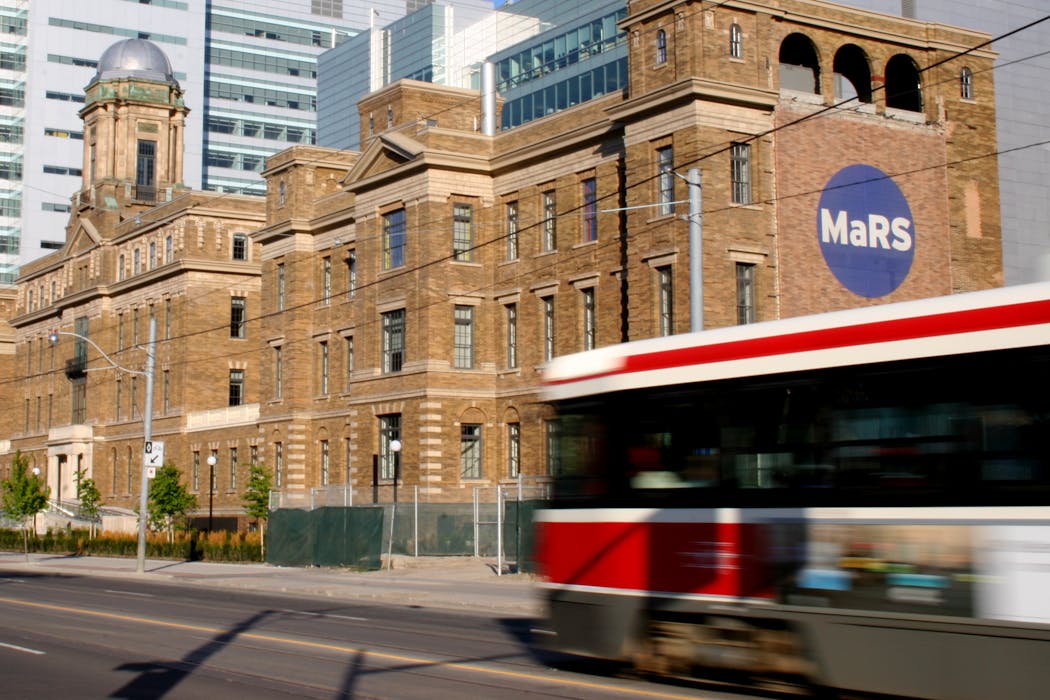
The MaRS urban innovation hub building in Toronto. Canada may benefit from the American H-1B visa fee increase by attracting highly skilled tech workers and others from abroad to Canada instead of the United States. (WikiMedia), CC BY

The United States government recently announced a US$100,000 H-1B visa fee on new applications, which will affect highly educated workers from abroad who are seeking jobs in the U.S. This policy could have ripple effects for Canada by reducing the emigration of Canadians going to work in the U.S. — and by attracting a talented workforce to the country.

The H-1B visa program was created in 1990 for applicants with at least a bachelor’s degree or higher to work in the U.S. The current annual statutory cap is 65,000 visas, with 20,000 additional visas for professionals from abroad who graduate with a master’s or doctorate from an American institution of higher learning.

The recent announcement regarding the fee increase has astounded tech companies that have long relied on the visa to employ foreign workers in the U.S. Since 2012, about 60 per cent of H-1B workers approved each year have held a tech-related job. Tech companies have been pushing U.S. Congress to expand the visa program due to the high demand and competition for the H-1B.

Instead, this massive increase in fees will make it much more expensive for firms to hire highly educated and skilled immigrants.

The impact on Canadians

Approximately 828,000 Canadian-born immigrants lived in the U.S. as of 2023, many of whom moved to the country via employment channels. Canadians made up one per cent of the total H-1B applications in 2019, and the new H-1B visa fee could reduce the number of Canadians moving to the U.S. for work.

This is especially true in the tech sector, as noted by Prime Minister Mark Carney in his recent remarks at the Council of Foreign Relations in New York:

“We are a leading developer of AI. And our research universities are some of the biggest producers in volume of AI, computing and quantum talent in the world. Unfortunately, most of them go to the United States. I understand you’re changing your visa policy, I hear, so going to hang onto a few of those.”

But another possibility is that American businesses could shift towards using the TN visa — an American non-immigrant visa for citizens of Canada and Mexico to work in specific professional-level jobs — to hire more Canadian workers. Canadians are eligible for the work permit under the Canada-US-Mexico-trade agreement.

These companies could then bypass paying the new H-1B visa fee while still hiring Canadian talent.

Prime Minister Mark Carney’s full remarks to the Council of Foreign relations. (Reuters)

Competition for global talent

Various countries, including Canada, are competing to attract and retain global talent. For many highly educated people from abroad seeking work in the U.S., especially recent international graduates of American universities, the new visa fee might result in fewer employment opportunities. As they start to look elsewhere, Canada could be an attractive destination if immigration pathways can be provided in a timely fashion.

Research has also shown that when faced with restrictions on immigration policies to hire skilled immigrants, U.S.-based multinational companies have responded by decreasing the number of jobs they offer in the U.S. and by increasing foreign affiliate employment, particularly in India, China and Canada.

So Canada should be proactive in working with these companies as they plan alternate pathways to retain their workforce.

This sudden and drastic change in the H-1B visa fee by the Donald Trump government presents a window of opportunity for Canadian policymakers to react quickly and offer pathways to recruit such foreign talent. The Canadian government seems to be paying attention. Carney told a recent news conference in London:

“Not as many of those people are going to get visas to the United States. And these are people with lots of skills that are enterprising, and they’re willing to move to work …. So it’s an opportunity for Canada, and we’re going to take that into account. And we’ll have a clear offering on that.”

Crises can create opportunities

A policy window opens when there is the right combination of recognizing a problem and providing a feasible policy solution while there is a favourable political climate. This allows policymakers to link the problem to a solution and advocate for change.

In the current environment, policy officials inside and outside of government can provide ideas on creating targeted policies and pathways to recruit talented workers to Canada.

An example of such a targeted initiative was seen in 2023, when the Canadian government, while announcing its Tech Talent Strategy, introduced a program that allowed H-1B visa holders to apply to receive an open three-year work permit in Canada.

It became clear that Canada was regarded as a popular alternative when applications closed within 24 hours after the maximum number of 10,000 applications was reached.

The Conversation

Richa Shivakoti receives funding from the Social Science and Humanities Research Council.

Anna Triandafyllidou receives funding for research related to high-skilled migration and its governance from the Tri-Council Agency and the Social Sciences and Humanities Research Council of Canada, as well as Horizon Europe (Link4Skills research project).

ref. The H-1B visa fee hike in the United States opens a policy window for Canada – https://theconversation.com/the-h-1b-visa-fee-hike-in-the-united-states-opens-a-policy-window-for-canada-266518

Why free speech rights got left out of the Constitution – and added in later via the First Amendment

Source: The Conversation – USA – By Donald Nieman, Professor of History and Provost Emeritus, Binghamton University, State University of New York

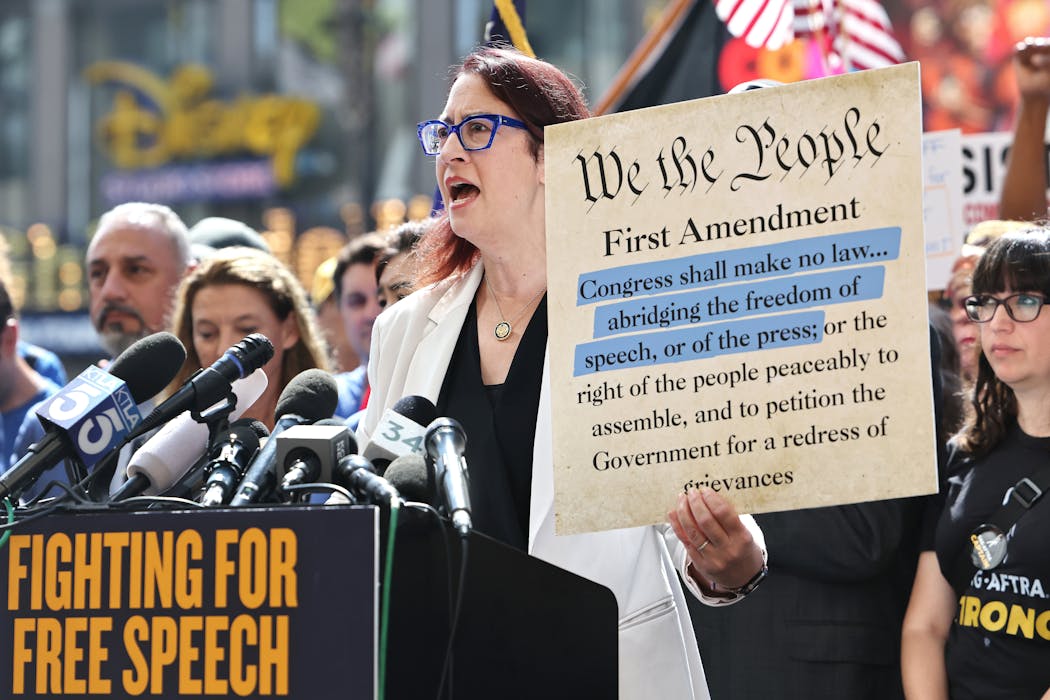
Supporters of free speech gather in September 2025 to protest the suspension of ‘Jimmy Kimmel Live!’, across the street from the theater where the show is produced in Hollywood. Mario Tama/Getty Images

Bipartisan agreement is rare in these politically polarized days.

But that’s just what happened in response to ABC’s suspension of “Jimmy Kimmel Live!” The suspension followed the Federal Communications Commission chairman’s threat to punish the network for Kimmel’s comments about Charlie Kirk’s alleged killer.

It lit up the media. Democrats and civil libertarians denounced the FCC chairman Brendan Carr for violating the First Amendment’s guarantee of freedom of speech. Voices on the right, including Senator Ted Cruz, joined them.

Within a week, Kimmel’s show was back on the air.

While bipartisan agreement may be rare, it’s not surprising that it came in defense of the First Amendment – and a popular TV show. A recent poll found that a whopping 90% of respondents called the First Amendment “vital,” while 64% believed it’s so close to perfection that they wouldn’t change a word.

In just 45 words, it bars Congress from establishing or preventing the free exercise of religion, interfering with the peoples’ right to assemble and petition, or abridging freedom of speech or the press.

I’m a historian and scholar of modern U.S. law and politics. Here’s the story of why this amendment – now considered fundamental to American freedom and identity – wasn’t part of the original Constitution and how it was included later on.

Added three years after the Constitution was ratified, it resulted from political compromise and a change of heart by framer James Madison.

An antique document with both printing and handwritten edits to it.
Handwritten revisions by senators during the process of altering and consolidating the amendments to the U.S. Constitution proposed by James Madison of Virginia.
National Archives

Soured on bills of rights

Building a strong national government was the focus of Madison and the other delegates who met in Philadelphia in May 1787 to draft the Constitution.

They believed the government created by the Articles of Confederation after the colonists declared independence was dysfunctional, and the nation was disintegrating.

The government could not pay its debts, defend the frontier or protect commerce from interference by states and foreign governments.

Although Madison and the other framers aimed to create a stronger national government, they cared about protecting liberty. Many had helped create state constitutions that included pioneering bills of rights.

Madison himself played a critical role in securing passage in 1776 of the Virginia Declaration of Rights, a monument to civil liberties.

By the time the Constitutional Convention met, however, Madison had soured on such measures. During the 1780s, he had watched with alarm as state legislatures trampled on rights explicitly guaranteed by their constitutions. Bills of rights, he concluded, weren’t sufficient to protect rights.

So Madison and his colleagues put their faith in reinventing government.

No appetite to haggle

The Constitution they wrote created a government powerful enough to promote the national interests while maintaining a check on state legislatures. It also established a system of checks and balances that ensured federal power wasn’t abused.

In the convention’s waning days, delegates briefly discussed adding a bill of rights but unanimously decided against it. They had sweated through almost four months of a sweltering Philadelphia summer and were ready to go home. When Virginia’s John Rutledge noted “the extreme anxiety of many members of the Convention to bring the business to an end,” he was stating the obvious. With the Constitution in final form, few had the appetite to haggle over the provisions of a bill of rights.

That decision nearly proved fatal when the Constitution went to the states for ratification.

The new Constitution’s supporters, known as Federalists, faced fierce opposition from Anti-Federalists who charged that a powerful national government, unrestrained by a bill of rights, would inevitably lead to tyranny.

Ratification conventions in three of the most critical states – Massachusetts, New York and Virginia – were narrowly divided; ratification hung in the balance. Federalists resisted demands to make ratification contingent on amendments suggested by state conventions. But they agreed to add a bill of rights – after the Constitution was ratified and took effect.

That concession did the trick.

A poster featuring an image of Colonial men and boys in a blacksmith shop, with 'Our Bill of Rights IS EVERYBODY'S BUSINESS' written on it.
A poster from 1959, published by the U.S. government, about the First Amendment.
Stanley Dersh citizenship poster, U.S. Government Publishing Office via Reagan Library

Harmless, possibly helpful

The three critical states ratified without condition, and by midsummer 1788, the Constitution had been approved.

However, when the First Congress met in March 1789, the Federalist majority didn’t prioritize a bill of rights. They had won and were ready to move on.

Madison, now a Federalist leader in the House of Representatives, insisted that his party keep its word. He warned that failure to do so would undermine trust in the new government and give Anti-Federalists ammunition to demand a new convention to do what Congress had left undone.

But Madison wasn’t just arguing for his party keeping its word. He had also changed his mind.

The ratification debates and Madison’s correspondence with Thomas Jefferson led him to think differently about a bill of rights. He now thought it harmless and possibly helpful. Its provisions, Madison conceded, might become “fundamental maxims of a free government” and part of “the national sentiment.” Broad popular support for a bill of rights might provide a check on government officials and how they wielded power.

Madison pushed his colleagues relentlessly. Wary of provisions that would weaken the national government, he developed a slate of amendments focused on individual rights. Ultimately, Congress approved 12 amendments – ensuring rights from freedom of speech to protection from cruel and unusual punishment – and sent them to the states for ratification.

First Amendment no cure-all

By the end of 1791, 10 of them – including the First Amendment ≠ had been ratified.

As Madison anticipated, the First Amendment wasn’t a cure for a government bent on suppressing dissent. From the Sedition Act in the 1790s to McCarthyism in the 1950s and the Trump administration’s assault on the First Amendment, government has used its awesome powers to pursue and punish critics.

On occasion, courts have intervened to protect First Amendment rights, a weapon Madison didn’t anticipate. But not always.

Perhaps the ultimate protection for First Amendment rights is “national sentiment,” as Madison suggested. Norm-breaking presidents can disregard the law, and judges may cave. But public sentiment is a powerful force, as Jimmy Kimmel can attest.

The Conversation

Donald Nieman receives funding from the National Endowment for the Humanities and the American Council of Learned Societies. He is affiliated with Braver Angels.

ref. Why free speech rights got left out of the Constitution – and added in later via the First Amendment – https://theconversation.com/why-free-speech-rights-got-left-out-of-the-constitution-and-added-in-later-via-the-first-amendment-266639

The Supreme Court is headed toward a radically new vision of unlimited presidential power

Source: The Conversation – USA – By Graham G. Dodds, Professor of Political Science, Concordia University

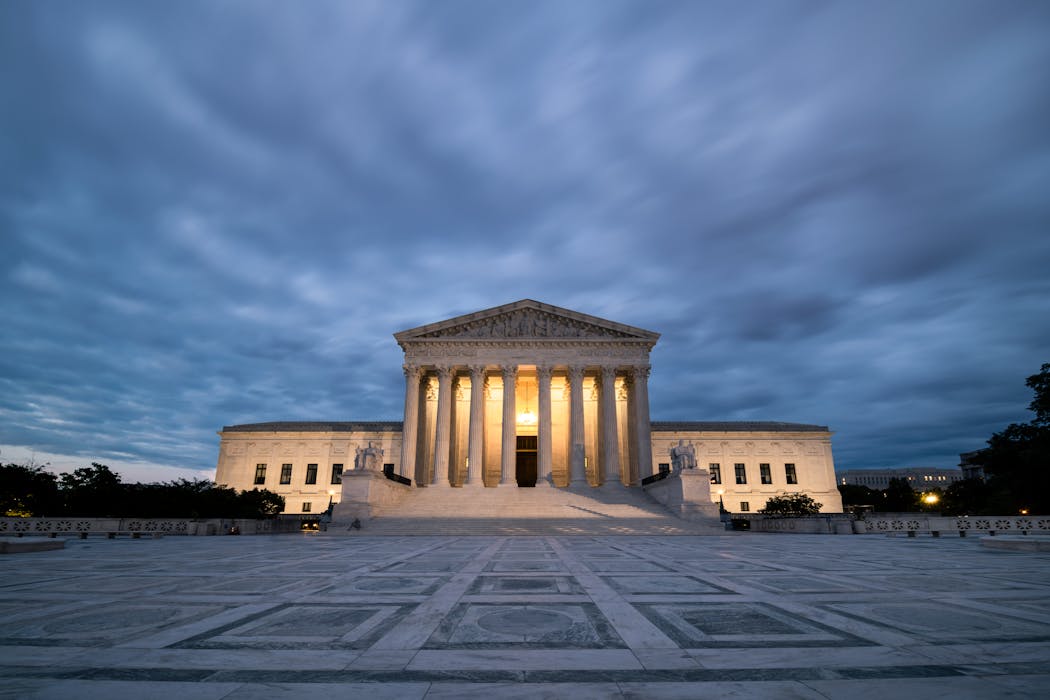
In a series of cases over the past 15 years, the Supreme Court has moved in a pro-presidential direction. Geoff Livingston/Getty Images

President Donald Trump set the tone for his second term by issuing 26 executive orders, four proclamations and 12 memorandums on his first day back in office. The barrage of unilateral presidential actions has not yet let up.

These have included Trump’s efforts to remove thousands of government workers and fire several prominent officials, such as members of the Corporation for Public Broadcasting and the chair of the Commission on Civil Rights. He has also attempted to shut down entire agencies, such as the Department of Education and the U.S. Agency for International Development.

For some scholars, these actions appear rooted in the psychology of an unrestrained politician with an overdeveloped ego.

But it’s more than that.

As a political science scholar who studies presidential power, I believe Trump’s recent actions mark the culmination of the unitary executive theory, which is perhaps the most contentious and consequential constitutional theory of the past several decades.

A prescription for a potent presidency

In 2017, Trump complained that the scope of his power as president was limited: “You know, the saddest thing is that because I’m the president of the United States, I am not supposed to be involved with the Justice Department. I am not supposed to be involved with the FBI, I’m not supposed to be doing the kind of things that I would love to be doing. And I’m very frustrated by it.”

The unitary executive theory suggests that such limits wrongly curtail the powers of the chief executive.

Formed by conservative legal theorists in the 1980s to help President Ronald Reagan roll back liberal policies, the unitary executive theory promises to radically expand presidential power.

There is no widely agreed upon definition of the theory. And even its proponents disagree about what it says and what it might justify. But in its most basic version, the unitary executive theory claims that whatever the federal government does that is executive in nature – from implementing and enforcing laws to managing most of what the federal government does – the president alone should personally control it.

This means the president should have total control over the entire executive branch, with its dozens of major governmental institutions and millions of employees. Put simply, the theory says the president should be able to issue orders to subordinates and to fire them at will.

President Donal Trump appears seated in the oval office.
President Donald Trump signs executive orders in the Oval Office next to a poster displaying the Trump Gold Card on Sept. 19, 2025.
AP Photo/Alex Brandon

The president could boss around the FBI or order the U.S. attorney general to investigate his political opponents, as Trump has done. The president could issue signing statements – a written pronouncement – that reinterpret or ignore parts of the laws, like George W. Bush did in 2006 to circumvent a ban on torture. The president could control independent agencies such as the Securities and Exchange Commission and the Consumer Product Safety Commission. The president might be able to force the Federal Reserve to change interest rates, as Trump has suggested. And the president might possess inherent power to wage war as he sees fit without a formal authorization from Congress, as officials argued during Bush’s presidency.

A constitutionally questionable doctrine

A theory is one thing. But if it gains the official endorsement of the Supreme Court, it can become governing orthodoxy. It appears to many observers and scholars that Trump’s actions have intentionally invited court cases by which he hopes the judiciary will embrace the theory and thus permit him to do even more. And the current Supreme Court appears ready to grant that wish.

Until recently, the judiciary tended to indirectly address the claims that now appear more formally as the unitary executive theory.

During the country’s first two centuries, courts touched on aspects of the theory in cases such as Kendall v. U.S. in 1838, which limited presidential control of the postmaster general, and Myers v. U.S. in 1926, which held that the president could remove a postmaster in Oregon.

In 1935, in Humphrey’s Executor v. U.S., the high court unanimously held that Congress could limit the president’s ability to fire a commissioner of the Federal Trade Commission. And in Morrison v. Olson the court in 1988 upheld the ability of Congress to limit the president’s ability to fire an independent counsel.

Some of those decisions aligned with some unitary executive claims, but others directly repudiated them.

Warming up to a unitary executive

In a series of cases over the past 15 years, the Supreme Court has moved in an unambiguously unitarian, pro-presidential direction. In these cases, the court has struck down statutory limits on the president’s ability to remove federal officials, enabling much greater presidential control.

These decisions clearly suggest that long-standing, anti-unitarian landmark decisions such as Humphrey’s are on increasingly thin ice. In fact, in Justice Clarence Thomas’ 2019 concurring opinion in Seila Law LLC v. CFPB, where the court ruled the Consumer Financial Protection Bureau’s leadership structure was unconstitutional, he articulated his desire to “repudiate” the “erroneous precedent” of Humphrey’s.

Several cases from the court’s emergency docket, or shadow docket, in recent months indicate that other justices share that desire. Such cases do not require full arguments but can indicate where the court is headed.

In Trump v. Wilcox, Trump v. Boyle and Trump v. Slaughter, all from 2025, the court upheld Trump’s firing of officials from the National Labor Relations Board, the Merit Systems Protection Board, the Consumer Product Safety Commission and the Federal Trade Commission.

Previously, these officials had appeared to be protected from political interference.

President George W. Bush appears with several soldiers.
President George W. Bush signed statements in 2006 to bypass a ban on torture.
AP Photo/Pablo Martinez Monsivais, File

Total control

Remarks by conservative justices in those cases indicated that the court will soon reassess anti-unitary precedents.

In Trump v. Boyle, Justice Brett Kavanaugh wrote, “whether this Court will narrow or overrule a precedent … there is at least a fair prospect (not certainty, but at least a reasonable prospect) that we will do so.” And in her dissent in Trump v. Slaughter, Justice Elena Kagan said the conservative majority was “raring” to overturn Humphrey’s and finally officially embrace the unitary executive.

In short, the writing is on the wall, and Humphrey’s may soon go the way of Roe v. Wade and other landmark decisions that had guided American life for decades.

As for what judicial endorsement of the unitary executive theory could mean in practice, Trump seems to hope it will mean total control and hence the ability to eradicate the so-called “deep state.” Other conservatives hope it will diminish the government’s regulatory role.

Kagan recently warned it could mean the end of administrative governance – the ways that the federal government provides services, oversees businesses and enforces the law – as we know it:

“Humphrey’s undergirds a significant feature of American governance: bipartisan administrative bodies carrying out expertise-based functions with a measure of independence from presidential control. Congress created them … out of one basic vision. It thought that in certain spheres of government, a group of knowledgeable people from both parties – none of whom a President could remove without cause – would make decisions likely to advance the long-term public good.”

If the Supreme Court officially makes the chief executive a unitary executive, the advancement of the public good may depend on little more than the whims of the president, a state of affairs normally more characteristic of dictatorship than democracy.

The Conversation

Graham G. Dodds does not work for, consult, own shares in or receive funding from any company or organization that would benefit from this article, and has disclosed no relevant affiliations beyond their academic appointment.

ref. The Supreme Court is headed toward a radically new vision of unlimited presidential power – https://theconversation.com/the-supreme-court-is-headed-toward-a-radically-new-vision-of-unlimited-presidential-power-265840

Wings, booze and heartbreak – what my research says about the hidden costs of sports fandom

Source: The Conversation – USA (2) – By Aaron Mansfield, Assistant Professor of Sport Management, Merrimack College

A Buffalo Bills fan who prefers ketchup over mustard on his hot dog. Brett Carlsen/Getty Images

Being from Buffalo means getting to eat some of the best wings in the world. It means scraping snow and ice off your car in frigid mornings. And it means making a lifelong vow to the city’s NFL franchise, the Bills – for better or worse, till death do us part.

When I grew up in New York’s second-largest city, my community was bound together by loyalty to a football team that always found new ways to break our hearts. And yet at the start of each NFL season, we always found reasons to hope – we couldn’t help ourselves.

Coming from this football-crazed culture, I often wondered about the psychology of fandom. This eventually led me to pursue a Ph.D. in sport consumer behavior. As a doctoral student, I was most interested in one question: Is fandom good for us?

I found a huge body of research on the psychological and social effects of fandom, and it certainly made being devoted to a team look good. Fandom builds belonging, helps adults make friends, boosts happiness and even provides a buffer against traumatic life events.

So, fandom is great, right?

As famed football commentator Lee Corso would say: “Not so fast, my friend.”

While fandom appears to be a boon for our mental health, strikingly little research had been conducted on the relationship between fandom and physical health.

So I decided to conduct a series of studies – mainly of people in Western countries – on this topic. I found that being a sports fan can have some drawbacks for physical health, especially among the most committed fans.

Reach for the nachos

Playing sports is healthy. But watching them? Not so much.

Tailgating culture revolves around alcohol. Research shows that college sports fans binge drink at significantly higher rates than nonfans, are more likely to do something they later regretted and are more likely to drive drunk. Meanwhile, watch parties encourage being stationary for hours and mindlessly snacking. And, of course, fandom goes hand in hand with heavily processed foods like wings, nachos, pizza and hot dogs.

One fan told me that when watching games, his relationship with food is “almost Pavlovian”; he craves “decadent” foods the same way he seeks out popcorn at the movies.

Rows of leather chairs filled with men, many of whom have multiple beers on their side tables. Big screens air different games and ads.
Fans kick back to watch games at Caesars Palace Race and Sports Book in Las Vegas.
George Rose/Getty Images

Inside the stadium, healthy options have traditionally been scarce and overpriced. A Sports Illustrated writer joked in 1966 that fans leave stadiums and arenas with “the same body chemistry as a jelly doughnut.”

Little seems to have changed since. One Gen Z fan I recently interviewed griped, “You might find one salad with a plain piece of lettuce and a quarter of a tomato.”

Eating away the anxiety and pain

The relationship between fandom and physical health isn’t just about guzzling beer, sitting for hours on end or scarfing down hot dogs.

One study analyzed sales from grocery stores. The researchers found that fans consume more calories – and less healthy food – on the day following a loss by their favorite team, a reaction the researchers tied to stress and disappointment.

My colleagues and I found something similar: Fandom induces what’s called “emotional eating.”

Emotions like anger, sadness and disappointment lead to stronger cravings. And this relationship is tied to how your favorite team performs when it matters most. For example, we found that games between rivals and closely contested games yield more pronounced effects. Emotional states generated by the game are also significantly correlated with increased beer sales in the stadium.

High-calorie cultures

In another paper, my co-authors and I found that fans often feel torn between their desire to make healthy choices and their commitment to being a “true fan.”

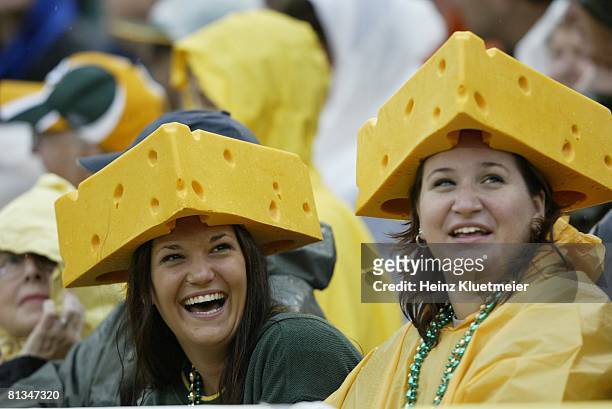
Every fan base develops its own culture. These unwritten rules vary from team to team, and they aren’t just about wearing a cheesehead hat or waving a Terrible Towel. They also include expectations around drinking, eating and lifestyle.

These health-related norms are shaped by a variety of factors, including the region’s culture, team history and even team sponsorships.

For example, the Cincinnati Bengals partner with Skyline Chili, a regional chain that makes a meat sauce that’s often poured over hot dogs or spaghetti. One Bengals fan I interviewed observed that if you attend a Bengals game, sure, you could eat something else – but a “true fan” eats Skyline.

I have two studies in progress that show how hardcore fans typically align their health behaviors with the health norms of their fan base. This becomes a way to signal their allegiance to the team, improve their standing among fellow fans, and contribute to what makes the fan base distinct in the eyes of its members.

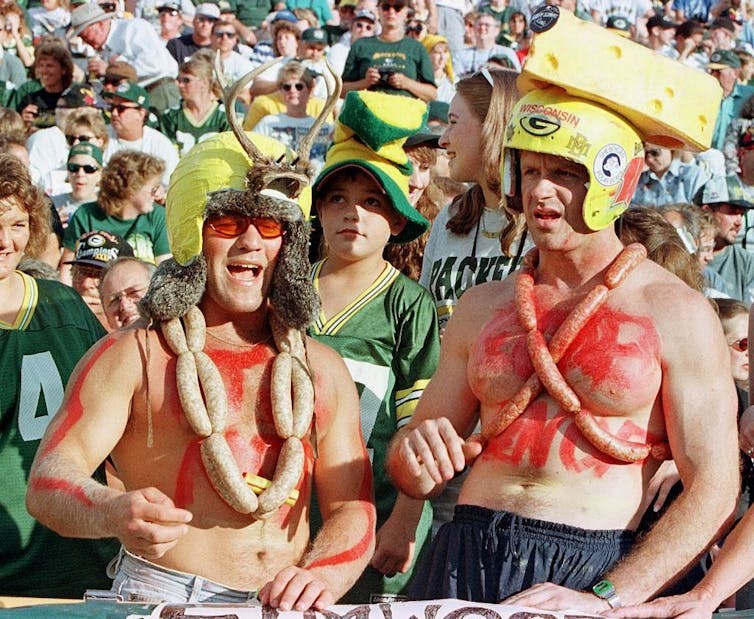
Two shirtless fans, one wearing a cheesehead hat, another wearing a helmet with antlers. Both wear sashes made of sausage links.
Cheese and sausages are synonymous with Wisconsin – and being a fan of the state’s NFL team, the Green Bay Packers.
Jeff Haynes/AFP via Getty Images

In Buffalo, for example, tailgating often revolves around alcohol – so much so that Bills fans have a reputation for over-the-top drinking rituals.

And in New Orleans, Saints fans often link fandom to Louisiana food traditions. As one fan explained: “People make a bunch of fried food or huge pots of gumbo or étouffée, and eat all day – from hours before the game until hours after.”

A new generation of health-conscious fans

The fan experience is shaped by the culture in which it is embedded. Teams actively help shape these cultures, and there’s a business argument to be had for teams to play a bigger role in changing some of these norms.

Gen Z is strikingly health-conscious. They’re also less engaged with traditional fandom.

If stadiums and tailgates continue to revolve around beer and nachos, why would a generation attuned to fitness influencers and “fitspiration” buy in? To reach this market, I think the sports industry will need to promote its professional sports teams in new ways.

Some teams are already doing so. The British soccer team Liverpool has partnered with the exercise equipment company Peloton. Another club, Manchester City, has teamed up with a nonalcoholic beer brand as the official sponsor of its practice uniforms.

And several European soccer clubs have even joined a “Healthy Stadia” movement, revamping in-stadium food options and encouraging fans to walk and bike to the stadium.

For the record, I don’t think the solution is replacing typical fan foods with smoothies and salads. Alienating core consumers is generally not a sound business strategy.

I think it’s reasonable, however, to suggest sports teams might add more healthy options and carefully evaluate the signals they send through sponsorships.

As one fan I recently interviewed said: “The NFL has had half-assed efforts like Play 60” – a campaign encouraging kids to get at least 60 minutes of physical activity per day – “while also making a ton of money from beer, food and, back in the day, cigarette advertisements. How can sports leagues seriously expect people to be healthier if they promote unhealthy behaviors?”

Today’s consumers want to support brands that reflect their values. This is particularly true for Gen Zers, many of whom are savvy enough to see through hollow campaigns and quick to reject hypocrisy. In the long run, I think this type of dissonance – sandwiching a Play 60 commercial between ads for Uber Eats and Anheuser-Busch – will prove counterproductive.

Three people dressed up in hot dog costumes – one green, one red and one yellow – race during a baseball game.
Relish, ketchup and mustard ‘race’ during a September 2025 baseball game between the Kansas City Royals and Seattle Mariners, in an encapsulation kind of dissonance between showcasing both physical activity and junk food at sporting events.
Scott Winters/Icon Sportswire via Getty Images

I, as much as anyone else, understand what makes fandom special – and yes, I’ve eaten my share of wings during Bills games. But public health is a pressing concern, and though the sports industry is well-positioned to address this issue, fandom isn’t helping. Actually, my research suggests it’s having the opposite effect.

Striking the balance I’m advocating will be tricky, but the sports industry is filled with bright problem-solvers. In the film “Moneyball,” Brad Pitt’s character, Billy Beane, famously says sports teams must “adapt or die.” He was referring to the need for baseball teams to integrate analytics into their decision-making.

Professional sports teams eventually got that message. Maybe they’ll get this one, too.

The Conversation

Aaron Mansfield does not work for, consult, own shares in or receive funding from any company or organization that would benefit from this article, and has disclosed no relevant affiliations beyond their academic appointment.

ref. Wings, booze and heartbreak – what my research says about the hidden costs of sports fandom – https://theconversation.com/wings-booze-and-heartbreak-what-my-research-says-about-the-hidden-costs-of-sports-fandom-265158

Tribal colleges and universities aren’t well known, but are a crucial steppingstone for Native students

Source: The Conversation – USA (2) – By Cynthia Lindquist, Director of Tribal Initiatives & Collaborations, University of North Dakota

Navajo Technical University in Crownpoint, N.M., is the largest tribal university in the country. Blake Gumprecht/Flickr, CC BY

Most Native American high school students do not attend or graduate from college.

As a tribal member of Spirit Lake Nation in North Dakota and the former president of Cankdeska Cikana Community College in Fort Totten, North Dakota, I recognize the difference that tribal colleges and universities, like the one I used to work at, can have in rerouting Native students’ education journeys.

Tribal colleges and universities, or TCUs, are public institutions that are founded and run by a Native American tribe and focus on serving Native American students and communities.

The approximately 3.9 million Native Americans living in the U.S. have long recognized that TCUs are unique institutions that help Native students succeed in school and earn higher education degrees.

Most Americans, though, have no idea that tribal colleges and universities even exist, let alone know how they work.

A wooden sign on a quiet road with grass says 'Salish Kootenai College.'
Salish Kootenai College in Pablo, Mont., is one of 35 recognized tribal colleges and universities in the country.
U.S. Department of Education, CC BY

Understanding tribal colleges

TCUs enroll approximately 30,000 students each year, including some non-Native students. The median annual tuition at TCUs is US$3,572, making them more affordable than most other public universities.

There are 35 accredited TCUs across 13 states, including Montana, Arizona, Oklahoma, North Dakota and South Dakota. All of these schools are nonprofits.

While a single Native tribe sometimes sets up a tribal college, in other cases a consortium of tribes or the federal government helps establish a school.

Despite their differences, tribal colleges and universities all have the same mission of teaching Indigenous history, culture and languages.

All the tribal colleges also offer associate degrees and certifications. Twenty-two of them have only baccalaureate programs, and nine have master’s programs. Navajo Technical University, a tribal college in Crownpoint, New Mexico, which has the largest enrollment size of all the TCUs, began offering a first of its kind doctorate program in Diné Studies in 2024. This program focuses on the language, culture and history of the Diné people, also known as Navajo people.

Affordability has always been a consideration when TCUs set tuition and fees, since most are located on rural American Indian reservations with high unemployment and poverty rates, as well as few available jobs.

TCUs keep their tuition relatively low in part because a majority of their funding comes from the federal government. They also receive funding from philanthropic organizations.

TCUs also generally have minimal overhead costs, since most students live off-campus and only a handful of these colleges and universities offer on-campus housing. Most TCUs have both in-person and online courses.

While there is no single profile of a TCU student, I found that it is common to encounter a 30-year-old, single mother who works full time while trying to earn a college degree.

A growth in college enrollment

In 1968, just 181 Native Americans graduated from a four-year college.

That same year, the Navajo Nation established the first tribal college, then called the Navajo Community College, in Tsaile, Arizona. This school is now called Diné College.

Several factors prevented most Native American students from attending a college or university.

The cost of college was prohibitive, and many Native American students were also not adequately prepared for college in high school. These students and their families also feared that higher education could force them to assimilate into Western and white culture, and erase their own Native traditions and languages.

A long political relationship

When considering this historical context, it is important to understand that Native Americans have a unique relationship with the federal government.

Native Americans largely consider this relationship a political one, bound by the various legal precedents, federal policies and executive orders from the 1800s and onward. These orders and policies from the past several hundred years vary, but they often focus on questions of land, assimilation and the political independence of Native tribes.

There are also treaties and orders that focus on education and spell out the federal government’s responsibility to help coordinate and give money to support tribal education.

In 1978, Congress approved the Tribally Controlled Community College Assistance Act, which recognized tribal colleges as higher education institutions and established that the federal government would regularly help fund these schools.

Alongside the creation of new tribal colleges and universities over the past several decades, more and more Native people living on reservations have graduated from high school and received higher education degrees.

The percentage of Native college graduates rose 125% from 1990 to 2020. While 4.5% of Native students living on reservations received a college degree in 1990, that percentage rose to 10.3% with at least a college degree in 2020, according to findings by Harvard Kennedy School in September 2025.

Yet, unlike the high school trends, Native people still graduate college at a much lower rate than the general American population.

In 1990, 20.3% of all Americans had at least a college degree. In 2020, 34.3% of Americans had a college degree at a minimum, according to the Harvard Kennedy School findings.

A woman smiles at a cat that is resting on a cat bed, in a classroom with people seated nearby.
A professor at Navajo Technical University participates in a veterinary technology program conducted with the Department of Agriculture in 2019 in Crownpoint, N.M.
Flickr/U.S. Department of Agriculture, CC BY

A lasting impact

While tribal colleges and universities receive state and federal funding, they are chronically underfunded and often operate in survival mode. In some cases, they lack money to make needed repairs on campus buildings.

One major reason for this shortfall: While Congress agreed in the late 1970s to annually give tribal colleges $8,000 for each Native student they enroll, it has not met this financial and political commitment.

Tribal colleges annually receive $250 million less than what the federal government promised them, a 2024 ProPublica investigation found.

Tribal college and universities’ futures were cast in doubt in the spring of 2025, when the Trump administration announced a proposal to cut the Bureau of Indian Education’s annual budget from $183 million to $22 million. The Bureau of Indian Education is part of the Department of the Interior and oversees education for Native students.

But the Department of Education went on to announce in September that it would make a one-time, $495 million investment in historically Black colleges and universities and TCUs.

TCU leaders say they are still trying to understand the significance of this funding announcement and what it will result in.

I think it is important to recognize that TCUs make broad contributions to society, well beyond the impact they have on individual students.

TCUs teach entrepreneurship and business development and serve as pilot sites in launching businesses, for example.

For every federal dollar invested in tribal colleges, the schools return $1.60 in tax revenue through the increased tax payments of their alumni and their alumni’s employers, according to a September 2025 report by the American Indian Higher Education Consortium, a national organization that represents TCUs.

TCU alumni also generated $3.8 billion in added income, or gross domestic product, to the national economy from October 2022 through September 2023.

These schools offer a unique pathway for Native students to attend a higher education institution, while teaching them the skills they need to build a stable career.

The Conversation

I served as President of Cankdeska Cikana Community College (CCCC) one of the 34 tribal colleges located in North Dakota and that is affiliated with AIHEC. I am a member of the Spirit Lake Dakota Tribe who chartered CCCC in the 1970s. As a tribal college President, I served on the AIHEC Board of Directors and its Executive Committee.

ref. Tribal colleges and universities aren’t well known, but are a crucial steppingstone for Native students – https://theconversation.com/tribal-colleges-and-universities-arent-well-known-but-are-a-crucial-steppingstone-for-native-students-261222

More young adults are living with their parents than previous generations did

Source: The Conversation – USA (2) – By Rohan Shah, Assistant Professor of Economics, University of Mississippi; Institute for Humane Studies

Welcome back: The number of young adults living with their parents has risen by 1.5 million over the past decade. Maskot/DigitalVision via GettyImages

A potentially worrisome trend is emerging among young adults. Instead of landing a job and moving to the big city after graduation, many are moving back into their childhood homes instead. About 1.5 million more adults under 35 live with their parents today than a decade ago. That’s a 6.3% jump, more than double the rate of growth for the young adult population overall.

The issue is affordability. Over the past decade, urban rents have climbed about 4% per year, while wages for full-time workers have increased by only 0.6% annually. That means it’s harder than ever to live in a big city on the typical salary – especially if you’re a new graduate without much work experience.

The situation is even more challenging for aspiring homeowners: The median house price in the U.S. has risen about 90% in just 10 years, or more than 6% each year. And as prices rise – the median home sells for more than $400,000 now – so too do the ages of homebuyers. The median first-time U.S. homebuyer is 38 years old, up from 31 about a decade ago.

Why is the rent so high?

Put simply, there isn’t enough housing. As an economist, I know that when demand rises faster than supply, prices have to increase. And supply is severely limited in the places where people most want to live: big cities such as New York and San Francisco.

In most of these cities, planning and zoning laws prevent developers from building enough to meet demand. For example, rezoning a plot of land from commercial to residential often requires mountains of paperwork. And in many cities, objections from neighbors can stall a proposed development. These are just two of many obstacles local governments throw in homebuilders’ way.

One city that has tried something different is Austin, Texas. After deliberately relaxing its zoning laws a few years ago, Austin has seen a boom in home construction. Rents fell by 10% in one year and by as much as 22% in two years after that change. By making it easier to build, Austin has made it cheaper to live there.

I don’t think it’s a coincidence that Austin has a far lower share of its young adults living with their parents than many other cities do. Just 6% of working adults in the Austin metro area live with their parents, one analysis found, versus nearly 14% in Greater San Antonio and 20% in Greater Los Angeles.

The pros and cons of living with the ’rents

One obvious advantage of living with parents is that they tend to charge below-market rents, or nothing at all. That makes it easier to save for a deposit on a house, helping young adults get on the property ladder sooner than they would otherwise. Indeed, homeownership rates among those 25 to 34 have risen slightly since 2016.

There are also potential disadvantages, however, particularly when it comes to socializing. Living at home with parents can make it much more challenging to meet new people. This, in turn, could partly help explain why Americans are getting married and having children later in life. These delays might not seem important, but they can leave people feeling like they’re behind in life, which can affect their health and well-being.

I also wonder whether living with parents is indirectly making young adults unhappier at work. That’s because older adults often live far from the urban centers where young people are most likely to find jobs directly related to their degrees. Job satisfaction rates are substantially lower among 18- to 29-year-olds than among the rest of the working population.

A problem for the entire US

The housing shortage isn’t just an issue for young adults. A recent analysis I found insightful was headlined “The housing theory of everything.” It argued that the issue helps explain at least part of the current malaise in the U.S. economy.

For example, when people can’t live and work where they want, they’re unable to use their talents fully. That contributes to the relatively slow productivity growth the U.S. has experienced in recent years.

Similarly, if people can’t live in areas where they might meet and work with like-minded individuals, they have fewer opportunities to share ideas, which can hinder innovation.

And if the housing shortage is indeed encouraging young adults to delay having children, it could make it harder for the U.S. to fund Social Security and other government programs in the future.

Making it easier to build new homes in places people want to live and work could go a long way to easing these problems. It’s possible high rents translate into high barriers to adulthood, too.

The Conversation

I am acquaintances with the authors of the article “The Housing Theory of Everything.”

ref. More young adults are living with their parents than previous generations did – https://theconversation.com/more-young-adults-are-living-with-their-parents-than-previous-generations-did-264570

Even small drops in vaccination rates for US children can lead to disease outbreaks

Source: The Conversation – USA (3) – By David Higgins, Assistant Professor of Pediatrics, University of Colorado Anschutz Medical Campus

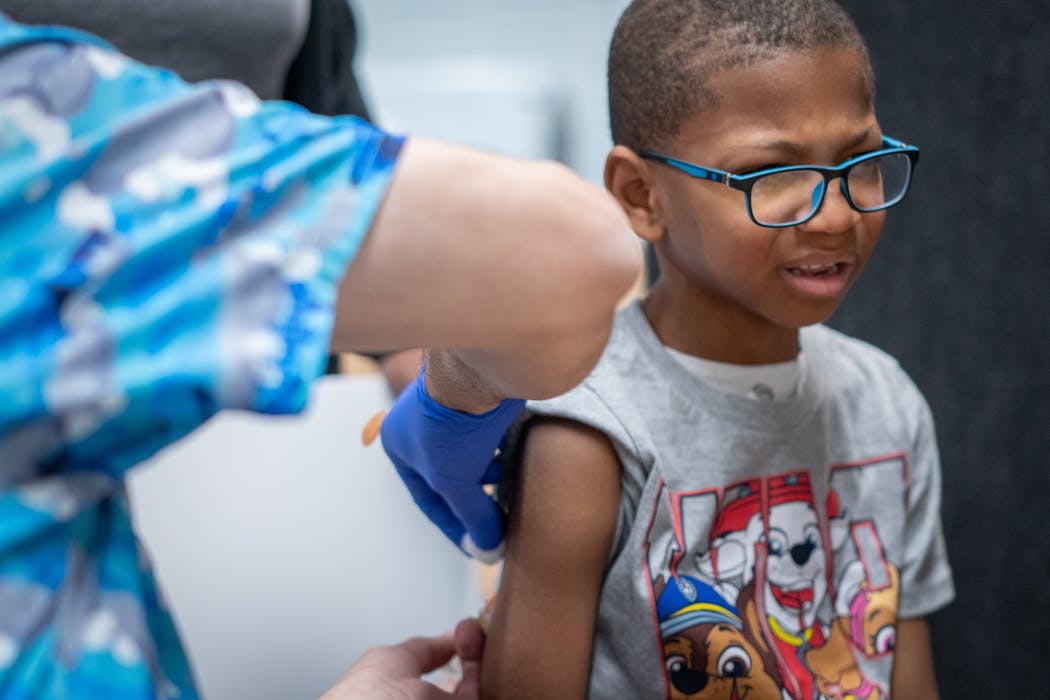
Xerius Jackson, age 7, gets an MMR vaccine during the Texas measles outbreak in March 2025. Jan Sonnenmair via Getty Images

More than three-quarters of U.S. counties and jurisdictions are experiencing declines in childhood vaccination rates, a trend that began in 2019, according to a September 2025 NBC News–Stanford University investigation. The report also found a “large swath” of the U.S. no longer has the “basic, ground-level immunity” needed to stop the spread of measles.

Dr. David Higgins, an assistant professor of pediatrics at the University of Colorado CU Anschutz Medical Center and a pediatrician who researches vaccines, discusses the dangers of not vaccinating your children.

Dr. David Higgins discusses back-to-school vaccinations.

The Conversation has collaborated with SciLine to bring you highlights from the discussion, edited for brevity and clarity.

What vaccines are typically required for schoolchildren, and why?

David Higgins: The vaccine requirements for kids to attend school are set by states, not the federal government. Most states require kindergartners get vaccines for pertussis – that’s whooping cough – and tetanus, measles, mumps, rubella and chickenpox.

For older kids, a booster of the tetanus and pertussis vaccine is typically required, as well as a vaccine for meningococcal disease.

Vaccines reduce the risk of outbreaks in places where transmission of these diseases is easy. Not only do vaccinations help keep both students and teachers safe, it also encourages overall higher community coverage for these vaccines.

How do scientists track the safety of vaccines over time?

Higgins: Before vaccines are approved, they undergo rigorous trials. During this process, scientists look at the safety and effectiveness of the vaccine, testing it first in small groups to assess safety, then in larger groups to confirm protection and detect uncommon side effects. That process continues after the vaccine is approved. Those systems continually monitor the safety of vaccines, both here in the U.S. as well as around the world.

What are the vaccination coverage trends for kindergartners?

Higgins: What we have seen is a small downward trend since 2019, the year prior to the COVID-19 pandemic. It slipped from 95% of new kindergartners being up to date on many of their routine vaccines to about 92%.

That’s a small percentage decrease, so a great majority of parents are still vaccinating their kids. But at the same time, anything below our target of 95% for diseases like measles becomes a problem, because that’s below the level that’s needed for what we call herd immunity, or community immunity. When that happens, it’s not a matter of if, but when, we see an outbreak of these infectious diseases.

And while nationwide rates are important to look at, outbreaks happen at local community levels. For example, earlier this year, an outbreak of measles in West Texas spread rapidly through communities where vaccination rates had slipped well below the state average.

So, the vaccination rate at your own school or community is much more meaningful than what the national vaccination rate is.

How do non-medical vaccine exemptions work?

Higgins: First, actual medical exemptions are rare, and these occur when the vaccine is unsafe for the child to receive, like when he or she has a known severe allergic reaction to vaccine ingredients.

Non-medical exemptions for vaccines are often for religious, personal or philosophical reasons. They have been increasing for the past several years, rising from the range of 1 to 2% up to 3.6% in the 2024–25 school year. That’s a small increase, but again, it’s still concerning.

{What are some reasons why parents are} Why are some parents vaccine hesitant?

Higgins: There are multiple reasons. These include misinformation which algorithm-driven echo chambers on social media can spread at an alarming rate right now. Also, Americans report less trust in institutions and experts, and studies have found growing partisanship around vaccines.

Additionally, vaccines are victims of their own success. They have worked so well that many diseases like polio aren’t routinely seen anymore. That might lead a parent to think the risk for their child is so low that the vaccine is not necessary. But the fact is, vaccines are simply holding these diseases at bay. And as vaccination rates drop, these diseases will come back and more kids will be at risk.

What advice do you have for parents?

Higgins: The most important thing you can do as a parent is to keep your kids up to date on required vaccines. That includes the annual flu shot. Follow your state’s requirements and current recommendations from trusted sources like the American Academy of Pediatrics and your own personal pediatrician to know which vaccines your child should have.

You also want to reinforce other common sense approaches to keeping your children healthy. Make sure they know how to wash their hands properly and that they stay home when they’re sick. Teach them to sneeze and cough into their elbow instead of into their hands – even though doing so isn’t a perfect solution.

As a pediatrician, I love when my families come and talk to me about their concerns. I help them walk through their worries so they can feel more confident that they’re making a truly informed decision that’s in the best interest of their child’s health.

SciLine is a free service based at the American Association for the Advancement of Science, a nonprofit that helps journalists include scientific evidence and experts in their news stories.

The Conversation

David Higgins is a member of the American Academy of Pediatrics. He is also on the board of directors (volunteer) for Immunize Colorado.

ref. Even small drops in vaccination rates for US children can lead to disease outbreaks – https://theconversation.com/even-small-drops-in-vaccination-rates-for-us-children-can-lead-to-disease-outbreaks-265555

From the pulpit to the picket line: For many miners, religion and labor rights have long been connected in coal country

Source: The Conversation – USA (3) – By Richard J. Callahan, Jr., Associate Professor of Religious Studies, Gonzaga University

Harlan County is the heart of eastern Kentucky’s coal region. Scott Olson/Getty Images

In October 2025, Cecil Roberts will officially retire from his role as president of the United Mine Workers of America. A sixth-generation coal miner, he has led the union for 30 years. Only one man held the role longer: John L. Lewis, whom many consider one of the most important labor leaders of the 20th century.

Roberts has seen the union through an especially difficult period for the coal industry and grew up immersed in it. He was raised in Cabin Creek, West Virginia, where his great-grandmother – an activist in her own right – let miners camp on her property during a legendary strike in 1912. Bill Blizzard, his great-uncle, led miners during the Battle of Blair Mountain, the largest labor uprising in U.S. history. Both of his grandfathers died in mine accidents.

And there’s another way Roberts is steeped in Appalachian history: Before an audience of workers, observers have often noted, he speaks like a preacher. Roberts likens miners’ struggles to biblical stories, references the power of God and the teachings of Jesus, and speaks in the dynamic cadences found in an Appalachian church.

A man with white hair raises his arms as he speaks animatedly at a podium, while he and other men nearby wear camo-colored t-shirts.
United Mine Workers of America President Cecil Roberts speaks to about 4,000 retired members in Lexington, Ky., on June 14, 2016.
AP Photo/Dylan Lovan

“Be like Jesus,” he told a rally in Charleston, West Virginia, in 2015, opposing a “right to work” bill that allowed workers in union-run shops to opt out of paying dues. “Jesus saw the money changers in the temple, and Jesus drove the money changers from the temple. So let me tell the National Right to Work Committee, the Chamber of Commerce, the Koch Brothers, and all those who gave money: you got your money’s worth, but we’re not for sale in West Virginia.”

“How many of you have been to a Baptist church? We’re going to take up a collection. It is altar call time,” he continued. “Now, I’m going to ask you something: Are you fed up? Let me hear you say, ‘Fed up.’… Are you so fed up that you are now fired up? Let me hear you say, ‘Fired up!’”

Capping off the rousing call-and-response, he shouted, “God bless all of you, you’re the salt of the earth!”

Roberts’ style is a glimpse into a bigger story. For over a century, coal has transformed central Appalachia: from the shape of the landscape to place names, and from folk music and crafts to economic conditions.

All the while, religion has been transforming in the mountains, too. Labor and religion are deeply entangled here – a subject I explored in my book “Work and Faith in the Kentucky Coal Fields: Subject to Dust.”

‘Railroad religion’

In the 1880s, two groups rushed into the central Appalachian Mountains: industrialists seeking coal, and missionaries seeking moral reform. Both changed the region forever, and their stories were intertwined.

At the time, central Appalachia was widely depicted in the popular press as a backward, ignorant region whose mountainous terrain kept its people isolated, outside the flow of progress – a stereotype still common today. Equating economic progress with moral progress, many Americans assumed that developing industry would lift people out of what they perceived as fatalism and superstition.

The coal industry used this idea to promote its rapid exploitation of mountain resources. Companies built railroads to connect the region to the national market, developed industrial coal mines and reshaped the central Appalachian economy. Missionaries opened churches, schools and camps.

A black and white photo of a settlement on a small hill along a river.
Henry Ford founded Twin Branch, W.Va. – shown here in the 1920s – as a town for coal miners.
Bettmann via Getty Images

Company-owned coal towns encompassed miners’ lives. People who had long farmed for themselves and lived, as the Bible told them to, “by the sweat of their brow,” became dependent upon coal companies as mine development shrank the size of family farms. Not only did employers own the miners’ houses, but they also paid workers in “scrip,” which was redeemable only at the company store.

Many company towns included theaters, offered films and music, and even built churches and paid pastors’ salaries. These were typically mainline Protestant churches, such as Methodist or Presbyterian.

To some Appalachian natives, these denominations were known as “railroad religion” because of the way they entered the mountains. And, for many miners, these were the churches of management. When there was labor unrest, the coal town churches tended to side with the companies, advising miners against strikes or agitation.

Faith and action

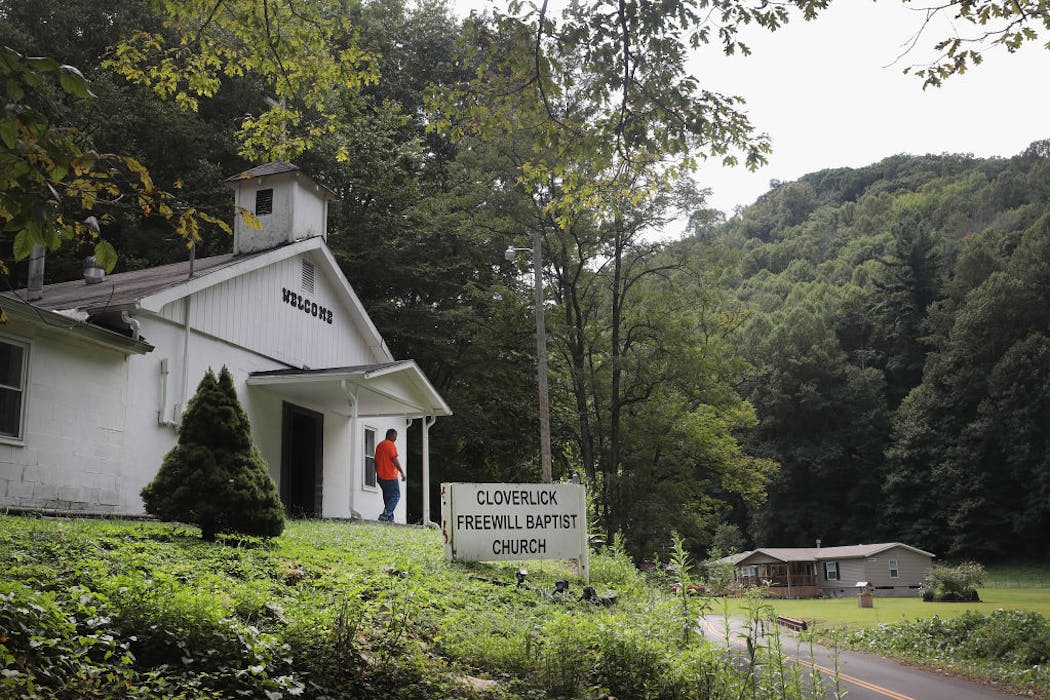
The churches of most miners born in central Appalachia, meanwhile, were in the mountain communities – independent Baptist or Holiness congregations whose pastors were usually miners themselves.

Pastors preached about the dangers and sacrifices miners faced deep underground, in an age of few regulations. God was on the side of the oppressed and downtrodden, they stressed – and those who gained at others’ expense would ultimately face divine judgment.

Their passionate preaching was meant to inspire action, whether it was committing one’s life to Jesus or to the union. Labor rights were deeply understood as religious issues, rooted in Christian concerns for justice and care.

John Sayles’ 1987 film “Matewan” powerfully depicted the divided role that religion played in West Virginia’s coalfields. One preacher, played by Sayles, equates the union with “the Prince of Darkness.” Another, a young miner, advocates in biblical terms for the union’s righteousness and helps to lead a strike. The result was the Matewan Massacre of 1920: a bloody battle between miners and armed guards hired by the mine owners.

Miner preachers and independent churches were central to the organization of miners in eastern Kentucky in the 1930s, too, during another period of violence between mine operators and miners over conditions, wages and unionization. It was during this time that miner’s wife and singer Sarah Ogan Gunning penned “Dreadful Memories,” turning the traditional hymn “Precious Memories” into a visceral depiction of miners’ struggle and a call for unionization:

“Dreadful memories, how they linger,
How they ever flood my soul.
How the workers and their children
Died from hunger and from cold.”

A black and white photo of several men in slacks and shirts standing outside a small white building.
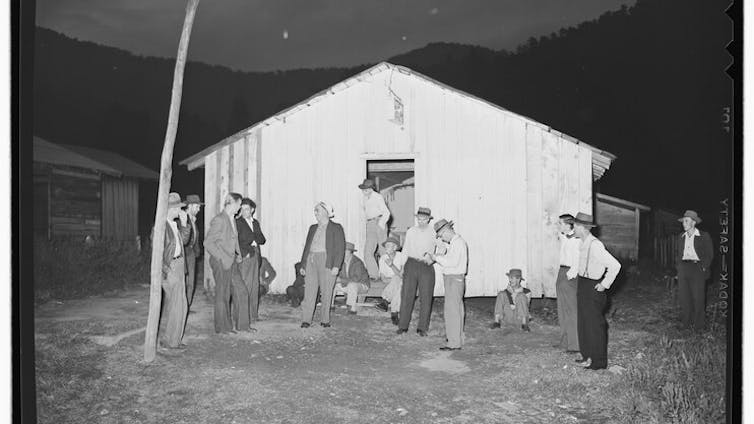
Miners in Harlan County, Ky., arrive at the Pentecostal Church of God building for a union meeting in 1946.
Department of the Interior/National Archives at College Park via Wikimedia Commons

Looking to the future

Today, it is still not surprising to find religious – particularly Christian – rhetoric in labor organizing. United Auto Workers President Shawn Fain is another example of a union leader whose speeches draw from the Bible.

But the dynamics of religion and class forged by industrial mining have shaped central Appalachia’s culture in lasting ways particular to the coalfields. The history of labor struggle, infused with religious idioms, is a source of identity and values evident in everything from union meetings in churches to prayers on picket lines.

Today, the United Mine Workers of America is focused less on coal itself, which miners know cannot last forever. The union represents members in other sectors, too, including public employees, manufacturing, health care and employees of the Navajo Nation. It has also focused its work on an equitable transition to renewable energy: one that accounts for the economic, cultural and environmental destruction that a single-industry economy has wreaked on central Appalachia.

A black wall with paler silhouettes of men standing along it, positioned above a low stone wall next to the road.
A memorial in Whitesville, W.Va., honors the 29 miners killed in a 2010 explosion in Massey Energy’s Upper Big Branch coal mine in nearby Montcoal.
Kristian Thacker for The Washington Post via Getty Images

Likewise, the United Mine Workers of America has fought to hold coal companies to their pension and health care obligations toward retired and sick miners whose work fueled the country and made companies rich.

And that struggle, Roberts would say, is a religious one as well.

The Conversation

Richard J. Callahan, Jr. does not work for, consult, own shares in or receive funding from any company or organization that would benefit from this article, and has disclosed no relevant affiliations beyond their academic appointment.

ref. From the pulpit to the picket line: For many miners, religion and labor rights have long been connected in coal country – https://theconversation.com/from-the-pulpit-to-the-picket-line-for-many-miners-religion-and-labor-rights-have-long-been-connected-in-coal-country-262472