When US president Donald Trump recently announced his 20-point peace plan for Israel and Hamas, he claimed the moment was: “Potentially, one of the great days ever in civilisation … and I’m not just talking about Gaza … the whole deal, everything getting solved. It’s called peace in the Middle East.” But there’s a massive gap between the diplomatic stage and the harsh reality faced by ordinary people in both Israel and Gaza.
Two years after October 7, one Israeli wrote on X about the shock he experienced when the war began: “When the first reports started rolling in that the [IDF] outposts had been captured … I, a former observation platoon commander, knew that in those outposts there were also young female observers, without weapons, without real protection.
“A few months earlier, I managed to quit using [anxiety drug] Clonazepam. When I read the messages, heard the voices, I felt I was going to pass out. I took two tablets. On the same day, in the afternoon, I found myself checking the door to my flat multiple times. Not to lock it, just to make sure, as if checking would protect me.”
This personal story, from a person in Tel Aviv, who was geographically far away from where the Hamas attack was taking place, is common among Israelis. To a people raised on stories of countless pogroms and the horror of the Holocaust, October 7 brought echoes of Israel’s collective memories of innocents being yanked out of their homes by brutal killers.
The atrocities of October 7 and their horrific and detailed documentation, ubiquitously disseminated on traditional and social media have created a nation stuck in a loop, unable to move on and largely unable to acknowledge all the horrific things it has done since. The reason for this inability to move forward and reflect backwards is the endlessness of the war.
Another Israeli wrote the following on X: “The 7th of October will never end (at least not in our lifetime); it is a wound that will remain … Even in 15 or 50 years, we will feel those itches in our bodies as the date approaches … But amidst all this, our most basic desire is to try and heal, because that’s what humans do – things get destroyed and ruined, and people try to rebuild. As long as the war continues and the hostages are still in Gaza, even that attempt cannot happen.”
In the meantime, the destruction and death in Gaza Israeli soldiers have witnessed or taken part in haunts them when they return home after their tours of duty. PTSD and suicide cases have spiked. Thousands are in treatment in military hospitals, while many thousands more are thought to be suffering untreated.
Palestinians struggle to survive
But for the people of Gaza, returning home is currently an impossibility. Hungry, exhausted and repeatedly displaced, ordinary people are fighting a daily struggle to survive. A video posted on X by Arab 48 (a Palestinian news website based in Haifa) provides powerful testimonials collected during the war.
One person from Rafah, sitting outdoors with his family to cook food, explains (in Arabic – my translation): “If the occupation ends, there will be no wars or struggles … we can live in peace, we [the Palestinians] will have a state, they [the Israelis] have a state, there will be no problem, the suffocating [situation] will end, our lives will stabilise.”
In one particularly heartbreaking scene in this report, one Palestinian family roaming Gaza with the few belongings they have left stops next to a pile of rubble which was once their home. The father reflects on: “A year of war, a year of anxiety, a year of sorrow, of fear, of homelessness. We left our beautiful, calm, safe, stable home, for a life of homelessness, suffering and anxiety, carrying all that we have with us. [We suffer from] a lack of food, poor health, and have no security.”
Another video within this report shows a man returning with a backpack to a big tent where his wife is waiting for him. He immediately collapses on a chair, dehydrated, as she splashes water on his face to help him regain strength. The caption to this segment reads: “His ‘peaceful’ return to his tent after trying to secure food for his family from the relief trucks.”
One man’s daily mission: find food and stay alive. X
Peace for this man has been reduced to coming home alive from a trip to the food distribution centres, now dangerous places where many Palestinians have been shot by IDF soldiers.
After two years of conflict, there must be a way to bridge the unfathomable distance between these two visions of peace. Trump’s grandiose vision of peace as the “greatest day in civilisation” for which he is congratulating himself in advance. And the reality for two million people in Gaza, for whom peace is merely living to see another day without starvation.
Yuval Katz does not work for, consult, own shares in or receive funding from any company or organisation that would benefit from this article, and has disclosed no relevant affiliations beyond their academic appointment.
Source: The Conversation – UK – By Matt Walsh, Head of the School of Journalism, Media and Culture, Cardiff University
The BBC’s livestreaming of the Glastonbury performance by punk-rap duo Bob Vylan broke editorial guidelines on preventing harm and offence to viewers, according to the corporation’s complaints unit. More than 5,000 people complained about the broadcast after the duo chanted “death, death to the IDF” and made other derogatory comments.
However, the BBC’s Executive Complaints Unit cleared the BBC of breaching rules on impartiality, saying: “Coverage of a music festival is clearly not on the same footing as coverage of news and current affairs; […] a wide tolerance for expressions of opinion by performers or audiences would be in keeping with audience expectations for events it does cover.”
This aligns with a pattern revealed by our ongoing research into impartiality at Cardiff University – viewers have significant concerns about BBC impartiality and frequently lodge complaints about it. But those complaints are rarely upheld.
We tracked all the complaints to Ofcom and the BBC between January and August 2025.
Ofcom received 33,108 complaints about all UK broadcasters. Of those, 71.7% were about ITV programming, with over 50% related to Love Island. In the latest series, audiences made thousands of complaints alleging gaslighting and bullying on screen. The regulator rejected all of the complaints.
By comparison, news programming such as GB News – which often attracts headlines for allegedly breaching rules on impartiality – and Sky News received far fewer complaints (making up 5.1% and 4.7%, respectively).
Ten most complained about broadcasters (Ofcom)
The most common complaint category was “generally accepted standards”. This is an Ofcom complaint category designed to protect the public from harmful or offensive material, including offensive language, discrimination, and sexual or violent content. More than half of all complaints fell into this category.
By contrast, there were far fewer complaints related to the impartiality of broadcasters: due accuracy (4.5%), due impartiality/bias (3.3%), and due impartiality (just four cases).
BBC complaints
Unlike other UK broadcasters, the BBC operates its own complaints process, BBC First. Under this system, concerns must be raised with the BBC directly before they can be escalated to Ofcom.
If broadcasters are found in breach of the rules, Ofcom can impose a range of penalties including fines and even revoking a broadcaster’s licence.
Between January and August 2025, the BBC received 9,602 complaints. More than half (52.5%) concerned BBC iPlayer, followed by BBC One (19.6%), BBC Radio 4 (12.6%) and BBC News (8.7%).
Ten most complained about services (BBC)
As with Ofcom, entertainment and music were the biggest drivers of complaints for the BBC. These were dominated by Glastonbury and Bob Vylan’s performance, which made up 52% of complaints. News and current affairs followed (32.5%), with BBC News and Today among the frequently complained about.
Ten most complained about series (BBC)
Our analysis reveals a major difference in the types of complaints the BBC receives about its output compared to those made to Ofcom about other broadcasters.
For the BBC, impartiality overwhelmingly dominated, accounting for 72.9% of all complaints. By comparison, fairness (4.6%), gender discrimination/offence (4.4%) and accuracy (4.4%) were far less prominent.
This suggests audiences strongly associate the BBC with impartiality, and complaints are more likely where it is believed one party or political issue was favoured over another.
Complaints rarely upheld
Despite differences in what audiences complain about to the BBC and Ofcom, the outcome of complaints was broadly similar across both organisations. In both cases, it was extremely rare for the regulator or broadcaster to uphold the complaints (find the content to have breached standards).
At Ofcom, only eleven complaints were upheld (0.03%). At the BBC, 4.6% were upheld and 0.2% upheld in part. However, outcomes for 21.9% of BBC complaints remain unknown, as the organisation does not always publish full details online.
Our review of the specifics finds that complaints which are upheld are often concerning concrete, provable breaches. For Ofcom, this included offensive language likely to be heard by children, and programming giving undue prominence to a product. At the BBC, upheld complaints were most often about accuracy, such as the misrepresentation of political figures.
When it comes to impartiality specifically, the majority of complaints were halted early.
Complaints dealt with by Ofcom, show 97.9% related to due accuracy, 100% related to due impartiality, and 77.4% related to due impartiality/bias were not pursued. At the BBC, 98.8% of impartiality complaints, 99.5% of bias complaints, and 83.4% of accuracy complaints were resolved at the initial stage.
A small number of cases did progress. Between 2021 and 2025, Ofcom recorded just ten confirmed breaches of impartiality. GB News accounted for five of these cases, followed by the BBC with three, and then isolated incidents involving other broadcasters such as Times Radio and ITV.
Our systematic examination of complaints and whether they were upheld reveals a clear distinction between the importance of impartiality in the public’s perception of broadcasters and actual regulatory outcomes. Despite thousands of complaints, audience concerns are rarely deemed to officially be breaches of broadcasting standards.
Matt Walsh receives funding from the AHRC for research into broadcasters’ impartiality.
Keighley Perkins receives funding from the AHRC for research into broadcasters’ impartiality.
Maxwell Modell receives funding from the AHRC for research into broadcasters’ impartiality.
The UK government has announced plans for police to get new powers to restrict “repeat protests”, including banning such protests outright. The home secretary, Shabana Mahmood, said that police should be able to consider the “cumulative impact” of protest activity when placing conditions on where and when protests can take place.
The move comes after two people were killed at a Manchester synagogue on October 2. Following the attack, pro-Palestine groups were asked to reconsider planned marches and “respect the grief of British Jews”. The demonstrations nevertheless went ahead. The organisers said that cancelling a peaceful protest would be to “let terror win”.
The home secretary then announced the plans for new powers over the weekend, saying that large and repeated protests left communities “feeling unsafe and intimidated”.
Having researched protest and dissent over many years, I find the the position the government is taking on repeat protests, and the threat it poses to democratic rights, highly concerning.
Sustained campaigns are widely considered necessary for democracies to function. Successful attempts by the public to influence politicians are often the direct result of repeated actions seeking to hold the powerful to account through protest.
In recent research I conducted into environmentalist protest campaigns, “perseverance” was one of the most important factors determining whether a campaign would be successful. Those campaigns that lasted for at least one year, and staged repeated protests throughout their campaign, were highly likely to be successful.
The decision to halt fracking in the UK in 2019 came at the end of an anti-fracking campaign that involved repeated protests over the course of a decade. The controversial drilling method was ended once it became clear that it risked causing earthquakes for nearby residents.
The Reclaim the Power campaign against the UK’s largest opencast coal mine in Ffos-y-fran, south Wales, involved multiple protests over several years. Eventually the Merthyr Tydfil council refused the mine operator’s licence extension. Now that the mine has been closed, its full impact – on local residents’ wellbeing and on the environment – is finally being acknowledged.
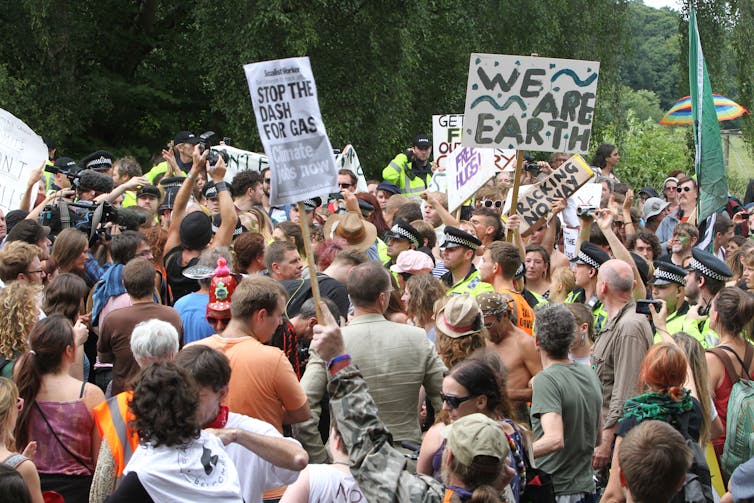
Regular anti-fracking protests took place over the course of a decade before fracking was banned in 2019. Marcella2024/Shutterstock
There are plenty of similar examples both in the UK and elsewhere. Earlier this year, the government announced it would hold the Battle of Orgreave national inquiry. This followed sustained pressure by the Orgreave Truth and Justice Campaign that lasted 13 years and involved multiple repeat protests and demonstrations.
In Israel, massive national protests took place from January to October 2023, in opposition to judicial reforms that threatened to weaken the power of the country’s supreme court. While the reforms went ahead, they remained contested, and were subsequently reversed.
History is full of prolonged protest campaigns producing significant democratic outcomes. The national independence movement in India lasted for three decades. The fall of the Berlin Wall was partly due to an ongoing campaign of weekly Monday demonstrations.
The suffragette protest campaign calling for the vote for women in Britain lasted for nearly ten years. The British state repeatedly imprisoned and force fed protesting women before eventually granting them the vote.
The important contribution to democratic life that sustained and repeated protests can have – typically as a direct result of their “cumulative impact” – is not only recognised by academics and civil liberty campaigners.
The current deputy prime minister, David Lammy, made exactly the same point in 2021 when Labour opposed the first attempt to curtail protest by the previous Conservative government. At that time he remembered how the “anti-apartheid movement, of which I was part, marched continuously on Trafalgar Square for black and white people to be treated as equal”.
The (restricted) right to protest
The home secretary has argued that the latest proposals are not a ban on protest, but “about restrictions and conditions”.
Similar language was also used by the previous Conservative government when it introduced a first round of anti-protest legislation in 2022. In defending that legislation, the Conservative government repeatedly promised that it was not banning peaceful protest.
Conservative home office minister Victoria Atkins claimed at the time: “Peaceful protest is absolutely fundamental to a free society. The right to peaceful protest will not be, and will never be, in question by this Government.”
Yet, the Police, Crime, Sentencing and Courts Act 2022 introduced a range of restrictions to prevent noisy or disruptive protests. This has had a concerning impact on the right to protest, and led to some of the most draconian sentences for environmental protest that the UK has ever seen.
The Labour party opposed that earlier anti-protest law. David Lammy (then shadow justice secretary) described how the legislation was “giving the police the power to prohibit the fundamental freedoms of protest that the British public hold dear”.
Since entering office, however, the Labour government has further tightened restrictions on the right to protest. The crime and policing bill currently going through parliament will ban the wearing of face masks during certain protests.
The recent proscription of Palestine Action as a terrorist organisation has led to hundreds of arrests of peaceful protesters, and been widely criticised by civil liberties groups. The UN’s high commissioner for human rights described the banning of the organisation as “at odds with the UK’s obligations under international human rights law”.
If “cumulative impact” is now to be grounds for limiting or prohibiting protest, it could mean certain protests are only allowed on a restricted number of occasions. As the evidence suggests, this risks permitting only those protests that have no chance of success. In curtailing or removing the potential for those in power to be held to account through public demonstration, the UK would lose a crucial democratic and human right.
Want more politics coverage from academic experts? Every week, we bring you informed analysis of developments in government and fact check the claims being made.
David J. Bailey does not work for, consult, own shares in or receive funding from any company or organisation that would benefit from this article, and has disclosed no relevant affiliations beyond their academic appointment.
Against the backdrop of a fragmenting political system, the 2025 party conference season in the UK has been an unusual one. The Greens and Reform, having secured strong results in the 2024 election, enjoyed an unprecedented level of interest in their events. Members were interviewed in the media and party leaders’ speeches were scrutinised.
Attention is almost always squarely focused on Labour and the Conservatives, perhaps with some Liberal Democrat coverage too. And there have been times when party members have seemed very out of sync with the general public. This was a strong theme during the years of Jeremy Corbyn’s leadership of the Labour party. But it has also affected the Conservatives. Party members strongly supported Brexit at a time when the Conservative leadership opposed it.
But these days, it’s Reform and Green party members who are most ideologically at odds with the voting public – something their leaders will need to be mindful of as they prepare for the next election. Labour and Liberal Democrat party members are the most aligned, followed by the Conservatives.
To show this, we can use data from a large-scale national survey conducted just prior to the general election in 2024 by the British Election Study. With more than 30,000 respondents the survey makes it possible to compare the views of party members with those of voters to see how much they differ.
Percentages of party members in the BES Panel Survey 2024:
A breakdown of the party members in the survey. P Whiteley, CC BY-ND
The survey asked respondents if they were members of a political party and a total of 1,191 said they were, making up 4% of all respondents. The chart shows the percentage shares of these members in each of the five national parties at that time.
Labour membership was twice as large as that of the Conservatives and they in turn were just over twice as large as the Liberal Democrats. Reform and the Greens had the same percentage of members.
To judge whether party members were extreme in their views compared to the average population, we can use responses to a question which asked: “In politics people sometimes talk of left and right. Where would you place yourself on the following scale?” The scale runs from 0 (far left) to 10 (far right).
The ideology scores on the left-right scale for voters in 2024:
Where party members sit on the political spectrum. P Whiteley, CC BY-ND
Most voters place themselves at the centre of the left-to-right ideological spectrum, with a mean score of 4.8 on the scale. There is an important strand of academic research in political science which suggests that voters will support the party that is closest to them on this ideological scale.
This is the so-called spatial model of party competition. The distance between the voters and the party members on the scale measures how “extremist” party members are in relation to voters as a whole.
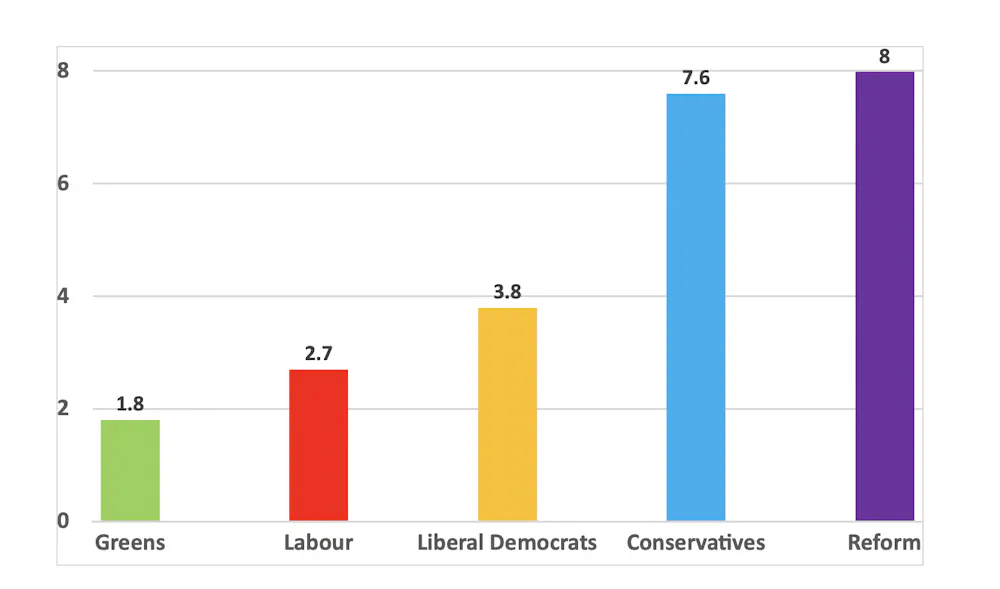
The third chart shows the scores of party members on this left-right scale. It shows that the Liberal Democrat members are closer to the voter mean of 4.8 than any other party. They have a score of 3.8. The second closest party is Labour on 2.7, followed by the Conservatives on 7.6.
The two clear outliers are the Greens on 1.8 who are well to the left of Labour and Reform on 8, which is well to the right of the Conservatives.
Mean scores of party members on the left-right ideological scale:
Reform and the Greens are furthest from the general public. P Whiteley, CC BY-ND
Political polarisation can weaken the relationship between ideology and voting because it flattens the distribution of voters on the left-right scale. It creates more extremists so that the distribution has fatter tails.
That said, the chart does not show large numbers of extremists in the British electorate, since the great majority of voters are clustered in the centre. This makes it unwise for any party to be too leftwing or rightwing – something which is likely to cause problems for both Reform and the Greens.
“Performance politics” also plays a role. This refers to the extent that incumbent parties deliver on their promises.
This has been a major problem for the Conservatives in the past and it is now affecting the Labour government. Voters want fast action to solve their problems, making this an issue for centre parties as much as for fringe parties.
Both Reform and the Greens have not had to struggle with delivery at the national level, although their recent successes in local government elections will provide evidence of this by the time of the next general election.
Overall Reform and the Greens should note that it is better to be close to what the electorate want than far away when voters start to look at what the parties are offering during an election campaign.
Want more politics coverage from academic experts? Every week, we bring you informed analysis of developments in government and fact check the claims being made.
This article contains references to books that have been included for editorial reasons, and this may include links to bookshop.org. If you click on one of the links and go on to buy something from bookshop.org The Conversation UK may earn a commission.
Paul Whiteley has received funding from the British Academy and the ESRC.
France has been experiencing an unprecedented political crisis since President Emmanuel Macron dissolved parliament in June 2024. For political scientist Rémi Lefebvre, this deadlock is not only institutional: it reveals a crisis of representative governance fuelled by mistrust, social fragmentation and the erosion of majority rule.
Following the dissolution and the legislative elections that followed it, the governments of prime ministers Michel Barnier, François Bayrou and Sébastien Lecornu have all been unable to govern. Many commentators have suggested that this deadlock could be linked to a lack of compromise among political parties, or to unhelpful institutional rules. On the contrary, it seems that the disruption runs much deeper. The relationship with politics in France has changed in recent decades, and the current crisis is merely a symptom of the erosion and breakdown of the link between voter and representative itself.
A disrupted political routine
In France, particularly since the 1970s, we have become accustomed to the “majority system”: the president was elected by direct universal suffrage and needed a majority in parliament, which he generally obtained. Political life had a routine rhythm of alternating majorities. Then this system gradually broke down.
The lack of alternatives to this rhythm has led to a proliferation of political parties, creating chronic disillusionment in each political camp. The rise of the far right, which claims to embody a new path, is associated with the blurring of the left-right divide. In 2017, the arrival of Macron was seen as the result of the exhaustion of this divide and a response to the democratic crisis, driven by a rhetoric of “transcendence”.
But the president has exacerbated the crisis by pushing the margins to extremes and, ultimately, polarising political life while shifting his own position to the right. Macron has fuelled the far right, and he has weakened the left. While there are strong calls for compromise, on the left, the Socialist Party (PS) is under the thumb of La France Insoumise (France Unbowed or LFI) and constantly exposed to accusations of “treason”. The difficulty in building majorities, linked to the tripartite nature of political life, is exacerbated by internal fragmentation within each bloc.
However, this crisis cannot be understood solely in terms of political manoeuvring. We must also take into account changes in the relationship between voters and politics. Since the early 2000s, the very mechanism of elections has been called into question. The legitimacy given to those in power by elections is increasingly weak, as explained by historian Pierre Rosanvallon. This is reinforced by the widespread development of strategic voting: people are increasingly voting “usefully” in order to eliminate candidates, but voters are no longer really expressing their preferences, which weakens their commitment to the appointment of a representative and the legitimacy of that representative. Thus, the electoral process is fundamentally flawed: this is referred to as “negative” democracy. We eliminate more than we choose.
Fragmentation of society
Furthermore, the fragmentation of political identities partly reflects the fragmentation of society itself. The crisis of governance or governability is linked to a more individualised and fragmented society, exacerbated by inequalities and a form of separatism. Identities and divisions are more complex and less structured by homogeneous class identities, as explained by sociologist Gérard Mauger.
If political parties are unwilling to compromise, it is also because they do not want to disappoint the divided social groups that still support them and because they fear “betraying” distrustful voters and increasingly volatile and narrow electoral constituencies. Society is more polarised (the emotional polarisation caused by social media is undeniable), which also makes political compromises more difficult. We could add that the fragmentation and splintering of voters’ political identities is exacerbated by the weakness of the parties and their large number – there are now 11 parliamentary groups in the National Assembly, which is a record. One of the major consequences is that political parties are no longer able to organise public debate around a few coherent and simple visions.
Could the current political impasse be resolved by dissolution, negotiations, new parliamentary elections or even a presidential election? It is doubtful. Ultimately, it is possible that the carte blanche given to a French president, which comes via legislative elections that follow presidential polls, will no longer exist in the future. Political majorities are nowhere to be found, but perhaps neither are social and electoral majorities (ie alliances of social groups large enough to support political majorities).
Mistrust and disillusionment
The economic crisis we have been experiencing for the past year is part of an even broader trend, namely a considerable increase in mistrust of politics.
According to the 2025 barometer of political trust published by the Centre of Political Research at Sciences Po (CEVIPOF), around 20% of French people trust politicians. The French therefore consider the political class incapable of solving problems. They even consider it unworthy. It must be said that the spectacle on offer is rather unattractive, and it can be argued that the calibre of politicians is declining. Political scientist Luc Rouban has shown that this phenomenon fuels a desire to retreat into the private sphere along the lines of “leave us alone, we don’t care about politics”. The current crisis is therefore the product of this mistrust, and the political class’s inability to resolve it reinforces the phenomenon.
Disappointment and disillusionment have been building up for decades. The weakening of the left-right alternation that used to punctuate political life runs deep. Former president Nicolas Sarkozy served only one term, as did his successor François Hollande: both campaigned on volontarisme (the idea that the human will is capable of imposing change), but quickly disappointed. They pursued liberal economic policies that undermined the idea that politics could change things. Macron, who was re-elected, also disappointed. He fuelled the anti-elite sentiment that manifested itself powerfully during the “yellow vest” protests.
Ultimately, each camp is marked by disenchantment and produces mechanisms of polarisation. Thus, the Socialists produced LFI, which was the result of disappointment with the left in power. The far right is also, to a large extent, the result of political disillusionment. These two forces, LFI and Rassemblement National (the far-right National Rally), are hostile to any compromise.
Unavoidable challenges
This mistrust of politics is not specific to France, as political scientist Pierre Martin has shown in his analysis of the crisis facing governing parties. These mechanisms are present everywhere, in Europe and the US. Since the work of Colin Crouch, political scientists have even begun to talk about “post-democratic” regimes, where decisions are increasingly beyond the control of political power.
Globalisation, Europeanisation, and the power of large financial groups and lobbies have devalued political power and reduced its room for manoeuvre. However, politics raises expectations, and politicians attempt to re-enchant the electoral process by making promises at every election.
This situation is particularly difficult to accept in France, where there is a culture of very high expectations of the state. This crisis of volontarisme politique (which sees political leaders saying they will be capable of imposing change, but then failing to do so) is causing repeated disappointment. The latest CEVIPOF survey shows that mistrust is growing and is associated with a feeling of governmental and electoral impotence. The French believe that politics no longer serves any purpose: the sterile game of politics is spinning its wheels, with no impact on reality.
The current situation plays into the hands of the far right, as mistrust of politics fuels anti-parliamentarianism and also reinforces the idea that a political force that has not held office can be a solution.
In addition, a part of society finds itself aligned with right-wing issues: immigration, security, rejection of environmentalism, etc. In this context, the victory of the far right may seem inevitable. It has happened in the US, and it is difficult to imagine France escaping it, given the great fragmentation of the left, its pitfalls and its dead ends. However, if the far right comes to power – which would be a dramatic turn of events – it will also face the test of power and will certainly disappoint, without resolving the political crisis we are currently experiencing. Its electorate, which is very interclass (working class in the north, more middle class in the southeast), has contradictory expectations and it will be difficult to satisfy them.
Rebalancing democracy?
It would be naïve to believe in an “institutional solutionism” that would resolve this political crisis. Democracy cannot be reduced to electoral rules and institutional mechanisms. It is underpinned by values, culture, practices and behaviours.
Given this, a change to proportional representation would encourage voters to vote according to their convictions and marginalise “tactical voting”. The aim would be to better reflect voters’ political preferences through the voting system and to re-legitimise the electoral process.
A Sixth Republic would certainly help to regenerate institutions linked to an exhausted presidential system, as demonstrated by political scientist Bastien François. Nowadays, the verticality of power no longer works in a society shaped by horizontal dynamics. The image associated with the French president accentuates disappointment by creating a providential figure who cannot keep his promises. While the French are not in favour of abolishing direct universal suffrage for presidential elections, it is possible to limit the powers of the president – just as it is possible to reverse the calendar with legislative elections preceding presidential ones.
Many works, such as those by political scientist Loïc Blondiaux, also propose ways of thinking about a new balance between representative democracy and participatory democracy, a more continuous democracy that is less focused on elections. For a long time, elections were sufficient to ensure democracy, but that cycle is now over. This means tinkering and experimenting – with referendums, citizens’ conventions, etc. – in order to find a new balance between participation and representation. However, these solutions are complex to implement, whereas democracy through voting alone was very simple. Finally, democracy is a culture, and it is necessary to encourage participation at all levels by promoting a more inclusive, less competitive society, particularly in schools and businesses.
Another issue is that of political parties: citizens no longer join them because they are perceived as unattractive. Some studies suggest that they should be reformed and that their public funding, for example, should be rethought, with funding being made conditional on the diversity of elected representatives.
Democracy and the economy
Finally, a major democratic challenge is to regain control over the economic sphere. The debate on the Zucman tax highlights the political barrier that needs to be broken down: the power of the financial oligarchy. As long as political power has to bow down to finance, the deceptive logic of post-democracy will continue. However, inequalities have increased to such an extent that societies could demand a rebalancing. In this sense, post-democracy is not inevitable.
Economic forces will attempt to protect their positions and power, but, as political sociologist Vincent Tibérj shows, there is a very strong commitment to social justice and redistribution in France, even among the far right. Under pressure, the elites could therefore be forced to give in.
A weekly e-mail in English featuring expertise from scholars and researchers. It provides an introduction to the diversity of research coming out of the continent and considers some of the key issues facing European countries. Get the newsletter!
Rémi Lefebvre ne travaille pas, ne conseille pas, ne possède pas de parts, ne reçoit pas de fonds d’une organisation qui pourrait tirer profit de cet article, et n’a déclaré aucune autre affiliation que son organisme de recherche.
Genetic inheritance may sound straightforward: One gene causes one trait or a specific illness. When doctors use genetics, it’s usually to try to identify a disease-causing gene to help guide diagnosis and treatment. But for most health conditions, the genetics is far more complicated than how clinicians are currently looking at it in diagnosis, counseling and treatment.
Your DNA carries millions of genetic variants you inherit from your parents or develop by chance. Some are common variants, shared by many people. Others are rare variants, found in very few people or even unique to a family. Together, these variants shape who you are – from visible traits such as height or eye color to health conditions such as diabetes or heart disease.
In our newly published research in the journal Cell, my team and I found that a genetic mutation involved in neurodevelopmental and psychiatric conditions such as autism and schizophrenia is affected by multiple other genetic variants, changing how these conditions develop. Our findings support the idea that, rather than focusing on single genes, taking the whole genome into account would provide insight into how researchers understand what makes someone genetically predisposed to certain diseases and how those diseases develop.
Primary and secondary variants
Certain rare variants can cause problems on their own, such as the genetic mutations that cause sickle cell anemia and cystic fibrosis. But in many cases, whether someone actually develops symptoms of disease depends on what else is happening across the genome.
While a primary variant might trigger a disease, secondary variants can alter how that disease develops and progresses. Think of it like a song: The melody (primary variant) is the main part of the song, but the bassist and drummer (secondary variants) can change its groove and rhythm.
That’s why two people with the same genetic mutation can seem so different. One person might have severe symptoms, another person mild symptoms, and another none at all. These variations can even occur within the same family. This phenomenon, called variable expressivity, arises from differences in the secondary variants a person has. In most cases, these variants amplify the effects of the primary mutation. A higher number of secondary variants on top of a primary variant generally leads to more severe disease.
Mutations are a source of genetic variation.
Sometimes, a primary variant and a secondary variant together can cause two different disorders in the same person, such as Prader-Willi syndrome and Pitt-Hopkins syndrome. Other times, secondary variants have no obvious effect on their own but together can tip the balance of whether and how a disease will appear, even in the absence of a primary variant. This can be seen in the development of heart disease in children.
Insights from a missing piece of a chromosome
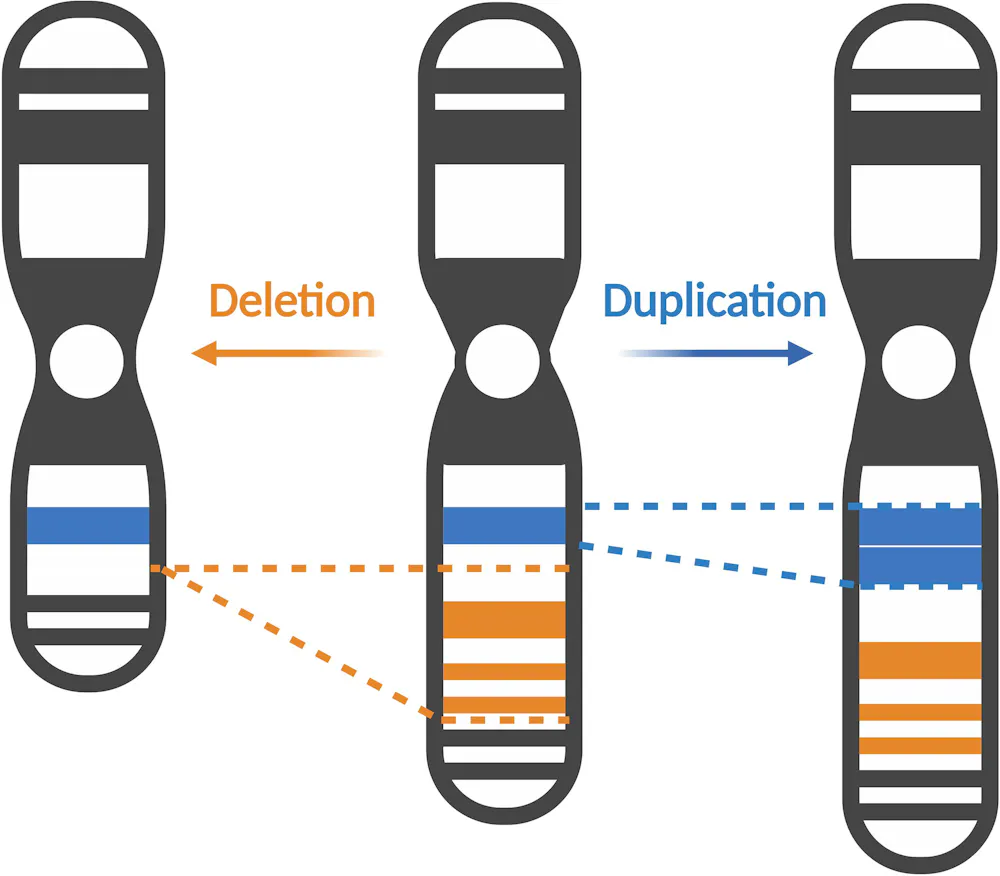
My team and I studied a genetic change known as a 16p12.1 deletion, where a small piece of chromosome 16 is missing. Researchers have linked this mutation to developmental delay, intellectual disability and psychiatric conditions such as schizophrenia. Yet most children inherit this genetic variant from a parent who has milder symptoms, different symptoms or sometimes no symptoms at all.
To understand why this happens, we analyzed 442 individuals from 124 families carrying this genetic mutation. We found that children lacking this piece of chromosome 16 had more secondary variants elsewhere in the genome compared to their carrier parents. These secondary variants took many forms, including both small changes and large deletions, duplications and expansions of their DNA.
Each type of secondary variant was associated with different health outcomes. Some were linked to smaller head size and reduced cognitive function, while others contributed to higher rates of psychiatric or developmental symptoms. This suggests that while a 16p12.1 deletion makes the genome more sensitive to neurodevelopmental disorders, which symptoms manifest depends on which other variants are present.
The story gets even more complex when considering the fact that children not only inherit a 16p12.1 deletion from one parent but also inherit secondary variants from both parents.
My team and I found that the symptoms of the parent with this genetic mutation often match those of their spouse. For example, a parent with a 16p12.1 deletion who shows signs of anxiety or depression is more likely to have a partner who also has these symptoms. This pattern, called assortative mating, means that when parents with overlapping genetic risks have children, those risks can combine and accumulate.
Over generations, this stacking of secondary variants can lead to children who have more severe symptoms than their parents.
Biases in genetics research
One reason why scientific understanding of secondary variants has lagged is that genetic research often depends on who is recruited to participate in these studies and how researchers recruit them.
Most studies recruit patients affected with a particular disease. Families recruited from genetic clinics typically have children with severe versions of the disease. But if studies focus only on patients with the most acute symptoms, researchers may overestimate the effects of primary variants and miss the subtler role that secondary variants may play in how a disease develops.
But if researchers were to study people drawn from the general population – say, by recruiting people from a large shopping mall – some might carry the same primary variant but have far milder symptoms or none at all. This variability allows researchers to better dissect how different parts of the genome interact with each other and affect how a disease develops.
In our study, for example, we found that people with a 16p12.1 deletion who were recruited from the general population often had milder symptoms and different patterns of secondary variants compared to those who were recruited in a clinic.
Instead of a deterministic view where one mutation equals one outcome, a more complex model accounts for the fact that whether and how a disease develops depends on the interplay between different genetic variants and environment. This has implications for how genetics is used in the clinic.
Currently, a child who tests positive for a genetic variant might be diagnosed with a disease tied to that mutation. In the future, doctors might also examine the child’s broader genetic profile to better predict their developmental trajectory, psychiatric risk or response to therapies. Families could be counseled with a more realistic picture of their child’s probability of developing a disease, rather than assuming every person with the same genetic variant will share the same outcome.
The science is still emerging. Larger and more diverse datasets and models that can better capture the subtle effects of genetic variants and environmental factors are still needed. But what’s clear is that secondary variants are not secondary in importance.
By embracing this complexity, I believe genetics can move closer to its ultimate promise: not just explaining why disease happens, but predicting who is most at risk and personalizing care for each individual.
Santhosh Girirajan receives funding from the National Institutes of Health.
Une étude montre que le nombre de suggestions affichées sur les sites de e-commerce compte bien plus que les fameuses étoiles laissées par les autres consommateurs.
Qui n’a jamais acheté un produit en ligne sur un coup de tête ? Un coussin moelleux, une cafetière design ou un gadget apparu comme par magie dans la section « recommandé pour vous ». Si vous vous reconnaissez, vous n’êtes pas seul : la prédominance du e-commerce rend les achats impulsifs (c’est-à-dire soudains) plus fréquents. Un assortiment plus large de produits, des stratégies marketing sophistiquées (incluant par exemple la réalité virtuelle) ou encore les évaluations d’autres consommateurs rendent les espaces en ligne particulièrement propices à ce type d’achat, davantage que les magasins physiques.
Les achats impulsifs sont activement encouragés par la manière dont les sites de e-commerce conçoivent leurs systèmes de recommandation. Dans une recherche, nous montrons que plus nous pensons qu’un algorithme est performant (par rapport à un humain), plus nous lui faisons confiance… et plus nous cliquons sur « ajouter au panier » sans réfléchir. Avec un résultat surprenant : le nombre de suggestions affichées compte bien plus que les fameuses étoiles laissées par les autres clients.
Des algorithmes qui nous connaissent (trop) bien
Les sites e-commerce, comme Amazon, Cdiscount ou Temu, n’affichent pas leurs suggestions par hasard. Leurs algorithmes analysent notre historique de navigation, nos achats passés, et même le moment de la journée où nous naviguons sur leurs sites pour nous proposer des produits sur mesure.
Résultat : des recommandations personnalisées, parfois trop bien ciblées. À titre d’exemple, elles permettent de générer 35 % des ventes d’Amazon. L’âge rentre aussi en ligne de compte : les jeunes adultes semblent effectuer peu de recherche d’informations et ont davantage tendance à céder à des achats impulsifs.
Cocktail gagnant de l’achat impulsif
Le processus qui mène à l’achat impulsif se déroule en deux temps. D’abord, en tant que consommateurs, nous développons une attente de performance : nous sommes convaincus que l’algorithme, capable d’analyser de très nombreuses données, est plus efficace qu’un vendeur humain pour nous proposer le bon produit.
Cette perception de compétence génère de la confiance et c’est cette confiance qui ouvre la porte à l’achat impulsif. Elle nous rend plus réceptifs aux suggestions. Ce besoin de personnalisation est d’ailleurs important : 71 % des acheteurs en ligne se sentent frustrés lorsque le contenu d’un site n’est pas personnalisé. Nous faisons confiance aux algorithmes parque nous croyons en leur supériorité, et cette confiance nous pousse à l’achat spontané.
Trop de choix ? Tant mieux !
Notre recherche s’est également intéressée à la façon dont les recommandations sont présentées : plus il y a de recommandations affichées, plus l’achat impulsif est probable. Comment l’expliquer ? Face à une suggestion unique, notre « radar à manipulation » peut s’activer. L’intention du site semble trop évidente : nous pousser à acheter ce produit en particulier.
En revanche, une large sélection de recommandations donne une illusion de contrôle et de diversité. L’algorithme ne semble plus essayer de nous vendre un produit, mais plutôt de nous ouvrir un catalogue de possibilités pertinentes, nous laissant a priori l’entière liberté du choix final. Cette abondance de suggestions, loin de nous paralyser, nous rassure et nous incite à explorer… et donc, à potentiellement craquer.
Les notes (des consommateurs) pas si décisives
Contre toute attente, les notes attribuées par les autres consommateurs n’ont pas d’effet sur l’achat impulsif. Cette découverte peut s’expliquer par une forme de lassitude et de méfiance généralisée envers ces systèmes de notation. Les consommateurs sont de plus en plus conscients que ces avis peuvent être biaisés ou manipulés.
Pour les marques, l’enjeu est de proposer des recommandations nombreuses et crédibles, sans donner l’impression de manipuler. Et pour les consommateurs ? La conclusion n’est pas de se méfier de toute technologie, mais de garder une forme de scepticisme éclairé.
Ces recommandations sont des outils permettant de découvrir des produits, à condition de se souvenir que derrière chaque « recommandé pour vous » se cache une architecture de persuasion pensée pour nous faire cliquer. Et parfois, le clic le plus puissant est celui qui ferme l’onglet.
Les auteurs ne travaillent pas, ne conseillent pas, ne possèdent pas de parts, ne reçoivent pas de fonds d’une organisation qui pourrait tirer profit de cet article, et n’ont déclaré aucune autre affiliation que leur organisme de recherche.
Samedi 11 octobre 2025, les associations seront dans la rue pour dénoncer les violentes coupes budgétaires qui les menacent. C’est le résultat d’une lente dégradation des rapports entre le monde associatif et l’État. Par ailleurs, depuis la loi de 2021 instaurant un contrat d’engagement républicain (CER), certaines associations citoyennes sont sanctionnées par l’État, au détriment des libertés publiques.
Les associations battront le pavé lors d’une manifestation inédite, le 11 octobre 2025, pour défendre le fait associatif lui-même, et non une cause particulière. Cette mobilisation témoigne d’une crise profonde touchant à leur modèle économique mais aussi à la liberté associative, face à un État plus répressif. Elle en dit long sur la crise de l’État social comme sur l’état des libertés publiques en France. Comme si le tournant néolibéral des politiques publiques des années 1980 avait fini de saper l’alliance nouée après-guerre entre l’État et le monde associatif. Avec quelles conséquences ?
Une transformation de la relation État-associations
Le débat sur la réduction des déficits publics, mis à l’agenda en 2024, a révélé les mutations des aides publiques. Les associations ont longtemps été considérées comme une économie subventionnée. Or, non seulement la part des subventions publiques dans les ressources budgétaires des associations a baissé de 34 % à 20 % entre 2005 et 2020 au profit des recettes d’activité (vente de produits ou de services), mais en plus l’État préfère soutenir les entreprises que les associations au nom de la compétitivité.
L’économie sociale et solidaire (ESS), au sein de laquelle les associations concentrent la grande majorité des emplois et des ressources publiques, ne reçoit que 7 % des aides publiques aux entreprises alors qu’elle représente 13,7 % des emplois privés.
Ces orientations sont, de plus, porteuses d’iniquités de traitement. Le crédit d’impôt recherche (CIR), qui a financé à hauteur de 7,6 milliards d’euros la recherche et développement en 2024, exclut l’innovation sociale et, avec elle, les associations. Pour y remédier, on pourrait, par exemple, imaginer que les entreprises bénéficiaires en reversent 20 % à un fonds d’innovation sociale.
Dans le même sens, alors que la cotisation sur la valeur ajoutée des entreprises (CVAE) est en voie de disparition, la taxe sur les salaires pour les associations continue de s’appliquer, ce qui introduit une distorsion de concurrence avec des effets contreproductifs sur les conditions de rémunération et sur l’attractivité des emplois associatifs.
Cette régulation marchande aboutit à modifier en profondeur le modèle socioéconomique des associations, ce qui a deux conséquences majeures. D’une part, elle transforme les associations en prestataires de services publics. Entre 2005 et 2020, la part des commandes publiques dans leurs ressources budgétaires est ainsi passée de 17 % à 29 %, soit une inversion par rapport à l’évolution du poids des subventions.
Cela change également le rapport des associations avec les pouvoirs publics. Elles sont mises en concurrence avec des entreprises privées lucratives – ce qui a, par exemple, été à l’origine du scandale d’Orpea – et doivent, en plus, exécuter un marché plutôt que proposer des projets. D’autre part, la marchandisation de leurs ressources leur fait courir le risque de perdre leur caractère d’intérêt général, en étant soumises aux impôts commerciaux et en n’accédant plus aux dons défiscalisables, au détriment de leurs missions sociales.
Les effets de ces décisions sont immédiats. Selon une enquête réalisée auprès de 5 557 dirigeants associatifs, près d’un tiers des associations ont une trésorerie inférieure à trois mois et 45 % des subventions sont en baisse. Près d’un tiers des associations envisagent de réduire leurs effectifs et de diminuer leurs activités.
Alors que les associations représentent 1,8 million de salariés et que l’emploi associatif se caractérise par une prévalence du temps partiel et des contrats précaires ainsi que par des salaires plus bas, ces informations qui remontent du terrain inquiètent. Elles le sont d’autant plus que la baisse tendancielle des participations bénévoles est plus marquée dans les associations employeuses de l’humanitaire, du social et de la santé, qui concentrent la majorité des emplois.
Atteintes aux libertés publiques
À ces politiques d’austérité, il faut ajouter des atteintes aux libertés publiques. Elles s’inscrivent dans un contexte de défiance, illustré par la loi du 24 août 2021 confortant le respect des principes de la République, qui a instauré le contrat d’engagement républicain (CER) auquel doivent souscrire les associations qui veulent obtenir un agrément de l’État ou une subvention publique, ou encore accueillir un jeune en service civique.
Certes, les cas sont rares, mais ils témoignent d’une atmosphère répressive qui touche particulièrement les associations citoyennes. Le préfet de la Vienne a, par exemple, contesté l’attribution d’une subvention de la mairie de Poitiers à Alternatiba, en raison de l’organisation par cette association d’un atelier de formation à la désobéissance civile, tandis que le ministre de l’intérieur Gérald Darmanin a remis en cause le soutien public à la Ligue des droits de l’homme à la suite de ses critiques de l’action des forces de l’ordre lors des manifestations contre les bassines agricoles à Sainte-Soline (Deux-Sèvres).
Une enquête de l’Observatoire des libertés associatives fait état de sanctions institutionnelles, souvent liées à l’exercice de la liberté d’expression (prise de position, pétition, rencontre, manifestation, etc.). Ainsi, 9,6 % des répondants – et même 17,1 % des associations citoyennes – déclarent des sanctions matérielles (subventions, locaux, etc.) ou symboliques (participation à des événements, conventions, etc.). Des collectivités locales arrêtent brutalement certains programmes pour des raisons autant budgétaires qu’idéologiques, comme l’a illustré le cas médiatisé de la Région Pays de la Loire qui a supprimé 4,7 millions d’euros pour la culture, le sport et la vie associative.
À ce tableau, s’ajoute désormais la crainte d’une extrême droite accédant au pouvoir, extrême droite dont le programme de gouvernement prévoit de réserver les aides sociales aux Français en appliquant la « priorité nationale » pour l’accès au logement et à l’emploi. Autant de domaines dans lesquels les associations, très présentes, seraient sommées de « collaborer ». Les quelques expériences du RN à la tête d’exécutifs locaux comme les discours tenus dans les hémicycles des collectivités ou au Parlement laissent par ailleurs craindre une répression des associations environnementales, féministes ou de défense des droits ainsi qu’une instrumentalisation des politiques culturelles.
Le monde associatif, rempart de la République
Il y a cinquante ans, une circulaire du premier ministre de l’époque, Jacques Chirac, stipulait que « l’État et les collectivités publiques n’ont pas le monopole du bien public ». Elle rappelait le rôle de l’initiative associative pour répondre à des tâches d’intérêt général pour soutenir les personnes vulnérables (personnes âgées, personnes en situation de handicap, lutte contre la pauvreté, lutte pour l’insertion, etc.), pour réduire les inégalités et pour préserver le lien social (éducation populaire, culture, sport, etc.).
C’est là tout l’héritage légué par la régulation tutélaire de l’État, mise en place après-guerre en s’appuyant sur les initiatives associatives pour répondre aux besoins des populations. Le développement de l’État social est allé de pair avec celui des associations gestionnaires, que la loi de 1975 sur les institutions sociales et médico-sociales est venue moderniser.
Défendre les associations, c’est défendre nos droits fondamentaux, comme la République qui s’enracine dans le corps social et qui permet la vitalité démocratique. Comme l’écrivait Alexis de Tocqueville, « dans les pays démocratiques, la science de l’association est la science mère ; le progrès de toutes les autres dépend des progrès de celle-là ».
Timothée Duverger ne travaille pas, ne conseille pas, ne possède pas de parts, ne reçoit pas de fonds d’une organisation qui pourrait tirer profit de cet article, et n’a déclaré aucune autre affiliation que son organisme de recherche.
Pour décarboner efficacement le secteur des transports, il faut que les ménages les plus modestes soient accompagnés. Mais qui sont les précaires en transport ?
En France, le secteur du transport produit un tiers des émissions de gaz à effet de serre (GES), dont 60 % proviennent du transport routier. Afin d’atteindre la neutralité carbone d’ici 2050, revoir nos usages de la voiture est donc indispensable. Pour cela, différentes mesures ont déjà été mises en place ces dernières années. Néanmoins, elles ne sont pas facilement acceptées étant donné leurs effets potentiellement inégaux sur la population si aucun mécanisme de redistribution n’est conçu et déployé.
En voici trois exemples :
La mise en place de zones à faibles émissions (ZFE) dans 43 villes françaises où ne pourraient donc plus circuler les voitures les plus polluantes bien que le sujet soit actuellement débattu après un vote en faveur de sa suppression à l’Assemblée nationale en juin 2025.
L’établissement du système européen d’échange de quotas d’émission 2 (ETS2) à partir de 2027, axé sur les émissions de carburants provenant principalement des transports et des bâtiments. Ce qui inciterait les entreprises à respecter des limites en termes de pollution et/ou à revoir leur processus de production pour devenir plus propre.
Comment fonctionne le système d’échanges de quotas d’émissions de Co2 en Europe.
L’interdiction de vendre des voitures neuves polluantes à partir de 2035 dans toute l’Union européenne (UE), ce qui obligerait les ménages à repenser leurs habitudes de transport, leur localisation et/ou à se tourner vers des options de transport plus propres.
La lutte contre la pauvreté en transports dans l’UE
Pour que cette transition ne se fasse pas au détriment des plus précaires, l’ETS2 s’accompagne également de la création du Fonds social pour le climat, un fonds doté de plus de 86 milliards de financements pour lutter contre la précarité en transport et la précarité énergétique ») dans les pays de l’UE à partir de 2026.
Des recommandations détaillées pour la lutte contre la précarité en transports et le développement d’une mobilité équitable et durable ont été publiées récemment par la Commission Européenne. De plus, un nouveau Transport Poverty Hub a été créé pour améliorer l’identification des zones vulnérables.
Que sont la précarité en transport et la précarité énergétique ?
La précarité en transport est définie comme l’incapacité ou la difficulté pour les individus et pour les ménages à faire face aux coûts des transports privés ou publics, ou par leur manque d’accès (ou leur accès limité) aux transports nécessaires pour accéder aux activités et aux services socioéconomiques essentiels, compte tenu du contexte national et spatial.
La précarité énergétique désigne une situation dans laquelle les ménages ne sont pas en mesure d’accéder aux services énergétiques essentiels.
En France, plus d’un quart du budget des ménages était consacré au logement et 13,6 % au transport en 2022. En Allemagne, ces postes de dépense sont quasiment similaires. Dans ce contexte, l’accompagnement des ménages les plus vulnérables devient nécessaire pour une transition environnementale plus juste et acceptable.
On sait aussi aujourd’hui que les mesures pour la transition peuvent faire d’une pierre deux coups : être à la fois progressives et plus acceptables si elles sont accompagnées, par exemple, des mécanismes de redistribution et si les citoyens sont informés de la mise en place de ces derniers.
Mais qui faudrait-il accompagner pour cette transition des transports ?
Une échelle de précarité en transport
C’est la question à laquelle j’ai tâché de répondre dans une étude sur le cas de l’Allemagne. Si la précarité en transport peut être liée au revenu et au niveau de vie elle dépend aussi d’autres critères : le lieu de vie et d’emploi, l’accès (ou le manque d’accès) aux transports publics et privés, la dépendance à la voiture privée, le coût des transports, les habitudes en termes de mobilité…
Lorsqu’on prend en compte tous ces paramètres, quatre catégories apparaissent :
Les ménages indépendants qui représentent près de la moitié de la population. Ce sont les ménages vivant en centre-ville, ils ne dépendent pas de l’utilisation de la voiture individuelle pour se déplacer car ils ont accès à d’autres modes de transport. Ils ont les besoins de déplacement (en termes de distance) les plus faibles de l’échantillon. Ce seraient par exemple les personnes qui habitent dans des villes du quart d’heure.
Les ménages suffisants (sufficient en anglais) qui représentent environ 34 % de la population. Ce sont les ménages qui, en règle générale, habitent le plus loin du centre-ville et qui se déplacent le plus. Cependant, leurs revenus plus élevés leur permettent de faire face et de ne pas trop subir des chocs potentiels des prix des transports.
Les ménages dépendants de la voiture : qui représentent environ 16 % de la population. Leur principale contrainte provient de leur localisation (la plupart sont en périphérie ou en milieu rural), ce qui se traduit par un faible degré d’accès aux autres modes de transport et une forte distance à parcourir. La plupart d’entre eux (98 %) déclarent n’avoir pas d’autre option que la voiture pour leurs déplacements. Ces ménages sont également surexposés aux changements soudains des prix des transports privés (par exemple, via l’inflation ou des politiques publiques sans mécanisme de redistribution).
Les ménages précaires en transport, soit la traduction du terme anglais transport poor : qui représentent environ 2 % de la population. Ce sont les ménages qui sont les plus contraints en termes de ressources financières. Ils sont également contraints par leur localisation, qui est similaire aux « dépendants » de la voiture. En outre, plus de la moitié de ces ménages ne possèdent pas de voiture privée et dépend donc des transports en commun. L’interaction entre ces trois caractéristiques fait que ce sont eux qui passent le plus de temps dans les transports publics.
En moyenne, ils doivent parcourir 12 kilomètres (aller simple) pour les déplacements nécessaires (faire leurs courses, emmener les enfants à l’école, aller au travail, etc.). Ils parcourent la même distance que les « dépendants », soit environ 1400 kilomètres par mois (tous type de voyage compris), mais 89 % de ces kilomètres sont faits en transport public. Ils consacrent environ 23 heures chaque mois aux déplacements nécessaires contre 14 heures pour les « dépendants » et 10 heures/mois pour les « indépendants ».
À noter que ceux qui possèdent une voiture, étant déjà limités en termes de revenus, sont surexposés aux changements des prix des transports privés.
Ces différences entre les classes peuvent nous aider à comprendre les leviers potentiels pour l’amélioration de la mobilité. Un des facteurs de précarité qui apparaît est géographique : l’endroit où habitent les citoyens au regard des besoins de chaque ménage en termes de déplacement (distances à parcourir, temps de trajet, etc.) De plus, la localisation des ménages a un impact sur l’accès à des transports en commun.
Cette dernière dimension est également un levier potentiel, par exemple, pour améliorer la mobilité des ménages dépendants de la voiture. Dans le cadre de cette étude, 77 % de l’échantillon n’était pas satisfait de l’offre de transport en commun entre leur lieu de vie et travail/étude. Selon une publication récente, les infrastructures actuelles sont particulièrement adaptées à la voiture et incitent les citoyens à prendre ce moyen de transport. Des investissements d’infrastructure et des incitations vers d’autres modes de transport seraient donc des solutions envisageables et nécessaires).
Des pistes pour le cas français : faire face aux inégalités subjacentes
Des études similaires ont été menées au sujet du territoire français et ont obtenu des résultats étroitement liés, soulignant les inégalités sous-jacentes à prendre en compte lors de la mise en place des politiques publiques pour la transition du secteur des transports. Par exemple, l’économiste Audrey Berry et ses collègues] soulignent la pertinence des interactions entre différentes dimensions (localisation, revenu, options de transport) qui peuvent avoir un impact sur la mobilité des ménages.
Les résultats de l’Enquête Nationale sur les Mobilités de personnes 2019 confirment également la corrélation entre le fait de vivre dans des zones moins denses (rurales) et l’utilisation plus régulière de la voiture individuelle : environ 80 % des déplacements en voiture individuelle sont effectués en zone rurale, contre seulement 33 % dans la région parisienne qui dispose d’une offre plus importante de modes de transport public. L’accès aux transports alternatifs pour les milieux ruraux et les périphéries serait donc un des leviers clés pour la transition.
De plus, en France, des inégalités existent concernant l’accès à des véhicules moins polluants. Les plus pauvres possèdent des voitures polluantes. Lors du déploiement de politiques publiques pour la transition, ce levier serait clé pour diminuer les effets négatifs sur les populations vulnérables.
Récemment, l’économiste Lola Blandin identifiait elle les profils vulnérables suite à la mise en place d’une ZFE à Grenoble. Y apparaissaient également comme facteurs clés les contraintes financières, les infrastructures de transport disponibles et les horaires de travail. En outre, l’introduction de ZFE peut avoir des effets négatifs sur l’accessibilité à l’emploi pour les ménages les plus modestes
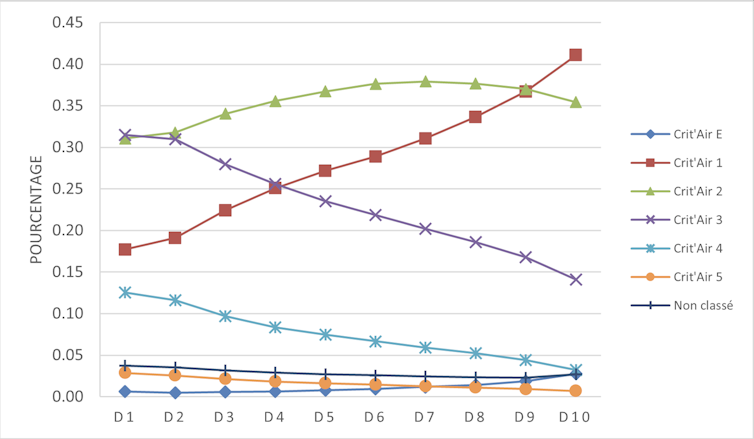
Pourcentage des voitures par Crit’Air selon le niveau de revenu des ménages en 2023. Graphique adapté de « Le parc automobile des ménages en 2023 : moins de voitures pour les plus modestes, plus souvent anciennes et diesel ». Sources des données : SDES, Rsvero ; Insee, Fidéli, Fourni par l’auteur
Andrea Rangel Guevara a reçu des financements de l’Agence nationale de la recherche (ANR). Le projet ciblé 3 ANR-22-EXSS-0004 bénéficie d’un financement du gouvernement français.
La Khazneh, à Pétra, apparaît au bout du Siq, étroite gorge qui mène au centre de l’antique capitale des Nabatéens, aujourd’hui en Jordanie. Photo : Schwentzel., Fourni par l’auteur
Peu connue du grand public, la reine Houldou régna aux côtés d’Arétas IV, au tournant de notre ère, dans la Pétra des Nabatéens. Coiffée de la couronne de la déesse Isis, elle incarne une figure fascinante, entre histoire et légende. Fut-elle, comme Cléopâtre en Égypte, une souveraine-déesse ? Dans les Nabatéens, IVe avant J.-C.-IIe siècle. De Pétra à Al-Ula, les bâtisseurs du désert, Christian-Georges Schwentzel, spécialiste de l’Orient ancien, nous plonge au cœur d’une civilisation originale, parfaitement identifiable par son style artistique et architectural unique, ses divinités et son écriture si caractéristiques. Extraits.
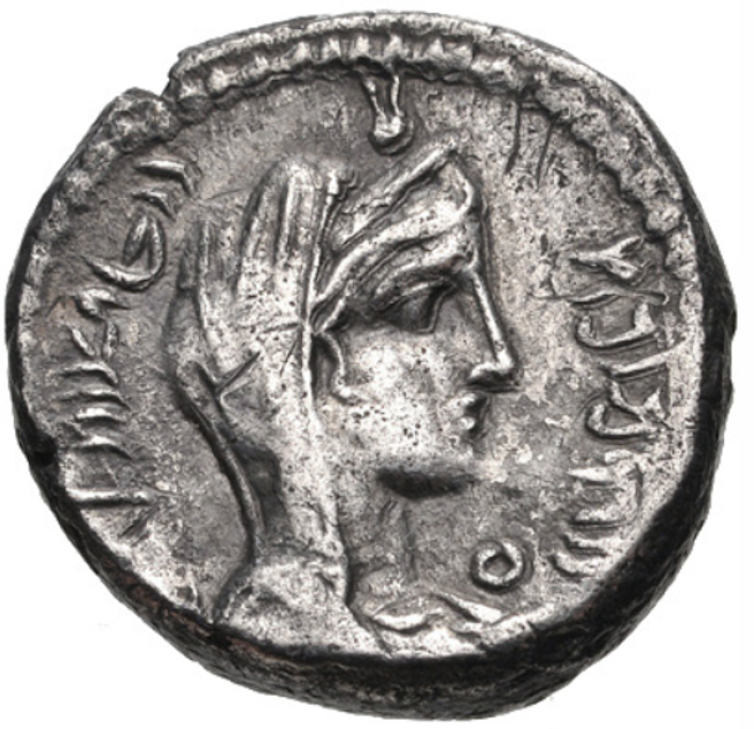
Sur les monnaies d’argent, dès les émissions de l’an 1 d’Arétas IV, la reine Houldou porte, au-dessus de son front, la couronne de la déesse égyptienne Isis, constituée de cornes de vaches enserrant le disque solaire, parfois surmontée d’une plume.
La reine Houldou, voilée et couronnée. La coiffe d’Isis se dresse au sommet de son front. Monnaie d’argent. Début du Iᵉʳ siècle. CNGCoins.
Isis est une ancienne déesse, éminemment bénéfique, décrite dans les mythes égyptiens comme une magicienne instruite des secrets de la résurrection. Après avoir réuni les morceaux épars de son époux Osiris, lâchement massacré et dépecé par son frère Seth, elle les réajuste et les entoure de bandelettes, confectionnant la première momie. Elle parvient, de cette manière, à faire renaître le défunt dans l’au-delà, et même à lui donner un fils posthume : Horus, ou Harpocrate, c’est-à-dire « Horus l’Enfant », qui, devenu adolescent, venge son père en écrasant Seth et en rétablissant la justice en Égypte. À la Basse Époque égyptienne, Isis est assimilée à Hathor, déesse de la maternité, qui peut prendre la forme d’une vache ; d’où les cornes de la couronne divine. Comme Hathor avait, selon un mythe, aidé le Soleil à se lever dans le ciel, l’astre est représenté entre ses cornes de vache. […]
La facade de la Khazneh, Pétra. Photo : Schwentzel, Fourni par l’auteur
La Khazneh et ses symboles féminins
La couronne isiaque de Houldou nous conduit à la Khazneh, le plus célèbre des monuments de Pétra, véritable icône de la civilisation nabatéenne. Sa façade, haute de 40 mètres et large de 28 mètres, se divise en deux parties aujourd’hui visibles : un porche monumental, en bas, précédé de six colonnes et surmonté d’un fronton ; un étage dont la partie centrale adopte la forme d’un édifice circulaire appelé tholos en grec. Le toit conique de la tholos est surmonté d’une urne, encadrée de deux demi-frontons symétriques, où sont perchés des aigles. L’urne est un symbole funéraire, emprunté à l’art grec, manifestant ici la présence de l’âme d’un défunt, tandis que les aigles, également figurés sur les monnaies, font référence à Doushara, grand dieu protecteur du pouvoir royal.
Fouilles au pied de la Khazneh, Pétra, août 2024. Photo : Schwentzel
Un autre niveau, inférieur, a été mis au jour, lors des fouilles de 2003 ; on y trouve des sépultures qui constituent une sorte de « crypte » de la Khazneh où les recherches ont repris durant l’été 2024.
Au sommet de l’angle supérieur du fronton, est perché le symbole isiaque, exceptionnellement mis en valeur par sa position parfaitement centrale. Deux cornes de vaches lyriformes servent de berceau au disque solaire surmonté de plumes, aujourd’hui largement effacées par l’érosion. De part et d’autre, deux épis de blé symétriques se dressent en s’écartant.
La coiffe isiaque au sommet du fronton de la Khazneh, Pétra. Photo : Schwentzel, Fourni par l’auteur
On remarque que la distance entre le socle sur lequel se dresse la coiffe d’Isis et la base du monument est égale à celle qui sépare ce même socle du haut de l’urne au sommet de la Khazneh. On peut ainsi affirmer que la coiffe est, en quelque sorte, le nombril de la Khazneh, sa porte d’entrée et sa clé d’interprétation. Elle se trouve aux pieds d’une figure féminine sculptée en relief qui occupe une position centrale à l’étage, où elle est entourée, à sa droite et à sa gauche, de quatre personnages symétriques.
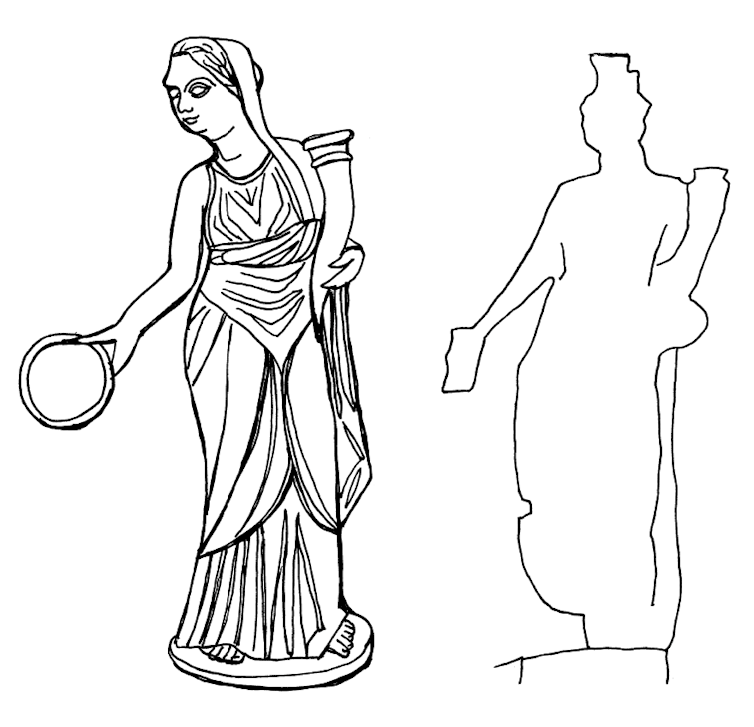
Celle-ci est directement inspirée des représentations de reines ptolémaïques, comme Bérénice II, assimilée aux déesses Isis et Tyché, sur des vases en faïence produits en Égypte. Figurée en train de faire une libation, Bérénice II tient une patère dans la main droite et une corne d’abondance dans la gauche.
À gauche : la reine Bérénice II en Isis-Tyché sur une oinochoé en faïence. Fin du IIIᵉ siècle av. J.-C., J. Paul Getty Museum, Los Angeles. À droite : contours de l’image de déesse-reine de la Khazneh. Dessin : Schwentzel, Fourni par l’auteur
Sur la façade de la Khazneh, l’image féminine est coiffée d’un attribut dont la forme évasée se devine encore aujourd’hui. On hésite entre la couronne crénelée de Tyché et le polos, coiffe arrondie de Déméter. Quoi qu’il en soit, il s’agit de deux attributs également repris, ou susceptibles de l’être, par Al-Ouzza [(déesse arabe préislamique, ndlr)]. D’où l’hypothèse, suggérée par Jean Starcky, selon laquelle le personnage féminin dominant la façade de la Khazneh représenterait une reine nabatéenne assumant, comme les souveraines ptolémaïques avant elle, le rôle d’une déesse. Une déesse-reine, en quelque sorte.
Les figures féminines de l’étage de la Khazneh. Photo : Schwentzel, Fourni par l’auteur
Examinons maintenant les huit autres figures qui entourent la reine à l’étage. Deux représentent Nikè, déesse grecque de la victoire, pourvue d’ailes, et les autres des femmes qui, dans un mouvement très dynamique, paraissent danser autour de la reine. On les a parfois interprétées comme des Amazones brandissant chacune un instrument qui pourrait être une double hache, arme traditionnelle de ces combattantes dans les mythes grecs. Elles exécuteraient ici une ronde guerrière.
Si les Victoires ailées, déjà présentes sur les monnaies d’Arétas II, n’ont rien de bien étonnant, les danseuses sont plus inattendues. Elles n’adoptent pas ici la position habituelle des femmes guerrières dans l’art grec, où elles sont généralement représentées blessées ou vaincues par des héros. En fait, leur état de conservation ne permet pas de distinguer si elles brandissent des haches ou plutôt des thyrses, ces bâtons liés à la figure de Dionysos dans le monde gréco-romain. Elles pourraient donc aussi bien représenter ici des Bacchantes, ces jeunes femmes en transe, adeptes de Dionysos qui fut identifié à Doushara ; ce qui pourrait expliquer leur représentation sur le monument.
Le rez-de-chaussée est, quant à lui, décoré de deux représentations de cavaliers. On voit encore leurs torses musclés et une partie de leurs chevaux qu’ils tenaient par la bride. Cette iconographie s’inspire de celle de Castor et Pollux, les Dioscures de la mythologie grecque, qui sont fréquemment associés aux monuments funéraires en raison de leurs fonctions psychopompes, c’est-à-dire de guides du défunt après la mort. Les hypogées alexandrins ont pu servir de modèle, car les Dioscures y sont souvent représentés accompagnant le mort, lui-même parfois figuré sous l’aspect d’un troisième cavalier.
Mais ce riche décor nous permet-il d’identifier la déesse-reine de la Khazneh ? Houldou est mentionnée pour la dernière fois en l’an 24 du règne d’Arétas IV, soit 15 apr. J.-C., date de sa mort. On peut émettre l’hypothèse que c’est à ce moment-là que le roi entreprit l’édification de la Khazneh qui devait servir de somptueux mausolée pour son épouse défunte. Il a pu s’inspirer de Ptolémée II qui rendit des hommages divins à sa sœur-épouse Arsinoé II en lui faisant édifier, près d’Alexandrie, le temple du Cap Zéphyrion où elle était figurée en déesse. La forme de la tholos pourrait elle-même s’inspirer de ce modèle lagide.
« La Khazneh aurait pu servir de mémorial et de lieu de célébrations en l’honneur de Houldou assimilée à Al-Ouzza et revêtue des attributs à la fois d’Isis et de Tyché. S’il est évident que des honneurs lui furent rendus, la reine ne fut cependant pas officiellement divinisée, contrairement à Arsinoé II ou Bérénice II. Aucune inscription ne suggère qu’elle fut élevée au rang de divinité, contrairement à Obodas Ier, seul Rabbelide [(nom que l’auteur donne à la dynastie des souverains nabatéens, ndlr)] déifié à notre connaissance. La reine, morte prématurément, fit seulement, si l’on peut dire, l’objet d’une forme d’héroïsation posthume, à travers une iconographie inspirée des précédents qu’offraient, en Égypte, les reines ptolémaïques. »
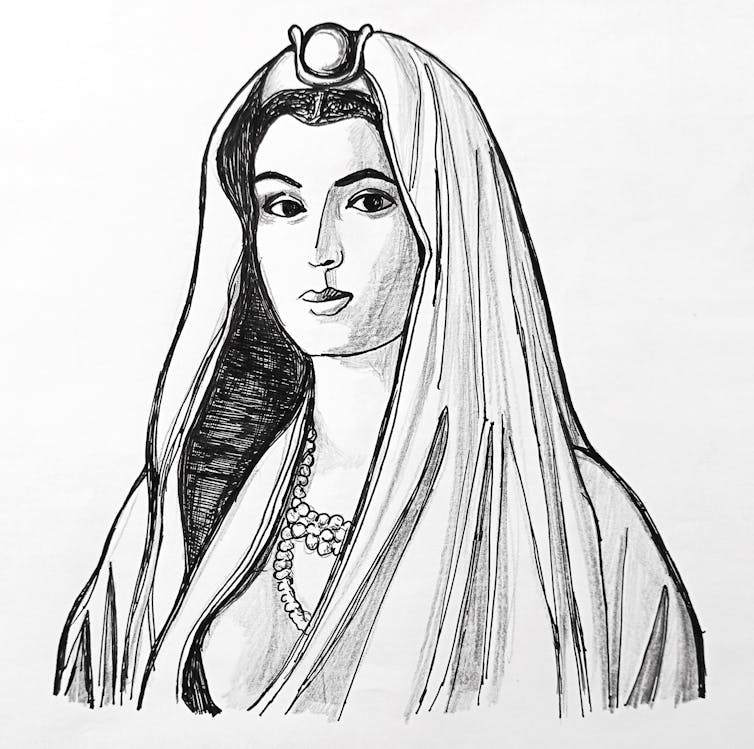
Reconstitution imaginaire du buste de la reine Houldou à partir des monnaies. Dessin : Schwentzel
Pénétrons à l’intérieur du monument. Après avoir traversé le vestibule que précèdent les colonnes du premier niveau, nous entrons dans une vaste salle, aujourd’hui totalement vide. Les murs sont percés de trois portes, la principale au centre, les deux autres sur les côtés. Elles donnent chacune accès à une petite pièce, sorte de niche, où devait reposer les dépouilles, peut-être de Houldou et de membres de sa famille. Après la mort de la reine Houldou, Arétas IV épouse en secondes noces Shaqilat Ire, qui apparaît à son tour sur les monnaies. La nouvelle souveraine reprend les éléments de l’iconographie de Houldou : voile à l’arrière de la tête et couronne de laurier. Mais elle ne porte la couronne isiaque que sur une pièce de bronze où figurent les bustes conjoints des souverains, non sur les émissions d’argent où son buste occupe à lui seul une face de la monnaie. Les autres reines qui lui succèderont ne reprendront plus ce symbole ; ce qui fait de Houldou la seule véritable reine à la coiffe égyptienne et conforte l’hypothèse du lien entre la Khazneh et la première épouse d’Arétas IV.
Christian-Georges Schwentzel ne travaille pas, ne conseille pas, ne possède pas de parts, ne reçoit pas de fonds d’une organisation qui pourrait tirer profit de cet article, et n’a déclaré aucune autre affiliation que son organisme de recherche.