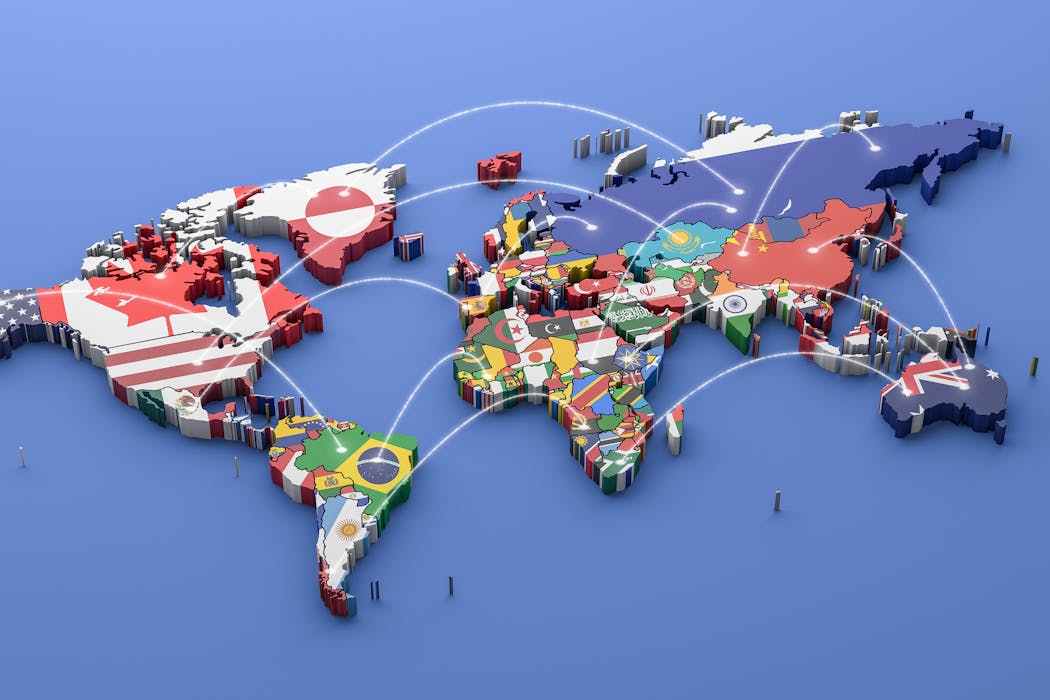
Gaza ceasefire and Donald Trump’s ‘dead cat diplomacy’

Source: The Conversation – UK – By Jonathan Este, Senior International Affairs Editor, Associate Editor, The Conversation

This newsletter was first published in The Conversation UK’s World Affairs Briefing email. Sign up to receive weekly analysis of the latest developments in international relations, direct to your inbox.


There were emotional scenes in both Gaza and across Israel this week as people celebrated the prospect of an end to a war which has cost so many lives. Israel and Hamas agreed the first phase of a ceasefire deal which, if it holds, will bring an end to nearly two years of bitter conflict in the Gaza Strip.

The latest casualty count is devastating. On the Palestinian side, more than 67,000 people, most of them civilians and among them an estimated 20,000 children. Israel lost more than 1,800 people: about 1,200 – mainly civilians – during the Hamas attack of October 7 2023 and the rest killed during the assault on Gaza.

Footage and images from both sides show relief, joy and hope that this deal, for which Donald Trump can rightly claim much credit, will hold, that the Israeli hostages will be returned and that a process of healing can begin. For Palestinians there is also the hope that they can return to their homes and begin the process of rebuilding.

But what comes next is far from certain, as Scott Lucas, an expert in Middle East politics from University College Dublin, explains. For the ceasefire to hold, particularly once the 22 remaining live hostages and the bodies of 26 who have died in captivity are released to Israel, assumes a great deal of good faith on both sides. But particularly from Israel.

The release of the hostages removes any leverage Hamas might have had, Lucas writes. And the fact that Israel was still hitting Gaza with airstrikes hours after the US president announced that a deal had been done must cast some doubt on that good faith.

Nevertheless, the ceasefire is due to begin on Friday, after Israel’s cabinet meets to sign off on the hostage agreement. This is when the hard part begins, says Lucas. Hamas will be unwilling to comply with Israel’s demand to disarm and disband and take no further part in Palestinian politics. We don’t know how the future governance covered in Trump’s 20-point plan will work. We don’t know when and to what extent Israel will withdraw its troops.

And Israel’s prime minister, Benjamin Netanyahu, still has to get the deal past the two far-right cabinet ministers, Itamar Ben-Gvir and Bezalel Smotrich. Smotrich has already said he will oppose the deal.

But, for now at least, there is reason to hope. And this is something that has been in painfully short supply in Gaza of late.


Read more:
Israel and Hamas agree ceasefire deal – what we know so far: expert Q&A


Trump’s idiosyncratic style of diplomacy may often appear hasty, clumsy and ill-judged. But it’s questionable whether this particular deal could have happened without him. Asaf Siniver believes Trump was key to getting both Israel and Hamas into line. Siniver, an expert in international security from the University of Birmingham, highlights Trump’s apparent mastery of what is known as “dead cat diplomacy”.

This is a foreign policy approach identified by James Baker, former US secretary of state, in the late 1980s. He recalled in his memoir that he employed it during his own attempts at securing a peace deal between Israel and a delegation of negotiators from Palestine.

Siniver says dead cat diplomacy requires three things: “It must be perceived by the intransigent parties as a last-chance threat, it must be perceived as a credible move by the third party and there must be internal factors which limit the intransigent party’s capacity to ignore the threat.”

All three of these were met in the case of the recent negotiations between Israel and Hamas. It was just a case, to paraphrase Baker, of “laying the dead cats at Israel’s and Hamas’s doorsteps”. In other words, to publicly blame and shame both parties for any reluctance to advance the deal.

Trump did this famously by reporting he’d told the Israeli prime minister he was “always fucking negative” about the peace process. He made sure that everyone knew that he’d forced Netanyahu to apologise to Qatar for launching the airstrikes in early September to try to kill Hamas leaders.

His constant social media messaging to Hamas that it was the major obstacle to Middle East peace fulfilled the same principles. He told Hamas that he’d given Netanyahu carte blanche to “finish the job” and was aware of quite how isolated Hamas had become – not just from its former allies in the Arab states, but with the people it was ostensibly fighting to protect, the Gazans themselves.


Read more:
How Donald Trump’s ‘dead cat diplomacy’ may have changed the course of the Gaza war


Two years of tragedy

There can be no doubt that, whatever the leaders on both sides thought, most ordinary people in Israel and Gaza just wanted the war to end. This week marked the second anniversary of the brutal October 7 Hamas attack on southern Israel. Yuval Katz, whose research has involved speaking to a lot of Israeli citizens about the war and examining social media reports from Gaza, feels that both sets of people were caught between two visions of what peace might mean.

For the politicians, particularly for Donald Trump, a solution for Gaza was part of something else. Trump saw it as the cornerstone of a broader US-sponsored deal for the Middle East: “I’m not just talking about Gaza … the whole deal, everything getting solved. It’s called peace in the Middle East.”

For the Israeli prime minister, the war was part of a delicate political manoeuvre to retain the backing of his far-right allies and keep himself in power.

Neither gave the impression they were in touch with the trauma of the ordinary people. Israelis felt the October 7 massacre and the hostages as a constant pain. Cases of PTSD and suicide among those who served in the military have soared over the two years.


Read more:
October 7 two years on: Israelis and Palestinians caught between two conflicting ideas of peace


Two years of war have also reshaped the Middle East, writes Simon Mabon. Mabon, a scholar of Middle East politics at Lancaster University, outlines the profound ways the region has changed over two years. Iran and its proxies have had their wings severely clipped. In Lebanon, Hezbollah has been crippled. In Syria, Israel has taken advantage of the turmoil following the fall of Assad in December 2024 to carve itself out a buffer zone around the Golan Heights in the south.

Meanwhile, normalisation between Israel and Saudi Arabia – an extension of the Abraham accords which Trump saw as one of his major foreign policy achievements in his first term – has been set back considerably, certainly for years. A lot, says Mabon, will hang on what happens next in Gaza.


Read more:
The two years of fighting since October 7 have transformed the Middle East


Donald Trump: Nobel peace laureate?

It’s highly unlikely Trump would be recognised at Friday’s Nobel peace prize announcement for a ceasefire deal that hasn’t even yet come into force. But if it does lead to a lasting peace, there will be plenty of speculation about whether the Nobel committee will recognise the US president in the future.

After all, there have arguably been more controversial choices. Colin Alexander, an expert in political communication at Nottingham Trent University, walks us through some of them.


Read more:
The Nobel peace prize has a record of being awarded to controversial nominees


Sign up to receive our weekly World Affairs Briefing newsletter from The Conversation UK. Every Thursday we’ll bring you expert analysis of the big stories in international relations.


The Conversation

ref. Gaza ceasefire and Donald Trump’s ‘dead cat diplomacy’ – https://theconversation.com/gaza-ceasefire-and-donald-trumps-dead-cat-diplomacy-267155
AI, drone ships and new sensors could leave submarines with few places to hide in the ocean

Source: The Conversation – UK – By David Stupples, Professor of Electrical and Electronic Engineering and Director of Electronic Warfare Research, City St George’s, University of London

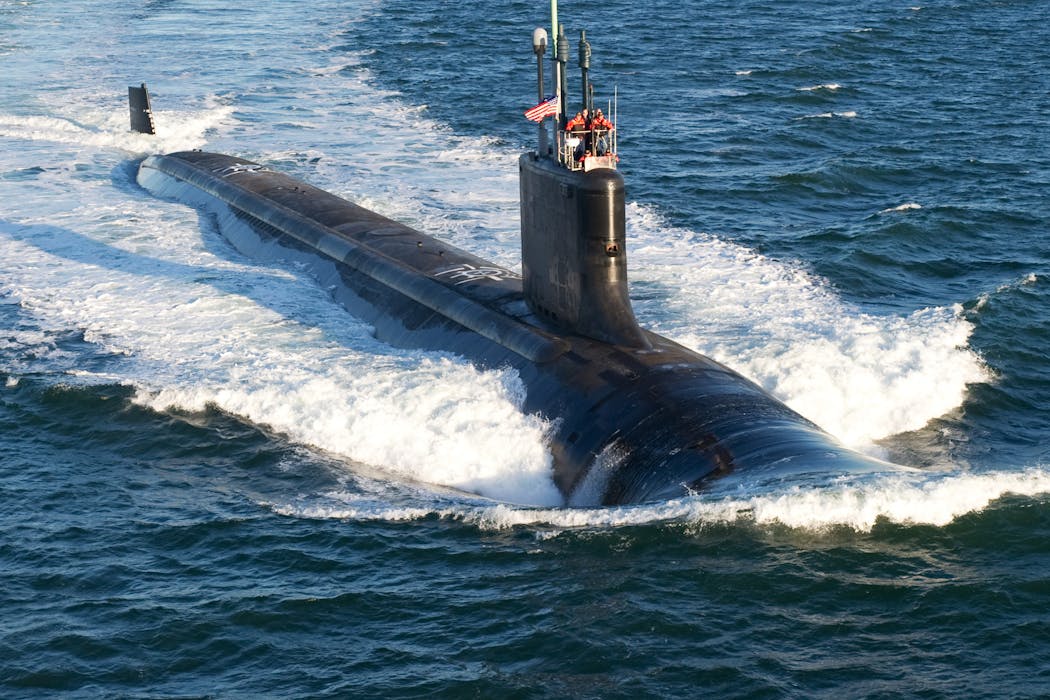
A US Virginia-class attack submarine during sea trials in the Atlantic Ocean. US Navy courtesy of General Dynamics Electric Boat

For over a century, the ocean has been the ultimate refuge for those who wished to disappear. From the U-boats of the first world war to the nuclear-powered leviathans that glide through today’s deep waters, the submarine has thrived on one simple principle: stealth.

Sound waves travel further and faster in water than light or radar waves. This means sound is the most effective way to detect underwater objects. Modern anti-submarine warfare (ASW) is an ongoing cat-and-and-mouse game of detecting, tracking and deterring enemy submarines. With sound as the ocean’s only reliable language, ASW has primarily been a contest of listening.

But the game is changing. Advances in artificial intelligence (AI), sensor networks, and autonomous vehicles are eroding the acoustic monopoly that submarines once enjoyed.

A new generation of tireless, networked and increasingly intelligent machines is beginning to patrol the seas. This promises a future where even the quietest submarine will find it harder to remain unseen.

As the ocean’s soundscape becomes more crowded, navies are increasingly turning to non-acoustic methods. These technologies detect the effects of a submarine rather than its noise. Satellites equipped with synthetic aperture radar can detect subtle ripples and temperature gradients on the sea surface caused by subsurface movement.

Until recently, magnetometers, which can measure the minute disturbances a submarine creates in Earth’s magnetic field, were constrained by physics and sensitivity limits. The magnetic anomaly detectors used for ASW could only operate effectively at low altitude and at short range.

Emerging quantum magnetometers, which make use of the strange science of quantum mechanics, promise orders-of-magnitude improvements in sensitivity. They could, in theory, detect the presence of a steel hull tens of kilometres away, especially when deployed in swarms aboard uncrewed aircraft or sea surface vessels.

A technique called distributed acoustic sensing (DAS) could turn ordinary undersea cables – primarily used for internet traffic – into vibration sensors. It works by measuring subtle changes in strain in the cables’ optical fibres.

Through DAS, a single transoceanic cable could, in effect, become an enormous underwater microphone (hydrophone). In principle, this would allow a submarine crossing a major ocean basin to be detected by subtle pressure waves recorded in the fibres beneath it.

Autonomous vessels

At the heart of the revolution in ASW are uncrewed surface vehicles (USVs). These autonomous vessels range from small, solar-powered craft to large, long endurance ships capable of spending weeks or months at sea.

Unlike crewed ships, USVs can be built cheaply and in large numbers. Armed with sonar, radar, magnetometers and communications links, they are the mobile nodes of an ocean-scale sensor network that can listen, learn and adapt in real time.

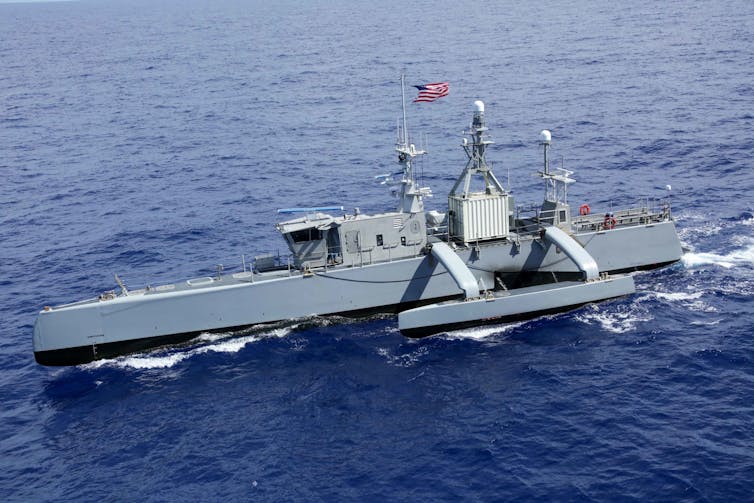
US Navy Sea Hunter
The Sea Hunter is an autonomous anti-submarine vessel built for the US Navy.
Petty Officer 3rd Class Aleksandr Freutel.

The US Navy’s Sea Hunter, an autonomous trimaran, has demonstrated its ability to track a diesel-electric submarine for extended periods without human intervention. In the UK, the Royal Navy’s Cetus project and its experimental uncrewed fleet at Portsmouth are exploring similar ideas.

But it is the integration of AI with autonomy that reshapes the picture. A single USV, even a sophisticated one, can only observe a small patch of ocean. A swarm of hundreds, each communicating via satellite, laser, or acoustic link, can share information and act cooperatively.

AI is a game changer

AI does things that human operators and legacy systems cannot. It fuses data from multiple sources into a coherent picture. A single acoustic anomaly may mean little, but when combined with other data, it may form a high confidence detection.

AI operates continuously and without fatigue. Persistence is vital when hunting for the fleeting signature of a submarine designed to operate silently for weeks.

And by learning how submarines navigate, avoid detection, and exploit environmental features, algorithms can forecast likely positions and movements. This could prompt ASW to move from being primarily reactive to predictive – a shift comparable to how meteorology evolved from observation to forecasting.

Through these capabilities, AI could move from simply assisting detection to orchestrating it.

Humans are not leaving the loop, however. The role of human operator is shifting from hands-on detection to oversight, strategy, and what’s known as trust management.

Trust is a key challenge: in this context, it’s about ensuring human decision makers understand what AI is doing and why it recommends certain actions.

Navies are therefore investing heavily in explainable AI – systems that can account for their decisions – and robust communications systems that allow human operators to intervene when needed.

A connected ocean

By the 2030s, the world’s oceans may become as transparent to sensors as the skies became to radar in the 20th century. With help from AI, multiple transmitters and receivers – mounted on ships, aircraft and USVs – will be able to triangulate the positions of submarines in real time.

Swarms of autonomous underwater vehicles – relatively small robotic drones – will patrol close to shore, relaying data to surface craft. Satellites will flag anomalies for local sensor networks to investigate. And the fibre-optic infrastructure that spans the seabed may double as a global array of undersea microphones.

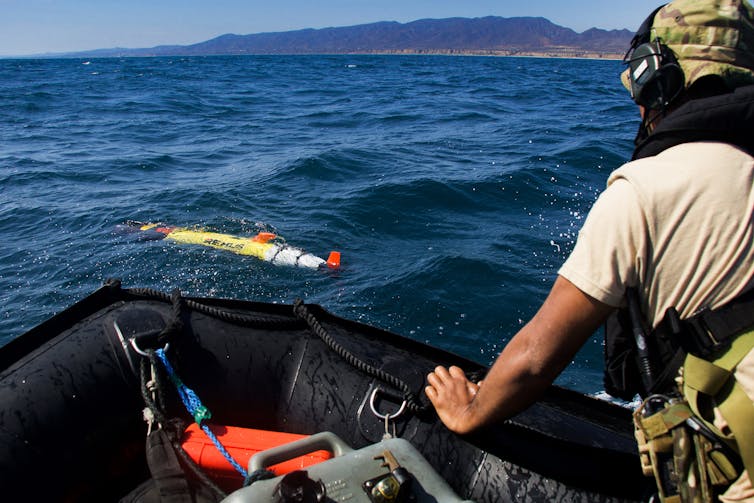
Autonomous underwater vehicle
Autonomous underwater vehicles could patrol areas near the shore.
US Navy

For now, such a vision remains technically ambitious. The ocean is extraordinarily complex: temperature gradients, salinity layers, and seabed topography all distort signals and confound algorithms. But with every incremental improvement in AI modelling and computational power, those obstacles shrink.

As detection grows more sophisticated, so too will the submarines. The future may see submarines using propulsion systems and materials in their hulls that leave minimal thermal or acoustic signature. Decoy drones could be used to confuse detection systems.

Some analysts predict that submarines will operate deeper and slower to evade wide-area surveillance. A shift towards autonomous undersea drones that can saturate defences through sheer numbers is also possible.

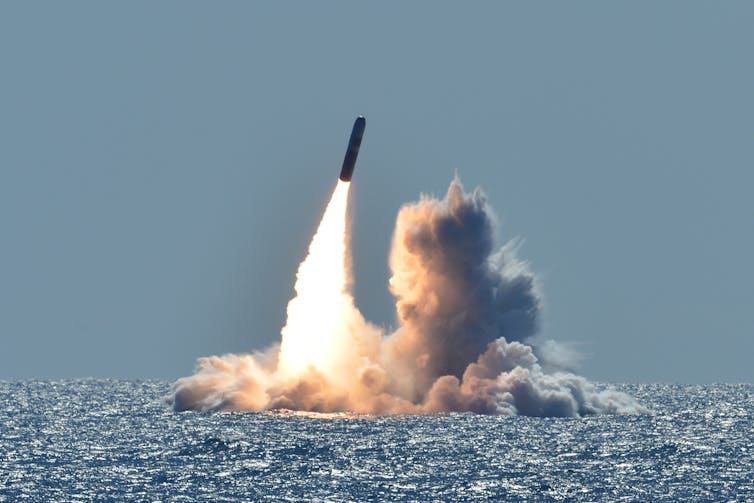
An unarmed Trident II D5 missile launches from the USS Nebraska
An unarmed Trident II D5 missile launches from the USS Nebraska. Submarines have long been the cornerstone of nuclear deterrence.
US Navy photo by Mass Communication Specialist 1st Class Ronald Gutridge

The strategic implications are profound. Submarines have long been the cornerstone of nuclear deterrence and covert power projection. Their ability to vanish beneath the waves gave nations second-strike capability (the ability to retaliate after absorbing a nuclear attack) and freedom of manoeuvre.

The result of AI-driven transparency could be greater stability – reducing incentives for surprise attack – or, paradoxically, new instability as nations race to preserve secrecy.

The submarine will remain a formidable weapon, but it will no longer move unseen. The ocean, once humanity’s final hidden frontier, is becoming transparent to the eyes of machines.

The Conversation

David Stupples does not work for, consult, own shares in or receive funding from any company or organisation that would benefit from this article, and has disclosed no relevant affiliations beyond their academic appointment.

ref. AI, drone ships and new sensors could leave submarines with few places to hide in the ocean – https://theconversation.com/ai-drone-ships-and-new-sensors-could-leave-submarines-with-few-places-to-hide-in-the-ocean-266973

What could burst the AI bubble?

Source: The Conversation – UK – By Richard Whittle, University Fellow in AI and Human Decision Making, University of Salford

Tada Images/Shutterstock

Some of the world’s biggest tech firms have soared in value over the last year. As AI evolves at pace, there are hopes that it will improve lives in ways that people could never have imagined a decade ago – in sectors as diverse as healthcare, employment and scientific discovery.

OpenAI is now worth US$500 billion (£373 billion), compared with US$157 billion last October. Another firm, Anthropic, has almost trebled its valuation. But the Bank of England has now warned of a possible rapid “correction” due to its concerns about these staggering valuation rises.

The question is whether these values are realistic – or based on hype, excitement and unfounded optimism for the potential of AI. Put simply, is AI’s value today a product of what AI will do in future or what people hope it may do? Ultimately, we will only really know if it’s a bubble if it bursts – though the warning signs are evident today.

With hindsight, many things that happen in a bubble may sound exceedingly optimistic. If you take many headlines and replace the word AI with the word computers it often sounds a lot more naive.

But, predicting the path of technological change is hard. Back in 2000 the Daily Mail declared the internet could be a passing fad. Just a few months earlier the dotcom boom had peaked.

A burst bubble may not change the end of the journey. The internet was not a passing fad. However, bubbles are extremely disruptive and affect people in very real ways. Stocks fall, pensions suffer, unemployment rises and investment is wasted. Real potential is crowded out in the hype and mania to focus all investment in a small number of stocks and firms.

Right now, we have the first sign of a bubble – a rapid rise in valuations. If these correct and fall we will have a bubble. If these valuations continue to rise we could be seeing a new sustained market that is focused on the technology of the future.

Of course, it might be that these valuations plateau. What happens then depends on whether people have invested in the belief that prices will always rise.

Consider a situation where people believe – as the Bank of England does – that AI firms’ valuations may be “stretched”. It’s helpful to consider what these valuations are based on. Investment is simply a bet that AI increases profitability for the firms involved. These massive valuations are bets that AI will hugely increase future profitability.

In some cases these are bets that AI will improve in capabilities towards some kind of “artificial superintelligence” that can do everything a human can do – or more. This could raise the living standards of everyone on Earth. Leading computer scientist Stuart Russell estimates the value of that at US$14 quadrillion – investors are buying a claim on that outcome too.

If investors begin to fear that AI profits won’t materialise then they will try to get their money back. This realisation can appear quite suddenly and can be prompted by seemingly minor events. It doesn’t require a big needle to pop a bubble.

close-up of a 1990s desktop computer screen as it connects to internet.
Excitement at easy internet access in the 1990s fuelled the dotcom bubble.
Gorodenkoff/Shutterstock

A US article published in March 2000 warned that internet companies were fast running out of money. This caused many people to rethink their investments

At this stage of the bubble, investment excitement had spread to everyday investors. These regular people balanced their fear of missing out with a fear that they were investing in something new that they didn’t know much about. For many, an article in a popular magazine suggesting they may have made a mistake tipped the scales towards caution. They began to sell their dotcom stocks.

In search of profit

It may come as a surprise to some that, despite its increasing valuations, OpenAI does not yet make a profit. It may require ten times more revenue to do so.

A US$500 billion valuation is quite something for a company that reportedly lost US$7.8 billion in the first half of this year. Some of this value appears to flow from a new deal between OpenAI and Nvidia where Nvidia will invest in OpenAI and OpenAI will buy Nvidia chips. This circular financing keeps everything afloat for now, but at some point investors will need to see returns.

AI firms more generally do not appear to be profitable at the moment. Investors are not putting their money into today’s losses – they are betting on an AI future.

It is of course perfectly feasible that AI firms will develop business models to increase their profitability. OpenAI is exploring advertising options and allowing chatbots to recommend products.

Using AI to deliver these messages is a viable option, though they will have to avoid the tricks and manipulations associated with online platforms, such as when hotel websites announce that rooms are about to sell out. We believe that AI can increase the power of these manipulations and we wonder how persuasive chatbots may be in their recommendations.

However, the big four – Meta, Alphabet, Microsoft and Amazon – are this year spending the equivalent of the GDP of Portugal on AI infrastructure. This is not investment in new targeted ads, it is investment in an AI future. The bubble will burst if and when this future is in doubt.

The Conversation

Richard Whittle receives funding from several standard sources including UKRI and Research England. No funders are likely to benefit from, or influence this work

Stuart Mills does not work for, consult, own shares in or receive funding from any company or organisation that would benefit from this article, and has disclosed no relevant affiliations beyond their academic appointment.

ref. What could burst the AI bubble? – https://theconversation.com/what-could-burst-the-ai-bubble-267136

Should we decide by lottery who gets a medical treatment first?

Source: The Conversation – UK – By Philip Clarke, Professor of Health Economics, University of Oxford

Belish/Shutterstock.com

For decades, ethicists have argued that lotteries could be the fairest way to decide who gets life-saving treatment when there isn’t enough to go around. Yet our research suggests that most people would rather leave the choice to medical experts than to luck.

Our recent study involving more than 15,000 people across 14 countries found that the public preferred allocation by expert medical committees over lotteries for scarce COVID vaccines.

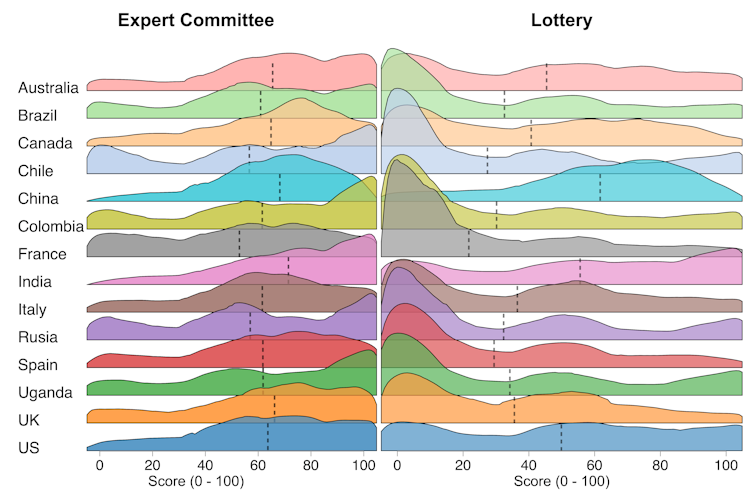
Respondents were presented with a scenario: a hospital wanted to vaccinate all 1,000 of its nurses but had only 500 doses of a COVID vaccine available. Some were asked whether they agreed that an expert committee was an appropriate way to make the decision; others were asked whether they agreed that a lottery was an appropriate way. Agreement with each method was measured on a scale from zero (strongly disagree) to 100 (strongly agree).

On average, expert committees scored 61, compared with just 37 for lotteries. While expert allocation was more acceptable everywhere, support for lotteries varied sharply across countries – from strikingly low in France and Chile to relatively high in China, India and the US.

Distribution of agreement with the appropriateness of allocation by lottery and expert committee.
CC BY

In theory, lotteries are fair when used for people who would benefit equally from treatment. They treat people with equal need equally and avoid rewarding those who happen to live closer to hospitals or who are better connected.

Many ethicists have proposed using them when it is hard to make decisions about life-saving treatments. For example, when kidney dialysis first became available in the 1960s, lotteries were discussed as a tie-breaker for equally eligible patients.

While ethicists often focus on fairness in principle, our results suggest that fairness alone may not be enough to persuade the public if the process feels random or impersonal.

During the early COVID pandemic, ethicists again argued for random allocation of potentially life-saving treatments. In the US, several National Academies even recommended lotteries for prioritising vaccines when “no further identifiable risk-based differences” existed between groups – that is, patients of the same age and health status.

Despite these arguments, lotteries were rarely used in practice during the pandemic. Our study suggests that the public was not supportive.

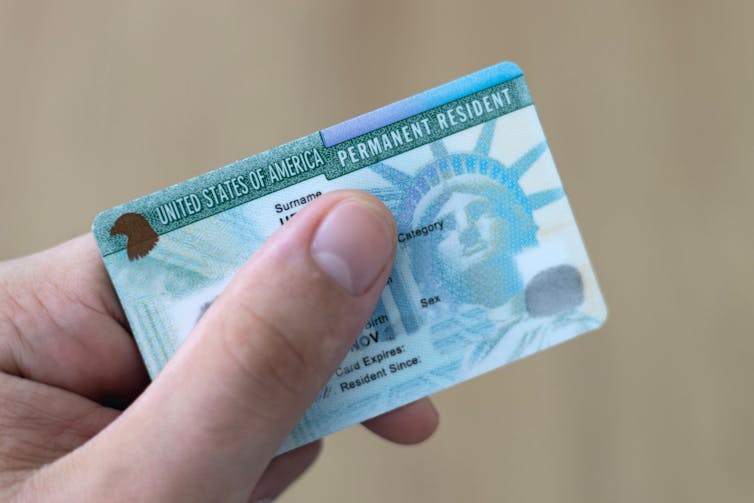
But cultural familiarity with lotteries also matters in terms of which nations will or won’t accept them. In India, lotteries are used to allocate school places and public housing. In China, they decide who gets car licence plates in crowded cities. And in the US, a green card lottery allocates immigration visas. In these countries, support for healthcare lotteries was noticeably higher.

A hand holding a green card.
In the US, some green cards are allocated by lottery.
kurgenc/Shutterstock.com

Luck of the draw

It is difficult to know whether existing lotteries for public services create acceptance, or whether they were introduced because public attitudes were already favourable. Either way, familiarity seems to make lotteries more acceptable.

Scepticism about healthcare lotteries is understandable. Yet committees are not perfect either – they can be slow, inconsistent, or swayed by politics or prejudice. Importantly, during the COVID pandemic, government expert committees in different countries came up with a wide variety of recommendations on who should be prioritised to receive the vaccine first.

If used, lotteries should be implemented in conjunction with medical guidelines. For example, during the COVID pandemic, the UK government prioritised access to vaccines largely based on five-year age bands starting with the oldest groups.

While allocating COVID vaccines based on age criteria was seen as appropriate medically, the order in which people should be vaccinated within an age group is less clear. For example, when rolling out the initial COVID vaccine, there were around 3 million people aged 65 to 69 in the same risk-based priority group, and vaccinating them all simultaneously was impossible.

To avoid vaccinating on a “first-come, first-served” basis that could reward proximity or privilege, a lottery could have been used to decide when each person in this group would receive their vaccine. Such a vaccine lottery featured in the 2011 film Contagion, but was hardly used during the actual pandemic.

The COVID pandemic is over, but future disease outbreaks are inevitable. We should think now about whether lotteries should play a role in allocating scarce treatments or vaccines next time.

For lotteries to be seen as a legitimate way to allocate healthcare, governments need to engage with the public and trial the approach. In 2008, the US state of Oregon used a lottery to select participants for limited Medicaid (a public health insurance programme) slots.

Lotteries remain one of the fairest tools we have when medical differences are otherwise equal. Next time, rather than treating lotteries as unthinkable, we should be ready to use them, with public understanding and trust already in place.

The Conversation

Philip Clarke receives funding from the NIHR Oxford Biomedical Research Centre and Oxford Health Biomedical Research Centre and previously the Department of Health and Social Care, for the evaluation of the COVID-19 Oxford Vaccine Trial.

Rhys Thomas declared no potential conflicts of interest with respect to the research, authorship, and/or publication of this article. The study presented in this article was supported by the National Institute for Health Research (NIHR) Oxford Biomedical Research Centre and the COVID-19 Oxford Vaccine Trial.

ref. Should we decide by lottery who gets a medical treatment first? – https://theconversation.com/should-we-decide-by-lottery-who-gets-a-medical-treatment-first-265454

Attachment to our home town runs deep – so what happens when it faces dramatic change?

Source: The Conversation – UK – By Aled Mark Singleton, Lecturer in Human Geography, Cardiff University

When the news broke in the autumn of 2023 that the blast furnaces at the steelworks in Port Talbot, south Wales, were closing, the headlines were laced with emotion: “devastating”, “fear”, “end of an era”. For many in the town, it wasn’t just the loss of 3,000 jobs, it was as though part of the town’s identity was being taken away.

Such emotional reactions are not just nostalgia or sentimentality. They’re a powerful example of what researchers call “place attachment”, the deep, often unspoken bonds we form with the places that shape our lives.

My own research has explored how people in Newport formed emotional attachments to the former Llanwern steelworks from when it was built in the 1960s.

We develop attachment to the places where we grow up, live, work and socialise. They could be your childhood street, the corner shop where you bought sweets, or the estate where you raised your children. These places hold memories, routines and milestones.

But our attachments aren’t just personal. As we age, they can become shared and tied to a town, a city, or a region. In south Wales, where industries like coal and steel once shaped generations, those attachments are often linked to pride, identity and social connection.

Sometimes, they’re hopeful, but other times they carry a sense of loss.

An uncertain future

In September 2024, the giant blast furnaces in Port Talbot were shut down, marking the end of traditional steelmaking in the town. A new, greener arc furnace is being built in its place, but the transition has brought fear and uncertainty. Will the next generation have jobs here? Will the town still feel like the place people knew?

Even before the closure, Cardiff University researchers described a “lingering sense of indignity and insecurity left by recent history” in the area. The emotional bonds people have with Port Talbot aren’t just rooted in the past; they’re being tested by what the future promises – or fails to.

To understand how people form and carry place attachments over time, I carried out research in Newport in 2019, nearly 50 miles east of Port Talbot. In 1962, a vast steelworks opened in Llanwern, just outside the city. Thousands of people moved there for work, and entire neighbourhoods were built around the promise of a better life. The plant remained a major employer for nearly 40 years, before most of it closed in 2001.

I wanted to understand how people who had lived through that era remembered it and how their feelings about the area had changed over time. Instead of conducting conventional interviews, I walked with residents through their neighbourhoods. We revisited places from the 1960s and 1970s, letting memories rise to the surface.


Read more:
Walking is a state of mind – it can teach you so much about where you are


To share public feelings, I curated two events in the community that also included guided walking tours. An important component was public performances that brought people’s stories to life, made by artist Marega Palser.

The walks and events revealed powerful stories.

A man remembered the feeling of something being taken away as habitats were destroyed to make way for houses. Another described the thrill of buying a first home near the steelworks, when “everything seemed possible”. One woman pointed out the exact spot where a car once crashed into her garden.

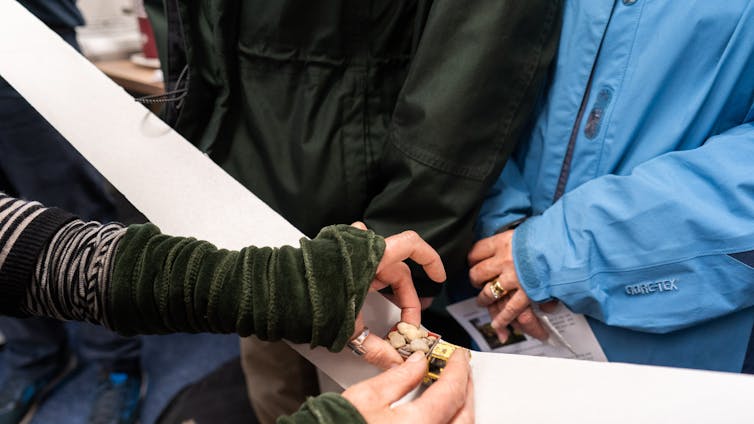
A close up of people's hands with a small toy lorry in the middle.
Artist Marega Palser creates a paper roadway with toy lorry to depict Llanwern steelworks opening in the 1960s.
Jo Hayock, CC BY-NC

One participant recalled how, in the early 1970s, “people were almost fulfilling their dreams: home ownership … people getting access to cars, things like tellies”. Others remembered the chaos caused by shale lorries rumbling through the nearby town of Caerleon in the 1960s, delivering material for the foundations of the steelworks.

For many, the steel industry hadn’t just shaped their town, it had shaped their life story. But these stories weren’t only about loss. They were also about pride, belonging and everyday joys.

Why these stories matter

Place attachment helps explain why people feel so strongly when things change. It’s why the closure of a factory, the demolition of a housing estate, or the decline of a high street can hit so hard. It’s not just about jobs or buildings but identity, memory and meaning.

In Port Talbot, these feelings are still raw. The town’s future is being recast by government policy, corporate decisions and global economics. But the emotional landscape mustn’t be overlooked. Understanding how people feel about a place can help us listen more carefully to what’s at stake when that place changes.

In Newport, where the industrial decline came earlier, the picture is more mixed. The city’s population is growing, and employment levels are above the national average. Today, people may form attachments through the independent music scene, or events connected to the city’s radical history, such as the Newport Rising festival.

These newer narratives matter just as much. Without them, older identities can become frozen in time, and communities may find it harder to imagine a different future.

Of course, our homes and neighbourhoods will always matter. But we also carry bigger attachments, to towns and cities, to shared pasts and imagined futures. Understanding those attachments means looking beyond headlines about economic loss or regeneration. It means listening to what people remember, what they still cherish and what they fear losing.

As Port Talbot’s steelworks are greatly reshaped and Newport continues to evolve, one thing is clear – we don’t just live in places. We feel them too.

The Conversation

Aled Mark Singleton received funding the Economic and Social Research Council: Grant Number ES/W007568/1. This work was supported by Swansea University Geography Department.

ref. Attachment to our home town runs deep – so what happens when it faces dramatic change? – https://theconversation.com/attachment-to-our-home-town-runs-deep-so-what-happens-when-it-faces-dramatic-change-263667

Un robot m’a pris mon stage : l’impact de l’IA sur l’entrée des jeunes dans le monde du travail

Source: The Conversation – in French – By Melise Panetta, Lecturer of Marketing in the Lazaridis School of Business and Economics, Wilfrid Laurier University

Pendant longtemps, l’expression « le robot m’a pris mon emploi » évoquait des machines dans les usines. Aujourd’hui, la génération Z fait face à un nouveau défi : l’IA s’invite dans les stages et les postes d’entrée.

Les stages et les emplois débutants ont toujours constitué un tremplin prévisible vers le monde du travail, en offrant aux nouveaux employés l’expérience et les compétences nécessaires à leur développement professionnel à long terme.

Mais à mesure que l’intelligence artificielle (IA) se répand dans tous les coins du monde du travail moderne, ces postes sont susceptibles d’être remplacés par l’automatisation.


25-35 ans : vos enjeux, est une série produite par La Conversation/The Conversation.

Chacun vit sa vingtaine et sa trentaine à sa façon. Certains économisent pour contracter un prêt hypothécaire quand d’autres se démènent pour payer leur loyer. Certains passent tout leur temps sur les applications de rencontres quand d’autres essaient de comprendre comment élever un enfant. Notre série sur les 25-35 ans aborde vos défis et enjeux de tous les jours.

Les postes d’entrée impliquent généralement des tâches peu complexes et fréquentes, telles que la saisie de données, la planification ou la rédaction de rapports, tâches que l’IA générative peut accomplir à un coût nettement inférieur et plus rapidement qu’un être humain. Cela signifie presque certainement une diminution du nombre d’échelons traditionnels au bas de l’échelle professionnelle.

Nous en constatons déjà les effets : les emplois de premier échelon se font plus rares, les candidats étant confrontés à une augmentation de 14 % du nombre de candidatures par poste, selon LinkedIn.

L’IA transforme le monde du travail

L’intégration de l’IA dans tous les secteurs est en train de remodeler fondamentalement le marché du travail.

Près de la moitié des professionnels craignent que l’IA ne remplace leur emploi. Et ils ont de bonnes raisons de s’inquiéter : d’ici 2030, on estime que près de 30 % des tâches pourraient être automatisées par l’IA générative.

Par ailleurs, près des deux tiers des cadres se disent prêts à utiliser des outils d’IA pour augmenter la productivité, au risque de réduire les effectifs. À l’inverse, seul un cadre sur trois est prêt à conserver son personnel au détriment d’une productivité attendue plus élevée.

On prévoit également que la diminution des postes traditionnels de niveau débutant ou junior dans des secteurs tels que la restauration, le service à la clientèle, la vente et le soutien administratif pourrait représenter près de 84 % des changements professionnels attendus d’ici 2030.

Pénurie de talents et de postes d’entrée à l’avenir

Les données sur l’IA et l’avenir du travail soulignent également un autre problème potentiel : la pénurie de talents pour certaines compétences. Un rapport publié en 2024 par Microsoft et LinkedIn révèle que les dirigeants s’inquiètent de la pénurie dans des domaines tels que la cybersécurité, l’ingénierie et la conception créative.

Bien que ces données puissent sembler contradictoires, elles indiquent qu’outre la diminution du nombre de postes de débutants disponibles, des changements dans les rôles et les compétences sont également à prévoir.

En conséquence, la concurrence pour les postes de débutants devrait s’intensifier, et les candidats capables d’utiliser des outils d’IA pour améliorer leur productivité et leur efficacité seront davantage valorisés.

Au lieu de simplement supprimer des postes, de nombreux emplois se transforment pour exiger de nouvelles compétences. Il existe également une demande croissante de talents spécialisés dans les domaines où l’IA ne peut pas encore augmenter pleinement les capacités humaines.

La maîtrise de l’IA est la nouvelle condition d’entrée

À mesure que l’IA se généralise dans le monde du travail, les postes « débutants » ne consistent plus seulement à accomplir des tâches de base, mais aussi à savoir travailler efficacement avec les nouvelles technologies, y compris l’IA.

Les employeurs commencent à accorder une grande importance à la maîtrise de l’IA. Deux tiers des cadres affirment qu’ils n’embaucheraient pas une personne sans compétences en IA et 71 % déclarent qu’ils préféreraient un candidat moins expérimenté, mais possédant des compétences en IA à un candidat plus expérimenté, mais qui n’en possède pas.

Avec moins de postes de débutants disponibles, les jeunes travailleurs devront trouver comment se démarquer sur un marché du travail concurrentiel. Mais malgré ces défis, la génération Z est peut-être la mieux placée pour s’adapter à ces changements.

En tant que natifs du numérique, de nombreux membres de la génération Z intègrent déjà des outils d’IA dans leur travail. Un rapport de LinkedIn et Microsoft a révélé que 85 % d’entre eux utilisent des outils d’IA tels que ChatGPT ou Copilot sur leur lieu de travail, ce qui indique qu’ils sont à la fois à l’aise et désireux d’utiliser cette technologie.

Cette tendance reflète des tendances plus générales au sein de la population active. Un rapport a révélé que 76 % des professionnels estiment avoir besoin de compétences liées à l’IA pour rester compétitifs. Ce même rapport de Microsoft et LinkedIn a révélé une augmentation de 160 % des cours de formation à l’IA.

Cette importance croissante accordée aux compétences en IA s’inscrit dans une tendance plus large vers le « renforcement des compétences », c’est-à-dire le processus qui consiste à améliorer ses compétences pour s’adapter à l’évolution du marché du travail. Aujourd’hui, l’amélioration des compétences consiste à apprendre à utiliser l’IA pour améliorer, accélérer et renforcer ses performances sur le lieu de travail.

Un nouveau type d’emploi de premier échelon

Étant donné que la maîtrise de l’IA devient une compétence professionnelle essentielle, il est important de pouvoir se présenter comme un candidat possédant des compétences en IA pour se démarquer sur un marché de l’emploi de premier échelon très concurrentiel. Cela implique de savoir utiliser les outils d’IA, d’évaluer leurs résultats de manière critique et de les appliquer dans un contexte professionnel. Cela signifie également apprendre à présenter ses compétences en IA sur un CV et lors d’entretiens.


Déjà des milliers d’abonnés à l’infolettre de La Conversation. Et vous ? Abonnez-vous aujourd’hui à notre infolettre pour mieux comprendre les grands enjeux contemporains.


Les employeurs ont également un rôle à jouer dans tout cela. S’ils veulent attirer et retenir des employés, ils doivent repenser les postes d’entrée. Au lieu de les supprimer, ils devraient se recentrer sur des activités à plus forte valeur ajoutée qui nécessitent un esprit critique ou de la créativité. Ce sont là les domaines dans lesquels les humains surpassent les machines et où l’IA peut servir de soutien plutôt que de remplacement.

Mais pour que cela fonctionne, les employeurs doivent réévaluer leurs pratiques d’embauche afin de privilégier la maîtrise de l’IA et le savoir-faire transférable plutôt que des exigences d’expérience dépassées.

L’avenir du travail ne réside pas dans le remplacement des humains par les robots, mais dans l’apprentissage de la technologie pour renforcer les compétences et ouvrir de nouvelles voies vers l’emploi.

La Conversation Canada

Melise Panetta ne travaille pas, ne conseille pas, ne possède pas de parts, ne reçoit pas de fonds d’une organisation qui pourrait tirer profit de cet article, et n’a déclaré aucune autre affiliation que son organisme de recherche.

ref. Un robot m’a pris mon stage : l’impact de l’IA sur l’entrée des jeunes dans le monde du travail – https://theconversation.com/un-robot-ma-pris-mon-stage-limpact-de-lia-sur-lentree-des-jeunes-dans-le-monde-du-travail-266134

¿Por qué el termómetro marca 25 º y la sensación térmica es de 27 º?

Source: The Conversation – (in Spanish) – By Natalia Limones, Hidroclimatología y riesgos hidrometeorológicos, Universidad de Sevilla

DimaBerlin/Shutterstock

Este artículo forma parte de la sección The Conversation Júnior, en la que especialistas de las principales universidades y centros de investigación contestan a las dudas de jóvenes curiosos de entre 12 y 16 años. Podéis enviar vuestras preguntas a tcesjunior@theconversation.com


Pregunta formulada por María Elena, de 16 años. IES V Centenario (Sevilla)


No es un fallo de la app o del aparato: se trata de dos cosas distintas. Entender esa diferencia te ayuda a planificar mejor tu actividad, escoger la ropa que debes ponerte e hidratarte adecuadamente. Veamos qué mide cada indicador.

Lo que mide el termómetro y lo que percibe la piel

En primer lugar, un termómetro meteorológico registra la temperatura del aire en condiciones controladas: a la sombra, con ventilación y a una altura estándar. Es una referencia física estable y comparable entre lugares y días. En cambio, la sensación térmica, o temperatura aparente, es una estimación de lo que percibe el cuerpo.

El objetivo práctico de la segunda es claro: traducir condiciones meteorológicas en confort o estrés térmico. No sustituye al termómetro, sino que lo contextualiza desde la fisiología humana.

Para calcular esa sensación se combinan diversas variables que alteran nuestro intercambio de calor con el ambiente: la temperatura, la humedad, el viento y la radiación solar. Por eso, dos días con la misma temperatura pueden sentirse distintos; si cambian esas condiciones, cambia lo que siente nuestra piel.

Nuestro aire acondicionado biológico

El sudor es nuestro aire acondicionado biológico: al evaporarse, extrae calor de la piel y nos enfría. Pero esa evaporación depende de cuánta humedad (es decir, cuánto vapor de agua) hay flotando en el aire. Con humedad alta, el aire está “cargado” de vapor y cuesta más que el sudor se convierta en gas.

El resultado es que notamos el sudor líquido en la piel –no lo evacuamos–, con la consecuencia de que nos enfriamos peor y sentimos más calor a igual temperatura. Por eso, en días pegajosos, de mucha humedad, hablamos de “bochorno”.

Con humedad baja, ocurre lo contrario: el sudor se evapora con facilidad, la piel pierde calor con más eficacia y la sensación puede ser más fresca. Ahora bien, en esos días, y aunque no lo notemos, estaremos sudando mucho. De ahí la importancia de reponer líquidos para evitar deshidratarnos.

El “efecto ventilador”

La sensación térmica también depende del movimiento del aire. El viento acelera el intercambio y la renovación de aire junto a la piel y favorece la evaporación del sudor porque llega continuamente nuevo aire seco. Como ese “efecto ventilador” hace que puedas sudar –y, con ello, refrigerarte–, notarás una sensación térmica más baja que la que correspondería a la temperatura del aire. Una brisa ligera ya se nota, pero con viento sostenido puede haber realmente mucha diferencia.

Por otro lado, el sol directo actúa al revés: añade radiación que el cuerpo absorbe como calor. Lo mismo pasa con superficies calientes como el asfalto, el metal o las fachadas soleadas: irradian energía hacia nosotros, sin que realmente la temperatura del aire que nos rodea cambie mucho. Estar a pleno sol o junto a un pavimento recalentado eleva la sensación térmica, y por eso en las ciudades dicha percepción suele incrementarse.

A consecuencia de ello, la suma de sombra y brisa normalmente reduce la sensación térmica, mientras que la conjunción de sol y superficies calientes suelen aumentarla. Ponerse a la sombra, o desviarse a una calle ventilada, suponen una diferencia significativa sin que el termómetro necesariamente se modifique. De noche, si hay poca humedad y algo de viento, esa diferencia en la sensación térmica se hace muy evidente.

Por qué importa saberlo

Algunas aplicaciones del tiempo suelen mostrar un índice de calor corporal. Por ejemplo, puedes calcular uno de estos índices en la web del Instituto de Salud Global de Barcelona de forma muy simple, combinando temperatura y humedad. Este parámetro nos puede resultar especialmente útil cuando el aire supera los 27–30 °C y tenemos que planificar actividades exigentes como deporte intenso o trabajos al sol.

En interiores también cambia lo que sentimos aunque el termómetro marque la misma temperatura. Un gimnasio cerrado, una cocina industrial o un taller con hornos pueden acumular radiación procedente de superficies calientes. Si además de esto la ventilación es pobre, la humedad sube y el sudor se evapora peor. Resultado: con 25 °C “oficiales” puedes notar más calor que en el exterior a la sombra.

Por eso, cuando realizamos una actividad intensa o prolongada, no basta con mirar la temperatura: hay que valorar el estrés térmico real. En el mundo laboral, el Instituto Nacional de Seguridad y Salud en el Trabajo usa otro indicador, el Wet Bulb Globe Temperature, que integra la temperatura del aire, la humedad, el efecto del sol o de superficies radiantes y la ventilación. Este cálculo se recomienda para evaluar condiciones tanto en interiores como en exteriores, y sirve decidir las pausas, el ritmo o qué equipos de protección llevar en los trabajos.

¿Y por qué importa todo esto? Importa porque de esa sensación térmica dependen nuestro confort y nuestra salud. Entenderlo ayuda a cuidarnos mejor, ya que planificar la actividad según el sol y la humedad, hidratarse bien y usar ropa transpirable marcan la diferencia. En olas de calor, por ejemplo, nos sirve de referencia para tomar decisiones prudentes.


El museo interactivo Parque de las Ciencias de Andalucía y su Unidad de Cultura Científica e Innovación colaboran en la sección The Conversation Júnior.


The Conversation

Natalia Limones no recibe salario, ni ejerce labores de consultoría, ni posee acciones, ni recibe financiación de ninguna compañía u organización que pueda obtener beneficio de este artículo, y ha declarado carecer de vínculos relevantes más allá del cargo académico citado.

ref. ¿Por qué el termómetro marca 25 º y la sensación térmica es de 27 º? – https://theconversation.com/por-que-el-termometro-marca-25-y-la-sensacion-termica-es-de-27-252140

La ciencia del café de especialidad

Source: The Conversation – (in Spanish) – By José Ángel Rufián Henares, Catedrático del departamento de Nutrición y Bromatología, Universidad de Granada

Narong Khueankaew/Shutterstock

El café de especialidad es, como bien dice su nombre, un café “especial”, singular. Pero ¿por qué? ¿Qué lo hace diferente al resto?

Pues el secreto está en su procesamiento. En el fruto del café existen varias capas que se deben tener en cuenta para poder comprender los pretratamientos a los que se ve sometido. La capa más externa es la cáscara, seguida de una capa de pectina, también llamada pulpa y, finalmente, en el centro, se encuentra la semilla (el café verde), que se conoce como almendra.

Los cafés de especialidad, tras ser recolectados, sufren tres tipos de pretratamientos que modifican el sabor y aroma del café final: lavado, honey y natural.

  • Para obtener el café lavado, se separa la cáscara de la almendra con su cubierta de pectina. Posteriormente se lava con agua para eliminar la pulpa y se lleva a cabo un proceso de fermentación.

  • En el café honey solo se realiza el proceso de descascarillado para eliminar la cáscara, llevándose a cabo posteriormente la fermentación y el secado de la almendra recubierta de la capa de pectina.

  • Por último, en el café natural todo el fruto (con todas sus capas) se ve expuesto al proceso fermentativo y de secado.

Cada uno de estos pretratamientos otorga al café de especialidad características de sabor y aroma diferentes antes de su tostado.

El proceso de tostado

El grano de café verde, aunque se haya sometido a los pretratamientos comentados anteriormente, carece de los matices del tostado. Es en este proceso, al aplicar temperaturas den 170 °C y 220 °C , cuando se permite llegar al grano al punto de ruptura para conseguir unas propiedades organolépticas óptimas.

En el caso de que el tostado sea demasiado ligero, tendremos notas más similares al café verde, con mayor acidez y menor amargor; sin embargo, cuando el tostado es más intenso, el café adquiere un perfil mucho más amargo y menos ácido.

Un ejemplo de café muy tostado es el café torrefacto, que se consume bastante en España (aunque está prohibido en varios países de la Unión Europea). Se tuesta junto con azúcar a altas temperaturas, dando como resultado un café con notas a quemado, caramelo, tierra y carbón.

Café de especialidad vs comercial

El café de especialidad se diferencia del comercial en dos aspectos fundamentales.

En primer lugar, en el primero se conocen todas las características que modifican los aromas y el sabor del café: procedencia, variedad, especie…

En segundo lugar, el café de especialidad es avalado por la Speciality Coffee Association (SCA) mediante la realización de una cata, donde se valora el café con un número comprendido entre el 0 y el 100. Así, el café solo será considerado de especialidad si este valor se encuentra por encima de 80.

Esto implica que la etiqueta “de especialidad” otorga importancia a la calidad, trazabilidad y sostenibilidad de toda la cadena productiva y de distribución, mientras que el café comercial busca un precio más bajo en detrimento de la calidad.

Beneficios nutricionales

El café de especialidad presenta grandes beneficios nutricionales frente al café comercial estándar. Se debe a que su riguroso proceso de fabricación garantiza la presencia de compuestos bioactivos.

Algunas de las propiedades saludables son:

  • Capacidad antioxidante: una taza de café puede aportar entre 200 y 550 miligramos de compuestos antioxidantes, lo que en algunos países puede llegar a suponer el 60 % de la ingesta total de antioxidantes diaria.

  • Cambios en la expresión de los genes: ciertos estudios demuestran que el café, gracias a sus compuestos bioactivos, puede modificar la activación de genes en patologías como el cáncer de colon, la leucemia y el cáncer de mama, entre otros.

  • Cambios en la microbiota intestinal: su consumo puede favorecer una microbiota intestinal más diversa, con una mayor capacidad antiinflamatoria.

En conclusión, el café de especialidad no solo es una bebida con unas características sensoriales superiores a la del café comercial, sino que también posee unos beneficios nutricionales que hacen de este alimento un potenciador de la salud humana.

The Conversation

Las personas firmantes no son asalariadas, ni consultoras, ni poseen acciones, ni reciben financiación de ninguna compañía u organización que pueda obtener beneficio de este artículo, y han declarado carecer de vínculos relevantes más allá del cargo académico citado anteriormente.

ref. La ciencia del café de especialidad – https://theconversation.com/la-ciencia-del-cafe-de-especialidad-263565

Rusia obliga a Europa a prepararse frente a la amenaza de los drones

Source: The Conversation – (in Spanish) – By Michele Testoni, Professor of International Relations, IE University

Anelo/Shutterstock

Mientras la ofensiva militar de Moscú continúa en el extremo oriental de Europa, las tensiones se disparan en el continente debido a las repetidas y descaradas violaciones del espacio aéreo europeo orquestadas deliberadamente por Rusia. La Unión Europea ha anunciado contramedidas, en forma de un “muro antidrones”, para combatir esta nueva amenaza.

Entre el 9 y el 10 de septiembre, se avistaron 19 drones entrando en el espacio aéreo polaco. Se activó inmediatamente una respuesta de defensa aérea liderada por la OTAN, con F-16 polacos y F-35 holandeses despegando en una misión de alerta de reacción rápida. Tres de los drones fueron derribados, mientras que al menos otros ocho se estrellaron en territorio polaco. Otro dron penetró hasta 260 km en Polonia, más allá de la capital, Varsovia, lo que obligó al cierre temporal de cuatro aeropuertos.

Un incidente aún más grave se produjo el 13 de septiembre, cuando tres cazas rusos MiG-31 violaron el espacio aéreo de Estonia durante más de 10 minutos. Los aviones volaron en paralelo a la frontera, penetrando menos de 10 km en territorio estonio antes de ser escoltados de vuelta por cazas de la OTAN.

Polonia y Estonia invocaron el artículo 4 del Tratado de Washington, un mecanismo de consulta colectiva que se activa cuando “la integridad territorial, la independencia política o la seguridad de cualquiera de las Partes se ve amenazada”. La OTAN respondió condenando “las acciones imprudentes de Rusia” y prometiendo reforzar la “postura de disuasión y defensa de la Alianza, incluso mediante una defensa aérea eficaz”.

Se han producido otras presuntas violaciones en Dinamarca (que acababa de anunciar la compra de “armas de precisión de largo alcance”), Finlandia, Francia, Alemania, Letonia, Noruega y Rumanía. El 3 de octubre, los avistamientos de drones provocaron el cierre del aeropuerto de Múnich durante unas horas y la cancelación de casi 20 vuelos.

¿Qué pretende Rusia?

A través de estas intrusiones, Rusia quiere poner a prueba la preparación de los mecanismos de defensa colectiva de la OTAN. Putin quiere saber hasta dónde está dispuesta a llegar Europa para defender a Ucrania ante la ambivalente política exterior de Estados Unidos. En otras palabras: ¿sigue siendo el artículo 5 de la OTAN un elemento disuasorio creíble contra los planes imperialistas del Kremlin?

La estrategia de Rusia ha tomado claramente esa dirección tras el fracaso de la Cumbre de Alaska entre Trump y Putin el 15 de agosto de 2025. La reunión no dio lugar a medidas concretas y, para empeorar las cosas, Trump reconoció abiertamente la imposibilidad de alcanzar un alto el fuego entre Rusia y Ucrania.

La política arriesgada de Putin –la práctica de llevar una negociación al borde del conflicto abierto para lograr el resultado deseado– debe interpretarse como una señal hostil. El Kremlin está diciendo que no quiere detener los combates (todavía), ya que percibe una ventaja en prolongar la guerra. Es más, están pisando el acelerador.


Leer más:
Misiles, drones y sabotajes: cómo Rusia intensifica su ofensiva ‘silenciosa’ sobre Europa


Drones ficticios y la “zona gris”

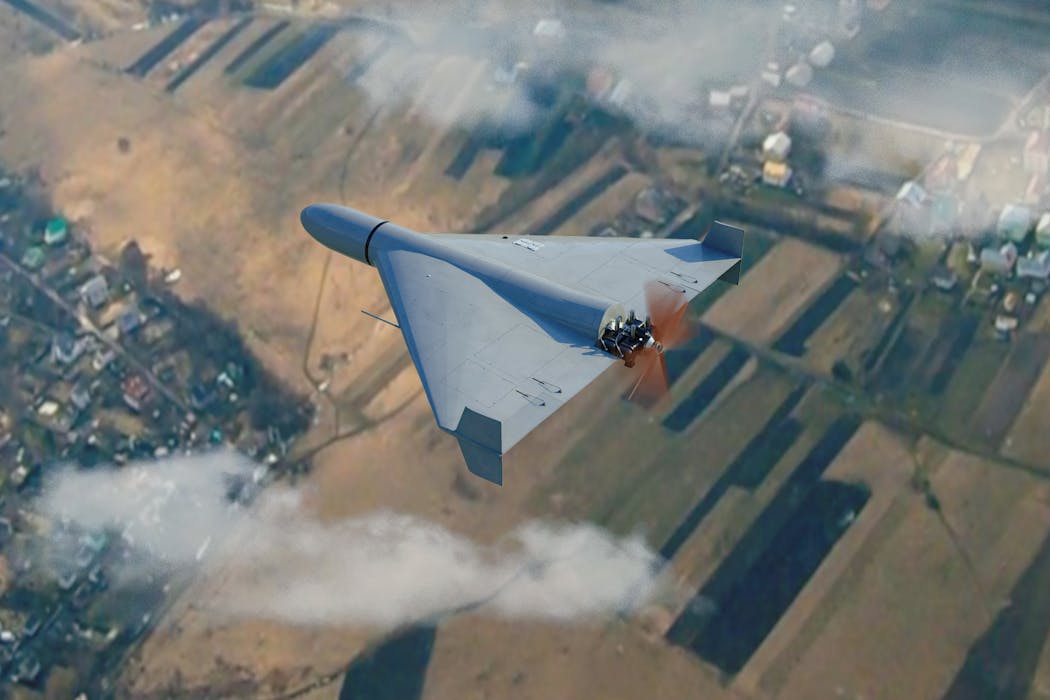
El objetivo de esta escalada calculada se ve confirmado por el arma elegida por el Kremlin. La mayoría de los dispositivos derribados o recuperados han resultado ser drones kamikaze de fabricación rusa Geran-2 (Geranium-2), una versión simplificada y más barata del Shahed-136 iraní, ampliamente utilizado en Ucrania.

Estos drones se emplean principalmente como señuelos para saturar y distraer a las defensas aéreas, aunque también pueden realizar reconocimientos y ataques oportunistas con pequeñas cargas explosivas.

Un dron negro yace en el suelo mientras dos soldados lo inspeccionan
Un dron ruso Geran-2, encontrado en la región de Vinnytsia, en Ucrania, en marzo de 2024.
Policía Nacional de Ucrania / Wikimedia Commons, CC BY

Las imprudentes acciones de Rusia también tienen un segundo objetivo en mente: evaluar la cohesión general de la opinión pública occidental, y de los europeos en particular. Las dimensiones informativas y psicológicas de la guerra son fundamentales en este tipo de operaciones y están profundamente arraigadas en el pensamiento estratégico de Rusia, especialmente en sus últimas iteraciones.

Esto incluye la difusión de información errónea a través de las redes sociales o el empoderamiento de partidos políticos antieuropeístas y prorrusos, pero ahora ha ido más allá: Rusia está operando deliberadamente en la “zona gris”. Se trata del espacio entre la guerra y la paz en el que se llevan a cabo acciones coercitivas no militares con el fin de alcanzar objetivos estratégicos por debajo del umbral de los conflictos armados convencionales.

Sin embargo, sus recientes provocaciones pueden correr el riesgo de escalar a una guerra abierta que, al menos oficialmente, nadie desea y que sería devastadora para todas las partes.


Leer más:
¿Qué implica para España el ataque ruso con drones en Polonia?


¿Un frente unido?

Rusia está poniendo a prueba la determinación colectiva de Europa mediante un peligroso juego de “divide y vencerás” con las diferentes percepciones de amenaza del continente. Puede que esté funcionando. El canciller alemán Friedrich Merz ha afirmado que “Europa ya no está en paz con Rusia”, y la primera ministra danesa Mette Fredriksen ha argumentado que “Europa se encuentra en la situación más peligrosa desde la Segunda Guerra Mundial”, pero otros responsables políticos europeos parecen reacios a adoptar una postura tan firme.

Además, las protestas propalestinas generalizadas que estallaron a raíz de la interceptación por parte de Israel de la flotilla de ayuda a Gaza han puesto de relieve las persistentes diferencias en la percepción de la amenaza dentro de las sociedades europeas.

Estas divisiones no solo están determinadas por factores geográficos o físicos, sino también por alineamientos ideológicos: las posiciones pro-Palestina se asocian en gran medida con los sentimientos de izquierda, mientras que las actitudes pro-Ucrania se vinculan con opiniones centristas o de derecha. La debilidad de Europa, reforzada por las inconsistencias de la política exterior estadounidense, explica en gran medida la fortaleza de Rusia.

A pesar de estas diferencias, la reciente reunión de la Comunidad Política Europea (EPC) en Copenhague vio a los líderes europeos proyectar una imagen de unidad, cohesión y resiliencia al aprobar una nueva iniciativa emblemática denominada “muro antidrones”.

No se trataría de una barrera física, sino de una red por capas de sistemas de detección e interceptación. Se basaría en las capacidades antidrones existentes en cada uno de los países europeos.

A día de hoy, se sabe poco sobre cómo será realmente este “muro” y cuánto tiempo llevará ejecutarlo (el ministro de Defensa alemán, Boris Pistorius, dijo que podría ser cuestión de tres o cuatro años), y quién se encargará de su implementación: ¿la Comisión Europea o los Estados miembros?

La guerra está evolucionando

Lo que está totalmente claro es que los países de la UE y la OTAN tienen que adaptar sus sistemas de defensa aérea a un panorama estratégico cambiante. La amenaza que representa Rusia ya no proviene únicamente de dispositivos de movimiento rápido –aviones, misiles balísticos, de crucero o incluso hipersónicos–, sino también de la tecnología en rápida evolución de los drones no tripulados. Esta nueva amenaza debe contrarrestarse incorporando métodos de guerra electrónica más baratos, como el bloqueo, la suplantación o la interrupción de las señales electrónicas de las que dependen los drones.

La guerra en Ucrania ya ha demostrado que los drones son un elemento revolucionario en la estrategia militar del siglo XXI. Son baratos, pequeños (lo que significa que son difíciles de detectar con la tecnología existente), capaces de infligir daños importantes y, en general, capaces de suponer una amenaza desproporcionada. Los drones están haciendo que la seguridad internacional se enfrente a nuevos peligros y sea más inestable, ya que desplazan el equilibrio militar de la defensa hacia el ataque.

Por esta razón, la racionalización de los sistemas de defensa contra los drones es una necesidad estratégica para Europa. La respuesta de los Estados miembros de la UE y la OTAN debe ser decisiva, rápida y eficaz, ya que en este momento no se puede descartar una acción mucho más agresiva por parte de Rusia, como una invasión terrestre de los Estados bálticos.

The Conversation

Michele Testoni no recibe salario, ni ejerce labores de consultoría, ni posee acciones, ni recibe financiación de ninguna compañía u organización que pueda obtener beneficio de este artículo, y ha declarado carecer de vínculos relevantes más allá del cargo académico citado.

ref. Rusia obliga a Europa a prepararse frente a la amenaza de los drones – https://theconversation.com/rusia-obliga-a-europa-a-prepararse-frente-a-la-amenaza-de-los-drones-266962

¿Está España preparada para liderar la diplomacia de datos en la era digital?

Source: The Conversation – (in Spanish) – By Armando Alvares Garcia Júnior, Professor de Direito Internacional, Relações Internacionais e Geopolítica/Geoeconomia, UNIR – Universidad Internacional de La Rioja

Carlos andre Santos/Shutterstock

La diplomacia clásica encontró en los salones recién pintados de las cancillerías y en las mesas de negociación su espacio natural. Hoy esa escena se ha trasladado al ciberespacio, un ámbito en el que la soberanía de los Estados se mide por su capacidad para gestionar, proteger y compartir datos.

Bajo el paraguas de la diplomacia cibernética –o diplomacia de datos– los gobiernos y las instituciones internacionales debaten la regulación de flujos de información, la defensa frente a ciberataques y el establecimiento de protocolos comunes para el cifrado y la certificación de identidades. El impulso por colocar la información en el centro de la acción exterior revela un cambio profundo: los datos se han convertido en un recurso estratégico equivalente al petróleo o al acero.

Oportunidades y obstáculos para liderar el sector

En este contexto, España cuenta con ventajas singulares. Su red de centros de datos se alinea con cables submarinos que la vinculan directamente con América Latina, que le otorga una posición geoestratégica única. La implementación temprana del Reglamento General de Protección de Datos y el prestigio de la Agencia Española de Protección de Datos consolidan una reputación de rigor que resulta atractiva para socios europeos y latinoamericanos.

No obstante, la fragmentación competencial entre el Estado y las comunidades autónomas dificulta la convergencia en una sola voz. El artículo 149.1.29 de la Constitución reserva al Estado la competencia exclusiva en materia de seguridad pública –que abarca la ciberseguridad–, mientras que las comunidades autónomas gestionan de forma independiente sus propios sistemas de respuesta, el SOC de la Comunidad de Madrid o el CERT de la Generalitat de Cataluña), lo que obliga a sincronizar procedimientos entre múltiples instituciones antes de hablar con la UE.

Para minimizar este problema, movimientos como el Foro Nacional de Ciberseguridad –impulsado en julio de 2020 por el Centro Criptológico Nacional y el Departamento de Seguridad Nacional y que integra a ministerios, INCIBE, CCN-CERT, universidades y empresas– están comenzando a sentar las bases de una estrategia nacional coordinada.

Retraso en cumplir la normativa

Estas nuevas dinámicas buscan consolidar una coordinación indispensable. La Directiva (UE) 2022/2555, conocida como NIS 2, obliga a las entidades de 18 sectores críticos a implantar un sólido sistema de gestión de riesgos, notificar incidentes en un plazo de 24–72 horas, reforzar la cooperación transfronteriza y exigir la rendición de cuentas de sus máximos responsables. Esta norma ha intensificado la presión de Bruselas sobre España, que aún no ha completado su transposición y se expone a posibles sanciones por parte de la Comisión Europea.

La mayoría de los Estados miembros de la UE ya han incorporado la Directiva NIS2 a su ordenamiento, pero España sigue pendiente de culminar el proceso legal y no notificó a la Comisión Europea la aprobación definitiva de su Ley de Coordinación y Gobernanza de la Ciberseguridad dentro del plazo previsto (principios de julio de 2025). Como resultado, sigue abierto el procedimiento de infracción y el país podría ser condenado por el Tribunal de Justicia de la Unión Europea, lo que supondría sanciones y, sobre todo, comprometería la eficiencia del escudo cibernético europeo, dificultando la plena integración de España en el sistema europeo de respuesta y alerta mientras empresas y administraciones continúan sujetas a las normativas previas de ciberseguridad, en un momento crítico de creciente sofisticación de los ciberataques.


Leer más:
La ciberdelincuencia es un reto económico global


El talento investigador español contribuye en el fortalecimiento de esta iniciativa. Equipos de la Universidad Politécnica de Madrid, de la UPV/EHU y de la Universidad de Málaga lideran proyectos en ciberseguridad y análisis masivo de datos. Sus publicaciones y colaboraciones con organismos internacionales demuestran que España participa activamente en el Internet Governance Forum de la ONU, en comités de la OCDE y en grupos de trabajo de la Organización para la Seguridad y la Cooperación en Europa (OSCE). Cada una de estas plataformas sirve como escenario para exponer propuestas, intercambiar mejores prácticas y forjar alianzas que trascienden fronteras.

Alianzas necesarias para lograr un objetivo

La diplomacia de datos demanda vínculos con el sector privado y con la sociedad civil. Google, Microsoft, Amazon, Meta y Apple actúan como interlocutores influyentes, capaces de impulsar inversiones en infraestructuras estratégicas y de negociar criterios de cumplimiento normativo. En España, las conversaciones con proveedores de hardware, con empresas de servicios en la nube y con operadores de telecomunicaciones han permitido diseñar una hoja de ruta que no sacrifica la protección de datos personales a cambio de potenciar la innovación. Resulta necesario afianzar esas relaciones, fomentando alianzas público-privadas que permitan convertir las políticas de datos abiertos en un motor de desarrollo económico responsable.


Leer más:
Derechos digitales para proteger a los ciudadanos de los riesgos de la tecnología


Una oportunidad única que aprovechar

La propuesta de conectar Europa con América Latina y el Caribe mediante un corredor digital seguro capitaliza el valor geográfico y cultural de España. Madrid, Lisboa y Santos (Brasil) podrían constituir nodos fundamentales de intercambio de información respetando normativas homogéneas. Un proyecto de este tipo serviría para impulsar la investigación, facilitar la movilidad académica y fortalecer la cooperación en áreas como la salud pública, el cambio climático y la seguridad alimentaria. La diplomacia académica tendría un papel decisivo en este planteamiento, convocando foros internacionales en Barcelona y Madrid que reúnan a diplomáticos, técnicos y representantes del sector tecnológico.

El ámbito de la ciberseguridad cooperativa exige también una respuesta coordinada. Prevenir ataques a infraestructuras críticas, como redes eléctricas o sistemas hospitalarios, requiere mecanismos de alerta temprana y canales confidenciales de intercambio de información. España dispone de propuestas de colaboración con países vecinos para la creación de un centro europeo de excelencia en ciberinteligencia que agrupe a Portugal, Italia y Grecia en un esfuerzo conjunto. Esa iniciativa reflejaría una visión compartida y reforzaría la capacidad de respuesta frente a amenazas que traspasan cualquier frontera.

Grandes retos para España

La formación de profesionales en diplomacia digital constituye otro pilar esencial. Instituir cátedras especializadas en universidades nacionales y desarrollar programas de posgrado orientados a la gestión de datos en el ámbito internacional incrementaría la masa crítica de expertos. Eventos organizados en sedes universitarias y centros de congresos permitirían articular un diálogo permanente entre la academia, la Administración y la industria. Esta diplomacia académica alimentaría la práctica diplomática con análisis rigurosos y casos de estudio aplicables en cada negociación.


Leer más:
Para qué sirve una red privada virtual (y por qué nos conviene)


España ha avanzado en la regulación de la localización de datos y en la adopción de estándares internacionales de cifrado, pero mantiene dependencia de proveedores extraeuropeos de hardware. Cubrir esa debilidad exige impulsar la industria nacional de servidores y componentes de red, fomentando un ecosistema de startups capaz de competir con polos tecnológicos de Berlín, Londres o Estocolmo. El respaldo institucional a través de ayudas a la innovación y a fondos de capital riesgo especializados en ciberseguridad resultaría determinante para consolidar un tejido emprendedor robusto.

Horizontes de la diplomacia de datos española

La diplomacia de los datos no puede entenderse sin una participación activa de la ciudadanía. Generar conciencia sobre la importancia de la protección de datos, la soberanía digital y la ética en el uso de la información es condición previa para que los acuerdos internacionales cuenten con un respaldo social sólido. Iniciativas de formación en centros educativos y campañas de divulgación contribuirían a cerrar brechas de conocimiento y consolidar un entorno en el que las estrategias de ciberdiplomacia cuenten con legitimidad democrática.

Su construcción con sello español requiere combinar la fortaleza en protección de datos, la infraestructura de conectividad y el talento académico con una estrategia coordinada entre administraciones y con la sociedad civil. Transformar a España en referente de esta nueva frontera de la influencia global depende de alcanzar un equilibrio entre la innovación tecnológica y la protección de derechos, consolidar corredores digitales con América Latina y articular un ecosistema público-privado vibrante. De prosperar este planteamiento, España hablará con autoridad en el idioma universal de los datos.

The Conversation

Armando Alvares Garcia Júnior no recibe salario, ni ejerce labores de consultoría, ni posee acciones, ni recibe financiación de ninguna compañía u organización que pueda obtener beneficio de este artículo, y ha declarado carecer de vínculos relevantes más allá del cargo académico citado.

ref. ¿Está España preparada para liderar la diplomacia de datos en la era digital? – https://theconversation.com/esta-espana-preparada-para-liderar-la-diplomacia-de-datos-en-la-era-digital-259622