Friendships aren’t just about keeping score – new psychology research looks at why we help our friends when they need it

Source: The Conversation – USA – By Jessica D. Ayers, Assistant Professor of Psychological Science, Boise State University

Friendship isn’t about a running tally of who’s doing more. miodrag ignjatovic/E+ via Getty Images

Despite how natural friendship can feel, people rarely stop to analyze it. How do you know when someone will make a good friend? When is it time to move on from a friendship? Oftentimes, people rely on gut intuitions to answer these kinds of questions.

In psychology research, there’s no universally accepted definition of a friend. Traditionally, when psychologists have analyzed friendship, it’s often been through the lens of exchange. How much did that friend do for me? How much did I do for them? The idea is that friendships are transactional, where friends stick around only as long as they are getting at least as much as they are giving in the friendship.

But this focus doesn’t capture what feels like the essence of friendship for many people. We and our colleagues think another model for relationships – what we call risk-pooling – better matches what many people experience. In this kind of friendship, no one is keeping track of who did what for whom.

Our research over the past decade suggests that this kind of friendship was essential for our ancient ancestors to survive the challenges they encountered. And we feel it’s essential for surviving the challenges of life today, whether navigating personal struggles or dealing with natural disasters.

three men drink wine at cafe table with bill on it
Social exchange theory focuses on whether friends are investing and getting the same amount from the relationship.
tim scott/Moment via Getty Images

A focus on what friends give you

The traditional social exchange theory of friendship views relationships as transactions where people keep a tally of costs and benefits. Building on this framework, researchers have suggested that you approach each friendship with a running list of pluses and minuses to decide whether to maintain the bond. You keep friendships that provide more benefits than costs, and you end those that don’t.

The theory holds that this balancing act comes into play when making decisions about what kinds of friendships to pursue and how to treat your friends. It’s even made its way into pop psychology self-help spaces.

We contend that the biggest issue with social exchange theory is that it misses the nuances of real-life relationships. Frankly, the theory’s wrong: People often don’t use this cost-to-benefit ratio in their friendships.

Less accounting, more supporting

Anybody who has seen a friend through tough times – or been the one who was supported – can tell you that keeping track of what a friend does for you isn’t what friendships are about. Friendships are more about companionship, enjoyment and bonding. Sometimes, friendship is about helping just because your friend is in need and you care about their well-being.

Social exchange theory would suggest that you’d be better off dropping someone who is going through cancer treatment or a death in the family because they’re not providing as many benefits to you as they could. But real-life experiences with these situations suggest the opposite: These are the times when many people are most likely to support their friends.

Our research is consistent with this intuition about the shortcomings of social exchange theory. When we surveyed people about what they want in a friend, they didn’t place a high value on having a friend who is conscientious about paying back any debts – something highly valued from a social exchange perspective.

People considered other traits – such as loyalty, reliability, respectfulness and being there in times of need – to be much more important. These qualities that relate to emotional commitment were seen as necessities, while paying back was seen as a luxury that mattered only once the emotional commitment was met.

Having friends who will help you when you’re struggling, work with you in the friendship and provide emotional support all ranked higher in importance than having a friend who pays you back. While they might not always be able to provide tangible benefits, friends can show they care in many other ways.

Of course, friendship isn’t always positive. Some friends can take advantage by asking too much or neglecting responsibilities they could handle themselves. In those cases, it can be useful to step back and weigh the costs and benefits.

Friendship is more than the sum of its parts

But how do friendships actually help people survive? That is one question that we investigated as part of The Human Generosity Project, a cross-disciplinary research collaboration.

The risk-pooling rather than exchange pattern of friendship is something that we found across societies, from “kere kere” in Fiji to “tomor marang” among the Ik in Uganda. People help their friends in times of need without expecting to be paid back.

Two Maasai herders in traditional clothing with herd of cattle against dusty landscape
Maasai people cultivate lifelong relationships called osotua partnerships.
calm_eyes/iStock via Getty Images Plus

The Maasai, an Indigenous group in Kenya and Tanzania who rely on cattle herds to make their living, cultivate friends who help them when they are in need, with no expectation about paying each other back. People ask for help from these special friends, called osotua partners, only when they are in genuine need, and they give if they are asked and able.

These partnerships are not about everyday favors – rather, they are about surviving unpredictable, life-altering risks. Osotua relationships are built over a lifetime, passed down across generations and often marked with sacred rituals.

When we modeled how these osotua relationships function over time, we found they help people survive when their environments are volatile and when they ask those most likely to be able to help. These relationships lead to higher rates of survival for both partners compared to those built on keeping track of debts.

These friends act as social insurance systems for each other, helping each other when needs arise because of unpredictable and uncontrollable events.

And we see this in the United States, just as we do in smaller-scale, more remote societies. In one study, we focused on ranchers in southern Arizona and New Mexico embedded in a network of what they call “neighboring.” They don’t expect to be paid back when they help their neighbors with unpredictable challenges such as an accident, injury or illness. We also found this same pattern in an online study of U.S.-based participants.

In contrast, people such as the ranchers we studied are more likely to expect to be paid back for help when needs arise because of more predictable challenges such as branding cattle or paying bills.

Catastrophic insurance, not tit for tat

What all this research suggests is that friendship is less about the exchange of favors and more about being there for each other when unforeseeable disaster strikes. Friendship seems more like an insurance plan designed to kick in when you need it most rather than a system of balanced exchange.

What lets these partnerships endure is not only generosity, but also restraint and responsibility: Maasai expect their osotua partners to take care of themselves when they can and to ask only when help is truly needed. That balance of care, respect and self-management offers a useful model.

In a world of growing uncertainty, cultivating risk-pooling friendships and striving to be a good partner yourself may help you build resilience. Our ancestors survived with the help of this kind of relationship; our future may depend on them too.

The Conversation

Athena Aktipis receives funding from the National Science Foundation. She is the Executive Director of the Cooperative Futures Institute.

Jessica D. Ayers does not work for, consult, own shares in or receive funding from any company or organization that would benefit from this article, and has disclosed no relevant affiliations beyond their academic appointment.

ref. Friendships aren’t just about keeping score – new psychology research looks at why we help our friends when they need it – https://theconversation.com/friendships-arent-just-about-keeping-score-new-psychology-research-looks-at-why-we-help-our-friends-when-they-need-it-258549

Our engineering team is making versatile, tiny sensors from the Nobel-winning ‘metal-organic frameworks’

Source: The Conversation – USA – By Jie Huang, Chair Professor of Electrical and Computer Engineering, Missouri University of Science and Technology

Prof. Jie Huang stands with the MOF-based breathalyzer his lab developed with support from the NIH. Michael Pierce/Missouri S&T

When the 2025 Nobel Prize in Chemistry honored Omar Yaghi – the “father of metal-organic frameworks,” or MOFs – along with Susumu Kitagawa and Richard Robson, it celebrated more than the creation of a new class of crystalline materials. It recognized a revolution quietly reshaping how scientists capture, store and sense molecules. These MOFs could allow for sensor technologies that make workplaces, the environment and human bodies safer.

What are MOFs, and why do they matter?

MOFs are made by linking metal ions – atoms that carry an electrical charge – with organic molecules, the carbon-based building blocks found in most living things. Together they form tiny, sponge-like structures full of microscopic pores. You can imagine them as an atomic-scale scaffold filled with nano-sized rooms, each precisely engineered to host certain molecules like guests.

A diagram of molecules arranged in a cube structure, with empty space in each cube.
Metal-organic frameworks, such as MOF-5 shown here, have metal components, organic ‘linkers’ and a cavity that can allow in gases.
Tony Boehle/Wikimedia Commons, CC BY-SA

Because chemists can mix and match different metals and organic linkers, there are thousands of possible MOFs – each with unique properties. Depending on how they’re structured, some have so much internal surface area that a single gram could cover a football field.

This sponge-like porosity – meaning lots of tiny holes inside – lets MOFs trap and release gases, store energy-rich fuels like hydrogen, and capture harmful pollutants. MOFs can use a variety of chemicals in their structure, which lets researchers fine-tune how strongly an MOF interacts with specific molecules.

These features have already inspired potential uses such as capturing carbon dioxide from the air to reduce greenhouse gas concentrations in the atmosphere, pulling clean water from humid air, and delivering medicines inside the body. Over the past decade, the unique properties of MOFs have also opened new possibilities for sensing and detection.

Since 2016, our team of engineers has been developing MOF-based sensors that can detect certain gases and vapors in an environment in real time. These materials’ unique properties are opening new possibilities for sensing in health, safety and environmental monitoring.

From a storage material to a sensing material

When an MOF takes in gas or liquid molecules, its tiny framework changes ever so slightly: It may change in size, how it bends light, or how it conducts electricity, depending on what and how many molecules it absorbs.

By connecting MOFs to devices that can sense changes in light or electricity, researchers can turn these tiny shifts into measurable signals such as light, frequency or voltage. The signals then reveal what chemical is present and how much of it there is. In simple terms, when molecules enter or leave the MOF’s pores, they slightly change how light travels through it or how electricity behaves around it, and those changes become the sensor’s readable output.

Our group at Missouri University of Science and Technology has developed several kinds of MOF-based sensor platforms. Across all these platforms, the core idea is the same: MOFs act as selective sponges that temporarily hold certain gas molecules in their tiny cages, and our devices measure the timing and amount of this uptake and release.

In one study, we attached a single crystal of a copper-based MOF called HKUST-1 to the smooth, flat end of a cut optical fiber – the same kind of thin glass strand used to carry internet and phone signals.

This crystal-fiber combination worked as a tiny device that could measure how light waves interfere with each other. As nearby gas molecules moved into the tiny pores of the MOF crystal, the way it bent and reflected light changed slightly. The optical fiber – connected to a light source and detector – picked up these changes, allowing us to see in real time how many gas molecules the material was taking in.

Our probes show not just that gas molecules enter the tiny cages of the MOF, but also how fast they come and go. By measuring both the amount and the speed of adsorption and release, we can tell which molecules are being taken up and in what proportion, when several are present together. This dynamic view helps us see, in real time, how the material selects one target gas over others. It turns adsorption into a measurable, useful signal for sensing and identification.

In health care, an MOF can act like a selective sponge for specific breath molecules that indicate real, measurable diseases. For example, an MOF designed to adsorb acetone can capture and concentrate this gas from exhaled breath. Acetone levels rise above normal values in people with diabetic ketoacidosis, allowing the sensor to clearly and quantitatively detect the disease.

A photo showing a tube-like device, and a person exhaling into it out of their nose. A cloud of breath hangs in the air between.
Prof. Jie Huang and his team at Missouri S&T developed an MOF–based breath sensor, funded by the NIH, that was developed for COVID-19 and can also be employed for detecting disease biomarkers such as acetone and ammonia in exhaled breath.
Michael Pierce/Missouri S&T

Likewise, an MOF that selectively adsorbs ammonia can concentrate this compound from exhaled breath. Ammonia levels increase above normal values in people with chronic kidney disease, so the sensor can provide a definite indicator of reduced kidney function. Integrating such MOFs into sensor hardware would allow for sensitive, noninvasive screening for these two diseases, based on quantifiable breath markers.

Coating a material in a thin layer of MOFs can take hours. But recently, we developed a quick and simple “droplet-drying” method that forms a crystal layer of the copper-based MOF HKUST-1 directly onto the end of an optical fiber in under two minutes. The resulting film, only about 1/20th the width of a human hair, acted as a high-performance gas sensor that detected humidity, ethanol or carbon dioxide in the environment within seconds.

We also combined MOFs with a hand-held metal device that can sense changes in microwave signals – a bit like how a radio antenna picks up invisible waves in the air. When gas molecules entered the MOF layer, they slightly changed how the device responded to those waves, allowing it to detect gases with remarkable sensitivity.

This sensor made for a low-cost, portable device that could tell one kind of gas molecule apart from another, rather than just detecting that some gas is present. It’s like having a nose that can tell apples from oranges, not just detect that something smells fruity.

Our research suggests that MOF sensors within compact, energy-efficient devices can pick out specific molecules – even when only trace amounts are present in the air. The pores of an MOF can be designed to concentrate specific target molecules. All molecules smaller than the window to an MOF cage will get into the cage. So, we design the sensors so that the molecules we are interested in sensing will reside in the cages longer. The huge internal surface area created by these pores makes them incredibly responsive. Even just a few trapped molecules can trigger a clear signal.

These sensors also work at room temperature and our research suggests they are more precise and adaptable than many traditional chemical sensors.

Toward real-world impact

The main challenges lie in improving MOFs’ long-term durability and environmental resistance. Many frameworks degrade under humidity or heat, though some research groups are looking into how to make them more stable.

When combined with machine-learning algorithms, these sensors can learn to recognize patterns from several gases at once, rather than detecting just one chemical at a time – much like how a human nose can tell different smells apart. This capability could even extend to human breath monitoring, where subtle changes in exhaled gases provide early clues to diseases such as diabetes, lung infections or cancer.

Researchers are working to embed MOFs into flexible films, printed circuits and wireless devices. With these new advances and further research, MOFs could bridge chemistry and engineering one day. As the Nobel Prize recognized, MOFs exemplify how design at the molecular scale can help mitigate problems humans face at a global scale.

If researchers can scale up this technology and overcome the challenges, networks of fiber-optic and microwave MOF sensors could one day monitor industrial plants, pipelines and even human breath for unwanted chemicals to improve safety, efficiency and health.

The Conversation

Jie Huang receives research funding from the U.S. Army Research Laboratory and the National Institutes of Health.

Rex Gerald receives research funding from the U.S. Army Research Laboratory and the National Institutes of Health.

Bohong Zhang and Chen Zhu do not work for, consult, own shares in or receive funding from any company or organization that would benefit from this article, and have disclosed no relevant affiliations beyond their academic appointment.

ref. Our engineering team is making versatile, tiny sensors from the Nobel-winning ‘metal-organic frameworks’ – https://theconversation.com/our-engineering-team-is-making-versatile-tiny-sensors-from-the-nobel-winning-metal-organic-frameworks-267103

Travelling to the U.S.? How the government shutdown will impact tourism

Source: The Conversation – Canada – By Frédéric Dimanche, Professor and former Director (2015-2025), Ted Rogers School of Hospitality and Tourism Management, Toronto Metropolitan University

A shutdown of the United States federal government started on Oct. 1 after President Donald Trump and Congress failed to reach an agreement on the funding legislation required to finance the government.

Tens of thousands of government employees will continue working without pay, and some may be furloughed, affecting many public services with interruptions or delays, depending on how long the shutdown lasts.

Politics and travel are very closely connected, and the current situation is likely to have a strong ripple effect far beyond Washington, D.C.

Although essential services such as border security and air traffic control continue to operate, the shutdown can still create disruptions, uncertainty and reduced service quality for travellers, while also causing significant economic stress for travel businesses.

For Canadians, the shutdown presents risks that could affect travel experiences, safety and trip values to the U.S.

Border delays and processing challenges

The Canada-U.S. border, the world’s longest international boundary, is administered by U.S. Customs and Border Protection, an agency whose employees are considered essential. This means ports of entry remain open. However, essential does not necessarily mean fully staffed.

During past shutdowns, U.S. Customs officers were required to work without pay until government funding resumed, leading to increased absenteeism, low morale and slower processing times. This turns into longer and more stressful travel experiences.

For Canadians travelling on the road, this can translate into longer waits at land crossings, particularly during weekends and holiday periods. Even air travellers face such risks.

At Canadian airports offering U.S. pre-clearance, U.S. customs officers perform entry inspections before departure. Any staff shortage or delay in pay could result in longer queues or flight delays at pre-clearance facilities. A further long-term risk could be the closure of pre-clearance at some airports.

Air travel disruptions

Airports are another critical pressure point. Both air traffic controllers and Transportation Security Administration (TSA) agents continue to work during a shutdown, yet without pay.

As seen in previous government shutdowns, absenteeism tends to rise when employees struggle with financial uncertainty. The result can be longer security lines, flight delays and even cancellations.

The Federal Aviation Administration also halts non-essential activities, such as training new controllers or performing certain maintenance and safety inspections. The U.S. already faces a significant shortage of air traffic controllers. A shutdown freezes recruitment and training, worsening the shortage and magnifying safety risks.

Disruptions at U.S. airports typically begin to appear after about a week, but the longer the shutdown continues, the more likely these disruptions become.

For travellers, this means a greater likelihood of delayed flights at major U.S. hubs like New York, Chicago or Los Angeles, which serve as major gateways for connecting flights. A shutdown may also disrupt smaller regional airports, which have less staffing flexibility.

People flying to the U.S. should build extra buffer time into their itineraries and avoid tight connecting flights. The safety of air travel will only be assured through further ground delays at airports and flight cancellations.

Federal attractions closed but private ones open

Canadians visiting the U.S. for leisure could face disappointment when federal attractions and parks close. The National Park Service, Smithsonian museums and numerous monuments depend on federal funding and staffing.

In past shutdowns, parks like Yellowstone and the Grand Canyon closed their visitor centres, limited maintenance and suspended ranger programs. Although some parks may initially use “carry-over” funds to stay open, those reserves will run out. Visitors might find roads unmaintained, restrooms locked and emergency services unavailable.

Even if the gates remain open, safety and cleanliness often deteriorate, making the experience less enjoyable and potentially hazardous. In addition, National Park websites and social media accounts will not be maintained, and updates will not be provided to visitors.

Although the public sector shutdown affects travel to and within the U.S., the good news for travellers is that private operators in the tourism sector are less directly impacted. Hotels, private museums, restaurants and tour operators will continue to operate, but they may also suffer from delays, cancellations or border frictions.

The economic impact of a shutdown

The shutdown adds to the woes of the U.S. travel and tourism sector, which continues to suffer from a drop in the number of visitors from Canada — its largest international market — and other countries.

The US Travel and Tourism Association has warned that inbound visits are projected to decrease by 6.3 per cent, from 72.4 million in 2024 to 67.9 million in 2025 — a decline not seen since COVID-19. The association also estimates that the travel economy is at risk of losing US$1 billion a week due to the disruptions.

Additional financial pressures may further deter travellers. The cost of the Electronic System for Travel Authorization (ESTA) rose from US$21 to US$40 on Sept. 30, and a new US$250 “visa integrity fee” for visitors from non–visa waiver countries like Mexico, China and India could contribute to fewer international visits.

For Canadians, the shutdown is yet another reason to avoid travelling to the U.S. Business travellers may delay a trip, and leisure tourists may also defer or cancel a trip across the border. This situation may continue to negatively impact the economy of border towns that depend on unrestricted mobility of travellers.

Know your risks before you travel

The concerns are growing, and likely will continue to grow if the shutdown extends for several weeks, as it did in 2018-19. The year 2025 has not been a good year for U.S. tourism and the Canadian market, and travellers continue to rethink travel plans.

In addition to the risks that travel to the U.S. presents for Canadians, there is now the added possibility of disrupted travel, closed national attractions like parks and museums and a general decline in service quality.

The U.S. government shutdown is just the latest in a series of crises that have impacted U.S.-Canada tourism since 9/11. Response and recovery are not enough when it comes to risk and disasters; businesses, but also travellers, must engage in contingency planning and risk and crisis management to avoid negative consequences.

The Conversation

The authors do not work for, consult, own shares in or receive funding from any company or organisation that would benefit from this article, and have disclosed no relevant affiliations beyond their academic appointment.

ref. Travelling to the U.S.? How the government shutdown will impact tourism – https://theconversation.com/travelling-to-the-u-s-how-the-government-shutdown-will-impact-tourism-266650

Mobilisation de recettes vs inclusion financière : le dilemme de la taxation du mobile money au Sénégal

Source: The Conversation – in French – By Awa Diouf, chercheure, Institute of Development Studies, Institute of Development Studies

En Afrique, le mobile money – défini comme “un service transactionnel axé sur les téléphones mobiles qui peut être transmis par voie électronique en utilisant les réseaux mobiles” – a contribué à réduire la pauvreté, renforcer la résilience des ménages aux chocs et soutenir l’activité économique. Un succès qui attire l’attention des gouvernements. Une quinzaine de pays, la plupart en période de fortes contraintes budgétaires, ont introduit des taxes spécifiques sur les Services financiers numériques (SFN). Leur rendement, en moyenne de 1 à 3 % des recettes fiscales totales, reste modeste mais non négligeable pour des budgets fragiles.

En septembre 2025, le Sénégal a lui-même adopté une taxe de 0,5 % sur les paiements, les transferts et les retraits (voir tableau).

J’ai étudié la taxation des SFN en Afrique. Cette mesure ciblant trois des quatre opérations principales, soulève des questions sur les effets potentiels pour l’inclusion financière, les ménages vulnérables et l’équilibre entre transferts formels et informels.

Effets sur l’inclusion financière et les ménages à faibles revenus

Le caractère abordable du mobile money constitue un facteur central d’adoption des services. Ainsi, l’introduction de taxes spécifiques renchérit ces services et peut affecter l’inclusion financière, notamment des ménages pauvres. Ces derniers supportent un fardeau fiscal proportionnellement plus lourd, ce qui peut conduire à un retour au cash ou à l’informel.

Les expériences africaines montrent que ces taxes ont souvent un effet régressif. Au Kenya, l’instauration d’un droit d’accise en 2013 a ralenti la croissance des usages taxés, notamment les envois entre ménages, avec un impact marqué sur les foyers pauvres et nombreux.

En Ouganda, la taxe de 2018 sur la valeur des transactions a provoqué une baisse de plus de 50 % des transferts de personne à personne dès les premiers mois, avant d’être révisée pour ne viser que les retraits. Au Ghana la taxe a entraîné un recul immédiat des transactions et un rejet populaire massif. Malgré une réduction du taux et un recouvrement progressif du taux d’utilisation, la perception négative est restée dominante et la taxe a finalement été supprimée en Avril 2025, après le changement de régime.

Les opérateurs subissent également des pertes. Au Ghana, ils estiment que les baisses initiales de chiffre d’affaires restent irrécupérables, même après un redressement partiel de l’activité. Au Cameroun, la taxe a diminué la rentabilité de l’activité des agents de mobile money.

Les risques de basculement vers l’informel

Les SFN jouent un rôle clé dans la formalisation économique. L’administration publique peut ainsi avoir une meilleure visibilité sur les flux financiers, élargir l’assiette fiscale et renforcer le contrôle des transactions.

Au Sénégal, la taxe de 0,5 % s’applique aux paiements, transferts et retraits, avec une exonération des dépôts en numéraires et un plafond pour les transferts et retraits. Cette configuration crée une incitation forte à contourner le système. En taxant trop largement les transactions formelles, l’État risque d’encourager le retour aux circuits parallèles et au cash. Ces pratiques pourraient ainsi réduire la traçabilité et affaiblissent les efforts de formalisation.

L’expérience du Ghana avec l’E-Levy illustre ce phénomène : près de la moitié des usagers interrogés déclaraient avoir adopté le cash comme principale stratégie d’adaptation à la taxe. En Ouganda, les opérateurs ont plaidé pour concentrer la taxation sur les retraits plutôt que sur les paiements afin de préserver l’usage numérique.

Le Sénégal, en choisissant de taxer à la fois les retraits et les paiements, neutralise cet effet. En dessous du seuil de 20 000 francs CFA (31 dollars US), il est devenu plus abordable de faire un retrait (gratuit) et de payer en espèces (gratuit). Quand la taxe dépasse 2000 francs CFA (3 dollars US), il est également plus abordable de faire un retrait (payer 2000 francs CFA) et payer en espèces (gratuit) plutôt que de faire un paiement électronique pour lequel la taxe n’est pas plafonnée à 2000 francs CFA.

Que retenir ?

Il faut élargir l’assiette fiscale sans compromettre l’inclusion financière.

La nouveauté des taxes sur les SFN rend leur forme adéquate encore incertaine, mais l’expérience des autres pays africains fournit des enseignements utiles.

Les exonérations rendent les taxes sur les SFN moins régressives afin de mieux protéger les populations défavorisées. Or, la réforme sénégalaise ne prévoit aucun seuil d’exonération pour les paiements et transferts, alors même que les virements bancaires en sont exclus.

L’incitation à la formalisation passe pourtant par une orientation de la taxe vers les retraits et une exonération des paiements. C’était l’esprit de la réforme ghanéenne, où l’exonération des paiements marchands visait à inciter usagers et commerçants à rester dans les circuits formels.

Par ailleurs, taxer modestement les commissions des opérateurs semble mieux toléré par les utilisateurs, même si cette forme peut être plus régressive en raison de l’importance relative des commissions pour les plus faibles transactions. Au Sénégal, les opérateurs prônent une approche semblable au modèle ivoirien en proposant une taxe sur leur chiffre d’affaires. Ils suggèrent une contribution de 2,5 % pendant trois ans au lieu de taxer les utilisateurs.

L’expérience de l’Ouganda, où un processus inefficace et non inclusif a provoqué une période d’adaptation inutile et des révisions fréquentes de la législation, montre l’importance de la concertation avec les acteurs du secteur. Les États doivent accompagner toute réforme d’études rigoureuses, de prévisions réalistes et d’un suivi attentif. Au Ghana, des projections trop optimistes ont conduit à n’atteindre que 12 % des recettes prévues.

Ces expériences démontrent qu’il n’existe pas de modèle unique. Comme en Tanzanie, en Ouganda ou au Ghana, les pays doivent rester ouverts aux ajustements en fonction des réactions et des conséquences. Les perceptions et sentiments des parties prenantes sont essentiels pour guider l’adhésion, et une communication claire peut faire la différence.

The Conversation

Awa Diouf does not work for, consult, own shares in or receive funding from any company or organisation that would benefit from this article, and has disclosed no relevant affiliations beyond their academic appointment.

ref. Mobilisation de recettes vs inclusion financière : le dilemme de la taxation du mobile money au Sénégal – https://theconversation.com/mobilisation-de-recettes-vs-inclusion-financiere-le-dilemme-de-la-taxation-du-mobile-money-au-senegal-266811

For war-weary Syria, potential benefits of security pact with Israel comes with big risks

Source: The Conversation – Global Perspectives – By Mireille Rebeiz, Chair of Middle East Studies, Dickinson College

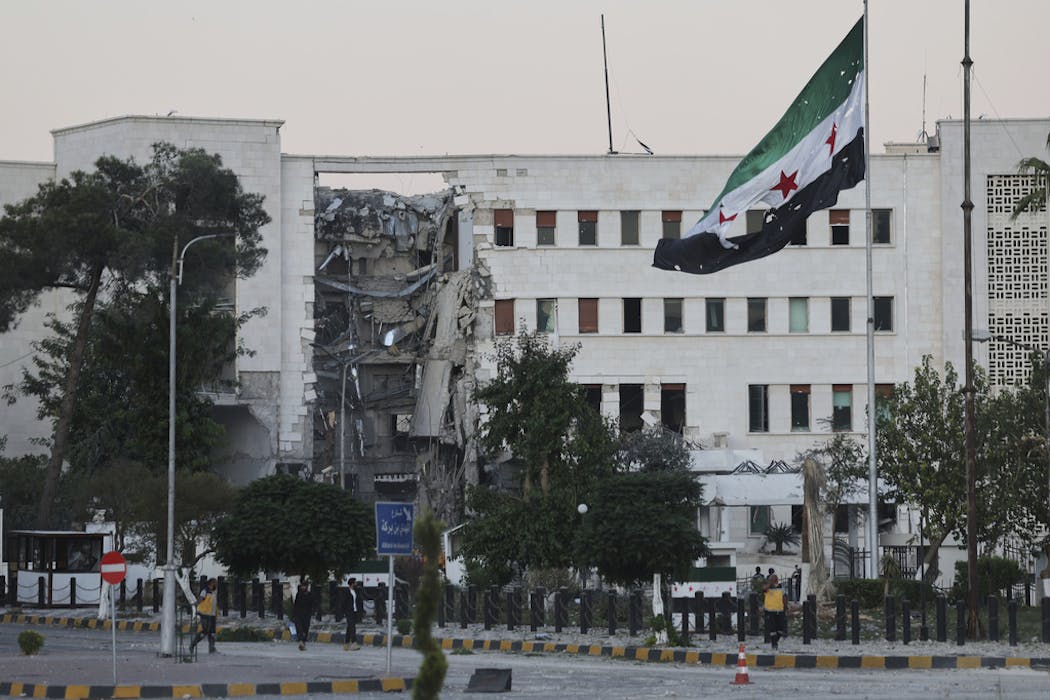
The Syrian Defense Ministry was heavily damaged after airstrikes in Damascus on July 16, 2025.
AP Photo/Ghaith Alsayed

On Sept. 21, 2025, a senior U.S official boasted that an Israeli-Syrian security agreement to resolve months of conflict was “99% complete” and would be announced within two weeks.

Those two weeks have now passed. And the reality on the ground suggests that the two countries are still far from sealing any deal to end the Israeli military incursions into Syrian territory that have occurred since the fall of Syrian President Bashar Assad in December 2024. Just days after the American official gave his prognosis and as negotiations continued, Israel struck several Syrian targets.

Citing negotiation sources, several news outlets reported that the delay in securing a deal was primarily related to Israel’s 11th-hour demand of creating a so-called humanitarian corridor that would link the Israeli-occupied Golan Heights to Sweidah, a city in southern Syria. Israel said the purpose is to protect religious minorities in the Golan Heights and Sweidah.

The hitch, after months of U.S.-mediated talks, reflects Syria’s vulnerability in these negotiations. Seeking to move on after year of war, the current Syrian leadership is eager to snuff out remaining internal violence, secure the borders and return to the United Nations-brokered truce with Israel that had been in place for decades. However, concluding a deal with its militarily superior neighbor risks the further fragmentation of Syria and an entrenched violation of its sovereignty.

Indeed, as an expert on the Middle East, I believe the talks and the potential last-minute snag point to Israel believing it has the upper hand. Meanwhile for Syria, a desire for security can’t mask what it sees as Israel’s expansionist policy in the region, and concerns that it is using things like a proposed humanitarian corridor as a way to achieve recognition of areas only recently under Israeli control.

The fraught history of Syrian-Israeli relations

Following the United Nations’ partition of Palestine in 1947 and the proclamation of the state of Israel in 1948, a coalition of five Arab armies, including Syria, declared war on Israel and lost the ensuing conflict.

Soldiers stand by barbed-wire fences.
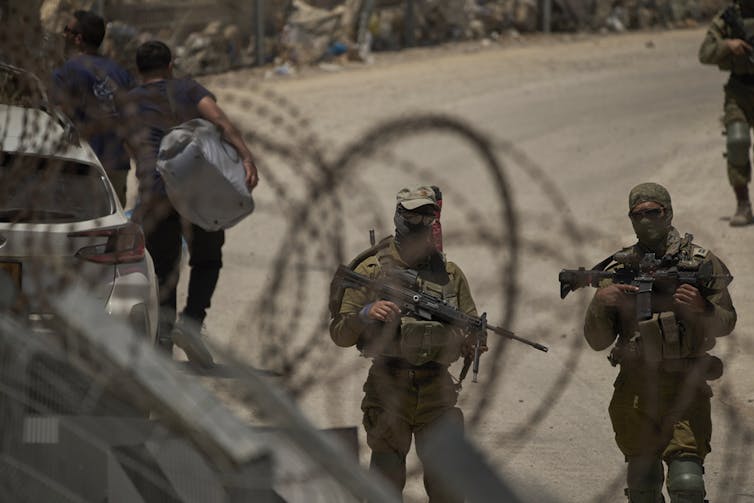
Israeli soldiers stand guard as Syrian Druze people cross back into Syria at the Israeli-Syrian border in the Israeli-occupied Golan Heights town of Majdal Shams.
AP Photo/Leo Correa

As a result, Syria was forced to sign an armistice agreement with Israel on July 20, 1949.

Yet de facto peace never lasted long. The two countries squared off in repeated conflicts in the next 25 years, including the Six-Day War in 1967 that launched Israel’s still-ongoing occupation of Syria’s Golan Heights.

In 1974, the U.N. brokered the Agreement on Disengagement between Israeli and Syrian forces. While not a peace agreement, the pact served to codify a ceasefire and created a buffer zone between the two countries monitored by U.N. observers.

For 50 years, that status quo held uneasily, as subsequent peace efforts failed. The conflict was effectively frozen, punctuated by occasional flare-ups of violence.

Entering the post-Assad era

The fall of Assad and his goverment in December 2024 suddenly injected a new dose of uncertainty into Israel-Syria relations.

As rebel-turned interim President Ahmed al-Sharaa worked to consolidate power and vowed to restore peace and stability for his war-torn country, Israel went on the offensive.

Shortly after the collapse of the Assad government, Israeli Prime Minister Benjamin Netanyahu declared the 1974 Disengagement Agreement “void until order is restored in Syria.” As a result, and in violation of the agreement, Israel occupied the demilitarized zone in the Golan Heights and expanded its control inside Syria. For months, Israel has conducted a campaign of airstrikes across Syria, repeatedly bombing Syrian military positions, including near the presidential palace in Damascus. Israel says it is doing so to stop weapon transfers from Iran and to protect its borders and ensure its security.

At the same time, it has pressed the U.S. to keep Syria weak and divided, in part due to Netanyahu’s and his far-right coalition’s hostility to an Islamist-governed neighbor.

The U.S., at the urging of allies like Saudi Arabia which are close with the Sharaa government, recently lifted sanctions on Syria. For months, officials of the Trump administration have likewise mediated talks and pushed Israel and Syria to conclude an agreement to stop Israel’s seizures and air campaign.

For his part, Sharaa and his negotiators have continually pressed for a halt to Israeli incursions and a return to the 1974 disengagement agreement and the de facto borders it established, describing it as a “necessity.”

Hints of common ground on Hezbollah and Iran

Aside from Syria’s immediate desire and chief priority to end all hostilities on its territory, there are some potential benefits to a new arrangement with Israel from both countries’ perspective.

Before its fall, the Assad government was close to Hezbollah and the Islamic Republic of Iran. Hezbollah, a Lebanese Shia Islamist political party and paramilitary group funded by Iran, supported Assad and played a major role in Syria’s civil war.

Furthermore, under Assad’s government, Syria served as a land bridge between Iran and Lebanon through which Hezbollah fighters transported their military equipment, money and drugs.

Under Sharaa, Syria’s central government is now closely allied to the Arab Gulf countries that have long been Iran’s regional rivals. In strengthening its security, Syria will no longer serve as Hezbollah-Iran meeting point, which will subsequently benefit Israel. For Syria, it will also stabilize the country against Iranian interference.

The risk of Syria’s further fragmentation

The risks of a deal with Israel from Syria’s standpoint, however, are significant.

In defending its incursions into Syria, Israel has pointed to both the security threat it says Syria poses to Israel and also the situation of minority groups in Syria, where sectarian violence has risen against communities like the Christian Orthodox and the Druze.

Israel has floated a number of plans for how it intends to retain a heavy footprint in Syria beyond the occupation of the Golan Heights and the 1974 Agreement of Disengagement.

One option on the table is an extension of the historical buffer zone and splitting Syria into autonomous zones, in which Sweidah province would be a demilitarized buffer zone between Israel and Syria. With the most recent idea of a humanitarian corridor couched in the language of protecting Syrian minorities, Israel could be seeking a wider area under more explicit control.

From the Syrian perspective, all of the above are backdoor ways by Israel to cement post-Assad military actions beyond the scope of the 1974 truce. As such, agreement to a security pact on Israeli terms would mean jeopardizing or shrinking Syria’s sovereignty and territorial integrity.

Demonstrators hold up flags.
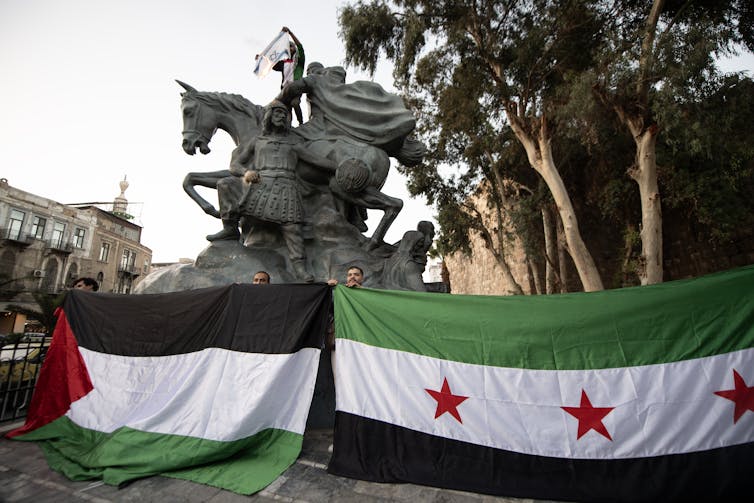
Syrian protesters gather in front of Damascus Citadel to denounce Israel’s attacks on the Gaza Strip and to oppose any potential agreement that would lead to normalization of relations with Israel.
Hasan Belal/Anadolu via Getty Images

The Syrian leadership’s challenge going forward

After years of war and fragmentation, most Syrians will take any cessation of hostilities with Israel as a welcome development – but not at any cost. Many Syrians are opposed to further fragmentation of the country. And considering the ongoing killing and displacement of Palestinians in Gaza – described recently by a U.N. body as genocide – and Syria’s historic commitment to pan-Arabism, many Syrians will likely be skeptical if a security deal with Israel means a de facto recognition of the land and sovereignty Israel has acquired since December 2024.

That points to the major dilemma underpinning Sharaa’s position. Syria is in a vulnerable place and is not in position to negotiate from strength, especially as Sharaa tries to open Syria to the Western world, boost its economy and bring back the civil war refugees from neighboring countries. Seeking to consolidate his government’s hold on power and end the presence of a foreign military, Sharaa likely sees a security agreement as in his immediate interest.

While such a pact may bring some stability to Syria and the region, it could also codify Israel’s nearly unchallenged regional power.

The Conversation

Mireille Rebeiz is affiliated with the American Red Cross.

ref. For war-weary Syria, potential benefits of security pact with Israel comes with big risks – https://theconversation.com/for-war-weary-syria-potential-benefits-of-security-pact-with-israel-comes-with-big-risks-265785

The Gaza ceasefire deal could be a ‘strangle contract’, with Israel holding all the cards

Source: The Conversation – Global Perspectives – By Marika Sosnowski, Senior research fellow, The University of Melbourne

There are jubilant scenes in both Gaza and Israel after both sides in the war have agreed to another ceasefire. If all goes well, this will be only the third ceasefire to be implemented by Israel and Hamas, despite there being numerous other agreements to try to stop the violence.

There is a lot to be happy about here. Most notably, this ceasefire will bring a halt to what has now been established as a genocidal campaign of violence against Palestinians in Gaza, the release of all hostages held by Hamas, and the resumption of aid into Gaza to alleviate the famine conditions there.

However, a lot of unknowns remain. While the terms of the “first phase” of this ceasefire have been rehearsed in previous ceasefires in November 2023 and January 2025, many other terms remain vague. This makes their implementation difficult and likely contested.

After this phase is complete, a lot will depend on domestic Israeli politics and the Trump administration’s willingness to follow through on its guarantor responsibilities.

Immediate positives for both sides

The ceasefire agreement appears to be based on the 20-point plan US President Donald Trump unveiled in the White House alongside Israeli Prime Minister Benjamin Netanyahu on September 29.

What will be implemented in what is being called the “first phase” are the practical, more detailed and immediate terms of the ceasefire.

In the text of the peace plan released to the public, these terms are stipulated in:

  • Point 3 – an “immediate” end to the war and Israeli troop withdrawal to an “agreed upon line”.

  • Points 4 and 5 – the release of all living and deceased hostages by Hamas in exchange for Palestinian prisoners.

  • Point 7 – full aid to flow into the strip, consistent with the January ceasefire agreement terms.

While these steps are positive, they are the bare minimum you would expect both sides to acquiesce to as part of a ceasefire deal.

Over the past two years, Gaza has been virtually demolished by Israel’s military and the population of the strip is starving. There is also great domestic pressure on the Israeli government to bring the hostages home, while Hamas has no cards left to play besides their release.

The text of these particular terms has been drafted in a way that means both Israel and Hamas know what to do and when. This makes it more likely they will abide by the terms.

Both sides also have a vested interest in these terms happening. Further, both parties have taken these exact steps before during the November 2023 and January 2025 Gaza ceasefires.

Given this, I expect these terms will be implemented in the coming days. It is less clear what will happen after that.

What comes next: the great unknown

After the first phase of the ceasefire has been implemented, Hamas will find itself in a situation very similar to ceasefire agreements that occurred during the Syrian civil war that began in 2011 and only recently ended with the downfall of the Assad regime in late 2024. I call these strangle contracts.

These type of ceasefire agreements are not like bargains or contracts negotiated between two equal parties. Instead, they are highly coercive agreements that enable the more powerful party to force the weaker party into agreeing to anything in order for them to survive.

Once the hostages are released, Hamas will go back to having negligible bargaining power of its own. And the group, along with the people of Gaza themselves, will once again be at the mercy of Israeli military might and domestic and international politics.

Other terms of the Trump peace plan relating to Hamas’ demilitarisation (Points 1 and 13), the future governance of Gaza (Points 9 and 13) and Gaza’s redevelopment (Points 2, 10 and 11) are also extremely vague and offer little guidance on what exactly should occur, when or how.

Under such a strangle contract, Hamas will have no leverage after it releases the hostages. This, together with the vague terms of the ceasefire agreement, will offer Israel a great deal of manoeuvrability and political cover.

For example, the Israeli government could claim Hamas is not abiding by the terms of the agreement and then recommence bombardment, curtail aid or further displace the Palestinians in Gaza.

While Point 12 rightly stipulates that “no one will be forced to leave Gaza”, Israel could make conditions there so inhospitable and offer enough incentives to Gazans, they might have little choice other than to leave if they want to survive.

Points 15 and 16 stipulate that the United States (along with Arab and other international partners) will develop a temporary International Stabilisation Force to deploy to Gaza to act as guarantors for the agreement. The Israel Defence Force (IDF) will also withdraw “based on standards, milestones, and timeframes linked to demilitarization”.

But these “standards, milestones and timeframes” have been left unspecified and will be hard for the parties to agree on.

It is also possible Israel could use the vagueness of these terms to its advantage by arguing Hamas has failed to meet certain conditions in order to justify restarting the war.

Knowing it has no leverage after the first phase, Hamas has explicitly said it is expecting the US to fulfil its guarantor role. It is certainly a good sign the US has pledged 200 troops to help support and monitor the ceasefire, but at this stage, Hamas has little choice other than to pray the US’ deeds reflect its words.

While the ceasefire has now been passed by a majority of the Knesset (Israel’s parliament), five far-right ministers voted against the deal. These include Israel’s National Security Minister Itamar Ben-Gvir, who said the ceasefire is akin to “a deal with Adolf Hitler”.

This opposition bloc will no doubt be making more threats – and could potentially act – to bring down Netanyahu’s government after the first phase is implemented.

The problem with ceasefires

The first phase of this ceasefire will offer Hamas and Israel key items – a hostage-prisoner swap, a halt to violence and humanitarian aid.

After that, rather than a bargaining process with trade-offs between negotiating partners operating on a relatively even playing field, without US opprobrium, the ceasefire could easily devolve into an excuse for further Israeli domination of Gaza.

A ceasefire was always going to be a very small step forward in a long road towards peace between Israelis and Palestinians. Without meaningful engagement with Palestinians in their self-determination, we can only hope the future for Gazans will not get any worse.

As a Palestinian leader from Yarmouk camp in Syria told me back in 2018: “If there is a ceasefire, people know the devil is coming.”

The Conversation

Marika Sosnowski does not work for, consult, own shares in or receive funding from any company or organisation that would benefit from this article, and has disclosed no relevant affiliations beyond their academic appointment.

ref. The Gaza ceasefire deal could be a ‘strangle contract’, with Israel holding all the cards – https://theconversation.com/the-gaza-ceasefire-deal-could-be-a-strangle-contract-with-israel-holding-all-the-cards-267208

La Fête de la science 2025 met toutes les intelligences à l’honneur

Source: The Conversation – in French – By Laurent Bainier, Directeur de la rédaction The Conversation France, The Conversation

Il est entre parenthèses mais il donne tout son sens au thème. En ajoutant un « s » au thème de son édition 2025, la Fête de la science (dont The Conversation est cette année encore partenaire) nous propose d’explorer toutes les formes d’intelligence.

Dans notre dossier spécial, vous trouverez donc aussi bien des articles sur l’IA, sur l’intelligence culturelle ou celle des animaux.

Mais en vidéo, cette année, nous avons voulu mettre l’accent sur deux formes bien spécifiques d’intelligence.

Tout d’abord celle qui permet de lutter contre la bêtise humaine. En poussant les portes d’Inria, nous avons découvert les travaux de Célia Nouri, doctorante en intelligence artificielle, à la croisée du traitement automatique du langage et des sciences sociales. Elle développe des modèles de détection prenant en compte le contexte social et communautaire des propos haineux, modèle qui servent à mieux lutter contre le harcèlement en ligne.

Le Cnes nous a également ouvert ses portes et avec elles, l’horizon de nos préoccupations. Jacques Arnould, théologien et spécialiste en éthique du centre national d’études spatiales, il nous encourage à réfléchir aux intelligences extraterrestres. Si demain nous devions en rencontrer, comment arriverions-nous à leur faire reconnaître notre intelligence ? Des pistes de réponse dans cette vidéo.

Jacques Arnould, expert du Cnes en matière d’éthique.

The Conversation

ref. La Fête de la science 2025 met toutes les intelligences à l’honneur – https://theconversation.com/la-fete-de-la-science-2025-met-toutes-les-intelligences-a-lhonneur-267147

The new archbishop of Canterbury has already made history – but she has huge challenges ahead

Source: The Conversation – UK – By William Crozier, Duns Scotus Assistant Professor of Franciscan Studies, Durham University

Bruised by recent events, the Church of England has just entered a new era. Dame Sarah Mullally’s appointment as the first female archbishop of Canterbury is momentous. But Mullally has an enormous challenge ahead of her in healing the wounds that afflict her church. Restoring trust in the church’s senior leadership and preventing the church from fracturing over issues of sexuality and gender will be at the top of her agenda.

Mullally’s appointment comes on the heels of a period of crisis in the church. The former archbishop of Canterbury, Justin Welby, was forced to resign following revelations about how he and other senior church leaders handled historic cases of child abuse.

Mullally made clear that her first task will be to restore confidence in the church’s senior management and safeguarding processes: “As archbishop, my commitment will be to ensure that we continue to listen to survivors, care for the vulnerable, and foster a culture of safety and wellbeing for all.”

As the first female archbishop of Canterbury, Mullally faces a unique set of challenges. A former chief nursing officer for England, Mullally was one of the first women to be made a senior bishop in a diocese when she was made bishop of London in 2018. While many in the Church of England have welcomed women priests and bishops, some – particularly on the traditionalist Evangelical and Catholic wings of the church – continue to oppose women’s ordination.

Mullally’s role in guiding the global Anglican family is also complicated by the fact that many of its member churches do not accept women bishops and priests. Senior Anglican leaders from Africa and Asia have openly criticised her appointment, both because she is a woman and because of her views on same-sex marriage.


Read more:
First woman archbishop of Canterbury can’t preside over communion in hundreds of churches


Mullally will have to try and build bridges with those who oppose women priests and bishops – and who thereby deny her right to hold the office of archbishop – while assuring them that the church can still provide suitable provisions for them.

Leadership culture

Along with restoring trust in the church’s safeguarding processes, Mullally must also heal divisions within the church’s hierarchy over leadership culture. In the weeks leading up to Welby’s resignation, both he and the archbishop of York, Stephen Cottrell, were accused of using “coercive language” by the bishop of Newcastle, Helen-Ann Hartley.

According to Hartley, both archbishops showed a “complete lack of awareness of how power dynamics operate in the life of the church”. Mullally is now in a position to encourage reconciliation within the church’s hierarchy, and to lead it in a way that fosters mutual respect and accountability.

Mullally must also encourage more people to join the priesthood, especially among the under-40s. Key here will be attracting new vocations not only to the parish system, but to “non-stipendary” forms of ministry – priests who hold down regular secular jobs while helping out in local churches. Mullally may have a unique advantage in this respect, given that she was a non-stipendary priest prior to resigning her post as chief nursing officer.

While overall church attendance has declined in recent decades, the trend has reversed slightly in the last few years. In 2024, some 582,000 people regularly attended Sunday services, up from 574,000 in 2023. Mullally’s task will be to help foster this growth, while finding new ways of communicating to a radically changing society.

Same-sex marriage

Currently, the Church of England does not conduct same-sex marriages, nor does it allow its clergy to enter them. In 2017, however, it launched Living in Love and Faith – a project to “listen, learn and respond to changing views” on gender, marriage, relationships and sexual identity.

In light of this, the House of Bishops – one of the church’s main systems of government – voted in 2023 to allow the clergy to offer prayers of blessing for same-sex couples. Mullally was one of the bishops who voted for this move.

Many in the church, including several bishops, are pushing for the church to go further and conduct same-sex marriages. A poll of clergy taken in 2023 by the Times revealed that 49.2% of Church of England clergy would be willing to conduct same-sex weddings. Others, though, oppose any change to the current doctrine, arguing that such a move would contradict both the Bible and tradition.

As archbishop, how Mullally steers the church on this issue will be one of the defining characteristics of her tenure. But she herself cannot change church doctrine. Only the General Synod – the church’s chief governing body – has the power to do this.

Adding an extra degree of complexity is that, as the new archbishop of Canterbury, Mullally is also the spiritual leader of the 85 million-strong global Anglican communion.

Present in 165 countries, the Anglican communion consists of 42 member churches. Some of these, including the Scottish and Canadian Episcopal Churches, already permit same-sex marriage. Others, however, oppose it. Laurent Mbanda, the archbishop of Rwanda, said Mullally had “repeatedly promoted unbiblical and revisionist teachings regarding marriage and sexual morality”.

Should the Church of England – as the “mother church” of the Anglican communion –move towards same-sex marriage during Mullally’s time in office, it is possible that the already deeply divided Anglican communion could fracture irrevocably.

The Conversation

William Crozier does not work for, consult, own shares in or receive funding from any company or organisation that would benefit from this article, and has disclosed no relevant affiliations beyond their academic appointment.

ref. The new archbishop of Canterbury has already made history – but she has huge challenges ahead – https://theconversation.com/the-new-archbishop-of-canterbury-has-already-made-history-but-she-has-huge-challenges-ahead-266821

Explainer: what powers does Trump actually have to deploy the military to US cities?

Source: The Conversation – Global Perspectives – By John Hart, Emeritus Faculty, US government and politics specialist, Australian National University

US President Donald Trump’s efforts to deploy the military for law enforcement duties in selected American cities is likely to end up before the US Supreme Court.

If it does, the nine justices will be faced with sorting out a dog’s breakfast of constitutional and statutory laws full of contradictions and ambiguities.

Given the propensity of the current Supreme Court to support and even extend the scope of presidential authority, it could very well rule in Trump’s favour. And this would have far-reaching implications for civil liberties and democracy in the United States.

How did we get to this point, and what does the law actually say about using the National Guard in US cities?

What is Trump attempting to do?

The National Guard is made up of part-time reservists assigned to units in each state. These soldiers are typically called into service by the governors of the states where they serve to respond to disasters or large protests.

In certain circumstances, presidents can also “federalise” National Guard troops, though it rarely happens against a governor’s wishes. Before this year, the last time this happened was in Selma, Alabama, in 1965, to protect civil rights protesters.

In recent months, Trump has attempted to “federalise” the National Guard units belonging to several states and dispatch them to cities (Los Angeles, Memphis, Washington DC, Portland and Chicago) that he claims are out of control.

The troop deployments have been opposed by the Democratic governors in some of these states, then blocked or restricted by temporary restraining orders issued by federal district court judges. (The order in California was subsequently stayed by the US Court of Appeals, pending a further appeal).

There are several issues being contested:

  • the conditions under which the National Guard can be mobilised by the federal government
  • the degree of collaboration between federal and state governments in issuing orders to the National Guard, and
  • the prohibition on the military being used for domestic law enforcement purposes.

Trump’s moves are testing the uncertain boundaries of all these constraints on executive power. But, more significantly, he is also challenging the long-standing American tradition of keeping the military out of domestic politics.

What are the legal issues at play?

The constitutional authority to deploy the National Guard is actually assigned to Congress, not the president. Article 1, Section 8 of the US Constitution gives Congress the power to “provide for calling forth the militia to execute the laws of the Union, suppress insurrections and repel invasions”. Militias have been interpreted to include the National Guard.

However, the Constitution also charges the president with two very significant duties. The first is to “preserve, protect and defend the Constitution of the United States”; the second is to “take care that the laws be faithfully executed”. These two duties can amount to a significant grant of power in times of crisis.

The Trump administration will almost certainly argue he is deploying the National Guard in these US cities to carry out these duties.

There’s a bigger issue for Trump, though. Another law, the Posse Comitatus Act of 1878, makes it illegal for federal troops to engage in civilian law enforcement unless expressly authorised by the Constitution or the law.

Trump is currently acting without this explicit legal authorisation. However,
as the Brennan Center for Justice has recently pointed out, there are 26 different laws that allow for the military to execute the law in specific situations. These exceptions undermine the purpose of the Posse Comitatus Act, making the case for urgent reform of the law.

What about the Insurrection Act?

One of these exceptions is the Insurrection Act of 1807, which gives the president the power to use the military or federalise National Guard troops to put down domestic uprisings. Since the civil rights movement in the 1960s, the act has seldom been used.

Trump said this week he would consider invoking the act to “get around” any court decisions blocking his move to deploy National Guard troops in US cities.

He also claimed the demonstrations against the US Immigration and Customs Enforcement (ICE) building in Portland amounted to a “criminal insurrection”.

Trump then ramped up the rhetoric and the hyperbole even further by calling for the jailing of Illinois Governor JB Pritzker and Chicago Mayor Brandon Johnson for failing to protect ICE agents in that city.

The demonstrations against Trump’s immigration policies in Los Angeles, Portland, and Chicago are nowhere near meeting the definition of insurrection.

But, as the president told the meeting of military generals in Virginia last week, he is keen to push the bounds on using the military in domestic affairs. Or, as he put it, to use these cities as “training grounds” for the armed forces.

If the Supreme Court rules in Trump’s favour on this issue, it would be tantamount to saying the president is the only arbiter on whether a political protest amounts to an insurrection and when it’s necessary to use the military to quell it.

It would also expand the scope for Trump to use the military in other areas of domestic politics.

The president has already deployed the military for border protection, so patrolling universities or even the lines outside polling stations on election day could be next.

The Conversation

John Hart does not work for, consult, own shares in or receive funding from any company or organisation that would benefit from this article, and has disclosed no relevant affiliations beyond their academic appointment.

ref. Explainer: what powers does Trump actually have to deploy the military to US cities? – https://theconversation.com/explainer-what-powers-does-trump-actually-have-to-deploy-the-military-to-us-cities-267109

Trump’s tragedy: the US becomes an autocracy and the presidency, a dictatorship

Source: The Conversation – Global Perspectives – By Emma Shortis, Adjunct Senior Fellow, School of Global, Urban and Social Studies, RMIT University

[…]we took the freedom of speech away.

We should use some of these dangerous cities as training grounds for our military[…]

They’re poisoning the blood of our country.

Stand back and stand by.

The president has been saying it out loud all along.

During his first administration, in 2019, US President Donald Trump said the Constitution gave him “the right to do whatever I want”. Five years later, the Supreme Court affirmed that view when it ruled the president has quasi-regal powers of immunity for “official acts”.

And then last week at the Marine Corps base in Quantico, Virginia, Trump’s existential threat to American democracy escalated significantly.

Secretary of Defense Pete Hegseth had assembled around 800 of the United States military’s top leaders. Hegseth convened the conference in an attempt to impose an ex-National Guard major’s authority on America’s professional military leadership. He reduced professionalism to physical appearance and fitness standards dressed up as “the warrior ethos” and “lethality”.

His speech was a charge of far-right talking points. Obesity and beards are out. Hyper-masculinisation and misogyny are in.

No more identity months, DEI (Diversity, Equity, Inclusion) offices, dudes in dresses, no more climate change worship, no more division, distraction or gender delusions – we are done with that shit.

Trump commandeered the event. The president’s stream-of-consciousness, campaign-style speech took an even more radical turn.

His disdain for the admirals and generals was clear from the outset. “If you don’t like what I’m saying, you can leave the room – of course, there goes your rank, there goes your future.”

From both Hegseth and Trump, the message was clear. The military leaders in the room – who have all sworn an oath to defend and uphold the Constitution (not, it should be noted, the commander-in-chief) – should consider themselves nothing more than obedient servants of the president.

That in itself would represent a radical shift in civil-military relations.

But Trump, as he always does, took things even further.

He said:

I told Pete [Hegseth] we should use some of these dangerous cities [Washington DC, San Francisco, New York, Los Angeles, Portland] as training grounds for our military.

The president of the United States has decided that the US military, which is now meant to be more focused than ever on “lethality”, should include American cities and the people who live in them in their operational plans.

‘Do whatever the hell you want’

Trump’s main audience for this speech, as usual, was not really the people in the room. It was his MAGA (Make America Great Again) base, a movement that he knows well and plays like a virtuoso. The same base he told to “stand back and stand by” in 2020, just before the January 6 insurrection.

We can bet they are listening. That base knows, instinctively – as does the leadership of the movement – that Trump’s promise of no consequences extends beyond the military. He showed them that when he pardoned those that had tried to overthrow a democratically elected government on his behalf.

This context matters, because Trump, Hegseth and the rest are reshaping not just the military but the entire federal government in their ideological image. Through mass layoffs and recruitment – all laid out in Project 2025 – they are consolidating their power everywhere.

The cities Trump wants the military to use as “training grounds” are the same cities being targeted by violent, oppressive enforcement of the Trump administration’s “mass deportations” policy, led by the Department of Homeland Security and Immigration and Customs Enforcement (ICE).

In practice, those operations include the arbitrary arrest and detention of American citizens and the denial of legal rights and due process. In Chicago, where Trump has just deployed the National Guard, raids have reportedly included pulling children naked from their beds in the middle of the night and separating them from their mothers. Those same agencies using these practices are clashing with protesters in increasingly violent confrontations, and the National Guard is being deployed as reinforcement.

At times during his speech, Trump spoke directly to “border patrol, ICE” saying that if they were spat at or had bricks thrown at their vehicles, “you get out of that car and you can do whatever the hell you want to do”.

The president then went on to immediately compare this to the administration’s attacks on Venezuelan boats in international waters, which the New York City Bar Association has described as “unlawful executions”. As Trump put it: “we take them out.”

ICE is currently engaged in a program of mass recruitment, spending $30 billion to find 10,000 new deportation officers, even going so far as to offer $50,000 bonuses. In July, DHS Secretary Kristi Noem said that recruits were needed because “Together, we must defend the homeland”.

This blood-and-soil style violent nationalism infuses everything the administration is doing, from its recruitment to its firings, from its promises to crackdown on the “radical left” to its suppression of free speech.

The president has repeatedly told the movement behind him, and the military and law enforcement agencies, directly and indirectly, that they are free to impose this radical vision for America violently – without fear of consequence.

An American tragedy

Trump has long mused about using the military against his own people. According to former Defense Secretary Mark Esper, during his first administration, enraged at Black Lives Matter protests, Trump reportedly asked “Can’t you just shoot them, just shoot them in the legs or something?”

On Thursday US time, NBC reported that officials in the White House were having “increasingly serious discussions” about invoking the Insurrection Act, which would allow the President to deploy the military domestically for civilian law enforcement. That process is now, according to an unnamed source, on its way up “an escalatory ladder”.

As has been noted many times, Trump is now surrounded by people who are all-in on his agenda. The guardrails have been dismantled.

What Trump suggested in Quantico would mean the use of unaccountable, unsanctioned force against American citizens delivered by the all-volunteer personnel of the US military.

None of the assembled generals or admirals walked out when he said that.

In the absence of resistance, this transforms the US military into a domestic political tool of the executive and turns American military leaders into the enforcers of presidential political will against the American people themselves.

The meeting at Quantico was a transformation point in the second Trump presidency. It turned the assembled admirals and generals into a de facto enemy of the people.

It transforms the United States into an autocracy and the presidency into a dictatorship.

This is the tragedy of Trump’s America.

The Conversation

Emma Shortis is Director of International and Security Affairs at The Australia Institute, an independent think tank.

ref. Trump’s tragedy: the US becomes an autocracy and the presidency, a dictatorship – https://theconversation.com/trumps-tragedy-the-us-becomes-an-autocracy-and-the-presidency-a-dictatorship-266675