Pourquoi la « business pride » du Medef n’aura pas lieu

Source: The Conversation – in French – By Michel Offerlé, Sociologie du politique, École normale supérieure (ENS) – PSL

Les patrons sont sous pression alors que les appels à taxer les hauts patrimoines se multiplient, notamment avec une taxe Zucman sur les plus riches d’entre eux. Un meeting « énorme », censé défendre les intérêts patronaux, devait se tenir ce lundi 13 octobre : il a finalement été reporté par le Medef. Alors que la crise politique perdure, les patrons, généralement adeptes du lobbying discret, semblent remontés, mais divisés et hésitants sur la marche à suivre.


En 2009, Charlie Hebdo faisait sa une avec une caricature de Cabu montrant Laurence Parisot tenant une pancarte proclamant « Nos stock-options », devant un fond : « Sarkozy, t’es foutu le Medef est dans la rue ! »
Le Figaro du 5 octobre 1999 éditait une photographie en première page représentant une foule assemblée, avec au premier rang un homme d’une cinquantaine d’années coiffé d’un haut chapeau vert sur le lequel était inscrit, « Respect ».

Ces images de patrons dans la rue sont rares. Ce 13 octobre 2025, les patrons, ou plutôt certains patrons, devaient se réunir au Palais omnisport de Paris-Bercy (Accor Arena) pour une initiative peu banale, annonçant un « meeting énorme ». Patrick Martin, président du Medef, a finalement décidé de reporter ce rendez-vous en raison, selon lui, de la démission du premier ministre Sébastien Lecornu. Pourquoi cette mobilisation et pourquoi cette reculade ?

Lobbying et discrétion patronale

Les patrons ne sont pas professionnellement la catégorie sociale qui se mobilise le plus fréquemment dans la rue ou dans des meetings. Ils utilisent peu l’action collective visible, dans ce que les sociologues appellent « les répertoires de l’action collective ». Ils ont accès (pour les plus grands d’entre eux surtout) à des moyens d’action plus feutrés et plus furtifs (ce qu’on appelle la « quiet politics ») dans toutes ses variétés et dimensions, qui leur permettent d’interpeller les décideurs de manière discrète, voire très privée. C’est ce que l’on désigne habituellement par lobbying.

L’Association française des entreprises privées (Afep) est le parangon de ces tentatives d’influence, mais ses démarches publiques vont pourtant rarement au-delà des communiqués ou des conférences de presse.

Les patrons sont (rarement) dans la rue

Des chefs d’entreprise ont pu participer individuellement à des manifestations de rue (pour l’école privée en 1984 ou contre le mariage pour tous en 2013, mais pas en tant que patrons. On pourra aussi en avoir vu parmi les Bonnets rouges ou les gilets jaunes.
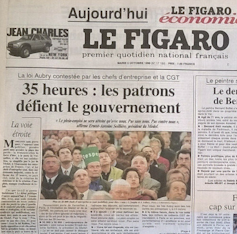
Le 5 octobre 1999, le Figaro place à la une les patrons qui manifestent contre les 35 heures.
Le Figaro, Fourni par l’auteur

L’appel à la rue est l’apanage des seuls petits patrons qui l’ont utilisé pour des raisons dissemblables, dans les années 1950 lors des mobilisations poujadistes, autour de Gérard Nicoud à la fin des années 1960 ou dans les années 1990 avec la figure controversée de Christian Poucet. La mobilisation par réseaux sociaux des « pigeons » en 2012, suivie, de celles moins relayées de divers volatiles la même année, a fait exception aussi en utilisant des moyens innovants. Il y aura encore des manifestations patronales depuis 2000, celles des buralistes ou localement celles du bâtiment, ou autour du collectif Sauvons nos entreprises en 2014.

Malgré son opposition à la politique du début du quinquennat Hollande, le Medef n’ira pas au-delà de réunions publiques à Lyon, dans le Rhône, (avec cartons jaunes et sifflets) et à Paris (avec des petits drapeaux « Libérez l’entreprise »), et la CGPME d’une opération organisée devant Bercy avec une agence d’événementiel sur le thème du cadenas (« PME cadenASSEZ »).

La lente sortie des restrictions liées au Covid a vu fleurir les actions de rue à Lyon ou encore à Paris en 2020 ou le très original die in de Toulouse, en Haute-Garonne (France Bleu titrait « À Toulouse, place du Capitole, un millier de petits commerçants crient leur peur de mourir », en novembre 2020) initiative prise avec les métiers du spectacle, sur la thématique de la mort des entreprises (les manifestants transportant des cercueils et s’habillant en noir).

Mobilisations exceptionnelles contre la gauche en 1982 et en 1999

Les deux grands meetings de 1982 et de 1999 sont donc exceptionnels. Le 14 décembre 1982, le Conseil national du patronat français (CNPF, ancêtre du Medef) et les autres organisations patronales organisent, contre la politique économique et sociale de la gauche, les « États généraux des entreprises au service de la nation ». Ainsi, 25 000 patrons viennent à Villepinte et « adoptent » la Charte de Villepinte, cahiers de revendications et de propositions. L’opération est aussi interne, le président du CNPF, Yvon Gattaz, est alors contesté par certaines fédérations, et renforce alors sa légitimité :

« Tout le monde est venu, comme le grand Condé est venu auprès de Louis XIV après sa dissidence sous la Fronde », déclarait-t-il avec emphase, en 2007 (entretien avec l’auteur).

Le 4 octobre 1999, c’est contre les 35 heures (« Tout le monde ne chausse pas du 35 ») qu’Ernest-Antoine Seillière, président du tout nouveau Mouvement des entreprises de France (Medef, créé de manière militante l’année précédente à Strasbourg), contribue à rassembler quelque 30 000 personnes selon les organisateurs :

« J’ai monté en province des réunions, des congrès, des shows, des rassemblements absolument sans cesse », affirmait le patron des patrons, tout en soulignant le plaisir qu’il prenait à la tribune (entretien avec l’auteur, 2009).

Dans les deux cas, ce sont une succession de discours militants plus ou moins décapants et de témoignages « d’entrepreneurs de terrain » qui constituent la réussite de ces événements classiques, avec écrans géants et quelques pancartes plus ou moins contrôlées.

Le meeting « énorme » 13 octobre 2025

Le meeting du 13 octobre 2025, annoncé comme « énorme », aurait pu se nourrir de ces précédents, ainsi que des prestations très travaillées de Laurence Parisot (remarquée en 2007 à Bercy ou en 2008 au Parlement européen), et aurait été nécessairement jaugé en fonction des performances passées.

Ses organisateurs avaient tenté d’en formuler la réception :

« Une forme républicaine, pacifique, qui rassemblera le patronat au-delà du Medef. On ne descendra pas dans la rue. On réunira massivement, comme ce fut le cas par le passé, sous forme de meeting, des milliers de chefs d’entreprise de tout profil (…) Pour bien signifier que nous refusons d’être la variable d’ajustement de politiques qui nous paraissent contraires à la bonne marche de l’économie et à l’intérêt du pays », expliquait ainsi Patrick Martin, l’actuel président du Medef.

Il s’agissait pour ce dernier de mettre en scène les récentes propositions issues du « Front économique » dont le dirigeant a pris l’initiative. Mais aussi de proposer ce que l’on pourrait qualifier de « business pride » (marche patronale des fiertés). On ne saurait en effet oublier que cette volonté de mobilisation exprime une cristallisation d’un vieux mal-être patronal français.

En effet, depuis de très nombreuses années, les porte-paroles du patronat et certains grands patrons développent un discours de victimisation, d’incompréhension face à ce qu’ils estiment être la surdité et l’incompétence de l’ensemble des politiques. Il s’agissait donc – non seulement d’interpeller le gouvernement et l’ensemble des partis politiques –, mais aussi d’affirmer la fierté d’être entrepreneur.

(Re)faire entendre la voix des patrons

Les précédentes grandes mobilisations avaient eu lieu sous des gouvernements de gauche. Celle de 2025 a éclos dans une autre conjoncture politique, peu lisible et incertaine. Elle fait écho aux prises de parole répétée des organisations patronales et de patrons médiatiques, dans l’espace public depuis la dissolution (MM. Arnault, Trappier, Pouyanné, Niel, ou encore Leclerc et Pigasse).

Avec la victoire de Donald Trump, les analyses relatives à la « trumpisation des patrons français » se sont multipliées, soulignant l’acceptation latente ou la cooptation de Jordan Bardella, président du Rassemblement national, comme moindre mal face à la menace de La France insoumise (LFI) ou du Nouveau Front populaire (NPF), ou encore face à la taxe Zucman (dont l’auteur a été vilipendé par Patrick Martin et Bernard Arnault) imposant les ultrariches.

Il y a sans doute plusieurs colères patronales, puisque leurs intérêts et leurs quotidiens sont incomparables et plusieurs anticipations de l’avenir (la catégorie patronale est la plus hétérogène de toutes les professions et catégories socioprofessionnelles). Tous les patrons ne peuvent pas se faire entendre de la même manière.

L’ombre du RN sur le meeting

Les déclarations de Michel Picon (président de l’U2P), fréquemment sollicité par les médias, sonnent comme une rupture de l’unité patronale (la « finance » contre « le travail »). La crainte d’une salle peu garnie et atone a sans doute pesé sur cette décision de report, mais la possibilité d’un cavalier seul des petites et moyennes entreprises dans les relations sociales à venir apparaît comme l’une des « peurs » du Medef, dont la représentativité tient plus au bon plaisir de l’État qu’à un rapport des forces militantes.

Il est vraisemblable que certains grands patrons ont rappelé à l’ordre leur « commis » et que certaines fédérations ont donné de la voix au sein du Medef.

L’explication officielle de Patrick Martin, expliquant le report du meeting par sa volonté de contribuer à « l’apaisement du pays » après la démission de Sébastien Lecornu n’est donc pas la seule explication à ce retournement.

L’ombre du RN planait aussi sur le meeting de Bercy. Les petits et tout petits patrons peuvent s’y retrouver, et les grands anticipent de possibles accommodements comparables à ceux de Giorgia Meloni et du patronat italien, quand d’autres radicalisent leur discours par l’acquisition de médias (Vincent Bolloré ou Pierre-Édouard Stérin, voire le raidissement de Bernard Arnault, également propriétaire de journaux).

Reporter le meeting de Bercy, c’est aussi se donner le temps de voir venir. Car les patrons sont suspendus à une conjoncture politique où ils vont devoir choisir : considérer l’arrivée possible au pouvoir du RN comme un danger, ou cultiver la politique du moindre mal.


Michel Offerlé est l’auteur de Ce qu’un patron peut faire, (Gallimard, 2021), et de Patron (Anamosa, 2024).

The Conversation

Michel Offerlé ne travaille pas, ne conseille pas, ne possède pas de parts, ne reçoit pas de fonds d’une organisation qui pourrait tirer profit de cet article, et n’a déclaré aucune autre affiliation que son organisme de recherche.

ref. Pourquoi la « business pride » du Medef n’aura pas lieu – https://theconversation.com/pourquoi-la-business-pride-du-medef-naura-pas-lieu-266270

A pro-democracy Venezuelan politician wins this year’s Nobel Peace Prize. Is it a rebuke to Trump?

Source: The Conversation – Canada – By James Horncastle, Assistant Professor and Edward and Emily McWhinney Professor in International Relations, Simon Fraser University

The Nobel Committee has ended months of speculation over the 2025 Nobel Peace Prize winner in selecting Venezuelan politician and activist María Corina Machado. With no obvious candidate this year, analysts spent months debating who should win the prestigious award.

In the end, however, the committee signalled its efforts to uphold the increasingly threatened liberal international order by selecting Machado, one of Venezuela’s key opposition figures and a proponent of democracy.

The politics of the prize

The Nobel Peace Prize, like most international awards, is highly subjective. In some years the winners may appear obvious, such as in 1994 when Yasser Arafat, Yitzhak Rabin and Shimon Peres shared the award for the Oslo Accord, but in other years, it’s not so clear; 2025 is one such year.

This ambiguity has given rise to many people and organizations angling for the award.

In 2025, United States President Donald Trump made a concerted and high-profile push for the award to cement his dubious legacy. Although many people found his demands for the award laughable, there is precedent for politics overstepping the reality of an individual’s contribution.

U.S. President Barack Obama received the 2009 Nobel Peace Prize for “extraordinary efforts to strengthen international diplomacy and co-operation between peoples.” But in reality, Obama had accomplished little to justify the award at that point of his political career just a year into his historic presidency.

Instead, the best justification that the committee chairman could offer was “we want to embrace the message that he stands for.”

In the case of Machado, the Nobel Committee chose to endorse both a message as well as actions.

Declining democracy in Venezuela

Democratic rights in Venezuela have declined significantly over the last two decades. Initially, people greeted the election of Hugo Chávez in 1998 as a significant break from the corruption and economic crisis that defined Venezuelan politics in the 1990s. They were wrong.

Once Chávez rose to power, his regime became increasingly authoritarian over time. The complete pivot to authoritarianism in Venezuela, however, happened after Chavez’s death under his successor, Nicolás Maduro, who assumed the presidency in 2013.

By 2016, outside observers argued that Maduro’s efforts to centralize power for himself constituted a “full-on dictatorship.” Despite several nominal elections since that time, Maduro has used a variety of tactics in order to guarantee he and his regime remain in power.

The Maduro regime’s tactics range from digital censorship to threats in the face of protests and outright violence. The people of Venezuela, in short, are far from free.

A champion for democracy

The tactics used by Maduro’s government to suppress the opposition means it requires considerable personal bravery and integrity to challenge the regime. Machado possesses such traits.

She’s faced considerable threats to her life throughout her political career. Starting in 2011, Machado was physically attacked by Chavez supporters. These attacks have escalated since Maduro assumed power.

While many of her fellow politicians have fled the country fearing such threats of violence, Machado has remained in the country and become a symbol of defiance and democracy for the opposition. Even though her centre-right views are not in alignment with much of the Venezuelan opposition’s political stances, she was nevertheless chosen to be the unity candidate in the 2024 Venezuelan presidential election.

Maduro’s government, fearing her appeal as a candidate, ultimately barred her from holding office.

Champion of a failing order

Machado’s personal bravery in the face of threats from the Maduro regime also highlights another matter the Nobel Prize committee seeks to highlight: the declining state of democracy at an international level.

Democracy is regarded by many as a foundational pillar for peace. The Nobel Prize committee is among them.

In awarding the 2025 Nobel Peace Prize, the committee noted:

“Democracy is a precondition for lasting peace. However, we live in a world where democracy is in retreat, where more and more authoritarian regimes are challenging norms and resorting to violence. The Venezuelan regime’s rigid hold on power and its repression of the population are not unique in the world.”

Most analyses suggest that liberal democracy is in decline at an international level. Whether through the development of hybrid regimes or outright authoritarian governments, democracy as both a concept and a practice is under threat.

Trump’s second stint in the Oval Office seems to vividly illustrate this decline. The U.S. president and his supporters have been quite explicit that their priority is “America First.” The U.S., which previously served as a champion of the liberal international order on the global stage, is anything but at the moment.

Furthermore, Trump’s domestic actions domestically that threaten the basis of democratic governance will undoubtedly embolden other politicians to pursue similar policies.

With the world’s traditional champion of democratic governance in retrenchment, other pro-democracy forces are stepping into the breach — including the Nobel Committee and its selection of Machado for the 2025 Nobel Peace Prize.

The Conversation

James Horncastle does not work for, consult, own shares in or receive funding from any company or organisation that would benefit from this article, and has disclosed no relevant affiliations beyond their academic appointment.

ref. A pro-democracy Venezuelan politician wins this year’s Nobel Peace Prize. Is it a rebuke to Trump? – https://theconversation.com/a-pro-democracy-venezuelan-politician-wins-this-years-nobel-peace-prize-is-it-a-rebuke-to-trump-267189

From artificial atoms to quantum information machines: Inside the 2025 Nobel Prize in physics

Source: The Conversation – USA – By Zhixin Wang, Postdoctoral Researcher in Physics, University of California, Santa Barbara

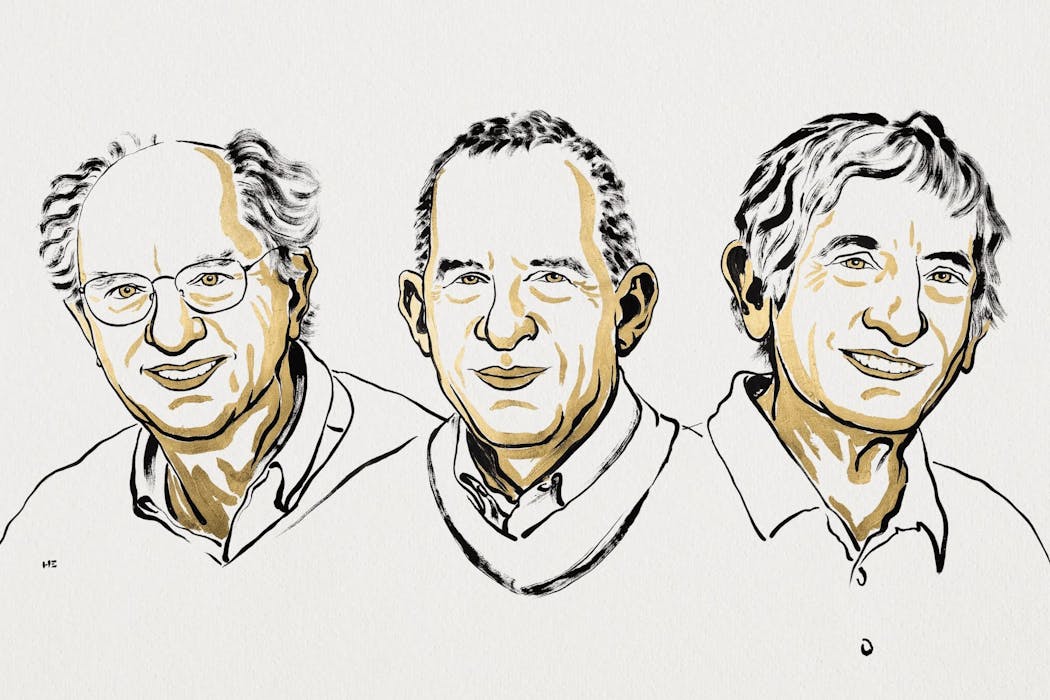
This illustration shows, from left to right: John Clarke, Michel Devoret and John Martinis. Niklas Elmehed © Nobel Prize Outreach, CC BY-NC

The 2025 Nobel Prize in physics honors three quantum physicists – John Clarke, Michel H. Devoret and John M. Martinis – for their study of quantum mechanics in a macroscopic electrical circuit.

Since the prize announcement, cheers and excitement have surrounded the home institutions of these laureates in Berkeley, Santa Barbara and New Haven.

The award of this prestigious prize to pioneering research in quantum physics coincides with the 100th anniversary of the birth of quantum mechanics – a revolutionary scientific theory that forms the foundation of modern physics.

Quantum mechanics was originally formulated to explain and predict the perplexing behaviors of atoms, molecules and subatomic particles. It has since paved the way for a wide range of practical applications, including precision measurement, laser technology, medical imaging and, probably the most far-reaching of all, semiconductor electronic devices and computer chips.

Yet numerous aspects of the quantum world have long remained mysterious to scientists and engineers. From an experimental point of view, the tiny scale of microscopic particles poses outstanding challenges for studying the subtle laws of quantum mechanics in laboratory settings.

The promises of quantum machines

Since the closing decades of the past century, researchers around the world have sought to precisely isolate, control and measure individual physical objects, such as single photons and atomic ions, that display quantum behaviors under very specific experimental conditions. These endeavors have given rise to the emerging field of quantum engineering, which aims to utilize the peculiarities of quantum physics for groundbreaking technological innovations.

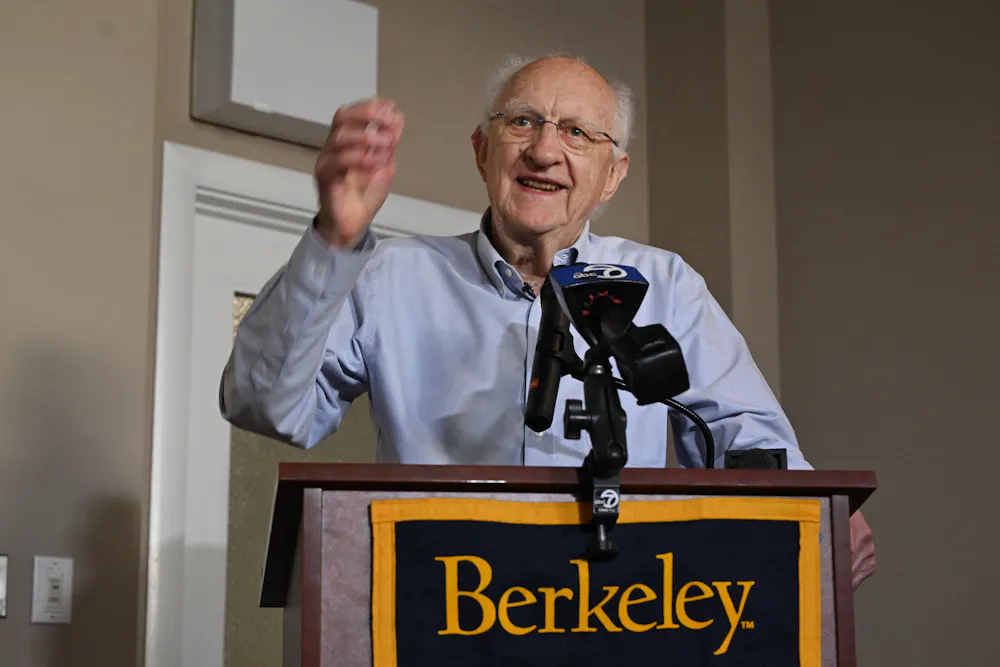
A man speaking at a podium with a 'Berkeley ' sign on it
John Clarke, an emeritus professor of physics at the University of California, Berkeley, speaks on Oct. 7, 2025, at a press conference on the campus celebrating his 2025 Nobel Prize in Physics.
Karl Mondon/AFP via Getty Images

One of the most promising directions is quantum information processing, whose goal is to design and implement machines that can encode, process, transmit and detect information in “strange” quantum manners: For instance, an object can be in a superposition of different states at the same time. Distant objects can manifest quantum entanglement – remote correlations that escape all possible classical interpretation. Compared with their conventional electronics predecessors, quantum information machines could have advantages in specific tasks of computation, simulation, cryptography and sensing.

The realization of such quantum machines would require experimenters having access to reliable physical components that can be assembled and controlled on the human scale, yet fully obey quantum mechanics. Counterintuitive as it might sound, can we break the implicit boundaries of the natural world and bring microscopic physical laws into the macroscopic reality?

Quantum mechanics in an electrical circuit

In 1985, the three Nobel laureates – then working in the same research group at the University of California, Berkeley – provided an affirmative answer to the question above. They were studying electrical circuits made of superconductors. Superconductivity is a special state of matter famous for conducting electrical currents without resistance, due to underlying quantum mechanical interactions of electrons at low temperatures. For the first time, the trio observed distinct quantum behaviors of a macroscopic physical variable.

In a superconductor, two electrons bond together to form a Cooper pair. These electron pairs condense into a macroscopic state, which can be described by a collective phase variable shared by all its microscopic constituents. In this state, trillions or more electrons effectively behave like a single entity, resembling the mass collections of atoms that form everyday objects like pendulums or billiard balls.

To observe the quantum mechanical motion of this macroscopic phase variable, the three scientists fabricated a device called the Josephson junction, which consists of two pieces of superconductors separated by an insulator layer thinner than 1/10,000 of a human hair. They discovered that, at sufficiently low temperatures (below −273 degrees Celsius, or −459 degrees Fahrenheit), the phase variable difference across the Josephson junction shows a unique quantum mechanical phenomenon known as quantum tunneling, where an object may escape a barrier without the need to climb over its summit.

Furthermore, the team exposed the Josephson junction to microwave electromagnetic radiation whose frequency is close to that of Wi-Fi signals. They measured energy levels of the circuit at discrete, or quantized, values, which are usually present only in microscopic atoms and molecules. The device used in these experiments can thus be referred to as an “artificial atom” – namely, an electrical circuit with atom-like properties, which is at once macroscopic in size, adjustable in design, and quantum mechanical in nature.

Implications and outlooks

The groundbreaking works by Clarke, Devoret and Martinis have had many profound impacts. On the fundamental level, they suggested that distinct quantum phenomena – once thought to exist only at the microscopic level – can actually manifest at much larger physical scales. In the meantime, the invention of superconducting artificial atoms has opened brand-new avenues toward building useful quantum machines with advanced engineering techniques.

Based on these discoveries, researchers – including these Nobel Prize recipients and their research groups – have made significant achievements in constructing prototype quantum computers using superconducting quantum circuits in the decades since. The elementary device unit that makes up these information processors is the superconducting quantum bit, or “qubit” for short. Each superconducting qubit is an artificial atom containing one or more Josephson junctions. Its quantum state can be precisely prepared, manipulated and measured by experimenters. The perfection and integration of superconducting qubits are among the state-of-the-art challenges in quantum information technology.

2025 Nobel laureate John Martinis discusses the roadmap of building a quantum computer at the 2016 Adiabatic Quantum Computing Conference in Los Angeles.

The 2025 Nobel Prize for physics recognizes original investigations in the intersection of basic and applied sciences. The prize recipients tested profound quantum mechanical hypotheses through clear and rigorous experimentation.

From those artificial atoms have emerged the audacious efforts and rapid progress in building practical quantum information machines. The combination of pure intellectual inquiries and engineering advancement has been shaping this interdisciplinary field since its creation.

This Nobel Prize is therefore a tribute to the three inventors of superconducting quantum circuits, whose inquisitive minds, broad visions and adventurous attitudes represent the true scientific spirit and will continue to inspire future generations.

The Conversation

Zhixin Wang does not work for, consult, own shares in or receive funding from any company or organization that would benefit from this article, and has disclosed no relevant affiliations beyond their academic appointment.

ref. From artificial atoms to quantum information machines: Inside the 2025 Nobel Prize in physics – https://theconversation.com/from-artificial-atoms-to-quantum-information-machines-inside-the-2025-nobel-prize-in-physics-266976

Opa del BBVA al Banco Sabadell: capítulo final

Source: The Conversation – (in Spanish) – By Jorge Hernando Cuñado, Profesor de Dirección y Organización de Empresas, Universidad Complutense de Madrid

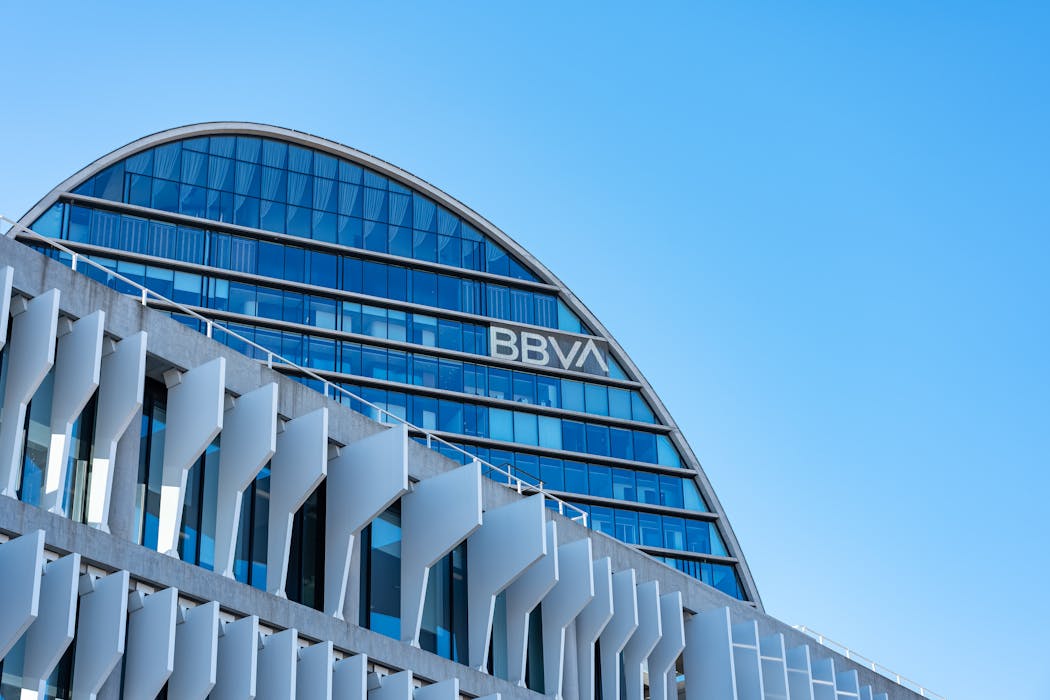
La sede del BBVA en Madrid. José Miguel Sánchez/Shutterstock

El viernes 10 de octubre a las 23.59 acaba el plazo para que los accionistas de Banco Sabadell acudan a la opa del BBVA, declarada hostil por la directiva de la entidad catalana. El Gobierno de España, en el Consejo de Ministros del 24 de junio de 2025 y tras someter la operación a consulta pública, autorizó la oferta bajo condiciones estrictas para proteger el interés general. En consecuencia, la opa podrá ejecutarse siempre que al menos el 50 % de los accionistas del Sabadell la acepten.

En septiembre de 2025 el BBVA mejoró su oferta, elevando su valor inicial en un 10 %. La propuesta es mayoritariamente en acciones: por cada 4,83 títulos del Sabadell se ofrecería una acción de nueva emisión del BBVA, con un pequeño ajuste en efectivo para redondear el canje. Por su parte, el Consejo del Banco Sabadell ha mantenido la recomendación a sus accionistas de rechazar la oferta, argumentando que la valoración es insuficiente y que el valor real del banco es significativamente superior al ofertado.

Ahora mismo existe una gran incertidumbre sobre el desenlace. Tras el vencimiento del plazo, los resultados definitivos se publicarán el 17 de octubre a través de la CNMV.

Se barajan tres escenarios posibles:

  1. La aceptación supera el 50 % del capital: la opa prosperaría y la fusión se realizaría bajo los términos acordados y las condiciones impuestas por el Gobierno.

  2. Se sitúa entre el 30 % y el 50 %: la normativa exige al BBVA lanzar una oferta adicional obligatoria en efectivo por el resto del capital no aceptado, sin poder ofrecer un precio inferior al de la oferta inicial.

  3. La aceptación es inferior al 30 %: la opa se considerará fallida y no se producirá la fusión.

El escenario intermedio, entre el 30 y el 50 %, es considerado el más probable . El desenlace dependerá de la capacidad del BBVA para convencer a un número suficiente de accionistas del Sabadell.

Riesgo fiscal para los aceptantes

Existe un riesgo fiscal para los residentes en España: si la opa no supera el 50 %, quienes hayan aceptado podrían verse obligados a tributar por las plusvalías al no cumplirse la neutralidad fiscal prevista.

Entre los accionistas relevantes, Zurich Insurance, con alrededor del 4,9 % del capital, ha anunciado públicamente que no acudirá a la oferta por considerarla poco atractiva. En cambio, David Martínez, consejero del Sabadell y titular de aproximadamente el 3,8 % de las acciones, ha expresado su apoyo a la operación
.

Desde el punto de vista económico, de salir adelante la opa la entidad resultante vería mejoradas la eficiencia operativa (gracias a las economías de escala), aumentaría su rentabilidad por las sinergias (o sea, el valor de la empresas resultante de la fusión es mayor que el valor individual de las empresas fusionadas) y reforzaría la posición competitiva internacional del BBVA. Pero por otro lado, incrementaría el riesgo sistémico derivado del tamaño del banco resultante y reduciría la competencia, al concentrarse buena parte del mercado financiero español en tres grandes entidades (CaixaBank, Banco Santander y BBVA).


Leer más:
Ocho mil despidos y 1 500 oficinas menos: un resultado previsible de la fusión de CaixaBank y Bankia


Objetivo de Europa: bancos más grandes y solventes

Desde la crisis de 2008, tanto el Banco Central Europeo como la Comisión Europea impulsan un modelo bancario basado en la consolidación y la solvencia. El objetivo es contar con menos bancos, pero más grandes y sólidos, con supervisión centralizada por parte del BCE y de la Autoridad Bancaria Europea y avanzar hacia un mercado bancario único que resista mejor a las crisis financieras.

Uno de los fines es competir con los gigantes estadounidenses y asiáticos. Sin embargo, la Unión Europea aún carece de un auténtico “campeón bancario continental”, y operaciones como la de BBVA–Sabadell se interpretan como pasos intermedios hacia integraciones transnacionales futuras.

No obstante, este modelo también presenta riesgos estructurales: mayor exposición al riesgo sistémico –las entidades “demasiado grandes para caer” (too big to fail) que ya vivimos durante la crisis de 2008–, dependencia del BCE como garante de estabilidad y pérdida de la diversidad financiera local, que cumple funciones económicas y sociales esenciales.


Leer más:
El crédito cooperativo contribuye a la inclusión financiera en las zonas más despobladas


Adaptarse al cambio

Esta opa representa una respuesta adaptativa a un entorno cada vez más complejo, marcado por márgenes estrechos, competencia digital y presión regulatoria. Pero también implica una reducción de la diversidad, un debilitamiento de la descentralización y una pérdida de raíces locales dentro del sistema financiero español.

En breve conoceremos el desenlace, que marcará un nuevo capítulo en la reconfiguración del sistema bancario español y, posiblemente, en la propia arquitectura financiera europea.

The Conversation

Jorge Hernando Cuñado no recibe salario, ni ejerce labores de consultoría, ni posee acciones, ni recibe financiación de ninguna compañía u organización que pueda obtener beneficio de este artículo, y ha declarado carecer de vínculos relevantes más allá del cargo académico citado.

ref. Opa del BBVA al Banco Sabadell: capítulo final – https://theconversation.com/opa-del-bbva-al-banco-sabadell-capitulo-final-267248

María Corina Machado, Nobel de la Paz 2025: la estrategia de la constancia

Source: The Conversation – (in Spanish) – By Benigno Alarcón, Director of the Center for Political Studies, Universidad Católica Andrés Bello

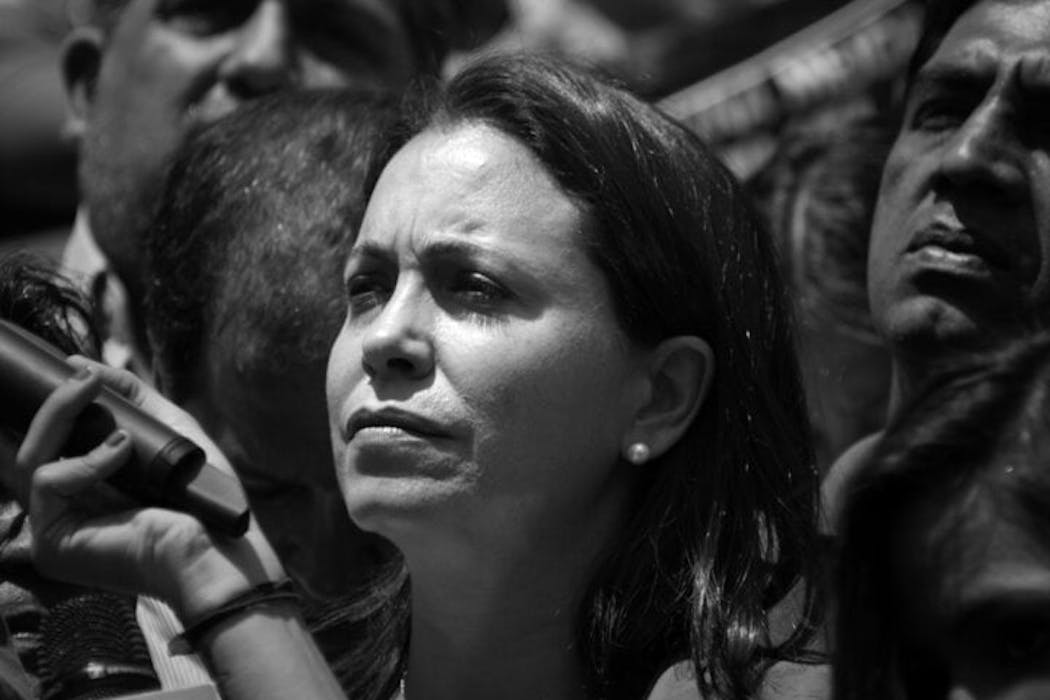
María Corina Machado, en 2014. Carlos Díaz/Wikimedia Commons, CC BY

Nacida en Caracas en 1967, ingeniera industrial, cofundadora de Súmate y exdiputada, María Corina Machado se formó políticamente en la intersección entre integridad electoral, ciudadanía activa y democracia con libertades políticas y económicas para todos.

Sobre esa base, y apoyada en una amplia plataforma cívica, obtuvo el 22 de octubre de 2023 una victoria abrumadora en la primaria opositora, lo que legitimó su liderazgo al frente del movimiento democrático. Pese a ello, en 2024 fue inhabilitada por el gobierno, contraviniendo el espíritu del Acuerdo de Barbados.

Sin embargo, se mantuvo en la ruta electoral apoyando con generosidad y entrega máxima la candidatura unitaria de Edmundo González Urrutia.


Leer más:
¿Qué implica el acuerdo de Barbados entre el gobierno y la oposición de Venezuela?


Voto, calle y diplomacia

Las presidenciales de 2024 –marcadas por graves irregularidades– concluyeron con la proclamación oficial de Nicolás Maduro, mientras la oposición afirmó, con actas en mano, la victoria de González Urrutia. Varios gobiernos reclamaron verificación y Estados Unidos reconoció a González como “presidente electo”.


Leer más:
Elecciones en Venezuela: cómo la tecnología y los datos abiertos han defendido la democracia


En ese contexto, Machado y su equipo han afrontado persecución. Desde el 9 de enero de 2025, tras una detención seguida de liberación en circunstancias opacas, ella ha tenido que resguardarse. Aun así, no habilitó salidas insurreccionales: sostuvo la verdad electoral, preservó la organización social y escaló la presión diplomática.

Esa combinación –voto, calle no violenta y diplomacia– es el corazón estratégico que hoy explica este reconocimiento a través del Nobel de la Paz.

¿Dónde está hoy Venezuela?

Hoy, el país vive un agravamiento de la suspensión del Estado de derecho, que se viene arrastrando desde la llegada de Chávez al poder, en 1999, y se ha acentuado progresivamente desde el ascenso de Maduro en 2013. Instituciones capturadas, resultados disputados y nunca auditados, coerción selectiva, tejido social exhausto.


Leer más:
Maduro: objetivo, silenciar a la disidencia


La documentación de 2024–2025 sobre violaciones de derechos humanos en el contexto electoral deja poco margen de duda. Sin embargo, persiste un sustrato ciudadano reacio a ceder su voz. En este paisaje, el liderazgo de Machado –de facto y moral– ha operado como columna vertebral de la resistencia cívica, a pesar de detenciones, exilios y amenazas.

A pesar de todo, octubre de 2025 será, para la memoria colectiva venezolana, un mes de señales. El 19 de octubre, el Vaticano canonizará al doctor José Gregorio Hernández y a la madre Carmen Rendiles, los dos primeros santos de un país profundamente creyente. También en octubre, y por sorpresa, Venezuela celebra que a una mujer venezolana se le haya concedido el Nobel de la Paz (Baruj Benacerraf, nacido en Caracas, obtuvo el de Medicina en 1980). No se confunden los lenguajes –fe y política– pero se reflejan en el espejo de una misma ética de servicio al país y a sus ciudadanos a través de valores espirituales como la resiliencia, la constancia, la templanza y la fidelidad a la verdad.

El cruce de símbolos recuerda que la grandeza nacional no siempre se mide en conquistas materiales.

Efectos geopolíticos y domésticos

El reconocimiento reconfigura incentivos en tres planos:

  1. Eleva el costo reputacional de quienes intentan normalizar el autoritarismo venezolano.

  2. Endurece la condicionalidad de cualquier negociación: el estándar ya no es “diálogo por el diálogo”, sino verificación, cronograma, cumplimiento y retorno a la democracia.

  3. Empodera a la diáspora como actor diplomático y económico con una narrativa transversal –no partidista– que articula libertad, democracia y derechos humanos.

Hacia adentro, el Nobel consolida una doble legitimidad del liderazgo de Machado: de origen, por su investidura cívica y la victoria en la primaria, y de ejercicio, por su negativa a trivializar la violencia y su papel en la unificación opositora. Cada intento de criminalizarla chocará con un blindaje simbólico global.

Hacia afuera, se robustece su capacidad de interlocución con gobiernos y organismos: deja de ser “oposición local” para convertirse en referente normativo hemisférico sobre cómo se defiende la democracia en contextos cerrados y altamente represivos como el venezolano.

Asimismo, el lauro facilita en Washington, Europa y la región –tanto para los gobiernos como para los parlamentos– un marco más nítido para calibrar decisiones inteligentes que faciliten la transición democrática.

La propia Machado ha pedido mayor acción frente al endurecimiento del régimen, la represión y el control institucional. El premio reconoce su autoridad moral para plantearlo sin que se desdibuje el carácter pacífico de su estrategia, y aumenta los costos para los normalizadores del autoritarismo dentro y fuera de Venezuela.

Una lectura personal

Hemos sido testigos, a través de los años, del crecimiento como líder de María Corina Machado en medio de un ambiente muy hostil. Su mérito no es la infalibilidad –nadie la tiene–, sino la voluntad de aprender y persistir: abandonar maximalismos, tejer alianzas, aceptar el escrutinio, resistir tentaciones de violencia y mantener la brújula moral cuando otros la pierden y los incentivos colocados por el régimen han empujado a muchos liderazgos al despeñadero.

María Corina Machado se enfrenta a Chávez en 2012 en el Congreso de Venezuela.

Por eso este Nobel trasciende lo personal y la reconoce como el eje de unidad y coordinación entre actores democráticos pero dispersos –líderes políticos y sociales, iglesia, academia, empresa, aliados democráticos– en torno a una agenda común: unas elecciones con resultados legítimos, el retorno a la democracia y la búsqueda de una salida que minimice daños y garantice el futuro del país.


Leer más:
¿Es posible una transición democrática negociada en Venezuela?


El Nobel de la Paz 2025 no resuelve la transición, pero recalibra el tablero. Cuando un país contempla, en el mismo mes, la canonización de sus dos primeros santos y el reconocimiento global de quien encarna su lucha cívica, no asiste a un milagro fortuito: renace la esperanza al comprobar que la templanza también mueve montañas. El premio a María Corina Machado no concluye el camino, lo ilumina.

The Conversation

Benigno Alarcón no recibe salario, ni ejerce labores de consultoría, ni posee acciones, ni recibe financiación de ninguna compañía u organización que pueda obtener beneficio de este artículo, y ha declarado carecer de vínculos relevantes más allá del cargo académico citado.

ref. María Corina Machado, Nobel de la Paz 2025: la estrategia de la constancia – https://theconversation.com/maria-corina-machado-nobel-de-la-paz-2025-la-estrategia-de-la-constancia-267252

Government shutdown hasn’t left consumers glum about the economy – for now, at least

Source: The Conversation – USA (2) – By Joanne Hsu, Research Associate Professor at the Institute for Social Research, University of Michigan

Economic clouds gathering? Perhaps not yet. Brendan Smialowski/AFP via Getty Images

The ongoing federal shutdown has resulted in a pause on regular government data releases, meaning economic data has been in short supply of late. That has left market-watchers and monetary policymakers somewhat in the dark over key indicators in the U.S. economy.

Fortunately, the University of Michigan’s Surveys of Consumers is unaffected by the impasse in Washington and released its preliminary monthly report on Oct. 10, 2025; the final read of the month will be released in two weeks.

The Conversation U.S. spoke with Joanne Hsu, the director of the Surveys of Consumers, on what the latest data shows about consumer sentiment – and whether the shutdown has left Americans feeling blue.

What is consumer sentiment?

Consumer sentiment is something that we at the University of Michigan have measured since 1946. It looks at American attitudes toward the current state of the economy and the future direction of the economy through questions on personal finances, business conditions and buying conditions for big-ticket items.

Over the decades, it has been closely followed by policymakers, business leaders, academic researchers and investors as a leading indicator of the overall state of the economy.

When sentiment is on the decline, consumers tend to pull back on spending – and that can lead to a slowdown in the economy. The opposite is also true: High or rising sentiment tends to lead to increased spending and a growing economy.

How is the survey compiled?

Every month, we interview a random sample of the U.S. population across the 48 contiguous states and the District of Columbia. Around 1,000 or so people take part in it every month, and we include a representative sample across ages, income, education level, demography and geography. People from across all walks of life are asked around 50 questions pertaining to the economy, personal finances, job prospects, inflation expectations and the like.

When you aggregate that all together, it gives a useful measure of the health of the U.S. economy.

What does the latest survey show?

The latest survey shows virtually no change in overall sentiment between September and October. Consumers are not feeling that optimistic at the moment, but generally no worse than they were last month.

Pocketbook issues – high prices of goods, inflation and possible weakening in the labor market – are suppressing sentiment. Views of consumers across the country converged earlier in the year when the Trump administration’s tariffs were announced. But since then, higher-wealth and higher-income consumers have reported improved consumer sentiment. It is for lower-income Americans – those not owning stock – that sentiment hasn’t lifted since April.

In October, we also saw a slight decline in inflation expectations, but it remains relatively high – midway between where they were around a year ago and the highs of around the time of the tariff announcements in April and May.

Has the government shutdown affected consumer sentiment?

The government shutdown was in place for around half the time of the latest survey period, which ran from Sept. 23-Oct. 6, 2025. And so far, we are not seeing evidence that it is impacting consumer sentiment one way or another.

And that is not super-surprising. It is not that people don’t care about the shutdown, just that it hasn’t affected how they see the economy and their personal finances yet.

History shows that federal shutdowns do move the needle a little. In 2019, around 10% of people spontaneously mentioned the then-shutdown in the January survey. We saw a decline in sentiment in that month, but it did improve again the following month.

Looking back, we tend to see stronger reaction to shutdowns when there is a debt ceiling crisis attached. In 2013, for example, there was a decline in consumer sentiment coinciding with concerns over the debt ceiling being breached. But it did quickly rebound when the government opened again.

Whether or not we see a decline in sentiment because of the current shutdown depends on how long it lasts – and how consumers believe it will impact pocketbook issues, namely prices and job prospects.

The Conversation

Joanne Hsu receives research funding from NIA, NIH, and various sponsors of the University of Michigan Surveys of Consumers.

ref. Government shutdown hasn’t left consumers glum about the economy – for now, at least – https://theconversation.com/government-shutdown-hasnt-left-consumers-glum-about-the-economy-for-now-at-least-267264

Nobel peace prize winner Maria Corina Machado: the Venezuelan opposition leader forced into hiding after taking on Maduro

Source: The Conversation – UK – By Pia Riggirozzi, Professor of Global Politics, University of Southampton

Across Latin America, democracy is coming under severe pressure. Authoritarian leaders across the continent have been entrenching political power through constitutional manipulation, militarised policing and the persecution of dissent.

In Venezuela, Nicaragua, El Salvador and Argentina, regimes are increasingly eroding democracy and mounting a backlash against human rights.

It is in this bleak regional landscape that the Nobel Committee’s decision to award the 2025 peace prize to María Corina Machado has landed. The award is a recognition of one woman’s defiance. But it is also an opportunity to ask what kind of democracy and what kind of peace the world should aspire to.

Machado has long been the face of Venezuela’s democratic opposition. Disqualified from public office, vilified by Nicolás Maduro’s regime and repeatedly threatened, she embodies the persistence of civic dissent.

The Nobel prize committee’s citation reads: “She is receiving the Nobel Peace Prize for her tireless work promoting democratic rights for the people of Venezuela, and for her struggle to achieve a just and peaceful transition from dictatorship to democracy.”

Yet that transition is a long way from being achieved and remains deeply uncertain. Venezuela has fallen victim to increasing political polarisation and is now suffering one of the worst displacement crises in the hemisphere, with 8 million people having left the country since 2014. And the threat of US interference is ever present.

The prize thus risks celebrating an aspiration more than an outcome. It represents a fragile hope in a region where democratic renewal is both urgent and unfinished.

A feminist reading of courage and contradiction

The award makes Machado the first Venezuelan to receive the Nobel peace prize, underscoring the international significance of her career and support for the Venezuelan democratic cause. There is no doubt that her courage is extraordinary.

Machado has refused exile, rejected violence and unified a fragmented opposition under conditions that would crush most political careers. She was forced to go into hiding last year shortly after alleging fraud in Nicolás Maduro’s reelection on July 28 2024.

For decades, women in Latin America have been at the forefront of resistance movements. From the Mothers of the Plaza de Mayo in Argentina to the Ni Una Menos protests in Buenos Aires, Santiago, Bogotá and Mexico City, women’s groups have focused on advancing human rights and social justice. Machado’s recognition inserts Venezuelan women’s political agency into that prominent tradition.

In a region where politics remains saturated by machismo and military archetypes, this is not trivial. The image of a woman – assertive, unapologetic, unbowed – being recognised as a symbol of peace and democratic resistance matters deeply.

Yet the discussion cannot stop there. Machado comes from a powerful business family. She was educated in exclusive schools in Venezuela and the US and shaped by early work in her family’s steel company – all of which may have informed and defined her political outlook.

Her position as an elite woman in a country whose crisis has hit the poor and working-class hardest highlights the need to broaden the conversation about what a just and inclusive democracy looks like.

Her economic agenda – market-oriented and pro-privatisation – raises questions about whether democratic renewal can balance economic reforms, social protection and grassroots priorities. It asks how best to address inequalities that underpin Venezuela’s crisis.

In recognising Machado, the Nobel committee has invited reflection not only on the courage of individual leaders but also on how democratic movements can more fully integrate issues of peace and social justice for all alongside the fight against authoritarianism.

The announcement of the 2025 Nobel peace prize.

Democracy, peace, and the displaced

The Nobel committee described Machado’s resistance as peaceful. In Venezuela the concept of peace is multifaceted. It encompasses not only the absence of violence but also the profound challenges of hunger, displacement and uncertainty that millions continue to face.

The mass displacement since 2014 has disproportionately affected women and girls. They often flee for gender-specific reasons such as the collapse of maternal healthcare and increased rates of gender-based violence. Many have been exposed to trafficking and sexual violence and have faced bureaucratic indifference.

They are the collateral damage of Venezuela’s authoritarian collapse. But they are also symptomatic of an international order that fails to protect women.

This situation underscores the necessity of broadening our understanding of peace to include the protection and rights of women – in this case, the many displaced Venezuelan women and girls.

It must demand a transition that not only restores electoral democracy but guarantees dignity for those who lost everything to repression and political, economic and humanitarian decay.

A mirror for the region

Machado’s Nobel prize is especially timely given that it has been awarded against a backdrop of democratic backsliding and even erosion across Latin America. Her experience highlights the way that the more democracy is undermined by a regime in power, the more difficult it becomes for an opposition to unseat that regime in elections – or assume office if it does win power.

Latin American democracies are losing institutional capacity to restrain the executive – while on the streets, popular protest is often forcibly repressed. Many opposition politicians and activists have no option but to flee or hide.

This has been Machado’s experience. But this Nobel prize sends a signal that global institutions are watching and highlights the deep concern for the future of democracy and the fragility of peace.

The Conversation

Pia Riggirozzi have received funding from ESRC for the project Redressing Gendered Health Inequalities of Displaced Women and Girls in Contexts of Protracted Crisis in Central and South America (ReGHID)

ref. Nobel peace prize winner Maria Corina Machado: the Venezuelan opposition leader forced into hiding after taking on Maduro – https://theconversation.com/nobel-peace-prize-winner-maria-corina-machado-the-venezuelan-opposition-leader-forced-into-hiding-after-taking-on-maduro-267245

Donald Trump would have been an unsuitable choice for the 2025 Nobel peace prize – but he may be a more serious contender in 2026

Source: The Conversation – UK – By Stefan Wolff, Professor of International Security, University of Birmingham

And the winner is … not Donald Trump. That the US president didn’t get his much-coveted award is probably going to be the enduring memory of the 2025 Nobel peace prize.

This year’s recipient is María Corina Machado, leader of Venzuela’s opposition movement. The Norwegian Nobel committee awarded her the prize “for her tireless work promoting democratic rights for the people of Venezuela, and for her struggle to achieve a just and peaceful transition from dictatorship to democracy”.

Machado’s efforts are laudable and she deserves praise for her personal courage standing up to Venezuela’s strong-man ruler, Nicolás Maduro. What is less apparent is how her selection fits with the award criteria as specified in Alfred Nobel’s will.

Nobel wanted the recipient to be “the person who shall have done the most or the best work for fraternity between nations, the abolition or reduction of standing armies, and for the holding and promotion of peace congresses”. It’s open to debate whether Machado fits those criteria.

In fact, the entire process surrounding the 2025 Nobel peace prize has been highly unusual, in the way it has involved very public lobbying for a particular candidate. Trump himself has used every conceivable opportunity to push for the award – even his speech before the UN general assembly on September 23, when he reiterated an earlier claim to have “solved seven wars” that he made on August 19.

Those claims have been widely called into question, with good reason. Tenuous ceasefires are the closest that Trump got in some of the actual wars in which intervened.

This would not necessarily have ruled him out of the competition – the criteria do not require success and allow for effort to be rewarded. Yet even then, his chances for success were remote, given that nominations close on January 31, after which a shortlist is developed from late February and deliberations commence.

At that stage, the US president had arguably played a role in a temporary ceasefire in the war in Gaza – but most of his subsequent claims had yet to come to pass.

Nobel controversies

There have been controversial choices for the Nobel peace prize before: Henry Kissinger and Abiy Ahmed Ali, to name just two.

Kissinger won the prize in 1973 for ending the Vietnam war, together with Le Duc Tho, the principal Vietnamese negotiator who declined the prize. But while Kissinger negotiated the end of that war as US secretary of state, he was also notorious for his devastating bombing campaign against Cambodia from 1969 to 1973, among other things,.


Read more:
The Nobel peace prize has a record of being awarded to controversial nominees


Abiy was awarded the 2019 prize “for his efforts to achieve peace and international cooperation, and in particular for his decisive initiative to resolve the border conflict with neighbouring Eritrea”. But that did not stop him from fighting a vicious civil war against the Tigray People’s Liberation Front, which has cost the lives and livelihoods of hundreds of thousands of civilians.

Trump clearly looks a better candidate in comparison to Abiy and Kissinger. But now compare him with three other past US presidents who won the prize.

Theodore Roosevelt won in 1906 for mediating an end to the Russo-Japanese war. Woodrow Wilson won in 1919 for founding the League of Nations. And Jimmy Carter won in 2002 for decades of work promoting peaceful conflict resolution, democracy and human rights. Against these, Trump’s track record of success looks shakier.

Shaky track record

While he deserves some credit for his efforts and at least some temporary successes, Trump has no spotless track record as a peacemaker. His eight months in office since re-entering the White House in January 2025 are hardly an advertisement for criteria set out by Alfred Nobel.

Trump has threatened to annex Greenland and incorporate Canada as the 51st state of the US, joined Israel in bombing Iran during the so-called 12-day war, and carried out a deadly campaign of airstrikes against alleged Venezuelan drug traffickers.

This mixture of peacemaking and warmongering sets Trump apart from the fourth US president to win the prize, Barack Obama, who won in 2009 “for efforts to strengthen international diplomacy and cooperation between peoples”. This too was a controversial choice at the time as it was mostly aspirational, given Obama’s lack of track record as president in the early months of his administration.


Read more:
Nobel peace prize winner Maria Corina Machado: Venezuelan opposition leader forced into hiding after taking on Maduro


Perhaps the best outcome of the 2025 Nobel peace prize saga, and the fact Trump did not win, might be that the US president now doubles down on his peacemaking efforts. He has gone on the record as having ended seven wars, and now has another potential success with the Gaza ceasefire deal.

If he wants to remain in contention for the 2026 award, Trump can’t afford for his grandiose claims to be proved wrong. If he succeeds in preventing any of these conflicts from flaring up again, a service to peace will have been done – and it shouldn’t matter that it was done by Trump, or what his ultimate motivation was.

The Conversation

Stefan Wolff is a past recipient of grant funding from the Natural Environment Research Council of the UK, the United States Institute of Peace, the Economic and Social Research Council of the UK, the British Academy, the NATO Science for Peace Programme, the EU Framework Programmes 6 and 7 and Horizon 2020, as well as the EU’s Jean Monnet Programme. He is a Trustee and Honorary Treasurer of the Political Studies Association of the UK and a Senior Research Fellow at the Foreign Policy Centre in London.

ref. Donald Trump would have been an unsuitable choice for the 2025 Nobel peace prize – but he may be a more serious contender in 2026 – https://theconversation.com/donald-trump-would-have-been-an-unsuitable-choice-for-the-2025-nobel-peace-prize-but-he-may-be-a-more-serious-contender-in-2026-267067

Why some people turn off the lights, and others don’t

Source: The Conversation – UK – By Lorraine Whitmarsh, Professor of Environmental Psychology, University of Bath

Southworks/Shutterstock

Saving energy isn’t just about keeping bills down. A new analysis of 100 existing studies across 42 countries shows that people with positive attitudes to the environment, or who want what they do at home to make a difference to society, are more likely to save energy.

This finding is in line with leading psychological models of behaviour, which show there is often a relationship between what we feel and what we do.

But these models, and the evidence about who is more likely to turn off the lights and save energy, also show very clearly that there is often an “attitude-behaviour gap” – what we know we should do doesn’t always translate into action.

Anyone who has tried to lose weight or quit smoking will be very aware of this. Like health behaviour, environmental actions also suffer from this gap: while most people worry about climate change, far fewer take sufficient action.

This is because it is not only attitudes that predict behaviour, but the social, economic and physical context in which we act. In fact for many people, these factors exert a stronger influence on what we do than internal factors such as attitudes.

Cost and convenience matter

Cost, convenience and societal conventions are all strong influences on our actions. This helps to explain changes in how much homes are heated (due to central heating being more widespread), or use of hot water.

Many older people remember a weekly bath being the norm in their childhoods. Yet today, daily showers are more typical – partly because many more houses have showers now. Unsurprisingly, cost is also a driver of behaviour: more people will invest in energy-saving technology when energy prices are high than when they’re low.

Similarly, the new study shows that knowledge of environmental impact has a limited effect on energy-saving behaviour. For example, we have found that environmental awareness has little influence on whether people fly for work. In our 2020 study of academic travel, the people flying the most were climate change professors – who certainly knew that aviation is a contributor to climate change.

This gap between knowledge and action exists for the same reason as the attitude-behaviour gap: namely, our behaviour is influenced by wider factors than what we feel or know. A person whose job requires air travel is likely to fly for work even when they are aware of the environmental harm.

People are more likely to get heat pumps if their neighbours get them.

Neighbours are influential

The new study also finds that people save more energy if they think others expect them to – showing that social norms are a powerful influence on our behaviour.

Recent work similarly shows that social factors strongly shape people’s decision to buy a heat pump – one of the most effective energy-saving actions. Having a friend or neighbour with a heat pump means you hear about its benefits and how to buy it, and are more likely to believe it is a good idea than just hearing about it through secondhand sources (such as news reports).

At least as important, though, is making energy-saving actions cheap and convenient. So policies to reduce costs of energy technologies or insulation, and which ensure skilled installers are available, are critical. Saving energy is more often motivated by financial than environmental concerns – so price is a particularly powerful lever.

The new study also finds links between energy-saving and other green behaviour, such as recycling or using public transport. Research suggests that similar actions often relate. For instance, people who save energy are more likely to save water – often because these actions flow from a “green identity”: a sense of being an environmentally interested person.

But these links are not very strong, and become weaker across more diverse actions – for example, avoiding car use and saving energy at home – because the external factors that shape these choices are very different. So, living in a rural area might preclude reducing car use, while saving energy might be possible.

Ultimately, promoting energy-saving behaviour means creating the right conditions for people to act.

While information and motivation are crucial, meaningful and sustained change depends on making the greener option affordable, convenient – and just normal. If policies and environments support energy-saving choices, large-scale behaviour change (and progress towards climate and energy goals) becomes far more achievable.


Don’t have time to read about climate change as much as you’d like?

Get a weekly roundup in your inbox instead. Every Wednesday, The Conversation’s environment editor writes Imagine, a short email that goes a little deeper into just one climate issue. Join the 45,000+ readers who’ve subscribed so far.


The Conversation

Lorraine Whitmarsh receives funding from UKRI.

Sam Hampton receives funding from UKRI and the Askehave Climate Foundation.

ref. Why some people turn off the lights, and others don’t – https://theconversation.com/why-some-people-turn-off-the-lights-and-others-dont-266738

Hamas at a crossroads as the Gaza ceasefire deal comes into force

Source: The Conversation – UK – By Dale Pankhurst, PhD Candidate and Tutor in the School of History, Anthropology, Philosophy and Politics, Queen’s University Belfast

After two years of war, Israel and Hamas have agreed on the “first phase” of a US-backed peace plan for Gaza. The deal, if it holds, will involve the release of Israeli hostages and Palestinian prisoners, the withdrawal of Israeli troops from Gaza and the entry of aid into the enclave.

The president of the Palestinian Authority, Mahmoud Abbas, has welcomed the news. He has expressed hope that the deal acts as a “prelude to reaching a permanent political solution” between Israel and Palestine.

But what lies ahead for Hamas? A clause in the wider peace plan calls for the full dissolution of the group, both as a militant organisation and as a civil administration. It is difficult to see how Hamas leadership will negotiate their way through this without some form of disarmament or demobilisation.

The Israeli government, with backing from the US and other western countries such as the UK, has repeatedly said the full demobilisation of Hamas and its militant wing is the only possible outcome it will accept. This leads to a significant dilemma for Hamas.

Its entire reason for existence is to seek the destruction of the Israeli state through violence. There is no room for peaceful, democratic means in its objectives. So if the Hamas leadership are to pursue some form of demobilisation, they risk fracturing the organisation into dissenting armed factions that continue their militancy against Israel.


Read more:
Israel and Hamas agree ceasefire deal – what we know so far: expert Q&A


The Wall Street Journal reports that Hamas’s lead negotiator, Khalil al-Hayya, as well as other political officials living outside of Gaza, are ready to accept disarmament as part of a wider peace process. But analysts suggest other leaders and militants still based in Gaza may be less willing to compromise.

Hamas has remained remarkably resilient throughout the two years of war in Gaza. US figures from early 2025 showed that Hamas had added up to 15,000 new volunteers since the October 7 attacks in 2023, largely replacing those it had lost since the start of the conflict. Many of these recruits may be reluctant to surrender their weapons after losing family and property during the war.

At the same time, Hamas is not the only armed Palestinian group operating in Gaza. Although Hamas led the October 7 attacks against Israel, the attacking force contained militants from multiple armed groups.

These included Palestinian Islamic Jihad (PIJ), the Marxist-Leninist Popular Front for the Liberation of Palestine, the Al-Aqsa Martyrs Brigades, the Maoist Democratic Front for the Liberation of Palestine (DFLP) and the Palestinian Mujahideen Movement.

Some of these groups, including the PIJ, are thought to have joined Hamas in peace talks with Israel. Others are less willing to enter negotiations. The DFLP, for example, has said in a statement that it rejects any form of international mandate or guardianship in Gaza. This includes the future involvement of the former British prime minister, Sir Tony Blair, or an international security force.


Read more:
Gaza peace plan risks borrowing more from Tony Blair’s failures in the Middle East than his success in Northern Ireland


Beyond Gaza, Hamas has to consider its future in broader Palestinian politics. The armed group has ruled over Gaza since 2007. But its traditional opponent, Fatah, which Hamas expelled from the Gaza Strip in 2007 following a bloody feud, continues to wield significant political authority in the West Bank through its dominance of the Palestinian Authority.

Relations between Hamas and Fatah have been cordial in recent years. But Hamas may fear any demobilisation of its armed forces could shift the balance of power within Palestinian politics, enabling the Palestinian Authority to renew efforts for Gaza to rejoin the West Bank under a single, unified political authority.

Some form of disarmament is possible

Comparable case studies show that the disarmament and demobilisation of insurgent groups is possible, at least in part. In Northern Ireland, the Provisional Irish Republican Army (Pira) decommissioned a large portion of its weaponry in 2005 following protracted peace negotiations.

The Revolutionary Armed Forces of Colombia (Farc) also demobilised its armed units in 2017, a year after a historic peace settlement was reached between the Colombian state and the leftist rebels. Both organisations disarmed despite the presence of other armed groups, such as dissident republicans in Northern Ireland and the National Liberation Army in Colombia, that continued to wage violent campaigns.

Yet in Northern Ireland, the Pira never fully demobilised its volunteer base nor did it decommission all of its weapons. British security services and the Northern Irish police have found evidence that Pira members have been involved in several murders against internal opponents since the group decommissioned.

British intelligence also believes that the Pira’s militant structures and decision-making body, the army council, remain intact. They allege that these people now oversee the political strategy of Sinn Féin, an Irish republican political party.

While some insurgent groups disarm and demobilise, their legacy is slow to fade. Would Israel be willing to accept a similar disarmament, demobilisation and reintegration arrangement in Gaza as the British have done in Northern Ireland?

It is difficult to see the government of Israeli prime minister, Benjamin Netanyahu, which has continually reiterated that Hamas must be completely destroyed, doing so. Yet a different Israeli administration might.

It also remains to be seen whether Hamas could plausibly disarm a portion of its forces, such as its rocket units and armed assault groups, and allow others to be absorbed into a security force system governed by a body styled on the Palestinian Authority.

A monumental shift in strategic direction would be required for Hamas to reach this point. And the group is arguably more ideologically entrenched now as an Islamist Palestinian movement than the Pira was in the 1990s or the Farc in the 2010s.

Hamas is at a crossroads. It now faces either a period of negotiating for its future with little room to manoeuvre or further war with Israel if it refuses to dissolve. The challenge for mediators is to find a pathway that satisfies Israeli security demands and Hamas’s own quest for survival and transformation within Palestinian politics.

The Conversation

Dale Pankhurst does not work for, consult, own shares in or receive funding from any company or organisation that would benefit from this article, and has disclosed no relevant affiliations beyond their academic appointment.

ref. Hamas at a crossroads as the Gaza ceasefire deal comes into force – https://theconversation.com/hamas-at-a-crossroads-as-the-gaza-ceasefire-deal-comes-into-force-267145