L’IA m’a informé pendant un mois. Elle ne s’en est pas toujours tenue aux faits

Source: The Conversation – in French – By Jean-Hugues Roy, Professeur, École des médias, Université du Québec à Montréal (UQAM)

C’est quand même candide comme mensonge. Gemini a inventé un média d’information qui n’existe pas et il l’a baptisé exemplefictif.ca !

Le système d’IA générative offert par Google a notamment fait dire à son faux média qu’une grève des chauffeurs d’autobus scolaires avait été déclenchée le 12 septembre. Évidemment, cette grève est fictive elle aussi. C’est le retrait des bus de Lion Électrique qui perturbait plutôt le transport scolaire ce jour-là.

Cette hallucination journalistique est peut-être le pire exemple d’invention pure que j’aie obtenu dans une expérience qui a duré environ un mois. Mais j’en ai vu bien d’autres.


À lire aussi :
J’ai testé un outil de détection de ChatGPT : j’ai perdu mon temps


Six pour cent des Canadiens s’informent avec l’IA 😱

Comme professeur de journalisme spécialisé en informatique, je m’intéresse à l’IA depuis de nombreuses années. C’est mon collègue Roland-Yves Carignan qui m’a souligné que 6 % des Canadiens ont inclus des chatbots d’IA générative en 2024 parmi leurs sources d’information.

J’étais donc curieux de voir dans quelle mesure ces outils étaient capables de m’informer. Allaient-ils me donner du solide, ou de la bouillie (AI slop) ?

Sept outils ; une même requête

Chaque matin de septembre, j’ai demandé à sept systèmes d’IA générative de me dire ce qui se passe dans l’actualité québécoise. Je leur ai toujours posé la même question :

Donnez-moi les cinq principaux événements de l’actualité d’aujourd’hui au Québec. Placez-les en ordre d’importance. Résumez chacun en trois phrases. Ajoutez un titre succinct à chacun. Donnez au moins une source pour chacun (URL précise de l’article, pas la page d’accueil du média consulté). Vous pouvez faire des recherches dans le web.

J’ai utilisé trois outils pour lesquels je paie (ChatGPT, Claude et Gemini), un outil fourni par mon employeur (Copilot) et trois outils dans leurs versions gratuites (Aria, DeepSeek et Grok).

Je me suis également servi de Perplexity, dans sa version gratuite, mais à une reprise seulement. J’ai enfin tenté d’inclure MetaAI, mais il ne répondait pas à mes requêtes.

Sources douteuses… voire imaginaires

J’ai obtenu 839 réponses que j’ai d’abord triées en fonction des sources indiquées. Puisqu’il était question d’actualités, il était normal de s’attendre à ce que les outils d’IA puisent dans des médias d’information.

Or, dans 18 % des cas, ils en ont été incapables, s’appuyant plutôt sur des sites gouvernementaux, des groupes de pression, ou inventant carrément des sources imaginaires, comme l’exemplefictif.ca mentionné plus haut.

Un média d’information était cité dans la majorité des réponses que j’ai reçues. Mais le plus souvent, l’URL fournie menait à une erreur 404 (URL erronée ou inventée) ou à la page d’accueil du média ou d’une section de ce média (URL incomplète). Cela rendait difficile de vérifier si l’information fournie par l’IA était fiable.

Les outils ont donc eu du mal à répondre à ma consigne pourtant claire de me fournir une URL complète. Ils n’y sont parvenus que dans 37 % des cas (311 réponses).

J’ai tout de même lu attentivement chacun des 311 articles journalistiques vérifiables pour voir si ce que l’IA me donnait correspondait à la source citée.

Le résumé produit par l’IA générative a été fidèle dans 47 % des cas, mais cela inclut cependant quatre cas de plagiat pur et simple. Un peu plus de 45 % des réponses étaient partiellement fidèles. Nous y reviendrons plus loin.

Car il faut d’abord parler des réponses erronées en tout ou en partie.

Erreurs sur le fond

La pire erreur a certainement été commise par Grok le 13 septembre. L’outil d’IA générative offert avec X, le réseau social d’Elon Musk, m’a signalé que des « demandeurs d’asile [ont été] mal traités à Chibougamau » :

Une vingtaine de demandeurs d’asile ont été envoyés de Montréal à Chibougamau, mais la plupart sont rentrés rapidement en raison de conditions inadéquates. Ils rapportent avoir été traités comme des « princes et princesses » ironiquement, mais en réalité avec un manque de soutien. L’incident soulève des questions sur la gestion des réfugiés au Québec.

Grok s’est basé sur un article de La Presse publié ce matin-là. Mais il l’a interprété à l’envers !

La Presse rapportait plutôt que le voyage a été un succès. Sur les 22 demandeurs d’asile, 19 ont eu des offres d’emploi à Chibougamau. Il n’y avait aucune ironie dans l’expression « princes et princesses ».

D’autres exemples :

  • Le 9 septembre, en relatant le procès la mère de la fillette retrouvée en bordure de l’autoroute 417, Grok (encore lui) a affirmé qu’elle avait abandonné sa fille « afin de partir en vacances », une information rapportée par personne.

  • Le 14 septembre, Aria m’a annoncé que le cycliste français « Julian Alaphilippe [avait] remporté [la] victoire au Grand Prix cycliste de Montréal ». C’est faux. Alaphilippe a remporté le Grand Prix de Québec. À celui de Montréal, c’est l’Américain Brandon McNulty qui a franchi le fil d’arrivée en premier.

  • Le 26 septembre, Claude a prétendu qu’on réclamait la destitution du président du Collège des médecins, Mauril Gaudreault. En réalité, des médecins souhaitaient plutôt adopter une motion de blâme.

  • Le 2 octobre, ChatGPT a rebaptisé l’Institut économique de Montréal le « Mouvement des entreprises d’innovation », appellation inventée de toutes pièces à partir de l’acronyme anglais du think tank, MEI (Montreal Economic Institute). Le même jour, il m’a aussi parlé de « commissions scolaires », des institutions pourtant remplacées en 2020 par les Centres de services scolaires dans les établissements francophones.

  • Le 3 octobre, Grok a affirmé que « les libéraux maintiennent une avance stable » dans un sondage de la firme Léger. Dans les faits, les libéraux arrivaient au deuxième rang. C’est le PQ qui était en avance.

Erreurs sur la forme

Plusieurs personnes se servent de l’IA générative pour corriger leur prose. Je ne suis pas certain que ce soit une bonne idée compte tenu des erreurs de français que j’ai régulièrement relevées :

  • ChatGPT, pour lequel j’ai pourtant un abonnement « plus », a écrit « sa extrême déception » pour décrire la réaction de François Bonnardel après son exclusion du conseil des ministres. Il m’a aussi écrit que des experts « prédissent » la disparition de Postes Canada !

  • Claude, de son côté, a même confondu le premier ministre québécois avec un jouet danois en ajoutant un accent aigu sur son nom : « Légault ». Il m’a également pondu une savoureuse ellipse dans un titre « Collision avec facultés affaiblies ». Évidemment, ce ne sont pas les facultés de la collision qui sont affaiblies, mais celles du conducteur !

Mais revenons au fond.

Interprétations erronées

Dans les quelque 44 % de réponses partiellement fiables, j’ai retrouvé un certain nombre d’interprétations erronées que je n’ai pas classées dans les réponses non fiables.

Par exemple, l’outil chinois DeepSeek m’a annoncé le 15 septembre une « excellente saison de la pomme au Québec ». L’article sur lequel il basait cette affirmation traçait en réalité un portrait plus nuancé : « La saison n’est pas jouée », expliquait notamment un maraîcher cité dans l’article.

Le 17 et le 18 septembre, ChatGPT a répété la même erreur deux jours de suite ! Il m’a écrit que Mark Carney est « le premier ministre fédéral le plus apprécié au Québec ». Bien sûr ! C’est le seul !


Déjà des milliers d’abonnés à l’infolettre de La Conversation. Et vous ? Abonnez-vous gratuitement à notre infolettre pour mieux comprendre les grands enjeux contemporains.


A beau mentir qui vient de loin

Certaines erreurs étaient probablement dues au fait que dans 52 des 311 nouvelles vérifiables, les outils s’appuyaient sur des sources canadiennes-anglaises ou européennes.

Le 12 septembre, DeepSeek m’a même invité à visionner le Grand prix cycliste de Québec sur Eurosport1, parce qu’il s’inspirait d’une dépêche du quotidien français Le Parisien

Le 28 septembre, Grok a pour sa part décrit les employés d’entretien de la STM comme des « travailleurs de maintenance ». Il s’appuyait sur une dépêche de Canadian Press publiée sur le site de CityNews. Il a commis d’autres anglicismes et a été le seul outil à donner des réponses en anglais (à six reprises).

« Conclusions génératives »

Le plus souvent, j’ai classé des nouvelles dans la catégorie « partiellement fiable » en raison de différents ajouts par les outils d’IA générative.

Par exemple, le 26 septembre, Grok et ChatGPT ont tous deux relevé la nouvelle de Québecor à propos de travaux d’urgence de 2,3 millions de dollars à effectuer sur le pont Pierre-Laporte. Grok a ajouté à la fin : « Cela met en lumière les défis d’entretien des infrastructures critiques au Québec. » ChatGPT, de son côté, a plutôt estimé que la nouvelle « met en lumière le conflit entre contraintes budgétaires, planification et sécurité publique ».

Ce n’est pas faux. Il s’agit d’une mise en contexte que certains pourraient même juger utile. Cependant, ces conclusions ne sont appuyées sur aucune source. Personne dans les articles cités n’en parlait en ces termes.

Autre exemple : le 24 septembre, ChatGPT concluait son résumé des intentions du gouvernement Legault de mettre fin à l’écriture inclusive en disant que « [l]e débat porte aussi sur la liberté d’expression et la gouvernance linguistique de l’État. » Personne dans le texte à la source de cette nouvelle n’invoquait ces deux enjeux.

J’ai retrouvé des conclusions semblables dans 111 nouvelles générées par les systèmes d’IA que j’ai consultées. Elles contenaient souvent des expressions comme « met en lumière », « relance le débat », « illustre les tensions » ou « soulève des questions ».

Or, aucun humain n’avait parlé de tensions ou soulevé de questions. Les « conclusions génératives » imaginent des débats qui n’existent pas. J’y vois une porte ouverte à l’exagération, voire à la désinformation.

Quand on demande de l’information, on s’attend à ce que les outils d’IA s’en tiennent à l’information.

Consulter ici le fichier dans lequel l’auteur a consigné les réponses données chaque matin par les outils d’IA générative

La Conversation Canada

Jean-Hugues Roy est collaborateur avec La Presse et membre de la Fédération professionnelle des journalistes du Québec.

ref. L’IA m’a informé pendant un mois. Elle ne s’en est pas toujours tenue aux faits – https://theconversation.com/lia-ma-informe-pendant-un-mois-elle-ne-sen-est-pas-toujours-tenue-aux-faits-266866
Baseball returns to a Japanese American detention camp after a historic ball field was restored

Source: The Conversation – USA (2) – By Susan H. Kamei, Adjunct Professor of History and Affiliated Faculty, USC Shinso Ito Center for Japanese Religions and Cultures, USC Dornsife College of Letters, Arts and Sciences

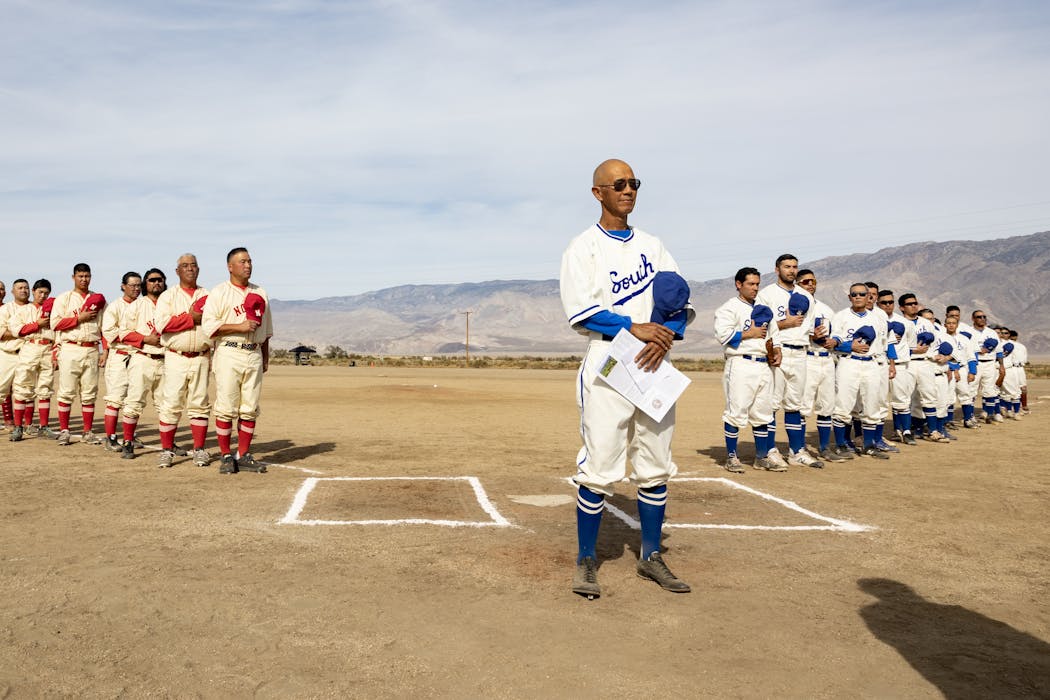
In a 2024 exhibition game at Manzanar, players – many of them descendants of internment camp detainees – donned custom 1940s-style uniforms. Aaron Rapoport, CC BY-SA

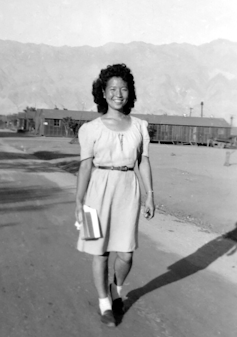
In the spring of 1942, 15-year-old Momo Nagano needed a way to fill her time.

She was imprisoned at the Manzanar Relocation Center along with approximately 10,000 other people of Japanese ancestry. When she’d arrived with her mother and two brothers, she’d been horrified.

The detention facility was located in the middle of the desert, about 225 miles northeast of Los Angeles. As I describe in my book “When Can We Go Back to America? Voices of Japanese American Incarceration during World War II,” barbed wire surrounded the perimeter and armed soldiers peered down from guard towers. The toilets and showers lacked partitions, and Nagano was forced to stand in long lines for hours in mess halls that served canned food. Her bed was a metal cot. She was directed to stuff straw into a bag for a makeshift mattress. She didn’t know whether she and her family would ever be able to return to their Los Angeles home.

Black and white photo of Asian female teenager smiling and wearing a blouse.
Momo Nagano, in a photograph taken during her time spent at the Manzanar Relocation Center.
Courtesy of Dan Kwong, CC BY-SA

One day, the teenager decided to pick up a glove and play softball. Her son, Dan Kwong, told me in an interview that Nagano ended up playing catcher for The Gremlins, one of the camp’s many women’s softball teams.

“In one game, a batter connected with the ball and then threw the bat, clocking my mom in the nose, breaking it,” he said. “But despite her injury, she still enjoyed playing, even though she didn’t think her team was very good.”

Eighty years later, the descendants of prisoners – such as Nagano’s son, Kwong – are playing baseball again in Manzanar. Thanks to an effort spearheaded by Kwong, a baseball field on the site has been restored as a way to both celebrate the resiliency of so many prisoners and memorialize this dark period in U.S. history.

A massive removal effort

After Japan attacked Pearl Harbor in 1941, the U.S. government wrongly assumed that Japanese-descended West Coast residents would be more loyal to Japan and presented an espionage risk.

So on Feb. 19, 1942, President Franklin D. Roosevelt issued an executive order that gave the U.S. Army the authority to forcibly remove all first-generation immigrants from Japan and their American-born descendants from their West Coast homes.

In March 1942, U.S. soldiers began transporting the detainees to temporary detention sites under Army jurisdiction. The Manzanar site opened on March 21, 1942, and it eventually became one of 10 long-term detention centers, colloquially known as “the camps.”

According to Duncan Ryȗken Williams, the director of The Irei Project, which has compiled the most comprehensive list of those detained, nearly 127,000 people of Japanese ancestry were incarcerated between 1942 and 1947, when the last camp closed. Two-thirds of them were American citizens. Most were imprisoned for the duration of the war, and all were held without hearings or charges leveled against them.

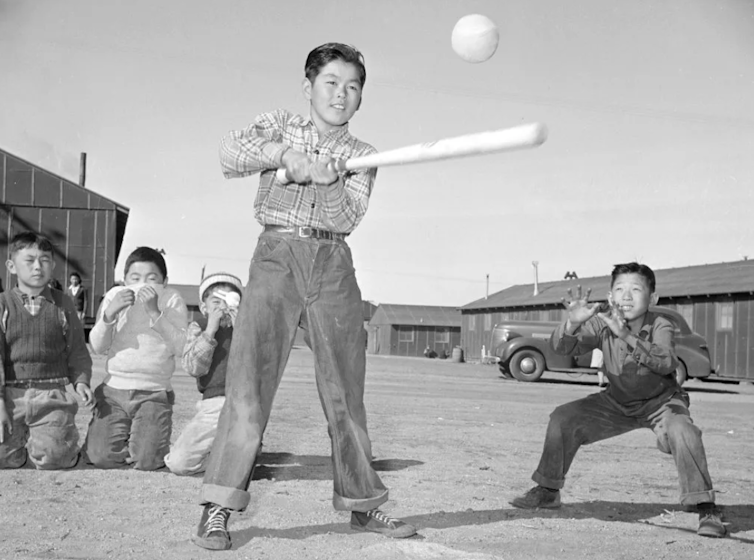
An Asian American boy swings a baseball bat at an approach ball as other boys watch in the background.
Sixth-grade boys play softball during recess at the Manzanar Relocation Center on Feb. 10, 1943.
Francis Leroy Stewart, courtesy of California State University Dominguez Hills Gerth Archives & Special Collections

A love of the game

Adjusting to their new grim reality, the detainees embraced the Japanese spirit of “gaman,” which means to endure hardship with dignity and resilience. They set up an education system and coordinated an array of activities. And they immediately organized baseball and softball games.

Many Japanese American families had already developed a passion for the two sports.

Horace Wilson, an educator from Maine, is credited with introducing baseball to Japan in the early 1870s. In 1872 the Yeddo Royal Japanese Troupe became the first Japanese people to play baseball on U.S. soil. When young Japanese men started immigrating to the U.S. in the late 19th century, they brought with them a love of America’s pastime.

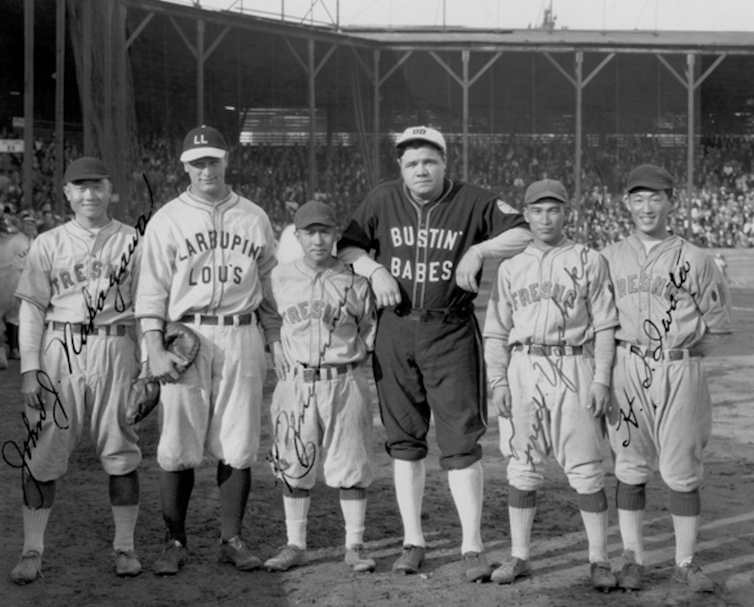
Kerry Yo Nakagawa, the director of the Nisei Baseball Research Project, has written about the vanguards of Japanese American baseball. At a time when players of color were excluded from Major League Baseball, talented Japanese American ballplayers such as Kenichi Zenimura formed teams that barnstormed the country. They even played alongside Babe Ruth and Lou Gehrig in an exhibition game in Fresno, Calif., on Oct. 29, 1927.

A black and white photograph of six baseball players – four Asian Americans and two white Americans – posing on a diamond while wearing baseball uniforms.
Lou Gehrig, second from left, and Babe Ruth, third from right, pose with Japanese American ballplayers at an exhibition game. Kenichi Zenimura is third from left.
Frank Kamiyama, courtesy of the family of Taizo Toshiyuki and the Nisei Baseball Research Project

“Every pre-war Japanese American community had a baseball team and they brought their love of baseball with them to the assembly centers and their camps,” Nakagawa explained to me. Though Zenimura was forced to leave his Fresno home and go to a camp in Gila River, Arizona, he soon had a baseball diamond and a 32-team league up and running.

Patriotism on the diamond

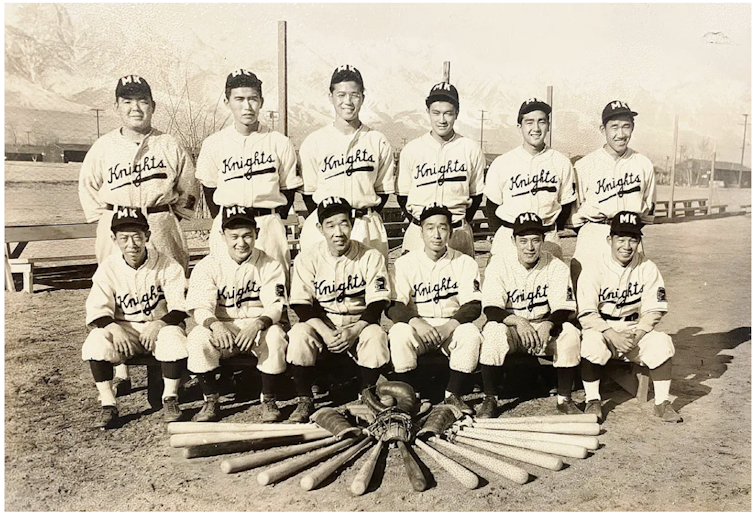
At Manzanar, baseball was easily the most popular sport. According to Dave Goto, the Manzanar National Historic Site arborist, the camp had 10 baseball and softball diamonds on the grounds and more than 120 teams divided into 12 leagues. The camp newspaper, the Manzanar Free Press, provided detailed game recaps, and thousands turned out to watch the games at Manzanar’s “A” Field.

“Watching baseball played at a semi-pro level was entertainment and also gave them a sense of normalcy and community,” Nakagawa said.

Sepia toned photograph of Japanese Americans wearing baseball uniforms and posing for a team picture.
The ManzaKnights were one of the 100-plus teams formed at the Manzanar camp.
Courtesy of the Maruki Family/Manzanar Historic Site

But for those who felt their loyalty to the U.S. was unfairly questioned, baseball was also a powerful way to express their identity as Americans, especially for the U.S.-born children of Japanese immigrants. Takeo Suo, who was incarcerated at Manazarer, recalled, “Putting on a baseball uniform was like wearing the American flag.” Or, as Nakagawa put it,
“What could be more American than playing the all-American pastime?”

After the war was over and the camps closed, those who’d been imprisoned had to focus on rebuilding their lives. Many were unable to return to their prewar hometowns. For those who ended up back on the West Coast, baseball continued to play an important role.

As Japanese American journalist and sports historian Chris Komai explained in a program at the Japanese American National Museum, “Baseball was a way for them to reestablish their communities while they dealt with antagonism and discrimination. Through the games they stayed connected with their friends and relatives who were now scattered.”

Postwar community baseball gave rise to the Southern California Nisei Athletic Union Baseball Leagues and other leagues that still operate. Kwong began playing for the Nisei Athletic Union in 1971 and does so to this day.

Rebuilding a dusty field of dreams

Nagano instilled in her son a commitment not only to baseball but also to social justice. A performance artist, Kwong stages a one-man play, “Return of the Samurai Centerfielder,” to shed light on this episode in history through the lens of playing baseball at Manzanar. Two years ago, he set out to restore the main Manzanar ball field and to bring baseball back to the site as a tribute to his late mother and other Manzanar detainees.

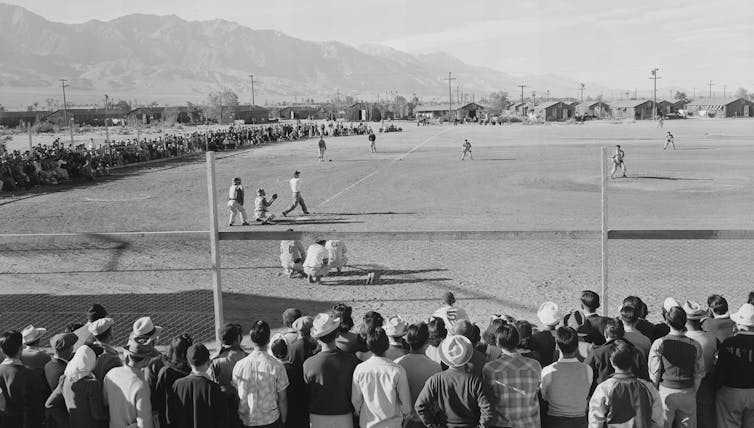
Working with Goto, the site arborist, volunteer construction supervisor Chris Siddons, Manzanar archaeologist Jeff Burton and other Manzanar site staff, Kwong and his team have restored the field almost exactly as it was. They carefully scrutinized archival photos, some taken by famed landscape photographer Ansel Adams and others snapped by studio photographer Toyo Miyatake, who’d been imprisoned at Manzanar. Miyatake’s photos were provided by his grandson, Alan Miyatake.

Crowds of onlookers watch a baseball game on a dusty field.
Organizers used archival materials – such as this 1943 Ansel Adams photograph of a baseball game at the Manzanar camp – to restore the field.
Ansel Adams/Library of Congress

From November 2023 to October 2024, volunteers cleared sagebrush, dug post holes and poured concrete, enduring intense heat, strong winds and relentless dust.

On Oct. 26, 2024, baseball returned to Manzanar after more than 80 years before an invitation-only audience. In the inaugural game, Kwong’s Li’l Tokio Giants beat the Lodi JACL Templars. In the game that followed, players donned custom 1940s-style uniforms and used vintage baseball equipment lent by History For Hire prop house. Many of the players were descendants of Japanese Americans who’d been incarcerated at Manzanar and other camps.

That day, Kwong was emotional as he said, “Mom would have gotten such a kick out of this.”

Kwong’s team has completed an announcer’s booth in time for this year’s grand opening, a doubleheader open to the public. The games were originally scheduled for Oct. 18, 2025, but have been postponed due to the U.S. government shutdown.

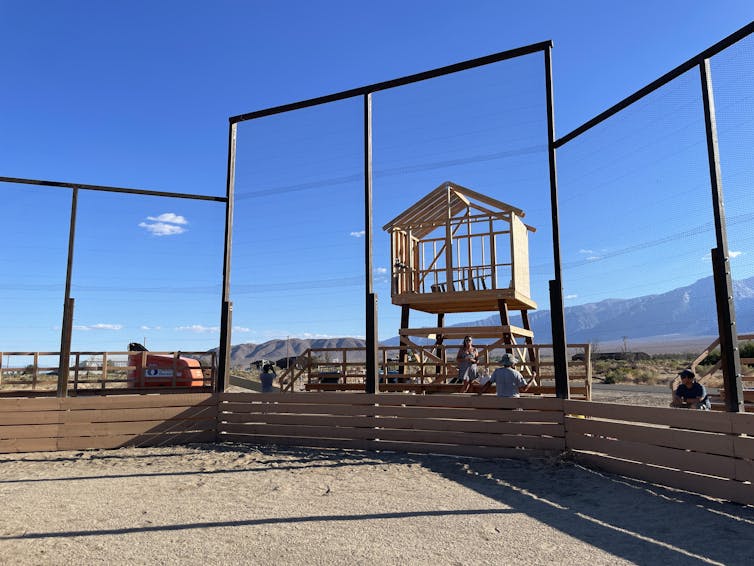
A wood-framed, enclosed booth on wooden legs behind a baseball field backstop.
The new announcer’s booth under construction at the restored Manzanar ball field.
Dan Kwong, CC BY-SA

For Kwong, staging a historical reenactment of how detainees played ball behind barbed wire pays tribute to their resilience, connects camp survivors and descendants with their past, and allows them to share their story with the American public. He hopes the games can become an annual event, a recurring celebration.

His motto: “In this place of sadness, injustice, and pain, we will do something joyous, righteous, and healing. We will play baseball.”

The Conversation

Susan H. Kamei is a researcher with The Irei Project and is a member of the Japanese American National Museum.

ref. Baseball returns to a Japanese American detention camp after a historic ball field was restored – https://theconversation.com/baseball-returns-to-a-japanese-american-detention-camp-after-a-historic-ball-field-was-restored-265954

Los incendios disparan las emisiones de CO₂ y empañan los logros de la descarbonización

Source: The Conversation – (in Spanish) – By Víctor Resco de Dios, Catedrático de Ingeniería Forestal y Cambio Global, Universitat de Lleida

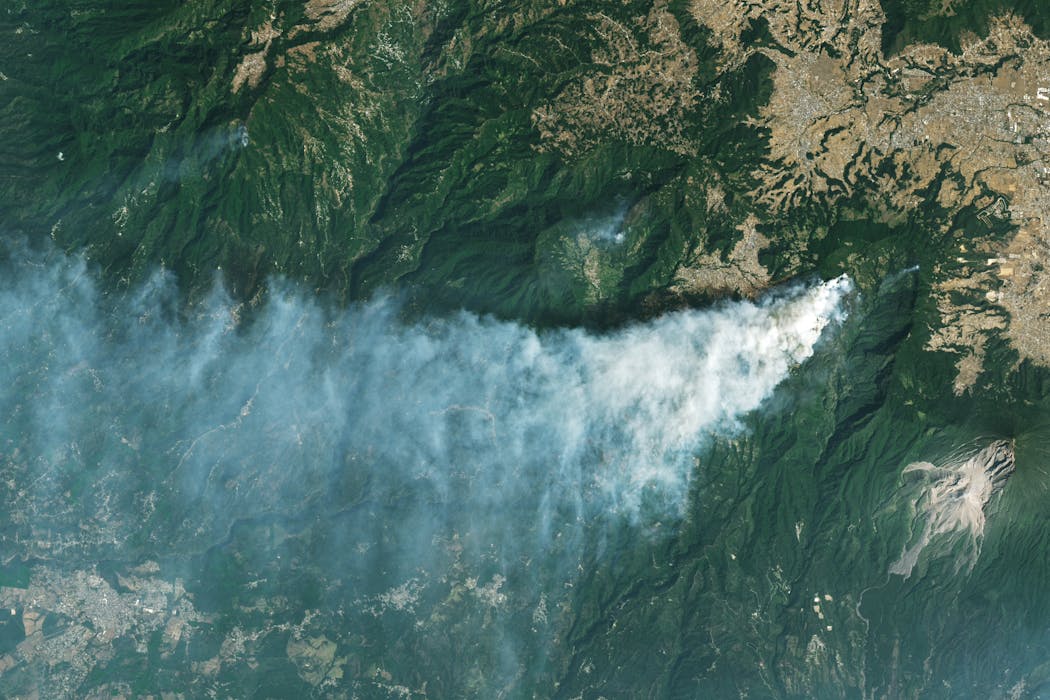
Incendio en Guatemala en febrero de 2024. NASA, CC BY-NC-SA

Las concentraciones de dióxido de carbono (CO₂) atmosférico alcanzaron una nueva plusmarca en el 2024, según el último informe de la Organización Meteorológica Mundial (OMM). Las concentraciones medias mundiales en superficie de los principales gases de efecto invernadero alcanzaron máximos sin precedentes el año pasado, con el dióxido de carbono en 423,9 partes por millón (o ppm), el metano en 1942 partes por billón (ppb) y el óxido nitroso en 338 ppb.

En la década de 1960, el CO₂ se acumulaba en la atmósfera a razón de 0,8 partes por millón cada año (esto es, aumentos anuales del 0,00008 %). Este crecimiento se triplicó entre 2011 y 2020, situándose en los 2,4 ppm anuales. Y la tasa de crecimiento de dióxido de carbono entre 2023 y 2024 ha ascendido hasta los 3,5 ppm, el mayor incremento anual desde que comenzaron las mediciones modernas en 1957.

Aumento de las medias anuales de dióxido de carbono atmosférico.
WMO/NOAA/SIO, CC BY-NC-SA

Antes de dejarnos arrastrar por el tremendismo, vale la pena sumergirse en estos datos y bucear hasta entender las causas de estos incrementos. Nos encontraremos con varias sorpresas gratas que nos recordarán que todavía podemos mitigar el cambio climático y aunar el crecimiento económico con la descarbonización.

La economía se está descarbonizando

El aumento en las concentraciones de CO₂ depende del balance entre las emisiones y las absorciones de este gas (los “sumideros”). Esto es, las concentraciones pueden aumentar si lo hacen las emisiones, o si disminuye la capacidad de absorción, o de almacenaje, por parte de los sumideros. Aunque parezca difícil de creer, lo cierto es que la economía mundial se está descarbonizando: cada vez producimos con menos emisiones de CO₂.

La intensidad del carbono, esto es, las emisiones de CO₂ por dólar de PIB, alcanzaron su pico en 1920, y llevan cayendo de manera casi lineal desde 1968. Esto nos indica, por un lado, que las políticas destinadas a disminuir las emisiones han fracasado: las emisiones empezaron a disminuir décadas antes de conferencias como la de Río de Janeiro (1992) y del Protocolo de Kyoto (1997), y ese descenso no se ha acelerado a pesar de las incontables cumbres climáticas. Pero también cabe una lectura positiva: la descarbonización de la economía es una realidad imparable, a pesar de las zancadillas que tratan de imponer gobiernos y multinacionales negacionistas.

Por otro lado, estos datos muestran que los países emergentes pueden crecer con muchas menos emisiones que hace unas décadas. Estados Unidos, que siempre ha sido el principal emisor, llegó a generar 1,6 kg de CO₂ por cada dólar de PIB en 1917, cuando alcanzó su pico de intensidad de carbono. Sin embargo, el récord de emisiones en China se quedó en 1,1 kg CO₂ por dólar en 1960, cuando llegó a su máximo. India, que parece haber alcanzado su techo de crecimiento de emisiones por ahora, mostró una intensidad de carbono máxima de 0,73 kg por dólar en 1992.

Este resultado es muy importante porque nos indica que el crecimiento económico es cada vez más independiente de las emisiones, y que los países del sur global podrán mejorar sus estándares de vida con menos emisiones de las que requirieron los Estados ricos.

Por qué han subido las emisiones

Bajo esta realidad, cabe preguntarse por qué se han incrementado entonces las emisiones de dióxido de carbono. Las bajadas en la intensidad del carbono no impactarán sobre las emisiones si el PIB aumenta muy rápido. Esto es, de poco sirve que emitamos menos CO₂ por unidad de PIB, si el PIB no para de crecer. Las emisiones solo disminuirán si la descarbonización de la economía avanza más rápidamente que el crecimiento económico. Y aunque es cierto que la descarbonización sigue un ritmo más tibio de lo que a muchos nos gustaría, no es menos cierto que llevamos décadas en la imparable senda de la descarbonización económica.

Ahora bien, el fenómeno que está pulverizando los récords de crecimiento de emisiones, según el informe de la OMM, no lo encontramos en la actividad económica, sino en la actividad de los incendios. En 2023, Canadá sufrió la peor epidemia pírica de su historia, con 15 millones de hectáreas abrasadas: las emisiones asociadas a estos incendios fueron mayores a las de cualquier otro país (excepto las de los tres superemisores: EE. UU., China e India).

En 2024 nos encontramos nuevamente con unas emisiones desproporcionadas por los muchos incendios que afectaron a zonas tropicales como Brasil y Bolivia.

Imagen de satélite que muestra los incendios en Pantanal (Brasil) en septiembre de 2024.
NASA

Los incendios en este 2025 también nos ha dejado con unas emisiones de récord en países como España que, con una estimación de 19 millones de toneladas de CO₂ emitido, se acerca peligrosamente a las emisiones por generación eléctrica (25 Mt).


Leer más:
Incendios en España: ¿por qué ahora? ¿Por qué allí?


Los incendios afectan al balance de dióxido de carbono de distintas formas. La más conocida es la liberación del carbono almacenado en los ecosistemas. Pero los efectos de los megaincendios se dejan notar durante muchos años porque dejan tras de sí amplias zonas con vegetación rala y, en consecuencia, áreas donde apenas hay fotosíntesis (el proceso por el que las plantas absorben CO₂ de la atmósfera).

La conjunción entre cambio climático e incendios forestales, por tanto, está creando un bucle peligroso: el cambio climático favorece a los megaincendios que, a su vez, liberan cantidades colosales de dióxido de carbono a la atmósfera, lo que aumenta la intensidad del cambio climático en un círculo vicioso.


Leer más:
Los incendios forestales extremos son cada vez más intensos y se han duplicado en los últimos 20 años


La buena noticia

La buena noticia es que los incendios se pueden prevenir. Hace años advertíamos del advenimiento de la era de los fuegos que no se pueden apagar, debido a la intensidad creciente de los incendios. Este fenómeno se agrava año tras año, pero se puede evitar.

Para ello, necesitamos gestionar en torno al 5 % del territorio forestal. La ciencia e ingeniería forestal nos ha mostrado el camino, que ha demostrado su eficiencia en muchas regiones del mundo.

La descarbonización de la economía es un paso imprescindible para disminuir las emisiones, pero el esfuerzo resultará fútil si no viene acompañada de una gestión a gran escala del territorio. Las emisiones inducidas por megaincendios están contrarrestando las mejoras en la intensidad de carbono que ha desarrollado la economía mundial durante las últimas décadas. Ahora necesitamos ponernos manos a la obra desde la concordia y la evidencia, sustituyendo la ideología por el método científico, la ingeniería y el humanismo.

The Conversation

Víctor Resco de Dios recibe fondos de MICINN.

ref. Los incendios disparan las emisiones de CO₂ y empañan los logros de la descarbonización – https://theconversation.com/los-incendios-disparan-las-emisiones-de-co-y-empanan-los-logros-de-la-descarbonizacion-267644

AI-generated lesson plans fall short on inspiring students and promoting critical thinking

Source: The Conversation – USA (2) – By Torrey Trust, Professor of Learning Technology, UMass Amherst

When teachers rely on commonly used artificial intelligence chatbots to devise lesson plans, it does not result in more engaging, immersive or effective learning experiences compared with existing techniques, we found in our recent study. The AI-generated civics lesson plans we analyzed also left out opportunities for students to explore the stories and experiences of traditionally marginalized people.

The allure of generative AI as a teaching aid has caught the attention of educators. A Gallup survey from September 2025 found that 60% of K-12 teachers are already using AI in their work, with the most common reported use being teaching preparation and lesson planning.

Without the assistance of AI, teachers might spend hours every week crafting lessons for their students. With AI, time-stretched teachers can generate detailed lesson plans featuring learning objectives, materials, activities, assessments, extension activities and homework tasks in a matter of seconds.

However, generative AI tools such as ChatGPT, Gemini and Copilot were not originally built with educators in mind. Instead, these tools were trained on huge amounts of text and media drawn largely from across the internet and then launched as general-purpose chatbots.

As we started using these tools in our practice as educators, we noticed they often produced instructional materials and lessons that echoed the “recite and recall” model of traditional schooling. This model can be effective for memorizing basic facts, but it often fails to engage students in the active learning required to become informed citizens. We wondered whether teachers should be using these general-purpose chatbots to prepare for class.

For our research, we began collecting and analyzing AI-generated lesson plans to get a sense of what kinds of instructional plans and materials these tools provide to teachers. We decided to focus on AI-generated lesson plans for civics education because it is essential for students to learn productive ways to participate in the U.S. political system and engage with their communities.

To collect data for this study, in August 2024 we prompted three GenAI chatbots – the GPT-4o model of ChatGPT, Google’s Gemini 1.5 Flash model and Microft’s latest Copilot model – to generate two sets of lesson plans for eighth grade civics classes based on Massachusetts state standards. One was a standard lesson plan and the other a highly interactive lesson plan.

We garnered a dataset of 311 AI-generated lesson plans, featuring a total of 2,230 activities for civic education. We analyzed the dataset using two frameworks designed to assess educational material: Bloom’s taxonomy and Banks’ four levels of integration of multicultural content.

Bloom’s taxonomy is a widely used educational framework that distinguishes between “lower-order” thinking skills, including remembering, understanding and applying, and “higher-order” thinking skills – analyzing, evaluating and creating. Using this framework to analyze the data, we found 90% of the activities promoted only a basic level of thinking for students. Students were encouraged to learn civics through memorizing, reciting, summarizing and applying information, rather than through analyzing and evaluating information, investigating civic issues or engaging in civic action projects.

When examining the lesson plans using Banks’ four levels of integration of multicultural content model, which was developed in the 1990s, we found that the AI-generated civics lessons featured a rather narrow view of history – often leaving out the experiences of women, Black Americans, Latinos and Latinas, Asian and Pacific Islanders, disabled individuals and other groups that have long been overlooked. Only 6% of the lessons included multicultural content. These lessons also tended to focus on heroes and holidays rather than deeper explorations of understanding civics through multiple perspectives.

Overall, we found the AI-generated lesson plans to be decidedly boring, traditional and uninspiring. If civics teachers used these AI-generated lesson plans as is, students would miss out on active, engaged learning opportunities to build their understanding of democracy and what it means to be a citizen.

Why it matters

Teachers can try to customize lesson plans to their situation through prompts, but ultimately generative AI tools do not consider any actual students or real classroom settings the way a teacher can.

Although designed to seem as if they understand users and be in dialogue with them, from a technical perspective chatbots such as ChatGPT, Gemini and Copilot are machines that predict the next word in a sequence based on massive amounts of ingested text.

When teachers choose to use these tools while preparing to teach, they risk relying on technology not designed to enhance, aid or improve teaching and learning. Instead, we see these tools producing step-by-step, one-size-fits-all solutions, when what’s needed in education is the opposite – flexibility, personalization and student-centered learning.

What’s next

While our study revealed that AI-generated lesson plans are lacking in many areas, this does not mean that teachers should not use these tools to prepare for class. A teacher could use generative AI technologies to advance their thinking. In the AI-generated lesson plans we analyzed, there were occasional interesting activities and stimulating ideas, especially within the homework suggestions. We would recommend that teachers use these tools to augment their lesson-planning process rather than automate it.

By understanding AI tools cannot think or understand context, teachers can change the way they interact with these tools. Rather than writing simple, short requests – “Design a lesson plan for the Constitutional Convention” – they could write detailed prompts that include contextual information, along with proven frameworks, models and teaching methods. A better prompt would be: “Design a lesson plan for the Constitutional Convention for 8th grade students in Massachusetts that features at least three activities at the evaluate or create level of Bloom’s Taxonomy. Make sure to incorporate hidden histories and untold stories as well as civic engagement activities at the social action level of Banks’ four levels of integration of multicultural content model.”

Our study emphasizes the need for teachers to be critical users, rather than quick adopters, of AI-generated lessons. AI is not an all-in-one solution designed to address the needs of teachers and students. Ultimately, more research and teacher professional development opportunities are needed to explore whether or how AI might improve teaching and learning.

The Conversation

The authors do not work for, consult, own shares in or receive funding from any company or organization that would benefit from this article, and have disclosed no relevant affiliations beyond their academic appointment.

ref. AI-generated lesson plans fall short on inspiring students and promoting critical thinking – https://theconversation.com/ai-generated-lesson-plans-fall-short-on-inspiring-students-and-promoting-critical-thinking-265355

Trump administration’s layoffs would gut department overseeing special education, eliminating parents’ last resort

Source: The Conversation – USA (2) – By Joshua Cowen, Professor of Education Policy, Michigan State University

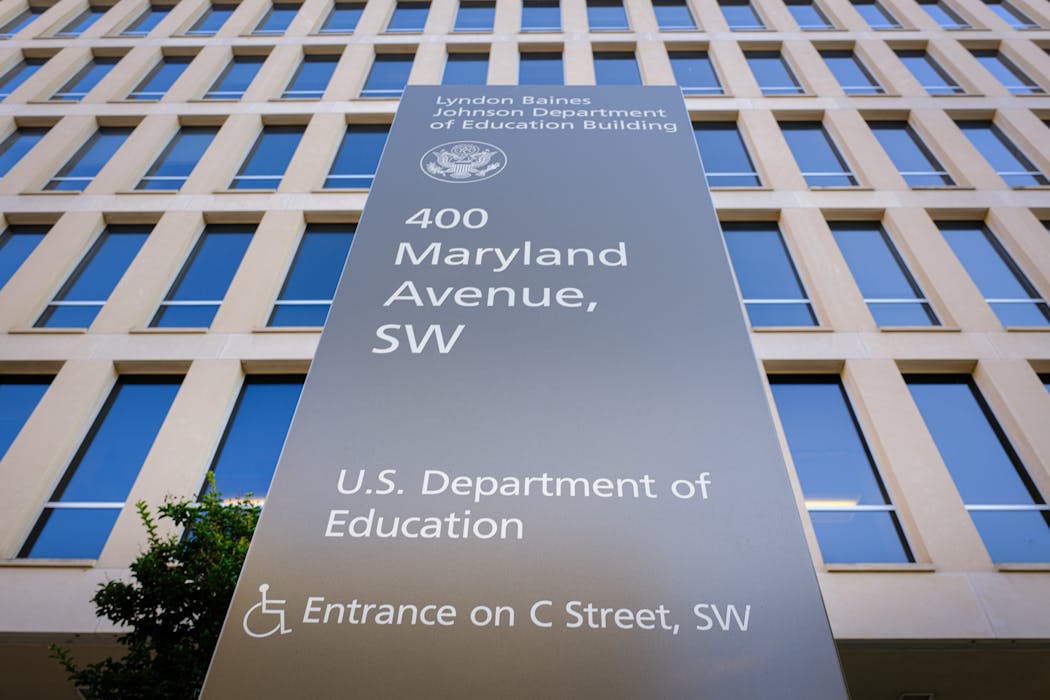
A sign marks the outside of the Department of Education headquarters in Washington, D.C. J. David Ake/Getty Images

A federal judge on Oct. 16, 2025, paused the Trump administration’s latest round of layoffs, which targeted more than 4,000 federal workers at a range of agencies, including 466 workers at the Department of Education.

U.S. District Judge Susan Illston said that the administration’s layoffs, which it has justified because of a lapse of funding during the government shutdown, are “both illegal and in excess of authority” and called them “arbitrary and capricious.” The Trump administration is expected to appeal the judge’s decision.

The Trump administration first eliminated about half of the Department of Education’s more than 4,200 positions in March 2025. This latest round of cuts would eliminate almost all of the work of the remaining Department of Education offices, including that of the Office of Special Education Programs. OSEP is responsible for ensuring children with disabilities across the U.S. receive a free, appropriate public education, as required by federal law.

Amy Lieberman, the education editor at The Conversation U.S., spoke with Josh Cowen, a scholar of education policy, to understand how these cuts would hinder the educational opportunities for children with special needs.

A large group of people hold yellow signs in front of a building. Some of the signs say
People rally in front of the Department of Education to protest budget cuts on March 13, 2025.
Kayla Bartkowski/Getty Images

What would these cuts mean for parents, children and schools?

With these cuts, we are talking about getting rid of some really important positions. People in these roles serve kids and families across the country. They help them answer questions about how school districts are providing for their children, in the way they are legally required to, if their child has special needs.

Special education is a very broad category. Under the Department of Education, it encompasses everything from dyslexia to a child who is blind. There is no educational need so severe that a child is not entitled to free and adequate education.

When navigating challenges related to your child’s special needs education, you really need an advocate – in the legal sense of the term rather than the political one. You need someone whose job it is to take your call and walk you through options, or just document your call and start an inquiry into your case.

What does the Office of Special Education Programs do?

The Office of Special Education Programs is part of the Department of Education’s Office of Special Education and Rehabilitative Services, which has about 179 employees. The government spent more than US$20 billion on its work from April 2024 through March 2025, making the broader Office of Special Education and Rehabilitation Services the third-largest branch of the Education Department, in terms of spending.

There are very strong federal legal obligations – and often state ones, too – for schools to serve kids with whatever need they have. This office’s main job is to be a resource to parents for their child’s education, particularly if parents feel they are not having these legal obligations met.

Let’s say a child with autism is in school. Their parent does not believe the school district is providing the accommodations that their child is legally entitled to. The school district disagrees and thinks the child is doing well in school. When things get fuzzy about what a child’s needs actually are, or parents feel they are being ignored, OSEP can help parents learn what their options are, and then can even become involved and serve as an arbitrator to figure out the best course of action.

Sometimes, public school districts and state departments of education have very clear, accessible ways for parents to receive information about their rights and obtain instructions for putting together an individualized education plan for their child. If those rights are not met, states may open an investigation into the matter to ensure compliance.

Throughout this process, parents may seek support and guidance from OSEP to make sure state investigations into special education cases are being done and being done well.

What could these investigations result in?

The Department of Education can help hold states and districts accountable and push districts and schools to be more responsive. In the best-case scenario, additional or tailored programming and support – whether it is a teacher’s aide or something else – can come from an OSEP investigation.

An older white woman wears a cream suit and sits at a table, with two men on either side of her.
U.S. Secretary of Education Linda McMahon, center, speaks during a cabinet meeting at the White House on Aug. 26, 2025.
Mandel Ngan/AFP via Getty Images

What does your research show about the impact of cutting services like these?

Well, we don’t really know what happens when you gut OSEP because no one has tried to gut OSEP before.

But it’s safe to say that parents will get really frustrated. I have been contacted by parents who have shared heartbreaking examples of the special education system not working over the past couple of years.

Feeling like the education system is really not serving you can push parents to leave the public school system and consider homeschooling or private options. In the long run, this may actually make parents even worse off because those sectors have have no obligation at all to serve students with special needs. So what’s happening at the U.S. Department of Education right now is not only creating more dissatisfaction and distrust in the system as it stands, but it’s also going to leave parents and kids with fewer options to get the support they need.

The Conversation

Josh Cowen ran for Congress as a Democrat prior to ending his campaign and returning to research and teaching during the fall of 2025.

ref. Trump administration’s layoffs would gut department overseeing special education, eliminating parents’ last resort – https://theconversation.com/trump-administrations-layoffs-would-gut-department-overseeing-special-education-eliminating-parents-last-resort-267684

Baseball returns to a Japanese American detention camp after a historic ball field was restored to honor the resilience of those incarcerated

Source: The Conversation – USA (2) – By Susan H. Kamei, Adjunct Professor of History and Affiliated Faculty, USC Shinso Ito Center for Japanese Religions and Cultures, USC Dornsife College of Letters, Arts and Sciences

In a 2024 exhibition game at Manzanar, players – many of them descendants of internment camp detainees – donned custom 1940s-style uniforms. Aaron Rapoport, CC BY-SA

In the spring of 1942, 15-year-old Momo Nagano needed a way to fill her time.

She was imprisoned at the Manzanar Relocation Center along with approximately 10,000 other people of Japanese ancestry. When she’d arrived with her mother and two brothers, she’d been horrified.

The detention facility was located in the middle of the desert, about 225 miles northeast of Los Angeles. As I describe in my book “When Can We Go Back to America? Voices of Japanese American Incarceration during World War II,” barbed wire surrounded the perimeter and armed soldiers peered down from guard towers. The toilets and showers lacked partitions, and Nagano was forced to stand in long lines for hours in mess halls that served canned food. Her bed was a metal cot. She was directed to stuff straw into a bag for a makeshift mattress. She didn’t know whether she and her family would ever be able to return to their Los Angeles home.

Black and white photo of Asian female teenager smiling and wearing a blouse.
Momo Nagano, in a photograph taken during her time spent at the Manzanar Relocation Center.
Courtesy of Dan Kwong, CC BY-SA

One day, the teenager decided to pick up a glove and play softball. Her son, Dan Kwong, told me in an interview that Nagano ended up playing catcher for The Gremlins, one of the camp’s many women’s softball teams.

“In one game, a batter connected with the ball and then threw the bat, clocking my mom in the nose, breaking it,” he said. “But despite her injury, she still enjoyed playing, even though she didn’t think her team was very good.”

Eighty years later, the descendants of prisoners – such as Nagano’s son, Kwong – are playing baseball again in Manzanar. Thanks to an effort spearheaded by Kwong, a baseball field on the site has been restored as a way to both celebrate the resiliency of so many prisoners and memorialize this dark period in U.S. history.

A massive removal effort

After Japan attacked Pearl Harbor in 1941, the U.S. government wrongly assumed that Japanese-descended West Coast residents would be more loyal to Japan and presented an espionage risk.

So on Feb. 19, 1942, President Franklin D. Roosevelt issued an executive order that gave the U.S. Army the authority to forcibly remove all first-generation immigrants from Japan and their American-born descendants from their West Coast homes.

In March 1942, U.S. soldiers began transporting the detainees to temporary detention sites under Army jurisdiction. The Manzanar site opened on March 21, 1942, and it eventually became one of 10 long-term detention centers, colloquially known as “the camps.”

According to Duncan Ryȗken Williams, the director of The Irei Project, which has compiled the most comprehensive list of those detained, nearly 127,000 people of Japanese ancestry were incarcerated between 1942 and 1947, when the last camp closed. Two-thirds of them were American citizens. Most were imprisoned for the duration of the war, and all were held without hearings or charges leveled against them.

An Asian American boy swings a baseball bat at an approach ball as other boys watch in the background.
Sixth-grade boys play softball during recess at the Manzanar Relocation Center on Feb. 10, 1943.
Francis Leroy Stewart, courtesy of California State University Dominguez Hills Gerth Archives & Special Collections

A love of the game

Adjusting to their new grim reality, the detainees embraced the Japanese spirit of “gaman,” which means to endure hardship with dignity and resilience. They set up an education system and coordinated an array of activities. And they immediately organized baseball and softball games.

Many Japanese American families had already developed a passion for the two sports.

Horace Wilson, an educator from Maine, is credited with introducing baseball to Japan in the early 1870s. In 1872 the Yeddo Royal Japanese Troupe became the first Japanese people to play baseball on U.S. soil. When young Japanese men started immigrating to the U.S. in the late 19th century, they brought with them a love of America’s pastime.

Kerry Yo Nakagawa, the director of the Nisei Baseball Research Project, has written about the vanguards of Japanese American baseball. At a time when players of color were excluded from Major League Baseball, talented Japanese American ballplayers such as Kenichi Zenimura formed teams that barnstormed the country. They even played alongside Babe Ruth and Lou Gehrig in an exhibition game in Fresno, Calif., on Oct. 29, 1927.

A black and white photograph of six baseball players – four Asian Americans and two white Americans – posing on a diamond while wearing baseball uniforms.
Lou Gehrig, second from left, and Babe Ruth, third from right, pose with Japanese American ballplayers at an exhibition game. Kenichi Zenimura is third from left.
Frank Kamiyama, courtesy of the family of Taizo Toshiyuki and the Nisei Baseball Research Project

“Every pre-war Japanese American community had a baseball team and they brought their love of baseball with them to the assembly centers and their camps,” Nakagawa explained to me. Though Zenimura was forced to leave his Fresno home and go to a camp in Gila River, Arizona, he soon had a baseball diamond and a 32-team league up and running.

Patriotism on the diamond

At Manzanar, baseball was easily the most popular sport. According to Dave Goto, the Manzanar National Historic Site arborist, the camp had 10 baseball and softball diamonds on the grounds and more than 120 teams divided into 12 leagues. The camp newspaper, the Manzanar Free Press, provided detailed game recaps, and thousands turned out to watch the games at Manzanar’s “A” Field.

“Watching baseball played at a semi-pro level was entertainment and also gave them a sense of normalcy and community,” Nakagawa said.

Sepia toned photograph of Japanese Americans wearing baseball uniforms and posing for a team picture.
The ManzaKnights were one of the 100-plus teams formed at the Manzanar camp.
Courtesy of the Maruki Family/Manzanar Historic Site

But for those who felt their loyalty to the U.S. was unfairly questioned, baseball was also a powerful way to express their identity as Americans, especially for the U.S.-born children of Japanese immigrants. Takeo Suo, who was incarcerated at Manazarer, recalled, “Putting on a baseball uniform was like wearing the American flag.” Or, as Nakagawa put it,
“What could be more American than playing the all-American pastime?”

After the war was over and the camps closed, those who’d been imprisoned had to focus on rebuilding their lives. Many were unable to return to their prewar hometowns. For those who ended up back on the West Coast, baseball continued to play an important role.

As Japanese American journalist and sports historian Chris Komai explained in a program at the Japanese American National Museum, “Baseball was a way for them to reestablish their communities while they dealt with antagonism and discrimination. Through the games they stayed connected with their friends and relatives who were now scattered.”

Postwar community baseball gave rise to the Southern California Nisei Athletic Union Baseball Leagues and other leagues that still operate. Kwong began playing for the Nisei Athletic Union in 1971 and does so to this day.

Rebuilding a dusty field of dreams

Nagano instilled in her son a commitment not only to baseball but also to social justice. A performance artist, Kwong stages a one-man play, “Return of the Samurai Centerfielder,” to shed light on this episode in history through the lens of playing baseball at Manzanar. Two years ago, he set out to restore the main Manzanar ball field and to bring baseball back to the site as a tribute to his late mother and other Manzanar detainees.

Working with Goto, the site arborist, volunteer construction supervisor Chris Siddons, Manzanar archaeologist Jeff Burton and other Manzanar site staff, Kwong and his team have restored the field almost exactly as it was. They carefully scrutinized archival photos, some taken by famed landscape photographer Ansel Adams and others snapped by studio photographer Toyo Miyatake, who’d been imprisoned at Manzanar. Miyatake’s photos were provided by his grandson, Alan Miyatake.

Crowds of onlookers watch a baseball game on a dusty field.
Organizers used archival materials – such as this 1943 Ansel Adams photograph of a baseball game at the Manzanar camp – to restore the field.
Ansel Adams/Library of Congress

From November 2023 to October 2024, volunteers cleared sagebrush, dug post holes and poured concrete, enduring intense heat, strong winds and relentless dust.

On Oct. 26, 2024, baseball returned to Manzanar after more than 80 years before an invitation-only audience. In the inaugural game, Kwong’s Li’l Tokio Giants beat the Lodi JACL Templars. In the game that followed, players donned custom 1940s-style uniforms and used vintage baseball equipment lent by History For Hire prop house. Many of the players were descendants of Japanese Americans who’d been incarcerated at Manzanar and other camps.

That day, Kwong was emotional as he said, “Mom would have gotten such a kick out of this.”

Kwong’s team has completed an announcer’s booth in time for this year’s grand opening, a doubleheader open to the public. The games were originally scheduled for Oct. 18, 2025, but have been postponed due to the U.S. government shutdown.

A wood-framed, enclosed booth on wooden legs behind a baseball field backstop.
The new announcer’s booth under construction at the restored Manzanar ball field.
Dan Kwong, CC BY-SA

For Kwong, staging a historical reenactment of how detainees played ball behind barbed wire pays tribute to their resilience, connects camp survivors and descendants with their past, and allows them to share their story with the American public. He hopes the games can become an annual event, a recurring celebration.

His motto: “In this place of sadness, injustice, and pain, we will do something joyous, righteous, and healing. We will play baseball.”

The Conversation

Susan H. Kamei is a researcher with The Irei Project and is a member of the Japanese American National Museum.

ref. Baseball returns to a Japanese American detention camp after a historic ball field was restored to honor the resilience of those incarcerated – https://theconversation.com/baseball-returns-to-a-japanese-american-detention-camp-after-a-historic-ball-field-was-restored-to-honor-the-resilience-of-those-incarcerated-265954

Protein powders and shakes contain high amounts of lead, new report says – a pharmacologist explains the data

Source: The Conversation – USA (3) – By C. Michael White, Distinguished Professor of Pharmacy Practice, University of Connecticut

If consumed in high doses, lead and other heavy metals have serious, well-documented health risks. whitebalance.space/E+ via Getty Images

Powder and ready-to-drink protein sales have exploded, reaching over US$32 billion globally from 2024 to 2025. Increasingly, consumers are using these protein sources daily.

A new study by Consumer Reports, published on Oct. 14, 2025, claims that some such protein products contain dangerously high levels of lead, as well as other heavy metals such as cadmium and arsenic. At high levels, these substances have serious, well-documented health risks.

I am a clinical pharmacologist who has evaluated the heavy metal content of baby food, calcium supplements and kratom products. Lead and other heavy metals occur naturally in soil and water, so achieving zero-level exposure would be impossible. Additionally, the level of lead exposure that Consumer Reports deems safe is significantly lower than those set by the Food and Drug Administration.

However, regardless of the safety cutoff, the study does show that a few products are delivering a concerningly high dose of heavy metals per serving.

How Consumer Reports did the study

The new study assessed 23 powder and ready-to-drink protein products from popular brands by sending three samples of each product to an independent commercial laboratory.

Consumer Reports considered anything over 0.5 micrograms per day from any single source to be above recommended maximum lead levels. That number comes from the California Office of Environmental Health Hazard Assessment, which established recommended maximum levels for a variety of substances that could cause cancer or fetal harm.

It is significantly more conservative than the safety standard for lead exposure used by the FDA for drugs and supplements. The discrepancy is driven by Consumer Reports’ aspirational goals of very low exposure versus the more realistic but actionable requirements from the FDA.

According to the FDA, the limit for the amount of lead that a person should consume from any single dietary supplement product is 5 micrograms per day. That number is 10 times higher than the Consumer Report limit.

The FDA has another standard for the total daily amount of lead a person can safely consume from food, drugs and supplements combined. This number, called the Interim Reference Level, or IRL, for lead is based on concentrations of lead in the blood that are associated with negative health effects in different populations.

For people who could become pregnant, that level is 8.8 micrograms per day, and for children it’s 2.2 micrograms per day. For everyone else, it’s 12.5 micrograms per day. Every food, drug and dietary supplement that contains lead contributes to the total daily exposure, which should be less than this amount.

Bodybuilder at the gym drinking a protein shake
In assessing lead levels, Consumer Reports used a more conservative safety standard than the one used by the FDA for drugs and supplements.
lakshmiprasad S/iStock via Getty Images Plus

What the report found

The nonprofit advocacy group found that 16 of the 23 products it tested exceeded 0.5 micrograms, the level of lead in a standard serving that the organization deems safe.

Four of the 23 products exceeded 2.2 micrograms, the FDA’s cutoff for the total daily amount of lead children should consume. Two products contained 72% and 88%, respectively, of the total daily amount of lead that the FDA deems safe for pregnant women.

In addition, Consumer Reports found that two of the 23 products delivered more than what it considers a safe amount of cadmium per serving, and one had more arsenic than was recommended.

The organization’s safety cutoff for cadmium is 4.1 micrograms per day, and for arsenic it is 7 micrograms per day. These numbers align fairly closely with the FDA’s recommended exposure limit for cadmium and arsenic from a single product. For cadmium, the FDA’s limit is set at 5 micrograms per day for a given dietary supplement product and 15 micrograms per day for arsenic.

The study found that the source of protein was key: Plant-derived protein products had nine times the lead found in dairy proteins like whey, and twice as much as beef-based protein.

Where are these heavy metals coming from?

Lead and other heavy metals are present in high amounts in volcanic rock, which comes from molten rock called magma beneath the Earth’s surface. When volcanic rock is eroded, the heavy metals contaminate the local soil and water supply. What’s more, some crop plants are especially efficient at extracting heavy metals from the soil and placing them in the parts of the plants that consumers ingest.

Fossil fuels, which come from deep within the Earth, also billow heavy metals into the air when they are burned. These substances then settle out into the soil and water. Finally, some fertilizers, herbicides and pesticides also contain heavy metals that can further contaminate soil and local water.

High levels of heavy metals have been found in plant-based protein powder, spices like cinnamon, dark chocolate, root vegetables like carrots and sweet potatoes, rice, legumes such as pea pods and many herbal supplements.

A cast iron pot of cubed sweet potatoes
Root vegetables such as sweet potatoes can absorb heavy metals from the soil.
Virginia State Parks, CC BY

Should consumers be concerned? And what can they do?

Occasionally exceeding the daily recommended heavy metal doses is unlikely to result in serious health issues.

Repeated, heavy exposure to heavy metals can cause harm, however. When they accumulate in the blood, these substances can delay or impair mental functioning, damage nerves, soften bones and raise blood pressure – which in turn increases the risk of strokes and heart attacks. Heavy metals can also increase the risk of developing cancer.

It’s important to note that all the products Consumer Reports flagged have lead levels significantly lower than the maximum daily exposure levels established by the FDA.

Consumers can limit exposure by choosing dairy- or animal-based sources of protein products, since they generally seemed to have less heavy metal contamination than plant-based ones. However, some plant-based protein products in the study did not have high levels of heavy metals. Heavy metal levels vary widely in the environment, so the results from the Consumer Reports study show a snapshot in time. They might not be consistently accurate across batches if, for example, a manufacturer changes the source of its raw ingredients.

For protein products that do show an especially high heavy metal content, using them more sporadically, rather than daily, can reduce exposure. Studies suggest that organic plant-based products generally yield less heavy metal content than traditionally farmed ones.

Finally, the Consumer Reports study measured heavy metals in a single serving of protein products, so it’s helpful to understand what constitutes a serving for specific products and to avoid sharply increasing daily consumption.

Overall, the wide variation in lead levels across different protein powders and ready-made protein products highlights the need for manufacturers to tighten product testing and good manufacturing practices.

The Conversation

C. Michael White does not work for, consult, own shares in or receive funding from any company or organization that would benefit from this article, and has disclosed no relevant affiliations beyond their academic appointment.

ref. Protein powders and shakes contain high amounts of lead, new report says – a pharmacologist explains the data – https://theconversation.com/protein-powders-and-shakes-contain-high-amounts-of-lead-new-report-says-a-pharmacologist-explains-the-data-267591

Antioxidants help stave off a host of health problems – but figuring out how much you’re getting can be tricky

Source: The Conversation – USA (3) – By Nathaniel Johnson, Assistant Professor of Nutrition and Dietetics, University of North Dakota

Many fruits and vegetables are high in antioxidants. istetiana/Moment via Getty Images

When it comes to describing what an antioxidant is, it’s all in the name: Antioxidants counter oxidants.

And that’s a good thing. Oxidants can damage the structure and function of the chemicals in your body critical to life – like the proteins and lipids within your cells, and your DNA, which stores genetic information. A special class of oxidants, free radicals, are even more reactive and dangerous.

As an assistant professor of nutrition, I’ve studied the long-standing research showing how the imbalances in antioxidants and oxidants lead to oxidative stress, which is linked to cancer, diabetes, cardiovascular disease and dementia and Alzheimer’s disease. In fact, a primary cause of aging is the damage accumulated across of a lifetime of oxidative stress.

Simply put: To help prevent oxidative stress, people need to eat foods with antioxidants and limit their exposure to oxidants, particularly free radicals.

The research: Food, not supplements

There’s no way for any of us to avoid some oxidative stress. Just metabolism – the processes in your body that keep you alive, such as breathing, digestion and maintaining body temperature – are a source of oxidants and free radicals.
Inflammation, pollution and radiation are other sources.

As a result, everyone needs antioxidants. There are many different types: enzymes, minerals, vitamins and phytochemicals.

Two types of phytochemicals deserve special mention: carotenoids and flavonoids. Carotenoids are pigments, with the colors yellow, orange and red; they contain the antioxidants beta-carotene, lycopene and lutein. Some flavonoids, called anthocyanins, are pigments that give foods a blue, red or purple color.

Although your body produces some of these antioxidants, you can get them from the foods you eat, and they’re better for you than supplements.

In fact, researchers found that antioxidant supplements did not reduce deaths, and some supplements in excessive amounts contribute to oxidative stress, and may even increase the risk of dying.

It should be pointed out that in most of these studies, only one or two antioxidants were given, and often in amounts far greater than the recommended daily value. One study, for example, gave participants only vitamin A, and at an amount more than 60 times an adult’s recommended intake.

A synopsis of the study that measured the antioxidant content of more than 3,000 foods.

Foods rich in antioxidants

In contrast, increased antioxidant intake from whole foods is related to decreased risk of death. And although antioxidant supplementation didn’t reduce cancer rates in smokers, the antioxidants in whole foods did.

But measuring antioxidants in foods is complicated. Extensive laboratory testing is required, and too many foods exist to test them all anyway. Even individual food items that are the same exact variety of food – such as two Gala apples – can have different amounts of antioxidants. Where the food was grown and harvested, how it was processed and how it was stored during transportation and while in the supermarket are factors. The variety of the food also matters – the many different types of apples, for instance, can have different amounts of antioxidants.

Nonetheless, in 2018, researchers quantified the antioxidant content of more than 3,100 foods – the first antioxidant database. Each food’s antioxidant capacity was determined by the amount of oxidants neutralized by a given amount of food. The researchers measured this capacity in millimoles per 100 grams, or about 4 ounces.

For fruits easily found in the grocery store, the database shows blueberries have the most antioxidants – just over 9 millimoles per 4 ounces. The same serving of pomegranates and blackberries each have about 6.5 millimoles.

For common vegetables, cooked artichoke has 4.54 millimoles per 4 ounces; red kale, 4.09 millimoles; cooked red cabbage, 2.15; and orange bell pepper, 1.94.

Coffee has 2.5 millimoles per 4 ounces; green tea has 1.5; whole walnuts, just over 13; whole pecans, about 9.7; and sunflower seeds, just over 5. Herbs and spices have a lot: clove has 465 millimoles per 4 ounces; rosemary has 67; and thyme, about 64. But keep in mind that those enormous numbers are based on a quarter-pound. Still, just a normal sprinkle packs a powerful nutritional punch.

A young woman picks up a package of fresh produce at the supermarket.
The antioxidant levels of a food can be affected by its storage time in the supermarket.
d3sign/Moment via Getty Images

Other tips

Other ways to choose antioxidant-rich foods: Read the nutrition facts label and look for antioxidant vitamins and minerals – vitamins A, C, E, D, B2, B3 and B9, and the minerals selenium, zinc and manganese.

Just know the label has a drawback. Food producers and manufacturers are not required to list every nutrient of the food on the label. In fact, the only vitamins and minerals required by law are sodium, potassium, calcium, iron and vitamin D.

Also, focus on eating the rainbow. Colorful foods are often higher in antioxidants, like blue corn. Many darker foods are rich in antioxidants, too, like dark chocolate, black barley and dark leafy vegetables, such as kale and Swiss chard.

Although heat can degrade oxidants, that mostly occurs during the storage and transportation of the food. In some cases, cooking may increase the food’s antioxidant capacity, as with leafy green vegetables.

Keep in mind that while blueberries, red kale and pecans are great, their antioxidant profile will be different than that of other fruits, vegetables and nuts. That’s why diversity is the key: To increase the power of antioxidants, choose a variety of fresh, flavorful, colorful and, ideally, local foods.

The Conversation

Nathaniel Johnson does not work for, consult, own shares in or receive funding from any company or organization that would benefit from this article, and has disclosed no relevant affiliations beyond their academic appointment.

ref. Antioxidants help stave off a host of health problems – but figuring out how much you’re getting can be tricky – https://theconversation.com/antioxidants-help-stave-off-a-host-of-health-problems-but-figuring-out-how-much-youre-getting-can-be-tricky-256974

How new foreign worker visa fees might worsen doctor shortages in rural America

Source: The Conversation – USA (3) – By Patrick Aguilar, Managing Director of Health, Washington University in St. Louis

Many physicians who aren’t U.S. citizens come to the U.S. to do medical residency programs. SDI Productions/E+ via Getty Images

There are almost 1.1 million licensed physicians in the United States. That may sound like a lot, but the country has struggled for decades to train enough physicians to meet its needs – and, in particular, to provide care in rural and underserved communities.

Foreign-born physicians have long filled that gap, reducing the overall national shortage and signing up to practice in often overlooked regions and specialties. Today, 1 in 5 doctors licensed to practice in the U.S. were born and trained in another country.

But the ability of physicians from other countries to obtain work in the U.S. may be threatened by the Trump administration’s aims of limiting foreign workers. In September, Trump issued a proclamation requiring employers sponsoring foreign-born workers through a type of work visa called an H-1B to pay a fee of US$100,000 to the government. The White House has signaled doctors may be exempt but has not clarified its position.

As a physician and professor who studies the intersection of business and medicine, I believe increasing restrictions on H-1B visas for physicians may exacerbate the physician shortage. To grasp why that is, it’s important to understand how foreign-trained doctors became such an integral part of U.S. health care – and the role they play today.

The roots of today’s physician shortage

The Association of American Medical Colleges, a trade association representing U.S. medical schools, estimates there will be a deficit of about 86,000 physicians in the country by 2036.

The roots of this shortage stretch back more than a century. In 1910, a landmark study called the Flexner Report detailed significant inconsistencies in the quality of education at American medical schools. The report resulted in the closure of over half the country’s medical schools, winnowing their numbers down from 148 to 66 over two decades.

As a result, the number of doctors in the U.S. declined until new training programs emerged. Between 1960 and 1980, 40 new medical schools launched with the help of federal funding. In 1980, a congressionally mandated assessment deemed the problem solved, but by the early 2000s, a physician shortage emerged once more. In 2006, the American Association of Medical Colleges called for raising medical school enrollment by 30%.

Doctor looking at x-rays
Foreign-born doctors have helped the U.S. bridge a physician shortage for decades.
stevecoleimages/E+ via Getty Images

Growth in medical school enrollment hit that target in the late 2010s, but even so, the U.S. still lacks enough medical graduates to fill yearslong training programs, called residencies, that early-career physicians must complete to become fully qualified to practice.

Especially lacking are primary care physicians – particularly in rural areas, where there are one-third as many physicians per capita as in urban areas.

Opportunities for foreign-born doctors

Even as the U.S. built up medical school enrollment in the 1960s and 1970s, the government joined other countries such as the U.K. and Canada in creating immigration policies that drew physicians from developing countries to practice in underserved areas. Between 1970 and 1980, their numbers grew sharply, from 57,000 to 97,000.

Foreign-born and -trained physicians have remained a key pillar of the U.S. medical system. In recent years, the majority of those physicians have come from India and Pakistan. Citizens of Canada and Middle Eastern countries have added significantly to that count, as well. Most arrive in the U.S. as trainees in residency programs through one of two main visa programs.

The majority come on J-1 visas, which allow physicians to enter the U.S. for training but require them to return to their home country for at least two years when their training is complete. Those who wish to remain in the U.S. to practice must transition to an H-1B visa.

A small percentage of physicians come to the U.S. on H-1Bs from the start.

H-1B visas are employer-sponsored temporary work permits that allow foreign-born, highly skilled workers to obtain U.S. employment. Employers directly petition the government on behalf of visa applicants, certifying that a foreign worker will be paid a similar wage to U.S. workers and will not adversely affect the working conditions of Americans.

Several programs sponsor H-1B visas for physicians, though the most common requires a three-year commitment to work in an underserved area after completing their training.

Foreign physicians fill a crucial need

In 2025, foreign-trained medical graduates filled 9,700 of the nearly 40,000 training positions. Of those, roughly one-third were actually U.S. citizens who attended medical schools in other countries, with the remainder being foreign citizens seeking more training in the U.S.

After residency, these doctors frequently practice in precisely the geographic areas where the physician shortage is most severe. A nationwide survey of international medical graduates found that two-thirds practice in regions that the federal government has designated as lacking sufficient access to health care.

These doctors also occupy a disproportionate number of primary care positions. In a sample of 15,000 physicians who accepted new jobs in one year, foreign-born doctors were nine times more likely to enter primary care specialties. In 2025, 33.3% of internal medicine, 20.4% of pediatric and 17.6% of family medicine training positions were filled by physicians trained in other countries.

Who will pay?

Approximately 8,000 foreign-born physicians received H-1B visas in 2024. The new requirement of a $100,000 sponsorship fee would hit hardest for hospitals, health systems and clinics in areas of the country most significantly affected by the physician shortage.

These organizations are already under economic strain due to increasing labor costs and Medicare payments that have not kept pace with inflation. Dozens of these hospitals have closed in recent years, and many currently do not make enough money to support their operations.

On Sept. 25, 2025, 57 physician organizations cosigned a letter petitioning Homeland Security Secretary Kristi Noem to waive the new application fee for physicians.

Already, however, the new rule may be having a chilling effect. Despite years of annual growth in the number of foreign-born applicants to U.S. physician training programs, 2025 has seen a nearly 10% drop. If the new H-1B fee is applied to physicians, the number is likely to keep falling.

The Conversation

Patrick Aguilar Washington University, an employer of physicians.

ref. How new foreign worker visa fees might worsen doctor shortages in rural America – https://theconversation.com/how-new-foreign-worker-visa-fees-might-worsen-doctor-shortages-in-rural-america-266544

Qu’est-ce que la Françafrique ? Une relation ambiguë entre héritage colonial et influence contemporaine

Source: The Conversation – in French – By Christophe Premat, Professor, Canadian and Cultural Studies, Stockholm University

L’expression « Françafrique » évoque à la fois une époque révolue et un système qui, selon beaucoup, continue de hanter les relations entre la France et ses anciennes colonies africaines. Elle désigne un ensemble de réseaux politiques, économiques et militaires visant à maintenir l’influence française sur le continent. Le mot-valise a été repris par François-Xavier Verschave, dans son livre La Françafrique, le plus long scandale de la République (1998) pour caractériser le modèle néocolonial d’ingérence et de dépendance des anciennes colonies vis-à-vis de la France. Cette expression détourne le sens initial de France-Afrique, qui désignait à l’origine une coopération jugée privilégiée entre la France et ses anciennes colonies.

En tant que chercheur en études mémorielles, discours politiques et relations francoafricaines, j’analyse dans cet article comment le concept de Françafrique a façonné et structuré les perceptions actuelles entre la France et ses anciennes colonies.

Les origines du terme

Le mot « Françafrique » apparaît pour la première fois sous la plume de Jean Piot, rédacteur en chef de L’Aurore, qui voit dans la fusion entre la France et l’Afrique un des éléments de renouveau de l’Empire français. Par la suite, Félix Houphouët-Boigny, premier président de la Côte d’Ivoire indépendante, l’utilise positivement dès 1955 à l’aube des indépendances des États africains francophones, pour célébrer la continuité entre la France et l’Afrique : un partenariat fondé sur la langue, la culture et les intérêts économiques communs.


Read more:
François Mitterrand, à l’origine du déclin de l’influence postcoloniale de la France en Afrique ?


Le journaliste et militant François-Xavier Verschave, dans son livre La Françafrique, le plus long scandale de la République (1998), renverse complètement le sens du terme : la Françafrique devient alors le symbole d’un système opaque de corruption, de clientélisme et d’interventions politiques. L’un des artisans de cette relation est sans aucun doute Jacques Foccart qui fut le conseiller des affaires africaines de plusieurs présidents de la République et secrétaire général pour la Communauté et les affaires africaines et malgaches, une structure imaginée par le général Charles de Gaulle pour organiser les relations de la France à ses anciennes colonies.

Un système d’alliances et de dépendances

La Françafrique repose sur trois piliers principaux :

Le soutien politique et militaire : depuis les indépendances des années 60, la France a entretenu des liens étroits avec des dirigeants africains considérés comme « amis de la France ». Des accords de défense permettaient à Paris d’intervenir militairement pour stabiliser ou sauver des régimes alliés — de l’opération Manta au Tchad (1983) à Serval au Mali (2013). Ce réseau s’appuyait sur des conseillers officieux, des services de renseignement et des relations personnelles entre dirigeants, symbolisées par la «cellule africaine» de l’Élysée, longtemps dirigée par le même Jacques Foccart.

Les liens économiques : le franc CFA (créé en 1945, devenu franc de la « Communauté financière africaine ») illustre la dépendance monétaire héritée de la période coloniale. De grandes entreprises françaises comme Elf, Bolloré, Bouygues ou Total ont bénéficié de positions privilégiées dans les secteurs stratégiques (pétrole, infrastructures, télécommunications). En échange, ces firmes ont souvent alimenté un système de financements occultes de partis politiques ou de régimes africains. Dans les années 1990, une vaste enquête judiciaire révèle que le groupe pétrolier public français Elf-Aquitaine entretenait un système de corruption à grande échelle, mêlant responsables politiques français et dirigeants africains.

Les réseaux personnels et informels : au-delà des institutions officielles, la Françafrique fonctionnait par l’entremise d’intermédiaires — hommes d’affaires, diplomates, militaires — qui formaient un véritable « État parallèle ». Ces réseaux, où se mêlaient affaires, services secrets et amitiés, permettaient de contourner les voies diplomatiques classiques. Dans ses mémoires publiés en septembre 2024, Robert Bourgi, disciple de Jacques Foccart, rappelle l’ensemble de ses relations personnelles avec un certain nombre de dirigeants politiques africains.


Read more:
Ce que la France perd en fermant ses bases militaires en Afrique


La fin annoncée de la Françafrique ?

L’effondrement du bloc soviétique, la montée des revendications démocratiques en Afrique et les scandales politico-financiers en France ont mis à mal ce système. Sous François Mitterrand, le discours de La Baule (1990) conditionne désormais l’aide française à des avancées démocratiques, marquant un tournant. Pourtant, la logique d’influence perdure sous d’autres formes : privatisations, nouveaux partenariats militaires, diplomatie économique.

Les années 2000 voient la France tenter de redéfinir sa présence en Afrique. Jacques Chirac, puis Nicolas Sarkozy et François Hollande, promettent tour à tour d’en finir avec la Françafrique. Mais les opérations militaires (Côte d’Ivoire en 2002, Mali en 2013, Sahel jusqu’en 2023) rappellent la permanence d’un rôle sécuritaire français. Pour beaucoup d’Africains, la Françafrique n’a pas disparu : elle s’est simplement adaptée aux mutations du continent.


Read more:
Franc CFA : les conditions sont réunies pour remplacer la monnaie héritée du colonialisme


Un concept en crise

Sous Emmanuel Macron, le mot « Françafrique » est devenu un repoussoir officiel. Le président français affirme depuis son discours de Ouagadougou de 2017 vouloir rompre avec les logiques de paternalisme et de domination, prônant un « partenariat d’égal à égal ». Des initiatives symboliques — comme le retour d’œuvres d’art spoliées au Bénin, la reconnaissance du rôle de la France dans le génocide des Tutsi au Rwanda ou la création du « Sommet Afrique-France » de Montpellier sans chefs d’État — visent à moderniser la relation.

Mais sur le terrain, les perceptions restent contrastées. Les interventions militaires françaises au Sahel, la persistance du franc CFA (malgré sa future transformation en « éco » et la présence de grandes entreprises hexagonales nourrissent le sentiment d’une influence persistante. Dans plusieurs pays (Mali, Burkina Faso, Niger), le rejet de la France s’exprime aujourd’hui à travers des discours panafricanistes et souverainistes qui ont conduit à des changements de régime.


Read more:
Le recul de la France en Afrique : une perte de crédibilité mondiale


La concurrence des nouvelles influences

L’un des traits marquants de la période actuelle est la diversification des partenaires africains. La Chine, la Turquie, la Russie ou encore les pays du Golfe occupent désormais une place croissante dans les secteurs économique et sécuritaire. Le « pré carré » français n’existe plus : les États africains ont désormais une marge de manœuvre géopolitique beaucoup plus grande.

Dans ce contexte, la France tente de redéfinir sa politique africaine en privilégiant des relations bilatérales ciblées, le soutien à la société civile et la coopération universitaire ou culturelle. Mais cette réorientation peine à effacer des décennies de méfiance. L’imaginaire de la Françafrique continue de structurer les représentations, notamment chez les jeunes générations africaines.

Penser le passé… et questionner le présent

Parler de Françafrique aujourd’hui, c’est donc évoquer à la fois un système historique et un imaginaire politique. Si les réseaux opaques des années 1970 ont en grande partie disparu, les structures d’influence et de dépendance économiques persistent, tout comme les affects postcoloniaux qui traversent la relation franco-africaine.

Le défi pour la France, comme pour ses partenaires africains, consiste désormais à inventer un autre vocabulaire : celui d’une relation fondée sur la confiance, la transparence et la réciprocité. La Françafrique n’est peut-être plus une réalité institutionnelle, mais elle demeure un prisme puissant pour comprendre comment les héritages coloniaux continuent de peser sur le présent.

The Conversation

Christophe Premat est professeur en études culturelles francophones et directeur du Centre d’études canadiennes à l’Université de Stockholm. Il est également co-directeur en chef de la Revue Nordique des Études Francophones.

ref. Qu’est-ce que la Françafrique ? Une relation ambiguë entre héritage colonial et influence contemporaine – https://theconversation.com/quest-ce-que-la-francafrique-une-relation-ambigue-entre-heritage-colonial-et-influence-contemporaine-267065