Source: The Conversation – in French – By Josep M. Trigo Rodríguez, Investigador Principal del Grupo de Meteoritos, Cuerpos Menores y Ciencias Planetarias, Instituto de Ciencias del Espacio (ICE – CSIC)
La comète Lemmon (C/2025 A6), découverte en janvier 2025, traverse en ce moment notre ciel et s’offre déjà à l’œil nu. Un spectacle rare à saisir avant son départ vers l’espace profond.
Dans les prochains jours, nous aurons l’occasion d’admirer, et de photographier, une comète brillante visible au crépuscule. Il s’agit de la comète C/2025 A6, surnommée Lemmon, découverte le 3 janvier 2025 par l’astronome Carson Fuls dans le cadre du programme de suivi du Mount Lemmon Observatory (Arizona).
La comète parcourt une orbite très excentrique qui peut l’éloigner jusqu’à 36 milliards de kilomètres du Soleil. Il lui faut environ 1 350 ans pour en faire le tour. Autant dire qu’il faut en profiter ce mois-ci, avant qu’elle ne rapetisse à nos yeux et ne reparte vers les confins du système solaire.
Comment repérer la comète Lemmon dans le ciel
Si vous n’avez jamais eu la chance d’observer une comète et que vous voulez tenter l’expérience, pas de panique : avec quelques repères simples, l’aventure est à la portée de tous.
Première règle : trouver un ciel noir, loin des grandes villes et de toute pollution lumineuse. Choisissez de préférence une nuit claire avec l’horizon ouest dégagé, sans lampadaires ni obstacles.
Le meilleur moment pour commencer l’observation est le début de la nuit. Dès l’apparition des premières étoiles, cherchez la silhouette de la Grande Ourse à l’horizon nord-ouest. Cette constellation, formée de sept étoiles, est aussi connue sous le nom de « Grand Chariot » (ou « Grande Casserole »). Les deux étoiles les plus brillantes, situées vers le nord, permettent de tracer une ligne vers l’étoile polaire.
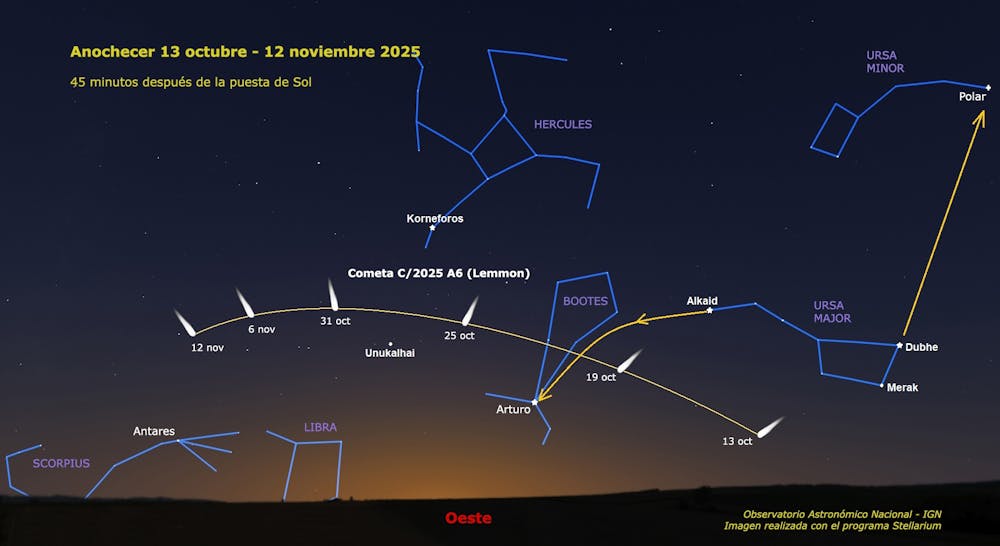
Trajet de la comète parmi les constellations visibles au crépuscule entre la mi-octobre et novembre 2025. La position de la comète doit être interpolée en fonction des repères indiqués pour chaque date. Image adaptée par l’auteur à partir d’une carte réalisée avec le logiciel Stellarium. Observatorio Astronómico Nacional-IGN
Une fois la Grande Ourse repérée, prolongez en courbe sa « queue », dont la dernière étoile se nomme Alkaïd, jusqu’à atteindre l’étoile la plus brillante de la région : Arcturus. Cette dernière sera précieuse car le mardi 21 octobre, au moment où la comète sera la plus proche de la Terre (101 millions de kilomètres), Lemmon se trouvera dans la constellation du Bouvier, non loin d’Arcturus.
À l’œil nu ou aux jumelles
En ciel sombre, Lemmon est visible à l’œil nu, surtout depuis l’Espagne, le Mexique et l’Amérique centrale (ainsi que la France, NLDT), puisqu’elle se déplace dans l’hémisphère céleste Nord. Sa luminosité devrait se situer entre celle d’Alkaïd (queue de la Grande Ourse) et celle, plus faible, de Kornephoros (Beta Herculis), voire davantage.
En cas de pollution lumineuse, une paire de jumelles astronomiques avec un grossissement de 7 à 12 suffira. Orientez-les vers Arcturus, puis glissez doucement vers Alkaïd jusqu’à distinguer une petite tache nébuleuse prolongée d’une queue tournée à l’opposé du Soleil. N’hésitez pas à répéter le mouvement plusieurs fois.
La comète et sa queue colorée
Ces dernières semaines, les images spectaculaires de Lemmon se multiplient sur les réseaux sociaux. Les astrophotographes raffolent de ces astres changeants. À mesure qu’elle s’approche du Soleil, la surface glacée de Lemmon se réchauffe et commence à se sublimer. Les photos révèlent alors une queue bleutée, dite « ionique », ondulante et sensible au vent solaire.
La comète Lemmon (C/2025 A6) depuis l’ermitage de Santa Bàrbara, à Sant Feliu de Buixalleu (Catalogne, Espagne). Télescope Askar FRA400 à 280 mm avec une caméra Player One Ares-C PRO. Image reproduite avec l’autorisation de l’auteur. Pau Montplet i Sanz (ACDAM/AstroMontseny)
Sa chevelure diffuse, appelée « coma », s’étend déjà sur plusieurs degrés. On s’attend aussi à l’apparition d’une seconde queue, cette fois poussiéreuse, produite par les particules libérées par les glaces sublimées. Ces minuscules grains réfléchissent la lumière solaire et donnent une queue plus diffuse, jaunâtre, souvent très lumineuse.
Les cartes de l’Observatoire astronomique national espagnol montrent le déplacement progressif de la comète vers l’ouest, nuit après nuit. Fin octobre, elle passera entre Kornephoros (dans la constellation d’Hercule) et Unukalhaï (dans la constellation du Serpent). Mi-novembre, Lemmon se rapprochera d’Antarès, l’étoile la plus brillante du Scorpion.
En ville, les comètes perdent de leur éclat. Voilà donc une belle occasion de fuir l’éclairage urbain, de lever les yeux vers le ciel et de s’offrir quelques minutes de contemplation d’un astre unique.
Josep M. Trigo Rodríguez reçoit des financements du projet du Plan national d’astronomie et d’astrophysique PID2021-128062NB-I00, soutenu par le MICINN et l’Agence nationale espagnole de la recherche.
Si les filles sont beaucoup moins enclines que les garçons à se diriger vers des filières scientifiques, c’est bien entendu lié pour une part à la persistance des stéréotypes de genre. Mais d’autres facteurs entrent en compte lors des processus d’orientation scolaire. Explications à partir d’une enquête de la Chaire pour l’emploi et l’entrepreneuriat des femmes (Sciences Po).
Comment attirer plus de femmes vers des études supérieures en sciences et technologies ? Depuis plusieurs années, les pouvoirs publics soutiennent des initiatives visant à favoriser la mixité de ces filières d’études, la plus récente étant le plan d’action « Filles et maths », lancé par le ministère de l’éducation nationale, de l’enseignement supérieur et de la recherche, en mai 2025.
Deux raisons principales motivent ces initiatives. D’une part, il s’agit de réduire les inégalités femmes-hommes sur le marché du travail, en particulier les écarts de rémunération. D’autre part, l’objectif est de soutenir la croissance économique dans des domaines porteurs, en formant davantage de personnes pouvant contribuer à l’innovation dans des secteurs d’activité stratégiques.
Des différences de choix marquées sur Parcoursup
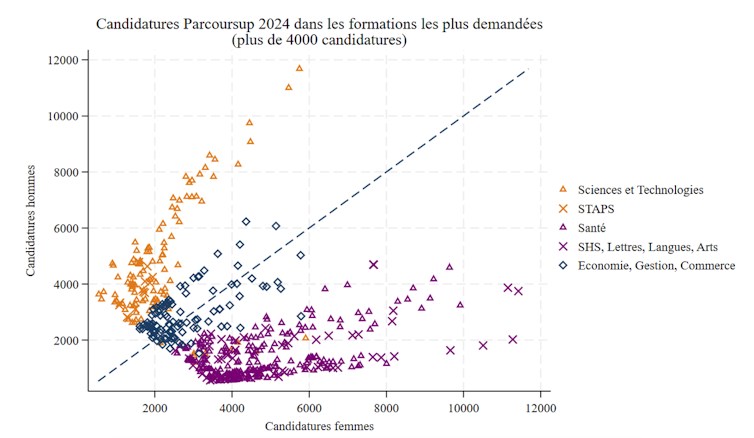
Les différences d’orientation entre les femmes et les hommes restent très marquées à l’entrée de l’enseignement supérieur. C’est ce qui ressort des choix formulés par les élèves de terminale sur Parcoursup, la plateforme d’accès aux filières postbac, comme on peut le voir dans le graphique ci-dessous, obtenu grâce aux données mises à disposition sur Datagouv. Il représente le nombre de candidatures pour les formations les plus demandées (plus de 4 000 candidatures).
Source : Parcoursup 2024 – vœux de poursuite d’études et de réorientation dans l’enseignement supérieur et réponses des établissements. Fourni par l’auteur
Les points au-dessus de la diagonale représentent les formations avec une prédominance de candidatures hommes, alors que ceux en dessous représentent les formations avec une prédominance de candidatures de femmes. Les hommes représentent environ 70 % des candidatures aux formations en sciences et technologies, y compris en sciences et technologies des activités physiques et sportives, ou Staps (en orange).
Les principales exceptions concernent des formations en sciences de la vie et de la Terre, pour lesquelles les candidatures par des femmes sont plus nombreuses. Les formations en sciences économiques, en gestion et en commerce (en bleu) sont plutôt mixtes. Enfin, les formations en santé, en sciences humaines et sociales, en lettres, en langues et en arts (en violet) sont majoritairement privilégiées par les femmes, qui constituent autour de 75 % des candidatures.
La passion pour un domaine d’études, un facteur déterminant
Afin de mieux comprendre les raisons actuelles des différences entre femmes et hommes dans les choix d’études supérieures, la Chaire pour l’emploi et l’entrepreneuriat des femmes de Sciences Po a mené, en février 2025, une enquête en partenariat avec Ipsos auprès d’un échantillon représentatif de la population étudiante en France, comprenant au total 1 500 réponses. Les résultats de cette enquête ont été publiés par l’Observatoire du bien-être du Centre pour la recherche économique et ses applications (Cepremap).
L’un des résultats marquants de l’enquête concerne les différences femmes-hommes dans l’importance accordée à la passion comme facteur déterminant des choix d’études supérieures.
Les étudiantes sont significativement plus nombreuses à choisir des filières en lien avec leurs passions, et elles semblent faire ce choix en ayant pleinement conscience qu’il risque de les pénaliser plus tard sur le marché du travail. En effet, 67 % des femmes (contre 58 % des hommes) disent « préférer étudier un sujet qui les passionne, même si cela ne garantit pas un emploi bien rémunéré », alors que 33 % des femmes (contre 42 % des hommes) disent « préférer obtenir un emploi bien rémunéré, même si cela ne garantit pas d’étudier un sujet qui les passionne ».
Les femmes qui privilégient la passion ont une probabilité plus élevée de s’inscrire en lettres, arts et humanités, alors que celles qui préfèrent un emploi bien rémunéré ont une probabilité plus élevée de s’inscrire en sciences économiques, gestion et commerce ou en sciences et technologies.
Des parents plus ou moins prescripteurs
Par ailleurs, les résultats de l’enquête mettent en évidence le fait que les parents sont plus prescripteurs pour les garçons que pour les filles, concernant les choix d’études de leurs enfants. En effet, les étudiantes ont davantage le soutien de leurs parents, quel que soit le domaine d’études de leur choix, alors que les étudiants reçoivent moins souvent l’approbation de leurs parents, en particulier pour les domaines d’études qui mènent vers des carrières moins rémunératrices sur le marché du travail (par exemple, en sciences humaines et sociales ou en lettres et arts) ou qui se sont féminisés (par exemple, le droit ou la santé).
Paradoxalement, le manque de prescriptions parentales sur les choix des filles peut expliquer qu’elles suivent plus souvent leur passion, se retrouvant plus contraintes par la suite sur le marché du travail.
Les résultats montrent aussi que les goûts développés pour les différentes matières dans le secondaire permettent d’expliquer plus de la moitié des différences femmes-hommes dans les choix d’études supérieures.
« Les filles et les mathématiques » (France Info, 2013).
Les filles auraient des goûts plus diversifiés, le seul goût pour les maths n’explique qu’une petite partie (environ 10 %) de l’écart dans les choix d’études. Cela permet d’expliquer en partie pourquoi les filles se détournent des formations en sciences et technologies, qui peuvent être perçues comme impliquant un renoncement à d’autres matières appréciées. Les hommes sont quant à eux plus nombreux à n’avoir aimé que des matières scientifiques dans le secondaire (29 % des étudiants contre 14 % des étudiantes).
Filières pluridisciplinaires et « roles models »
Si l’économie française a besoin de davantage de femmes diplômées en sciences et technologies, comment faire alors pour les attirer vers ces domaines d’études ? Le défi principal réside dans le fait de transmettre la passion des sciences et technologies aux femmes.
Cela peut passer par les « role models », avec des personnalités qui viennent communiquer leur enthousiasme pour leur discipline avant que les élèves ne fassent des choix cruciaux, notamment en termes d’options choisies au lycée. Cela peut aussi passer par le développement de filières pluridisciplinaires qui associent sciences, sciences sociales et humanités, de manière à offrir aux jeunes femmes (et aux jeunes hommes) aux intérêts variés la possibilité de poursuivre des études scientifiques sans renoncer à d’autres domaines.
Enfin, les formations scientifiques peuvent adapter leur offre pédagogique afin de rendre les enseignements plus attractifs auprès des étudiantes. En mettant en avant comment les sciences et technologies peuvent contribuer au bien commun et aux défis de nos sociétés contemporaines, une reformulation des intitulés de cours peut par exemple faire ressortir des enjeux leur tiennent à cœur.
Créé en 2007 pour aider à accélérer et partager les connaissances scientifiques sur des questions sociétales clés, le Fonds Axa pour la recherche – qui fait désormais partie de la Fondation Axa pour le progrès humain – a soutenu plus de 750 projets à travers le monde sur des risques environnementaux, sanitaires et socio-économiques majeurs. Pour en savoir plus, rendez-vous sur le site web du Fonds Axa pour la recherche ou suivez @AXAResearchFund sur LinkedIn.
La collecte de données a été financée par la Chaire pour l’emploi et l’entrepreneuriat des femmes (Sciences Po, Paris).
Source: The Conversation – in French – By Kevan Gafaïti, Enseignant à Sciences Po Paris en Middle East Studies, Président-fondateur de l’Institut des Relations Internationales et de Géopolitique, doctorant en science politique – relations internationales au Centre Thucydide, Sciences Po
Dans un contexte où la protection militaire fournie par les États-Unis peut paraître douteuse, l’Arabie saoudite s’est rapprochée du Pakistan, en signant avec ce grand pays d’Asie doté de l’arme nucléaire un accord de défense aux multiples implications.
Du fait de ses possibles implications nucléaires, l’accord semble porteur de conséquences régionales et internationales majeures. En réalité, une analyse précise révèle que l’Arabie saoudite ne bénéficiera pas nécessairement du parapluie nucléaire pakistanais
et que cet accord stratégique n’est pas aussi disruptif qu’annoncé.
Quel lien avec la frappe israélienne sur Doha ?
L’annonce intervient peu de temps après l’attaque illicite israélienne sur Doha, officiellement pour assassiner des cadres du Hamas, alors que le Qatar bénéficie d’un accord de défense avec les États-Unis, dont il héberge la plus grande base militaire au Moyen-Orient.
Il serait erroné de croire que l’accord saoudo-pakistanais a été initié par l’agression israélienne contre le Qatar, laissée impunie par les États-Unis, pourtant juridiquement engagés à protéger l’émirat : un pacte de défense mutuelle s’initie, se prépare et se matérialise en plusieurs années, et certainement pas en quelques jours.
En revanche, l’attaque israélienne et l’impunité qui s’en est suivie ont assurément accéléré le calendrier de l’annonce dudit accord stratégique, l’Arabie saoudite cherchant certainement à souligner une vérité politique ancienne mais peu connue : Riyad et Islamabad entretiennent une relation stratégique fournie, le Pakistan entraînant depuis plusieurs années déjà l’armée saoudienne, et recevant de la monarchie wahhabite différents soutiens financiers.
Il existe évidemment une proximité religieuse entre les deux États musulmans sunnites. À titre anecdotique, il peut être rappelé ici que les talibans afghans, d’obédience deobandi, école religieuse pakistanaise, avaient vu leur premier émirat reconnu internationalement par de très rares États, dont l’Arabie saoudite.
Cette annonce entre l’Arabie saoudite et le Pakistan vient ainsi mettre en lumière plusieurs dynamiques politiques pré-existantes, mais s’accélérant ostensiblement : la maîtrise de la technologie nucléaire civile et militaire fait l’objet d’une rude compétition au Moyen-Orient, région au sein de laquelle les blocs se reconfigurent.
Un accord nucléaire défensif, vraiment ?
La conclusion de l’accord de défense mutuel entre l’Arabie saoudite et le Pakistan est évidemment un événement majeur en soi pour la sécurité internationale, étant donné que le Pakistan possède l’arme nucléaire.
La doctrine nucléaire pakistanaise est de premier emploi, c’est-à-dire que, contrairement à la plupart des autres États nucléarisés, Islamabad se réserve le droit d’utiliser l’arme nucléaire en premier, et pas nécessairement en représailles face à une première attaque nucléaire. Il faut y ajouter que la formulation retenue à propos dudit accord rappelle clairement celle de l’article 5 du traité de Washington établissant l’Organisation du traité de l’Atlantique Nord (Otan), c’est-à-dire une clause d’assistance mutuelle et de défense collective. En d’autres termes, si le territoire saoudien est attaqué, même par des moyens conventionnels, le Pakistan peut en théorie employer l’arme nucléaire contre l’agresseur. C’est d’ailleurs ce qu’a affirmé Ali Shihabi, présenté comme un analyste proche de la cour royale saoudienne.
Cependant, seul fait foi le verbe des autorités officielles des deux États, dont le communiqué officiel conjoint ne fait absolument pas mention de l’arme nucléaire pakistanaise. Plus largement, le contenu précis de l’accord n’a pas été révélé publiquement, ce qui tend à remettre en cause les analyses trop rapides selon lesquelles la bombe pakistanaise pourrait être utilisée au bénéfice de l’Arabie saoudite.
Le ministre pakistanais de la défense Khawaja Muhammad Asif, a toutefois affirmé que le programme nucléaire de son pays serait « mis à la disposition de l’Arabie saoudite en cas de besoin ». Nous sommes dans le flou sur ce que recouvre vraiment cette coopération nucléaire : sera-t-elle civile ou militaire ? Le volet précis est volontairement non précisé.
À ce stade, il apparaît donc que cet accord marque effectivement une nouvelle étape nucléaire pour l’Arabie saoudite, engagée dans cette voie depuis longtemps ; mais ce pacte de défense mutuelle n’est ni du même calibre que l’Otan ni une garantie militaire nucléaire pour Riyad.
Un approfondissement certain de la relation stratégique Riyad-Islamabad
Si, pour le moment, rien n’indique concrètement que la bombe nucléaire pakistanaise pourrait être utilisée en dehors de la seule défense du territoire national, il n’en reste pas moins que cet accord constitue une avancée majeure dans la relation bilatérale. L’Arabie saoudite marque clairement son souhait de diversifier ses partenariats stratégiques et de ne pas se reposer sur le seul partenaire américain.
Riyad, sans nécessairement s’éloigner de Washington, cherche à se rapprocher d’autres acteurs, asiatiques notamment. L’année 2025 a démontré que les États-Unis de Donald Trump alignaient leur politique moyen-orientale sur celle d’Israël : le président états-unien affirme régulièrement qu’en cas d’échec de la stabilisation à Gaza, le premier ministre israélien aura son plein soutien pour « finir le travail » ; Washington a attaqué l’Iran dans la foulée de l’agression illicite israélienne du vendredi 13 juin 2025 contre l’Iran, mais, nous l’avons dit, n’a pas réagi lorsque Tel-Aviv a aussi attaqué le Qatar, pourtant allié des États-Unis, Trump se contentant, trois semaines plus tard, de contraindre Nétanyahou à téléphoner en sa présence à l’émir du Qatar pour lui présenter ses excuses.
Pour autant, il ne faudrait pas voir une rupture complète dans la relation Washington-Riyad. Celle-ci s’inscrit toujours dans le strategic partnership unissant les deux États depuis le pacte de Quincy de 1945, basé sur une équation simple mais fondamentale : l’Arabie saoudite fournit du pétrole et achète massivement les équipements militaires américains (récemment encore, un contrat d’armement pour 142 milliards de dollars a été signé) ; en contrepartie, les États-Unis protègent l’Arabie saoudite et la monarchie wahhabite à sa tête.
Le Pakistan, quant à lui, renforce son statut de puissance militaire asiatique, mais aussi musulmane, tout en étant tracté vers le jeu moyen-oriental. L’accord peut aussi avoir pour effet de provoquer une embellie économique pakistanaise par des investissements saoudiens, la monarchie wahhabite étant accoutumée à l’équation « sécurité et armes contre financements et contrats ». Cette annonce de pacte de défense mutuelle permet également au Pakistan de réapparaître fort et protecteur par rapport à d’autres acteurs, quand sa propre situation sécuritaire est déjà particulièrement tendue.
Sur son flanc est, des combats sporadiques avaient éclaté en avril-mai 2025 avec le frère ennemi indien dans la région contestée du Jammu-et-Cachemire, faisant craindre le risque d’une guerre ouverte entre puissances nucléaires.
Et sur son flanc sud-ouest, le Pakistan sait que la région du Sistan-Baloutchistan, à cheval sur le sol iranien, est hautement inflammable d’un point de vue stratégique, Islamabad entretenant une relation ambivalente avec Téhéran.
L’instauration d’un nouvel ordre sécuritaire régional ?
L’annonce du nouveau partenariat stratégique entre l’Arabie saoudite et le Pakistan est indubitablement un événement majeur dans les dynamiques sécuritaires régionales et internationales, notamment pour les raisons susmentionnées. Nonobstant, cet accord confirme des dynamiques pré-existantes plus qu’il n’en crée et resserre des liens entre des acteurs qui collaboraient déjà dans les secteurs militaire et technologique. Il conforte un lien étroit entre puissances usuellement considérées comme « périphériques » et « intermédiaires », qui cherchent toutes deux à s’éloigner de l’hyperpuissance américaine, mais aussi de ses concurrents globaux (Chine et Russie).
Au-delà de cet accord bilatéral, il faudra suivre de près les perceptions et réactions de deux voisins : l’Iran pour l’Arabie saoudite, l’Inde pour le Pakistan. Téhéran et Riyad sont des rivaux pour l’hégémonie régionale et l’Iran ne saurait voir d’un bon œil un accord stratégique – surtout avec un versant nucléaire – entre deux États l’entourant, même si le président Pezeshkian a salué le pacte, le présentant comme le début de la mise en place d’« un système de sécurité régional ». L’Arabie saoudite doit également ménager son partenaire indien, qui goûte peu ce nouveau rapprochement de Riyad avec Islamabad.
Une puissance internationale peut clairement se réjouir d’un tel accord saoudo-pakistanais : la Chine. Pékin est le premier client du pétrole saoudien et le port pakistanais de Gwadar, dont il a acquis la propriété et où il prévoit d’installer des infrastructures militaires, est le premier point de sa stratégie dite du « collier de perles » qui vise à sécuriser ses approvisionnements énergétiques en provenance du golfe Persique. On l’aura compris : les États-Unis voient se bâtir de nouvelles reconfigurations ouest et sud-asiatiques sans eux, et confortant le rival chinois.
Kevan Gafaïti ne travaille pas, ne conseille pas, ne possède pas de parts, ne reçoit pas de fonds d’une organisation qui pourrait tirer profit de cet article, et n’a déclaré aucune autre affiliation que son organisme de recherche.
En 2022, en Martinique, les prix sont en moyenne plus élevés de 13,8 % qu’en France hexagonale.Marc Bruxelle/Shutterstock
Contre la vie chère dans les territoires français ultra-marins, la loi Lurel interdit les contrats exclusifs de distribution entre une entreprise hexagonale exportatrice de produits et un importateur-distributeur situé dans les départements, régions et collectivités d’outre-mer. Avec quelles réussites ?
En 2009, les « États généraux de l’outre-mer » font de la vie chère une priorité nationale. Trois ans plus tard, la loi Lurel instaure une mesure radicale : l’interdiction automatique – appelée « per se » – des droits exclusifs d’importation… sans avoir à prouver qu’ils sont anticoncurrentiels.
Présentée comme un outil pour briser des situations de monopole et faire baisser les prix, cette loi consiste à mettre fin à la possibilité, pour une marque, de confier à un seul importateur la distribution de ses produits dans un territoire ultra-marin. Un choix souvent adopté par les producteurs en outre-mer, puisque approvisionner ces îles au moyen de plusieurs importateurs peut multiplier de facto les coûts.
Applicable dans les départements, régions et collectivités d’outre-mer (DROM-COM) – mais pas dans l’Hexagone –, elle inspire des législations similaires en Nouvelle-Calédonie et, un temps, en Polynésie française.
Notre analyse, fondée sur l’examen de douze années d’application de cette loi, montre que cette singularité française est injustifiée sur le plan économique. Elle génère en réalité des inefficacités qui vont à l’encontre de l’objectif affiché de compétitivité et de baisse des prix pour les consommateurs ultramarins.
Pratiques anticoncurrentielles verticales et horizontales
L’approche des droits exclusifs d’importation fait figure d’exception dans le paysage antitrust mondial. Partout ailleurs, les exclusivités territoriales sont analysées au cas par cas selon la « règle de raison » – un texte peut être contesté « dans un délai raisonnable » – qui évalue leurs effets proconcurrentiels et anticoncurrentiels.
En droit de la concurrence, le recours à l’interdiction per se est réservé aux pratiques dont les effets anticoncurrentiels sont quasi certains, et les effets bénéfiques quasi nuls. Il s’agit notamment des ententes conclues sur les prix entre entreprises concurrentes d’un même marché, ou entente horizontale.
Pour les accords concertés entre entreprises opérant à différents niveaux de la chaîne de production ou de distribution, ou entente verticale, la pensée économique a au contraire généralisé le recours à la règle de raison. Par exemple, les cosmétiques de luxe sont commercialisés en choisissant les distributeurs. Cette restriction verticale garantit aux parfumeurs la préservation de leur image de luxe.
Interdiction sans justification solide
L’interdiction des droits exclusifs d’importation ultra-marine a été décidée sans que la preuve de leur nocivité systématique n’ait été apportée. Aucune étude n’a démontré qu’elles avaient des effets globalement négatifs.
La loi prévoit théoriquement une exemption si une entreprise démontre les bénéfices économiques de l’exclusivité et le partage équitable des profits avec le consommateur. Dans les faits, cette démonstration s’avère impossible à réaliser, transformant cette présomption réfragable (qui peut être renversée par la preuve contraire) en une interdiction pure et dure. Aucune entreprise n’y est jamais parvenue, comme l’a encore confirmé une récente affaire concernant l’importation de champagne aux Antilles-Guyane.
Trois idées reçues qui brouillent le débat
Cette interdiction s’est construite sur une perception souvent erronée de la réalité des marchés ultramarins.
Notion abusive de « monopole »
Qualifier l’importateur exclusif d’une marque de « monopole » est économiquement incorrect et sémantiquement connoté. Un agent qui représente une marque sur un territoire n’en retire pas pour autant de façon automatique un pouvoir excessif sur le marché du produit en question. Il fournit un service de commercialisation et participe de facto à la concurrence avec les autres marques.
Cette situation n’est pas différente de celle d’un industriel comme Nestlé, qui implante sa propre filiale de distribution locale en outre-mer. Le groupe agroalimentaire suisse commercialise seul ses produits, c’est-à-dire qu’il procède lui-même à l’importation de ses produits dans les outre-mer et les revend ensuite aux distributeurs de détail (ce que l’on appelle le circuit intégré). Il n’est donc pas considéré comme un importateur exclusif, puisque cette logistique est réalisée au sein du groupe.
Pour la loi Lurel, ce circuit de distribution est légal. En revanche, une société qui, plutôt que d’implanter un représentant local, contracte avec une autre société (l’importateur exclusif) pour la commercialisation de son produit, se trouve à l’inverse sanctionnable.
Annihilation supposée de la concurrence intramarque
L’idée que l’exclusivité au stade grossiste tue toute concurrence entre détaillants pour les ventes de la même marque est contredite par les faits. En Polynésie française, on observe pour des produits très populaires, comme le Nutella, des écarts de prix allant jusqu’à 80 % entre différents détaillants ! Cela prouve une concurrence intramarque vive au niveau du détail, les commerces étant libres de fixer leurs prix.
L’exclusivité d’importation ne concerne généralement que le stade grossiste (et encore est-elle limitée par le recours possible aux centrales d’achat) et n’empêche pas la concurrence entre les nombreux points de vente.
Faiblesse présumée de la concurrence entre les marques
Il est souvent postulé que les marchés ultramarins, oligopolistiques, sont caractérisés par une faible concurrence intermarques. Si cela peut être vrai pour quelques produits particuliers, ce n’est pas le cas général. Dans les affaires sanctionnées, comme celle précitée du champagne, les autorités ont elles-mêmes reconnu l’existence d’une vive concurrence entre les marques.
Bilan coût-avantage négatif
L’interdiction exclusive, ou per se, génère plus de coûts que de bénéfices.
Les agents commerciaux des marques peuvent proposer dans les économies insulaires éloignées des services complémentaires qui évitent aux distributeurs de détail de les prendre en charge. Par exemple, ils assurent la logistique complexe – transport maritime, dédouanement, stockage –, ou adaptent les produits aux marchés locaux. La suppression de leur rôle risque de fragmenter les commandes, privant les distributeurs de remises sur volume.
Si un distributeur peut bénéficier d’une exclusivité, il pourra plus facilement promouvoir sa marque. À l’inverse, interdire les exclusivités peut décourager l’entrée de nouvelles marques, et finalement restreindre le choix du consommateur. Les centrales d’achat métropolitaines, souvent présentées comme une alternative efficiente, opèrent une sélection de produits qui n’est pas toujours adaptée aux goûts et besoins locaux.
La décision politique de l’interdiction per se des exclusivités d’importation dans les outre-mer, ou loi Lurel, est une exception française, dont les fondements économiques sont fragiles et les résultats concrets décevants. Ni soutenue par les faits ni alignée sur les meilleures pratiques internationales, elle semble moins corriger des abus systématiques que créer de nouvelles inefficacités.
Plutôt que de renforcer une réglementation automatique et contre-productive, il serait plus judicieux de revenir à l’application de la règle de raison. Cela permettrait aux autorités de concurrence locales, qui en ont la capacité, de cibler leurs interventions sur les cas où des exclusivités auraient effectivement des effets anticoncurrentiels avérés, tout en préservant les nombreux avantages qu’elles procurent.
La lutte contre la vie chère mérite mieux que des solutions simplistes et idéologiques ; elle exige une analyse pragmatique et nuancée de la réalité économique des outre-mer. D’autres effets potentiels sur les prix devraient être étudiés : structure des coûts d’approche, impact de la lourdeur des réglementations, régulation inefficace des monopoles naturels, fiscalité douanière, mesures de protection des marchés, etc.
Les auteurs ne travaillent pas, ne conseillent pas, ne possèdent pas de parts, ne reçoivent pas de fonds d’une organisation qui pourrait tirer profit de cet article, et n’ont déclaré aucune autre affiliation que leur organisme de recherche.
Your phone buzzes at 6 a.m. It’s ChatGPT: “I see you’re traveling to New York this week. Based on your preferences, I’ve found three restaurants near your hotel. Would you like me to make a reservation?”
You didn’t ask for this. The AI simply knew your plans from scanning your calendar and email and decided to help. Later, you mention to the chatbot needing flowers for your wife’s birthday. Within seconds, beautiful arrangements appear in the chat. You tap one: “Buy now.” Done. The flowers are ordered.
This isn’t science fiction. On Sept. 29, 2025, OpenAI and payment processor Stripe launched the Agentic Commerce Protocol. This technology lets you buy things instantly from Etsy within ChatGPT conversations. ChatGPT users are scheduled to gain access to over 1 million other Shopify merchants, from major household brand names to small shops as well.
OpenAI’s ChatGPT takes on e-commerce with Etsy, Shopify partnership.
From searching to being served
For three decades, the internet has worked the same way: You want something, you Google it, you compare options, you decide, you buy. You’re in control.
That era is ending.
AI shopping assistants are evolving through three phases. First came “on-demand AI.” You ask ChatGPT a question, it answers. That’s where most people are today.
Now we’re entering “ambient AI,” where AI suggests things before you ask. ChatGPT monitors your calendar, reads your emails and offers recommendations without being asked.
Soon comes “autopilot AI,” where AI makes purchases for you with minimal input from you. “Order flowers for my anniversary next week.” ChatGPT checks your calendar, remembers preferences, processes payment and confirms delivery.
Each phase adds convenience but gives you less control.
The manipulation problem
AI’s responses create what researchers call an “advice illusion.” When ChatGPT suggests three hotels, you don’t see them as ads. They feel like recommendations from a knowledgeable friend. But you don’t know whether those hotels paid for placement or whether better options exist that ChatGPT didn’t show you.
Traditional advertising is something most people have learned to recognize and dismiss. But AI recommendations feel objective even when they’re not. With one-tap purchasing, the entire process happens so smoothly that you might not pause to compare options.
OpenAI isn’t alone in this race. In the same month, Google announced its competing protocol, AP2. Microsoft, Amazon and Meta are building similar systems. Whoever wins will be in position to control how billions of people buy things, potentially capturing a percentage of trillions of dollars in annual transactions.
What we’re giving up
This convenience comes with costs most people haven’t thought about.
Privacy: For AI to suggest restaurants, it needs to read your calendar and emails. For it to buy flowers, it needs your purchase history. People will be trading total surveillance for convenience.
Choice: Right now, you see multiple options when you search. With AI as the middleman, you might see only three options ChatGPT chooses. Entire businesses could become invisible if AI chooses to ignore them.
Power of comparing: When ChatGPT suggests products with one-tap checkout, the friction that made you pause and compare disappears.
It’s happening faster than you think
ChatGPT reached 800 million weekly users by September 2025, growing four times faster than social media platforms did. Major retailers began using OpenAI’s Agentic Commerce Protocol within days of its launch.
History shows people consistently underestimate how quickly they adapt to convenient technologies. Not long ago most people wouldn’t think of getting in a stranger’s car. Uber now has 150 million users.
Convenience always wins. The question isn’t whether AI shopping will become mainstream. It’s whether people will keep any real control over what they buy and why.
What you can do
The open internet gave people a world of information and choice at their fingertips. The AI revolution could take that away. Not by forcing people, but by making it so easy to let the algorithm decide that they forget what it’s like to truly choose for themselves. Buying things is becoming as thoughtless as sending a text.
In addition, a single company could become the gatekeeper for all digital shopping, with the potential for monopolization beyond even Amazon’s current dominance in e-commerce. We believe that it’s important to at least have a vigorous public conversation about whether this is the future people actually want.
Here are some steps you can take to resist the lure of convenience:
Question AI suggestions. When ChatGPT suggests products, recognize you’re seeing hand-picked choices, not all your options. Before one-tap purchases, pause and ask: Would I buy this if I had to visit five websites and compare prices?
Review your privacy settings carefully. Understand what you’re trading for convenience.
Talk about this with friends and family. The shift to AI shopping is happening without public awareness. The time to have conversations about acceptable limits is now, before one-tap purchasing becomes so normal that questioning it seems strange.
The invisible price tag
AI will learn what you want, maybe even before you want it. Every time you tap “Buy now” you’re training it – teaching it your patterns, your weaknesses, what time of day you impulse buy.
Our warning isn’t about rejecting technology. It’s about recognizing the trade-offs. Every convenience has a cost. Every tap is data. The companies building these systems are betting you won’t notice, and in most cases they’re probably right.
The authors do not work for, consult, own shares in or receive funding from any company or organization that would benefit from this article, and have disclosed no relevant affiliations beyond their academic appointment.
Source: The Conversation – USA – By Jordan Bretzfelder, Postdoctoral Fellow, Earth and Atmospheric Sciences, Georgia Institute of Technology
Analog missions, like those conducted at NASA’s CHAPEA facility at the Johnson Space Center, help scientists study human spaceflight without leaving Earth. Ronaldo Schemidt/AFP via Getty Images
Humanity’s drive to explore has taken us across the solar system, with astronaut boots, various landers and rovers’ wheels exploring the surfaces of several different planetary bodies. These environments are generally hostile to human and equipment health, so designing and executing these missions requires a lot of planning, testing and technological development.
One way to test out techniques and identify situations that may arise during a real mission is using a simulation, which in this field is more commonly known as an analog. Researchers choose and design analog missions and environments to replicate elements of a real mission, using what is available here on Earth.
These missions are conducted in extreme environments on Earth that are comparable to the Moon or Mars, in habitats designed to replicate living quarters, or a combination of both. Researchers can use analogs to study crew performance and procedures, or to test instruments under development for use in space.
For example, operating a drill or wrench may seem easy here on Earth, but try doing the same task in thick gloves on a bulky, pressurized space suit in lower gravity. Suddenly, things aren’t so straightforward. Testing these scenarios on Earth allows researchers to identify necessary changes before launch. The analogs can also train crew members who will one day undertake the actual mission.
I’m a planetary scientist, which means I study the geology of other planets. Currently, I study environments on Earth that are similar to other planets to improve our understanding of their counterparts elsewhere in the solar system. I participated as a volunteer in one of these analog missions as an “analog astronaut,” serving as the crew geologist and applying my prior research findings from studying the surfaces of the Moon and Mars.
These analog missions vary in setting, length and intensity, but all aim to learn more about the human factors involved in space exploration.
Where do we send them?
Analog missions are designed to simulate the crew’s experience in a given mission plan. In some cases, they simulate surface operations on the Moon or Mars for up to a year. Others might replicate the experience of being in transit to Mars for a period of time, followed by the crew “landing” and exploring the surface.
NASA uses several analog mission facilities spread across the world. For example, the Mars Desert Research Station in Utah is located in an environment chosen to imitate conditions on Mars, while analog missions at Aquarius, an undersea research station off the coast of Florida, help scientists learn about crew behavior and psychology in a confined habitat located in a hostile environment.
I participated in a simulated 28-day lunar surface mission at a facility called Hi-SEAS as part of a study on crew dynamics and psychology in extreme isolation. The facility is located on Mauna Loa, a volcano on the big island of Hawaii. This habitat has been used for a variety of studies, as the volcanic terrain is reminiscent of both the Moon and parts of Mars, and the isolated location simulates being in space.
The HI-SEAS Habitat, which recreates the conditions of living and working on the Moon, is located in Mauna Loa, Hawaii. Jordan Bretzfelder
Analog mission crews
Most missions require applicants to hold relevant degrees. They must undergo physical health and psychiatric evaluations, with the goal being to select individuals with similar backgrounds to those in the astronaut corps. The ideal crew is typically made up of participants who work and live well with others, and can stay cool under stress.
Crews also include at least one person with medical training for emergencies, as well as a variety of scientists and engineers to operate the habitat’s life support systems.
Special suits were required whenever researchers left the habitat. They consisted of flight suits, protective pads, thick motorcycle gloves and a modified helmet with an air pump unit attached, housed in a backpack. Ensuring the suits and air systems were functioning before and during these short expeditions was critical. Jordan Bretzfelder
The experiences of each crew varies, depending on the mission design, location and makeup of the crew. My mission was designed so that the six crew members would not have any information about our crewmates until we arrived in Hawaii for training. In addition to geology expertise, I also have some medical training as a Wilderness First Responder, so I was there to assist with any medical issues.
Daily life on an analog mission
Once in Hawaii, the crew spent three days learning how to operate the habitat systems, including the hydroponic garden and solar panels. We practiced emergency procedures and were taught how to perform other tasks.
After that orientation, we were deployed to the habitat for 28 days. We turned in our phones to mission control and could only access the internet to check emails or use a few preapproved websites required for our daily duties. Our days were scheduled with tasks from wake up, about 6:30 a.m., to lights out, about 10 p.m.
The mission patch from the lunar analog mission.
The tasks included a variety of exercises to assess individual and group performance. They included individual assessments – similar to a daily IQ test – and group computer-based tasks, such as team 3D Tetris. The researchers remotely monitored our interactions during these activities, and the results were analyzed as the mission progressed. They used our fluctuating performance on these activities as a proxy for estimating stress levels, group cohesion and individual well-being.
Additionally, we went on two-to-three-hour extra-vehicular activities, or excursions outside the habitat, on alternating days. During these expeditions, we conducted geologic investigations on the volcano. On our “off days,” we spent two hours exercising in the habitat. We had to be fully suited in a mock spacesuit any time we went outside, and we had to be careful about the airlock procedures. We were never outdoors alone.
We could only eat freeze-dried and powdered foods, aside from what we were able to grow in the hydroponic system. We had no additional food delivered during our stay. Water was also rationed, meaning we had to find innovative ways to maintain personal hygiene. For example, a bucket shower one or two times per week was allowed, supplemented by “wilderness wipe” baths. As someone with a lot of very curly hair, I was happy to figure out a method for managing it using less than two liters of water per week. We were also permitted to do laundry once during our stay, as a group. Sorting through your crewmates’ wet clothes was certainly one way to bond.
Though physically demanding at times, the workload was not unreasonable. We were kept busy all day, as certain everyday tasks, such as cooking, required more effort than they might need in our normal lives. Preparing nutritionally balanced and palatable meals while rationing our very limited resources was hard, but it also provided opportunities to get creative with recipes and ingredients. We even managed to bake a cake for a crew member’s birthday, using peanut butter protein and cocoa powders to flavor it.
After dinner each night, we shared the pre-saved movies and shows we had each brought with us into the habitat, as we could not access the internet. Those of us who had brought physical copies of books into the habitat would trade those as well. One crew member managed to acquire a downloadable form of the daily Wordle, so we could still compete with our friends back home. We also played board games, and all of these activities helped us get to know each other.
Though different from our typical daily lives, the experience was one of a kind. We had the satisfaction of knowing that our efforts advanced space exploration in its own small way, one IQ test and slapdash cake at a time.
Jordan Bretzfelder does not work for, consult, own shares in or receive funding from any company or organization that would benefit from this article, and has disclosed no relevant affiliations beyond their academic appointment.
Hurricanes are America’s most destructive natural hazards, causing more deaths and property damage than any other type of disaster. Since 1980, these powerful tropical storms have done more than US$1.5 trillion in damage and killed more than 7,000 people.
The No. 1 cause of the damages and deaths from hurricanes is storm surge.
Storm surge is the rise in the ocean’s water level, caused by a combination of powerful winds pushing water toward the coastline and reduced air pressure within the hurricane compared to the pressure outside of it. In addition to these factors, waves breaking close to the coast causes sea level to increase near the coastline, a phenomenon we call wave setup, which can be an important component of storm surge.
Accurate storm surge predictions are critical for giving coastal residents time to evacuate and giving emergency responders time to prepare. But storm surge forecasts at high resolution can be slow.
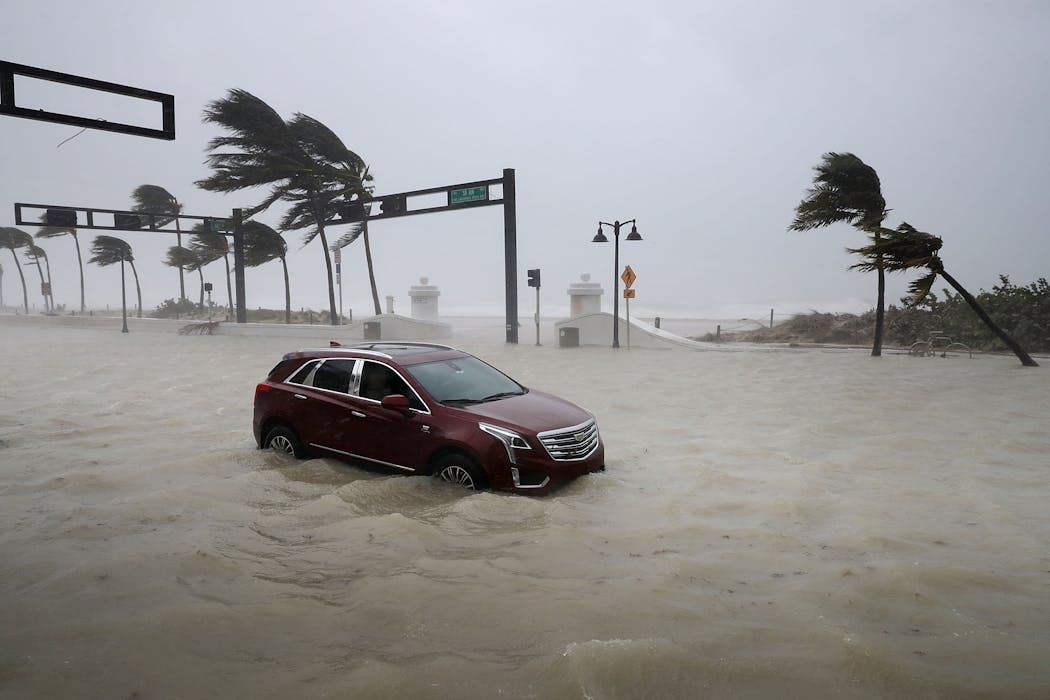
An aerial photo of Fort Myers Beach, Fla., in the aftermath of Hurricane Ian in September 2022 shows the damage storm surge can do. Ricardo Arduengo/AFP via Getty Images
As a coastal engineer, I study how storm surge and waves interact with natural and human-made features on the ocean floor and coast and ways to mitigate their impact. I have used physics-based models for coastal flooding and have recently been exploring ways that artificial intelligence can improve the speed of storm surge forecasting.
These models use current environmental conditions – such as how fast the storm is moving toward shore, its wind speed and direction, the timing of the tide, and the shape of the seafloor and the landscape – to compute the projected surge height and determine which locations are most at risk.
Hydrodynamic models have substantially improved in recent decades, and computers have become significantly more powerful, such that rapid low-resolution simulations are possible over very large areas. However, high-resolution simulation that provide neighborhood-level detail can take several hours to run.
Those hours can be critical for communities at risk to evacuate safely and for emergency responders to prepare adequately.
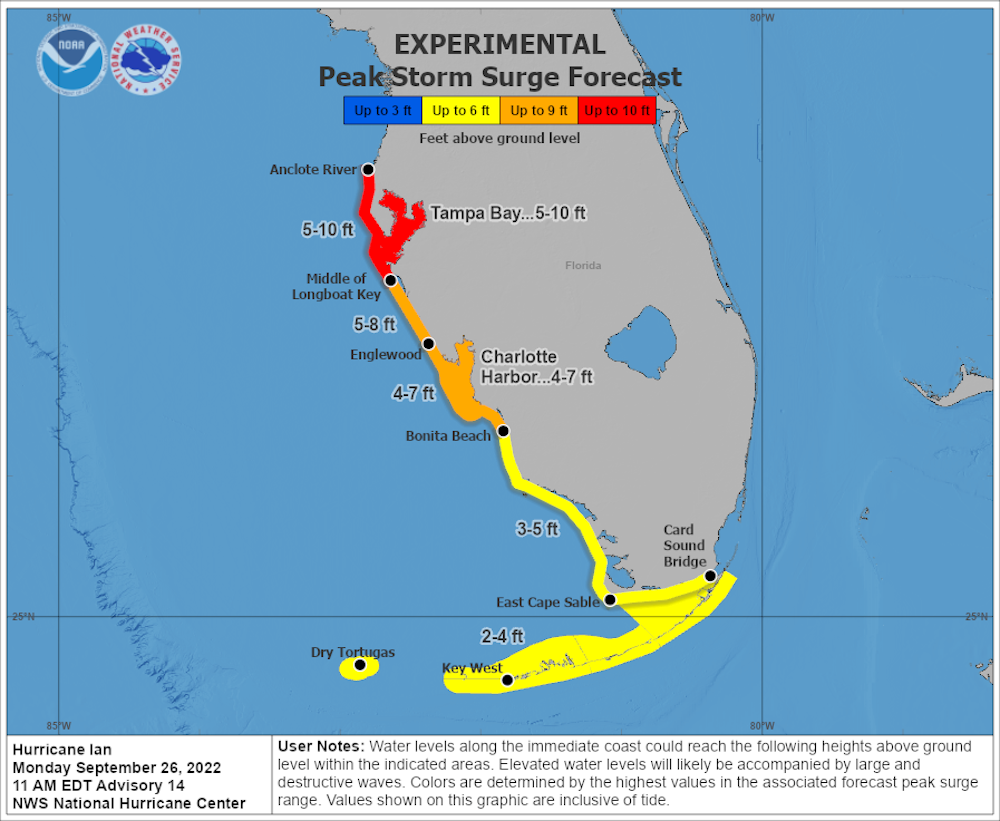
The National Hurricane Center’s storm surge forecast for Hurricane Ian two days before it made landfall near Fort Myers, Fla., on Sept. 28, 2022. NOAA
To forecast storm surge across a wide area, modelers break up the target area into many small pieces that together form a computational grid or mesh. Picture pixels in an image. The smaller the grid pieces, or cells, the higher the resolution and the more accurate the forecast. However, creating many small cells across a large area requires greater computing power, so forecasting storm surge takes longer as a result.
Forecasters can use low-resolution computer grids to speed up the process, but that reduces accuracy, leaving communities with more uncertainty about their flood risk.
AI can help speed that up.
How AI can create better forecasts
There are two main sources of uncertainty in storm surge predictions.
One involves the data fed into the computer model. A hurricane’s storm track and wind field, which determine where it will make landfall and how intense the surge will be, are still hard to forecast accurately more than a few days in advance. Changes to the coast and sea floor, such as from channel dredging or loss of salt marshes, mangroves or sand dunes, can affect the resistance that storm surge will face.
The second uncertainty involves the resolution of the computational grid, over which the mathematical equations of the surge and wave motion are solved. The resolution determines how well the model sees changes in landscape elevation and land cover and accounts for them, and at how much granularity the physics of hurricane surge and waves is solved.
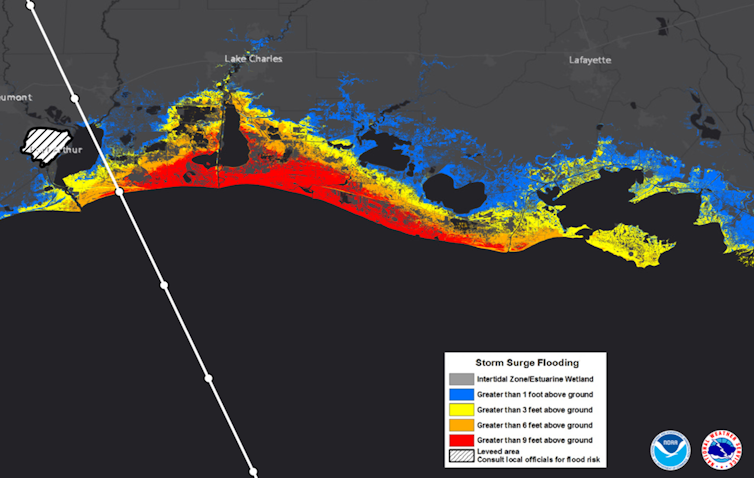
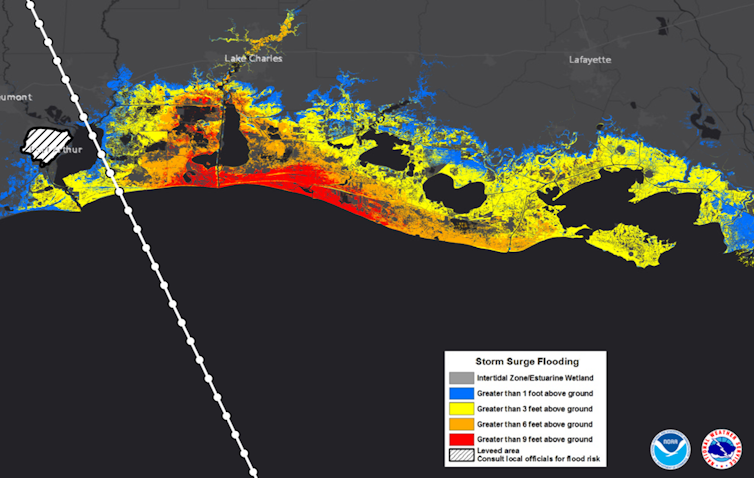
Detailed storm surge models can provide more specific information about expected flood height. These two modeled examples show the difference in expected flooding from a fast-moving storm, above, and a slow-moving storm, below. NOAA Slower-moving storms tend to have higher and broader storm surge inland, including into bays and estuaries. NOAA
AI models can produce detailed predictions faster. For example, engineers and scientists have developed AI models based on deep neural networks that can predict water levels along the coastline quickly and accurately by using data about the wind field. In some cases, these models have been more accurate than traditional hydrodynamic models.
AI can also develop forecasts for areas with little historic data, or be used to understand extreme conditions that may not have occurred there before.
For these forecasts, physics-based models can be used to generate synthetic data to train the AI on scenarios that might be possible but haven’t actually happened. Once an AI model is trained on both the historic and synthetic data, it can quickly generate surge forecasts using details about the wind and atmospheric pressure.
Training the AI on data from hydrodynamic models can also improve its ability to quickly generate inundation risk maps showing which streets or houses are likely to flood in extreme events that may not have a historical precedent but could happen in the future.
The future of AI for hurricane forecasting
AI is already being used in operational storm surge forecasts in a limited way, mainly to augment the commonly used physics-based models.
As artificial intelligence models rapidly spread through every aspect of our lives and more data becomes available for training them, the technology offers potential to improve hurricane and storm surge forecasting in the future, giving coastal communities faster and more detailed warnings about the risks on the way.
Navid Tahvildari’s research on coastal flooding has been funded by NSF, NOAA, NASA, and DOT.
Halloween is a fun, scary time for children and adults alike – but why does the holiday seem to start so much earlier every year? Decades ago, when I was young, Halloween was a much smaller affair, and people didn’t start preparing until mid-October. Today, in my neighborhood near where I grew up in Massachusetts, Halloween decorations start appearing in the middle of summer.
What’s changed isn’t just when we celebrate but how: Halloween has evolved from a simple folk tradition to a massive commercial event. As a business school professor who has studied the economics of holidays for years, I’m astounded by how the business of Halloween has grown. And understanding why it’s such big business may help explain why it’s creeping earlier and earlier.
The business of Halloween
Halloween’s roots lie in a Celtic holiday honoring the dead, later adapted by the Catholic Church as a time to remember saints. Today it’s largely a secular celebration – one that gives people from all backgrounds a chance to dress up, engage in fantasy and safely confront their fears.
And people are planning to shell out more money than ever. Total spending on Halloween is expected to reach a record US$13 billion this year, according to the federation – an almost fourfold increase over the past two decades. Adjusting for inflation and population growth, I found that the average American will spend an expected $38 on Halloween this year – up from just $18 per person back in 2005. That’s a lot of candy corn.
Candy imports show a similar trend. September has long been the key month for the candy trade, with imports about one-fifth higher than during the rest of the year. Back in September 2005, the U.S. imported about $250 million of the sweet stuff. In September 2024, that figure had tripled to about $750 million.
This is part of a larger trend of Halloween becoming a lot more professionalized. For example, when I was a kid, it wasn’t unusual for households to pass out brownies, candied apples and other homemade treats to trick-or-treaters. But because of safety concerns and food allergies, for decades Americans have been warned to stick to mass-produced, individually wrapped candies.
The same shift has happened with costumes. Years ago, many people made their own; today, store-bought costumes dominate — even for pets.
Why Halloween keeps creeping earlier
While there’s no definitive research establishing why Halloween seems to start earlier each year, the increase in spending is one major driver.
Halloween items are seasonal, which means no one wants to buy giant plastic skeletons on Nov. 1. As total spending grows, retailers order more inventory, and the cost of storing ever-larger amounts of unsold items until the next year becomes a bigger consideration.
Once a season’s commercial footprint becomes large enough, retailers begin ordering and displaying merchandise long before it’s actually needed. For example, winter coats start appearing in stores in early fall and are typically gone when the snow starts falling. It’s the same with Halloween: Retailers put out merchandise early to ensure they’re not stuck with unsold goods once the season is over.
They also often price strategically – charging full price when items first hit the shelves, appealing to eager early shoppers, and then marking down prices closer to the holiday. This clears shelves and warehouses, making room for the next upcoming shopping season.
Over the past two decades, Halloween has become an ever-bigger commercial holiday. The growth in people enjoying the holiday and the increase in spending has resulted in Halloween becoming one giant treat for businesses. The big trick for retailers is preventing this holiday from starting before the Fourth of July.
Jay L. Zagorsky does not work for, consult, own shares in or receive funding from any company or organization that would benefit from this article, and has disclosed no relevant affiliations beyond their academic appointment.
“Why are ladies’ shoes so pointy? Feet and toes aren’t pointy, most of men’s shoes aren’t pointy, and they hurt my feet.” – Bunny, age 13, Mizpah, New Jersey
While people’s actual feet are rounded on the end, women’s dress shoes often come to a sharp point at the toe. Many people also feel these pointy shoes are uncomfortable to wear. So why do shoe designers keep making them this way?
With over two decades in the fashion industry, I’ve researched and taught on the influences behind fashion design and how it’s used, even when certain traditions and styles seem impractical.
Revisiting the interesting history behind women’s pointy shoes can help us understand the various reasons why they’re still popular.
Pointy poulaines for men
Several current fashion trends for women, including pointy shoes, were in fact initially adopted by men.
In medieval Europe, around the 14th and 15th centuries, pointy leather shoes were popular among wealthy men. Called poulaines – or cracows, after the Polish city Kraków, where historians think they originated – these shoes could run as long as 12 inches in length. To keep the stiff, pointy shape, the wearer would stuff the ends of the shoes with moss or wool.
Like most items of fashion, shoes signal the wearer’s status to their peers. Poulaines were heavily decorated and expensive to make, and their elongated design made it difficult to move around. Thus, wearing poulaines communicated to others that the wearer was wealthy, having no need to perform physical work that required mobility.
Pointy shoes as status symbol
These shoes became so popular that in 1463 King Edward IV of England passed laws limiting toe length to 2 inches for anyone below a lord in social ranking. This decree had social, political and religious effects.
Socially, restricting the longest-toed shoes to the nobility ensured the shoe would be a visual status marker associated with the upper classes. This obvious sign helped maintain social order and prevented lower-class people from trying to pass themselves off as higher in standing than they were.
Politically, the king used this same legislation to control the textile trade and protect English industries. By regulating the fabrics and accessories necessary to make excessively ornate shoes, Edward IV could limit foreign competition with English textile manufacturers and at the same time manage fashion trends.
From a religious perspective, King Edward IV passed these laws on the grounds that God was displeased by anything other than modest clothing – for the lower classes, anyway. Additionally, religious leaders believed that the long toes prevented people from kneeling in a respectful, submissive manner and so restricted the ability to properly pray.
The pressure to literally “fit in” to these pointy shoes also came with a physical cost. Poulaines hurt the wearer’s feet and could make their toe bones crooked. Bunions – a bony bump that develops on the inside of the foot at the big toe – became more common with the popularity of these shoes.
Pain with a purpose
Various cultures have adopted pointy shoes throughout history, often to signify status, wealth or a connection to a specific subculture. A few examples include the juttis or khussas of Northern India and Pakistan, respectively; the lotus shoes once popular in China; and the pointed flat slippers worn during the Etruscan civilization.
From a practical standpoint, however, pointy-toed shoes can lead to foot deformities and health problems. Why do people still wear pointy shoes if they’re so painful?
One reason is a desire to belong. Your brain is programmed to seek out and find people who think and believe like you. Like how early humans needed to stay with their tribe to survive, your brain thinks that being part of a group can help keep you safe.
Because high-heeled, pointed shoes are commonly worn by women, wearing them gives the wearer feelings of acceptance from other women. While there is nothing inherent about pointy shoes that make them feminine or attractive – considering that they were often originally designed for men – fashion often relies on trends that people unconsciously agree on. What is stylish is often influenced by accepted social norms.
Your brain also has clever shortcuts to help you make decisions quickly. One shortcut is to look at what other people are doing. If you see lots of people wearing a certain style or playing a particular game, your brain thinks, well, if everyone is doing this, it must be a good choice. This process helps you make decisions without having to think too hard about every little detail.
Scientists call the powerful, mental influence fashion has on both the person wearing it and the people seeing their outfit enclothed cognition. The shoes you wear may alter how you perceive yourself and others, as well as carry symbolic meaning. So designers might use elongated shoes to create the illusion of a long, slender silhouette to create a look that is not only seen but also personally felt as elegant and powerful.
With new technology and an increased consumer desire for comfort, the good news is that next time you get dressed and want to wear pointy, fashionable shoes, they may be at least a little less painful than they were in the past.
Hello, curious kids! Do you have a question you’d like an expert to answer? Ask an adult to send your question to CuriousKidsUS@theconversation.com. Please tell us your name, age and the city where you live.
And since curiosity has no age limit – adults, let us know what you’re wondering, too. We won’t be able to answer every question, but we will do our best.
Michael Watson does not work for, consult, own shares in or receive funding from any company or organization that would benefit from this article, and has disclosed no relevant affiliations beyond their academic appointment.
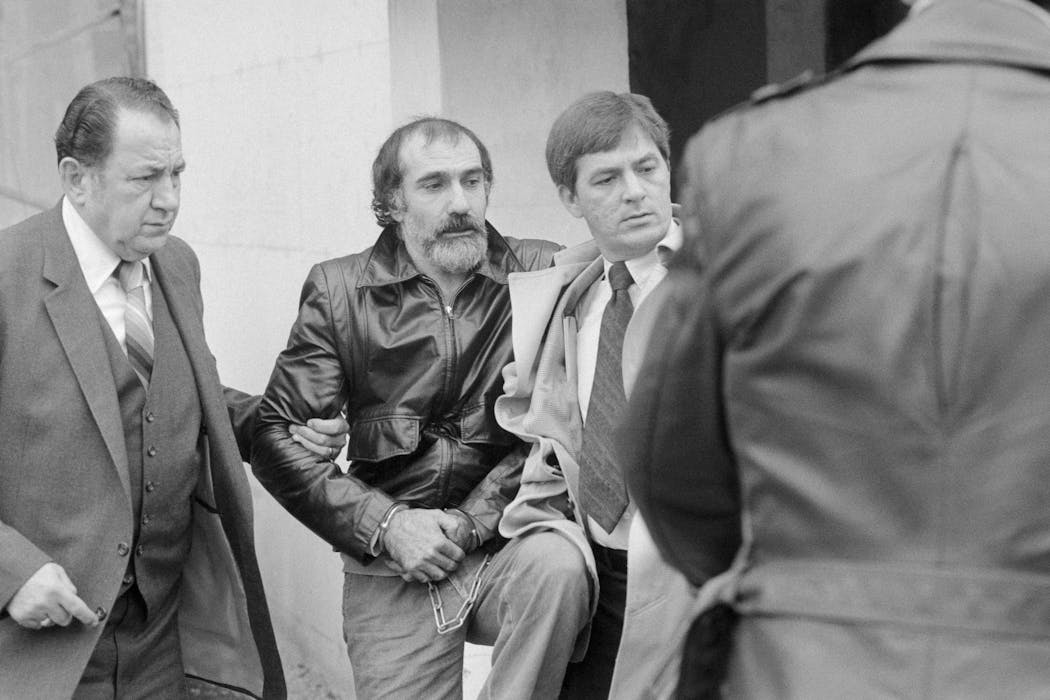
Former mob boss John Stanfa, pictured here in 1980, waged a bloody war for control of the Philadelphia mafia in the late 1990s. Bettmann via Getty Images
The bloody mob war that is the focus of the new Netflix series “Mob War: Philadelphia vs. The Mafia,” which premieres Oct. 22, 2025, is full of the murder and mayhem, treachery and deceit that have been the hallmarks of the nation’s Cosa Nostra family conflicts.
What was different in Philadelphia was that the FBI had it all wired for sound.
Electronic surveillance has been a major tool in the government’s highly successful war against the Mafia nationwide, but nowhere has its impact been felt more dramatically than in Philadelphia.
As a reporter for The Philadelphia Inquirer, I covered this mob war in real time from 1994 through 2000. Now I teach a course at Rowan University on the history of organized crime, using the war as a case study, and I was a consultant on the Netflix series.
The war pitted one faction of the Philadelphia mob, headed by Sicilian-born John Stanfa, against a rival faction led by Joseph “Skinny Joey” Merlino. The issues were control of all illegal operations in the underworld – gambling, loan-sharking, drug-dealing and extortion. Money was the bottom line, but there also was a cultural and generational divide that had Stanfa and, for the most part, his group of older wiseguys facing off against Merlino and his crew of young South Philadelphia-born mobsters.
But only after indictments were handed down and evidence was introduced at trials did the extent of the electronic surveillance operation become known.
A trailer for ‘Mob War: Philadelphia vs. The Mafia’
‘Goodfellas kill goodfellas’
Mobsters, speaking in unguarded moments and unaware that the feds were listening, buried themselves.
So here was mob boss Stanfa discussing with an associate plans to lure Merlino and two of his two lieutenants to a meeting where they would be killed:
“See, you no gotta give a chance,” the Sicilian-born Stanfa said in his halting English. “Bam, bam … Over here is best, behind the ear.”
Or here was Salvatore Profaci, a New York mobster brought in to quietly settle a dispute that had gone public after mob lawyer Salvatore Avena filed a multimillion-dollar lawsuit against his mobbed-up business partner in a trash-hauling business.
“Goodfellas don’t sue goodfellas,” Profaci said in a line that couldn’t have been written any better by “The Godfather” author Mario Puzo or delivered more effectively by the award-winning actor Robert De Niro. “Goodfellas kill goodfellas.”
The most staggering piece of the investigation, which was made known only after Stanfa and more than 20 of his associates had been indicted and arrested, was that the FBI had received court authorization to plant listening devices in the Camden, New Jersey, law offices of Salvatore Avena, Stanfa’s defense attorney.
A judge approved the highly unusual authorization after the feds argued that Stanfa was using the shield of attorney-client privilege to conduct mob meetings in Avena’s office while a mob war raged on the streets of South Philadelphia.
More than 2,000 conversations were recorded during the two-year electronic surveillance operation, with FBI agents and an assistant U.S. attorney manning a listening post in the basement of the federal courthouse a block away from Avena’s office. Whenever Stanfa and his associates got together, the feds were listening. Many of those conversations were then introduced as evidence at the racketeering trials that followed.
The conversations proved to be a treasure trove not only for investigators but also for journalists who covered the story as it unfolded and later got access to the tapes that were made public when the cases went to trial.
Blood in the streets
Two of the books I’ve written about the Philadelphia mob, “The Last Gangster” in 2004 and “The Goodfella Tapes” in 1998, are built around those tapes and the investigations they spawned.
Anyone who has written true crime knows that part of the problem with nonfiction storytelling is coming up with dialogue. In writing books about the Philadelphia mob wars that are the focus of the new Netflix series, that was never a problem.
Mobsters from Philadelphia, South Jersey, New York and the Scanton-Wilkes Barre area of Pennsylvania ended up on the recordings, which offered not only details about the war but also included philosophical ramblings and personal asides that provided a glimpse into the world of organized crime as good as or better than any fictionalized story line from “The Godfather” or “The Sopranos.”
Throughout the conflict, as bodies piled up and blood ran in the streets of the City of Brotherly Love, Stanfa and several of his associates were picked up plotting murder and mayhem, bemoaning the loss of honor and loyalty that had once been the hallmark of Cosa Nostra, and belittling their street-corner rivals, the “little Americans” who hadn’t a clue about what it meant to be a real mafioso.
“When you’re a dwarf they could put you on a high mountain, you’re still a dwarf,” Avena told Stanfa in one of several conversations mocking Merlino and his associates.
“I was born and raised in this thing (Cosa Nostra) and I’m gonna die in this thing,” said Stanfa at another point, bemoaning the state of the Philadelphia mob. “But with the right people. Over here is like kindergarten.”
Former Philadelphia mob boss ‘Skinny’ Joey Merlino, pictured here in 1997. AP Photo/H. Rumph Jr.
Stanfa is currently serving life in prison. Several of his top associates were jailed for more than 20 years. In a second prosecution, Merlino and most of his top associates were convicted of racketeering and jailed for sentences ranging from seven to 14 years.
Dozens of conversations were played for the juries that sat in judgment during the racketeering trials that followed. Again and again the mobster’s own words were turned against them.
Another highlight was an FBI surveillance video of a mob hit picked up on a hidden camera as it occurred. A surveillance camera located across the street from a deli run by then-Stanfa underboss Joseph Ciancaglini Jr. picked up the early morning shooting in which four shadowy figures burst into the deli and opened fire. An audio bug hidden inside the deli provided the sound effects – gunshots, shouting and the screams of a waitress. The shooting occurred shortly after 6 a.m. and just moments after Ciancaglini and his waitress had arrived and begun setting up for business.
Cooperating witnesses were also part of the trial, but defense attorneys frequently undermined their testimony by providing a litany of the crimes – often including murders – that the witnesses had admitted to as part of their plea deals.
You can attack the credibility of a cooperating witness by focusing on his own crimes and his need to say whatever the government wants in order to win a lenient sentence, a defense attorney once explained to me. What you can’t do, he said, “is cross-examine a tape.”
Jurors got to hear mobsters in their own words discussing the mob war. And there was nothing the defense could do to counterattack the impact of those words.
One classic discussion underscored the mobsters’ concern about electronic surveillance and demonstrated their inability to do much about it.
Stanfa consigliere Anthony Piccolo was talking with Avena about the problem with cooperators and phone taps. Both men agreed it was important to be cautious. Avena then told Piccolo that he’d had an electronic anti-bugging expert come into his office over the weekend and had swept the rooms. It had cost him $500, Avena said.
“It’s money well spent,” said Piccolo as the undetected FBI listening device beamed the conversation back to the listening post.