John Singer Sargent et la mode : le peintre américain qui fit briller les soies et les satins

Source: The Conversation – France (in French) – By Serena Dyer, Associate Professor, Fashion History, De Montfort University

_Portrait de Mme ***, dite aussi Madame X_ (1884), pièce maîtresse des expositions londonienne et parisienne. Metropolitan Museum, CC BY

Avant que le musée d’Orsay (Paris) organise son exposition « John Singer Sargent. Éblouir Paris » (jusqu’au 11 janvier 2026), un autre événement avait mis le peintre américain à l’honneur. L’exposition « Sargent and Fashion », à Londres, avait permis en 2024 de redécouvrir le travail de cet amoureux des vêtements. L’historienne de la mode Serena Dyer l’avait alors chroniquée pour « The Conversation UK ». En voici une version traduite en français.


En tant qu’historienne de la mode, je repars toujours des musées avec l’appareil photo saturé d’images de vêtements plutôt que de visages. Je reste fascinée par la manière dont un peintre parvient à saisir les reflets changeants d’une soie bruissante ou la lumière dansante sur des bijoux étincelants.

Dans le monde de la critique d’art, la mode en peinture reste pourtant souvent méprisée. L’exposition « Sargent and Fashion » qui se tenait à la Tate Britain en 2024 a été critiquée pour ses « toiles encombrées de vieux habits » ou son « déferlement de mièvrerie ». Ces jugements révèlent des idées reçues persistantes : la mode serait frivole, secondaire, indigne d’un véritable sujet artistique.

Cette exposition, coproduite par la Tate et le Museum of Fine Arts de Boston, s’attache au contraire à corriger cette vision dépassée et réductrice. Sargent ne serait pas Sargent sans son rapport intime à la mode. Le parcours nous invite à considérer que sa virtuosité du pinceau allait de pair avec une véritable maîtrise des étoffes, des aiguilles et des épingles.

Les élégantes victoriennes qu’il peignait avaient d’ailleurs bien compris le pouvoir que leur donnaient leurs vêtements. En 1878, l’écrivaine Margaret Oliphant remarquait déjà :

« Il existe désormais une classe de femmes qui s’habillent d’après les tableaux, et qui, en achetant une robe, demandent : “Est-ce que ça se peindra bien ?” »

Art et mode étaient alors intimement liés, et la modernité, le dynamisme et la pertinence culturelle de la mode s’expriment dans chaque coup de pinceau de John Singer Sargent (1856-1925).

Sargent, styliste avant l’heure

Dès la première salle, on a l’impression d’entrer dans un salon mondain. Le visiteur est accueilli par le portrait d’Aline de Rothschild, Lady Sassoon (1907). Drapée dans une spectaculaire fantaisie de taffetas noir, son visage émerge d’un tourbillon d’ombre, irradiant sous le velours sombre de sa cape d’opéra. Même si, en tant qu’historienne de la mode, je choisis mes tenues avec soin, mais je n’ai pas pu m’empêcher de me sentir affreusement mal habillée face à tant d’éclat.

Mais sans doute est-ce parce que je ne dispose pas d’un John Singer Sargent comme directeur artistique. Car l’exposition le montre autant peintre que styliste. Il maniait les pinceaux, certes, mais aussi les épingles, modelant les tissus autour de ses modèles pour créer des formes vertigineuses. Les commissaires le comparent d’ailleurs à un directeur artistique de séance photo : ses portraits ne reproduisent pas la mode de son époque, ils construisent sa propre vision esthétique.

La cape de Lady Sassoon, exposée à proximité, en est la preuve. Datée de 1895, elle précède le tableau d’une décennie. Entre ses mains, ce vêtement ancien devient, par un savant jeu de drapés et d’épingles, une image saisissante de modernité.

Tout au long du parcours, les tableaux dialoguent avec des caricatures d’époque moquant la mode, des photographies des modèles dans leur vie quotidienne, ou encore des pièces textiles et accessoires ayant servi à la composition des œuvres.

Les femmes qu’on ne voit pas

Si le rôle de John Singer Sargent comme peintre et styliste est omniprésent, celui des créateurs et créatrices de ces vêtements – souvent des femmes modestes – reste dans l’ombre. À part un court panneau consacré à Charles Frederick Worth, figure surestimée de la couture du XIXe siècle, peu d’hommages sont rendus aux mains qui ont coupé, épinglé et cousu ces merveilles. La plupart des pièces exposées portent la mention « créateur inconnu ».

L’une de ces créatrices est cependant mise en avant : Adele Meyer, dont Sargent a peint le portrait en 1896. Femme élégante et militante, Meyer fut aussi une défenseure des droits des ouvrières du vêtement. Avec Clementina Black, elle publia en 1909 Makers of our Clothes : A Case for Trade Boards, enquête pionnière sur les conditions de travail dans les ateliers de couture.

Le livre est exposé à côté du tableau, quelque peu éclipsé par le rayonnement du portrait. Cette mise en scène rappelle – plus qu’elle ne dénonce – combien la beauté de la mode a souvent invisibilisé le labeur de celles qui la produisent.

Une exposition discrètement féministe

L’exposition interroge aussi, avec subtilité, les rapports de pouvoir. Dans les livres d’art et les catalogues d’exposition, les modèles de John Singer Sargent sont le plus souvent désignées par le nom de leur mari.

Mary Louisa Cushing devient « Mrs Edward Darley Boit », Mathilde Seligman « Mrs Leopold Hirsch ». Suivant l’étiquette victorienne, ces femmes perdent leur identité propre pour n’exister qu’à travers celle de leur époux.

Les commissaires ont pris le parti – subversif en apparence, mais en réalité légitime – d’associer à chaque titre officiel le nom de jeune fille du modèle. Un détail discret, sans doute imperceptible pour la majorité des visiteurs, mais essentiel pour redonner leur individualité à ces femmes.

Au final, cette exposition ne bouleverse pas l’histoire de la mode, mais elle avance dans la bonne direction. L’opportunité de voir ou revoir le célèbre portrait de Madame X, qui représente la mondaine Virginie Amélie Avegno Gautreau dans sa robe noire – un tableau qui a fait scandale à l’époque – a certainement attiré les foules. Mais l’exposition nous rappelle surtout une vérité subtile : si Sargent a su devenir un grand peintre, c’est parce qu’il fut d’abord un immense styliste.

The Conversation

Serena Dyer ne travaille pas, ne conseille pas, ne possède pas de parts, ne reçoit pas de fonds d’une organisation qui pourrait tirer profit de cet article, et n’a déclaré aucune autre affiliation que son organisme de recherche.

ref. John Singer Sargent et la mode : le peintre américain qui fit briller les soies et les satins – https://theconversation.com/john-singer-sargent-et-la-mode-le-peintre-americain-qui-fit-briller-les-soies-et-les-satins-267681

Des parasites découverts chez les vers plats envahissants, enfin une piste de lutte ?

Source: The Conversation – France in French (2) – By Jean-Lou Justine, Professeur, UMR ISYEB (Institut de Systématique, Évolution, Biodiversité), Muséum national d’histoire naturelle (MNHN)

Une des espèces de plathelminthes pour laquelle des parasites ont été identifés : _Austroplana sanguinea_. Gastineau et al., CC BY-SA

Les vers plats terrestres (ou, plathelminthes) causent d’importants dégâts écologiques en France, car ces espèces n’ont pas de prédateurs dans l’Hexagone. La découverte très récente de parasites va-t-elle permettre de lutter contre ces espèces ?


Depuis une dizaine d’années, nous étudions l’invasion de la France et de l’Europe par des vers plats terrestres (ou, plathelminthes). Ces animaux exotiques, généralement longs comme le doigt, sont arrivés en Europe par l’intermédiaire du transport des plantes en pots. Une dizaine d’espèces sont maintenant chez nous, venant principalement de l’hémisphère Sud (Argentine, Australie, Nouvelle-Guinée, Asie du Sud-Est). Elles se sont largement installées dans les jardins, en particulier Obama nungara, désormais présent dans plus de 70 départements. D’autres sont aussi connues du public, comme Bipalium kewense, qui peut atteindre une trentaine de centimètres, ou Vermiviatum covidum.

Quand une espèce envahit un écosystème, elle provoque souvent toute une série de problèmes écologiques. Les plathelminthes terrestres sont des prédateurs, et on sait qu’ils consomment (en particulier dans le cas d’Obama nungara) les vers de terre, ces précieux alliés du jardinier pour la fertilité des sols.


À lire aussi :
L’invasion des vers plats est loin d’être terminée


La fameuse théorie du « relâchement de la pression des ennemis »

Et là, se pose la question, comment lutter contre ces envahisseurs ? Aucun produit chimique n’étant homologué ni même testé, oublions immédiatement cette solution. Des prédateurs qui mangeraient ces vers ? On n’en connaît pas en Europe. Des parasites qui pourraient limiter leur prolifération ? Inconnus aussi.

Les scientifiques qui étudient les invasions considèrent généralement qu’une espèce envahissante abandonne derrière elle prédateurs et parasites en arrivant dans un nouveau territoire, ce qui supprime tout frein à sa prolifération : c’est la théorie du « relâchement de la pression des ennemis ». C’est bien le cas des plathelminthes terrestres en France et en Europe.

La découverte de parasites

Nous avons sursauté quand nous avons trouvé les premières traces de parasites dans des plathelminthes terrestres envahissants. Mais, comme vous allez le lire, cette découverte n’a pas été aussi facile qu’on pourrait l’imaginer.

Nous n’avons pas vu ces parasites. Comment, alors, ont-ils été découverts ? Nous faisons, depuis plusieurs années, une analyse moléculaire des plathelminthes terrestres. En particulier, nous avons décrit, non pas le génome entier, ce qui serait très long et coûteux, mais le génome mitochondrial de plus d’une dizaine d’espèces.

Le génome mitochondrial, ou mitogénome, est celui qui permet aux mitochondries, ces petits éléments présents dans toutes les cellules, de fonctionner. Chez les plathelminthes, les organes sont noyés dans un tissu mou appelé parenchyme. Ainsi, lorsqu’on analyse un individu, on obtient non seulement son propre ADN, mais aussi celui de ses proies présentes dans l’intestin. Cela permet de mieux comprendre leur régime alimentaire en identifiant les espèces consommées.

Nous voilà donc faisant une analyse de routine sur deux espèces trouvées en Irlande du Nord, Kontikia andersoni et Australoplana sanguinea. Ces deux espèces viennent d’Australie et de Nouvelle-Zélande et ont envahi les îles Britanniques, mais pas (encore) l’Europe continentale. Les analyses ont rapidement permis de caractériser les mitogénomes des plathelminthes et de déterminer leurs proies, qui sont, dans les deux cas, des vers de terre. Mais une surprise nous attendait.

Des mitogénomes de parasites ?

Dans chacune des espèces de plathelminthes, nous avons trouvé un signal moléculaire d’une espèce du genre Mitosporidium. Jusqu’ici, le genre Mitosporidium ne contenait qu’une seule espèce, Mitosporidium daphniae, qui est un parasite des daphnies, des petits crustacés d’eau douce. Mitosporidium est très original : c’est une microsporidie « primitive ». Que sont les microsporidies ? Des parasites unicellulaires.

Une microsporidie est devenue tristement célèbre dans les années 1980, Enterocytozoon bieneusi, qui infectait les patients atteints du sida dont l’immunité était compromise. Avant la génétique moléculaire, on classait les microsporidies dans les « protozoaires » et on les reconnaissait par leurs spores très caractéristiques. On a depuis compris que ce sont des champignons très modifiés par le parasitisme, en particulier par la perte des mitochondries.

Comme mentionné plus haut, les mitochondries sont des organites présents dans toutes les cellules des eucaryotes, mais les microsporidies, qui vivent dans les cellules de leurs hôtes, n’en ont plus besoin et s’en sont débarrassées.

Une spore typique de microsporidie, colorisée pour montrer les structures internes.
Jaroenlak et coll., 2020, CC BY

Mais la nature aime les exceptions, et les scientifiques aiment les exceptions quand elles permettent de mieux comprendre la nature… Mitosporidium daphniae a toutes les caractéristiques d’une microsporidie, sauf qu’elle a conservé un génome de mitochondrie. C’est pour cela que l’on considère cette espèce comme « basale » : elle représenterait une étape de l’évolution des champignons vers les microsporidies, en ayant déjà la morphologie et la vie intracellulaire d’une microsporidie, mais en ayant gardé le mitogénome.

Et donc, nous avons trouvé deux nouvelles espèces de Mitosporidium, une dans chaque espèce de ver plat. Rien que le fait de faire passer ce genre d’une seule espèce à trois était déjà une découverte significative ; la seule espèce connue avait été décrite en 2014, et aucune depuis.

Les génomes mitochondriaux des deux espèces de microsporidies découvertes.
Gastineau et al, CC BY

Parasites de quoi ?

Un gros problème est apparu. Pour des raisons techniques, nous n’avons pas vu les microsporidies. On ne les reconnaît facilement que quand elles sont au stade de spores, et les autres stades, dans les tissus de l’hôte, sont difficiles à détecter. Et puis surtout, la question a été : de qui sont parasites ces microsporidies ? Rappelez-vous, notre analyse a été faite sur un mélange de tissus : tissus du plathelminthe prédateur et tissus du ver de terre dans son intestin. Ces Mitosporidium étaient-ils des parasites des plathelminthes eux-mêmes ou de leurs proies, les vers de terre ?

Pour l’instant, nous ne pouvons pas trancher définitivement, mais un principe biologique nous guide : la spécificité parasitaire. En effet, un parasite est souvent associé à une seule espèce d’hôte. Or, dans chaque plathelminthe terrestre étudié, nous avons trouvé une espèce unique de Mitosporidium.

Deux hypothèses sont possibles. Soit ces parasites viennent des vers de terre que les plathelminthes consomment – mais il faudrait alors admettre un hasard improbable : que chaque plathelminthe ait mangé une seule espèce de ver de terre, elle-même infectée par son parasite spécifique. Soit, plus simplement, chaque plathelminthe possède son propre Mitosporidium. C’est cette seconde hypothèse qui nous paraît la plus plausible, en attendant des analyses plus larges.

Un avenir pour la lutte contre les vers plats ?

Nous supposons, donc, maintenant avoir découvert des parasites de vers plats envahissants. Selon la théorie générale du « relâchement de la pression des ennemis », un moyen de se débarrasser d’une espèce envahissante est de l’infecter par un parasite ou par un pathogène qui va réduire ses populations. Un exemple classique est celui du lapin en Australie : libéré de ses prédateurs et parasites, il s’est multiplié de façon incontrôlable et seule l’introduction de la myxomatose a permis de réduire un peu sa population. Mais ce n’est pas toujours facile : pour le frelon asiatique, envahissant en Europe, plusieurs parasites ont été identifiés, sans qu’aucun ne puisse freiner réellement son expansion.

Introduire des microsporidies pour réduire les populations de plathelminthes terrestres envahissants ? Une idée séduisante, mais nous en sommes très loin.

D’abord, comme expliqué plus haut, nous ne sommes pas encore sûrs que les Mitosporidium soient des parasites de plathelminthes. Ensuite, on ne sait pas du tout s’ils sont pathogènes ! La seule espèce connue avant notre travail, Mitosporidium daphniae, n’a qu’une petite influence négative sur la fertilité des daphnies infectées. Des années de recherche sont encore nécessaires.

The Conversation

Jean-Lou Justine est Rédacteur-en-Chef de Parasite, la revue scientifique de la Société Française de Parasitologie, dans laquelle a été publiée cette étude. Toutes les précautions éthiques ont été prises, en suivant les recommandations de COPE https://publicationethics.org/ .

Archie K. Murchie a reçu des financements du Department of Agriculture, Environment & Rural Affairs, Northern Ireland

Romain Gastineau a reçu des financements du ministère de la recherche et de l’éducation de Pologne.

Leigh Winsor ne travaille pas, ne conseille pas, ne possède pas de parts, ne reçoit pas de fonds d’une organisation qui pourrait tirer profit de cet article, et n’a déclaré aucune autre affiliation que son organisme de recherche.

ref. Des parasites découverts chez les vers plats envahissants, enfin une piste de lutte ? – https://theconversation.com/des-parasites-decouverts-chez-les-vers-plats-envahissants-enfin-une-piste-de-lutte-266265

The Erie Canal: How a ‘big ditch’ transformed America’s economy, culture and even religion

Source: The Conversation – USA (2) – By Matthew Smith, Visiting Assistant Professor of History, Miami University

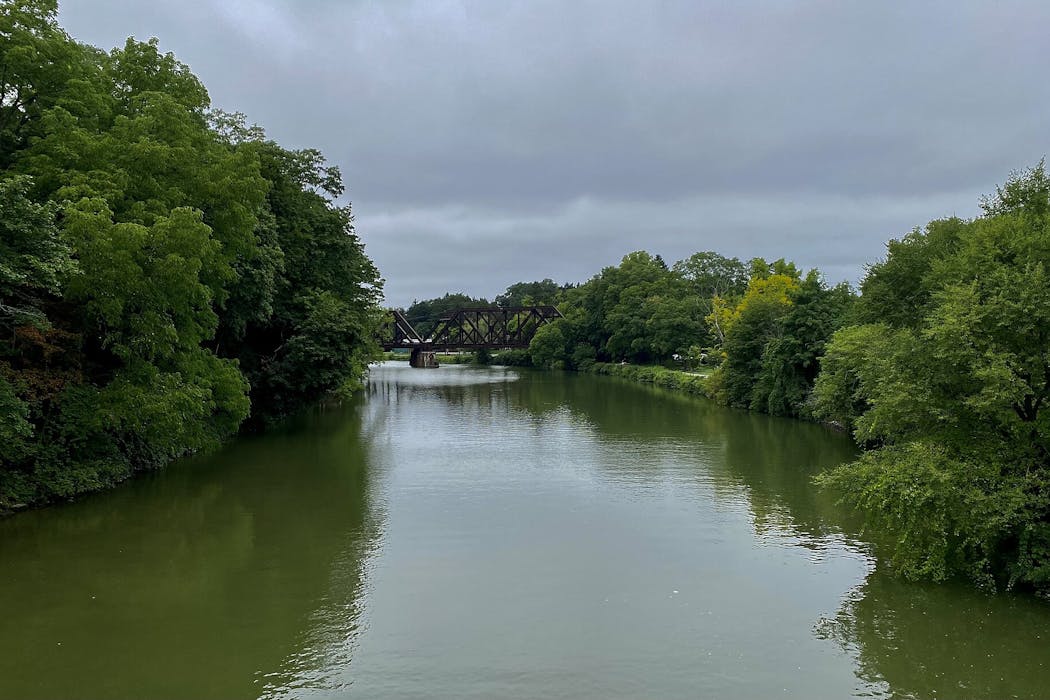
The Erie Canal, seen here in Pittsford, N.Y., opened up western regions to trade, immigration and social change. Andre Carrotflower via Wikimedia Commons, CC BY-SA

Two hundred years ago, on Oct. 26, 1825, New York Gov. DeWitt Clinton boarded a canal boat by the shores of Lake Erie. Amid boisterous festivities, his vessel, the Seneca Chief, embarked from Buffalo, the westernmost port of his brand-new Erie Canal.

Clinton and his flotilla made their way east to the canal’s terminus in Albany, then down the Hudson River to New York City. This maiden voyage culminated on Nov. 4 with a ceremonial disgorging of barrels full of Lake Erie water into the brine of the Atlantic: pure political theater he called “the Wedding of the Waters.”

A faded black-and-white illustration of men in formal 18th-century clothing standing in front of a crowd as one pours a stream of water from a small barrel.
DeWitt Clinton pouring water from Lake Erie into the Atlantic, engraved by Philip Meeder.
The New York Public Library via Wikimedia Commons

The Erie Canal, whose bicentennial is being celebrated all month, is an engineering marvel – a National Historic Monument enshrined in folk song. Such was its legacy that as a young politician, Abraham Lincoln dreamed of becoming “the DeWitt Clinton of Illinois.”

As a historian of the 19th-century frontier, I’m fascinated by how civil engineering shaped America – especially given the country’s struggles to fix its aging infrastructure today. The opening of the Erie Canal reached beyond Clinton’s Empire State, cementing the Midwest into the prosperity of the growing nation. This human-made waterway transformed America’s economy and immigration while helping fuel a passionate religious revival.

But like most big achievements, getting there wasn’t easy. The nation’s first “superhighway” was almost dead on arrival.

Clinton’s folly

The idea of connecting New York City to the Great Lakes originated in the late 18th century. Yet when Clinton pushed to build a canal, the plan was controversial.

The governor and his supporters secured funding through Congress in 1817, but President James Madison vetoed the bill, considering federal support for a state project unconstitutional. New York turned to state bonds to finance the project, which Madison’s ally Thomas Jefferson had derided as “madness.”

Some considered “Clinton’s big ditch” blasphemy. “If the Lord had intended there should be internal waterways,” argued Quaker minister Elias Hicks, “he would have placed them there.”

Construction began on July 4, 1817. Completed eight years later, the canal stretched some 363 miles (584 kilometers), with 18 aqueducts and 83 locks to compensate for elevation changes en route. All this was built with only basic tools, pack animals and human muscle – the latter supplied by some 9,000 laborers, roughly one-quarter of whom were recent immigrants from Ireland.

A faded chart shows the names of cities, in order from west to east, along with their relative elevation.
An 1832 lithograph by David H. Burr shows elevation changes along the Erie Canal.
David Rumsey Map Collection via Wikimedia Commons

Boomtowns

Despite its naysayers, the Erie Canal paid off – literally. Within a few years, shipping rates from Lake Erie to New York City fell from US$100 per ton to under $9. Annual freight on the canal eclipsed trade along the Mississippi River within a few decades, amounting to $200 million – which would be more than $8 billion today.

Commerce drove industry and immigration, enriching the canal towns of New York – transforming villages like Syracuse and Utica into cities. From 1825-1835, Rochester was the fastest-growing urban center in America.

By the 1830s, politicians had stopped ridiculing America’s growing canal system. It was making too much money. The hefty $7 million investment in building the Erie Canal had been fully recouped in toll fees alone.

Religious revival

Nor was its legacy simply economic. Like many Americans during the Industrial Revolution, New Yorkers struggled to find stability, purpose and community. The Erie Canal channeled new ideas and religious movements, including the Second Great Awakening: a nationwide movement of Christian evangelism and social reform, partly in reaction to the upheavals of a changing economy.

Though the movement began at the turn of the century, it flourished in the hinterlands along the Erie Canal, which became known as the “Burned-Over District.” Revivalists like Charles Grandison Finney – America’s most famous preacher at the time – found a lively reception along this “psychic highway,” as one author later dubbed upstate New York.

Some denominations, like the Methodists, grew dramatically. But the “Burned-Over District” also gave birth to new churches after the canal’s creation. Joseph Smith founded the Church of Jesus Christ of Latter-day Saints, often known as Mormons, in Fayette, New York, in 1830. The teachings of William Miller, who lived near the Vermont border, spread west along the canal route – the roots of the Seventh-day Adventist Church.

A faded black-and-white illustration of a small crowd in front of a speaker's stand in a clearing amid trees.
A camp revival meeting of the Methodists , circa 1829.
Fine Art Images/Heritage Images/Getty Images

Door to the West

As Clinton predicted, the Erie Canal was “a bond of union between the Atlantic and Western States,” uniting upstate New York and the agrarian frontier of the Midwest to the urban markets of the Eastern seaboard.

In the mid-1820s, Ohio Gov. Ethan Allen Brown praised America’s canals “as veins and arteries to the body politic” and commissioned two canals of his own: one to link the Ohio River to the Erie Canal, completed in 1832; and another to link the Miami River, completed in 1845. These canals in turn connected to numerous smaller waterways, creating an extensive network of trade and transportation.

Like New York, Ohio had its canal towns, including Middletown: the birthplace of Vice President JD Vance and a city emblematic of America’s shifting industrial fortunes.

While America’s canal boom brought prosperity, this wealth came at a cost to many Indigenous communities – a cost that is only slowly being acknowledged. The Haudenosaunee, often known by the name “Iroquois,” especially paid the price for the Erie Canal. The confederacy of tribes was pressured into ceding lands to the state of New York, and further displaced by ensuing frontier settlement.

Past and future

As the U.S. nears its 250th birthday on July 4, 2026, the official website of this commemoration urges Americans “to pause and reflect on our nation’s past … and look ahead toward the future we want to create for the next generation and beyond.”

As the recent federal government shutdown suggests, however, the nation’s political system is struggling.

Overcoming gridlock demands bipartisan consensus on basic concerns. Technology changes, but the demands of infrastructure – from rebuilding roads and bridges to expanding broadband and sustainable energy networks – and the will needed to address them, persist. As the Erie Canal reminds us, American democracy has always been built upon concrete foundations.

The Conversation

Matthew Smith does not work for, consult, own shares in or receive funding from any company or organization that would benefit from this article, and has disclosed no relevant affiliations beyond their academic appointment.

ref. The Erie Canal: How a ‘big ditch’ transformed America’s economy, culture and even religion – https://theconversation.com/the-erie-canal-how-a-big-ditch-transformed-americas-economy-culture-and-even-religion-266343

Comment le sens de l’orientation vient aux enfants – et ce que changent les GPS

Source: The Conversation – France in French (3) – By Clément Naveilhan, Doctorant en Sciences du Mouvement Humain, Université Côte d’Azur

Avec le développement des outils numériques, perdons-nous ce sens de l’orientation qui se forge durant les premières années de la vie ? Comprendre comment les enfants apprennent à élaborer ces cartes mentales nous éclaire sur ce qui se joue vraiment derrière ces mutations.


Vous avez prévu un séjour en famille et ça y est, tout est prêt pour le départ. Vous allumez alors le téléphone pour lancer votre application GPS préférée mais, stupeur, rien ne se passe… Vous réessayez alors en lançant une autre application ou en changeant de téléphone mais toujours rien. Il va falloir faire sans.

Après tout, cela ne devrait pas être si difficile, c’est la même route chaque année ; pour rejoindre l’autoroute, c’est sur la gauche en sortant du pâté de maisons. À moins qu’il faille plutôt prendre à droite pour d’abord rejoindre la nationale, et ensuite récupérer l’autoroute dans la bonne direction ?


À lire aussi :
Pourquoi tout le monde n’a pas le sens de l’orientation


Finalement, ce n’est pas gagné… et le départ devra attendre le retour du GPS ou que vous retrouviez cette ancienne carte format papier perdue (elle aussi) quelque part chez vous. En cherchant la carte routière, peut-être vous demanderez-vous comment on faisait pour se déplacer avant les GPS.

Cette technologie nous aurait-elle fait perdre le sens de l’orientation ?

Qu’est-ce que « la navigation spatiale » ?

Attention, nous n’allons pas parler de fusée ou d’astronautes en parlant de « navigation spatiale », l’expression désigne tout simplement l’ensemble des processus qui nous permettent de nous orienter et de nous déplacer dans notre environnement.

Les capacités de navigation reposent à la fois sur l’intégration de nos propres mouvements dans l’environnement via le calcul en continu de notre position. C’est cette capacité qui vous permet de vous orienter aisément dans le noir ou les yeux fermés, sans risquer de confondre la salle à manger avec les toilettes lors de vos trajets nocturnes par exemple.

Mais, avec la distance parcourue, la précision diminue et on est de plus en plus perdu. Afin de garder le cap, nous utilisons en complément des points de repère externes particuliers offerts par le monde qui nous entoure, comme un monument ou une montagne. Grâce à la combinaison de ces deux sources d’informations spatiales, nous sommes capables de créer une carte mentale détaillée de notre environnement.

La création de ce type de carte mentale, relativement complexe, n’est pas la seule stratégie possible et, dans certains cas, on préférera se souvenir d’une séquence d’actions simples à accomplir, par exemple « à gauche, en sortant » (direction l’autoroute), « puis tout droit » et « votre destination sera à 200m sur votre droite ». On est ici très proche des outils digitaux GPS… mais pas de risque de déconnexion… bien pratique, ce système de navigation embarqué !

S’orienter dans l’espace, un jeu d’enfant ?

Dès les premiers mois de vie, les nouveau-nés montrent des capacités étonnantes pour se repérer dans l’espace. Contrairement à ce qu’on pouvait penser il y a quelques décennies, ces tout petits êtres ne voient pas le monde uniquement depuis leur propre point de vue et, dès 6 à 9 mois, ils arrivent à utiliser des repères visuels familiers pour ajuster leur orientation, surtout dans des environnements familiers.

À 5 mois, ils perçoivent les changements de position d’un objet et, vers 18 mois, ils peuvent partiellement mémoriser des emplacements précis. Vers 21 mois, ils commencent à combiner les informations issues de leurs propres mouvements avec les repères extérieurs pour retrouver une position précise dans l’espace.

L’expérience motrice semble jouer un rôle clé ici : plus les jeunes enfants marchent depuis longtemps, plus leurs compétences spatiales progressent. Dans la suite des étapes du développement, les compétences spatiales s’affinent de plus en plus. À 3 ans, ils commettent encore des erreurs de perspective, mais dès 4 ou 5 ans, ils commencent à comprendre ce que voit une autre personne placée ailleurs dans l’espace.


À lire aussi :
Les enfants libres d’aller et venir seuls s’orienteront mieux à l’âge adulte


Entre 6 ans et 10 ans, les enfants deviennent capables de combiner différents types d’informations externes comme la distance et l’orientation de plusieurs repères pour se situer dans l’espace. À partir de 10 ans, leurs performances spatiales se rapprochent déjà de celle des adultes.

Le développement de ces capacités repose notamment sur la maturation d’une région cérébrale connue sous le nom du complexe retrosplénial (RSC). Cette zone est impliquée dans la distinction des endroits spécifiques (comme un magasin près d’un lac ou d’une montagne), ce qui constitue la base d’une navigation spatiale fondée sur les repères.

Des résultats récents montrent que cette capacité à construire des cartes mentales est déjà en partie présente dès l’âge de 5 ans. Mais alors, si ce sens de l’orientation se développe si tôt et est si fiable, pourquoi avons-nous besoin de GPS pour nous orienter ?

Le GPS, allié ou ennemi de notre sens de l’orientation ?

S’il est facile de s’orienter dans les lieux familiers, le GPS devient vite un allié incontournable dès que l’on sort des sentiers battus. Cependant, son usage systématique pourrait tendre à modifier notre manière de nous repérer dans l’espace en général. Dans ce sens, quelques études suggèrent que les utilisateurs intensifs de GPS s’orientent moins bien dans des environnements nouveaux et développent une connaissance moins précise des lieux visités.

Une méta-analyse récente semble confirmer un lien négatif entre usage du GPS, connaissance de l’environnement et sens de l’orientation. Toutefois, certains des résultats nuancent ce constat : les effets délétères semblent surtout liés à un usage passif. Lorsque l’utilisateur reste actif cognitivement (en essayant de mémoriser ou d’anticiper les trajets) l’impact sur les compétences de navigation est moindre, voire nul.

Ainsi, le GPS ne serait pas en lui-même néfaste à nos capacités de navigation. Ce serait davantage la manière dont on l’utilise qui détermine son influence positive, négative ou neutre sur nos capacités de navigation spatiale.

Donc, bonne nouvelle, même si vous n’êtes pas parvenu à retrouver votre carte routière, vous avez remis la main sur votre ancien GPS autonome, celui qui n’a jamais quitté votre tête ! Et, même si désormais la destination est programmée et qu’il ne vous reste plus qu’à suivre le chemin tracé, songez parfois à lever les yeux pour contempler le paysage ; en gravant quelques repères à mémoriser, vous pourriez savourer le voyage et réapprendre à naviguer.

The Conversation

Clément Naveilhan a reçu des financements de l’Université Côté d’Azur.

Stephen Ramanoël a reçu des financements nationaux (ANR) et locaux (Université Côte d’Azur – IDEX)

ref. Comment le sens de l’orientation vient aux enfants – et ce que changent les GPS – https://theconversation.com/comment-le-sens-de-lorientation-vient-aux-enfants-et-ce-que-changent-les-gps-264631

Trump is attracting investment to the US – but at a huge cost to workers and the environment

Source: The Conversation – UK – By Benjamin Selwyn, Professor of International Relations and International Development, Department of International Relations, University of Sussex

Early in his second presidency, Donald Trump’s imposition of tariffs was met with widespread scepticism. Critics warned of economic decline and a global backlash. Yet the current landscape for the United States paints a more complex picture.

Less than a year into his second term in office, the White House claims that Trump is bringing manufacturing back to the US. It also proclaims that Trump has secured trillions of dollars of foreign direct investment (FDI) in 2025 alone. Other voices, however, estimate that these commitments will amount to just a fraction of that.

So what’s the true picture? Much of this FDI is going into the US’s burgeoning semiconductor sector. This inward investment is indeed a stark reversal from the post-1991 trend of outbound American capital, when US firms raced to set up factories in countries where it was cheaper to manufacture.

And the surge is bolstered by commitments of US$300 billion (£225 billion) in capital investment commitments from tech giants like Amazon, Microsoft, Alphabet and Meta. These investments reflect both Trump’s aggressive diplomacy and his close relationship with Silicon Valley’s tech elite.

Despite concerns about a tech bubble, these investments signal a deepening state-private partnership, and a reorientation of priorities with a view to coming out on top in the global AI race.

Central to this strategy is the reshaping of global supply chains. At a conference of venture capitalists in March, US vice-president J.D. Vance criticised US firms for their reliance on cheap overseas labour. He warned of the risks of losing the US’s technological advantage, especially to China.

The solution, Vance and Trump argue, is to bring investments and jobs back home. But does this logic – backed by massive domestic and foreign investment – translate into the kind of reshoring (when operations that were previously moved abroad transfer back to the country) that delivers good jobs?

In our new book Capitalist Value Chains, Christin Bernhold and I argue that global supply chains have made labour exploitation and environmental degradation worse. Efforts by both former president Joe Biden and Trump to contain China’s rise reflect not a retreat from globalisation, but a strategic reconfiguration of supply chains.

In the early days of globalisation, American administrations supported China’s rise as the workshop of the world and an exporter of low-cost consumer goods to the US. But over the last 15 years, the US has increased efforts to contain China’s technological rise, while continuing to rely on its cheap imports.

Trump’s tariffs on China represent a step change. The US’s strategy now seems to have shifted from slowing China’s advance to attempts to inflict severe economic damage on the Chinese economy in order to reduce it to a subordinate, rather than rival, trading partner.

So will these investments create quality employment? And what are the environmental consequences? The likely answers are probably not, and probably terrible.

Reshoring doesn’t mean abandoning global supply chains. Recently, Trump threatened sweeping tariffs on China in response to its restrictions on rare earth exports. Western industries – especially automotive and defence – warned that this escalation could break supply chains. US chip-dependent sectors such as electronics, defence and telecoms still rely heavily on Chinese rare earths.

Even if the US succeeds in reshaping supply chains, it doesn’t guarantee the creation of good jobs. Despite Trump’s pro-labour rhetoric, his administration’s actions tell a different story.

In March 2025, Elon Musk’s Department of Government Efficiency laid off 216,000 federal workers. Collective bargaining rights were stripped from 400,000 employees across agencies like Veterans Affairs, the Environmental Protection Agency and the Transportation Security Administration. The White House also revoked the US$15 per hour minimum wage requirement for publicly-funded businesses.

Pain for US workers

Traditional sectors are suffering. Since April, machinery giant John Deere has cut more than 2,000 jobs, citing cost increases blamed on Trump’s tariffs. The big three carmakers – Ford, GM and Stellantis – claim that tariffs will cost them US$7 billion in lost earnings in 2025, with severe consequences for pay and jobs.

Will the tech sector’s massive capital spends offset these losses? Most of the US$300 billion pledged by firms like Apple and Amazon is earmarked for AI infrastructure: high-powered data centres, custom chips, graphics processing units and cloud networks.

These are capital-intensive projects that generate short-term construction jobs but offer little in the way of long-term employment.

Simultaneously, tech companies are downsizing as they substitute AI for human labour. Microsoft announced layoffs of 6,000 and 9,000 employees from its 228,000-strong global labour force in May and July 2025, including 800 in Washington, Microsoft’s home state.

And what about the quality of the remaining jobs? At Amazon, for example, the company’s software engineers have described how it is using AI to cut jobs and speed up work. According to reports, tasks that previously took weeks are now expected to be completed in days. One engineer told journalists that his team was halved in size, but is expected to produce the same amount of code, using AI tools.

The environmental costs of AI are mounting. Researchers have found that data centres already consume 4.4% of the US’s electricity. By 2028, AI could require as much power as 22% of American households use annually.

aerial view of a google data centre in nevada, usa
Enormous data centres, like this one in Nevada, are using an increasing share of the US’s electricity.
Audio und werbung/Shutterstock

This surge in demand, combined with federal budget cuts to green energy initiatives, is diverting renewable energy away from broader decarbonisation efforts such as hydrogen tech projects, battery plants and upgrades to the electric grid.

These figures are only set to rise if the surge continues. According to the International Energy Agency, fossil fuels – particularly coal and natural gas – are expected to supply more than 40% of the additional electricity needed by data centres until 2030.

Trump’s push towards AI, coupled with his tariff regime and alliance with Silicon Valley’s elite, may reshape the economy and global supply chains – but not in favour of workers or the planet. The promise of revitalised manufacturing and job creation masks deeper risks: automation, weakened labour protections and escalating environmental harm.

The Conversation

Benjamin Selwyn does not work for, consult, own shares in or receive funding from any company or organisation that would benefit from this article, and has disclosed no relevant affiliations beyond their academic appointment.

ref. Trump is attracting investment to the US – but at a huge cost to workers and the environment – https://theconversation.com/trump-is-attracting-investment-to-the-us-but-at-a-huge-cost-to-workers-and-the-environment-267505

Hamas turns to executions as it tries to establish a monopoly on force in Gaza

Source: The Conversation – UK – By Tahani Mustafa, Lecturer in International Relations, King’s College London

An uneasy ceasefire is still in place in Gaza despite Israeli strikes on what it called “Hamas terror targets” in response to what the Israel Defense Forces said here rocket attacks on its positions.

But there appears to be continuing violence between Hamas fighters and members of various armed clans that has increased since the withdrawal of Israel from parts of Gaza. In the days following the ceasefire agreement being struck on October 13. Most notably, videos circulated which appeared to show Hamas executing members of some of the clans. The killings appear to have been brutal and conducted without even the pretence of an impartial legal process.


Read more:
Hamas is battling powerful clans for control in Gaza – who are these groups and what threat do they pose?


Speaking to my contacts in Gaza developed through 15 years of research, including one employee of an international organisation who has advised Hamas and the Palestinian Authority, it appears many Gazans may support these executions. One source in the office of the security coordinator in Gaza told me this week that many people in Gaza believe this show of force could pave the way for the reestablishment of law and order and the effective distribution of aid.

In part, this reflects the situation in Gaza since Israel began its assault two years ago, after the Hamas attack of October 7 2023. That day saw an estimated 3,000 Hamas fighters pour across the borders into southern Israel, killing about 1,200 people and taking 250 hostages.

The months and years that followed saw Israel launched an overwhelming military assault on Gaza, killing more than 68,000 and wounding more than 170,000, according to estimates from the Gaza health ministry. Israel’s declared intention was the destructio of Hamas as both a government and a military force. The civilian population of Gaza witnessed growing chaos and lawlessness as the conflict led Hamas forces into hiding.

But a significant number have survived. AN estimated 7,000 Hamas fighters have now been deployed across the territory. In seeking to crack down publicly and brutally on the most serious forms of lawlessness Gaza has seen over the last two years – including murders, revenge killings, trafficking, kidnappings, robbery, theft and drug dealing – Hamas appears to be demonstrating its resolve to establish an effective monopoly on the use of force in Gaza.

Hamas faced a similar situation in 2007, when it abruptly inherited governance of the Gaza Strip. Fatah, the Palestinian faction that has controlled the Palestinian Authority (PA) since its creation in 1994, moved with the backing of the US, against the then newly elected Hamas government.

After a protracted struggle, Hamas lost control over the West Bank, but expelled Fatah from Gaza. In Gaza, Hamas inherited an administration in the process of being rebuilt after its virtual destruction.

The group addressed the yawning security vacuum and lawlessness in a way similar to the way it appears to be doing now. It employed brutality establish a monopoly on the use of force. It disarmed the various armed factions and established a civil administration. Its administration was based on that of the PA, but was generally recognised to be more effective and less corrupt than the PA and its security forces.

It worked with other political factions in the Strip, including Fatah, in rebuilding Gaza’s administration. Many of the civil servants, judges and even police it employed were not members of Hamas – and were not required to become so.

This is not to say there weren’t limits to important freedoms under Hamas rule – there were. But these were arguably no more authoritarian than those imposed by Fatah in the West Bank.

Who are the clans?

At the centre of the criminality in Gaza today are armed gangs, whose members are often drawn from the territory’s powerful clans. These clans are extended families that have historically played leading roles in their communities – but have also, at times, operated like local mafia.

During the recent conflict, clans have settled old scores with violence. Gangs associated with the clans have expanded into racketeering, drug dealing, kidnapping, robbery and extortion.

Israeli prime minister Benjamin Netanyahu has confirmed his country has armed some of the gangs, following reports of Israeli forces handing over weapons directly or leaving weapons for them to claim hoping they would use them against Hamas. Hamas has made much of this, characterising the men it publicly executed as “collaborators”. The largest assembly of clans, the Palestinian Tribal Committee, has supported Hamas’s crackdown and condemned the criminality of the gangs.

Hamas is reported to have offered an amnesty deal to the clans and gangs, calling on them to surrender their weapons and for any involved in criminality to hand themselves in to face trial. Thus far, the Dogmush and Majaydah clans have complied, days after 26 members of the Dogmush were killed in clashes with Hamas.

US approval

While the US president, Donald Trump, has said that Hamas has to disarm “within a reasonable period of time”, he has also stated that he has given them a green light to reestablish law and order in the Strip “for a period of time”. Flying back to the US from Egypt on October 14, Trump told reporters: “Well, they [Hamas] are standing because they do want to stop the problems, and they’ve been open about it, and we gave them approval for a period of time.”

Trump: Hamas can resore law and order in Gaza.

It is true that order needs to be restored if aid is to reach those who need it. It is also essential if some form of civil administration to provide for the most basic needs of Gazans is to be reestablished in the interim, before a final deal on what to do with Gaza, Hamas and the Israeli occupation of Gaza is agreed.

But by arming these clans, Israel has arguably further destabilised the territory and contributed to the discord and civil strife that threatens to overwhelm the Gaza Strip as Hamas conducts its brutal campaign. The worse things get, the more likely that Gazans will be willing to accept Hamas’s form of order, based not on law but on extrajudicial violence.

The Conversation

Tahani Mustafa is affiliated with the European Council on Foreign Relations (ECFR)

ref. Hamas turns to executions as it tries to establish a monopoly on force in Gaza – https://theconversation.com/hamas-turns-to-executions-as-it-tries-to-establish-a-monopoly-on-force-in-gaza-267558

Could your walk be a signal about your ability to win a fight?

Source: The Conversation – UK – By Connor Leslie, Assistant Professor in Criminology, Northumbria University, Newcastle

Your walk carries information about how much of a threat you might pose. Wirestock Creators/Shutterstock

Humans have been fighting each other since the earliest stages of our species’ history.

Scientists believe that these fights changed how we evolved, particularly men. This is known as intrasexual selection, where competition between members of the same sex shape how they evolve. My new research raises the possibility we may have evolved to detect clues about whether a man is dangerous from the way he walks.

As it was men who were more likely to engage in physical fights in our early history, it would be beneficial for them evolve to win and survive a fight. Men are still more likely to be the perpetrator of violent crimes, and men account for a higher proportion of victims of violence when the perpetrator is a stranger.


Read more:
How much do we actually know about the psychology of violence?


Men on average not only have 80% more arm muscle mass and 50% more lower body muscle mass than women but also tougher skulls to help them survive their fights.

You may win a fight, but if you win with a broken jaw, it will not feel like much of a victory when you try and eat. So evolving the ability to tell if someone can hurt us would have allowed our ancestors to ready themselves for a fight or try and avoid the confrontation if the risk seemed too high.

And it seems that we are good at this, according to research over the last two decades. In a 2009 study participants from several countries including Bolivia, Argentina and the US were asked to look at photographs of men’s faces and bodies.

They could tell when a man was strong, even from just looking at the face pictures. When they looked at photographs of women, the participants could still assess strength, but less accurately compared to the photographs of men.

Voices hold important information about other people’s strength too. A 2010 study
had participants listen to voice recordings of native speakers in English, Spanish, Romanian and indigenous Bolivian language Tsimane. Participants could accurately estimate the speakers’ upper body strength, although they were less accurate when it came to female speakers than men.

Silhouette of man walking through underpass tunnel.
If you find someone’s walk intimidating, it’s not just you.
LBeddoe/Shutterstock

But when a fight is coming our way, it is unlikely that we would only see the person’s face, or just hear their voice.

Research, helped by modern day motion capture techniques, has started to show humans can detect a potential threat from body language. These techniques can produce a computer-generated representation of someone that hides certain physical features. It can make a tall person and short person look the same height or make a person with a lot of muscle look like someone who has very little.

Researchers using these techniques in a 2016 study found that participants could still detect when someone is strong, even though they couldn’t tell what the person looked like. This suggests that there may be something in the way we move that shows to someone else that we can harm them.

One of the videos made with motion capture techniques for the author’s study.

For our new research, my colleagues and I used similar motion capture techniques to represent how 57 different men walked without showing their size. We then asked 137 participants to watch three-second (on average) representations of the models walking.

On average the participants rated the men who were physically bigger (a combination of BMI, bicep, shoulder, chest, and waist circumferences) as higher in physical dominance, even though they couldn’t see how big they were. Higher physical dominance means they are more likely to win a fight.

What we may have found are specific movements that could indicate someone’s size and so their potential ability to cause physical harm. Men who were perceived as being more likely to win a fight had more of a swagger to them, where their shoulders moved more in a swaying motion. This is almost the stereotypical walk of the western movie hero.

The exact nature of this link isn’t clear. Might we simply have evolved to spot bigger men, who tend to walk with a confident swagger? Or are we alert to signals that these men might want to do us harm?

Previous research has suggested men may, consciously or subconsciously, try to give off intimidating signals through their walk.

A 2003 study by cognitive psychologist Nikolaus Troje of people’s perception of other people’s gait used this style of walking as a caricature of male walking style. He pointed out that male animals often try to occupy as much space as possible to appear bigger than he is.

“Like in pigeons where the male puffs up his feathers or like in lions where the male evolves its mane, we find in our species sex-specific differences in the way to move which eventually result in men to appear bigger and heavier.”

It’s also worth noting we found other factors could affect people’s perception. Women participants were more likely to rate the men in the videos as high in physical dominance than the male participants. And older people rated the men’s movements as higher in physical dominance compared to younger participants.

However, our natural movement, our walk, is surprisingly hard to change. So being able to read the signs of danger in someone walking towards us would be a very valuable skill to evolve.

The Conversation

Connor Leslie does not work for, consult, own shares in or receive funding from any company or organisation that would benefit from this article, and has disclosed no relevant affiliations beyond their academic appointment.

ref. Could your walk be a signal about your ability to win a fight? – https://theconversation.com/could-your-walk-be-a-signal-about-your-ability-to-win-a-fight-262649

The exercise paradox: why workouts aren’t great for weight loss but useful for maintaining a healthy body weight

Source: The Conversation – UK – By Rachel Woods, Senior Lecturer in Physiology, University of Lincoln

Studies show exercise only has a modest effect on weight loss. Giuseppe Elio Cammarata/ Shutterstock

The basic principle of weight loss is straightforward: if you consume fewer calories than you burn, you’ll lose weight. In practice though, this isn’t usually so easy or simple.

Alongside counting calories or eating smaller portions, many people add exercise into the equation when trying to lose weight to help tip the balance. Yet research shows that exercise may only have modest effects on weight loss.

But before you ditch your workouts, it’s important to note that exercise still plays a really important role when it comes to health – perhaps especially in keeping the pounds off after reaching your goal weight.

There are several processes that help explain why exercise doesn’t always result in huge amounts of weight loss.

Exercise can stimulate appetite, leading to increased food intake. People may also subconsciously move less throughout the rest of the day after doing a workout, which means exercise may have less impact on their overall calorie deficit.

The body also becomes more efficient over time – burning fewer calories while doing the same activity. This process, sometimes called “metabolic adaptation”, reflects the body’s tendency to defend against weight loss.

From an evolutionary perspective, conserving energy during periods of intense physical activity probably protected our ancestors from starvation. But in today’s world, metabolic adaptation is one of many factors that can make weight loss difficult.

The importance of exercise

Although exercise may not be the main driver of weight loss, it seems it might play a role in maintaining weight loss.


Read more:
Seven techniques to avoid weight regain, approved by experts


In a study of over 1,100 people, physical activity was shown to have little effect on the amount of weight a person initially lost. However, doing higher levels of activity after losing weight was strongly linked to maintaining the weight loss.

It’s worth noting that exercise was also associated with measurable health improvements – including better cholesterol, lower inflammation, better blood sugar control and insulin sensitivity, all of which are associated with lower risk of health problems, such as heart disease and type 2 diabetes.

Two girls perform ab exercises on yoga mats in their living room.
Exercise has many health benefits.
Chay_Tee/ Shutterstock

These many health benefits show just how important it is to exercise both while losing weight and maintaining weight loss.

Evidence also suggests that combining exercise with weight loss drugs (such as Saxenda), may help people maintain their weight loss better than using the drug alone.

Why exercise works

It may seem confusing that exercise isn’t especially effective for losing weight but can help prevent regain. The reasons behind this paradox aren’t fully understood, but several mechanisms may offer an explanation.

The first has to do with our resting energy expenditure (the amount of calories our body burns when doing nothing).

When we lose weight, our resting energy expenditure decreases by more than you would expect for the amount of weight lost. This is thought to contribute to weight regain. But exercise raises total daily energy expenditure, which can help to partially offset this.

A second factor relates to muscle mass.

Weight loss usually results in the loss of both fat and muscle. Losing muscle lowers resting energy expenditure, which can contribute to weight regain.

But exercise, especially resistance training (such as Pilates or lifting weights), can help preserve or even rebuild muscle mass. This can boost our metabolism, which may aid in long-term weight maintenance.

Physical activity also helps our body to maintain its ability to burn fat. After losing weight, the body often becomes less efficient at using fat for energy.

But intense exercise can improve fat burning and metabolic flexibility – the ability to switch between burning carbohydrates and fat depending on what’s available. This helps the body continue burning fat even when calorie intake is low or weight is lost.

Exercise improves insulin sensitivity as well. This reduces the amount of insulin required to regulate blood sugar. This is beneficial as higher insulin levels can promote fat storage and reduce fat breakdown.

Exercise has many indirect effects on us that can aid in weight maintenance. For instance, exercise can improve sleep, mood and reduce stress levels. These all reduce levels of the stress hormone cortisol, which could lower the amount of fat the body stores.

Regular activity can also help regulate appetite and blood glucose, which may help reduce cravings and limit overeating.

It’s important to acknowledge that everyone is different. This means we all respond differently to exercise in terms of how many calories we burn or whether a workout makes us feel hungrier later in the day.

Different types of workouts also confer their own benefits when it comes to health and weight maintenance.

Aerobic exercise (such as brisk walking, cycling or running) burns calories and, at higher intensities, may also enhance the body’s ability to burn fat for fuel.

Resistance training, on the other hand, helps build and preserve muscle mass. This supports a higher resting energy expenditure, aiding long-term weight maintenance.

Exercise may not be the most powerful tool for losing weight, but it could help sustain hard-earned weight loss. Perhaps most importantly, it offers many physical and mental health benefits that go far beyond the numbers on the scale.

The Conversation

Rachel Woods does not work for, consult, own shares in or receive funding from any company or organisation that would benefit from this article, and has disclosed no relevant affiliations beyond their academic appointment.

ref. The exercise paradox: why workouts aren’t great for weight loss but useful for maintaining a healthy body weight – https://theconversation.com/the-exercise-paradox-why-workouts-arent-great-for-weight-loss-but-useful-for-maintaining-a-healthy-body-weight-266715

New study reveals how illegal wildlife trade intersects with organized crime in Canada

Source: The Conversation – Canada – By Michelle Anagnostou, Banting Postdoctoral Fellow, Department of Biology, University of Oxford

When most people hear terms like poaching, wildlife trafficking or illegal wildlife trade, they probably think of threatened species such as elephants, rhinos, tigers or sharks. Geographically, wildlife crime may feel like a problem confined to southern Africa or southeast and East Asia.

Of course, these species have long been heavily trafficked, and those regions are major hotspots for the trade. However, illegal wildlife trade affects thousands of species of wild plants, animals and fungi, and has been reported in 162 countries, including Canada, which is far from a passive bystander.

Illegal wildlife trade is one of the largest criminal activities in the world and some black markets are growing each year. The immense scale of the problem, coupled with a changing climate and a widening gap between organized crime and countries’ capacities to respond, poses a mounting global concern.

Yet one of the biggest gaps in our understanding has been the nature of organized crime connections to illegal wildlife trade, hardly surprising given how difficult criminal networks are to study.

In recent years, experts have increasingly stated illegal wildlife trade converges with other forms of serious and organized crime, such as drug and human trafficking.

Though reported in the media, empirical evidence has been lacking. Much of what we knew about these convergences came from anecdotal reports and reviews. In response, research by our team in 2021 and 2022 reviewed existing knowledge and theorized how these criminal convergences work, laying the groundwork for new empirical research.

Our latest study documents those connections directly through more than 100 interviews with investigators on the ground in Canada, South Africa and Hong Kong. This study mapped how illegal wildlife trade intersects with other organized criminal activities.

A complex web of criminality

Our findings confirm that wildlife trafficking is rarely isolated. Whether in South Africa’s rhino reserves, Hong Kong’s shipping terminals or Canada’s coastal towns, the same pattern repeats: the people and networks trading in wildlife are often involved in other illicit activities.

Our research shows that illegal wildlife trade converges with drug, sex and human trafficking, child abuse, trade in human body parts, forced and bonded labour, arms trafficking; vehicle theft and trafficking, counterfeit and pirated goods trade, and illegal trade in metals and minerals. The list goes on.

In Canada, interviewees described wildlife being bartered like currency. In several provinces, fish and animal parts, such as sturgeon, have been exchanged directly for illegal drugs. One officer recalled raiding a trafficker’s house and finding grizzly bear and polar bear hides that had been exchanged for high-value narcotics.

Similar stories came from other provinces, where guns are often illegally exchanged for wildlife, or where migrant workers are illegally exploited in illegal wildlife processing facilities. Some cases were small-scale, localized operations, while others linked local poachers to sophisticated international organized crime networks.

Still other cases connected wildlife to the murkier “oddities” trade: human bones, preserved reptiles, bird parts and other macabre collectables. In these circles, even the line between wildlife trafficking and the illegal sale of human remains can blur.

How Canada fits a global pattern

The Canadian examples mirrored experiences reported by law enforcement in other countries. In South Africa, rhino horn trafficking networks have also run child exploitation rings; in Hong Kong, shark fins and endangered turtles are trafficked alongside counterfeit and pirated goods. Across all three jurisdictions, convergence of these crimes follows the same logic: shared infrastructure and the pursuit of profit from illegal sources.

Trafficking illegal commodities requires prearranged transportation, trusted fixers, corrupt officials and money laundering channels. Diversifying into wildlife simply offers another revenue stream with relatively low penalties if caught. As one investigator told us: “If you’re a smuggler, the commodity might change, but you will remain a smuggler.”

Despite these convergences, Canada’s response remains siloed, inadequately prioritized and under-resourced. Wildlife crime cases are generally handled by conservation or environment authorities, while narcotics, arms and human trafficking cases fall to police or border agencies, each constrained within geographically defined jurisdictions.

This siloed system creates blind spots that sophisticated networks exploit. Without mechanisms for joint intelligence-sharing and prosecution, each agency sees only pieces of the puzzle.

Tackling converging crimes

Canada’s experience is part of a much larger global challenge. Delegates from around the world will soon gather in Samarkand, Uzbekistan for the 20th meeting of the Conference of the Parties to the Convention on International Trade in Endangered Species of Wild Fauna and Flora (CITES), where they will discuss strengthening enforcement and co-operation. Countering illegal wildlife trade requires collaborative multi-agency and cross-sectoral approaches, in Canada and beyond.

This requires deepening collaborations and information sharing protocols between partners including environmental, policing, financial, customs and organized crime agencies — and recognition that wildlife trafficking is as much an economic crime and security issue as an environmental one.

Stronger penalties, better co-operation and the use of anti-money laundering approaches could significantly improve efforts. Public awareness is also key: illegal wildlife purchases, increasingly via online and social media platforms, represent not only environmental harm, but also link consumers to a criminal economy most would likely want nothing to with.

Unfortunately, the illegal wildlife trade is still one of the most lucrative of all illegal trades. The World Bank estimates that illegal logging, fishing and wildlife trade result in economic losses amounting to trillions of dollars annually. The immense profits are siphoned off by organized crime networks and corrupt officials, instead of supporting conservation and sustainable development.

Moreover, when wildlife trafficking intersects with drug and arms trade, it reinforces the same criminal networks that destabilize communities, laundering dirty money, spreading corruption, eroding governance and weakening the rule of law.

Ultimately, by treating wildlife trafficking as a complex form of organized crime, Canada can help dismantle the networks that profit from exploiting both people and the planet.

The Conversation

Michelle Anagnostou receives funding from the Social Sciences and Humanities Research Council of Canada. She also consults for World Wide Fund for Nature (WWF) and the National Cargo Bureau on counter-wildlife trafficking projects.

Peter Stoett receives funding from the Social Sciences and Humanities Research Council of Canada.

Ashwell Glasson and Brent Doberstein do not work for, consult, own shares in or receive funding from any company or organisation that would benefit from this article, and have disclosed no relevant affiliations beyond their academic appointment.

ref. New study reveals how illegal wildlife trade intersects with organized crime in Canada – https://theconversation.com/new-study-reveals-how-illegal-wildlife-trade-intersects-with-organized-crime-in-canada-266753

With Miss Chief Eagle Testickle, Cree artist Kent Monkman confronts history

Source: The Conversation – Canada – By Anna Hudson, Professor, Art History, York University, Canada

Cree artist Kent Monkman is a contemporary old master most celebrated for his reworking of figurative painting. Now in his 60th year, Monkman’s gut-wrenching recastings of images drawn from the western canon are produced by his atelier, a studio modelled on a longstanding tradition of the artist as chef d’atelier.

His 2019 completion of the commission mistikôsiwak (Wooden Boat People) for the Metropolitan Museum of Art’s (the Met) Great Hall marked the first of three institutional plays by the Met for social relevancy. Monkman, along with African-American contemporary artist Jacolby Satterwhite and Taiwanese calligrapher Tong Yang-Tze, each transformed the vast temple-like lobby into a gathering place for cross-cultural dialogue.

Six years later, Kent Monkman: History is Painted by the Victors, a major retrospective currently on view at the Montréal Museum of Fine Arts, positioned mistikôsiwak as the height of Monkman’s boundary-breaking practice and stratospheric rise to the upper echelons of the contemporary international art world.

Monkman’s hired team of Indigenous and non-Indigenous apprentice painters, actors, makeup artists, fashion designers, filmmakers and photographers carry his epic compositions to completion. Their collaborations balance reference to iconic European, Canadian and American nationalist paintings with Monkman’s Cree perspective on the imperial consumption of Indigenous lands.

At their root is Monkman’s commentary on the imposition of western art education in the Americas through the establishment of fine art academies in new nation states to train settler artists.

Kent Monkman speaks about his work with Denver Art Museum’s Beyond the Art.

Fine art and colonialism

By the late 18th and early 19th centuries, landscape painting developed into one of the most celebrated fine art genres. Colonial landowners and governments saw the land around them as a resource to be documented.

Monkman interrupts this by combining two genres — landscape and history painting — to create monumental documents of colliding worldviews: the colonial investment in individual land ownership versus Indigenous land stewardship.

Landscape painting continues to shape Canadian and American national identity. For example, the works of the Canadian Group of Seven are implicated in the idea of Canadian-ness.

Monkman’s approach channels the Romantic painters, and most compellingly, Théodore Géricault’s 1819 The Raft of the Medusa.“ This painting is a canonical composition of bodies caught in the rawest human dynamic of hope versus despair, life versus death — themes interpreted in Monkman’s work. Géricault was controversially unafraid to focus on the dead, diseased and depraved and highlight political incompetence and corruption.

Gericault’s painting records the aftermath of the 1816 shipwreck of the Medusa, a French Royal Navy frigate commissioned to ferry officials to Senegal to formally re-establish French occupation of the colony. As a result of the captain’s inept navigation, the Medusa struck a sandbank off the West African coast. Survivors piled onto a life raft to endure a dehumanizing and deadly 13 days before being rescued by another ship, barely visible on the painting’s horizon.

Response to the canon

Monkman’s 2019 Great Hall commission of two monumental paintings for the Met marked unheard-of success for a contemporary Indigenous artist. As part of the Met’s initiative to invite artists to create new works inspired by the collection in honour its 150th anniversary, the diptych mistikôsiwak (Wooden Boat People) offers a uniquely re-canonizing response to western art history.

This prestigious commission of two monumental paintings, Welcoming the Newcomers and Resurgence of the People, brought settler reckoning to new audiences in the aftermath of Canada’s Truth and Reconciliation Commission’s (TRC) 94 Calls to Action.

Given its grand size and public location, mistikôsiwak presented a parallel Indigenous canon, a painterly two-row wampum of sorts that runs alongside its western European historical counterpart towards Indigenous survivance — survival, resilience and endurance — and futurity.

The two-row wampum belt created in the 17th century acknowledged the colonial establishment of two paths: western versus Indigenous. Today, they are entangled by neocolonial industrial pollution and climate change. To artist and curator Rick Hill, this reality, along with the arrival on Indigenous homelands of generations of diaspora populations, brings forth the question: “What is your relationship to this land? What is your relationship to your Native neighbours?”

Given that western and Indigenous definitions of sovereignty remain intractably at odds, Hill’s questions provoke a consideration of land as a shared resource, for humans and non-human life.

The Art Gallery of Ontario presents a segment on treaties with artist, writer and curator Rick Hill.


Read more:
From the Amazon, Indigenous Peoples offer new compass to navigate climate change


Transformative painting

Miss Chief Eagle Testickle is Monkman’s dynamic anti-colonial trans superhero who often appears in his work. In mistikôsiwak, Miss Chief is represented alongside the arrival of all sorts: colonizers, settlers, servants, slaves, migrants and refugees who never left.

In Resurgence of the People, Monkman riffs off such American idols as Emanuel Leutze’s Washington Crossing the Delaware (1851), depicting George Washington and Continental Army troops crossing the river prior to the Battle of Trenton on the morning of Dec. 26, 1776.

In Monkman’s remaking, Miss Chief captains a boat of survivors who, together, make a spectacle of the Doctrine of Discovery that granted European authority to claim the lands and resources of non-Christian peoples.

Prime Minister Pierre Trudeau is represented clinging to the boat’s port side, his red tie flailing and his right hand attempting to take control of a paddle. His gold watch is a heart-sinking reminder of the colonial consumption of peoples and land. These representations gesture towards a political versus cultural sense of belonging that underwrote the Liberal government’s 1969 White Paper, which proposed final assimilation of Indigenous Peoples.

In the boat sits Murray Sinclair, the chief commissioner of the Truth and Reconciliation Commission of Canada who fostered understanding, compassion and reconciliation between Indigenous Peoples and non-Indigenous people in Canada.


Read more:
Carrying the spirit and intent of Murray Sinclair’s vision forward in Treaty 7 territory


Resilience and survival

In Welcoming the Newcomers, Miss Chief is the admonishing figure lifted from the academic tradition who locks eyes with the viewer. Her gaze draws us into the drama unfolding on Turtle Island.

Monkman references the Met’s Watson and the Shark, a 1778 painting by American painter John Singleton Copley recounting a young man’s remarkable rescue from a shark attack. In Monkman’s retelling, the boat is capsized, and only the slave pictured in the original is rescued by Miss Chief, who is bathed in breaking light. In the centre, a muscular figure cradles an Indigenous newborn baby.

In French Romantic artist Eugène Delacroix’s early 19th-century painting, The Natchez, also in the Met, a dying baby cradled by a couple signals the massacre of a people. But the washed-up conquistadors scattered along the painted shoreline of Turtle Island remind viewers of more than 500 years of Indigenous resilience. Monkman’s incorporated reference to Delacroix notes the Natchez are alive and well.

Historical revision

Monkman’s paintings present the landscape as a theatrical stage upon which stories of human exploitation play out. Throughout his career, he has consistently transformed European and settler-colonial photography, film, performance and painting into cross-cultural encounters featuring Miss Chief.

Monkman’s goal? To remind settler and diaspora Canadians of their accountability. We share the Earth with each other, human and otherwise, for a collective future.

The Conversation

Anna Hudson receives funding from the Social Sciences and Humanities Research Council of Canada (SSHRC), the Canada Foundation for Innovation (CFI) and the Ontario Research Fund (ORF)

ref. With Miss Chief Eagle Testickle, Cree artist Kent Monkman confronts history – https://theconversation.com/with-miss-chief-eagle-testickle-cree-artist-kent-monkman-confronts-history-252136