Le succès des applis de scans alimentaires comme Yuka à l’ère de la défiance

Source: The Conversation – France in French (3) – By Jean-Loup Richet, Maître de conférences et co-directeur de la Chaire Risques, IAE Paris – Sorbonne Business School; Université Paris 1 Panthéon-Sorbonne

Portées par la popularité de Yuka ou d’Open Food Facts, les applications de scan alimentaire connaissent un réel engouement. Une étude analyse les ressorts du succès de ces outils numériques qui fournissent des informations nutritionnelles perçues comme plus indépendantes que celles présentes sur les emballages et délivrées soit par les pouvoirs publics (par exemple, l’échelle Nutri-Score) soit par les marques.


La confiance du public envers les autorités et les grands industriels de l’alimentaire s’érode, et un phénomène en témoigne : le succès fulgurant des applications de scan alimentaire. Ces outils numériques, tels que Yuka ou Open Food Facts, proposent une alternative aux étiquettes nutritionnelles officielles en évaluant les produits au moyen de données collaboratives ouvertes ; elles sont ainsi perçues comme plus indépendantes que les systèmes officiels.

Preuve de leur succès, on apprend à l’automne 2025 que l’application Yuka (créée en France en 2017, ndlr) est désormais plébiscitée aussi aux États-Unis. Robert Francis Kennedy Jr, le ministre de la santé de l’administration Trump, en serait un utilisateur revendiqué.

Une enquête autour des sources d’information nutritionnelle

La source de l’information apparaît essentielle à l’ère de la méfiance. C’est ce que confirme notre enquête publiée dans Psychology & Marketing. Dans une première phase exploratoire, 86 personnes ont été interrogées autour de leurs usages d’applications de scan alimentaire, ce qui nous a permis de confirmer l’engouement pour l’appli Yuka.

Nous avons ensuite mené une analyse quantitative du contenu de plus de 16 000 avis en ligne concernant spécifiquement Yuka et, enfin, mesuré l’effet de deux types de signaux nutritionnels (soit apposés sur le devant des emballages type Nutri-Score, soit obtenus à l’aide d’une application de scan des aliments comme Yuka).

Les résultats de notre enquête révèlent que 77 % des participants associent les labels nutritionnels officiels (comme le Nutri-Score) aux grands acteurs de l’industrie agroalimentaire, tandis qu’ils ne sont que 27 % à percevoir les applis de scan comme émanant de ces dominants.


À lire aussi :
Pourquoi Danone retire le Nutri-Score de ses yaourts à boire


À noter que cette perception peut être éloignée de la réalité. Le Nutri-Score, par exemple, n’est pas affilié aux marques de la grande distribution. Il a été développé par le ministère français de la santé qui s’est appuyé sur les travaux d’une équipe de recherche publique ainsi que sur l’expertise de l’Agence nationale de sécurité sanitaire de l’alimentation, de l’environnement et du travail (Anses) et du Haut Conseil de la santé publique (HCSP).

C’est quoi, le Nutri-Score ?

  • Le Nutri-Score est un logo apposé, sur la base du volontariat, sur l’emballage de produits alimentaires pour informer le consommateur sur leur qualité nutritionnelle.
  • L’évaluation s’appuie sur une échelle de cinq couleurs allant du vert foncé au orange foncé. Chaque couleur est associée à une lettre, de A à E.
  • La note est attribuée en fonction des nutriments et aliments à favoriser dans le produit pour leurs qualités nutritionnelles (fibres, protéines, fruits, légumes, légumes secs) et de ceux à éviter (énergie, acides gras saturés, sucres, sel et édulcorants pour les boissons).

De son côté, la base de données Open Food Facts (créée en France en 2012, ndlr) apparaît comme un projet collaboratif avec, aux manettes, une association à but non lucratif. Quant à l’application Yuka, elle a été créée par une start-up.

Des applis nutritionnelles perçues comme plus indépendantes

Ces applications sont vues comme liées à de plus petites entités qui, de ce fait, apparaissent comme plus indépendantes. Cette différence de perception de la source engendre un véritable fossé de confiance entre les deux types de signaux. Les consommateurs les plus défiants se montrent plus enclins à se fier à une application indépendante qu’à une étiquette apposée par l’industrie ou par le gouvernement (Nutri-Score), accordant ainsi un avantage de confiance aux premières.

Ce phénomène, comparable à un effet « David contre Goliath », illustre la manière dont la défiance envers, à la fois, les autorités publiques et les grandes entreprises alimente le succès de solutions perçues comme plus neutres. Plus largement, dans un climat où rumeurs et désinformation prospèrent, beaucoup préfèrent la transparence perçue d’une application citoyenne aux communications officielles.

Dimension participative et « volet militant »

Outre la question de la confiance, l’attrait des applications de scan tient aussi à l’empowerment ou empouvoirement (autonomisation) qu’elles procurent aux utilisateurs. L’empowerment du consommateur se traduit par un sentiment accru de contrôle, une meilleure compréhension de son environnement et une participation plus active aux décisions. En scannant un produit pour obtenir instantanément une évaluation, le citoyen reprend la main sur son alimentation au lieu de subir passivement l’information fournie par le fabricant.

Cette dimension participative a même un volet qui apparaît militant : Yuka, par exemple, est souvent présentée comme l’arme du « petit consommateur » contre le « géant agro-industriel ». Ce faisant, les applications de scan contribuent à autonomiser les consommateurs qui peuvent ainsi défier les messages marketing et exiger des comptes sur la qualité des produits.

Des questions de gouvernance algorithmique

Néanmoins, cet empowerment s’accompagne de nouvelles questions de gouvernance algorithmique. En effet, le pouvoir d’évaluer les produits bascule des acteurs traditionnels vers ces plateformes et leurs algorithmes. Qui définit les critères du score nutritionnel ? Quelle transparence sur la méthode de calcul ? Ces applications concentrent un pouvoir informationnel grandissant : elles peuvent, d’un simple score, influer sur l’image d’une marque, notamment celles à la notoriété modeste qui ne peuvent contrer une mauvaise note nutritionnelle.

Garantir la sécurité et l’intégrité de l’information qu’elles fournissent devient dès lors un enjeu essentiel. À mesure que le public place sa confiance dans ces nouveaux outils, il importe de s’assurer que leurs algorithmes restent fiables, impartiaux et responsables. Faute de quoi, l’espoir d’une consommation mieux informée pourrait être trahi par un excès de pouvoir technologique non contrôlé.

À titre d’exemple, l’algorithme sur lequel s’appuie le Nutri-Score est réévalué en fonction de l’avancée des connaissances sur l’effet sanitaire de certains nutriments et ce, en toute transparence. En mars 2025, une nouvelle version de cet algorithme Nutri-Score est ainsi entrée en vigueur.

La montée en puissance des applications de scan alimentaire est le reflet d’une perte de confiance envers les institutions, mais aussi d’une aspiration à une information plus transparente et participative. Loin d’être de simples gadgets, ces applis peuvent servir de complément utile aux politiques de santé publique (et non s’y substituer !) pour reconstruire la confiance avec le consommateur.

En redonnant du pouvoir au citoyen tout en encadrant rigoureusement la fiabilité des algorithmes, il est possible de conjuguer innovation numérique et intérêt général. Réconcilier information indépendante et gouvernance responsable jouera un rôle clé pour que, demain, confiance et choix éclairés aillent de pair.

The Conversation

Marie-Eve Laporte a reçu des financements de l’Agence nationale de la recherche (ANR).

Béatrice Parguel, Camille Cornudet, Fabienne Berger-Remy et Jean-Loup Richet ne travaillent pas, ne conseillent pas, ne possèdent pas de parts, ne reçoivent pas de fonds d’une organisation qui pourrait tirer profit de cet article, et n’ont déclaré aucune autre affiliation que leur poste universitaire.

ref. Le succès des applis de scans alimentaires comme Yuka à l’ère de la défiance – https://theconversation.com/le-succes-des-applis-de-scans-alimentaires-comme-yuka-a-lere-de-la-defiance-267489


‘America’s big case’: the US Supreme Court raises doubts about Trump’s tariff regime

Source: The Conversation – Global Perspectives – By Catherine Gascoigne, Macquarie Research Fellow in International Economic Law, Macquarie University

The US Supreme Court has heard arguments overnight on the legality of President Donald Trump’s “liberation day” tariffs on most countries around the world.

The number of sceptical questions posed by the justices in the hearings was striking for a court that is dominated by conservative appointees by six to three.

At stake is not only whether the sweeping tariffs will be upheld, but the extent to which the Supreme Court is willing to extend the limits of presidential power.

So, what will the the court have to consider?

Where’s the emergency?

Trump issued these tariffs in April claiming an economic emergency, using the International Emergency Economic Powers Act (IEEPA) of 1977. So, the two primary legal questions for the court to consider are:

  1. whether the IEEPA authorises Trump to issue widespread tariffs; and

  2. if the IEEPA does authorise tariffs, whether it delegates authority to the president in an unconstitutional manner.

These questions have already been considered by three lower US courts, including the United States Court of International Trade. All three courts found that Trump’s tariffs were illegal.

Trump claims his power to impose tariffs is derived from the words “regulate … importation” in the IEEPA. However, justices from both sides of politics expressed scepticism about how much authority that implied. The majority in one of the lower courts described the phrase as “a wafer-thin reed”.

Supreme Court Justice Brett Kavanaugh, a Trump appointee, said:

Figuring out what ‘regulate importation’ means is – is obviously central here […] One problem you have is that presidents since IEEPA have not done this.

Chief Justice John Roberts and Justice Amy Coney Barrett, both conservatives, expressed doubt about that phrase authorising tariffs of the scale of the “liberation day” tariffs. Justice Roberts said:

The justification is being used for a power to impose tariffs on any product from any country for – in any amount for any length of time. […] that’s major authority, and the basis for the claim seems to be a misfit.

Justice Elena Kagan, a Democratic appointee, seemed to sum up the case when she quipped that the IEEPA “has a lot of verbs … It just doesn’t have the one you want”.

In short, whether such an ambiguous phrase could confer such sweeping powers was sharply questioned by justices on both sides of politics.

Discussion of refunds on tariffs already paid

The fact the Supreme Court went on to consider the question of remedies for potentially striking down the tariffs is also a telling sign.

Specifically, Justice Barrett asked how the process for issuing refunds for the potentially illegally collected tariffs would work.

Counsel for the plaintiffs explained the five businesses that brought the action against Trump’s tariffs would be reimbursed first.

As to the imports from the rest of the world, given the case was not a class action, the process would be “a very complicated thing”. As the lawyers for the businesses elaborated on what the refund process might look like, Justice Barrett interjected with the summation: “So, a mess”.

Counsel for the businesses noted there may be legal precedent for the court to limit its decision to “prospective relief”. This means the Supreme Court’s decision would only affect tariffs collected after the court’s judgement, with no effect on tariffs collected before it.

If this legal precedent were to be followed, refunds would not be issued for tariffs collected before the Supreme Court decision (except for the five businesses that brought the case). The court did not pass any comment on the likelihood of following such a precedent.

Regardless of how the refunds might be issued, it is clear they would result in economic and political upheaval, both for the US and exporters from around the world.

Nonetheless, counsel for the businesses noted the Supreme Court had previously said in a case from 1990, “a serious economic dislocation” was not a reason not to do something. In other words, the fact the reimbursement process would be difficult to administer should not be a block to the Supreme Court ruling the tariffs are illegal.

When will the justices rule?

The court agreed to hear the case on an “expedited” basis, but has not set a date for when it will rule. Betting markets were swift to react, though, with traders marking down the chances of the court ruling in Trump’s favour to 30% after the hearing, from nearly 50% before.

Never one for understatement, Trump has said, “I think it’s the most important decision … in the history of our country”.

Despite Trump’s hyperbole, the case currently before the US Supreme Court is not just about the “liberation day” tariffs. It is also about the role of the judiciary in limiting ever-expanding presidential power. This role is so important that it transcends political lines.

The Conversation

Catherine Gascoigne does not work for, consult, own shares in or receive funding from any company or organisation that would benefit from this article, and has disclosed no relevant affiliations beyond their academic appointment.

ref. ‘America’s big case’: the US Supreme Court raises doubts about Trump’s tariff regime – https://theconversation.com/americas-big-case-the-us-supreme-court-raises-doubts-about-trumps-tariff-regime-269178

We studied 217 tropical cyclones globally to see how people died. Our findings might surprise you

Source: The Conversation – Global Perspectives – By Wenzhong Huang, Postdoctoral Research Fellow, School of Public Health and Preventive Medicine, Monash University

Tropical Cyclone Ita off the shore of Queensland, Australia, 2014. NASA/NOAA via NOAA Environmental Visualization Laboratory/Flickr, CC BY

Tropical cyclones – also known as hurricanes, typhoons or storms, depending on their location and intensity – are among the world’s most destructive and costly climate disasters.

Their direct physical impacts, such as injuries and drowning, are well known.

But what about the wider health effects in the days and weeks after a cyclone? As health systems are disrupted and other issues arise, what happens next?

We analysed 14.8 million deaths in 1,356 communities around the world that had 217 tropical cyclones between them.

In our paper published today in the BMJ, we show what, and who, we should be focusing on if we are to prevent more people dying after these devastating events.

Why we’re interested in this

Each year, tropical cylones affect more than 20 million people and rack up around US$51.5 billion in damage globally.

In recent years, these cyclones have been getting stronger and lasting longer. They are expected to become more intense as our climate warms.

As well as wanting to know the wider health effects of tropical cyclones, we wanted to find out how these differ between countries and territories.

For instance, how do the wider health effects differ in countries such as Australia, which usually see fewer cyclones, compared to cyclone “hot zones”, such as those in East and Southeast Asia, or the eastern coast of the United States?

Understanding these differences is important given the shifting behaviour of tropical cyclones in a changing climate. This may include a greater risk in historically less-affected regions.

What we did

Our research team collected data from 1,356 communities across Australia, Brazil, Canada, South Korea, Mexico, New Zealand, the Philippines, Taiwan and Thailand between 2000 and 2019.

We combined death records with modelling of wind and rainfall patterns for each cyclone. This allowed us to assess relationships of cyclone windspeed and rainfall with the risk of dying from various causes afterwards. We also accounted for seasonal variations in mortality, and other factors.

What we found and what could explain it

The results were striking. Risks of dying from various causes consistently increased after a tropical cyclone. Generally, the risk peaked within the first two weeks of the cyclone, followed by a rapid decline.

Over the first two weeks, the largest increases were seen in deaths from kidney disease (up 92%) and injuries (up 21%) per cyclone-day in the first week. The more cyclone-days, the greater the cumulative risk.

We found more modest increases for deaths from diabetes (15%), neuropsychiatric disorders (such as epilepsy) (12%), infectious diseases (11%), gut diseases (6%), respiratory diseases (4%), cardiovascular diseases (2%) and cancer (2%).

So why is this happening? A combination of disrupted essential health care, limited access to medications, and increased physical and psychological stress likely explain our findings.

For example, power outages, flooding, or transportation disruptions caused by cyclones might stop the regular dialysis for people with kidney disease, creating life-threatening complications.

Rain may be even more deadly

We also found that rainfall from tropical cyclones is more strongly associated with deaths than wind, especially for cardiovascular, respiratory and infectious diseases.

This may be because the hazards associated with heavy rainfall, such as flooding and water contamination, can be more deadly than the direct impacts of strong winds, particularly for certain diseases.

So early warning systems for tropical cyclones may need to place greater emphasis on cyclone-related rainfall as well as windspeed.

Poorer countries were worse off

A similar study in 2022 focused on deaths after cyclones in the US. But when we studied more countries, we found higher risks of cyclone-related deaths.

We also found people living in poorer communities are substantially more likely to die from various causes after tropical cyclones.

These health gaps appeared to be most pronounced for kidney, infectious and gut diseases, as well as diabetes, reflecting existing health inequities.

Notably, countries and communities that rarely experienced cyclones but were now exposed to them were at greater risk of cyclone-related deaths. This may reflect a lack of effective response systems in areas with historically fewer cyclones.

The findings also highlight that many areas in the world that have had few cyclones historically, including Australia and higher-latitude regions, cannot afford to be complacent. With climate change, cyclone tracks and intensity are shifting, and these places may be especially vulnerable.

Where to next?

To reduce the health impacts of tropical cyclones, health departments’ disaster planning must look beyond immediate injuries and infrastructure damage. They need to prepare for a surge in medical needs across a range of diseases.

Emergency management agencies need to invest in poorer communities to reduce the persistent and significant health inequities they face during disasters such as cyclones.

Meteorological departments should also integrate more health data and epidemiological evidence into cyclone early warning and management systems to better protect vulnerable populations.

The Conversation

Wenzhong Huang receives funding from the China Scholarship Council.

Shandy (Shanshan) Li receives funding from the NHMRC.

Yuming Guo receives funding from the NHMRC and ARC.

ref. We studied 217 tropical cyclones globally to see how people died. Our findings might surprise you – https://theconversation.com/we-studied-217-tropical-cyclones-globally-to-see-how-people-died-our-findings-might-surprise-you-268983

Hundreds of genes act differently in the brains of men and women

Source: The Conversation – Global Perspectives – By Jenny Graves, Distinguished Professor of Genetics and Vice Chancellor’s Fellow, La Trobe University

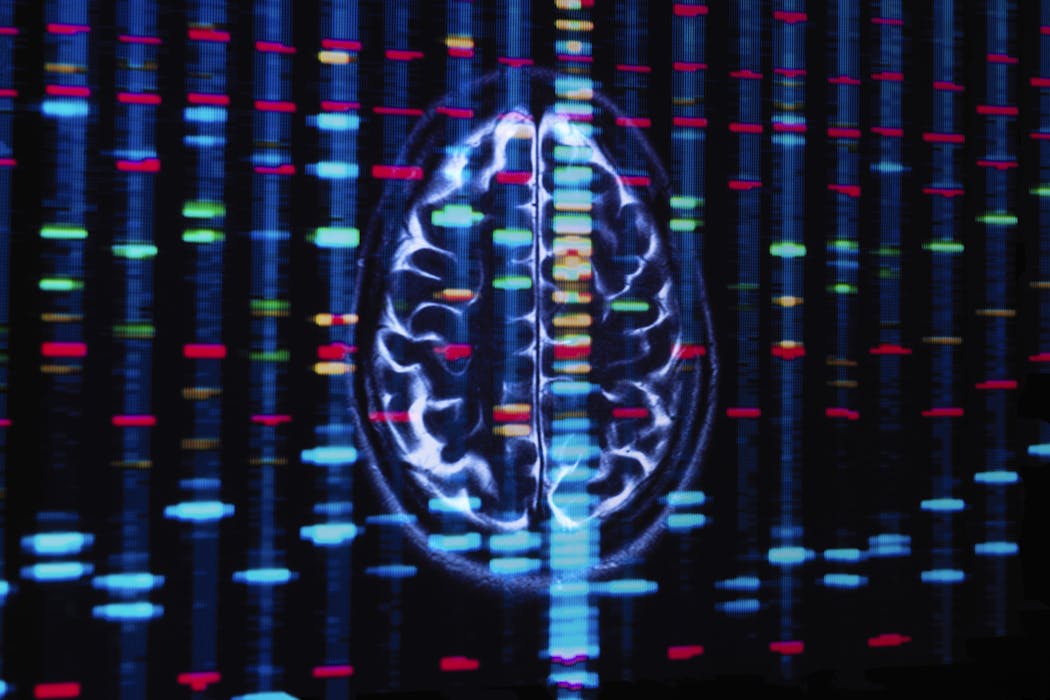
GettyImages Tek Image / Science Photo Library via Getty Images

Differences between men and women in intelligence and behaviour have been proposed and disputed for decades.

Now, a growing body of scientific evidence shows hundreds of genes act differently in the brains of biologically male or female humans. What this means isn’t yet clear, though some of the genes may be linked to sex-biased brain disorders such as Alheizmer’s and Parkinson’s diseases.

These sex differences between male and female brains are established early in development, so they may have a role in shaping brain development. And they are found not only in humans but also in other primates, implying they are ancient.

Gene activity in male and female brains

Decades of research have confirmed differences between men and women in brain structure, function and susceptibility to mental disorders.

What has been less clear is how much of this is due to genes and how much to environment.

We can measure the influence of genetics by looking directly at the activity of genes in the brains of men and women. Now that we have the full DNA sequence of the human genome, it is comparatively easy to detect activity of any or all of the roughly 20,000 genes it contains.

Genes are lengths of DNA, and to be expressed their sequence must be copied (“transcribed”) into messenger RNA molecules (mRNA), which are then translated into proteins – the molecules that actually do the work that underpins the structure and function of the body.

So by sequencing all of this RNA (called the “transcriptome”) and lining up the base sequences to the known genes, we can measure the activity of every gene in a particular tissue – even an individual cell.

When scientists compared the transcriptomes in postmortem tissue samples from hundreds of men and women in 2017, they found surprisingly different patterns of gene activity. A third of our 20,000 genes were expressed more in one sex than the other in one or several tissues.

The strongest sex differences were in the testes and other reproductive tissues, but, surprisingly, most other tissues also showed sex biases. For instance, a subsequent paper showed very different RNA profiles in muscle samples from men and women, which correspond to sex differences in muscle physiology.

A study of brain transcriptomes published earlier this year revealed 610 genes more active in male brains, and 316 more active in female brains.

What genes show sex bias in the brain?

Genes on the sex chromosomes would be expected to show different activity between men (with an X chromosome and a Y chromosome) and women (with two X chromosomes). However, most (90%) sex-biased genes lie on ordinary chromosomes, of which both males and females have two copies (one from mum, one from dad).

This means some sex-specific signal must control their activity. Sex hormones such as testosterone and oestrogen are likely candidates, and, indeed, many sex-biased genes in the brain respond to sex hormones.

How are sex differences established in the brain?

Sex differences in brain gene activity appear early in the development of the foetus, long before puberty or even the formation of testes and ovaries.

Another 2025 study examined 266 post mortem fetal brains and found more than 1,800 genes were more active in males and 1,300 in females. These sets of sex-biased genes overlapped with those seen in adult brains.

This points to direct genetic effects from genes on the sex chromosomes, rather than hormone-driven differences.

Do these differences mean male and female brains work differently?

It would be remarkable if sex differences in the activity of so many genes were not reflected in some major differences in brain function between men and women. But we don’t know to what extent, or which functions.

Some patterns are emerging. Many female-biased genes have been found to encode neuron-associated processes, whereas male-biased genes are more often related to traits such as membranes and nuclear structures.

Many genes are sex-biased only in particular sub-regions of the brain, which suggests they have a sex-specific function only in those regions.

However, differences in RNA levels don’t always produce differences in proteins. Cells can compensate to maintain protein balance, meaning that not all RNA differences have functional outcomes. Sometimes, developmental processes differ between sexes but lead to the same end result.

Brain health

Of particular interest is the finding of a relationship between sex biases and sex differences in the susceptibility to some brain disorders.

Many genes implicated in Alzheimer’s disease are female-biased, perhaps accounting for the doubled incidence of this disease in women. Studies on rodents imply that expression of the male-only SRY gene in the brain exacerbates Parkinson’s disease.

Evolution of sex differences in brain gene function

These sex-biased gene expression patterns are by no means unique to humans.
They have also been found in the brains of rats and mice as well as in monkeys.

The suites of male- and female-biased genes in monkeys overlap significantly with those of humans, implying that sex biases were established in a common ancestor 70 million years ago.

This suggests that natural selection favoured gene actions that promoted slightly different behaviours in our male and female primate ancestors – or perhaps even further back, in the ancestor of all mammals, or even all vertebrates.

In fact, sex differences in the expression of genes in the developing brain look to be ubiquitous in animals. They have been observed even in the humble nematode worm.

The Conversation

Jenny Graves receives funding from the Australian Research Council.

ref. Hundreds of genes act differently in the brains of men and women – https://theconversation.com/hundreds-of-genes-act-differently-in-the-brains-of-men-and-women-266352

Taking prescription opioids for too long can be harmful. Here’s how to cut back and stop

Source: The Conversation – Global Perspectives – By Aili Langford, Pharmacist, Lecturer, NHMRC Emerging Leadership Fellow, Sydney Pharmacy School, The University of Sydney, University of Sydney

Maskot/Getty Images

Opioids, such as oxycodone, morphine, codeine, tramadol and fentanyl, are commonly prescribed to manage pain. You might be given a prescription when experiencing pain, or after surgery or an injury.

But while opioids may relieve pain in the short term, they provide little to no lasting improvement in pain or function beyond a few weeks for people whose pain isn’t caused by cancer.

Opioids can also cause side effects such as nausea, constipation and drowsiness, as well as serious risks such as dependence and overdose.

Over the past decade, Australia has introduced initiatives to reduce opioid use and related harm. This includes new guidelines that recommend reducing the dose or stopping opioids when the risks of continuing outweigh the benefits.

Many people can reduce or stop opioids without their pain worsening. Some people even experience less pain. However, for some people, reducing or stopping opioids can result in worse pain, mental health crises and even suicide.

Our new research, published today in the New England Journal of Medicine, explains how to safely reduce and stop taking prescription opioids.

How do you know when it’s time to stop? Then what?

Determining whether it is appropriate to reduce or stop opioids depends on several factors unique to each person. These include:

  • why opioids were prescribed
  • how long they’ve been used
  • what other treatments you’ve tried
  • how the medication affects your pain, function and quality of life
  • your life circumstances.

If it’s appropriate to trial reducing or stopping opioids, guidelines from Australia, the United Kingdom and the United States emphasise the following principles:

1) Shared decision-making

Shared decision-making is where health-care professionals and patients work together to set goals, weigh risks and benefits, and make informed choices.

This means collaboratively designing an opioid reduction plan that reflects the person’s needs, preferences and circumstances, rather than imposing a one-size-fits-all approach.

Research shows shared decision-making may lead to better outcomes, and patients value this process.

2) Reduce gradually

Stopping opioids suddenly can cause withdrawal symptoms such as anxiety, insomnia, and stomach upset. Rapid dose reductions can also increase the risk of overdose, mental distress and suicide.

To avoid these risks, opioids should be reduced gradually over weeks, months or even longer. The process should be flexible, allowing for pauses or adjustments to the reduction plan if needed.

When someone takes lower doses of opioids over time, their body’s tolerance decreases. If they return to a higher dose, there is a risk of overdose. For this reason, health-care professionals may recommend having naloxone available. This is a medication that can reverse an opioid overdose.


Read more:
Naloxone can reverse opioid overdose. Here’s why you might need some at home or in your bag


3) Set up other supports

Supportive strategies should be used before, during and after reducing opioids. These can include:

  • physical therapies such as physiotherapy
  • psychological approaches such as mindfulness
  • non-opioid medications
  • mental health support from health-care professionals, friends and family
  • education about pain self-management.

The evidence supporting specific interventions is often limited or uncertain. Choosing a strategy will depend on your individual preferences and access. The best approach is likely a combination of several different supports.

4) See your health-care provider for ongoing monitoring

Regular monitoring from a health-care professional is recommended during and after opioid reduction to assess pain, function, withdrawal symptoms and wellbeing.

This can help to ensure that any issues are identified early and are addressed.

If someone experiences a clear decline in their quality of life, for example, it may be necessary to pause or stop the taper and revisit it later, provide extra supports or implement strategies to manage withdrawal symptoms.

We need a health system that supports this process

Making opioid reduction safer and more effective requires putting these principles into practice. But many patients and health-care professionals still face challenges when doing so.

It’s best practice to access a team-based pain management program with support from a doctor, physiotherapist and psychologist, among other providers, to manage pain and reduce the use of opioids. But access to these services remains limited in many parts of Australia.

Physio works with patient in a clinic
Not everyone has access to team-based pain management.
Hispanolistic/Getty Images

Consumer organisations and professional bodies have called for greater access to team-based pain services so more people, especially those living in rural and under-served areas, can access support.

Australian health-care professionals have also requested more education and training in pain management, prescribing and opioid reduction, as well as stronger evidence about what works, for whom and why. This is so they’re better able to tailor their care to each person’s needs.

Other strategies such as reducing the amount of opioids prescribed – including after surgery – have also been proposed to help prevent long-term opioid use and the need for reduction plans later on.

The Conversation

Aili Langford receives funding from the Australian National Health and Medical Research Council through an Investigator Grant Fellowship. She sits on the Executive Committee of the Australian Deprescribing Network (ADeN). This is an unpaid volunteer role.

Christine Lin receives funding from the National Health and Medical Council and the Medical Research Future Fund. She is a member of the Australian Physiotherapy Association and Fellow of the Australian College of Physiotherapy.

ref. Taking prescription opioids for too long can be harmful. Here’s how to cut back and stop – https://theconversation.com/taking-prescription-opioids-for-too-long-can-be-harmful-heres-how-to-cut-back-and-stop-265874

Do you speak cat? Take this quiz to find out

Source: The Conversation – Global Perspectives – By Julia Henning, PhD Candidate in Feline Behaviour, School of Animal and Veterinary Science, University of Adelaide

Katelyn G/Unsplash

While often miscast as mysterious or hard to understand, cats are actually excellent communicators. In fact, in free-ranging cat colonies, physical fights are kept to a minimum through clever use of body posturing, scent exchange and vocalisations.

Cats have also adapted their communication for humans. For instance, adult cats don’t usually meow at each other. But when around people, cats meow a lot, suggesting they have adapted this vocalisation for communicating with humans.

And it’s not just the meow. Cats have a wide vocal repertoire for conveying different meanings, even for specific people. Bonded cats and humans often develop their own communication repertoires, similar to having a unique dialect.

Cats can understand human communication too. Studies show cats know their own names and the names of their companions, and can recognise human emotions, even changing their own behaviour in response.

Despite all this, humans still routinely misunderstand cats. Our new study, published in Frontiers in Ethology, shows just how little people understand the cues cats give. Try the quiz below to see how well you speak cat.

What we did

We asked 368 Australian participants to watch videos of human–cat play interactions. But not all the videos were “play” for the cat. Only half of the cats were playing, while the other half were actually showing signs they didn’t want to play, or were feeling stressed by the interaction.

After each video, participants were asked if they thought the interaction was overall positive or negative for the cat, based only on the cat’s behaviour. They were then asked how they would interact with the cat in the video they had just seen.

How well do you speak cat?

Watch the short videos below and decide: is the cat feeling positive or negative about the interaction? Remember to base your answers only on the cat’s behaviour.

What did our study find?

Results showed that participants struggled to recognise negative cues indicating discomfort or stress in cats.

For videos of cats who weren’t playing and were showing subtle negative cues (such as sudden tension in the body or avoiding touch), participants only recognised the negative cues about as well as chance (48.7%).

Even when participants watched videos of cats showing overt negative cues like hissing, biting or trying to escape, they still incorrectly categorised these as positive 25% of the time.

Recognising when a cat is stressed is only the first step. We also need to know how to respond to these cues.

Even when participants did successfully recognise negative cues, they often chose to engage with the cat in ways that would cause more stress and increase the risk of human injury, such as stroking, belly rubbing and playing with hands.

A man in a summer outfit on a street pats a friendly cat who is wearing a collar.
Cats are excellent communicators – you just need to know the signs.
Micky White/Unsplash

Stress is unhealthy

Stress can have serious consequences. Cats who experience regular or prolonged stress (including from unwanted interactions like those in the negative videos) are at higher risk of heath issues such as bladder inflamation.

They’re also more likely to develop behaviours people find problematic, such as increased aggression or urinating outside of the litter tray. In turn, these behaviours increase risk of the cat being euthanised or rehomed.

Cat stress is bad for humans, too. If a person doesn’t heed early warning signs, the cat may bite or scratch, depositing bacteria and microorganisms deep into the skin. Rapid infection follows 30%–50% of cat bites. If not treated promptly, it can lead to serious complications including sepsis, chronic health issues and even death. Cat bites and scratches can also transmit zoonotic diseases such as cat scratch disease.

A calico cat getting hugs and pats.
Cats are less stressed when they’re not having to deal with unwanted interactions.
Fuzzy Rescue/Unsplash

How to play safely with cats

Watch for early warning signs a cat isn’t enjoying themselves and stop if you notice any. By the time cues are obvious, cats are already experiencing distress.

Early warnings include turning away, dodging or blocking attempts to touch, flinching, body tension, ears back or to the side, lip/nose licking and tail thrashing, slapping or tucking.

Touch

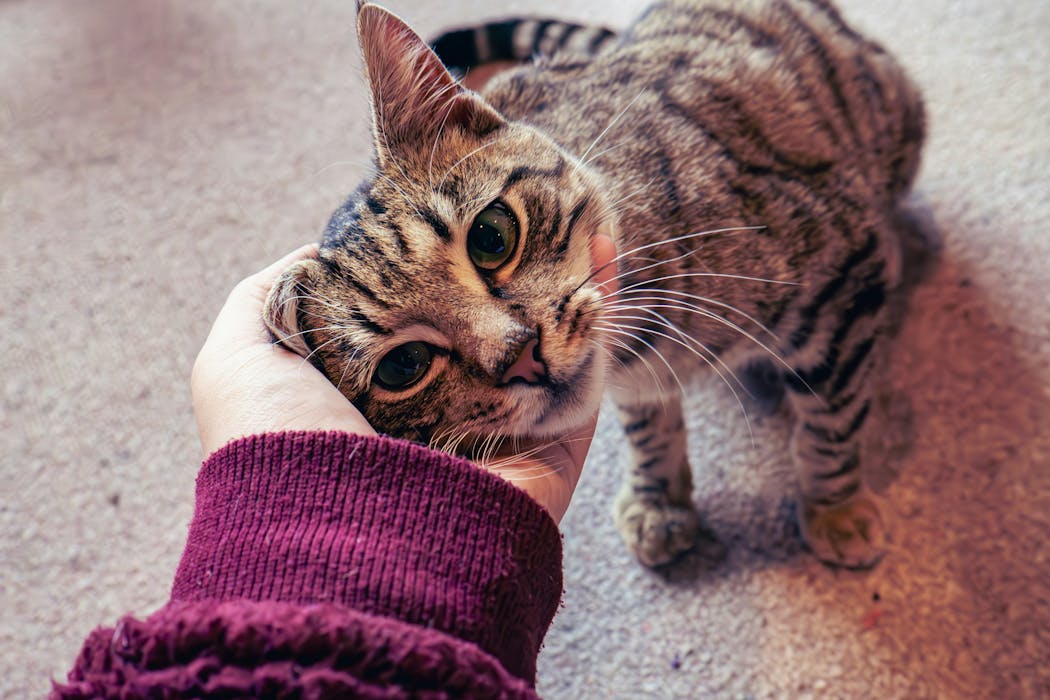
Avoid sensitive areas such as the belly, paws or the base of the tail. Cats prefer to be touched on the head and neck.

Avoid using hands to play. It teaches cats that hands are toys, and increases the risk of accidental injury. Instead, use toys that keep your face and hands away, such as a wand toy with a long handle.

Tail

Tail movements aren’t always a negative sign – they just mean the cat is emotionally stimulated and that could be from stress or excitement. Cats also use their tails for balance. So it’s best to consider the tail in combination with the whole body and the context.

Changes in tail movements can also give important clues to the cat’s mood. Generally, the bigger the movement, the more intense the feeling. So, if the movements start to get bigger or faster during play, or if a tail goes from relaxed to swishing when you touch, that might be a sign to back off.

Ears

Cats’ ears are like antennas that swivel and adjust to pinpoint sound, but they can also give us a clue to how they are feeling. If the ears move for a moment and then return to a relaxed position, that usually means they’re listening to the world around them. If the ears remain flattened and back, that’s a sign of distress.

Vocalisations

Trilling and chirruping both suggest a playful cat, while hissing, growling and yowling all indicate stress. Purring might seem positive but may indicate a cat is stressed and trying to self soothe.

Let them be

When early warnings don’t work, cats may show overt signs such as hissing, growling, trembling, hiding and, ultimately, biting or scratching.

If you notice warning signs, give the cat plenty of space. When stressed, cats don’t like being touched or having people too close. If the cat comes back and re-initiates contact, that’s a good sign they’re comfortable, but keep watch for warning signs returning.

If you pay attention to your cat’s behaviour and give them space when they need it, with a bit of practice you might just become fluent in cat.

The Conversation

Julia Henning does not work for, consult, own shares in or receive funding from any company or organisation that would benefit from this article, and has disclosed no relevant affiliations beyond their academic appointment.

ref. Do you speak cat? Take this quiz to find out – https://theconversation.com/do-you-speak-cat-take-this-quiz-to-find-out-268217

Comment les enfants du baby-boom vivront-ils la fin de vie au Québec ?

Source: The Conversation – in French – By Jean-Ignace Olazabal, Responsable de programmes, Université de Montréal

Les personnes âgées de 65 ans et plus (environ 2 250 000 personnes en 2033) représenteront 25 % de la population de la province de Québec au début des années 2030, les enfants du baby-boom composant dès lors la presque totalité de la population aînée.

Le taux de mortalité augmentera cela dit progressivement à partir de 2036, avec plus de 100 000 décès par année, et dépassera de loin le nombre de naissances, maintenant le Québec dans un contexte de post-transition démographique qui pourrait provoquer un déclin de la population globale.

Quoi qu’il en soit, l’augmentation de la longévité prévue fera que ces nouveaux vieux, les enfants du baby-boom, seront plus nombreux à devenir octogénaires et nonagénaires que ceux des générations précédentes. En effet, les 80+ pourraient représenter près de 8 % de la population en 2033, alors que l’espérance de vie prévue par Statistique Canada sera de 82 ans pour les hommes et de 86 ans pour les femmes.

Il est clair que la balise 65+ n’est plus la même qu’il y a 50 ans, et que la vieillesse est désormais un cycle de vie long, avec les enjeux et défis que cela comporte. Or, paradoxe remarquable, alors que le Québec figure au palmarès des sociétés où l’espérance de vie est la plus haute, elle est également celle où la demande d’aide médicale à mourir est la plus importante.

Anthropologue de la vieillesse et du vieillissement, je suis responsable de la formation en vieillissement à la Faculté de l’apprentissage continu (FAC) de l’Université de Montréal et je m’intéresse aux aspects sociaux du vieillissement des enfants du baby-boom au Québec.


Cet article fait partie de notre série La Révolution grise. La Conversation vous propose d’analyser sous toutes ses facettes l’impact du vieillissement de l’imposante cohorte des boomers sur notre société, qu’ils transforment depuis leur venue au monde. Manières de se loger, de travailler, de consommer la culture, de s’alimenter, de voyager, de se soigner, de vivre… découvrez avec nous les bouleversements en cours, et à venir.


Des vieux nouveaux genres ?

Si le baby-boom est un phénomène démographique englobant les personnes nées entre la fin de la Seconde Guerre mondiale et le milieu des années 1960, il est convenu, ici comme en France ou aux États-Unis, de réserver le nom baby-boomers aux personnes nées entre 1946 (1943 au Québec) et 1958.

Dans son livre intitulé Le fossé des générations, publié en 1971, l’anthropologue Margaret Mead disait des baby-boomers états-uniens qu’ils constituaient une génération préfigurative, en ce sens qu’ils ont inversé les termes de la transmission intergénérationnelle, les jeunes instruisant leurs aînés et, du coup, leurs pairs, plutôt que l’inverse, défiant ainsi la tradition.

Cette inscription en faux contre les valeurs parentales et ancestrales aura permis l’essor de la contreculture dans les années 1960-1970, comme l’expliquent les sociologues Jean-François Sirinelli dans le cas de la France et Doug Owram dans celui du Canada, à travers des valeurs jeunes (la musique pop, la consommation de drogues récréatives ou l’amour libre par exemple). Elle aura également permis de rompre avec la traditionnelle transmission des rôles et des statuts au sein de la famille, comme le souligne le sociologue québécois Daniel Fournier.

Un effet de génération

On parle ici d’un effet de génération au sens sociologique du terme. Au Québec, les baby-boomers seraient, selon le sociologue québécois Jacques Hamel, ceux qui constituent cette fraction des enfants du baby-boom ayant souscrit au slogan « qui s’instruit, s’enrichit » et qui détiennent ces « diplômes universitaires, expression par excellence de cette modernisation » que connut le Québec dans les années 1960.

Ces derniers auront fomenté, sous l’égide des aînés ayant réfléchi la Révolution tranquille (soit les René Lévesque, Paul Gérin-Lajoie et autres révolutionnaires tranquilles), des transformations majeures au sein d’institutions sociales et d’idéaux aussi fondamentaux que la famille (en la réinventant), la nation (en la rêvant) ou la religion catholique (en la reniant de façon massive).

Le sociologue américain Leonard Steinhorn reconnaît dans cette génération des personnes aux valeurs progressistes ayant tendance à une plus grande reconnaissance de la diversité culturelle, des nouvelles mœurs (comme la légalisation du mariage homosexuel, de l’aide médicale à mourir, ou du cannabis récréatif), ou de l’égalité entre les hommes et les femmes, par rapport aux générations précédentes.


Déjà des milliers d’abonnés à l’infolettre de La Conversation. Et vous ? Abonnez-vous gratuitement à notre infolettre pour mieux comprendre les grands enjeux contemporains.


Mais ce qui distingue surtout ces baby-boomers vieillissants des générations de personnes âgées d’antan, c’est la persévérance dans la conviction de la primauté du sujet, par delà les conventions sociales, même dans la dépendance et la fin de vie.

L’effet de génération, bien qu’il diffère chez chacun des membres d’un même ensemble générationnel, est un produit de l’histoire et des conditionnements sociohistoriques auxquels le sujet aura été exposé au cours des premières décennies de sa vie. Les premières générations du baby-boom ont dès leur jeune âge adulte participé activement à la laïcité de l’État et de l’espace public et privé, et souscrit à l’État technobureaucratique promu par la Révolution tranquille, libérant le sujet des attaches communautaristes pour le rendre autonome.

Les enfants du baby-boom et la fin de vie

L’affranchissement des contraintes religieuses chez les Québécois d’origine canadienne-française, le difficile accès aux soins palliatifs pour les personnes âgées et, surtout, la volonté de contrôler sa propre destinée, sont autant de facteurs qui risquent d’influer sur la fin de vie et la mort des enfants du baby-boom au Québec.

En 2023, 7 % des personnes décédées au Québec – majoritairement des personnes âgées – ont choisi la mort médicalement assistée, dans un contexte d’acceptation sociale presque unanime. En effet, 90 % de la population québécoise appuie la loi sur l’aide médicale à mourir, selon un sondage Ipsos, soit le plus haut taux au Canada.

La détresse existentielle face à la fin de vie et le refus de la souffrance et de l’agonie pourraient expliquer l’engouement des enfants du baby-boom pour ce qu’ils considèrent une mort digne.

Or le grand volume de personnes qui constituent l’ensemble des cohortes du baby-boom, soit les personnes nées entre 1943 et 1965, invite à réfléchir au sort qui sera réservé à beaucoup d’entre eux et elles quant à la qualité et à la quantité des soins et des services publics qui leur seront alloués. Étant donné le contexte plutôt critique du Réseau québécois de la santé et des services sociaux, se pose la question des conditions dans lesquelles se dérouleront ces nombreux décès, estimés à plus de 100 000 par année dès 2036.

Pas tous égaux devant la vieillesse

Certes, une bonne proportion de personnes parmi ce grand ensemble populationnel seront effectivement à l’aise financièrement et jouiront d’un bon état de santé grâce à leur niveau d’éducation, à de généreuses pensions et autres fonds de retraite, à de saines habitudes de vie, et à la biomédecine. Cela étant dit, une proportion non négligeable vieillira appauvrie et malade. Les inégalités sociales de santé demeureront importantes au sein de ces nouvelles générations de personnes âgées.

Les hommes bénéficieront globalement d’un avantage sur les femmes en termes de conditions de retraite et de qualité de vie, tout comme les natifs par rapport aux immigrants, soulignent les démographes Patrik Marier, Yves Carrière et Jonathan Purenne dans un chapitre de l’ouvrage Les vieillissements sous la loupe. Entre mythes et réalités. Cela aura une incidence sur les conditions d’habitation et de résidence, sur les coûts privés en santé et sur la qualité du vieillissement en général.

Ces inégalités sociales de santé feront que les dernières années de vie de plusieurs, des femmes surtout, risquent de l’être en mauvaise santé, appauvries et sans forcément un entourage de qualité. Mais vivre plus longtemps à n’importe quel prix n’est pas le souhait de beaucoup parmi les enfants du baby-boom, et ce indépendamment de leur statut socioéconomique.

L’aide médicale à mourir deviendra-t-elle, dès lors, un acte médical ordinaire, alors que le système public de santé et de services sociaux connaîtra une pression accrue ? Quoi qu’il en soit, ce geste médical ultime devrait toujours jouir d’une popularité incontestable parmi les nouveaux vieux Québécois, du moins ceux d’origine canadienne-française qui ont rompu avec le catholicisme, ce qui pourrait contribuer à freiner l’augmentation de l’espérance de vie au Québec.

Mais encore faut-il que la fin de vie se déroule également dans la dignité.

La Conversation Canada

Jean-Ignace Olazabal a reçu des financements du CRSHC, IRSC.

ref. Comment les enfants du baby-boom vivront-ils la fin de vie au Québec ? – https://theconversation.com/comment-les-enfants-du-baby-boom-vivront-ils-la-fin-de-vie-au-quebec-252148

Lack of progress on joining EU caps another bad month for Ukraine

Source: The Conversation – UK – By Stefan Wolff, Professor of International Security, University of Birmingham

Ukraine is having a tougher-than-usual time at the moment. On the frontlines, the battle of Pokrovsk is raging, and it does not look like Ukraine is winning it.

Nor do things look good for the country’s energy resilience after months of an intensive Russian air campaign targeting key infrastructure. According to the UN, this could trigger another major humanitarian crisis in the already war-ravaged country.

The geopolitical picture looks equally grim. The delivery of long-range Tomahawk missiles, sought by Kyiv for months now, has again been ruled out by the US president, Donald Trump. What’s more, after his meeting with the Chinese president, Xi Jinping, in South Korea on October 30, Trump said that the US and China would work together to end the war in Ukraine.

The possibility of a productive collaboration between Trump and Xi on peace in Ukraine, let alone its successful conclusion, is remote. And even if there was a Washington-Beijing sponsored deal, it would not be in Ukraine’s favour as became clear a few days later.

During a high-profile, two-day visit of the Russian prime minister, Mikhail Mishustin, to China on November 3 and 4, Beijing showed no signs of backing out of its partnership with Russia, which is key to sustaining the Kremlin’s war machine.

Nor does the continuing delay in approving an EU loan to Ukraine worth €60 billion (£53 billion) and backed by frozen Russian assets bode well for Kyiv.

Given all this bad news, it was therefore no surprise that Ukraine’s president, Volodymyr Zelensky, leapt at what looked, on the surface, like good news in the European commission’s latest assessment of Kyiv’s progress towards EU membership. The European commission notes in its report that Ukraine has made progress in all of the 33 different chapters of the accession negotiations. This is as remarkable as it is commendable given that the country has done so in the shadow of Russia’s aggression since February 2022.

Yet, in many areas, progress is modest at best. A more careful analysis of the 2025 commission report suggests that positive news, if any, is in the presentation, not the underlying facts.

ISW map showing the state of the conflict in Pokrovsk, Ukraine, NOvember 4 2025.
This map of the region around the townof Pokrovsk, in Ukarine’s east, shows the extent of Russian advances.
Institute for the Study of War

For example, in relation to the fight against corruption the commission reports that recent developments “cast doubts on Ukraine’s commitment to its anti-corruption agenda”. This is primarily a reference to attempts by Zelensky’s government to limit the independence of the country’s anti-corruption institutions. The issue triggered massive public protests in the summer and forced a partial government climb-down.

Worryingly, the commission also notes “political pressure on anti-corruption activists” and “harassment and intimidation of journalists”. This includes “cases of strategic lawsuits against public participation (SLAPPs) related to journalistic investigations”.

Meanwhile, in the fight against serious and organised crime, the commission report states: “The freezing and confiscation of criminal assets remain very limited.” Other shortcomings concern limited progress on decentralisation, lack of transparency in recruitment to civil service positions, the independence and impartiality of the judiciary, and the persistence of torture and ill treatment in the prison and detention system.

On the one hand, it is not surprising that these shortcomings exist. Ukraine has been fighting an existential war for almost four years. The country has only been a candidate country for EU membership since June 2022, four months after Russia launched its full-scale invasion. Accession negotiations didn’t start until December 2023.

Yet it is the persistence of these highly visible, easily exploitable problems related to fundamental values of the EU that are causing concern. Almost identical issues were raised in the European commission’s opinion on Ukraine’s membership application in 2022. It was raised again in the 2023 report and again in last year’s progress report on accession negotiations.

It may be an exaggeration to claim that Ukraine is experiencing a turn towards a more autocratic style of presidential government under Zelensky. But there clearly are signs that war-time politics in Kyiv has a darker side that does little to bolster the country’s credentials for EU membership.

Discord within

This provides easy ammunition for Ukraine’s detractors inside the EU. Chief among them is Hungary’s prime minister, Viktor Orbán, whose obstruction tactics have frustrated European commission efforts on Ukraine’s accession.

Poland and Slovakia have joined Hungary in defying the EU’s effforts to complete an updated trade deal with Ukraine. Opposition to Ukraine from within the EU has now been further strengthened by the formation of a eurosceptic, hard-right populist government coalition in the Czech republic.

The EU’s foreign affairs chief, Kaja Kallas, continues to insist that membership for Ukraine by 2030 “is a realistic goal”.

But the EU’s enlargement commissioner, Marta Kos, is more guarded. She has noted that “future accession treaties will need to contain stronger safeguards” to “reassure our citizens in the Member States that the integrity of our Union and democratic values are ensured, also after the accession”.

In an interview with the Financial Times, she said that she did not “want to go down as the commissioner bringing in the Trojan horses”.

Given the detail in Ukraine’s 2025 progress report on areas where Kyiv clearly needs to make urgent improvements, this suggests that the tough times for Ukraine are likely to continue, and not just in its war with Russia.

Though the future of the EU and Ukraine have become ever more closely entwined since February 2022, there remains a bigger question for the EU. Its dilemma is how to balance holding the line on its membership standards and enabling Ukraine to hold the line against Russia.

The Conversation

Stefan Wolff is a past recipient of grant funding from the Natural Environment Research Council of the UK, the United States Institute of Peace, the Economic and Social Research Council of the UK, the British Academy, the NATO Science for Peace Programme, the EU Framework Programmes 6 and 7 and Horizon 2020, as well as the EU’s Jean Monnet Programme. He is a Trustee and Honorary Treasurer of the Political Studies Association of the UK and a Senior Research Fellow at the Foreign Policy Centre in London.

Tetyana Malyarenko receives funding from Elliott School of International Affairs, The George Washington University.

ref. Lack of progress on joining EU caps another bad month for Ukraine – https://theconversation.com/lack-of-progress-on-joining-eu-caps-another-bad-month-for-ukraine-268921

How Zohran Mamdani’s ‘talent for listening’ spurred him to victory in the New York mayoral election

Source: The Conversation – UK – By Daniel Hutton Ferris, Lecturer in Political Theory and Philosophy, Newcastle University

Zohran Mamdani, a 34-year-old democratic socialist, has been elected as New York City’s mayor. He became the first New York mayoral candidate to win more than 1 million votes since 1969, and looks set to secure over 50% of the total vote.

With almost all of the votes counted, independent candidate Andrew Cuomo seems to have been backed by 41.6% of voters. Republican Curtis Sliwa has secured just 7%.

Mamdani, who has become New York City’s first Muslim mayor, swept to victory on what was characterised as a radical left-wing platform. He has promised to tax millionaires more in order to fund free buses and childcare for all.

He has also vowed to honour an International Criminal Court arrest warrant for the Israeli prime minister, Benjamin Netanyahu, over alleged war crimes in Gaza if he visits New York. The Israeli foreign ministry has previously called Mamdani a “mouthpiece for Hamas propaganda”.

How did a figure on the far left of American politics, who is also a staunch critic of Israel, win in a city that is full of millionaires and home to a sizeable Jewish population?

The corruption and sexual harassment scandals affecting his main rival certainly helped, as did the focus of his campaign on making life more affordable for New Yorkers. Mamdani’s presence on social media raised his profile and attracted voters, too.

He posted slick videos on TikTok and Instagram throughout his campaign, including one where he criticised the rent increases seen under outgoing mayor Eric Adams while running the New York City marathon.

But journalists and commentators have noticed something else that has helped boost Mamdani’s appeal among New Yorkers. He has what the New York Times called in July “a rare talent for listening”.

Mamdani is unusually reflective in interviews, often thinking silently for more than 20 seconds before responding to questions. And after his successful primary earlier in 2025, Mamdani contacted every business and cultural leader in the city he could get hold of to hear about why they opposed him.

The viral campaign videos that made his name also see him walking the streets of New York, asking voters questions and listening to their answers at length without interruption. Mamdani may be a radical, but he really listens.

Talking to voters

Democratic theorists are likely to celebrate Mamdani’s approach. Many philosophers embrace what is known as the “deliberative theory of democracy”, which argues that talking – as opposed to voting – is the central democratic institution.

These people suggest that politicians should talk to a diverse range of voters respectfully about their decisions. Listening to diverse perspectives improves policy because it requires leaders to consider a range of ideas and arguments, relying less on their own gut intuitions.

As a respectful and inclusive political style, it can also help citizens feel heard and challenge the idea that politicians are interested only in power and will say whatever it takes to win. A more deliberative kind of responsiveness to voters can therefore increase political legitimacy and trust.

Political scientists are likely to point out that Mamdani has an important strategic reason for his deliberative political style. New York City uses a system of ranked choice voting, or “the alternative vote”, which asks voters to rank candidates in order of their preference rather than choosing just one.

This encourages politicians to find policy proposals that are supported by large majorities, such as taxing millionaires to pay for free childcare, and to communicate respectfully with people of all political persuasions in the hope they might win their second-preference votes.

Larry Diamond, a leading American democracy expert, has called ranked choice voting the “Archimedean lever of change” for solving the deep polarisation currently affecting US politics. This is because it penalises candidates who rely on divisive rhetoric to appeal to a passionate base of supporters.

They are unlikely to win second-preference votes from people whose first preference is for one of their rivals. Conversely, ranked choice voting rewards politicians who try to bridge political divides with respectful and inclusive campaigning.

Depolarising US politics

There are many lessons that the political left in the US and beyond can learn from Mamdani’s victory. Most obviously, it shows that a socialist and pro-Palestine candidate can win in a major US electoral contest by combining a lively digital campaign with a strong focus on the cost of living.

It also suggests that candidates perceived as being radical are more likely to succeed in elections when they are visibly willing to listen to and deliberate with voters from all sorts of backgrounds.

Mamdani’s rise should also encourage a wider embrace of ranked choice voting. The system has been used to elect members of Australia’s House of Representatives for more than a century and it is now used in the US states of Maine and Alaska, as well as in the San Francisco Bay Area.

It should be adopted elsewhere too, as an antidote to political polarisation. The UK held a referendum on changing the electoral system to the alternative vote in 2011. However, UK voters unfortunately rejected the proposal.

Finally, Mamdani’s victory shows that radicalism and reflectiveness can come together, especially when the electoral system promotes it. Ranked choice voting is so good at encouraging a politics of respect and listening that it is sometimes accused of creating boring centrist candidates.

But Mamdani has reminded us that this does not have to be the case. Reforming US election systems could encourage deliberative responsiveness and depolarise American politics, without taking radical options off the menu.

The Conversation

Daniel Hutton Ferris does not work for, consult, own shares in or receive funding from any company or organisation that would benefit from this article, and has disclosed no relevant affiliations beyond their academic appointment.

ref. How Zohran Mamdani’s ‘talent for listening’ spurred him to victory in the New York mayoral election – https://theconversation.com/how-zohran-mamdanis-talent-for-listening-spurred-him-to-victory-in-the-new-york-mayoral-election-268950

US election results suggest Trump’s coalition of voters is collapsing

Source: The Conversation – UK – By Andrew Gawthorpe, Lecturer in History and International Studies, Leiden University

Americans voted in elections on November 4 in the first major test of whether Republicans can hold together the coalition of voters that propelled Donald Trump to the White House in November 2024. The result was a Democratic party triumph.

Trump was not directly on the ballot in any of these elections, the most high-profile of which were to decide who would become the mayor of New York City and the governors of Virginia and New Jersey. But each race has been seen to varying degrees as a referendum on the president and the direction he has taken his party.

American politics is highly nationalised. This means that results in local and state elections are often heavily influenced by how voters feel about the national political situation. This is often frustrating to local politicians.

In New Jersey, for example, the Republican candidate Jack Ciattarelli frequently complained that his Democratic opponent Mikie Sherrill was trying to make their recent race a referendum on the president rather than basing the campaign on the relative merits of their own proposals.

“If you get a flat tire on the way home tonight, she’s going to blame it on President Trump”, Ciattarelli said to voters at numerous campaign rallies. In the end, Sherrill won by 13%.

Republicans’ fraying coalition

None of the major races decided on November 4 were in the states usually regarded as the “swing states” – the ones that could reasonably be won either by the Democrats or Republicans and usually decide the outcome of presidential elections. But this doesn’t mean we cannot learn anything from them.

The nationalisation of US politics means that voters with similar demographic characteristics – for instance, what race they identify as or whether they live in the suburbs or rural areas – tend to vote in similar ways across state lines. If a party is improving its performance in the suburbs of New Jersey, the same is likely to be the case in the swing state of Pennsylvania.

In this respect, democratic socialist Zohran Mamdani’s victory in New York City was the least surprising news of the night. For New York to have its first Muslim mayor is a historic milestone, and Mamdani’s achievement has electrified many. But Democrats usually dominate in urban areas, and he was no exception.

Republicans will be much more worried about what happened elsewhere. In both Virginia and New Jersey, Democrats won by double-digit margins – and they did so by winning back the groups that deserted them in the 2024 presidential election.

In 2024, Republicans were thrilled to make big inroads with Hispanic voters. Many saw it as proof that their party was extending its appeal beyond the white voters who make up its core supporter base. But in the recent elections, those inroads seemed to vanish.

Sherrill, a moderate Democrat who hasn’t generated nearly as much excitement as Mamdani, made her biggest gains in Passaic and Hudson counties, two of New Jersey’s most heavily Hispanic areas. Abigail Spanberger made the same inroads in Virginia.

Suburban voters, who often prove crucial to winning presidential elections, also deserted the Republicans in large numbers. Spanberger won Virginia’s Henrico County, a swathe of the suburbs of Richmond, by 40%. This was the Democrats’ biggest margin of victory in the county ever.

Some caveats

These results are great news for Democrats, and they exceeded the expectations of most observers before election night. Taken together, they seem to suggest that the coalition that won victory for the Republicans in 2024 is collapsing.

But it’s also not time for possible 2028 Democratic presidential candidates to start measuring the White House drapes quite yet. These results reflect a recent trend in US politics in which Republicans have struggled to win so-called off year elections – ones in which the presidency is not on the ballot.

In his ten years on the political scene, Trump has transformed the Republican party by expanding its appeal among less-educated white voters, younger voters and, to some extent, voters of colour.

But these are also groups that are less likely to vote than the average American. As a result, getting them to turn out when Trump is not on the ballot is a goal that Republicans have found elusive. So, we have to be careful about the conclusions we draw from these results.

At a minimum, we can safely say that the results of the recent elections suggest Democrats can expect to perform well in the midterms in 2026. That gives them the opportunity to win back one or two houses of Congress and act as a check on Trump’s agenda.

For their part, Republicans have some soul-searching to do. Trump is constitutionally barred from seeking a third term in 2028. Unless some other Republican can reproduce Trump’s appeal to infrequent voters, the signs are that his party will struggle even in presidential election years.

Much also depends on Trump’s policies in the years to come. Voters are clearly fed up with the lack of progress on reducing the cost of living, the brutality of immigration raids, and the corruption and chaos that many perceive to exist under this administration.

Voter sentiment on these issues is unlikely to change unless Trump changes course. The question, given his political style and his personality, is whether he can – or whether he even wants to.

The Conversation

Andrew Gawthorpe does not work for, consult, own shares in or receive funding from any company or organisation that would benefit from this article, and has disclosed no relevant affiliations beyond their academic appointment.

ref. US election results suggest Trump’s coalition of voters is collapsing – https://theconversation.com/us-election-results-suggest-trumps-coalition-of-voters-is-collapsing-268967