Comment la philosophie d’Hartmut Rosa « résonne » avec les sports de glisse

Source: The Conversation – in French – By Jérôme Visioli, Maître de Conférences STAPS, Université de Bretagne occidentale

Zachary DeBottis/Pexels, CC BY

Le sociologue et philosophe allemand Hartmut Rosa a développé une sociologie de la relation au monde qui distingue deux expériences fondamentales. D’un côté, l’« aliénation », lorsque l’individu se sent indifférent ou agressé par son environnement. De l’autre, la « résonance », expérience d’harmonie que les sportifs, entre autres, tendent à rechercher à travers leurs pratiques.


Selon Hartmut Rosa, la « résonance » repose sur quatre dimensions : être touché par le monde, entrer en relation avec lui sans chercher à le dominer, le transformer tout en acceptant d’être transformé et accueillir l’imprévisibilité de cette interaction. L’auteur souligne également que la recherche de l’expérience de résonance par les sportifs constitue l’un des principaux motifs de leur engagement durable dans la pratique, avec des enjeux importants en termes de bien-être.

Si les études empiriques visant à documenter les expériences de résonance et d’aliénation restent rares, on note actuellement un développement des recherches en sciences du sport autour de différentes pratiques (course, apnée, yoga, parkour, etc.). Cela s’illustre, par exemple, dans le numéro de la revue Sport, Ethics and Philosophy intitulé « Hartmut Rosa as a sport philosopher », que nous coordonnons avec Matthieu Quidu, Brice Favier-Ambrosini et Bernard Andrieu, à paraître en 2026.

À ce titre, les sports de glisse constituent un terrain particulièrement fécond, car ils mobilisent simultanément un rapport sensible à l’environnement naturel ou urbain, des interactions sociales marquées par la coopération et la reconnaissance entre pairs, une relation intime à la matérialité de l’équipement, un fort engagement corporel, mental et émotionnel (équilibre, risque, maîtrise technique), un rapport au temps singulier où alternent attente, répétition et fulgurance des instants de réussite.

Pour illustrer plus concrètement cet aspect, nous proposons de rendre compte d’une étude auprès de skateurs, menée avec Oriane Petiot, Pauline Prouff et Gilles Kermarrec, à paraître en 2026. L’objectif était de documenter résonance et aliénation à travers la documentation de récits d’expérience particulièrement marquants, correspondant à des incidents critiques. L’étude a été menée auprès de 50 skateurs âgés de 10 à 47 ans, dont 9 femmes et 41 hommes.

L’expérience de résonance en skateboard

L’expérience de résonance, c’est ce moment où une personne sent que « quelque chose vibre » entre elle et le monde. Dans le cadre de la pratique du skate, elle se divise en deux grandes catégories : la relation à la planche (74,2 %) et la relation à l’environnement (25,8 %).

La première regroupe la réussite dans une figure (47 %) et le dépassement de la peur (27,3 %). Dans le premier cas, la résonance est vécue comme une expérience d’harmonie entre corps, esprit et skateboard :

« Une session de skate où ma confiance en moi était totale. Je me sentais aligné avec toutes les planètes, presque dans un état de grâce. […] J’avais l’impression de me voir skater de l’extérieur et que mes capacités cognitives étaient amplifiées. »

Dans le second, elle naît du surpassement de soi face aux échecs et à la prise de risque :

« Après des tentatives ratées et beaucoup de peur, le trick passe enfin : un immense soulagement, une fierté et un bonheur intenses. »

Ces récits montrent que l’expérience de résonance émerge autant en lien avec la maîtrise de la planche que dans le dépassement de l’insatisfaction.

La deuxième catégorie (25,8 %) met en évidence la qualité de la relation au monde, structurée autour de deux sous-catégories : les moments avec les pairs (N = 15 ; 22,7 %) et les déplacements et découvertes de spots (N = 2 ; 3,0 %). Des moments d’émotions partagées illustrent une résonance collective, nourrie aussi par des projets communs où

« tout le monde vit le trick avec toi et t’encourage à le réussir ! […] Une joie folle, une immense satisfaction de partager un tel moment avec autant d’amis ».

Les voyages et découvertes de spots offrent également des expériences mémorables :

« Partir une semaine avec neuf potes… joie intense, liberté totale, euphorie, ivresse. »

Ces récits d’expérience soulignent l’importance du partage social des émotions liées à la découverte de nouveaux espaces de pratique.

L’expérience d’aliénation en skateboard

L’expérience d’aliénation correspond à une rupture du lien avec le monde, lorsque l’individu ne parvient plus à se sentir en relation vivante et signifiante avec son environnement. Dans le cadre de la pratique du skate, elle se divise en deux grandes catégories : la relation avec la planche (88,5 %) et la relation avec l’environnement ou les pairs (11,5 %).

Dans la première catégorie, l’aliénation découle principalement des blessures (45,9 %), des échecs répétés (32,8 %) et des difficultés d’apprentissage (9,8 %). Un jeune skateur raconte :

« Je me suis cassé le bras assez sérieusement […]. Dès que je suis tombé, j’ai su qu’il était cassé. »

L’expérience de la blessure est non seulement liée à la douleur, mais également à l’impossibilité de continuer à pratiquer le skateboard associée à une fragilisation de l’estime de soi et des liens sociaux :

« Boom, entorse ! […] tu réalises que tu ne pourras pas skater pendant un ou deux mois. »

Les échecs répétitifs suscitent également une forte insatisfaction :

« Après des dizaines d’essais sur un trick, tu te sens capable, mais ça ne passe pas […] fatigue, nervosité, frustration m’ont fait littéralement craquer. »

La seconde catégorie porte sur la relation au social, et représente 11,5 % des expériences d’aliénation, autour de la pression sociale et de la compétition (8,2 %), mais aussi des conflits (3,3 %). L’aliénation émerge notamment lorsque les interactions avec les pairs deviennent sources de rejet :

« Un gars m’a poussé, et, honnêtement, j’ai beaucoup remis en question ma place au skatepark. »

Certains évoquent un sentiment de solitude :

« Pendant trois-quatre mois, j’ai skaté seul… vraiment triste, car à ce moment, le skate était la seule chose qui me faisait plaisir. »

L’observation et le jugement peuvent également blesser les pratiquants :

« Après une chute devant les autres, j’étais tellement honteuse […] je suis partie démoralisée. »

Ces expériences montrent l’ambivalence des relations sociales, qui peuvent fragiliser l’estime de soi et transformer le skatepark en espace d’exclusion.

À la recherche de l’expérience de résonance dans les pratiques sportives

Les résultats de l’étude révèlent une dialectique essentielle entre résonance et aliénation dans l’expérience des skateurs, qui se déploie sur une temporalité évolutive. La résonance surgit souvent après des phases d’aliénation, par exemple lorsqu’un trick réussi suit de multiples tentatives infructueuses. Inversement, l’intensité des moments de résonance peut nourrir la quête permanente de sensations, au risque de retomber dans l’aliénation. Cette dialectique structure la pratique du skateboard, redéfinissant les relations au corps, à la planche, à l’environnement social et urbain.

Ces processus échappent en partie à notre contrôle, car, comme l’explique Rosa, l’expérience de résonance se caractérise aussi par une certaine indisponibilité, c’est-à-dire qu’elle ne peut pas être produite ou maîtrisée à volonté. Néanmoins, la pratique régulière favorise l’appropriation progressive de la planche comme prolongement du corps.

Le skatepark apparaît également comme une « oasis de résonance » potentielle, par ses dimensions sociales parfois associées à l’écoute de la musique, permettant de s’évader d’une société caractérisée par l’accélération, autre concept développé par Hartmut Rosa.

The movie tag contains https://www.arte.tv/fr/videos/110980-002-A/le-grand-entretien-avec-hartmut-rosa/, which is an unsupported URL, in the src attribute. Please try again with youtube or vimeo.

Les résultats de notre étude invitent à la prise en compte de l’expérience des pratiquants par les intervenants dans le cadre d’une pédagogie de la résonance. Ils peuvent également susciter des réflexions dans les associations sportives et les politiques publiques, afin de favoriser des environnements propices à l’épanouissement des skateurs.

Enfin, ils invitent à élargir les recherches sur l’expérience de résonance à d’autres sports de glisse (surf, planche à voile, snowboard, etc.), et plus globalement à l’ensemble des pratiques sportives contemporaines, en intégrant éventuellement l’écoute de la musique comme amplificateur d’évasion.

The Conversation

Jérôme Visioli ne travaille pas, ne conseille pas, ne possède pas de parts, ne reçoit pas de fonds d’une organisation qui pourrait tirer profit de cet article, et n’a déclaré aucune autre affiliation que son organisme de recherche.

ref. Comment la philosophie d’Hartmut Rosa « résonne » avec les sports de glisse – https://theconversation.com/comment-la-philosophie-dhartmut-rosa-resonne-avec-les-sports-de-glisse-263674

Tests psychologiques : à quels outils se fier sur un marché pléthorique ?

Source: The Conversation – France in French (3) – By Katia Terriot, Maîtresse de conférences en psychologie, Conservatoire national des arts et métiers (CNAM)

Du milieu scolaire aux process de recrutement, en passant par les choix d’orientation, les tests psychologiques sont de plus en plus mobilisés, dans des situations décisives pour l’avenir des personnes concernées. Mais sont-ils toujours fiables ? Et à quelles sont les conditions d’une utilisation pertinente ?


À leur création au XIXe siècle, les tests psychologiques ont été utilisés principalement pour étudier le fonctionnement de l’intelligence. Avec la création de programmes centrés sur l’évaluation des personnalités à partir des années 1960, ils ont été largement diffusés dans les entreprises pour accompagner la gestion des ressources humaines et le recrutement.

Depuis les années 2000, ils sont de plus en plus mobilisés dans le champ de l’orientation également. Du test d’aptitudes pour un futur pilote de l’air au questionnaire de personnalité destiné à un manager, en passant par l’évaluation cognitive en milieu scolaire, ces outils interviennent chaque jour dans des situations décisives.

Utilisés à bon escient, ils peuvent éclairer et objectiver un choix ; mal choisis ou mal interprétés, ils risquent au contraire de l’orienter dans une mauvaise direction.

Une offre pléthorique

La diversité des tests psychologiques est impressionnante : tests d’aptitude pour surveillant pénitentiaire, questionnaire de personnalité pour managers, échelles de motivation pour élèves en difficulté… et, à l’autre extrémité du spectre, les quiz en ligne ou dans les magazines, parfois présentés comme « scientifiques » mais sans aucune base rigoureuse.

Certains tests psychologiques sont utilisés dans le monde entier, parfois à des milliers d’exemplaires chaque année. Leur popularité, le fait qu’ils aient été créés par une personnalité reconnue ou adoptés par de grandes entreprises ne garantit pourtant en rien leur qualité scientifique. Derrière une apparente simplicité et un succès commercial peuvent se cacher de fortes disparités de qualité. Or, un outil mal construit peut mener à des interprétations erronées et à des décisions inadaptées.

À quoi les tests servent-ils ?

Un test psychologique n’est pas qu’un simple questionnaire. C’est un instrument standardisé (c’est-à-dire prévu pour être utilisé dans des conditions contrôlées, toujours les mêmes), destiné à mesurer une dimension précise, comme le raisonnement, la mémoire, l’attention, la personnalité ou les intérêts professionnels. Par exemple, certaines épreuves de raisonnement sont utilisées depuis plus d’un siècle et ont été améliorées avec le temps. Elles permettent de manière fiable de prédire la capacité d’une personne à s’adapter à des situations nouvelles et complexes.

Utilisés de manière appropriée (c’est-à-dire adaptés à la situation et à la personne évaluée, utilisés par une personne compétente, respectant les règles de standardisation), ces outils ont une réelle valeur ajoutée. Ils permettent d’objectiver des observations (par exemple, pour confirmer ou pour infirmer un trouble d’apprentissage) ou d’aider à la prise de décisions d’orientation scolaire ou professionnelle, en éclairant les motivations, les intérêts ou les compétences des personnes, ou encore de suivre l’évolution d’une compétence ou d’une souffrance psychologique au fil du temps.

Si les tests peuvent jouer un rôle clé dans de nombreux contextes, encore faut-il qu’ils soient conçus avec rigueur. Dans l’idéal, la conception d’un test psychologique s’appuie sur plusieurs années de travail collectif entre chercheurs et praticiens, avec des phases d’expérimentation et une validation par les pairs. En pratique, beaucoup d’outils diffusés dans le monde du travail ou sur Internet échappent à ce cadre scientifique rigoureux, ce qui explique la grande diversité de qualité que l’on trouve sur le marché.

La démarche d’élaboration d’un test psychologique

Construire un test de qualité demande bien plus qu’une idée lumineuse. Le processus commence par un modèle théorique solide. Les tests d’intelligence actuels, par exemple, reposent souvent sur le modèle CHC (Cattell-Horn-Carroll), qui distingue différentes composantes cognitives. À partir de cette base, on élabore des items (par exemple, une question ou un problème à résoudre), que l’on soumet à un large échantillon de participants.

Les données ainsi recueillies font l’objet d’analyses statistiques sophistiquées : on vérifie que le test mesure bien ce qu’il prétend mesurer (validité), que les résultats sont stables et reproductibles (fidélité), et que chaque item contribue réellement à l’évaluation. Cette phase est suivie de l’étalonnage. Les résultats d’un échantillon représentatif de la population à laquelle s’adresse le test sont recueillis.


À lire aussi :
« Dyslexique », « hyperactif », « HPI »… Ces diagnostics qui se multiplient en milieu scolaire


À chaque utilisation, les résultats d’une personne pourront ainsi être comparés à une « norme » de référence. Enfin, toutes ces étapes doivent être documentées dans un manuel détaillé, où sont présentées les preuves scientifiques, les conditions d’utilisation et les limites de l’outil.

Reconnaître un test de qualité

Ainsi, la qualité d’un test se juge d’abord sur la solidité de sa documentation. Un manuel expose clairement ses fondements théoriques, sa méthode de construction, les résultats des analyses statistiques et les conditions précises de passation.

Les normes doivent avoir été établies sur un échantillon représentatif, reflétant la diversité de la population à laquelle le test est destiné. L’absence de ces éléments doit alerter. Un test dépourvu de manuel, dont les promesses se limitent à des slogans vagues comme « Révélez votre potentiel caché » ou qui se contente de vanter sa popularité sans présenter de données scientifiques fiables, doit être abordé avec prudence.

À titre d’exemple, un argument marketing mettrait en avant que « ce test est plébiscité par des milliers d’utilisateurs et recommandé par les plus grands coachs » alors que l’argument scientifique pourrait indiquer que « ce test a été validé sur 1 500 personnes représentatives de la population française ».

Cependant, même lorsqu’un test est élaboré de façon rigoureuse sur le plan scientifique, il reste nécessaire de garder un regard critique sur ses atouts et sur ses limites. Les données psychométriques doivent être examinées avec attention pour faire un choix éclairé. Car un test fiable mais mal choisi peut avoir des conséquences importantes sur la pratique professionnelle.

Par exemple, utiliser avec un enfant un outil dont l’étalonnage a été conçu à partir d’une population d’adolescents peut conduire à sous-estimer les capacités de l’enfant, avec un risque de l’orienter vers un dispositif de soutien inapproprié.

Une utilisation éthique et rigoureuse

Mais avoir un regard critique sur la qualité d’un test ne suffit toujours pas. Encore faut-il que son utilisation respecte des règles strictes. Même l’outil le plus solide sur le plan scientifique peut produire des conclusions erronées s’il est administré dans de mauvaises conditions ou interprété sans tenir compte du contexte. C’est là qu’interviennent les principes d’une utilisation éthique et rigoureuse.

Respecter les conditions standardisées de passation (temps, consignes, cotation, environnement) est indispensable. La confidentialité des résultats doit être assurée, et leur interprétation doit tenir compte du contexte, des observations qualitatives et d’autres sources d’information. Il est, en effet, indispensable, de rappeler qu’un test psychologique, même élaboré scientifiquement, n’est pas omniscient. Il ne peut à lui seul saisir toute la complexité d’une personne ni prédire son avenir.

Un résultat chiffré ne prend sens que replacé dans un ensemble plus large d’informations : observations cliniques, entretiens, éléments contextuels. Se fier uniquement à un score, c’est comme évaluer toute la personnalité de quelqu’un en ne lui posant qu’une seule question, par exemple : « Préférez-vous passer vos vacances à la plage ou à la montagne ? »

En France, l’usage de certains tests est réservé aux psychologues, parce que leur interprétation exige des compétences techniques et cliniques spécifiques. D’autres outils peuvent être utilisés par des non-psychologues, à condition de suivre une formation spécifique, généralement proposée par l’éditeur du test. Mais même dans ce cas, un usage hors cadre légal ou déontologique expose à des décisions inadaptées, potentiellement néfastes pour l’individu, ou discriminatoires.

Dans un marché pléthorique, savoir faire la différence entre des tests valides scientifiquement et d’autres plus douteux est devenu une compétence en soi. C’est l’objectif du MOOC Tout comprendre sur les tests en psychologie : usages, limites et bonnes pratiques) diffusé sur FUN MOOC. Il propose aux professionnels et au grand public de comprendre les principes de construction des tests, d’identifier les critères de qualité et de distinguer preuves scientifiques et arguments commerciaux.


Le MOOC Tout comprendre sur les tests en psychologie : usages, limites et bonnes pratiques, a été conçu par Jean-Luc Bernaud, Pascal Bessonneau, Richard Gucek, Lin Lhotellier, Even Loarer, Katia Terriot et Aline Vansoeterstede, membres de l’Institut national d’étude du travail et d’orientation professionnelle (Inétop) du Conservatoire national des arts et métiers (Cnam).

The Conversation

Les auteurs ne travaillent pas, ne conseillent pas, ne possèdent pas de parts, ne reçoivent pas de fonds d’une organisation qui pourrait tirer profit de cet article, et n’ont déclaré aucune autre affiliation que leur organisme de recherche.

ref. Tests psychologiques : à quels outils se fier sur un marché pléthorique ? – https://theconversation.com/tests-psychologiques-a-quels-outils-se-fier-sur-un-marche-plethorique-264056

Why Jimmy Kimmel’s First Amendment rights weren’t violated – but ABC’s would be protected if it stood up to the FCC and Trump

Source: The Conversation – USA – By Wayne Unger, Associate Professor of Law, Quinnipiac University

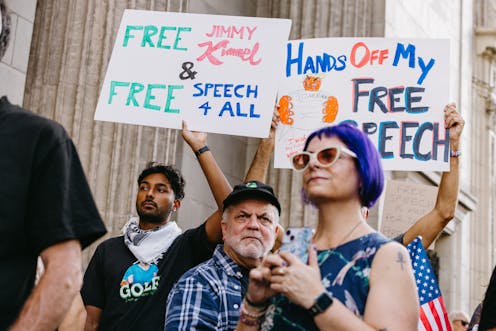
A crowd protests in Hollywood, Calif., on Sept. 18, 2025, after the suspension of the ‘Jimmy Kimmel Live!’ taping earlier in the day. David Pashaee / Middle East Images via AFP, Getty Images

The assassination of conservative activist Charlie Kirk has sparked a wave of political commentary.

There were the respectful and sincere comments condemning the killing. Former President Barack Obama said, “What happened was a tragedy and … I mourn for him and his family.” And former Vice President Mike Pence said, “I’m heartsick about what happened to him.”

But Kirk’s killing also elicited what many saw as inappropriate comments. MSNBC terminated commentator Matthew Dowd after he said, “Hateful thoughts lead to hateful words, which then lead to hateful actions.” American Airlines grounded pilots accused of celebrating Kirk’s death.

Perhaps the most notable reaction to remarks seen as controversial about the Kirk killing hit ABC comedian Jimmy Kimmel. His network suspended him indefinitely after comments that he made about the alleged shooter in Kirk’s death.

Countless defenders of Kimmel quickly responded to his indefinite suspension as an attack on the First Amendment. MSNBC host Chris Hayes posted the following on X: “This is the most straightforward attack on free speech from state actors I’ve ever seen in my life and it’s not even close.”

But is it?

FCC Chairman Brendan Carr’s statement about how Jimmy Kimmel’s remarks could hurt ABC affiliate stations.

Free speech? It depends

The First Amendment limits government officials from infringing one’s right to free speech and expression.

For example, the government cannot force someone to recite the Pledge of Allegiance or salute the American flag, because the First Amendment, as one Supreme Court justice wrote, “includes both the right to speak freely and the right to refrain from speaking at all.”

And government cannot limit speech that it finds disagreeable while permitting other speech that it favors.

However, the First Amendment does not apply to private employers. With the exception of the 13th Amendment, which generally prohibits slavery, the Constitution applies only to government and those acting on its behalf.

So, as a general rule, employers are free to discipline employees for their speech – even the employees’ speech outside of the workplace. In this way, U.S. Sen. Lindsey Graham correctly said on X, “Free speech doesn’t prevent you from being fired if you’re stupid and have poor judgment.”

This is why Amy Cooper’s employer, an investment firm, was free to terminate her following her 2020 verbal dispute in New York’s Central Park with a bird-watcher over her unleashed dog. She called the police, falsely claiming that the bird-watcher, a Black man, was threatening her life. The incident, captured on video, went viral and Cooper was fired, with her employer saying, “We do not condone racism of any kind.”

This is also why ABC was able to fire Roseanne Barr from the revival of her show, “Roseanne,” after she posted a tweet about Valerie Jarrett, a Black woman who had been a top aide to President Obama, that many viewed as racist.

But as a scholar of constitutional law, I believe Kimmel’s situation is not as straightforward.

A small monument made out of marble has the First Amendment to the US Constitution printed on it.
A marble plaque inscribed with the First Amendment sits on Independence Mall in Philadelphia, Pa.
Raymond Boyd/Getty Images

Threat complicates things

Neither Cooper’s employer nor Barr’s employer faced any government pressure to terminate them.

Kimmel’s indefinite suspension followed a vague threat from the chairman of the Federal Communications Commission, Brendan Carr. As complaints about Kimmel’s statement exploded in conservative media, Carr suggested in a podcast interview that Kimmel’s statements could lead to the FCC revoking ABC affiliate stations’ licenses.

“We can do this the easy way or the hard way,” Carr said.

But the Supreme Court has been crystal clear. Government officials cannot attempt to coerce private parties in order to punish or suppress views that the government disfavors.

In a 2024 case, National Rifle Association v. Vullo, a unanimous Supreme Court plainly said that the government’s threat of invoking legal sanctions and other coercion to suppress speech it doesn’t like violates the First Amendment. That principle is so profound and fundamental that it got support from every member of an often bitterly divided court.

A threat to revoke broadcast licenses would almost certainly be seen in a court of law as a government action tantamount to coercion. And Carr’s public comments undoubtedly connect that threat to Kimmel’s disfavored comments.

If the FCC had indeed moved to strip ABC affiliates of their licenses to broadcast because of what Kimmel said, ABC and its parent company, Disney, could have sued the FCC to block the license revocations on First Amendment grounds, citing the NRA v. Vullo case.

But the network seemingly caved to the coercive threat instead of fighting for Kimmel. This is why so many are decrying the Kimmel suspension as an attack on free speech and the First Amendment – even though they might not fully understand the law they’re citing.

The Conversation

Wayne Unger does not work for, consult, own shares in or receive funding from any company or organization that would benefit from this article, and has disclosed no relevant affiliations beyond their academic appointment.

ref. Why Jimmy Kimmel’s First Amendment rights weren’t violated – but ABC’s would be protected if it stood up to the FCC and Trump – https://theconversation.com/why-jimmy-kimmels-first-amendment-rights-werent-violated-but-abcs-would-be-protected-if-it-stood-up-to-the-fcc-and-trump-265703

A violent dystopian thriller, KPop Demon Hunters and an updated Ibsen play: what to see this week

Source: The Conversation – UK – By Jane Wright, Commissioning Editor, Arts & Culture, The Conversation

No one wants to see a good Jedi turn bad, but that’s exactly what happens to Luke Skywalker actor Mark Hamill in The Long Walk, an adaptation of a Stephen King story of the same name. Hamill plays the terrifying major who presides over a group of young men taking part in a barbaric televised contest that requires them to walk continuously at a speed above 3mph or be summarily executed.

The setting for this violent dystopian thriller is a bleak 1970s America in the grip of economic decline that follows an unnamed war. A forerunner to the Hunger Games (the film is directed by Francis Lawrence, who helmed four of the five-film franchise), The Long Walk focuses on the idea of suffering and survival as spectacle. It’s not hard to see the source material’s influence on series like Squid Game or films like Koushun Takami’s Battle Royale.

Written in 1967, King’s story was a heartfelt response to the Vietnam draft and the impact of the war on his generation. Our reviewer Matt Jacobsen found the setting of a dark, inhospitable America a clever inversion that distils many of the familiar themes of the Vietnam movie. Indeed, he points to the deadly road march as reminiscent of GIs trudging through the jungle of Vietnam in 1980s films like Platoon and Full Metal Jacket.

At the film’s heart is the relationship between Ray Garraty (Cooper Hoffman) and Peter McVries (David Jonsson) with distinct echoes of Stand By Me in its depiction of friendship between boys. It has particular resonance in today’s bleak cultural environment for young men, vulnerable to the darker influences of social media and the conflicting expectations placed on them.

In The Long Walk, wit, tenderness and compassion come to the fore as the contestants are made vulnerable by the punishing exertions of the march and the violence meted out to those who falter. Some consolation perhaps, in what is undoubtedly a grim but compelling watch.

The Long Walk is in cinemas now


Read more:
The Long Walk: a brutal, brilliant film about suffering in the name of patriotism


KPopping and queer Americana

I have to say I’m late to the KPop Demon Hunters thing, and only started paying attention when a colleague mentioned his young daughters were crazy for it, and explained it was now Netflix’s most watched film ever.

That’s quite an achievement, and it ticks all the boxes: catchy tunes, stunning animations and relatable themes, not to mention a good dose of girl power in the form of three K-pop girl-banders who use their voices to protect the world from demonic forces (of course). But how much does the film reflect the real K-pop phenomenon? Our Korean culture expert Cholong Sung has the answers.

KPop Demon Hunters is on Netflix now


Read more:
KPop Demon Hunters gives a glimpse into K-pop culture in South Korea


What at first seems like a forbidden love story between a young woman and her fiance’s brother, On Swift Horses unexpectedly pivots to the hidden queer culture that existed in the United States of the 1950s. At the height of the American dream, when culture celebrated marriage and family as duty-bound goals, both characters turn out to be attracted to their own sex.

The glossy iconography of 1950s Americana is reimagined for this hidden world, making visible the queer lives that existed below the radar at a time of social censure and legal repression. This is an enjoyable watch that perhaps, according to our reviewer, would have worked better as a TV series, affording the space to develop characters more fully.

On Swift Horses is in cinemas now


Read more:
On Swift Horses: a film that fails to go deep enough on the complex queer lives of people in the 1950s


Love in a warm climate

I do love a bit of dark Scandinavian intrigue, so a new adaptation of Ibsen’s The Lady From The Sea makes a welcome addition to London’s theatrical fare. Starring Alicia Vikander as Ellida, a woman drawn ineluctably to the ocean, and Andrew Lincoln as her husband Edward, the setting is transferred from the Norwegian fjords to the Yorkshire coast.

Loaded with contemporary relevance, writer and director Simon Stone references Beyoncé and Just Stop Oil activism, and features a millennial protagonist struggling with climate anxiety. Does it work in this updated incarnation? Read our review and find out.

The Lady From The Sea is on at the Bridge Theatre in London until November 8


Read more:
The Lady from the Sea: a fierce play that shies from the wonderful unknowability of Henrik Ibsen’s original


From the late medieval period to the Arts and Crafts movement of the late 19th and early 20th centuries, The Nature of Gothic at the Blackburn Museum and Art Gallery explores the fascinating history of decorative borders. The show takes in in a diverse array of historical examples, from Islamic calligraphy adorned with floral frames, to vividly illuminated medieval manuscripts and the lush decorated margins of Pre-Raphaelite paintings.

The Nature of Gothic at the Blackburn Museum and Art Gallery until December 13


Read more:
New exhibition explores history of decorative borders: from medieval manuscripts to William Morris


Looking for something good? Cut through the noise with a carefully curated selection of the latest releases, live events and exhibitions, straight to your inbox every fortnight, on Fridays. Sign up here.


The Conversation

ref. A violent dystopian thriller, KPop Demon Hunters and an updated Ibsen play: what to see this week – https://theconversation.com/a-violent-dystopian-thriller-kpop-demon-hunters-and-an-updated-ibsen-play-what-to-see-this-week-265553

Robert Redford: ten great films from a brilliant career

Source: The Conversation – UK – By Daniel O’Brien, Lecturer, Department of Literature Film and Theatre Studies, University of Essex

Over the course of an illustrious film career which began in 1960, Robert Redford starred in more than 50 films and directed nine. He was nominated for an Oscar four times, won best director for his debut Ordinary People in 1980, and received an honorary Oscar for his contribution to the film industry in 2001. It’s an extraordinary body of work – here we pick our ten favourites.

1. Butch Cassidy and the Sundance Kid (1969)

Robert Redford defined his Hollywood stardom in 1969 with George Roy Hill’s Butch Cassidy and the Sundance Kid, a film that reconfigured both the western and the buddy movie. Riding the momentum of New Hollywood titles like Easy Rider and Midnight Cowboy, Hill’s film struck a balance between fresh storytelling and classic Hollywood style.

Playing opposite Paul Newman’s wily Butch, Redford’s cool, sharp-shooting Sundance creates one of cinema’s most iconic duos. Their charisma and wit onscreen are as striking as their arresting good looks. But this is also carefully balanced. Sundance’s inability to swim, for example, adds humour and vulnerability, humanising Redford’s star power. The final defiant freeze-frame is culturally iconic, while the film’s legacy lives on through the Sundance Film Festival, providing a platform for independent filmmakers.

2. Jeremiah Jonhnson (1972)

Redford’s portrayal of 19th-century mountain man Jeremiah Johnson tells the tale of a disillusioned figure retreating into the wilderness, seeking solace in the solitude, beauty and danger of the Rocky Mountains.

Sparse in dialogue and narrative, the film relies on Redford’s quiet authority to carry it. Very much a product of its era, it frames Johnson in violent clashes with both Native Americans and nature itself. Most significantly, it marked the beginning of Redford’s long partnership with director Sydney Pollack, a fruitful collaboration that would later include The Way We Were, Three Days of the Condor, and Out of Africa.

3. The Sting (1973)

Reuniting with director George Roy Hill, Redford teamed up again with Paul Newman for The Sting, a stylish 1930s caper about two grifters scheming to outwit a crime boss, played with icy menace by Robert Shaw – a stark contrast to the warmth between the leads. This time it’s Newman’s turn to wear the moustache, with Redford clean-shaven, a playful reversal of their Butch Cassidy look. With its clever twists, Scott Joplin ragtime piano score and screen-wipe transitions, the film won seven Oscars at the 46th Academy Awards, including best picture and best director, and earned Redford a nomination for best actor.

4. All the President’s Men (1976)

Alan J. Pakula’s All the President’s Men paired Redford with Dustin Hoffman in a serious contemporary role, dramatising the Watergate scandal just two years after Nixon’s resignation. A taut, uncompromising account of investigative journalism, the film showcases Redford’s range in a part that eschews glamour for realism and the pursuit of truth. Fifty years later it remains one of cinema’s most sophisticated political dramas. The project owed much to Redford, who approached Bob Woodward and Carl Bernstein before securing rights to their book, and adapting it for the screen.

5. Ordinary People (1980)

Redford’s directorial debut, Ordinary People was a huge success, winning best picture and earning him the Oscar for best director. A powerful family drama about grief and alienation, it starred Donald Sutherland, Mary Tyler Moore and Timothy Hutton. The film transformed Redford’s career, expanding his influence behind the camera.

6. Sneakers (1992)

Directed by Phil Alden Robinson, Sneakers let Redford dip back into the caper genre, this time with a tech-age twist. He plays a former hacker turned security consultant who, along with a mismatched crew (Sidney Poitier, Dan Aykroyd, River Phoenix), is pulled into a plot over a code-breaking device. The film mixes comedy, intrigue and early 1990s paranoia about surveillance, while retaining a breezy touch as Redford holds it all together with his familiar charm.

7. Quiz Show (1994)

Redford’s fourth feature film, Quiz Show, returned to his interest in public scandal – this time shifting from the White House to NBC’s 1950s game show Twenty-One and the controversy surrounding contestant Charles Van Doren (Ralph Fiennes). Exposing how producers rigged the contest to engineer Van Doren’s success, the film probes questions of truth, media and morality, echoing Redford’s enduring fascination with power and integrity in American culture. Nominated for four Oscars, Quiz Show remains one of Redford’s most accomplished and incisive directorial works.

8. The Great Gatsby (1974)

Jack Clayton’s adaptation of F. Scott Fitzgerald’s The Great Gatsby cast Redford as one of literature’s most enigmatic figures: Jay Gatsby, the wealthy, detached, and obsessive dreamer pining for Daisy Buchanan (Mia Farrow). With his good looks and charisma, Redford embodied Gatsby’s allure, mystery and melancholy, even as the film itself divided critics. Lavish costumes and period design capture the excess of the Jazz Age, while Redford grounds the story’s glittering parties with Gatsby’s aching loneliness.

9. All Is Lost (2013)

J.C. Chandor’s All Is Lost is an engaging piece of action survival cinema, with Redford at 77 proving he could still carry a film entirely alone. He plays an unnamed sailor in the Indian Ocean whose boat is punctured by a drifting shipping container, an accident that escalates into a fight for survival on the open sea. With almost no dialogue (just 51 words), the drama relies on Redford’s presence and physicality. Like Jeremiah Johnson transposed from mountains to water, the film is elemental and meditative, and Redford delivers a late-career performance of remarkable endurance, which earned him the New York Film Critics Circle Award for best actor.

10. The Old Man & the Gun (2018)

David Lowery’s The Old Man & the Gun was announced as Redford’s final starring role, and it feels like a fitting farewell. While he later appeared briefly in Avengers: Endgame (2019) and in the anthology film Omniboat: A Fast Boat Fantasia (2020), this was the last feature he headlined.

Redford plays Forrest Tucker, a real-life career criminal who, well into his seventies, escapes prison and keeps robbing banks with a smile. The film isn’t about suspense so much as presence, and Redford brings the same easy charisma that defined his early career. Gentle, nostalgic and playful, it stands as an apt curtain call for a legendary performer and filmmaker.


Looking for something good? Cut through the noise with a carefully curated selection of the latest releases, live events and exhibitions, straight to your inbox every fortnight, on Fridays. Sign up here.


The Conversation

Daniel O’Brien does not work for, consult, own shares in or receive funding from any company or organisation that would benefit from this article, and has disclosed no relevant affiliations beyond their academic appointment.

ref. Robert Redford: ten great films from a brilliant career – https://theconversation.com/robert-redford-ten-great-films-from-a-brilliant-career-265687

Elon Musk’s speech to far-right rally should have us all thinking about the power social media companies hold over our democracies

Source: The Conversation – UK – By Verena K. Brändle, Assistant Professor, Department of Political Science and International Studies, University of Birmingham

Elon Musk seems to enjoy awkward surprise appearances. Joining a far-right rally in London via livestream, he demanded the “dissolution” of the British parliament, falsely linked immigration to violence, and warned that the only option for protesters was to “fight back” or “die”.

He did similar in January 2025 when he joined a campaign event of the German far-right party Alternative for Germany (AfD). Again over video he told supporters that “the German people are really an ancient nation” and the AfD is “the best hope for the future of Germany”.

It appears that the currently second-richest person in the world has become a mascot for the European far-right. In 2022, Musk bought one of the major social media platforms, then Twitter, to promote “free speech”. He stepped right into the ongoing “culture war” that is currently polarising US politics and finding traction across Europe. This makes him a problem for democratic politics.

The combination of massive wealth, far-right ideology and power over a large share of public discourse is a recurrent issue for democracy in general, but its negative effects have become even more prevalent in the age of social media. Two aspects are of particular importance here: social media companies’ monetising of user data and a dependence of democratic politics on platform discourse.

Social media runs on an advertisement-based revenue model. Every click or lingering over a post produces data and metadata which are a lucrative resource. Social media companies make a lion’s share of their revenue from charging advertisers to show ads to specific users based on such data. Some of us might remember Mark Zuckerberg replying “Senator, we run ads” when asked during testimony before the US Senate in 2018 how he made money without charging users for his services.

Importantly, advertisers do not only come in the form of clothing brands, restaurant chains and protein shakes. Political parties, governments, think-tanks, and foundations have all paid for ads on social media.

Studies show that social media has contributed to political polarisation during crucial political moments such as Brexit. It also harms democratic discourse when it facilitates online abuse that excludes already minoritised groups from democratic debate. Too often, such abuse is directed at minority women and girls as well as LGBTQ+ people.

Meta has followed X’s turn towards a right-leaning interpretation of “free speech”. It has abolished its third party fact-checking programme, widely credited with helping to manage disinformation.

Meanwhile, politicians across Europe struggle to decide what to do about Musk’s destabilising comments. Keep in mind that governments are doing (or thinking about doing) business with big tech leaders. This situation is politically complex, to say the least, because Musk and others, while being outspoken about their annoyance with aspects of democracy, are also at the forefront of developing the AI technologies many nations are relying on in their hope for economic growth.

This means that Musk has cracked the code for success in capitalist democracies: he makes the headlines with extreme statements, allows debates to unfold “freely” on his platform, and makes some of his money from the generated data.

This situation has created a strange relationship between democratic politics and social media leaders. For people like Musk, there is almost an economic incentive to engage in politics, riling up people and pressuring governments. He is both a business leader and a political actor.

“Free speech” regulations on social media platforms and their leaders’ political stances are increasingly at odds with democratic guidelines. Democracies need to have a more focused debate about how to minimise this incentive structure for destabilising politics.


Want more politics coverage from academic experts? Every week, we bring you informed analysis of developments in government and fact check the claims being made.

Sign up for our weekly politics newsletter, delivered every Friday.


The Conversation

Verena K. Brändle does not work for, consult, own shares in or receive funding from any company or organisation that would benefit from this article, and has disclosed no relevant affiliations beyond their academic appointment.

ref. Elon Musk’s speech to far-right rally should have us all thinking about the power social media companies hold over our democracies – https://theconversation.com/elon-musks-speech-to-far-right-rally-should-have-us-all-thinking-about-the-power-social-media-companies-hold-over-our-democracies-263074

Lasting relief from depression after magic-mushroom treatment – new study

Source: The Conversation – UK – By Petri Kajonius, Associate Professor, Personality Psychology, Lund University

Fotema/Shutterstock.com

Two-thirds of people who underwent psilocybin-assisted therapy remained free from depression five years later, according to recent research that offers the first long-term glimpse into the lasting power of psychedelic treatment.

The findings, published by researchers at Ohio State University and Johns Hopkins University, followed up participants from a study published in 2021 to track whether the dramatic improvements in depression symptoms would endure. The results suggest they do – and, remarkably, without serious side-effects.

The original study involved 24 people aged 21 to 75 who were randomly assigned to receive psilocybin treatment in 2019 and 2020 either immediately or after an eight-week delay. Each participant received two doses of the psychoactive compound found in magic mushrooms, spaced two weeks apart, alongside 13 hours of psychotherapy support.

When researchers checked in five years later, the improvements in depression seen after one year were still holding strong, suggesting psilocybin therapy may last longer than traditional treatments, such as antidepressants or psychotherapy.

But the researchers are cautious about overselling their findings. The follow-up study lacked a comparison group, making it impossible to know whether people who recovered from depression through other means might experience similar long-term success. Eleven of the 18 participants who remained in the trial also reported using antidepressants during the study period, muddying the waters about what exactly drove their continued recovery.

The study design presents other puzzles as well. Was it the psilocybin itself that proved beneficial, or the extensive psychotherapy, or some combination of both? The original research didn’t include a placebo group – everyone knew they were taking psilocybin – raising questions about whether expectations alone might have influenced the outcomes.

Despite these limitations, other studies are painting a similar picture of psilocybin’s enduring effects on depression. While psychedelic research is still in its infancy and grapples with design challenges, the results consistently show significant reductions in depression symptoms following psychedelic-assisted therapy.

What makes these findings particularly intriguing is the suggestion that just one or two treatment sessions might deliver lasting benefits. This is in stark contrast to traditional antidepressants, which typically require daily use and often come with a catalogue of side-effects.

The researchers propose that psilocybin therapy may trigger “positive behavioural feedback loops”, helping people gain fresh perspectives and emotional insights that continue benefiting their lives long after the treatment ends. This could enable the development of healthier habits and relationships that serve as natural buffers against depression’s return.

One participant captured this transformation vividly: “I’m doing more of activities that I enjoy. My life these days is a lot more social with family. Helping out my family. Helping out friends. Connecting with old friends.”

Friends sitting on some steps outdoors, having a laugh.
People’s lives continued to improve after treatment.
DavideAngelini/Shutterstock.com

Psychology matters

At Lund University in Sweden, my colleagues and I are exploring similar territory, including an upcoming study on psilocybin and anorexia. And our early results, published in Scientific Reports, suggest that individual psychology plays a crucial role in both how people experience psychedelic sessions and the benefits they derive from them.

The picture becomes even more complex when considering that many people report personality changes after psychedelic experiences, particularly becoming more open to new experiences. This psychological shift adds another layer to understanding how and why psychedelics might produce lasting change.

Psychedelic research still faces significant hurdles, from creating convincing placebo groups to accounting for the self-selecting nature of many participants. These methodological challenges make it difficult to draw sweeping conclusions about psychedelics’ therapeutic potential.

Yet perhaps the most compelling evidence lies not in clinical scores but in participants’ own words about their transformed lives. As one person put it: “I think I’m more open to gratitude and more open to delight.” Such testimonies remind researchers why they’re exploring what some describe as potentially “one of the most meaningful experiences in life” – and why this emerging field of medicine deserves serious scientific attention.

The Conversation

Petri Kajonius does not work for, consult, own shares in or receive funding from any company or organisation that would benefit from this article, and has disclosed no relevant affiliations beyond their academic appointment.

ref. Lasting relief from depression after magic-mushroom treatment – new study – https://theconversation.com/lasting-relief-from-depression-after-magic-mushroom-treatment-new-study-265219

Poor sleep may nudge the brain toward dementia, researchers find

Source: The Conversation – UK – By Timothy Hearn, Senior Lecturer in Bioinformatics, Anglia Ruskin University

fizkes/Shutterstock.com

Staring at the ceiling while the clock blinks 3am doesn’t only sap energy for the next day. A large, long-running US study of older adults has now linked chronic insomnia to changes inside the brain that set the stage for dementia.

The researchers, from the Mayo Clinic in the US, followed 2,750 people aged 50 and over for an average of five and a half years. Every year the volunteers completed detailed memory tests and many also had brain scans that measured two telltale markers of future cognitive trouble: the buildup of amyloid plaques, and tiny spots of damage in the brain’s white matter – known as white-matter hyperintensities.

Participants were classed as having chronic insomnia if their medical records contained at least two insomnia diagnoses a month apart – a definition that captured 16% of the sample.

Compared with people who slept soundly, those with chronic insomnia experienced a faster slide in memory and thinking and were 40% more likely to develop mild cognitive impairment or dementia over the study period.

When the team looked more closely, they saw that insomnia paired with shorter-than-usual sleep was especially harmful. These poor sleepers already performed as if they were four years older at the first assessment and showed higher levels of both amyloid plaques and white-matter damage.

By contrast, insomniacs who said they were sleeping more than usual, perhaps because their sleep problems had eased, had less white-matter damage than average.

Why do both amyloid plaques and blood-vessel damage matter? Alzheimer’s disease isn’t driven by amyloid alone. Studies increasingly show that clogged or leaky small blood vessels also speed cognitive decline, and the two disease states can magnify each other.

Amyloid plaques explained.

White-matter hyperintensities disrupt the wiring that carries messages between brain regions, while amyloid gums up the neurons themselves. Finding higher levels of both in people with chronic insomnia strengthens the idea that poor sleep may push the brain towards a double hit.

The study’s models confirmed the well-known effect of carrying the ApoE4 variant; the strongest common genetic risk factor for late-onset Alzheimer’s. Carriers declined more quickly than non-carriers, and the insomnia effect was large enough to be comparable to the effect of having the gene.

Scientists suspect ApoE4 amplifies the damage of sleepless nights by slowing the overnight clearance of amyloid and making blood vessels more vulnerable to inflammation.

Taken together, these findings add to a growing body of research, from middle-aged civil servants in the UK, to community studies in China and the US, showing that how well we sleep in midlife and beyond tracks closely with how well we think later on.

Chronic insomnia appears to accelerate the trajectory towards dementia, not through one pathway but several: by boosting amyloid, eroding white matter and probably raising blood pressure and blood-sugar levels too.

That sounds like an obvious next step, but the evidence is mixed. The Mayo Clinic researchers found no clear benefit, or harm, from the sleeping pills its participants were taking. Trials of newer drugs such as orexin blockers have hinted at reductions in Alzheimer-related proteins in spinal fluid, but these studies are tiny and short term.

Cognitive behavioural therapy for insomnia, delivered in person or digitally, remains the gold-standard treatment and improves sleep in around 70% of patients. Whether it also protects the brain is still unproven, although one small trial in people with mild cognitive impairment showed sharper executive function after this type of talk therapy.

So the relationship is unlikely to be as simple as “treat insomnia, avoid dementia”. Poor sleep often co-exists with depression, anxiety, chronic pain and sleep apnoea – all of which themselves hurt the brain. Unravelling which piece of the puzzle to target, and when, will take rigorously designed long-term studies.

Prevention starts early

The participants in Mayo Clinic study were, on average, 70 years old at the start of the study, but other research has shown that routinely sleeping less than six hours a night in your 50s is already linked to higher dementia risk two decades later.

That suggests prevention efforts shouldn’t wait until retirement. Keeping an eye on sleep from midlife, alongside blood pressure, cholesterol and exercise, is a sensible brain-health strategy.

Sleepless nights are more than a nuisance. Chronic insomnia appears to accelerate both amyloid buildup and silent blood-vessel damage, nudging the brain toward cognitive decline – especially in people who already carry the high-risk ApoE4 gene.

Good quality sleep is emerging as one of the modifiable pillars of brain health, but scientists are still working out whether fixing insomnia can truly head off dementia, and at what stage of life interventions will have the greatest payoff.

The Conversation

Timothy Hearn does not work for, consult, own shares in or receive funding from any company or organisation that would benefit from this article, and has disclosed no relevant affiliations beyond their academic appointment.

ref. Poor sleep may nudge the brain toward dementia, researchers find – https://theconversation.com/poor-sleep-may-nudge-the-brain-toward-dementia-researchers-find-265216

How farmers are finding greener ways to produce food, from East Anglia to Andhra Pradesh in India

Source: The Conversation – UK – By Lynn Dicks, Professor of Ecology, University of Cambridge

An innovative sustainable farming method which avoids fertilisers and pesticides in favour of natural soil regeneration has helped farmers in India increase profits while also benefiting wild birds. Our new research shows how “zero budget natural farming” has more than doubled farmer profits.

Ecologists like us evaluate low-tech agroecological approaches that harness the power of nature and people to produce food with skilled labour, knowledge and active management of ecological functions like pollination and soil nutrient cycling.

We’ve been studying two promising agroecological systems, both devised by farming communities to address the soil degradation that threatens the long-term future of food.

Zero budget natural farming is a sustainable farming system that is being heavily incentivised by the government of Andhra Pradesh, a state on the east coast of southern India. Zero budget natural farming is generating considerable interest from other countries, including Brazil, Mexico, Zambia and Indonesia.

The other farming system we’ve been examining is “regenerative farming”, increasingly popular in the UK, US and Europe. While similar, these two farming systems have very different cultural framings.

Regenerative farming is a set of principles that aims to regenerate rather than degrade soil. Farmers are encouraged to monitor their own outcomes and adaptively manage their soils.

Zero budget natural farming aims to boost crop yields and reduce costs by ending the use of synthetics (fertilisers and pesticides) and regenerating natural ecological functions. Farmers are encouraged to work together and share resources such as straw, manures and soil treatments at village level.

To understand whether these two systems could really be scalable, we measured their outcomes for nature, food production and profitability on real working farms. We focused on these key aspects because there is often a direct trade-off between them. Having more nature locally can mean that less food is produced on farmed land.

Nature-friendly farming can lower overall food production or profits, especially at scales larger than individual fields and farms, because land is taken out of production for wildlife-friendly strips around fields, for example.

If there is no change in overall food demand, this creates a risk of driving even greater nature loss and greenhouse gas emissions elsewhere, as agriculture continues to expand into natural habitats.

For agroecological systems to be a solution, they must be highly productive, minimising the footprint (total area) of agriculture on Earth, while supporting enough wild nature to maintain ecological functions such as soil nutrient cycling and pollination.

big black bird with yellow beak eating yellow berries on tree branch
Some native birds such as the Malabar pied hornbill rely on natural forests to thrive.
Chris Barber71/Shutterstock

Our research shows that the shift to zero budget natural farming more than doubles farmer profits and does not reduce food production relative to chemical farming. These farms also support more wild birds, especially those that help control pests by eating insects and other invertebrates, such as drongos, pipits and warblers. For the rice-dominated small farms we studied in south India, zero budget natural farming avoids the direct trade-off between nature and food production.

But this agroecological farmland is no substitute for natural forest in terms of bird conservation. Forests are vital for birds threatened with extinction, many of which cannot thrive on farmland of any kind, such as the Malabar pied hornbill.


Read more:
Regeneratively farmed is the new buzz label on supermarket shelves – but what does it actually mean?


The situation is different for the arable farmers we’re working with in eastern and southern England, who are farming regeneratively. This approach is challenging to define so we calculated a “regenerative score” for each farm based on the consistency with which farmers adhered to the five principles of regenerative farming. Those principles include keeping the soil covered to reduce erosion and increase its organic content, and increasing crop diversity.

Becoming more regenerative on this scale has clear benefits for some indicators of healthy soils such as earthworm numbers. But our initial data indicated some declines in yield at field scale. This is likely to be larger when scaled up to landscapes, because of crop choices. The regenerative system in these arable farms is more sustainable by many measures, but not quite as productive, in terms of food output, as intensive chemical farms.

The future of farming

Things might look different in the future, as accelerating climate change makes the soil’s abilities to absorb and retain water much more important. Regenerative farming potentially offers resilience to climate change, through better soils and higher diversity, but this is challenging to demonstrate empirically. For now, regenerative farming in the English farms where we work is not a straightforward solution that delivers high food production and better nature, like zero budget natural farming in India.

One reason for the difference might be that UK arable farms are largely constrained to working with crop varieties engineered to thrive in very intensive systems with high chemical inputs. These varieties have weaker roots and potentially lower disease resistance than more traditional crop varieties. Part of the solution here is to breed crop varieties that thrive in agroecological systems without heavy chemical fertiliser use (so-called “lower input systems”). For industrial agriculture systems, this will involve the plant breeding industry.

Zero budget natural farmers are encouraged to use traditional crop varieties, and are more likely to re-use their own seeds, rather than buying them in every year. Perhaps this means their crops are better adapted to lower input conditions, with stronger roots or better positive associations with soil microbes. To cement its future, those who live and work in the region are calling for zero budget natural farming to be recognised by buyers, so farmers can access new markets for sustainable produce and take advantage of higher retail prices.

In both cases, the key to long term success may be economic, rather than purely scientific, with changes in the crop breeding industry, markets and value chains as important as how farms themselves are managed.


Don’t have time to read about climate change as much as you’d like?

Get a weekly roundup in your inbox instead. Every Wednesday, The Conversation’s environment editor writes Imagine, a short email that goes a little deeper into just one climate issue. Join the 45,000+ readers who’ve subscribed so far.


The Conversation

Lynn Dicks receives funding from UKRI (NERC and BBSRC). She is affiliated with Natural England, as a Board Member, and the East Suffolk Trust as a Trustee.

Katherine Berthon receives funding from UKRI BBSRC. She is affiliated with the H3 Project (https://h3.ac.uk/) and a member of the British Ecological Society.

Iris Berger does not work for, consult, own shares in or receive funding from any company or organisation that would benefit from this article, and has disclosed no relevant affiliations beyond their academic appointment.

ref. How farmers are finding greener ways to produce food, from East Anglia to Andhra Pradesh in India – https://theconversation.com/how-farmers-are-finding-greener-ways-to-produce-food-from-east-anglia-to-andhra-pradesh-in-india-261890

How workplace bullying can affect your personality

Source: The Conversation – UK – By Samuel Farley, Senior Lecturer in Work Psychology, University of Sheffield

Littleaom/Shutterstock

Sadly, most people will come across a workplace bully at some point. Unwarranted criticism, ostracism, personal insults, and verbal or physical threats are just some of the tools in the bully’s locker. Over time, the target of bullying can find it increasingly difficult to defend themselves from this behaviour.

Bullying undermines productive workplaces, and can damage the reputations of both the bully and the organisation. Of course, it is even more damaging for the targets of the bully, who report physical and psychological health problems, job loss, and even symptoms of post-traumatic stress.

With up to one in ten UK employees experiencing bullying, this problem could affect more than three million workers across the country.

In a recent research study drawing on data from 2,469 employees over a four-year period, we examined whether experiences of bullying were related to changes in the “big five” personality traits: openness, conscientiousness, extroversion, agreeableness and neuroticism.

It’s well known that bullying is bad for wellbeing, performance and mood. But why would we think that bullying might change core aspects of a person, including their personality?

Our predictions were primarily based on a personality change theory. The core idea is that repeatedly experiencing thoughts, emotions and reactions that are at odds with a person’s normal traits can actually change them over time.

For example, extroverts are typically cheerful, sociable people who seek excitement. However, an extrovert exposed to bullying would in all likelihood start to experience negative emotions regularly. They might withdraw socially, and could learn that social isolation is an effective way to avoid bullying. As a result, their normal outgoing traits might reduce over time.

Our results showed that being bullied was associated with significant reductions in extrovert traits and conscientiousness (that is, being dependable and organised). The drop in conscientiousness could be because the target feels demotivated by the unfairness of being bullied – or the bullying may even take the form of removing meaningful tasks from the colleague.

Being bullied was also linked to increased neuroticism, which is the tendency to experience negative emotional states such as anxiety, anger and depression.

We also found that longer periods of bullying were associated with the target becoming less of an extrovert and more neurotic.

This suggests that, in addition to all the other harms, bullying can also rob people of their cheerfulness, sociability, dependability and calmness.

Who do bullies target?

Our research also explored whether personality traits were a risk factor for experiencing bullying. We discovered that conscientiousness and extroversion may put workers at greater risk of attracting the attention of a workplace bully.

A cautious interpretation of this might infer that conscientious employees are targeted by those envious of their higher performance levels (tall poppy syndrome – where high-flying people are “cut down” out of a misplaced sense of egalitarianism). It is less clear however why extroverts might be targeted.

Interestingly, when we looked at people who experienced sustained bullying over longer periods of time, we found that other personality traits were risk factors. Neuroticism, openness (encompassing traits of imagination, curiosity and novelty) and disagreeableness were all linked to experiencing bullying for a longer duration.

This indicates that emotional, unconventional and argumentative people tend to experience the most bullying. However, it’s still not fully understood whether it is personality that attracts bullying, or whether in fact the bullying is driving personality change.

HR policy manual on a desk beside a computer keyboard
An effective anti-bullying policy can help to mitigate the harm to employees.
Vitalii Vodolazskyi/Shutterstock

There is little other research on the personality types most likely to be targeted by bullies. And we don’t yet know if the personality changes suffered by them are likely to be permanent. However, we do have concrete knowledge about the factors that are most helpful in limiting the impact of bullying on victims.

Working in a supportive environment where wellbeing is prioritised and where there are processes to enable a resolution can really help those experiencing bullying. Equally, receiving support from colleagues, friends and family can limit the damaging effects.

Ultimately, bullying is an escalating process that causes lasting harm. The best medicine is to end the experience as soon as possible, or better yet, prevent it altogether.

The Conversation

The authors do not work for, consult, own shares in or receive funding from any company or organisation that would benefit from this article, and have disclosed no relevant affiliations beyond their academic appointment.

ref. How workplace bullying can affect your personality – https://theconversation.com/how-workplace-bullying-can-affect-your-personality-265350