Jean Baudrillard, le philosophe qui a prédit l’intelligence artificielle, trente ans avant ChatGPT

Source: The Conversation – France in French (3) – By Bran Nicol, Professor of English, University of Surrey

Visionnaire de la culture numérique, Jean Baudrillard pensait l’intelligence artificielle comme une prothèse mentale capable d’exorciser notre humanité, et un renoncement à notre liberté.


Certains penseurs semblent si précis dans leur compréhension du lieu vers lequel la société et la technique nous emportent qu’ils sont affublés du titre de « prophète ». C’est le cas de J. G. Ballard, Octavia E. Butler, ou encore Donna Haraway.

L’un des membres les plus importants de ce club est le penseur Jean Baudrillard (1929-2007) – bien que sa réputation se soit amoindrie depuis une vingtaine d’années, il est désormais vaguement associé à l’époque révolue où les théoriciens français tels que Roland Barthes et Jacques Derrida régnaient en maîtres.

Lorsque nous l’avons relu pour écrire la nouvelle biographie qui lui est consacrée, nous nous sommes toutefois souvenus à quel point ses prédictions sur la technologie contemporaine et ses effets se révélaient prémonitoires. Sa compréhension de la culture numérique et de l’intelligence artificielle (IA) s’avère particulièrement clairvoyante – d’autant que ses écrits l’ont présentée plus de trente ans avant le lancement de ChatGPT.

Un contexte de préhistoire numérique

Il faut bien se figurer que les technologies de communication de pointe des années 1980 nous paraissent désormais totalement obsolètes : Baudrillard écrit alors que l’entourent des répondeurs téléphoniques, des fax, et bien sûr, le Minitel, prélude médiatique franco-français au réseau Internet. Son génie résidait dans une aptitude à entrevoir au sein de ces dispositifs relativement rudimentaires une projection des usages probables de la technologie dans le futur.

À la fin des années 1970, il avait déjà commencé à développer une théorie originale de l’information et de la communication. Celle-ci s’est encore déployée à partir de la publication de Simulacres et Simulation en 1981 (l’ouvrage qui a influencé les sœurs Wachowski dans l’écriture du film Matrix, sorti en 1999).

Dès 1986, le philosophe observait :

« Aujourd’hui, plus de scène ni de miroir, mais un écran et un réseau. »

Il prédit alors l’usage généralisé du smartphone, en imaginant que chacun d’entre nous serait aux commandes d’une machine qui nous tiendrait isolés « en position de parfaite souveraineté », comme un « cosmonaute dans sa bulle ». Ces réflexions lui ont permis d’élaborer son concept le plus célèbre : la théorie d’après laquelle nous serions entrés dans l’ère de « l’hyperréalité ».

Matrix (1999), partiellement inspiré des travaux de Jean Baudrillard.

Dans les années 1990, Baudrillard a porté son attention sur les effets de l’IA, d’une manière qui nous aide à la fois à mieux comprendre son essor tentaculaire dans le monde contemporain et à mieux concevoir la disparition progressive de la réalité, disparition à laquelle nous faisons face chaque jour avec un peu plus d’acuité.

Les lecteurs avertis de Baudrillard n’ont probablement pas été surpris par l’émergence de l’actrice virtuelle Tilly Norwood, générée par IA. Il s’agit d’une étape tout à fait logique dans le développement des simulations et autres deepfake, qui semble conforme à sa vision du monde hyperréel.

« Le spectacle de la pensée »

Baudrillard envisageait l’IA comme une prothèse, un équivalent mental des membres artificiels, des valves cardiaques, des lentilles de contact ou encore des opérations de chirurgie esthétique. Son rôle serait de nous aider à mieux réfléchir, voire à réfléchir à notre place, ainsi que le conceptualisent ses ouvrages la Transparence du mal (1990) ou le Crime parfait (1995).

Mais il était convaincu qu’au fond, tout cela ne nous permettrait en réalité uniquement de vivre « le spectacle de la pensée », plutôt que nous engager vers la pensée elle-même. Autrement dit, cela signifie que nous pourrions alors repousser indéfiniment l’action de réfléchir. Et d’après Baudrillard, la conséquence était limpide : s’immerger dans l’IA équivaudrait à renoncer à notre liberté.

Voilà pourquoi Baudrillard pensait que la culture numérique précipiterait la « disparition » des êtres humains. Bien entendu, il ne parlait pas de disparition au sens littéral, ni ne supposait que nous serions un jour réduits à la servitude comme dans Matrix. Il envisageait plutôt cette externalisation de notre intelligence au sein de machines comme une manière « d’exorciser » notre humanité.

En définitive, il comprenait toutefois que le danger qui consiste à sacrifier notre humanité au profit d’une machine ne proviendrait pas de la technologie elle-même, mais bien que la manière dont nous nous lions à elle. Et de fait, nous nous reposons désormais prodigieusement sur de vastes modèles linguistiques comme ChatGPT. Nous les sollicitons pour prendre des décisions à notre place, comme si l’interface était un oracle ou bien notre conseiller personnel.

Ce type de dépendance peut mener aux pires conséquences, comme celles de tomber amoureux d’une IA, de développer des psychoses induites par l’IA, ou encore, d’être guidé dans son suicide par un chatbot.

Bien entendu, les représentations anthropomorphiques des chatbots, le choix de prénoms comme Claude ou encore le fait de les désigner comme des « compagnons » n’aide pas. Mais Baudrillard avait pressenti que le problème ne provenait pas de la technologie elle-même, mais plutôt de notre désir de lui céder la réalité.

Le fait de tomber amoureux d’une IA ou de s’en remettre à sa décision est un problème humain, non pas un problème propre à la machine. Encore que, le résultat demeure plus ou moins le même. Le comportement de plus en plus étrange de Grok – porté par Elon Musk – s’explique simplement par son accès en temps réels aux informations (opinions, assertions arbitraires, complots) qui circulent sur X, plateforme dans laquelle il est intégré.

« Suis-je un être humain ou une machine ? »

De la même manière que les êtres humains sont façonnés par leur interaction avec l’IA, l’IA est dressée par ses utilisateurs. D’après Baudrillard, les progrès technologiques des années 1990 rendaient déjà impossible la réponse à la question « Suis-je un être humain ou une machine ? »

Il semblait confiant malgré tout, puisqu’il pensait que la distinction entre l’homme et la machine demeurerait indéfectible. L’IA ne pourrait jamais prendre plaisir à ses propres opérations à la manière dont les humains apprécient leur propre humanité, par exemple en expérimentant l’amour, la musique ou le sport. Mais cette prédiction pourrait bien être contredite par Tilly Norwood qui a déclaré dans le post Facebook qui la révélait au public :

« Je suis peut-être générée par une IA, mais je ressens des émotions bien réelles. »

The Conversation

Les auteurs ne travaillent pas, ne conseillent pas, ne possèdent pas de parts, ne reçoivent pas de fonds d’une organisation qui pourrait tirer profit de cet article, et n’ont déclaré aucune autre affiliation que leur organisme de recherche.

ref. Jean Baudrillard, le philosophe qui a prédit l’intelligence artificielle, trente ans avant ChatGPT – https://theconversation.com/jean-baudrillard-le-philosophe-qui-a-predit-lintelligence-artificielle-trente-ans-avant-chatgpt-269417

La justice restaurative aide-t-elle les femmes victimes de violences sexuelles ?

Source: The Conversation – in French – By Delphine Griveaud, Chargée de recherche au Fonds national de la recherche scientifique belge (FNRS), Université catholique de Louvain (UCLouvain)

Le film _Je verrai toujours vos visages_ (2023), de Jeanne Herry, restitue avec acuité la pratique de la justice restaurative en France. Christophe Brachet/Chifoumi Prod/Trésor Films/StudioCanal/France 3 Cinéma

La justice restaurative consiste à accompagner des victimes et des auteurs d’infractions qui souhaitent dialoguer. Ce type de rencontre ne prétend pas remplacer la justice pénale, mais offrir une option supplémentaire à celles et ceux qui y aspirent. Que sait-on aujourd’hui de ces mesures, de leurs effets, de leurs limites et des expériences de celles qui les vivent ?


Le film Je verrai toujours vos visages (2023), de Jeanne Herry, a permis au grand public de découvrir l’existence des mesures de justice restaurative prévues par le système judiciaire français. Fidèle à la réalité, cette fiction montre notamment le processus par lequel une jeune femme en vient à rencontrer son frère, qui l’a plusieurs fois violée enfant. Elle souhaite convenir avec lui d’une séparation des espaces de la ville dans laquelle elle et lui vont devoir cohabiter alors qu’il vient de sortir de prison. Ce cas a suscité des réactions critiques, soulignant les débats houleux qui entourent la justice restaurative dans le cas de violences de genre.

Peut-on traiter à égalité, dans le processus d’une médiation, les propos et attentes d’une victime d’inceste et de celui qui l’a violée ? Cela revient-il à minimiser les faits ? Ne serait-il pas dangereux, au moins psychiquement, pour une victime de violence sexuelle de rencontrer son agresseur ? Y a-t-il là un trop fort risque d’instrumentalisation du processus de la part de l’auteur des faits ?

Ces questions agitent les discussions sur la justice restaurative en cas de violences de genre, mais à l’aune de nos recherches en sciences sociales auprès des premières personnes concernées, elles tendent à réduire la complexité de la pratique.

Justice restaurative : de quoi parle-t-on ?

Depuis 2014, l’article 10-1 du Code de procédure pénale indique qu’une mesure de justice restaurative peut être proposée

« à l’occasion de toute procédure pénale et à tous les stades de la procédure, y compris lors de l’exécution de la peine, [à] la victime et l’auteur d’une infraction, sous réserve que les faits aient été reconnus ».

Ces mesures sont mises en place si victimes et auteurs le souhaitent. Elles développent une approche différente de la justice pénale : il s’agit moins de punir l’auteur des faits que de créer un dialogue entre victimes et auteurs pour réparer les victimes et responsabiliser les auteurs.

Différentes pratiques restauratives coexistent en France aujourd’hui. Les plus répandues sont les médiations restauratives : des processus, longs, menés par des animateurs et animatrices formées à cet effet, qui offrent un cadre sécurisant à une victime ou un auteur de délit/crime pour revenir sur ce qu’il s’est passé, et se préparer à une rencontre avec l’autre (son auteur, sa victime) s’ils le souhaitent.

Ces mesures reposent sur la libre participation de celles et ceux qui le souhaitent, elles ne peuvent en aucun cas être imposées. Étant donné le peu de moyens alloués et le manque d’information des justiciables, elles sont peu nombreuses. En 2023, l’Institut français pour la justice restaurative, l’association prenant en charge la majorité des mesures de justice restaurative sur le territoire dénombrait 89 mesures terminées et 158 en cours, dont plus de 90 % de médiations restauratives. En agrégeant à cela les mesures restauratives de toutes les autres organisations, à l’activité quantitativement plus restreinte, on ne dépasse pas les 200 mesures terminées sur l’année 2023. Selon les estimations les plus récentes, les deux tiers de ces mesures concernent des violences de genre, cette proportion ayant progressivement augmenté depuis 2014.

La justice restaurative : un danger pour les victimes de violences de genre ?

Parce qu’elle s’appuie sur une approche relationnelle qui tend à (ré)instaurer une communication entre eux par un processus qui propose autant d’écoute et de considération à l’un qu’à l’autre, on peut considérer que la justice restaurative tend à symétriser les positions de victime et d’auteur.

Cette démarche égalitariste peut entrer en conflit avec la perspective des associations de lutte contre les violences sexuelles (et/ou conjugales, incestueuses, etc.) qui mettent l’accent sur le rapport de pouvoir existant entre auteur et victime et sur les risques que cette asymétrie engendre en cas de face-à-face. Elles craignent que cela réinstaure l’« emprise » de l’auteur sur la victime et accroisse le risque de « revictimiser » la victime.

Reposant sur une compréhension individuelle des violences, qui emprunte à des savoirs psychologiques très diffusés actuellement, une telle approche amène à considérer le pouvoir que prennent les auteurs sur les victimes en matière de violences de genre moins comme le produit d’un contexte social inégalitaire que comme une faculté individuelle des auteurs, qui leur permet de prendre l’ascendant psychique sur leur victime pour les déposséder de leur libre arbitre. Dans cette perspective, la source du pouvoir n’est pas un ensemble de mécanismes sociaux mais la personnalité de l’auteur lui-même.

Par ailleurs, certaines associations féministes voient dans les « médiations restauratives » une manière déguisée de contourner l’interdiction pour une autorité publique d’imposer une médiation dans les situations de violences dans le couple ; celle-ci a justement été posée pour couper court aux risques d’emprise des hommes violents sur leurs victimes par la Convention d’Istanbul sur la lutte contre la violence à l’égard des femmes, ratifiée par la France en 2014.

Pourtant, la médiation restaurative n’est pas une médiation obligatoire telle qu’interdite dans la Convention, elle ne peut pas être imposée, elle n’est pas un acte de procédure pénale et n’a pas les mêmes objectifs que celle-ci. Mais ces distinctions semblent floues pour beaucoup, et les pouvoirs publics prennent donc de grandes précautions au sujet de la justice restaurative en cas de violence conjugale.

Ce sont alors d’autres types de pratiques restauratives qui sont privilégiées, des pratiques indirectes, qui accompagnent auteurs et victimes à des rencontres avec d’autres auteurs et victimes qui ont commis ou subi le même type de délit/crime, mais qui ne se connaissent pas au préalable. Ces dispositifs sont appelés « rencontres détenus-victimes ».

Les réticences sont moins grandes du côté des pouvoirs publics dans les cas de violences sexuelles extérieures au couple, mais elles ont pu émerger du côté des associations : en 2022, la Fédération des CIDFF (centres d’information sur les droits des femmes et des familles) s’est ainsi opposée à la justice restaurative au niveau national, tandis que le rapport de la Commission indépendante sur l’inceste et les violences sexuelles faites aux enfants (Civiise) de 2023 la rejetait catégoriquement dans les cas de violences incestueuses.

Ce que les victimes de violences de genre font de la justice restaurative

Les débats sur la pertinence de la justice restaurative dans les cas de violences de genre sont souvent théoriques, et détachés de l’analyse de ce qu’il se passe réellement quand des mesures de justice restaurative sont mises en place. Surtout, ces débats sont menés au nom du bien-être et de la protection des victimes, sans connaissance réelle de la méthode de travail des associations spécialisées et sans qu’on entende les voix de celles qui ont bénéficié ou sont engagées dans une mesure de justice restaurative.

Entre 2022 et 2023, notre terrain d’enquête nous a amenées à rencontrer 14 d’entre elles : neuf victimes de violences sexuelles et cinq victimes de violences conjugales (dont les violences étaient à la fois psychologiques, physiques et sexuelles). Certaines se sont lancées dans la justice restaurative après une mauvaise expérience avec la justice pénale, au cours de laquelle elles ne s’étaient pas senties écoutées. D’autres sont dans des situations beaucoup plus rares en France, mais qui tendent à se développer : elles ont été prises en charge par des associations qui, contrairement à celles travaillant sous financement du ministère de la justice, acceptent d’accompagner des médiations restauratives hors de toute reconnaissance judiciaire. Elles n’ont donc jamais déposé plainte. Cinq ont fait l’expérience d’une rencontre entre détenus et victimes ; neuf d’une médiation restaurative. Ce nombre de victimes est trop peu élevé pour que nos observations puissent avoir un caractère représentatif, mais il nous donne un aperçu de ce que peut être la justice restaurative en cas de violences de genre.

Tout d’abord, les raisons qui ont amené ces personnes à s’engager dans la justice restaurative sont multiples : souvent, elles saisissent une main tendue et l’opportunité, rare, d’une écoute gratuite et inconditionnelle, elles espèrent que cela leur permettra d’aller mieux, mais elles peuvent aussi vouloir poser des questions à un ou à leur auteur ou espérer que la démarche pourra transformer l’auteur et ainsi protéger d’autres femmes ou enfants. Ensuite, elles s’approprient de manières disparates les dispositifs. À rebours de l’image de passivité prêtée aux victimes, l’une d’entre elles nous a raconté avoir parlé sans discontinuer pendant une heure lors de la rencontre avec son frère qui l’avait violée enfant. Elle lui a dit tout ce qu’elle n’avait jamais pu lui dire dans le cadre familial qui, contrairement au cadre créé par la justice restaurative, ne légitimait pas sa parole.

Enfin, toutes les personnes que nous avons rencontrées ont souligné l’importance d’avoir été reconnues et écoutées par les praticiennes de la justice restaurative, sans remise en cause de leur récit ni injonction à s’expliquer, se justifier.

Témoignages de praticiennes de la justice restaurative.

Cette considération est racontée comme étant en elle-même réparatrice, et ce, aussi parce qu’elle contraste avec le peu d’attention apportée aux victimes par leur entourage. Les personnes rencontrées qui sont, ou ont été, engagées dans une procédure judiciaire opposent par ailleurs une justice pénale froide, technique et pragmatique à une justice restaurative chaleureuse, empathique, et laissant place aux émotions.

En pratique donc, les victimes de violences de genre avec qui nous avons échangé ne se sentent pas vulnérabilisées par les mesures de justice restaurative. Au contraire, elles se disent renforcées par elles. Ces expériences sont produites, selon les cas, à la fois par la considération et la reconnaissance accompagnant l’entrée dans les mesures, par le travail émotionnel des praticiennes, par la resocialisation permise par la mesure (sortie de l’isolement que connaissent de nombreuses victimes à la suite des violences, formation d’amitiés avec d’autres victimes rencontrées pendant le parcours, et même avec des auteurs participant aux cercles de parole) et par la revalorisation de soi qu’elle permet bien souvent également.

Ces résultats indiquent sans doute l’importance du contexte que la justice restaurative produit pour la rencontre entre victime et auteur : considérant auteurs et victimes à parts égales, il peut donner de fait plus de pouvoir aux victimes qu’elles n’en avaient dans les relations violentes qui les liaient à leurs agresseurs, d’autant plus que ce cadre s’éloigne de la figure de passivité attribuée aux victimes pour ouvrir la possibilité d’une prise en main de leur histoire. En revanche, si le cadre créé par la justice restaurative établit une égalité entre auteur et victime au moment de leur rencontre, il ne change pas les inégalités sociales qui ont permis la violence. En cela, selon nous, la justice restaurative ne constitue pas tant un moyen de lutte contre les violences de genre que la rustine d’une société qui tolère, et favorise, ces violences.

The Conversation

Delphine Griveaud a reçu pour cette recherche des financements du Fonds national de la recherche scientifique belge (FNRS), de l’Institut Robert Badinter (CNRS – Ministère de la Justice), de la Direction et l’Ecole nationale de la protection judiciaire de la jeunesse, et du Service d’aide aux victimes et à l’aide juridictionnelle.

Emeline Fourment a reçu pour cette recherche des financements de l’Institut Robert Badinter (CNRS – Ministère de la Justice) et du Centre Rouennais d’Etudes Juridiques (CUREJ).

ref. La justice restaurative aide-t-elle les femmes victimes de violences sexuelles ? – https://theconversation.com/la-justice-restaurative-aide-t-elle-les-femmes-victimes-de-violences-sexuelles-260935

Bamako est sous pression, mais pas assiégée : la différence a toute son importance

Source: The Conversation – in French – By Lamine Doumbia, Research Associate – Dep. African History /Institute for Asian and African Studies, Humboldt University of Berlin

Depuis plus d’une décennie, le Mali peine à venir à bout des « djihadistes » autour de Gao, Kidal et Ségou. Le Jama’at Nusrat al-Islam wal-Muslimin (JNIM), affilié à Al-Qaïda, est considéré comme le plus violent des groupes terroristes opérant dans la région, compte tenu de l’ampleur de ses attaques.

Le groupe veut imposer sa propre interprétation stricte de l’islam et de la charia. Il a récemment intensifié ses opérations dans certaines zones du Mali. Cela a mis à rude épreuve les routes commerciales et l’approvisionnement en produits de première nécessité, notamment en carburant.

Face à cela, plusieurs médias s’inquiètent d’une crise sécuritaire qui s’aggrave. Cependant, en tant que chercheurs maliens, nous pensons que certaines de leurs affirmations sont exagérées. Nous travaillons dans les domaines des études africaines, de l’anthropologie sociale, de l’histoire, de l’économie et des études en développement, et menons des travaux de terrain à Bamako depuis six mois. Notre analyse s’appuie aussi sur nos recherches sur les marchés urbains et la résilience sociale en Afrique de l’Ouest.

Nous estimons que ce qui est rapporté relève davantage de conjectures fondées sur certains signaux que sur des conclusions solides étayées par des preuves empiriques.

Par exemple, la crise du carburant à Bamako a été interprétée comme uniquement la conséquence directe d’activités terroristes. Mais les limites institutionnelles, structurelles et gouvernementales à bien organiser l’approvisionnement et le stockage du carburant ont dû jouer aussi un rôle important dans cette situation.

Les efforts du gouvernement n’ont pas encore permis de stabiliser durablement la situation. Mais cela ne signifie pas pour autant que la capitale est assiégée.

Nos observations de terrain montrent une réalité différente. Bamako est sous forte pression et certaines activités sont perturbées. Mais les marchés continuent de fonctionner et les habitants font preuve d’une solidarité et d’une capacité d’adaptation remarquables dans leur vie quotidienne.

La nuance est importante. Il ne s’agit pas de minimiser la crise, mais de la décrire avec précision, en tenant compte de sa complexité et des réalités locales.

Au-delà du récit de l’effondrement

Décrire Bamako comme « assiégée » risque d’occulter une réalité sociale complexe. Les routes sont certes moins sûres, mais la ville continue de fonctionner.

Les marchés continuent de fonctionner, même si les conditions sont difficiles. Les écoles, bien que fermées par intermittence, ont rouvert après deux semaines de fermeture. Beaucoup de communautés urbaines mobilisent des formes locales de résilience. Les analyses externes négligent trop souvent ces aspects.

Qualifier cette situation de « blocus » revient à confondre perturbation logistique et encerclement militaire. Un blocus impliquerait qu’aucun mouvement de personnes ou de marchandises n’est possible, ce qui n’est pas le cas. Ce à quoi nous assistons, c’est un étouffement progressif des artères économiques de la ville, et non un siège total.

Réalités quotidiennes : marchés et difficultés

Pour comprendre la crise actuelle autour de Bamako, il faut retracer son histoire. Comme l’explique l’anthropologue social émérite Georg Klute, les conflits dans la région du Sahara-Sahel ont longtemps pris la forme de « petites guerres » asymétriques et nomades.

Il ne s’agissait pas de guerres totales, mais de confrontations mobiles et négociées, fondées sur des stratégies d’autonomie et de survie dans des environnements marginaux. Ce que nous observons aujourd’hui s’inscrit dans la continuité de cette tradition de contestation localisée.

Ces « petites guerres» asymétriques ont évolué pour devenir des insurrections hybrides mêlant modes de résistance historiques, revendications politiques depuis les années 1990 et idéologie terroriste transnationale.

Cette trajectoire était déjà visible il y a plus de dix ans, lorsque le coup d’État de 2012 a été suivi par l’occupation du nord du Mali par des séparatistes touaregs et des groupes terroristes islamistes.

Autrefois célébré comme un modèle de démocratie, le Mali est entré dans un cycle prolongé de fragilité, marqué par des coups d’État militaires, une autorité fragmentée et l’effritement de la confiance publique.

Si Bamako est confrontée à des pénuries et à une hausse des prix, l’épicentre des difficultés économiques se situe plus au nord et à l’est, dans les régions de Mopti, Kayes et Ségou. Des études récentes montrent comment les groupes armés se sont immiscés dans la vie économique quotidienne. Ils contrôlent les marchés, taxent les routes commerciales et réglementent la mobilité.

À Mopti, des factions « djihadistes » ont mis en place des systèmes de gouvernance parallèles, collectant des impôts « zakat », appliquant leurs propres codes de justice et offrant une sécurité minimale en échange de la conformité.

À Ségou, les réseaux de transport sont étroitement surveillés. Les agriculteurs et les commerçants sont souvent contraints de payer des taxes informelles pour transporter des marchandises entre les villages. Ces mesures ont perturbé les économies locales, réorienté les chaînes de valeur et imposé de nouvelles hiérarchies de contrôle.

Ce qui avait commencé comme une insurrection localisée dans les périphéries nomades touche désormais le cœur urbain de la vie politique et économique du Mali.

Pourtant, comme nous l’avons observé lors de notre récente étude de terrain au Grand Marché de Bamako, il ne s’agit pas d’une guerre menée uniquement avec des armes, mais aussi d’une lutte pour la survie, la dignité et la souveraineté.

Résilience et solidarité

Au cours de nos récentes recherches sur le terrain consacrées à la dynamique des marchés urbains et aux contestations en Afrique de l’Ouest, nous avons pu constater à quel point la crise actuelle a bouleversé la vie quotidienne à Bamako.

Au Grand Marché, le cœur commercial de la ville, les commerçants et les consommateurs sont confrontés à des difficultés. La pénurie de carburant a perturbé la circulation des marchandises et des personnes, rendant les transports rares et coûteux.

Cette pénurie a déclenché une réaction en chaîne. Les prix des produits de base ont explosé et les coupures d’électricité se sont multipliées. Cela affecte le stockage frigorifique, les petites industries et les moyens de subsistance des ménages. Bien que nous ne disposions pas de données officielles, nous avons observé que les travailleurs « non déclarés » – qui constituent la majorité de la main-d’œuvre de Bamako – ont vu leurs sources de revenus s’effondrer.

Pourtant, la résilience et la solidarité restent frappantes. De nombreux commerçants continuent de parcourir de longues distances à pied pour se rendre au marché, souvent sans savoir si des clients viendront. Le samedi, lorsque le carburant est devenu un peu plus disponible, les marchés ont retrouvé leur ambiance et attiré de nombreux vendeurs et acheteurs.

Partout dans la ville, de longues files d’attente se forment devant les stations-service. Les habitants attendent patiemment et s’entraident en partageant de l’eau, des informations et en multipliant les petits gestes de solidarité.

De ces scènes se dégage une forte impression de solidarité, une volonté collective de tenir et de s’adapter. Face au manque de carburant, les habitants de Bamako réinventent leur vie quotidienne grâce à l’entraide, à la persévérance et à un sentiment d’appartenance à la communauté.

Dans ce contexte, la leçon est claire : une escalade militaire seule ne saurait pas résoudre une crise qui a pris racine dans le tissu social. Comme le montrent nos observations sur le terrain, constats et recherches à long terme, seule une négociation (ancrée dans les réalités locales et le sens de l’histoire) peut offrir une solution durable.

La négociation, pas la militarisation

A partir du cœur du Grand Marché, on aperçoit la véritable nature de la crise actuelle à Bamako. Il ne s’agit pas d’un effondrement imminent mais d’une lassitude accumulée. La résilience du peuple ne peut pas compenser indéfiniment la paralysie de la gouvernance.

La crise malienne a démontré à maintes reprises les limites d’une réponse strictement militaire. Le désespoir social et économique auquel nous assistons aujourd’hui renforce l’urgence d’un dialogue sociopolitique. Il ne s’agit pas, en l’occurrence, d’un signe de faiblesse, mais d’une reconnaissance pragmatique de la réalité.

La négociation doit dépasser la simple opposition entre « État et groupes armés ». Elle doit inclure des leaders religieux, des acteurs du marché, des organisations de la société civile, des chercheurs universitaires et des communautés locales.

Un tel processus s’annonce ardu, notamment compte tenu de l’engagement en faveur de la laïcité dans le cadre constitutionnel du Mali. Mais persister dans le refus du dialogue ne ferait qu’accroître l’isolement du pays, sur les plans politique, social et humanitaire.

Plutôt que de dépeindre la capitale malienne comme une cité assiégée, il faut y voir une métropole qui, sous une pression extrême, continue de lutter, de respirer et de s’adapter.

Plutôt que de présenter la capitale malienne comme une ville assiégée, nous devrions la reconnaître comme une ville qui lutte sous une pression immense, mais qui continue de respirer, de résister et de s’adapter. La négociation, et non la militarisation, reste la voie la plus crédible vers une paix durable à Bamako.

The Conversation

The authors do not work for, consult, own shares in or receive funding from any company or organisation that would benefit from this article, and have disclosed no relevant affiliations beyond their academic appointment.

ref. Bamako est sous pression, mais pas assiégée : la différence a toute son importance – https://theconversation.com/bamako-est-sous-pression-mais-pas-assiegee-la-difference-a-toute-son-importance-270450

Llegó antes de lo esperado: ¿qué podemos esperar de la gripe de esta temporada?

Source: The Conversation – (in Spanish) – By Ignacio López-Goñi, Catedrático de Microbiología. Miembro de la Sociedad Española de Microbiología (SEM), Universidad de Navarra

Cada invierno, los virus respiratorios, especialmente la gripe, el SARS-CoV-2 y el virus respiratorio sincitial, presionan el sistema sanitario no solo en nuestro país, sino en toda Europa. En una temporada típica, la gripe causa hasta 50 millones de casos sintomáticos y entre 15 000 y 70 000 muertes anuales en el continente.

Todos los grupos de edad se ven afectados, aunque los niños presentan tasas más altas de infección y suelen ser los primeros en contraer la enfermedad y transmitirla en sus hogares, lo que impulsa la expansión. Se estima que hasta el 20 % de la población contrae la gripe cada año.

Los virus de la gripe que normalmente infectan a los humanos pertenecen principalmente a dos tipos: gripe A (la más variable y responsable de la mayoría de las epidemias estacionales y de todas las pandemias de gripe conocidas) y la B (que circula casi exclusivamente en humanos).

De la gripe A hay muchos subtipos diferentes según se combinen sus proteínas de hemaglutinina (H) y neuraminidasa (N), pero los subtipos que circulan actualmente en humanos son el H1N1 (incluyendo la variante pandémica de 2009, que ahora es estacional) y el H3N2. Dichos subtipos pueden variar cada temporada debido a pequeñas mutaciones o deriva antigénica. De la gripe B hay dos linajes: B/Victoria y B/Yamagata (este último prácticamente no se ha detectado desde 2020).

Por eso las vacunas se preparan cada año con una combinación de tres (o cuatro) de los virus que circularon el año anterior.

¿Qué está pasando este otoño?

La temporada de gripe se está adelantando unas cuantas semanas, en comparación con años anteriores. Por ejemplo, en Japón se registró un número inusual de casos desde el mes de octubre.

En la Unión Europea también se está manifestando de forma inusualmente temprana. En España ya se ha superado el umbral de epidemia, unas semanas antes de lo esperado.

Otra de las novedades es que se detecta un claro predominio del virus de la gripe A(H3N2) y de una clase concreta: la K. Aunque el virus A(H1N1) predominó este año en el hemisferio sur y la clase K de A(H3N2) despegó solo al final, acabó siendo predominante en Reino Unido y en Japón: cerca del 90 % de las muestras de gripe en estos países ya son A(H3N2) clase K. La misma tendencia parece que está ocurriendo en Estados Unidos y en Canadá.

Este grupo K de A(H3N2) (anteriormente denominado J.2.4.1) ha sido detectado ya en todos los continentes y representa un tercio de todos los virus A(H3N2) analizados entre mayo y noviembre de 2025 a nivel mundial, y casi la mitad en la Unión Europea.

A(H3N2) K: diferente pero no más virulento

Los cambios genéticos en la clase K del virus A(H3N2) no provienen de una recombinación o mezcla de virus y no suponen un gran cambio. En realidad, es el mismo A(H3N2) que ha estado circulando en la población humana desde 1968, pero con algunas mutaciones en sus genes. Cada temporada, el virus de la gripe evoluciona (muta) para escapar de nuestra inmunidad, y algunos años tiene más éxito que otras.

No parece que las mutaciones en esta nueva clase K afecten a la eficacia de los medicamentos antivirales, ni que estén asociadas con una mayor virulencia del patógeno o gravedad de la enfermedad.

De hecho, los países de Asia oriental que ahora comunican un descenso de las epidemias de A(H3N2) K no han experimentado una gravedad inusualmente alta de la dolencia. Además, los análisis sugieren que las cepas de la clase K de A(H3N2) que circulan en estos países no difieren de las que ahora están presentes en la Unión Europea. La buena noticia, por tanto, es que A(H3N2) K no parece que sea más virulento o que cause una enfermedad más grave.

¿Habrá más casos?

A(H3N2) no ha sido el virus de la gripe dominante en las últimas temporadas –el más frecuente es el A(H1N1)–. Esto podría llevar a una menor inmunidad en la población por no haber tenido una exposición a A(H3N2) recientemente. Además, las temporadas dominadas por este patógeno suelen ser más fuertes, con menor eficacia de la vacuna y con casos más graves en adultos mayores que en temporadas dominadas por A(H1N1).

¿Hasta qué punto protege la vacuna?

Para crear las vacunas contra la gripe, los científicos utilizan datos del año anterior con el fin de predecir qué cepas del virus podrían ser más dominantes en el siguiente. La vacuna de esta temporada fue diseñada para proteger contra dos subtipos de A(H1N1), gripe B y una clase de A(H3N2), anterior a esta nueva clase K.

Algunos análisis muestran una divergencia de la nueva clase K con respecto a la cepa vacunal de A(H3N2), aunque los datos sobre la efectividad vacunal en el mundo real son actualmente limitados. Si la eficacia de la vacuna se reduce, sí que se pueden esperar más casos de gripe. Esta temporada la vigilancia es crucial para determinar cuánta protección están ofreciendo las inmunizaciones.

Sin embargo, aunque un virus A(H3N2) menos emparejado con la vacuna llegue a predominar este invierno, se espera que la inmunización siga proporcionando protección contra la enfermedad grave, por lo que continúa siendo una herramienta fundamental de salud pública.

En este momento, se considera que el riesgo para la población general es moderado, pero puede ser más alto para las personas con mayores probabilidades de desarrollar enfermedad grave (mayores de 65 años, con otras enfermedades, embarazadas o inmunodeprimidas, principalmente).

Por lo tanto, aunque la nueva clase K del virus A(H3N2) no parezca ser más virulenta, el hecho de que la temporada de gripe se haya adelantado unas semanas y que la cepa más frecuente esté siendo A(H3N2), hace prever una temporada más complicada, con un mayor número de hospitalizaciones y una mayor presión sobre los servicios sanitarios. Y no se deberá a que A(H3N2) K sea más virulento, sino porque haya más casos.

Recomendación: vacunarse sin demora

Incluso en temporadas en las que la eficacia de la vacuna es menor, esta aún ofrece algo de protección y es el arma más importante para reducir el riesgo de enfermedad grave.

Por todo ello, es recomendable la vacuna en todas aquellas personas a las que esté indicada. Además, como este año la epidemia se ha adelantado y una vez recibida la inmunización pasan unas semanas hasta que se activan completamente las defensas contra el virus, se aconseja ponerse la vacuna sin demora. Y, por último, conviene insistir en el lavado de manos y el uso de mascarilla ante la sospecha de estar infectado para evitar el contagio de los más vulnerables.

The Conversation

Ignacio López-Goñi no recibe salario, ni ejerce labores de consultoría, ni posee acciones, ni recibe financiación de ninguna compañía u organización que pueda obtener beneficio de este artículo, y ha declarado carecer de vínculos relevantes más allá del cargo académico citado.

ref. Llegó antes de lo esperado: ¿qué podemos esperar de la gripe de esta temporada? – https://theconversation.com/llego-antes-de-lo-esperado-que-podemos-esperar-de-la-gripe-de-esta-temporada-270470

Colleges teach the most valuable career skills when they don’t stick narrowly to preprofessional education

Source: The Conversation – USA (2) – By Daniel V. McGehee, Professor of Industrial and Systems Engineering, University of Iowa

Tracking graduates’ earnings is just one way to measure the benefit of higher education. iStock/Getty Images Plus

Across state legislatures and in Congress, debates are intensifying about the value of funding certain college degree programs – and higher education, more broadly.

The growing popularity of professional graduate degrees over the past several decades – including programs in business administration and engineering management – has reshaped the economics of higher education. Unlike traditional academic graduate programs, which are often centered on research and scholarship, these professionally oriented degrees are designed primarily for workforce advancement and typically charge much higher tuition.

These programs are often expensive for students and are sometimes described as cash-cow degrees for colleges and universities, because the tuition revenue far exceeds the instructional costs.

Some universities and colleges also leverage their brands to offer online, executive or certificate-based versions of these programs, attracting many students from the U.S. and abroad who pay the full tuition. This steady revenue helps universities subsidize tuition for other students who cannot pay the full rate, among other things.

Yet a quiet tension underlies this evolution in higher education – the widening divide between practical, technical training and a comprehensive education that perhaps is more likely to encourage students to inquire, reflect and innovate as they learn.

An overlooked factor

Some states, including Texas, track salary data for graduates of every program to measure worth through short-term earnings. This approach may strike many students and their families as useful, but I believe it overlooks a part of what makes higher education valuable.

A healthy higher education system depends not only on producing employable graduates but also on cultivating citizens and leaders who can interpret uncertainty, question assumptions and connect ideas across disciplines.

When assessing disciplines such as English, philosophy, history and world languages, I think that we should acknowledge their contributions to critical thought, communication and ethical reasoning.

These academic disciplines encourage students to synthesize ideas, construct arguments and engage in meaningful debate. Some law schools often draw their strongest students from these backgrounds because they nurture analytical and rhetorical skills essential for navigating complex civic and legal issues.

Historically, poets and writers have often been among the first to be silenced by authoritarian regimes. It’s a reminder of the societal power of inquiry and expression that I believe higher education should protect.

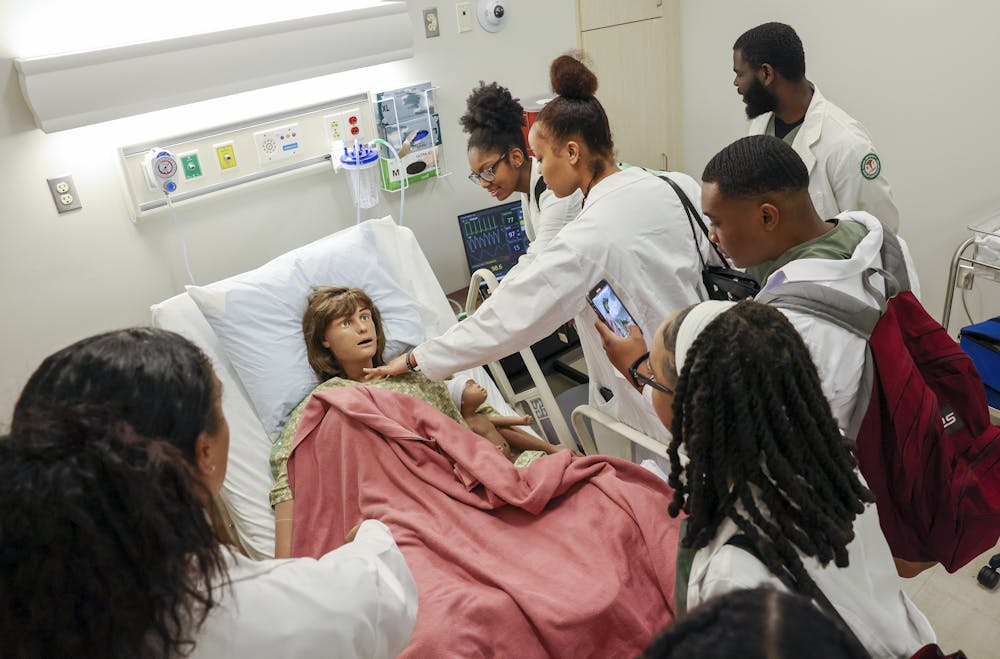
A group of young people wear white jackets and stand around a dummy dressed with a pink blanket over it in a hospital bed.
Undergraduate students who want to become doctors or work in other specialized fields are often encouraged to take only classes that connect with their long-term career trajectory.
Glenn Beil/Florida A&M University via Getty Images

Why students stay on narrow professional paths

Students entering college today face significant pressure to choose what they might see as safe majors that will result in a well-paying career. For aspiring physicians and engineers, the path is often scripted early by steering them toward physical and biosciences. High test scores, internships and other stepping stones are treated as nonnegotiable. Parents and peers can reinforce this mindset.

Most colleges and universities do not reward a future medical student who wants to major in comparative literature, or an engineering student who is spending time on philosophy.

Students’ majors also typically place course requirements on them, in addition to a school’s general course requirements. This often does not leave a lot of room for students to experiment with different classes, especially if they are pursuing vocationally focused majors, such as engineering.

As a result, I’ve seen many students trade curiosity for credentialing, believing that professional identity must come before intellectual exploration.

As someone who began my education in psychology and later transitioned into engineering, I have seen how different intellectual traditions approach the same human questions. Psychology teaches people to observe behavior and design experiments. Engineering trains students to model systems and optimize performance.

When combined, they help reveal how humans interact with technology and how technological solutions reshape human behavior.

In my view, these are questions neither field can answer alone.

Initiative is the missing ingredient

One of the most important and often overlooked ingredients in thriving high tech, medical and business environments is initiative. I believe students in the humanities routinely practice taking initiative by framing questions, interpreting incomplete information and proposing original arguments. These skills are crucial for scientific or business innovation, but they are often not emphasized in structured science, technology, engineering and mathematics – or STEM – coursework.

Initiative involves the willingness to move first and to see around corners, defining the next what-if, rallying others and building something meaningful even when the path is uncertain.

To help my engineering students practice taking initiative, I often give them deliberately vague instructions – something they rarely experience in their coursework. Many students, even highly capable ones, hesitate to take initiative because their schooling experience has largely rewarded caution and compliance over exploration. They wait for clarity or for permission – not because they lack ability, but because they are afraid to be wrong.

Yet in business, research labs, design studios, hospitals and engineering firms, initiative is the quality employers most urgently need and cannot easily teach. Broader educational approaches help cultivate this confidence by encouraging students to interpret ambiguity rather than avoid it.

How teaching can evolve

Helping all students develop a sense of initiative and innovation requires university leaders to rethink what success looks like.

Universities can begin with achievable steps, such as rewarding cross-disciplinary teaching and joint appointments in promotion and tenure criteria.

At the University of Iowa’s Driving Safety Research Institute, where our teams blend engineering, medicine, public health and psychology, students quickly learn that a safe automated vehicle is not just a technical system but also a behavioral one. Understanding how human drivers respond to automation is as important as the algorithms that govern the vehicle.

Other institutions are modeling this approach of integrating social, behavioral and physical sciences.

Olin College of Engineering, a school in Needham, Massachusetts, builds every project around both technical feasibility and human context. Courses are often co-taught by humanities and engineering professors, and projects require students to articulate not only what they built but why it matters.

Still, integrating liberal and technical education is difficult in practice. Professional curricula often overflow with accreditation requirements. Faculty incentives reward specialization more than collaboration. Students and parents, anxious about debt and job security, hesitate to spend credits outside of a student’s major.

Rethinking what success means

I believe that higher education’s purpose is not to produce uniform workers but adaptable thinkers.

It might not be productive to center conversations about defending the liberal arts or glorifying STEM. Rather, I think that people’s focus should be on recognizing that each field is incomplete without the other.

Education for a complex world must cultivate depth, initiative and perspective. When students connect disciplines, question assumptions and act with purpose, they are prepared not only for their first job but for a lifetime of learning and leadership.

The Conversation

Daniel V. McGehee does not work for, consult, own shares in or receive funding from any company or organization that would benefit from this article, and has disclosed no relevant affiliations beyond their academic appointment.

ref. Colleges teach the most valuable career skills when they don’t stick narrowly to preprofessional education – https://theconversation.com/colleges-teach-the-most-valuable-career-skills-when-they-dont-stick-narrowly-to-preprofessional-education-270025

Does BBC Civilisations get its four stories of collapse correct? Experts weigh in

Source: The Conversation – UK – By Jay Silverstein, Senior Lecturer in the Department of Chemistry and Forensics, Nottingham Trent University

In four episodes, the BBC’s Civilisations series tells the story of the fall of the Romans, Aztecs, Egypt’s Ptolemies and Japan’s Edo Samurais. The show tells these stories through a combination of recreated dramatic scenes, explanation from experts and discussions of objects from the British Museum. Here, four experts in each period have reviewed the episodes and shared their recommendations for further reading.

The Collapse of the Roman Empire

The canonical date of the fall of the Western Roman Empire is 476, when the general Odoacer deposed the last emperor, Romulus Augustulus – a child who had been on the throne for less than a year. I teach my students that this relatively muted event was probably not noticed by many ordinary people at the time, as very little likely immediately changed in their daily lives.

Instead, the much more dramatic events of 410 were the real collapse moment of the ancient world: the metropolis of Rome, the capital of the empire, was sacked by King Alaric and his Gothic army. As one of the expert contributors to this episode puts it, you would remember where you were when the news reached you.

The episode’s key achievement is to depict the way that Roman mistreatment of the Goths – a Germanic-speaking people many of whom fled war with Huns into the Roman Empire – effectively threatened their survival and backed them into a corner. While historians have long discussed these realities, it’s refreshing to see this message presented in such a compelling and humane way to the wider public. The contemporary resonances are obvious, and while history cannot provide us with answers, it can give us food for thought.

Further reading
To learn more about the end of the Western Roman Empire, I would recommend starting with the very readable and provocative introduction by Bryan Ward-Perkins, The Fall of Rome: And the End of Civilization. It looks at the very real changes that ordinary people would have experienced as a centuries-old empire fell apart.

Tim Penn is Lecturer in Roman and Late Antique Material Culture at University of Reading

The Last Days of the Ptolemies in Egypt

Neither the gradual decline nor the final fall of the Ptolemaic dynasty in Egypt in 30 BC is accurately realised in this episode. It presents a simplistic narrative riddled with factual inaccuracies. It also features inadvertent misreadings or deliberate misrepresentations that play fast and loose with the historical chronology of the reign of Cleopatra VII, and the significant historical figures that were part of it.

Such inaccuracy is not helped by the fact that, with the exception of two contributors, no one participating is actually an expert on this specific period of ancient Egyptian history. One prominent figure is not even an historian or archaeologist at all.

Most of the artefacts that are incorporated in an attempt to provide insight don’t date to this period of Egyptian history, and lead the narrative off in irrelevant directions. It’s not clear who the intended audience is, nor what they are expected to take away from this, beyond appreciation for the sumptuous dramatisation that unfolds in the background. There was potential here, such as the contribution of climate change and the wider geopolitical context, that was unfortunately squandered.

Further reading

If you want to read about Cleopatra’s reign specifically, then Duane W. Roller’s Cleopatra: A Biography is good. For the Ptolemaic dynasty more broadly, from start to end, I’d recommend Lloyd Llewelyn-Jones’s The Cleopatras: The Forgotten Queens of Egypt.

Jane Draycott is Senior Lecturer in Ancient History at the University of Glasgow

The Collapse of the Aztec Empire

The episode on the Aztecs focuses on the Aztec emperor Moctezuma in the 15th century. It offers a refreshing shift from the Eurocentric narrative that often paints him as indecisive while glorifying his nemesis, the conquistador Hernán Cortés. Here, the roles are reversed: Cortés’s ambition and brutality are exposed, while Moctezuma appears as a thoughtful and capable leader. Their confrontation feels less like a simple conquest and more like a high-stakes chess match – Moctezuma had Cortés in check until one audacious move changed history.

If you’re looking for a comprehensive account of the Aztec collapse, this episode won’t deliver that. Experts such as Matthew Restall, known for challenging colonial myths, are used sparingly, and the story remains selective. Key events are skipped, and contradictory sources are left out. All of this is inevitable in a single-episode format.

What it does offer is a visually stunning, well narrated introduction to imperial collapse, framed through iconic artefacts that bring the past to life.

Further reading

To learn more about the fall of the Aztecs, read
The True History of the Conquest of New Spain, Volume 4 by Bernal Díaz del Castillo – a Spaniard who served under Cortés during conquest of the Aztec Empire. There are many translations but the first edition of the text, edited by Mexican historian Genaro García and translated by Alfred Percival Maudslay, is my pick.

Jay Silverstein is Senior Lecturer in the Department of Chemistry and Forensics at Nottingham Trent University

The End of the Samurai in Japan

This episode deals with the military encounter between the American “black ships” (kurofune 黒船) under naval commodore Matthew Perry and the Tokugawa shogunate 徳川幕府 between 1852 and 1855. The interviewed historians are certainly familiar with the event, yet the conceptual framing is not quite right.

“Traditional Japan” is introduced as an unchanging and isolated place. In reality, Japan had lived in close economic and cultural symbiosis with continental East Asia since at least the rise of Buddhism in the 6th century.

A 1637 proclamation, known as sakoku, by the Tokugawa shogunate did make Japan a hostile place for Christians and foreigners. However, the Protestant Dutch, arch-enemies of their former Spanish overlords, were granted the right to send annual expeditions. These became the basis for Japan’s “Dutch studies” (rangaku 蘭學), an exchange of scientific knowledge which is ignored by the programme. Meanwhile, contact with China and Korea continued, albeit under stricter regulations.

The documentary dwells on the image of a powerful and conservative samurai class without alluding to the social transformations which had eroded its influence. The capital Edo was not only the largest city on earth, but a veritable engine of urbanisation and commercialisation.

This documentary is still a pleasure to watch, but the premise that Perry’s western gunboats led to the “fall” of Japanese civilisation is erroneous.

Further reading
If you want to know more about the political and social turmoil that led to the end of the samurais and the Tokugawa shogunate, I recommend The Emergence of Meiji Japan by Marius B. Jansen.

Lars Laamann is Senior Lecturer in the History of China At Soas, University of London


This article features references to books that have been included for editorial reasons, and may contain links to bookshop.org. If you click on one of the links and go on to buy something from bookshop.org The Conversation UK may earn a commission.


Looking for something good? Cut through the noise with a carefully curated selection of the latest releases, live events and exhibitions, straight to your inbox every fortnight, on Fridays. Sign up here.


The Conversation

The authors do not work for, consult, own shares in or receive funding from any company or organisation that would benefit from this article, and have disclosed no relevant affiliations beyond their academic appointment.

ref. Does BBC Civilisations get its four stories of collapse correct? Experts weigh in – https://theconversation.com/does-bbc-civilisations-get-its-four-stories-of-collapse-correct-experts-weigh-in-270114

The ChatGPT effect: In 3 years the AI chatbot has changed the way people look things up

Source: The Conversation – USA – By Deborah Lee, Professor and Director of Research Impact and AI Strategy, Mississippi State University

ChatGPT has become the go-to app for hundreds of millions of people. AP Photo/Kiichiro Sato

Three years ago, if someone needed to fix a leaky faucet or understand inflation, they usually did one of three things: typed the question into Google, searched YouTube for a how-to video or shouted desperately at Alexa for help.

Today, millions of people start with a different approach: They open ChatGPT and just ask.

I’m a professor and director of research impact and AI strategy at Mississippi State University Libraries. As a scholar who studies information retrieval, I see that this shift of the tool people reach for first for finding information is at the heart of how ChatGPT has changed everyday technology use.

Change in searching

The biggest change isn’t that other tools have vanished. It’s that ChatGPT has become the new front door to information. Within months of its introduction on Nov. 30, 2022, ChatGPT had 100 million weekly users. By late 2025, that figure had grown to 800 million. That makes it one of the most widely used consumer technologies on the planet.

Surveys show that this use isn’t just curiosity – it reflects a real change in behavior. A 2025 Pew Research Center study found that 34% of U.S. adults have used ChatGPT, roughly double the share found in 2023. Among adults under 30, a clear majority (58%) have tried it. An AP-NORC poll reports that about 60% of U.S. adults who use AI say they use it to search for information, making this the most common AI use case. The number rises to 74% for the under-30 crowd.

Traditional search engines are still the backbone of the online information ecosystem, but the kind of searching people do has shifted in measurable ways since ChatGPT entered the scene. People are changing which tool they reach for first.

For years, Google was the default for everything from “how to reset my router” to “explain the debt ceiling.” These basic informational queries made up a huge portion of search traffic. But these quick, clarifying, everyday “what does this mean” questions are the ones ChatGPT now answers faster and more cleanly than a page of links.

And people have noticed. A 2025 U.S. consumer survey found that 55% of respondents now use OpenAI’s ChatGPT or Google’s Gemini AI chatbots about tasks they previously would have asked Google search to help them with, with even higher usage figures for the U.K. Another analysis of more than 1 billion search sessions found that traffic from generative AI platforms is growing 165 times faster than traditional searches, and about 13 million U.S. adults have already made generative AI their go-to tool for online discovery.

This doesn’t mean people have stopped “Googling,” but it means ChatGPT has peeled off the kinds of questions for which users want a direct explanation instead of a list of links. Curious about a policy update? Need a definition? Want a polite way to respond to an uncomfortable email? ChatGPT is faster, feels more conversational and feels more definitive.

At the same time, Google isn’t standing still. Its search results look different than they did three years ago because Google started weaving its AI system Gemini directly into the top of the page. The “AI Overview” summaries that appear above traditional search links now instantly answer many simple questions – sometimes accurately, sometimes less so.

But either way, many people never scroll past that AI-generated snapshot. This fact combined with the impact of ChatGPT are the reasons the number of “zero-click” searches has surged. One report using Similarweb data found that traffic from Google to news sites fell from over 2.3 billion visits in mid-2024 to under 1.7 billion in May 2025, while the share of news-related searches ending in zero clicks jumped from 56% to 69% in one year.

Google search excels at pointing to a wide range of sources and perspectives, but the results can feel cluttered and designed more for clicks than clarity. ChatGPT, by contract, delivers a more focused and conversational response that prioritizes explanation over ranking. The ChatGPT response can lack the source transparency and multiple viewpoints often found in a Google search.

In terms of accuracy, both tools can occasionally get it wrong. Google’s strength lies in letting users cross-check multiple sources, while ChatGPT’s accuracy depends heavily on the quality of the prompt and the user’s ability to recognize when a response should be verified elsewhere.

OpenAI is aiming to make it even more appealing to turn to ChatPGT first for search by trying to get people to use a browser with ChatGPT built in.

Smart speakers and YouTube

The impact of ChatGPT has reverberated beyond search engines. Voice assistants, such as Alexa speakers and Google Home, continue to report high ownership, but that number is down slightly. One 2025 summary of voice-search statistics estimates that about 34% of people ages 12 and up own a smart speaker, down from 35% in 2023. This is not a dramatic decline, but the lack of growth may indicate a shift of more complex queries to ChatGPT or similar tools. When people want a detailed explanation, a step-by-step plan or help drafting something, a voice assistant that answers in a short sentence suddenly feels limited.

By contrast, YouTube remains a giant. As of 2024, it had approximately 2.74 billion users, with that number increasing steadily since 2010. Among U.S. teens, about 90% say they use YouTube, making it the most widely used platform in that age group. But what kind of videos people are looking for is changing.

People now tend to start with ChatGPT and then move to YouTube if they need the additional information a how-to video conveys. For many everyday tasks, such as “explain my health benefits” or “help me write a complaint email,” people ask ChatGPT for a summary, script or checklist. They head to YouTube only if they need to see a physical process.

You can see a similar pattern in more specialized spaces. Software engineers, for instance, have long relied on sites such as Stack Overflow for tips and pieces of software code. But question volume there began dropping sharply after ChatGPT’s release, and one analysis suggests overall traffic fell by about 50% between 2022 and 2024. When a chatbot can generate a code snippet and an explanation on demand, fewer people bother typing a question into a public forum.

So where does that leave us?

Three years in, ChatGPT hasn’t replaced the rest of the tech stack; it’s reordered it. The default search has shifted. Search engines are still for deep dives and complex comparisons. YouTube is still for seeing real people do real things. Smart speakers are still for hands-free convenience.

But when people need to figure something out, many now start with a chat conversation, not a search box. That’s the real ChatGPT effect: It didn’t just add another app to our phones – it quietly changed how we look things up in the first place.

The Conversation

Deborah Lee does not work for, consult, own shares in or receive funding from any company or organization that would benefit from this article, and has disclosed no relevant affiliations beyond their academic appointment.

ref. The ChatGPT effect: In 3 years the AI chatbot has changed the way people look things up – https://theconversation.com/the-chatgpt-effect-in-3-years-the-ai-chatbot-has-changed-the-way-people-look-things-up-270143

From concrete to community: How synthetic data can make urban digital twins more humane

Source: The Conversation – USA – By Wei Zhai, Associate Professor of Public Affairs and Planning, University of Texas at Arlington

How people behave is a critical element of how cities function. Ahmed Deeb/picture alliance via Getty Images

When city leaders talk about making a town “smart,” they’re usually talking about urban digital twins. These are essentially high-tech, 3D computer models of cities. They are filled with data about buildings, roads and utilities. Built using precision tools like cameras and LiDAR – light detection and ranging – scanners, these twins are great at showing what a city looks like physically.

But in their rush to map the concrete, researchers, software developers and city planners have missed the most dynamic part of urban life: people. People move, live and interact inside those buildings and on those streets.

This omission creates a serious problem. While an urban digital twin may perfectly replicate the buildings and infrastructure, it often ignores how people use the parks, walk on the sidewalks, or find their way to the bus. This is an incomplete picture; it cannot truly help solve complex urban challenges or guide fair development.

To overcome this problem, digital twins will need to widen their focus beyond physical objects and incorporate realistic human behaviors. Though there is ample data about a city’s inhabitants, using it poses a significant privacy risk. I’m a public affairs and planning scholar. My colleagues and I believe the solution to producing more complete urban digital twins is to use synthetic data that closely approximates real people’s data.“

Digital twins are more than simulations.

The privacy barrier

To build a humane, inclusive digital twin, it’s critical to include detailed data on how people behave. And the model should represent the diversity of a city’s population, including families with young children, disabled residents and retirees. Unfortunately, relying solely on real-world data is impractical and ethically challenging.

The primary obstacles are significant, starting with strict privacy laws. Rules such as the European Union’s General Data Protection Regulation, or GDPR, often prevent researchers and others from widely sharing sensitive personal information. This wall of privacy stops researchers from easily comparing results and limits our ability to learn from past studies.

Furthermore, real-world data is often unfair. Data collection tends to be uneven, missing large groups of people. Training a computer model using data where low-income neighborhoods have sparse sensor coverage means the model will simply repeat and even magnify that original unfairness. To compensate for this, researchers can use the statistical technique of weighting the data in the models to make up for the underrepresentation.

Synthetic data offers a practical solution. It is artificial information generated by computers that mimics the statistical patterns of real-world data. This protects privacy while filling critical data gaps.

Synthetic data: Tool for fairer cities

Adding synthetic human dynamics fundamentally changes digital twins. It shifts them from static models of infrastructure to dynamic simulations that show how people live in the city. By generating synthetic patterns of walking, bus riding and public space use, planners can include a wider, more inclusive range of human actions in the models.

For example, Bogotá, Colombia, is using a digital twin to model its TransMilenio bus rapid transit system. Instead of relying only on limited or privacy-sensitive real-world sensor data, the city planners generated synthetic data to fill the digital twin. Such data artificially creates millions of simulated bus arrivals, vehicle speeds and queue lengths, all based on the statistical patterns – peak times, off-peak times – of actual TransMilenio operations.

This approach transforms urban planning in several crucial ways, making simulations more realistic and diverse. For example, planners can use synthetic pedestrian data to model how elderly and disabled residents would navigate a new urban design.

It also allows for risk-free testing of ideas. Planners can simulate diverse synthetic populations to see how a new flood evacuation plan would affect various groups, all without risking anyone’s safety or privacy in the real world.

Cities are increasingly building digital twins for planning and development.

Making digital twins trustworthy

For all the promises of synthetic data, it can only be helpful if planners can trust it. Since they base major decisions on these virtual worlds, the synthetic data must be proved to be a reliable replacement for real-world data. Planners can test this by checking to see if the main policy decisions they reach using the synthetic data are the same ones they would have made using real-world data that puts people’s privacy at risk. If the decisions match, the synthetic data is trustworthy enough to use for that planning task going forward.

Beyond technical checks, it’s important to consider fairness. This means routinely auditing the synthetic models to check for any hidden biases or underrepresentation across different groups. For example, planners can make sure an emergency evacuation plan in the urban digital twin works for elderly residents with mobility issues.

Most importantly, I believe planners should include their communities. Establishing citizen advisory boards and designing the synthetic data and simulation scenarios directly with the people who live in the city helps ensure that their experiences are accurately reflected.

By moving beyond static infrastructure to dynamic environments that include people’s behavior, synthetic data is set to play a critical role in urban planning. It will shape the resilient, inclusive and human-centered urban digital twins of the future.

The Conversation

Wei Zhai receives funding from National Science Foundation.

ref. From concrete to community: How synthetic data can make urban digital twins more humane – https://theconversation.com/from-concrete-to-community-how-synthetic-data-can-make-urban-digital-twins-more-humane-268847

When darkness shines: How dark stars could illuminate the early universe

Source: The Conversation – USA – By Alexey A. Petrov, Professor of physics and astronomy, University of South Carolina

NASA’s James Webb Space Telescope has spotted some potential dark star candidates. NASA, ESA, CSA, and STScI

Scientists working with the James Webb Space Telescope discovered three unusual astronomical objects in early 2025, which may be examples of dark stars. The concept of dark stars has existed for some time and could alter scientists’ understanding of how ordinary stars form. However, their name is somewhat misleading.

“Dark stars” is one of those unfortunate names that, on the surface, does not accurately describe the objects it represents. Dark stars are not exactly stars, and they are certainly not dark.

Still, the name captures the essence of this phenomenon. The “dark” in the name refers not to how bright these objects are, but to the process that makes them shine — driven by a mysterious substance called dark matter. The sheer size of these objects makes it difficult to classify them as stars.

As a physicist, I’ve been fascinated by dark matter, and I’ve been trying to find a way to see its traces using particle accelerators. I’m curious whether dark stars could provide an alternative method to find dark matter.

What makes dark matter dark?

Dark matter, which makes up approximately 27% of the universe but cannot be directly observed, is a key idea behind the phenomenon of dark stars. Astrophysicists have studied this mysterious substance for nearly a century, yet we haven’t seen any direct evidence of it besides its gravitational effects. So, what makes dark matter dark?

A pie chart showing the composition of the universe. The largest proportion is 'dark energy,' at 68%, while dark matter makes up 27% and normal matter 5%. The rest is neutrinos, free hydrogen and helium and heavy elements.
Despite physicists not knowing much about it, dark matter makes up around 27% of the universe.
Visual Capitalist/Science Photo Library via Getty Images

Humans primarily observe the universe by detecting electromagnetic waves emitted by or reflected off various objects. For instance, the Moon is visible to the naked eye because it reflects sunlight. Atoms on the Moon’s surface absorb photons – the particles of light – sent from the Sun, causing electrons within atoms to move and send some of that light toward us.

More advanced telescopes detect electromagnetic waves beyond the visible spectrum, such as ultraviolet, infrared or radio waves. They use the same principle: Electrically charged components of atoms react to these electromagnetic waves. But how can they detect a substance – dark matter – that not only has no electric charge but also has no electrically charged components?

Although scientists don’t know the exact nature of dark matter, many models suggest that it is made up of electrically neutral particles – those without an electric charge. This trait makes it impossible to observe dark matter in the same way that we observe ordinary matter.

Dark matter is thought to be made of particles that are their own antiparticles. Antiparticles are the “mirror” versions of particles. They have the same mass but opposite electric charge and other properties. When a particle encounters its antiparticle, the two annihilate each other in a burst of energy.

If dark matter particles are their own antiparticles, they would annihilate upon colliding with each other, potentially releasing large amounts of energy. Scientists predict that this process plays a key role in the formation of dark stars, as long as the density of dark matter particles inside these stars is sufficiently high. The dark matter density determines how often dark matter particles encounter, and annihilate, each other. If the dark matter density inside dark stars is high, they would annihilate frequently.

What makes a dark star shine?

The concept of dark stars stems from a fundamental yet unresolved question in astrophysics: How do stars form? In the widely accepted view, clouds of primordial hydrogen and helium — the chemical elements formed in the first minutes after the Big Bang, approximately 13.8 billion years ago — collapsed under gravity. They heated up and initiated nuclear fusion, which formed heavier elements from the hydrogen and helium. This process led to the formation of the first generation of stars.

Two bright clouds of gas condensing around a small central region
Stars form when clouds of dust collapse inward and condense around a small, bright, dense core.
NASA, ESA, CSA, and STScI, J. DePasquale (STScI), CC BY-ND

In the standard view of star formation, dark matter is seen as a passive element that merely exerts a gravitational pull on everything around it, including primordial hydrogen and helium. But what if dark matter had a more active role in the process? That’s exactly the question a group of astrophysicists raised in 2008.

In the dense environment of the early universe, dark matter particles would collide with, and annihilate, each other, releasing energy in the process. This energy could heat the hydrogen and helium gas, preventing it from further collapse and delaying, or even preventing, the typical ignition of nuclear fusion.

The outcome would be a starlike object — but one powered by dark matter heating instead of fusion. Unlike regular stars, these dark stars might live much longer because they would continue to shine as long as they attracted dark matter. This trait would make them distinct from ordinary stars, as their cooler temperature would result in lower emissions of various particles.

Can we observe dark stars?

Several unique characteristics help astronomers identify potential dark stars. First, these objects must be very old. As the universe expands, the frequency of light coming from objects far away from Earth decreases, shifting toward the infrared end of the electromagnetic spectrum, meaning it gets “redshifted.” The oldest objects appear the most redshifted to observers.

Since dark stars form from primordial hydrogen and helium, they are expected to contain little to no heavier elements, such as oxygen. They would be very large and cooler on the surface, yet highly luminous because their size — and the surface area emitting light — compensates for their lower surface brightness.

They are also expected to be enormous, with radii of about tens of astronomical units — a cosmic distance measurement equal to the average distance between Earth and the Sun. Some supermassive dark stars are theorized to reach masses of roughly 10,000 to 10 million times that of the Sun, depending on how much dark matter and hydrogen or helium gas they can accumulate during their growth.

So, have astronomers observed dark stars? Possibly. Data from the James Webb Space Telescope has revealed some very high-redshift objects that seem brighter — and possibly more massive — than what scientists expect of typical early galaxies or stars. These results have led some researchers to propose that dark stars might explain these objects.

Artist's impression of the James Webb telescope, which has a hexagonal mirror made up of smaller hexagons, and sits on a rhombus-shaped spacecraft.
The James Webb Space Telescope, shown in this illustration, detects light coming from objects in the universe.
Northrup Grumman/NASA

In particular, a recent study analyzing James Webb Space Telescope data identified three candidates consistent with supermassive dark star models. Researchers looked at how much helium these objects contained to identify them. Since it is dark matter annihilation that heats up those dark stars, rather than nuclear fusion turning helium into heavier elements, dark stars should have more helium.

The researchers highlight that one of these objects indeed exhibited a potential “smoking gun” helium absorption signature: a far higher helium abundance than one would expect in typical early galaxies.

Dark stars may explain early black holes

What happens when a dark star runs out of dark matter? It depends on the size of the dark star. For the lightest dark stars, the depletion of dark matter would mean gravity compresses the remaining hydrogen, igniting nuclear fusion. In this case, the dark star would eventually become an ordinary star, so some stars may have begun as dark stars.

Supermassive dark stars are even more intriguing. At the end of their lifespan, a dead supermassive dark star would collapse directly into a black hole. This black hole could start the formation of a supermassive black hole, like the kind astronomers observe at the centers of galaxies, including our own Milky Way.

Dark stars might also explain how supermassive black holes formed in the early universe. They could shed light on some unique black holes observed by astronomers. For example, a black hole in the galaxy UHZ-1 has a mass approaching 10 million solar masses, and is very old – it formed just 500 million years after the Big Bang. Traditional models struggle to explain how such massive black holes could form so quickly.

The idea of dark stars is not universally accepted. These dark star candidates might still turn out just to be unusual galaxies. Some astrophysicists argue that matter accretion — a process in which massive objects pull in surrounding matter — alone can produce massive stars, and that studies using observations from the James Webb telescope cannot distinguish between massive ordinary stars and less dense, cooler dark stars.

Researchers emphasize that they will need more observational data and theoretical advancements to solve this mystery.

The Conversation

Alexey A Petrov receives funding from the US Department of Energy.

ref. When darkness shines: How dark stars could illuminate the early universe – https://theconversation.com/when-darkness-shines-how-dark-stars-could-illuminate-the-early-universe-266971

Fern stems reveal secrets of evolution – how constraints in development can lead to new forms

Source: The Conversation – USA – By Jacob S. Suissa, Assistant Professor of Plant Evolutionary Biology, University of Tennessee

The lacy frond of the intermediate wood fern (_Dryopteris intermedia_). Jacob S. Suissa, CC BY-ND

There are few forms of the botanical world as readily identifiable as fern leaves. These often large, lacy fronds lend themselves nicely to watercolor paintings and tricep tattoos alike. Thoreau said it best: “Nature made ferns for pure leaves, to show what she could do in that line.”

But ferns are not just for art and gardens. While fern leaves are the most iconic part of their body, these plants are whole organisms, with stems and roots that are often underground or creeping along the soil surface. With over 400 million years of evolutionary history, ferns can teach us a lot about how the diversity of planet Earth came to be. Specifically, examining their inner anatomy can reveal some of the intricacies of evolution.

Sums of parts or an integrated whole?

When one structure cannot change without altering the other, researchers consider them constrained by each other. In biology, this linkage between traits is called a developmental constraint. It explains the limits of what possible forms organisms can take. For instance, why there aren’t square trees or mammals with wheels.

However, constraint does not always limit form. In my recently published research, I examined the fern vascular system to highlight how changes in one part of the organism can lead to changes in another, which can generate new forms.

Close-up of a small, flat green circle with a brown outline, held between two fingers
Cross section of a stem of Adiantum in Costa Rica. If you zoom in, you can make out the radial arrangement of bundles in the stem – the darker dots in the circle at its center.
Jacob S. Suissa, CC BY-ND

Before Charles Darwin proposed his theory of evolution by natural selection, many scientists believed in creationism – the idea that all living things were created by a god. Among these believers was the 19th-century naturalist Georges Cuvier, who is lauded as the father of paleontology. His argument against evolution was not exclusively based in faith but on a theory he called the correlation of parts.

Cuvier proposed that because each part of an organism is developmentally linked to every other part, changes in one part would result in changes to another. With this theory, he argued that a single tooth or bone could be used to reconstruct an entire organism.

He used this theory to make a larger claim: If organisms are truly integrated wholes and not merely sums of individual parts, how could evolution fashion specific traits? Since changes in one part of an organism would necessitate changes in others, he argued, small modifications would require restructuring every other part. If the individual parts of an organism are all fully integrated, evolution of particular traits could not proceed.

However, not all of the parts of an organism are tethered together so tightly. Indeed, some parts can evolve at different rates and under different selection pressures. This idea was solidified as the concept of quasi-independence in the 1970s by evolutionary biologist Richard Lewontin. The idea of organisms as collections of individually evolving parts remains today, influencing how researchers and students think about evolution.

Fern vasculature and the process of evolution

Ferns are one of four lineages of land plants that have vascular tissues – specialized sets of tubes that move water and nutrients through their bodies. These tissues are composed of vascular bundles – clusters of cells that conduct water through the stem.

How vascular bundles are arranged in fern stems varies substantially. Some have as many as three to eight or more vascular bundles scattered throughout their stem. Some are arranged symmetrically, while others such as the tobacco fern – Mickelia nicotianifolia – have bundles arranged in a whimsical, smiley-face pattern.

Cross-section of a roughly oblong stem with a smiley face shape towards one end
Cross section of the rhizome of Mickelia nicotianifolia, showing the smiley-face patterning of the vascular tissues. Each gap in the central system is associated with the production of a leaf.
Jacob S. Suissa, CC BY-ND

For much of the 20th century, scientists studying the pattern and arrangement of vascular bundles in fern stems thought these broad patterns may be adaptive to environmental conditions. I set out in my own research to test whether certain types of arrangements were more resistant to drought. But contrary to my initial hypotheses – and my desire for a relationship between form and function – the arrangement of vascular bundles in the stem did not seem to correlate with drought tolerance.

This may sound counterintuitive, but it turns out the ability of a fern to move water through its body has more to do with the size and shape of the water-conducting cells rather than how they’re arranged as a whole in the stem. This finding is analogous to looking at road maps to understand traffic patterns. The patterning of roads on a map (how cells are arranged) may be less important in determining traffic patterns than the number and size of lanes (cell size and number).

This observation hinted at something deeper about the evolution of the vascular systems of ferns. It sent me on a journey to uncover exactly what gave rise to the varying vascular patterns of ferns.

Simple observations and insights into evolution

I wondered how this variation in the number and arrangement of vascular bundles relates to leaf placement around the stem. So I quantified this variation in vascular patterning for 27 ferns representing roughly 30% of all fern species.

I found a striking correlation between the number of rows of leaves and the number of vascular bundles within the stem. This relationship was almost 1-to-1 in some cases. For instance, if there were three rows of leaves along the stem, there were three vascular bundles in the stem.

What’s more, how leaves were arranged around the stem determined the spatial arrangement of bundles. If the leaves were arranged spirally (on all sides of the stem), the vascular bundles were arranged in a radial pattern. If the leaves were shifted to the dorsal side of the stem, the smiley-face pattern emerged.

Importantly, based on our understanding of plant development, there was a directionality here. Specifically, the placement of leaves determines the arrangement of bundles, not the other way around.

Microscopy images of cross-section of fern stems in different shapes, one a cluster of spots, another concentric circles and another three separate segments
Vascular architectures of three different ferns. From left: Lygodium microphyllum, Sitobolium punctilobulum and Amauropelta noveboracensis.
Jacob S. Suissa, CC BY-ND

This may not sound all that surprising – it seems logical that vasculature should link up between leaves and stems. But it runs counter to how scientists have viewed the fern vascular system for over 100 years. Many studies on fern vascular patterning have tended to focus on individual parts of the plant, removing vascular architecture from the context of the plant as a whole and viewing it as an independently evolving pattern.

However, this new work suggests that the arrangement of vascular bundles in fern stems is not able to change in isolation. Rather, like Cuvier’s idealized organisms, vascular patterning is linked to and explicitly determined by the number and placement of leaves along the stem. This is not to say that vascular patterns could not be adaptive to environmental conditions, but it means that the handle of evolutionary change in the number and arrangement of vascular bundles is likely changes to leaf number and placement.

From parochial to existential

While this study on ferns and their vascular system may seem parochial, it speaks to the broader question of how variation – the fuel of evolution – arises, and how evolution can proceed.

While not all parts of an organism are so tightly linked, considering the individual as a whole – or at least sets of parts as a unit – can help researchers better understand how, and if, observable patterns can evolve in isolation. This insight takes scientists one step closer to understanding the minutia of how evolution works to generate the immense biodiversity on Earth.

Understanding these processes is also important for industry. In agricultural settings, plant and animal breeders attempt to increase one aspect of an organism without changing another. By taking a holistic approach and understanding which parts of an organism are developmentally or genetically linked and which are more quasi-independent, breeders may be able to more effectively create organisms with desired traits.

Slices of  fern stem on a table
Researchers can learn much about evolution from the stems of Mickelia nicotianifolia
Jacob S. Suissa, CC BY-ND

Constraint is often viewed as restricting, but it may not always be so. The Polish nuclear physicist Stanisław Ulam noted that rhymes “compel one to find the unobvious because of the necessity of finding a word which rhymes,” paradoxically acting as an “automatic mechanism of originality.” Whether from the literary rules of a haiku or the development of ferns, constraint can be a generator of form.

The Conversation

Jacob S. Suissa receives funding from The National Science Foundation. He is affiliated with Arnold Arboretum of Harvard University, and Let’s Botanize Inc.

ref. Fern stems reveal secrets of evolution – how constraints in development can lead to new forms – https://theconversation.com/fern-stems-reveal-secrets-of-evolution-how-constraints-in-development-can-lead-to-new-forms-267401