Thousands of criminals reoffend in South Africa – better data would show where the justice system is failing

Source: The Conversation – Africa (2) – By Marelize Isabel Schoeman, Professor, University of South Africa

In a recent statement, South Africa’s minister of correctional services said more than 18,000 parolees had reoffended in the past three years. They included 209 committing murder and 330 rape during 2024-25. This is one of the country’s most pressing justice problems, yet it remains poorly understood. It’s called recidivism: a situation where an individual who has already served a sentence commits another crime and is arrested, convicted or sentenced again.

Academic and media reports suggest that many released prisoners commit another crime and are sentenced. However, South Africa lacks a standard definition for recidivism or a consistent way to measure it. This means that no one knows the true rate. Researcher Marelize Schoeman explains why tracking recidivism matters.

Why is the definition of recidivism so important?

Recidivism is not simply reoffending. The word comes from Latin. It means “to fall back”. It describes when an individual who has already served a sentence commits another crime and is arrested, convicted or sentenced again.

A high recidivism rate, therefore, reflects not only reoffending, but the criminal justice system’s failure to rehabilitate offenders and prevent further crime.

According to academic research, South Africa’s recidivism rate ranges from 55% to 95%. Media reports claim it to be as high as 80% to 97%.

These figures, however, can only be regarded as estimates. South Africa lacks a standard definition of recidivism. This has led to researchers and criminal justice institutions – including the Department of Correctional Services, the South African Police Service and the National Prosecuting Authority – using different definitions and measurement methods. This produces inconsistent data and inaccurate recidivism statistics.

The lack of a shared definition and common understanding has resulted in recidivism being used as a buzzword. This is done to create public sensation, score political points or claim programme success without any credible or generalisable evidence.

As a result, policymakers and service providers in the criminal justice sector don’t know whether:

  • policing, sentencing and rehabilitation programmes are effective

  • correctional centres are overcrowded due to repeat offenders

  • parole and reintegration efforts are successful.

This absence of reliable information hampers the criminal justice system’s ability to deliver effective prevention services, support parolees after release, reduce reoffending and build safer communities.

How can South Africa better define and address the problem?

The first step is to have a uniform definition of recidivism across the criminal justice sector. Then the rate can be measured accurately. Without accurate data, resources can be wasted on crime prevention and rehabilitation programmes that do not work. Effective initiatives will remain unnoticed or underfunded. You can’t manage what you can’t measure.

The second step is to improve record-keeping and create a central digitised databank for sentenced offenders. This databank would hold key information, such as personal details, previous convictions, the nature of each offence, and other risk-related factors that could influence an offender’s rehabilitation prospects.

This information should be accessible to the prisons, police and prosecutors. The courts, parole boards and accredited rehabilitation service providers should also have access.

Currently, there is no central record system. The police service maintains all criminal record information. To obtain a person’s criminal record, a form and the individual’s fingerprints must be submitted. An official then checks the database for any previous convictions, offence details and sentencing information. This largely paper-based system is prone to delays, human error and inaccuracies.

Many offenders use aliases or do not have identity documents.

A uniform identification system, using digitally captured fingerprints or iris scans, would be a more effective way of identifying and keeping records of individuals with a criminal record.

Digitising this process has been planned since 1996, but hasn’t happened. Fragmented systems, weak accountability, outdated infrastructure, governance bottlenecks and late deliveries have delayed it.

What difference will the database make?

Making these improvements would change how South Africa measures, understands and manages recidivism. A uniform definition would replace guesswork and political rhetoric with a clear, evidence-based standard.

Policymakers, researchers and practitioners could use a common language to make comparisons and coordinate strategies.

The focus could shift from viewing recidivism merely as individuals reoffending, to the criminal justice system’s effectiveness in breaking the cycle of crime.

A centralised, digitised offender database would reduce human error and improve data reliability, making it possible to identify and do what works.

Public trust in the criminal justice sector might improve, enhancing rehabilitation outcomes and building safer communities.

What countries have cracked this?

Countries like the United Kingdom, Norway, Finland and Sweden, Canada, New Zealand and Singapore have adopted a uniform definition of recidivism. They use it to measure the performance of their criminal justice systems.

The effectiveness of these steps is clear in Norway and Singapore. The two countries have some of the lowest recidivism rates in the world at 20% and 21%, respectively. The UK’s recidivism rates have declined from 31.6% in 2010 to 26.5% in 2023. In New Zealand, performance data is used to target high-risk groups and strengthen rehabilitation efforts.

These countries use biometric databases in law enforcement and correctional facilities. The databases help to identify offenders, track parolees and manage prisons. Authorities can identify ex-offenders who commit new crimes.

Recidivism statistics are also used as key performance indicators across the criminal justice system. They guide funding and programme development.

In South Africa, a review of the parole board system which began in September 2025 offers the Department of Correctional Services an opportunity to define what recidivism means.

This step could create the basis for developing a central record system for both incarcerated offenders and those under community corrections. The system could later be expanded across the entire criminal justice network.

The Conversation

Marelize Isabel Schoeman does not work for, consult, own shares in or receive funding from any company or organisation that would benefit from this article, and has disclosed no relevant affiliations beyond their academic appointment.

ref. Thousands of criminals reoffend in South Africa – better data would show where the justice system is failing – https://theconversation.com/thousands-of-criminals-reoffend-in-south-africa-better-data-would-show-where-the-justice-system-is-failing-268413

Global power shifts are playing out in the Red Sea region: why this is where the rules are changing

Source: The Conversation – Africa (2) – By Federico Donelli, Associate Professor of International Relations, University of Trieste

The competition for global influence and control is shifting. One of the places where this dynamic is playing out is the Red Sea region, which encompasses Egypt, Eritrea, Djibouti, Sudan, Saudi Arabia and Yemen. Here, international rivalries, regional ambitions and local politics collide. Federico Donelli, who has studied these political dynamics and recently published Power Competition in the Red Sea, explains what’s driving the region’s geopolitical significance.

What defines the Red Sea as a region?

The region stretches from the Suez Canal to the Bab el-Mandeb Strait, covering approximately 438,000km². The Red Sea borders some of the world’s most volatile regions: the Horn of Africa, the Arabian Peninsula and the western shore of the Indo-Pacific area.

The Red Sea region

The Red Sea is rapidly becoming a highly contested zone, where traditional and emerging global powers are vying for influence and control. The decline of western geopolitical centrality, the rise of alternative powers and the increasing assertiveness of regional actors converge in the Red Sea.

This has created a complex and dynamic arena in which to test future global power hierarchies. The Red Sea region is challenging the liberal international order that emerged at the end of the cold war in 1989. That order is based on:

  • multilateralism – cooperation among multiple states

  • a free market – limited state intervention in the economy

  • liberal democracy – political pluralism and individual rights.

These tenets have been eroded by a combination of internal weaknesses and external challenges over the past 20 years.

While competition for global power between the United States and China tends to dominate the headlines, the true laboratories of the post-liberal world order are found in regions where international, regional and local dynamics collide.

The broader Red Sea region is one of them. Others are the Arctic, the South Indo-Pacific and the Balkans.

Why is the Red Sea region a stage for global power competition?

The region lacks a clear dominant power that is capable of imposing order. This makes it an open arena of competition among states with overlapping interests.

The Red Sea has great strategic value. It connects the Mediterranean and the Indo-Pacific, and is a maritime route for global trade and energy. It also borders several fragile states like Sudan, Eritrea and Yemen.

This combination – on the one hand, limited or contested authority that leaves the area exposed to external penetration, and on the other, its significant strategic value – has turned the region into a magnet for external involvement.

The United States and China both have military facilities in Djibouti. Russia has sought access to Port Sudan. Gulf powers, notably Saudi Arabia, the United Arab Emirates and Qatar, have expanded their presence across the Horn of Africa. They’ve done this by investing in ports, infrastructure and military cooperation especially in Sudan, Somalia and Ethiopia.

Turkey, Iran and Israel have also established political, economic and security ties. This links the Red Sea to the eastern Mediterranean and the Persian Gulf.

However, external powers are not the only drivers of change in the region.

Local actors, from Ethiopia to Sudan, Eritrea, Egypt and Somalia, are exploiting global rivalries to advance their strategic objectives. They are courting competing external powers by trading military access for security guarantees, or seeking investment in strategic infrastructure. They are also using diplomatic alignment with the US, China, Gulf states or Turkey to strengthen domestic and regional positions.

These actions create a complex web of overlapping interests. These blur the line between regional and global politics. Governments and non-state actors now have multiple external patrons to choose from. They can play one power against another.

This “multi-alignment” gives regional players leverage. It also increases volatility and uncertainty. For example, rival factions in the ongoing Sudanese civil war have sought support from external players, ranging from Saudi Arabia to the UAE. This has transformed an internal conflict into a proxy battlefield.

In Somalia, local and clan authorities negotiate security and economic deals directly with foreign powers like Turkey and Gulf states, often bypassing weak local institutions.

Meanwhile, landlocked Ethiopia’s search for sea access has drawn it into new diplomatic and security entanglements with Somaliland, Somalia, Eritrea, Egypt and Gulf countries.

These examples reveal how the Red Sea arena has become a microcosm of the post-liberal order: fragmented, transactional and deeply interconnected.

What are the main outcomes and lessons from this alignment?

The Red Sea region reflects the broader transformation of global politics.

Rather than producing a new balance, the decline of western influence has created a decentralised and competitive system.

In this environment, regional areas serve as testing grounds for new patterns of interaction between global and local powers, state and non-state actors, and formal alliances and informal partnerships.

While western-centric “universal” rules and institutions defined the liberal international order, the post-liberal order is characterised by selective engagement, bilateral bargains and flexible alignments.

The result is a world where order emerges from competition rather than consensus.

Competition among great powers now occurs less through international institutions and more through regional arenas. Military presence, infrastructure investment and political alliances now serve as instruments of influence.

What conclusions do you draw?

The Red Sea region is a reminder to scholars and policymakers that the future of international politics will not be defined solely in Washington, Beijing, Brussels or Moscow. It will also be defined in places like Port Sudan, Aden and Djibouti, where the new global order is being shaped.

Regions have become true laboratories of international change. They are places where global competition interacts with local conflicts, and new models of governance and influence emerge.

Local actors, state and non-state, are no longer passive recipients of external interference. They are active participants in shaping their own security environments.

The Conversation

Federico Donelli is affiliated with the Italian Institute for International Political Studies (ISPI), the Nordic Africa Institute (NAI), and the Orion Policy Institute (OPI)

ref. Global power shifts are playing out in the Red Sea region: why this is where the rules are changing – https://theconversation.com/global-power-shifts-are-playing-out-in-the-red-sea-region-why-this-is-where-the-rules-are-changing-268895

Stranger Things has kept our attention through clever use of ‘hauntology’ – a psychologist explains

Source: The Conversation – UK – By Edward White, PhD Candidate in Psychology, Kingston University

For the final season of Stranger Things, millions of fans will take one last plunge into the Upside Down to watch an epic showdown against Vecna as he threatens the town of Hawkins – and the entire world. But what sparks our collective fascination with this dark, horror-filled universe?

The answer lies in psychological and philosophical principles that shed light on why we’re drawn not only to entertainment but also to information. Understanding why millions willingly immerse themselves in the terrifying world of the Upside Down reveals deep truths about human nature and our relationship with fear.

From ghost stories to true crime documentaries, our obsession with the macabre stems from a bias towards negativity: the tendency to react more strongly to negative information than to positive or neutral content.

This negativity bias evolved as an alert system – our fight-or-flight response to threats. Today, since we no longer face sabre-toothed tigers, this alertness has transformed into a thrill-seeking drive to pursue frightening content for its intense arousal.

This explains why viewers are simultaneously scared and captivated by scenes like the traumatic flashbacks of Eleven (Millie Bobby Brown) or the Demogorgon’s savage attacks. Our brains are wired to respond to danger, even in make-believe scenarios.

The trailer for season five of Stranger Things.

Research into horror psychology shows that sensation-seekers actively chase negative stimuli to boost their sense of excitement. Cross-cultural studies on curiosity about morbid topics, meanwhile, reveal that this attraction appears across diverse human cultures and is rooted in stable psychological mechanisms rather than culture specific ones.

Stranger Things masterfully taps into all four dimensions of our morbid curiosity: exploring villains (like Vecna and Dr Brenner), witnessing violence (from the Upside Down creatures), experiencing body horror (through the Mind Flayer’s infections) and confronting paranormal threats (those haunting Hawkins). This comprehensive engagement explains the show’s massive global appeal.

Neuroimaging research employing brain-scanning tools like functional magnetic resonance imaging or fMRI, which tracks blood flow and neural activity in real time, indicates that watching disturbing content activates the brain’s reward system.

This neurological response explains why Stranger Things feels simultaneously terrifying and deeply satisfying – our reward systems are reinforcing the psychological benefits of confronting fear through fictional proxies, allowing us to practice emotional resilience and threat assessment without real-world consequences.

The hauntological framework

One popular aspect of Stranger Things is its setting: 1980s America. This choice adds a deeper psychological resonance to what French philosopher Jacques Derriera coined “hauntology”.

Hauntology suggests that we are all “haunted” by two ghosts. The first is a return to the social past, that idea that things were better before. The second ghost represents a yearning for a future that promises redemption and a belief that meaningful change remains possible. These two ghosts create a condition that sits between presence and absence, where lingering traces of unresolved pasts continue to haunt and shape the present.

The 1980s setting of Stranger Things serves as a deliberate return to a romanticised era, where unresolved social, economic and cultural issues from the past “haunt” the present.

The town of Hawkins, where the show is set, is presented as an idealised town of traditional values and economic stability. But underneath this facade, the series systematically dismantles the myth of 1980s American innocence by revealing the psychological trauma embedded withing the perfect suburban life.

For instance, the Upside Down (a dark and decaying alternate dimension that mirrors our own) functions as a psychological manifestation of what psychologist Carl Jung termed the “shadow” – those repressed aspects of individual and collective consciousness that society refuses to acknowledge.

Hawkins Laboratory, operating in secret beneath the town’s surface, represents the dark underbelly of American scientific progress during the cold war era, where children become subjects in the pursuit of science. Eleven’s systematic abuse at the hands of Dr Brenner (Matthew Modine) exposes how institutional authority can perpetrate intergenerational trauma while maintaining facades of benevolent care.

Ultimately, Stranger Things is so addictive because it taps into multiple psychological layers at once. The show’s clever use of our natural negativity bias and curiosity about the morbid keeps viewers hooked emotionally from the start, while its hauntological framework adds deeper resonance by encouraging us to face the hidden traumas beneath our favourite cultural stories.

This blend – where our brain’s reward signals meet genuine reflection – helps explain why so many of us keep returning to Hawkins’ mysterious world. It becomes almost a shared form of therapy, letting us work through fears about betrayal by institutions, childhood wounds, and social breakdowns through supernatural stories that feel safe.

In this way, Stranger Things shows that our love for fictional horror has a real purpose: it allows us to rehearse resilience while also critiquing the very systems that create our everyday anxieties. The series’ enduring popularity suggests that viewers instinctively grasp this dual function, seeking not just entertainment but also meaning in a world where the boundary between monsters and societal horrors has become surprisingly blurry.


Looking for something good? Cut through the noise with a carefully curated selection of the latest releases, live events and exhibitions, straight to your inbox every fortnight, on Fridays. Sign up here.


The Conversation

Edward White is affiliated with Kingston University.

ref. Stranger Things has kept our attention through clever use of ‘hauntology’ – a psychologist explains – https://theconversation.com/stranger-things-has-kept-our-attention-through-clever-use-of-hauntology-a-psychologist-explains-269641

Anthology 4 shows there’s still more to discover about The Beatles

Source: The Conversation – UK – By Glenn Fosbraey, Associate Dean of Humanities and Social Sciences, University of Winchester

A lot can happen in three decades. Since 1995, we’ve seen nine different UK prime ministers, the birth and death of the Minidisc, iPod and DVD. Manchester City sank to the third tier of English football then rose to become champions of Europe. One thing that hasn’t wavered, though, is the popularity of The Beatles.

On November 21, The Beatles’ Anthology 4 was released to an eager worldwide audience, 30 years after the first instalment in the series, Anthology 1, and 56 years after the band split.

Released in November 1995, Anthology 1 was initially met with bemusement by reviewers. Some dismissed its contents as “scrappy old demo tapes, TV recordings, and studio outtakes” which were “of scant interest to anyone but obsessives”. Perhaps there were simply a lot more “obsessives” than critics thought – the public bought the album in droves. Anthology 1 topped charts all over the world with the highest first week of sales ever recorded.

Anthologies 2 and 3 followed in March 1996 and October 1966, respectively. Although they didn’t quite reach the commercial heights of Anthology 1, they still sold in their millions. Their releases also coincided with the peak of Britpop, which came not so much to bury the Fab Four’s legacy as to raise it to new heights with figureheads Noel and Liam Gallagher of Oasis regularly espousing their idolatry for the band.

Trailer for The Beatles Anthology on Disney+.

The Anthology trilogy may not have been the first outtakes and demos albums (that honour goes to The Who and their 1974 Odds and Sods collection), but they did break new ground in showing how a retrospective of band’s career can move beyond a compilation of previously released tracks.

The Anthologies told the story of The Beatles, tracking their development from amateur cover-artists to bona fide musical pioneers. It showed listeners how their favourite songs were constructed, morphing from, in the case of Strawberry Fields Forever, a home recording, through a series of experimental studio versions, to the finished product.

Most importantly, though, the albums offered intimate access to private spaces. It felt as if we were in Studio 2 with the band, listening to them chatting, playing around, trying things out, then, finally, creating some of the greatest songs ever committed to tape.

Anthology 4

As with all the previous instalments, Anthology 4 shows how the personalities of John Lennon, Paul McCartney, George Harrison and Ringo Starr were so key to their appeal. Their famous sense of humour and joie de vivre can be heard throughout. On Baby You’re A Rich Man (Takes 11 and 12), following Lennon’s request for bottles of Coke from roadie Mal Evans, McCartney jokingly asks for some cannabis resin before wryly remarking “that’s recorded evidence for the high court tomorrow”.

Harrison laughs at his inability to “do a Smokey [Robinson]” on While My Guitar Gently Weeps (Third Version – Take 27); and Lennon seems to be having the time of his life singing All You Need is Love (Rehearsal for BBC Broadcast). Their humility shines through, too.

On Julia (Two Rehearsals), for example, we hear Lennon speaking with producer George Martin about his struggles with playing and singing it. Here’s the most celebrated artists of all time unsure whether he’s good enough. The recording took place only a matter of months after the release of Sgt. Pepper’s Lonely Hearts Club Band, an album considered to have changed not only music, but pop culture at large. And when Starr bashfully asks whether anyone “has heard the Octopus one” before giving Octopus’s Garden (Rehearsal) an airing, we genuinely feel his anxiety.

Another extraordinary element of this collection (and the previous three) is the Beatles’ shift from just seeming like a group of lads larking about to a group of musicians creating masterpieces, then back again. It happens so quickly and so naturally that it’s almost disorientating.

More than any of the other Anthologies, the significance of Martin’s contribution is printed in bold, then underlined, twice, in red ink. If anyone ever deserved the accolade of “fifth Beatle” it was he, with his skills as an arranger and composer gloriously evident on I am The Walrus (Take 19 – Strings, Brass, Clarinet Overdub), Strawberry Fields Forever (Take 26), and Something (Take 39 – Strings Only Instrumental).

Sadly, it looks like the well of treasures may have finally run dry. The collection includes several tracks Beatles devotees will have already hoovered up via Abbey Road Super Deluxe, The Beatles (White Album) 50th Anniversary Edition, and Let It Be Super Deluxe. But, when it comes to The Beatles, enough is never enough. As well as the album, there is also an extended version of the 1990s docuseries Anthology airing on Disney+ on November 26th, and a 25th Anniversary edition of the book (also titled Anthology).

Anthology 4 already has something in common with its mid-90s ancestors courtesy of some less-than-charitable press, but whether it will mirror their success remains to be seen. What is for sure, though, is that The Beatles’ commercial juggernaut, well into its seventh decade now, shows no signs of slowing down.


Looking for something good? Cut through the noise with a carefully curated selection of the latest releases, live events and exhibitions, straight to your inbox every fortnight, on Fridays. Sign up here.


The Conversation

Glenn Fosbraey does not work for, consult, own shares in or receive funding from any company or organisation that would benefit from this article, and has disclosed no relevant affiliations beyond their academic appointment.

ref. Anthology 4 shows there’s still more to discover about The Beatles – https://theconversation.com/anthology-4-shows-theres-still-more-to-discover-about-the-beatles-270486

Pillion: what a sex therapist expert thinks of this domination-themed queer rom-com

Source: The Conversation – UK – By Chantal Gautier, Senior Lecturer in Psychology and Sex and Relationship Therapist, University of Westminster

If you’re looking for a film that’s daring and emotionally layered, then Harry Lighton’s debut feature Pillion absolutely hits the mark. The film follows Colin (Harry Melling), a shy suburban guy stuck in routine and Ray (Alexander Skarsgård), a magnetic unreadable biker whose presence exudes both aloofness and intrigue.

What starts as a rough transactional alleyway hook-up, quickly shifts into a 24/7 BDSM (best understood when read in three pairs: bondage and discipline, domination and submission, sadism and masochism) dynamic built on power, ritual and control.

Within the broader framework of BDSM, Pillion situates Colin and Ray’s dynamic inside the concept of consensual total power exchange: a structured voluntarily arrangement in which a submissive (or “slave”) offers continuous obedience and service to a dominant (or “master”) extending beyond “scenes” and into daily life.

At its core Pillion explores power, eroticism, masculinity and identity. Lighton doesn’t shy away from the erotic elements. In fact, Lighton uses them as a springboard for deeper questions of self-definition. As we witness moments of submission and humiliation rituals (shot with a mix of tension and tenderness), we follow Colin’s emotional journey. From confusion to curiosity and eventually, a sense of charged enjoyment he didn’t expect, Colin finds himself surrendering in ways he never imagined.

The trailer for Pillion.

One of the film’s most memorable sequences places submissives lined up face-down with bare backsides on picnic tables in the middle of a forest. Colin’s despair is unmistakable. It’s in these moments the film’s title snaps into sharp focus, clarifying who leads, who submits, and who rides pillion (the “bottom” in queer discourse).

Lighton solidifies dominant-submissive slave devotion with an unexpected sense of groundedness. The involvement of real-life members of the Gay Bikers Motorcycle Club amplifies the scene’s credibility, giving it a charged, lived-in authenticity.

Beneath the leather mask

But what symbolic or emotional function does control serve for Ray (if there is one, it might simply be this is what Ray is into – what we call their erotic template).

The film offers two compelling possibilities. First, the symbolic elements of BDSM (collars, rituals and rules) create a relationship framework that reaffirms the dominant-submissive bond of unity. For Ray, this connection doesn’t stem from emotional openness but from the stability he maintains through structure and control.

BDSM becomes a space where instructing Colin allows Ray to assert his identity through a style of masculinity that values control. Ray has deliberately curbed his emotional expression. At his core, he is someone who does not allow himself to need. So, for Ray, the dominant-submissive slave dynamic, becomes a mechanism for keeping vulnerability at bay.

Second, research on attachment styles suggest dominance within BDSM can offer the kind of predictability and structure that people with avoidant attachment styles often experience as safe. People like Ray who are uneasy with emotional closeness or unpredictability, may find reassurance in the clearly defined expectations of these dynamics. With emotional disclosure minimised and expectations clarified, the dominant role creates conditions that shield Ray from the forms of vulnerability he finds threatening.

The film’s exploration of masculinity deepens, revealing how societal and cultural norms shape what is considered “manly”. Ray embodies commonly held masculine ideals, including stoicism, self-control, confidence and a sculpted physique. Colin’s more submissive, compliant energy challenges these expectations, revealing masculinity as culturally shaped rather than fixed.

Alexander Skarsgård on Pillion.

Awakening of self

In his “slave” role, Colin embodies both conventional and unconventional masculinity. His surrender emerges as strength – endurance, discipline, sexual stamina. Because submissive roles demand patience, obedience and the resilience to meet discomfort (consensually), they cultivate qualities that expand, rather than diminish, the boundaries of masculinity, providing a more fluid and expansive understanding of masculine identity.

For Colin, the dominant-submissive slave journey becomes a path of self-discovery, allowing him to recognise what he wants, what he excels at – his “aptitude for devotion” – and ultimately who he is. His evolving masculine identity takes shape as he embraces the newly uncovered self, not with shame, but with authenticity.

The film makes clear that BDSM dynamics, despite popular assumptions, are not bound by gender. And while Pillion concentrates on a gay male relationship, the emotional terrain it explores – power, vulnerability and identity – resonate across genders.

Eventually, in pursuit of greater happiness Colin begins to question the arrangement, perhaps prompted by those rare fleeting moments when Ray lets his guard down. Summoning newfound courage, he asks for a “day off” from their daily dominant-submissive dynamic. After a chaotic and rebellious detour, Ray agrees to the new terms. But a question lingers at the film’s emotional core: can Ray allow himself to experience emotional closeness beyond his role as “master”?

Pillion is an emotionally intelligent multi-layered film, rich with moments of humour, wonder and rawness. Boldly provocative it immerses viewers in a world of BDSM, while challenging conventional assumptions about desire, relationships and identity. Lighton delivers a film anchored by exceptional performances from both its main cast and its supporting ensemble, crafting a story that sticks with you long after the credits rolls.


Looking for something good? Cut through the noise with a carefully curated selection of the latest releases, live events and exhibitions, straight to your inbox every fortnight, on Fridays. Sign up here.


The Conversation

Chantal Gautier does not work for, consult, own shares in or receive funding from any company or organisation that would benefit from this article, and has disclosed no relevant affiliations beyond their academic appointment.

ref. Pillion: what a sex therapist expert thinks of this domination-themed queer rom-com – https://theconversation.com/pillion-what-a-sex-therapist-expert-thinks-of-this-domination-themed-queer-rom-com-270224

A brief history of the exposed nipple in fashion – from Marie Antoinette to Sydney Sweeney

Source: The Conversation – UK – By Naomi Braithwaite, Associate Professor in Fashion and Material Culture, Nottingham Trent University

When Hollywood actress Sydney Sweeney attended Variety’s Power of Women event on October 30 in Los Angeles, she may have delivered an empowering and inspirational speech, but it was her dazzling, see-through dress that really stole the show.

The floor-length silver design was a collaborative creation by Christian Cowan and Elias Matso. It was made from crystal mesh and structured around a steel-bone corset. The sheerness of the fabric meant her nipples were visible – a detail that stirred a frenzy of media attention across the globe.

Many people have marvelled at the dress, with an X user calling it an “absolute showstopper”. Sweeney’s bold choice to go braless sparked debates on social media around image and empowerment. But there has also been a backlash, criticising her for wearing such a revealing dress at an event that celebrates female advocacy and achievements.

Sweeney wearing the dress as she is recognised at the Variety Power of Women event.

Since 2012, the Free the Nipple movement has campaigned for gender equality for women by highlighting that while men can go topless in public, in many countries women could be arrested for indecent exposure.

Over the years the movement has gained momentum with the intention of showing that it is not just about nudity, but – importantly – about how women present their bodies and are perceived by others.

Critiques of Sweeney’s dress, however, demonstrate that the visible nipple still causes controversy. At the Brit Awards in March 2025, musician Charli XCX’s sheer outfit and visible nipples led to hundreds of complaints to Ofcom. A recent 2025 survey by YouGov, meanwhile, found that only 25% of women thought it was “completely” or “somewhat” acceptable for celebrities to wear garments that displayed their nipples (compared to 45% of men).

In her 1975 seminal work Visual Pleasure and the Narrative Cinema, feminist film theorist Laura Mulvey unpacks the notion of the male gaze, where women are often presented in film as objects of male desire.

The continued disapproval of the visible nipple may suggest, she argues, that it is still considered as a sign of sexual objectification through the male gaze, rather than a personal choice that represents women’s confidence, empowerment and body positivity.

The nipple in fashion history

Fashion’s fascination with exposed breasts has a long and compelling history. During French queen Marie Antionette’s (1755-1793) reign, modest dress was confined to those of the lower classes. At the Court of Versailles, the décolleté (plunging neckline) was the height of fashion for women, and a mark of social standing.

Painting of Marie Antoinette with a rose
Marie Antoinette à la Rose by Élisabeth-Louise Vigée Le Brun (1783).
Wiki Commons

Marie Antoinette, a great advocate of style, was known to have a penchant for revealing fashion, and she was not alone. Émilie du Châtelet (1706-1749), a philosopher, mathematician and Voltaire’s mistress, was known for plunging necklines and exposed nipples which she would rouge to accentuate their appearance. Pauline Bonaparte, Napoleon’s sister, often did the same.

The fashion for breasts at the French Court could perhaps be traced as far back as the mistress of Charles VII (1403-1461), Agnès Sorel, who would purportedly leave her bodice unlaced and her breasts exposed.

Fast forward to the 20th century and countless celebrities from Marilyn Monroe to Jane Birkin have worn sheer clothing that displayed their breasts and nipples. Monroe famously wore a sheer dress when she sang Happy Birthday to US President John F. Kennedy in 1962. The dress from an original sketch by US designer Bob Mackie was so tight that Monroe was reportedly sewn into it, and chose to wear nothing underneath.

There are few better showcases for the fashion of the 2000s than Sex and the City (1998-2004). Set in New York City, it followed the lives of four women as they negotiated work, life, friendship and love, all while wearing the most fabulous clothes. Across episodes the series had a profound impact on fashion, launching designers and creating trends.

Samantha Jones’s faux nipples in Sex and the City.

In an episode aired in 2001, one of the female protagonists, Samantha Jones (played by Kim Cattrall), wore a pair of fake stick-on nipples under a blue vest top, for a date. Proclaiming them all the rage to her friends with the line, “nipples are huge right now”, she found herself a man, and quickly removed them and flung them across the room when he wasn’t looking.

For Jones, visible nipples were clearly an example of sexualisation as empowerment. Perhaps this moment was a precursor to Kim Kardashian’s lingerie label SKIMS releasing a nipple bra. In stark contrast, other Sex and the City cast members have revealed that they were afraid to show their real nipples on the show in case they were shunned by the film world.

From shock, to disapproval and on occasion admiration, debates about the appropriateness of visible nipples for women drone on. I for one respect celebrities like Sweeney for making a stand against societal expectations over the presentation of women’s bodies.

Freedom of self-expression is after all a manifestation of empowerment and bodily confidence. Long live the freed nipple.


Looking for something good? Cut through the noise with a carefully curated selection of the latest releases, live events and exhibitions, straight to your inbox every fortnight, on Fridays. Sign up here.


The Conversation

Naomi Braithwaite does not work for, consult, own shares in or receive funding from any company or organisation that would benefit from this article, and has disclosed no relevant affiliations beyond their academic appointment.

ref. A brief history of the exposed nipple in fashion – from Marie Antoinette to Sydney Sweeney – https://theconversation.com/a-brief-history-of-the-exposed-nipple-in-fashion-from-marie-antoinette-to-sydney-sweeney-269444

Elphaba the ecofeminist: Wicked For Good casts its heroine as an icon of resistance

Source: The Conversation – UK – By Laura O’Flanagan, PhD Candidate, School of English, Dublin City University

The sequel to the hugely successful Wicked brings the story of Elphaba Thropp (Cynthia Erivo), also known as the Wicked Witch of the West, to its conclusion.

An alternative perspective on The Wizard of Oz (1939), Wicked began life in 1995 as a novel and in 2003 became a successful musical, before being adapted into a two-part film. This second film completes Elphaba’s story and firmly establishes her as one of modern cinema’s most compelling ecological heroines.

In the closing moments of the first film, Elphaba’s transformation to “wicked witch” is complete. She has refused to allow the Wizard (Jeff Goldblum) and his sidekick Madame Morrible (Michelle Yeoh) to control her magic, and so she is immediately cast out of Emerald City society and labelled as an enemy of the people. Elphaba’s magical powers are out of the regime’s control, and she instantly becomes a figure of fear and derision.

But to the audience Elphaba is a heroic, transgressive figure who resists pressure to conform. Her independence and individuality are celebrated through soaring musical numbers. Defying Gravity is about standing up for those who cannot and fighting back against injustice when no one else will. Elphaba is a heroine on the right side of history, while the cruel autocratic Wizard and Madame Morrible are cast as the film’s villains.

In Wicked: For Good Elphaba’s link with nature remains central throughout the story, expressed through her green colouring and her affinity with animals. She is portrayed as wild and uncontrollable in comparison to the rigid order of the Emerald City. The visual contrasts between Elphaba’s world and the Wizard’s regime are striking.

The Emerald City is garish, with unnatural colours, neatly manicured landscapes and steampunk-style technology, compared to the natural rugged cliffs scattered with wildflowers and open ocean surrounding Elphaba as she flies high above them on her broom.

Opposing the Wizard’s anti-animal policies places Elphaba in direct conflict with a regime that silences its most vulnerable. From this stance, she emerges as an ecofeminist figure of resistance.

A term first coined in 1974 by Francoise D’Eaubonne in her book Feminism or Death, ecofeminism argues that the oppression of women and the exploitation of nature spring from the same systems of power and domination.

Marginalised and feared for the raw power of her magic, Elphaba embodies the ecofeminist cause against the dual oppression of women and the natural world. In defending the animals of Oz and resisting forces seeking to control her, Elphaba is an icon of ecofeminist resistance.

Care as a form of resistance

This reading is further supported by the work of American philosopher and historian Carolyn Merchant, who argues that modern political power structures rely on viewing nature as mechanistic and controllable. The Wizard’s desire to silence and control the animals illustrates this worldview, turning living beings into manageable pieces of his ordered Oz.

Elphaba, by contrast, embraces a holistic, relational understanding of nature which is rooted in respect rather than control. By placing Elphaba in opposition to the Wizard, Wicked: For Good casts her as an ecological and political disruptor, reclaiming agency for herself and for the natural world she strives to protect.

The film presents relationships between women as catalysts for resistance and change. Ecofeminism places great importance on relationships and care, and Elphaba’s bond with “good witch” Glinda (Ariana Grande) aligns strongly with this emphasis. Although their relationship is briefly complicated by a love triangle, the film never positions them as rivals.

Instead, it foregrounds their evolving connection as a source of strength and moral clarity. Their friendship is defined by mutual care, which contrasts starkly with the Wizard’s desire for domination.

By the end of Wicked: For Good, Elphaba becomes more than the misunderstood witch of Oz. She is an ecological heroine who reminds the audience that care can be a powerful form of resistance. She invites us to look again at how a figure can come to be feared, and how easily power can shape the stories we inherit.

Her strength grows from compassion and from the courage to live truthfully. Far from wicked, Elphaba is a heroine and a role model for the ages, with a deep and intuitive understanding of the transformative power of care and friendship.


Looking for something good? Cut through the noise with a carefully curated selection of the latest releases, live events and exhibitions, straight to your inbox every fortnight, on Fridays. Sign up here.


This article features references to books that have been included for editorial reasons, and may contain links to bookshop.org – f you click on one of the links and go on to buy something, The Conversation UK may earn a commission.

The Conversation

Laura O’Flanagan does not work for, consult, own shares in or receive funding from any company or organisation that would benefit from this article, and has disclosed no relevant affiliations beyond their academic appointment.

ref. Elphaba the ecofeminist: Wicked For Good casts its heroine as an icon of resistance – https://theconversation.com/elphaba-the-ecofeminist-wicked-for-good-casts-its-heroine-as-an-icon-of-resistance-270474

Encouraging young people to vote requires understanding why they don’t

Source: The Conversation – Canada – By Christopher Alcantara, Professor of Political Science, Western University

Around the world, political institutions are under threat and democracy hangs in the balance. Deepening political divisions, political apathy and the rise of opportunistic populist leaders have all contributed to widespread democratic backsliding and a rise in authoritarianism.

Meeting this challenge requires active and engaged citizens. In Canada, there’s a strong sense that civic engagement is on the decline, especially among young people. Recent research commissioned by the Max Bell Foundation — a charity that works to improve educational, health and environmental outcomes for Canadians — suggests that the real story may be more complex.

Our research on political engagement has found that while today’s young Canadians are participating less in conventional political activities, they are increasingly active in other less traditional ways. How do we encourage youth to engage in all forms of civic life?

Ballots versus boycotts

Our analyses of Elections Canada voting data and survey data, collected through the Canada Election Study and Democracy Checkup projects, clearly illustrate that young people differ from older Canadians in how they participate in civic and political life.

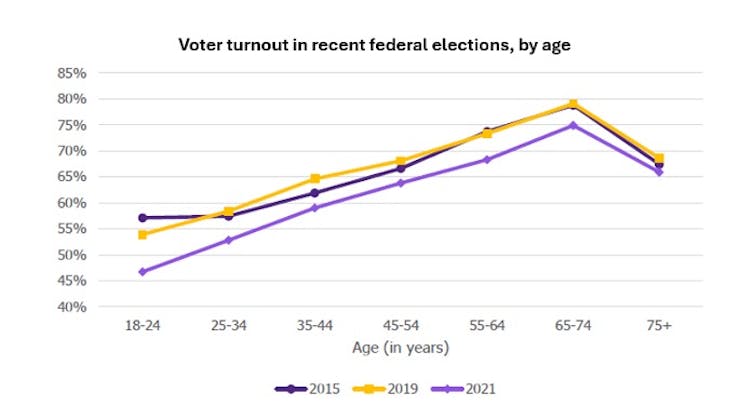
Canadians between the ages of 18 and 34 are less likely to vote than those in other age cohorts and had the steepest decline in turnout from 2015 to 2021, when fewer than half of eligible young Canadians voted.

Young people are generally less knowledgeable and politically informed than older adults.

A graph shows voter turnout numbers in recent Canadian federal elections by age
Voter turnout numbers in recent Canadian federal elections by age.
(Elections Canada)

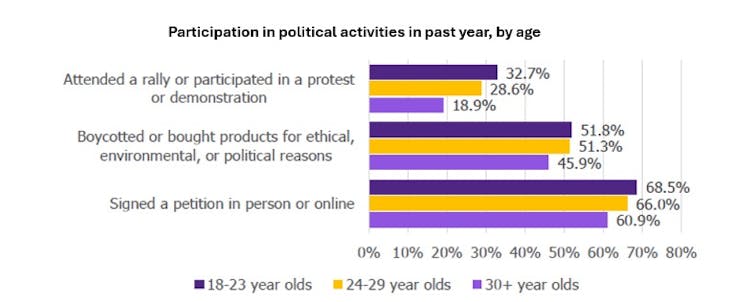
At the same time, young Canadians are at the forefront of discussing politics online, following politicians on social media and mobilizing their peers through digital platforms. They are more likely to take part in protests, petitions and political consumerism — from boycotts to buycotts — and to volunteer with community organizations and political campaigns at higher rates than other age groups.

a graph shows levels of political participation by age
Data on levels of political participation by age.
(Democracy Checkup surveys)

The real story isn’t that youth don’t care or aren’t political. It’s that they are turning away from conventional, formal participation in favour of alternative ways of sharing and expressing their views.

Explaining changing participation norms

Our analysis suggests that younger Canadians differ from their older counterparts across key factors that shape whether and how they participate.

Many young Canadians cite a lack of time as a barrier to engagement, have lower levels of political knowledge, report slightly lower levels of interest in politics and struggle to make the connection between politics and the issues they care about.

Our work also suggests that youth are noticeably less likely to see civic participation like voting as a duty, and they’re much more likely to be influenced by whether they believe their participation will make a difference.

This presents a particular challenge, because youth also tend to express higher levels of skepticism that their participation matters.

One final surprising finding is that more attention may need to be paid to understanding how political polarization affects youth. Young people may be increasingly put off from politics by hostility and conflict that they want to avoid.

Civic engagement beyond election day

Youth don’t seem to be tuning out but are instead finding different ways to engage. Nonetheless, declining interest in political engagement through formal institutions represents a real concern for democracy in Canada.

So how to build upon the areas where youth are already engaging, and bring young people back into conventional forms of civic engagement like voting?

Our conversations with civil society organizations suggest that civic engagement starts with effective civic education programs in schools, while highlighting the challenges these programs face — from educator training to curriculum design and sustainability over time.

They also highlight the challenge of reaching older youth, especially those referred to as NEET by statisticians — not in employment, education or training. Our interviewees shared their own successful strategies and emphasized the importance of reaching out to youth where they are and through the media and platforms that they prefer.

What comes next?

Democracies around the world are under pressure, and Canada is no exception. In this moment, it’s more critical than ever to pay attention to youth civic engagement.

Investing in civic education and encouraging civic participation early in life helps ensure young people have a voice in politics. But perhaps more importantly, it can also demonstrate how civic engagement can lead to change and challenge the feelings of powerlessness that drive disengagement. Youth participation helps build habits that last a lifetime and is essential to sustaining democracy for generations to come.

The future of Canadian democracy is in the hands of our youth. They must be equipped with the knowledge and the skills to shape it for the better.

The Conversation

Christopher Alcantara receives funding from Max Bell Foundation for this research report.

Craig Mutter receives funding from Max Bell Foundation for this research.

Laura Stephenson receives funding from Max Bell Foundation for this research.

ref. Encouraging young people to vote requires understanding why they don’t – https://theconversation.com/encouraging-young-people-to-vote-requires-understanding-why-they-dont-270015

Online harassment is silencing Canada’s health experts — institutions need to do more to protect them

Source: The Conversation – Canada – By Heidi J. S. Tworek, Professor of History and Public Policy, University of British Columbia

Canada has lost the measles elimination status it has held since 1998. To regain that status, one crucial factor is hearing from researchers who speak about vaccine safety in public.

Canada can’t afford to lose expert voices at a moment when the threat of vaccine-preventable diseases is rising. Yet our work suggests that online harassment is a growing deterrent that is driving researchers and scientists out of the conversations needed at this time.

Harassment is a long-standing problem in academia. While it occurs within different institutions and disciplines, it has increasingly taken the form of online attacks from people outside of academia. It’s a phenomenon that accelerated during the COVID-19 pandemic, and one where health experts are left to cope alone.

Canadian institutions and research organizations need to create broad support for these individuals.

The harms of online harassment

Our recent study on prominent Canadian health communicators — including university researchers and public health officials — found that 94 per cent, or 33 of 35 interviewees, had faced online abuse during the COVID-19 pandemic.

Online harassment goes beyond vaccines and COVID-19; climate change, gender diversity, immigration and other topics have all triggered a backlash. But we found that vaccination was one of the topics most likely to trigger abuse, and it’s an issue that has become increasingly politicized in Canada.

As with many issues in Canada, developments in the United States have played a major role. For instance, a 2021 study on vaccine hesitancy in Canada showed how social media conversations on vaccinations were heavily influenced by discussions in the U.S. It turned out that Canadians followed a median of 32 Canadian accounts and 87 American accounts.

With such interconnected information ecosystems, anti-science harassment directed at American researchers routinely spills into Canadian online spaces. This is worsened when senior officials in the U.S. administration publicly express a lack of support for immunization and evidence-based health recommendations.

Canadian universities and academic institutions need to develop mitigation and support strategies to deal with online harassment fuelled by these realities.

We can learn from action plans by U.S.-based universities and coalitions. Canada can also learn from models in countries like the Netherlands that have created national initiatives to support researchers experiencing harassment.

Hostility that threatens public health

While academics should be comfortable having their ideas challenged, technology-facilitated harassment is very different. Online harassment is often linked with other forms of targeted abuse and includes acts of doxxing, reputation attacks or threatening and sexualized messaging, among others.

Though this hostility often targets individuals working on politically contested issues, researchers from equity-deserving groups face online abuse that builds on systemic inequities related to race, gender, sexuality and other identity factors.

Online abuse can harm mental health, provoke fears about employment or grants and undermine academic freedom, as the Canadian Association of University Teachers observes. Our research found that health communicators faced the “psychological toll” of reading hostile emails day after day, with several reporting fear, sadness or anxiety in response to threats of violence.

A racialized expert recounted how personal attacks on her appearance and background “take a toll,” while a health journalist said that messages like one wishing her “blood clots” sometimes kept her awake at night. Several interviewees described exhaustion, worry and depressive symptoms, highlighting the hidden burden of online harassment.

Besides having serious personal, institutional and societal consequences, this reality risks creating information gaps that could be quickly filled by conspiracy theories. Some health researchers decided to stop media interviews or social media posts on controversial issues. So should they simply avoid public engagement on contentious topics?

While this approach might lessen the risks, it would also dramatically reduce the impact of their expertise. Public engagement is not only a key part of research grants but it also ensures that Canadians benefit directly from research.

Currently, scholars and public health communicators targeted with online abuse mainly use individual coping strategies such as deleting social media accounts, withdrawing from public communication or accepting abuse as inevitable.

These strategies, however, leave individuals to address attacks in isolation. While such measures provide temporary relief, they reinforce self-censorship and hamper public access to expert knowledge.

The need for ‘wraparound’ support

Institutions need to adopt “wraparound” support. This approach acknowledges researcher agency and institutional responsibility through a rights-based framework. It also shifts responsibility from individuals to institutions.

Unlike many universities’ current siloed and inflexible approach, a wraparound approach co-ordinates and integrates multiple domains of support.

For instance, some targeted individuals may not face legal or safety risks but can benefit from psychological support. Others may need assistance with cybersecurity risks or removing online mentions of personal information like their home address or children’s school.

Our institution, the University of British Columbia, for example, offers cybersecurity assistance, mental health support and other key elements of a response.

However, when we consulted faculty and staff, we learned that people found it daunting to figure out all the supports available and how to access them. We created an online resource to help. York University solved that problem by creating a map.

Canadian universities can also turn to international models for inspiration. Fourteen universities in the Netherlands, for instance, participate in a joint SafeScience initiative, which offers guidance and a national helpline to report incidents. Germany’s SciComm-Support provides resources, training and free counselling to researchers.

If we expect scientists and health experts to speak out about issues like measles vaccination for the good of society, they must know that their employers and institutions will stand with them, that they will have their backs.

Canada cannot prepare for future public health emergencies, like another pandemic, without protecting the safety of researchers and their freedom to pursue their lines of inquiry without fear.

Immunity and Society is a new series from The Conversation Canada that presents new vaccine discoveries and immune-based innovations that are changing how we understand and protect human health. Through a partnership with the Bridge Research Consortium, these articles — written by academics in Canada at the forefront of immunology and biomanufacturing — explore the latest developments and their social impacts.

The Conversation

Heidi J. S. Tworek receives funding from the Bridge Research Consortium (BRC), part of Canada’s Immuno-Engineering and Biomanufacturing Hub, which in turn is funded by the Canada Biomedical Research Fund, Canada Foundation for Innovation and the BC Knowledge Development Fund. She also receives funding from the Canada Research Chair Programme and the Social Sciences and Humanities Research Council.

Chris Tenove receives funding from the Bridge Research Consortium (BRC), part of Canada’s Immuno-Engineering and
Biomanufacturing Hub, which in turn is funded by the Canada Biomedical Research Fund, Canada Foundation for Innovation and the BC Knowledge Development Fund.

Netheena Neena Mathews receives funding from the Bridge Research Consortium (BRC), part of Canada’s Immuno-Engineering and Biomanufacturing Hub, which in turn is funded by the Canada Biomedical Research Fund, Canada Foundation for Innovation and the BC Knowledge Development Fund.

ref. Online harassment is silencing Canada’s health experts — institutions need to do more to protect them – https://theconversation.com/online-harassment-is-silencing-canadas-health-experts-institutions-need-to-do-more-to-protect-them-267532

An important wetland in Ghana is under siege. Researchers investigate the real issues

Source: The Conversation – Africa – By Stephen Leonard Mensah, PhD Candidate, University of Memphis

Wetlands are vital ecological resources that provide several benefits in urban and peri-urban areas. They slow down flood waters, and act as a source of fishing and farming livelihoods. They also provide socio-cultural benefits for local communities. But some of these valuable ecosystems, due to their presence in prime locations, are at the centre of competing cultural, ecological and economic interests. Property development, especially, is a threat to wetlands.

The 2025 Global Wetland Outlook emphasises that the protection of wetlands is key to sustainable development. However, since 1970, about 411 million hectares of wetlands have been lost. In Africa, degradation is widespread and many are in poor condition.

We are a multidisciplinary team of researchers working in the area of resilience, sustainability and justice in urban transitions.

Our research highlights some of the local-level issues and conflicting interests that are shaping the rapid destruction of the Sakumono Ramsar Site in Tema, Ghana. Under the Ramsar Convention, a Ramsar site is a designated wetland with special natural significance.

We found institutional complicity and the lack of engagement with communities to be key drivers shaping current wetland conditions. Our study proposes a model for enforcing regulations and asserting the community’s right to nature for socio-cultural purposes.


Read more:
A root cause of flooding in Accra: developers clogging up the city’s wetlands


Tema: wetlands in an industrial city

Tema was developed from a small fishing community into an industrialised port city by independent Ghana’s first president, Kwame Nkrumah. Its purpose was to facilitate international trade and vibrant economic development. It is one of Ghana’s most important cities and has been experiencing urban expansion and land use changes. This has led to encroachment in environmentally sensitive areas, including the Ramsar site.

The Sakumono wetland was officially designated a Ramsar site in 1992 to protect its rich biodiversity. It covers about 1,400 hectares and is protected by several regulations, including the Wetland Management Regulations Act, 1999.

But the site has, over the years, witnessed rapid depletion and intense encroachment from property development. Approximately 80% of the Sakumono Ramsar Site has been encroached on, leaving only about 20% of the wetland intact.

Population in the wetland’s catchment area had grown from about 114,600 in 1984 to over 500,000 by 2000, indicating that large numbers of people live around and rely on the wetland. Although the exact number of people currently affected by the wetlands encroachment is unknown, the dense surrounding population suggests that many households, especially those engaged in farming and fishing, have likely experienced reduced access and livelihood displacement. Like other wetlands in Ghana, the Sakumomo Ramsar site risks eventual destruction if nothing is done to reverse current trends.

The president of Ghana has called for heavy punishment for individuals who encroach on Ramsar sites. Both community and institutional respondents in our research claimed, however, that it was the political elites who were behind unbridled property development in the first place.


Read more:
Flooding incidents in Ghana’s capital are on the rise. Researchers chase the cause


Multiple and conflicting interests in wetlands management

The main objective of our study was to analyse stakeholders’ perspectives on the use, value and management of wetlands. We evaluated the impact of these views on the sustainable management of ecologically sensitive areas. We conducted in-depth interviews with community residents, community leaders and opinion leaders. We also interviewed officials from metropolitan and municipal assemblies. The research was conducted in the Sakumono community, where the Sakumono Ramsar site is located.

Conflicting views on wetlands value: while the value of the site lies in its economic and ecological benefits, community residents were more interested in its economic value. That is, how it provides livelihood opportunities through farming and fishing activities.

Residents wondered why developers were allowed to exploit portions of the wetlands for building purposes, while they were prevented from fishing and farming. One of the residents said:

See rich and influential people buying land in the wetland area and using it for building properties. But we are not permitted to fish there.

For state institutions, protecting the wetland meant restricting access for community members. They encouraged activities such as tree planting and periodic desilting.

Conflicting views on wetlands use: the views of stakeholders also showed the changing understanding of the use of wetlands. An official from the forestry commission revealed that the wetland was acquired by the state during the 1980s for conservation. But other institutional officials, such as those of the lands commission, revealed that it had become a prime area for property development. Powerful developers bypass the land registration process and build without a permit.

The size of the Ramsar site has reduced because people are acquiring the wetland, including the buffer area, for residential development. Even though the wetland area is demarcated as a protected area, many of the politically connected developers go behind us and build without a permit.

Conflicting views on wetlands management: our research revealed contradictions between state institutions and community stakeholders. For instance, traditional authorities were of the view that:

Since the management of the wetland is not under our control, we are not responsible for the current developments taking place in and around the demarcated area.

The traditional authorities said they were not consulted and did not benefit from the wetland. This perhaps explains why they watched on as destruction continued. A member of the traditional council said:

As leaders of the community, we are not consulted about how the wetland is managed. You always hear the forestry commission accusing community leaders that we are selling the land. We can’t sell land that does not belong to us.

Towards a community-based stewardship model

Communities should be at the centre of wetlands management. We propose a stewardship-based co-management model that enforces environmental and conservation regulations. It emphasises working with a range of stakeholders. This includes government agencies, traditional authorities and environmentally conscious community members. We call for an updated wetlands management plan that reflects recent changes, but that is also fair, responsible and protective for present and future generations. This is essential for building sustainable communities in Ghana and beyond.

The Conversation

Louis Kusi Frimpong receives funding from African Peacebuilding and Developmental Dynamics (APDD) through the Individual Research Fellowship (IRF).

Seth Asare Okyere and Stephen Leonard Mensah do not work for, consult, own shares in or receive funding from any company or organisation that would benefit from this article, and have disclosed no relevant affiliations beyond their academic appointment.

ref. An important wetland in Ghana is under siege. Researchers investigate the real issues – https://theconversation.com/an-important-wetland-in-ghana-is-under-siege-researchers-investigate-the-real-issues-269016