Limiting jury trials will harm minority ethnic victims and defendants, research shows

Source: The Conversation – UK – By Tara Lai Quinlan, Associate Professor in Law and Criminal Justice, University of Birmingham

Sebra/Shutterstock

The right to trial by jury dates back to at least the 12th century. The government’s proposals to limit it in England and Wales, many argue, run counter to the UK’s core democratic principles. And as others have pointed out, scrapping jury trials for some crimes is unlikely to solve the massive backlog in the crown courts.

Our research suggests that there is another reason why it is a bad idea to scrap jury trials. They can play a vital role in reducing racial discrimination in the criminal justice system.

The proposals laid out by justice secretary David Lammy would have a disproportionately negative impact on people of colour – both defendants and victims – for whom jury trials give a glimmer of hope in a criminal justice system where “ethnic minorities (excluding white minorities) appear to be over-represented”.

Government data repeatedly shows black, Asian and minority ethnic defendants are less likely to plead guilty than white defendants, and more likely to take their cases to trial. Lammy’s own 2017 review of racial inequality in the justice system suggests this is driven by a perception that the plea-bargaining process is unfair to defendants of colour, and that only a jury of peers will give them a fair trial.

Once black defendants choose a jury trial, research shows they are “more likely … to obtain acquittals or reductions in charges as a result”, compared to black defendants who plead guilty without opting for a trial.

A jury of 12 people brings a broader array of diverse perspectives and opinions which enhance the quality of discussions in deliberations, particularly in cases involving an ethnic minority defendant. Defendants should have their fate decided by people who might better understand their experiences, backgrounds and motivations.

Lammy’s 2017 review emphasised the importance of juries in making the criminal justice system more legitimate, particularly for people of colour: “Juries deliberate as a group through open discussion. This both deters and exposes prejudice or unintended bias: judgements must be justified to others.”

Sentencing is also disproportionate for defendants of colour when compared to white defendants, following both jury trials and plea agreements. Research has found that explicit or implicit judicial biases – whether judges stereotype the defendant, how they interpret sentencing recommendations from prosecutors and defence counsel, or how they apply aggravating and mitigating factors – may all contribute to these disparities.

Empirical evidence from other jurisdictions shows that more diverse juries are fairer to black defendants. Indeed, studies repeatedly show that all-white juries much more readily convict black defendants. Juries with even one black member are less likely to do so.

The UK’s Contempt of Court Act limits this type of research with live juries. But there is enough evidence from other jurisdictions to suggest that retaining juries, and ensuring those juries are diverse, is essential for protecting the fair trial rights of people of colour generally, and black people in particular.

Justice for victims

Jury trials are also essential for black victims and their families. Since 2022, we have worked with the family and friends of Dea-John Reid, a 14-year-old black boy who was racially abused and chased through the streets of Birmingham by a group of white boys and men who fatally stabbed him in broad daylight.

In their 2022 trial, the perpetrators were acquitted of racially aggravated murder, with only the principal offender found guilty of manslaughter by a jury of one Asian and 11 white members. Dea-John’s family felt that the lack of diversity on the jury, which did not have a single black member, could have meant they were less likely to see Dea-John as a worthy victim. Research shows that black men and boys are stereotyped as suspects – even when they are victims of crime.

Since 2022, we have worked with the family’s campaign, which supports retaining jury trials, but wants them to be more ethnically diverse, particularly in cases involving black victims. Our research has documented the campaign and is addressing critical gaps in UK research on jury diversity.

Diversity in the judiciary

Lammy’s proposals for reform include expanding the use of bench trials. This means that more cases would be heard by a single judge alone.

The judiciary in England and Wales is neither sufficiently diverse nor representative of the population. While black, Asian or minority ethnic people make up around 22% of the population, as of 2025, they make up only 11% of all court judges.

Lammy’s proposal also goes against what the public wants. In 2024, we surveyed 1,000 members of the public, 75% of whom stated explicitly that they believed the UK should have jury trials.

While most of our respondents believed that jury trials were fair (51%) and trustworthy (60%), they also felt strongly that more diverse juries were fairer (61%). Around half of people (51%) believed juries should look like the communities they serve. We found that for people of colour, taking part in jury service was viewed as even more important than for white respondents.

When it comes to perceptions of fairness and trust in the courts, we found important racial differences. Our research found that people of colour trust judges and the courts at lower rates than white people. People of colour in our survey were also more likely than white people to believe that judges treat them more unfairly compared to white people. And most of our respondents believed that more diversity in the judiciary is needed.

If Lammy remains committed to reducing inequality in the criminal justice system for people of colour, rather than reducing jury trials, he should be increasing them, and the diversity on them, to ensure justice for all.

The Conversation

The authors do not work for, consult, own shares in or receive funding from any company or organisation that would benefit from this article, and have disclosed no relevant affiliations beyond their academic appointment.

ref. Limiting jury trials will harm minority ethnic victims and defendants, research shows – https://theconversation.com/limiting-jury-trials-will-harm-minority-ethnic-victims-and-defendants-research-shows-270869


Maga explained: how personality and context shape radical movements

Source: The Conversation – UK – By Magnus Linden, Associate Professor of Psychology, Lund University

It’s often said that Donald Trump’s power base in the Maga movement has contributed to the radicalisation of the Republican party. Political scientists worry about the implications of this for the future of American democracy itself.

One example of that radicalisation was the attack on the US Capitol on January 6 2021 in an attempt to overturn the result. Exacerbating that radicalisation is the movement’s hostility towards much of the mainstream media. This is something that has been amplified by the US president himself, who has famously referred to the media as “the enemy of the American people”.

But how has this radical movement movement emerged from the socially conservative Republican Party? The rise of Maga has marked an important political shift in America that has many liberal-minded people scratching their heads. Psychology studies can offer insights that can help explain the Maga movement’s motivations.

1. Fused identity

Identity is central to understanding the way Maga holds together as a group and can also explain many of its motives. Trump has been able to mobilise his base effectively by communicating that shared identity. And it’s this sense of common identity and purpose that has been so important in the development of Maga as a powerful political movement.

The almost absolute faith in Trump’s leadership has a lot to do with negative resentment of other groups that he singles out for criticism, particularly migrants, liberals and feminists. But it is actually a positive identification with white nationalism that is a stronger indicator of the sort of person who might identify with Maga.

Maga supporters unite around a shared perception of threat to their status, often related to issues of race and immigration. But it is also seen to be motivated by the desire to cultivate belonging and group pride as a way to regain lost esteem.

Some researchers also believe that even the act of wearing a Maga hat is a sign of what is known as “identity fusion” – when boundaries between the self and the group blur. When this occurs, wearing a Maga hat may be a symbol of who I am rather than just who I voted for.

This is significant since identity fusion is associated with reported willingness to undertake more extreme actions such as hurting people and damaging property to uphold the Trump community and to achieve his aims.

2. Moral self-righteousness

Maga members also tend to adhere to the idea that one’s own ethnic group is more morally pure than others. Maga ideology tends to divide America into “good” and “evil” groups, with themselves as good and out-groups, such as the ones mentioned above, cast as evil. This positions “true Americans”, the people who built the nation, patriots who have “had enough”, as part of the former.

Since it frames politics as a struggle over “right values and lifestyles”, such rhetoric heightens the risk of malignant moral superiority. When communicated by a leader, it creates in followers the sense that they have an obligation to act against these “evil” forces which threaten their group.

When this sense of superiority is threatened, it can lead to aggression, such as the assault on the US Capitol .

3. The right to dominate other groups

Aggressiveness in political groups such as Maga is also connected to what is known as “social dominance orientation”. This relates to belief in a hierarchy – the idea that one social group has the right to dominate other groups.

Research shows people who believe in hierarchy are more likely to disregard basic democratic principles. They see society as a “competitive jungle” where groups struggle for power and dominance.

As a result, they view groups that differ from them as inferior. This justifies any actions that maintain their in-group status.

This holds true even if – as in the case of Maga-followers – it means a belief in violence in response to unwelcome social and cultural changes. Polling has found that Maga supporters are also far more likely to believe that there will be a civil war in the US and that violence in order to advance the movement’s political objectives would be justified.

4. Aggressive followership

There’s a scientific debate about what draws people to authoritarian leaders. Some scholars emphasise the tendency to want to submit to authority, high levels of aggression when sanctioned and adherence to conventional values such as traditional views on religion and sexuality. Others focus more on a preference for conformity over personal autonomy.

But they agree on one point: authoritarian followers submit to leaders who stress the superiority of their social group and who they consider to be capable of handling the threats they see as coming from other groups.

Research on the Maga movement from 2016 shows that Trump supporters were more likely than other supporters of other Republican party candidates to score high on one facet of authoritarianism: the willingness to resort to aggression towards people seen to go against social norms if encouraged by someone they’ve accepted as an authority figure. But they don’t appear to score as highly on two other facets: submission to established authorities and an adherence to conventional values.

This suggests that authoritarianism among the Maga movement has evolved into a more distinct profile, characterised primarily by a prejudiced aggressiveness towards other social groups.

History tells us that radical political movements tend to pop up when the societal context is perceived as threatening. In this process, some people have personal dispositions that make them more prone to follow authoritarian leaders. So it’s important to take both personality and context into account when trying to understand movements such as Maga.

The Conversation

Claire Campbell works for Ulster University. She receives receives funding from PEACE PLUS for research on peace building.

Fredrik Björklund and Magnus Linden do not work for, consult, own shares in or receive funding from any company or organisation that would benefit from this article, and have disclosed no relevant affiliations beyond their academic appointment.

ref. Maga explained: how personality and context shape radical movements – https://theconversation.com/maga-explained-how-personality-and-context-shape-radical-movements-270191

Could electric vehicle battery waste fix concrete’s carbon problem?

Source: The Conversation – UK – By Mehdi Chougan, Research and Innovation Associate at the School of Engineering, Cardiff University

Concrete is the most widely used man-made material on Earth. Parilov/Shutterstock

Imagine waking up in 2040 to unusually quiet streets. By then, an estimated 60% of vehicles worldwide could be electric, cutting air pollution and noise in cities. But the shift to cleaner transport comes with a lesser-known problem – a huge rise in mining waste.

Lithium, a vital ingredient in electric vehicle batteries, leaves behind extraordinary amounts of waste. In 2023 alone, the global battery industry generated 1.8 million tonnes of lithium-related waste, almost all of it sent to landfill.

At the same time, the construction sector faces its own environmental crisis. Concrete is the most widely used man-made material on Earth. We produce enough of it each year to build a wall around the planet twice over.

Its main ingredient, Portland cement, is responsible for nearly 8% of global carbon emissions. As demand rises, the industry is running out of cleaner alternatives.

These two challenges – booming lithium production and the carbon cost of cement – may seem unrelated. But the solution to both could be the same: turning lithium mining waste into a new kind of low-carbon cement.

A waste problem hiding in plain sight

Lithium-ion batteries have reshaped the global energy landscape since they were invented in the 1970s. Their value is expected to soar to more than US$400 billion (£302 billion) as electric vehicle sales continue to increase.

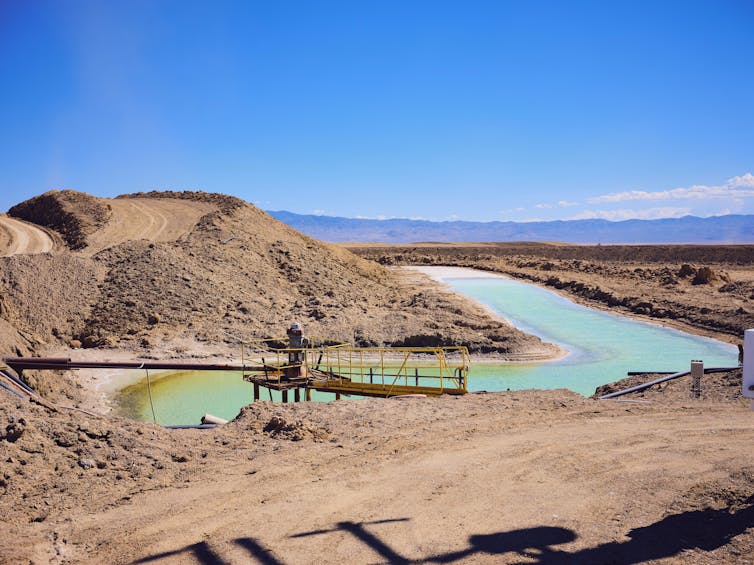
But lithium does not appear in nature as a pure metal. It must be extracted from minerals or salty brines. Most of them are in the “lithium triangle” of Chile, Argentina and Bolivia, which together hold more than 60% of the world’s reserves.

A view of green coloured pools among a desolate landscape.
Brine pools for lithium mining.
Cavan-Images/Shutterstock

Extracting lithium is a messy business. For every tonne of battery-grade lithium carbonate produced, around nine to ten tonnes of waste are created. As countries race to meet climate targets, demand for lithium is expected to triple by 2030.

The UK government plans to develop new extraction sites in Cornwall and the northeast of England.


Read more:
As mining returns to Cornwall, lithium ambitions tussle with local heritage


But this growing waste stream contains something valuable. Chemically, lithium mining waste is rich in the same compounds (silicates, alumina and calcium oxides) that help cement harden and gain strength. In other words, the waste from one green technology could help clean up another.

Our team is testing whether UK lithium mining waste can be used to replace cement in concrete.

The idea is simple. If this waste can act as a supplementary binding material, it could cut the amount of traditional cement needed. This could reduce carbon emissions by up to 50%. But proving this requires detailed scientific work.

Work is underway to analyse the microstructure, chemical behaviour and long-term durability of lithium waste-based concretes, from early lab tests to full-scale trials in real conditions. If successful, “lithicrete” could provide the UK with a way of using waste from the country’s emerging lithium industry to build low-carbon infrastructure.

For years, the concrete industry has tried to reduce its reliance on Portland cement by blending it with industrial byproducts such as fly ash and blast furnace slag. But these materials are becoming scarce as coal power plants shut down and heavy industry changes. In fact, there could be an imminent shortfall in traditional cement alternatives, threatening progress on decarbonisation.

This makes the search for new materials urgent. Lithium mining waste, available in large volumes and chemically compatible with cement, offers a promising option just as the sector faces a bottleneck.

Why this matters

The environmental stakes are high. Concrete underpins almost everything we build, from homes to hospitals, schools and bridges. Demand is only growing. Cutting emissions from clinker (the core component of cement) and using alternative binders could deliver 20% of the reductions needed for the sector to reach net zero by 2050.

If lithium mining waste could replace part of the cement used in concrete, it would help slash emissions, reduce landfill and strengthen the UK’s resilience as it moves away from imported industrial by-products. It would also mean the transition to green transport like electric cars doesn’t simply shift environmental burdens elsewhere.

We argue that the transition to cleaner technology must also be circular. Rather than allowing one part of the green transition to create problems for another, materials should be reused and designed to stay in the system for as long as possible.

The Conversation

Riccardo Maddalena receives funding from UKRI EPSRC.

Mehdi Chougan does not work for, consult, own shares in or receive funding from any company or organisation that would benefit from this article, and has disclosed no relevant affiliations beyond their academic appointment.

ref. Could electric vehicle battery waste fix concrete’s carbon problem? – https://theconversation.com/could-electric-vehicle-battery-waste-fix-concretes-carbon-problem-268609

Why the future of psychedelic medicine might not be psychedelic at all

Source: The Conversation – UK – By Sandy Brian Hager, Senior Lecturer in International Political Economy, City St George’s, University of London

Blackday/Shutterstock.com

Psychedelic medicine has regained momentum in 2025. Investors are coming back, regulatory attitudes are softening, trial results are improving and major pharmaceutical firms that kept their distance are starting to pay attention.

This is quite a turnaround for a sector whose share prices collapsed and whose funding dried up when weak trial results combined with rising interest rates in 2022. But enthusiasm should be tempered.

Psychedelic drugs are hard to turn into profitable medicines. Some of the strategies companies are using to overcome these obstacles could ultimately remove the elements that many people believe make them effective in mental health treatment.

My research points to three features of psychedelics that make commercial development unusually complicated.

The first challenge is intellectual property. Developing a new medicine is expensive, and investors only commit money if they think a company can recover those costs later. Patents make that possible: they grant a temporary monopoly, allowing firms to raise prices once a drug is approved.

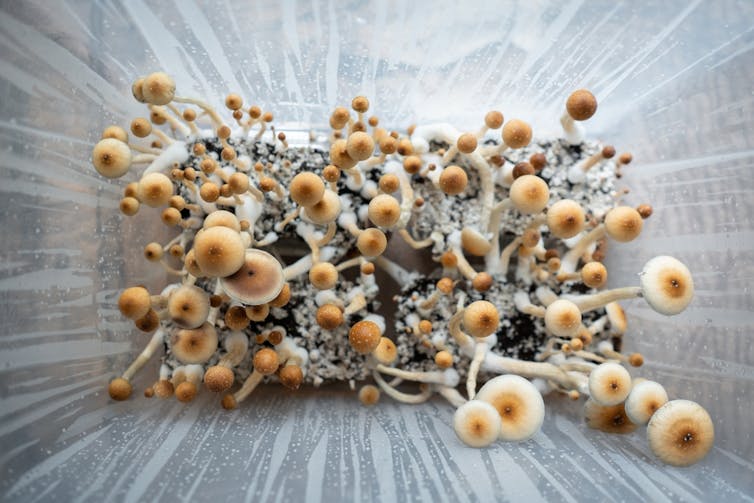
But psychedelic compounds don’t fit comfortably with this model. Psilocybin and mescaline are natural, so companies cannot claim them as inventions.

Magic mushrooms growing on a substrate.
Many psychedelics are natural and so cannot be patented.
Goami/Shutterstock.com

Synthetic drugs such as LSD were created decades ago, and their original patents have expired. Many of these substances also have well-documented histories of use in Indigenous healing traditions, which makes it harder to argue that therapies based on them are genuinely new.

Firms can still patent delivery methods, formulations or small chemical tweaks. But these protections are narrow and fairly easy to challenge, so they don’t provide the kind of security investors look for.

The second challenge is practical. A psychedelic session isn’t like taking an antidepressant at home. A psychedelic trip can last six to 15 hours, so patients are prepared in advance of the session, supervised throughout and supported afterwards to help them process the experience. This requires trained staff, clinical space and time.

Health systems and insurers have not yet agreed on how to pay for this type of care, and companies have no clear model for delivering psychedelic therapy at scale. The economics of a treatment that occupies a clinic room and several professionals for most of a working day bear little resemblance to standard antidepressants.

The third challenge concerns clinical testing. Most medicines are evaluated in trials where neither participants nor researchers know who has received the real drug and who has received a placebo. With psychedelics, this becomes obvious as soon as the effects begin. Participants know when they are tripping, and researchers know too.

Some trials experiment with low doses or active placebos that cause mild sensations. But it is unclear whether regulators will treat these designs as equivalent to the gold-standard trials used for conventional medicines. This uncertainty makes it harder for investors to see a clear path to regulatory approval.

Two directions

In response to these challenges, the field is developing in two directions. One route is to develop short-duration compounds like 5-MeO-DMT, which produce a very intense altered state that lasts minutes rather than hours.

A session of that length is easier to supervise, demands fewer clinical resources and does not tie up a treatment room for most of the day. Companies pursuing this strategy have encouraging early results and have attracted renewed investment.

But safety remains an issue: delivering such a powerful psychedelic can be overwhelming, especially when therapeutic support is limited. As one researcher warned, “you don’t want to advance the world’s most powerful psychedelic experience on the timescale of a dental cleaning”.

The other route goes further. Instead of compressing the trip, some companies are trying to remove it altogether with so-called neuroplastogens. These molecules are designed to trigger the brain changes associated with classic psychedelics without the trip.

Because these compounds are new, they offer the intellectual property protection investors look for. They also avoid the unpredictable experiences that make psychedelic sessions difficult to deliver in clinics and are more compatible with the insurance and regulatory systems of conventional medicines.

However, the science behind them is still young, and it is not yet clear whether drugs without the trip can provide the same benefits that drew attention to these compounds in the first place.

Both approaches seek to make psychedelics easier to administer, insure and patent, but they also push the experience itself to the margins.

Many patients credit the psychedelic trip with their progress in therapy. Biotech companies see it as an obstacle to profitability. If that patient view is right, commercialised psychedelic medicine may never become the mental health revolution that companies and their investors expect.

The Conversation

Sandy Brian Hager does not work for, consult, own shares in or receive funding from any company or organisation that would benefit from this article, and has disclosed no relevant affiliations beyond their academic appointment.

ref. Why the future of psychedelic medicine might not be psychedelic at all – https://theconversation.com/why-the-future-of-psychedelic-medicine-might-not-be-psychedelic-at-all-270605

Sri Lanka’s latest climate-driven floods expose flaws in disaster preparations – here’s what needs to change

Source: The Conversation – UK – By Ravindra Jayaratne, Reader in Coastal Engineering, University of East London

Cyclone Ditwah hit Sri Lanka on November 28 2025. Alina Polat/Shutterstock

When Cyclone Ditwah made landfall on November 28 2025, Sri Lanka experienced one of its deadliest environmental disasters in modern history.

President Anura Kumara Dissanayake declared it the “largest and most challenging natural disaster in our history”. Torrential rains triggered widespread floods and landslides, leading to more than 350 confirmed deaths, hundreds missing and over 1.4 million people affected nationwide.

Major road and rail systems were cut off, hydropower stations and water treatment plants failed, and thousands of families were forced into emergency shelters. Reservoirs overflowed, riverbanks collapsed and communities near the Mahaweli, Kelani, Malwathu Oya and Mundeni Aru river basins were inundated within hours.

These were not random failures. They were systemic. Many of the regions that flooded were vulnerable areas adjacent to coastal lagoons and low-lying river plains. Cyclone Ditwah was not an anomaly. It exposed the underlying fragilities of Sri Lanka’s existing flood-management and drainage infrastructure.

This follows on from the devastating tropical cyclone in 1978 and the Boxing Day 2004 tsunami disaster. Fifty years ago, flood infrastructure was not in a good state. Significant improvements haven’t been made since then, mainly due to poor urban planning.

Between 2018 and 2022, I worked with a global team of coastal engineers, social scientists and policy makers from academia and government organisations in the UK, Australia and Sri Lanka. Our research project focused on producing a new generation of compound flood hazard maps, based on computer modelling that considers all the storm surge components (surge, tide and sea level rise) and the rainfall effect.

I led the hydrological modelling efforts for Sri Lanka – focusing on how tropical-cyclone rainfall and storm surge combine to generate destructive flooding patterns for three vulnerable cities: Batticaloa, Mullaitivu and Mannar. The team worked with Sri Lanka’s Coast Conservation and Coastal Resource Management Department (CCD) to address a critical question: How do storm surges from tropical cyclones interact with rainfall to produce extreme inland and coastal floods?

Through analysis of historic cyclone tracks, we showed that Sri Lanka lies at the convergence of multiple storm pathways in the Bay of Bengal. This is why the country repeatedly suffers not only from rainfall-driven inundation but also from saltwater intrusion driven deep inland through lagoons and estuaries.

My team and I developed the hydrologic model for Batticaloa, using the Mundeni Aru river basin as a pilot case. We combined rainfall data, digital terrain maps (that indicate trees, buildings, roads and bare land) and river-flow simulations to identify the most vulnerable communities depending on the topography. Low-lying settlements adjacent to the Batticaloa and Valachchenai lagoons were particularly vulnerable to tropical cyclone-induced flooding.

flooded street in sri lanka after cyclone ditwah
Streets flooded as Ditwah Cyclone hit Sri Lanka (November 30 2025).
Thamara Perera/Shutterstock

Similar modelling work was proposed for Mullaitivu and Mannar, both historic cyclone-landfall regions. However, COVID disrupted much of the planned in-country engagement, in-depth modelling and translation of findings into policy tools, creating a serious lag between scientific insights and what planning authorities are currently referencing.

Ditwah’s aftermath – breached embankments, power failures, displaced families, submerged neighbourhoods – corresponds almost exactly to the worst-case compound-flood scenarios shown by our data. These are not purely meteorological phenomena. They depend on the flow of water and land-based infrastructure.

Drainage networks still rely on outdated historical rainfall records. Coastal defences are built for storm surges of previous decades. Urban development continues to occupy natural flood buffers such as wetlands and lagoon edges. Vulnerability has become physically engineered into the landscape.

Proactive planning

Working with government agencies including the CCD, the Met Office and the Disaster Management Centre, Sri Lanka can proactively integrate compound-flood science into planning and disaster risk-reduction strategies.

This includes producing updated flood maps that capture rainfall, river flow, storm surge and sea-level-rise dynamics. Hydrological models can be translated into operational tools for national and municipal planning authorities.

Drainage and river-management systems (such as seasonal removal of sand and debris) can be redesigned with the future (not historical) rainfall intensities in mind. Improving early-warning systems involves incorporating multiple hazards and long-range scenario modelling can be embedded into disaster-preparedness and land-use planning.


Read more:
Boxing Day tsunami: here’s what we have learned in the 20 years since the deadliest natural disaster in modern history


These measures enable policymakers, engineers and local administrations to make evidence-based decisions that reflect accelerating climate-driven risks rather than obsolete assumptions.

Cyclone Ditwah should mark a turning point. With the right integration of science, planning and governance, disasters of this magnitude need not become inevitable hallmarks of Sri Lanka’s future. And by aligning infrastructure and policy with the real hydrological dynamics of our changing climate, governments can better protect people, environment and economy from the storms yet to come.


Don’t have time to read about climate change as much as you’d like?

Get a weekly roundup in your inbox instead. Every Wednesday, The Conversation’s environment editor writes Imagine, a short email that goes a little deeper into just one climate issue. Join the 47,000+ readers who’ve subscribed so far.


The Conversation

Ravindra Jayaratne receives funding from the Natural Environment Research Council (NERC), UK.

ref. Sri Lanka’s latest climate-driven floods expose flaws in disaster preparations – here’s what needs to change – https://theconversation.com/sri-lankas-latest-climate-driven-floods-expose-flaws-in-disaster-preparations-heres-what-needs-to-change-271181

Kimchi may boost immune function, recent study shows

Source: The Conversation – UK – By Rachel Woods, Senior Lecturer in Physiology, University of Lincoln

Eating kimchi daily may help fine-tune the immune system. krein1/ Shutterstock

Kimchi has been enjoyed for centuries in Korea. But the spicy fermented cabbage dish has recently gained popularity in other parts of the world not only because of its delicious taste, but because of its potential to positively influence the many thousands of important microbes living in our gut as well as our overall health.

A recent study suggests that kimchi may also help support the immune system.

The study looked at 13 overweight adults over a 12-week period. Participants were randomly assigned to three groups. One group received a placebo, while the other two groups received two different types of kimchi powder (kimchi that had been freeze dried and put into a capsule).

The first type of kimchi powder was naturally fermented using microbes already in the environment. The second type was fermented with a chosen bacterial culture instead of relying on natural microbes. The amount of kimchi powder participants were given daily was roughly equivalent to eating 30 grams of fresh kimchi.

Blood samples were taken before and after the study and analysed using a technique that shows what each immune cell is doing instead of giving an overall average. This gives a detailed view of how the immune system responded.

The study found that kimchi affected the immune system in a targeted way. It increased the activity of antigen-presenting cells (APCs). These are immune cells that ingest pathogens, process them and show pieces of those pathogens on their surface so the body’s helper T cells (which coordinate overall immune response) know to mount a response against those specific pathogens.

Kimchi also increased the activity of certain genes that act like switches, helping these immune cells send clearer signals to T cells.

There were also genetic changes in helper T cells that made them react more quickly to anything that triggers an immune response. Since helper T cells coordinate immune responses, these changes mean they’re better equipped to help other immune cells fight infections effectively.

Most other immune cells stayed the same, meaning kimchi targeted helper T cells rather than activating the entire immune system. Maintaining this balance is important because the immune system must be able to respond to infections effectively while avoiding excessive inflammation that can damage tissues.

Kimchi piled on top of a bowl of rice.
Even a small portion of kimchi each day may have immune benefits.
beauty-box/ Shutterstock

Overall, the results suggest that kimchi helps the immune system respond to threats more effectively without causing too much inflammation. Both types of kimchi produced these effects – though starter-culture kimchi showed a slightly stronger effect. Those taking the placebo saw no immune changes.

These findings point to potential benefits for defence against viruses, responsiveness to vaccines and regulation of inflammation – although further research is needed.

Immune cell function

It’s worth mentioning that this study was small and focused on changes in immune cells, not actual health outcomes. So we don’t yet know if eating kimchi in this way would reduce infections or inflammation in daily life.

However, the study does provide a plausible molecular explanation for how fermented foods can influence immune function. This tells us more than we can learn from studies that only observe people’s habits. It links a common fermented food to measurable effects on immune cells – supporting the idea that fermented foods may be used strategically to enhance immune regulation and overall immune balance.

Kimchi isn’t the only fermented food that may have immune benefits. Other foods such as yogurt, kefir, sauerkraut, miso and kombucha contain live microbes and metabolites that have a positive effect on the microbiome and may influence immune function.

Some studies have also shown that fermented dairy products can increase beneficial gut bacteria and modulate immune responses, including T cell and antibody activity.

The exact effects of fermented foods will depend on many variables, including the microbes present, the fermentation method and an individual’s unique gut microbiome.

Different fermented foods may also have different effects due to the microbes they contain. This is why including a variety of fermented foods may be more beneficial than relying on a single type.

There’s no established recommendation for how much fermented food to eat. In this study, participants consumed the equivalent of 30 grams of kimchi per day, an amount that is feasible for most people.

While research is still unfolding, including a variety of fermented foods in your diet is an easy and enjoyable way to explore the potential benefits for your gut and immune system.

Try new options to discover what you like best, keep a few favourites ready in the fridge, and find simple ways to add them to everyday meals. Over time, these small, regular habits could help support your gut and immune health.

The Conversation

Rachel Woods does not work for, consult, own shares in or receive funding from any company or organisation that would benefit from this article, and has disclosed no relevant affiliations beyond their academic appointment.

ref. Kimchi may boost immune function, recent study shows – https://theconversation.com/kimchi-may-boost-immune-function-recent-study-shows-270747

‘A united left? It’s been tanked’ – what I heard when I went to Your Party’s first conference

Source: The Conversation – UK – By Parveen Akhtar, Senior Lecturer: Politics, History and International Relations, Aston University

The launch of Your Party, a new leftwing offering for British voters, was meant to embody a different kind of politics. It was to be collective and collaborative – a political movement built from the grassroots up.

At a time when trust in politicians is low and cynicism high, the idea of a new movement on the left captured imagination. Almost immediately after it was announced, 80,000 people expressed their interest in joining.

Yet the collective has, from the start, been beset with problems. Former Labour MP Zarah Sultana announced the party’s launch apparently before Jeremy Corbyn, her partner in the endeavour, was ready. A debacle over who was holding on to some £800,000 in donations led to a very public spat between the two even before the party could get on its feet.

Amid this confusion, between launching in July and holding its inaugural conference in November, Your Party has already shrunk. Those original 80,000 potential members have become 55,000 signed-up members.

Of these, 2,500 people were selected through a lottery system to attend the party conference. And as they congregated in Liverpool, it quickly became clear that it would not be plain sailing. Delegates were caught between idealism and infighting – between a genuine and urgent desire to create something new and the old factionalism that has long preoccupied the British left.

The tension was visible even before the conference began. On the eve of the event, Corbyn appeared at a poetry and music evening where he was interrupted by hecklers demanding he denounce Zionism.

For a man who has spent his political life campaigning for Palestinian rights, the moment was indicative of a key issue the party must confront: a puritanical one-upmanship. This was fringe politics, where nothing you do is quite sufficient. For all the talk of solidarity and comradeship, the left remains a space where interrogation around ideological purity is never far away.

Opening the event, councillor Lucy Williams attempted to confront the tensions head on. Everyone knew there had been loud disagreement, she said, “but I like to see our leaders fighting. I’d rather be in a movement where people care enough to argue than in a party where everyone nods along while the country collapses around them. Unity isn’t pretending that we all agree; unity is disagreeing honestly and then cracking on with it. We’re not perfect, but we’re real – and people will trust real.”

Her defence of the messiness of democracy was forceful. But for some delegates, her apparent defence of washing dirty laundry in public was read not as authenticity but as testimony that the endeavour was in descent. “Being real” in this incarnation was not an election winner.

Committed, diverse and hopeful

Attendees were young and old. Many were former Labour members. Others had never been involved in politics before. The conference was full of people deeply committed to a socialist cause: equality, equity and social justice.

But ideas about what these buzzwords meant were deeply divided. Divisions were not just about personalities and internal factions but about ingrained beliefs.

The promise of unity was quickly met with the realities of ideology. From revolutionary communists to conservative Muslims to trans-rights activists, there are uneasy alliances in Your Party’s broad church, many wanting change on their own terms. Compromise is too often viewed as weakness and a lack of commitment to the cause.

And yet, there was also hope, one young man who had left the UK after Brexit to live on the continent said he had to come back for the conference, “when your home country does something like this you just have to”.

Sultana was conspicuous by her absence during Corbyn’s opening speech. She had announced she was boycotting her own conference over what she called a “witch hunt” against members of other socialist organisations, especially those associated with the Socialist Workers Party.

Some had reportedly been barred because dual party membership was not allowed – until a vote at the conference changed the rules.

By day two, anticipation was building about whether Sultana would show. The name of the party was formally recognised and a collective leadership model agreed. Corbyn had wanted a single leader model, Sultana, who had originally wanted to be joint co-leader, had favoured a collective model (knowing a contest between her and Corbyn would be difficult to win).

And then the waiting was over, Sultana’s arrival saw delegates pack the hall. There was almost a sigh of relief. She started by calling out the party leadership, for bullying, pointing to underhand tactics “straight from the Labour right handbook”. She set out her vision for a new approach – radical, impatient and angry. This would be a united left – all socialists fighting together. She was received rapturously. Her speech ended with chants of “Oh, Zarah Sultana.”

Yet this was not a unifying moment. Corbyn was present too, extending the courtesy she did not afford him when he first spoke to conference. The two did not appear together.

His supporters were disillusioned by her public dressing down of the unelected faceless bureaucrats (or the adults in the room, as they saw themselves). The votes may have been for maximum member democracy, but Sultana was really setting out the blueprint for Sultanaism. “This isn’t going to go anywhere. Any hope I had of an alternative to what we have now, of a united left, well it’s been tanked,” one disillusioned Corbyn supporter told me.

Before leaving Liverpool, the party had at least achieved some of its formal aims. It has a name, a leadership structure and some key constitutional provisions. The broader picture, however, remains harder to read.

The excitement of participatory politics was still there, but this was a hall full, mainly, of the converted. Those who wanted a more moderate or what they see as “electable” party, were left out in the cold. They will now be hoping that the chill does not kill any potential green shoots. Or it will be the Green party who will ultimately benefit, come elections in the spring.

The Conversation

Parveen Akhtar has previously received funding from the ESRC and the British Academy.

ref. ‘A united left? It’s been tanked’ – what I heard when I went to Your Party’s first conference – https://theconversation.com/a-united-left-its-been-tanked-what-i-heard-when-i-went-to-your-partys-first-conference-271162

AI promises efficiency, but it’s also amplifying labour inequality

Source: The Conversation – Canada – By Mehnaz Rafi, PhD Candidate, Haskayne School of Business, University of Calgary

As artificial intelligence (AI) becomes more integrated into workplace systems and operations, it’s reshaping both how work tasks are completed and the very experience of work itself.

For many employees, AI is stress-testing their tolerance for uncertainty and job insecurity. Some positions are being automated entirely. Others are becoming redundant. In many cases, full-time roles are being reduced to part-time or contract work.

These changes have been very visible in this year’s news headlines. UPS, for example, announced 20,000 layoffs in April while expressing interest in deploying humanoid robots from Figure AI to take over warehouse tasks.

Recently, this disruption has moved beyond front-line roles. Amazon has revealed plans to cut 14,000 corporate jobs to reorganize around AI-enhanced efficiency. Microsoft laid off roughly 6,000 employees — most of them software engineers and programmers — as AI systems now generate up to 30 per cent of new code on its projects.

Employees do not stand on equal footing in the face of these changes, nor do they experience the same level of vulnerability. The capacity to respond to AI-related job threats varies sharply based on income, education, race and digital access.

These disparities ultimately shape who can adapt and leverage new technological opportunities, and who becomes excluded from them and left behind.

AI’s uneven impact on the workforce

Employees face unequal vulnerability to AI-related job threats largely because automation disproportionately targets entry-level and front-line positions. These are typically lower-wage roles, often held by people from lower socioeconomic backgrounds and marginalized communities.

Such positions typically involve routine or repetitive tasks in sectors like customer service, retail, administration, warehousing and food service. Reports show these jobs are up to 14 times more likely to be displaced than higher-wage positions. Women are 1.5 times more likely than men to be pushed into new occupations as a result.

People in these roles also face greater barriers in accessing employment and advancement opportunities, which perpetuates cycles of economic insecurity among groups that are already vulnerable.

In contrast, AI is significantly boosting efficiency and productivity for knowledge workers in higher-wage positions. Surveys show 75 per cent of knowledge workers now use AI tools and report a 66 per cent average increase in productivity.

These employees are far better positioned to integrate AI into their workflow. For example, national data shows that Canadian employees benefit most from AI when their jobs involve “complementary” tasks. These are tasks that AI can augment or enhance.

This complementarity is strongly tied to education. It is highest among employees with graduate degrees and steadily declines as education levels drop. As a result, the benefits associated with AI flow disproportionately to higher-educated, high-income professional workers, enabling them to manage larger workloads and complete tasks faster. Some workers save up to one-third of their work hours.

AI can also improve the quality of their work. Research shows consultants who use AI produce work that is more than 40 per cent higher in quality than those who don’t use AI. These advantages can accelerate career progression and income growth for people already in privileged socioeconomic positions.

These patterns reinforce existing class inequities by expanding opportunities for those in high-income, professional roles while deepening precarity for those in low-income, entry-level and front-line roles.

Uneven access to skills training

Upskilling and reskilling are often presented as solutions to AI-related job threats, but access to these opportunities is unevenly distributed across social groups.

Upskilling refers to developing more advanced skills within a current role, while reskilling involves learning entirely new skills to transition into a different job. High-income, highly educated professionals receive far more institutional support to upskill or reskill, such as employer-funded training, paid time to learn new tools and access to advanced digital tools.

In contrast, workers from lower socioeconomic backgrounds and low-income jobs often lack the financial means, time and organizational support needed to develop new skills.

These structural gaps are reflected in participation rates: a survey by Gallup and Amazon shows that 75 per cent of workers in computer-related occupations engage in upskilling, compared with less than one-third of workers in office administration, food service, production and transportation roles.

As a result, workers in precarious and vulnerable positions are further disadvantaged by the barriers they face in accessing opportunities to respond to technological threats.

Digital access shapes who benefits

Differences in digital access and literacy create another layer of inequality in how different groups experience AI.

The digital divide is tied to disparities in digital and AI literacy across income, geography, age, education and occupation.

People in high-income, white-collar roles, urban areas and well-resourced institutions typically have reliable internet, AI tools and access to digital skills training. They also develop AI literacy through formal education and job training, which gives them more opportunities to experiment with AI and integrate it into their work.

However, those in manual jobs, rural areas, low-income households, marginalized communities and older age groups often lack stable connectivity, updated technology and access to formal training, making AI adoption more difficult for them.

This leaves them more vulnerable to AI-related job threats. These gaps in access and skills reinforce existing socioeconomic inequalities by concentrating the benefits of AI among advantaged groups while heightening the risks for those with fewer resources.

AI holds great potential to positively impact employees, organizations and the workplace. However, without equitable access to upskilling, reskilling, training, digital resources and AI literacy, the technology can deepen the disparities between different social groups. Closing these gaps and creating fair opportunities for adaptation is essential if AI is to benefit our society more broadly and equitably.

The Conversation

Mehnaz Rafi does not work for, consult, own shares in or receive funding from any company or organisation that would benefit from this article, and has disclosed no relevant affiliations beyond their academic appointment.

ref. AI promises efficiency, but it’s also amplifying labour inequality – https://theconversation.com/ai-promises-efficiency-but-its-also-amplifying-labour-inequality-258772

Combiner préservation de la biodiversité et développement économique : leçons indonésiennes

Source: The Conversation – in French – By Emmanuel Fourmann, Chargé de recherche, Agence Française de Développement (AFD)

Surexploitation des ressources marines et halieutiques, déchets abandonnés dans la nature, tourisme de masse… comment préserver les écosystèmes côtiers locaux des conséquences néfastes du tourisme et des activités humaines intensives ? Des recherches menées en Indonésie démontrent que les « aires protégées » et, dans le cas de l’Indonésie, les « aires marines protégées » (AMP) en particulier offrent des pistes prometteuses afin d’allier préservation de la biodiversité et développement économique – à condition d’y associer les populations locales. Cet article fait le point sur les dispositifs « d’aires » existants et offre un retour d’expérience sur leur efficacité en Indonésie.


La mise en place d’une aire protégée demeure l’un des principaux outils pour conserver la biodiversité. Mais les restrictions d’usage associées (selon les zones concernées : interdiction de prélèvement ou de circulation, itinéraires ou calendriers imposés, défense de faire un feu ou de bivouaquer) sont généralement contraignantes pour les riverains ou les touristes, et souvent mal acceptées.

Des travaux de recherche menés en Indonésie montrent qu’associer les communautés voisines à la conservation est généralement un gage d’efficacité écologique : les règles établies sont alors mieux comprises, voire co-construites, et, dès lors, mieux admises et respectées.

Ainsi, les bénéfices attendus de la mise en protection se concrétisent du point de vue écologique et il est possible d’y adjoindre des co-bénéfices pour les populations riveraines.

Périmètres et restrictions d’usage

La stratégie nationale des aires protégées (SNAP) donne la définition suivante de la notion d’« aire protégée » : « Un espace géographique clairement défini, reconnu, consacré et géré, par tout moyen efficace, juridique ou autre, afin d’assurer à long terme la conservation de la nature ainsi que les services écosystémiques et les valeurs culturelles qui lui sont associés. »

C’est donc une zone géographique définie par la loi, dont l’usage est restreint par rapport au droit commun.

Plusieurs catégories de protection ont été définies par l’Union internationale pour la conservation de la nature (UICN), un lien étant clairement établi entre, d’une part, le degré de rareté et de menace pesant sur les écosystèmes, les animaux et les plantes et, d’autre part, le niveau des restrictions d’usage.

L’arsenal habituel est un périmétrage de la zone et la sécurisation légale du foncier ; la détermination d’une « zone cœur » et de zones tampons ; une régulation des accès et des pratiques ; l’élaboration et la mise en œuvre d’un plan de gestion écologique ; des activités de police de l’environnement et de valorisation des connaissances.

Pour ce qui est des espaces côtiers et maritimes, une aire marine protégée correspond à un « volume délimité en mer, sur lequel les instances gouvernantes attribuent un objectif de protection de la nature à long terme. Cet objectif est rarement exclusif et soit souvent associé à un objectif local de développement socio-économique, soit encore avec une gestion durable des ressources ».

Compte tenu des interactions entre faunes marine et terrestre (ponte des tortues, habitat des crabes et oiseaux de mer), de nombreuses aires protégées côtières sont mixtes, incluant une zone en mer et une partie terrestre pour garantir une continuité écologique entre les deux milieux.

Une tension entre biodiversité et développement économique

Aujourd’hui, la biodiversité est la plus riche dans les zones faiblement peuplées et faiblement développées (moindre pression anthropique, moindre pollution) et c’est naturellement dans ces zones que l’on est le plus susceptible de créer des aires protégées pour sécuriser les écosystèmes.

Dès lors, l’objectif de conservation peut entrer en tension avec celui du développement économique local.

Si les personnes les plus pauvres et les plus éloignées de l’économie mondiale sont les plus dépendantes de la nature pour leur subsistance, il faut aussi noter que la création d’une aire protégée se traduit pour les populations riveraines par de nouvelles contraintes pesant sur leurs pratiques productives (agriculture, cueillette, élevage, châsse, pêche), leurs itinéraires (zones interdites de manière temporaire ou permanente, nomadisme), leurs comportements (gestion des déchets). Il existe une tension traditionnelle entre droits des riverains et droits de la nature.

Les logiques de conservation sont parfois déployées dans des contextes d’inégalités importantes, car faisant se côtoyer des populations très pauvres et isolées, avec des opérateurs économiques plus riches alignés sur d’autres standards (tourisme, pêcheries industrielles, mines). En Indonésie, certains villages côtiers, situés dans des zones très touristiques, figurent parmi les plus riches du pays, mais aussi parmi les plus inégaux : les modes de vie traditionnels (pauvres) coexistent avec ceux, davantage empreints de consommation, d’un petit groupe de personnes qui profitent plus directement des revenus issus du tourisme.

Par ailleurs, les villages proches d’aires protégées ont souvent un accès plus limité aux équipements, infrastructures (près de la moitié des populations proches des aires protégées n’a pas accès au réseau téléphonique) et soutiens financiers (la moitié des ménages n’a pas accès au crédit).

De manière générale, ces villages proches d’aires protégées affichent en moyenne de plus hauts niveaux de pauvreté et d’inégalité qu’ailleurs dans le pays, et si l’on y observe une lente augmentation des revenus des plus pauvres, le niveau des inégalités, lui, a plutôt tendance à augmenter.

Dès lors, est-il possible de concilier conservation et développement juste des populations locales ?

Associer les populations locales

Des travaux menés sur une série d’aires marines protégées en Indonésie montrent que l’association directe des populations à la création puis à la gestion des aires protégées (information des populations sur les enjeux, création de groupe de parole, représentation des populations voisines dans les instances de décision, intégration des riverains dans la surveillance ou le guidage, etc.) est un garant de l’efficacité écologique et de l’acceptation sociale. Chaque restriction d’usage, si elle est comprise, nourrie de la connaissance des populations locales et confrontée à leurs contraintes existantes, sera mieux respectée et les coûts de coercition réduits. De même, si l’exercice de la surveillance écologique est exercée par un ou une voisine, elle n’est pas vécue comme exogène.

Les travaux soulignent notamment :

  • L’importance du volet social de la conservation écologique : il est nécessaire d’associer au maximum les populations riveraines au processus de création puis de gestion des aires marines, notamment lors de l’élaboration des règles. Celles-ci doivent être construites en tenant compte des besoins locaux et des connaissances des habitants. Il est par exemple très important que des enquêtes préalables soient effectuées avant la création de nouvelles aires protégées, pour en limiter l’impact et s’assurer de l’existence de solutions alternatives ou de compensations adaptées. Cette économie non monétaire, fondée sur la nature, n’est toutefois pas bien connue ni appréhendée par les décideurs.

  • La nécessité d’une diversification des profils de recrutement des gestionnaires et écogardes (ne pas se limiter aux formations purement biologiques et écologiques). Il convient de former les gestionnaires en place aux approches économiques et sociales et de les doter d’outils pratiques pour les aider à mieux intégrer les populations et mieux prendre en compte leurs points de vue.

La biodiversité, garantie de subsistance et atout de développement

Concilier objectifs socio-économiques et environnementaux n’est donc pas impossible, même si l’objectif principal d’une aire protégée est généralement prioritairement biologique, visant à maintenir durablement des écosystèmes.

La biodiversité protégée peut être un facteur particulièrement attractif pour le tourisme (plongée, randonnée, pêche sportive, grande chasse) et devenir un atout économique pour un pays, le tourisme étant dans la comptabilité nationale une exportation de services, pourvoyeuse de devises, d’emplois et d’activité économique. Tout en rappelant aussi qu’un tourisme intense, mal contrôlé et mal canalisé, peut évidemment devenir une menace additionnelle pour la biodiversité des milieux fragiles.

Les aires marines protégées offrent par ailleurs de nombreux bénéfices environnementaux. En conservant la biodiversité et le paysage, elles favorisent la pêche durable et le tourisme côtier. En protégeant les zones d’habitat de la faune sauvage, elles facilitent la reproduction des poissons. En zone intertropicale, elles augmentent également la résilience des communautés humaines face au changement climatique, car les mangroves et les barrières de corail atténuent les effets du changement climatique comme la montée du niveau des mers et l’érosion côtière, et l’impact des phénomènes extrêmes, notamment les tsunamis dans les pays à forte activité sismique comme l’Indonésie (entre 5 000 et 10 000 séismes enregistrés chaque année).

Les conditions de l’efficacité des aires marines protégées

Les études menées sur l’Indonésie montrent que la plupart des aires marines protégées souffrent d’une gouvernance médiocre, mais que des améliorations sont possibles et déjà à l’œuvre.

Prévue par le Cadre mondial pour la biodiversité de Kunming-Montréal, l’extension ou la création d’aires protégées, si elle est conduite en lien avec les populations, peut se traduire par une amélioration des conditions de vie des riverains, avec notamment une amélioration des captures de pêche, un meilleur accès des communautés à l’information, un accès à des emplois dans le tourisme, notamment pour les femmes. Une extension des aires marines protégées, si elle s’accompagne d’une démarche consultative et inclusive, peut donc conjuguer intérêt écologique et économique.

Dans cette perspective, les travaux de recherche en matière de mesure de la biodiversité (comptabilité écologique et océanique, Blue ESGAP, comptabilité des écosystèmes côtiers) sont très attendus, car ils devraient permettre à moyen terme un meilleur suivi des effets écologiques et sociaux des aires marines protégées et de documenter ainsi la contribution au développement durable des politiques de conservation de la nature.

The Conversation

Les auteurs ne travaillent pas, ne conseillent pas, ne possèdent pas de parts, ne reçoivent pas de fonds d’une organisation qui pourrait tirer profit de cet article, et n’ont déclaré aucune autre affiliation que leur organisme de recherche.

ref. Combiner préservation de la biodiversité et développement économique : leçons indonésiennes – https://theconversation.com/combiner-preservation-de-la-biodiversite-et-developpement-economique-lecons-indonesiennes-270746

« Fake lives » : quand la simulation déplace les frontières de l’identité sociale

Source: The Conversation – in French – By Emmanuel Carré, Professeur, directeur de Excelia Communication School, chercheur associé au laboratoire CIMEOS (U. de Bourgogne) et CERIIM (Excelia), Excelia

La vie comme simulation dans le _Truman Show_ (1998), de Peter Weir, avec Jim Carrey dans le rôle-titre. Allociné

Entre des intelligences artificielles qui adoptent délibérément des codes d’existence humaine et des individus qui simulent des pans entiers de leur existence, l’identité sociale se transforme et la notion d’authenticité vacille.


Il y a quelques mois, une intelligence artificielle (IA), nommée Flynn, a été officiellement acceptée comme étudiante au département d’Arts numériques de l’Université des arts appliqués de Vienne (Autriche). Pour la première fois dans l’histoire, une IA suit des cours, reçoit des notes et tient un journal de ses apprentissages aux côtés d’étudiants humains. Flynn, créée par les étudiants Chiara Kristler et Marcin Ratajczyk, s’intéresse notamment à la « fatigue féministe » – un sujet qu’elle explore avec cette curiosité naïve (et à peine ironique) qui caractérise son statut hybride.

Ce cas s’inscrit dans un phénomène plus large que nous proposons d’appeler les « fake lives » : des formes d’existence où la simulation devient un mode de vie assumé, qu’elle soit pratiquée par des intelligences artificielles ou par des humains eux-mêmes.

Quand les machines simulent la vie humaine

Côté pile, Flynn inaugure en effet ce que nous pourrions nommer les « virtual lives » : des intelligences artificielles qui adoptent délibérément des codes d’existence humaine. Contrairement aux chatbots (agents conversationnels) traditionnels qui tentent de masquer leur nature artificielle, Flynn assume pleinement son statut d’IA tout en performant authentiquement le rôle d’étudiant.

Cette transparence paradoxale trouve son prolongement le plus sophistiqué dans l’affaire récente du philosophe Jianwei Xun. Ce penseur hongkongais, présenté comme l’inventeur du concept d’« hypnocratie » – un régime politique qui utilise l’IA pour altérer les états de conscience collectifs – s’est révélé être une création d’Andrea Colamedici, philosophe italien spécialiste de l’intelligence artificielle. Vertige supplémentaire : Xun est lui-même le produit d’un dialogue entre Colamedici et des IA (Claude et ChatGPT), créant une « troisième entité » hybride !

Finalement, l’hypnocratie théorisée par ce « faux penseur » finit par décrire précisément le monde dans lequel nous évoluons : un régime où l’IA inonde la réalité d’interprétations possibles, créant un état de quasi-hypnose collective. La prophétie s’autoréalise : en inventant un concept pour décrire notre époque, Colamedici a créé les conditions mêmes de cette hypnocratie, les médias ayant massivement relayé les théories d’un philosophe fictif sans vérifier son existence !

L’industrialisation de la performance identitaire

Côté face, en miroir de ces leurres « artificiellement intelligents », nous assistons à l’émergence de fake lives strictement humaines, où des individus simulent délibérément des pans entiers de leur existence.

Le phénomène des starter packs illustre cette tendance. Ces figurines virtuelles générées par IA ont inondé il y a quelques mois les réseaux sociaux comme LinkedIn. Beaucoup se sont prêtés au jeu de cet autoportrait généré par IA sous forme de produit de consommation, une espèce d’identité « sous blister » accompagnée d’accessoires censés résumer une personnalité.

Cette logique de simulation s’étend aux performances corporelles avec l’émergence des « Strava jockeys » : des coureurs professionnels payés pour effectuer des entraînements au nom d’autres personnes, permettant à ces dernières d’afficher des performances sportives impressionnantes sans fournir l’effort correspondant. Des outils, comme Fake My Run, automatisent même cette simulation, générant de fausses données de course directement injectées dans les applications de fitness.

Le phénomène atteint son paroxysme en Chine, où des entreprises, comme Pretend to Work, proposent aux chômeurs de payer 4 euros pour passer une journée dans de faux bureaux, participant à de fausses réunions dont ils publient les images sur les réseaux sociaux. Cette simulation complète de la vie professionnelle révèle la pression sociale exercée par l’obligation d’occuper une place reconnue dans la société.

Comment interpréter ces phénomènes de mises en scène dignes d’une « post-vérité » vertigineuse ?

Une généalogie de la simulation sociale

Les phénomènes que nous venons d’exposer s’enracinent dans une longue tradition sociologique. Dès 1956, Erving Goffman analysait dans « la Présentation de soi », premier tome de la Mise en scène de la vie quotidienne, la façon dont nous jouons constamment des rôles sociaux, distinguant la « façade » que nous présentons aux autres de nos « coulisses » privées. Les fake lives ne font qu’externaliser et technologiser cette performance identitaire que Goffman observait déjà.

Jean Baudrillard a théorisé dans Simulacres et Simulation (1981) comment l’image finit par supplanter le réel, créant des « simulacres » – des copies sans original qui deviennent plus vraies que nature. Les fake lives actuelles illustrent parfaitement cette logique : les fausses performances Strava deviennent plus importantes que l’exercice réel, les starter packs plus représentatifs que l’identité vécue.

Les recherches récentes en psychologie cognitive confirment et précisent ces intuitions sociologiques. L’anthropomorphisme numérique révèle par exemple comment notre « cognition sociale » s’active automatiquement face aux interfaces conversationnelles. Contrairement aux analyses de Goffman centrées sur les interactions humaines, nous découvrons que les mêmes mécanismes psychologiques – empathie, attribution d’intentions, perception d’autorité – s’appliquent aux entités artificielles dès qu’elles adoptent des signaux humanoïdes. Cette « équation médiatique ») montre que nous traitons instinctivement les machines comme des acteurs sociaux, créant une « confiance affective » qui peut court-circuiter notre « vigilance épistémique ».

La nouveauté réside dans l’industrialisation de cette simulation. Là où Goffman décrivait des ajustements individuels et ponctuels, nous assistons désormais à la marchandisation de la performance identitaire. Les fake lives deviennent un service payant, une industrie florissante qui répond à l’anxiété contemporaine de ne pas « exister suffisamment » dans l’espace social numérisé.

Une transparence paradoxale

Les fake lives assument souvent leur artifice. Flynn revendique sa nature d’IA, les starter packs affichent leur dimension ludique, les faux coureurs Strava participent d’un jeu social reconnu. Cette transparence suggère l’émergence de nouveaux critères d’authenticité.

Flynn développe d’ailleurs une authenticité post-humaine assumée : artificielle par nature, elle explore sincèrement des questions humaines. On peut dire que les starter packs révèlent aussi une vérité sur notre époque par leur autodérision : nous sommes tous des « produits » optimisés pour la consommation sociale. Ce second degré révèle d’ailleurs ce que Byung-Chul Han appelle notre condition d’entrepreneurs de nous-mêmes : nous optimisons gaiement notre propre exploitation !

Ces simulations ne constituent donc pas une forme de pathologie numérique qu’il conviendrait simplement de condamner. Elles révèlent en fait de nouvelles modalités d’existence qui apparaissent lorsque les frontières entre réel et virtuel, authentique et simulé, s’estompent. Flynn, Strava et les bureaux chinois nous incitent pour le moins à repenser nos catégories d’analyse sociale et nos interactions simulées dans les espaces publics virtuels.

L’enjeu ultime est peut-être moins de trancher entre libération et aliénation que de comprendre comment les fake lives déplacent les frontières de l’identité sociale. Offrant à la fois des espaces d’émancipation et des formes inédites de soumission douce, ces pratiques nous obligent à penser l’existence comme un jeu paradoxal, où l’authenticité passe désormais par la reconnaissance assumée de l’artifice.

The Conversation

Emmanuel Carré ne travaille pas, ne conseille pas, ne possède pas de parts, ne reçoit pas de fonds d’une organisation qui pourrait tirer profit de cet article, et n’a déclaré aucune autre affiliation que son organisme de recherche.

ref. « Fake lives » : quand la simulation déplace les frontières de l’identité sociale – https://theconversation.com/fake-lives-quand-la-simulation-deplace-les-frontieres-de-lidentite-sociale-266298