Struggling to believe Stranger Things’ Jim Hopper as the ‘good guy’? You’re not alone

Source: The Conversation – Global Perspectives – By David Marshall, Emeritus Professor, New Media, Communication and Cultural Studies, Deakin University

Netflix

The first half of Stranger Things’ (2016–) final season has received almost 60 million views in five days – making it Netflix’s largest ever English language debut. But the reception has been marred by controversies surrounding actor David Harbour, who plays Jim Hopper, an ex-police chief in the fictional town of Hawkins, Indiana.

Harbour has been the subject of pop culture news for several weeks now, following the release of ex-partner Lily Allen’s new album. The pair separated in December, 2024, after four years together.

A little over a month ago, Allen released West End Girl – her first full-length album in seven years. It’s a blistering critique of her former partner, and accuses him of cheating during their marriage.

It has been lapped up by critics and – although Harbour has yet to directly address the claims – has clearly left an impression on the public.

Online, Stranger Things viewers have pointed out they can no longer view Hopper – one of the “good guys” on the show – the way they did before Allen’s accusations surfaced.

The line between public and private

The public’s reaction to the couple’s highly-publicised separation is an interesting case study into how social media platforms now shape celebrity culture.

Both Allen and Harbour are successful in their respective fields and have large online followings. They are connected to fans who appreciate their work – many of whom are invested in their personal lives.

And while such parasocial relationships between stars and fans have existed since the dawn of Hollywood, social media platforms are reconstructing what can be defined as “public” and “publicity” – as well as the counterpoints of “private” and “privacy”.

Today’s platforms use algorithms to amplify subtle behaviours, interactions and personal qualities in celebrities that may have once flown under the radar. Putting the magnifying glass on stars in this way helps us feel “closer” to them – further blurring the line between the person and their onscreen personas.

And this inability to separate both explains why numerous stars through the decades have opted to keep certain aspects of their identity (such as their sexuality) hidden.

A screenshot of two comments made under an Instagram post promoting Lilly Allen's new album.
Two top-rated comments made under an Instagram post promoting Allen’s new album.
Instagram

A social media golden girl

Allen has used Instagram (where she has about two million followers) and TikTok (420,000 followers) to get word of her new album out. It’s clear from her promotional material – and her history with social media – that she knows how to leverage an online audience.

Allen was already a hit on MySpace back in 2006. She had tens of thousands of “friends” on the then-ubiquitous platform, and sold about four million copies of her album Alright, Still (2006) in the first week of its release.

Harbour also has a huge online presence, including some 8.4 million Instagram followers. Interestingly, though, he has been relatively silent about the breakdown of his marriage.

He is now also the subject of headlines focused on allegations, first published in a Daily Mail report, that Stranger Things co-star Millie Bobby Brown filed a bullying and harassment complaint against him before filming began in 2024.

In the recent press tour, Brown told outlets she “felt safe” and has a “great relationship” with Harbour. Still, the initial Daily Mail report seems to have taken root in coverage surrounding the tour.

A new age of celebrity

Stardom has been transformed in the era of social media.

One question now is figuring out the extent to which scandals that are amplified by social media actually impact celebrities’ careers, and how this compares to coverage in the pre-social media age. If fans start to see Harbour as a “bad guy” because of the press and social media chatter, will this affect the quantity or types of roles he gets in the future?

And is it acceptable for social media platforms and influential users to have such outsized power in driving pop culture narratives?

On one hand, fans arguably deserve to know the character of the artists they choose to support. On the other, it’s concerning to think tabloids such as the Daily Mail could potentially derail someone’s career using unverified reports and unnamed sources.

The Conversation

David Marshall is an emeritus professor at Deakin University. He is also an honorary professor at the University of Nottingham – Ningbo China and Co-chair of the Power of Prestige (PoP) research conference. In addition, he is one of the founders/editors of the journal Persona Studies and M/C Journal: Media and Culture.

ref. Struggling to believe Stranger Things’ Jim Hopper as the ‘good guy’? You’re not alone – https://theconversation.com/struggling-to-believe-stranger-things-jim-hopper-as-the-good-guy-youre-not-alone-270951

Myanmar’s military will no doubt win this month’s sham elections. But could a shake-up follow?

Source: The Conversation – Global Perspectives – By Nicholas Coppel, Honorary Fellow, The University of Melbourne

Myanmar’s military regime has announced elections will be held in three phases, starting on December 28 and concluding in January.

Two outcomes are certain: first, the military-aligned party will be recorded as winning and, second, the government in exile – the National Unity Government – will fade even further into the background.

In the close to five years since the military seized power in February 2021, the country has been engulfed in a civil war, with the military pitted against People’s Defence Forces and numerous ethnic armed organisations. Thousands of resistance protestors, fighters and politicians, including President Win Myint and the ever-popular leader Aung San Suu Kyi, remain imprisoned.

The military controls the levers of government and holds all the major population centres. But its brutal air, artillery and drone attacks have failed to crush the resistance. The resistance has captured large swathes of territory, restricting the upcoming elections to only 274 of the nation’s 330 townships (constituencies).

Inside and outside the country, the elections are seen as a sham. The military-stacked Union Election Commission has deregistered political parties for failing to meet criteria it has set, such as having a certain number of party members or offices. It has also dissolved Aung San Suu Kyi’s National League for Democracy party.

The elections will be held in the context of a state-controlled media landscape in which criticism of them is prohibited under the newly-minted Law on the Prevention of Disruption and Sabotage of Multi-Party Democratic General Elections.

Citizens criticising the election on social media have been sentenced for up to seven years in prison with hard labour. For some offences, the death penalty applies.

The elections are an attempt to gain the legitimacy, at home and abroad, that currently eludes the military regime. They are designed to demonstrate authority and give an impression of effective control. By simulating compliance with international democratic norms, the regime hopes to promote a sense of normalcy, consolidate power and open the door to greater international engagement, all the while preserving the status quo.

The National Unity Government living in exile and a myriad of its international supporters are calling on the international community to not send election observers. Instead, they want the world to denounce the sham election.

ASEAN leaders are insisting that a cessation of violence and inclusive political dialogue precede elections. They have rebuffed an invitation to send observers.

The best the regime could hope for is that some individual ASEAN member states join Russia and Belarus in sending observers. However Thailand, the most ambivalent ASEAN member, which has argued the election should serve as a foundation for a sustainable peace process, is now saying it will be difficult for ASEAN re-engage with Myanmar. China is believed to be supportive of elections, but has not committed publicly to sending observers.

Continued Western ostracism won’t matter to the junta, for whom regional legitimacy is more important than either domestic or Western legitimacy.

Neighbouring countries are concerned about peace and stability on their borders, high levels of irregular migration, the impact of unregulated mining that pollutes rivers flowing through their countries, the flourishing production and trade in heroin and methamphetamine, and the proliferation of cyber scam centres enslaving and defrauding their citizens.

Citizens of these countries demand their governments address these issues, and the elections will make contact with the regime more defensible. It won’t be a case, as it was before, of competing views on whether engagement or isolation is the better way to bring about reform in Myanmar.

This time, there will be no delusions about reform. Rather, neighbours will be concerned with their national interest agenda, and will ride out any accusations of appeasement and complicity in atrocity crimes. After all, authoritarian elections and dealing with authoritarian regimes is not unusual in Southeast Asia.

It would be a mistake to see the elections in 2025–26 as a re-run of the 2010 elections. Those elections were held under the 2008 constitution, which ushered in a reformist government led by a former general.

The elections will not be a transition to civilian or parliamentary rule. Nor will they be an exit ramp for coup leader Commander-in-Chief Min Aung Hlaing. To ensure his own safety, he will want to remain in a role where the apparatus of the state will protect, not prosecute, him.

The elections will be a sham, but they will usher in changes to the military line-up. The current commander will no doubt become president and choose a compliant military officer as his replacement as commander-in-chief. The parliament will be dominated by the military and military-aligned parties.

In the immediate aftermath of the election, it will be hard to see any change in the fear and violence that are the tools of choice for regime survival.

However, under Myanmar’s tattered constitution, the military commander is not answerable to any civilian authority, even the president. Min Aung Hlaing’s replacement might at some point become his own man and favour a negotiated end to the conflict.

That is, the elections open the possibility of some diffusion of power. Although this seems unlikely now, it may be better to have this (albeit remote) possibility rather than no election and a continuation of the status quo – a brutal military dictatorship and relentless war of attrition.

The National Unity Government in exile needs to engage with the reality that elections will be held, bringing the junta greater regional engagement, rather than wishing for some imagined day of meaningful international support. Otherwise, it could fade even further into the background.

The Conversation

Nicholas Coppel is affiliated with the Australia Myanmar Institute, a not-for-profit group, and is a former Australian ambassador to Myanmar.

ref. Myanmar’s military will no doubt win this month’s sham elections. But could a shake-up follow? – https://theconversation.com/myanmars-military-will-no-doubt-win-this-months-sham-elections-but-could-a-shake-up-follow-269793

Governments need to prepare for more frequent large floods

Source: The Conversation – Canada – By Samadhee Kaluarachchi, PhD Student in Forest Hydrology, University of British Columbia

Flood management is a priority for many governments around the world. Recent floods have led to hundreds of deaths and caused significant damage in Indonesia, Sri Lanka, Thailand, Vietnam, Albania, Kenya and elsewhere.

Canada too is no stranger to floods. Notably, in 2021, flooding in British Columbia cut off access to Metro Vancouver from the rest of the country and caused up to $14 billion in damages.

While many scientific and technical reports show that floods are becoming larger and more common, these reports may be underestimating how their frequency is changing. Flood sizes get the spotlight, however governments and experts need to also consider their frequency to address implications overlooked by traditional management methods.

Frequency and size together must tell the story, because even modest increases in size can lead to surprisingly big jumps in frequency. For example, timber harvesting in the B.C. Interior has led to a 19 to 26 per cent increase in flood size, and turned the former 100-year flood into a once-a-decade flood. Despite floods becoming more frequent, today’s practices still dominantly focus on flood size.

The consequences are severe. We can build infrastructure like dikes and dams bigger so they withstand larger once-in-a-century floods. But if we don’t capture how floods of all sizes (including the 100- and 200-year events) are becoming way more common, infrastructure can weaken and fail faster than we expect.

In our recently published study, we examined a range of scientific, technical and governmental documents to assess whether practices today help us reliably predict flood risks. We found that many of the factors contributing to the severity of a flood could respond much more strongly to climate and landscape changes than traditional methods imply, calling for change in our flood prediction practices.

We’re underestimating flood risk

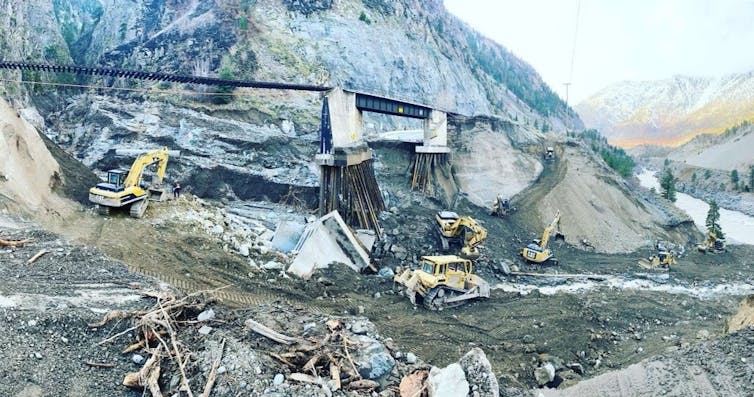
tractors and diggers clear debris following a flood
Restoration work underway following November 2021 flooding damage at Tank Hill on Highway 1 in B.C.
(B.C. Ministry of Transportation and Transit/flickr), CC BY-NC-ND

Nature’s flood “ingredients” include rainfall, snow, soil wetness and energy for snowmelt, which combine in many “recipes” to trigger floods. Human influences like climate change, land use and land cover changes can alter these recipes, making floods bigger and more common. Understanding how human activity causes these effects on floods means predicting flood frequency and size together.

However, short flood records make it difficult to estimate the frequency and size of large floods. Without overcoming this challenge, assessments can produce unreliable results.

Additionally, many studies lump distant flood records with more recent records, suggesting that floods today have similar odds as those decades ago. Yet, experts agree that changes in the climate and landscape alter floods more strongly today.

These practices together produced a widespread perception in risk assessments where flood sizes rise rapidly, or steeply, per change in frequency (called a “heavier tail”).

Our recently published study challenges that perception, which implies that human influence shouldn’t greatly alter floods. In many places, human activities are making large floods more common. By giving little attention to how our activities affect flood frequencies, our practices don’t seem to capture just how sensitive floods are and how much they’re changing.

Without adapting our practices, we risk the loss of lives and livelihoods, misallocating funds, economic losses and lawsuits against governments, municipalities and professionals. Reliable flood projection and management is vital.

Considering flood frequency

To make reliable flood projections, we first need to identify a region’s natural flood frequencies and sizes, and which climate and landscape features drive them. With this solid baseline, we can determine how human activities shift flood frequencies and sizes, if floods are sensitive to human influence and what this means for society.

We can do this by predicting how different human activities affect floods through modelling or landscape experiments. We can work with flood records, using methods that recognize how current and future floods are far more affected by human activities than past floods.

We can use existing techniques to overcome challenges with short records and ensure that our estimates reflect a strong understanding of the natural and human drivers of flood frequencies and sizes.

By adopting stronger practices, our study predicts that many regions could see very different frequency-size relations: flood sizes could increase more slowly per change in frequency.

It signals a more “fragile,” or super sensitive, flood regime than what current methods imply. When we disturb the climate or landscape, large floods can react strongly; they become much more common, reflecting what we see in many places today.

This knowledge can help governments effectively manage the land while mitigating major jumps in flood frequency.

The way forward

Muddy floodwaters submerge a highway
Floodwaters wash away part of Highway 8 in B.C. in November 2021.
(B.C. Ministry of Transportation and Transit/flickr), CC BY-NC-ND

Effective flood management must include strong policies, nature-based solutions, and infrastructure designed for size and strength to withstand both larger and more frequent floods.

Nature-based solutions such as green areas, permeable surfaces and water-retaining features are being adopted by governments worldwide. Studies suggest that measures like increased forest cover have little impact on large floods; however, this may reflect the focus on flood size. Natural landscapes like forests can greatly reduce flood frequencies, even for very large floods.

In B.C., landscape features like mountains, forests, lakes, wetlands and floodplains spread out floods, lowering their peaks and making large events rarer. However, these same features make floods react strongly to changes in the climate and landscape.

Flood risk management must work with nature, maintaining or increasing the landscapes’ ability to store floodwaters. Our policies must address flood risk at the source through effective land management, recognizing that key causes of urban floods could lie thousands of kilometres away in the distant uplands. With strong policies and interventions both upstream and downstream, we can proactively manage floods.

The Conversation

Samadhee Kaluarachchi receives funding from the Natural Sciences and Engineering Research Council of Canada, the Faculty of Forestry at the University of British Columbia, the Gordon and Nora Bailey Fellowship in Sustainable Forestry, and the Mary and David Macaree Fellowship.

Younes Alila receives funding from Mitacs Canada and the Natural Sciences and Engineering Research Council of Canada.

ref. Governments need to prepare for more frequent large floods – https://theconversation.com/governments-need-to-prepare-for-more-frequent-large-floods-269251

Wicked: For Good – what lies beneath correcting the way people speak?

Source: The Conversation – UK – By Emma Humphries, Research Fellow, School of Arts, English and Languages, Queen’s University Belfast

“Pink goes good with green.” This is a lesson we learned from Glinda (Ariana Grande) in Wicked part one. But do you remember the line that comes after that?
“Goes well with green.”

A small, easily missed comment from the green-skinned outsider Elphaba (Cynthia Erivo), but one that reveals something important about language and common usage. Hierarchies of “correct” and “incorrect” language are not just found in grammar books and classrooms, but in popular culture too.

From “holding space” to “sex cardigans”, Wicked continues to dominate popular culture, but one thing that has been overlooked is Elphaba’s insistence on correct language.

In the first film, we see Elphaba ostracised and eventually positioned as public enemy number one by the Oz propaganda machine. From the film’s very opening, a flashforward to citizens celebrating Elphaba’s death, her unpopularity is made clear in the song No One Mourns The Wicked.

One way in which the filmmakers signal Elphaba’s unlikeability is through her often awkward, borderline rude social encounters, including when she first meets her frenemy, Glinda. It’s safe to say that the two characters don’t hit it off and Elphaba’s correction seems to upset Glinda.

Glinda: I could care less what others think.

Elphaba: Couldn’t.

Glinda: What?

Elphaba: You couldn’t care less what other people think. Though, I … I doubt that.

In the land of Oz, where people “pronuncify” and “rejocify”, are “disgusticified” and “moodified”, Elphaba’s comments demonstrate the idea that there is only one correct way to use language and that incorrect language should be corrected.

From stage to cinema

Elphaba’s corrections are not in the original stage musical. They were added to the film. The adaptation of a stage show for film offers an opportunity to modernise and change parts of the story that have been controversial or become outdated.

One excellent example of this in Wicked is its improvement of the stage show’s depiction of disability. The addition of language policing, however, is more disappointing. Because when we correct someone’s language, it’s about much more than the words themselves.

Correcting language is not neutral. When we place value on using language correctly, those who fall short often find themselves judged and discriminated against.

The policing of correct language can be seen as a gatekeeping tool, deciding who belongs and who is excluded. This has inevitable consequences for diversity. The way we speak, write and sign can reflect many aspects of our identities: where and how we grew up, our gender, age and race.

Rules and rebellion

With the run time of the films almost doubling that of the stage show, there is much more time devoted to character development in the films. Elphaba’s language pedantry has been added to demonstrate how she can rub people up the wrong way. However, it also suggests an adherence to authority and to socially constructed rules that stands in contrast to her character more broadly.

Elphaba is an outsider who starts the film wanting to be “degreenified”, but by the end of Wicked part one and as a main storyline in Wicked: For Good, she is willing to sacrifice her safety and reputation to do what is morally right, rather than what is socially acceptable.

Adherence to the strict rules of correct language suggests the opposite: a tendency to want to be accepted and to uphold the societal status quo. Elphaba resists social norms in every other respect, yet the film makes her a standard grammar enforcer.

Given that this trait is absent from part two, rather than undermining her personality as a resister, perhaps this further signals Elphaba’s journey from wishing to fit in to fully embracing her outsider status. Indeed, Elphaba’s insistence on correctness speaks to a broader challenge facing anyone positioned as an outsider: having to work that much harder to be accepted.

Glinda’s (famous) need to be popular and her interests in social climbing align with traits of a language enforcer, yet her behaviour tells a different story. She corrects language only once and it concerns her original name, Galinda. When Dr Dillamond, a professor at Shiz University – who also happens to be a goat – struggles to pronounce the “gah” in Galinda, Glinda corrects his pronunciation and berates him.

This moment, present in both the stage musical and the film, does not reflect a desire to uphold the prescriptive rules of the language, but rather a personal motivation. Glinda’s name is central to her self-image and public persona, and protecting that matters to her.

Beyond Oz

In an era when equality, diversity and inclusion initiatives are being rolled back, and languages other than English face renewed marginalisation, Wicked offers a case study in how linguistic hierarchies operate under the radar of popular culture. But there are plenty other examples. Think about Ross in Friends, Ted in How I Met Your Mother and Sheldon in The Big Bang Theory – all notorious language correctors.

Elphaba’s corrections are more than just a shorthand to signal an abrasive character. They reflect the linguistic hierarchies and gatekeeping that exist beyond Oz. Using language “correctly” is a marker of belonging and shows adherence to societal norms.

Across the two films, Elphaba moves from wanting to conform and erase a stigmatised part of her identity, her skin colour, towards rebellion against convention. It’s clear she questions blind adherence to political power, but perhaps this extends further to questioning the rules we construct around language.


Looking for something good? Cut through the noise with a carefully curated selection of the latest releases, live events and exhibitions, straight to your inbox every fortnight, on Fridays. Sign up here.


The Conversation

Emma Humphries receives funding from The Leverhulme Trust and is currently employed by Queen’s University Belfast.

ref. Wicked: For Good – what lies beneath correcting the way people speak? – https://theconversation.com/wicked-for-good-what-lies-beneath-correcting-the-way-people-speak-270639

FDA claims on COVID-19 vaccine safety are unsupported by reliable data – and could severely hinder vaccine access

Source: The Conversation – USA (3) – By Frank Han, Assistant Professor of Pediatric Cardiology, University of Illinois Chicago

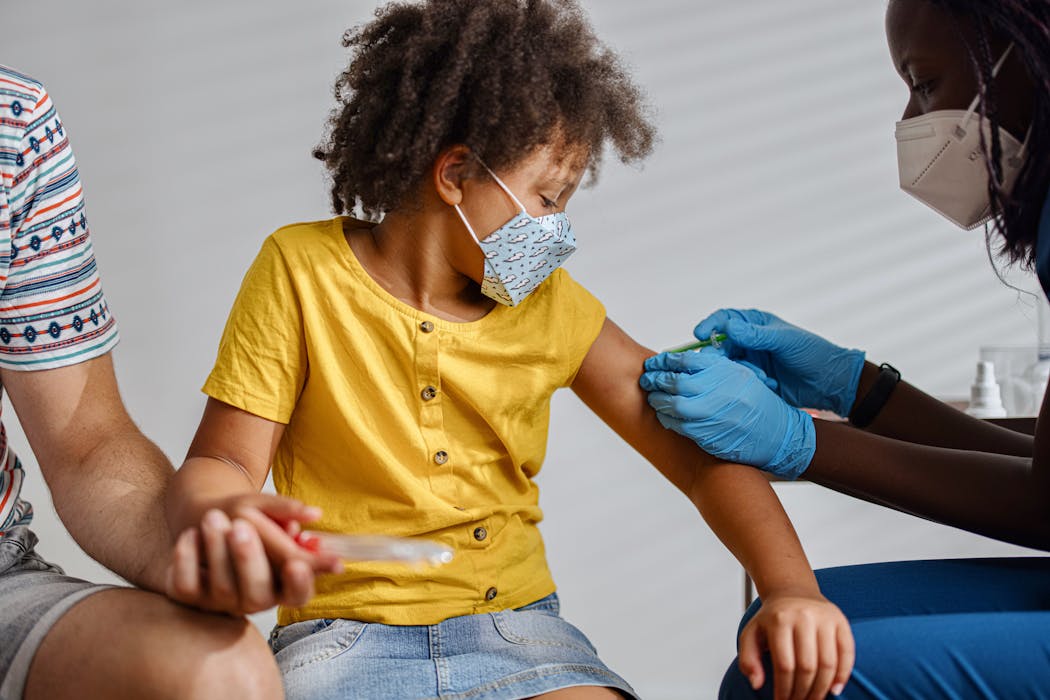
The FDA has provided no evidence that children died because of receiving a COVID-19 vaccine. Anchiy/E+ via Getty Images

The Food and Drug Administration is seeking to drastically change procedures for testing vaccine safety and approving vaccines, based on unproven claims that mRNA-based COVID-19 vaccines caused the death of at least 10 children.

The agency detailed its plans in a memo released to staff on Nov. 28, 2025, which was obtained by several news outlets and published by The Washington Post.

Citing an internal, unpublished review, the memo, written by the agency’s top vaccine regulator, Vinay Prasad, attributes the children’s deaths to myocarditis, an inflammation of the heart muscle. And it says the deaths were reported to the Vaccine Adverse Event Reporting System, or VAERS, but provides no evidence that the vaccines caused the deaths.

The death of children due to an unsafe vaccine is a serious allegation. I am a pediatric cardiologist who has studied the link between COVID-19 vaccines and heart-related side effects such as myocarditis in children. To my knowledge, studies to date have shown such side effects are rare, and severe outcomes even more so. However, I am open to new evidence that could change my mind.

But without sufficient justification and solid evidence, restricting access to an approved vaccine and changing well-established procedures for testing vaccines would carry serious consequences. These moves would limit access for patients, create roadblocks for companies and worsen distrust in vaccines and public health.

In my view, it’s important for people reading about these FDA actions to understand how the evidence on a vaccine’s safety is generally assessed.

Determining cause of death

The FDA memo claims that the deaths of these children were directly related to receiving a COVID-19 immunization.

From my perspective as a clinician, it is awful that any child should die from a routine vaccination.

However, health professionals like me owe it to the public to uphold the highest possible standards in investigating why these deaths occurred. If the FDA has evidence demonstrating something that national health agencies worldwide have missed – widespread child deaths due to myocarditis caused by the COVID-19 vaccine – I don’t doubt that even the most pro-vaccine physician will listen. So far, however, no such evidence has been presented.

While a death logged in VAERS is a starting point, on its own it is insufficient to conclude whether a vaccine caused the death or other medical causes were to blame.

To demonstrate a causal link, FDA staff and physicians must align the VAERS report with physicians’ assessments of the patient, as well as data from other sources for monitoring vaccine safety. These include PRISM, which logs insurance claims data, and the Vaccine Safety Datalink, which tracks safety signals in electronic medical records.

It’s known that most deaths logged only in VAERS of children who recently received vaccines have been incorrectly attributed to the vaccines – either by accident or in some cases on purpose by anti-vaccine activists.

Heart-related side effects of COVID-19 vaccines

In his Substack and Twitter accounts, Prasad has said that he believes the rate of severe cardiac side effects after COVID-19 vaccination is severely underestimated and that the vaccines should be restricted far more than they currently are.

In a July 2025 presentation, Prasad quoted a risk of 27 cases per million of myocarditis in young men who received the COVID-19 vaccine. A 2024 review suggested that number was a bit lower – about 20 cases out of 1 million people. But that same study found that unvaccinated people had greater risk of heart problems after a COVID-19 infection than vaccinated people. In a different study, people who got myocarditis after a COVID-19 vaccination developed fewer complications than people who got myocarditis after a COVID-19 infection.

Existing vaccine safety infrastructure in the U.S. successfully identifies dangers posed by vaccines – and did so during the COVID-19 pandemic. Today, most COVID-19 vaccines in the U.S. rely on mRNA technology. But as vaccines were first emerging during the COVID-19 pandemic, two pharmaceutical companies, Janssen and AstraZeneca, rolled out a vaccine that used a different technology, called a viral vector. This type of vaccine had a very rare but genuine safety problem that was detected.

A report in VAERS is at most a first step to determining whether a vaccine caused harm.

VAERS, the Vaccine Safety Datalink, clinical investigators in the U.S. and their European counterparts detected that these vaccines did turn out to cause blood clotting. In April 2021, the FDA formally recommended pausing their use, and they were later pulled from the market.

Death due to myocarditis from COVID-19 vaccination is exceedingly rare. Demonstrating that it occurred requires proof that the person had myocarditis, evidence that no other reasonable cause of death was present, and the absence of any additional cause of myocarditis. These factors cannot be determined from VAERS data, however – and to date, the FDA has presented no other relevant data.

A problematic vision for future vaccine approvals

Currently, vaccines are tested both by seeing how well they prevent disease and by how well they generate antibodies, which are the molecules that help your body fight viruses and bacteria.

Some vaccines, such as the COVID-19 vaccine and the influenza vaccine, need to be updated based on new strains. The FDA generally approves these updates based on how well the new versions generate antibodies. Since the previous generation of vaccines was already shown to prevent infection, if the new version can generate antibodies like the previous one, researchers assume its ability to prevent infection is comparable too. Later studies can then test how well the vaccines prevent severe disease and hospitalization.

The FDA memo says this approach is insufficient and instead argues for replacing such studies with many more placebo-controlled trials – not just for COVID-19 vaccines but also for widely used influenza and pneumonia vaccines.

That may seem reasonable theoretically. In practice, however, it is not realistic.

Today’s influenza vaccines must be changed every season to reflect mutations to the virus. If the FDA were to require new placebo-controlled trials every year, the vaccine being tested would become obsolete by the time it is approved. This would be a massive waste of time and resources.

A pharmacy with a sign advertising flu shots
Influenza vaccines must be updated for every flu season.
Jacob Wackerhausen/iStock via Getty Images Plus

Also, detecting vaccine-related myocarditis at the low rate at which it occurs would have required clinical trials many times larger than the ones that were done to approve COVID-19 mRNA vaccines. This would have cost at least millions of dollars more, and the delay in rolling out vaccines would have also cost lives.

Placebo-controlled trials would require comparing people who receive the updated vaccine with people who remain unvaccinated. When an older version of the vaccine is already available, this means purposefully asking people to forgo that vaccine and risk infection for the sake of the trial, a practice that is widely considered unethical. Current scientific practice is that only a brand-new vaccine may be compared against placebo.

While suspected vaccine deaths should absolutely be investigated, stopping a vaccine for insufficient reasons can lead to a significant drop in public confidence. That’s why it’s essential to thoroughly and transparently investigate any claims that a vaccine causes harm.

Vaccine vs illness

To accurately gauge a vaccine’s risks, it is also crucial to compare its side effects with the effects of the illness it prevents.

For COVID-19, data consistently shows that the disease is clearly more dangerous. From Aug. 1, 2021, to July 31, 2022, more than 800 children in the U.S. died due to COVID-19, but very few deaths from COVID-19 vaccines in children have been been verified worldwide. What’s more, the disease causes many more heart-related side effects than the vaccine does.

Meanwhile, extensive evidence shows that COVID-19 vaccination reduces the risk of hospitalization by more than 70% and the risk of severe illness in adolescent children by 79%. Studies also show it dramatically reduces their risk of developing long COVID, a condition in which symptoms such as extreme fatigue or weakness persist more than three months after a COVID-19 infection.

Reporting only the vaccines’ risks, and not their benefits, shows just a small part of the picture.

The Conversation

I am a fellow of the American Academy of Pediatrics and regularly go on social media to share pro vaccine information.

ref. FDA claims on COVID-19 vaccine safety are unsupported by reliable data – and could severely hinder vaccine access – https://theconversation.com/fda-claims-on-covid-19-vaccine-safety-are-unsupported-by-reliable-data-and-could-severely-hinder-vaccine-access-271028

At Donald Trump’s prompting, Benjamin Netanyahu seeks a pardon – but insists he has done nothing wrong

Source: The Conversation – UK – By John Strawson, Emeritus Professor of Law, University of East London

The interesting thing about Benjamin Netanyahu’s call on Israel’s president, Isaac Herzog, to pardon him for charges of bribery, fraud and breach of trust, is that he has not been found guilty on any of them.

The trial is made up of three separate but related cases and began in May 2020. They’ve been paused regularly, especially since the country began its military campaign in Gaza, and are thought likely to continue for years.

Netanyahu’s 111-page pardon application does not admit guilt. Instead it’s a sustained attack on Israel’s legal system. In particular it alleges that the cases against him have involved illegal interrogations and unlawful manipulation in the collection of evidence. He argues that the charges against him undermine national unity and impair his ability to do his job as the country’s leader.

In short this is not Netanyahu asking for a pardon so much as an attempt by the prime minister to portray himself as a great man wronged by the elite.

Significantly it comes just a few months before the next election will have be called in Israel. As Herzog has said the application will could “unsettle” the Israeli public.

The latest developments in the long-running saga of the Israeli prime minister’s trial began in October. The US president, Donald Trump, in his speech to the Knesset to celebrate the apparent success of his peace plan for Gaza, called for the pardon.

Having recently humiliated Netanyahu at a meeting in the White House by making him apologise to Qatar for his airstrike on Hamas officials in Doha, Trump – ever the deal maker – thought he could sweeten things for his staunch ally by making such a public appeal. The US president has since followed this up with a formal letter to the Israeli president.

Donald Trump calls for Netanyahu to be pardoned.

Trump seems to be under the impression that Israel’s president has the same widely discretionary powers that he exercises. He has just pardoned the former president of Honduras, Juan Orlando Hernandez, who had been sentenced to 45 years during the Biden years for drug trafficking and has a well established track record of pardoning his allies.

But Israel has a complex system that may take weeks to work through. First the pardon must be submitted to the Ministry of Justice to consider before it goes to the president. The president then has to ask his own legal advisor for her view.

The reaction to Netanyahu’s pardon application has predictably divided Israelis along political lines.

Opposition party leaders are overwhelmingly opposed to the grant of a pardon, especially as Netanyahu has not accepted guilt. Opposition leader Yair Lapid has said that no pardon can be given unless Netanyahu admits guilt. Yair Golan, the leader of the Democrats, also says that only the guilty can apply for pardon.

Former prime minister, Naftali Bennett – a frontrunner to succeed Netanyahu should the opposition coalition win the election – has a more nuanced view. He argues that a pardon should be given but on condition that Netanyahu retires from office.

Netanyahu’s government colleagues have of course welcomed the application and agree with Netanyahu’s criticisms of Israel’s justice system. Environment minister, Idit Silman – a fellow member of Likud, Netanyahu’s party – has gone so far as to suggest that any refusal to grant the pardon will result in the justice officials involved being sanctioned by the Trump administration.

Undermining due process

All of this places Herzog in a delicate position. The judicial reforms which the current government initiated when it took office in December 2022, which have drawn the anger of many in Israel who perceive them as an attempt to emasculate what was once a robust legal system, have continued during the war in Gaza.

The government and its supporters already treat Israel’s Supreme Court with contempt. This was amply demonstrated on December 1 when a hearing on the government’s attempt to sack the attorney general was cancelled after the government boycotted the hearing.

It is also a moot point whether the president is legally able to pardon anyone who has not been convicted of a crime or at least been admitted guilt. There have been two cases where pardons were granted without convictions.

These related to a 1984 trial in which two operatives working for Israeli intelligence agency Shin Bet were charged with the summary execution of two Palestinians who were hijacking a bus. It was considered that a full trial could compromise security – so on the basis of the admission of guilt a pardon was given.

It has been suggested that Herzog could offer a conditional pardon dependent on Netanyahu not returning to office after the next election, whatever the result. But the Israeli prime minister seems in no mood to admit to any wrongdoing on his part – let alone retreat from political life. Instead, his application for a pardon is a demand that the Israel public rally round him and a statement that disunity has been caused by the trial not by his actions.

This has echoes of the way in which Trump dealt with the litigation against him after his first term. He used it as proof of the bias and indeed the corruption of the legal system at the service of the elite.

In this period of populist politics this stance evidently did him no harm as he was reelected. Netanyahu must be hoping the same politics work for him. But unlike Trump, it was under his watch the most catastrophic intelligence and military failures took place on October 7 2023.

The Israeli electorate may well not accept his excuses for that traumatic day. They may instead see his pardon application as another self-serving act of a politician who is putting himself first.

The Conversation

John Strawson does not work for, consult, own shares in or receive funding from any company or organisation that would benefit from this article, and has disclosed no relevant affiliations beyond their academic appointment.

ref. At Donald Trump’s prompting, Benjamin Netanyahu seeks a pardon – but insists he has done nothing wrong – https://theconversation.com/at-donald-trumps-prompting-benjamin-netanyahu-seeks-a-pardon-but-insists-he-has-done-nothing-wrong-271136

Así es la peste porcina africana que amenaza a España

Source: The Conversation – (in Spanish) – By Raúl Rivas González, Catedrático de Microbiología. Miembro de la Sociedad Española de Microbiología., Universidad de Salamanca

KACHALKIN OLEG/Shutterstock

La peste porcina africana ha entrado en España. El 27 de noviembre de 2025, España notificó su primer brote de peste porcina africana (PPA) desde 1994. Como consecuencia, este país ha perdido su estatus de país libre de PPA.

El número de casos positivos ha ido aumentando con el paso de los días. De momento, hay nueve jabalíes muertos por la enfermedad, todos en el municipio de Cerdanyola del Vallés (Barcelona). Los servicios veterinarios oficiales de Catalunya, en colaboración con el Ministerio de Agricultura, Pesca y Alimentación, han delimitado una zona de control y vigilancia en un radio de 20 kilómetros en torno a los casos detectados.

La campaña europea

En otoño de 2020, la Autoridad Europea de Seguridad Alimentaria (European Food Safety Authority, EFSA) lanzó una campaña, bautizada como “Alto a la peste porcina africana”, destinada a concienciar y sensibilizar a la población y a detener los graves brotes que surgían en el sudeste de Europa y que pueden amenazar gravemente la economía del continente. De momento, el éxito de la campaña es limitado, porque es evidente que la enfermedad continúa en expansión.

La peste porcina africana (PPA) es una devastadora enfermedad vírica, producida por un virus de ADN de la familia Asfarviridae y caracterizada por fiebres hemorrágicas, ataxia y depresión severa, que afecta a cerdos, jabalíes y a los parientes cercanos de la familia Suidae, con una tasa de letalidad de hasta el 100 %. Esta enfermedad afecta a todas las razas y tipos de cerdos domésticos y jabalíes europeos, y los animales de todas las edades son igualmente susceptibles al virus. Según la Organización Mundial de Sanidad Animal (OMSA), el virus de la peste porcina africana (PPA) es el patógeno más importante que afecta a la población porcina doméstica a nivel mundial.

Una de las carnes más consumidas

La enfermedad no tiene potencial zoonótico, porque no afecta al ser humano, pero el impacto socioeconómico que manifiesta es tremendo, porque el cerdo es una de las carnes más consumidas a nivel mundial.

Los cerdos son una fuente primaria de ingresos domésticos en muchos países y suponen una de las principales fuentes de proteínas animales, representando más del 35 % de la ingesta mundial de carne. En 2024, la UE produjo una cantidad provisional de 21,1 millones de toneladas de carne de cerdo. Los dos principales países productores de carne de porcino de la UE son, precisamente, España (5,0 millones de toneladas en 2024) y Alemania (4,3 millones de toneladas)

Durante la última década, la peste porcina africana ha pasado de ser una enfermedad regional del África subsahariana a erigirse como una amenaza considerable y tangible para la cría de cerdos, especialmente en Europa y en Asia. Su propagación ha devastado las granjas porcinas gestionadas por familias, a menudo el pilar del sustento de las personas. Como efecto colateral, ha reducido las oportunidades de acceder a la atención médica y a la educación en países pobres.

Europa, China y Vietnam

Desde enero de 2022, en Europa más de 1,5 millones de cerdos domésticos han muerto o han tenido que ser sacrificados o eliminados por causa de la peste porcina africana, para lq que no existe una vacuna eficaz.

En agosto del año 2018 apareció un gran brote de PPA en China, el mayor productor y consumidor de carne porcina del mundo, que obligó a los productores chinos a sacrificar a más de 200 millones de cerdos y supuso una pérdida económica del 0,78 % en el producto interior bruto chino del año 2019. Esto tuvo un importante impacto desacelerador en la economía china y afectó a los mercados cárnicos a nivel mundial, representando una fuerte amenaza para el suministro global de carne de cerdo.

En cuanto al brote de peste porcina africana que sufrió Vietnam en el año 2019, provocó una disminución del PIB del país de al menos un 0, %.

El PPA tiene 24 genotípos diferentes

El virus tiene 24 genotipos descritos, basados en la secuenciación del gen de la proteína de la cápside p72 del ASFV (siglas de African swine fever virus).

El genotipo I del virus de la peste porcina africana es endémico en Cerdeña. El genotipo II del virus fue introducido en el año 2007 en Georgia y desde allí se propagó a través de la región del Cáucaso, afectando a Armenia, Azerbaiyán, Rusia, Ucrania, Bielorrusia, Lituania, Letonia, Polonia, Estonia, Moldavia, la República Checa y Rumania, donde el virus continúa circulando.

El virus de la peste porcina africana hallado en jabalíes en España es el genotipo II, el mismo que circula en Europa.

Ojo con los productos cárnicos infectados

El virus de la PPA es muy resistente en el medio ambiente y en los productos porcinos, lo que significa que puede sobrevivir en la ropa, botas, ruedas y otros materiales y cruzar fronteras si no se toman las medidas adecuadas. Así, la transmisión de un país a otro puede verse facilitada por los viajeros que llevan cerdos infectados o productos porcinos contaminados y no los declaran a las autoridades.

Como se trata de un virus resistente a un amplio rango de pH y a ciclos de congelación y descongelación, puede permanecer infeccioso durante muchos meses a temperatura ambiente o almacenado a 4 °C. El virus presente en fluidos corporales y suero se inactiva a 60 °C en 30 minutos. Sin embargo, el virus presente en carne de cerdo sin procesar, donde puede permanecer viable durante varias semanas o meses, solo se inactiva calentándolo a 70 °C durante 30 minutos.

Se considera que la principal vía de infección por el virus de la peste porcina africana (PPA) es la ingesta de productos de animales infectados o material contaminado con el virus, como restos de comida o desperdicios que contengan carne de cerdo o productos cárnicos infectados.

Esta ruta es especialmente relevante para la propagación en jabalíes, debido a sus hábitos carroñeros o muy oportunistas a la hora de buscar comida, razón por la cual frecuentan la basura. Otras vías de transmisión importantes incluyen el contacto directo entre animales infectados (cerdos o jabalíes) y sanos (a través de fluidos corporales como saliva, orina, heces, secreciones nasales), el contacto indirecto a través de fómites (ropa, vehículos, equipos, calzado, pienso contaminado) y, en ciertas regiones, la picadura de garrapatas blandas del género Ornithodoros que actúan como vectores biológicos.

La persistencia del virus en el medio ambiente y en productos cárnicos (incluso curados, congelados o refrigerados) hace que estas vías de infección indirectas sean particularmente peligrosas y difíciles de controlar.

El aumento en el número de países infectados representa una amenaza significativa debido a la posible introducción del virus de la peste porcina africana en países libres de la enfermedad, ya sea a través de poblaciones de jabalíes salvajes o de la importación y el comercio legales e ilegales de productos y desechos de cerdo contaminados. Dado que los efectos de un brote de peste porcina africana pueden ser devastadores, la prevención, la detección y la información son esenciales para evitar la propagación y poder contener la enfermedad.

The Conversation

Raúl Rivas González no recibe salario, ni ejerce labores de consultoría, ni posee acciones, ni recibe financiación de ninguna compañía u organización que pueda obtener beneficio de este artículo, y ha declarado carecer de vínculos relevantes más allá del cargo académico citado.

ref. Así es la peste porcina africana que amenaza a España – https://theconversation.com/asi-es-la-peste-porcina-africana-que-amenaza-a-espana-271230

Hannah Arendt y Gaza hoy: la persistente banalidad del mal

Source: The Conversation – (in Spanish) – By Álvaro Ledesma de la Fuente, Profesor de Filosofía, Universidad de La Rioja

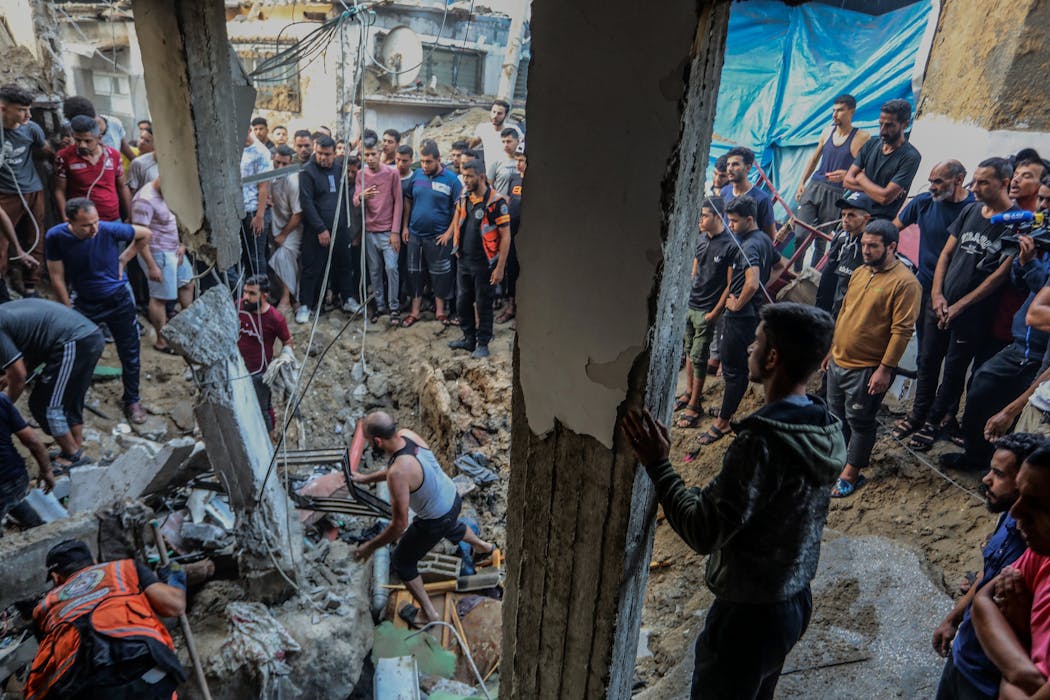
La Defensa Civil palestina busca vecindarios bajo los escombros tras una incursión israelí en una casa en Rafah, al sur de la Franja de Gaza, el 24 de octubre de 2023. Anas-Mohammed/Shutterstock

El 4 de diciembre de 1975 fallecía en su apartamento de Nueva York Hannah Arendt, filósofa y politóloga judía de origen alemán, nacionalizada estadounidense, cuya obra alcanzó una enorme proyección internacional.

Su trayectoria se distingue por una independencia intelectual poco común, que hace difícil su encuadre en las corrientes dominantes del pensamiento del siglo XX. Sus investigaciones abordan temas tan variados como la sociedad de masas, las posibilidades de la acción política, las tensiones internas de la democracia, la violencia extrema y la responsabilidad de los ciudadanos ante esa violencia.

Sin embargo, Arendt es recordada sobre todo por el concepto de “banalidad del mal”, formulado en su estudio sobre el criminal de guerra Adolf Eichmann, quien –a diferencia de otros jerarcas nazis juzgados en Núremberg en 1946– había logrado eludir la justicia durante años.

La aniquilación sin preguntas

En Eichmann en Jerusalén. Un informe sobre la banalidad del mal, de 1963, Arendt argumenta que Eichmann no era ninguna encarnación del mal radical, una figura demoníaca o un sádico. Era, más bien, un individuo mediocre, gris, anodino y sobre todo incapaz de pensar de forma crítica.

Portada del libro _Eichmann en Jerusalén_ en 1963.
Portada del libro Eichmann en Jerusalén en 1963.
Wikimedia Commons

En esencia, Eichmann cumplió el papel de un funcionario diligente, más atento a la eficiencia administrativa que a las implicaciones éticas de sus actos. Consideraba que la aniquilación sistemática de un grupo humano –aceptada sin reflexión y justificada por la supuesta amenaza que representaba para la supervivencia del Estado– no solo era legítima sino necesaria. También entendía que cumplir con esa tarea formaba parte de su deber como ciudadano alemán.

Su obediencia estricta a las órdenes, desprovista de pensamiento y de empatía, revelaba un tipo de mal que no surge de una voluntad perversa, sino de una profunda incapacidad para pensar. Ese mal banal es superficial y conformista: no se manifiesta como un impulso violento o ideologizado, sino como una obediencia ciega a estructuras jerárquicas que diluyen la responsabilidad individual. Arendt advirtió que esta forma de mal es especialmente peligrosa porque no se reconoce a sí misma como tal. Además abre la posibilidad inquietante de que atrocidades radicales puedan ser cometidas por personas aparentemente normales, carentes de pensamiento crítico.

El genocidio en Gaza

Resulta tristemente irónico que, algo más de medio siglo después de estas investigaciones, el mundo asista impertérrito a otro genocidio.

Ya en abril de 2025 la relatora de la ONU para los Territorios Palestinos, Francesca Albanese, señaló la presencia de patrones genocidas en las actuaciones que Israel sigue llevando a cabo en Palestina, especialmente en la Franja de Gaza, a pesar del alto en fuego. Entre los argumentos que sustentaron esta valoración figuraban, entre otros, la hambruna deliberada provocada mediante restricciones políticas a la ayuda humanitaria, la destrucción sistemática del patrimonio histórico y cultural palestino y la creación de condiciones de vida que hacían prácticamente imposible la existencia cotidiana en el territorio, tal y como documentó Amnistía Internacional.

El exministro de Defensa del gobierno de Israel Yoav Gallant describió a los gazatíes como “animales humanos”. El actual ministro ultra Bezalel Smotrich llamó a destruir totalmente Gaza y concentrar a su población o incluso confesar que “nadie nos dejará matar a 2 millones de civiles de hambre, incluso aunque sea algo justificado y moral”. Sin embargo, a pesar de las numerosas y documentadas declaraciones de estos jerarcas debemos asumir, según el planteamiento de Arendt, que los soldados israelíes que cumplen estas órdenes no actúan necesariamente por maldad personal.

Las acciones del piloto de las FDI que recibe la orden de bombardear un hospital, o del ingeniero informático que programa el algoritmo que determina dicho ataque y calcula cuántas bajas civiles pueden causar sin soliviantar en exceso la opinión pública de Occidente no responden necesariamente a una voluntad genocida propia. Se insertan dentro de un sistema jerárquico y burocratizado que proporciona amparo legal y legitimidad política a sus acciones, pero no se les pueden atribuir una maldad intrínseca.

Nociones de ética pero no aplicación

Uno de los aspectos que más sorprendió a Arendt de su cobertura al juicio de Eichmann fue que el acusado parecía tener nociones de la ética kantiana. Esta señala la autonomía del juicio moral y el deber de actuar según un criterio que pueda ser asumida como principio universal. El acusado entendía que el principio de su voluntad podría devenir en unas leyes generales, en este caso una que se fundamentara en la supervivencia del Tercer Reich a través de las acciones necesarias, incluida la solución final. La nueva escala de valores prescrita por el gobierno hacía que a Eichmann, que se expresaba en términos burocráticos, le fuera irrelevante pensar desde el punto de vista de las otras personas, las víctimas. También le permitía sentirse, según sus propias palabras, “libre de toda culpa”.

Retrato en blanco y negro de una mujer con traje.
Retrato de Hannah Arendt en 1958 hecho por Barbara Niggl Radloff.
Münchner Stadtmuseum, Sammlung Fotografie, CC BY-SA

No resultaría difícil imaginar justificaciones parecidas en el caso de que existiese un futuro tribunal internacional que juzgase a los responsables del genocidio en Palestina: que la aniquilación sistemática de un grupo humano –aceptada sin reflexión y amparada en la supuesta amenaza que representaba para la supervivencia del Estado– no solo se consideraba legítima sino necesaria. Según esto, cumplir con esa tarea formaba parte del deber como ciudadanos israelíes.

El mal no se revela con rostro monstruoso, sino que se esconde en la mediocridad, la obediencia ciega y la incapacidad de pensar por uno mismo. En tiempos de crisis, esta advertencia sigue siendo urgente: solo una ciudadanía activa, reflexiva y moralmente responsable puede frenar la deshumanización y el autoritarismo.

Como señala la periodista Teresa Aranguren en su reciente libro Palestina: la existencia negada, al día siguiente de la destrucción del hospital de Al-Ahli por un misil de alta tecnología –armamento solo accesible a una potencia como Israel– Netanyahu se reunió con Joe Biden, entonces presidente de Estados Unidos. Este, según los informes, le dijo con una media sonrisa: “Parece que han sido los del otro lado, no tú”.

Responder de esa manera, con tal cinismo ante la muerte de civiles, es un ejemplo claro de lo que Hannah Arendt llamó la banalidad del mal.

The Conversation

Álvaro Ledesma de la Fuente no recibe salario, ni ejerce labores de consultoría, ni posee acciones, ni recibe financiación de ninguna compañía u organización que pueda obtener beneficio de este artículo, y ha declarado carecer de vínculos relevantes más allá del cargo académico citado.

ref. Hannah Arendt y Gaza hoy: la persistente banalidad del mal – https://theconversation.com/hannah-arendt-y-gaza-hoy-la-persistente-banalidad-del-mal-271047

Soluciones basadas en la naturaleza frente a eventos climáticos extremos en cuencas mediterráneas

Source: The Conversation – (in Spanish) – By Raquel Luján Soto, Postdoctoral fellow, Centro de Edafología y Biología Aplicada del Segura (CEBAS-CSIC)

Sequías e inundaciones son dos fenómenos climáticos extremos relacionados entre sí y que han afectado históricamente a la cuenca mediterránea. Desde el año 1259 existen, por ejemplo, registros de inundaciones en la Cuenca del Río Segura, las cuales generaron grandes pérdidas materiales y humanas.

A pesar de que los fenómenos climatológicos extremos son endémicos de la cuenca mediterránea, el cambio climático hace que sean cada vez mas frecuentes e intensos. Es una tendencia que afecta cada vez a más regiones y que se espera que vaya en aumento en las próximas décadas.

Además, el crecimiento de zonas urbanas sin una planificación urbanística adecuada, la intensificación de la agricultura y una deficiente gestión integrada de los recursos hídricos han dado como resultado una mayor exposición y vulnerabilidad de las sociedades a sufrir los impactos de sequías e inundaciones.


Leer más:
Imitar a la naturaleza para evitar inundaciones en las ciudades


Impactos del cambio climático en Europa

En los últimos años hemos sido testigos de la magnitud e intensidad que esos eventos han tomado en Europa. Claros ejemplos de ello son las sequías que afectaron en 2022 a distintos países y dejaron al descubierto las “piedras del hambre” en la cuenca del río Elba; el incendio en la región de Evros, Grecia, que en 2023 asoló cerca de 90 000 hectáreas, considerándose el más extenso registrado en Europa; o las inundaciones por la dana en la región de Valencia en octubre de 2024, que se convirtieron en las más destructivas en la Unión Europea en cuanto a daños personales y materiales, a pesar de no ser las más extensas en superficie.

Infraestructuras grises y la falsa sensación de seguridad

Durante décadas, las instituciones han priorizado la construcción de “infraestructuras grises” como presas, embalses o la canalización de ríos con el fin de almacenar agua para riego, proteger a las poblaciones frente a las inundaciones y facilitar la evacuación rápida de aguas pluviales.

A pesar de estos esfuerzos masivos, el riesgo de sufrir inundaciones y sequías no sólo no ha disminuido significativamente, sino que en muchas ocasiones incluso ha aumentado por la disminución efectiva de la superficie de la llanura aluvial. También por una mayor concentración de las poblaciones y las actividades económicas en áreas percibidas como de mayor protección.

Soluciones basadas en la naturaleza en cuencas mediterráneas

Para hacer frente a esta situación, diferentes instituciones internacionales reclaman la implementación de soluciones basadas en la naturaleza (SBN). Alternativas o complementarias a las infraestructuras grises, las SBN son acciones enfocadas a favorecer las funciones de los ecosistemas.

La evidencia científica ha mostrado, por ejemplo, su gran potencial para retener e infiltrar agua en suelos y subsuelos, reduciendo así la gravedad de sequías e inundaciones.

Pero ¿cuáles deben ser las soluciones prioritarias en las cuencas mediterráneas? ¿Y qué medidas se pueden tomar para facilitar su puesta en marcha?

1. Reforestación de cabeceras de cuencas y subcuencas

Las tradicionales reforestaciones en cabeceras de cuencas y subcuencas de los ríos son una medida altamente efectiva. Pero no se deben llevar a cabo de cualquier manera.

Si bien el aumento de la cobertura forestal puede mitigar, al menos parcialmente, los impactos negativos de las inundaciones, también pueden surgir desventajas importantes con respecto a las sequías. Esto se debe a un mayor consumo de agua por la vegetación (evapotranspiración) y a una menor entrada de agua a los embalses.

Por ello, es especialmente relevante tener en cuenta un buen diseño de la reforestación y una buena gestión posterior. Se debe priorizar el uso de especies nativas y de diferentes estratos arbóreos y arbustivos, así como el control estratégico de la densidad; por ejemplo, a través de una gestión silvopastoral para reducir el riesgo de incendios.

2. Renaturalización del río y la llanura aluvial

En segundo lugar, es crucial poner en práctica soluciones con un impacto en la parte media del río y la llanura aluvial. Un caso de éxito lo constituye la restauración fluvial del río Arga (Navarra). En su ecosistema han sido implementadas diversas medidas para disminuir el riesgo de inundación de las poblaciones colindantes, como la eliminación de escolleras, la conexión del río con meandros abandonados y el retranqueo (alejamiento) de las motas del río, es decir, las estructuras de tierra elevadas construidas en sus orillas para proteger las áreas circundantes.

Estas acciones tratan de devolver el espacio natural de los ríos para que el agua pueda fluir disipando su energía. Recientemente, un estudio ha revelado que estas soluciones podrían ser adecuadas en cuencas tan importantes como la cuenca del río Segura, representativa de muchas cuencas mediterráneas. No obstante, su implantación implica varios desafíos debido principalmente a la necesidad de expropiación de terrenos con alto valor económico, lo que puede generar rechazo social y ser el detonante para la inacción política.

3. Agroecología

Junto a las medidas anteriores, habría que priorizar soluciones en tierras agrícolas basadas en prácticas agroecológicas. Bajo los principios de utilización dinámica de la biodiversidad, cierre de ciclos de nutrientes y aguas, y generación de sinergias entre los componentes del ecosistema agrícola se derivan una gran variedad de prácticas altamente efectivas para regenerar suelos degradados, regular ciclos hidrológicos y producir alimentos sanos y de alta calidad nutricional.

La reducción de la labranza y el mantenimiento de cubiertas vegetales sembradas o naturales es, por ejemplo, clave para frenar la erosión y aumentar la infiltración de agua, disminuyendo la concentración de flujos cargados de sedimentos aguas abajo. Además, el uso de compost y estiércoles animales en sustitución de fertilizantes de síntesis química aumenta la materia orgánica y la biodiversidad del suelo, mejorando su capacidad de retención de agua.

Por otra parte, la recuperación de las terrazas tradicionales de piedra seca (técnica que no usa aglutinante), la implantación de setos vegetales en las lindes de los campos, o el diseño de las plantaciones en línea clave (diseño que se basa en generar canales en el suelo con pendientes muy leves que conducen el agua de lluvia desde las zonas más altas a las zonas mas llanas de un terreno distribuyéndola de manera uniforme) son soluciones que ayudan a frenar la escorrentía y aumentan la retención de suelo y agua.

Para finalizar, debido a su diversificación y complejidad ecológica, los sistemas agroforestales y silvopastorales han sido destacados como grandes aliados para hacer frente al cambio climático, regulando el ciclo hidrológico

4. Infraestructuras verdes en zonas urbanas y periurbanas

Es crucial no olvidar las zonas urbanas y periurbanas, muchas de ellas ubicadas aguas abajo. Existen múltiples soluciones basadas en la naturaleza que, aplicadas en conjunto y en superficies amplias, pueden ayudar a aliviar los impactos de sequías e inundaciones.

Algunas de las más comúnmente implementadas incluyen parques de inundación, bosques urbanos, sistemas de drenaje sostenible, techos verdes, pavimentos permeables, corredores verdes y arbolado urbano.

Estas soluciones ayudan a amortiguar las temperaturas y a minimizar el efecto isla de calor, tan común en muchas ciudades mediterráneas. Además, resultan de gran atractivo para la población, ya que se prestan a la realización de actividades recreativas, deportivas, educativas y turísticas.

Estas medidas “aguas abajo” deben aplicarse junto a las soluciones “aguas arriba” o que retienen el agua en origen, evitando así los picos extremos en los caudales de los ríos y ramblas.

Cómo fomentar estas soluciones

A pesar del gran potencial de las soluciones basadas en la naturaleza y del bajo coste que implican, su adopción sigue siendo limitada, en gran parte debido a barreras socioeconómicas, culturales, legislativas y políticas. También influye la falta de procesos participativos para buscar soluciones adaptadas a los contextos locales. No obstante, existen una serie de propuestas que pueden ayudar a fomentar la implantación de este tipo de medidas:

  • Una gobernanza responsable del territorio y de los usos del suelo.

  • La formación y fortalecimiento de capacidades en responsables políticos y personal técnico.

  • La gestión integrada de cuencas hidrográficas y de los recursos hídricos.

  • El aumento de recursos económicos destinados a la implementación de prácticas agroecológicas, por medio de políticas públicas y colaboración público-privada.

  • El fortalecimiento de la normativa en cuestión de protección de humedales, riberas y llanuras aluviales.

  • La generación de procesos participativos y de ciencia ciudadana que involucren a la ciudadanía en la toma de decisiones adaptadas a las necesidades y realidades del territorio.

The Conversation

Raquel Luján Soto cuenta con una beca postdoctoral Juan de la cierva, ayuda JDC2022-050217-I, que cuenta con la cofinanciación de la Agencia Estatal de Investigación, por el Ministerio de Ciencia Innovación y Universidades MCIU/AEI/10.13039/501100011033 y por la Unión Europea NextGenerationEU/PRTR

Carolina Boix Fayos recibe fondos para su investigación del Ministerio de Ciencia, Innovación y Universidades con el proyecto AGRI_SER PID2020-119825RB-I00 y la Fundación Biodiversidad del Ministerio de Transición Ecológica y Reto Demográfico con el proyecto AGROSIMBIOSISLab.

Joris de Vente recibe fondos para el proyecto LandEX (PCI2024-153454) del Ministerio de Ciencia, Innovación y Universidades, y la Agencia Estatal de Investigación (AEI 10.13039/501100011033/EU) en el marco de la convocatoria conjunta 2022 de la colaboración europea Water4All (101060874).

ref. Soluciones basadas en la naturaleza frente a eventos climáticos extremos en cuencas mediterráneas – https://theconversation.com/soluciones-basadas-en-la-naturaleza-frente-a-eventos-climaticos-extremos-en-cuencas-mediterraneas-267392

Entrenamiento neuromuscular: la clave para afinar la coordinación de movimientos en la adolescencia

Source: The Conversation – (in Spanish) – By Elena Mainer Pardos, Profesora e Investigadora Universidad San Jorge. Ciencias de la Actividad Física y del Deporte., Universidad San Jorge

BearFotos/Shutterstock

Durante la adolescencia, el cuerpo cambia a gran velocidad. Los huesos crecen, los músculos se desarrollan y el equilibrio se altera. A simple vista, parece una etapa llena de energía, pero en realidad es un periodo delicado para el control del movimiento.

Muchos adolescentes pierden capacidad de coordinación. Tropiezan con facilidad o pierden precisión en tareas que antes dominaban. No es torpeza, es biología. El cuerpo cambia más rápido de lo que el cerebro puede adaptarse.

Entrenar el cerebro

Y aquí es donde entra en juego el entrenamiento neuromuscular. Este tipo de ejercicio ayuda a coordinar los músculos de forma eficiente, rápida y segura, ya que afina la precisión con la que el cerebro les indica cuándo y cuánto activarse.

En pocas palabras, se podría decir que mejora la forma en que el cerebro interpreta la información del entorno y responde ante ella. Por ejemplo, cuando una persona pierde el equilibrio, el sistema nervioso detecta el cambio y activa los músculos correctos en milésimas de segundo. Un cerebro adiestrado aprende a reaccionar antes y evita movimientos peligrosos o desajustados.

La ciencia ha demostrado que, realizados con buena técnica y bajo supervisión, los ejercicios neuromusculares mejoran el cambio de dirección, el equilibrio, la velocidad de reacción y la coordinación entre músculos. También aumentan la estabilidad de las articulaciones y la eficiencia del movimiento, factores clave para prevenir lesiones y optimizar el rendimiento físico.

¿En qué consiste?

Un programa neuromuscular combina ejercicios de fuerza, equilibrio, coordinacion y agilidad. A diferencia de otros métodos, su meta no reside en levantar más peso ni hacer más repeticiones, sino en moverse mejor.

Para que lo visualice el lector, a continuación explicamos un ejemplo sencillo que no requiere material. Con una duración total de 10 a 12 minutos, se trata de dedicar 40 segundos de trabajo y 20 segundos de descanso a cada uno de los cinco ejercicios, con una frecuencia de 2 o 3 veces por semana:

Movilidad dinámica:

  • Flexiones de cadera con equilibrio (elevación de rodilla y estiramiento suave).

  • Rotaciones de columna y movilidad de hombros.

El objetivo es activar el cuerpo y mejorar la alineación antes de moverse.

Estabilidad y equilibrio:

  • Sostenimiento sobre una pierna tocando puntos en el suelo delante, detrás y a los lados.

  • Variante: cerrar ligeramente la base o girar la cabeza.

Objetivo: mejorar el control postural, que suele deteriorarse durante el estirón de la pubertad.

Fuerza del tronco y la cadera.

  • Plancha con elevación alterna de piernas o brazos.

  • Mantenimiento de la pelvis estable mientras se mueve una extremidad.

Objetivo: reforzar la musculatura que estabiliza la columna y las piernas.

Alineación de rodilla y aterrizaje seguro.

  • Saltos verticales suaves centrados en “caer blando”: rodillas hacia delante, cadera atrás y pies separados a la anchura de hombros. El foco debe estar en cómo se aterriza, no en saltar a gran altura.

Objetivo: mejorar la técnica de aterrizaje y reducir riesgo de lesiones.

Agilidad y cambios de dirección.

  • Desplazamientos en zigzag entre conos (o dos objetos si se hace en casa).

  • Frenadas controladas antes de cambiar de dirección.

Objetivo: que el cerebro aprenda a frenar, estabilizar y reorientar el movimiento sin perder control.

Vulnerabilidad motriz

¿Y por qué es especialmente importante hacer este tipo de ejercicios en la adolescencia? Durante la pubertad, el cuerpo crece a ritmos irregulares. Primero lo hacen los huesos, luego los músculos y después las conexiones nerviosas. Esa desincronización puede afectar al equilibrio, la coordinación y el control postural. Por eso, muchos adolescentes atraviesan lo que se llama un “periodo de vulnerabilidad motriz”.

El entrenamiento neuromuscular puede ayudar a reeducar el control corporal. Además de enseñar al cerebro a adaptarse a un cuerpo que cambia cada pocos meses, también estimula la maduración del sistema nervioso y mejora la respuesta ante los estímulos externos. Es una clave no solo para el deporte, sino para la vida diaria: caminar, subir escaleras o reaccionar ante una caída.

Porque el valor del entrenamiento neuromuscular va más allá del deporte. En adolescentes, puede influir en su salud física y mental: mejora la postura, la conciencia corporal y la confianza en el movimiento, reduce el riesgo de lesiones en rodillas, tobillos o espalda y favorece la concentración y la atención.

En un mundo cada vez más sedentario y digital, enseñar a los jóvenes a moverse con control y equilibrio es casi una forma de alfabetización corporal. Por eso, incluir este tipo de trabajo en colegios, programas juveniles o rutinas de actividad física no debería ser un lujo para deportistas, sino una parte esencial del desarrollo saludable en la adolescencia.

The Conversation

Las personas firmantes no son asalariadas, ni consultoras, ni poseen acciones, ni reciben financiación de ninguna compañía u organización que pueda obtener beneficio de este artículo, y han declarado carecer de vínculos relevantes más allá del cargo académico citado anteriormente.

ref. Entrenamiento neuromuscular: la clave para afinar la coordinación de movimientos en la adolescencia – https://theconversation.com/entrenamiento-neuromuscular-la-clave-para-afinar-la-coordinacion-de-movimientos-en-la-adolescencia-269045