Home borrowing costs, like other long-term rates, are not directly controlled by the Fed – but they still feel its influence.athima tongloom/Moment via Getty Images
For most of us, the main impact tends to be how much we have to pay to borrow to buy a house or car. But for the Federal Reserve, the purpose of its monetary policy is mandated by Congress.
This is widely known as the Federal Reserve’s dual mandate: promoting maximum employment and stable prices. The Fed itself refers to these two objectives regularly in its Federal Open Market Committee statements announcing its monetary policy decisions.
A third objective of monetary policy, however, is less well-known: moderate long-term interest rates.
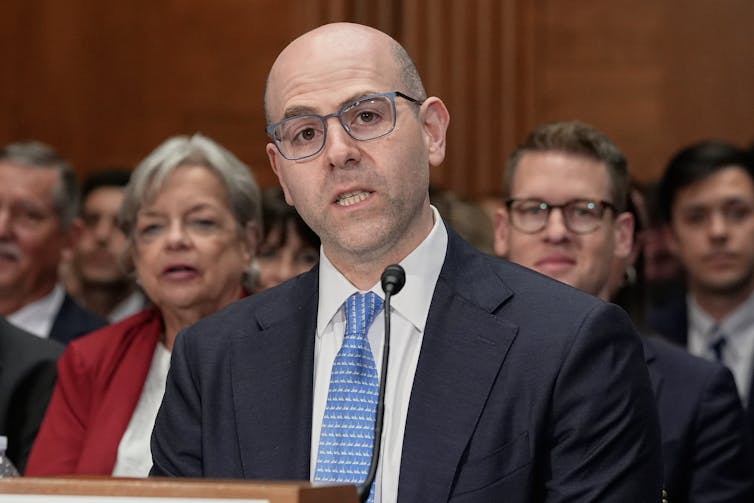
This “third mandate” was a big news story in September 2025, when the Trump administration’s newly appointed Fed governor, Stephen Miran, referred to it in his testimony before the Senate Banking Committee. Financial markets paid close attention to this aspect of the testimony because the comments suggested that Miran and other presidential appointees may focus on this third mandate – and on driving down long-term borrowing costs – more than the Fed has in the recent past.
I’ve been closely following how the Fed conducts monetary policy for many years. Miran is correct that Congress has tasked the U.S. central bank with all three of these objectives – but that’s not the whole story. In fact, none of these goals were originally spelled out in the act that set up the Fed over a century ago.
Since then, the Fed’s goals have been revised several times – typically in response to a crisis.
The Fed’s shifting goals
The original purpose of the Fed, as explained in the Federal Reserve Act of 1913, was to provide flexibility in the nation’s currency supply and to supervise the U.S. banking system. The current dual mandate was not part of the original goals of the Fed.
Instead, its core goal was to reduce the frequent banking panics that were costly to the economy and sharply increased interest rates.
The first big change in the goals, in response to the Great Depression, was the Employment Act of 1946 that stated the goal of federal government policy – and, therefore that of the Fed – is to “promote maximum employment, production and purchasing power.”
This is where the two goals of the dual mandate first began to emerge, with purchasing power implying the Fed needed to keep inflation low.
Following the macroeconomic instability of the 1970s with high unemployment and high inflation, Congress enacted the Federal Reserve Reform Act of 1977 that formalized the Fed mandate: “maintain long run growth of the monetary and credit aggregates commensurate with the economy’s long run potential to increase production, so as to promote the goals of maximum employment, stable prices, and moderate long-term interest rates.”
In other words, Congress gave the Fed three mandates to follow in monetary policy.
Stephen Miran mentioned the third mandate during his testimony before the Senate Banking Committee in September 2025. AP Photo/Mariam Zuhaib
What happened to the third mandate?
So why doesn’t the Fed still talk about that third mandate?
Part of the answer is that moderate long-term interest rates are a natural by-product of successfully managing the other two.
In pursuit of low inflation and maximum employment, the Fed primarily uses a short-term interest rate, known as the Federal Funds rate. When journalists report that the Fed raised or lowered interest rates, this refers to the so-called target rate that the central bank uses to control the Fed Funds rate. For example, the current target rate is a range of 3.75% to 4%, while the effective Fed Funds rate is 3.89%. Banks use the funds rate as the cost other banks must pay to borrow reserve funds for one day.
However, most of the interest rates that matter to people, businesses and the economy at large have much longer terms – such as five, 10 or 30 years. Examples include mortgages, car loans and corporate bonds. The Fed does not directly control these longer-term interest rates, which are set by financial markets.
So if markets believe the Fed has inflation under control, they tend to keep long-term rates on mortgages and everything else low because they don’t expect the Fed will increase its target rate. If inflation is running high, long-term rates tend to rise because markets expect the Fed to have to lift its short-term rate to deal with it. But if unemployment is running high, long-term rates tend to fall because markets expect the Fed to reduce its short-term rate to deal with that.
Longer-term rates are, therefore, not independent of the dual mandate of the Fed. They are often an outcome of how successfully the Fed is meeting the dual mandate of full employment and stable prices currently and in the future.
As a result, the Fed doesn’t typically talk about this third mandate.
Promoting economic stability
That said, the Fed has, at times, although very rarely, influenced long-term rates directly.
For example, in late 2010, following the Great Recession of 2007-2009, the Fed purchased billions of dollars’ worth of long-term Treasury bonds and other securities – a program known as “QE2” for quantitative easing – in an effort to lower the cost of borrowing for consumers and businesses. The Fed did something similar in 1961 with Operation Twist, similarly with an aim to support the U.S. economy by reducing long-term borrowing costs.
But even this phase of quantitative easing was primarily about meeting the Fed’s dual mandate. More specifically, since inflation was already low, the Fed was trying to boost hiring in the wake of the Great Recession.
The Fed is keenly aware that longer-term interest rates that are not aligned with its dual mandate can be an important source of instability in the economy. A modern central bank’s primary goal is to promote stability in the economy, so longer-term interest rates should be at levels that are appropriate to ensure current and future economic stability.
Arabinda Basistha does not work for, consult, own shares in or receive funding from any company or organization that would benefit from this article, and has disclosed no relevant affiliations beyond their academic appointment.
When it comes to major U.S. industries, three tends to be the magic number.
Historically, auto manufacturing was long dominated by Chrysler, Ford and General Motors – the so-called “Big Three,” which at one point controlled over 60% of the U.S. auto market. A dominant trio shows up elsewhere, too, in everything from the U.S. defense market – think Lockheed Martin, Boeing and Northrup Grumman – to cellphone service providers (AT&T, T-Mobile and Verizon). The same goes for the U.S. airline industry in which American, Delta and United fly higher than the rest.
The rule of three also applies to what Americans watch; the glory days of television was dominated by three giants: ABC, CBS and NBC.
Now, in the digital age, we are rapidly moving to a “Big Three” dominating streaming services: Netflix, Amazon and Disney.
The latest step in that process is Netflix’s plan to acquire Warner Bros. for US$72 billion. If approved, the move would solidify Netflix as the dominant streaming platform.
Being an early adopter as viewing went from cable and legacy to online and streaming gave Netflix an advantages in also developing support technology and using subscriber data to create new content.
Netflix’s lead would only be reinforced by the proposed deal with Warner Bros., as it would add ownership of Warner subsidiary HBO Max, which is currently the fourth-biggest streamer in the U.S. with a combined 128 million subscribers. While some of them will overlap, Netflix is likely to still gain subscribers and better retain them with a broader selection of content.
Netflix’s move to acquire Warner Bros. also follows prior entertainment industry consolidation, driven by a desire to control content to retain streaming service subscribers.
Should the Netflix deal go through, it would continue this trend of streaming consolidation. It would also leave a clear gap at the top between the emerging Big Three and other services, such as Paramount+ with 79 million subscribers and Apple TV+, which has around 45 million. Paramount+ was also a rival bidder for Warner Bros., and while it is protesting Netflix’s deal for Warner Bros., it likely will need to pursue other options to remain relevant in streaming.
Why industries come in threes
But why do industries converge to a handful of companies?
As an expert on mergers, I know the answer comes down to market forces relating to competition, which tends to drive consolidation of an industry into three to five firms.
From a customer perspective, there is a need for multiple options. Having more than one option avoids monopolistic practices that can see prices fixed at a higher rate. Competition between more than one big player is also a strong incentive for additional innovation to improve a product or service.
For these reasons, governments – in the U.S. and over 100 other countries – have antitrust laws and practices to avoid any industry displaying limited competition.
However, as industries become more stable, growth tends to slow and remaining businesses are forced to compete over a largely fixed market. This can separate companies into industry leaders and laggards. While leaders enjoy greater stability and predictable profits, laggards struggle to remain profitable.
Lagging companies often combine to increase their market share and reduce costs.
The result is that consolidating industries quite often land on three main players as a source of stability – one or two risks falling into the pitfalls of monopolies and duopolies, while many more than three to five can struggle to be profitable in mature industries.
What’s ahead for the laggards
The long-term viability of companies outside the “Big Three” streamers is in doubt, as the main players get bigger and smaller companies are unable to offer as much content.
A temporary solution for smaller streamers to gain subscribers is to offer teaser rates that later increase for people that forget to cancel until companies take more permanent steps. But lagging services will also face increased pressure to exit streaming by licensing content to the leading streaming services, cease operations or sell their services and content.
Additionally, companies outside the Big Three could be tempted to acquire smaller services in an attempt to maintain market share.
There are already rumors that Paramount, which was a competing bidder for Warner Bros., may seek to acquire Starz or create a joint venture with Universal, which owns Peacock.
Apple shows no immediate plan of discontinuing Apple TV+, but that may be due to the company’s high profitability and an overall cash flow that limits pressures to end its streaming service.
Still, if the Netflix-Warner Bros. deal completes, it will likely increase the valuation of other lagging streaming services due to increased scarcity of valuable content and subscribers. This is due to competitive limits that restrict the Big Three from getting bigger, making the combination of smaller streaming services more valuable.
This is reinforced by shareholders expecting similar or greater premiums from prior deals, driving the need to pay higher prices for the fewer remaining available assets.
The cost to consumers
So what does this all mean for consumers?
I believe that in general, consumers will largely not be impacted when it comes to the overall cost of entertainment, as inflationary pressures for food and housing limit available income for streaming services.
But where they access content will continue to shift away from cable television and movie theaters.
Greater stability in the streaming industry through consolidation into a Big Three model only confirms the decline in traditional cable.
Netflix’s rationale in acquiring Warner Bros. is likely to enable it to offer streaming at a lower price than the combined price of separate subscriptions, but more than Netflix alone.
This could be achieved through additional subscription tiers for Netflix subscribers wanting to add HBO Max content. Beyond competition with other members of the “Big Three,” another reason why Netflix is unlikely to raise prices significantly is that it will likely commit to not doing so in order to get the merger approved.
Netflix’s goal is to ensure it remains consumer’s first choice for streaming TV and films. So while streaming is fast becoming a Big Three industry, Netflix’s plan is to remain at the top of the triangle.
David R. King does not work for, consult, own shares in or receive funding from any company or organization that would benefit from this article, and has disclosed no relevant affiliations beyond their academic appointment.
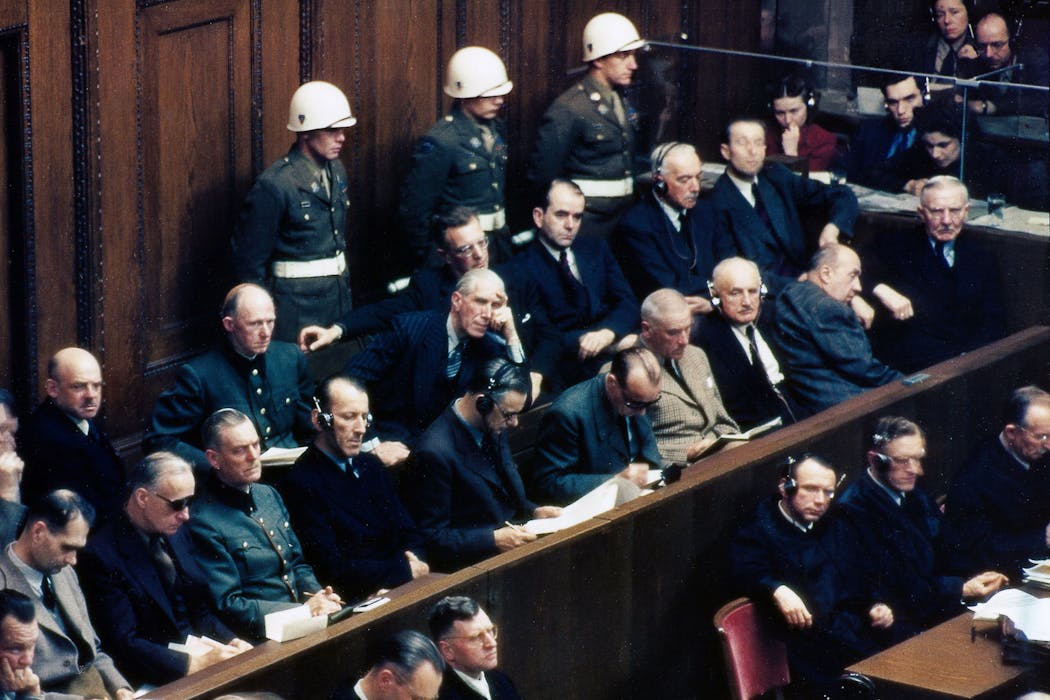
The film “Nuremberg” depicts events surrounding the post-World War II International Military Tribunal – the first and best-known of the Nuremberg trials – which was created to carry out the “just and prompt trial and punishment of the major war criminals of the European Axis.”
Nazi party leaders Hermann Göring, Alfred Rosenberg and Wilhelm Keitel were among the 24 people who ended up being indicted. Six organizations were also indicted, including the Gestapo and the SS. The tribunal, which took place in Nuremberg, Germany, and resulted in 19 convictions, attracted worldwide media attention.
The public’s understanding of these terms is due, in large part, to the success of the Nuremberg trials and the remarkable degree of international cooperation they required. But the shakiness of international justice today, along with the ongoing complexity of legal and moral conceptions of guilt, shows the limits of the law when it comes to holding the worst of the worst accountable.
Not the first attempt at international justice
These trials were not the first effort to prosecute war crimes in an international court.
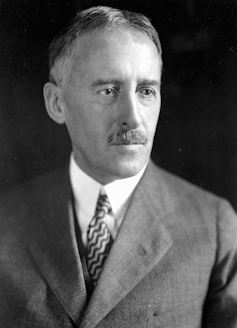
U.S. Secretary of War Henry L. Stimson was a key proponent of an international tribunal to hold Nazis to account. Library of Congress
Several years before the end of World War II, officials in the U.K., U.S. and USSR had already begun to discuss what mechanisms would be best for handling a defeated Germany. Some officials, such as U.S. Secretary of War Henry L. Stimson, argued in favor of trials that adhered closely to American legal principles. Others, like British Foreign Secretary Anthony Eden, objected, specifically citing the failure of the Leipzig trials.
But several aspects were different this time around.
When the four chief prosecutors of the International Military Tribunal, representing the U.K., U.S., USSR and France, filed the indictment for the Nuremberg trials, most of the accused were already in custody. The prosecuting attorneys also had access to a trove of Nazi documents to build their cases.
There still needed to be a solid legal basis for the trials. Some defendants argued that their actions, at the time, had been legal under German law.
For these reasons, the charter that established the International Military Tribunal represented a significant development by outlining and defining the specific crimes that would fall under its jurisdiction: war crimes, crimes against peace and crimes against humanity.
While the category of war crimes was based on existing international conventions, crimes against peace and crimes against humanity had not been previously codified.
The International Military Tribunal proceedings began on Nov. 20, 1945, and the hearings lasted until Sept. 1, 1946. Four judges – one from each of the countries convening the tribunal – presided over the case. Each of the four convening countries also appointed a chief prosecutor to lead the prosecution. Defendants were allowed to select their own legal counsel, subject to the court’s approval.
On Oct. 1, 1946, after a month of deliberation, the judges issued the final rulings. Of the 22 individual defendants, 19 were found guilty, 12 of whom were sentenced to death.
Atrocities committed by Allied forces, however, were not subject to the court’s scrutiny as possible war crimes, nor were actions taken by Allied governments domestically, including the incarceration of Japanese Americans by the U.S. government.
Even U.S. Supreme Court Chief Justice Harlan Fiske Stone expressed misgivings about the legal precedent he saw the trials setting. In a letter discussing International Military Tribunal chief prosecutor Robert H. Jackson – who, at the time, was Stone’s colleague on the Supreme Court – Stone lamented, “I don’t mind what he does to the Nazis, but I hate to see the pretense that he is running a court and proceeding according to common law.”
Questions about the complicity of everyday German citizens and those in Nazi-occupied territories were also left unresolved. To philosopher Hannah Arendt, the verdicts felt rather hollow.
“The Nazi crimes, it seems to me, explode the limits of law,” she wrote to her friend and fellow philosopher Karl Jaspers. “This guilt, in contrast to all criminal guilt, oversteps and shatters any and all legal systems. … We are simply not equipped to deal, on a human, political level, with a guilt that is beyond crime.”
In “Nuremberg,” psychiatrist Douglas Kelley, played by Rami Malek, attempts to understand Hermann Göring’s personality and motivations in order to prevent future atrocities. Kelley assumes Göring will come off as an exemplar of evil. But he finds Göring to be largely ordinary, even likable, and not so different from many Americans.
Psychiatrist Douglas Kelley, on the left, was played by Rami Malek in the film ‘Nuremberg.’ The Denver Post/Getty Images
Nuremberg laid the groundwork
While the Nuremberg trials left plenty of further work to do in developing a fair and functional framework for international justice, they represented a landmark development in international law, most directly in the adoption of the Nuremberg Principles, a set of guidelines regarding what constitutes a war crime.
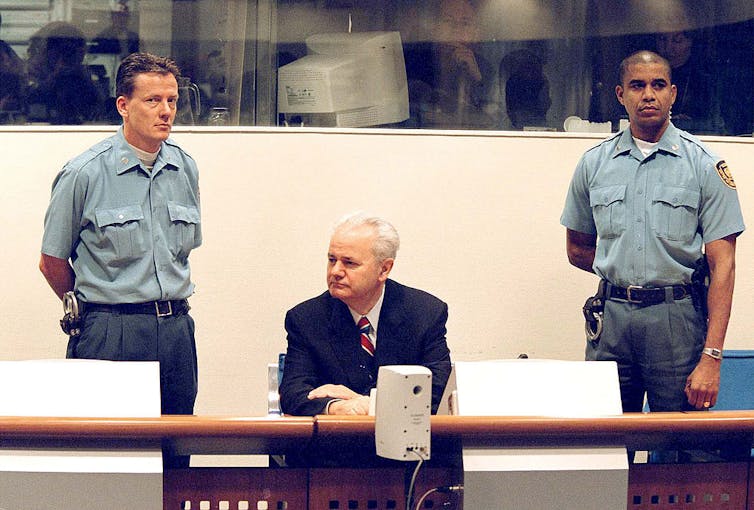
Former Yugoslav President Slobodan Milosevic appears before the U.N. war crimes tribunal at The Hague on Feb. 13, 2002. Pool Photo/Getty Images
A fragile consensus today
After the International Military Tribunal issued its verdicts, Stimson remained a stalwart proponent of the trials he’d championed.
“It was not a trick of the law which brought them to the bar,” he wrote in 1947. It was the “massed angered forces of common humanity.”
In the 80 years since, the world has witnessed countless conflicts and atrocities unfold across the globe, yet only a relatively small number of the alleged perpetrators have been tried before international courts.
Beyond staunch disagreement over how to stop them, you’ll see debates over whether they even constitute crimes in the first place. The legitimacy of international courts is also disputed: In August 2025, the U.S. – which does not belong to the International Criminal Court – imposed sanctions on ICC officials after the court issued arrest warrants against top Israeli officials over alleged crimes in Gaza.
Watching “Nuremberg” in light of Stimson’s claim, you might wonder how to view this current moment vis-à-vis this earlier era.
Have political and social conditions shifted to such an extent that appealing to the “forces of common humanity” is no longer a viable political strategy? Or is the takeaway that there is always value in endeavoring to cultivate some form of consensus – no matter how small – over whether certain lines can never be crossed?
Even if consensus remains elusive, one thing is clear: The world’s knowledge of terms like “genocide” and “crimes against humanity” provides a universally understood way to push back against unfolding atrocities.
B.B. Blaber does not work for, consult, own shares in or receive funding from any company or organization that would benefit from this article, and has disclosed no relevant affiliations beyond their academic appointment.
Federal agents in military fatigues chat with Chicago police officers in Chicago’s Brighton Park neighborhood on Oct. 4, 2025, after federal agents shot a woman during a confrontation.Joshua Lott/The Washington Post via Getty Images
In early 2025, in an effort to facilitate its deportation goals, the Trump administration entered into hundreds of agreements with local police departments to essentially deputize them to act as federal immigration agents.
The bulk of these agreements were signed in Republican strongholds such as Texas and Florida, places where the immigration policies of state leaders aligned with those of the Trump administration.
But as Trump ramped up his deportation efforts over the course of 2025, how would immigration enforcement play out in sanctuary cities and states?
Sanctuary policies aim to focus local policing on community safety rather than immigration enforcement. In 2016, there were approximately 340 of these sanctuary jurisdictions in the U.S. By the start of Trump’s second term, there were just over 1,000 of them
Would local police in sanctuary cities and states step in to protect someone they knew hadn’t committed a felony or was a citizen? Would officers in these places admonish ICE agents for failing to follow proper protocol?
Instead, over the course of 2025, videos from sanctuary jurisdictions – including Chicago, California and Worcester, Massachusetts – showed local police acting more like auxiliary enforcers.
Peter Mancina.
In Peter Mancina’s forthcoming book “On the Side of ICE: Policing Immigrants in a Sanctuary State,” he explores the cultural, bureaucratic and political roadblocks to enacting immigrant-friendly policing reforms, with a focus on New Jersey, where Mancina works as an adjunct law professor at Rutgers University.
In an interview, edited for length and clarity, Mancina explains why sanctuary policies don’t necessarily change what happens on the ground.
The adoption of sanctuary policies grew dramatically during the first Trump administration. Yet at various points in the book, you call them a “rebrand,” a “public relations facade” and “immigration enforcement assistance with an immigrant friendly face.” What’s behind those characterizations?
There’s an internal tension to sanctuary policies. There’s this broader sanctuary movement that’s been around since roughly 1980, which came about largely in response to U.S. involvement in Central American civil wars and protecting immigrants fleeing these and other conflicts.
The activists started working with city officials sympathetic to their cause in cities such as San Francisco to create resolutions protecting immigrants that were largely symbolic. After the San Francisco Police Department was found to be ignoring the resolution, the city created the country’s first sanctuary ordinance in 1989. With this ordinance, activists hoped that local police could be prevented from collaborating with federal immigration officers.
But many activists assumed that the kind of ethics and the values that existed in the sanctuary movement could actually be taken up in policy and implemented, because there’s this notion that when you pass a law or ordinance it will be implemented as written.
A major part of the book is to say, “Actually, that’s not how policy works.” It fits within these bureaucratic cultures. And in policing culture, there’s already this web of relationships that local cops have with federal agents, and these cultures have their own value systems. Something that people don’t really talk about is that local police aren’t just used by ICE as these local enforcers of immigration law. In fact, a lot of times local law enforcement look to ICE as partners and collaborators.
Where does the breakdown happen between policy and practice?
These current policies largely acknowledge the fact that the majority of the undocumented people that local law enforcement encounter don’t have criminal backgrounds. They say that what we want to target are these really terrible people who are the violent criminals.
These criminals are framed as the exception to the rule. But these exceptions still end up leading to quite a few people being transferred by local police and jails to ICE. And the exceptions can easily be exploited or broadened by the boots on the ground – the police tasked with following the policy – because there’s often this gray area in the language.
So what ends up happening is that there really isn’t any sort of major decrease in deportations in sanctuary jurisdictions. In 2018, New Jersey Attorney General Gurbir Grewal issued his Immigrant Trust Directive, which barred local law enforcement from helping federal authorities carry out civil-immigration enforcement. The last year before it was implemented, local police turned 1,000 people being held in local jails over to ICE. After it went into effect, that number went down slightly the following year, to 700 people. That’s still a lot of undocumented people being turned over. And it’s because local police were able to apply those “exceptional circumstances” in many of those cases.
In the book, you relay this one instance in New Jersey where ICE calls in the local police as backup, and the local police – aware of the state’s new Immigrant Trust Directive – describe their role on the scene to local activists and passersby as “protecting public safety.” Yet you point out that they actually are helping ICE, because their cars are parked to block the street so the targeted immigrant can’t drive away.
You can have a policy, like the one that the Los Angeles City Council passed in 2024, which was basically written as a “no cooperation policy.” And still, it’s not possible to actually pull off in practice, because you then have those cases like the one you just mentioned, where even if you ban “immigration enforcement practices” like making immigration-related arrests, basic public safety policing is going to still happen, whether that’s crowd control or traffic control.
So when local police show up at an immigration home arrest or a worksite raid, they often become part of immigration enforcement by virtue of the fact that they’re there to protect pedestrians, route traffic, respond to violence or protect ICE agents.
You’ll see this on social media, when protests rapidly form to surround ICE officers during raids. Police step in to assist ICE by protecting them as they haul someone away. This turns emergency assistance and crowd control into a form of immigration enforcement itself.
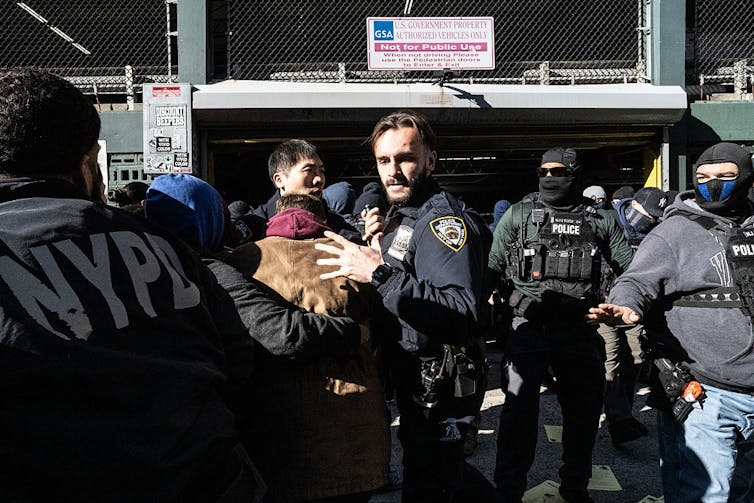
NYPD officers respond as protestors block a garage used by ICE vans ahead of a purported ICE raid on New York City’s Canal Street on Nov. 29, 2025. Stephanie Keith/Getty Images
Ultimately, when you get down into the procedural level of how you implement this stuff, it’s actually not possible to avoid cooperating. Complete non-cooperation and complete protection simply do not happen.
I’ve also seen local law enforcement agencies in sanctuary jurisdictions simply post all of their inmate information online. ICE agents can routinely check those databases and show up to arrest them once the inmates are released.
Under the George W. Bush administration, there was the Secure Community program, in which the Department of Homeland Security required local police to check the immigration status of anyone that they fingerprint. The Obama administration actually expanded this program. How have programs like this facilitated what you describe as a “professional kinship” between local police and federal agents?
The way I see it, local police and federal agencies have different missions and different objectives, but they see themselves as being able to help each other accomplish their various goals.
Many local police departments have long seen deportations as just another tool that they can use to get criminals off the street for good. Once they’ve arrested an undocumented person, they assume that if they’re deported, there won’t be an opportunity for them to return to the community to commit more crimes. And this view has been ingrained and reinforced through these collaborative partnerships like the Secure Communities program.
Interestingly, during the height of the Secure Communities program, (legal scholars) Adam Cox and Thomas Miles conducted a statistical analysis of 3,000 counties from 2005 to 2013 that assisted ICE by turning people over to them from local jails.
They found, across the board, that crime in these counties didn’t decrease. It sounds counterintuitive. But when most people deported through jail transfers are people with low-level jail bookings – and not serious convictions – it makes more sense. It also doesn’t stop people who are part of a criminal enterprise from figuring out a way to get back into the country after being deported.
I want to go back to that term “sanctuary.” Opponents of sanctuary policies seem to have used it as a cudgel, and I think that’s because the layperson understands “sanctuary” as total protection. You obviously show that not to be the case. Have you seen elected officials avoiding the term?
Around 2011 or 2012, officials started walking back the way they framed sanctuary policies. They were clearly sanctuary policies in terms of how they’d been crafted and what they attempt to do. But places like Chicago, for example, called theirs a “Welcoming City” ordinance.
These new terms emerged largely due to attacks by right-wing outlets such as Fox News and Breitbart. There was just a lot of bad press.
And, yeah, politicians are running away from the term: I’ve heard different ones say, you know, “This is not a sanctuary policy,” even though it’s been crafted using almost the exact same language as policies that are explicitly described as sanctuary policies.
As I noted earlier, there was a time when activists and lawmakers thought these policies really were going to stop local jails and local police from helping to deport people. They just didn’t anticipate the durability of local-federal partnerships and their tenacity in finding ways to circumvent the intentions of lawmakers.
I think over time – as the spirit of these policies continues to be violated by many local law enforcement officers – the term “sanctuary” has been used in more of an aspirational sense.
Do local officers ever get disciplined for violating sanctuary policy?
I actually studied this – separate from the book – in San Francisco, where the police chief had issued a sanctuary city order.
If an officer violates a local department order, it can go in their police file. These write-ups can add up and can lead to an actual firing under police union rules.
In every single case where there was a violation of the sanctuary rules, the only thing that was issued was a verbal admonishment. So no write-ups. It’s the equivalent of someone saying, “Don’t do that again,” and leaving it at that.
They knew their superiors were aware. So it was not nothing. In certain circumstances, those who had violated the order were told to go back to the San Francisco Police Academy for training on the sanctuary ordinance.
But none of it went into their files. You could say it was a very lenient culture around those rules.
Returning to New Jersey: Was there any follow-up on whether local police departments were adhering to the Immigrant Trust Directive?
So when the trust directive was implemented, the New Jersey attorney general’s office created training for all law enforcement officers. It was an online video that they had to watch. It was a few hours long. It was very technical. I watched it. Though some officers were allowed to do other work while watching, they all had to do it, and there was a very firm accounting of ensuring that every officer got that training.
I also know that in the first year, they required local agencies to report back any instances of cooperation with federal immigration authorities. But after that first year, the follow-up seems to have stopped altogether. There were no further documented reports.
I also managed a team of researchers that did a public records request of over 400 agencies across the state. I wanted to see whether local police departments had changed their policies to include the dictates of the Immigration Trust Directive.
I was able to get access to records from 68% of all law enforcement agencies in the state. Of those, only 55% had actually changed their procedures so they were compliant with the Immigrant Trust Directive. Keep in mind, there were still pro-immigration enforcement procedures that were already on the books from Anne Milgram’s tenure (New Jersey’s attorney general from 2007 to 2010), when officers were encouraged to inquire about immigration status. It turns out many departments didn’t even tweak these internal policies and procedures.
What has stood out to you about the deportation efforts of the second Trump administration?
What’s happening are extensions of what’s been happening over the past few decades, in terms of the federal government looking to partner with different agencies at the local, state and federal levels, whether it’s sheriff’s departments, the ATF, the FBI or the Secret Service.
But none of this coordination has ever happened to the degree we’re seeing right now. The administration is assigning people within these various agencies to do full-time immigration enforcement.
What’s been really amazing to me, too, has been the amplification of the 287(g) program. These are agreements signed with the Department of Homeland Security that permits local police officers to go out and find undocumented people to arrest and be potentially deported in the course of their everyday policing activities. So it allows them to double as a federal officer.
Over the course of your 15 years studying sanctuary policing – either for this book or for your other studies – did you ever encounter instances where local police arrived at the scene of an ICE raid or an arrest and took the side of undocumented immigrants or citizens for one reason or another, whether that meant admonishing ICE agents for their aggressiveness or telling them, “Hey, you’re not following proper protocol.”
Obituaries preserve what families most want remembered about the people they cherish most. Across time, they also reveal the values each era chose to honor.
In a study published in the journal Proceedings of the National Academy of Sciences, we analyzed 38 million obituaries of Americans published from 1998 to 2024. We identified the values families most often highlight, and how those values shift across generations, regions and major historical events.
Specifically, working with psychologists Liane Young and Thomas Mazzuchi, we examined the language used on Legacy.com, an online platform where families often post obituaries and share memories of loved ones.
During their lifetime, most people tend to be guided by a small set of broad values like caring for others, honoring tradition, keeping loved ones safe and seeking personal growth. To understand how these values showed up in remembrance, we used text-analysis tools built on curated lists of everyday words people use when talking about those themes.
By analyzing the words that appeared again and again in memorials, we could see which values communities chose to emphasize when looking back on the lives of their loved ones, and how those patterns changed over time. Because the dataset included 38 million obituaries, the analysis ran on a supercomputer.
Across nearly 30 years of obituaries, words related to the value “tradition” appeared most often – many tributes described religious participation and enduring customs. Words related to the value “benevolence” – caring for the welfare of others – were also consistently prominent. In fact, tradition and benevolence formed the dominant value profile across the dataset: They appeared in more than 70% of the obituaries. By contrast, words related to values like “achievement” and “power” appeared far less often.
Historical events did leave a mark. After the attacks of Sept. 11, 2001, the language families used to remember loved ones shifted compared with the period just before the attacks – and those shifts persisted for at least a year. Words related to the value “security” – including terms like “surviving,” “health” and “order” – showed up less often. At the same time, families used more language related to values like “benevolence” and “tradition.” Terms like “caring,” “loyal” and “service” showed up more often. These changes were especially strong in New York, where the attacks had the most direct impact.
COVID-19, however, produced the most dramatic shifts. Beginning in March 2020, benevolence-related language – including terms like “love,” “sympathy” and “family” – declined sharply, and hasn’t been the same since. Tradition-related language – terms like “service,” “faith” and “heritage” – initially declined as well, then rose above baseline levels during later stages of the pandemic.
These changes show that collective disruptions impact the moral vocabulary families use when commemorating loved ones. They shift what it means to have lived a good life.
We also saw differences that reflect stereotypes about gender and age. Obituaries for men contained more language linked to achievement, conformity and power. Meanwhile, obituaries for women contained more language associated with benevolence and enjoying life’s pleasures.
Older adults were often remembered more for valuing tradition. Younger adults, on the other hand, were often remembered more for valuing the welfare of all people and nature, and for being motivated to think and act independently. Value patterns in men’s obituaries shifted more across the lifespan than those in women’s. In other words, the values highlighted in younger and older men’s obituaries differed more from each other, while women’s value profiles stayed relatively consistent across age.
Why it matters
The most visited parts of print newspapers and online memorial sites, obituaries offer a window into what societies value at different points in time.
This study contributes to the broader scientific understanding of legacy. People often hold strong preferences about how they want to be remembered, but far less is known about how they actually are remembered, in part because large-scale evidence about real memorials is rare. Our analysis of millions of obituaries helps fill that gap.
What’s next
Obituaries allow researchers to trace cultural values across time, geography and social groups. Future work can examine differences across race and occupation, as well as across regions. It could also look to earlier periods using historical obituary archives, such as those preserved in older newspapers and local records.
Another direction is to examine whether highlighting how often kindness shows up in obituaries could inspire people to be more caring in daily life.
Understanding what endures in memory helps clarify what people consider meaningful; those values shape how they choose to live.
The Research Brief is a short take on interesting academic work.
The authors do not work for, consult, own shares in or receive funding from any company or organization that would benefit from this article, and have disclosed no relevant affiliations beyond their academic appointment.
There is a meme that circulates every holiday season, an image of a sign in a restaurant window. “The Chinese Restaurant Association of the United States would like to extend our thanks to the Jewish people,” it says. “We do not completely understand your dietary customs … but we are proud and grateful that your GOD insists you eat our food on Christmas.”
Is the sign real? Perhaps not; the fact-checking site Snopes found no evidence of the association even existing. But the joke’s popularity points to a tradition cherished by many American Jews – Chinese food on Christmas.
But why would Jews, who do not celebrate Christmas, have Christmas traditions?
Like many minority groups, Jews have always created ways of adapting to the societies in which they live, but whose culture they do not totally share. And one thing that means is a collection of Christmas traditions, varying by time and place. Many of them came up in interviews for my book “Beyond Chrismukkah: The Christian-Jewish Interfaith Family in the United States.”
Old World festivities
Long before Jews came to the United States, some of them celebrated Christmas – participating in many of the cultural traditions, even as they avoided the religious part of the holiday.
According to Jordan Chad, author of “Christmas in Yiddish Tradition,” Jewish folklore about the holiday appears as early as the late 1300s. Plenty of Jewish communities in Europe spent Christmas Eve dancing and drinking, feasting and gambling – as many of their Christian neighbors did, when those neighbors were not in church.
Other scholars have argued that these traditions grew out of attempts to avoid studying Jewish religious texts on a Christian holiday. But Chad demonstrates that, over centuries, those customs came to celebrate the revelry of the season – though not the birth of Jesus.
Even in the 20th century, scholars such as Yaniv Feller have found, many middle- and upper-class German Jews embraced a secular Christmas, complete with a tree, a traditional dinner and presents. After all, some of those Christmas traditions stem less from religion than folk traditions and industrialization.
Given that long history, Jewish Christmas traditions are not necessarily a sign of Americanization.
That said, in the United States, Christmas is so culturally powerful – a day that almost everyone has off, and that the majority of Americans spend with their kith and kin – that many non-Christian immigrants celebrate it in a secular way, with family visits, Santa and a tree. They do not necessarily do the religious parts of the holiday, but they may well deck the halls. Certainly, my own Hindu relatives do.
And many Jews celebrate Christmas in some way because they are part of interfaith families – whether their own immediate family or extended relatives with whom they spend the day. Today, estimates place the American Jewish interfaith marriage rate as high as 50%.
Kosher-style Chinese
For plenty of contemporary Jews, however, it is profoundly important not to celebrate a secular version of Christmas. Starting in the 1970s, in fact, when American Jews were particularly worried about rising rates of interfaith marriage, many of the rabbis willing to perform ceremonies for Jewish-Christian couples made them promise to not have a Christmas tree. This happened despite the fact that, at the time, many American Jews did have Christmas trees in their homes.
Even if Jews do not want to deck the halls, though, many still have the day off. Meanwhile, their non-Jewish friends, families and co-workers are busy and much of the world is closed. And so many Jews have developed their own ways of marking the day.
Elena Kagan’s Senate confirmation hearings made mention of the famous tradition.
The first written mention of Jews eating Chinese food on Christmas Day comes from 1935, when, according to The New York Times, a man named Eng Shee Chuck brought chow mein and toys to a New Jersey Jewish orphanage.
His generosity was probably not why Jews started going to Chinese restaurants on Christmas; it is more likely that they were already doing so. The two communities lived cheek by jowl in many American cities, where immigrants of different sorts ended up in the same neighborhoods. And Chinese food contains little dairy, meaning it rarely violated Jewish dietary laws against mixing milk and meat.
Most Chinese cuisines do use pork and shrimp, which is forbidden by kosher laws. But many Jewish customers were happy to make an exception, especially if the forbidden food was tucked in a dumpling or otherwise out of sight – at least outside their own homes.
As restaurant owners learned that Jews often eschewed pork, some began to offer traditional dishes with chicken instead – allowing more observant Jews to eat “kosher style,” without eating explicitly forbidden food. Today, there is wide variation in Jewish dietary practices, making Chinese food even more accessible for most Jews.
Two men enjoy Chinese cuisine, prepared under kosher guidelines, around 1960. Bettmann via Getty Images
By the end of the 20th century, “Chinese food and a movie” had become the trope of Jewish Christmas. Because most Chinese immigrants were not Christian, their restaurants are often open on Dec. 25. And indeed, they are often filled with Jews.
Movies, volunteering and more
The same tends to be true for movie theaters. In 2012, I saw “Les Misérables” on Christmas Day in a theater that seemed to be a who’s who of the Atlanta Jewish community. In fact, the movies and the Chinese food are often paired, whether out on the town or at home, streaming with take out.
Jewish museums are often open and are another popular destination in cities that have them. And some Jews use Christmas Day for travel. At least in eras past, plane tickets were notably cheaper than the days around the holiday.
Another Jewish Christmas tradition is simply to go to work, so as to let Christian colleagues have the day off. Many Jewish doctors and nurses are on call, or staff the emergency room or the intensive care unit, so that their colleagues can be home.
A Christmas tree is decorated with the pandemic in mind in the COVID-19 ICU at UMass Memorial Medical Center in Worcester, Mass., in December 2020. Craig F. Walker/The Boston Globe via Getty Images
Still other Jews perform charitable deeds on Christmas: They staff soup kitchens and food banks, bring holiday cheer to nursing homes and hospital patients, or deliver gifts to children in shelters.
Living in a culture that largely closes down each Dec. 25, many Jews have found ways of making meaning in the day – be that sharing family time over beef and broccoli, followed by a holiday blockbuster, or working to make sure that more of their colleagues can have a family day. And those, too, are Christmas traditions.
Samira Mehta receives funding from the Henry Luce Foundation.
In a Maryland operating room one day in November 2025, doctors made medical history by transplanting a genetically modified pig kidney into a living patient. The kidney had been engineered to mimic human tissue and was grown in a pig, as an alternative to waiting around for a human organ donor who might never come. For decades, this idea lived at the edge of science fiction. Now it’s on the table, literally.
A decade ago, scientists were chasing a different solution. Instead of editing the genes of pigs to make their organs human-friendly, they tried to grow human organs – made entirely of human cells – inside pigs. But in 2015 the National Institutes of Health paused funding for that work to consider its ethical risks. The pause remains today.
As a bioethicist and philosopher who has spent years studying the ethics of using organs grown in animals – including serving on an NIH-funded national working group examining oversight for research on human-animal chimeras – I was perplexed by the decision. The ban assumed the danger was making pigs too human. Yet regulators now seem comfortable making humans a little more pig.
Why is it considered ethical to put pig organs in humans but not to grow human organs in pigs?
Urgent need drives xenotransplantation
It’s easy to overlook the desperation driving these experiments. More than 100,000 Americans are waiting for organ transplants. Demand overwhelms supply, and thousands die each year before one becomes available.
For decades, scientists have looked across species for help – from baboon hearts in the 1960s to genetically altered pigs today. The challenge has always been the immune system. The body treats cells it does not recognize as part of itself as invaders. As a result, it destroys them.
A recent case underscores this fragility. A man in New Hampshire received a gene-edited pig kidney in January 2025. Nine months later, it had to be removed because its function was declining. While this partial success gave scientists hope, it was also a reminder that rejection remains a central problem for transplanting organs across species, also known as xenotransplantation.
Decades of research have led to the first clinical trial of pig kidney transplants.
Researchers are attempting to work around transplant rejection by creating an organ the human body might tolerate, inserting a few human genes and deleting some pig ones. Still, recipients of these gene-edited pig organs need powerful drugs to suppress the immune system both during and long after the transplant procedure, and even this may not prevent rejection. Even human-to-human transplants require lifelong immunosuppressants.
That’s why another approach – growing organs from a patient’s own cells – looked promising. This involved disabling the genes that let pig embryos form a kidney and injecting human stem cells into the embryo to fill the gap where a kidney would be. As a result, the pig embryo would grow a kidney genetically matched to a future patient, theoretically eliminating the risk of rejection.
Cross-species organ growth was not a fantasy – it was a working proof of concept.
Ethics of creating organs in other species
The worries motivating the NIH ban in 2015 on inserting human stem cells into animal embryos did not come from concerns about scientific failure but rather from moral confusion.
Policymakers feared that human cells might spread through the animal’s body – even into its brain – and in so doing blur the line between human and animal. The NIH warned of possible “alterations of the animal’s cognitive state.” The Animal Legal Defense Fund, an animal advocacy organization, argued that if such chimeras gained humanlike awareness, they should be treated as human research subjects.
The worry centers on the possibility that an animal’s moral status – that is, the degree to which an entity’s interests matter morally and the level of protection it is owed – might change. Higher moral status requires better treatment because it comes with vulnerability to greater forms of harm.
Think of the harm caused by poking an animal that’s sentient compared to the harm caused by poking an animal that’s self-conscious. A sentient animal – that is, one capable of experiencing sensations such as pain or pleasure – would sense the pain and try to avoid it. In contrast, an animal that’s self-conscious – that is, one capable of reflecting on having those experiences – would not only sense the pain but grasp that it is itself the subject of that pain. The latter kind of harm is deeper, involving not just sensation but awareness.
Thus, the NIH’s concern is that if human cells migrate into an animal’s brain, they might introduce new forms of experience and suffering, thereby elevating its moral status.
How human do pigs need to be for them to be considered part of the human species? AP Photo/Shelby Lum
The flawed logic of the NIH ban
However, the reasoning behind the NIH’s ban is faulty. If certain cognitive capacities, such as self-consciousness, conferred higher moral status, then it follows that regulators would be equally concerned about inserting dolphin or primate cells into pigs as they are about inserting human cells. They are not.
In practice, the moral circle of beings whose interests matter is drawn not around self-consciousness but around species membership. Regulators protect all humans from harmful research because they are human, not because of their specific cognitive capacities such as the ability to feel pain, use language or engage in abstract reasoning. In fact, many people lack such capacities. Moral concern flows from that relationship, not from having a particular form of awareness. No research goal can justify violating the most basic interests of human beings.
If a pig embryo infused with human cells truly became something close enough to count as a member of the human species, then current research regulations would dictate it’s owed human-level regard. But the mere presence of human cells doesn’t make pigs humans.
The pigs engineered for kidney transplants already carry human genes, but they aren’t called half-human beings. When a person donates a kidney, the recipient doesn’t become part of the donor’s family. Yet current research policies treat a pig with a human kidney as if it might.
There may be good reasons to object to using animals as living organ factories, including welfare concerns. But the rationale behind the NIH ban that human cells could make pigs too human rests on a misunderstanding of what gives beings – and human beings in particular – moral standing.
Monika Piotrowska does not work for, consult, own shares in or receive funding from any company or organization that would benefit from this article, and has disclosed no relevant affiliations beyond their academic appointment.
Source: The Conversation – UK – By Kathrin Maurer, Professor, Department of Cultural and Linguistic Studies, University of Southern Denmark
It’s 2:44 am. An air siren cuts through the clear night sky over Kyiv and into my sleep. Heart pounding, I rise out of bed in my seventh-floor room of the Hotel Rus. Feeling like I’m on autopilot, I walk down the stairs to the bomb shelter. Chairs are lined up in orderly rows in this basement that was once a gym. But only one elderly man in jogging pants with a travel cushion around his neck sits here.
I quietly take a seat next to him and try to figure out the threat level on my newly installed Kyiv Air Alert App. The air threat persists, but tonight people seem to have decided that sleep is more important. I, too, resolve to return to my room. I have to be awake for my lecture tomorrow at the Pinchuk Art Centre, a well-known international museum for contemporary art in Kyiv.
The lecture is the reason I am in Kyiv. As a professor of culture and technology at the University of Southern Denmark, I was invited to speak about my research on drone art.
Drone art is about using artistic practices to explore, question and reflect on military drones. Being asked to give a talk about this in Ukraine felt like a rare and important opportunity – and I didn’t hesitate to say yes.
The next day, I have some time before my talk. I take a stroll along the boulevards and the grand neoclassical buildings in the centre of Kyiv. People are out in cafes, bars and restaurants. The bustling shops are crowded with customers.
Where is the war on this blue-sky day in Kyiv, one might wonder.
But the war is here, constantly.
I spot groups of soldiers in camouflage standing on the street. A man on crutches, who carefully crosses a road junction. Statues encased in sandbags and boarded up – sheltered from air raids.
Kyiv’s central square, Maidan Square, is awash with flags and portraits commemorating fallen soldiers. The air is filled with the constant roar of generators that provide electricity during ongoing power outages.
In the evening, I finally stand in the lecture hall of the Pinchuk Art Centre to give my presentation. Young people, art students, curators, artists and older generations sit in the audience.
What can I tell them about drones – those for whom remote warfare has become a daily reality?
I talk about art, about military drones, about technology, about loss. I focus on the Ukrainian artist Lesia Khomenko, whose large format oil and acrylic works are on show in the museum.
Her painting “I’m a Bullet” (2024) is striking, as it shows the perspective of a kamikaze drone before it hits its target.
The painting is abstract, and its white, expressive brush strokes give you an impression of an explosion. Khomenko’s art does not represent iconic images of war; her work engages with questions of how remote sensing technology dehumanises the subject and raises ethical questions about how we, as an audience, “watch” war.
Their recent work “Four Seasons” (2025) is a four-channel film that shows a small drone hitting a window in a living room and making a buzzing noise. Its manoeuvres echo Ukrainian youths practising drone piloting at home to prepare for possible conscription.
Yarema Malashchuk and Roman Khimei, Four Seasons (2025). With permission of the artists.
After my lecture, a woman who sat in the front row and eagerly took notes approached me: “My son was killed by a Russian drone strike”. We look at each other in silence. I try to find words. She gives me a slight smile and says: “Thank you for coming to Kyiv. Engaging with art can be a lifeline”. And then she hastily leaves the room.
Staying connected to life
During my time in Kyiv, in my conversations with the artists, curators and people I meet, I’m told time and again how creating or engaging with art builds resilience – how art helps people get through crisis and how art helps communities stay connected to life.
The sold-out opera houses, concert halls and theatres are proof of that. And although museums have had to protect part of their collections in shelters, they are open, and people flock to the exhibits.
On my departure day, I sit on the early morning train to Warsaw – 16 hours ahead, no flights in or out of Kyiv these days. Through the train window, birch trees pass in a blur, as we traverse snow-covered fields and quiet villages.
During the past few days, the war came closer to me than ever. It is as though I can feel it in my body, although I have only been in Kyiv for 72 hours.
I have the privilege of returning to a place of peace. Others do not.
The war does not stop at the border – it touches all of us in ways seen and unseen. In the spaces of art and culture, we can pause, reflect, and hold in our minds the lives and stories that demand to be remembered.
This article was commissioned as part of a partnership between Videnskab.dk and The Conversation.
This article was commissioned as part of a partnership between Videnskab.dk and The Conversation.
Source: The Conversation – in French – By Zunaida Moosa Wadiwala, Legal Researcher, PhD Candidate and Lead of the African Climate Law Programme, Mandela Institute, University of the Witwatersrand
Une décision de justice française pourrait donner aux pays africains davantage de moyens pour demander des comptes aux entreprises qui se prétendent écologiques sans l’être. Le Tribunal de grande instance de Paris a jugé le géant mondial du pétrole et du gaz TotalEnergies coupable de pratiques commerciales trompeuses. L’affaire a été portée devant les tribunaux par trois organisations environnementales.
Cette décision d’octobre 2025 est historique. C’est la première fois qu’un grand groupe pétrolier est puni par les tribunaux pour écoblanchiment ou greenwashing. Le greenwashing, c’est quand une entreprise fait croire qu’elle respecte l’environnement alors que ce n’est pas vrai.
Les émissions de gaz à effet de serre de TotalEnergies augmentent chaque année. Pourtant, dans une campagne publicitaire, l’entreprise se présentait comme “un acteur majeur de la transition énergétique”. L’entreprise a également affirmé pouvoir atteindre la neutralité carbone d’ici 2050. Autrement dit, elle serait capable de ne plus émettre de gaz à effet de serre qu’elle ne pourrait en absorber.
Les organisations ont déclaré au tribunal que TotalEnergies avait fait croire aux consommateurs qu’elle disposait d’un plan climatique conforme à l’objectif de l’Accord de Paris. Celui-ci vise à limiter le réchauffement climatique à moins de 1,5 °C par rapport aux niveaux préindustriels.
Pour atteindre cet objectif, il faut réduire les émissions de gaz à effet de serre de 43 % d’ici 2030. Les pollueurs utilisant des combustibles fossiles devraient mettre fin à la plupart de leurs émissions.
Le tribunal a donné raison aux plaignants. Il a confirmé que les publicités de TotalEnergies pouvaient faire croire au consommateur moyen que l’entreprise participait à la lutte contre le changement climatique.
Nous sommes des spécialistes du droit climatique et nous étudions les conséquences pour l’Afrique des jugements rendus par les tribunaux internationaux contre la pollution causée par les combustibles fossiles.
Pour nous, cette décision du tribunal de Paris contre TotalEnergies est un tournant. Elle marque un moment décisif en matière de responsabilité des entreprises et des litiges climatiques. Cette défaite de TotalEnergies montre que les entreprises ne peuvent pas se contenter de belles promesses de neutralité carbone. Leurs engagements climatiques doivent être assortis d’objectifs clairs et scientifiquement vérifiables.
Ce jugement pourrait inspirer des actions similaires en justice dans les pays africains. Il montre que les consommateurs peuvent intenter des procès contre des entreprises responsables de publicités mensongères sur le climat. Il montre également que la société civile peut utiliser la législation sur la protection des consommateurs contre les grands pollueurs. Et ce, avant même que les autorités de régulation ne réagissent. Cette voie est désormais ouverte pour les tribunaux africains.
Les projets énergétiques controversés suscitent des réactions négatives
TotalEnergies exploite des projets pétroliers et gaziers dans 43 pays africains. Elle est perçue comme une entreprise controversée. En effet, ses projets pétroliers et gaziers de grande envergure en Afrique sont pointés du doigt pour leur impact sur l’environnement et leur contribution au changement climatique.
L’entreprise prévoit également d’étendre ses activités sur le continent. En août 2024, TotalEnergies a décidé de mettre fin à l’exploration gazière dans les blocs offshore sud-africains. Mais elle a ensuite annoncé son intention de procéder à des forages offshore en 2026 dans le pays, si elle obtient les autorisations environnementales requises.
Au Mozambique, TotalEnergies n’a réalisé que 40 % d’un projet gazier de 20 milliards de dollars. Ce chantier a été suspendu pendant quatre ans en raison des attaques des insurgés dans la région de Cabo Delgado. Maintenant, l’entreprise demande une prolongation de contrat de 10 ans pour compenser les coûts supplémentaires. Le gouvernement pourrait contester cette demande.
TotalEnergies participe aussi au projet pétrolier du pipeline d’Afrique de l’Est (EACOP)) en Ouganda et en Tanzanie. Des organisations à but non lucratif sur place qualifient cet oléoduc de “catastrophe humanitaire et environnementale”.
Ce que TotalEnergies a fait de mal
En France, le greenwashing est réglementé. Afin de protéger les consommateurs, les allégations environnementales des entreprises doivent être exactes, vérifiables et non trompeuses. La loi prévoit des conséquences juridiques en faveur des consommateurs.
Le tribunal français a jugé que TotalEnergies avait induit le public en erreur en affirmant qu’elle atteindrait la neutralité carbone. Elle a été condamnée pour des pratiques commerciales déloyales et interdites par le Code de la consommation français.
Le tribunal a ordonné à TotalEnergies de mettre fin à sa publicité trompeuse. L’entreprise doit publier la décision sur son site web pendant 180 jours, sous peine d’une amende de 20 000 € (23 000 $ US) par jour. Elle a également été condamnée à verser 8 000 € (9 230 $ US) aux plaignants pour préjudice moral.
La nouveauté sur le plan juridique est que le tribunal ne s’est pas contenté d’examiner les émissions de gaz à effet de serre de TotalEnergies pour juger si l’entreprise respectait les règles climatiques. Il a vérifié aussi si les engagements climatiques futurs de l’entreprise correspondaient à l’objectif juridiquement contraignant de l’Accord de Paris (limiter le réchauffement à 1,5 °C par rapport à la température mondiale avant 1760).
Le tribunal a jugé que la promesse de TotalEnergies d’augmenter à la fois sa production de pétrole, de gaz et la réduction des émissions de gaz à effet de serre était trompeuse. En l’occurrence, le tribunal a appliqué un standard scientifique pour évaluer la crédibilité des engagements climatiques de l’entreprise.
Pourquoi ce jugement est important
Ce jugement fait suite à plusieurs affaires dans lesquelles la Cour européenne des droits de l’homme a estimé que les pays ne faisaient pas assez pour prévenir de nouveaux dommages climatiques. Par exemple, la Cour a estimé que la Suisse n’avait pas développé une politique climatique suffisante pour protéger le droit à la vie des citoyens. Elle a également estimé que la Norvège devait réaliser des études complètes sur le climat avant d’approuver de nouveaux projets pétroliers et gaziers. Ces évaluations doivent inclure l’impact des gaz à effet de serre émis à l’étranger.
La Cour internationale de justice et le Tribunal international du droit de la mer rappellent aussi que les pays doivent tout mettre en œuvre pour prendre des précautions contre les émissions de gaz à effet de serre d’origine humaine. La Cour internationale de justice a également confirmé qu’un environnement propre, sain et durable est un droit humain.
Combinés à la décision relative au greenwashing de TotalEnergies, ces jugements reflètent une évolution majeure du droit climatique. La loi ne s’intéresse plus seulement à ce que les pollueurs émettent, mais aussi à ce qu’ils affirment.
Quelle est la prochaine étape pour l’Afrique ?
La [Charte africaine des droits de l’homme et des peuples](https://www.african-court.org/wpafc/wp-content/uploads/2020/04/AFRICAN-BANJUL-CHARTER-ON-HUMAN-AND-PEOPLES-RIGHTS.pdf “) reconnaît déjà que les personnes ont droit « à un environnement global satisfaisant et propice au développement ». Et la décision de justice indique clairement que les allégations trompeuses en matière de climat violent ce droit.
La décision précise également que le greenwashing constitue une violation des droits des consommateurs. Pour l’Afrique, cela veut dire que tous les gouvernements doivent veiller à ce que leurs lois sur la consommation et la publicité protègent la société contre le greenwashing.
En définitive, cette décision montre que les revendications de pratiques prétendument « vertes » ou « neutres en carbone » peuvent donner lieu à des poursuites judiciaires devant les tribunaux africains. Pour les consommateurs, les investisseurs et les décideurs politiques, la leçon est claire : les entreprises doivent faire preuve d’honnêteté sur leurs engagements sur le climat.
Tracy-Lynn Field receives funding from the Claude Leon Foundation. She is a non-executive director of the Wildlife and Environmental Society of South Africa.
Zunaida Moosa Wadiwala does not work for, consult, own shares in or receive funding from any company or organisation that would benefit from this article, and has disclosed no relevant affiliations beyond their academic appointment.
Source: The Conversation – in French – By Ibrahima Diallo, Chercheur à l’Institut Sénégalais de Recherches Agricoles, Institut sénégalais de recherches agricoles (ISRA)
Derrière les discours sur la modernisation de l’agriculture en Afrique, une question centrale demeure : comment garantir des conditions de travail dignes dans un secteur dominé par l’informel et des tâches pénibles ?
Ibrahima Diallo, chercheur à l’Institut sénégalais de recherches agricoles (Isra), spécialiste des questions liées au travail agricole, s’est penché sur le sujet dans une étude collective récente . Il explique à The Conversation les leviers pour améliorer concrètement la vie de ceux et celles qui travaillent la terre.
Comment définissez-vous le “travail décent” en agriculture ?
Lorsque l’on parle de « travail décent », on se réfère généralement à la définition proposée par l’Organisation internationale du travail (OIT) : un travail productif, correctement rémunéré, exercé dans des conditions de sécurité, de liberté et de dignité. C’est une définition importante, mais dans nos recherches – menées avec mes collègues Pierre Girard (Cirad), Nathalie Hostiou (Inrae) et Benoît Dedieu (Inrae) – nous avons très vite vu ses limites lorsqu’on l’applique directement à l’agriculture en Afrique de l’Ouest.
Les limites de l’utilisation de ce concept de travail décent dans le secteur agricole ont également été pointées dans un article collectif de chercheurs membres de l’IAWA (International Association of Work in Agriculture « Revisiting the concept of ‘decent work’ for agriculture » .
Pourquoi ? Parce que la définition proposée par l’OIT repose implicitement sur un modèle salarial formel, souvent absent du monde agricole sur le continent. Dans nos enquêtes de terrain au Sénégal, au Burkina,au Bénin et au Ghana, nous avons rencontré des exploitations qui fonctionnent avec une organisation beaucoup plus complexe : des chefs d’exploitation, des membres de la famille, des saisonniers, des journaliers, des métayers, des prestataires de service… Autant de statuts, de trajectoires et de rapports au travail qui ne rentrent pas dans les cases habituelles.
C’est pour cela que, dans notre note politique publiée par l’AFD qui s’appuie sur les travaux de mes co-auteurs, nous avons voulu dépasser la définition classique du travail décent. À nos yeux, le cœur du sujet n’est pas seulement le respect de normes minimales, c’est la manière dont le travail s’organise au quotidien, comment il se répartit, qui l’accomplit, dans quelles conditions physiques et sociales, et comment la valeur créée est partagée entre ceux et celles qui participent au processus productif.
Quelle approche proposez-vous ?
Pour nous, un travail décent en agriculture, c’est un travail qui permet à chacun – qu’il soit membre de la famille, salarié permanent ou saisonnier, homme ou femme – de travailler dans des conditions compatibles avec la dignité, la santé et une répartition équitable des bénéfices. Cela dépend directement des modèles agricoles.
Par exemple, dans la riziculture irriguée de la Volta au Ghana, mes co-auteurs Pierre Girard, Nathalie Hostiou et Benoît Dedieu ont montré dans leurs travaux que l’intensification augmentait certes les rendements, mais qu’elle entraînait aussi une demande plus forte de main-d’œuvre temporaire pour réaliser des tâches physiquement pénibles et dangereuses pour la santé, comme les applications d’herbicides ou la manutention répétée.
Cette réalité nous a conduit à défendre une idée simple : on ne peut pas parler de travail décent en agriculture sans analyser en profondeur l’organisation du travail et les choix productifs qui la façonnent.
Quels sont les principaux obstacles au travail décent dans ce secteur ?
Le premier obstacle, c’est l’informalité massive. En Afrique, les exploitations familiales, pourtant majoritaires, n’ont pas de statut juridique reconnu. Elles ne rentrent pas dans les catégories classiques du droit du travail, ce qui empêche de garantir leurs droits, leur protection sociale ou même leur reconnaissance professionnelle.
Un autre obstacle majeur est la pénibilité persistante du travail agricole, accentuée par une mécanisation partielle. Dans les zones cotonnières du Bénin, du Mali et du Burkina Faso, les tracteurs facilitent le labour, mais ils contribuent aussi à augmenter les surfaces cultivées, et donc la charge de travail manuel au moment du semis ou de la récolte. Ce surcroît de travail repose souvent sur les femmes ou sur des saisonniers, dans des conditions difficiles.
La division sexuée du travail constitue également un enjeu important. Dans les systèmes rizicoles du Ghana, les femmes sont massivement mobilisées dans les opérations post-récoltes, très chronophages et rarement rémunérées. À l’inverse, les hommes notamment salariés sont davantage exposés aux risques chimiques lors de l’application des traitements herbicides sur les parcelles de riz.
Un autre obstacle tient aux inégalités dans le partage de la valeur. Par exemple, la certification biologique du cacao au Ghana augmente bien les revenus des exploitations, mais elle n’améliore pas les revenus ni les conditions de travail des salariés temporaires qui effectuent les tâches les plus pénibles lors des récoltes et de l’après-récolte.
Enfin, un frein important est le manque de données fiables sur l’emploi agricole. Sans données solides, il est difficile pour les gouvernements d’orienter les politiques vers davantage d’emplois décents. C’est pour cela que des actions sont en cours pour mieux évaluer la qualité et la quantité d’emplois dans le secteur agricole comme le fait actuellement le projet JobAgri au Ghana.
Faut-il revoir l’objectif de productivité s’il génère plus de travail précaire ?
Il faut surtout revoir la manière dont on associe productivité et modernisation. Plus de productivité ne signifie pas forcément moins de pénibilité ni plus de droits.
Dans la note, nous avons montré qu’en Afrique de l’Ouest certains modèles intensifs, notamment dans le riz ou le coton, créent davantage d’activité, mais au prix d’une précarisation du travail temporaire. Les exploitations plus grandes ou plus intensifiées, comme je l’indiquais précédemment, font plus appel à des journaliers, souvent pour les tâches les plus dures, sans amélioration parallèle des conditions de travail.
Au Sénégal, dans les systèmes horticoles de la zone des Niayes, certaines pratiques agroécologiques augmentent la diversité et la résilience des systèmes sans nécessairement accroître la demande globale en travail, même si elles réorganisent les tâches et les rythmes de travail. Cela montre qu’on peut concilier performance économique, durabilité et amélioration du travail.
En réalité, la question n’est pas de renoncer à la productivité, mais de demander : productivité, oui mais au bénéfice de qui, et avec quelles conséquences sur le travail et leur rémunération ?
Les politiques agricoles doivent désormais intégrer une évaluation systématique des impacts sur l’organisation du travail, la santé et la sécurité au travail et la rémunération. C’est un changement de paradigme, mais il est indispensable.
Comment rendre l’agriculture attractive pour les jeunes, notamment au Sénégal ?
Les jeunes veulent avant tout un travail qui ait du sens, qui permette de vivre dignement, et qui ouvre des perspectives. L’agriculture peut répondre à ces attentes, mais à certaines conditions.
D’abord, il faut mieux rémunérer le travail agricole. Cela passe par des prix plus stables, des circuits de commercialisation plus courts et un partage plus équitable de la valeur. Ensuite, il faut réduire la pénibilité : cela suppose d’investir dans des formes de mécanisation adaptées, dans des services de prestation, ou dans des innovations qui allègent le travail familial.
La formation est également déterminante. Au Sénégal, beaucoup de jeunes souhaitent se lancer, mais manquent d’accès à des parcours de formation adaptés aux besoins réels des filières : maintenance des machines, conduite d’équipements, transformation agroalimentaire, gestion, numérique agricole.
Enfin, il faut travailler sur l’attractivité des territoires ruraux. Si les villages manquent d’eau, d’électricité, d’accès à Internet, de routes praticables ou de structures de santé, les jeunes n’y resteront pas, même avec des opportunités agricoles.
L’agriculture ne sera donc attractive que si elle est à la fois rémunératrice et socialement valorisée.
Quelles actions prioritaires pour améliorer les conditions des travailleurs agricoles ?
En nous appuyant sur notre note publiée par l’AFD, cinq priorités s’imposent :
Reconnaître juridiquement les travailleurs agricoles, en particulier les membres de la famille et les saisonniers, pour qu’ils puissent bénéficier de mécanismes de protection adaptés.
Produire des données solides sur le travail agricole, afin que les politiques publiques puissent réellement cibler la création d’emplois décents.
Intégrer le travail dans tous les appuis agricoles : formation, conseil, mécanisation, subventions. La question « qui fera le travail, et dans quelles conditions ? » doit devenir centrale.
Renforcer les formations pour accompagner les transformations du travail : ergonomie, gestion du travail, santé, égalité de genre.
Améliorer le partage de la valeur dans les filières afin d’augmenter la rémunération des travailleurs familiaux et des salariés.