The metaverse is ushering in a new era of behind-the-scenes exploitation

Source: The Conversation – UK – By Vincent Charles, Reader in AI for Business and Management Science, Queen’s University Belfast

Pools for the extraction of lithium in Salinas Grandes, Jujuy, Argentina Brester Irina

From ancient slavery to the factory floor, progress has often relied on the exploitation of human beings. We might like to believe those days are well behind us. But in the digital age, AI and the metaverse risk repeating that pattern with new forms of invisible labour and inequality.

Ridley Scott’s 2000 film Gladiator told the story of Maximus Decimus Meridius, a betrayed Roman general who becomes enslaved and must fight as a gladiator to entertain the Roman elite. The sequel offered a new perspective on cycles of exploitation and the struggle for dignity.

Both films hold a mirror to modern forms of servitude. These stories remain unsettlingly relevant even today, where the metaverse, AI and digital economies are reshaping labour dynamics.

As AI takes over key logistics and procurement processes, new blind spots can emerge. AI tools designed to monitor efficiency and productivity, for example, can also be misused to micromanage workers. A 2022 investigation found that eight of the ten largest US employers use AI to track worker productivity, particularly in low-wage digital jobs.

Then there are the low-wage workers who moderate online content, protecting metaverse users from harmful material. Research has found that moderators can experience anxiety, depression, nightmares, fatigue and panic attacks due to their exposure to disturbing content. This can include images and videos of child abuse and violence, as well as cruelty and humiliation.

Another study revealed how content moderators in places such as the Philippines, India, Mexico and Silicon Valley suffer psychological trauma, exploitative contracts and a lack of protections. Companies in this case effectively outsource the psychological toll of this work. While it’s true that a smaller number of moderators are employed in higher-income countries, most content moderation is outsourced to lower-wage regions.

And although AI can help to flag and filter harmful content, research shows that manual content moderation remains critical in immersive environments.

screen showing 'content removed' message
Content moderation can leave low-wage workers traumatised and exhausted.
Nwz/Shutterstock

The metaverse is often hyped as a space for creativity, freedom and new economic opportunities. Large tech companies promise users the ability to build virtual worlds, participate in decentralised economies and redefine their work-life balance. But again, this vision obscures the potential exploitation embedded within these systems.

Consider the rise of “play-to-earn” gaming platforms, where users earn cryptocurrency or digital assets by playing games. While it appears empowering, it often relies on labour from marginalised regions where players hope to earn a living but end up facing financial losses.

These can arise from the initial outlays required to play. This makes them players in name only, as they participate out of economic necessity.

Another practice in virtual economies is “gold farming”. This originated in so-called “massively multiplayer online role-playing games”, and involves “worker-players” repeatedly performing monotonous in-game tasks, known as “grinding”. This generates virtual currency or items, which are then sold for real-world money to higher-income “leisure-players”.

Gold-farming operations are typically run in low-income countries, where worker-players dedicate long hours for meagre pay while wealthier players benefit from purchasing the virtual goods and services.

In the metaverse, this practice is evolving into large-scale digital labour, where workers farm virtual goods in gig-like conditions without protections, benefits or fair wages.

Yet, empirical research on these forms of digital labour remains limited, even as these systems expand at remarkable speed.

Entertainment and ethics

The metaverse cannot exist without a vast material supply chain. Take, for instance, the workers who endure harsh conditions to produce the hardware that powers it. The mining of earth metals, critical for electronics like VR headsets, frequently involves exploitative labour practices.

The Democratic Republic of Congo (DRC) accounts for more than 50% of global cobalt reserves and is the second largest producer of copper in the world. But first-hand reports reveal that miners work in shafts as deep as 100 metres with no safety protection. Workers, including children, risk their lives for minimal pay under dangerous conditions.

The demand for critical minerals is intensifying. The International Energy Agency has projected that demand for cobalt, lithium, nickel and copper could triple or more by 2050. To meet this demand, more than 350 new mines may be needed by 2035, increasing concerns about human rights.

The metaverse promises rich user experiences but also deepens the risk of exploitation. The escapism it provides often comes at the expense of unseen workers trapped in unequal systems. The growing number of people serving it certainly warrants more attention from regulators, unions and authorities.

However, the metaverse also poses new and unique challenges for regulation because it lacks physical boundaries. This is made harder by its fragmented, decentralised governance and the speed of its evolution.

But there are signs of progress. Governments are revisiting regulations to enforce ethical labour practices in supply chains. And the EU’s corporate sustainability due diligence directive, adopted in July 2024, represents a significant step in holding companies accountable for human rights violations.

Similarly, the UK’s modern slavery statement requires businesses to do more to identify and mitigate forced labour risks in their supply chains. However, as the metaverse evolves, regulatory frameworks will need to adapt rapidly.

Exploitation in labour systems is not new, but the forms it takes in digital environments can be harder to detect and easier to scale. That is why staying attuned to these emerging dynamics matters.

The metaverse has the potential to democratise access to information, connection and opportunity. But its foundations must be free from the taint of exploitation.

We are all spectators, witnessing mostly the convenience of the end-user experience. But how different are we from the crowds who cheered for the gladiators in the Colosseum? In ancient Rome, suffering was visible yet overlooked; in the digital world it is perhaps easier to look away. The answer lies in regulation, accountability and a collective commitment to ensuring that the digital age does not repeat historical cruelties.

The Conversation

The authors do not work for, consult, own shares in or receive funding from any company or organisation that would benefit from this article, and have disclosed no relevant affiliations beyond their academic appointment.

ref. The metaverse is ushering in a new era of behind-the-scenes exploitation – https://theconversation.com/the-metaverse-is-ushering-in-a-new-era-of-behind-the-scenes-exploitation-269679

Everything from air fryers to TVs suck up our personal data – here’s how to give gadgets that respect privacy this Xmas

Source: The Conversation – UK – By Dana Lungu, Research Associate Research Institute for Sociotechnical Cyber Security, University of Bristol

Smart gadgets collect vast amounts of our personal data through their apps. It’s usually unclear why the manufacturers need this information or what they do with it. And I don’t just mean smartphones. All kinds of devices are quietly mining us, and few people have any idea it’s happening.

Some brands of air fryers, for instance, request permission to listen in on conversations. Smart toys can also listen to and record conversations, not to mention the child’s name, age and birthday. Meanwhile, certain TVs insist on seeing all the apps on your phone.

It’s a bit of a barcode lottery: data collection varies from brand to brand and from one operating system to another, making it even harder for consumers to get on top of this situation. For instance, Android phone users who have smart speakers like Amazon Echo or Google Nest have to share much more personal data than those with Apple iOS devices.

Gift-wrapped air fryer
Ding dong merrily on fry.
Shutterstock AI

If you think this all sounds worrying, you’re not alone. A 2024 study by the UK Information Commissioner’s Office (ICO) found that participants were concerned about the excessive and unnecessary amount of personal information being collected by devices.

Unlike with those air fryers, much data gathering takes place without the user even having to give explicit permission. If you’re wondering how this is legal given the explicit consent requirements of general data protection regulation (GDPR), the answer lies in the lengthy technical policies buried in the fine print of privacy notices. Most consumers skim-read these or find them difficult to understand, leaving them with little sense of the choices they are making.

Privacy nutrition labels

It seems to boil down to two options. We share our personal data with the apps of smart devices and hope they will only collect routine information, or we opt out and usually have to live with limited functionality or none at all.

However, there is a middle ground that most people are unaware of: privacy nutrition labels. These allow you to take some control by understanding what personal data your gadgets are collecting, without struggling through the privacy blurb.

The trouble is they are difficult to find. They are not mentioned by consumer magazine Which? or the ICO, perhaps because they are only “recommended” by the UK government and the Federal Communications Commission in the US. Yet despite not being legally binding on manufacturers, these privacy labels have become the norm when it comes to smartphone apps, while other smart devices are gradually catching up.

Ironically, this solution came from the pioneers of smart gadgets, Apple and Google. They voluntarily adopted the idea after it was proposed by researchers in 2009 as a way of informing users that their data was being collected.

Experts at Rephrain, the UK’s National Research Centre on Privacy, Harm Reduction and Adversarial Influence Online, have developed the following step-by-step guide to help consumers find their privacy labels on iPhones and Android phones (click or zoom to make the image bigger):

Graphic showing how to check privacy nutrition labels on an iPhone.

Rephrain, CC BY-SA
Graphic showing how to check privacy nutrition labels on an Android phone

Rephrain, CC BY-SA

Once you find the relevant privacy label for the device in question, you’ll see practical, concise information about what data the app collects and why. Two sections list the types of data collected: “Data Used to Track You” and “Data Linked to You” for iPhones, and “Data Shared” and “Data Collected” for Android.

By reading the privacy label before making a purchase, consumers can decide if they are comfortable with the data collected and the way it is handled.

For example, I checked the privacy label of the app for the smart toothbrush I planned to get my husband this Christmas. I found out it collects the device ID to track users across apps and websites owned by other companies, and data linked to identity such as location and contact information.

So before purchasing smart devices for your loved ones this Christmas, check the privacy labels of their apps on your smartphone. You may be surprised by what you find. This holiday season, don’t just give someone a lovely present – give them the gift of data control at the same time.

The Conversation

This article draws on some research into privacy labels from the University of Bristol’s Marvin Ramokapane and Sophia Walsh.

ref. Everything from air fryers to TVs suck up our personal data – here’s how to give gadgets that respect privacy this Xmas – https://theconversation.com/everything-from-air-fryers-to-tvs-suck-up-our-personal-data-heres-how-to-give-gadgets-that-respect-privacy-this-xmas-271352

Why you feel pressure to adhere to Christmas traditions – and how to reject the ones you don’t like

Source: The Conversation – UK – By Robert Dempsey, Senior Lecturer in Psychology, Manchester Metropolitan University

Roman Samborskyi/Shutterstock

It’s December, the weather’s turning, and the holidays are fast approaching. You’ve got to find the perfect gift for your partner, parents or that weird relative you only see once a year. At work, there’s the secret Santa for a colleague you barely know, and the office party you’d rather avoid.

Maybe you’re planning Christmas lunch – is it turkey and all the trimmings? There’s travel to sort out, dodging the rush hour trains or traffic. You might feel obliged to appear merry, even if you’re already exhausted.

Where exactly did this to-do list come from? Many of these pressures – these “got tos” – have their basis in social norms, not actual rules.

Social norms are unwritten rules or expectations that guide our behaviour. They reflect what we perceive as normal or correct in a given situation. Norms can help to create a sense of belonging, set expectations and help us avoid social friction. But norms can and do change.

While social norms can be important for regulating group behaviour and relationships, people can feel pressure to conform to these expectations. Not conforming could have potential consequences – like feeling socially excluded or losing status – but this will depend on the social group. Saying that, you’re allowed to reinterpret norms, question them or ignore them entirely.

In the UK, buying and sharing gifts, going to the work party, having large family gatherings, wearing Christmas jumpers, putting up decorations, eating and drinking too much and spending more money than usual are common Christmas norms. These norms are context-dependent though. Other countries, cultures and religions may have their own unique norms or not share celebrations at this time of year.

Social norms shape our sense of what we think we should do or feel during the festive season. Such norms can be positive or negative in nature, and may not always be helpful to adhere to.

Christmas norms have many origins. The pressure to buy “the perfect gift” largely emerged from 20th-century mass marketing, which encouraged people to spend more in shops and buy specific products. Other traditions, like sending Christmas cards, pulling crackers or decorating Christmas trees, date back to the Victorian era.

Today, the internet and social media expose us to a stream of photos, posts and adverts presenting an idealised Christmas. Television and film also reinforce polished images of festive harmony. We might see these portrayals weeks or months before Christmas, shaping our expectations – and possible anxieties – about how we ought to celebrate.

Why we follow norms

We tend to follow social norms through conformity: changing our behaviour to align with what we think others are doing or think is important. Sometimes we do this to fit in (known as normative influence). Other times we do it because we believe others know the right thing to do (informational influence).

Several things could make Christmas norms feel powerful.

Social comparison plays a big role. A perfectly staged Instagram photo of a family in matching jumpers, smiling in front of a table piled high with food, can pressure others to match or outdo that ideal. Not meeting such perceived standards may make us feel worse about ourselves in comparison.

Mere exposure can also be important. Simple repeated viewing of others’ Christmas posts on social media can influence what we think is the norm.

We may also fear judgement for not conforming. Having a smaller Christmas, changing traditions or opting out entirely can feel risky if we worry others will see us as stingy, antisocial or a grinch.

A family decorating a christmas tree
Pressure to conform can come from social media photos and advertising.
Syda Productions/Shutterstock

Another factor is pluralistic ignorance: assuming everyone else loves and expects full-scale Christmas celebrations. Others might actually prefer a smaller, quieter Christmas, but feel they can’t have one. My research with colleagues frequently finds that people misperceive what others actually think or do, and these misperceptions add extra pressure to conform to an imagined standard.

None of these factors make us irrational. Perceived social norms are a useful guide and can provide comfort, predictability and connection. But when norms become rigid they can generate stress, financial strain and emotional burnout. Rethinking such norms isn’t rebellious – it’s healthy.

How to let go of Christmas norms

Understanding these pressures can help us make conscious choices about which traditions to keep and which to let go. We know that social norms can be flexible, develop and change over time. Most families already have their own variations on Christmas norms and traditions.

Mine certainly does. In the 1990s, we always visited my grandparents on Christmas Eve for a family meal. Grandad, a non-smoker for the rest of the year, was known to treat himself to a Christmas cigar and a whisky. As kids, we were allowed to open a few presents early because Grandma had “spoken to Father Christmas” – and we didn’t argue with her.

Later on, we stopped having turkey on Christmas Day. My brother and I were never that keen; what we really wanted were the Yorkshire puddings and pigs in blankets. Eventually we shifted to different meals altogether, including curries and Mum’s famous spaghetti bolognese. Dad, who liked traditional roast meals, missed turkey – but our neighbours would sneak over a leftover plate across the fence so he didn’t lose out.

None of these changes meant abandoning tradition or rejecting each other. They simply reflected what worked for us. Often, doing Christmas differently opens the door for more honest conversations about what people enjoy and what they find overwhelming.

Our perceptions of what we think we should do can lead us to take on obligations we might not actually want. Notice which norms feel meaningful to you, and which feel burdensome. You could travel less, spend less, do less or simply not feel festive. You can keep some traditions and let others go. You can establish your own Christmas norms – or have none at all.

The Conversation

Robert Dempsey receives funding from the BIAL Foundation for ongoing psychometric research..

ref. Why you feel pressure to adhere to Christmas traditions – and how to reject the ones you don’t like – https://theconversation.com/why-you-feel-pressure-to-adhere-to-christmas-traditions-and-how-to-reject-the-ones-you-dont-like-268707

Eyes Wide Shut is the ultimate Christmas film

Source: The Conversation – UK – By Nathan Abrams, Professor of Film Studies, Bangor University

Forget Die Hard, Eyes Wide Shut is really the Christmas film hiding in plain sight.

Released in 1999 and set entirely during the festive season, the film follows a doctor, Bill Harford (Tom Cruise), whose wife Alice (Nicole Kidman) admits she once considered an affair. Shaken, he becomes obsessed with pursuing his own sexual encounter and stumbles into an underground world of masked orgies and ritualised desire.

Director Stanley Kubrick chose Christmas after deciding that the original mardi gras setting from Arthur Schnitzler’s novella wouldn’t work in contemporary New York. Christmas offered the closest equivalent. After all, it’s a modern period of ritual excess, indulgence and office-party transgressions.

It’s also a season of overeating, drinking and heightened expectations, which makes it the perfect environment for exploring jealousy, deceit and desire, the film’s defining concerns.

Kubrick also uses Christmas to highlight the thin line between social and sexual ritual. Both are governed by rules, masks and secrecy, and by the privileges of those with enough power or money to ignore the rules altogether.

Eyes Wide Shut (1999) Official Trailer.

In this, Kubrick was curiously prophetic, pointing to the predations of the likes of Jeffrey Epstein. Meanwhile, the lavishness hints at the world of Donald Trump, who, when Kubrick made the film, was just a real estate and hotel entrepreneur.

Christmas is also the season for performing middle-class normality, a performance the film slowly unravels. The festive backdrop disguises the fact that Kubrick recreated New York on London streets and soundstages, contrasting choreographed gaiety with the darker psychological terrain of the story.

The setting also serves a crucial aesthetic purpose. The near-pervasive Christmas lights and decorations suit Kubrick’s love of practical lighting. These are visible, realistic light sources that add texture and colour, contributing to its dreamlike atmosphere. The original story he adapted was called Traumnovelle (German for “dream story”).

There may have been another reason, too. As I’ve written about extensively, Bill functions as a hidden Jewish character like the protagonist of the original book. The pervasiveness of Christmas underscores his sense of being an outsider. As Kyle Broflovski sang in the TV series South Park: “It’s hard to be a Jew on Christmas.”


Read more:
Eyes Wide Shut at 25: why Stanley Kubrick’s final film was also his greatest


Eyes Wide Shut depicts the upper-middle-class and moneyed elites of Manhattan, who use those beneath them to “service” their needs. Bill is summoned for his medical expertise when a sex worker overdoses at Victor Ziegler’s lavish party. He might just as easily be a plumber called to fix a leak.

Sex workers fare worse still. In the masked ceremony, the naked participants are staged as tableaux, basically objects, even furniture, for others’ pleasure.

Christmas consumerism also frames Bill and Alice’s marital tensions. The film repeatedly places Bill in service spaces like coffee shops, boutiques, hotels and hospitals. Even the apartment of Domino, the sex worker he meets, is presented as a workplace. On her shelf sits a copy of Introducing Sociology, reinforcing the consumerist theme.

By contrast, the Harfords’ flat, modelled on Kubrick’s own 1960s New York apartment, is warm and inviting. Kubrick lingers on domestic rituals such as brushing teeth, undressing, everyday movement. But even this comfort feels modest beside Ziegler’s townhouse or the opulent mansion where the orgy takes place.

Class anxiety runs through the film. Bill is preoccupied with his status, flashing his medical ID to access restricted spaces like the morgue and a closed costume shop. But such credentials barely get him close to the elite worlds he longs to enter.

To infiltrate them, he must use disguise. Money guides him; his wallet is always full, and his very name, Bill, seems a wry nod to economic power. Affluent by ordinary standards, he is still dwarfed by Ziegler’s wealth.

His masculinity is even more under threat. Alice cuckolds him, shattering his complacent illusion of security. She revels in puncturing his smugness.

Kubrick played cleverly with Tom Cruise’s Mission Impossible persona, simultaneously using and undermining it. Bill’s most heroic act is offering a handkerchief to a model. “That’s the kind of hero I can be,” he says.

We’re not sure whether he’s being self-deprecating. He is flirting, but all his sexual encounters other than those with Alice are unconsummated. The only real act of heroism in the movie is done for him when the mysterious woman saves him at the orgy.

Why was the film so misunderstood?

When Eyes Wide Shut was released, audiences had been waiting 12 years for a new Kubrick film. If you wait 12 years for anything, you’ll probably be disappointed.

Many expected another grand narrative about war, geopolitics or technology. Instead they found a slow, dreamlike study of marital insecurity. And because the film opened in July, most critics missed its subversive Christmas commentary entirely. They didn’t connect the dots.

Kubrick spent his career making subversive films, intellectually and technologically. Eyes Wide Shut was no exception. As his final work, it stands as the ultimate counter-Christmas film, made, fittingly, by a man who knew what it meant to be a lonely Jew at Christmas.

The Conversation

Nathan Abrams has received external funding from government-funded organisations, charities, foundations, and research council grants.

ref. Eyes Wide Shut is the ultimate Christmas film – https://theconversation.com/eyes-wide-shut-is-the-ultimate-christmas-film-271158

How ‘everyday AI’ encourages overconsumption

Source: The Conversation – UK – By Jutta Haider, Professor in Information Studies, Swedish School of Library and Information Science, University of Borås

Foto Eak/Shutterstock

From automatically generated overviews to chatbots in spreadsheets, so-called artificial intelligence is increasingly being integrated into our watches, phones, home assistants and other smart devices.

AI-in-everything is becoming so ordinary and everyday that it is easy to overlook. But this normalisation is having a dangerous effect on the environment, the planet and our response to climate change.

AI’s direct environmental costs are undeniable. Data centres consume large amounts of electricity and water and AI queries use up much more energy than a conventional internet search.

The same companies that develop and promote consumer AI – including Microsoft, Google and Amazon – also use it to help corporations find and extract oil and gas as quickly as possible. But when it comes to the indirect effects of AI, the environment remains a huge blind spot for most people.

Our research identifies hidden costs and draws attention to how AI encourages hyperconsumption and large carbon footprint lifestyles. We also study how the cultural values embedded within widely available AI applications emphasise individualism and commodification, while ignoring or downplaying the relevance of environmental issues.

Consumption-based emissions must fall to avoid runaway climate change, so how environmental values are expressed matters. Our research shows that many AI companies do not consider the environmental harm caused by their products to be something worth worrying about.

AI is embedded in the digital tools and platforms people use in their everyday lives. Search engines, social media and online marketplaces have all incorporated what they call “AI features” into their applications.

These are often default settings that are hard to disable or opt out of. Many people are unaware these functions are switched on, let alone that their ultimate purpose is to encourage purchases from which platform owners can extract a profit.

maptop with online shopping on screen and mini trolley with tiny boxes of goods
Ai tends to encourage shopping habits – but has the potential to showcase more environmentally friendly alternatives.
UnImages/Shutterstock

Such a business model accomplishes two things at once, generating both financial profits and data to be used as business intelligence. And it means emissions are generated twice: through the direct use of widely available applications, and in the additional emissions encouraged by the content being delivered to users. This is a double whammy for the environment.

As part of our research into big tech, we prompted Microsoft’s prominent chatbot Copilot with the simple term “children’s clothes”. This generated a list of links to online shops and department stores. Our prompt did not say we wanted to buy new children’s clothes.

To understand how the chatbot had turned our prompt into a web search, we asked it to describe its decisions. Copilot provided three phrases, all referring to consumption: children’s clothing stores, best places to buy kids’ clothes, and popular children’s clothing brands.


Read more:
Internet search results could be increasing your carbon emissions


Copilot’s response could have been about typical materials and colours, sewing, or swapping and buying secondhand children’s clothes. In fact, Ecosia, the search engine that uses profits to fund climate action, foregrounds buying sustainable alternatives and shows options for renting, borrowing and buying secondhand.

However, Copilot’s AI search focused on shopping for new clothes – indirectly encouraging overconsumption. The same prompts in OpenAI’s SearchGPT produced near-identical results, by interpreting the user’s intent as that of a shopper. We also tested Google AI overviews and this gave us the same results, as did another search engine called Perplexity.

Nobody takes responsibility for these indirect emissions. They don’t come from the producers of the children’s clothes or the consumers. They fall outside most mechanisms for attributing, measuring and reporting environmental impacts.

By naming this phenomenon for the first time, we can bring greater attention to it.
We use the term “algorithmically facilitated emissions” – and believe platform owners, whose profits depend on connecting producers with consumers and extracting value from their exchange, should bear the responsibility for them.

‘Acceptable’ environmental harm

We can tell that most AI developers do not pay attention to the environment by analysing what these companies allow and restrict. We studied the acceptable use policies they have for their AI models, which specify the kinds of queries, prompts and activities that users are not allowed to perform with their services. Very few of these AI policies include the environment or nature – and when they do, it is usually superficial.

For instance, animals are only mentioned in one-sixth of 30 use policies we investigated. When included, animals are listed as individuals after humans, not as species that need protection or are valuable to ecosystems.

Misinformation is frequently mentioned in these policies as unacceptable. While policies like this tend to be human-centered, there is a lack of regard for the environment, both in terms of misinformation and overall mentions. Contributing to climate change or other environmental harms does not feature as a risk that should be avoided.


Read more:
Artificial intelligence is front and centre at COP30


Tech companies, policymakers, governments and business organisations should acknowledge that the continued growth of AI is having systemic consequences which harm the environment. These include direct effects of energy and resource use, plus indirect effects pertaining to consumption-focused lifestyles and social norms that disregard the environment.

But the normalisation of AI-in-everything helps bury these consequences – just when environmental awareness is needed most, and pressure on governing bodies to pass climate-forward policies should be maintained.

New language can help these dynamics be seen, talked about and measured. Platforms that connect producers and consumers play an important role in deciding what gets produced and consumed – yet the way we, as a society, typically think about consumption does not allow for this. New terms, such as algorithmically facilitated emissions, can hopefully help people rethink and redesign our information infrastructure.

If AI can be built to increase consumption, then the opposite is also possible. AI could promote environmental values and reduce consumption – not the other way around.


Don’t have time to read about climate change as much as you’d like?

Get a weekly roundup in your inbox instead. Every Wednesday, The Conversation’s environment editor writes Imagine, a short email that goes a little deeper into just one climate issue. Join the 47,000+ readers who’ve subscribed so far.


The Conversation

Jutta Haider receives funding from Mistra – the Foundation for Environmental Strategic Research and from Formas – Swedish Research Council for Sustainable Development.

Björn Ekström receives funding from Mistra – the Foundation for Environmental Strategic Research.

James White receives funding from The Swedish Research Council.

ref. How ‘everyday AI’ encourages overconsumption – https://theconversation.com/how-everyday-ai-encourages-overconsumption-268800

Toxic air in the home is a global health emergency

Source: The Conversation – UK – By Vikram Niranjan, Assistant Professor in Public Health, School of Medicine, University of Limerick

Indra Bimbim/Shutterstock

After joining the GBD 2021 Household Air Pollution team, an international effort to quantify the global health burden of household air pollution from 1990 to 2021, I expected familiar work: analysing how indoor smoke harms the body. Instead, what first looked like household data revealed a far deeper picture of global inequity.

The urgency of that inequity has rarely felt more immediate. In December 2025, the UK government published an updated environmental plan that would impose tighter restrictions on wood-burning stoves – a move aimed at cutting PM2.5 pollution, the fine particulate matter small enough to enter the lungs and bloodstream, linked to serious health risks.

Working with the data felt personal. Each night, I scrolled through country estimates, picturing families preparing meals over smoky stoves, inhaling toxins they cannot see and may not realise are damaging their health. For many communities, shifting to cleaner fuels is not about convenience. It is about survival.

Our study examined how exposure to household air pollution changed between 1990 and 2021 across 204 countries. Although the use of solid fuels such as wood, coal and dung has declined, household air pollution exposure remains widespread and the health consequences are severe.

Household air pollution rarely dominates headlines, yet it claims millions of lives each year. Every time a meal is cooked over smoke-filled flames, families inhale toxins that can shorten lifespans, hinder child development and deepen structural inequities.

Research links childhood exposure to impaired cognitive development, respiratory vulnerability and long-term health disadvantage. These effects are often hidden, unfolding slowly over years, which makes them easy to ignore and harder to address.

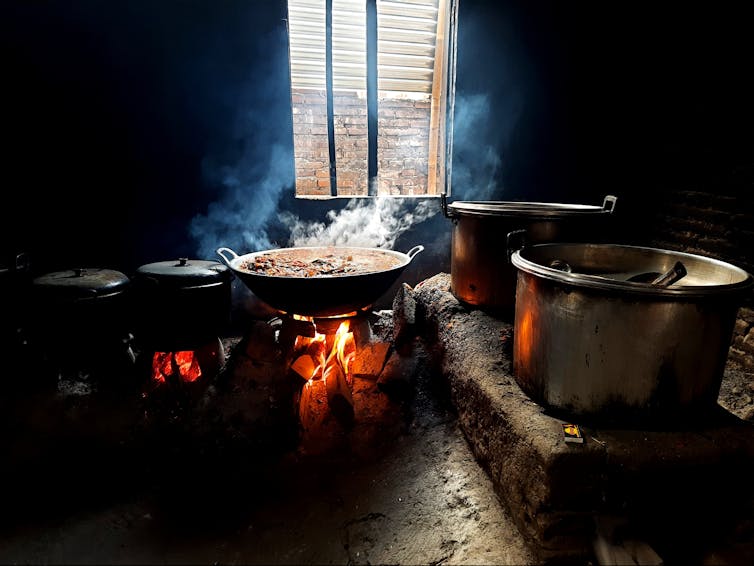
Kitchen with wood-fired stove creating white smoke
Millions of people are exposed to toxic cooking smoke.
RUKUN NIKU NAMIKULO/Shutterstock

Household air pollution is a major risk factor for chronic obstructive pulmonary disease, stroke, lower respiratory infections, lung cancer and ischaemic heart disease, which is also called coronary heart disease and occurs when the heart is starved of oxygen because its arteries have narrowed or become blocked. These health risks play out unevenly across the world, and the global patterns in our data underline that unevenness.

Wealthier regions have seen sustained declines in exposure. Global data sets that track access to clean and modern energy show that households in higher income countries now rely far less on polluting stoves than they did in the past. Yet many parts of sub-Saharan Africa and south Asia remain heavily dependent on polluting fuels. Clean options such as liquefied petroleum gas, electricity, ethanol, improved biomass stoves and biogas remain financially out of reach for many households.

But our research can inform investments in clean energy, help shape health policy and strengthen public understanding of the risks.

Governments and development partners can accelerate access to cleaner fuels by improving the infrastructure that delivers them, such as fuel storage, transport and local retail networks. They can also strengthen electricity systems so households have consistent power supplies that support electric cooking.

Subsidies can help lower the cost of clean fuels and stoves so families are not pushed back toward cheaper, more polluting options. Investment in locally appropriate technologies matters because stoves work best when they suit the foods people prepare, the pot sizes they use and the rhythms of daily life.

Health systems can improve diagnosis and treatment for chronic conditions linked to household air pollution, particularly in places where exposure remains high. Stronger data systems also matter, since many countries still lack reliable monitoring of pollution exposure. Without accurate data it is difficult to identify communities at highest risk, measure progress or plan effective interventions.

Community engagement is central to lasting progress. Uptake improves when stoves fit local cooking styles, meet household preferences and are introduced through trusted local groups rather than imposed from outside. People are more likely to try and keep using a new stove when it comes from sources they know and when it aligns with their everyday routines.

Although household air pollution may be perceived as a personal or domestic issue, its effects extend far beyond the home. Clean cooking is not only a sustainability or climate topic. It is a matter of health equity. Clean cooking is not simply about replacing a stove or fuel type. It is about protecting health, expanding opportunity and giving every child the chance to grow up in an environment that does not silently harm them.

Reducing smoke in homes means fewer chronic illnesses, fewer premature deaths and a stronger foundation for global health. If progress slows, the burden will continue to fall most heavily on the places least able to bear it.

The Conversation

Vikram Niranjan does not work for, consult, own shares in or receive funding from any company or organisation that would benefit from this article, and has disclosed no relevant affiliations beyond their academic appointment.

ref. Toxic air in the home is a global health emergency – https://theconversation.com/toxic-air-in-the-home-is-a-global-health-emergency-270863

La consommation d’alcool chez les hommes nuit aux femmes et aux enfants

Source: The Conversation – in French – By Leane Ramsoomar, Public health researcher, South African Medical Research Council

On sait que la consommation d’alcool est dangereuse pour la santé. Mais ses effets ne s’arrêtent pas là. Par exemple, les hommes subissent plus de conséquences liées à leur propre consommation que les femmmes. Ils sont plus touchés par l’agressivité, les accidents et les blessures. Mais lorsqu’un homme boit, les femmes et les enfants qui lui sont proches en paient souvent le prix également.

Je fais partie d’un groupe mondial de chercheurs en santé qui s’est attelé à étudier comment et dans quelle mesure la consommation d’alcool des hommes nuit aux femmes et aux enfants.

Notre étude récente s’appuie sur trois grandes revues de la littérature sur le sujet. Elle porte des résultats obtenus à partir d’études menées dans des pays riches, pauvres et à revenu intermédiaire. Celles-ci portaient sur les préjudices causés aux femmes, aux enfants et aux options politiques visant à réduire la consommation nocive d’alcool chez les hommes. Les analyses ont porté sur 49 études et 11 analyses couvrant la période 1990-2023.

Nous avons synthétisé les données afin d’éclairer les politiques publiques, les pratiques et les futures recherches. Nos résultats suggèrent des pistes de changement systémique et d’amélioration de la santé et du bien-être des femmes et des enfants dans le monde.

Ce que nous avons découvert

Les trois études révèlent que les hommes boivent plus que les femmes. Sous l’effet de l’alcool, ils adoptent parfois des comportements nocifs : agressivité, violence, tension dans la famille, contrôle du partenaire et la coercition sexuelle. Ils s’absentent aussi souvent du foyer pour aller boire et ne mettent pas toujours les besoins des femmes et des enfants en priorité. Quand les hommes dépensent l’argent du ménage pour l’alcool, il n’en reste pas assez pour la nourriture, les frais scolaires ou les médicaments. Cela nuit directement aux femmes et aux enfants.

Les femmes interrogées rapportent les actes de violence et d’agression liés à l’alcool. Il s’agit notamment de coups de poing, de coups de pied, des brûlures et des passage à tabac.

Mais les effets de la consommation d’alcool des hommes ne sont pas toujours visibles. Beaucoup de femmes parlent de préjudices cachés subis avec un partenaire alcoolique : l’embarras, la honte, l’isolement pour éviter les humiliations en public et le sentiment de solitude lié au fait d’avoir un partenaire alcoolique. Ce stress peut conduire à la dépression, à l’insomnie, voire à des pensées suicidaires.

Une femme a déclaré :

Je déteste vraiment ce que l’alcool lui fait. On se dispute à la maison. Ensuite, il débarque ivre à mon travail et exige qu’on parle de notre dispute sur place. Il m’humilie devant mes collègues.

Une autre a dit :

Je ressens une sorte de réaction traumatique lorsque les gens boivent trop autour de moi. Donc je ne fréquente pas beaucoup ce milieu.

Les enfants sont également touchés

Lorsque les hommes boivent de l’alcool, cela peut avoir directement ou indirectement des conséquences préjudiciables aux enfants. Les hommes peuvent mettre en danger la sécurité et le bien-être de leurs enfants en les exposant à leur propre violence, soit comme cibles, soit comme témoins.

Des recherches ont montré que lorsque les enfants grandissent dans des foyers où règne la violence, ils courent le risque de subir toute une série de conséquences négatives. On peut en citer de mauvais résultats scolaires, une faible estime de soi et le fait que les enfants deviennent eux-mêmes auteurs ou victimes de violence. Lorsqu’il y a des disputes à la maison, les enfants deviennent des victimes actives ou silencieuses.

Les études examinées montrent que la consommation d’alcool chez les hommes peut également conduire à la négligence et à la maltraitance des enfants. Les enfants dont les pères boivent beaucoup peuvent ne pas se sentir aussi proches d’eux sur le plan émotionnel, car ils ont peur de leurs pères lorsqu’ils sont ivres. L’alcool peut créer des conflits dans le foyer, dont un désengagement des responsabilités par ou une distanciation progressive.

La consommation d’alcool est souvent considérée comme une question privée, mais elle est influencée par de nombreux facteurs au niveau de la société, de la communauté et du foyer.

Par exemple, les lois et les politiques en matière d’alcool ont une incidence sur la disponibilité de l’alcool, le nombre de points de vente d’alcool dans les quartiers et l’âge approprié pour acheter de l’alcool. La consommation d’alcool a un impact sur le bien-être et la sécurité dans les foyers, les communautés et la société.

Nous avons constaté que les femmes et les enfants des pays pauvres sont les plus touchés par les effets de la consommation d’alcool des hommes, car ils disposent de moins de ressources. De plus, dans ces sociétés, il est plus souvent considéré comme normal que les hommes boivent ou abusent des femmes, comparé aux pays plus riches.

Que peut-on faire pour y remédier ?

Les gouvernements et les autorités sanitaires se concentrent principalement sur la réduction des risques encourus par les buveurs eux-mêmes. Par conséquent, les politiques, les programmes et les services mis en place sont centrés sur l’individu.

Bien que les recherches montrent que les buveurs peuvent être aidés grâce à des programmes de soutien par les pairs comme les Alcooliques Anonymes, ou par un accompagnement psychologique individuel incluant des interventions brèves, ces programmes doivent s’inscrire dans un environnement social et politique qui encourage un changement positif et tient compte des questions de genre.

Notre étude a révélé que les politiques et les programmes doivent tenir compte des préjudices par les autres, en particulier les femmes et les enfants. Une façon d’y parvenir consiste à associer les interventions en matière d’alcoolisme à des interventions communautaires axées sur les préjudices qui touchent spécifiquement les femmes et les enfants. Une première étape utile consiste à concevoir des interventions qui sensibilisent à l’abus d’alcool en tant que problème de santé publique touchant de manière disproportionnée les femmes et les enfants. Il faut combiner ces actions avec avec des programmes de traitement et de dépistage dans les établissements de soins primaires.

On peut aussi instaurer des « zones sèches » où la consommation d’alcool est interdite. Ces zones peuvent couvrir un quartier, une ville ou une région. Mais généralement les restrictions et les interdictions de vente d’alcool ne concernent que les espaces publics comme les parcs et abords des routes.

Les gouvernements du monde entier doivent donner la priorité aux politiques en matière d’alcool qui se sont avérées efficaces et rentables :

  • réduire la disponibilité et l’accessibilité financière de l’alcool

  • garantir qu’il ne soit pas vendu à des personnes n’ayant pas l’âge légal pour consommer de l’alcool

  • limiter l’exposition des enfants à la commercialisation et la publicité de l’alcool.

Cependant, les gouvernements doivent aller plus loin en tenant compte des effets de l’alcool et ses méfaits sur les femmes et les enfants. Les politiques de lutte contre l’alcool ne peuvent pas être séparées des questions de genre et de pouvoir qui, dans de nombreuses sociétés, contribuent à ses méfaits.

The Conversation

Leane Ramsoomar reçoit un financement du Conseil sud-africain de la recherche médicale.

ref. La consommation d’alcool chez les hommes nuit aux femmes et aux enfants – https://theconversation.com/la-consommation-dalcool-chez-les-hommes-nuit-aux-femmes-et-aux-enfants-271410

Trains de nuit : une relance peut cacher une pause

Source: The Conversation – in French – By Guillaume Carrouet, Maître de conférences en Géographie, Université de Perpignan Via Domitia

Alors que le train connaît un engouement depuis la fin du Covid-19, les difficultés pèsent sur certains segments du secteur ferroviaire, comme le train de nuit. Le (re)déploiement de ce service populaire et bas carbone est contraint par une pluralité de facteurs.


Que ce soit à l’international ou à l’échelle de la France, la relance du train de nuit se fait attendre au regard de ce qu’annonçait le gouvernement au sortir de la crise du Covid-19. Si le contexte semble favorable avec près de 114 milliards de voyageurs-kilomètre et une hausse de 6 % par rapport à 2023 et de 14 % par rapport à 2019, l’un des parents pauvres du secteur ferroviaire de voyageurs semble être le train de nuit.

Alors que le rapport additionnel à la LOM prévoyait une colonne vertébrale, avec un réseau structurant composé d’une dizaine de lignes, la situation à la fin de 2025 n’est pourtant pas flamboyante. En France métropolitaine, la ligne Paris-Aurillac, ouverte en 2023, est la dernière en date d’un plan de relance ligne par ligne (Paris-Tarbes-Lourdes, Paris-Nice), initié il y a quelques années par l’État.


À lire aussi :
Le retour des trains de nuit se fait-il sur de bons rails ?


Le bilan de la relance des dessertes de nuit en Europe est plus négatif, du moins vu depuisla France. Si l’Autriche, par l’intermédiaire de son champion ÖBB, est le fer de lance des lignes européennes depuis quelques années déjà, les liaisons internationales au départ ou à destination de la France peinent à être relancées. Quand elles ne disparaissent pas purement et simplement.

Un exemple du renouveau des lignes internationales

Le cas récent des lignes Paris-Berlin et Paris-Vienne mises en place en décembre 2023 et qui seront arrêtée le 14 décembre prochain, est particulièrement éclairant sur les contraintes fortes qui viennent contrarier la relance du train de nuit à l’échelle européenne. cette réouverture était pourtant présentée comme l’exemple du renouveau des lignes internationales de nuit, notamment suite à l’arrêt en 2021 d’une autre ligne Paris-Milan-Venise opérée par Thello, une entreprise née de l’entente entre Veolia et Trenitalia.

La ligne s’insèrerait pourtant très bien dans les objectifs européens de réduction des émissions de gaz à effet de serre, en sachant que le secteur des transports est le premier émetteur de CO2 en France. Le déploiement de l’usage du train, et du train de nuit en particulier, répond aux objectifs du Green Deal européen annoncé en 2019 avec l’objectif d’une neutralité carbone pour toute l’économie à l’horizon 2050. Pourtant, seulement 2 années plus tard, l’ensemble des partenaires du projet (ÖBB, Deutsche Bahn et SNCF) ont annoncé la fin du service, avec pour principale raison, l’arrêt de la subvention de l’État français.

Pas de compensation au retrait français

À l’origine, la participation de l’État était conditionnée à la mise en place d’une desserte quotidienne entre l’ensemble des villes avec un train comptant 12 wagons, avec séparation en 2 : 6 voitures pour Berlin et 6 pour Vienne. Face au constat de la mise de seulement 3 allers-retours par semaine, l’État français a décidé de suspendre la participation, ce qui a mécaniquement condamné la ligne, dans un contexte où les autres partenaires ne souhaitent pas compenser ce retrait.

Tout n’est pourtant pas perdu pour les lignes internationales de nuit puisque, devant cet échec, l’entreprise belgo-néerlandaise European sleeper constituée sous forme de coopérative a souhaité reprendre la ligne pour une ouverture prévue le 26 mars 2026. Détail non négligeable, l’opérateur, déjà présent sur le segment Bruxelles-Prague, ne bénéficierait pas de subvention publique pour le fonctionnement de la desserte.

Les difficultés d’une relance

À l’image du cas des lignes intérieures en France, cet exemple international souligne toutes les difficultés de relance d’un mode de transport alors qu’il répond à des enjeux de décarbonation du secteur. Cette expérience met en évidence le faisceau de contraintes qui pèsent sur le train de nuit. Elles ne se réduisent pas uniquement au caractère internationale de ce type de ligne, comme les changements de locomotives ou encore la planification des horaires pour plusieurs pays.

En effet, si le taux de remplissage de la ligne était jugé correct (près de 70 %), ce service et plus généralement l’ensemble des trains de nuit sont contraints par un déficit d’investissement dans le matériel roulant. En France, l’État a financé dans le cadre du Plan de relance, une rénovation du matériel, en particulier pour les trains de nuit, qui aujourd’hui a plus de 45 ans. Certaines compagnies, n’ayant pas le matériel en propre, se tournent vers la location notamment dans le cas des Rosco (Rolling Stock Company). Dans ce schéma, des entreprises achètent le matériel roulant et le louent aux compagnies. L’intérêt est de ne pas supporter des coûts d’investissements très importants avec une maintenance intégrée. Néanmoins, le bilan financier est moins intéressant sur l’ensemble de la durée de location.

C’est dans l’air France TV 2025.

À ces contraintes matérielles s’ajoute le pan financier inhérent au fonctionnement des lignes de nuit (équipage, contrôleur) et l’impossibilité de faire plusieurs rotations compte tenu de la longueur des parcours, comparativement à des TER, TGV et même par rapport à l’aérien. Ajoutons le coût du péage et l’utilisation du réseau la nuit qui coïncide avec les phases de travaux. Ces derniers ont eu un impact non négligeable sur les problèmes de ponctualité du Paris-Berlin et du Paris-Vienne.

Concurrence interne

Enfin, last but not least, le train de nuit souffre de la concurrence, y compris dans son propre segment. À titre d’exemple, on peut rappeler l’ouverture d’une liaison à grande vitesse en ICE (InterCity Express) Paris-Berlin direct, depuis décembre 2024, portée par un partenariat entre les opérateurs SNCF et Deutsche Bahn. Le trajet en ICE, c’est-à-dire à grande vitesse, s’effectue en 8 heures avec la desserte de quelques villes intermédiaires comme Strasbourg ou Karlsruhe.

Le train de nuit s’inscrit depuis plusieurs années dans un contexte de fortes incertitudes sur la pérennité de l’offre, du moins dans le cas de la France. Il semble en effet que la SNCF, par ses réticences, souffle le chaud et le froid. Simultanément, aucun opérateur ne semble être à l’heure actuelle en mesure de développer une offre propre, comme en témoigne l’expérience ratée de Midnight Trains pour des questions principalement financières.

The Conversation

Guillaume Carrouet ne travaille pas, ne conseille pas, ne possède pas de parts, ne reçoit pas de fonds d’une organisation qui pourrait tirer profit de cet article, et n’a déclaré aucune autre affiliation que son organisme de recherche.

ref. Trains de nuit : une relance peut cacher une pause – https://theconversation.com/trains-de-nuit-une-relance-peut-cacher-une-pause-271351

Internationally experienced teachers: An overlooked resource to address teaching shortages

Source: The Conversation – Canada – By Gloria Ramirez, Associate Professor of Education, Thompson Rivers University

The increasing teacher shortage is a concerning global crisis. It will reach a shortfall of 44,000,000 teachers by 2030, according to the United Nations Educational Scientific and Cultural Organization.

From rural and remote school districts struggling to recruit staff to urban districts scrambling to cover classrooms, the signs are everywhere: unfilled positions, growing reliance on uncertified substitutes and an overextended workforce.


Read more:
Solving teacher shortages depends on coming together around shared aspirations for children


Canada is no exception. Ontario anticipates a full-blown shortage in core areas like French immersion by 2027. In British Columbia, uncertified teachers filled an estimated 20 per cent of teaching positions in the Peace River South district during 2023–24.

Teacher shortages are concerning because study after study has shown teaching quality is the most important in-school factor for student learning and well-being.

Yet, as our research is examining, internationally educated and experienced teachers (IETs) remain sidelined, underemployed or forced into careers outside education.

Ten years ago, a report by the Council of Ministers of Education, Canada noted that
thousands of internationally educated teachers apply for certification in Canada each year.

In our ongoing study with IETs in the B.C. interior, and in our work there, we’ve seen that many IETs have masters degrees or PhDs.

Findings from a 2024 study conducted on behalf of B.C.’s Ministry of Education and Child Care revealed systemic barriers to certification in the province for internationally educated and experienced teachers, including long wait times, unclear application procedures and high costs. The study included more than 730 survey responses and numerous interviews.

Barriers to teaching

Many internationally experienced and educated teachers who participated in the B.C. ministry study expressed frustration. Some considered abandoning their goal of teaching in B.C. altogether.

Key obstacles included requirements such as completing a new practicum and taking additional coursework at Canadian universities. Many study participants perceived these additional requirements as redundant and exclusionary given their prior qualifications and professional experience.

This begs the question, why are highly qualified IETs less able to secure teaching jobs in Canadian public schools?

Canadian teaching standards

The argument made by Canadian credentialing bodies is that their processes are in place to protect Canadian professional teaching standards. No one would argue with the importance of maintaining high standards, particularly in an education system highly regarded around the world, with students ranking comparatively highly on international tests.

One could argue that underneath the surface, these reasons mask unconscious biases that few are willing to recognize and acknowledge. Some researchers have said IETs are viewed as inexperienced, insufficiently attuned to local contexts or suspect. Their education systems are often seen as less rigorous and their professional identities as somehow inferior. There have been calls to use a more personal approach to better assess their qualifications.

The demographics of internationally educated and experienced teachers mirror the diversity of Canadian classrooms. Despite diverse Canadian classrooms, the teaching workforce remains predominantly white. The systemic distrust for internationally educated and experienced teachers comes at a steep price.

Students lose out on the diversity of perspectives and the cultural wealth these professionals bring. Schools miss out on teachers fluent in multiple languages, familiar with global education and research — and ways of teaching experienced in contexts of migration, displacement and resilience.

Ongoing research

Our ongoing study examines the experiences of 11 IETs who are participating in an orientation to Canadian kindergarten to Grade 12 education course and learning in K-12 classrooms in an interior city of B.C.

Early data from interviews with these study participants, teacher mentors and district administrators confirms the benefits of integrating IETs into our classrooms. Students in K-12 respond positively to seeing a teacher in the classroom who looks like them.

Many of the IETs participating in our study have moved from large metropolitan areas in their country of origin. Their ability to move from cities such as Shanghai, Manila, Jakarta, Delhi, Tokyo — with recorded populations of well over 25 million — to a small semi-rural urban centre of less than 100,000 people shows great adaptability.

While the adjustment requires a reorienting of thinking, these IETs do adjust, demonstrating adaptability. They come to love the open space and access to nature that Canada offers. They also value the sense of community found in small cities.

They want to stay. They are willing to relocate to stay. They need to work, and they want to be teachers. They just need an opportunity to demonstrate skills.

Extensive prior experience, resilience

One factor fuelling Canada’s teacher shortage is burnout. Many leave the profession within just a few years, citing overwhelming workloads, lack of support and mental health strain.

Around 25 to 75 per cent of Canadian teachers report experiencing moderate to severe burnout, with high emotional exhaustion affecting up to three quarters of teachers in some provinces.

Against this backdrop, IETs represent a formidable, yet under-tapped, resource. These educators have already demonstrated resilience. Many have taught in environments with class sizes of 50 or more, managed demanding schedules with little institutional support and thrived where resources are scarce.

Learning curve is expected for many teachers

The concern that internationally educated teachers lack Canadian classroom experience is no different from the learning curve faced by novice teachers educated in Canada.

Findings from the 2021-22 British Columbia New Teachers Survey reveal that many new B.C.-trained teachers begin their careers feeling under-prepared for essential aspects of teaching — from managing diverse learning needs to handling workload pressures and classroom complexity.

In contrast, IETs often bring extensive prior experience and resilience.

Fear from employers

The fear — often unspoken — is that recognizing their qualifications would mean lowering standards. But this argument has no validity.

The B.C. Teacher Regulation Branch (TRB) currently grants internationally certified teachers temporary teaching permits, typically valid for three years. But rather than assessing these teachers’ suitability based on demonstrated classroom performance during that period, the TRB requires them to complete multiple additional university courses before obtaining a full B.C. teaching certificate.

The best way to understand existing school systems is to work in them — to teach, to interact with students and colleagues, to participate in the daily life of a school.

By denying internationally trained teachers this route, B.C. undermines its own educational philosophy.

If Canada is serious about addressing the teacher shortage, it must take immediate steps to dismantle credentialing barriers for IETs. Canada cannot afford to let bias stand in the way of solutions. Internationally educated and experienced teachers are not a problem to be fixed — they are part of the solution for a system under strain.

The Conversation

Gloria Ramirez receives funding from The Social Sciences and Research Council of Canada

Victoria Handford and Wei Lin Ang do not work for, consult, own shares in or receive funding from any company or organisation that would benefit from this article, and have disclosed no relevant affiliations beyond their academic appointment.

ref. Internationally experienced teachers: An overlooked resource to address teaching shortages – https://theconversation.com/internationally-experienced-teachers-an-overlooked-resource-to-address-teaching-shortages-267171

War of words between China and Japan is fuelling real tension in the Asia-Pacific region

Source: The Conversation – Canada – By Kuan-Wei Chen, Researcher, Air and Space Law, McGill University; Bond University

In a now deleted social media post, the Consul General of the People’s Republic of China to the Japanese city of Osaka recently threatened to “cut off” Japanese Prime Minister Sanae Takaichi’s “filthy head.”

This graphic threat was in response to Takaichi’s suggestion that Japan’s Self-Defense Forces may exercise the right of collective self-defence and become involved in the event of a Chinese attack on Taiwan.

China has called on Takaichi to retract her “erroneous remarks.”

The Chinese outrage is apparently intensifying after Chinese military planes were accused of locking their radar on Japanese fighter jets near the Okinawa islands. China also imposed a ban on Japanese seafood imports.

China’s response has political and nationalistic undertones. China views Taiwan as an “inalienable part” of its territory, a reminder of the “century of humiliation” when the [island was ceded by Imperial China to Japan and became a Japanese colony in 1895].

A matter of history — and law

Even after the Second World War ended, sovereignty over Taiwan was never formally settled. China believes Taiwan must be “reunified” with the motherland, if necessary by force.

The number and intensity of Chinese military drills aimed at intimidating Taiwan have significantly increased in recent years. Chinese leader Xi Jinping has reportedly begun mobilizing the People’s Liberation Army for an invasion of Taiwan by 2027.

Taiwan’s status is complicated under international law. While it has a functioning government, population and defined territory — all necessary elements of statehood — much of the world does not officially recognize Taiwan as a state.

Most countries, including Canada and the United States, engage with Taiwan in a non-official capacity and simply “acknowledge” China’s insistence that Taiwan is part of China.

This respect paid to China is a matter of geopolitics and strategic ambiguity likely due to China’s global economic and political clout, and has little foundation in law.

International resolutions, declarations

China often asserts the 1943 Cairo Declaration as the legal basis for its claim over Taiwan. However, this unsigned media communiqué lacks legal force under international law, something pointed out by British Prime Minister Winston Churchill in 1955.

At the outbreak of the Korean War, U.S. President Harry Truman stated unequivocally that the “determination of the future status of (Taiwan) must await the restoration of security in the Pacific, a peace settlement with Japan or consideration by the United Nations.”

The 1951 Treaty of San Francisco, which ended the war between Japan and the Allied powers, is a legally binding treaty. While Japan renounced “all right, title and claim” to Taiwan, there was no mention of the People’s Republic of China — established only two years earlier — in terms of Taiwanese sovereignty.

The United Nations has never considered, let alone decided upon, the issue of sovereignty over Taiwan. China often cites the UN’s General Assembly Resolution 2758 in 1971 as another legal basis for its assertion of sovereignty over Taiwan. But that resolution only addresses the status of the People’s Republic of China as the legitimate representative of China and makes no mention of Taiwan.

The European Parliament and the parliaments of Australia, the Netherlands, as well as U.S. congress, have openly opposed China’s distortion of the UN resolution and attempts to exert undue influence over international organizations for political ends.

Japan-Taiwan proximity

Takaichi’s remarks are simply a reiteration of the late Japanese Prime Minister Shinzo Abe’s remarks that “a Taiwan emergency is a Japan emergency (台湾有事は日本有事).”

This is no surprise since, at their closest point, Japan and Taiwan are just over 100 kilometres apart. Japan’s deployment of anti-air missiles on the Okinawa prefecture’s Yonaguni Island and long-range anti-ship missiles at the mouth of the Miyako Strait are clearly aimed at countering a potential Chinese offensive.

The site of the largest American Air Force base in East Asia just a 90-minute flight from Taiwan, and is similarly already gearing up for a potential Chinese missile attack amid rising tensions.


Read more:
Why a row over military bases on Okinawa spells trouble for US-Japan relations


Taiwan itself is situated at the crossroads of vital maritime and aviation routes, and manufactures more than 70 per cent of the world’s microchips.

If China opts to blockade or attack Taiwan, it will severely impact the world economy since a fifth of global maritime trade, valued at $2.5 trillion, transits through the Taiwan Strait.

It’s in no one but China’s interests if the Chinese mount an attack, and certainly it’s not the will of the 23 million inhabitants of the independent island nation who enjoy some of the highest levels of political and civil liberties in the world.

The U.S. continues to bolster Taiwan’s defence to deter a Chinese attack since Taiwan’s security is pivotal to America’s strategic standing in the Asia-Pacific region and the world.

Global peace and security

With great power comes great responsibility, and this is true for all states. Threats of invasion, the use of force and non-peaceful means of settling disputes are all prohibited under international law. Undiplomatic rhetoric and distortions of history and the law is also detrimental to peace.

If Taiwan truly is a part of China, then there would be no need for an invasion or threats to “crush” any foreign interference. Through its wolf-warrior diplomacy and shows of force, China is in effect globalizing the Taiwan issue.

As the recent G7 statement states, the international community has “an interest in the preservation of peace and stability across the Taiwan Strait” as China’s military drills and threats of war jeopardize “global security and prosperity.”

In a world beset by conflict in the Middle East and an enduring war in Ukraine, tensions are again heating up in East Asia. Will cooler heads prevail?

The Conversation

Kuan-Wei Chen is the recipient of a Australian Government Research Training Program scholarship.

ref. War of words between China and Japan is fuelling real tension in the Asia-Pacific region – https://theconversation.com/war-of-words-between-china-and-japan-is-fuelling-real-tension-in-the-asia-pacific-region-270434